


Abstract
Even though hydrogen fuel cell vehicles are essential for decarbonization, getting consumers to accept them remains a tough issue. This research combines normative and cognitive theories to find out if environmental values actually take precedence over logical risk assessments. We analyzed data from 761 consumers in Türkiye, using the structural equation model and Hayes’ PROCESS Macro. The results show that, although environmental concerns strongly increased awareness (β = 0.80) and awareness lowered perceived risk (β = −0.34), perceived risk itself did not significantly predict purchase intention (β = 0.03, p > 0.05). Instead, decisions were motivated by a hope-based path: Concern → Awareness → Usefulness → Intention. We tentatively interpret this as Green Motivation Dominance, whereby environmentally motivated early adopters appear to prioritize environmental benefits over technical hazards; notably, perceived usefulness significantly predicted intention (β = 0.29), and the serial path Concern → Awareness → Usefulness → Intention was significant (effect = 0.25, 95% CI [0.17, 0.35]). This interpretation, however, warrants direct testing in future research. Thus, the main factor driving adoption is the presence of advantages, not the absence of risk. Therefore, policymakers should focus on maximizing benefits rather than just trying to reduce risks.
1. Introduction
Growing global climate change concerns, the need for sustainable energy sources, and the environmental and economic consequences of fossil fuel dependence require a global shift to clean energy technologies [1,2,3,4]. High-carbon sectors like road transport play a critical role in achieving environmental sustainability goals [5,6]. Decarbonizing the transportation sector can cut emissions, boost energy security, and reduce fossil fuel imports [1,2].
In this context, hydrogen energy (HE) emerges as a sustainable alternative to fossil fuels [4,7,8]. As a flexible energy carrier [1], hydrogen generates electricity and emits only water vapor when used in fuel cell vehicles (HFCVs) [6,9]. Compared to traditional EVs, HFCVs offer superior range and refueling times, making them suitable for intercity travel, heavy trucks, buses, maritime, and rail transport [2,5,6].
Although hydrogen technology offers environmental and economic benefits, public acceptance and consumer purchasing intentions limit its widespread use [7,9,10]. HFCV adoption is primarily hindered by high costs, limited refueling infrastructure, and perceived safety risks [9,10]. Specifically, concerns regarding the probability and severity of accidents during production, transport, and storage significantly impact public acceptance [11,12]. So, understanding consumer perceptions and intentions toward this emerging technology is vital for industry growth and policy formulation [13,14].
Previous studies on hydrogen-powered vehicle adoption have predominantly used cognitive-based frameworks such as the Technology Acceptance Model (TAM) or the Unified Theory of Acceptance and Use of Technology (UTAUT) [15,16]. While valuable, these models often overlook the complex interplay between rational cost–benefit analyses and normative values, particularly regarding safety concerns and environmental responsibility [17,18,19]. This oversight has led to inconsistent findings regarding the barriers to the hydrogen economy [17,20]. A comprehensive model integrating cognitive evaluations with value-based motivations for pro-environmental technologies remains empirically untested [18,21,22,23].
Theoretically, this study constructs a limited, value-informed acceptance model proposing that HFCV purchase intention extends beyond rational cost–benefit analysis [7,9,20,24] to include complex decision mechanisms driven by environmental values and social responsibility [7,14,21]. The model is tested in Türkiye, a developing economy and strategic energy market [1,25], to assess its generalizability across diverse socioeconomic contexts. Research on this topic in Türkiye is still in its early stages [7,14], making this study particularly significant for both local policymaking and the international literature.
The primary aim of this study is to analyze the interaction of cognitive and value-based factors that shape consumer purchase intentions toward HFCVs. Specifically, the study pursues the following concrete objectives:
- To evaluate the comparative weight of cognitive factors, such as perceived usefulness, versus normative factors, like environmental values, in shaping purchase intention.
- To identify the role of perceived risk as a parallel mediating mechanism—alongside perceived usefulness—and determine whether safety concerns offset the positive effects of hydrogen energy awareness.
- To test the robustness of the proposed VBN-informed, usefulness-focused acceptance model using Structural Equation Modeling (SEM) for structural validity and Hayes’ PROCESS Macro (Model 6) for mediation analysis.
- To propose actionable, evidence-based policy recommendations for automotive manufacturers and energy policymakers to overcome consumer resistance.
In pursuit of these objectives, this study introduces three key novel contributions to the literature:
- Theoretical Framing: Rather than claiming a full integration of TAM and VBN, this research advances a limited, VBN-informed and usefulness-focused acceptance model. It links a value-based antecedent—environmental and social concerns, consistent with VBN reasoning but not the full VBN causal chain—to the cognitive evaluations of usefulness and risk, allowing a simultaneous analysis of how technological utility and environmental values jointly shape consumer decisions.
- The Limited Role of Perceived Risk: The study shows that, in this early-adopter sample, strong perceived usefulness coexists with safety-related risk perceptions that do not significantly deter purchase intention, offering a nuanced, empirically grounded view of the limited role of perceived risk.
- Methodological Rigor: The study goes beyond simple direct effects by using the PROCESS macro (Model 6) to identify a mediating pathway, and assessing whether perceived risk operates as a psychological barrier within this pathway.
2. Conceptual Framework and Literature Review
2.1. Theoretical Background
2.1.1. Cognitive Approaches
The process by which individuals adopt a new technology is a subject of extensive research, particularly in the social sciences and information systems, and has been ongoing for many years. A significant portion of theoretical work in this area assumes that individuals base their decisions to use or reject technology on rational, cognitive processes [16,26]. The most fundamental and widely accepted of these approaches is the TAM, developed by Davis [27] in the context of information systems. TAM extends the Theory of Reasoned Action (TRA) from social psychology, which links behavioral intention to attitudes and perceptual norms [28]. Specifically, TAM explains technology adoption through two primary cognitive constructs:
Perceived Usefulness (PU): Defined as the degree to which a user believes that using a particular system will improve his or her job performance or quality of life [18,27,28]. This factor refers to one’s perception of how helpful technology will be in achieving one’s goals.
Perceived Ease of Use (PEOU): Defined as the degree to which a user believes that using a particular system will not be mentally or physically demanding [18,27,28]. This factor highlights how effortless the technology is to use.
According to TAM, an individual who believes that a technology is easy to use also tends to think that technology is useful, and these two beliefs create a positive attitude towards the technology and ultimately a high intention to adopt it [28]. Davis [27] removed the construct attitude from the final model to explain intention more simply. Following this parsimonious logic—and because HFCVs are not yet commercially available for use in the Turkish market, which precludes a meaningful assessment of ease of use—the present study focuses on perceived usefulness as the core cognitive evaluation and does not model perceived ease of use or attitude as separate constructs. However, in later extensions of the model, social factors such as subjective norm were reintroduced as an additional predictor of intention, particularly for compulsory use cases [28]. TAM has been widely applied to various technologies and different user contexts and has made a significant impact on the field with its strong explanatory power [16].
To synthesize the theoretical knowledge in the technology acceptance literature, Venkatesh et al. [28] developed the UTAUT. UTAUT integrates the core constructs of the TAM and other leading models to provide a more comprehensive and unified framework. This model explains an individual’s intention to use technology through four key factors. According to this framework, four key constructs determine the intention to use technology. Performance Expectancy is defined as the individual’s belief that using the system will increase job or task success, while Effort Expectancy refers to the belief that using the system will be easy. Beyond personal evaluations, the model includes Social Influence, defined as the perceived pressure from significant others, and Facilitating Conditions, reflecting the belief that adequate technical and organizational infrastructure exists to support usage.
These cognitive models offer a solid framework for analyzing purchase intentions, particularly for high-value, complex products like automobiles [29]. Indeed, many studies on HFCV adoption have adapted the core logic of TAM and UTAUT to their specific contexts [15,30]. Typically, these inquiries balance benefit dimensions—such as environmental and economic advantages—against barriers like high costs, infrastructure gaps, and safety concerns [7,9,16,18,23,26,31,32]. Collectively, this body of work highlights the central role of rational assessment in technology adoption decisions.
However, rational models often fail to capture deeper value-based motivations and ethical responsibility, especially for sustainability-focused technologies like HFCVs. Purely cognitive frameworks struggle to reflect the complex interplay of environmental values, social responsibility, and personal norms. For instance, Hienuki et al. [20] found that the environmental and socioeconomic benefits of fuel cell vehicles had little impact on the acceptability of hydrogen stations. This suggests that a rational assessment of benefits is insufficient to drive sustainable technology adoption. Similarly, studies like Bayrakdar Ateş and Çalık [7] indicate that cognitive models frequently overlook normative factors critical to adopting green technologies. Furthermore, Huan et al. [33] argue that treating perceived risk as a single construct fails to explain its complexity, highlighting the need for a multidimensional approach. These insights imply that HFCV purchase intentions stem not just from rational cost–benefit analysis but from a more complex decision-making mechanism. This underscores the need for research that integrates value-based motivations alongside cognitive variables, bridging the gap between what is analyzed and what is valued.
2.1.2. Value-Based Approaches
While cognitive and rational-based models explain technology adoption [27,28], they often fail to account for the fact that human behavior is not merely a cost–benefit analysis [7,20]. Deeper values, beliefs, and personal norms frequently shape decisions, particularly in ethical domains like sustainability [19,22]. This highlights the role of value- and norm-based theories in explaining pro-environmental behavior.
Stern et al.’s VBN Theory stands out as a prominent framework in this field [34,35]. Extending Schwartz’s Norm Activation Model (NAM), VBN Theory [34,36] postulates a causal chain driving pro-environmental behaviors [24,37]. This chain originates from stable personal values, specifically biospheric (concern for nature) and altruistic (concern for others) orientations [34,35,36,37].
These core values shape an individual’s general beliefs about the environment and the consequences of human actions [23,38]. These beliefs, in turn, activate a sense of personal moral obligation to act to protect the environment in a given situation, i.e., personal norms [36]. This sense of moral responsibility directs the individual towards concrete pro-environmental behaviors like recycling, saving energy, and buying green products [34,36].
Under VBN theory, purchasing eco-friendly products is both a rational choice and a moral act [39]. This framework posits that awareness of consequences and ascribed responsibility activate personal norms, leading to pro-environmental behaviors [36]. This value-based perspective validates the role of the Environmental and Social Concerns (ESC) construct as our model’s starting point. Aligning with VBN principles, ESC encompasses responsibility, the value of a clean environment, and climate concerns [9,23]. Indeed, existing literature confirms that environmental concerns positively influence consumer attitudes and purchase intentions for sustainable products [7,16,40,41,42].
Value- and norm-based approaches are essential for understanding the intent to adopt sustainable technologies. Numerous empirical studies confirm that environmentally conscious consumers consistently prefer sustainable products [16,25,29,39,40,42,43,44]. This motivation stems from intrinsic values and a sense of responsibility toward society and the environment [38]. For instance, Bayrakdar Ateş and Çalık [7] found that ESCs positively influence investment intentions in hydrogen energy, potentially prompting government incentives. Similarly, Gordon et al. [17] demonstrated that environmental awareness often overrides rational cost calculations, as consumers weigh social responsibility against economic returns. Sala et al. [9] also identified environmental attitudes as key predictors of hydrogen technology adoption. Furthermore, Waqas et al. [19] used the NAM to link responsibility attribution to sustainable transport uptake. Ultimately, these findings indicate that HFCV acceptance depends not only on practical benefits but also on alignment with the consumer’s value system and moral compass [5,40,45,46,47,48]. As the demand for clean energy grows [49], these value-based approaches significantly enrich our understanding of technology adoption.
Perceptions of social responsibility significantly shape intentions toward green investments [7]. Moreover, securing a low-carbon energy future hinges on social acceptance, positioning consumer attitudes as pivotal in technology acceptance management [17,50,51].
Preferences for eco-friendly products, responsibility for carbon reduction, and climate concerns are pivotal in driving the adoption of green technologies, particularly EVs [29,42]. Amidst the escalating demand for clean energy [25], these findings confirm that HFCV acceptance relies as much on the consumer’s moral compass as on the technology’s practical utility.
Value-based approaches influence cognitive processes as much as behavioral intentions. Individuals driven by environmental concern and moral responsibility actively seek solutions to align their actions with their values [33,52]. The perceived gravity of environmental issues heightens the motivation to acquire relevant knowledge. While information gaps breed uncertainty regarding next-generation energy technologies, informed awareness fosters positive intentions [14]. Thus, this ethical foundation serves as a critical precursor to shaping consumer awareness.
However, the literature also contains conflicting findings showing that the impact of value-based motivations on technology acceptance is not always consistent. For example, a study by Hienuki et al. [20] concluded that the environmental and socioeconomic benefits of fuel cell vehicles (FCVs) had little correlation with the acceptability of hydrogen stations. It can be observed that information does not always reduce risk perception; sometimes it increases it, as more information can reveal the true costs and potential dangers more clearly [33,53]. These conflicting findings suggest that the influence of individual and societal values on technology adoption may be more complex than that of rational cost–benefit analyses and direct perceptions of environmental benefits [20,41]. This situation highlights the need to examine more deeply not only the role of values, but also the mediating role of knowledge and awareness in these complex relationships. This would represent a significant step towards understanding the adoption of sustainable technology from a more holistic perspective.
2.1.3. The Mediating Role of Awareness
Cognitive/rational and value/norm-based approaches reveal the fundamental motivational sources influencing technology adoption. However, how the bridge between these two theoretical currents is built—that is, how individuals’ deep-seated values shape their rational evaluations—has generally received less attention in the literature [23,54]. In particular, it was emphasized that examining perceptions and attitudes is critical for the social acceptance of renewable energy technologies [55,56]. The scarcity of studies in the current literature that holistically address awareness of hydrogen energy or examine the relationships between different awareness structures using a conceptual model [50,54] points to this gap. This study proposes that awareness is the critical mechanism that fills this gap. In the technology adoption literature, awareness is addressed using concepts such as knowledge or familiarity, and generally refers to the mental schema an individual has regarding a technology [33,57,58,59]. To avoid conceptual ambiguity, the present study treats hydrogen energy awareness as issue awareness combined with subjective (self-assessed) knowledge—that is, an individual’s perceived familiarity with and understanding of the technology—rather than objective knowledge measured through factual testing. This subjective awareness, not objective expertise, is the proximal cognitive antecedent of the benefit and risk perceptions modeled here.
Awareness plays a critical mediating role, especially when it comes to complex and new technologies like HFCVs, for two main reasons. Firstly, awareness is directly related to an individual’s values and beliefs. Individuals with high environmental concerns and a sense of moral responsibility in this regard tend to be more receptive to information and solutions consistent with their values and actively seek out information on these topics [14,22,36,52]. The literature shows that personal, environmental, and social concerns trigger the search for information regarding next-generation energy technologies and indirectly influence adoption intentions for these technologies [33,60,61]. For example, individual environmental awareness and commitment to climate change have been shown to be associated with stronger perceptions of environmental benefits [17]. So, ESCs serve as a powerful motivational driver that drives individuals to become more aware of relevant technologies such as hydrogen energy [36,38]. Çalık and Bayraktar Ateş emphasized that awareness is a critical tool in the process of adopting new-generation energy technologies and that knowledge and awareness are the first and most important elements in society’s acceptance of a new technology [14]. It has also been noted that a lack of information increases uncertainty about next-generation energy technologies, while informed understanding and technological awareness enhance positive intentions [1,58].
Secondly, this level of awareness forms the basis of an individual’s rational evaluations of technology. The level of knowledge and familiarity with a technology directly influences how its potential benefits and risks are perceived [23,32,62]. This interaction can be explained as follows:
Impact on Perceived Benefits: For a consumer with low awareness of a technology, its benefits, such as the long range of HFCVs [7,15,41] or environmental advantages [54,63,64,65], may remain abstract and vague [14,66]. As awareness increases, these potential benefits become more tangible and understandable, which positively impacts the Perceived Benefit [9,14,17,23]. Commitment to renewable energy technologies has been associated with stronger perceptions of environmental benefits [17]. However, the literature also contains findings suggesting that this relationship is not always direct and positive [7,20]. Bayrakdar Ateş and Çalık [7] stated that experts explaining the returns and potential benefits of hydrogen energy did not have an additional effect on the investor, and that the relationship between perceived benefit and investment intention could even disappear when experts were involved in the process. This suggests that the way information influences the perception of utility may vary depending on the context or type of awareness (such as expert knowledge versus general public awareness). In general, perceiving the benefits of a technology forms the basis for positive attitudes and acceptance of that technology [23,32,62].
The impact of awareness on risk perception is more complex and presents a two-sided debate in the literature [30,67].
Risk Perception Reduction Aspect: On the one hand, increased information (awareness) reduces risk perception by addressing misconceptions and fears stemming from uncertainty about the technology. A lack of sufficient public information can lead to concerns about hydrogen energy. Indeed, Obenaus-Emler et al. [52] discuss how education and public awareness can contribute to obtaining a societal license for new technological developments.
Increasing Risk Awareness: On the other hand, a more informed consumer or expert having a better understanding of the real challenges and potential dangers of the technology can increase risk awareness [26]. This shows that more information can increase risk perception because it can reveal the true costs and potential dangers more clearly [7]. Huan et al. [33] also stated that the effect of accident awareness on risk perception is complex and that there is no significant effect on perceived threat in the accident-aware group.
Therefore, awareness is not a passive accumulation of knowledge, but an active cognitive construct that serves as a dynamic bridge between values and rational perceptions [23,33,52]. This theoretical framework supports the central argument of our study. We believe that the impact of environmental concerns on purchasing intention occurs not directly, but through a series of mediating processes that first raise awareness of hydrogen energy and then shape the perceptions of benefits and risks that this awareness entails. This mechanism is a critical step in understanding the adoption of sustainable technology from a more holistic perspective.
2.2. Hypotheses Development
2.2.1. Environmental Concern and Awareness
According to the basic principles of VBN theory, the deep environmental values and concerns that individuals possess actively shape not only their behavioral intentions but also their cognitive processes [34,36,37]. Individuals tend to pay more selective attention to information that is consistent with their sense of responsibility and to actively seek information on these topics [18]. This psychological mechanism, also called motivated cognition, reflects the individual’s motivation to find solutions that align with their intrinsic values [18,36]. Therefore, an individual with high levels of environmental and social anxiety is expected to have a strong motivation to address these concerns or to find pro-environmental solutions that align with these values [9,19].
This theoretical background remains widely relevant in the context of adopting sustainable energy technologies. The literature clearly shows that pro-environmental attitudes and environmental concerns encourage individuals to learn more and learn about green technologies [53,59]. When it comes to new, complex and less public technologies such as hydrogen energy, one of the main triggers for an individual’s interest and awareness of this issue is their sensitivity to current environmental problems and their expectation for solutions [1,13,23]. Individuals’ risk perceptions and general attitudes are also among the important cognitive factors that affect their interest in these new technologies and therefore their knowledge acquisition processes [12,33,62]. It is emphasized that knowledge and experience play a critical role in the public acceptance of HFCVs [20,41,44]. In this context, ESCs provide a starting point for an individual to assess whether hydrogen energy is a potential solution, which increases their awareness of the issue [7,14,23].
In line with the above theoretical discussion and literature findings, the first hypothesis of this study was formed as follows:
H1.
Environmental and Social Concerns significantly impact Hydrogen Energy Awareness.
2.2.2. The Dual Effect of Awareness on Usefulness and Risk
In the realms of consumer behavior and technology acceptance literature, it is widely acknowledged that individuals’ perceptions and attitudes toward an innovation are predicated upon their level of knowledge and awareness regarding that innovation [28,50,52]. It cannot be expected that a consumer with no knowledge or familiarity with a technology will evaluate or appreciate its potential benefits [7]. This is particularly pertinent for multicomponent technologies that are not yet fully understood by the public, such as HFCVs [52]. Indeed, potential advantages offered by these technologies—such as zero emissions [6,65], long driving range, rapid refueling [2,22], and contribution to national energy independence [4,46]—may not be fully perceptible at first glance without adequate knowledge and awareness.
The literature explicitly demonstrates that technological awareness is a fundamental antecedent shaping individuals’ perceived usefulness of that technology [9,20]. As the level of awareness increases, consumers are better equipped to translate the abstract promises of a technology into tangible personal and societal benefits [2,46,53]. Studies conducted by Bayrakdar Ates & Calik [7] and Calik & Bayrakdar Ates [14] empirically indicate that knowledge-based expertise and general awareness positively influence individuals’ perceived usefulness, which in turn affects their purchase or investment intentions. Specifically, as emphasized within the TAM framework, an individual who understands the function and advantages of a technology is naturally more likely to perceive it as useful [15,23,28].
In this context, it is posited that hydrogen energy awareness will enable individuals to evaluate the potential advantages of HFCVs in a more positive and concrete manner. Accordingly, the second hypothesis of the study is formulated as follows:
H2.
Hydrogen Energy Awareness has a significant effect on Perceived Usefulness.
In contrast to the straightforward positive influence of awareness on perceived usefulness, the impact of awareness on perceived risk represents a more complex and multifaceted debate within the technology acceptance literature [23,33,62]. The direction of this relationship can vary depending on the type of awareness, the consumer’s mode of information processing, and the nature of the technology itself [38].
According to the first perspective, increased awareness and knowledge serve to mitigate perceived risk [17,30]. This approach posits that uncertainty and lack of knowledge are primary sources of fear and anxiety [67]. When consumers lack sufficient information about a technology, they tend to fill these cognitive gaps with uncertainty or sensationalist narratives propagated by the media [55,68]. As awareness increases, individuals gain a clearer understanding of the technology’s safety protocols, regulations, and actual operational risks [31,69]. This can lead to the alleviation of unfounded fears and the perception of the technology as safer [20,67].
A second and opposing viewpoint suggests that increased awareness may, in certain instances, heighten perceived risk [9,23]. While a consumer with superficial knowledge might overlook potential dangers, a more informed individual is better positioned to comprehend the genuine challenges and inherent risks of the technology [31,70,71]. Possessing greater knowledge about issues such as hydrogen’s flammability and explosive nature [65], as well as high-pressure storage and transportation [31,71], can lead to a more conscious—and consequently higher—perception of risk. Indeed, some studies have demonstrated that increased knowledge at an expert level can negatively impact investment intention by raising awareness of the technology’s actual costs and difficulties [10,30,55].
These findings in the literature indicate the absence of a simple, unidirectional relationship between awareness and perceived risk [9,23,33,62]. On the one hand, there is a view advocating that awareness reduces risk by diminishing uncertainty [7,12,17,20,67]; on the other hand, there is the contention that it increases risk by revealing inherent challenges and dangers [31,65,70,71]. This study aims to empirically investigate and contribute to the clarification of this debate. Therefore, given the complex landscape of the literature, assigning a predetermined direction would be a premature theoretical judgment; thus, establishing a nondirectional hypothesis that tests the existence of the relationship without imposing a direction is the most rigorous and scientifically objective approach.
H3.
Hydrogen Energy Awareness significantly affects Perceived Risk.
2.2.3. Determinants of Purchase Intention
Perceived usefulness, the cornerstone of the TAM, is one of the strongest determinants of an individual’s intention to use a new technology [15,18]. According to the theory, individuals adopt a technology to the extent that they believe it will enhance their quality of life, increase their efficiency at work, or facilitate the achievement of specific goals [27,32]. If a consumer does not anticipate that a product or technology will provide concrete benefits, they cannot be expected to develop a purchase intention toward that product [9,23].
This fundamental principle has been consistently validated in studies regarding the adoption of sustainable technologies such as HFCVs. The extent to which consumers perceive the advantages offered by HFCVs—including environmental benefits [4,47], functional benefits [2], and economic benefits [10,72]—is directly correlated with positive attitudes and purchase intentions toward these vehicles. In a study by Liu and Wu [36] integrating VBN and TAM theories, it was empirically demonstrated that perceived usefulness has a statistically significant and strong positive effect on the intention to use green packaging. Similarly, research specific to hydrogen vehicles indicates that potential users’ perceived usefulness is one of the most critical predictors of their purchase intentions [7,15,20,32].
In light of these findings, it is expected that consumers who perceive the multidimensional benefits (environmental, economic, technological) of HFCVs at a higher level will exhibit a stronger intention to purchase these vehicles. Accordingly, the fourth hypothesis of the study is formulated as follows:
H4.
Perceived Usefulness has a positive and significant effect on Purchase Intention.
In the consumer behavior literature, while perceived usefulness plays an incentivizing role in adopting a technology, perceived risk exerts the exact opposite effect [7,17]. When evaluating a new product or technology, consumers weigh potential benefits against possible losses and uncertainties [32]. The higher the perceived risk, the lower the probability of adopting a technology [72]. This risk perception possesses a multidimensional structure, particularly for technologies that require high investment [5] and have not yet fully permeated society, such as HFCVs [50]. These dimensions include financial risks [5,17,43], safety risks [11,42,54,69,71], performance/technological risks [21,66] and infrastructural risks [25,41,48,59,73,74].
There is substantial evidence in the literature indicating that each of these risk dimensions negatively affects purchase intention toward sustainable transportation technologies. A comprehensive review by Scovell [23] emphasizes that when explaining the social acceptance of hydrogen technologies, perceived risk is one of the most significant factors negatively influencing this acceptance. Empirical studies demonstrate that factors such as the high initial costs, potential safety concerns, and limited refueling infrastructure of HFCVs induce hesitation in consumers and significantly reduce their purchase intentions [7,25,65,72]. When consumers perceive that a technology could pose a potential threat to themselves or their families, or that they may not receive a return on their investment, they tend to avoid that technology [10,54,65].
In this regard, it is expected that consumers who perceive the risks associated with HFCVs at a higher level will exhibit a lower intention to purchase these vehicles. Based on this premise, the fifth hypothesis of the study is formulated as follows:
H5.
Perceived Risk has a negative and significant effect on Purchase Intention.
2.2.4. Mediation Mechanism
The hypotheses developed in the preceding sections (H1-H5) established the theoretical foundation for the individual relationships between the core constructs of our study. However, the central premise of this research is that these relationships do not operate in isolation but rather function as a sequential causal chain. Our model proposes that the effect of Environmental and Social Concerns on Purchase Intention is not direct; instead, it is transmitted indirectly, through Hydrogen Energy Awareness, which in turn shapes two parallel cognitive evaluations—Perceived Usefulness and Perceived Risk—that jointly influence Purchase Intention. The serial mediation hypothesis (H6) formalizes this chain specifically for the usefulness pathway.
The first mediation path operates through a positive expectation framework. According to our theoretical framework, higher Environmental and Social Concerns will elevate an individual’s Hydrogen Energy Awareness (H1); this increased awareness will clarify the potential advantages of HFCVs, thereby enhancing Perceived Usefulness (H2); and this heightened perception of usefulness will positively influence Purchase Intention (H4). To test the existence of this sequential effect, our sixth hypothesis is formulated as follows:
H6.
Hydrogen Energy Awareness and Perceived Usefulness serially mediate the relationship between Environmental & Social Concerns and Purchase Intention.
Testing this mediation hypothesis is anticipated to make a significant contribution to the literature by enabling us to understand not merely the relationships between variables, but also the underlying psychological processes and mechanisms driving these relationships.
2.3. Research Model
Based on the theoretical framework and the hypotheses developed above, the conceptual model of the study is proposed. As illustrated in Figure 1, the model posits that environmental and social concerns serve as the antecedent variable, influencing hydrogen energy awareness. Subsequently, this awareness affects purchase intention through two parallel mediators—perceived usefulness and perceived risk—with the serial indirect pathway (H6) operating through perceived usefulness.
Figure 1.
The Proposed Research Model.
3. Methodology
3.1. Sampling and Data Collection
This study adopts a quantitative research approach to investigate the factors shaping consumers’ purchase intentions toward HFCVs and the complex interrelationships among these factors. The theoretical framework of the study is grounded in a correlational research design, which facilitates the testing of cause-and-effect relationships. Data were collected utilizing an online survey technique to access a broad participant base and expedite the data collection process.
The population of the study comprises individuals living in Türkiye’s three largest metropolises—Istanbul, Ankara, and Izmir—who are active vehicle users. These cities were selected as they represent the primary target regions for the potential HFCV market and infrastructure investments. Due to the large size of the population and the difficulty in accessing a complete sampling frame, convenience sampling, a non-probability sampling method, was employed. The survey was disseminated to potential participants through social media platforms and digital channels. Following data cleaning procedures, 761 valid survey forms were retained for analysis. This sample size meets the minimum sample size criteria (n > 300) recommended in the literature for Structural Equation Modeling analyses [75].
3.2. Measures
A structured questionnaire consisting of two sections was employed as the data collection instrument. The first section comprises 8 items designed to ascertain the participants’ demographic characteristics (gender, age, education, occupation, etc.) and their general tendencies regarding technology and the environment.
The second section utilizes scales adapted from the literature to measure the constructs within the research model. All items were rated using a 5-point Likert-type scale ranging from 1 = Strongly Disagree to 5 = Strongly Agree. The structures of the scales are as follows:
- Perceived Usefulness: 8 items were used to measure the advantages provided by HFCVs, adapted from Yildiz et al. [76] and Loengbudnark et al. [26].
- Perceived Risk: 8 items were employed to measure the perception regarding the potential dangers and uncertainties of the technology, based on scales by Chen et al. [77], Huan et al. [33], and Loengbudnark et al. [26].
- Purchase Intention: 7 items were utilized to determine consumers’ willingness to purchase HFCVs, adapted from Norazahar et al. [78].
- Environmental and Social Concerns: 6 items were used to measure individuals’ sensitivities toward the environment and society, drawn from Norazahar et al. [78].
- Hydrogen Energy Awareness: Initially, a 14-item pool was prepared based on Bayrakdar Ates and Calik [1] and Huan et al. [33] to measure participants’ level of knowledge and awareness regarding the subject (during the analysis, 6 of the initial 14 items were removed because their factor loadings fell below the 0.50 criterion and/or they cross-loaded on other factors, yielding a final 8-item scale; the full item pool and the retained items are reported in Appendix A).
3.3. Data Analysis Strategy
The analysis of the collected data was conducted using a two-stage approach utilizing the SPSS 23 and AMOS 23 statistical software packages.
In the First Stage (Validation of the Measurement Model), Exploratory Factor Analysis (EFA) was initially conducted to test the construct validity of the dataset. Subsequently, Confirmatory Factor Analysis (CFA) was performed to verify the accuracy of the obtained factor structure. Cronbach’s Alpha coefficients were examined to determine scale reliability, while Average Variance Extracted (AVE) and Composite Reliability (CR) values were calculated to assess convergent validity. Additionally, Pearson correlation analysis was conducted to observe the direction and strength of the relationships between variables.
In the Second Stage (Structural Model and Hypothesis Testing), SEM was employed to test the research hypotheses. The model’s goodness-of-fit indices (χ2/df, GFI, CFI, TLI, RMSEA, SRMR) were evaluated based on acceptance criteria in the literature. Furthermore, Hayes’ PROCESS Macro extension (Model 6) was utilized to test the serial mediation effect (H6) in a more detailed and robust manner.
4. Results
4.1. Sample Characteristics
Data belonging to 761 valid participants obtained from the survey conducted within the scope of the study were analyzed following data cleaning procedures. The detailed distribution regarding the demographic characteristics of the participants is presented in Table 1.
Table 1.
Demographic Characteristics and Descriptive Statistics of Participants (n = 761).
An examination of the sample structure reveals a balanced gender distribution (52.7% female, 47.3% male). Regarding age groups, the majority of participants (66.2%) fall within the 18–35 age range, followed by the 36–55 age group at 26.4%. This indicates that the sample is predominantly composed of a young and dynamic population.
In terms of education level, it is noteworthy that a significant portion of participants (73.3%) holds undergraduate or graduate degrees. The concentration of students (48%) and public/private sector employees in the occupational distribution suggests that the sample represents an educated and socio-economically active cohort. Furthermore, the fact that 91.2% of participants reside in metropolitan areas and city centers aligns with the target regions where HFCV infrastructure is planned to be established initially.
Regarding the sample’s attitudes toward technology and the environment, it was determined that 72.9% actively follow technological innovations and 66.9% tend to prefer environmental products. These findings demonstrate that the study group fits the early-adopter profile, characterized by a high potential for adopting innovative and eco-friendly technologies such as hydrogen energy.
4.2. Measurement Model Assessment
A two-stage approach was adopted to test the construct validity of the research model. Initially, Exploratory Factor Analysis (EFA) was applied to examine the factor structure of the dataset. The analysis yielded a Kaiser–Meyer–Olkin (KMO) value of 0.950, and the Bartlett’s Test of Sphericity result was found to be significant (p < 0.001). These values indicate that the data are suitable for factor analysis at an excellent level.
Confirmatory Factor Analysis (CFA) was conducted using AMOS software to verify the obtained factor structure. Upon examination of the goodness-of-fit indices of the measurement model, it was observed that the model fits the data quite well (χ2/df = 2.749; CFI = 0.943; TLI = 0.937; RMSEA = 0.048; SRMR = 0.046). All factor loadings are statistically significant, supporting the construct validity of the model. Because the exploratory and confirmatory analyses were conducted on the same sample, the measurement structure should be regarded as internally validated rather than cross-validated; replication on an independent sample is a recommended direction for future research.
Cronbach’s Alpha, Composite Reliability (CR), and Average Variance Extracted (AVE) values were calculated to evaluate the reliability and validity of the scales (Table 2).
Table 2.
Measurement Model: Reliability and Validity Analysis Results.
Reliability: Cronbach’s Alpha values for all scales range between 0.87 and 0.93. These values are well above the 0.70 threshold, indicating that the scales possess high internal consistency.
Convergent Validity: CR values for all constructs are above 0.70. With the exception of Perceived Risk, AVE values for all constructs exceed 0.50. Although the AVE value for the Perceived Risk construct (0.46) is slightly below the threshold, convergent validity is considered established due to its high CR value (0.87) [79]. Nevertheless, this below-threshold AVE should be interpreted with caution: perceived risk is a conceptually multidimensional construct—spanning financial, safety, performance, and infrastructure facets—and collapsing these facets into a single first-order factor likely attenuates the average variance extracted. We therefore treat the perceived-risk measure as sufficiently reliable but acknowledge its modest convergent validity as a measurement limitation (see Section 7.2).
Correlation analysis was performed to determine the direction and strength of the relationships between the variables (Table 3). The results indicate that, as expected, there are negative and significant relationships between Perceived Risk and the other variables (Intention, Usefulness, Awareness). Conversely, positive and significant relationships were observed among Intention, Perceived Usefulness, Environmental Concern, and Awareness. The finding that these correlation coefficients are lower than the square roots of the AVE values further supports discriminant validity, confirming that the constructs are distinct from one another. This clear discriminant structure also bears on the question of common-method bias: although a formal common-method test was not reported, the well-fitting multi-factor solution and the distinctness of the constructs are inconsistent with a single dominant method factor. Furthermore, because common-method variance tends to inflate observed associations, it cannot readily account for the non-significant risk–intention path; we nonetheless acknowledge the single-source, cross-sectional design as a limitation that future studies should address through procedural and statistical remedies such as temporal separation or marker variables.
Table 3.
Correlation Analysis and Discriminant Validity (Fornell–Larcker Criterion).
4.3. Structural Model Results
The structural equation model constructed to test the research hypotheses is presented in Figure 2. The goodness-of-fit indices of the model indicate that the proposed structure exhibits a good fit with the data.
Figure 2.
Structural Equation Model with Standardized Path Coefficients. (Note: *** p < 0.001, n.s.: not supported).
The standardized path coefficients (β) and significance levels on the model are summarized in Table 4. The analysis results reveal that ESCs have a very strong and positive effect on HEA (β = 0.80, p < 0.001), thereby supporting H1.
Table 4.
Structural Equation Model with Standardized Path Coefficients.
When examining the impact of awareness (HEA) on outcome variables, it was observed that awareness strongly enhances PU (β = 0.77, p < 0.001) and significantly reduces PR (β = −0.34, p < 0.001). With these findings, H2 and H3 are accepted.
Regarding the determinants of PI, PU has a positive and significant effect on intention (β = 0.29, p < 0.001); thus, H4 is supported. However, the effect of PR on purchase intention was not found to be statistically significant (β = 0.03, p > 0.05). As seen in Figure 2, the path coefficient from the risk factor to intention is negligible. Therefore, H5 is rejected.
Additionally, it was observed in the model that HEA has a direct positive effect on PI (β = 0.34, p < 0.001).
4.4. Mediation Analysis
To test the sequential relationships and mediation mechanism (H6) within the research model, the PROCESS Macro (Model 6) developed by Hayes [80] was utilized. The analyses were based on 5000 bootstrap samples and a 95% confidence interval (CI).
The analysis results are summarized in Table 5. As seen in the table, the indirect effect of the path Environmental & Social Concerns → Awareness → Perceived Usefulness → Purchase Intention, tested for hypothesis H6, is statistically significant (Effect = 0.2542). Since the lower and upper confidence interval values (BootLLCI = 0.1663; BootULCI = 0.3534) do not contain zero, this mediation effect is confirmed. This finding demonstrates that consumers’ environmental concerns translate into purchase intention through the chain of awareness and perceived usefulness.
Table 5.
Mediation Analysis Results (PROCESS Model 6).
4.5. Supplementary Analyses: Relative Importance, Sensitivity, Moderation, and Subgroup Robustness
To further probe the relative contributions of the cognitive and value-based predictors of purchase intention—and to test the proposed Green Motivation mechanism—we conducted three supplementary analyses, following the relative-importance and variance-based sensitivity approach advocated by Owais et al. [81].
First, a relative-importance analysis (LMG variance decomposition) was performed for the regression of purchase intention on the four predictors (Table 6). Hydrogen energy awareness (45.5%) and perceived usefulness (39.7%) jointly accounted for roughly 85% of the explained variance, environmental and social concerns for 13.2%, and perceived risk for only 1.7% (95% bootstrap CI [0.6, 5.3]).
Table 6.
Relative importance (LMG) and variance-based sensitivity (random forest) of the predictors of purchase intention.
Second, a variance-based sensitivity analysis using a random-forest model (1000 trees) corroborated this ranking: perceived risk was the least influential of the four constructs (permutation importance, %IncMSE: awareness 69.3, usefulness 68.4, concerns 57.9, risk 38.3; Table 6).
Third, a moderation analysis tested whether environmental and social concerns alter the effect of perceived risk on intention (Table 7). The risk × concern interaction was significant and positive (β = 0.08, p = 0.001): as environmental concern increased, the deterrent effect of perceived risk weakened further. Consistently, in a median split, perceived risk did not significantly predict intention in either the low- (β = −0.03, p = 0.52) or high-concern subgroup (β = +0.01, p = 0.79), whereas perceived usefulness remained a strong predictor in both (β = 0.51 and β = 0.37, both p < 0.001).
Table 7.
Moderation analysis: purchase intention regressed on standardized perceived risk, environmental and social concerns, and their interaction.
Finally, to verify that these patterns are not an artifact of the sample’s demographic profile, the model was re-estimated within demographic subgroups (Table 8). Perceived usefulness remained a strong, significant predictor of purchase intention in every subgroup (standardized β = 0.25–0.35, all p < 0.01), whereas perceived risk was not a significant deterrent in any subgroup. The benefit-over-risk pattern is therefore robust to the sample’s skew toward younger, more educated, and more technologically engaged respondents.
Table 8.
Robustness across respondent subgroups.
Taken together, these analyses indicate that perceived risk contributes negligibly to purchase intention relative to usefulness and awareness, and that environmental concern further attenuates its already minimal deterrent role—empirical support for the Green Motivation Dominance pattern is interpreted below.
5. Discussion
This study investigated the mechanisms shaping consumers’ purchase intentions for HFCVs in Türkiye’s developing hydrogen energy market through a model integrating value-based and cognitive factors. The findings revealed results that not only support established assumptions in the literature but also uncover a striking paradox regarding the role of risk perception, thereby opening a new avenue for discussion.
5.1. Values Triggering Cognitive Processes
It was determined that Environmental and Social Concerns, the starting point of the study, strongly trigger consumers’ Hydrogen Energy Awareness (H1). This finding empirically validates the phenomenon of motivated cognition, discussed in the literature within the context of VBN theory. The thesis proposed by Stern [35] and Liu and Wu [36], suggesting that individuals engage in more active information seeking regarding issues that align with their intrinsic values, is supported in our study. In other words, an individual concerned about the environment does not remain a passive observer; rather, they exert active mental effort to learn about solutions (such as hydrogen technology) capable of alleviating this concern [33,52].
5.2. The Dual Role of Knowledge
Our model demonstrates that while increased awareness enhances Perceived Usefulness (H2), it significantly reduces Perceived Risk (H3). This result takes a clear stance in the ongoing debate in the literature regarding the following question: does knowledge increase risk or does ignorance? While some researchers [30,31] argue that as technical knowledge increases, individuals might better grasp the explosive nature of hydrogen and thus raise their risk perceptions, our findings align with the views of Hienuki et al. [20] and Buchner et al. [67]. In the Turkish context, knowledge minimizes the fear factor by eliminating uncertainty and fosters consumer trust in the technology. As consumers become familiar with the technology, safety and infrastructure concerns give way to expectations of tangible benefits.
5.3. Green Motivation Dominance and the Limited Role of Perceived Risk
The study’s most striking findings—the strong effect of Perceived Usefulness (H4) and the non-significant effect of Perceived Risk (H5)—constitute the primary theoretical contribution of this paper when evaluated together. At the same time, this non-significant risk coefficient should not be interpreted solely as substantive risk tolerance; it may partly reflect measurement factors, as perceived risk was modeled as a single, conceptually multidimensional construct with modest convergent validity (AVE = 0.46), which can attenuate its observed structural effect. Moreover, the difference between the significant usefulness path and the non-significant risk path was not formally tested; the present interpretation therefore rests on the individual significance of each path rather than on a statistical comparison of their magnitudes.
First, Perceived Usefulness was found to be one of the strongest direct determinants of purchase intention (H4). This finding aligns with the fundamental axiom of Davis’s [27] TAM: people adopt what is useful to them. It also supports the view of Ansari et al. [15] and Hou & Wang [32] that, in HFCV acceptance, concrete functional advantages such as long range, fast refueling, and technological superiority are decisive alongside environmental benefits. Consumers act with the motive of benefit maximization rather than risk avoidance when making decisions.
This strong pull factor helps explain a central finding of the study. While many studies, such as Scovell [23] and Bhirowo et al. [72], emphasize high cost and safety concerns as the biggest barriers to HFCV acceptance, this barrier did not significantly shape intentions in our sample. We interpret this pattern as Green Motivation Dominance. Consistent with this account, the supplementary analyses (Section 4.5) show that perceived risk contributes negligibly to purchase intention relative to usefulness and awareness, and that environmental concern significantly attenuates the deterrent role of risk (risk × concern interaction, β = 0.08, p = 0.001). While these analyses support the proposed pattern, the underlying motivational mechanism is inferred from cross-sectional data and warrants confirmation through longitudinal and experimental designs. This dominance further advances the thesis of Gordon et al. [17], which suggests that strong environmental commitment overshadows financial concerns. Strong environmental values and the resulting high awareness in consumers simultaneously elevate the value of technological superiority and functional utility (H4) while raising the threshold for tolerating risks.
5.4. The Trajectory of the Decision-Making Mechanism
Finally, the mediation analysis (H6) revealed that the consumer’s decision-making process is shaped by hope and benefit rather than fear. Environmental concerns are transformed into intention through awareness and the chain of benefits. This confirms the view emphasized by Ansari et al. [15] and Hou & Wang [32]—that perceived usefulness is far more decisive than perceived risk in HFCV acceptance.
6. Implications
This study presents significant implications for both academic literature and industry practices based on the empirical findings obtained.
6.1. Theoretical Contributions
Our study provides original contributions to the sustainable technology acceptance literature in three main points:
Green Motivation Dominance and the Limited Role of Risk: It was observed in our study that PU is one of the strongest direct determinants of purchase intention (H4) and possesses a statistically high level of significance. This finding not only coincides with the fundamental axiom of Davis [27] but also indicates that consumers demand HFCVs not only because they are environmentally friendly but also because they offer tangible superiorities such as long range, fast refueling, and technological innovation. As also stated by Ansari et al. [15] and Hou & Wang [32], consumers in the hydrogen vehicle equation are motivated by the attraction factor rather than the fear factor.
In this context, the fact that PR has a non-significant effect on purchase intention (H5) should be examined together with this strong role of Perceived Usefulness. Green Motivation Dominance, defined in our study, is ensured not only by strong environmental values overshadowing risk concerns (H3) but also by the functional benefit maximization triggered by this motivation. In other words, consumers appear to weight gain-seeking (usefulness) far more heavily than loss-avoidance (risk)—a pattern directly supported by the relative-importance and moderation analyses reported in Section 4.5. This supports the power of commitment to overcome technical concerns put forward by Gordon et al. [17] in a multifaceted way against the deterrent effect of risk emphasized by Scovell [23] in the literature.
Proving the Mediation Mechanism: The study revealed that the transformation of environmental concerns into intention occurs not directly but through the Awareness → Usefulness chain (H6). This result underscores the value of VBN-informed acceptance models that link value-based antecedents to cognitive evaluations, rather than treating value-based and cognitive perspectives in isolation. Environmental values alone are not sufficient; these values need to be transformed into cognitive awareness and subsequently into a concrete perception of usefulness, as also pointed out by Calik and Bayrakdar Ates [14].
The Dual Function of Awareness: It has been shown that awareness simultaneously increases usefulness and decreases risk, but the main determinant of intention is usefulness increase, not risk decrease. This turns the needle clearly to the usefulness side in the debate regarding risk reduction strategies versus usefulness emphasis in the literature [15,32]. For the Turkish consumer, the determinant is the presence of usefulness, not the absence of fear.
6.2. Managerial and Policy Implications
The strategic roadmap for policymakers and automotive manufacturers managing the transition process to hydrogen energy is as follows:
Our findings indicate that consumers focus on benefits rather than risks. Therefore, marketing communications should avoid defensive language regarding safety assurances. Instead, superior advantages such as long range, fast refueling, and zero emissions should be aggressively prioritized. This approach aligns with the benefits emphasized by Fan et al. [2] and Qian & Li [6]. A visionary and positive communication language will be much more effective than risk mitigation efforts. At the same time, because hydrogen-related safety incidents—though rare—tend to attract disproportionate media attention, manufacturers and policymakers should proactively prepare transparent, fact-based risk-communication and crisis-response protocols. Embedding credible safety information within a benefit-led narrative, rather than leading with defensive reassurance, preserves the positive framing while protecting public trust against isolated adverse events.
Cognitive Transformation through Education: The key point in the transformation of environmental concern into intention is awareness. As suggested by Obenaus-Emler et al. [52], not only advertisements but also interactive societal learning programs, science centers, and test drives should explain what hydrogen technology is. As knowledge increases, the perception of usefulness in consumers’ minds will automatically rise, and as seen in our H3 finding, risk perception will spontaneously diminish.
Target Audience, Focusing on Green Pioneers: The current consumer profile (young, educated, environmentalist) points to an audience whose strong environmental motivation appears to outweigh risk concerns. Initial launch and market entry strategies should be constructed upon these green pioneers, as stated in the typology of Gordon et al. [17], rather than the general public. This audience will serve as a lever in the diffusion of the technology to society and create social proof.
7. Conclusions and Future Directions
7.1. Conclusions
This study analyzed the adoption process of HFCVs, which possess critical importance in line with Türkiye’s decarbonization goals, through the chain of Environmental Concern → Awareness → Perceived Usefulness/Risk → Intention. Empirically, environmental and social concerns strongly predicted awareness (β = 0.80), which in turn raised perceived usefulness (β = 0.77) and reduced perceived risk (β = −0.34); perceived usefulness significantly predicted purchase intention (β = 0.29), whereas perceived risk did not (β = 0.03, p > 0.05), and the serial indirect path was significant (effect = 0.25, 95% CI [0.17, 0.35]).
The obtained results revealed that consumers’ purchase intention is driven by normative environmental values and benefit expectations rather than rational risk calculations. Although awareness regarding hydrogen energy was effective in reducing consumers’ risk perception, it was observed that this risk perception was not a determinant in the final decision. This situation indicates that society holds a high level of trust toward HFCV technology and that environmental motivations appear strong enough to tolerate technological uncertainties in this early-adopter sample. In summary, for potential users in the Turkish market, hydrogen is positioned not as a feared unknown but as a desired solution to environmental problems.
7.2. Limitations of the Study and Future Studies
The findings of this study should be evaluated within the framework of certain limitations.
Sampling Limitation: Data were collected via the convenience sampling method and online channels. The fact that participants’ education levels and interest in technology are above the general average of Türkiye suggests that the results reflect an early-adopter audience rather than the general public. It is recommended that future studies be conducted with stratified samples that are more heterogeneous and cover rural areas as well. In addition, because participation was voluntary and the subject matter was salient, respondents already favorably disposed toward hydrogen technology may have been more inclined to participate (self-selection); this, combined with the exclusive reliance on self-reported measures, may inflate the observed associations. As a direct check, the model was re-estimated within demographic subgroups (Section 4.5, Table 8): the dominance of perceived usefulness and the negligible role of perceived risk replicated across age, education, gender, and technological-engagement groups, indicating that the findings are not driven by the sample’s profile. Future research should nonetheless complement convenience samples with probability-based or stratified designs and, where feasible, with stated-preference or discrete-choice experiments that reduce self-selection and social-desirability biases. Combining such designs with machine-learning models and global sensitivity analysis would further test the robustness and relative importance of predictors across heterogeneous respondent profiles [81]. The findings should therefore be interpreted as characterizing environmentally engaged early adopters rather than the general population.
Cross-sectional Data: The study has a cross-sectional design where data were collected within a specific timeframe. Longitudinal studies are needed to monitor how consumer perceptions change over time. Accordingly, although the structural model is specified directionally on theoretical grounds, cross-sectional data establish association rather than causation; the causal language used throughout should therefore be read as theoretically motivated rather than empirically proven, and the proposed pathways require confirmation through longitudinal or experimental designs.
Intention–Behavior Gap: The study measured consumers’ intentions, yet it is known that intention does not always translate into purchase behavior. In future periods, when HFCVs become widespread in the market, conducting behavioral studies based on actual sales data would make a significant contribution to the literature.
Construct scope: This study operationalizes a limited, VBN-informed and usefulness-focused acceptance model rather than a full integration of Value–Belief–Norm theory or the Technology Acceptance Model. Core VBN constructs—values, awareness of consequences, ascription of responsibility, and personal norms—and the TAM constructs of perceived ease of use and attitude were not measured. Incorporating these constructs is an important direction for future research.
Variable Scope: Factors such as cost and infrastructure were addressed in the model as a general structure under the umbrella of Perceived Risk. Future research incorporating specific variables such as price sensitivity or station access distance into the model separately could explain in greater detail why risk perception emerged as non-significant. Although the proposed Green Motivation Dominance pattern is now supported by relative-importance, sensitivity, and moderation analyses (Section 4.5), its motivational interpretation remains inferential given the cross-sectional design and should be confirmed through longitudinal or experimental work.
Author Contributions
Conceptualization, B.Y., Ş.Ç., S.K. and D.N.K.; methodology, B.Y. and Ş.Ç.; software, B.Y.; validation, Ş.Ç.; formal analysis, S.K.; investigation, D.N.K.; resources, Ş.Ç., and S.K.; data curation, B.Y.; writing—original draft preparation, B.Y. and Ş.Ç.; writing—review and editing, S.K. and D.N.K.; visualization, B.Y.; supervision, B.Y., Ş.Ç. and S.K. All authors have read and agreed to the published version of the manuscript.
Funding
This research received no external funding.
Institutional Review Board Statement
The study was conducted in accordance with the Higher Education Council (YÖK) Scientific Research and Publication Ethics Guidelines in Türkiye, and approved by the Ethics Committee of Gaziantep University on 7 April 2025 (Approval Code: 4).
Informed Consent Statement
Informed consent was obtained from all subjects involved in the study.
Data Availability Statement
The original contributions presented in this study are included in the article. Further inquiries can be directed to the corresponding author.
Conflicts of Interest
The authors declare no conflicts of interest.
Abbreviations
The following abbreviations are used in this manuscript:
| HFCV | Hydrogen Fuel Cell Vehicle |
| TAM | Technology Acceptance Model |
| VBN | Value–Belief–Norm Theory |
| UTAUT | Unified Theory of Acceptance and Use of Technology |
| HE | Hydrogen Energy |
| SEM | Structural Equation Modeling |
| PU | Perceived Usefulness |
| PEOU | Perceived Ease of Use |
| AVE | Average Variance Extracted |
| CR | Composite Reliability |
| SRMR | Standardized Root Mean Square Residual |
Appendix A
Table A1.
Scale Items. Please answer using the following scale: 1 = Strongly disagree, 2 = Disagree, 3 = Somewhat agree, 4 = Agree, 5 = Strongly agree.
References
- Bayrakdar Ates, E.; Calik, E. Public awareness of hydrogen energy: A comprehensive evaluation based on statistical approach. Int. J. Hydrogen Energy 2023, 48, 8756–8767. [Google Scholar] [CrossRef] [Scilit]
- Fan, L.; Tu, Z.; Chan, S.H. Recent development of hydrogen and fuel cell technologies: A review. Energy Rep. 2021, 7, 8421–8446. [Google Scholar] [CrossRef] [Scilit]
- Feng, R.; Xu, J.; Zhao, Z.; Dan, Y.; He, J.; Gu, C.; Shu, X.; Xia, X.; Yang, L.; Shen, L. Comparative Analysis of Energy Flow Characteristics in a Battery-Electric Heavy-Duty Tractor-Trailer between Standard and User Driving Test Cycles. Energy 2026, 355, 141217. [Google Scholar] [CrossRef] [Scilit]
- Veziroğlu, T.N.; Şahin, S. 21st Century’s energy: Hydrogen energy system. Energy Convers. Manag. 2008, 49, 1820–1831. [Google Scholar] [CrossRef] [Scilit]
- François, A.; Roche, R.; Grondin, D.; Winckel, N.; Benne, M. Investigating the use of hydrogen and battery electric vehicles for public transport: A technical, economical and environmental assessment. Appl. Energy 2024, 375, 124143. [Google Scholar] [CrossRef] [Scilit]
- Qian, S.; Li, L. A Comparison of Well-to-Wheels Energy Use and Emissions of Hydrogen Fuel Cell, Electric, LNG, and Diesel-Powered Logistics Vehicles in China. Energies 2023, 16, 5101. [Google Scholar] [CrossRef] [Scilit]
- Bayrakdar Ates, E.; Calik, E. Revealing factors influencing hydrogen energy investments using PLS-SEM. Int. J. Hydrogen Energy 2025, 98, 230–241. [Google Scholar] [CrossRef] [Scilit]
- Visvanathan, V.K.; Palaniswamy, K.; Ponnaiyan, D.; Chandran, M.; Kumaresan, T.; Ramasamy, J.; Sundaram, S. Fuel Cell Products for Sustainable Transportation and Stationary Power Generation: Review on Market Perspective. Energies 2023, 16, 2748. [Google Scholar] [CrossRef] [Scilit]
- Sala, R.; Gonçalves, L.; Huan, N.; Sato, H.; Yamamoto, T.; Haohui, Y.; Tzioutzios, D.; Navarro, J.-B. Public acceptance of hydrogen technologies and hydrogen refuelling stations in Spain. Int. J. Hydrogen Energy 2025, 142, 752–763. [Google Scholar] [CrossRef] [Scilit]
- Ye, T.; Zhao, S.; Lau, C.K.M.; Chau, F. Social media sentiment of hydrogen fuel cell vehicles in China: Evidence from artificial intelligence algorithms. Energy Econ. 2024, 133, 107564. [Google Scholar] [CrossRef] [Scilit]
- Ricci, M.; Newsholme, G.; Bellaby, P.; Flynn, R. The transition to hydrogen-based energy: Combining technology and risk assessments and lay perspectives. Int. J. Energy Sect. Manag. 2007, 1, 34–50. [Google Scholar] [CrossRef] [Scilit]
- Sun, D.; Guo, D.; Xie, D. Using Multicriteria Decision Making to Evaluate the Risk of Hydrogen Energy Storage and Transportation in Cities. Sustainability 2023, 15, 1088. [Google Scholar] [CrossRef] [Scilit]
- Calik, E.; Bayrakdar Ates, E. Developing an assessment scale for public awareness of hydrogen energy. Sustain. Energy Technol. Assess. 2023, 56, 103057. [Google Scholar] [CrossRef] [Scilit]
- Calik, E.; Bayrakdar Ates, E. Exploring the relationships and importance among constructs of hydrogen energy awareness: A PLS-SEM approach. Int. J. Hydrogen Energy 2024, 96, 244–254. [Google Scholar] [CrossRef] [Scilit]
- Ansari, Y.; Bansal, R.; Kumar Kar, S. An empirical analysis of Saudi Arabian women’s intentions to adopt hydrogen fuel cell cars. Transp. Res. Interdiscip. Perspect. 2024, 28, 101269. [Google Scholar] [CrossRef] [Scilit]
- Harichandan, S.; Kar, S.K. An empirical study on consumer attitude and perception towards adoption of hydrogen fuel cell vehicles in India: Policy implications for stakeholders. Energy Policy 2023, 178, 113587. [Google Scholar] [CrossRef] [Scilit]
- Gordon, J.A.; Balta-Ozkan, N.; Nabavi, S.A. Exploring the contours of consumer heterogeneity: Towards a typology of domestic hydrogen acceptance. Energy Res. Soc. Sci. 2024, 108, 103401. [Google Scholar] [CrossRef] [Scilit]
- Wang, J.-W.; Li, J. Risk-benefit perceptions and public acceptance of hydrogen e-bikes. Int. J. Hydrogen Energy 2025, 100, 905–914. [Google Scholar] [CrossRef] [Scilit]
- Waqas, M.; Dong, Q.; Ahmad, N.; Zhu, Y.; Nadeem, M. Understanding Acceptability towards Sustainable Transportation Behavior: A Case Study of China. Sustainability 2018, 10, 3686. [Google Scholar] [CrossRef] [Scilit]
- Hienuki, S.; Hirayama, Y.; Shibutani, T.; Sakamoto, J.; Nakayama, J.; Miyake, A. How Knowledge about or Experience with Hydrogen Fueling Stations Improves Their Public Acceptance. Sustainability 2019, 11, 6339. [Google Scholar] [CrossRef] [Scilit]
- Jalil, M.F.; Marikan, D.A.B.A.; Jais, M.B.; Arip, M.A.B. Kickstart manufacturing SMEs’ go green journey: A green hydrogen acceptance framework to enhance low carbon emissions through green digital technologies. Int. J. Hydrogen Energy 2025, 105, 592–610. [Google Scholar] [CrossRef] [Scilit]
- Liu, Y.; Li, Z.; Huang, X.; Liu, F.; Zhou, F.; Lim, M.K. Uncovering determinants and barriers to hydrogen fuel cell vehicle adoption: Evidence from Chongqing, China. Int. J. Hydrogen Energy 2025, 106, 875–887. [Google Scholar] [CrossRef] [Scilit]
- Scovell, M.D. Explaining hydrogen energy technology acceptance: A critical review. Int. J. Hydrogen Energy 2022, 47, 10441–10459. [Google Scholar] [CrossRef] [Scilit]
- Harichandan, S.; Kar, S.K. An empirical study on motivation to adopt hydrogen fuel cell vehicles in India: Policy implications for stakeholders. J. Clean. Prod. 2023, 408, 137198. [Google Scholar] [CrossRef] [Scilit]
- Apak, S.; Atay, E.; Tuncer, G. Renewable hydrogen energy and energy efficiency in Turkey in the 21st century. Int. J. Hydrogen Energy 2017, 42, 2446–2452. [Google Scholar] [CrossRef] [Scilit]
- Loengbudnark, W.; Khalilpour, K.; Bharathy, G.; Taghikhah, F.; Voinov, A. Battery and hydrogen-based electric vehicle adoption: A survey of Australian consumers perspective. Case Stud. Transp. Policy 2022, 10, 2451–2463. [Google Scholar] [CrossRef] [Scilit]
- Davis, F.D. Perceived Usefulness, Perceived Ease of Use, and User Acceptance of Information Technology. MIS Q. 1989, 13, 319–340. [Google Scholar] [CrossRef] [Scilit] [PubMed]
- Venkatesh, V.; Morris, M.G.; Davis, G.B.; Davis, F.D. User Acceptance of Information Technology: Toward a Unified View. MIS Q. 2003, 27, 425–478. [Google Scholar] [CrossRef] [Scilit]
- Eccarius, T.; Lu, C.-C. Powered two-wheelers for sustainable mobility: A review of consumer adoption of electric motorcycles. Int. J. Sustain. Transp. 2020, 14, 215–231. [Google Scholar] [CrossRef] [Scilit]
- Min, M.; Yoon, C.; Yoo, N.; Kim, J.; Yoon, Y.; Jung, S. Hydrogen Risk Assessment Studies: A Review Toward Environmental Sustainability. Energies 2025, 18, 229. [Google Scholar] [CrossRef] [Scilit]
- Calabrese, M.; Portarapillo, M.; Di Nardo, A.; Venezia, V.; Turco, M.; Luciani, G.; Di Benedetto, A. Hydrogen Safety Challenges: A Comprehensive Review on Production, Storage, Transport, Utilization, and CFD-Based Consequence and Risk Assessment. Energies 2024, 17, 1350. [Google Scholar] [CrossRef] [Scilit]
- Hou, J.; Wang, H. Analysis of Corporate Acceptance of Hydrogen Energy Technology Based on the Extended Technology Acceptance Model. Energies 2025, 18, 1013. [Google Scholar] [CrossRef] [Scilit]
- Huan, N.; Yamamoto, T.; Sato, H.; Sala, R.; Goncalves, L. Perceptions to connections: A multidimensional investigation of hydrogen acceptance. Renew. Sustain. Energy Rev. 2024, 200, 114612. [Google Scholar] [CrossRef] [Scilit]
- Fornara, F.; Molinario, E.; Scopelliti, M.; Bonnes, M.; Bonaiuto, F.; Cicero, L.; Admiraal, J.; Beringer, A.; Dedeurwaerdere, T.; de Groot, W.; et al. The extended Value-Belief-Norm theory predicts committed action for nature and biodiversity in Europe. Environ. Impact Assess. Rev. 2020, 81, 106338. [Google Scholar] [CrossRef] [Scilit]
- Stern, P.C. A Value-Belief-Norm Theory of Support for Social Movements: The Case of Environmentalism. Hum. Ecol. Rev. 2000, 6, 81–97. [Google Scholar]
- Liu, C.; Wu, Y. The Impact of Value-Belief-Norm Theory and Technology Acceptance Model on Use Intention of Green Design Packaging. Int. J. Bus. Manag. 2020, 15, 158. [Google Scholar] [CrossRef] [Scilit]
- Schwartz, S.H. Normative Influences on Altruism. In Advances in Experimental Social Psychology; Academic Press: Cambridge, MA, USA, 1977; Volume 10, pp. 221–279. [Google Scholar] [CrossRef] [Scilit]
- Al-Amin, A.Q.; Ambrose, A.F.; Masud, M.M.; Azam, M.N. People purchase intention towards hydrogen fuel cell vehicles: An experiential enquiry in Malaysia. Int. J. Hydrogen Energy 2016, 41, 2117–2127. [Google Scholar] [CrossRef] [Scilit]
- Soomro, A.M.; Rathi, M.K.; Shaikh, A.; Kumar, L.; Assad, M.E.H.; Ehyaei, M. Techno-economic analysis of stand-alone hybrid PV-hydrogen-based plug-in electric vehicle charging station. Energy Rep. 2024, 12, 3279–3290. [Google Scholar] [CrossRef] [Scilit]
- Chen, Z.; Eri, Q.; Yang, L. Study on the comprehensive performance of a hybrid power system based on hydrogen-driven solid oxide fuel cells for green unmanned aerial vehicles. Energy Convers. Manag. 2025, 327, 119611. [Google Scholar] [CrossRef] [Scilit]
- Khan, U.; Yamamoto, T.; Sato, H. Understanding attitudes of hydrogen fuel-cell vehicle adopters in Japan. Int. J. Hydrogen Energy 2021, 46, 30698–30717. [Google Scholar] [CrossRef] [Scilit]
- Odoi-Yorke, F.; Agyekum, E.B.; Rashid, F.L.; Davis, J.E.; Togun, H. Trends and determinates of hydrogen energy acceptance, or adoption research: A review of two decades of research. Sustain. Energy Technol. Assess. 2025, 73, 104159. [Google Scholar] [CrossRef] [Scilit]
- Oladosu, T.L.; Pasupuleti, J.; Kiong, T.S.; Koh, S.P.J.; Yusaf, T. Energy management strategies, control systems, and artificial intelligence-based algorithms development for hydrogen fuel cell-powered vehicles: A review. Int. J. Hydrogen Energy 2024, 61, 1380–1404. [Google Scholar] [CrossRef] [Scilit]
- Tarigan, A.K.M.; Bayer, S.B. Temporal change analysis of public attitude, knowledge and acceptance of hydrogen vehicles in Greater Stavanger, 2006–2009. Renew. Sustain. Energy Rev. 2012, 16, 5535–5544. [Google Scholar] [CrossRef] [Scilit]
- Gueniat, F.; Maryam, S. A comprehensive and policy-oriented model of the hydrogen vehicle fleet composition, applied to the UK market. Environ. Syst. Decis. 2024, 44, 85–99. [Google Scholar] [CrossRef] [Scilit]
- Le, T.T.; Sharma, P.; Bora, B.J.; Tran, V.D.; Truong, T.H.; Le, H.C.; Nguyen, P.Q.P. Fueling the future: A comprehensive review of hydrogen energy systems and their challenges. Int. J. Hydrogen Energy 2024, 54, 791–816. [Google Scholar] [CrossRef] [Scilit]
- Momirlan, M.; Veziroglu, T.N. Current status of hydrogen energy. Renew. Sustain. Energy Rev. 2002, 6, 141–179. [Google Scholar] [CrossRef] [Scilit]
- Moreno-Benito, M.; Agnolucci, P.; Papageorgiou, L.G. Towards a sustainable hydrogen economy: Optimisation-based framework for hydrogen infrastructure development. Comput. Chem. Eng. 2017, 102, 110–127. [Google Scholar] [CrossRef] [Scilit]
- Zubairu, N.; Al Jabri, L.; Rejeb, A. A review of hydrogen energy in renewable energy supply chain finance. Discov. Sustain. 2025, 6, 186. [Google Scholar] [CrossRef] [Scilit]
- Emodi, N.V.; Lovell, H.; Levitt, C.; Franklin, E. A systematic literature review of societal acceptance and stakeholders’ perception of hydrogen technologies. Int. J. Hydrogen Energy 2021, 46, 30669–30697. [Google Scholar] [CrossRef] [Scilit]
- Notteboom, T.; Haralambides, H. Seaports as green hydrogen hubs: Advances, opportunities and challenges in Europe. Marit. Econ. Logist. 2023, 25, 1–27. [Google Scholar] [CrossRef] [Scilit]
- Obenaus-Emler, R.; Lehner, M.; Murphy, M.; Pacher, C. Educational Concept for Citizens’ Awareness Towards Technological Advancements for a Sustainable Society. BHM Berg-Hüttenmänn. Monatshefte 2021, 166, 314–322. [Google Scholar] [CrossRef] [Scilit]
- Molin, E. Causal Analysis of Hydrogen Acceptance. Transp. Res. Rec. 2005, 1941, 115–121. [Google Scholar] [CrossRef]
- Agyekum, E.B.; Odoi-Yorke, F.; Abdullah, M.; Chowdhury, P. Investigating the nexus between radiolysis using spent nuclear fuel and hydrogen production, with environmental safety considerations. Nucl. Eng. Des. 2025, 438, 114048. [Google Scholar] [CrossRef] [Scilit]
- Arlt, D.; Becker, M.; Wolling, J. Stability, change, formation: Insights into the media’s role in shaping attitudes toward green hydrogen in Germany. Int. J. Hydrogen Energy 2025, 97, 328–337. [Google Scholar] [CrossRef] [Scilit]
- Vallejos-Romero, A.; Cordoves-Sánchez, M.; Cisternas, C.; Sáez-Ardura, F.; Rodríguez, I.; Aledo, A.; Boso, Á.; Prades, J.; Álvarez, B. Green Hydrogen and Social Sciences: Issues, Problems, and Future Challenges. Sustainability 2022, 15, 303. [Google Scholar] [CrossRef] [Scilit]
- Flynn, R.; Ricci, M.; Bellaby, P. The Mirage of Citizen Engagement in Uncertain Science: Public attitudes towards hydrogen energy. Int. J. Sci. Educ. Part B 2011, 1, 97–114. [Google Scholar] [CrossRef] [Scilit]
- Schreiber, J.; Scherrer, A.; Breetz, H.L. Driving discussion: Media framing of electric, hydrogen, and conventional vehicles in German newspapers and Twitter. Energy Res. Soc. Sci. 2023, 103, 103193. [Google Scholar] [CrossRef] [Scilit]
- Yap, J.; McLellan, B. Evaluating the attitudes of Japanese society towards the hydrogen economy: A comparative study of recent and past community surveys. Int. J. Hydrogen Energy 2024, 54, 66–83. [Google Scholar] [CrossRef] [Scilit]
- Chen, M.; Zhang, W.-H. Purchase intention for hydrogen automobile among Chinese citizens: The influence of environmental concern and perceived social value. Int. J. Hydrogen Energy 2021, 46, 18000–18010. [Google Scholar] [CrossRef] [Scilit]
- Hassan, Q.; Azzawi, I.D.J.; Sameen, A.Z.; Salman, H.M. Hydrogen Fuel Cell Vehicles: Opportunities and Challenges. Sustainability 2023, 15, 11501. [Google Scholar] [CrossRef] [Scilit]
- Kar, S.K.; Bansal, R.; Harichandan, S. An empirical study on intention to use hydrogen fuel cell vehicles in India. Int. J. Hydrogen Energy 2022, 47, 19999–20015. [Google Scholar] [CrossRef] [Scilit]
- Turoń, K. Hydrogen-powered vehicles in urban transport systems–current state and development. Transp. Res. Procedia 2020, 45, 835–841. [Google Scholar] [CrossRef] [Scilit]
- Uyar, T.S.; Beşikci, D. Integration of hydrogen energy systems into renewable energy systems for better design of 100% renewable energy communities. Int. J. Hydrogen Energy 2017, 42, 2453–2456. [Google Scholar] [CrossRef] [Scilit]
- Yusaf, T.; Mahamude, A.S.F.; Kadirgama, K.; Ramasamy, D.; Farhana, K.; Dhahad, H.A.; Abu Talib, A.R. Sustainable hydrogen energy in aviation–A narrative review. Int. J. Hydrogen Energy 2024, 52, 1026–1045. [Google Scholar] [CrossRef] [Scilit]
- Ingaldi, M.; Klimecka-Tatar, D. People’s Attitude to Energy from Hydrogen—From the Point of View of Modern Energy Technologies and Social Responsibility. Energies 2020, 13, 6495. [Google Scholar] [CrossRef] [Scilit]
- Buchner, J.; Menrad, K.; Decker, T. Keep it local and safe: Which system of green hydrogen production in Germany is accepted by citizens? Renew. Energy 2025, 241, 122366. [Google Scholar] [CrossRef] [Scilit]
- Afanasiev, A.; Kandinskaia, O.; Eminidou, S.; Sousanis, A. Hydrogen Valley in Cyprus: Insights and Strategies for Citizen Engagement. Sustainability 2025, 17, 804. [Google Scholar] [CrossRef] [Scilit]
- Huan, N.; Yamamoto, T.; Sato, H.; Tzioutzios, D.; Yin, H.; Sala, R. Does accident awareness affect people’s risk perception of hydrogen infrastructure and information-seeking behaviour? Appl. Energy 2024, 364, 123141. [Google Scholar] [CrossRef] [Scilit]
- Hosseini, S.E.; Butler, B. An overview of development and challenges in hydrogen powered vehicles. Int. J. Green Energy 2020, 17, 13–37. [Google Scholar] [CrossRef] [Scilit]
- Lam, C.Y.; Fuse, M.; Shimizu, T. Assessment of risk factors and effects in hydrogen logistics incidents from a network modeling perspective. Int. J. Hydrogen Energy 2019, 44, 20572–20586. [Google Scholar] [CrossRef] [Scilit]
- Bhirowo, H.; Indrawati; Tambunan, H.B.; Aditya, I.A.; Giri, R.R.W.; Hakim, F.M.; Pakutandang, F.N. Analyzing the adoption of hybrid electric and hydrogen vehicles in Indonesia: A multi-criteria and total cost of ownership approach. Clean. Eng. Technol. 2025, 24, 100893. [Google Scholar] [CrossRef] [Scilit]
- Karayel, K.G.; Javani, N.; Dincer, I. A comprehensive assessment of energy storage options for green hydrogen. Energy Convers. Manag. 2023, 291, 117311. [Google Scholar] [CrossRef] [Scilit]
- Tao, Y.; Qiu, J.; Lai, S.; Sun, X. Coordinated Planning of Electricity and Hydrogen Networks with Hydrogen Supply Chain for Fuel Cell Electric Vehicles. IEEE Trans. Sustain. Energy 2023, 14, 1010–1023. [Google Scholar] [CrossRef] [Scilit]
- Hair, J.F.; Black, W.C.; Babin, B.J.; Anderson, R.E. Multivariate Data Analysis, 8th ed.; Cengage: Boston, MA, USA, 2019. [Google Scholar]
- Yildiz, B.; Çiğdem, Ş.; Meidutė-Kavaliauskienė, I. Sustainable mobility and electric vehicle adoption: A study on the impact of perceived benefits and risks. Transport 2024, 39, 129–145. [Google Scholar] [CrossRef] [Scilit]
- Chen, T.-Y.; Huang, D.-R.; Huang, A.Y.-J. An empirical study on the public perception and acceptance of hydrogen energy in Taiwan. Int. J. Green Energy 2016, 13, 1579–1584. [Google Scholar] [CrossRef] [Scilit]
- Norazahar, N.; Ambikabathy, T.M.; Kasmani, R.M.; Ahmad, A.; Jalil, A.A.; Abdullah, T.A.T.; Kamaroddin, M.F.A. Hydrogen application and its safety: An overview of public perceptions and acceptance in Malaysia. Process Saf. Environ. Prot. 2023, 180, 686–698. [Google Scholar] [CrossRef] [Scilit]
- Fornell, C.; Larcker, D.F. Evaluating Structural Equation Models with Unobservable Variables and Measurement Error. J. Mark. Res. 1981, 18, 39–50. [Google Scholar] [CrossRef] [Scilit]
- Hayes, A.F. Partial, conditional, and moderated moderated mediation: Quantification, inference, and interpretation. Commun. Monogr. 2018, 85, 4–40. [Google Scholar] [CrossRef] [Scilit]
- Owais, M.; Salah, A.; Shehata, H.M. Integrating machine learning and global sensitivity analysis for modeling public transport acceptance: Evidence from Egyptian cities. Transp. Plan. Technol. 2026, 1–47. [Google Scholar] [CrossRef] [Scilit]


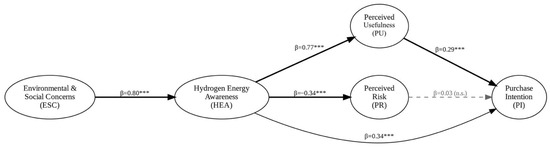
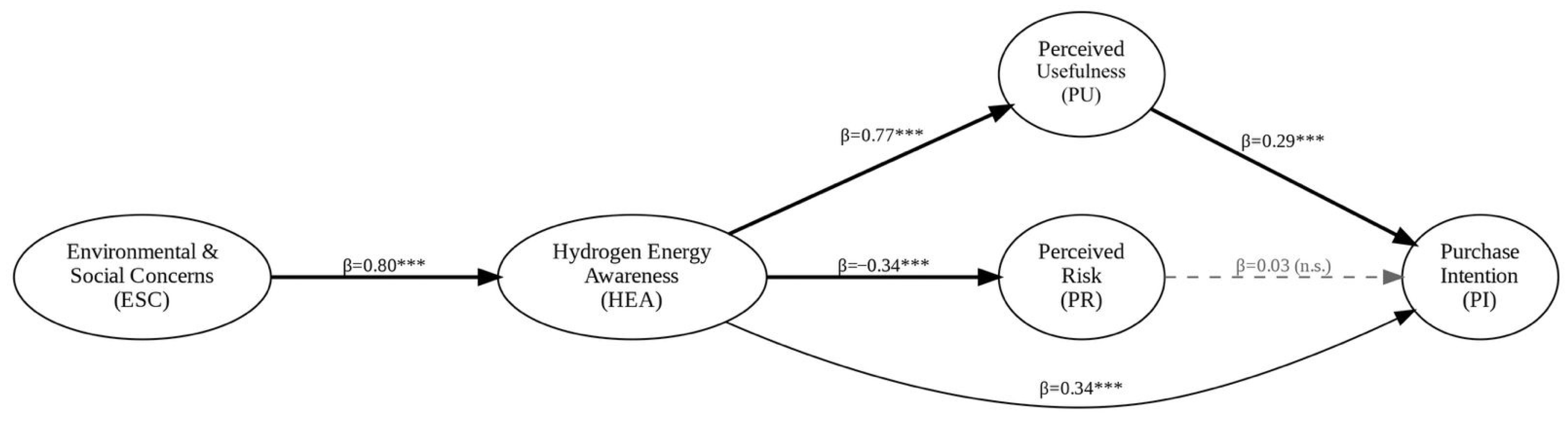

Disclaimer/Publisher’s Note: The statements, opinions and data contained in all publications are solely those of the individual author(s) and contributor(s) and not of MDPI and/or the editor(s). MDPI and/or the editor(s) disclaim responsibility for any injury to people or property resulting from any ideas, methods, instructions or products referred to in the content. |
© 2026 by the authors. Licensee MDPI, Basel, Switzerland. This article is an open access article distributed under the terms and conditions of the Creative Commons Attribution (CC BY) license.