


Abstract
Under the background of the steady advancement of the dual-carbon goal and the increasing improvement of the green financial system, green supply chain finance is like a bridge that closely links the capital of the financial market and the low-carbon transformation of the real economy. The following article chooses A-shares traded enterprises from 2014 to 2024 as the study sample, adopts multi-dimensional empirical methods to study the association in green supply chain finance along with corporate emission levels, and analyzes its transmission mechanisms and heterogeneity. The findings demonstrate that green supply chain finance has a substantial inhibitory impact with enterprise emission levels, a finding that remains robust across a series of tests, including parallel trend tests, placebo tests, and propensity score matching (PSM). Mechanism analysis demonstrates that green supply chain finance can indirectly reduce carbon emission intensity by improving both financing levels and supply chain stability. Looking at heterogeneity, we find that the emission-reducing effect tends to be stronger among state-owned firms, non-heavy polluters, enterprises with higher total factor productivity, and enterprises that are more financially oriented. Our theoretical value lies in clarifying the direct relationship between green supply chain finance and micro-enterprise carbon emissions, identifying two differentiated intermediary transmission paths, and defining the boundary conditions of the policy role across multiple dimensions, thereby better coordinating and promoting the digital and low-carbon transformation of enterprises.
1. Introduction
In 2020, China officially announced a major strategic decision to achieve carbon peak by 2030 and carbon neutrality by 2060. This commitment is of milestone historical significance [1]. From an international perspective, the Environmental Performance Index (EPI) released by Yale University shows that China’s performance on the index has been in the medium range for a long time. According to data released in 2020, China scored 37.3 points, ranking 120th among the 180 countries and regions participating in the assessment, far from the top countries [2]. At present, controlling carbon emissions is an important issue for China’s high-quality economic development [3]. In the whole market system, enterprises, as the main bodies of commodity production and supply, are not only the main consumers of natural resources but also the core force promoting low-carbon development and green production. Therefore, reducing carbon emissions at the enterprise level has become an urgent issue [4]. Against the backdrop of deep integration between green finance and supply chain development, green supply chain finance, as an important link between the financial market and the real economy, has become a key financial support for promoting enterprises’ low-carbon transformation. As early as 2019, as the first “equator bank” in China, Industrial Bank took the lead in formulating and issuing the business guidelines for green supply chain finance, integrating green concepts into supply chain finance and promoting green development [5]. Environmentally friendly source chain financing has become a novel economic type, which combines sustainable supply chains by combining sourcing network funding as well as environmentally friendly finance. From the standpoint of environmentally friendly cooperative development of industrial clusters, it guides the downstream as well as upstream businesses of the supply network to successfully carry out sustainable design, sustainable purchasing, sustainable manufacturing, sustainable transportation, and sustainable reuse, effectively controls carbon emissions and pollutant emissions, and provides important support for China’s sustainable economic development by optimizing resource allocation and reducing resource consumption in the whole chain [6]. Against this dual background, can enterprises achieve low-carbon development through green supply chain finance? What is the specific impact mechanism? Answering these questions goes beyond simply adding to the existing literature on green supply chain finance and corporate emission reduction. It also uncovers a fresh channel: firms can build stronger supply chain resilience while simultaneously lowering their emissions. Moreover, the findings can offer tangible pathways and practical guidance for advancing the digital transformation and carbon-neutral transition of enterprises, as well as for implementing the nation’s hybrid climate change strategy.
This paper offers several key contributions. First, we employ a broad sample covering many industries to empirically test how green supply chain finance helps cut carbon emissions. This approach overcomes the limitations of earlier work, which was often confined to a single sector or stayed at a purely theoretical level. Secondly, the existing literature discusses the inherent logic and transmission mechanism between green supply chain finance and enterprise carbon emissions, but this discussion is relatively shallow, and the core action path and boundary conditions lack systematic analysis. This article thoroughly expands and improves the correlation logic and transmission mechanism of the two, clarifying their core mechanisms and applicable boundaries. Finally, the heterogeneity analysis across ownership, pollution, productivity, and financialization reveals the effects of differentiation, providing an empirical basis for the design of targeted green supply chain financial policies and low-carbon transformation strategies.
2. Literature Review and Hypothesis Development
2.1. Literature Review
Prior studies on corporate carbon emissions have systematically looked into two primary aspects: influencing factors and accounting methods. In terms of influencing factors, existing research is mainly conducted from four core perspectives: enterprise technical capabilities [7,8], market-oriented environmental regulation [9,10], capital market opening [11], and factor market distortion [12]. In terms of carbon-emission accounting methods, existing results cover general quantitative indicators and industry-specific accounting systems. At the general indicator level, common methods include the accounting framework based on fossil energy consumption and the 2006 IPCC National Greenhouse Gas Inventory Guide [13], as well as the measurement method provided by the China Carbon Accounting Database (CEADs) based on energy activity data [14]. At the industry-specific level, Fei et al. (2023) [15] recommend accounting methods and emission factors applicable to different industries. Zhang et al. (2019) [16] combined the production and operation characteristics and emission characteristics of enterprises and put forward the carbon emission accounting method of construction enterprises.
The existing classical theoretical system of sustainable supply chain management takes the coordinated development of the triple bottom line of economy, environment, and society as the core logic. In the process of theoretical evolution, Carter and Jennings (2002) [17] led the development of an integrated analysis framework from a logistics social responsibility perspective, formally integrating the dimension of social responsibility into the research on supply chain management. Carter and Rogers (2008) [18] further refined the theoretical system, proposed a four-dimensional sustainable supply chain management framework encompassing economic benefits, environmental governance, social responsibility, and supply chain partnerships, and systematically defined the core components of sustainable supply chain management. Based on multiple case studies of ten industry benchmark enterprises, Pagell and Wu (2009) [19] further consolidated the theoretical core of the triple bottom line and built a more complete theoretical system of sustainable supply chain management. Based on the above literature, this article defines sustainable supply chain management as a systematic operational and management model that integrates economic performance, low-carbon emission reduction goals, and social responsibility as the core of the entire supply chain. Green supply chain finance is an important financial support tool for implementing sustainable supply chain management and promoting the green transformation of the industrial chain.
Traditional supply chain finance serves as a key link between real supply chains and capital markets. It uses authentic trade data to improve how capital is allocated across the industrial chain. Huff and Rogers (2015) [20] carried out a long-term tracking study and found that supply chain finance can effectively unlock liquid assets—such as accounts receivable, accounts payable, and inventory—within firms. Doing so goes a long way toward easing the financing constraints that typically trouble small- and medium-sized enterprises both upstream and downstream. This, in turn, helps achieve a more efficient flow of capital along the supply chain and enhances overall resource allocation.
Given this background, green supply chain finance has evolved into a novel business model—one that weaves together green supply chain governance, conventional supply chain finance, and green finance [21]. The global research on supply chain finance and green finance has established a sound theoretical foundation, which provides solid theoretical support for exploring the internal mechanism of green supply chain finance. Gelsomino et al. (2016) [22] systematically reviewed global studies concerning supply chain finance and constructed a dual theoretical framework for this field, which distinguishes between finance-oriented and operation-oriented research paradigms. As a landmark empirical study, Flammer (2021) [23] laid a solid empirical foundation for the facilitating effect of green financing on corporate low-carbon transformation. Further extending the research boundary of traditional supply chain finance, Kruger (2015) [24] explored its green application value from an industrial chain perspective and compensated for the research limitations of existing micro-level green finance studies that merely focus on individual enterprises. Domestic research further combines the characteristics of local industries on the basis of foreign theories and integrates key dimensions such as financing trust construction, financing constraint mitigation [25,26], risk control [27], interest balance mechanisms [28], policy governance effects [29], and digital technology empowerment [30] into green supply. The chain finance research system has formed a multi-perspective and multi-level local research framework.
Although more and more studies are looking into green supply chain finance, one question remains underexplored: how does it directly affect corporate carbon emissions? Existing work on this topic tends to be somewhat scattered, and the analysis often lacks sufficient depth. Thus, there is clear value in exploring how green supply chain finance might affect the carbon emissions of firms.
2.2. Policy Background
Promoting the development of the green supply chain and finance is a key measure to realize environmental regulation. In 2017, a key policy document was issued: the Guidance on Building a Green Financial System. This release marked a historic moment—China became the first nation globally to put in place a comprehensive policy framework for green finance. Importantly, the guidance also highlighted the need to develop green supply chain finance. It described this as a crucial instrument for encouraging the collaborative green transformation of industrial chains [31]. In 2019, the relevant authorities published the green industry guidance directory (2019 edition), which defined a clear industrial boundary for the development of green finance business, provided a basic standard basis, and laid a policy foundation for the definition of business scope and resource allocation of green supply chain finance [32,33]. Around the world, developed economies and international organizations have introduced a range of policies to support sustainable supply chain finance, forming a global institutional framework for green supply chain finance. Centered on the European Green Deal and the Corporate Sustainability Reporting Directive, the EU mandates multinational enterprises to disclose environmental and carbon emission information along supply chains and encourages financial institutions to innovate green supply chain financial products. Relying on the Inflation Reduction Act, the United States promotes low-carbon financing for domestic industrial chains through tax incentives. In addition, the United Nations and the OECD have issued guidelines on sustainable supply chain finance and ESG disclosure standards, establishing unified global evaluation criteria for investment and financing and offering international references for countries to develop green supply chain finance.
2.3. Theoretical Analysis and Research Hypotheses
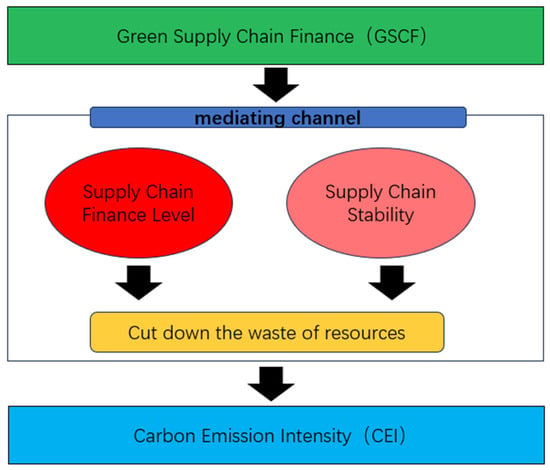
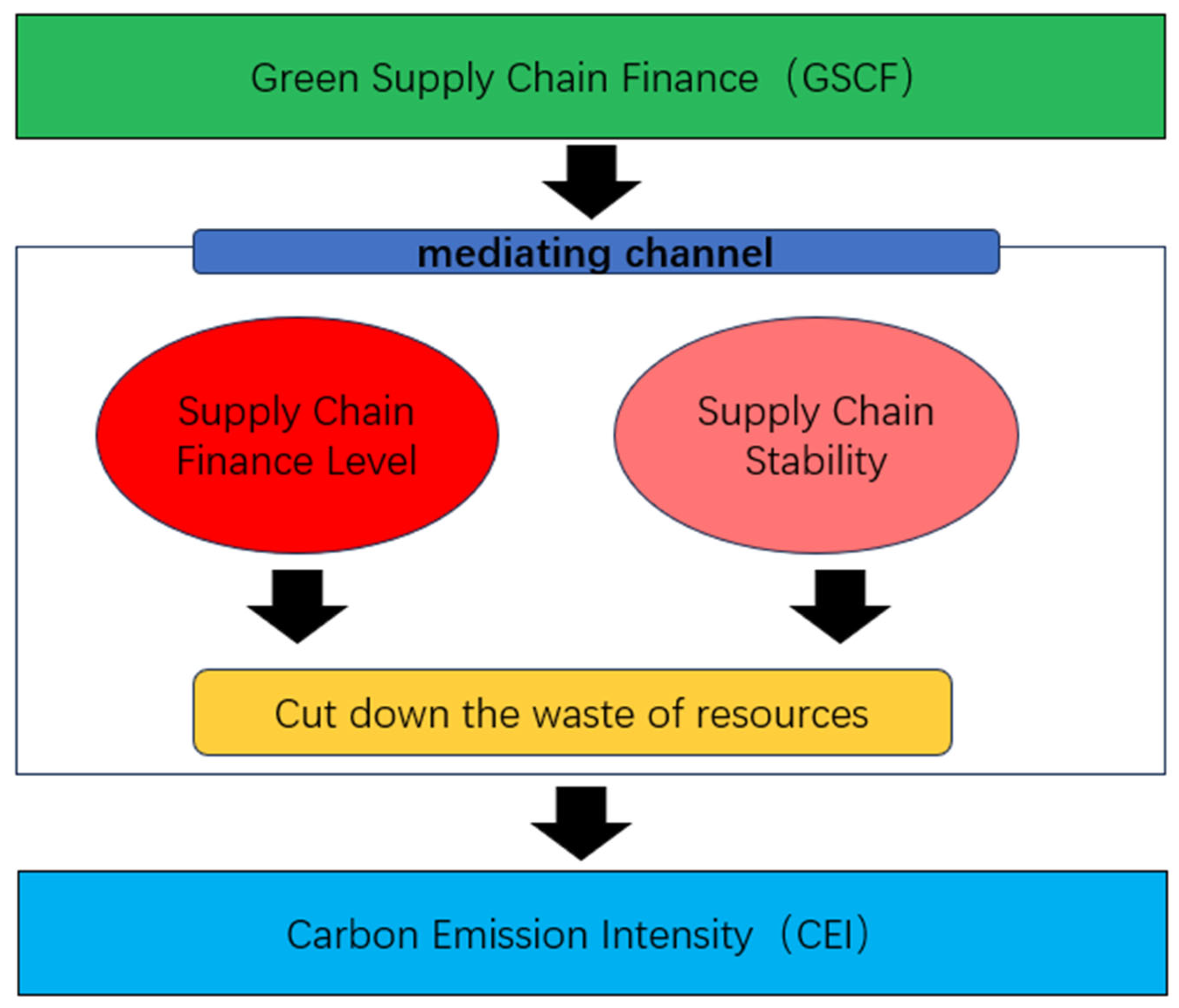
From a theoretical perspective, we have developed a systematic framework based on the theories of resource allocation, financing constraints, supply chain cooperative governance, and stakeholders. The framework examines how green supply chain finance affects enterprises’ carbon emissions (see Figure 1).
Figure 1.
Theoretical framework.
2.3.1. Direct Effects of Green Supply Chain Finance on Corporate Carbon Emissions
Green supply chain finance integrates the green development orientation with the resource allocation function of supply chain finance. Based on green indicators such as carbon emission level and environmental performance, it forms financing constraints on enterprises with excessive carbon emissions, forcing them to actively adjust production modes and optimize energy structure to decrease greenhouse gases [34]. In a comparable period the situation provides differentiated financial support for enterprises practicing low-carbon production in the supply chain, effectively alleviates the financing pressure of enterprises in terms of low-carbon technology research and development, green equipment update, clean production transformation, and helps enterprises improve resource utilization efficiency and reduce energy consumption and carbon emissions from the production side [35]. In addition, based on stakeholder theory, green finance exerts a dual driving effect on the emission reductions of upstream and downstream enterprises through supply chain transmission mechanisms [36]. Relying on the credit transmission effect of core enterprises, green supply chain finance promotes upstream and downstream enterprises in the supply chain to establish a green collaborative development mechanism [6], guides enterprises in the whole chain to jointly participate in low-carbon production practice, realizes emission reduction linkage in all links of the supply chain, and reduces the total carbon emissions in the whole process of enterprise production and operation as a whole. As a result, total carbon emissions from a firm’s overall production and operation activities are reduced. Given all of the above, it is reasonable to conclude that green supply chain finance can substantially curb corporate carbon emissions. Based on this line of reasoning, we propose our first hypothesis, H1.
H1.
Green supply chain finance can effectively restrain corporate carbon emissions.
2.3.2. The Effect of Supply Chain Finance Level
The reduction in financing constraints and the increase in the supply chain funding level may successfully alleviate financing limitations and capital turnover pressure of supply chain upstream and downstream enterprises, ensure the smooth flow of funds from raw material procurement to manufacturing, logistics distribution, and product sales [37], avoid the production stagnation, inventory backlog, and low operational efficiency caused by capital shortage, and realize the efficient and coordinated operation of the whole supply chain [38]. The rapid flow of information facilitates the movement of resource elements along the chain. While enhancing enterprises’ access to credit resources and providing financial support for efficient investment [39], it also enables participating parties, through the platform established by supply chain finance, to access inter-enterprise transaction information, logistics information, production information, and sales information, thereby reducing transaction costs between upstream and downstream enterprises as well as non-productive expenditures [40], lowering monitoring costs, and effectively supervising enterprises to improve the efficiency of resource integration in production, sales, and research and development [41]. The continuous improvement in the level of supply chain finance enhances efficiency, optimizes cost structures [42], reduces resource waste, and thus lowers carbon emissions. Based on theoretical analysis, this paper proposes Hypothesis H2.
H2.
Green supply chain finance can restrain the carbon emissions of enterprises by improving the financing level.
2.3.3. The Effect of the Supply Chain Stability
The instability of the supply chain can easily lead to problems such as production interruption and supply channel change. In order to deal with the risk of the supply chain, enterprises often adopt strategies such as over stocking and emergency production transfer [43], which will cause additional energy consumption and an abnormal increase in carbon emissions. Relying on the overall credit system of the supply chain, green supply chain finance provides stable financial support for upstream and downstream enterprises and reduces the cooperation risk caused by the rupture of the capital chain [44]. At the same time, it screens high-quality green partners through environmental performance, optimizes the supply chain cooperation pattern, and improves the stickiness and supply chain stability cooperation [45]. A stable supply chain enables enterprises to formulate long-term and reasonable production plans [46], avoiding unnecessary carbon emissions arising from risk response, thereby effectively curbing corporate carbon emissions. Stable supply chain partnerships are crucial, as they can effectively reduce costs and improve sustainability performance [47]. That is, green supply chain finance can curb enterprise greenhouse gases by optimizing the intermediary impact associated with supply chain stability. Based on theoretical analysis, this paper proposes Hypothesis H3.
H3.
Green supply chain finance suppresses enterprise carbon emissions by optimizing the stability of the supply chain.
3. Research Design
3.1. Data
Based on the available data, this study selects Chinese A-share-listed companies from 2014 to 2024 as the research sample. The data mainly comes from the CSMAR database [48], the China Industrial Economic Statistics Yearbook, and some company annual reports. In order to reduce potential estimation biases, enterprises with abnormal financial conditions (i.e., companies marked as ST or *ST) are excluded. At the same time, to ensure data integrity and authenticity, all observation samples with missing values are directly deleted [49]. Through this strict screening process, 4915 A-share-listed companies were identified as research samples. During the research period from 2014 to 2024, some enterprises failed to provide complete annual observations due to differences in listing dates, delistings, or missing data, resulting in an unbalanced panel dataset with 28,671 company annual observations.
3.2. Variable Measurement
3.2.1. Explained Variable
Corporate carbon emission intensity (CEI) serves as the explained variable in this research. This indicator is calculated by dividing each firm’s carbon dioxide emissions by its operating revenue. Both corporate CO2 emission figures and operating revenue records are extracted from the CSMAR database.
We adopt this ratio to quantify carbon intensity mainly to eliminate biases triggered by disparities in business scale. Firms differ substantially in operating revenue scale; raw total carbon emissions cannot support a valid cross-firm comparison of emission reduction performance. The constructed ratio captures carbon output per unit of revenue, conforming to the evaluation logic of the low-carbon transition. It objectively reflects resource utilization efficiency and emission reduction performance throughout firms’ production and operational activities.
3.2.2. Core Explanatory Variable
Green supply chain finance (GSCF) serves as the core explanatory variable in this paper. Two binary dummy indicators, namely the industry dummy Treat and the time dummy Post, are defined with values restricted to either 0 or 1 [50]. The classification standard for the treatment and control groups based on the dummy Treat hinges on the environmental and social risk tiers of each firm’s operating industry. This indicator takes the value of one for enterprises falling into Categories A and B—two industry groups (industries classified as Category A and Category B for environmental and social risks include: petroleum processing, chemical raw materials, coking and nuclear fuel processing, chemical products manufacturing, non-ferrous metal smelting and rolling processing, ferrous metal smelting and rolling processing, non-metallic mineral products, thermal power generation, heat production and supply, and gas production and supply, among others.) marked by elevated environmental and social risks. By contrast, firms operating within industries with medium, low, or even lower risk exposure are coded as zero.
Regarding the time dummy Post, the official release of the Guidelines for Green Supply Chain Finance Business in 2019 is set as the cutoff point for the policy shock, marking the formal rollout of targeted regulatory rules on green supply chain finance. This dummy equals one if the sample observation year is 2019 or later, indicating that the corresponding firm is subject to the aforementioned policy regulation. Observations dated prior to 2019 receive a value of zero, representing periods without policy constraints. Finally, the interaction term of Treat multiplied by Post serves as the proxy for GSCF.
3.2.3. Intermediate Variables
We selected financial level [51] and supply chain stability [52] as the intermediary variables. Table 1 presents the variable names along with their corresponding calculation formulas.
Table 1.
Variable definitions.
3.2.4. Control Variables
Control variable definitions and their calculation formulas are provided in Table 1.
3.3. Model Construction
To test the relationship between green supply chain finance and enterprise carbon emission intensity, the regression model (3) will be used.
Among the above components, CEI represents the carbon emission intensity of enterprises, GSCF represents green supply chain finance, control represents the control variable, the framework also adjusts for fixed influence of time (year) and fixed influence of firm (firm), i and t represent the sample enterprises and time, respectively, and ε represents the random interference term. If the empirical result is negative, it indicates that green supply chain finance can reduce corporate carbon emissions, and Hypothesis 1 is verified.
To test Hypotheses 2 and 3, the conduction mechanism model of Wen et al. [53] is used for reference, and the formula is as follows.
Among the above components, M (as defined in Equations (3) and (4)) is the intermediary variable, representing the supply chain financial level (SCF) and supply chain stability (SCS) indicators, respectively. Other variables are defined in the same way as in (3). If (from Equation (4)) is negative, it indicates that the supply chain financial level (SCF) and supply chain stability (SCS) can inhibit enterprise carbon emissions, and Hypotheses 2 and 3 are true. See Figure 1 for specific variable definitions and calculation formulas. All regression models in this study are estimated via Stata (v19.0).
4. Empirical Analysis
4.1. Descriptive Statistics
Table 2 presents the descriptive statistics for the core and control variables in this study. The table shows that the sample enterprises’ overall carbon emission intensity is at a medium level, and the differences between enterprises are moderate. The average value of green supply chain finance is 0.117, indicating that 11.7% of the sample enterprises use it, and the overall penetration rate is low.
Table 2.
Baseline regression results.
4.2. Benchmark Regression
All regressions in this paper employ robust standard errors clustered at the firm level to account for serial correlation within each firm over time. Firm and year two-way fixed effects are included to absorb unobserved heterogeneity. The clustering specification of standard errors is clearly stated below every regression table.
Table 3 presents how GSCF affects CEI. In column (1), we report the baseline regression result of GSCF on CEI. Column (2) shows that after adding control variables, GSCF still exhibits a negative effect on CEI. Hypothesis 1 thus receives preliminary support. In column (3), we further control for individual fixed effects, building on column (2). Column (4) adds year fixed effects to the specification of column (2). Column (5) includes both individual and year fixed effects along with all control variables. Looking across columns (1) through (5), GSCF consistently exerts a statistically significant and direct negative influence on CEI. Column (6) reports benchmark regression results augmented with industry-year fixed terms to exclude aggregation bias, and the estimated negative coefficient still carries statistical significance.
Table 3.
Mean-reversion.
4.3. Robustness Test
4.3.1. Parallel Trend Test
Existing staggered DID studies have pointed out the potential bias of traditional two-way fixed effects estimators under heterogeneous treatment effects. However, early related research rarely incorporates modern DID frameworks. To address this concern, we introduce three landmark papers, Callaway and Sant’Anna (2021) [54], Goodman-Bacon (2021) [55], and Sun and Abraham (2021) [56], to explain estimation bias and conduct supplementary robust checks.
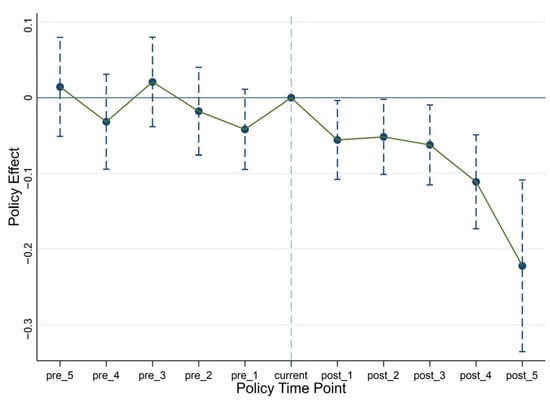
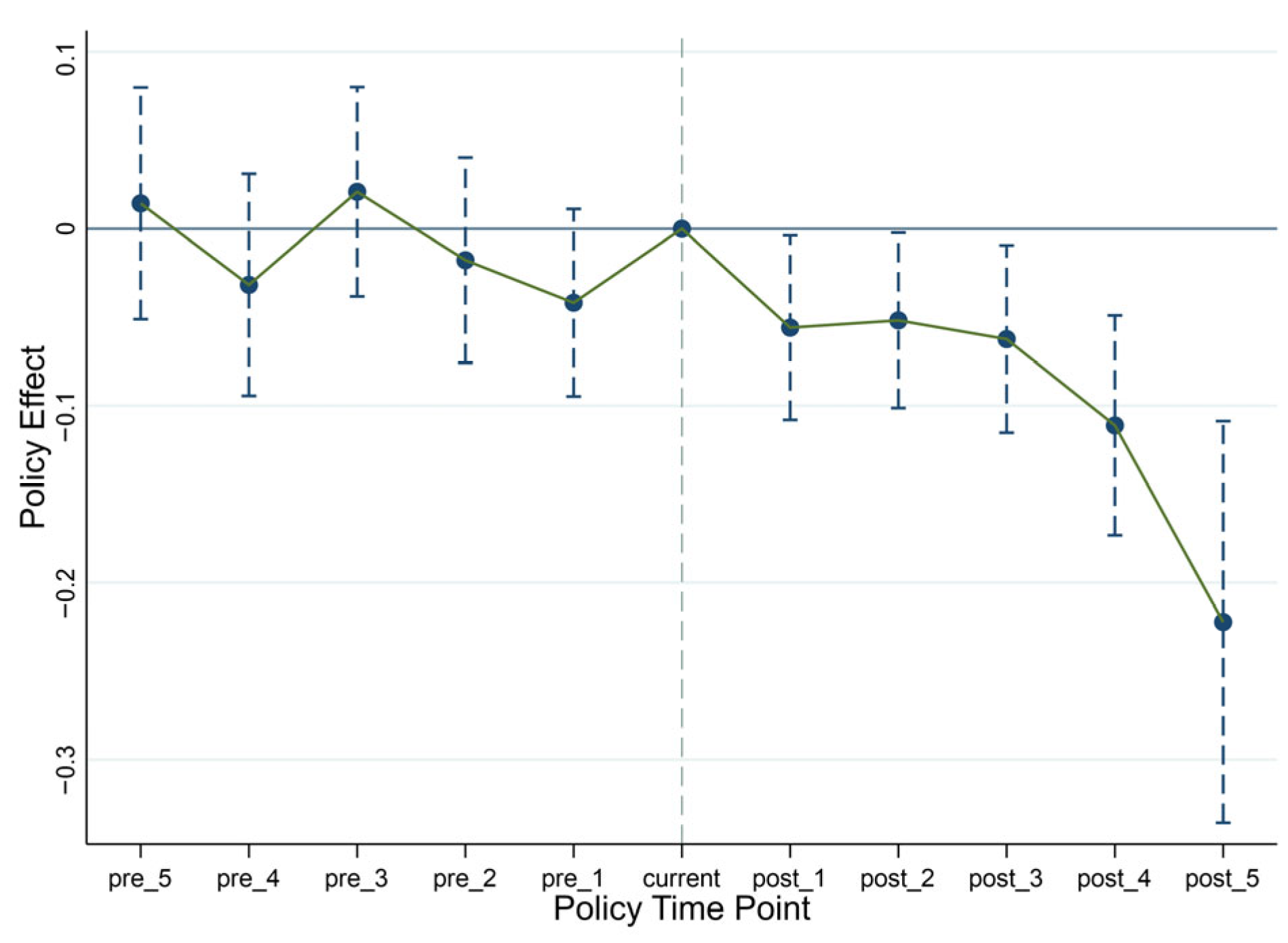
We took 2019 as the policy’s baseline year and performed a parallel trends test. Figure 2 reports the results. For all periods prior to the introduction of the green supply chain finance policy in 2019, the estimated coefficients do not differ significantly from zero. Following the policy’s rollout, the emission-reducing effect on corporate carbon intensity exhibits a pattern of delay and gradual build-up, which supports the existence of parallel trends.
Figure 2.
Parallel trend chart.
We also conducted a joint test focusing on the coefficients from the five intervals that came right before the policy. The test yields an F-statistic of 1.36, with a corresponding p-value of 0.2352. This result means we cannot reject the null hypothesis—namely, that the combined sum of all pre-policy coefficients is zero. Therefore, the treatment and control groups exhibited similar trajectories prior to the policy intervention. This confirms that the parallel trend assumption required for the DID model is satisfied.
In order to further test whether enterprises will anticipate policies in advance and take emission reduction actions in advance, this article analyzes the potential expected effect. According to the findings in Table 4, the estimated coefficients for the five periods leading up to the policy (from the fifth period before implementation down to the first) are all statistically insignificant. This shows that enterprises did not reduce emissions in advance before the policy was officially implemented.
Table 4.
Potential anticipation effects.
To mitigate potential biases from time-varying industry-level policy heterogeneity in two-way fixed effects estimation, we apply a difference-in-differences approach to examine parallel trends and dynamic effects. Table 5 reports the results. The coefficients estimated for the periods before treatment are statistically insignificant, which lends support to the parallel trend assumption. Turning to the post-treatment coefficients, those for T_2018_2021, T_2018_2023, and T_2018_2024 are all significantly negative. This indicates that GSCF substantially lowers CEI, and the magnitude of this reduction tends to grow over time. These findings align well with the conclusions drawn from our benchmark model. The period of 2018–2020 represents the initial rollout stage of the policy, coinciding with the COVID-19 pandemic. During this phase, firms scaled back green investment, resulting in weak short-term emission reduction effects. As supporting policies were gradually refined in later years, the emission-reduction effect became sustained and prominent. Such phased fluctuations align with real-world economic conditions and do not undermine the overall policy effect.
Table 5.
Heterogeneity-robust DID.
4.3.2. Placebo Test
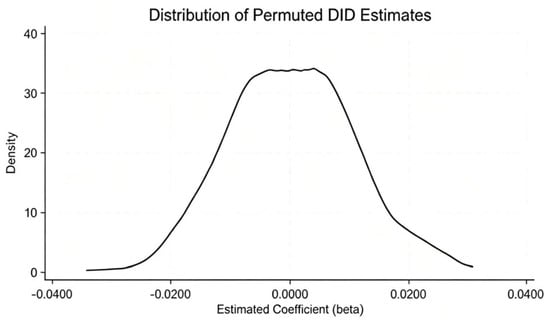
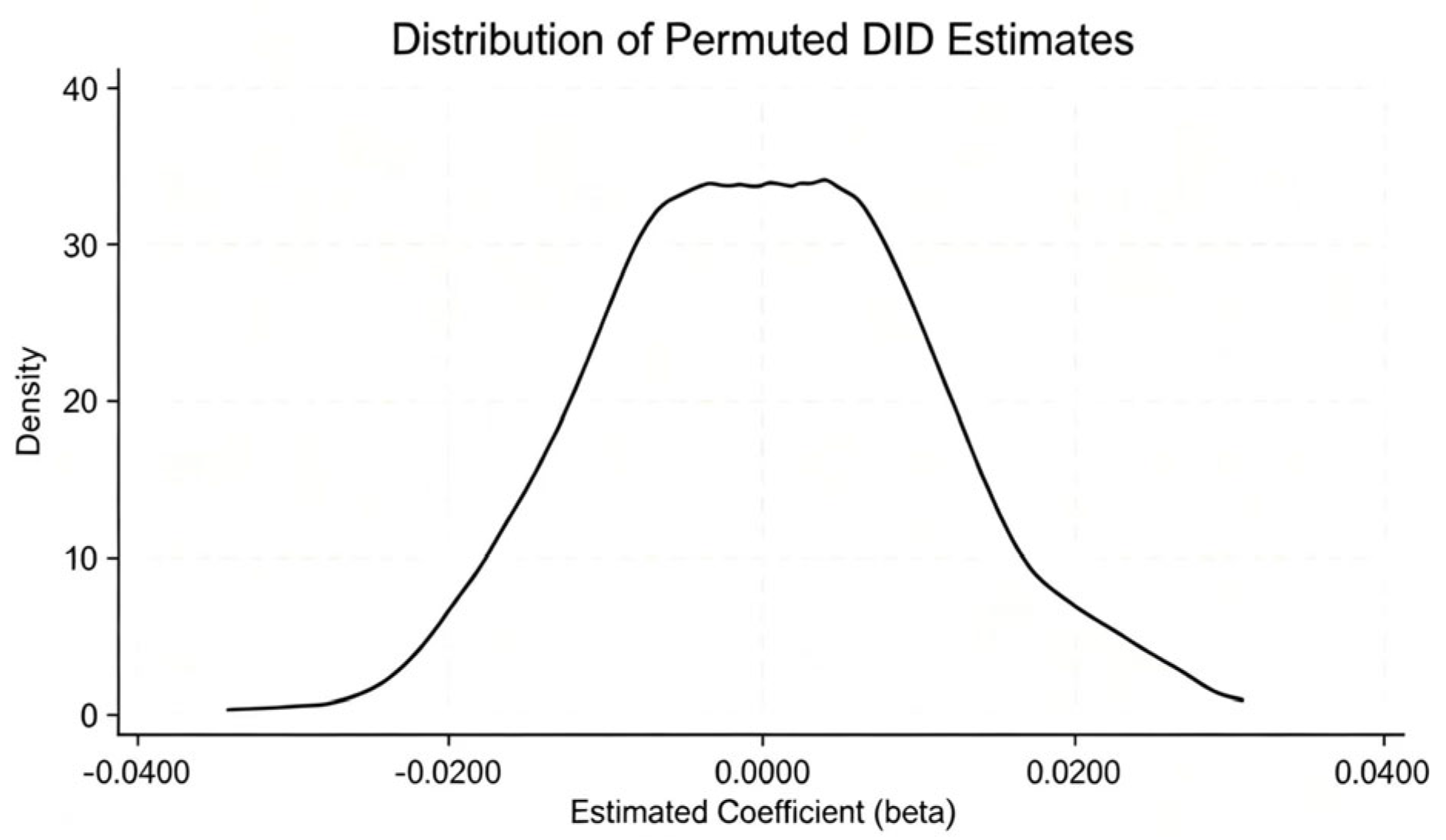
We perform a placebo test by randomly reassigning which firms are treated. The outcome is shown in Figure 3. After this random shuffling, the estimated coefficients cluster near zero. In contrast, our actual estimated value (−0.0061) falls in the right tail of the distribution, making it highly unlikely to arise from pure chance. This suggests that our benchmark regression findings are not driven by omitted variables or random noise, further confirming the robustness of our main conclusion.
Figure 3.
Test of placebo.
4.3.3. PSM
To address the estimated deviation caused by sample selection bias, this paper uses the 1:1 near-neighbor matching method with propensity score matching for testing. Table 6 is the result of the covariate equilibrium test of the tendency score matching. Prior to matching, the treatment and control groups differ substantially across several variables. After performing standard matching, however, column (2) reveals that every covariate’s standardized bias falls below 5%, and the associated t-tests become statistically insignificant. This suggests that the matching process successfully reduces systematic differences between the two groups and broadly satisfies the balance assumption. The robustness results in Column (1) of Table 7 indicate that GSCF significantly reduces CEI by 1%.
Table 6.
Covariate balance table.
Table 7.
Robustness regression results.
4.3.4. Replace the Explained Variable
Given that a single indicator cannot comprehensively and accurately reflect enterprises’ actual carbon emissions, we substitute enterprise carbon emissions (CCEs) for the earlier intensity measure (CEI). CCEs data are available from the CSMAR database. The findings reported in column (2) of Table 7 indicate that GSCF still exerts a significantly negative influence on CCEs.
4.3.5. Add the Lag Term of the Explained Variable
The lagged value of the dependent variable might strongly affect its current-period performance. As reported in column (3) of Table 7, GSCF has a notable effect on CEI. This suggests that our findings are robust.
4.3.6. Add Control Variable
To effectively mitigate bias from missing variables and ensure the robustness and reliability of the regression results, we have further increased the asset loss rate, operating income growth rate, and net asset rate of return control variables relative to the original control variables. As reported in column (4) of Table 7, GSCF still has a clear dampening effect on CEI.
4.3.7. Change the Research Model
To alleviate the error caused by too many data dimensions and reduce the deviation in results due to the mutual interference of variables, this study uses machine learning to test robustness. This paper adopts the random forest machine learning algorithm based on Python (v 3.10) for supplementary robustness tests. Looking at column (5) of Table 7, we find a negative regression coefficient, and the overall result remains consistent.
4.3.8. Replace the Core Explanatory Variables
We conduct an additional check to further confirm the robustness of our results. Because GSCF essentially merges traditional supply chain finance with green finance, we construct the corresponding composite indicators via the entropy weight approach [57]. Looking at column (6) of Table 7, we find a negative regression coefficient.
4.4. Mechanism Analysis
4.4.1. Improve the Financing Level
According to Formulas (2)–(4), the regression results are shown in Table 8. In column (2), the coefficient of GSCF and SCF is significantly positive, and in column (3), GSCF is significantly negative for CEI. Hypothesis 2 verification is successful. This shows that GSCF can improve the financial level of enterprises’ supply chain by optimizing the flow of funds in the supply chain, and the financial level of the supply chain provides more sufficient financial support for enterprises, so that they can invest in low-carbon technology upgrading, thus effectively suppressing carbon emissions. This constructs a complete transmission logic: green supply chain finance optimizes capital allocation within supply chains, eases corporate financing constraints, stimulates more investment in low-carbon technologies, and ultimately reduces carbon emission intensity.
Table 8.
Mechanism analysis (I).
4.4.2. Optimize Supply Chain Stability
Estimation outcomes derived from Equations (2)–(4) are laid out in Table 9. The interaction term between GSCF and SCS bears a statistically positive coefficient in Specification (2), while the standalone GSCF index presents a marked negative correlation with CEI in Column (3). The number of observations in Column (2) is 16,211 owing to missing values of relevant variables. Hypothesis 3 is successful. GSCF reduces cooperation risk and financing costs for upstream and downstream enterprises. It integrates supply chain information and optimizes credit assessment. Through these mechanisms, GSCF ultimately improves SCS. A stable supply chain relationship enables enterprises to plan low-carbon technology upgrades and emission-reduction investments more accurately, thereby effectively reducing low-carbon emissions. This forms a complete transmission path: green supply chain finance cuts supply chain cooperation risks and financing costs, boosts supply chain stability, encourages firms to make long-term investments in low-carbon technological transformation, and ultimately lowers carbon emission intensity.
Table 9.
Mechanism analysis (II).
4.5. Heterogeneity Analysis
4.5.1. Nature of Enterprise
State-owned and non-state-owned enterprises differ considerably when it comes to accessing resources, their internal management systems, and how decisions get made. Based on the nature of property rights, we split our sample into SOEs and non-SOEs, following [7]. Looking at columns (1) and (2) in Table 10, we see that GSCF produces a noticeably stronger carbon-reduction effect in state-owned firms. Why might this be? SOEs serve as key vehicles for the country’s green transition strategy. They enjoy inherent advantages in securing resources, responding to policy directives, and facing ESG assessment pressures. As a result, green supply chain finance can translate more smoothly into tangible environmental outcomes for them. Non-state-owned enterprises, in contrast, are more driven by profit goals and often struggle with financing constraints. Their investment in green transformation tends to be relatively limited. Consequently, the impact of GSCF on their CEI remains modest.
Table 10.
Heterogeneity test (I).
4.5.2. Pollution Attribute
We use average carbon intensity as the standard and divide enterprises into heavily polluted and non-heavily polluted groups. The results of (3) and (4) in Table 10 show that the impact of GSCF on the CEI is significantly stronger than that of non-heavy pollution enterprises. This is because non-heavy pollution enterprises have a good environmental foundation, and the financial support and technical empowerment brought by GSCF can efficiently reduce CEI, while heavily polluting enterprises rely on high-energy-consuming and high-emission production methods for a long time, and the transformation cost is high, so their marginal impact is relatively limited.
4.5.3. Enterprise Total Factor Level
This paper uses the GMM method to measure enterprise total factor productivity and divides the sample into strong and weak total factor productivity groups based on the middle digits of the regression [58]. As displayed within Specifications (1) and (2) of Table 11, GSCF policies deliver stronger carbon abatement effects among high-TFP enterprises compared with low-productivity peers. This is because enterprises with strong total factor productivity usually have higher technical levels and greater management efficiency. Emission reduction mainly depends on internal improvements within the enterprise and relies less on external financial instruments, whereas enterprises with weak total factor productivity are constrained by technical and management shortcomings, so their impact is not significant.
Table 11.
Heterogeneity test (II).
4.5.4. Financial Level
Enterprise financialization level refers to how firms allocate and use financial resources, which shows up in their ability to flexibly employ different financial instruments [59]. To construct this measure, we aggregate several components: trading financial assets, derivative financing, net loans and advances, net financial assets classified as available for sale, net investments held to maturity, and net investment property. We then divide that sum by total assets. Following, we split the sample into high and low financialization groups according to the median value of this ratio [60]. Looking at columns (3) and (4) in Table 11, we find that GSCF policies produce a stronger carbon-reduction effect in firms with a high level of financialization compared to those with a low level. Why? Firms that are highly financialized have a greater capacity to allocate and utilize financial resources. They can quickly translate the support from GSCF into low-carbon technology upgrades and concrete emission cuts [61]. In contrast, enterprises with weak financialization are constrained by their limited command over financial instruments and lower resource allocation efficiency. As a result, the dampening effect on their carbon emissions is relatively modest.
5. Conclusions
5.1. Theoretical Innovations
The research in this article makes a theoretical contribution. First, it broadens the research boundaries of green supply chain finance and improves the theoretical system of green finance and micro-enterprise emission reduction. This article breaks through the limitations of traditional single-industry research and clarifies the core value of green supply chain finance as an important financial tool for the low-carbon transformation of the industrial chain. It effectively fills the empirical gap in the micro-emission-reduction effect of green supply chain finance, enriches the theoretical connotation of green supply chain finance to empower enterprises’ low-carbon development and help implement the dual-carbon target, and improves the universality and theoretical persuasiveness of relevant research conclusions.
Second, it refines and improves the intermediary conduction theory system. Studies indicate that the discussion of the emission-reduction logic of green supply chain finance is relatively one-sided and fragmented. The complete causal transmission chain has not been cleared, and the identification and interpretation of the core role path are insufficient. Drawing on perspectives on supply chain capital flows and collaborative governance, this article identifies two core paths to improve the supply chain’s financial health and enhance its stability. This refines the mechanism for emission-reduction transmission in green supply chain finance, addresses the vague and one-sided problems of existing research mechanisms, and provides a more systematic and rigorous theoretical explanation of the low-carbon transformation enabled by green finance along the industrial chain.
Third, we map out the boundary conditions under which green supply chain finance actually reduces emissions. This helps extend the theories on heterogeneous governance and how policies adapt to different contexts. Looking across four dimensions—ownership type, pollution level of the industry, total factor productivity, and the degree of financialization—we see that the emission-cutting benefits of green supply chain finance show up more strongly in state-owned firms, non-heavy polluters, enterprises with high productivity, and those that are more financially oriented. These findings challenge the older, more homogeneous way of thinking about such effects. They also offer a solid theoretical grounding for the careful rollout of green finance policies: enabling targeted, categorized measures that can better support firms’ low-carbon transition. In doing so, our work contributes to and enriches the theoretical framework centered on green finance governance.
5.2. Practical and Policy Implications
Our research has a certain enlightenment. First of all, it improves the financial system of the green supply chain and improves the accuracy and coverage of financial services. It enhances the financial product system for the green supply chain and encourages financial institutions to develop new, exclusive products. It designs differentiated financing plans to meet the low-carbon needs of enterprises across industries and sizes and focuses on alleviating financing constraints for the green transformation of small- and medium-sized enterprises. In addition, we should expand the scope of application of green supply chain finance, overcome limitations specific to the manufacturing industry, develop a customized green supply chain financial service model applicable to agricultural, construction, service, and other industrial chains, and promote coordinated emission reduction across the whole industry.
Secondly, this research strengthens the enterprise’s main body’s capacity-building and promotes the deep integration of green supply chain finance and low-carbon transformation. It guides enterprises to establish the concept of green development, integrates carbon emission control into supply chain cooperation agreements, and encourages upstream and downstream enterprises to participate in the construction of a green supply chain through green supplier screening and low-carbon technical guidance.
Finally, this research implements differentiated policy support, increases policy support for green supply chain finance for state-owned enterprises, non-heavy-pollution enterprises, and other subjects with significant emission-reduction effects, and reduces the cost of green financing through financial discounts, tax incentives, etc. For heavily polluted enterprises and enterprises with weak total factor productivity, this research introduces special policies. Such policies promote the combination of green supply chain finance and low-carbon technology transformation, break the high-carbon locking effect, and help them gradually achieve low-carbon transformation.
6. Suggestions
6.1. Research Discussion
This study explores how GSCF relates to CEI. It also provides actionable pathways and practical examples to support firms in their digital and low-carbon transitions, thereby aiding the realization of China’s dual-carbon goals. We draw on data from A-share-listed companies spanning 2014 to 2024 to investigate how GSCF affects CEI and the mechanisms behind this effect. Our findings reveal a significant negative association between GSCF and CEI. Looking at transmission channels, we find that GSCF can lower CEI by enhancing firms’ financing capacity and improving supply chain stability. Additionally, we observe that the emission-reducing effect is strengthened in state-owned enterprises, non-heavy polluters, firms with high production efficiency, and enterprises with a high degree of financialization.
6.2. Research Limitations and Future Research Directions
Limitations: Firstly, our sample is restricted to A-share-listed companies, so data availability and the sample size are both constrained. Future work could ask whether the findings extend to unlisted small- and medium-sized enterprises or take a closer look at how differences across city types affect outcomes to better understand any gaps and what causes them. Secondly, the time dimension is relatively narrow, and the empirical analysis is based solely on the overall sample interval from 2014 to 2024. In the future, the scope of data will be expanded, and the dynamic response characteristics, repair capacity, and phased differences in enterprise carbon emissions across different external environments will be identified. Finally, the subdivision dimension of heterogeneity needs to be expanded. In the future, it will be refined and classified by industrial chain position, and more adaptive explanatory variables will be introduced to analyze the heterogeneous roles of different enterprises.
Author Contributions
Methodology, C.L.; software, M.K.; writing—original draft; M.K.; writing—review and editing, C.L.; data curation, investigation, English editing and revision, M.K.; funding acquisition, C.L. All authors have read and agreed to the published version of the manuscript.
Funding
This research was supported by the Social Science Fund of Hebei Province “Research on the impact of government digital procurement on enterprise green technology innovation” (Grant No. HB25yj021).
Institutional Review Board Statement
Not applicable.
Informed Consent Statement
Not applicable.
Data Availability Statement
Data included in this study are not publicly available. The China Stock Market & Accounting Research Database access is for qualified researchers with legitimate requests. Please contact the corresponding author to seek approval for data access.
Conflicts of Interest
All authors declare that there are no conflicts of interest.
References
- Li, Z.; Dong, L.; Zhang, H. Review of China’s 30-year participation in international climate governance. China Popul. Resour. Environ. 2021, 31, 202–210. [Google Scholar] [CrossRef]
- Fan, B.B.; Wen, J. Development of green bond market under the goal of carbon neutrality. China Financ. 2021, 19, 36–37. [Google Scholar]
- Niu, M.M.; Tan, X.C.; Guo, J.X.; Zhu, K.W.; Cheng, Y.L. The impact of total carbon control policy on high-quality economic development in China. Chin. J. Manag. Sci. 2024, 32, 24–34. [Google Scholar] [CrossRef]
- Sun, L.Y.; Zhang, Q.F. Research on the impact of digital inclusive finance on enterprise carbon emission intensity. Jiangxi Soc. Sci. 2023, 43, 90–101. [Google Scholar]
- Liu, H.; Bai, C. Has the digital transformation promoted the energy conservation and emission reduction of Chinese enterprises? J. Shanghai Univ. Financ. Econ. 2022, 24, 19–32. [Google Scholar] [CrossRef]
- Xue, X.F. Practical thinking on green supply chain finance of commercial banks: Modes, problems and countermeasures. New Financ. 2022, 3, 41–47. [Google Scholar]
- Li, G.; Huang, M. How does digital transformation enable corporate green technology innovation?—Empirical evidence from Chinese listed companies. Ind. Technol. Econ. 2025, 44, 96–105. [Google Scholar] [CrossRef]
- Zhang, Z.R.; He, J. The impact of digital economy development on urban carbon emissions: A quasi-experiment based on national big data comprehensive pilot zones. Inq. Into Econ. Issues 2024, 6, 153–174. [Google Scholar]
- Du, X.Q.; Zhang, X.S.; Xie, Y.H.; Zeng, Q.; Zhang, Y.Q. Can carbon emission trading promote energy conservation and emission reduction of enterprises?—A quasi natural experiment based on the pilot policy of carbon emission trading. J. Manag. Sci. 2025, 28, 22–38. [Google Scholar] [CrossRef]
- Wang, P.; Huang, S.; Wang, Y.; Li, W.X. Research on the impact of carbon emission trading on corporate carbon performance. Sci. Res. Manag. 2023, 44, 158–169. [Google Scholar] [CrossRef]
- Chen, C.; Jiang, Y.; Liu, L. Capital market openness, ESG and corporate risk-taking: Empirical evidence based on the “Shanghai-Hong Kong Stock Connect”. E-Commer. Lett. 2024, 13, 6018. [Google Scholar] [CrossRef]
- Zhou, J.; Sheng, Y.H. The impact of factor market distortion on carbon emissions of manufacturing enterprises. Econ. Manag. 2025, 47, 149–169. [Google Scholar] [CrossRef]
- Wu, G.Y.; Liu, J.D.; Chen, Y. Analysis of spatial characteristics and spillover effects of agricultural carbon emission intensity in China. Environ. Sci. Technol. 2021, 44, 211–219. [Google Scholar] [CrossRef]
- Xie, J.L.; Guo, J.; Huang, Y.T.; Liu, W.; Xu, M. Accounting and proportion estimation of household carbon emissions in China based on multi-source data. Chin. J. Environ. Eng. 2024, 18, 3081–3091. [Google Scholar] [CrossRef]
- Fei, W.L.; Niu, L.; Liu, J.Y.; Zhang, X.Y.; Xi, F.M.; Ruan, J.L.; Zhang, X.L. Empirical analysis of carbon emission accounting and factor decomposition in industrial parks. Chin. J. Environ. Eng. 2023, 17, 3744–3753. [Google Scholar] [CrossRef]
- Zhang, X.M.; Wu, Z.H. Analysis on accounting methods of building carbon emissions. Ind. Technol. Econ. 2019, 38, 31–40. [Google Scholar] [CrossRef]
- Carter, C.R.; Jennings, M.M. Social responsibility and supply chain relationships. Transp. Res. Part E Logist. Transp. Rev. 2002, 38, 37–52. [Google Scholar] [CrossRef] [Scilit]
- Carter, C.R.; Rogers, D.S. A framework of sustainable supply chain management: Moving toward new theory. Int. J. Phys. Distrib. Logist. Manag. 2008, 38, 360–387. [Google Scholar] [CrossRef] [Scilit]
- Pagell, M.; Wu, Z. Building a more complete theory of sustainable supply chain management using case studies of 10 exemplars. J. Supply Chain Manag. 2009, 45, 37–56. [Google Scholar] [CrossRef] [Scilit]
- Huff, J.; Rogers, D.S. Funding the organization through supply chain finance: A longitudinal investigation. Supply Chain Forum Int. J. 2015, 16, 4–17. [Google Scholar] [CrossRef] [Scilit]
- Xu, R.Z.; Wang, S.; He, T.T. Research on the dynamic mechanism of sustainable development of SMEs from the perspective of green supply chain finance. Financ. Theory Pract. 2022, 1, 76–86. [Google Scholar]
- Gelsomino, L.M.; Mangiaracina, R.; Perego, A.; Tumino, A. Supply chain finance: A literature review. Int. J. Phys. Distrib. Logist. Manag. 2016, 46, 348–366. [Google Scholar] [CrossRef] [Scilit]
- Flammer, C. Corporate green bonds. J. Financ. Econ. 2021, 142, 499–516. [Google Scholar] [CrossRef] [Scilit]
- Kruger, S.; Luke, R. Current issues in the transport and supply-chain environment in South Africa. J. Transp. Supply Chain Manag. 2015, 9, a220. [Google Scholar] [CrossRef] [Scilit]
- Song, P.; Yao, Z.X.; Yang, Q.F. Research on trust mechanism of E-order financing mode in green supply chain—From the perspective of reputation. Financ. Account. Mon. 2017, 23, 3–9. [Google Scholar] [CrossRef]
- Shan, M.W. Research on green supply chain finance model with multi participation. Environ. Sustain. Dev. 2019, 44, 64–67. [Google Scholar] [CrossRef]
- Yang, X.Y. Research on financial risk assessment of green supply chain—A comparative study based on logit model and BP neural network. Ind. Technol. Econ. 2020, 39, 46–53. [Google Scholar] [CrossRef]
- Peng, H.Q.; Zhou, G.G. Research on revenue-sharing contract of green supply chain under uncertain environment: Based on consumers’ green preference. Manag. Adm. 2016, 11, 112–116. [Google Scholar] [CrossRef]
- Feng, B.; Feng, C.F. Research on the behavior strategy of the main body of the green supply chain financial credit market—Based on the analysis of the four-party evolutionary game from the perspective of government subsidies. Financ. Theory Pract. 2022, 12, 54–66. [Google Scholar]
- Hong, Y.T.; Qin, C. Digital technology empowering financing decision-making of green supply chain finance: From the perspective of numerical simulation based on evolutionary game. Sci. Technol. Manag. Res. 2024, 44, 198–211. [Google Scholar] [CrossRef]
- Xie, Z. Interpretation of the “Guidelines for Establishing a Green Financial System”. China Resour. Compr. Util. 2016, 34, 17–18. [Google Scholar]
- Wu, Y.Y.; Zhao, S.L.; Chen, S.R.; Jiang, X.Y.; Peng, D.Y. Evaluation and Dynamic Comparison of Comprehensive Strength of China’s Green Industry Development. Front. Int. Account. 2025, 14, 300. [Google Scholar] [CrossRef]
- Lai, L.; Lin, K.; Yang, K.; Zhao, X.F. Strategic Thinking on Low-Carbon New Economy under the Background of Global Green New Deal. J. Low Carbon Econ. 2020, 9, 174. [Google Scholar] [CrossRef]
- Ji, X.L.; Wang, S.Y. Test on the impact effect and mechanism of green finance on agricultural carbon emission intensity. Stat. Decis. 2025, 41, 138–143. [Google Scholar] [CrossRef]
- Miao, J.C.; Zhai, N.N. Impact mechanism of digital technology innovation on urban carbon emissions. Sci. Technol. Manag. Res. 2025, 45, 197–205. [Google Scholar]
- Zhang, C.; Lu, J.Y.; Zhao, Q.N. Research on the impact of green finance development level on supply chain carbon emission reduction: Based on the “structuring, enabling, and valuing” perspective of resource orchestration. Ind. Technol. Econ. 2026, 45, 22–32. [Google Scholar] [CrossRef]
- Wang, L.Q.; Hu, Y. Supply chain finance and corporate financing constraints improvement—Based on the moderation effect of industry-finance integration and strategic commitment. China Bus. Mark. 2018, 32, 122–128. [Google Scholar] [CrossRef]
- Liu, W.H.; Li, Z.; Long, S.S.; Yu, Y.G.; Huo, B.F.; Liang, Y.J. Platform supply chain management: New challenges and new opportunities. Chin. J. Manag. Sci. 2025, 33, 165–181. [Google Scholar] [CrossRef]
- Bu, J.; Zhu, Y. Can supply chain finance improve corporate total factor productivity? Res. Financ. Econ. Issues 2024, 5, 89–104. [Google Scholar] [CrossRef]
- Ali, Z.; Gong, B.; Mehreen, A. Predicting supply chain effectiveness through supply chain finance: Evidence from small and medium enterprises. Int. J. Logist. Manag. 2019, 30, 488–505. [Google Scholar] [CrossRef] [Scilit]
- Brandt, L.; Van Biesebroeck, J.; Zhang, Y.F. Creative accounting or creative destruction? Firm-level productivity growth in Chinese manufacturing. J. Dev. Econ. 2012, 97, 339–351. [Google Scholar] [CrossRef] [Scilit]
- Lin, Z.J. Research on the impact of green supply chain integration on corporate performance: A case study of Baoshan Iron and Steel Co., Ltd. Front. Int. Account. 2025, 14, 990. [Google Scholar] [CrossRef]
- Jing, Y.; Liu, W.; Liu, Q.Q.; Cheng, F.J.; Zhang, H.R. Research on supply chain response plans to cope with supply disruptions under the impact of unexpected events. Chin. J. Manag. Sci. 2025, 33, 57–66. [Google Scholar] [CrossRef]
- Li, S. Discussion on management innovation of financing mode of state-owned enterprises. Account. Learn. 2024, 27, 143–145. [Google Scholar]
- Wu, J.Y. Research on the role, problems, and optimization paths of suppliers in the green supply chain of e-commerce platforms. E-Commer. Lett. 2026, 15, 925. [Google Scholar] [CrossRef]
- Du, Y. Research on supply chain management models and optimization strategies for seed industry enterprises. Mol. Plant Breed. 2025, 653-659, 23. [Google Scholar] [CrossRef]
- Zhou, H.H.; Kong, Y.Y. Research on innovation of circulation methods of agricultural product supply chain from a low-carbon perspective. Manag. Sci. Eng. 2025, 14, 627. [Google Scholar] [CrossRef]
- Hu, J.F.; Huang, Q.H.; Pan, X.X. Carbon emission trading system and enterprise innovation quality: Suppress or promote? China Popul. Resour. Environ. 2020, 30, 49–59. [Google Scholar]
- Hao, D.S. Research on the impact of carbon emission trading policy on corporate carbon emission reduction. Sustain. Dev. 2024, 14, 837–845. [Google Scholar] [CrossRef]
- Wang, J.; Wang, J.; Wang, Y.W. How does the development of digital finance affect manufacturing carbon intensity? China Popul. Resour. Environ. 2022, 32, 1–11. [Google Scholar] [CrossRef]
- Liu, N.; Gao, X.W. How does the “blue sky defense war” affect the synergy of pollution and carbon reduction? China Popul. Resour. Environ. 2024, 34, 66–75. [Google Scholar] [CrossRef]
- Zhong, T. Supply chain stability, market environment and sustainable competitive advantage of enterprises. Financ. Account. Commun. 2022, 13, 53–57. [Google Scholar] [CrossRef]
- Wen, Z.L.; Fang, J.; Xie, J.Y.; Ou Yang, J.Y. Methodological research on mediating effect in China. Adv. Psychol. Sci. 2022, 30, 1692–1702. [Google Scholar] [CrossRef] [Scilit]
- Callaway, B.; Sant’Anna, P.H.C. Difference-in-differences with multiple time periods. J. Econom. 2021, 225, 200–230. [Google Scholar] [CrossRef] [Scilit]
- Goodman-Bacon, A. Difference-in-differences with variation in treatment timing. J. Econom. 2021, 225, 254–277. [Google Scholar] [CrossRef] [Scilit]
- Sun, L.; Abraham, S. Estimating dynamic treatment effects in event studies with heterogeneous treatment effects. J. Econom. 2021, 225, 175–199. [Google Scholar] [CrossRef] [Scilit]
- Ding, J.; Tong, Y.S.; Wang, G.W. Research on the mechanism and path of blockchain enabling green supply chain finance development. Southwest Financ. 2023, 10, 31–41. [Google Scholar]
- Lu, X.D.; Lian, Y.J. Estimation of total factor productivity of Chinese industrial enterprises: 1999–2007. China Econ. Q. 2012, 11, 541–558. [Google Scholar] [CrossRef]
- Yu, C.H.; Wu, X.; Zhang, D.; Chen, S.; Zhao, J. Demand for green finance: Resolving financing constraints on green innovation in China. Energy Policy 2021, 153, 112–255. [Google Scholar] [CrossRef] [Scilit]
- Du, Y.; Xie, J.; Chen, J.Y. CEO financial background and entity enterprise financialization. China Ind. Econ. 2019, 5, 136–154. [Google Scholar] [CrossRef]
- Cheng, S.X.; Chen, H.; Tang, L.C.; Chen, M. Green finance pilot policy and corporate carbon emissions: Evidence from heavily polluting enterprises. J. Technol. Econ. 2025, 44, 111–125. [Google Scholar] [CrossRef]

Disclaimer/Publisher’s Note: The statements, opinions and data contained in all publications are solely those of the individual author(s) and contributor(s) and not of MDPI and/or the editor(s). MDPI and/or the editor(s) disclaim responsibility for any injury to people or property resulting from any ideas, methods, instructions or products referred to in the content. |
© 2026 by the authors. Licensee MDPI, Basel, Switzerland. This article is an open access article distributed under the terms and conditions of the Creative Commons Attribution (CC BY) license.