


Abstract
Fine particulate matter with an aerodynamic diameter of 2.5 μm or smaller (PM2.5) is a major environmental health risk that threatens individuals’ health, quality of life, and sustainable well-being. In the digital era, protective behaviors are increasingly shaped by people’s ability to access, evaluate, and use health information from online sources. This cross-sectional descriptive correlational study examined the levels of health literacy, digital health literacy, and self-care behaviors for PM2.5 protection and examined their associations with self-care behaviors among adults in Mueang District, Samut Songkhram Province, Thailand. A proportionate stratified sample of 375 adults from 11 subdistricts completed structured questionnaires. Data were analyzed using descriptive statistics and multiple linear regression. Most participants had moderate health literacy (55.2%), digital health literacy (52.0%), and self-care behaviors for PM2.5 protection (56.3%). The health literacy and digital health literacy dimensions jointly explained 28.1% of the variance in self-care behaviors. Using digital information for health decision-making showed the largest unique association with self-care behaviors (β = 0.31), followed by decision-making for PM2.5 protection (β = 0.26) and evaluation of information credibility (β = 0.24). Understanding PM2.5 information did not contribute independently after the other literacy dimensions were considered. PM2.5 risk communication should therefore move beyond information provision and strengthen credibility assessment, information appraisal, and action-oriented decision-making while addressing socioeconomic and digital-access barriers.
1. Introduction
Air pollution is one of the most persistent environmental health threats worldwide and remains closely linked to sustainable development, quality of life, and population well-being [1]. Fine particulate matter with an aerodynamic diameter of 2.5 μm or smaller (PM2.5) is particularly harmful because its small size allows it to penetrate deeply into the respiratory tract and enter the bloodstream, contributing to systemic inflammation and multiple adverse health outcomes [2,3]. Evidence has consistently linked short- and long-term PM2.5 exposure with cardiovascular disease, stroke, chronic respiratory disease, lung cancer, acute lower respiratory infection, and premature mortality [4,5]. Beyond clinical disease, PM2.5 exposure can disrupt daily activities, increase health care costs, reduce productivity, and affect psychological and social well-being. Therefore, PM2.5 is not only an environmental pollution issue but also a public health and sustainability challenge that requires both structural policy responses and individual-level protective behaviors [3,6].
Thailand has experienced recurring PM2.5 episodes, particularly during the dry season and in areas affected by traffic emissions, biomass burning, agricultural activities, industrial sources, and local meteorological conditions [7]. Evidence from other rapidly developing regions further indicates that long-term changes in PM2.5 concentrations are shaped by complex interactions among industrial restructuring, energy consumption, urban development, environmental regulation, and meteorological conditions [8]. These findings reinforce the view that PM2.5 pollution is embedded within broader socioeconomic and environmental systems and therefore requires both structural mitigation measures and informed individual responses. Although public attention in Thailand often focuses on major urban centers and northern provinces, smaller provinces may also experience harmful air quality conditions. Samut Songkhram Province, located in central Thailand, has distinctive coastal, agricultural, transportation, and community characteristics that may influence exposure patterns and health risks. PM2.5 concentrations in the province can periodically reach levels that can affect health, especially during seasonal high-pollution periods [9,10]. These conditions highlight the importance of community-level self-care behaviors, including monitoring the air quality index, reducing outdoor activities during high-risk periods, using appropriate masks, improving indoor air conditions, and seeking accurate information from reliable sources.
Individual protective behaviors during PM2.5 episodes depend not only on the availability of public health information but also on people’s ability to access, understand, evaluate, and apply such information in daily life. Health literacy is widely recognized as a social determinant of health because it shapes how individuals obtain and use health information to make appropriate decisions [11,12,13]. In the context of air pollution, health literacy may influence whether individuals can understand PM2.5 warnings, interpret air quality information, recognize personal risk, and select suitable protective actions. However, access to information alone may not lead to behavior change if people cannot evaluate the relevance, credibility, or practical meaning of that information. This is especially important in environmental health situations, where risk levels change over time and people must make repeated decisions about daily activities, household protection, and care-seeking.
The rapid expansion of digital media has transformed how people receive and respond to health and environmental risk information. Many individuals now obtain PM2.5-related information through social media, online news, mobile applications, public agency websites, and digital air quality platforms. These channels can support timely risk communication and increase public awareness, but they can also expose users to misinformation, commercial claims, exaggerated health advice, and content that lacks scientific evidence [14]. Digital health literacy, which refers to the ability to seek, understand, evaluate, and use health information from digital sources, is therefore increasingly important for informed health decision-making [15,16,17]. In the case of PM2.5, digital health literacy may help individuals compare information across sources, judge the credibility of online messages, avoid misleading claims, and use digital information to guide protective behaviors. It also supports responsible sharing of health information, which is essential in the current digital environment where inaccurate content can spread rapidly.
Previous research on PM2.5-related health literacy, risk perception, and protective behaviors has employed several methodological approaches. Cross-sectional questionnaire surveys are commonly used to assess knowledge, perceived risk, health literacy, digital information skills, and self-reported protective practices within community populations at a specific point in time [17,18,19,20]. Longitudinal studies and repeated exposure assessments can provide stronger evidence regarding changes in risk perception and behavior over time, whereas intervention studies are useful for determining whether health communication or literacy programs produce sustained behavioral improvement. However, these approaches generally require greater resources, repeated participant contact, and longer follow-up periods. The present study therefore adopted a cross-sectional descriptive correlational design because it enabled the simultaneous assessment of multiple literacy dimensions and self-care behaviors across a geographically distributed community sample during a defined period. Questionnaire-based methods are particularly practical for community research because they permit standardized assessment of perceived information skills and routine protective practices; nevertheless, such measures may be affected by recall bias, social desirability, and differences between perceived and objectively demonstrated ability.
Empirical evidence has reported associations between environmental health literacy, risk perception, and preventive behaviors related to PM2.5 exposure [18,19]. Recent evidence from Thailand also suggests that perceived risk and health-related knowledge are relevant to protective behaviors during PM2.5 episodes [20,21]. Nevertheless, limited research has examined health literacy and digital health literacy together in relation to self-care behaviors for PM2.5 protection in Thai community settings. This gap is important because digital information access is now common, but the ability to critically evaluate and use digital health information may vary across populations. Understanding these relationships can help public health agencies design more effective risk communication strategies, community interventions, and digital health promotion programs that support sustainable well-being in populations affected by air pollution.
Therefore, this study aimed to examine the levels of health literacy, digital health literacy, and self-care behaviors for PM2.5 protection among adults in Mueang District, Samut Songkhram Province, Thailand, and to examine the associations of health literacy and digital health literacy in regard to self-care behaviors for PM2.5 protection. By linking environmental health risk, digital information skills, and protective behavior, this study contributes to the broader discussion on human behavior, psychology, and sustainable well-being in the context of air pollution.
2. Materials and Methods
2.1. Study Design
This study employed a quantitative cross-sectional descriptive correlational design. The design was selected because the study aimed to describe the current levels of health literacy, digital health literacy, and self-care behaviors for PM2.5 protection and to examine associations among these variables at a single point in time. The quantitative approach enabled standardized data to be collected from adults across 11 subdistricts and permitted the simultaneous analysis of multiple literacy dimensions. This design was appropriate for identifying patterns and statistical associations but could not establish temporal ordering or causal relationships. The study was guided by the concepts of health literacy and digital health literacy, which emphasize individuals’ capacity to access, understand, evaluate, and use health information to make informed health decisions [11,16].
2.2. Setting and Participants
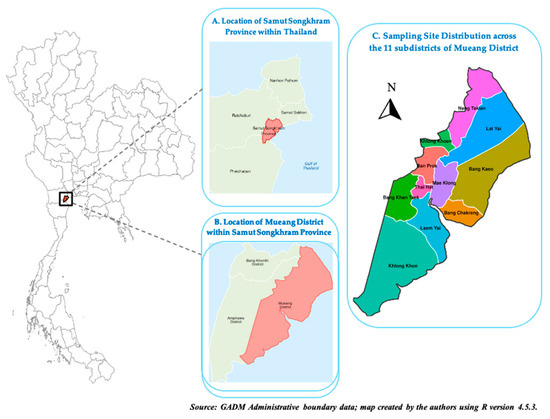
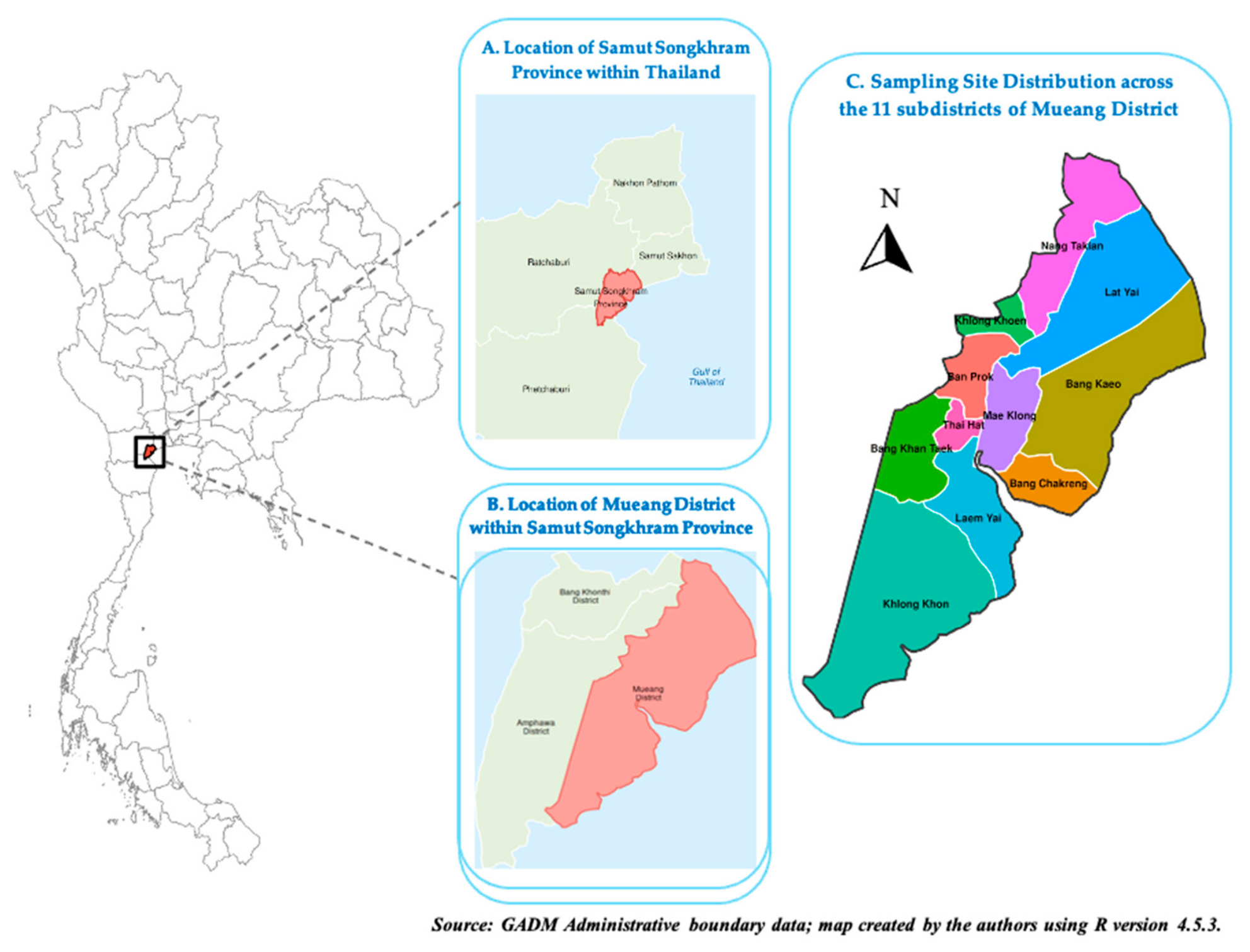
The study was conducted across the 11 subdistricts of Mueang District, Samut Songkhram Province, central Thailand. The district includes municipal, suburban, rural, riverside, and transportation-linked communities. Figure 1 shows the location of Samut Songkhram Province within Thailand, the location of Mueang District within the province, and the subdistrict-level coverage of the proportionate stratified sampling procedure.
Figure 1.
Geographic location and sampling coverage of the study area. (A) Location of Samut Songkhram Province within Thailand, with an inset showing its position in central Thailand. (B) Location of Mueang District within Samut Songkhram Province. (C) Administrative boundaries of the 11 subdistricts included in the proportionate stratified sampling procedure in Mueang District.
2.3. Sample Size and Sampling Procedure
The minimum sample size was calculated using the Krejcie and Morgan finite-population formula: n = χ2NP(1 − P)/[d2(N − 1) + χ2P(1 − P)] [22], where n is the required sample size, χ2 is the chi-square value for one degree of freedom at the 95% confidence level (3.841), N is the target population size (83,383), P is the assumed population proportion (0.50), and d is the margin of error (0.05). Substitution of these parameters produced a minimum required sample of approximately 383 participants. The recruitment target was increased by 80 participants, equivalent to approximately 20.9%, to account for potential non-responses and incomplete questionnaires, resulting in a target of 463 participants. No design effect was applied because participants were sampled as individuals through proportionate stratification by subdistrict rather than through cluster sampling.
The sample was allocated proportionately across the 11 subdistricts according to their adult population sizes. The final analytic sample of 375 participants represented 97.9% of the minimum sample calculated using the finite-population formula and provided approximately 42 observations for each of the nine literacy dimensions included in the regression model. Although the final sample was eight participants below the calculated minimum, it was considered adequate for estimating the prespecified multivariable model. Nevertheless, the shortfall was considered when interpreting the precision and generalizability of the findings.
2.4. Research Instruments
Data were collected using a structured questionnaire consisting of four sections.
The first section assessed demographic characteristics, including sex, age, occupation, monthly income, presence of underlying disease, residential area, and length of residence in the current area.
The second section measured health literacy related to PM2.5 protection. This instrument was developed based on a review of relevant literature [11] and adapted to the Thai community context. It consisted of 22 items covering four dimensions: access to PM2.5 protection information, understanding of PM2.5 protection information, verification of PM2.5 protection information, and decision-making for PM2.5 protection. Responses were rated on a five-point scale ranging from 1 = strongly disagree to 5 = strongly agree. Mean scores were interpreted as poor health literacy (1.00–3.00), moderate health literacy (3.01–4.00), and good health literacy (4.01–5.00). In the present study, the Cronbach’s alpha coefficient for the health literacy scale was 0.89.
The third section assessed digital health literacy related to PM2.5. This instrument was developed based on the eHealth literacy concept proposed by Norman and Skinner [17] and the Digital Health Literacy Instrument developed by van der Vaart and Drossaert [16]. It consisted of 25 items across five dimensions: accessing digital information about PM2.5, evaluating the credibility of information, understanding and interpreting health information, using information for health decision-making, and responsibly sharing health information. Responses were rated on a five-point Likert scale. Total scores ranged from 25 to 125 and were classified into three levels: low digital health literacy (25–75), moderate digital health literacy (76–100), and high digital health literacy (101–125). In the present study, the Cronbach’s alpha coefficient for the digital health literacy scale was 0.90.
The fourth section measured self-care behaviors for PM2.5 protection. This instrument was adapted from a previously developed self-care behavior scale for health protection [23] and was modified for PM2.5-related behaviors. It consisted of 19 items covering two dimensions: health monitoring behaviors related to PM2.5 exposure and behaviors to prevent PM2.5 exposure. Responses were rated on a five-point Likert scale according to frequency of practice, ranging from 1 = never practiced to 5 = regularly practiced. Mean scores were interpreted as needing improvement (1.00–3.00), moderate self-care behavior (3.01–4.00), and good self-care behavior (4.01–5.00). In the present study, the Cronbach’s alpha coefficient for the self-care behavior scale was 0.79.
Several procedures were used to strengthen questionnaire validity, reliability, administration consistency, and data quality. The instruments were developed or adapted from established conceptual frameworks and previously used measures. Three experts in nursing research, public health administration, and community health evaluated the relevance, clarity, and contextual appropriateness of the items. Internal consistency was acceptable to high, with Cronbach’s alpha coefficients of 0.89 for health literacy, 0.90 for digital health literacy, and 0.79 for self-care behaviors. Standardized information and instructions were provided to participants, and returned questionnaires were checked for completeness before data entry. Nevertheless, because the measures were self-reported, recall and social-desirability biases could not be completely excluded.
A detailed summary of the questionnaire components, including the constructs, dimensions, number of items, response formats, score ranges, instrument sources, representative item content, and internal consistency coefficients, is provided in Table A1 (Appendix A). Because parts of the questionnaire were adapted from previously developed instruments and may be subject to copyright and permission restrictions, the complete item-level questionnaire is not included in Appendix A. The full instrument may be available from the corresponding author upon reasonable request, subject to applicable copyright, ethical, and permission requirements.
2.5. Data Collection
Data collection was conducted from January to March 2026 after ethical approval was obtained. We coordinated with community leaders, village health volunteers, and local public health officers to explain the study objectives and request support for recruitment and data collection. Eligible participants were informed about the purpose of the study, study procedures, confidentiality, voluntary participation, and their right to withdraw from the study at any time without penalty.
Participants who agreed to participate provided informed consent before completing the questionnaire. The questionnaire was distributed in both paper-based and online formats according to participants’ preferences and accessibility. Completion of the questionnaire took approximately 20–30 min. We checked all returned questionnaires for completeness before data entry and analysis.
2.6. Data Analysis
Data were analyzed using IBM SPSS Statistics, version 29.0 (IBM Corp., Armonk, NY, USA). Before analysis, the dataset was screened for coding errors, missing values, and univariate outliers. Descriptive statistics were used to summarize participant characteristics and the study variables. Frequencies and percentages were reported for categorical variables, whereas means and standard deviations were calculated for continuous variables.
The distributional characteristics of the continuous composite scores were evaluated using histograms, normal probability plots, and skewness and kurtosis statistics. The assumptions of multiple linear regression were assessed by examining scatterplots and residual plots for linearity and homoscedasticity, a normal probability plot of standardized residuals for residual normality, and the Durbin–Watson statistic for the independence of errors. No variable transformations were applied because the composite scores were analyzed in their original scales and no substantial departures requiring transformation were identified during data screening.
Multiple linear regression using the enter method was selected because the dependent variable was a continuous composite self-care behavior score and the study sought to estimate the unique associations of multiple health-literacy and digital-health-literacy dimensions within one model. Standardized regression coefficients were used to compare the relative contributions of the dimensions after accounting for their shared variance. The term “predictor” refers to statistical prediction within the cross-sectional model and does not imply temporal or causal prediction.
Alternative predictive methods were not compared because the study was designed to examine theoretically specified associations rather than to develop or externally validate a prediction algorithm. Categorizing the continuous outcome for logistic regression would have resulted in loss of information, while structural equation modeling and machine-learning approaches would address different research purposes. Future studies could compare alternative models using larger independent samples and out-of-sample validation.
Multicollinearity was assessed using tolerance and variance inflation factor values. Tolerance values greater than 0.10 and VIF values below 5.00 were considered acceptable. The independence of residuals was evaluated using the Durbin–Watson statistic, with values close to 2.00 indicating no substantial autocorrelation. Unstandardized regression coefficients, standard errors, standardized coefficients, t statistics, and p-values were reported. The coefficient of determination (R2) and adjusted R2 were used to indicate the proportion of variance in self-care behaviors explained by the regression model. Statistical significance was set at p < 0.05. The statistical analyses and assessment of regression assumptions followed established guidance for multivariable analysis [24,25].
3. Results
3.1. Characteristics of Participants
A total of 375 participants were included in the final analysis. Most participants were male (67.20%), aged 60 years or older (28.80%), followed by those aged 51–60 years (26.90%). Regarding occupation, the largest proportion of participants were employed as general workers (32.00%), followed by those who were unemployed (19.70%) and those engaged in trading or private business (18.50%). More than half of the participants reported a monthly income below 10,000 Thai baht (56.30%). In terms of health status, 41.10% reported having at least one underlying disease. Nearly half of the participants lived in municipal or urban areas (48.00%), and most had lived in their current residence for more than 20 years (72.00%) (Table 1).
Table 1.
Demographic characteristics of participants.
3.2. Levels of Health Literacy, Digital Health Literacy, and Self-Care Behaviors for PM2.5 Protection
Table 2 presents the levels of health literacy, digital health literacy, and self-care behaviors for PM2.5 protection. More than half of the participants had a moderate level of health literacy (55.20%), followed by poor health literacy (22.90%) and good health literacy (21.90%). Similarly, most participants had a moderate level of digital health literacy (52.00%), while 30.40% had a high level and 17.60% had a low level. Regarding self-care behaviors for PM2.5 protection, 56.30% of participants reported moderate behaviors, 32.50% reported good behaviors, and 11.20% reported behaviors needing improvement.
Table 2.
Levels of health literacy, digital health literacy, and self-care behaviors for PM2.5 protection.
Table 3 shows the mean scores for health literacy, digital health literacy, and self-care behaviors for PM2.5 protection. The overall mean score for health literacy was 3.50 (SD = 0.71), indicating a moderate level. Among the health literacy dimensions, decision-making for PM2.5 protection had the highest mean score (M = 3.74, SD = 0.77), while understanding PM2.5 protection information had the lowest mean score (M = 3.40, SD = 0.68).
Table 3.
Mean scores of health literacy, digital health literacy, and self-care behaviors for PM2.5 protection.
The overall mean score for digital health literacy was 94.00 (SD = 12.54), indicating a moderate level. The highest mean score was observed for accessing digital information about PM2.5 (M = 19.42, SD = 3.12), whereas responsibly sharing health information had the lowest mean score (M = 18.02, SD = 3.81). The overall mean score for self-care behaviors was 3.75 (SD = 0.67), also indicating a moderate level. The mean score for behaviors to prevent PM2.5 exposure (M = 4.00, SD = 0.70) was higher than that for health-monitoring behaviors related to PM2.5 exposure (M = 3.50, SD = 0.65).
The concentration of participants in the moderate categories indicates that most respondents reported some capacity to locate, understand, and use PM2.5-related information but had not consistently reached the upper response range across all dimensions. This pattern was particularly evident for responsible information sharing and the use of digital information for health decision-making, which showed lower mean scores than access to digital information about PM2.5.
3.3. Factors Associated with Self-Care Behaviors for PM2.5 Protection
Multiple linear regression analysis was conducted to examine the independent associations of health literacy and digital health literacy dimensions with self-care behaviors for PM2.5 protection. The overall model explained 28.1% of the variance in self-care behaviors (R2 = 0.281; adjusted R2 = 0.263).
Among the health literacy dimensions, access to PM2.5 protection information (β = 0.12, p = 0.020), verification of PM2.5 protection information (β = 0.14, p = 0.041), and decision-making for PM2.5 protection (β = 0.26, p = 0.001) were significantly associated with self-care behaviors. Understanding PM2.5 protection information was not independently associated with self-care behaviors after the other dimensions were included in the model (β = 0.08, p = 0.368).
All five digital health literacy dimensions were significantly associated with self-care behaviors for PM2.5 protection. These dimensions included accessing digital information about PM2.5 (β = 0.19, p = 0.025), evaluating information credibility (β = 0.24, p = 0.003), understanding and interpreting health information (β = 0.18, p = 0.036), using information for health decision-making (β = 0.31, p < 0.001), and responsibly sharing health information (β = 0.15, p = 0.049).
The standardized coefficients indicated that using digital information for health decision-making had the largest unique association with self-care behaviors (β = 0.31), followed by decision-making for PM2.5 protection (β = 0.26) and evaluation of information credibility (β = 0.24). These coefficients were interpreted comparatively within the present model and should not be regarded as universal effect-size categories (Table 4).
Table 4.
Multiple linear regression analysis of factors associated with self-care behaviors for PM2.5 protection.
4. Discussion
This study found that adults in Mueang District, Samut Songkhram Province, had moderate levels of health literacy, digital health literacy, and self-care behaviors for PM2.5 protection. This pattern suggests that most participants had some capacity to locate and use PM2.5-related information but did not consistently demonstrate the highest levels of information appraisal, responsible sharing, or translation of information into protective action. Similar studies in Thailand have reported that PM2.5-related literacy and protective behaviors vary according to access to information, risk perception, and the ability to apply environmental health guidance [18,20,26,27]. The moderate levels observed in the present study may also reflect the dynamic nature of PM2.5 risk, which requires repeated decisions concerning outdoor activities, mask use, indoor air quality, and air-quality monitoring. Thus, receiving information may be insufficient when individuals lack the resources, confidence, or practical opportunities required to act on it consistently.
Access to PM2.5 protection information, information verification, and decision-making were significantly associated with self-care behaviors, whereas understanding PM2.5 information did not make a statistically significant unique contribution after the other literacy dimensions were entered into the model. This result should not be interpreted as indicating that comprehension is unimportant. Rather, the regression coefficients represent the unique association of each dimension after accounting for their shared variance. Rather, the regression coefficients represent the unique association of each dimension after accounting for their shared variance. Perceived understanding may overlap with information access, verification, and decision-making, thereby reducing its independent statistical contribution. Moreover, the instrument assessed self-reported understanding rather than objectively demonstrated comprehension, such as interpreting an AQI value or selecting an appropriate response to a hypothetical pollution episode.
The standardized coefficients showed that using digital information for health decision-making had the largest unique association with self-care behaviors (β = 0.31), followed by PM2.5-specific decision-making (β = 0.26) and evaluation of information credibility (β = 0.24). These coefficients are best interpreted comparatively within the present model rather than as fixed universal categories of small, medium, or large effects. Collectively, the findings indicate that action-oriented and evaluative literacy skills may be more directly connected with protective practices than perceived understanding alone. This interpretation is consistent with previous Thai studies reporting positive relationships between environmental health literacy, access to air-quality information, and PM2.5 preventive behaviors [18,28,29].
Digital health literacy was also importantly associated with self-care behaviors in this study. All five dimensions—accessing digital information, evaluating credibility, understanding and interpreting health information, using information for decision-making, and responsibly sharing information—were significantly associated with PM2.5 self-care behaviors. The strongest association was using digital health information for health decision-making. This finding is consistent with recent reviews showing that higher digital health literacy is generally associated with better health information navigation, self-management, and health-related behaviors [27,30,31]. In the current digital environment, people frequently obtain PM2.5 information through social media, mobile applications, air quality websites, and online news [32]. Therefore, the ability to evaluate source credibility and apply digital information is essential for avoiding misinformation and choosing appropriate protective actions.
The socioeconomic profile of the participants provides an additional context for interpreting the moderate literacy and self-care levels. More than half of the sample reported a monthly income below THB 10,000, and substantial proportions were general workers, unemployed, or engaged in occupations that may involve limited flexibility or outdoor exposure. Lower income may restrict access to reliable digital devices, mobile data, high-quality protective masks, and indoor air-filtration equipment, while occupational demands may make it difficult to avoid outdoor activity even when air-quality warnings are understood. Digital health literacy should therefore not be viewed solely as an individual cognitive skill; it is also shaped by access to technology, socioeconomic resources, social support, and opportunities to use digital information. Recent reviews have found that digital health literacy among older adults is influenced by sociodemographic characteristics, device access and use, and social support [33]. Evidence also indicates that digital exclusion disproportionately affects older adults with lower incomes and education and may reinforce existing health inequalities [34]. Education information was not collected in the present study, so its potential contribution could not be examined. Future research should assess whether income, education, occupation, age, and digital access modify the relationships between literacy and PM2.5 protective behaviors.
The significant association between responsible information sharing and PM2.5 self-care behavior also requires careful interpretation. In this study, responsible sharing was assessed through five self-reported items addressing participants’ perceived practices and judgment when communicating PM2.5-related information, including whether they considered source credibility, information accuracy, and potential consequences before sharing or forwarding content. The measure did not capture objectively verified online behavior, digital trace data, or peer-reported sharing. Accordingly, the result may reflect perceived practices, attitudes, or intentions and may be influenced by social desirability.
Nevertheless, responsible sharing remains relevant because health misinformation is widespread across social media and can influence public understanding and decision-making [35]. Experimental evidence further suggests that prompting users to consider accuracy can reduce misplaced trust in health misinformation and encourage greater attention to information credibility [36]. PM2.5 risk communication should therefore promote not only information access but also source verification and deliberate sharing. Future research could validate this dimension using behavioral scenarios, platform-based observations, peer reports, or ethically collected digital trace data.
From a sustainability perspective, these findings highlight the role of human behavior and digital information skills in promoting sustainable well-being under environmental health risk. PM2.5 pollution cannot be solved through individual behavior alone, but informed self-care can reduce exposure and support community resilience while broader environmental and policy measures are implemented [3,6]. Public health agencies should develop locally relevant digital communication strategies that provide clear, evidence-based, and actionable messages [14]. Community health volunteers, local health officers, schools, and digital platforms may also be used to improve health literacy and digital health literacy, particularly among older adults, low-income groups, and people living in high-exposure areas. Digital health literacy interventions have shown promise in improving access to reliable health information and supporting health-related decision-making [37,38,39].
This study has some limitations. First, the cross-sectional design limits causal interpretation. Second, all variables were measured using self-reported questionnaires, which may be affected by recall bias or social desirability bias. Third, the study was conducted in one district of Thailand; therefore, the findings may not be generalizable to all populations or regions with different PM2.5 exposure patterns. Future studies should consider longitudinal designs, objective exposure data, and intervention studies to test whether improving health literacy and digital health literacy can lead to sustained improvements in PM2.5 protective behaviors and well-being. The final analytic sample was slightly smaller than the minimum calculated using the finite-population formula, which may have modestly reduced the precision of the estimates. In addition, the study used a theory-driven multiple linear regression model and did not compare alternative statistical or machine-learning approaches. Future research could use larger independent samples, longitudinal designs, structural equation modeling, and cross-validated predictive methods to evaluate the robustness and predictive performance of the observed relationships. Additionally, the age–sex composition of the sample should be considered when interpreting the findings. Although proportionate stratified sampling was used to ensure representation across the 11 subdistricts, the sampling procedure was not stratified by age or sex. The relatively high proportion of men and older adults may reflect differences in availability, willingness to participate, or access through community recruitment channels. Consequently, the sample may not fully represent the demographic distribution of the wider population, and the findings should be generalized cautiously, particularly to women and younger adults.
5. Conclusions
Three principal findings emerged from this study. First, health literacy, digital health literacy, and self-care behaviors for PM2.5 protection were generally at moderate levels, suggesting that access to information did not consistently translate into strong appraisal skills or sustained protective practices. Second, selected dimensions of health literacy and the measured dimensions of digital health literacy were associated with self-care behaviors for PM2.5 protection. Third, the most influential dimensions involved using digital information for health decision-making, making PM2.5-specific protective decisions, and evaluating information credibility. These findings underscore the need for PM2.5 risk communication strategies that move beyond general information provision. Community-based interventions should strengthen practical skills in source evaluation, air-quality interpretation, and action-oriented decision-making while also addressing socioeconomic constraints, occupational exposure, and inequalities in digital access. Such approaches could support more equitable protective behaviors, community resilience, and sustainable well-being in populations affected by air pollution.
Author Contributions
Conceptualization, B.C., J.N. and J.O.; methodology, B.C., J.S. and J.O.; validation, P.R., V.C., J.S. and J.O.; formal analysis, J.S. and J.O.; investigation, B.C. and J.N.; resources, B.C., P.R. and V.C.; data curation, J.N. and J.O.; writing—original draft preparation, B.C., J.N. and J.O.; writing—review and editing, P.R., V.C., J.S. and J.O.; supervision, J.O.; project administration, B.C. and J.O. All authors have read and agreed to the published version of the manuscript.
Funding
This research received no external funding.
Institutional Review Board Statement
The study was conducted according to the guidelines of the Declaration of Helsinki and approved by the Institutional Review Board of Suan Sunandha Rajabhat University, Thailand (COE.2-507/2025, dated 11 November 2025).
Informed Consent Statement
Informed consent for participation was obtained from all subjects involved in the study.
Data Availability Statement
The data presented in this study are available from the corresponding author upon reasonable request. The data are not publicly available due to privacy and ethical restrictions related to participant confidentiality.
Acknowledgments
We would like to sincerely thank all participants for their time and valuable contributions to this study. This research project was financially supported by Mahasarakham University. During the preparation of this manuscript, the authors used Grammarly (grammarly.com) to support English language editing. The authors reviewed and edited the output and take full responsibility for the content of this publication.
Conflicts of Interest
The authors declare no conflicts of interest.
Abbreviations
The following abbreviations are used in this manuscript:
| AQI | Air Quality Index |
| PM2.5 | Fine Particulate Matter with an Aerodynamic Diameter of 2.5 μm or Smaller |
| SD | Standard Deviation |
| VIF | Variance Inflation Factor |
Appendix A. Summary of the Study Questionnaire
This appendix provides a summary of the questionnaire used in this study. The questionnaire consisted of four sections covering participant characteristics, health literacy related to PM2.5 protection, digital health literacy related to PM2.5, and self-care behaviors for PM2.5 protection. To support transparency and reproducibility, the table below summarizes the constructs, dimensions, number of items, response formats, score ranges, instrument sources, and internal consistency coefficients. Because parts of the questionnaire were adapted from previously developed instruments and may be subject to copyright and permission restrictions, the complete item-level questionnaire is not reproduced in this manuscript. The full instrument may be available from the corresponding author upon reasonable request, subject to applicable copyright, ethical, and permission requirements.
Table A1.
Summary of the study questionnaire.
References
- Azimi, M.N.; Rahman, M.M. Unveiling the health consequences of air pollution in the world’s most polluted nations. Sci. Rep. 2024, 14, 9856. [Google Scholar] [CrossRef] [Scilit] [PubMed]
- World Health Organization. Ambient (Outdoor) Air Pollution. Available online: https://www.who.int/news-room/fact-sheets/detail/ambient-(outdoor)-air-quality-and-health (accessed on 1 March 2026).
- World Health Organization. Health Consequences of Air Pollution on Populations. Available online: https://www.who.int/news/item/25-06-2024-what-are-health-consequences-of-air-pollution-on-populations (accessed on 27 March 2026).
- Yu, W.; Xu, R.; Ye, T.; Abramson, M.J.; Morawska, L.; Jalaludin, B.; Johnston, F.H.; Henderson, S.B.; Knibbs, L.D.; Morgan, G.G.; et al. Estimates of global mortality burden associated with short-term exposure to fine particulate matter (PM2.5). Lancet Planet. Health 2024, 8, e146–e155. [Google Scholar] [CrossRef] [Scilit] [PubMed]
- Guo, J.; Chai, G.; Song, X.; Hui, X.; Li, Z.; Feng, X.; Yang, K. Long-term exposure to particulate matter on cardiovascular and respiratory diseases in low- and middle-income countries: A systematic review and meta-analysis. Front. Public Health 2023, 11, 1134341. [Google Scholar] [CrossRef] [Scilit] [PubMed]
- Ounsaneha, W.; Bhatta, J.; Rattanapan, C. Factors related to protective behaviors and interventions targeting PM2.5 exposure reduction: A systematic review. Green Technol. Sustain. 2026, 4, 100256. [Google Scholar] [CrossRef] [Scilit]
- Suriyawong, P.; Chuetor, S.; Samae, H.; Piriyakarnsakul, S.; Amin, M.; Furuuchi, M.; Hata, M.; Inerb, M.; Phairuang, W. Airborne particulate matter from biomass burning in Thailand: Recent issues, challenges, and options. Heliyon 2023, 9, e14261. [Google Scholar] [CrossRef] [Scilit] [PubMed]
- Qiao, S.; Guo, Q.; He, Z.; Feng, G.; Wang, Z.; Li, X. Spatiotemporal Trends and Drivers of PM2.5 Concentrations in Shandong Province from 2014 to 2023 Under Socioeconomic Transition. Toxics 2025, 13, 978. [Google Scholar] [CrossRef] [Scilit] [PubMed]
- Vongruang, P.; Suppoung, K.; Kirtsaeng, S.; Prueksakorn, K.; Thao, P.T.B.; Pimonsree, S. Development of Meteorological Criteria for Classifying PM2.5 Risk in a Coastal Industrial Province in Thailand. Aerosol Air Qual. Res. 2024, 24, 230321. [Google Scholar] [CrossRef] [Scilit]
- Rattanaphra, D.; Tawkaew, S.; Kingkam, W.; Nuchdang, S.; Kitpakornsanti, K.; Suwanmanee, U. Health impacts and risk assessment of PM2.5 and PM10 at Suburban Site in Pathum Thani, Thailand. Toxicol. Rep. 2025, 15, 102109. [Google Scholar] [CrossRef] [Scilit] [PubMed]
- Nutbeam, D.; Lloyd, J.E. Understanding and Responding to Health Literacy as a Social Determinant of Health. Annu. Rev. Public Health 2021, 42, 159–173. [Google Scholar] [CrossRef] [Scilit] [PubMed]
- Suksatan, W.; Teravecharoenchai, S.; Sarayuthpitak, J. Determinants of the health-promoting behaviors among community-dwelling older adults with non-communicable diseases during the post-COVID-19 era. J. Nurs. Midwifery Sci. 2024, 11, e144587. [Google Scholar] [CrossRef] [Scilit]
- Suksatan, W.; Teravecharoenchai, S.; Sarayuthpitak, J. Health-Promoting Behaviors among Older Adults with Noncommunicable Diseases in Rural and Urban Areas during the New Normal Post-COVID-19 Era: A Structural Equation Modeling Analysis. Nutrients 2022, 15, 101. [Google Scholar] [CrossRef] [Scilit] [PubMed]
- Pfleger, E.; Adrian, C.; Lutz, R.; Drexler, H. Science communication on the public health risks of air pollution: A computational scoping review from 1958 to 2022. Arch. Public Health 2023, 81, 14. [Google Scholar] [CrossRef] [Scilit] [PubMed]
- Hasannejadasl, H.; Roumen, C.; Smit, Y.; Dekker, A.; Fijten, R. Health Literacy and eHealth: Challenges and Strategies. JCO Clin. Cancer Inform. 2022, 6, e2200005. [Google Scholar] [CrossRef] [Scilit] [PubMed]
- van der Vaart, R.; Drossaert, C. Development of the Digital Health Literacy Instrument: Measuring a Broad Spectrum of Health 1.0 and Health 2.0 Skills. J. Med. Internet Res. 2017, 19, e27. [Google Scholar] [CrossRef] [Scilit] [PubMed]
- Norman, C.D.; Skinner, H.A. eHealth Literacy: Essential Skills for Consumer Health in a Networked World. J. Med. Internet Res. 2006, 8, e9. [Google Scholar] [CrossRef] [Scilit] [PubMed]
- Pansakun, N.; Naksen, W.; Boonchieng, W.; Ong-Artborirak, P.; Prapamontol, T. Environmental Health Literacy Regarding Fine Particulate Matter and Related Factors Among Village Health Volunteers in Upper Northern Thailand. J. Prev. Med. Public Health 2024, 57, 138–147. [Google Scholar] [CrossRef] [Scilit] [PubMed]
- Kausar, S.; Cao, X.; Yadoung, S.; Wongta, A.; Zhou, K.; Kosashunhanan, N.; Hongsibsong, S. Associations Between Individual Health Risk Perceptions and Biomarkers of PAH Exposure Before and After PM2.5 Pollution in the Suburbs of Chiang Mai Province. Toxics 2025, 13, 491. [Google Scholar] [CrossRef] [Scilit] [PubMed]
- Luangwilai, T.; Ong-Artborirak, P.; Manomaipiboon, B.; Ruamtawee, W.; Kunno, J. PM2.5 risk perception and associated with sociodemographic factors in urban Thailand. Sci. Rep. 2025, 15, 32283. [Google Scholar] [CrossRef] [Scilit] [PubMed]
- Luangwilai, T.; Kunno, J.; Manomaipiboon, B.; Ruamtawee, W.; Ong-Artborirak, P. Risk Perception and Self-Monitoring of Particulate Matter 2.5 (PM 2.5) Associated with Anxiety Among General Population in Urban Thailand. Urban Sci. 2025, 9, 256. [Google Scholar] [CrossRef] [Scilit]
- Krejcie, R.V.; Morgan, D.W. Determining Sample Size for Research Activities. Educ. Psychol. Meas. 1970, 30, 607–610. [Google Scholar] [CrossRef] [Scilit]
- Intarakamhang, U. Development and Application of a Health Literacy Assessment Instrument for Thai Adults in Practicing the 3E Principles. Available online: http://bsris.swu.ac.th/upload/243362.pdf (accessed on 27 March 2026).
- Field, A. Discovering Statistics Using IBM SPSS Statistics; Sage Publications: New York, NY, USA, 2013. [Google Scholar]
- Hahs-Vaughn, D.L. Applied Multivariate Statistical Concepts; Routledge: New York, NY, USA, 2024. [Google Scholar]
- Bhatta, J.; Laosee, O.; Rattanapan, C. Factors related to preventive measures towards PM2.5 exposure: A systematic review. Glob. Transit. 2024, 6, 212–220. [Google Scholar] [CrossRef] [Scilit]
- Ban, S.; Kim, Y.; Seomun, G. Digital health literacy: A concept analysis. Digit. Health 2024, 10, 20552076241287894. [Google Scholar] [CrossRef] [Scilit] [PubMed]
- Srisupak, R.; Srisawangwong, S. Factors Associated with Environmental Health Literacy of People in Maha Sarakham Town Municipality, Maha Sarakham Province. Life Sci. Environ. J. 2025, 26, 234–248. [Google Scholar] [CrossRef]
- Kaojaree, T.; Saenta, B.; Jomin, N.; Bunnag, S.; Chantian, T.; Chaiut, W.; Mee-Inta, A.; Kaewboonchoo, T.; Ruanjai, T. Factors Influencing Self-Protective Behaviors from Exposure to Fine Particulate Matter Among Community-Dwelling People in Chiang Rai, Thailand. Res. Med. J. 2026, e277547. [Google Scholar] [CrossRef] [Scilit]
- Ji, H.; Dong, J.; Pan, W.; Yu, Y. Associations between digital literacy, health literacy, and digital health behaviors among rural residents: Evidence from Zhejiang, China. Int. J. Equity Health 2024, 23, 68. [Google Scholar] [CrossRef] [Scilit] [PubMed]
- Yuen, E.; Winter, N.; Savira, F.; Huggins, C.E.; Nguyen, L.; Cooper, P.; Peeters, A.; Anderson, K.; Bhoyroo, R.; Crowe, S.; et al. Digital Health Literacy and Its Association With Sociodemographic Characteristics, Health Resource Use, and Health Outcomes: Rapid Review. Interact. J. Med. Res. 2024, 13, e46888. [Google Scholar] [CrossRef] [Scilit] [PubMed]
- Schulte, K. ‘Real-time’ air quality channels: A technology review of emerging environmental alert systems. Big Data Soc. 2022, 9, 20539517221101346. [Google Scholar] [CrossRef] [Scilit]
- Shi, Z.; Du, X.; Li, J.; Hou, R.; Sun, J.; Marohabutr, T. Factors influencing digital health literacy among older adults: A scoping review. Front. Public Health 2024, 12, 1447747. [Google Scholar] [CrossRef] [Scilit] [PubMed]
- Yang, R.; Gao, S.; Jiang, Y. Digital divide as a determinant of health in the U.S. older adults: Prevalence, trends, and risk factors. BMC Geriatr. 2024, 24, 1027. [Google Scholar] [CrossRef] [Scilit] [PubMed]
- Suarez-Lledo, V.; Alvarez-Galvez, J. Prevalence of Health Misinformation on Social Media: Systematic Review. J. Med. Internet Res. 2021, 23, e17187. [Google Scholar] [CrossRef] [Scilit] [PubMed]
- Edelson, S.M.; Reyna, V.F.; Singh, A.; Roue, J.E. The Psychology of Misinformation Across the Lifespan. Annu. Rev. Dev. Psychol. 2024, 6, 425–454. [Google Scholar] [CrossRef] [Scilit]
- Ghorbanian Zolbin, M.; Huvila, I.; Nikou, S. Health literacy, health literacy interventions and decision-making: A systematic literature review. J. Doc. 2022, 78, 405–428. [Google Scholar] [CrossRef] [Scilit]
- Nutakor, J.A.; Zhou, L.; Larnyo, E.; Addai-Dansoh, S.; Cui, Y. Impact of health information seeking behavior and digital health literacy on self-perceived health and depression symptoms among older adults in the United States. Sci. Rep. 2024, 14, 31080. [Google Scholar] [CrossRef] [Scilit] [PubMed]
- Bober, T.; Rollman, B.L.; Handler, S.; Watson, A.; Nelson, L.A.; Faieta, J.; Rosland, A.-M. Digital health readiness: Making digital health care more inclusive. JMIR mHealth uHealth 2024, 12, e58035. [Google Scholar] [CrossRef] [Scilit] [PubMed]

Disclaimer/Publisher’s Note: The statements, opinions and data contained in all publications are solely those of the individual author(s) and contributor(s) and not of MDPI and/or the editor(s). MDPI and/or the editor(s) disclaim responsibility for any injury to people or property resulting from any ideas, methods, instructions or products referred to in the content. |
© 2026 by the authors. Licensee MDPI, Basel, Switzerland. This article is an open access article distributed under the terms and conditions of the Creative Commons Attribution (CC BY) license.