


Abstract
Quality of life is a multidimensional concept that includes characteristics of the residence and the wider living environment. The aim of the paper is to examine whether age groups differ in satisfaction with selected spatial characteristics of the residence and the immediate living environment, and whether comparable differences occur in the perceived healthy living environment. The research considers age and perceived quality of life on three distinct levels: specific spatial characteristics of the residence (for example, the presence of a balcony, terrace, daylighting and window view) with selected environmental characteristics of the immediate surroundings (open view, view of green areas, accessibility of green areas) and a broader perception of a healthy living environment (general perception of health and well-being). The research is based on questionnaire results that included 473 participants. The data were analyzed using analysis of variance, Tukey–Kramer comparisons and correlation analysis. The results show statistically significant differences between age groups, especially in regard to satisfaction with the presence of a balcony, terrace or atrium, to daylighting and the quality of the window view in the residences, with the satisfaction being lowest in the younger and highest in the older age group. Interestingly, there were no statistically significant differences in the general perception of a healthy living environment. The correlation analysis further showed that satisfaction and age was associated with home ownership, dwelling type, residential location and housing-cost burden, whereas proximity to green areas was not linearly associated with age. The findings showed that specific age groups perceived the quality of the living environment more pronouncedly when linked with specific spatial characteristics of the dwelling rather than the broader perception of the living environment.
1. Introduction
In the context of sustainable development, modern cities are increasingly characterized by urbanization, spatial densification, and pressure for more efficient land use. This is not surprising, since urban sprawl continues to be a major challenge even in countries with declining populations and with housing, industry and infrastructure development continuing to put pressure on peri-urban land [1,2]. Although densification is generally understood as an important part of sustainable urban development, the question of how such processes affect the quality of the living environment and the everyday experience of living is also raised. For a long time, discussions on sustainability have been dominated by indicators related to the use of space, energy efficiency, and infrastructural rationality, while the experiential quality of living space has often been considered marginally. In recent years, however, research on the built environment has increasingly shifted from a technical and energy-oriented approach to a human-centered understanding of living quality, in which the health, well-being, comfort, and satisfaction of users play an important role [3,4,5]. The topicality of the issue is further strengthened by demographic aging. The World Health Organization estimates that by 2030, one in six people in the world will be 60 years of age or older, and by 2050, the number of people aged 60 or older is expected to double to approximately 2.1 billion; United Nations projections also show that population aging is becoming one of the key demographic challenges that also affects spatial planning, housing policies, and everyday living needs [5,6,7].
1.1. Residential Level—Daylight and View
Among the factors that are increasingly recognized as an important part of maintaining health in the aged population are access to daylight and the quality of the window view [8]. A window is not only a building element that allows the daylighting of the interior space, but also an interface between the interior living environment and the wider urban or landscape context. Through the window, the user obtains visual information about the weather, time of day, events in the surroundings, spatial location and character of the space. At the same time, the window view has a significant impact on the experience of space, the feeling of openness, psychological well-being, stress reduction and mental renewal [8,9,10,11]. The issue of the quality of the window view and observed green spaces in densely built urban environments is studied by Kristl, Fošner, and Zbašnik-Senegačnik [12], who address users’ tolerance of views of neighboring facades. The EN 17037 standard [5] further strengthens the importance of daylight and the view outside, as it defines the quality of the interior environment not only in terms of the level of illumination, but also in terms of the view outside, sunlight and glare [3,6]. Access to daylight, quality views and direct outdoor space therefore have a social dimension in addition to the technical one. However, these features are not evenly distributed across various housing situations, and can therefore affect the sense of fairness, security, inclusion and everyday well-being in the living environment [13,14]. The importance of daylight is well supported by research on lighting standards and urban effects [5,8,10,11], while the importance of the window view is supported by research on the perceived quality of the view and views towards nearby facades and greenery [9,12,15].
1.2. Neighborhood Level—Access to Green Areas
The concept of a healthy living environment spans beyond the physical parameters of the residence. It refers to a much broader and general perception of the quality of the immediate living environment that supports health, well-being, safety, comfort, social inclusion and quality of everyday life. In this sense, a healthy living environment is not simply the absence of harmful influences, but a positive experience of the environment that enables an individual to live in a stable, safe and supportive way.
The proximity of parks or green spaces also strongly correlates with this framework. In contrast to daylighting, window view and balcony access, it is not a feature of the housing itself, but a component of the immediate outdoor living environment that allows residents to have daily contact with open space, greenery, opportunities for recreation and social life in the neighborhood. The accessibility of green spaces is associated with well-being, mental health and the quality of the living environment [16], and, in urban planning recommendations, is often considered an important indicator of a supportive living environment [17,18,19,20]. Especially in densely built urban environments, distances between buildings are decreasing, which affects physical contact with the outdoor environment [21,22,23]. Such conditions can also significantly decrease perceived well-being as well as real-estate value [24].
The beneficial effects of green spaces viewed from windows are particularly important for the elderly population [19,25,26]. This is directly relevant to the present research, as it shows that the quality of the window view, as well as access to green spaces, is not a binary attribute, but a complex part of the perceived quality of life.
1.3. Age and Perceived Quality of Life
The general understanding of quality of life and a supportive environment is based on research on the built environment, well-being and housing conditions [4,5,13]. In this context, quality of life is linked to the characteristics of the dwelling and the broader living context that supports health, well-being and a sense of life adequacy [4,5]. This research distinguishes between the narrower physical parameters of the dwelling—balcony, terrace or atrium, the availability of daylight and the quality of the window view—a selected environmental-spatial characteristic of the immediate living environment, i.e., proximity to parks or green spaces, and the broader perception of a healthy living environment as a general assessment of a supportive, safe and suitable environment for everyday life. This approach is supported by the survey of the Swedish housing stock. Although the research setup somewhat differs from the one proposed in this research, it clearly shows that overall satisfaction with housing is influenced by several layers of dwelling characteristics, such as size, layout, appearance and costs, well-being and neighborhood, along with the perceived quality of the indoor environment, including thermal, acoustic and visual comfort and air quality [27].
Further, the role of aging, age-friendly living and a sense of community is supported by research on the life course and social inclusion in the living environment [14,28,29]. The research on aging and the living environment highlights the growing proportion of the elderly population placing new demands on the planning and management of living environments. It is becoming clear that the relationship between aging, the quality of living space and sustainability must be considered holistically [28], as it has very broad implications for health and well-being, equality, sustainability and finance [1,2]. From the perspective of sustainable development [30] and the life course, the question of whether different age groups experience dimensions of living in a similar way is of particular importance.
1.4. Age and Housing Ownership
Recent empirical research on residential buildings reveals that indoor environmental indicators are significantly associated with the satisfaction of residents, especially in the older age groups. Yang et al. [31], for instance, found that the thermal, lighting and acoustic environment and air quality were statistically associated with the satisfaction of older users, with thermal comfort and air quality proving to be particularly important. Taking into account these findings, age can therefore also be considered as an indicator of diverse housing paths, living circumstances and housing needs. Additionally, for older adults, housing often becomes a significant foundation of stability, security, independent daily life, attachment to place, and permanence of the living environment [28,29]. Conversely, in European analyses of living conditions, young adulthood is often associated with the formation of an independent household and with significant exposure to housing limitations, which are also confirmed by recent Eurostat data on the housing conditions of young people, including overcrowding and the housing cost burden of young households [32,33]. Perception of living environment with respect to age was also studied by Grum, who found that older respondents, compared to younger ones, reported higher satisfaction with the living environment, better association with neighbors, a stronger sense of socioeconomic homogeneity in the neighborhood, and a higher rating of the overall quality of the built environment [34,35]. These findings demonstrate the importance of the specific physical conditions of housing for subjective satisfaction, especially in segments of the population that are strongly attached to their residential environment through ownership [36,37,38] and housing status [39]. These elements, although difficult to directly relate, significantly influence health and, therefore, the ability of elderly citizens to remain in their environment for a longer period of time [40,41].
1.5. Research Hypothesis and Objectives
As seen in the review, a longer life implies opportunities but also challenges. Evidence suggests that life expectancy is increasing; however, the proportion of life in good health has remained broadly constant, implying that the additional years are in poor health [6]. Supportive physical and social environments are thus vital not merely to ameliorate the losses associated with older age but also to reinforce recovery, adaptation and psychosocial growth. In the context of aging and sustainability, the existing research covers well health and the positive effects of daylighting, quality of window views, accessibility of green spaces and the importance of the quality living environment. However, there is significantly less research that simultaneously examines specific physical characteristics of the residence, selected environmental characteristics of the immediate surroundings and the broader perception of a healthy living environment by various age groups. This presents a research gap that requires further investigation. To better understand the influence of the specific features in the residential space, the specific aim of this article is thus to examine the influence of age on the selected dimensions of perceived quality of the living environment. The central question is whether age manifests primarily in the perception of specific physical parameters of residence and selected environmental characteristics of the immediate living environment, or also in the broader perception of a healthy living environment.
The considered spatial characteristics of a home in this study are defined quite narrowly and refer to three selected physical parameters: the presence of a balcony, terrace, or atrium; availability of daylight and level of daylighting, and the quality of the window view. These parameters were selected because they link the indoor living space with the outdoor environment and allow a thorough study of their influence on further included parameters. A balcony, terrace, or atrium allows direct contact with the outdoor environment; daylight affects visual comfort, orientation, circadian rhythms, and psychological well-being; the window view establishes a visual connection with the surroundings, sky, nature, neighborhood and wider urban structure [5,9,10,12,15,25,42]. Satisfaction with the proximity of parks or green spaces is included as a supplementary environmental-spatial variable. This variable does not describe the characteristics of the residence itself, but rather defines the accessibility of green open space in the immediate living environment, and therefore represents an intermediate level between the physical characteristics of the residence and the general perception of a healthy living environment [6,13,18,43].
Based on the literature review, three assumptions can be defined as the starting point of the research model: the spatial characteristics of the residence and the immediate living environment are an important part of the perceived quality of life; the quality of the window view and the accessibility of green spaces are perceptually and spatially located dimensions of everyday living; and age groups may value the same spatial conditions differently due to different housing paths, expectations and daily use of the residence [6,9,12,13,15,25]. Given the considered findings, it can be expected that age will influence the perceived importance of features that directly relate to the everyday experience of the living space (i.e., in the residence) and its immediate surroundings. Balcony, terrace or atrium, daylighting, window view and proximity to parks or green spaces are perceptible residence characteristics that may affect the perceived spaciousness, comfort, contact with the outdoor environment, access to greenery and the opportunity for regeneration. Since age groups are often associated with different housing paths like ownership, stability of living situation and changing needs in the course of life, differences in satisfaction with specific spatial and environmental parameters can be expected.
Based on the above considerations, three hypotheses are put forward:
H1.
There are statistically significant differences between age groups in regard to satisfaction with specific spatial parameters of residence, such as the availability of daylight, the quality of the window view and the presence of a balcony, terrace or atrium.
H2.
There are statistically significant differences between age groups in regard to satisfaction with specific environmental parameters of the broader living environment, such as the proximity of parks or green spaces.
H3.
There are no statistically significant differences between age groups in the broader perception of a healthy living environment.
The objective is to determine the influence of age on perception of the living environment; the influence of spatial characteristics of the residence and accessibility of green areas on the perceived quality of life and health; and whether age is also associated with accompanying housing characteristics, such as home ownership, type of housing, location of residence and costs of resolving the housing issue, which may help explain differences in perceived quality of life. The concept of age is used as an analytical category for comparing age groups and not as direct evidence of biological aging or the causal effect of age.
2. Materials and Methods
2.1. Conceptual Framework
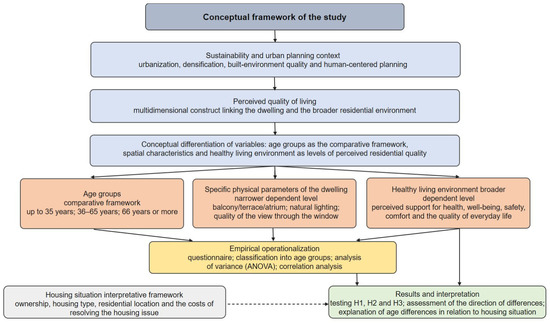
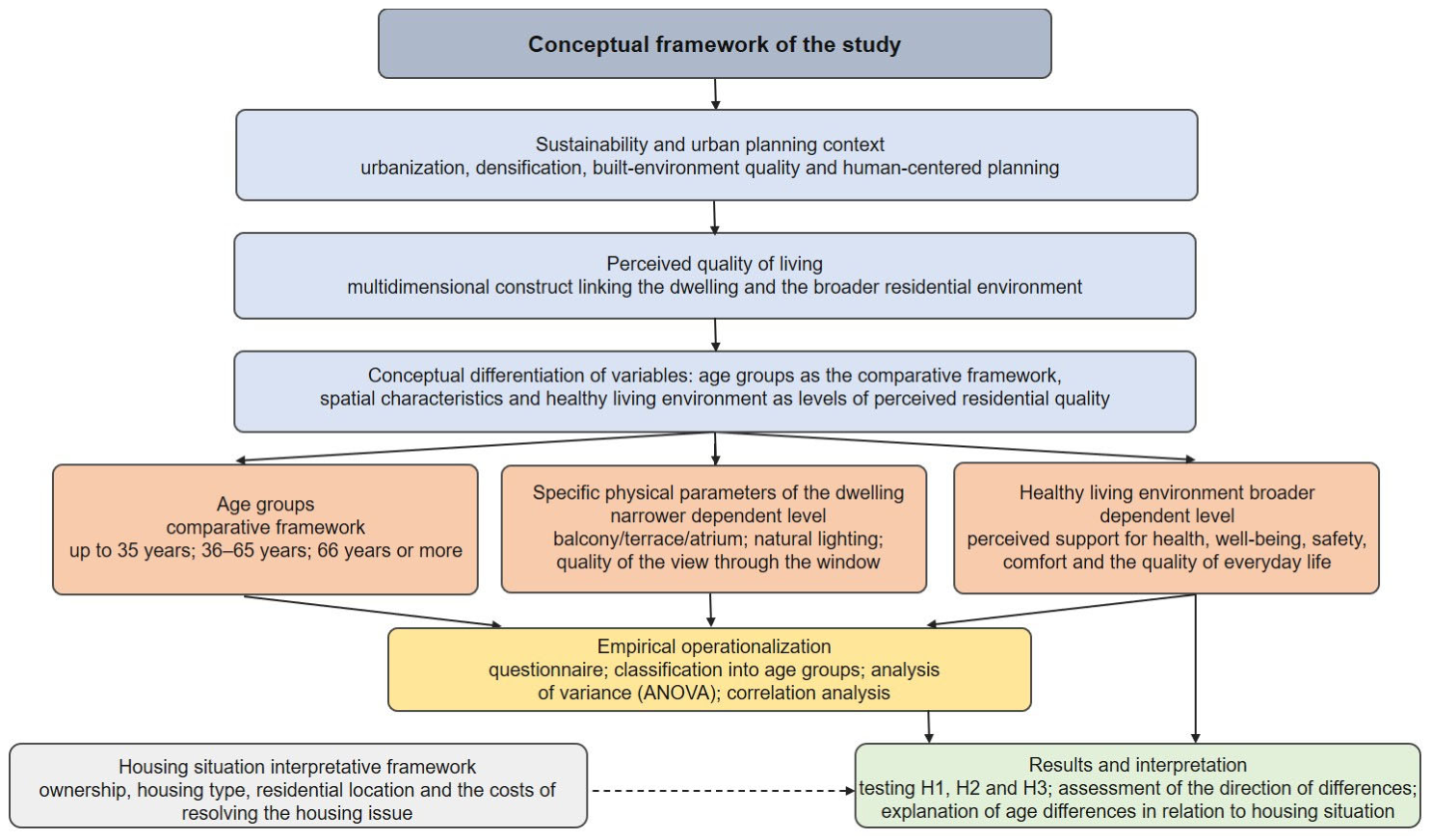
In the proposed model (Figure 1), age acts as a baseline comparison variable and is understood as an indicator of different housing paths, life circumstances, ownership status, location of residence and expectations linked to housing.
Figure 1.
Conceptual framework of the research. Source: Author’s presentation based on key findings from a literature review on the quality of the built and residential environment [3,4,13], daylight, window views and green spaces [7,9,12,15,25], and aging, housing situation and age-friendly living [14,28,29,34].
Age groups rather than a specific age represent a comparative framework for examining differences between the narrow, spatial-material level of perceived quality of life, a selected environmental characteristic of the immediate surroundings, and a broader perception of a healthy living environment. The selected age intervals of below 35 years, from 35 to 65 years and above 66 years are not intended as sharp developmental-psychological boundaries, but as a practical and substantively justified demarcation of the three life periods: young adulthood comprising predominantly the population of people establishing their career and partnerships, middle adulthood comprising predominantly members of the working population with established careers and family, and older adulthood comprising predominantly persons at the end of their careers and with mature family situations. Such a division follows the established European practice in terms of content, in which the above-mentioned broad age groups are often used in analyses of living conditions and well-being [32].
The specific spatial characteristics of the residence and proximity to green spaces act as central dependent variables of perceived quality of life.
The perception of a healthy living environment is discussed separately, because it includes a broader and integrative assessment of living adequacy. Housing situation is not considered as the main independent variable, but rather as an interpretative or contextual framework that helps to understand why age groups may differ in terms of satisfaction with selected spatial and environmental characteristics of the living environment [3,4,13,14,27,28].
2.2. Data Collection
To obtain the data, a quantitative approach is used, based on a previously developed questionnaire used for comprehensive research on urban space and life satisfaction [43]. The questionnaire is based on standard principles of structured surveying, which combines closed-end questions and questions with predetermined answers on a Likert-type five-point scale (1—do not agree, 2—partly not agree, 3—neutral, 4—partly agree, 5—agree) [44]. The questionnaire had previously been pre-tested, ethically proven, and empirically used.
In the present study, only certain variables from the original questionnaire were used that refer to the research purpose, i.e., comparing age with selected spatial characteristics of residence and with the broader perception of a healthy living environment: namely, access to balcony, terrace or atrium, daylighting, window view, access to green areas and perception of healthy living environment. The questionnaire comprises three parts that cover the demographic data (i.e., gender, age group, education, work status, residential situation, etc.), satisfaction with residence (i.e., location, size, balcony, atrium, daylighting window view, etc.) and satisfaction with wider residential environment (i.e., vicinity of green areas, public transport, traffic, shopping, etc.), altogether including 15 sets of questions to assess satisfaction with the selected residential and living environment parameters.
The study involved 473 adult participants. Data collection took place from January to May 2023 in Slovenia and was conducted in two phases. In the first phase, the questionnaire was distributed online and completed by 395 participants. In the second phase, snowball sampling was used to reach respondents who were less likely or less willing to participate in online surveys; this phase contributed an additional 78 participants. The final sample therefore consisted of 473 adult participants. The snowball phase was used as a complementary recruitment strategy to improve the inclusiveness of the sample, particularly with regard to groups that may be less accessible through online data collection alone. Participation in the study was voluntary and anonymous, and the responses were processed and presented at an aggregate level. The questionnaire did not directly collect any identifying data, and individual participants could not be identified from the collected or analyzed data when reporting on age group, gender, education and housing status.
2.3. Analyses
The data were processed in SPSS, version 28 and the analysis included descriptive statistics, analysis of variance, post hoc comparisons, and correlation analysis [45].
The methodological strategy was two-stage. First, a series of one-way analyses of variance were used to test for statistically significant differences between age groups in specific physical housing parameters, satisfaction with proximity to parks or green spaces, and broader perceptions of a healthy living environment. Secondly, correlation analyses were employed to examine the directions and strengths of associations between age and selected housing, environmental, and lifestyle characteristics that may help explain the observed differences. As the sample was partly based on the snowball method, the results do not allow for strict population generalization [46].
Hypotheses were tested using analyses of variance and post hoc comparisons, while correlation analysis was used for an additional research question on the association of age with accompanying housing characteristics. The essential dependent variables were “satisfaction with the presence of a balcony, terrace or atrium” (SP3), “satisfaction with natural lighting or availability of daylight” (SP4), “satisfaction with the quality of the window view” (SP7), “satisfaction with the proximity of parks or green spaces” (V37) and “the level of perception of a healthy living environment” (V44). The three initial variables represent specific physical parameters of the residence, V37 represents a specific environmental-spatial characteristic of the immediate living environment, and V44 represents a broader perceived assessment of the living environment [43]. A series of one-way analyses of variance (ANOVA) were performed for the central dependent variables. This method was chosen because it allows for comparison of means between three or more groups, which corresponds to the research design including three age groups [45]. Given the statistically significant results of individual analyses of variance, post hoc comparisons were performed to clarify differences between pairs of age groups using the Tukey–Kramer procedure, which is suitable for unequal group sizes. The effect size was estimated using eta square (η2). Since the analyzed items were measured on a five-point Likert-type scale, the results are interpreted as comparisons of mean ratings of perceived satisfaction. In this case, the use of ANOVA is suitable due to the comparatively large age groups and the evaluation of descriptive statistics, with the results being considered as robust comparisons of mean ratings, not as evidence of causal effects of age. In the case of the marginally significant result for V37, the interpretation has to be particularly prudent and also relies on descriptive statistics, post hoc comparisons, and correlation analysis.
3. Results
Table 1 shows that all three age groups were well represented in the sample, which allows for meaningful comparisons between the groups. It also shows that the groups differ not only in chronological age, but also in several accompanying life and housing characteristics that are important for the interpretation of later results. For example, a significantly larger proportion of the participants belonging to the young age group rented apartments compared to the older participants.
Table 1.
Structure of participants by age and accompanying life and housing variables.
3.1. Differences Between Age Groups Linked to Selected Variables
Table 2 shows the results of the one-way analysis of variance for the essential variables of the study, with which hypotheses H1 and H2 are tested. Statistically significant differences between the age groups were found for all three specific physical parameters of the residence: satisfaction with the presence of a balcony, terrace or atrium, satisfaction with natural lighting and satisfaction with the quality of the window view. In addition, statistically significant differences were also found for satisfaction with the proximity of parks or green spaces (V37), which represents an environmental-spatial characteristic of the immediate living environment. In contrast, there were no statistically significant differences between age groups in the broader sense of a healthy living environment.
Table 2.
Analysis of variance for age-related differences in the core survey variables.
Table 2 also reveals that the differences between age groups are highly statistically significant for all three specific physical parameters of residence: satisfaction with a balcony, terrace or atrium (SP3; F = 8.765; p < 0.001), satisfaction with daylighting (SP4; F = 7.860; p < 0.001) and satisfaction with the quality of the window view (SP7; F = 9.325; p < 0.001). A statistically significant difference is also determined for satisfaction with the proximity of parks or green spaces (V37; F = 3.094; p = 0.046), but this difference is weak, reaching the p < 0.05 level. In detail, this means that V37 complements the detected impact of age on the result, but is not as strong an indicator as SP3, SP4 and SP7. In contrast, in the sense of a healthy living environment (V44), the differences among the age groups are not statistically significant (F = 0.723; p = 0.486); therefore, the results are also consistent with the second hypothesis. In this sense, H1 is empirically supported for specific spatial and environmental characteristics, and the results for V44 supports the assumption of H2 that the broader perception of a healthy living environment does not differ statistically significantly across age groups.
After checking the statistical significance of the differences, Table 3 also shows the direction of the differences found in the central variables of the study. A uniform pattern is evident for the three physical parameters of residence: the lowest level of satisfaction is expressed by the younger age group, while higher mean values are achieved by the middle and older age groups. For V37, the pattern is different: the highest satisfaction with the proximity of parks or green spaces is expressed by the middle age group, and the lowest by the older age group. For the perception of a healthy living environment (V44), the mean values are very similar across age groups, which is consistent with the non-significant outcome of the analysis of variance.
Table 3.
Mean scores for selected central survey variables by age group.
In terms of satisfaction with the presence of a balcony, terrace or atrium, the younger age group achieved a mean of 3.79, the middle group 4.25, and the older group 4.33. A similar pattern can be detected in terms of satisfaction with daylighting, where the younger group achieved a mean of 4.18, the middle of 4.50, and the older group of 4.51. The most pronounced differences appeared in terms of the quality of the window view, where the younger group achieved a mean of 3.89, the middle 4.15, and the older 4.40. In terms of satisfaction with the proximity of parks or green spaces, the pattern is non-linear: the younger group achieved a mean of 4.01, the middle 4.08, and the older 3.77. This shows that the result for V37 does not reflect a simple increase in satisfaction with age, but rather a difference between the middle and older age groups.
3.2. Significance of Differences Among the Age Groups
Since the analysis of variance only shows the differences between groups, but does not define statistical significance between specific groups, additional post hoc comparisons were performed. Table 4 summarizes the Tukey–Kramer comparisons for all variables for which the ANOVA was statistically significant. In satisfaction with the balcony, terrace or atrium, the younger group differs significantly from the middle (p = 0.002) and the older group (p < 0.001), while the difference between the middle and older groups is not significant. A similar pattern is seen in daylighting, where the younger group differs significantly from the middle and older groups. In the quality of the window view, the difference between the younger and older groups is mainly statistically significant. For V37, the pattern is diverse: only the difference between the middle and older groups is statistically significant (p = 0.042), while the differences between the younger and middle and between the younger and older groups are not statistically significant. The analysis of variance for the perception of a healthy living environment was not statistically significant; therefore, the post hoc comparisons for V44 were not performed.
Table 4.
Tukey–Kramer post hoc comparisons between age groups.
The effect sizes were small, but in line with the research hypothesis. The η2 values were 0.036 for satisfaction with a balcony, terrace or atrium, 0.032 for satisfaction with natural lighting, 0.038 for satisfaction with the quality of the window view and approximately 0.013 for satisfaction with the proximity of parks or green spaces. The η2 value for the perceived healthy living environment was 0.003. This means that age explains a smaller proportion of the variance in the assessments; however, the differences evidently occur when observing spatial features of the residence and are weak for the selected environmental characteristic of the immediate surroundings, but do not occur for the broader assessment of a healthy living environment.
Post hoc comparisons in Table 4 therefore show more precisely that the pattern observed is not uniform across all pairs of groups. In the case of a balcony, terrace or atrium and daylighting, the younger group differs significantly from the middle and older groups, while the most pronounced difference between the younger and older groups is in the perceived quality of the window view. The results thus primarily indicate a less favorable situation of younger participants in terms of directly perceptible spatial characteristics of the residence. In V37, the pattern differs: the lowest rating for proximity to parks or green spaces is expressed by the older group, and only the difference between the middle and older age groups is statistically significant. Therefore, V37 cannot be interpreted as a linear age trend, but as an environmental-spatial difference, which can also be related to the location, type of residence and other characteristics of the living situation.
The correlation analysis conducted within the framework of research question RV1 further sheds light on the relationship between age and selected residence and environmental characteristics. Since the correlations in the study do not represent a central hypothesis test, but rather a supplementary interpretative indicator of residence situation, the results are presented descriptively by indicating key coefficients and not in a separate table. A positive, but relatively low, correlation was found between age and satisfaction with the presence of a balcony, terrace or atrium (r = 0.175). Similarly, age was also positively correlated with satisfaction with daylighting (r = 0.155) and with satisfaction with the quality of the window view (r = 0.195). In the case of satisfaction with the proximity of parks or green spaces, the linear correlation with age was not statistically significant (r = −0.084), which is consistent with the descriptive statistics: the middle age group has the highest mean, and the older one has the lowest. The ANOVA result for V37 therefore does not reflect a simple linear increase or decrease in satisfaction with age, but rather a specific difference between age groups.
The correlation data also show that age is not only related to perceived individual physical parameters of residence, but also to the broader housing situation. The most pronounced correlation appears between age and home ownership (r = −0.451). In addition, age is positively correlated with the location of residence (r = 0.128), the type of residence (r = 0.133) and the costs of solving the housing problem (r = 0.206), and negatively correlated with self-assessment of health (r = −0.276). V37 was statistically significantly corelated with the perceived healthy living environment (r = 0.194), which confirms that the proximity of green spaces is an important element of the broader perception of quality of life. Location and type of residence were also correlated; however, the direction of these correlations depends on the coding of the categories. This implies that this variable has to be considered primarily as an indicator of location, since the accessibility of green spaces is not independent of the mutual distance between the residence and the green space. This approach to the correlations maintains the focus on the results of the analysis of variance, while at the same time allowing for the interpretation of RV1 with sufficiently precise statistical data.
4. Discussion
In the context of the UN Decade of Healthy Aging (2021–2030) [6], quality of life is no longer considered as a mere technical or functional property of residence, but as a multidimensional concept that includes physical, perceptual, psychological, health and social dimensions of living. Such an understanding is vital because, besides physical space, the residence also presents a social environment in which the sensation of safety, privacy, comfort, control over the living space and the general well-being of users are fashioned [3,4], not only for the older groups but for the entire population. The main research contribution is therefore a simultaneous evaluation of the perceived quality of life on several levels. The first level includes the specific spatial characteristics of the residence and selected features of its immediate surroundings, while the second comprises the broader perception of a healthy living environment. Such a design allows the simultaneous study of age differences in relation to directly perceptible spatial and environmental characteristics of residential space and perceptions of the living environment in general.
At a theoretical level, the study contributes to a differentiated understanding of quality of life. On a practical level, the results suggest that a balcony, terrace, atrium, daylight, a quality window view, and the availability of green spaces are not marginal additions to housing quality, but rather important elements that influence the perceived quality of life and need to be suitably evaluated.
At the level of interpretation, the results support the central thesis of the article that age differences in perceived quality of life exist; however, they are not uniform. They are expressed most clearly in the specific physical parameters of the dwelling, and less clearly in the selected environmental characteristics of the immediate surroundings, but not at all levels of assessment of the living environment. This indicates the need for a precise distinction between the spatial-material, environmental-spatial and broader environmental levels of quality of life in the built environment.
4.1. Age and Immediate Residential Space
The results linked to age and specific spatial characteristics of the residence reveal that age group is not related to all dimensions of perceived quality of living environment equally. It is largely affected by features that are directly related to the spatial experience of the residence and its immediate surroundings. Especially significant is the physical and visual experience of connection with the outdoor environment, and specifically with greenery. An association with age group was detected as important when linked to satisfaction with the presence of a balcony, terrace or atrium, satisfaction with daylighting, with the quality of the window view and with the proximity of parks or green spaces. This result can be positively linked to previous research on the general importance of daylight, quality of window view, visual contact with the outdoor environment and accessibility of green spaces [5,9,10,13,15,17,18,24,25] and to research that links age to specific housing paths and modes of evaluating the living environment [21,22,23,28,32]. This finding is important because it shows that too general or very detailed assessments of the living environment are not sufficient to understand how age affects the perceived quality of life. Only the inclusion of specific spatial characteristics of the residence and selected environmental features of the immediate surroundings reveal the selective sensitivity to individual dimensions of living.
An association with age group can also be linked to housing situation. Younger adults are more often than older age groups becoming independent, forming a household and resolving other housing issues; further, the statistics reveal [33] they are more often renting or buying small apartments, live in a high-density neighborhood and accepting other unfavorable housing compromises, which limits their access to green spaces and quality window views, as well as to balconies and atriums. The middle age group generally includes a period of professional, family and housing stabilization, although it may be burdened by the debt or maintenance costs of real estate ownership. For older adults, housing often acquires greater importance in terms of security, daily usability, the possibility of independent living, attachment to the place and continuity of the living environment [19,28,29,32]. The finding that younger participants generally express lower satisfaction with a balcony, terrace or atrium, with daylighting, and partly also with the quality of the window view is consistent with recent research, which emphasizes that daylight and the window view are not only technical parameters of the indoor space but also important elements of comfort that influence the perceived quality of life [16,18,26,42]. The findings can be also linked to a wider context of urban development. For instance, the sustainable development goals report [30] states that global health progress is slowing after decades of gains due to the growing demand driven by population growth and aging. The report discloses important disparities across demographics linked to housing quality, disproportionately affecting marginalized groups such as women and youth.
4.2. Age and Broader Living Environment
Green spaces in urban areas are a key factor in achieving climate resilience and health. A paradigm shift of recognizing a healthy environment and green spaces as a fundamental feature transforms urban and regional planning. It has shifted urban design from treating nature as an aesthetic luxury to prioritizing it as a core public health necessity. The analyses for V37 extend this interpretation to the level of the immediate living environment; proximity to parks or green spaces is not an intrinsic characteristic of residence, although it importantly influences the daily experience of living, the possibility of regeneration, recreation and social contacts within the neighborhood [13,17,18]. The research found that the older age group expressed lower satisfaction with the vicinity of green areas, which can be linked to decreased mobility in advanced age and thus diminished accessibility, especially when a park is slightly further away from the residence. This corresponds to the previous research by Chastin et al. [19], which revealed that lack of resting places outside home reduced mobility in older women.
In this research, no statistically significant differences were found between age groups in the broader sense of a healthy living environment. This result suggests that the broader perception of the living environment works differently than the assessment of individual characteristics of the housing situation [3,4,5,28]. This interpretation is consistent with research on aging and the living environment, which emphasizes that the relationship between aging and housing includes not only physical accessibility and design features, but also a sense of safety, support, continuity, and adequacy of the environment [14,28,37]. However, it does not fully support the research results for the effects of distant urban window views on health. However, this research was carried out on the example of high-rise, high-density urban areas, which was not the case in our research [26].
4.3. Age and Housing Situation
A key interpretative question is whether the differences found primarily reflect chronological age or the broader housing situation for individuals. The results more convincingly support the second interpretation. Correlation analysis showed that age is associated not only with satisfaction with the physical parameters of housing, but also with residence ownership, type, location, and costs. The previous work by Grum and Kobal-Grum [46] revealed that high maintenance costs of real-estate do not in themselves usually lead to a willingness to move, as the elderly often express a strong attachment to their familiar living environment and social microspace. Similarly, in a study of housing factors during the COVID-19 pandemic, Grum found that the ability to work from home, internet connectivity, separate space, contact with nature, natural lighting and ventilation are also important for satisfaction with residence [39]. These findings meaningfully complement the present study, as they show that age and housing situation act through specific spatial conditions, everyday practices and a sense of control over residential space. In V37, the linear relationship with age was not significant, although ANOVA and post hoc comparisons show a difference between the middle and older age groups. This suggests that satisfaction with the proximity of green spaces has to be understood primarily as a spatial and housing-related characteristic, not as a direct effect of age. Such an interpretation is also consistent with European data on the housing conditions for young people, which show that younger population groups are more often exposed to overcrowding and housing cost burdens [33]. Such an interpretation is consistent with part of the literature that associates home ownership with higher housing satisfaction [36,37,38]. However, as mentioned above, these connections are not unambiguous, as stability, control over living space, security of housing situation and attachment to a familiar living environment also play important roles [19,34,35].
The results are also consistent with a study on housing satisfaction among the elderly, in which Rojo Pérez et al. [41] found that housing satisfaction is an important element of quality of life in old age and that it is related to several explanatory factors, not only to objective housing characteristics. The present study complements this framework by showing that even in a general sample including adults of various ages, differences between age groups are most pronounced in specific residence characteristics. Of particular importance is the study by Grum [35], which shows that older people often evaluate their living environment more favorably than younger people, which can be linked to accommodation, psychological attachment to the place, social stability, ownership and expectations [21,26,27,31,36,37,38,41].
4.4. Limitations and Future Research Directions
The study has several limitations. The first is related to the sampling method. Given a part of the sample is based on the snowball method, the results cannot be directly generalized to the entire population. The second is the cross-sectional nature of the study, which allows for comparisons between groups but does not allow for causal inferences. The third limitation is related to the self-reporting nature of the acquired data. The fourth limitation is methodological: the analysis is based on individual Likert-type items and a series of one-way analyses of variance; therefore, the results show statistical differences in mean scores, rather than independent effects of age after controlling for all accompanying factors. The result for V37 is additionally borderline significant, and should therefore be interpreted more cautiously than the highly significant variances for SP3, SP4, and SP7.
Further research should include multivariate models that would enable the simultaneous assessment of the associations of age, ownership, type of housing, location of residence, size of residence, urban density, financial burdens, health status and accessibility of green spaces with perceived quality of life. It would be opportune to link subjective assessments with objective spatial indicators, such as the orientation of the residence, the size of window openings, the distance to neighboring buildings, the amount of daylight, the presence of greenery, the distance from parks and the morphology of the window view. Longitudinal and qualitative research would also be particularly useful, showing how the importance of individual spatial and environmental characteristics of residence changes over the life course. This would allow for a more precise understanding of how the residential environment supports healthy, high-quality and sustainable living at different ages.
5. Conclusions
The objective of the research was to examine how age groups differ in the perceived quality of life and whether these differences are more pronounced in the specific spatial characteristics of the residence and its immediate surroundings or in the broader perception of a healthy living environment. The research was designed as a quantitative empirical analysis on a sample of 473 adult participants from Slovenia, classified into three age groups.
The data were processed using analysis of variance and correlation analysis, which enabled comparison of age groups and additional assessment of the correlations with age, physical and environmental parameters of living and accompanying residence characteristics. The analysis focused on satisfaction with the presence of a balcony, terrace or atrium, daylighting, quality of window view, the proximity of parks or green spaces and on the broader perception of a healthy living environment in terms of sustainable development of urban space.
The basic premise of the research is that the perceived quality of life is not a one-dimensional concept, but a multifaceted experience that connects the physical characteristics of the residence, the perceived quality of space, the access to green areas, the perceived health of the living environment and the broader housing situation of the individual.
In H1, the research assumed statistically significant differences between age groups in satisfaction with specific spatial and environmental parameters of residence. The results reveal a clear and substantively important pattern: age groups differ statistically significantly in all three physical parameters of residence discussed. In SP3, SP4 and SP7, the differences were highly statistically significant (p < 0.001). Additionally, they also differ in satisfaction with the proximity of parks or green spaces (H2). In V37, differences were significant at the level p < 0.05. Post hoc analyses show that the differences are not equally pronounced in all pairs of groups. In terms of satisfaction with a balcony, terrace or atrium and daylighting, the most pronounced differences were proven between the younger and both older groups, in terms of the quality of the window view, between the younger and both older groups, and in V37, between the middle and older age groups.
The research also assumed no statistically significant differences between age groups in the broader perception of a healthy living environment (H3), and the results confirmed this assumption. The results are therefore consistent with both research assumptions: H1 and H2 are empirically supported by the results for age groups that differ in specific spatial and environmental parameters of residence, and H3 is empirically supported by the result of no statistically significant differences defined in the broader perception of a healthy living environment. The research also confirmed that age is also associated with accompanying housing characteristics, such as home ownership, type of housing, location of residence and housing costs.
An important contribution of the research is that it considers age and perceived quality of life in a differentiated manner, with a distinction on three levels: specific spatial characteristics of the residence (for example, the presence of a balcony, terrace, daylighting and window view), selected environmental characteristics of the immediate surroundings (open view, view of green areas, accessibility of green areas) and a broader perception of a healthy living environment (general perception of health and well-being). The results confirm that a balcony, terrace or atrium, daylight, a quality window view and accessibility of parks or green areas are not just additional elements of the housing standard, but important factors of everyday living comfort that significantly affect the perception of the quality of the living environment. Such a finding is important for urban planning, housing policy and sustainable considerations of residential space, as it draws attention to spatial and environmental conditions that may contribute to perceived housing inequalities among generations, while also showing that a general assessment of a healthy living environment does not necessarily capture all differences in concrete living experiences.
Author Contributions
Conceptualization, Ž.K. and B.G.; methodology, Ž.K. and B.G.; formal analysis, Ž.K. and B.G.; investigation, Ž.K. and B.G.; writing, Ž.K. and B.G.; All authors have read and agreed to the published version of the manuscript.
Funding
This research received no external funding.
Institutional Review Board Statement
Ethical review and approval were waived for this study by Institution Committee as per the REGULATION (EU) 2016/679 OF THE EUROPEAN PARLIAMENT AND OF THE COUNCIL of 27 April 2016 on the protection of natural persons with regard to the processing of personal data and on the free movement of such data, and repealing Directive 95/46/EC (General Data Protection Regulation, GDPR) and the national Personal Data Protection Act (ZVOP-2), published in the Official Gazette of the Republic of Slovenia, No. 163/22.
Informed Consent Statement
Informed consent for participation was obtained from all subjects involved in the study.
Data Availability Statement
The original contributions presented in this study are included in the article. Further inquiries can be directed to the corresponding author.
Conflicts of Interest
The authors declare no conflicts of interest.
References
- EEA. The European Environment. State and Outlook 2015: Synthesis Report; European Environment Agency: Copenhagen, Denmark, 2015; Available online: https://www.eea.europa.eu/en/analysis/publications/the-european-environment-state-and-outlook-2015-synthesis-report (accessed on 8 May 2026).
- EEA. The European Environment. Trends and Projections in Europe 2024; European Environment Agency: Copenhagen, Denmark, 2024. [Google Scholar]
- Nicolini, E. Built Environment and Wellbeing—Standards, Multi-Criteria Evaluation Methods Certifications. Sustainability 2022, 14, 4754. [Google Scholar] [CrossRef] [Scilit]
- Quesada-Molina, F.; Astudillo-Cordero, S. Indoor Environmental Quality Assessment Model (IEQ) for Houses. Sustainability 2023, 15, 1276. [Google Scholar] [CrossRef] [Scilit]
- EN 17037: 2018; Daylight of Buildings. CEN: Brussels, Belgium, 2018.
- World Health Organization. Ageing and Health. Available online: https://www.who.int/news-room/fact-sheets/detail/ageing-and-health (accessed on 8 May 2026).
- United Nations, Department of Economic and Social Affairs, Population Division. World Population Prospects 2024: Summary of Results; United Nations: New York, NY, USA, 2024; Available online: https://population.un.org/wpp/assets/Files/WPP2024_Summary-of-Results.pdf (accessed on 8 May 2026).
- Šprah, N.; Košir, M. Daylight Provision Requirements According to EN 17037 as a Restriction for Sustainable Urban Planning of Residential Developments. Sustainability 2020, 12, 315. [Google Scholar] [CrossRef] [Scilit]
- Abd-Alhamid, F.; Kent, M.; Wu, Y. Quantifying Window View Quality: A Review on View Perception Assessment and Representation Methods. Build. Environ. 2023, 227, 109742. [Google Scholar] [CrossRef] [Scilit]
- Karaman Madan, Ö.; Chamilothori, K.; van Duijnhoven, J.; Aarts, M.P.J.; de Kort, Y.A.W. Restorative Effects of Daylight in Indoor Environments—A Systematic Literature Review. J. Environ. Psychol. 2024, 97, 102323. [Google Scholar] [CrossRef] [Scilit]
- Volf, C.; Bueno, B.; Edwards, P.; Hobday, R.; Mäder, S.; Matusiak, B.S.; Wulff, K.; Osterhaus, W.; Manoli, G.; Della Giustina, C.; et al. Why Daylight Should Be a Priority for Urban Planning. J. Urban Manag. 2024, 13, 175–182. [Google Scholar] [CrossRef] [Scilit]
- Kristl, Ž.; Fošner, A.; Zbašnik-Senegačnik, M. Tolerance to Urban Window Views with Various Design Features. Buildings 2025, 15, 914. [Google Scholar] [CrossRef] [Scilit]
- Riva, A.; Rebecchi, A.; Capolongo, S.; Gola, M. Can Homes Affect Well-Being? A Scoping Review among Housing Conditions, Indoor Environmental Quality, and Mental Health Outcomes. Int. J. Environ. Res. Public Health 2022, 19, 15975. [Google Scholar] [CrossRef] [Scilit] [PubMed]
- Sočan, G.; Kobal Grum, D. Psychometric Properties of the Slovenian Version of the Brief Sense of Community Scale. Sustainability 2023, 15, 15394. [Google Scholar] [CrossRef] [Scilit]
- Wang, Y.; Wang, D.; Zhang, X. Xin Higher greenery visibility is not necessarily better: A quantitative approach to evaluating window view quality in residential buildings. Build. Environ. 2025, 285, 113563. [Google Scholar] [CrossRef] [Scilit]
- Zhang, J.; Zhou, S.; Zhao, B. Residential greenspace exposure, particularly green window-views, is associated with improved sleep quality among older adults: Evidence from a high-density city. Build. Environ. 2024, 253, 111315. [Google Scholar] [CrossRef] [Scilit]
- World Health Organization Regional Office for Europe. Urban Green Spaces: A Brief for Action; World Health Organization: Copenhagen, Denmark, 2017; Available online: https://www.who.int/europe/publications/i/item/9789289052498 (accessed on 8 May 2026).
- Zhang, K.; Yan, D. Exploring Indoor and Outdoor Residential Factors of High-Density Communities for Promoting the Housing Development. Sustainability 2023, 15, 4452. [Google Scholar] [CrossRef] [Scilit]
- Chastin, S.F.M.; Fitzpatrick, N.; Andrews, M.; Dicroce, N. Determinants of sedentary behavior, motivation, barriers and strategies to reduce sitting time in older women: A qualitative investigation. Int. J. Environ. Res. Public Health 2024, 11, 773–791. [Google Scholar]
- Konijnendijk van den Bosch, C. Promoting Health and Wellbeing Through Urban Forests—Introducing the 3-30-300 Rule; IUCN Urban Alliance: Gland, Switzerland, 2021; Available online: https://iucnurbanalliance.org/promoting-health-and-wellbeing-through-urban-forests-introducing-the-3-30-300-rule/?fbclid=IwAR2rzf_t7mpXh4aCT0FqkxB3UtnmRRcHUIqOZhDkdjlD_jOJx3kanfPKh9817 (accessed on 8 May 2026).
- Chang, S.W.; Schiavon, S. Effects of window view attributes on occupants’ view satisfaction: Findings from human subject experiments evaluating actual window views. Build. Environ. 2026, 290, 114164. [Google Scholar] [CrossRef] [Scilit]
- Rana Elnaklah, R.; AlWaer, H. Impact of window views on cognitive functions and perceived comfort in healthcare environments. Build. Environ. 2025, 270, 112482. [Google Scholar] [CrossRef] [Scilit]
- Xuan, L.; Zhou, X. The cognitive benefit of a window view. J. Econ. Behav. Organ. 2026, 241, 107358. [Google Scholar] [CrossRef] [Scilit]
- Li, M.; Xue, F.; Yeh, A.G.O. Efficient and accurate assessment of window view distance using City Information Models and 3D Computer Vision. Landsc. Urban Plan. 2025, 260, 105389. [Google Scholar] [CrossRef] [Scilit]
- Guan, A.; Hsieh, C.M.; Tunan, D.; Li, N.; Lu, F. Linking green space patterns to elderly stress: The serial roles of greenery perception and physical activity. Environ. Res. 2026, 292, 123581. [Google Scholar] [CrossRef] [Scilit] [PubMed]
- Yue Yin, Y.; Xia, T.; Zhang, J. Watching nature through the window cannot be overlooked! Nexus between green window view, physical activity intention, and intensity among older adults. Landsc. Urban Plan. 2025, 257, 105318. [Google Scholar] [CrossRef] [Scilit]
- Psomas, T.; Kolias, P.; Teli, D.; Langer, S. Influence of Indoor Environmental Quality and Dwelling Satisfaction Aspects on Overall Satisfaction: Findings from a Swedish National Survey. E3S Web Conf. 2023, 396, 01033. [Google Scholar] [CrossRef] [Scilit]
- Grazuleviciute-Vileniske, I.; Seduikyte, L.; Teixeira-Gomes, A.; Mendes, A.; Borodinecs, A.; Buzinskaite, D. Aging, Living Environment, and Sustainability: What Should Be Taken into Account? Sustainability 2020, 12, 1853. [Google Scholar] [CrossRef] [Scilit]
- Luciano, A.; Pascale, F.; Polverino, F.; Pooley, A. Measuring Age-Friendly Housing: A Framework. Sustainability 2020, 12, 848. [Google Scholar] [CrossRef] [Scilit]
- UNSTATS. Sustainable Development Goals. Available online: https://unstats.un.org/sdgs/report/2025/ (accessed on 8 May 2026).
- Yang, S.; Bai, T.; Feng, L.; Zhang, J.; Jiang, W. Indoor Environmental Quality in Aged Housing and Its Impact on Residential Satisfaction Among Older Adults: A Case Study of Five Clusters in Sichuan, China. Sustainability 2025, 17, 5064. [Google Scholar] [CrossRef] [Scilit]
- Eurofound. Household Composition and Well-Being; Publications Office of the European Union: Luxembourg, 2019. [Google Scholar] [CrossRef]
- Eurostat. Young People—Housing Conditions. Statistics Explained. Available online: https://ec.europa.eu/eurostat/statistics-explained/index.php?title=Young_people_-_housing_conditions (accessed on 8 May 2026).
- Grum, B.; Kobal Grum, D. The Impact of Real Estate Maintenance Costs on the Potential Resettlement of Elderly People: The Case of Slovenia. Druš. Istraž. 2020, 29, 373–393. [Google Scholar] [CrossRef] [Scilit]
- Grum, B. Differences in Perceptions of the Living Environment by Respondent Age. Urban Izziv 2019, 30, 85–94. [Google Scholar] [CrossRef] [Scilit]
- Diaz-Serrano, L. Disentangling the Housing Satisfaction Puzzle: Does Homeownership Really Matter? J. Econ. Psychol. 2009, 30, 745–755. [Google Scholar] [CrossRef] [Scilit]
- Zheng, X.; Yuan, Z.-Q.; Zhang, X. Does Happiness Dwell in an Owner-Occupied House? Homeownership and Subjective Well-Being in Urban China. Cities 2020, 96, 102404. [Google Scholar] [CrossRef] [Scilit]
- Grimes, A.; Smith, C.; O’Sullivan, K.; Howden-Chapman, P.; Le Gros, L.; Kowalchuk Dohig, R. Housing Tenure and Subjective Wellbeing: The Importance of Public Housing. Appl. Res. Qual. Life 2026, 21, 305–328. [Google Scholar] [CrossRef] [Scilit]
- Grum, B. The Impact of Real Estate “COVID” Factors on Expressed Satisfaction of Residents during COVID-19 Pandemic. Sustainability 2024, 16, 739. [Google Scholar] [CrossRef] [Scilit]
- Makhlouf, S.; Cheraitia, M. Natural Light and Visual Comfort in Algerian Collective Housing: Insights from a Post-Occupancy Evaluation. Stud. Eng. Exact. Sci. 2024, 5, e11656. [Google Scholar] [CrossRef] [Scilit]
- Rojo Pérez, F.; Fernández-Mayoralas, G.; Pozo Rivera, E.; Rojo Abuín, J.M. Ageing in Place: Predictors of the Residential Satisfaction of Elderly. Soc. Indic. Res. 2001, 54, 173–208. [Google Scholar] [CrossRef] [Scilit]
- Meng, X.; Wang, M. Exploring the Health Impacts of Window Views: A Literature Review. J. Asian Arch. Build. Eng. 2025, 24, 5080–5103. [Google Scholar] [CrossRef] [Scilit]
- Grum, B. Raziskovanje urbanega prostora. In Urbani Prostor in Življenjsko Zadovoljstvo, 1st ed.; Kobal Grum, D., Grum, B., Eds.; Inštitut za Nepremičninske Vede: Ljubljana, Slovenia, 2024; pp. 27–58. [Google Scholar]
- Keats, D.M. Interviewing: A Practical Guide for Students and Professionals; Open University Press: Buckingham, UK, 2001. [Google Scholar]
- Kanji, G.K. 100 Statistical Tests; SAGE Publications: London, UK, 1993. [Google Scholar]
- Lobe, B. Mixing Qualitative and Quantitative Methods in the Environment of New Information-Communication Technologies. Ph.D. Thesis, Faculty of Social Sciences, University of Ljubljana, Ljubljana, Slovenia, 2006. [Google Scholar]

Disclaimer/Publisher’s Note: The statements, opinions and data contained in all publications are solely those of the individual author(s) and contributor(s) and not of MDPI and/or the editor(s). MDPI and/or the editor(s) disclaim responsibility for any injury to people or property resulting from any ideas, methods, instructions or products referred to in the content. |
© 2026 by the authors. Licensee MDPI, Basel, Switzerland. This article is an open access article distributed under the terms and conditions of the Creative Commons Attribution (CC BY) license.