


Abstract
Industrial modernization is widely regarded as an important pathway toward high-quality and sustainable economic development. Using panel data from 30 provinces in mainland China from 2012 to 2023, this study examines the relationship between artificial intelligence (AI) and industrial modernization. AI is proxied by industrial robot density, while industrial modernization is evaluated using a composite index covering supportiveness, substantiveness, innovativeness, greenness, openness, and integration. Fixed-effects models are employed, alongside a series of robustness tests and instrumental variable estimation. The results indicate that AI, as captured by industrial robot density, is positively associated with industrial modernization. This relationship remains robust after adopting alternative measures, introducing lagged explanatory variables and additional controls, applying winsorization, adjusting the sample, and addressing potential endogeneity. Heterogeneity analysis shows that the association is stronger in eastern provinces and in regions with higher levels of AI infrastructure and technical talent. Mechanism analysis suggests that green technology innovation is an important channel through which AI is associated with industrial modernization. In addition, software industry development strengthens the positive association between AI and industrial modernization, highlighting the importance of complementary digital capabilities in supporting industrial transformation. These findings contribute to understanding how AI adoption, represented by industrial robot deployment, is related to industrial modernization and suggest that policies promoting AI-driven industrial transformation should be accompanied by investments in green innovation, software industry development, digital infrastructure, and technical talent cultivation.
1. Introduction
Industrial modernization has emerged as a central strategic priority for economies seeking high-quality development, particularly in the face of rapid technological change and growing environmental challenges [1,2]. The rapid diffusion of artificial intelligence (AI) has created new opportunities to transform industrial systems. However, the mechanisms through which AI contributes to industrial modernization remain insufficiently understood. In particular, limited attention has been paid to the institutional and regional conditions that may strengthen or weaken its effects. These issues are closely related to sustainable industrial development and are particularly relevant to SDG 9 (Industry, Innovation and Infrastructure) and SDG 13 (Climate Action) [3].
China provides a particularly informative setting for examining these questions. Since 2012, China has become the world’s largest market for industrial robots [4], while simultaneously pursuing ambitious carbon reduction targets and promoting the integration of digital technologies into industrial development. Since the release of the Development Plan for the New Generation of Artificial Intelligence in 2017, AI has been positioned as a strategic technology for industrial transformation and economic modernization. Meanwhile, substantial variation exists across China’s provinces in terms of AI penetration, digital infrastructure, innovation capacity, environmental regulation, and institutional development. Such regional differences create a valuable empirical context for investigating how and under what conditions AI contributes to industrial modernization.
Before proceeding, it is necessary to distinguish industrial modernization from several related but conceptually narrower notions frequently discussed in the literature. Industry 4.0 primarily emphasizes the digitalization and automation of manufacturing processes through cyber-physical systems and intelligent production technologies [5,6]. Industry 5.0 extends this vision toward human-centric, resilient, and sustainable production systems [7]. Digital transformation focuses on the adoption and integration of digital technologies within organizational and production processes [8]. Industrial upgrading generally refers to the movement of industrial structures toward higher value-added activities [9], while smart manufacturing concentrates on intelligent production systems at the firm or factory level [10]. By contrast, industrial modernization, as conceptualized in this study and grounded in China’s development context, represents a broader systemic transformation process in which technological progress, institutional innovation, industrial restructuring, and sustainable development jointly enhance the overall quality of industrial development [11,12,13]. It encompasses multiple dimensions, including production efficiency, technological innovation capability, environmental sustainability, openness to international markets, supply chain resilience, and the integration of digital and real economies. This multidimensional perspective distinguishes industrial modernization from the narrower concepts above and motivates the construction of a six-dimensional composite index in the present study.
At the same time, the relationship between AI and industrial modernization is not necessarily straightforward. Existing studies often emphasize the positive effects of AI on productivity improvement, industrial upgrading, and green transformation [14,15]. However, AI adoption may also generate countervailing effects. Automation-driven labor displacement may increase adjustment costs and widen regional disparities, particularly in areas with limited capacity to absorb displaced workers into higher-skilled occupations [16,17]. The expansion of digital infrastructure and computing facilities required for AI deployment may increase energy consumption, creating rebound effects that partially offset environmental gains [18,19]. Moreover, substantial differences in digital infrastructure, human capital, and institutional quality may constrain the ability of some regions to convert AI investments into modernization outcomes [20,21]. Taken together, these competing mechanisms imply that the net effect of AI on industrial modernization is theoretically ambiguous and therefore remains an empirical question. This perspective further motivates the mechanism and heterogeneity analyses conducted in this study.
Against this background, this paper employs panel data from 30 provinces in mainland China over 2012–2023 (Tibet excluded due to data unavailability) to investigate the impact of AI on industrial modernization. This study contributes to the existing literature in three respects. First, while previous studies have primarily examined the effects of AI on specific dimensions of industrial development, such as industrial upgrading, productivity growth, and manufacturing transformation [22,23], this study conceptualizes industrial modernization as a multidimensional process and constructs a six-dimensional composite index encompassing supportive, substantive, innovative, environmental sustainability, openness, and integration dimensions, thereby providing a more comprehensive framework for evaluating AI-enabled industrial transformation. Second, although existing research has separately explored the relationship between AI and green technological innovation [15,24] and the contribution of green innovation to industrial development [25,26], limited attention has been paid to the transmission mechanism linking AI, green innovation, and industrial modernization. By incorporating green technological innovation as a mediating variable, this study provides further insight into the pathways through which AI contributes to industrial modernization. Third, building on studies of digital economy development and industrial transformation [27,28], this paper further investigates whether software industry development conditions the modernization effects of AI and explores regional heterogeneity, thereby providing new evidence on the institutional and regional conditions under which AI contributes to sustainable industrial development.
The remainder of the paper is organized as follows. Section 2 reviews the related literature. Section 3 develops the theoretical framework and research hypotheses. Section 4 introduces the empirical design, variables, and data sources. Section 5 presents the benchmark regression results and robustness tests. Section 6 reports the mechanism and heterogeneity analyses. Section 7 concludes with policy implications, limitations, and directions for future research.
2. Literature Review
2.1. AI and Industrial Modernization
Acemoglu and Restrepo (2020) [16] provided a theoretical basis for examining the relationship between AI and industrial development, analyzing how technological progress reshapes task allocation and resource distribution across sectors. In the Chinese context, studies suggest that AI contributes to industrial structure upgrading by enhancing production efficiency and directing resources toward higher-value activities, and that high AI penetration strengthens industrial chain resilience by enabling firms to better absorb and adapt to external disruptions [29].
Beyond structural upgrading, AI has been linked to sustainable industrial development through its effects on energy use and environmental performance. Several studies find that AI adoption reduces carbon emission intensity and supports the transition toward cleaner production in manufacturing [30]. AI penetration has also been associated with enhanced supply chain resilience, helping firms and sectors withstand market fluctuations and external shocks [29]. These findings indicate that AI’s influence spans technological advancement, environmental sustainability, and system stability, all of which constitute the scope of industrial modernization as defined in this study.
Existing studies, however, have largely focused on individual aspects of industrial development in isolation, without integrating them into a coherent account of industrial modernization as a multidimensional process. Moreover, while the positive effects of AI have been documented across various contexts, the conditions under which these effects are amplified or constrained remain insufficiently examined. In particular, regions with more developed software industries tend to offer richer data resources and more efficient channels for AI diffusion, but whether this translates into a stronger AI effect on industrial modernization has not been systematically examined. This study therefore examines software industry development as a moderating condition in the AI–industrial modernization relationship, alongside the mediating role of green technology innovation.
2.2. AI and Green Technology Innovation
Research on the relationship between AI and green technology innovation (GTI) has grown considerably in recent years, with studies examining this connection at both the firm and regional levels. At the firm level, Lee et al. (2022) [24] find that industrial robot adoption stimulates R&D activity and raises production efficiency, both of which support green innovation output. At the regional and national levels, Wang et al. (2025) [15] show that AI development is positively associated with green innovation output across countries, while Zhang et al. (2025) [30] find that China’s AI Innovation and Development Pilot Zones measurably increased regional green patent counts. These effects have been attributed to expanded R&D investment, eased financing constraints, and accelerated digital transformation [31,32].
While these studies establish a reasonably consistent positive relationship between AI and green innovation, most of the literature focuses on GTI as an outcome variable, paying less attention to its role as a pathway through which AI contributes to industrial modernization. Given that GTI independently drives industrial upgrading, cleaner production, and structural change, whether AI-induced GTI subsequently advances industrial modernization represents a question that existing research has not directly addressed. This study incorporates green technology innovation as a mediating mechanism to examine this transmission process.
2.3. Green Technology Innovation and Industrial Transformation
Scholars have examined green technology innovation as a driver of industrial transformation from several perspectives. In terms of productivity, green innovation reduces energy and material inputs per unit of output, thereby raising green total factor productivity (GTFP) and supporting more efficient industrial development. Zeng and Yin (2025) [33] find that this effect is reinforced when combined with digitalization and structural adjustment, while related work shows that cleaner production technologies also reduce carbon emission intensity, relaxing a key constraint on sustained industrial expansion [25]. Regarding industrial structural change, the accumulation of green patents raises the cost of maintaining high-pollution production under environmental regulation, prompting capital and labor to shift toward cleaner, technology-intensive activities and accelerating the upgrading of industrial structure [34]. Biggi et al. (2025) [26] further show that technologies integrating green and AI capabilities outperform single-domain innovations in quality and influence, suggesting these structural effects will intensify as green innovation becomes more digitally embedded. From the perspective of knowledge spillovers, green innovation generates positive externalities across sectors and regions, lowering adoption costs for firms beyond the original innovators. Luo et al. (2023) [35] demonstrate that digital infrastructure amplifies these effects, implying that green innovation-driven transformation can propagate more widely under favorable technological conditions.
However, most existing studies treat green innovation either as an outcome or as an independent driver of specific industrial changes, rather than as a transmission channel linking AI to the broader process of industrial modernization. How AI-induced green innovation translates into industrial modernization advances, and under what conditions this transmission is stronger, warrants closer examination. This study addresses this by treating green technology innovation as a mediating mechanism and by exploring how software industry development shapes the environment in which this mechanism operates.
3. Theoretical Basis and Hypothesis
3.1. Artificial Intelligence and Industrial Modernization
As a key technology of the Fourth Industrial Revolution, artificial intelligence is characterized by extensive pervasiveness, strong synergy, and capacity for technological diffusion. According to technology enablement theory, the diffusion of emerging technologies can systematically alter modes of production organization [36]. As a general-purpose technology, AI can affect industrial modernization through a range of mechanisms that extend across its technological, environmental, and systemic dimensions.
First, in terms of production efficiency and resource allocation, AI leverages large-scale computing capacity to process unstructured information and integrate fragmented production data into continuous data streams, enabling rapid information flow and demand-responsive decision-making. This reduces information asymmetries within the industrial system and raises total factor productivity across manufacturing sectors [16]. Second, regarding market supply capacity and industrial integration, the deep penetration of AI into traditional production processes restructures organizational capabilities and breaks down the geographical constraints of conventional industrial clustering [8]. The integration of AI with digital infrastructure enables the digital convergence of design, production, management, and services, driving industrial output toward greater flexibility and higher value-added outcomes. Third, at the level of structural transformation and environmental performance, AI accelerates the shift from labor-intensive to technology-intensive production and contributes to the high-end upgrading of industrial structures [14]. At the same time, AI applications reduce carbon emission intensity and improve energy efficiency in industrial enterprises, providing momentum for green industrial development [37,38]. AI also lowers the marginal cost of R&D search and strengthens firms’ innovation capacity, supporting the innovative dimension of industrial modernization [32].
Taken together, these channels suggest that AI exerts a broad influence on industrial modernization across its technological, structural, environmental, and innovative dimensions. Based on the above analysis, we propose the following hypothesis:
Hypothesis 1.
AI development is positively associated with the level of industrial modernization.
3.2. Artificial Intelligence, Green Technology Innovation, and Industrial Modernization
Against the dual backdrop of the “dual carbon” goals and the new industrialization strategy, China is currently in a critical phase of green and low-carbon transformation. According to endogenous growth theory, technological innovation is not exogenously given; AI can influence the input-output efficiency of green technology innovation through multiple channels and accelerate the accumulation of green knowledge capital.
First, AI helps reduce the cost and uncertainty of green technology R&D. Traditional green innovation faces obstacles such as long development cycles, high costs, and weak coordination among environmental regulatory tools. Innovation search theory posits that innovation activities are essentially a costly knowledge search process [39]. AI can capture cutting-edge data in real time from global patent databases, academic journals, and industry reports, substantially lowering the marginal search costs of green innovation and expanding the boundaries of innovation possibilities. A study based on 265 Chinese cities confirms that AI development significantly boosts green technology innovation output, with data informatization serving as a core transmission channel [32]. Second, AI possesses strong platform effects that break geographical barriers and promote cross-sectoral dissemination of green technology knowledge. Such knowledge spillovers generate positive externalities across spatial and industrial boundaries, incentivizing market actors to invest in green technology R&D [35].
Green technology innovation, in turn, contributes to industrial modernization through improvements in environmental efficiency and industrial upgrading. The Porter Hypothesis suggests that green innovation can simultaneously enhance environmental performance and production efficiency through technological progress, thereby supporting sustainable industrial development [34]. More specifically, green innovation raises GTFP by reducing energy and emission intensity per unit of output, while the accumulation of green patents subjects high-pollution industries to greater pressure for technological substitution, accelerating the evolution of industrial structure toward cleaner and higher-end manufacturing. Therefore, green technology innovation may serve as an important channel through which AI contributes to industrial modernization.
Moreover, the benefits of green technology innovation are not realized immediately. Green patents often require time to be transformed into commercial applications and production practices before their effects on industrial performance become evident. Based on the above analysis, we propose the following hypothesis:
Hypothesis 2.
AI development promotes industrial modernization partly through its positive effect on green technology innovation.
3.3. Artificial Intelligence, Software Industry Development, and Industrial Modernization
Entering the era of the digital economy, the software industry has become an important carrier of data resource accumulation and AI technology diffusion. The scale of software industry development in a given region reflects the availability of data resources and the efficiency with which AI capabilities can be integrated into industrial processes. In this context, software industry development may serve as a conditioning factor that shapes the extent to which AI translates into industrial modernization.
On one hand, regions with more developed software industries tend to offer richer and more accessible data resources, which lower the cost of AI-driven information processing and technology integration. He et al. (2025) [29] find that digital infrastructure development significantly reduces the cost of technology integration for manufacturing enterprises, suggesting that regions with stronger software industry foundations provide more favorable conditions for AI adoption and application. Where data resources are more readily available, AI can more efficiently process the information required for industrial upgrading, strengthening its capacity to drive industrial modernization. This suggests that a supportive digital environment can enhance the effectiveness of AI applications.
On the other hand, technology diffusion theory posits that the extent of innovation diffusion depends on the degree of market connectivity [40]. In regions where the software industry is more developed, digital technology diffusion channels are broader and more efficient, enabling cutting-edge technologies and green innovations to be more readily identified, adopted, and commercialized by industrial firms. Evidence from Chinese manufacturing data indicates that digital technology development can accelerate industrial transformation by facilitating technological upgrading and inter-sectoral connectivity, with more digitally connected regions experiencing faster industrial change [41]. This accelerates the translation of AI-enabled capabilities into productivity gains and structural upgrading, thereby reinforcing the promoting effect of AI on industrial modernization.
Taken together, these arguments suggest that software industry development amplifies the enabling role of AI by providing the data infrastructure and technological connectivity through which AI capabilities are more fully absorbed by the industrial system. Based on the above analysis, we propose the following hypothesis:
Hypothesis 3.
Software industry development positively moderates the relationship between AI and industrial modernization, such that the promoting effect of AI is stronger in regions with more developed software industries.
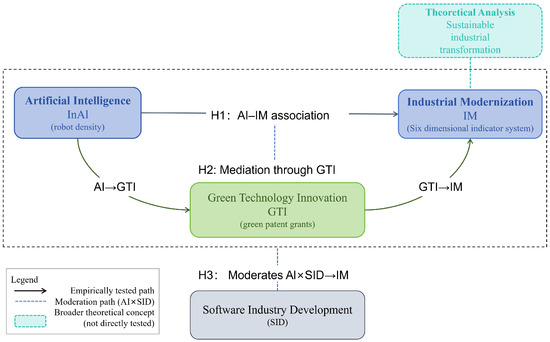
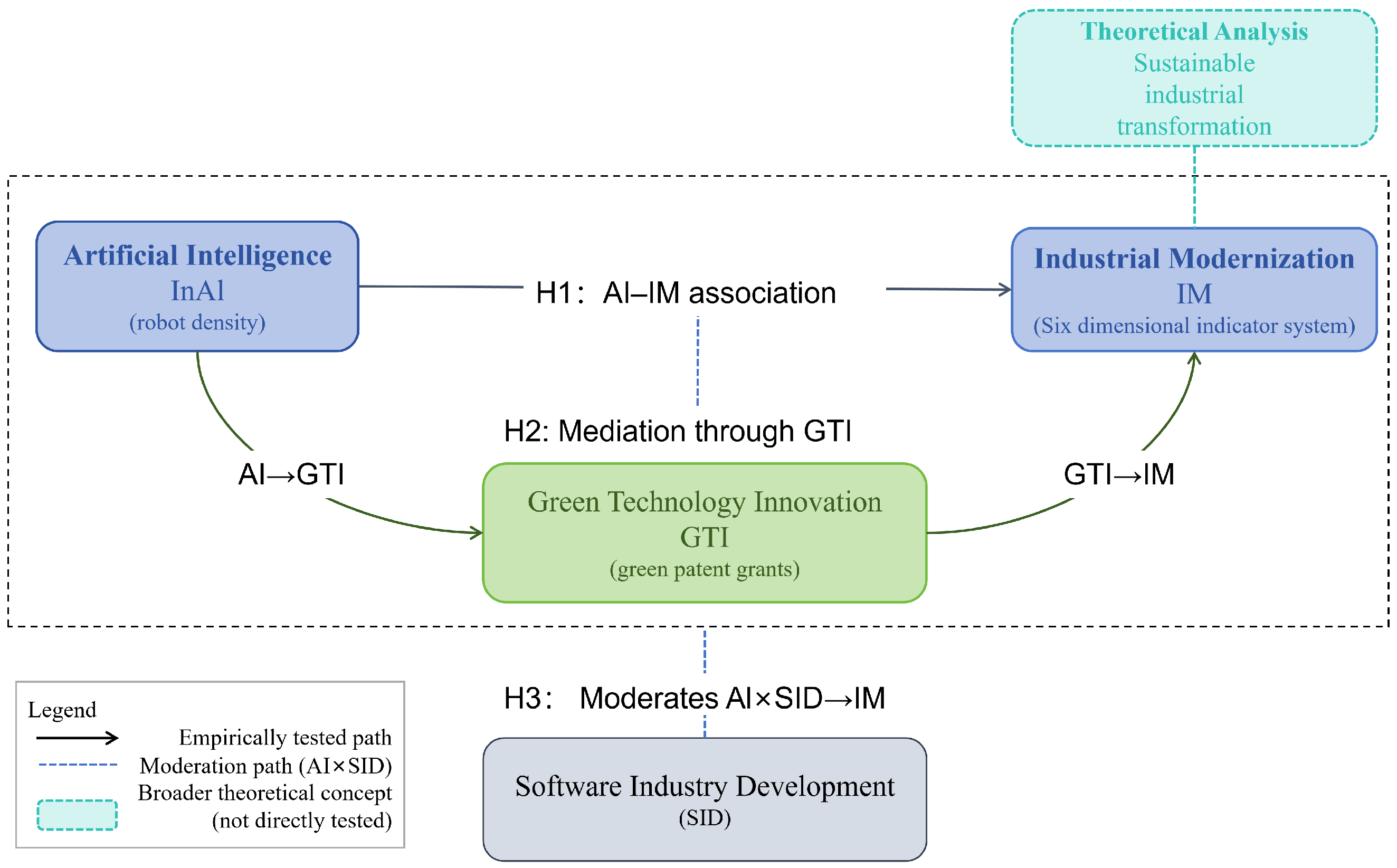
Building on the above discussion, Figure 1 provides a schematic overview of the theoretical framework and hypothesized relationships among variables.
Figure 1.
Conceptual Framework of AI-driven Industrial Modernization.
4. Study Design
4.1. Methodology
4.1.1. Base Regression Model
Based on the analysis of the relationship between artificial intelligence and industrial modernization, the following two-way fixed-effects model is constructed:
In Equation (1), i denotes the province; t denotes the year; represents the level of industrial modernization in province i in year t; represents industrial robot density in province i in year t; denotes a set of control variables; is the constant term; and are the coefficients to be estimated; is the province fixed effect; is the time fixed effect; and is the random disturbance term.
4.1.2. Mediation Effect Model
To investigate the impact of green technology innovation (GTI) on industrial modernization, a mediation effect model is constructed based on Equation (1):
In Equations (2) and (3), represents the mediating variable green technology innovation; , is the constant term; , , , , represents the effect coefficient; the meanings of the remaining variables are the same as in Equation (1).
4.1.3. Moderating Effect Model
To test the moderating role of software industry development, this study introduces the software industry development level (SID), artificial intelligence (AI), and their interaction term into the baseline regression framework. The moderating effect model is specified as follows:
In Equations (4) and (5), denotes the software industry development level. , is the intercept term, while , , , , , , denote the corresponding regression coefficients. The remaining variables are defined in the same way as Equation (1).
4.2. Variables and Data
4.2.1. Dependent Variable
Industrial modernization reflects the development of a modern industrial system driven by technological innovation, supported by human and financial capital, and guided by green and low-carbon principles. Following Lv et al. (2024) [13] and considering data availability, this study evaluates industrial modernization across six dimensions (see Table 1). Supportiveness captures institutional and resource foundations; materiality reflects industrial scale and production capacity; innovation measures technological advancement and knowledge creation; environmental sustainability evaluates low-carbon and green practices; openness reflects engagement with external markets; and integration captures inter-industry coordination and digital–physical synergy. Among these, the industrial diversification index (indiv) is characterized using the Herfindahl–Hirschman Index (HHI), which is the inverse of industrial concentration, as referenced in existing studies (Wei, 2023) [42]. The calculation process is as follows:
where represents the industrial diversification index; represents industrial concentration; and represents the proportion of industry’s output value to the regional gross domestic product (GDP). The indicators under each dimension are selected for their ability to represent the corresponding aspect of industrial modernization and their relevance in previous studies [13,43]. Positive, negative, and moderate indicators are clearly distinguished according to their effects on industrial development. To construct a composite index, all indicators are first standardized. The entropy weight method is then applied to determine the relative importance of each indicator based on the information it provides. Weighted indicators are aggregated to calculate the final industrial modernization index. The calculation process is as follows: For positive indicators:
Table 1.
Industrial Modernization Evaluation Indicator System.
For negative indicators:
For moderate indicators:
where i denotes a province-year observation and j denotes the indicator; is the original value of indicator j for observation i; is the standardized value; represents the proportion of indicator j for observation i; is the entropy value of indicator j; denotes the coefficient of variation of indicator j; is the weight assigned to indicator j; and is the composite score of industrial modernization obtained through weighted aggregation.
4.2.2. Core Explanatory Variable
Artificial Intelligence (AI). Measuring AI development at the provincial level remains challenging because software-based AI technologies, such as deep learning models and large language models, are not directly observable through official statistical data. As a result, industrial robot density has become one of the most commonly used proxies for provincial-level AI development in China [23,43,44]. This measure is appropriate for the present study because industrial modernization mainly concerns the transformation of the manufacturing system, including improvements in production efficiency, industrial upgrading, and green development. Industrial robots provide a direct and observable indicator of AI adoption in manufacturing activities. Nevertheless, robot density primarily reflects AI applications embodied in industrial equipment rather than software-based or algorithmic capabilities. Therefore, the empirical findings provide evidence primarily on the effects of industrial robot-based AI applications on industrial modernization. Since the International Federation of Robotics (IFR) provides robot installation data disaggregated by industry at the national level but not at the provincial level, we follow the standard approach in the literature [16,44] and construct a province-level robot density measure by weighting national industry-level robot intensity by each province’s employment structure. The specific formula is as follows:
where i denotes province, j denotes industry, and t denotes year. is the estimated industrial robot density in province i in year t, measured in units per 10,000 workers. is the number of employees in industry j in province i in year t; is the total number of employees in province i in year t; the ratio thus represents province i’s employment share in industry j, which serves as the weighting coefficient. is the total stock of industrial robots installed in industry j nationally in year t; is the total number of employees in industry j nationally in year t.
4.2.3. Control Variables
The development of industrial modernization is susceptible to external macroeconomic influences. To further accurately assess the impact of artificial intelligence on industrial modernization, and drawing on existing research [45], this study selects the following variables as control variables influencing industrial modernization:
(1) R&D intensity (RDI) is measured as the ratio of regional R&D expenditure to GDP. Innovation capacity determines a region’s ability to absorb and commercialize emerging technologies and is a key factor for AI-driven industrial upgrading [14,39].
(2) Environmental regulation (ER) is measured as the comprehensive utilization rate of general industrial solid waste. Regulatory stringency shapes green technology adoption and industrial restructuring across provinces [34]. It is included as a control to separate the effects of environmental regulation from those of AI, given the direct link between environmental policy and green patenting, the mediating variable in this study.
(3) Energy consumption scale (ES) is measured as each province’s share of national total electricity consumption, capturing the structural energy endowment of its industrial base. Provinces with larger energy footprints face greater structural inertia in transitioning toward green industrial systems, a constraint rooted in resource endowment rather than AI development levels [33].
(4) Fiscal capacity (FC) is measured as the ratio of general budgetary revenue to GDP. Fiscal strength determines a province’s capacity to sustain complementary public investments, such as infrastructure, talent programs, and green subsidies, which can amplify AI’s enabling effects on industrial modernization [27].
(5) Trade openness (OPEN) is measured as the ratio of total trade value to GDP, with import and export figures converted to RMB using annual average exchange rates. External economic integration exposes regional industries to global technological standards and competitive pressures that independently accelerate industrial upgrading, and controlling for this channel ensures the AI estimate is not confounded by the modernization-promoting effects of trade [35].
4.2.4. Mechanism Variable
Green Technology Innovation (GTI) is proxied by the number of green patent grants at the provincial level. Patent grants, unlike applications, have passed substantive examination, making them a more reliable indicator of realized innovation output rather than mere R&D intent. Following Yan et al. (2021) [45], green patents are identified using the IPC Green Inventory, covering classifications under Y02 and Y04S, and include both invention patents and utility model patents.
4.2.5. Moderating Variable
Software Industry Development (SID) is measured by regional software business revenue, which captures the scale of the software sector and, by extension, the availability of data resources and the breadth of digital technology diffusion channels within a province. Following He et al. (2025) [29], software industry scale serves as a reliable indicator of regional digital infrastructure development, reflecting the conditions under which AI capabilities can be effectively absorbed and applied across industrial processes. A higher level of software industry development indicates richer data resource availability and more efficient technology diffusion networks, both of which are expected to amplify the promoting effect of AI on industrial modernization.
4.3. Data Sources and Descriptive Statistics
4.3.1. Data Description
The sample comprises 30 Chinese provinces over the period 2012–2023. Tibet is excluded due to extensive data gaps, and Hong Kong, Macao, and Taiwan are excluded given their distinct administrative and economic systems. The sample period begins in 2012 to align with the availability of provincial robot data and extends to 2023 to capture recent developments in AI adoption. Variable definitions and data sources are summarized in Table 2.
Table 2.
Variables Used in the Analysis.
4.3.2. Descriptive Statistical Analysis
Table 3 reports the descriptive statistics for all variables. The industrial modernization index (IM) has a mean value of 0.223 and a standard deviation of 0.073, ranging from 0.111 to 0.500. The log-transformed AI variable (lnAI) has a mean of 8.747, with values ranging from 4.781 to 12.433. Green technology innovation (GTI) exhibits substantial variation across provinces, with a mean of 4844 patent grants, a standard deviation of 6878, and values ranging from 31 to approximately 45,900. The log-transformed software industry development variable (lnSID) ranges from 7.894 to 19.403 and shows lower dispersion than GTI. The control variables also exhibit reasonable variation. R&D intensity averages 1.81% of GDP, fiscal capacity averages 11.18%, and trade openness varies considerably across provinces.
Table 3.
Descriptive Statistics of Key Variables.
5. Empirical Analysis
5.1. Multicollinearity Test
To assess multicollinearity, variance inflation factors (VIF) were calculated for all explanatory variables. As reported in Table 4, individual VIF range from 1.830 (ER) to 5.210 (lnSID), with a mean VIF of 3.460, well below the conventional threshold of 10. These values indicate that multicollinearity does not pose a meaningful concern for the reliability of the estimated coefficients.
Table 4.
Multicollinearity Test (VIF).
5.2. Base Regression
Based on the results of the Hausman test ( = 38.94, ), a two-way fixed effects model was adopted for the baseline regression analysis. The results are reported in Table 5. Column (1) includes only province and year fixed effects, and the coefficient of AI is positive and significant at the 1% level. Column (2) further incorporates five key control variables, namely R&D intensity (RDI), environmental regulation (ER), energy structure (ES), fiscal capacity (FC), and openness (OPEN). The estimated coefficient of AI remains significantly positive. In Column (3), province-clustered robust standard errors are employed to account for within-province correlation. Although the coefficient of AI remains unchanged, the standard error increases slightly. Given the potential cross-sectional dependence among provinces, Column (4) reports the results using Driscoll–Kraay standard errors, which are robust to both heteroskedasticity and serial correlation and are particularly suitable for panels with a relatively small number of cross-sectional units (30 provinces) and possible cross-sectional dependence. Under this specification, the coefficient of AI is 0.0204 and remains significant at the 1% level. The signs of the control variables are generally consistent with theoretical expectations. Therefore, the estimates reported in Column (4) are used as the benchmark results. In terms of economic significance, a one-unit increase in AI development (corresponding to an e-fold increase in industrial robot density) is associated with an increase of approximately 0.0204 units in the industrial modernization index. This effect is equivalent to 9.2% of the sample mean and 28.1% of one standard deviation of the dependent variable, indicating a meaningful economic impact. Therefore, Hypothesis H1 is supported.
Table 5.
Benchmark Regression Results.
5.3. Robustness Tests
To further examine the robustness of the baseline results, a series of robustness tests were conducted. First, the core explanatory variable was replaced. Since some studies have used the number of AI patent applications as a proxy for AI development [46], the number of AI patent applications (AI2) was employed as an alternative measure. Second, the dependent variable was replaced. To reduce potential overlap between AI and the industrial modernization index, the digitalization and innovation-related indicators were removed from the index system, and a revised measure of industrial modernization (IM2) was constructed. Third, to alleviate potential reverse causality, the one-period lagged AI variable (L.lnAI) was used as the key explanatory variable. Fourth, to mitigate omitted variable bias, human capital (HC), measured by the proportion of university students in the total population, and digital infrastructure (DI), measured by mobile phone penetration, were included in the regression. Fifth, all continuous variables were winsorized at the 1% level on both tails before re-estimation. Finally, the four municipalities directly under the central government, including Beijing, Shanghai, Tianjin, and Chongqing, were excluded from the sample. The results are reported in Table 6. Across all specifications, the estimated coefficients of AI remain positive and statistically significant, indicating that AI development consistently promotes industrial modernization. These findings suggest that the main conclusions are robust and provide further support for Hypothesis H1.
Table 6.
Robustness Test Results.
5.4. Endogeneity Tests
To alleviate potential endogeneity arising from reverse causality and omitted variables, this study employs the instrumental variable (IV) approach and estimates the model using two-stage least squares (2SLS). The development of artificial intelligence is closely associated with the expansion of communication infrastructure. Following the approach of Huang et al. (2019) [47] and Nunn & Qian (2014) [48], instrumental variables are constructed by interacting the number of fixed-line telephone subscribers in each province in 1984 (tel84) with the previous year’s national software business revenue (soft_rev) and the number of Internet users (internet_users), respectively.
The proposed instrumental variables are expected to satisfy the relevance condition. Provinces with better communication infrastructure in the early period generally possessed a stronger technological foundation, which is likely to facilitate the subsequent development of artificial intelligence. Therefore, the interaction terms are closely related to provincial AI development.
The instrumental variables can also be considered plausibly exogenous. The number of fixed-line telephone subscribers in 1984 is a historical variable that was determined long before the sample period and is unlikely to be directly associated with contemporary industrial modernization. In addition, the previous year’s national software business revenue and Internet user population are driven by nationwide development trends rather than economic activities in any individual province. Consequently, the interaction terms are unlikely to affect industrial modernization through channels other than AI development.
The 2SLS estimation results are reported in Table 7. Column (1) uses as the sole instrumental variable. In the stage 1, the coefficient of the instrumental variable is significantly negative. The stage 1 F-statistic is 45.41, well above the Stock–Yogo 10% critical value of 16.38, indicating that the weak instrument problem is unlikely to be a concern. The Kleibergen-Paap rk LM statistic is 41.81, rejecting the null hypothesis of underidentification. In the stage 2, the coefficient of is positive and statistically significant at the 5% level.
Table 7.
Instrumental Variables 2SLS Regression Results.
Column (2) employs as the only instrumental variable. The stage 1 coefficient remains significantly negative, with an F-statistic of 52.74 and a Kleibergen–Paap rk LM statistic of 47.58. These results again reject the possibility of weak instruments and underidentification. The stage 2 coefficient of remains positive and significant.
Column (3) jointly uses both instrumental variables. The stage 2 F-statistic exceeds the Stock–Yogo 10% critical value for the joint instrument specification, indicating sufficient instrument strength. The Sargan overidentification test yields a p-value of 0.802, failing to reject the null hypothesis that all instruments are exogenous. The stage 2 coefficient of lnAI remains positive and statistically significant, and its magnitude is comparable to those obtained from the single-instrument specifications.
Overall, all instrumental variables pass the weak instrument and underidentification tests, while the overidentification test supports the validity of the joint instrument set. Across all specifications, the coefficient of lnAI remains significant at the 5% level and is broadly consistent with the baseline estimates. These results suggest that the positive effect of artificial intelligence on industrial modernization remains robust after accounting for potential endogeneity.
6. Further Analysis
6.1. Mechanism Analysis
6.1.1. Mediating Effect of Green Technological Innovation
The theoretical framework suggests that artificial intelligence may promote industrial modernization indirectly through green technological innovation. To examine this mechanism, this study employs the one-period lagged number of granted green invention patents as the mediating variable and conducts a three-step mediation analysis. Statistical inference is based on Driscoll–Kraay standard errors. The results are reported in Table 8.
Table 8.
Mediating Effect of Lagged Green Technological Innovation.
Column (1) presents the total effect of AI on industrial modernization and shows a positive and statistically significant coefficient. Column (2) reports the effect of AI on the lagged green technological innovation variable. The coefficient of AI is significantly positive, indicating that AI development contributes to green technological innovation. In Column (3), both the mediating variable and AI are included in the regression. The coefficient of L.GTI remains positive and statistically significant, while the coefficient of AI decreases from 0.0204 to 0.00931 but remains significant. These results suggest that green technological innovation serves as a partial mediator in the relationship between AI and industrial modernization.
To further quantify the mediation effect, the Delta method is employed to estimate the standard error and confidence interval of the indirect effect. As reported in Table 9, the indirect effect is estimated at 0.00877, and the corresponding 95% confidence interval does not include zero. The mediation effect accounts for 42.95% of the total effect. These findings are consistent with the theoretical expectation that AI promotes industrial modernization partly by stimulating green technological innovation, thereby supporting Hypothesis H2.
Table 9.
Indirect Effect Estimates Based on the Delta Method.
As a robustness check, the number of granted green utility model patents is used as an alternative measure of green technological innovation. In addition, the results based on the contemporaneous green technological innovation variable are reported in the Supplementary Materials. The findings remain qualitatively unchanged.
6.1.2. Moderating Effect of Software Industry Development
To examine the moderating role of software industry development (SID) in the relationship between artificial intelligence (AI) and industrial modernization (IM), this study introduces the interaction term between AI (c_lnAI) and software industry development (c_lnSID), denoted as c_interact, into the baseline model. All variables involved in the interaction are mean-centered prior to estimation. The results are reported in Table 10. As shown in Column (2), the coefficient of the interaction term is 0.00369 and is positive and significant at the 1% level, indicating that software industry development positively moderates the effect of AI on industrial modernization.
Table 10.
Moderating Effect of Software Industry Development.
To further examine the direction and magnitude of the moderating effect, the marginal effects of AI at different levels of software industry development (mean ± one standard deviation) are estimated using the “nlcom” command. The results are presented in Table 11. When the level of software industry development is low, the marginal effect of AI is not statistically significant. A similar result is observed at the mean level of software industry development. However, when software industry development is high, the marginal effect of AI becomes positive and significant at the 1% level, and the corresponding 95% confidence interval lies entirely above zero. These findings suggest that the positive effect of AI on industrial modernization depends on a well-developed software industry. In regions with a larger software industry, the benefits of AI can be more fully realized. The above results highlight the important role of the software industry as a new production factor in unlocking the potential of AI, thereby supporting Hypothesis H3.
Table 11.
Marginal Effects of AI at Different Levels of Software Industry Development.
As a robustness check, software industry development is alternatively measured by the logarithm of software business revenue per capita (lnPSID), and the moderation analysis is repeated. The results (reported in Supplementary Tables S8 and S9) show that the coefficient of the interaction term remains positive and statistically significant, while the marginal effects exhibit the same increasing pattern. These findings are fully consistent with the main results, suggesting that the moderating effect is not sensitive to the choice of indicator.
6.2. Heterogeneity Analysis
6.2.1. Regional Heterogeneity Analysis
To examine whether the impact of artificial intelligence (AI) on industrial modernization varies across regions with different resource endowments, this study divides the sample into eastern, central, and western China (Following the regional classification adopted in China’s Seventh Five-Year Plan, Liaoning Province is classified as part of the eastern region, while Jilin and Heilongjiang Provinces are included in the central region. This adjustment avoids potential estimation instability arising from the limited sample size of the northeastern region (three provinces over twelve years)). A full-sample interaction approach is employed, with the western region serving as the reference group. Interaction terms between AI and regional dummy variables are introduced, and all variables are mean-centered prior to estimation. The results are reported in Table 12. The marginal effect of AI in the western region is 0.0182 and is significant at the 1% level. The coefficients of both interaction terms, and , are positive and statistically significant. Since these interaction terms provide formal tests of between-group differences, the results indicate that the effect of AI on industrial modernization is significantly stronger in the eastern and central regions than in the western region.
Table 12.
Results of Regional Heterogeneity Tests.
The total effects of AI are estimated at 0.0267 for the eastern region, 0.0243 for the central region, and 0.0182 for the western region. These findings reveal a clear gradient pattern, with the effect of AI on industrial modernization being strongest in the eastern region, followed by the central region and the western region. One possible explanation is that the eastern region enjoys advantages in digital infrastructure, technological agglomeration, and industrial chain development, which enhance the effectiveness of AI. By contrast, the central and western regions may face constraints related to technology absorption capacity, supporting production factors, and industrial structure, resulting in relatively weaker effects. The subgroup regression results reported in Supplementary Table S11 provide additional support for these findings.
6.2.2. Analysis of Heterogeneity in the Level of Artificial Intelligence Development
The effectiveness of AI may depend on the availability of supporting infrastructure and human resources. To examine this possibility, a continuous interaction approach is adopted. Infrastructure development is measured by the logarithm of fixed-asset investment in the information transmission, software, and information technology services sector (), while talent availability is measured by the logarithm of employment in the same sector (). Interaction terms between AI and these two variables are introduced into the model, and all variables are mean-centered prior to estimation. The results are reported in Table 13.
Table 13.
Results on the Heterogeneity of AI Development Levels.
Column (1) presents the results for infrastructure development. The coefficient of the interaction term is 0.0044 and is positive and significant at the 1% level. The marginal effects reported in Supplementary Table S13 show that as infrastructure development increases from a low level ( SD) to a high level ( SD), the marginal effect of AI rises monotonically from 0.02836 to 0.04528. All estimated effects remain significant at the 1% level. These findings suggest that the contribution of AI to industrial modernization is stronger in regions with more developed infrastructure.
Column (2) reports the results for talent availability. The coefficient of the interaction term is 0.0098 and is also positive and significant at the 1% level. As shown in Supplementary Table S13, when talent availability is low ( SD), the marginal effect of AI is 0.00338 and statistically insignificant. As talent availability increases, the marginal effect becomes progressively larger, reaching 0.04443 at the high level ( SD), where it is significant at the 1% level. This finding highlights the importance of talent concentration in enabling regions to benefit from AI. The positive effect of AI becomes substantially stronger in areas with a larger pool of skilled workers.
Overall, the results indicate that the contribution of AI to industrial modernization is more pronounced in regions with better infrastructure and greater talent availability. The advantages associated with AI, such as information integration and cross-regional collaboration, are more likely to be realized where infrastructure and human resources are relatively abundant. This finding provides empirical support for differentiated development strategies.
7. Conclusions and Policy Recommendations
7.1. Conclusions
Using provincial panel data for 30 provinces in mainland China from 2012 to 2023 (excluding Tibet due to data unavailability), this study examines the relationship between artificial intelligence (AI), measured by industrial robot density, and industrial modernization. Industrial modernization is evaluated using a composite index covering six dimensions: supportiveness, substantiveness, innovativeness, greenness, openness, and integration. Four main findings emerge from the analysis.
First, AI is positively associated with industrial modernization. This relationship remains statistically robust across a range of alternative specifications, including the use of alternative measures of AI and industrial modernization, lagged explanatory variables, additional control variables, winsorization, and sample adjustments. Similar results are obtained from instrumental variable estimation. Taken together, these findings suggest that AI may be an important factor associated with industrial modernization in China.
Second, the association between AI and industrial modernization varies across regions and development conditions. The estimated relationship is stronger in eastern provinces than in central and western provinces. In addition, provinces with higher levels of AI infrastructure and larger pools of technical talent tend to exhibit a stronger association between AI and industrial modernization. These results suggest that regional differences in development conditions may influence the extent to which AI is associated with industrial modernization.
Third, green technology innovation appears to be an important channel linking AI and industrial modernization. The empirical results are consistent with the view that AI is associated with higher levels of green technology innovation, which in turn is associated with industrial modernization. This finding provides additional evidence on the potential role of innovation-related factors in the relationship between AI and industrial development.
Fourth, software industry development strengthens the positive association between AI and industrial modernization. The results indicate that the relationship between AI and industrial modernization is more pronounced in provinces with a higher level of software industry development. This finding suggests that complementary digital capabilities may shape the extent to which AI is associated with industrial modernization.
7.2. Policy Recommendations
Our findings carry targeted policy implications that follow directly from the empirical evidence, particularly for economies navigating the dual transition toward digitalization and industrial sustainability.
First, AI adoption policy should be calibrated to sectoral heterogeneity. Our results indicate that industrial robot deployment advances industrial modernization primarily through stimulating green technology innovation, rather than through broad-based diffusion across the economy. Policymakers should therefore concentrate resources on industries where robot-enabled process automation and cleaner production are most likely to generate measurable spillovers, particularly advanced manufacturing and energy-intensive sectors where the link between physical AI deployment and green innovation is most direct. Cross-sector consortia that bring together robotics developers, system integrators, and industrial users in these domains can help convert automation capacity into tangible innovation outcomes, reducing adoption uncertainty for follower firms and accelerating the translation of technological investment into industrial upgrading results.
Second, regional policy must respond to the pronounced spatial heterogeneity documented in the regression results. The weaker or statistically insignificant modernization effects observed in central and western provinces reflect structural gaps in absorptive capacity, including underdeveloped digital infrastructure, shallower human capital, and a less diversified industrial base, rather than differences in robot availability per se. This asymmetry calls for a two-track approach. Eastern provinces, which already possess the ecosystem conditions needed to convert robot investment into innovation outcomes, are well-positioned for advanced integration zones that deepen the automation–manufacturing linkage and build knowledge diffusion capacity. Central and western provinces, by contrast, require prior investment in complementary infrastructure and technical training before robot-focused policies can take meaningful effect. Without these foundations in place, technology transfer initiatives risk widening existing regional disparities rather than narrowing them. Inter-regional coordination mechanisms, such as paired provincial programs and mobile talent schemes, can support gradual diffusion while ensuring that the benefits of industrial upgrading reach less-advantaged regions.
Third, industrial policy should explicitly connect robot deployment with green technology objectives. Green technology innovation serves as the primary channel through which industrial robot penetration advances modernization in our analysis, and policymakers can reinforce this channel through several complementary instruments. Extending preferential financing and procurement criteria to automation applications with documented environmental performance, and incorporating clean-technology benchmarks into evaluation standards for robotics-related industrial projects, would strengthen the innovation incentive at the point of technology adoption. Supporting research and development at the intersection of robotics and environmental engineering, covering areas such as intelligent energy management, emission monitoring platforms, and robot-assisted materials innovation, would further consolidate the mechanism our study identifies and help ensure that automation-led industrial transformation contributes to broader sustainability objectives.
Fourth, governments should treat the development of a capable software industry as a structural precondition for robot-driven industrial modernization, rather than a parallel policy track. The moderation results show that the positive effect of robot density on industrial upgrading is significantly stronger in provinces with higher software industry revenue, suggesting that a well-developed software sector creates the technical ecosystem, including skilled labor pools, platform services, and accumulated data processing capacity, through which firms can extract productive value from physical AI deployment. Relevant policy instruments include expanding university-level software engineering programs to address persistent talent shortfalls, providing fiscal incentives for software enterprises engaged in industrial robotics applications, and encouraging platform-level collaboration between software developers and manufacturing firms. In regions where software industry development remains limited, such investments should be treated as foundational rather than supplementary, given that the amplifying effect documented in this study is unlikely to emerge without the underlying technical capacity already in place.
7.3. Limitations of the Study and Future Research Directions
First, artificial intelligence (AI) is proxied by industrial robot density, which primarily captures the deployment of industrial robots rather than the broader development of AI technologies. Although robustness tests based on AI patent applications yield consistent results, both measures represent only part of the multifaceted nature of AI. Future research could construct more comprehensive indicators by incorporating additional dimensions, such as AI-related enterprises, AI investment, and AI patent activities, to better capture regional AI development.
Second, green technology innovation is measured by the number of green patent authorizations. While this indicator is widely used in the literature, it does not account for differences in population size, economic scale, or industrial output across regions. Future studies could explore alternative measures, such as per-capita or output-normalized green patents, to provide a more nuanced assessment of green innovation performance.
Third, the analysis is based on provincial-level panel data, which may mask substantial within-province variation and limit the examination of micro-level mechanisms. Due to data availability constraints, the findings primarily reflect regional-level relationships rather than firm-level behavioral responses. Future research could employ prefecture-level or enterprise-level data to investigate how AI adoption influences industrial modernization through firm innovation, productivity improvement, and organizational transformation.
Despite these limitations, the results provide robust evidence on the relationship between AI adoption, green technology innovation, and industrial modernization in China, offering a useful foundation for further research in this field.
Supplementary Materials
The following supporting information can be downloaded at: https://www.mdpi.com/article/10.3390/su18136698/s1, Table S1: Data sources for the tertiary indicators of industrial modernization; Table S2: Industrial modernization evaluation indicator system after removing overlapping indicators; Table S3: Full regression coefficients for robustness tests; Table S4: Additional robustness checks; Table S5: Mediation effect using granted green utility model patents; Table S6: Mediation effect using contemporaneous granted green invention patents; Table S7: Indirect effect estimation for contemporaneous green innovation (Delta method); Table S8: Moderating effect using an alternative measure of software industry development ( PSID); Table S9: Marginal effects of AI at different levels of software industry development; Figure S1: Marginal effect of AI on industrial modernization as a function of software industry development (lnSID); Table S10: Full regression results for regional heterogeneity (western region baseline); Table S11: Regional heterogeneity: subsample regressions for eastern, central, and western regions; Table S12: Full regression results for heterogeneity in AI development levels; Table S13: Marginal effects of AI at different levels of infrastructure and talent scale. File S1: Dataset.
Author Contributions
Conceptualization, L.W.; methodology, J.L. and J.Q.; software, J.L. and J.Q.; validation, J.L. and J.Q.; formal analysis, L.W.; investigation, L.W.; resources, L.W.; data curation, J.L.; writing—original draft preparation, J.L. and J.Q.; writing—review and editing, L.W. and J.L.; visualization, J.L.; supervision, L.W.; project administration, L.W. All authors have read and agreed to the published version of the manuscript.
Funding
This research was funded by the Inner Mongolia Natural Science Foundation (Grant No. 2025MS07026).
Institutional Review Board Statement
Not applicable.
Informed Consent Statement
Not applicable.
Data Availability Statement
The data presented in this study are available on request from the corresponding author.
Acknowledgments
The authors thank the editors and reviewers for their helpful comments.
Conflicts of Interest
The authors declare no conflicts of interest.
Abbreviations
| AI | Artificial Intelligence |
| IM | Industrial Modernization |
| GTFP | Green Total Factor Productivity |
| HHI | Herfindahl–Hirschman Index |
| 2SLS | Two-Stage Least Squares |
| GMM | Generalized Method of Moments |
| FAI | Total fixed asset investment in the information transmission, software and information technology services industry |
| EMP | Total employment in the information transmission, software and information technology services industry |
References
- UNIDO. Industrial Development Report 2024: Turning Challenges into Sustainable Solutions—The New Era of Industrial Policy; United Nations Industrial Development Organization: Vienna, Austria, 2024; Available online: https://www.unido.org/sites/default/files/unido-publications/2024-06/Industrial%20Development%20Report%202024.pdf (accessed on 4 June 2026).
- OECD. OECD Science, Technology and Innovation Outlook 2023: Enabling Transitions in Times of Disruption; OECD Publishing: Paris, France, 2023. [Google Scholar] [CrossRef] [Scilit]
- United Nations. Transforming Our World: The 2030 Agenda for Sustainable Development; Resolution A/RES/70/1; United Nations General Assembly: New York, NY, USA, 2015; Available online: https://sdgs.un.org/2030agenda (accessed on 4 June 2026).
- Yu, L.; Wang, Y.; Wei, X.; Zeng, C. Towards low-carbon development: The role of industrial robots in decarbonization in Chinese cities. J. Environ. Manag. 2023, 330, 117216. [Google Scholar] [CrossRef] [Scilit] [PubMed]
- Liao, Y.; Deschamps, F.; Loures, E.D.F.R.; Ramos, L.F.P. Past, present and future of Industry 4.0: A systematic literature review and research agenda proposal. Int. J. Prod. Res. 2017, 55, 3609–3629. [Google Scholar] [CrossRef] [Scilit]
- Khan, M.I.; Yasmeen, T.; Khan, M.; Hadi, N.U.; Asif, M.; Farooq, M.; Al-Ghamdi, S.G. Integrating Industry 4.0 for enhanced sustainability: Pathways and prospects. Sustain. Prod. Consum. 2025, 54, 149–189. [Google Scholar] [CrossRef] [Scilit]
- Ghobakhloo, M.; Mahdiraji, H.A.; Iranmanesh, M.; Jafari-Sadeghi, V. From Industry 4.0 digital manufacturing to Industry 5.0 digital society: A roadmap toward human-centric, sustainable, and resilient production. Inf. Syst. Front. 2024, 27, 1–33. [Google Scholar] [CrossRef] [Scilit]
- Vial, G. Understanding digital transformation: A review and a research agenda. J. Strateg. Inf. Syst. 2019, 28, 118–144. [Google Scholar] [CrossRef] [Scilit]
- Humphrey, J.; Schmitz, H. How does insertion in global value chains affect upgrading in industrial clusters? Reg. Stud. 2002, 36, 1017–1027. [Google Scholar] [CrossRef] [Scilit]
- Zhong, R.Y.; Xu, X.; Klotz, E.; Newman, S.T. Intelligent manufacturing in the context of Industry 4.0: A review. Engineering 2017, 3, 616–630. [Google Scholar] [CrossRef] [Scilit]
- Breque, M.; De Nul, L.; Petridis, A. Industry 5.0: Towards a Sustainable, Human-Centric and Resilient European Industry; Directorate General for Research and Innovation (DG RTD) of the European Commission: Brussels, Belgium, 2021; No. KI-BD-20-021-EN-N. [Google Scholar]
- Gong, Y.; Shen, K. Impact of artificial intelligence technology on industrial modernization: An empirical study from a policy evaluation perspective. Technol. Soc. 2026, 86, 103316. [Google Scholar] [CrossRef] [Scilit]
- Lv, C.; Cui, Y.; He, J. Construction and temporal-spatial evolution of China’s modern industrial system. Manag. Rev. 2024, 36, 49–61. (In Chinese) [Google Scholar]
- Zhang, Y. AI-driven industrial structure upgrading: The moderating mechanism of inclusive finance development and regional differences analysis. Financ. Res. Lett. 2025, 80, 107327. [Google Scholar] [CrossRef] [Scilit]
- Wang, Q.; Sun, T.; Li, R. Does artificial intelligence promote green innovation? An assessment based on direct, indirect, spillover, and heterogeneity effects. Energy Environ. 2025, 36, 1005–1037. [Google Scholar] [CrossRef] [Scilit]
- Acemoglu, D.; Restrepo, P. Robots and jobs: Evidence from US labor markets. J. Polit. Econ. 2020, 128, 2188–2244. [Google Scholar] [CrossRef] [Scilit]
- Xin, B.; Ye, X. Robotics applications, inclusive employment and income disparity. Technol. Soc. 2024, 78, 102621. [Google Scholar] [CrossRef] [Scilit]
- Peng, H.-R.; Zhang, Y.-J.; Liu, J.-Y. The energy rebound effect of digital development: Evidence from 285 cities in China. Energy 2023, 270, 126837. [Google Scholar] [CrossRef] [Scilit]
- Peng, H.-R.; Qin, X.-F. Digitalization as a trigger for a rebound effect of electricity use. Energy 2024, 300, 131517. [Google Scholar] [CrossRef] [Scilit]
- Deng, Y.; You, D.; Wang, J. Spatiotemporal distribution and dynamics evolution of artificial intelligence development in China. Heliyon 2024, 10, e23573. [Google Scholar] [CrossRef] [Scilit] [PubMed]
- Luo, S.; Lei, W.; Hou, P. Impact of artificial intelligence technology innovation on total factor productivity: An empirical study based on provincial panel data in China. Natl. Account. Rev. 2024, 6, 172–194. [Google Scholar] [CrossRef] [Scilit]
- Yang, H.; Li, L.; Liu, Y. The effect of manufacturing intelligence on green innovation performance in China. Technol. Forecast. Soc. Change 2022, 178, 121569. [Google Scholar] [CrossRef] [Scilit]
- Xia, L.; Han, Q.; Yu, S. Industrial intelligence and industrial structure change: Effect and mechanism. Int. Rev. Econ. Financ. 2024, 93, 1494–1506. [Google Scholar] [CrossRef] [Scilit]
- Lee, C.C.; Qin, S.; Li, Y. Does industrial robot application promote green technology innovation in the manufacturing industry? Technol. Forecast. Soc. Change 2022, 183, 121893. [Google Scholar] [CrossRef] [Scilit]
- Meng, X.; Xu, S.; Zhang, J. How does industrial intelligence affect carbon intensity in China? Empirical analysis based on Chinese provincial panel data. J. Clean. Prod. 2022, 376, 134273. [Google Scholar] [CrossRef] [Scilit]
- Biggi, G.; Iori, M.; Mazzei, J.; Mina, A. Green intelligence: The AI content of green technologies. Eurasian Bus. Rev. 2025, 15, 803–840. [Google Scholar] [CrossRef] [Scilit]
- Bai, T.; Qi, Y.; Li, Z.; Xu, D. Digital economy, industrial transformation and upgrading, and spatial transfer of carbon emissions: The paths for low-carbon transformation of Chinese cities. J. Environ. Manag. 2023, 344, 118528. [Google Scholar] [CrossRef] [Scilit] [PubMed]
- Zhang, L.; Hu, Z. The impact of data factorization on the level of common prosperity. Soft Sci. 2024, 38, 18–25, 33. (In Chinese) [Google Scholar]
- He, Q.; He, X.; Chen, G.; Busababodhin, P.; Li, W. Research on the impact of artificial intelligence on the manufacturing industry chain resilience. Sci. Rep. 2025, 15, 33432. [Google Scholar] [CrossRef] [Scilit] [PubMed]
- Zhou, M.; Zhang, H.; Cheng, L. Research on the effects of artificial intelligence applications on green innovation. Econ. Dyn. 2025, 6, 33–50. (In Chinese) [Google Scholar]
- Ying, Y.; Jin, S. Artificial intelligence and green product innovation: Moderating effect of organizational capital. Heliyon 2024, 10, e28572. [Google Scholar] [CrossRef] [Scilit] [PubMed]
- Xu, B. Artificial intelligence and green technology innovation: Evidence from 265 cities in China. J. Environ. Manag. 2026, 398, 128494. [Google Scholar] [CrossRef] [Scilit] [PubMed]
- Zeng, W.; Yin, Z. Evaluating the impact of artificial intelligence development on industrial green transformation in China. Sci. Rep. 2025, 15, 44324. [Google Scholar] [CrossRef] [Scilit] [PubMed]
- Porter, M.E.; van der Linde, C. Toward a new conception of the environment-competitiveness relationship. J. Econ. Perspect. 1995, 9, 97–118. [Google Scholar] [CrossRef] [Scilit]
- Luo, S.; Yimamu, N.; Li, Y.; Wu, H.; Irfan, M.; Hao, Y. Digitalization and sustainable development: How could digital economy development improve green innovation in China? Bus. Strategy Environ. 2023, 32, 1847–1871. [Google Scholar] [CrossRef] [Scilit]
- Nambisan, S.; Wright, M.; Feldman, M. The digital transformation of innovation and entrepreneurship: Progress, challenges and key themes. Res. Policy 2019, 48, 103773. [Google Scholar] [CrossRef] [Scilit]
- Lu, Y.; Liao, Z. The influence of AI application on carbon emission intensity of industrial enterprises in China. Sci. Rep. 2025, 15, 12585. [Google Scholar] [CrossRef] [Scilit] [PubMed]
- Wen, H.; Yang, W. Artificial intelligence applications and the improvement of carbon emission efficiency from the perspective of sustainable development: Empirical evidence from China. Carbon Balance Manag. 2026, 21, 41. [Google Scholar] [CrossRef] [Scilit] [PubMed]
- Nelson, R.R.; Winter, S.G. An Evolutionary Theory of Economic Change; Harvard University Press: Cambridge, MA, USA, 1985. [Google Scholar]
- Calvino, F.; Costa, H.; Haerle, D. Digital Technology Diffusion in the Age of AI: Cross-Country Evidence From Microdata; OECD Science, Technology and Industry Policy Papers, 2026/01; OECD Publishing: Paris, France, 2026. [Google Scholar] [CrossRef] [Scilit]
- Xie, W.; Zheng, D.; Li, Z.; Wang, Y.; Wang, L. Digital technology and manufacturing industrial change: Evidence from the Chinese manufacturing industry. Comput. Ind. Eng. 2024, 187, 109825. [Google Scholar] [CrossRef] [Scilit]
- Wei, Y. The impact of digital finance on industrial chain resilience. China Circ. Econ. 2023, 37, 71–82. (In Chinese) [Google Scholar]
- Lu, T.; Zhu, Z. Will artificial intelligence reduce the labor income share? An empirical test based on fixed-effect model and panel quantile model. J. Shanxi Univ. Financ. Econ. 2021, 43, 29–41. (In Chinese) [Google Scholar]
- Shen, J.; Chang, Z. Industrial intelligence empowering high-quality development of private SMEs: A study based on the perspective of “specialized, refined, distinctive, and innovative” enterprises. Mod. Econ. Explor. 2024, 5, 52–64. (In Chinese) [Google Scholar]
- Yan, R. An Empirical Study on the Effect of Green Finance Development in China on Industrial Structure Transformation and Upgrading. Master’s Thesis, Jiangxi University of Finance and Economics, Nanchang, China, 2021. (In Chinese) [Google Scholar]
- Feng, T.; Dong, J.; Li, J. The dual impact of generative artificial intelligence (e.g., ChatGPT) on high-quality economic development in China and corresponding policy responses. J. Shaanxi Norm. Univ. (Philos. Soc. Sci. Ed.) 2023, 52, 44–54. (In Chinese) [Google Scholar]
- Huang, Q.H.; Yu, Y.Z.; Zhang, S.L. Internet development and productivity growth in manufacturing industry: Internal mechanism and China’s experiences. China Ind. Econ. 2019, 8, 5–23. (In Chinese) [Google Scholar] [CrossRef]
- Nunn, N.; Qian, N. US food aid and civil conflict. Am. Econ. Rev. 2014, 104, 1630–1666. [Google Scholar] [CrossRef] [Scilit]

Disclaimer/Publisher’s Note: The statements, opinions and data contained in all publications are solely those of the individual author(s) and contributor(s) and not of MDPI and/or the editor(s). MDPI and/or the editor(s) disclaim responsibility for any injury to people or property resulting from any ideas, methods, instructions or products referred to in the content. |
© 2026 by the authors. Licensee MDPI, Basel, Switzerland. This article is an open access article distributed under the terms and conditions of the Creative Commons Attribution (CC BY) license.