


Abstract
This study investigates the impact of green leadership on financial performance in the hospitality sector, focusing on the mediating roles of resource management and market positioning. Drawing upon the Resource-Based View and Stakeholder Theory, data were collected from 390 employees working in five-star hotels in Egypt and analyzed using Partial Least Squares Structural Equation Modeling (PLS-SEM) with SmartPLS 4.0. The findings reveal that green leadership positively influences financial performance both directly and indirectly. Specifically, green leadership enhances resource management practices and strengthens market positioning, which in turn contribute to improved financial outcomes. The mediation analysis confirms that both resource management and market positioning serve as significant mechanisms through which green leadership translates sustainability-oriented strategies into economic benefits. These findings extend current knowledge on sustainable leadership by identifying key organizational pathways linking environmental responsibility with financial success. This study also provides practical implications for hospitality managers seeking to integrate sustainability initiatives into strategic and operational decision-making to achieve long-term competitive advantage.
1. Introduction
The hospitality industry faces increasing pressure to adopt sustainable practices due to environmental concerns and stakeholder expectations. Green leadership, characterized by a commitment to environmental values and sustainable decision-making, has gained recognition as a strategic approach toward achieving organizational goals while promoting eco-friendly behaviors [1].
Incorporating green leadership into hotel management can lead to enhanced financial performance by fostering innovation, improving brand image, and attracting environmentally conscious customers [2]. However, the mechanisms through which green leadership influences financial outcomes remain underexplored, particularly concerning the roles of resource management and market positioning.
The hospitality industry has been operating under increased challenges to maintain a balancing act between provision for financial performance and environmental sustainability, as rising stakeholder expectations, the regulators, and shifts in consumer behavior are reported. In this scenario, green leadership has emerged as a winning strategic approach for organizations: a business philosophy whereby organizations embed environmental responsibility into their vision, culture, and operations [3]. Green leadership is defined by its adherence to sustainability, proactive environmental decision-making, and the inclination to inspire eco-centric behaviors among employees. Such leadership in the hospitality sector typically facilitates the establishment of green practices across an organization, the benefits of which may extend to operations or its financial outcomes, such as reduced costs, improved brand reputation, and increased customer loyalty [4].
One of the most crucial ways to translate green leadership into performance is through resource management [3]. According to the Resource-Based View (RBV), an ideal green resource management system works through energy, water, materials, and labor in accordance with environmental objectives but keeps the quality of services high and operation efficient. Generally, leaders who encourage allocation efficiencies and waste elimination will tend to garner more benefits associated with lower costs and strengthen internal capabilities that will sustain future success, such as improved employee morale and enhanced reputation in the marketplace [5].
Market positioning is another dimension that is important because it shows how a firm is talking about and differentiating itself with respect to its sustainability initiatives from the vantage point of customers [6]. Thus, if a hospitality firm is well perceived as environmentally responsible, it might enjoy better brand image benefits, loyalty from consumers, and an increased willingness from guests to pay premium prices. This form of positioning is highly influenced by green leadership in uniting efforts put into internal sustainability with an external strategy of marketing to eco-conscious consumers, which can ultimately enhance the financial performance of the firm by attracting a loyal customer base willing to pay more for sustainable practices [7].
Even though there is a growing body of the literature on green leadership and sustainability within hospitality organizations, some important gaps still remain. Earlier studies have mainly looked at how green leadership affects environmental performance, employee behavior, innovation and overall organizational sustainability. However, comparatively less attention has been given to the way green leadership turns into financial performance through specific organizational mechanisms [1]. In particular, the empirical evidence is limited when it comes to the mediating roles of resource management and market positioning—in other words, how sustainability-oriented leadership finally leads to measurable financial results. Furthermore, many of the existing studies were carried out in developed economies, while evidence from emerging tourism destinations seems thin.
The Egyptian hospitality industry provides an appropriate context for trying to fill those gaps. Egypt is among the leading tourism destinations in the Middle East and North Africa region, and it has faced increasing pressure to adopt sustainable business practices due to international environmental standards, stakeholder expectations, and shifting preferences of tourists. Five-star hotels are, in this regard, especially relevant because they tend to have more organizational resources, firmer sustainability commitments, and higher exposure to international environmental requirements than other segments of hospitality. Therefore, studying green leadership here is likely to clarify how sustainability-minded leadership can generate financial value in an emerging-market hospitality context.
Thus, based on this, this study builds and tests an integrated framework connecting green leadership, resource management, market positioning, and financial performance in Egyptian five-star hotels. By doing this, the study adds to the hospitality and sustainability literature, not just by describing outcomes, but also by pointing out the organizational processes that help green leadership create economic value while also supporting sustainable development aims.
2. Literature Review and Hypothesis Development
2.1. Green Leadership in the Hospitality Sector
Green leadership is an evolving paradigm in organizational behavior that integrates environmental sustainability into core leadership practices. It entails influencing and directing organizational stakeholders toward achieving ecological objectives without compromising profitability or competitiveness [8]. In the hospitality industry, particularly within hotels, green leadership manifests through tangible initiatives such as implementing energy-efficient systems, adopting waste-minimization practices, obtaining eco-certifications (e.g., LEED, Green Key), and embedding sustainability principles into daily operations [3]. More importantly, green leadership operates not only at the policy or operational level but also at the cultural and strategic level [9]. Leaders exhibiting green attributes inspire an organizational culture of responsibility and innovation, encouraging employees to align their performance with environmental values [2]. For instance, by promoting green training, leaders increase employees’ awareness and participation in sustainability programs, which can improve service design, reduce environmental impact, and strengthen the hotel’s ecological identity [10]. Furthermore, green leadership has been associated with transformational leadership theory—leaders who articulate a compelling vision, foster collaboration, and promote pro-environmental behavior among staff are more likely to achieve sustainability [11]. In hospitality, where service delivery is labor-intensive and experience-driven, leadership plays a central role in influencing both internal operations and customer perception. Consequently, green leadership is posited to be a strategic antecedent to superior operational and financial performance [12].
2.2. Financial Performance in Sustainable Hospitality
Indicators like Occupancy Rate (OR), Average Daily Rate (ADR), and Revenue per Available Room (RevPAR) are used to measure how well hotels are doing financially [13]. However, as the industry evolves toward environmental and social accountability, sustainability-related performance indicators [14] increasingly supplement these conventional metrics. The implementation of Environmental, Social, and Governance (ESG) frameworks has introduced fresh perspectives to the measurement and interpretation of performance [4]. Roffé et al., [15] showed that environmentally responsible practices can enhance financial performance through multiple mechanisms. These include operational cost savings (e.g., reduced utility bills through energy-saving measures), increased guest loyalty (as environmentally conscious travelers are more likely to return to sustainable hotels), and enhanced corporate reputation (which attracts partnerships and investment) [16,17,18]. Nonetheless, the literature also acknowledges that the positive impact of green initiatives on financial returns is conditional upon strategic integration and effective leadership [16,19]. The sustainability–financial nexus is not linear; while some practices yield immediate savings, others require upfront investment and longer-term returns [20,21]. Therefore, the effectiveness of green leadership in translating sustainability efforts into financial outcomes depends significantly on resource management efficiency and market positioning strategy—elements explored in subsequent sections [22].
2.3. Resource-Based View (RBV) and Green Resource Management
The Resource-Based View (RBV) provides a foundational theoretical lens for understanding how organizations derive competitive advantage from internal resources that are valuable, rare, inimitable, and non-substitutable [5]. In the hospitality industry, green resource management means using both physical and non-physical assets in a way that supports environmental goals. These resources may encompass eco-certified building infrastructure, efficient energy and water systems, supply chain relationships with sustainable vendors, and human capital trained in environmental service delivery [23,24]. Green leadership is instrumental in mobilizing these resources effectively. By fostering a shared vision of sustainability and promoting resource-conscious behavior, green leaders ensure that organizational resources are not only optimized for operational efficiency but also aligned with long-term environmental goals [25]. This is crucial in the hospitality sector, where resource use (e.g., water, electricity, food) has a direct impact on cost structure and environmental footprint. Moreover, the alignment of green leadership with RBV suggests that leadership acts as a catalyst that transforms available resources into distinctive capabilities, ultimately enhancing the organization’s competitive advantage in the market [24]. In this light, effective resource management can be conceptualized as a mediating mechanism through which green leadership influences financial performance. In other words, the benefits of green leadership are only seen when resources are used in a smart way to improve service quality, efficiency, and sustainability [26].
2.4. Market Positioning as a Strategic Mediator
Market positioning refers to the strategy of shaping consumer perception regarding a firm’s offerings relative to competitors. In green hospitality, market positioning becomes a powerful strategic tool when sustainability values are effectively communicated and embedded in customer experiences [27]. This form of green market positioning allows hotels to differentiate by highlighting eco-friendly operations, sustainable amenities, and responsible tourism practices [6,28]. Green leaders influence this position by shaping the brand identity and marketing communications to reflect authentic environmental commitments [7]. Strategic messaging, green certifications, and consistent service quality foster a reputation that resonates with environmentally conscious travelers, particularly Millennials and Gen Z tourists, who often prioritize sustainability in their travel decisions [16,29]. As such, green market positioning enhances brand equity and can command premium pricing and increased occupancy, thereby improving financial outcomes [30]. Furthermore, market positioning operates as a mediator in the green leadership–performance relationship by bridging internal environmental practices and external stakeholder perceptions. A well-positioned brand amplifies the visibility and credibility of green leadership efforts, leading to stronger customer trust, competitive advantage, and resilience in fluctuating markets. Multiple service sectors, including hospitality, retail, and tourism, have empirically validated this mediating role [2].
2.5. Hypotheses Development and Theoretical Justification
2.5.1. Green Leadership and Financial
The relationship between leadership and financial outcomes has been long established in strategic management and organizational behavior literature [31,32]. Green leadership, which encompasses visionary and responsible leadership focused on sustainability, is particularly relevant in the hospitality sector, where environmental concerns intersect with service quality and customer expectations. Research suggests that green leaders foster innovation, improve brand loyalty, and promote operational efficiencies [1,2,33]. These outcomes, in turn, lead to improved financial performance through cost reduction, risk mitigation, and increased market competitiveness [4,34]. Therefore, it is expected that green leadership directly contributes to superior financial results in hospitality firms [35]. Therefore, the following hypothesis is proposed:
H1.
Green leadership is positively associated with financial performance in the hospitality sector.
2.5.2. Green Leadership and Resource Management
Effective resource management involves optimizing the allocation and utilization of organizational resources—financial, human, material, and informational. Under the Resource-Based View [5], leadership plays a crucial role in enabling resource orchestration [36]. Green leadership promotes the efficient use of resources by embedding environmental priorities into operational systems and decision-making processes [23,37]. Research has shown that green leaders are more likely to use eco-friendly technologies, sustainable procurement, and employee training programs that focus on eco-efficiency [19]. These initiatives suggest that green leadership significantly enhances resource management practices [38,39]. Therefore, the following hypothesis is proposed:
H2.
Green leadership is positively associated with effective resource management.
2.5.3. The Relationship Between Green Leadership and Green Market Positioning Is Examined
Consumers perceive an organization’s market positioning in relation to its competitors [2]. Green leadership influences market positioning by shaping the organization’s environmental identity and marketing narratives [40]. Leaders who champion sustainability often influence brand messaging, service design, and customer engagement strategies in a way that highlights ecological responsibility [27], influences positioning, and attracts eco-conscious tourists and corporate clients, fostering differentiation in crowded hospitality markets [16,41]. Consequently, green leadership is posited to improve a company’s green market positioning by synchronizing internal practices with external branding [42]. Therefore, the following hypothesis is proposed:
H3.
Green leadership is positively associated with green market positioning.
2.5.4. Resource Management and Financial Performance
Research has shown that well-managed resources, especially those aligned with environmental goals, enhance cost efficiency, service reliability, and long-term asset utilization [43]. In hospitality, the efficient use of energy, water, food supplies, and labor can substantially lower operational costs, which translates to higher profitability [4]. Moreover, sustainable resource management supports resilience, allowing hotels to adapt to supply chain shocks and regulatory changes, which ultimately contributes to their overall competitiveness and ability to maintain profitability in a fluctuating market. Therefore, effective resource management is positively linked to financial performance as it enhances both cost control and service quality [44,45]. Consequently, we propose the following hypothesis:
H4.
Resource management is positively associated with financial performance.
2.5.5. Market Positioning and Financial Performance
Green market positioning serves as a strategic advantage by appealing to segments of consumers who prioritize sustainability in their travel decisions [46]. When hospitality firms clearly communicate and deliver on their environmental commitments, they often experience increased customer satisfaction, loyalty, and willingness to pay a premium [27]. Furthermore, green positioning can improve investor confidence and attract partnerships with ESG-conscious stakeholders, leading to enhanced financial performance and long-term business sustainability. Empirical findings support the assertion that firms with a strong sustainability-oriented market identity outperform their competitors in both growth and profitability metrics [23]. Therefore, the following hypothesis is proposed:
H5.
Market positioning is positively associated with financial performance.
2.5.6. Resource Management Mediates Between Green Leadership and Financial Performance
Green leadership affects financial performance not only directly but also indirectly through its impact on organizational capabilities [47]. The RBV posits that resource management serves as a mechanism through which leadership converts vision into concrete results [48]. Leaders who instill environmental values are more likely to optimize resource utilization, standardize green processes, and motivate staff to engage in eco-friendly behaviors [8]. These improvements in internal operations eventually contribute to stronger financial performance [49]. Thus, effective resource management serves as a key mediating mechanism, linking green leadership to financial success [50,51]. Therefore, the following hypothesis is proposed:
H6.
Resource management mediates the relationship between green leadership and financial performance.
2.5.7. Market Positioning Mediates the Relationship Between Green Leadership and Financial Performance
Market positioning reflects the external projection of internal capabilities and values [52]. Green leaders affect this projection by creating messaging strategies and service models that are good for the environment [53]. Their dedication to eco-friendly practices sets the company apart in the minds of customers, which leads to higher brand value and profits [2]. The literature supports that firms with credible green positioning, underpinned by authentic leadership, experience increased bookings and market share [16,18]. Therefore, market positioning mediates the relationship between green leadership and financial performance by bridging internal sustainability efforts with market perception [54]. Therefore, the following hypothesis is proposed:
H7.
Market positioning mediates the relationship between green leadership and financial performance.
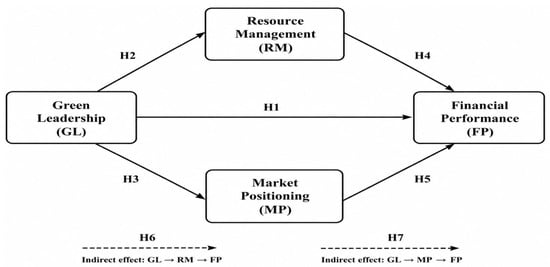
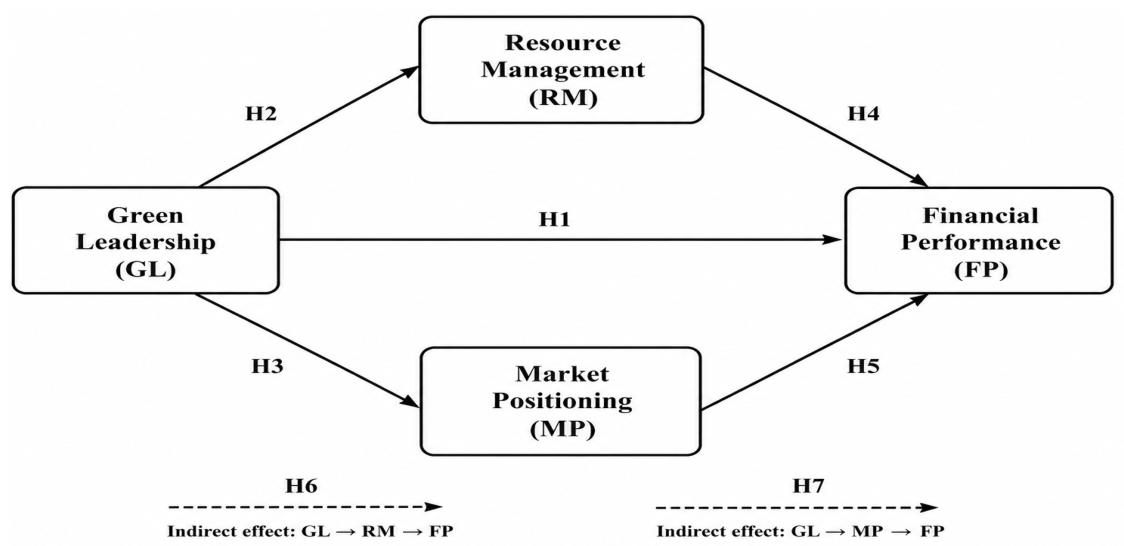
The theoretical framework of this study is illustrated below in Figure 1.
Figure 1.
The theoretical framework of this study.
3. Materials and Methods
3.1. Survey Methodology
The quantitative paradigm was followed in this study, which relied primarily on surveys, to analyze the influence of green leadership on financial performance. This methodology aptly investigates the connections among such key variables as green leadership, resource management, market positioning, and financial performance.
To guarantee content validity and consistency with past research, the measurement scales were adapted from instruments that had been previously validated. Green leadership was measured using items that were adapted from Asante [55]; resource management was assessed with scales adapted Zahra [21]; market positioning was measured using items based on Mahboobi et al. [56]; financial performance was evaluated using the method of Lu et al. [57]. All five-point scales for the items ranged from 1 (strongly disagree) to 5 (strongly agree), and minor adaptations of wording were done to suit the hospitality context while keeping within the boundaries of conceptual integrity. The complete measurement items for all constructs are presented in Appendix A.
This study was conducted in five-star hotels in Egypt, which have sufficiently shown their strong commitment to green leadership practices. A purpose sampling technique was utilized to focus on entities that actively participate in these ecological and sustainability efforts, hence maximizing the relevance of the respondents whose organizations were likely to experience the influence of green leadership on financial performance. The online surveys were employed for efficient data collection, providing the respondents with flexibility to participate in the research study.
Data were analyzed using SmartPLS 4.0 following the Partial Least Squares Structural Equation Modeling (PLS-SEM) approach. The measurement model was evaluated through reliability, convergent validity, and discriminant validity assessments, while the structural model was assessed using path coefficients, effect sizes (f2), and bootstrapping procedures.
The evaluation of the PLS-SEM model was carried out in accordance with the guidelines of Hair et al. [58] and included the measurement model (reliability, convergent validity, and discriminant validity) and the structural model (path coefficients, coefficient of determination (R2), effect sizes (f2), and bootstrapping significance tests). As PLS-SEM is mostly used for prediction, the focus was on explanatory and predictive capacities rather than on covariance-based global goodness-of-fit measures.
In addition, the explanatory power of the model was assessed through the coefficient of determination (R2), which indicated moderate predictive accuracy for the endogenous constructs for which it was appropriate to analyze complex models with mediation [58]. Resource management and market positioning were tested for mediation effects that would elucidate how green leadership is related to financial performance. This allowed an examination of both the direct relationship from green leadership to financial performance and how strategies being employed by the organization and resource allocation processes mediate this effect in the sector of hospitality.
3.2. Data Collection Methods
Assessment items were adapted from validated instruments in the scholarly literature. The questionnaire was administered in English, as respondents (hotel employees in Egypt) demonstrated sufficient proficiency. Relationships were tested using Structural Equation Modeling (SEM), with green leadership as an exogenous variable predicting financial performance both directly and indirectly through resource management and market positioning. Data were collected from personnel in 25 five-star hotels selected for their commitment to sustainability or CSR initiatives. Out of approximately 600 employees contacted, 390 valid responses were received (65% response rate). Data collection occurred from January to March 2025 via structured self-administered questionnaires, distributed face-to-face and through HR departments, as well as online surveys and semi-structured interviews. Participants included management and staff involved in sustainability and CSR activities. The final sample exceeded the minimum recommended for SEM, ensuring adequate power for analysis. As Hair et al. [58] note, samples of 200 or more are sufficient for models with up to seven latent variables, particularly using PLS-SEM, making this sample appropriate for valid and reliable analysis.
This study focuses on employees employed at five-star hotels in Egypt that showed clear, active involvement in sustainability initiatives, environmental certification schemes, or corporate social responsibility programs. For this reason, a set of possible hotels was put together using openly accessible industry sources plus hotel sustainability reports. In the end, twenty-five hotels agreed to take part in the research. The respondents were chosen through purposive sampling because they had enough expertise regarding sustainability-related practices inside their own organizations. The participants who qualified comprised department managers and supervisors as well as operational employees, who were involved in environmental stewardship, green initiatives, quality management, and customer care operations.
Overall, 600 questionnaires were given out, and 390 usable responses were kept for the analysis, producing a response rate of 65%.
3.3. Ethical Considerations
The study was carried out in line with the ethical guidelines described in the Declaration of Helsinki. Participation was voluntary, and respondents were told about the aims of the study before they finished the questionnaire. Everyone was assured that their answers would stay anonymous, held in confidence, and used only for scholarly research. In addition, no personally identifying details were gathered. Prior to actually taking part, informed consent was secured from each participant, using a consent statement placed right at the start of the questionnaire. Participants were moreover reminded that they could step away from the study at any moment without any sort of consequence.
3.4. Common Method Bias Assessment
Since all variables were collected through a single questionnaire survey, Harman’s single-factor test was conducted to assess the potential presence of common method bias. The results indicated that the first unrotated factor accounted for 38.42% of the total variance, which is below the recommended threshold of 50%. Therefore, common method bias was not considered a serious concern in this study.
4. Results
We present the demographic and organizational characteristics of the study’s participants (N = 390). The sample comprised 68.2% males and 31.8% females, reflecting the gender distribution in Egypt’s hospitality. In terms of age, nearly half of the respondents (46.5%) were between 30 and 45 years old, followed by 23.8% under the age of 30, and 30.7% over 45. The majority of participants held a bachelor’s degree (75%), while 18% had completed high school and 7% held a master’s or doctoral degree.
The measurement model was evaluated through reliability, convergent validity, and discriminant validity assessments. The results demonstrated satisfactory psychometric properties for all constructs, supporting the adequacy of the measurement model for subsequent structural analysis.
Table 1 shows measurement properties for the four constructs studied. Each construct consists of several indicators, with factor loading for those indicators between 0.52 and 0.91, which shows considerably strong associations between the indicators and their parent constructs. Composite reliability (CR) and Cronbach’s alpha (CA) values indicate strong internal consistency of all constructs, while the highest reliability was found for green leadership. The average variance extracted (AVE) shows a value from 0.51 to 0.59, indicating moderate to good convergence validity. VIF values ranging from 1.401 to 1.957 were well below the accepted limit of 3.3, thereby confirming that no multicollinearity issues exist in general.
Table 1.
Results of psychometric properties.
Table 2 shows the correlations between the study constructs. Overall, the findings point to positive links across all variables, with correlation values sitting somewhere between 0.410 and 0.653, maybe like that. The highest pair was between green leadership (GL) and resource management (RM) (r = 0.653), which suggests that, when green leadership practices are effective, they are closely tied to better resource management capabilities. Table 2 reports the correlations among the latent variables along with the square roots of the AVE based on the Fornell and Larcker criterion. The diagonal values represent the square roots of AVE for each construct and are higher than the corresponding inter-construct correlations, indicating adequate discriminant validity. Overall, the results indicate positive correlations among all constructs, ranging from 0.410 to 0.653, suggesting theoretically consistent relationships while maintaining adequate discriminant validity.
Table 2.
Correlations among latent variables.
Table 3 presents the discriminant validity assessment using the heterotrait–monotrait (HTMT) ratio. All HTMT values among the constructs are well below the conservative threshold of 0.85 and remain comfortably under the maximum acceptable limit of 0.90, indicating strong discriminant validity. Overall, the results provide further evidence that the measurement model demonstrates satisfactory discriminant validity.
Table 3.
Discriminant validity (HTMT).
Table 4 shows the effect size analysis, which shows different levels of predictive influence across the study constructs. Green leadership had a large impact on resource management (f2 = 0.512), and this kind of points to how sustainability-minded leadership matters a lot for making organizational resource utilization more effective. Green leadership also produced a medium effect on financial performance (f2 = 0.260) and a smaller effect on market positioning (f2 = 0.127). Then, resource management revealed a large effect on financial performance (f2 = 0.440), while market positioning showed a medium effect (f2 = 0.214), which underlines that it works as a kind of mechanism by which green leadership ends up supporting overall organizational success. In sum, the findings imply that resource management is the most solid explanatory route, connecting green leadership to better financial outcomes.
Table 4.
Effect sizes (f2) for total effects.
Structural Model and Hypotheses Testing
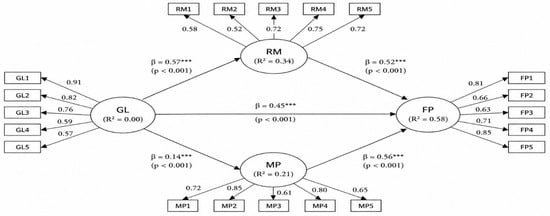
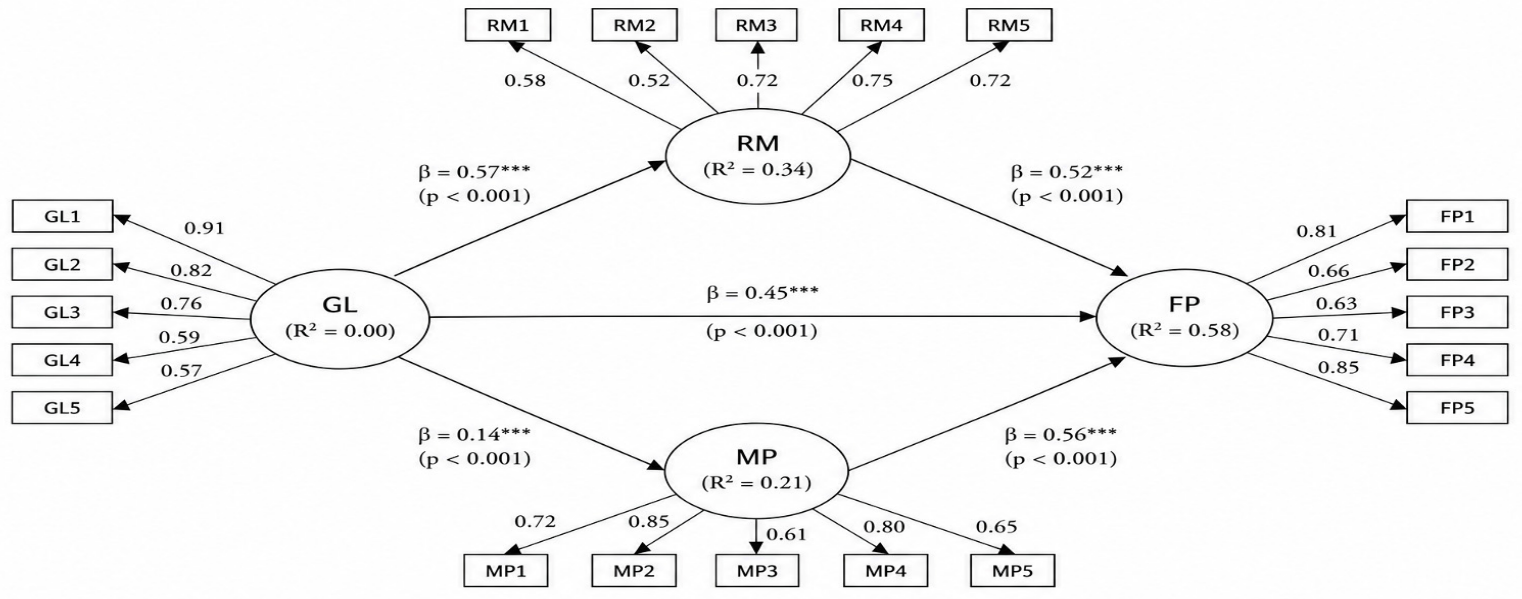
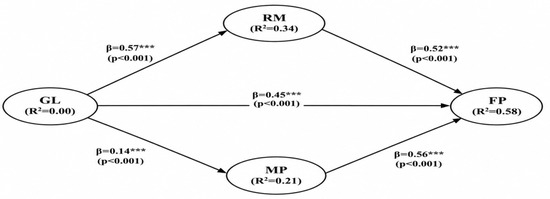
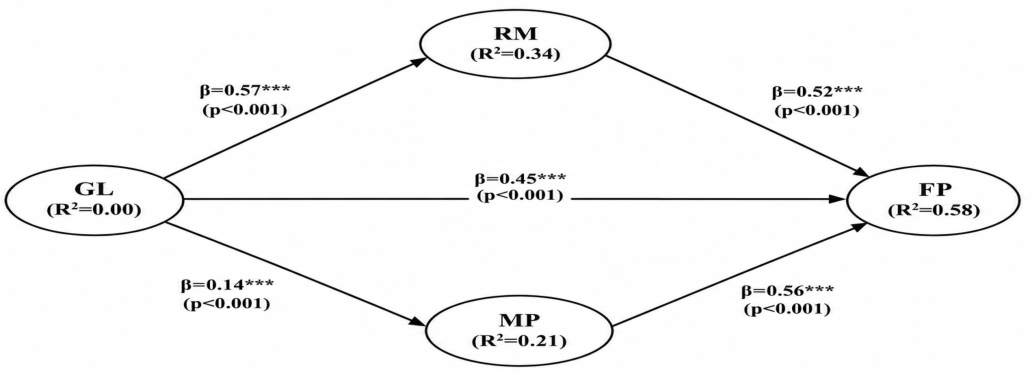
Figure 2 and Figure 3 presents the final PLS-SEM structural model, illustrating the standardized path coefficients, indicator loadings, and coefficients of determination (R2) for the endogenous constructs. Table 5 presents Direct impacts between critical constructs are presented in Panel A; as can be noted, all hypothesized relationships are statistically confirmed at the 0.001 level. H1 is confirmed, since there is a relatively strong and positive direct effect of green leadership on financial performance (β = 0.45, p < 0.001). It also significantly predicts resource management (β = 0.57, p < 0.001) and market positioning (β = 0.14, p < 0.001), thus confirming H2 and H3 respectively. Also, resource management (β = 0.52, p < 0.001) and market positioning (β = 0.56, p < 0.001), respectively, are found to have significantly positive contributions to financial performance, thus supporting H4 and H5. This strengthens the theoretical model and indicates that green leadership influences both internal operations and external strategic positioning directly and positively, thus boosting financial performance in the hospitality sector.
Figure 2.
Structure model of the study. Note: β values represent standardized path coefficients; *** indicates statistical significance at p < 0.001.
Figure 3.
Final results of the study. Note: β values represent standardized path coefficients; *** indicates statistical significance at p < 0.001.
Table 5.
Direct effects.
To check how meaningful the indirect effects are, a bootstrapping procedure with 5000 resamples was done with SmartPLS 4.0. Following what Hair et al. [58] recommend, bias-corrected 95% confidence intervals were produced for all indirect effects. Mediation was seen as significant if the confidence interval did not include zero. This kind of non-parametric path gives a solid read on indirect effects because it does not depend on the normality assumption.
A mediation analysis with the indirect effects tested, speculated by bootstrapping with 5000 samples and the 95% confidence intervals, was performed and summarized in Table 6. Resource management and market positioning are significant in mediating the path from green leadership to financial performance. The indirect effect from green leadership through resource management stands at 0.183, with confidence intervals not inclusive of zero (CI: 0.123–0.243), thereby supporting H6. Likewise, the indirect effect through market positioning is 0.090 (CI: 0.037–0.144), which corroborates H7. Thus, green leadership enhances financial performance, both directly and indirectly, through improving efficiency in internal operational practices and building a sustainable market identity for the firm. This highlights the role of operational efficiency and strategic branding in providing measurable financial returns for sustainability leadership.
Table 6.
Mediation analysis of bootstrapped confidence interval (N = 390).
5. Discussion
The results give important insight into the contribution of green leadership to financial performance in Egyptian five-star hotels. The results suggest that green leadership leads to financial benefits not because sustainability-oriented leadership automatically leads to better financial results, but only when it translates into effective internal resource management and credible external market positioning. This interpretation is consistent with the Resource-Based View, which postulates that organizational resources result in competitive advantage if they are strategically managed and transformed into valuable organizational capabilities [5].
The significant direct effect of green leadership on financial performance indicates that environmentally responsible leadership can support organizational outcomes by influencing strategic priorities, fostering operational discipline, and enhancing organizational commitment to sustainability. This result aligns with previous research that showed the positive impacts of green leadership on organizational effectiveness, sustainability performance, and long-term competitiveness [59,60,61]. The present research builds on previous hospitality literature by showing that green leadership affects financial performance both directly and indirectly through specific organizational mechanisms.
Both resource management and market positioning were found to play important mediating roles, with resource management showing stronger influence on financial performance. This indicates that the financial value of green leadership is mainly realized through the effective use of organizational resources. Green leaders promote environmentally responsible practices that reduce waste, enhance operational efficiency, optimize resource allocation, and improve organizational capabilities, leading to superior organizational performance [62,63,64].
Market positioning was another important mechanism that linked green leadership to financial performance. This is due to the competitive Egyptian five-star hotel sector, where hotels are competing more and more for environmentally friendly tourists, international visitors and corporate customers. Sustainable leadership can enhance the reputation of a hotel, perceived value and support differentiation strategies that improve competitive positioning in the marketplace [35,65]. Thus, those hotels, which can better communicate their care for the environment, may enjoy better recognition in the market as well as better organizational performance.
These results are especially important in the Egyptian hospitality context. As Egypt continues to emphasize sustainable tourism development and efforts are made to bring its tourism sector in line with international standards of sustainability, hotel organizations are experiencing mounting pressure from regulators, stakeholders and environmentally conscious consumers for responsible business practices. In such circumstances, green leadership is a vital strategic resource that supports environmental responsibility and organizational success [24,25].
The practical implications for management are that hotel managers should adopt the concept of green leadership in decision making at operational and strategic levels. Within the organization, there is a need to improve training programs on the environment, policies on sustainable procurement, initiatives to save resources and the engagement of employees in activities related to sustainability. On the external side, hotel managers should effectively communicate sustainability initiatives to stakeholders and integrate them into the overall positioning strategies. The results suggest that financial gains are more likely when environmental leadership is translated into tangible operational capabilities and a credible market differentiation than when viewed as a symbolic organizational commitment.
6. Implications
The evidence from this research bears out that green leadership is an important positive contributor to the financial performance of the hospitality sector. Resource management and market positioning were mediators in the relationship, therefore offering insight into the operating environment by which leadership with an environmental conscience translates its concerns into economic benefits. This article contributes to the theoretical schools of thought within sustainability and organizational leadership by presenting arguments linking operational practices of leadership to outcomes in both operational efficiency and strategic goals. The empirical backing it provides strengthens the arguments that incorporate environmental initiatives into core business strategies. This framework thus constitutes an important basis for researchers in pursuing a multi-dimensional understanding of how leadership is able to affect other sides of organization behavior. On the whole, it advances the understanding of sustainable management practices in the hospitality domain.
Furthermore, from a practical and policy perspective, findings imply a plethora of patchable suggestions for managers or executives of hotels. Green leadership programs may increase employee engagement, resource utilizations, and market positioning, hence increasing profitability. The recommended approach is to elevate sustainability from mere CSR to a strategic tool for gainful competitive advantage. Encouragement for such advancement may come from policymakers through guidelines, incentives, or even certifications advancing environment-friendly business practices. Empowering green leadership throughout the entire sector can benefit both its financial performance and its sustainable tourism objectives. This explains that, in these respects, sustainability seems beneficial for both an enterprise and an ecosystem.
7. Conclusions
This study looked at how green leadership connects with financial performance in Egyptian five-star hotels, with special attention on mediation, mainly on how resource management and market positioning interact. The results show that green leadership does not only have a direct effect on financial performance, but also works indirectly by using internal resources more effectively and by reinforcing market positioning. In practice, these findings back the Resource-Based View and the stakeholder theory, because they clarify the way sustainability-minded leadership could be turned into organizational capabilities, and how those capabilities then generate economic value.
This study contributes in some way to the hospitality and sustainability literature, in a way that feels integrated and ties leadership with operational capabilities, strategic positioning, and financial outcomes in an emerging-market setting. Managerially, it looks like hotel executives should weave sustainability principles into the day-to-day operational processes and into the market strategies, so they can improve competitiveness and maintain long-run organizational performance. In general, this article points out that green leadership is not only an environmental duty, but also a strategic resource—something that can enable sustainable financial success across the hospitality industry.
8. Limitations and Future Research Directions
When interpreting the findings, a few limitations should be kept in mind. For starters, this study was confined to five-star hotels in Egypt, so the results might not relate well to other parts of the hospitality sector, other tourism organizations, or different national contexts. In addition, because the design was cross-sectional, it is difficult to assert that there is a complete causal relationship about the links between green leadership, resource management, market positioning and financial performance, even if the associations look solid. Lastly, the evidence depended on self-reported perceptions gathered via one survey instrument, so there is a chance of response bias, even though this study used procedural steps intended to limit common method variance. Another limitation relates to the use of perceptual measures of financial performance rather than objective financial indicators. Future studies are encouraged to incorporate objective measures such as RevPAR, occupancy rates, profitability, and operating costs to further validate the observed relationships. Financial performance was assessed using perceptual measures reported by employees rather than objective financial indicators. Therefore, the findings should be interpreted as perceived organizational financial performance.
Future research should lean into longitudinal designs to see how the impact of green leadership leads to transformation over time and to construct more convincing causal ties. In addition, scholars are encouraged to add objective financial indicators, like revenue growth, profitability measures, occupancy rates, and operational efficiency metrics, so it is not only based on perceptual views of financial performance. Comparative work across various countries, hotel types, and tourism subsectors would also help the findings travel better to other contexts. Lastly, future efforts might expand the proposed framework by probing further mediating and moderating factors, with organizational culture, employee engagement, green innovation, digital transformation capabilities, and environmental strategy enactment included among them.
Author Contributions
Conceptualization, W.M.E.S. and Y.A.A.; methodology, W.M.E.S.; software, W.M.E.S.; validation, W.M.E.S. and Y.A.A.; formal analysis, W.M.E.S.; investigation, W.M.E.S. and Y.A.A.; resources, W.M.E.S.; data curation, W.M.E.S.; writing—original draft preparation, W.M.E.S.; writing—review and editing, W.M.E.S. and Y.A.A.; visualization, W.M.E.S.; supervision, W.M.E.S.; project administration, W.M.E.S.; funding acquisition, W.M.E.S. All authors have read and agreed to the published version of the manuscript.
Funding
This work was funded by the Deanship of Scientific Research, Vice Presidency for Graduate Studies and Scientific Research, King Faisal University, Saudi Arabia [KFU263009].
Institutional Review Board Statement
This study was conducted in accordance with the Declaration of Helsinki and approved by the ethical committee of King Faisal University on 1 February 2026 (Project Number: KFU263009).
Informed Consent Statement
Informed consent was obtained from all subjects involved in this study.
Data Availability Statement
The information provided in this research can be obtained by contacting the corresponding authors.
Conflicts of Interest
The authors declare no conflicts of interest.
Appendix A. Measurement Scales
| Green Leadership (GL) | GL1: My organization’s leadership actively promotes sustainability initiatives. |
| GL2: Leaders in my organization communicate the importance of green practices. | |
| GL3: There is a clear commitment to environmental stewardship from top management. | |
| GL4: My organization provides training on sustainable practices for employees. | |
| GL5: Leadership encourages employee involvement in sustainability initiatives. | |
| Resource Management (RM) | RM1: Our organization efficiently manages energy consumption. |
| RM2: We implement waste reduction strategies effectively. | |
| RM3: Resources are allocated towards sustainable practices in our operations. | |
| RM4: We track and measure our environmental impact regularly. | |
| RM5: Our procurement policies prioritize environmentally friendly products. | |
| Market Positioning (MP) | MP1: Our organization markets its sustainability initiatives to attract customers. |
| MP2: We have a competitive advantage due to our green initiatives. | |
| MP3: Customers perceive our establishment as environmentally friendly. | |
| MP4: We receive positive feedback from customers regarding our sustainability efforts. | |
| MP5: Our marketing materials highlight our commitment to sustainability. | |
| Financial Performance (FP) | FP1: Our organization has experienced revenue growth due to sustainability practices. |
| FP2: Sustainability initiatives have led to cost savings in our operations. | |
| FP3: Overall, our financial performance has improved as a result of green practices. | |
| FP4: Our customers are willing to pay a premium for our sustainable offerings. | |
| FP5: We have seen an increase in repeat business due to our commitment to sustainability. |
References
- Elshaer, I.A.; Azazz, A.M.S.; Kooli, C.; Aljoghaiman, A.; Elsawy, O.; Fayyad, S. Green Transformational Leadership’s Impact on Employee Retention: Does Job Satisfaction and Green Support Bridge the Gap? Adm. Sci. 2025, 15, 177. [Google Scholar] [CrossRef] [Scilit]
- Singh, S.K.; Del Giudice, M.; Chierici, R.; Graziano, D. Green innovation and environmental performance: The role of green transformational leadership. Technol. Forecast. Soc. Change 2020, 150, 119762. [Google Scholar] [CrossRef] [Scilit]
- Zhong, J.; Shao, X.; Xiao, H.; Yang, R.; An, X. The research on the green leadership: A systematic review and theoretical framework. Environ. Dev. Sustain. 2025, 27, 377–408. [Google Scholar]
- Rajâa, O.; Mekkaoui, A. Revealing the impact of social exchange theory on financial performance: A systematic review of the mediating role of human resource performance. Cogent Bus. Manag. 2025, 12, 2475983. [Google Scholar] [CrossRef] [Scilit]
- Barney, J. Firm resources and sustained competitive advantage. J. Manag. 1991, 17, 99–120. [Google Scholar] [CrossRef] [Scilit]
- Neirotti, P.; Raguseo, E.; Paolucci, E. Are customers’ reviews creating value in the hospitality industry? Exploring the moderating effects of market positioning. Int. J. Inf. Manag. 2016, 36, 1133–1143. [Google Scholar] [CrossRef] [Scilit]
- Jackson, S. Market share is not enough: Why strategic market positioning works. J. Bus. Strategy 2007, 28, 18–25. [Google Scholar] [CrossRef] [Scilit]
- Ahmad, S.; Javed, U.; Sharma, C.; Siddiqui, M.S. Green Human Resource Management: Analyzing sustainable practices and organizational impact through a Word2Vec approach. Green Technol. Sustain. 2025, 3, 100224. [Google Scholar] [CrossRef] [Scilit]
- Osmani, A. Transformational and Transactional Leadership: Their Impact on Sustainable Practices and Green Innovation in Organizations. EIRP Proc. 2025, 20, 132–141. [Google Scholar]
- Aleksandrovna, Z.; Poliak, N. Green transformational leadership and green growth. In Leadership—New Insights; IntechOpen: London, UK, 2022. [Google Scholar] [CrossRef] [Scilit]
- Robertson, J.L.; Barling, J. Toward a new measure of organizational environmental citizenship behavior. J. Bus. Res. 2017, 75, 57–66. [Google Scholar] [CrossRef] [Scilit]
- Susanti, I.R.; Sriyono, S. The Influence of Green Leadership and Green Economics on Sustainable Corporate Performance Through Employee Green Behavior at Bangil Regional Hospital. 2024. Available online: https://archive.umsida.ac.id/index.php/archive/preprint/view/6419/version/6412 (accessed on 15 March 2026).
- Ngek, N.B. Performance implications of financial capital availability on the financial literacy—Performance nexus in South Africa. Invest. Manag. Financ. Innov. 2016, 13, 354–362. [Google Scholar] [CrossRef] [Scilit]
- Kravchenko, M.; Pigosso, D.C.; McAloone, T.C. Towards the ex-ante sustainability screening of circular economy initiatives in manufacturing companies: Consolidation of leading sustainability-related performance indicators. J. Clean. Prod. 2019, 241, 118318. [Google Scholar]
- Roffé, M.A.; González, F.A.I. The impact of sustainable practices on the financial performance of companies: A review of the literature. Visión de Futuro 2024, 28, 221–240. [Google Scholar]
- Yang, Y.; Din, A.U.; Din, Q.M.U.; Khan, I.U. Green leadership in manufacturing industry: Unveiling the green Revolution’s impact on organizational performance. Heliyon 2024, 10, 13. [Google Scholar]
- Alqatan, A. Corporate responses to boycott movements: Impact on accounting and financial performance in the Middle East. Int. J. Islam. Middle East. Financ. Manag. 2025, 18, 360–380. [Google Scholar] [CrossRef] [Scilit]
- Daher, L.; Le Saout, E. The Determinants of the Financial Performance of Microfinance Institutions: Impact of the Global Financial Crisis. Strateg. Change 2015, 24, 131–148. [Google Scholar] [CrossRef] [Scilit]
- Rath, P.; Jindal, M.; Jindal, T. A review on economically-feasible and environmental-friendly technologies promising a sustainable environment. Clean. Eng. Technol. 2021, 5, 100318. [Google Scholar]
- Silva, R.; Oliveira, M.; Sousa, M.; Santos, T. Determinants of financial performance of non-profit organizations. J. Manag. Inf. Decis. Sci. 2021, 24, 1–10. [Google Scholar]
- Molina-Azorin, J.F.; López-Gamero, M.D.; Tarí, J.J.; Pereira-Moliner, J.; Pertusa-Ortega, E.M. Environmental management, human resource management and green human resource management: A literature review. Adm. Sci. 2021, 11, 48. [Google Scholar] [CrossRef] [Scilit]
- Brownhilder, N. Examining the moderating effect of environmental hostility on the entrepreneurial orientation-performance relationship. J. Econ. Behav. Stud. 2016, 8, 6–18. [Google Scholar]
- Leonidou, C.N.; Katsikeas, C.S.; Morgan, N.A. Greening the marketing mix: Do green marketing strategy and green performance have a positive impact on hotel financial performance? J. Bus. Ethics 2020, 169, 501–520. [Google Scholar] [CrossRef] [Scilit]
- Zahra, S.A. The Resource-Based View, Resourcefulness, and Resource Management in Startup Firms: A Proposed Research Agenda. J. Manag. 2021, 47, 1841–1860. [Google Scholar] [CrossRef] [Scilit]
- Murad, M.; Li, C. Impact of green inclusive leadership on employee green creativity: Mediating roles of green passion and green absorptive capacity. Leadersh. Organ. Dev. J. 2024, 46, 118–138. [Google Scholar] [CrossRef] [Scilit]
- Vakira, E.; Shereni, N.C. Fostering environmental performance through green human resource management practices in hotels: The moderating role of green inclusive leadership. J. Hum. Resour. Hosp. Tour. 2025, 24, 495–516. [Google Scholar] [CrossRef] [Scilit]
- Chung, K.C. Green marketing orientation: Achieving sustainable development in green hotel management. J. Hosp. Mark. Manag. 2020, 29, 722–738. [Google Scholar]
- Lagun, K. The Role of Eco-friendly Hotels Towards Sustainability–An Initiative from the Hospitality Sector. Int. J. Emerg. Knowl. Stud. 2023, 2, 176–180. [Google Scholar]
- Wang, H.-J. A New Approach to Network Analysis for Brand Positioning. Int. J. Mark. Res. 2015, 57, 727–742. [Google Scholar] [CrossRef] [Scilit]
- Nguyen-Viet, B. The impact of green marketing mix elements on green customer based brand equity in an emerging market. Asia-Pac. J. Bus. Adm. 2023, 15, 96–116. [Google Scholar]
- Kamaluddin, N.; Maulidya, N.; Saputro, I. Esg, Eco-Efficiency, And Green Innovation Positively Impact Corporate Financial Performance Through Sustainability Strategies. Int. J. Account. Bus. Soc. 2025, 33, 218–230. [Google Scholar] [CrossRef] [Scilit]
- Hariri, H. Leadership in a school context: How leadership styles are associated with leadership outcomes. Int. J. Financ. Account. Manag. 2020, 2, 159–170. [Google Scholar] [CrossRef] [Scilit]
- Gqaji, A.; Gerwel Proches, C.; Green, P. Perceived impact of public sector leadership on road infrastructure service delivery. Invest. Manag. Financ. Innov. 2016, 13, 394–402. [Google Scholar] [CrossRef] [Scilit]
- Hasanuddin, R.; Nurdin, N.N.; Natsir, N. The Influence of Financial Report Quality on Performance Accountability in the Regional Financial Management Agency of Mamasa Regency. Green Inflat. Int. J. Manag. Strateg. Bus. Leadersh. 2024, 1, 276–287. [Google Scholar] [CrossRef] [Scilit]
- Haile, E.A. The nexus between green transformational leadership and financial performance of hotels: The mediating effect of environmental management practices. J. Hosp. Tour. Insights 2025, 8, 1416–1435. [Google Scholar]
- Samson, D.; Terziovski, M. The relationship between total quality management practices and operational performance. J. Oper. Manag. 1999, 17, 393–409. [Google Scholar] [CrossRef] [Scilit]
- Fernando, Y.; Chiappetta Jabbour, C.J.; Wah, W.-X. Pursuing green growth in technology firms through the connections between environmental innovation and sustainable business performance: Does service capability matter? Resour. Conserv. Recycl. 2019, 141, 8–20. [Google Scholar] [CrossRef] [Scilit]
- Dahinine, B.; Laghouag, A.; Bensahel, W.; Alsolami, M.; Guendouz, T. Modelling the combined effect of green leadership and human resource management in moving to green supply chain performance enhancement in Saudi Arabia. Sustainability 2024, 16, 3953. [Google Scholar] [CrossRef] [Scilit]
- Khan, A.; Muttakin, M.B.; Siddiqui, J. Corporate Governance and Corporate Social Responsibility Disclosures: Evidence from an Emerging Economy. J. Bus. Ethics 2013, 114, 207–223. [Google Scholar] [CrossRef] [Scilit]
- Liao, L.; Luo, L.; Tang, Q. Gender diversity, board independence, environmental committee and greenhouse gas disclosure. Br. Account. Rev. 2015, 47, 409–424. [Google Scholar] [CrossRef] [Scilit]
- Çankaya, S.Y.; Sezen, B. Effects of green supply chain management practices on sustainability performance. J. Manuf. Technol. Manag. 2019, 30, 98–121. [Google Scholar] [CrossRef] [Scilit]
- Kumar, J.; Rani, V.; Rani, M.; Rani, G. Linking green intellectual capital and firm performance through green innovation and environmental performance in small and medium-sized enterprises. J. Intellect. Cap. 2025, 26, 670–690. [Google Scholar]
- Truong, Q.X.; Nguyen, P.V.; Nguyen, S.T.N.; Vrontis, D. From green intellectual capital to sustainable performance: The roles of innovation, human resource management, leadership and regulations. Int. J. Contemp. Hosp. Manag. 2026, 38, 1049–1068. [Google Scholar] [CrossRef] [Scilit]
- Jum’a, L. Digital voice of customer adoption, customer satisfaction and firm performance: The moderating role of customer trust in Jordan’s service sector. Int. J. Qual. Reliab. Manag. 2025. [Google Scholar] [CrossRef] [Scilit]
- Lumpkin, G.T.; Dess, G.G. Linking two dimensions of entrepreneurial orientation to firm performance: The moderating role of environment and industry life cycle. J. Bus. Ventur. 2001, 16, 429–451. [Google Scholar] [CrossRef] [Scilit]
- Maianto, T.; Yuntina, L.; Yosepha, S.Y.; Kamsariaty, K.; Wijanarko, B. Green Marketing of Analysis: Branding, positioning and eco-friendly products (literature review). Greenation Int. J. Tour. Manag. 2024, 2, 136–148. [Google Scholar] [CrossRef] [Scilit]
- Han, H.; Hsu, L.-T.; Sheu, C. Application of the Theory of Planned Behavior to green hotel choice: Testing the effect of environmental friendly activities. Tour. Manag. 2010, 31, 325–334. [Google Scholar] [CrossRef] [Scilit]
- Aboelmaged, M.; Hashem, G. Absorptive capacity and green innovation adoption in SMEs: The mediating effects of sustainable organisational capabilities. J. Clean. Prod. 2019, 220, 853–863. [Google Scholar] [CrossRef] [Scilit]
- Gunasekaran, A.; Papadopoulos, T.; Dubey, R.; Wamba, S.F.; Childe, S.J.; Hazen, B.; Akter, S. Big Data and Predictive Analytics for Supply Chain and Organizational Performance. J. Bus. Res. 2017, 70, 308–317. Available online: https://kar.kent.ac.uk/57171/13/JBR%20accepted.pdf (accessed on 15 March 2026). [CrossRef] [Scilit]
- Kraus, S.; Rehman, S.U.; García, F.J.S. Corporate social responsibility and environmental performance: The mediating role of environmental strategy and green innovation. Technol. Forecast. Soc. Change 2020, 160, 120262. [Google Scholar] [CrossRef] [Scilit]
- Pham, N.T.; Tučková, Z.; Chiappetta Jabbour, C.J. Greening the hospitality industry: How do green human resource management practices influence organizational citizenship behavior in hotels? A mixed-methods study. Tour. Manag. 2019, 72, 386–399. [Google Scholar] [CrossRef] [Scilit]
- Dao, T.C.; Liao, Y.K.; Chen, G.; Luu, T.M.N.; Le, T.M. The Influence of B2B Social Media Marketing and Relationship Marketing on Customer Relationship Management Effectiveness, WOM and Loyalty: A Mediator Analysis. Int. Rev. Manag. Mark. 2025, 15, 71. [Google Scholar]
- Siripipatthanakul, S.; Vasasiri, J.; Phayaphrom, B. The Relationship Between Brand Positioning, Attitude Knowledge and Green Brand Purchase Intention in Thailand. Int. Conf. Res. Dev. (ICORAD) 2022, 1, 116–131. [Google Scholar] [CrossRef] [Scilit]
- Zaki, N.A.B.M.; Norazman, I. The Relationship between Employee Motivation towards Green HRM Mediates by Green Employee Empowerment: A Systematic Review and Conceptual Analysis. J. Res. Psychol. 2019, 1, 6–9. [Google Scholar] [CrossRef] [Scilit]
- Asante, K. Hotels’ green leadership and employee pro-environmental behaviour, the role of value congruence and moral consciousness: Evidence from symmetrical and asymmetrical approaches. J. Sustain. Tour. 2023, 32, 1370–1391. [Google Scholar] [CrossRef] [Scilit]
- Mahboobi, R.; Amiri, A.; Mohammad, S.; Ansari, M. Developing a scale for brand competitive positioning: A study in the home appliance industry. J. Model. Manag. 2021, 16, 558–578. [Google Scholar] [CrossRef] [Scilit]
- Lu, K.; Onuk, C.B.; Xia, Y.; Zhang, J. ESG ratings and financial performance in the global hospitality industry. J. Risk Financ. Manag. 2025, 18, 24. [Google Scholar] [CrossRef] [Scilit]
- Hair, J.F.; Hult, G.T.M.; Ringle, C.M.; Sarstedt, M. A Primer on Partial Least Squares Structural Equation Modeling (PLS-SEM), 3rd ed.; Sage: Thousand Oaks, CA, USA, 2022. [Google Scholar]
- Ur Rehman, Z.; Shafique, I.; Khawaja, K.F.; Saeed, M.; Kalyar, M.N. Linking responsible leadership with financial and environmental performance: Determining mediation and moderation. Int. J. Product. Perform. Manag. 2023, 72, 24–46. [Google Scholar]
- Javed, M.; Rashid, M.A.; Hussain, G.; Ali, H.Y. The effects of corporate social responsibility on corporate reputation and firm financial performance: Moderating role of responsible leadership. Corp. Soc. Responsib. Environ. Manag. 2020, 27, 1395–1409. [Google Scholar]
- Hussain, Y.; Abbass, K.; Usman, M.; Rehan, M.; Asif, M. Exploring the mediating role of environmental strategy, green innovations, and transformational leadership: The impact of corporate social responsibility on environmental performance. Environ. Sci. Pollut. Res. 2022, 29, 76864–76880. [Google Scholar] [CrossRef] [Scilit]
- Morgan, R.E.; Strong, C.A.; McGuinness, T. Product-market positioning and prospector strategy: An analysis of strategic patterns from the resource-based perspective. Eur. J. Mark. 2003, 37, 1409–1439. [Google Scholar]
- Hooley, G.; Broderick, A.; Möller, K. Competitive positioning and the resource-based view of the firm. J. Strateg. Mark. 1998, 6, 97–116. [Google Scholar] [CrossRef] [Scilit]
- Papademetriou, C.; Belias, D.; Ntalakos, A.; Rossidis, I. Leading Green: How Leadership Styles Shape Environmental Human Resource Management Practices in Greek Hospitality Organizations. Sustainability 2026, 18, 974. [Google Scholar] [CrossRef] [Scilit]
- Alhemimah, A.; Ali, M.; Badghish, S.; Latan, H.; Chiappetta Jabbour, C.J. Go for green life: Linking green dynamic capabilities and ethical leadership with green competitive advantage through green marketing strategy. Manag. Environ. Qual. An. Int. J. 2025, 36, 1051–1070. [Google Scholar]

Disclaimer/Publisher’s Note: The statements, opinions and data contained in all publications are solely those of the individual author(s) and contributor(s) and not of MDPI and/or the editor(s). MDPI and/or the editor(s) disclaim responsibility for any injury to people or property resulting from any ideas, methods, instructions or products referred to in the content. |
© 2026 by the authors. Licensee MDPI, Basel, Switzerland. This article is an open access article distributed under the terms and conditions of the Creative Commons Attribution (CC BY) license.