


Abstract
Malawi faces increasing pressure on forest resources as rising urban demand for charcoal and firewood accelerates forest degradation in the Lilongwe River Upper Catchment, the primary water source for Lilongwe City. With over 90% of Malawians dependent on biomass energy and the country losing an estimated 33,000 hectares of forest annually, the consequences for water security, soil integrity, and rural livelihoods are severe. Existing research has largely examined woodfuel governance as a social and institutional issue, emphasising policy failures, corruption, and weak enforcement, with limited attention to the biophysical processes through which governance decisions shape landscapes. In this context, tracking changes in soils, water flows, and vegetation dynamics offers an important complementary perspective critical for integrated interventions. This paper proposes a conceptual framework, a Critical Zone Science and Social–Ecological Systems (CZS-SES) framework, which allows examination of how governance systems interact with biophysical processes across scales. The framework, informed by synthesis of policy documents and the empirical literature, highlights the need for more integrated, multidisciplinary approaches to understanding woodfuel governance and its implications for habitability in Malawi and across Africa.
1. Introduction
Globally, woodfuel, particularly charcoal and firewood, accounts for more than half of bioenergy consumption [1]. In sub-Saharan Africa, charcoal and firewood remain essential energy sources for both rural and urban households, supplying more than 80% of urban cooking and heating needs [2]. The woodfuel sector also supports the livelihoods of millions through production, transportation, and trade [3,4]. Despite the socioeconomic benefits, illegal and unsustainable woodfuel extraction has become a major driver of forest degradation. This has contributed to soil erosion, biodiversity loss, disruption of hydrological systems, and reduced carbon storage [5]. In Malawi, rapid population growth, currently at 2.6% per year, and urban expansion are placing increasing pressure on forests and water resources [6,7]. Although population growth rates are projected to decline, Malawi’s population is expected to reach 33.6 million by 2050 [8]. Lilongwe, one of the country’s fastest-growing cities, is expanding at around 4% annually [9]. The city relies heavily on water supplied from the Lilongwe River, specifically through Kamuzu Dam I and II. This water originates in the upper catchment of the Lilongwe River, which includes the Dzalanyama Forest Reserve. The reserve is an important ecological landscape providing timber, non-timber forest products, and watershed services that sustain both rural livelihoods and urban water supply [10,11].
The ecological integrity of the Lilongwe River Upper Catchment is increasingly threatened. Forest degradation in the catchment has been associated with rising sediment loads in the Lilongwe River and declining water quality downstream [6,12]. A key driver of this degradation is the growing demand for charcoal and firewood, driven by urban energy demands in Lilongwe City. For many smallholder farmers living within the catchment, charcoal production provides an important livelihood strategy amid limited employment and persistent food and income insecurity [13]. As a result, woodfuel extraction is shaped by competing pressures of environmental sustainability, livelihood security, and urban energy demand.
Governance plays a central role in shaping how forest resources are accessed, managed, and regulated. Woodfuel governance encompasses the policies, institutions, and practices that regulate the production, trade, and consumption of charcoal and firewood [14]. Across Africa, governance challenges in the woodfuel sector often include corruption, weak institutions, asymmetrical power structures, conflicting policies, and weak policy enforcement [15]. In Malawi, these challenges are particularly evident in the management of forest reserves such as Dzalanyama, where corruption and weak enforcement have been identified as major contributors to illegal logging and charcoal production [16]. Governance systems, therefore, influence both patterns of resource use and the distribution of environmental costs and benefits across different social groups.
While these insights are important, they tend to treat governance as a primarily social or institutional problem, with inadequate attention to how governance decisions translate into material changes in ecological systems [17]. As a result, there is limited understanding on how governance decisions shape the biophysical processes that sustain landscapes.
This gap is significant because forest ecosystems are dynamic systems in which vegetation, soils, water, and human activities interact continuously. Decisions about woodfuel production and regulation, therefore, trigger cascading effects across interconnected processes, from soil stability and water infiltration to nutrient cycling and sediment transport. Understanding these linkages requires a diagnostic framework capable of bridging governance systems and biophysical dynamics.
The concept of the Critical Zone (CZ) provides a useful perspective for understanding such interactions. The CZ refers to the Earth’s near-surface layer extending from the vegetation canopy to groundwater, where interactions among soil, water, rock, air, and living organisms sustain life [18,19]. It is within this zone that the ecological conditions necessary for human habitability are formed and sustained. Wrathall et al. [20] defined habitability as the set of environmental conditions that sustain human life, including safety, security, and the capacity to maintain livelihoods. Activities such as woodfuel production can disrupt CZ processes by altering vegetation cover, soil stability, and hydrological flows, thereby undermining habitability. Building on this perspective, the Social–Ecological Systems (SES) framework offers tools for analysing the institutional and social dynamics shaping natural resource governance [21].
Combining CZS and SES perspectives allows governance and ecological dynamics to be analyzed together, offering a more complete understanding of woodfuel systems. This paper argues for an integrated CZS–SES framework that conceptualises woodfuel systems as coupled human–environment systems, in which governance, actor behaviour, and biophysical processes continuously shape one another, rather than operating as separate domains.
The objective of this paper is therefore to propose a conceptual diagnostic framework linking governance systems to biophysical processes in the Lilongwe River Upper Catchment. Specifically, the paper addresses three questions: (1) What governance patterns characterise woodfuel governance in Malawi’s policy and empirical literature? (2) How do these governance patterns translate into biophysical processes affecting forest, soil, and water systems? (3) How can an integrated CZS–SES framework improve the diagnosis and design of woodfuel governance interventions?
2. Conceptual Frameworks
2.1. Critical Zone Science
Brantley et al. [22] introduced the idea of studying the Earth’s surface as one connected system integrating soil science, ecology, geology, and water science. Through a global network of Critical Zone Observatories (CZOs), the approach has developed into a global research framework that provides an integrative perspective [18]. As Brantley explains in her article ‘The Critical Zone Paradigm: A Personal View’ published in the award-winning collection edited by Bruno Latour and Peter Weibel, Critical Zones: The Science and Politics of Landing on Earth [23]:
“In many countries, if a doctor does not focus on problems of a specific body part, such as the heart, or a specific type of patient, such as children, or does not learn techniques of surgery or some other speciality, we call them a General Practitioner (GP). These GPs observe the entire patient and consult on health issues holistically. In Earth surface science before 2004, we did not have too many GPs. That’s why many of us pushed to create a new kind of scientific GP. We created Critical Zone Science to focus on studying earth’s surface from air to trees to water to rocks to humans.”[23]
Brantley and colleagues developed the critical zone approach to examine how biophysical processes interact, for example, how trees build and plumb the environment [18]. The approach emphasises how changes in one component cascade through the system, affecting ecosystem resilience and human habitability. Recently, critical zone sciences have begun exploring how to integrate social science, recognising humans as active components of the CZ [24,25]. This integration is particularly relevant in urban and peri-urban contexts where human activity directly alters ecosystem function.
2.1.1. What Critical Zone Science Offers to Woodfuel Governance Studies
People’s Science
Applying CZS to the Lilongwe River Upper Catchment could enable what is called a people’s science. Where SES focuses on formal institutions and state power, a CZ approach invites communities to think collectively about how their combined actions shape the future habitability of shared landscapes [25]. While SES examines who holds power within existing institutional arrangements, CZ frameworks invite collective discussion about material realities, including declining soil fertility, changing water cycles, and forest regeneration that affect everyone regardless of formal authority structures. Where residents are framing research questions about landscape changes that they see and know firsthand, a CZ approach draws attention to the cumulative effects of individual, household, sectoral and policy decisions, creating opportunities for collective deliberation and restoration efforts grounded in observable biophysical change.
Systems Integration
This participatory foundation becomes even more powerful when combined with a CZ systems perspective. In the Lilongwe River Upper Catchment, a CZ approach could reveal how policies covering forestry, water, energy, and agriculture interact through ecological connections that governance frameworks typically ignore. When trees are removed, the effects cascade downward through connected systems. For example, water infiltration decreases and surface runoff increases, while accelerated erosion strips away organic matter from soil and reduces long-term agricultural productivity. For instance, charcoal bans may appear as forest policy, but a CZ analysis would trace the processes by which effects spread across interconnected systems: triggering soil erosion that reduces agricultural productivity [26], altering water infiltration patterns that compromise water security, and changing vegetation cover that influences local microclimates [27]. This process perspective invites a change in governance approach to account for material connections across sectors rather than treating sectors in isolation. This matters, for communities experience these interconnected changes as unified landscape transformations.
Temporal Dynamics
Applying the CZS recognition that systems respond to disturbances across vastly different timescales could address critical governance challenges. It reveals, for instance, that while a licensing system for charcoal might be implemented within months, rebuilding soil organic matter in degraded production sites would require years to decades, and restoring watershed functions even longer. The Blantyre Firewood Project in Malawi illustrates this mismatch. After fifteen years of centralised state control, the government expected communities to immediately take over management responsibilities. However, rebuilding trust and reshaping institutions are processes that unfold over decades, not months. So too, the timeframes of different landscape processes require strategic and long-range policy decisions. A CZ approach explicitly matches governance timescales to biophysical system dynamics.
Monitoring and Adaptive Governance
Current woodfuel governance in the Lilongwe River Upper Catchment lacks feedback mechanisms that link policy interventions to measurable biophysical outcomes. A CZ-informed monitoring system tracks not just forest area but soil health, groundwater quality and availability, erosion rates, and ecological fluxes, creating empirical foundations for adaptive governance [28,29]. Conventional monitoring tracks policy outputs such as permits issued or hectares planted. This approach, however, does not reveal whether interventions actually improve conditions on the ground. Outcome monitoring goes further by measuring whether soil and water relations are being restored. Such evidence-based feedback loops would enable governance systems to adapt to what is measurably working rather than to what is politically expedient.
Transdisciplinary Integration
Just as no single natural science discipline suffices for understanding the Critical Zone [22], no single social science perspective adequately addresses governance complexity. CZ models of collaboration across multiple scientific disciplines, bringing together geologists, hydrologists, ecologists, and atmospheric scientists [29], can be applied to the integration of policy analysis, economics, anthropology, and political science in understanding woodfuel governance. Establishing a Critical Zone Observatory in the Lilongwe River Upper Catchment would provide the shared platforms for such collaboration. A CZO would create platforms for dialogue between scientists, policymakers, and communities, generating integrated knowledge that narrow single-discipline approaches cannot produce [30].
2.1.2. Limitations of the Critical Zone Science
CZS provides a detailed understanding of biophysical processes, but has recognised limitations. First, CZS has historically focused on pristine environments with limited attention to human dimensions, resulting in weak policy impact despite strong biophysical understanding [25,31]. Second, knowledge transfer from CZ scientists to practitioners remains underdeveloped, with the volume of technical information and discipline-specific language making it difficult to translate findings into practical governance guidance [23,32]. Third, the CZ science research sites remain geographically concentrated in the Global North [18], limiting the applicability of findings to African contexts like the Lilongwe River Upper Catchment in Malawi.
2.2. Social–Ecological Systems
2.2.1. What Social–Ecological Systems Offers
The Social–Ecological Systems (SES) framework analyses interactions among resource systems, resource units, actor groups, and governance systems [33,34]. SES helps identify actors, policies, and rules that shape resource use and environmental outcomes. The four subsystems continuously interact, and the outcomes they produce reshape the system over time [21,35]. One of SES’s most important contributions is its diagnostic power. The framework offers a structured opportunity to identify why governance succeeds or fails in specific contexts [34,36]. Ostrom’s eight design principles, derived from comparative analysis of the commons globally, provide practical criteria for evaluating governance arrangements [37,38]. These include clearly defined boundaries, rules adapted to local conditions, collective choice arrangements, monitoring mechanisms, graduated sanctions, conflict resolution processes, recognition of rights, and nested institutional layers [38]. Applied to woodfuel governance, the principles help diagnose specific institutional failures, including unclear land tenure boundaries, exclusion of communities from rule-making, and limited enforcement accountability [39].
2.2.2. Limitations of Social–Ecological Systems
Despite its strong conceptual development over the past two decades, SES continues to face important operational challenges [40]. Bodini et al. [41] argue that, although SES is conceptually well established, its practical application remains underdeveloped. Similarly, Cumming et al. [42] emphasise the need for more consistent approaches to selecting, defining, and measuring institutional elements, as well as stronger integration between theory and empirical research.
Ostrom and Cox [36] highlight the “panacea problem”, the tendency to apply one-size-fits-all institutional solutions to complex social–ecological challenges. Beyond these operational shortcomings, the framework has been persistently criticised for its inability to analyse cross-scale interactions and its thin incorporation of the biophysical environments. A limitation is that SES applications often simplify ecological dynamics by relying on broad environmental indicators such as deforestation rates or biomass loss [37,39], meaning that governance analyses may insufficiently capture the detailed biophysical processes through which environmental change occurs. Zhang [43] identifies these as structural weaknesses, noting that SES theory struggles to analyse cross-scale interactions because its explanatory power weakens beyond the local level. Large-scale biophysical models are also difficult to translate into locally meaningful insights [43]. Elsawah et al. [44] independently identify scales and scaling issues as one of eight grand challenges in socio-environmental systems modelling, arguing that connecting social and natural sciences across scales is fundamentally a challenge of bridging the different assumptions, methods, and languages of social and natural science disciplines. Garmestani et al. [45] noted that social–ecological processes interacting across multiple scales create confounding factors because the effects of governance decisions often appear at spatial or temporal scales different from where those decisions are implemented. On the biophysical side, Folke et al. [35] argue from within the SES tradition itself that Social–Ecological Systems coevolve with and depend on the broader biosphere, a dynamic that frameworks treating nature as a backdrop of variables fail to capture. Reyers et al. [46] extend this argument, calling for integrative approaches capable of handling unpredictable and disproportionate changes, sudden shifts between system states, and chain reactions that cascade across the earth system, precisely the cross-system interaction dynamics that the SES framework acknowledges but current approaches struggle to navigate. It is against this background that linking SES with CZS becomes analytically important.
2.3. Integrating Critical Zone Science and Social–Ecological System
SES and CZS complement each other because they address different but interconnected dimensions of environmental governance. SES maps actors, rules, interactions, and outcomes, revealing formal and informal governance, gendered divisions of labour, and power asymmetries in resource use. CZS explains the biophysical consequences of these human actions, such as impacts on soil quality, water flow, vegetation, and ecosystem resilience [47,48]. Neither framework alone is sufficient. SES without CZS risks underestimating the biophysical depth of degradation. While CZS without SES risks misattributing environmental change to natural processes rather than governance failures and structural inequalities. Integration is therefore analytically necessary.
In the Lilongwe River Upper Catchment, SES identifies the forest as the resource system and woodfuel (firewood and charcoal) as the resource units. Key actors include rural households, urban consumers, traditional leaders, Village Natural Resource Management Committees (VNRMCs), and government agencies such as the Department of Forestry (DoF), Lilongwe Water Board (LWB), and Extension Officers. Governance systems encompass forest, water, and agricultural policies, including permits, bans, and enforcement mechanisms, which are central to the global discourse on sustainable woody biomass governance [49].
The governance systems shape actor behaviour through enforcement and regulation, while actors simultaneously reshape governance through compliance, resistance, and informal practices like illegal charcoal production.
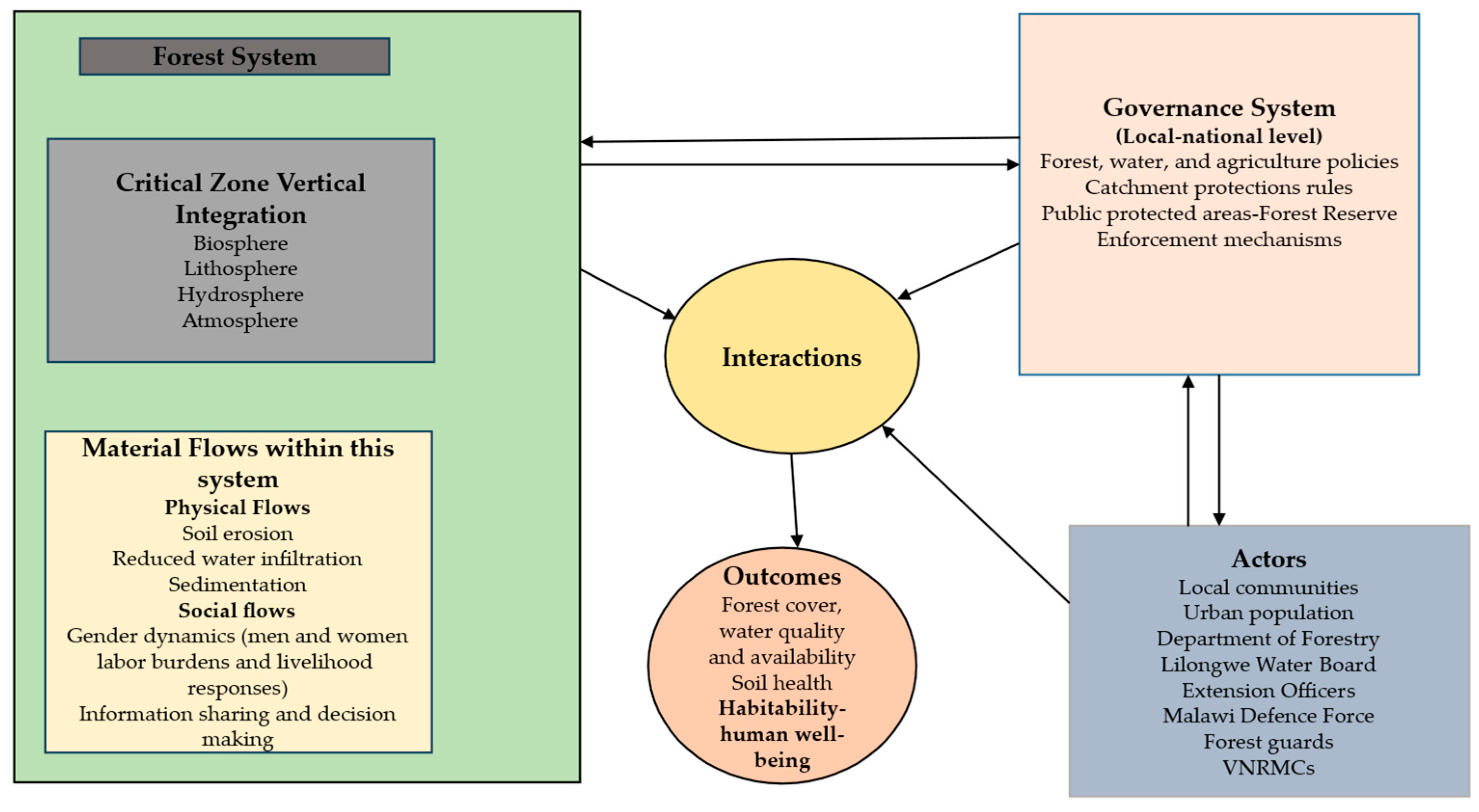
Mediating the relationships are material flows operating at multiple levels. Physical flows, such as soil erosion, reduced water infiltration, and sediment loads, represent the biophysical consequences of woodfuel extraction cascading through the CZ, necessitating multidisciplinary monitoring to preserve the vital subsurface processes [50]. The CZ orientation to vertical as well as horizontal processes is particularly valuable here because it draws attention to subsurface properties and processes like soil structure, water infiltration capacity, and sediment dynamics. Such processes are invisible to governance analysis yet fundamental to long-term catchment function and water security. By tracing material flows through the biosphere, lithosphere, hydrosphere, and atmosphere, CZS reveals how surface-level land use decisions by actors reverberate in volumetric space in ways that SES frameworks alone cannot capture. Social flows, including labour, information sharing, and authority structures, reflect the human dimensions through which resource decisions are made and negotiated. These social flows are not analytically separate from physical flows. They directly drive the physical and biogeochemical processes that alter CZ function by determining who extracts resources and under what governance conditions.
The flows also carry important economic dimensions that operate beyond monetary valuation. Within the catchment, livelihood dependencies, labour burdens, and unequal access to resources therefore represent important economic dimensions of woodfuel governance. For example, women’s firewood collection often reflects unpaid labour and gendered inequality, while charcoal production among men frequently represents a livelihood response to poverty, limited employment opportunities, and urban market demand. These activities reflect not merely social practices but rational responses to poverty, structural inequality, and the absence of affordable energy alternatives. However, reducing these ecological and social processes to monetary values risks undermining local value systems and encouraging the treatment of forest resources purely as commercial commodities [51,52].
The integrated CZS–SES framework conceptualises governance systems, actors, material flows, and biophysical processes as mutually influencing and inseparable rather than independent domains that can be studied in isolation. Their interactions collectively shape outcomes relating to forest cover, soil quality, water availability, sedimentation, and ecosystem function, all of which directly influence the long-term habitability and well-being of the catchment.
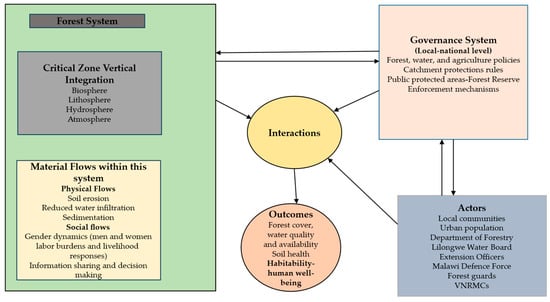
Integrating SES and CZS enables a multiscale analysis, connecting household-level practices to watershed-level environmental impacts and policy frameworks (Figure 1). This scalar integration operates across four interconnected domains: at the household scale, woodfuel extraction decisions reflect livelihood needs and energy insecurity; at the community scale, VNRMCs, traditional leaders, and informal rules mediate access and enforcement; at the watershed scale, cumulative extraction translates into measurable changes in forest cover, sedimentation, and water quality; and at the policy scale, national forest, water and agriculture policies shape the institutional environment within which all lower-scale interactions occur. For example, household reliance on woodfuel in the Lilongwe River Upper Catchment affects forest cover, which in turn influences sedimentation and water quality in Kamuzu Dam I and II. This SES-CZS perspective highlights how local decisions, enforcement gaps, and governance arrangements shape ecological processes. This also shows how the degradation of CZ function feeds back to undermine the livelihoods and well-being of the same actors driving resource use.
Figure 1.
Conceptual framework for diagnosing woodfuel governance, integrating Critical Zone (CZ) processes with Social–Ecological System (SES) components. Notes: the SES includes components such as governance systems and actor groups that interact with both the vertical dimensions of the CZ (biosphere, hydrosphere, and lithosphere) and horizontal processes (material flows). These interactions collectively influence the outcomes, including the habitability of the catchment. Source: developed by the authors, integrating concepts from Ostrom [21] and Brantley et al. [22].
3. Methodology
The paper draws on a narrative synthesis of policy documents and selected literature (Appendix A Table A1) to develop a mechanistic understanding of how governance shapes landscape outcomes. In doing so, it contributes a conceptual framework that can be empirically tested in future research and that may inform more adaptive, evidence-based governance approaches in Malawi and comparable contexts. The approach is guided by analytical depth rather than exhaustive coverage [53].
Sources were selected purposively, based on their relevance to the paper’s central concern: the structural disconnection between woodfuel governance and biophysical processes in Malawi’s forest landscapes. The analysis began with foundational policy texts and key empirical studies, expanding the corpus iteratively through citation tracking until no new governance logics or thematic patterns emerged [54]. The final corpus draws on three source types: national policy documents and legislation, peer-reviewed literature, and donor reports, with comparative governance cases from sub-Saharan Africa.
Each source was read interpretively, with policy texts treated not simply as records of intent but as texts that reflect particular assumptions about causality, agency, and social order [55]. Rather than aggregating findings, the synthesis identified recurring structural patterns and used these to build the paper’s conceptual framework. Coding was organised around three analytical threads. The first examined the institutional logics embedded in governance design. The second assessed whether and how biophysical and CZ processes were represented in policy framing. The third identified the mechanisms through which governance failures translate into landscape degradation. The analytical value of the corpus derives from the coherence and theoretical robustness of the patterns it reveals, rather than from its size [56].
4. Governance Patterns in Malawi Woodfuel Sector
4.1. Interpreted Policy Evidence
The degradation of forests driven by woodfuel production in Malawi cannot be understood solely as a cumulative outcome; it must also be examined through the structural logic shaping how governance frameworks interact with local biophysical processes. The evidence reviewed here reveals a recurring pattern of disconnection between governance design and the biophysical realities it is intended to manage (see Table 1 for a summary of policies, instruments, enforcement logic, observed outcomes, and CZS-SES diagnostics).
Table 1.
Summary of policies, instruments, enforcement logic, observed outcomes and CZS-SES diagnostics.
None of the reviewed policies explicitly incorporated Critical Zone processes into their governance analysis. This includes vertical and horizontal flows through atmosphere, vegetation, soil, and water systems, despite the same policies acknowledging broad relationships between forests, soils, and water. Historically, Malawi’s forestry policies prioritised timber over woodfuel. Early interventions focused on supply-side solutions like plantation development [64]. The Forest Act 1997 [58], Forest Policy, 1996 [57], and the National Energy Policy, 2003 [59] acknowledged the widespread reliance on charcoal and firewood, but enforcement remained top-down, relying on bans and restrictions without providing viable energy alternatives. Critics argued these measures were unrealistic given the lack of affordable options and the inability of most households to transition to cleaner fuels [65,66]. In practice, however, enforcement remained weak, coordination limited, and community participation minimal [67,68,69]. Further, the deployment of military personnel to enforce forest laws in Dzalanyama forest reserves in the Lilongwe River Upper Catchment [10], as a means of preserving forest cover, risks alienating communities and undermining collaborative governance [70].
More recent policies have rhetorically shifted towards more holistic livelihood-sensitive governance and models. Despite this progressive intent, implementation has had limited effectiveness. Sustainable pathways like Agroforestry Fuelwood Technologies (AFT) [71] and Community-Based Forest Management (CBFM) remain underutilised due to poor coordination, inadequate financial resources, and social–political interests [62,66,72,73]. This stagnation represents a missed opportunity. Modelling by Schuenemann et al. [74] indicates that interventions like a wide-scale farm-level agroforestry could generate millions of tonnes of sustainable wood supply while simultaneously improving soil fertility to raise maize yields by 13% to 23%.
4.1.1. The National Forest Policy [60]
The policy goal is to conserve, establish, protect, and manage trees and forests for the sustainable development of Malawi [60]. The policy is comprehensively designed and strongly aligned with international sustainability commitments, including the Rio Declaration, the United Nations Framework Convention on Climate Change, the Montreal Protocol, the United Nations Convention to Combat Desertification, and the United Nations Convention on Biological Diversity [67]. However, it has not translated into measurable reductions in forest degradation. This challenge is not unique to Malawi but is also documented in Kenya, Uganda, and Tanzania [14]. Implementation and enforcement challenges remain the primary constraints, not policy design weaknesses [67]. Informal and illegal woodfuel production continues to drive vegetation loss, soil erosion, and reduced water infiltration, thereby weakening the catchment’s habitability.
4.1.2. The Amended Forest Act [61]
The new amendment to Malawi’s Forestry Act considers charcoal as a forest product [61]. The Act strengthened penalties for illegal charcoal production and transportation, requiring producers to obtain licenses and submit reforestation plans. However, its effectiveness is fundamentally undermined by corruption and the absence of viable energy alternatives. Kansanga et al. [72] argue that such acts reflect a misplaced focus, targeting poor rural producers while powerful traders evade compliance, perpetuating structural inequalities across the value chain. Smith et al. [75] further argue that it shows that enforcement functions as a risk-shifting mechanism, subjecting rural transporters to arrests, bribes, and confiscations without reducing charcoal flows or halting CZ degradation. These enforcement patterns raise fundamental questions of justice [65], as the costs of governance are systemically borne by the most economically vulnerable actors while the benefits of continued extraction accrue to those with political and economic power.
4.1.3. The National Charcoal Strategy [63] and the National Energy Policy [62]
The Charcoal Strategy of 2017 is the most comprehensive document addressing broader woodfuel governance issues in Malawi [63]. On the other hand, the Malawi Energy Policy of 2018 aims to increase access to affordable, reliable, sustainable, efficient, and modern energy for all sectors and every person in the country [62]. However, they both fall short. While the Charcoal Strategy acknowledges near-universal household dependence on woodfuels, corruption among law enforcement perpetuates informal markets. This in turn accelerates interconnected CZ degradation processes, as forest loss intensifies soil erosion and compounds water insecurity. The Energy policy promotes alternative fuels and efficient cookstoves but prioritises centralised electrification, thereby neglecting rural populations. This paradoxically intensifies woodfuel extraction, further disrupting hydrological processes and deepening habitability challenges. McCauley et al. [65] argue that achieving genuine energy justice in Malawi requires grounding policy not only in efficiency and substitution logic but also in principles of equity, fairness, and recognition of the rural poor.
4.1.4. Comparative Evidence from Sub-Saharan Africa
Evidence from alternative governance models across Africa illustrates both the promise and limitations of formalised woodfuel governance arrangements. In West Africa, Burkina Faso’s participatory management of natural forests within dedicated Chantier d’Aménagement Forestier areas generated substantial village investment funds annually between 1990 and 2010, contributing to the construction of schools and water pumps at the community level. However, the model’s persistence, despite being nationally scaled, internationally supported, and having documented shortcomings, reveals how informal regulatory arrangements between state actors, merchants, and customary authorities can reproduce governance structures that serve political interests rather than ecological or livelihood outcomes [76]. In Senegal, villagers participating in donor-supported forest management projects earned substantially higher incomes from charcoal production, and decentralisation legislation formally allowed rural communities to control commercial charcoal production through democratically elected rural councils [77]. However, despite progressive legislation, the central Forest Service continued to control charcoal quotas and allocation, withholding real governance rights from rural councils and maintaining urban merchant dominance over the charcoal value chain, demonstrating that nominal decentralisation does not automatically translate into genuine redistribution of rights or benefits [78]. These parallel failures across different national contexts point to a structural limitation of the dominant governance framework, not a local implementation problem. The institutional failures manifest directly as compromised landscape processes: accelerated soil erosion, declining water infiltration, and sedimentation. What is required is not more biophysical data appended to institutional analysis, but a theoretical reorientation that places coupled material-social processes at the centre of governance analysis.
4.2. Governance in Practice
4.2.1. Command and Control Approach
The empirical literature consistently shows that woodfuel governance in Malawi remains trapped in a command-and-control approach associated with charcoal bans and fuel substitution policies [66]. It is well established that non-participatory, top-down government programmes disempower local communities [79]. The Blantyre City Fuelwood Project (1987–2001) [80] illustrates this dynamic: top-down implementation alienated communities from the outset, and when management authority was eventually devolved, communities resisted [79]. The documented consequence of such approaches is the exacerbation of livelihood risks and increased vulnerability to income insecurity among the rural poor [81]. In the Lilongwe River Upper Catchment, Dzalanyama Forest Reserve is managed through military enforcement, yet illegal logging and charcoal burning continue, and corruption remains on the rise [82]. This pattern is consistent with Abbot and Mace [83] finding that law enforcement does not deter illegal firewood collection in protected areas when livelihoods are at stake, an empirically grounded observation that the CZS-SES framework interprets as a habitability paradox: governance that secures the forest for conservation renders it inaccessible for energy needs.
4.2.2. Power Dynamics and Selective Enforcement
Class relations and power dynamics have been empirically documented as central in shaping woodfuel governance in Malawi [72]. Evidence from Uganda similarly shows that the relative power of actors determines access to and control of markets, confirming that political governance is fundamentally about power asymmetries between producers, traders, officials, and other stakeholders [3]. In Malawi, these dynamics manifest in hierarchical corruption: an elite class of large charcoal dealers pays bribes to produce freely, while rural producers are targeted by draconian forest laws [72]. This pattern of selective enforcement has been directly documented at the rural–urban interface of the Lilongwe River Upper Catchment [82].
The CZS-SES framework interprets this selective enforcement as regulatory capture—a governance condition in which those with economic resources are exempted from rules while those without face their full weight. The inferred consequence, while requiring further spatial empirical verification, is a misplaced policy gaze that targets symptoms such as rural production rather than structural root causes, including urban consumption, poverty, and the absence of clean energy alternatives [72]. Addressing these root causes requires confronting the political and economic interests that maintain the status quo [66,72] and grounding governance in principles of equity, fairness, and justice [61].
4.2.3. Market Structures and Livelihood Dependencies
The economic governance of woodfuel in Malawi is empirically documented as dominated by informal markets operating outside formal regulatory frameworks [81,84]. These informal markets lack mechanisms for ensuring sustainable resource extraction or equitable benefit distribution [66]. Urban energy markets remain dominated by charcoal due to poverty, limited electricity access, reliability issues, and tariff structures that entrench an enduring urban energy mix [66]. Dewees [64] identifies a significant and persistent gap between policy assumptions and actual deforestation dynamics, arguing for more targeted and holistic interventions. At the value chain level, producers receive minimal returns as a result of rent capture by government agencies, traditional institutions, and intermediaries, which undermines equity and encourages unsustainable production [85].
Financial incentives and disincentives operate as empirically documented drivers of decision-making across all levels of the woodfuel system. At the household level, charcoal production is pursued primarily as a livelihood necessity rather than a choice, driven by a lack of alternative income sources [86]. At the compliance level, poverty and livelihood pressures consistently outweigh regulatory deterrents, shaping decisions to engage in legal or illegal production [86]. At the market and governance level, financial disincentives are embedded within regulatory frameworks themselves. Across different African contexts, including Kenya, these take the form of logging moratoria, licensing delays, multiple taxes, and charcoal bans, while in Malawi, they manifest primarily as charcoal bans and licensing requirements [75]. The CZS-SES framework infers that these disincentives paradoxically incentivise informal and illegal production rather than sustainable practice. This represents governance–biophysical feedback that accelerates landscape degradation while leaving its structural drivers intact [66,86].
5. Discussion
5.1. Diagnostic Findings from the CZS-SES Lens
The woodfuel governance challenges in Malawi are clearly evident. In the Lilongwe River Upper Catchment, the documented failure of governance to secure sustainable woodfuel access has transformed the catchment, especially Dzalanyama Forest Reserve, into a de facto open-access system where woodfuel, the primary energy source, is extracted beyond the regenerative capacity of the landscape [82]. The CZS-SES framework interprets this as indicative of catchment vulnerability under competing socioeconomic pressures. Specifically, the mismatch between traditional and statutory management boundaries, combined with inadequate institutional capacity and elite capture, has structurally undermined effective regulation.
The biophysical consequences of this governance failure are some empirically documented and some inferred through the CZS-SES analytical lens. Directly measured evidence shows a 46.6% decline in forest cover in the Upper Lilongwe River basin, alongside significant increases in turbidity, nutrient loading, and faecal coliform contamination [12]. Evidence from comparable woodland systems across sub-Saharan Africa further demonstrates that charcoal production negatively affects soil hydrological properties and organic carbon stock, with large clearings generating increased surface runoff, reduced groundwater recharge, and progressively drier catchment conditions [87]. Drawing on these documented patterns, this study infers that similar woodland clearing dynamics in the Lilongwe River Upper Catchment are likely producing comparable hydrological and soil degradation trajectories. This inference, however, awaits direct empirical verification. The framework further infers that charcoal bans accelerate rather than arrest degradation. By criminalising producers and eliminating incentives for sustainable management, bans constitute a governance–biophysical feedback loop that deepens the very problem they aim to solve.
Two structural patterns emerge from the synthesis, one empirically grounded, one conceptually derived. The first, supported consistently across the reviewed policy and empirical literature, is that governance frameworks treat forests as static extraction stocks rather than as dynamic CZ components whose productivity depends on maintaining vertical and horizontal biophysical flows. This framing omission has measurable consequences. The empirical record consistently links forest cover loss to cascading failures in soil stability, water infiltration, and sediment regulation [12,87], outcomes that ultimately undermine the livelihoods that governance frameworks claim to protect. The second structural pattern is a conceptual inference of this paper. The literature’s tendency to treat governance as analytically separate from biophysical processes obscures the material pathways through which institutional arrangements produce landscape outcomes. Applying the CZS-SES lens makes this dynamic visible. Enforcement burdens fall disproportionately on communities and VNRMCs, while urban consumers and state agencies remain largely insulated from biophysical consequences. Yet it is the demand generated by these same actors that drives extraction pressure into ecologically sensitive areas such as Dzalanyama Forest Reserve. This inference, while theoretically grounded, requires spatially explicit empirical testing to confirm its magnitude and directionality.
These two patterns converge on a deeper conceptual proposition advanced by this paper: governance analyses confined to the social domain cannot account for the material outcomes they are designed to address. The social and political dimensions of woodfuel governance are well evidenced in the literature [65,66,72]. This paper proposes that integrating CZ biophysical tracking into governance analysis would reveal the actual state of ecosystem function in ways that political and institutional framings alone cannot. While this is currently a theoretical contribution rather than an empirical claim, we propose reframing landscape in governance not merely as a biophysical system but as a contested biogeosocial space. Where power asymmetries control the extraction of value from landscapes. This is to the detriment of the landscape as a whole. However, if future landscape habitability were to become a shared political concern, there would be potential to transform the orientation of local governance.
5.2. Propositions for the Operationalisation of the CZS-SES Framework in the Lilongwe River Upper Catchment
This section proposes an implementation pathway for the CZS-SES diagnostic framework using the Lilongwe River Upper Catchment as a case study.
Proposition 1.
Establish baseline CZ measurements linked to governance zones. The first practical step is to map the spatial boundaries of existing governance arrangements, like CBFM areas, and informal production hotspots onto a CZ measurement grid. At each governance zone, a minimum set of biophysical indicators should be measured: soil organic matter content (%), water infiltration rate (mm/hour), stream turbidity (NTU) as a proxy for sediment flux, and vegetation regeneration index (canopy cover change over time). These measurements do not require a fully equipped CZO. Community-based monitoring using low-cost turbidity tubes, infiltration rings, and satellite-derived vegetation indices can generate the baseline at a fraction of the cost. Measurements should be conducted on a seasonal basis to capture both dry and wet season variation in infiltration and turbidity, with the vegetation index recorded annually. This temporal structure allows detection of directional biophysical change attributable to governance interventions. The key institutional requirement is that these measurements be spatially linked to both governance boundaries and water catchment data so that changes in biophysical indicators can be understood on their own terms in ways that are compatible with existing governance systems.
Proposition 2.
Conduct actor network analysis using the SES framework. Parallel to baseline measurement, an SES actor network analysis should map all actors involved in woodfuel governance across the catchment: households, charcoal producers, transporters, traders, Traditional Authorities, VNRMCs, Department of Forestry officers, Lilongwe Water Board staff, and urban consumers. For each actor, the analysis should document: (a) what formal and informal rules govern their behaviour; (b) what information they have access to about the biophysical condition of the forest; (c) what gender differentiated roles, labour burdens, and decision-making authority shape their engagement with the resource system, recognising that women’s firewood collection and men’s charcoal production represent structurally distinct livelihood responses with different implications for governance design; and (d) what power they have to influence governance outcomes. The analysis should further document the urban demand chain from charcoal producers through transporters and traders to urban consumers in Lilongwe, since demand-side dynamics are a primary driver of extraction pressure that forest-side governance alone cannot address. This actor network analysis generates the social data necessary to identify governance interventions that are contextually grounded and practically feasible.
Proposition 3.
Identify governance–biophysical mismatches using the diagnostic matrix. Once baseline CZ measurements and actor network data are available, the CZS-SES diagnostic matrix can be applied. This involves overlaying governance outcome data, enforcement records, license compliance rates, and community-based management participation, with biophysical trend data for each governance zone. Zones where governance compliance is high but biophysical degradation continues indicate that the governance instruments in use are targeting the wrong drivers, for example, penalising small-scale woodfuel producers while large-scale extraction continues unchecked. Zones where biophysical recovery is occurring despite low formal compliance indicate the presence of effective informal governance mechanisms that policy should recognise and support rather than undermine. The matrix should also flag zones where biophysical indicators are declining despite stable actor behaviour. This may indicate threshold effects or non-linear CZ responses, for example, soil crust formation that prevents water infiltration, or hydrological disconnection between surface and groundwater systems, that require immediate intervention beyond governance adjustment alone. This diagnostic step transforms the CZS-SES framework from a conceptual integration into a practical analytical tool that generates specific, spatially explicit policy recommendations.
Proposition 4.
Design governance interventions calibrated to biophysical thresholds. The final implementation step is to use the diagnostic matrix outputs to design governance interventions that are explicitly calibrated to biophysical recovery thresholds rather than to administrative targets. For example, rather than setting a target of issuing 500 charcoal licenses per year, governance instruments should be calibrated to extraction rates that the forest’s measured regeneration rate and soil organic matter dynamics can sustain. Similarly, CBFM boundaries should be drawn to align with hydrological sub-catchments rather than administrative boundaries, so that community governance areas correspond to the spatial scale at which their collective management decisions actually produce biophysical outcomes. This step operationalises the CZS-SES integration in practice, where governance rules are derived from biophysical process data, and compliance is measured against biophysical outcomes rather than administrative outputs. A final implementation step is required to translate these outputs into habitability and human well-being terms, connecting CZ function to lived experience and policy relevance beyond the forestry sector, capturing impacts both downstream and in-place. In practice, this means supplementing biophysical and governance indicators with a minimum set of well-being metrics such as household water access, time burden of firewood and water collection disaggregated by gender, and food security indicators linked to soil health in adjacent agricultural areas.
5.3. Policy Recommendation and Future Direction
CZ science fundamentally reframes what woodfuel governance in Malawi is actually governing. Rather than managing forest stocks as extractable commodities, policy must shift its unit of governance to CZ process integrity. This means regulating the biophysical processes of water infiltration, soil formation, nutrient cycling, and sediment transport that forests actively sustain and that determine long-term landscape productivity. This requires embedding biophysical monitoring systems, tracking soil organic matter, water infiltration rates, sediment flux, and vegetation regeneration directly into governance frameworks as binding performance indicators, replacing the current reliance on administrative metrics that do not capture actual CZ function.
The most fundamental policy change required is the establishment of a biophysical monitoring system that generates the CZ process data necessary for evidence-based governance. Concretely, this means three actions. First, equipping at least three strategic monitoring points on the Lilongwe River with continuous turbidity and flow sensors linked to real-time data platforms accessible to the Department of Forestry and Lilongwe Water Board. Second, establishing an annual soil sampling protocol across stratified plots covering the full range of governance zones in Dzalanyama from strictly protected areas to active CBFM zones to informal production areas, measuring soil organic matter, bulk density, and infiltration rate. Third, establishing a vegetation regeneration monitoring protocol using freely available Sentinel-2 satellite imagery to track canopy cover change at the governance zone level. These three measures would cost a fraction of current enforcement budgets and would generate the feedback loops that adaptive governance requires. The critical institutional requirement is that monitoring data be formally incorporated into the Department of Forestry’s existing forest policy review cycle, with a mandatory biophysical performance report submitted by VNRMCs to district forestry offices annually, so that governance instruments are adjusted based on evidence rather than political expedience.
Current CBFM boundaries in the Lilongwe River Upper Catchment follow administrative demarcations that do not correspond to hydrological sub-catchments or soil unit boundaries. This spatial mismatch means that community governance decisions about harvesting in one CBFM area produce biophysical consequences, increased sediment loads, and reduced water infiltration that fall outside that governance area and therefore generate no feedback to the governing community. The Forest Act should be amended to require that CBFM boundaries align with hydrological sub-catchments identified through monitoring data, making this a legal condition of CBFM registration rather than a discretionary administrative guideline. CBFM performance agreements should also be amended to include biophysical performance targets, minimum soil organic matter levels, and maximum turbidity thresholds at the sub-catchment outlet alongside existing forest area targets, so that communities are formally accountable for the biophysical processes their collective decisions affect. VNRMCs should be formally recognised in the Forest Act as statutory community monitoring bodies with defined reporting obligations to the Department of Forestry, moving beyond their current advisory role and embedding community-led enforcement into the legal framework rather than leaving it dependent on donor project cycles. They should be further provided with low-cost monitoring equipment and training to measure biophysical indicators themselves, creating a community-owned monitoring infrastructure that builds local capacity while generating the data that adaptive governance requires.
6. Conclusions
The contribution of this paper is primarily theoretical, conceptual, and methodological, rather than empirical. The CZS-SES framework proposed here reframes the governance question from how to control illegal charcoal and firewood production to how to maintain the CZ processes that sustain forest regeneration and human livelihoods over time. The four operationalisation propositions advanced in Section 5.2 provide a practical pathway for translating this reframing into adaptive governance in the Lilongwe River Upper Catchment and comparable contexts.
While the integration of CZS and SES offers a powerful diagnostic framework, its application in Malawi faces practical constraints. Establishing a CZO requires sustained funding, specialised instrumentation, and interdisciplinary research capacity that currently exceeds what is available in Malawi. Community engagement also presupposes trust that decades of militarised enforcement have eroded, making trust-building itself a prerequisite governance challenge. These constraints are not reasons to abandon the framework, but rather to test and implement it incrementally, beginning with what is immediately feasible. Pilot initiatives of this kind could generate the preliminary evidence needed to attract the sustained investment that a full CZO requires.
Future research should empirically test the framework and prioritise studies that link governance systems to biophysical outcomes in the catchment. It should also include longitudinal research tracking coupled social and biophysical changes over relevant governance timescales. In addition, the establishment of a CZO in the Lilongwe River Upper Catchment could serve as a “people’s science” platform, bringing together communities, scientists, and policymakers to support adaptive and equitable woodfuel governance.
Author Contributions
Conceptualisation, F.S.; writing—original draft, F.S.; writing—review and editing, J.F.M.K., P.F., M.M., J.K.P., J.C., L.G. and J.K.; funding acquisition, L.G.; supervision, J.F.M.K., P.F., M.M., J.K.P., J.C. and L.G. All authors have read and agreed to the published version of the manuscript.
Funding
This publication emanates from the Critical Zones Africa research programme funded by the Science for Africa Foundation (SFA) via the Developing Excellence in Leadership, Training and Science in Africa (DELTAS Africa II) programme [Grant Number: DEL: 22-010], with support from Wellcome Trust and the UK Foreign, Commonwealth & Development Office, which is part of the EDCTP2 programme supported by the European Union. For purposes of open access, the author has applied a CC BY public copyright licence to any Author Accepted Manuscript version arising from this submission.
Institutional Review Board Statement
Not applicable.
Informed Consent Statement
Not applicable.
Data Availability Statement
The original contributions presented in this study are included in the article. Further inquiries can be directed to the corresponding author.
Acknowledgments
The authors gratefully acknowledge the Critical Zones Africa consortium members at the Universities of Cape Town, Zimbabwe, Dar es Salaam, Addis Ababa, LUANAR, and the Human Sciences Research Council.
Conflicts of Interest
The authors declare no conflicts of interest.
Abbreviations
The following abbreviations are used in the manuscript:
| CZ | Critical Zone |
| CIFOR-ICRAF | Center for International Forestry Research and the International Centre for Research in Agroforestry |
| CZS | Critical Zone Science |
| SES | Social–Ecological System |
| LWB | Lilongwe Water Board |
| DoF | Department of Forestry |
| MDF | Malawi Defence Force |
| CZO | Critical Zone Observatory |
| VNRMCs | Village Natural Resource Committees |
Appendix A
Table A1.
Description of documents on woodfuel governance in Malawi purposively included in the paper.
References
- International Energy Agency. African Energy Outlook 2019, World Energy Outlook Special Report. 2019. Available online: https://www.iea.org/reports/africa-energy-outlook-2019 (accessed on 27 December 2025).
- Branch, A.; Martiniello, G. Charcoal Power: The Political Violence of Non-Fossil Fuel in Uganda. Geoforum 2018, 97, 242–252. [Google Scholar] [CrossRef] [Scilit]
- Branch, A.; Phillips, J.; Agyei, F.K. Charcoal Politics in Africa: Value Chains, Resource Complexes, and Energopolitics. Prog. Environ. Geogr. 2023, 2, 77–96. [Google Scholar] [CrossRef] [Scilit]
- Ndegwa, G.; Sola, P.; Iiyama, M.; Okeyo, I.; Njenga, M.; Siko, I.; Muriuki, J. Charcoal Value Chains in Kenya: A 20-Year Synthesis; Working Paper Number 307; World Agroforestry: Nairobi, Kenya, 2020. [Google Scholar] [CrossRef] [Scilit]
- FAO. The State of the World’s Forests 2022: Forest Pathways for Green Recovery and Building Inclusive, Resilient and Sustainable Economies; FAO: Rome, Italy, 2022. [Google Scholar] [CrossRef] [Scilit]
- Munthali, K.G.; Murayama, Y. Modeling Deforestation in Dzalanyama Forest Reserve, Lilongwe, Malawi: A Multi-Agent Simulation Approach. GeoJournal 2015, 80, 743–757. [Google Scholar] [CrossRef] [Scilit]
- Ngwira, S.; Watanabe, T. An Analysis of the Causes of Deforestation in Malawi: A Case of Mwazisi. Land 2019, 8, 48. [Google Scholar] [CrossRef] [Scilit]
- National Statistical Office (NSO). 2018 Malawi Population and Housing. Population Projections 2018–2050 Report; National Statistical Office: Zomba, Malawi, 2020; Available online: https://cms.nsomalawi.mw/api/download/262/Population-Projections-2018-2050.pdf (accessed on 28 December 2025).
- Brown, D.; Manda, M.; Mwalyambwile, T. Lilongwe: City Report; ACRC Working Paper; 2024–13; African Cities Research Consortium: Manchester, UK, 2024; Available online: https://www.african-cities.org/publications/working-paper-13/ (accessed on 27 December 2025).
- Japan International Cooperation Agency. The Project for Conservation and Sustainable Management of Dzalanyama Forest Reserve, Project Completion Report; JICA: Tokyo, Japan, 2023. Available online: https://openjicareport.jica.go.jp/pdf/12343141_01.pdf (accessed on 28 December 2025).
- Katumbi, N.; Nyengere, J.; Mkandawire, E. Drivers of Deforestation and Forest Degradation in Dzalanyama Forest Reserve in Malawi. Int. J. Sci. Res. 2017, 6, 889–893. [Google Scholar]
- Nkwanda, I.S.; Feyisa, G.L.; Zewge, F.; Makwinja, R. Impact of Land-Use/Land-Cover Dynamics on Water Quality in the Upper Lilongwe River Basin, Malawi. Int. J. Energy Water Resour. 2021, 5, 193–204. [Google Scholar] [CrossRef] [Scilit]
- Munthali, K.G.; Murayama, Y. Interdependences between Smallholder Farming and Environmental Management in Rural Malawi: A Case of Agriculture-Induced Environmental Degradation in Malingunde Extension Planning Area (EPA). Land 2013, 2, 158–175. [Google Scholar] [CrossRef] [Scilit]
- Sola, P.; Schure, J.; Atyi, R.E.; Gumbo, D.; Okeyo, I.; Awono, A. Woodfuel Policies and Practices in Selected Countries in Sub-Saharan Africa–A Critical Review. Bois For. Trop. 2019, 340, 27–41. [Google Scholar] [CrossRef] [Scilit]
- Besada, H.G. Governance, Conflict, and Natural Resources in Africa: Understanding the Role of Foreign Investment Actors; McGill-Queen’s Press-MQUP: Montreal, QC, Canada, 2021. [Google Scholar]
- Makwinja, Y.H.; Mkhwimba, D. Extensive Logging in Miombo Woodlands Threatens Resource Nexus Potential for Diverse Values of Nature: Lessons from Dzalanyama Forest Reserve in Malawi. Front. For. Glob. Change 2025, 8, 1610680. [Google Scholar] [CrossRef] [Scilit]
- Van Assche, K.; Duineveld, M.; Beunen, R.; Valentinov, V.; Gruezmacher, M. Material Dependencies: Hidden Underpinnings of Sustainability Transitions. J. Environ. Policy Plan. 2022, 24, 281–296. [Google Scholar] [CrossRef] [Scilit]
- Brantley, S.L.; Eissenstat, D.M.; Marshall, J.A.; Godsey, S.E.; Balogh-Brunstad, Z.; Karwan, D.L.; Papuga, S.A.; Roering, J.; Dawson, T.E.; Evaristo, J.; et al. Reviews and Syntheses: On the Roles Trees Play in Building and Plumbing the Critical Zone. Biogeosciences 2017, 14, 5115–5142. [Google Scholar] [CrossRef] [Scilit]
- Lee, R.M.; Shoshitaishvili, B.; Buck, R.L.; Bekker, J.; Abbott, B.W. The Meanings of the Critical Zone. Anthropocene 2023, 42, 100377. [Google Scholar] [CrossRef] [Scilit]
- Wrathall, D.J.; de Sherbinin, A.; Oppenheimer, M.; Horton, R. Defining Habitability. PERN Cyberseminar Expert Paper on the Concept of Habitability in the Field of Population-Environment Studies: Relevance and Research Implications, Population-Environment Research Network (PERN), Columbia University, New York 2023. Available online: https://pern.ciesin.columbia.edu/sites/pern.ciesin.columbia.edu/files/content/cyberseminar/CyberseminarExpertPaper_Wrathall_etal_Habitability.pdf (accessed on 30 December 2025).
- Ostrom, E. A General Framework for Analyzing Sustainability of Social-Ecological Systems. Science 2009, 325, 419–422. [Google Scholar] [CrossRef] [Scilit] [PubMed]
- Brantley, S.L.; Goldhaber, M.B.; Ragnarsdottir, K.V. Crossing Disciplines and Scales to Understand the Critical Zone. Elements 2007, 3, 307–314. [Google Scholar] [CrossRef] [Scilit]
- Brantley, S.L. The Critical Zone Paradigm: A Personal View. In Critical Zones: The Science and Politics of Landing on Earth; Latour, B., Weibel, P., Eds.; MIT Press: Cambridge, MA, USA, 2020; pp. 140–141. [Google Scholar]
- Lü, Y.; Hu, J.; Fu, B.; Harris, P.; Wu, L.; Tong, X.; Bai, Y.; Comber, A.J. A Framework for the Regional Critical Zone Classification: The Case of the Chinese Loess Plateau. Natl. Sci. Rev. 2019, 6, 14–18. [Google Scholar] [PubMed]
- Naylor, L.A.; Zheng, Y.; Munro, N.; Stanton, A.; Wang, W.; Chng, N.R.; Oliver, D.M.; Dungait, J.A.J.; Waldron, S. Bringing Social Science Into Critical Zone Science: Exploring Smallholder Farmers’ Learning Preferences in Chinese Human-Modified Critical Zones. Earths Future 2023, 11, e2022EF003472. [Google Scholar] [CrossRef] [Scilit]
- Lin, H. Earth’s Critical Zone and Hydropedology: Concepts, Characteristics, and Advances. Hydrol. Earth Syst. Sci. 2010, 14, 25–45. [Google Scholar] [CrossRef] [Scilit]
- Minor, J.; Pearl, J.K.; Barnes, M.L.; Colella, T.R.; Murphy, P.C.; Mann, S.; Barron-Gafford, G.A. Critical Zone Science in the Anthropocene: Opportunities for Biogeographic and Ecological Theory and Praxis to Drive Earth Science Integration; SAGE Publications Ltd.: London, UK, 2020; Volume 44. [Google Scholar] [CrossRef] [Scilit]
- Banwart, S.A.; Nikolaidis, N.P.; Zhu, Y.G.; Peacock, C.L.; Sparks, D.L. Soil Functions: Connecting Earth’s Critical Zone. Annu. Rev. Earth Planet. Sci. 2019, 47, 333–359. [Google Scholar] [CrossRef] [Scilit]
- Banwart, S.A.; Chorover, J.; Gaillardet, J.; Sparks, D.; White, T.; Anderson, S.; Aufdenkampe, A.; Bernasconi, S.; Brantley, S.L.; Chadwick, O.; et al. Sustaining Earth’s Critical Zone Basic Science and Interdisciplinary Solutions for Global Challenges; International Critical Zone Observatory Workshop Report; The University of Sheffield: Sheffield, UK, 2013. [Google Scholar]
- Naylor, L.A.; Dungait, J.A.J.; Zheng, Y.; Buckerfield, S.; Green, S.M.; Oliver, D.M.; Liu, H.; Peng, J.; Tu, C.; Zhang, G.; et al. Achieving Sustainable Earth Futures in the Anthropocene by Including Local Communities in Critical Zone Science. Earths Future 2023, 11, e2022EF003448. [Google Scholar] [CrossRef] [Scilit]
- Chien, H.; Phan, L.T.; Jou, S.C. Social Science Approaches to Critical Zone Studies: A Systematic Review. Environ. Dev. Sustain. 2024, 26, 15573–15629. [Google Scholar] [CrossRef] [Scilit]
- Arora, B.; Kuppel, S.; Wellen, C.; Oswald, C.; Groh, J.; Payandi-Rolland, D.; Stegen, J.; Coffinet, S. Building Cross-Site and Cross-Network Collaborations in Critical Zone Science. J. Hydrol. 2023, 618, 129248. [Google Scholar] [CrossRef] [Scilit]
- McGinnis, M.D.; Ostrom, E. Social-Ecological System Framework: Initial Changes and Continuing Challenges. Ecol. Soc. 2014, 19, 30. [Google Scholar] [CrossRef] [Scilit]
- Ostrom, E. Sustainable Social-Ecological Systems: An Impossibility?Workshop in Political Theory and Policy Analysis Working Paper W07-02; Indiana University: Bloomington, IN, USA, 2007. [Google Scholar]
- Folke, C.; Biggs, R.; Norström, A.V.; Reyers, B.; Rockström, J. Social-Ecological Resilience and Biosphere-Based Sustainability Science. Ecol. Soc. 2016, 21, 41. [Google Scholar] [CrossRef] [Scilit]
- Ostrom, E.; Cox, M. Moving beyond Panaceas: A Multi-Tiered Diagnostic Approach for Social-Ecological Analysis. Environ. Conserv. 2010, 37, 451–463. [Google Scholar] [CrossRef] [Scilit]
- Cox, M.; Arnold, G.; Tomás, S.V. A Review of Design Principles for Community-Based Natural Resource Management. Ecol. Soc. 2010, 15, 38. [Google Scholar] [CrossRef] [Scilit]
- Ostrom, E. Governing the Commons: The Evolution of Institutions for Collective Action. Land Econ. 1992, 68, 354. [Google Scholar] [CrossRef] [Scilit]
- Partelow, S. A Review of the Social-Ecological Systems Framework: Applications, Methods, Modifications, and Challenges. Ecol. Soc. 2018, 23, 36. [Google Scholar] [CrossRef] [Scilit]
- Feng, J.; Zhao, Z.; Wen, Y.; Hou, Y. Organically Linking Green Development and Ecological Environment Protection in Poyang Lake, China Using a Social-Ecological System (Ses) Framework. Int. J. Environ. Res. Public Health 2021, 18, 2572. [Google Scholar] [CrossRef] [Scilit] [PubMed]
- Bodini, A.; Dambacher, J.M.; Jordán, F. Editorial: Looking Through the Mesh of a Net: The Challenge of Socio-Ecological Systems. Front. Ecol. Evol. 2021, 9, 785895. [Google Scholar] [CrossRef] [Scilit]
- Cumming, G.S.; Epstein, G.; Anderies, J.M.; Apetrei, C.I.; Baggio, J.; Bodin, Ö.; Chawla, S.; Clements, H.S.; Cox, M.; Egli, L.; et al. Advancing Understanding of Natural Resource Governance: A Post-Ostrom Research Agenda. Curr. Opin. Environ. Sustain. 2020, 44, 26–34. [Google Scholar] [CrossRef] [Scilit]
- Zhang, Y. On the Social-Ecological Systems (SES) Diagnostic Approach of the Commons: Sharing, Cooperation, and Maintenance. PLoS Sustain. Transform. 2023, 2, e0000057. [Google Scholar] [CrossRef] [Scilit]
- Elsawah, S.; Filatova, T.; Jakeman, A.J.; Kettner, A.J.; Zellner, M.L.; Athanasiadis, I.N.; Hamilton, S.H.; Axtell, R.L.; Brown, D.G.; Gilligan, J.M.; et al. Eight Grand Challenges in Socio-Environmental Systems Modeling. Socio-Environ. Syst. Model. 2020, 2, 16226. [Google Scholar] [CrossRef] [Scilit]
- Garmestani, A.; Allen, C.R.; Angeler, D.G.; Gunderson, L.; Ruhl, J.B. Multiscale Adaptive Management of Social-Ecological Systems. Bioscience 2023, 73, 800–807. [Google Scholar] [CrossRef] [Scilit] [PubMed]
- Reyers, B.; Folke, C.; Moore, M.L.; Biggs, R.; Galaz, V. Social-Ecological Systems Insights for Navigating the Dynamics of the Anthropocene. Annu. Rev. Environ. Resour. 2018, 43, 267–289. [Google Scholar] [CrossRef] [Scilit]
- Hu, C.; Liu, Z.; Xiong, K.; Lyu, X.; Li, Y.; Zhang, R. Temporal and Spatial Variations in Carbon/Nitrogen Output in the Karst Critical Zone and Its Response to the Forest Ecosystem of Karst Desertification Control. Forests 2023, 14, 1121. [Google Scholar] [CrossRef] [Scilit]
- Yang, Y.; Zhang, P.-P.; Song, Y.; Li, Z.-M.; Zhou, Y.-Y.; Sun, H.; Qiao, J.; Wang, Y.-Q.; An, S.-S. The Structure and Development of Loess Critical Zone and Its Soil Carbon Cycle. Carbon Neutrality 2024, 3, 1. [Google Scholar] [CrossRef] [Scilit]
- Pandey, S.; Erbaugh, J.T. Driving Sustainable Uptake: A Systematic Review of Global Literature on Policies Governing Woody Biomass for Energy. Discov. Sustain. 2024, 5, 28. [Google Scholar] [CrossRef] [Scilit]
- Sbarbati, C.; Lacchini, A.; Petitta, M. The Role of Hydrogeological Monitoring in a Multidisciplinary Context for the Preservation of the Critical Zone in the Natural Reserve of Castelporziano Estate. Front. Earth Sci. 2022, 10, 935791. [Google Scholar] [CrossRef] [Scilit]
- Sullivan, S. The Environmentality of ’ Earth Incorporated ’: On Contemporary Primitive Accumulation and the Financialisation of Environmental Conservation. In An Environmental History of Neoliberalism; Lund University: Lund, Sweden, 2010; pp. 1–24. [Google Scholar]
- Green, L. Material Flows as Earth Politics: Concepts, Methods, and Approaches for Transdisciplinary Diagnostics and Repair at Muizenberg East, Cape Town. Environ. Plan. E Nat. Space 2024, 7, 1279–1298. [Google Scholar] [CrossRef] [Scilit]
- Patton, M.Q. Qualitative Research and Evaluation Methods; Sage College Publishing: Thousand Oaks, CA, USA, 2002. [Google Scholar]
- Fusch, P.I.; Ness, L.R. Are We There yet? Data Saturation in Qualitative Research. Qual. Rep. 2015, 20, 1408–1416. [Google Scholar] [CrossRef] [Scilit]
- Bowen, G.A. Document Analysis as a Qualitative Research Method. Qual. Res. J. 2011, 28, 78–81. [Google Scholar]
- Thomas, J.; Harden, A. Methods for the Thematic Synthesis of Qualitative Research in Systematic Reviews. BMC Med. Res. Methodol. 2008, 8, 45. [Google Scholar] [CrossRef] [Scilit] [PubMed]
- Government of Malawi. National Forest Policy of Malawi; Department of Forestry, Ministry of Natural Resources: Lilongwe, Malawi, 1996.
- Government of Malawi. Ministry of Forestry, Fisheries and Environmental Affairs. Forest Act (Cap. 63:01); Government Printer: Zomba, Malawi, 1997.
- Government of Malawi. National Energy Policy for Malawi; Ministry of Energy and Mining: Lilongwe, Malawi, 2003.
- Government of Malawi. National Forest Policy; Government of Malawi: Lilongwe, Malawi, 2016.
- Government of Malawi. Forestry (Amendment) Act, 2019 (Act No. 7 of 2020); Government Printer: Zomba, Malawi, 2020.
- Government of Malawi. National Energy Policy; Ministry of Natural Resources, Energy and Mining, Department of Energy Affairs: Lilongwe, Malawi, 2018.
- Government of Malawi. National Charcoal Strategy; 2017–2027; Ministry of Natural Resources, Energy and Mining: Lilongwe, Malawi, 2017.
- Dewees, P.A. Forestry Policy and Woodfuel Markets in Malawi. Nat. Resour. Forum 1995, 19, 143–152. [Google Scholar] [CrossRef] [Scilit]
- McCauley, D.; Grant, R.; Mwathunga, E. Achieving Energy Justice in Malawi: From Key Challenges to Policy Recommendations. Clim. Change 2022, 170, 28. [Google Scholar] [CrossRef] [Scilit] [PubMed]
- Zulu, L. The Forbidden Fuel: Charcoal, Urban Woodfuel Demand and Supply Dynamics, Community Forest Management and Woodfuel Policy in Malawi. Energy Policy 2010, 38, 3717–3730. [Google Scholar] [CrossRef] [Scilit]
- Coutts, C.; Holmes, T.; Jackson, A. Forestry Policy, Conservation Activities, and Ecosystem Services in the Remote Misuku Hills of Malawi. Forests 2019, 10, 1056. [Google Scholar] [CrossRef] [Scilit]
- Kamoto, J.; Clarkson, G.; Dorward, P.; Shepherd, D. Doing More Harm than Good? Community Based Natural Resource Management and the Neglect of Local Institutions in Policy Development. Land Use Policy 2013, 35, 293–301. [Google Scholar] [CrossRef] [Scilit]
- Kunje, M. An Assessment of Community Based Management of Forest Resources: A Malawi Case Study. Ph.D. Thesis, University of Reading, Reading, UK, 2018. [Google Scholar]
- Duffy, R.; Massé, F.; Smidt, E.; Marijnen, E.; Büscher, B.; Verweijen, J.; Ramutsindela, M.; Simlai, T.; Joanny, L.; Lunstrum, E. Why We Must Question the Militarisation of Conservation. Biol. Conserv. 2019, 232, 66–73. [Google Scholar] [CrossRef] [Scilit] [PubMed]
- Toth, G.G.; Ramachandran Nair, P.K.; Jacobson, M.; Widyaningsih, Y.; Duffy, C.P. Malawi’s Energy Needs and Agroforestry: Adoption Potential of Woodlots. Hum. Ecol. 2017, 45, 735–746. [Google Scholar] [CrossRef] [Scilit]
- Kansanga, M.M.; Banda, D.; Mkandawire, P.; Kpienbaareh, D.; Bezner Kerr, R.; Luginaah, I. Tacit Evasion or A Misplaced Policy Gaze: A Political Ecology of the Deforestation and Charcoal Conundrum in Malawi. Geogr. Rev. 2024, 115, 703–728. [Google Scholar] [CrossRef] [Scilit]
- Toth, G.G.; Nair, P.K.R.R.; Jacobson, M.; Widyaningsih, Y.; Duffy, C.P. Malawi’s Energy Needs and Agroforestry: Impact of Woodlots on Fuelwood Sales. Energy Sustain. Dev. 2019, 50, 101–108. [Google Scholar] [CrossRef] [Scilit]
- Schuenemann, F.; Msangi, S.; Zeller, M. Policies for a Sustainable Biomass Energy Sector in Malawi: Enhancing Energy and Food Security Simultaneously. World Dev. 2018, 103, 14–26. [Google Scholar] [CrossRef] [Scilit]
- Smith, H.; Eigenbrod, F.; Kafumbata, D.; Hudson, M.; Schreckenberg, K. Criminals by Necessity: The Risky Life of Charcoal Transporters in Malawi. For. Trees Livelihoods 2015, 24, 259–274. [Google Scholar] [CrossRef] [Scilit]
- Côte, M.; Gautier, D. Fuelwood Territorialities: Chantier d’Aménagement Forestier and the Reproduction of “Political Forests” in Burkina Faso. Geogr. Helv. 2018, 73, 165–175. [Google Scholar] [CrossRef] [Scilit]
- Poteete, A.R.; Ribot, J.C. Repertoires of Domination: Decentralization as Process in Botswana and Senegal. World Dev. 2011, 39, 439–449. [Google Scholar] [CrossRef] [Scilit]
- Ribot, J.C. Authority over Forests: Empowerment and Subordination in Senegal’s Democratic Decentralization. Dev. Change 2009, 40, 105–129. [Google Scholar] [CrossRef] [Scilit]
- Kalipeni, E.; Zulu, L. From Top-down to Bottom-up: The Difficult Case of the Blantyre City Fuelwood Project. J. S. Afr. Stud. 2001, 28, 117–136. [Google Scholar] [CrossRef] [Scilit]
- Kalipeni, E.; Feder, D. A Political Ecology Perspective on Environmental Change in Malawi with the Blantyre Fuelwood Project Area as a Case Study. Politics Life Sci. 1999, 18, 37–54. [Google Scholar] [CrossRef] [Scilit]
- Smith, H.; Hudson, M.; Schreckenberg, K. Livelihood Diversification: The Role of Charcoal Production in Southern Malawi. Energy Sustain. Dev. 2017, 36, 22–36. [Google Scholar] [CrossRef] [Scilit]
- Lilongwe Wildlife Trust. Sounding the Alarm Malawi’s Forests on the Brink Investigative Dossier Part 1; Lilongwe Wildlife Trust: Lilongwe, Malawi, 2022. [Google Scholar]
- Abbot, J.I.O.; Mace, R. Managing Protected Woodlands: Fuelwood Collection and Law Enforcement in Lake Malawi National Park. Conserv. Biol. 1999, 13, 418–421. [Google Scholar] [CrossRef] [Scilit]
- Kambewa, P.; Mataya, B.; Sichinga, W.K.; Johnson, T. Charcoal: The Reality. A Study of Charcoal Consumption, Trade and Production in Malawi; International Institute for Environment and Development (IIED): London, UK, 2007; 60p, ISBN 978-1-84369-678-0. [Google Scholar]
- FAO. The Charcoal Transition: Greening the Charcoal Value Chain to Mitigate Climate Change and Improve Local Livelihoods; Food and Agriculture Organisation of the United Nations: Rome, Italy, 2017; ISBN 978-92-5-109680-2. [Google Scholar]
- Sola, P.; Gambo, J.; Muthui, R.; Amugune, I.; Wanjira, E.; Kitema, A. Regulatory Compliance, Motivations and Capacities in Charcoal Production in Baringo and Kitui Counties, Kenya; ICRAF Working Paper 2021, No. January 2022; World Agroforestry (ICRAF): Nairobi, Kenya, 2021. [Google Scholar]
- Lulandala, L.; Bargués-Tobella, A.; Masao, C.A.; Nyberg, G.; Ilstedt, U. The Size of Clearings for Charcoal Production in Miombo Woodlands Affects Soil Hydrological Properties and Soil Organic Carbon. For. Ecol. Manag. 2023, 529, 120701. [Google Scholar] [CrossRef] [Scilit]
Disclaimer/Publisher’s Note: The statements, opinions and data contained in all publications are solely those of the individual author(s) and contributor(s) and not of MDPI and/or the editor(s). MDPI and/or the editor(s) disclaim responsibility for any injury to people or property resulting from any ideas, methods, instructions or products referred to in the content. |
© 2026 by the authors. Licensee MDPI, Basel, Switzerland. This article is an open access article distributed under the terms and conditions of the Creative Commons Attribution (CC BY) license.