


Abstract
Over the last decades, the rapid growth of e-commerce has increased the scale and operational intensity of warehouse systems. Consequently, sustainability in warehouse operations has become increasingly important due to rising energy consumption and environmental concerns. As an answer to this growth, Automated Guided Vehicles (AGVs) are utilized more, directly affecting energy usage and operational efficiency. This study develops a sustainability-oriented optimization framework for AGV-assisted order picking in warehouses with random storage and multiple products per location. The framework includes five mathematical models prioritizing one or more environmental (distance minimization), economic (AGV utilization), and social (workload balancing) sustainability perspectives. A generalized recursive matheuristic algorithm based on iterative cut generation is developed for the first model. A real-life dataset is used to evaluate the proposed approaches. Results reveal substantially different outcomes from different sustainability perspectives. The “Compact Clustering Model” achieved the best environmental performance, reducing total travel distance and normalized energy consumption by approximately 27–29% compared with the baseline formulation. From an economic sustainability perspective, several formulations achieved 92–100% AGV utilization, while social sustainability indicators showed load variability ranging from approximately 5.1 to 13.1. Overall, the findings demonstrate that different formulations provide distinct sustainability advantages in AGV-assisted warehouse systems.
1. Introduction
Sustainability has become a central design criterion in modern logistics systems, particularly within warehouse operations, where energy consumption and resource intensity are inherently high. As supply chains expand and environmental regulations tighten, warehouses are increasingly recognized not only as operational hubs but also as significant contributors to energy usage and carbon emissions. Among warehouse activities, order picking is the most resource-intensive process, accounting for a substantial portion of total operational effort, travel distance, and energy consumption [1]. Reducing environmental impact while maintaining high service levels by improving the efficiency of order picking systems represents a key opportunity.
The adoption of Automated Guided Vehicles (AGVs) has transformed warehouse operations by enabling automation, improving consistency, and reducing manual labor. However, the sustainability performance of AGV-assisted systems is highly sensitive to operational decisions, particularly those related to routing, assignment, and fleet sizing. Excessive travel distances lead directly to increased energy consumption, while inefficient fleet utilization results in unnecessary deployment of vehicles and imbalanced workload. Therefore, optimizing AGV operations constitutes a sustainability-critical decision problem that requires careful consideration of efficiency, environmental impact and workload balance.
Despite the growing body of research on order picking optimization, most studies primarily focus on minimizing travel distance or improving computational efficiency, often treating sustainability as a secondary or implicit outcome, if at all. Even when considered as an outcome, sustainability objectives from different perspectives are not always aligned. From an environmental sustainability perspective, minimizing travel distance can reduce energy consumption and operational emissions. However, this may also lead to overloaded AGV assignments and workload imbalance, which negatively affects social sustainability. Conversely, improving social sustainability through balanced workload allocation may require assigning distant items to the same AGV, resulting in longer travel distances and increased energy consumption. Similarly, maximizing AGV utilization can improve economic sustainability through more efficient use of resources, while potentially increasing route lengths and operational complexity. These trade-offs illustrate the conflicting nature of sustainability objectives in AGV-assisted warehouse systems. Despite these practical trade-offs, existing research typically relies on a single modeling perspective, limiting the ability to evaluate how different structural decisions influence sustainability outcomes In practice, warehouse managers face several alternative strategies, including routing-based optimization, clustering approaches, and simplified distance approximations. Each strategy has different implications for environmental, economic, and social performance. However, systematic comparative evaluations of these alternative modeling approaches within a unified sustainability framework remain limited. A more detailed discussion on how these sustainability objectives from different perspectives conflict with one another, and what the corresponding gap in the literature is given in Section 2.
To address this gap, this study proposes a multi-model optimization framework for AGV-assisted order picking that explicitly evaluates the sustainability implications of different decision structures. Five mathematical models are developed, each capturing a distinct sustainability perspective, including environmental (distance minimization), economic (AGV utilization), and social (workload balancing) perspectives. Rather than focusing solely on solution quality, the framework investigates how these alternative modeling strategies influence key sustainability indicators such as energy consumption, fleet utilization, operational efficiency, and workload balancing. Using real-life data and multiple modeling approaches, this study presents practical insights into designing more energy-efficient and environmentally responsible warehouse systems.
The main contributions of this study are summarized as follows. First, a multi-model optimization framework is proposed for AGV-assisted order picking systems, enabling the comparative evaluation of alternative mathematical formulations under environmental, economic, and social sustainability perspectives. Second, a real-life benchmark dataset is developed to support future studies on AGV-assisted order picking problems. Third, extensive computational experiments are conducted to analyze the effects of alternative modeling structures on routing efficiency, AGV utilization, workload balancing, and sustainability outcomes. Finally, the study provides managerial insights regarding the trade-offs between operational efficiency, computational complexity, and sustainability objectives in intelligent warehouse systems.
The remainder of this paper is organized as follows. Section 2 reviews the relevant literature. Section 3 presents the problem definition. Section 4 introduces the mathematical models and proposed matheuristic algorithm, followed by computational results from experimentation with real-life dataset and managerial insights in Section 5. Finally, Section 6 presents the conclusions and future research directions.
2. Literature Review
The order picking process in warehouses has been recognized as one of the most cost-critical warehouse activities for many years. Thus, the early literature concentrated on the core design and control decisions of manual systems, which are layout, storage assignment, batching, zoning, and routing. Previous reviews by [2,3] considered warehousing as a multi-level planning problem and established order picking as a central operational layer. Later review work by [4,5,6,7] show that the field has progressively moved from isolated decisions toward integrated planning, types of warehouse layouts, and robotized settings.
The majority of research focuses on picker routing. The literature has become progressively sophisticated in terms of exact optimization and modeling structure, especially for modern warehouse layouts [8] proposed a model for single-picker routing in classical and modern warehouses, while [9] studied optimal picking policies in e-commerce warehouses with mixed shelves. More recent studies on scattered storage and mixed-shelves environments, such as [10,11,12] demonstrated that warehouses with multiple candidate storage locations transform routing into a combined selection-and-routing problem rather than a conventional warehouse traveling salesman problem. These findings highlight the increasing structural complexity of warehouse routing problems in modern logistics systems.
Another major research direction concerns integrated batching and routing optimization. Existing studies consistently demonstrate that solving batching and routing decisions separately leads to suboptimal warehouse performance. For this reason, integrated optimization frameworks have become increasingly prevalent. Exact and non-exact approaches proposed by [13,14,15,16,17] showed that batching, sequencing, and routing decisions can effectively be optimized simultaneously through mathematical programming frameworks. However, due to the NP-hard structure of integrated warehouse optimization problems, exact approaches rapidly become computationally intractable for large-sized instances. Consequently, heuristic and metaheuristic optimization methods in [18,19,20,21,22,23,24] have been developed to obtain high-quality solutions within reasonable computational time.
Research on automation, AGVs, and AMRs is relatively recent and remains more limited than the research on manual order picking systems [25] directly studied picker routing in AGV-assisted order picking systems [26] extends the field by combining AGV assistance with mixed-shelves storage and integrated batching/routing [27] addresses batching and sequencing in an AMR-assisted picker-to-parts system, while [28] reviews levels of automation in picker-to-parts systems. More recent studies [29,30] emphasize task balancing and path planning of AGVs, and scalability in intelligent warehouses. These studies confirm that the AGV/AMR literature is expanding, although it remains newer than the classical batching and routing literature, especially for mathematical comparisons across alternative model structures.
More recently, sustainability and green warehousing have emerged as important research directions in warehouse optimization studies. Sustainable warehouse management requires simultaneous consideration of environmental, economic, and social sustainability perspectives [31]. Environmental sustainability in warehouse systems is primarily associated with reducing energy consumption, carbon emissions, and unnecessary AGV movements through efficient routing and energy-aware warehouse operations [29,30,32]. From an economic sustainability perspective, efficient fleet utilization, operational productivity, and minimizing unnecessary AGV deployment are critical factors affecting both investment and operational costs [5,31]. In addition, social sustainability has attracted more attention in warehouse systems, particularly in terms of workload balancing, operational fairness, worker safety, and human–automation interaction [33,34,35].
Despite recent advancements, several important research gaps remain in the literature on AGV-assisted order picking problems. First, most existing studies mainly emphasize only environmental sustainability through travel distance or energy minimization, while economic and social sustainability perspectives such as fleet utilization, resource efficiency, and workload balancing receive comparatively limited attention as seen in Table 1. Second, existing literature generally focuses on a single objective or solution strategy, limiting the ability to systematically evaluate how different modeling structures affect sustainability performance under multiple perspectives. Third, to the best of our knowledge, there is no study jointly addressing environmental, economic, and social sustainability dimensions within a unified optimization framework for the AGV-assisted order picking problem. Moreover, real-life benchmark datasets reflecting warehouse characteristics are limited in the literature, and experimental analyses are predominantly conducted on synthetic instances, which leads to questions on applicability of results obtained from such datasets. To address these gaps, this study proposes a multi-model optimization framework that comparatively evaluates five mathematical formulations under environmental, economic, and social sustainability perspectives. Furthermore, a new real-life benchmark dataset generation framework is developed to support real-life experimentation and provide a reusable test environment for future studies in the AGV-assisted order picking problem.
Table 1.
Summary of literature for different sustainability perspectives in order picking systems.
3. Problem Definition
This study focuses on the AGV-assisted order picking problem in warehouses with a particular emphasis on sustainability and efficient resource utilization. In modern warehouses, order picking operations are among the most energy-intensive warehouse activities due to the significant travel distances required for collecting items. When Automated Guided Vehicles (AGVs) are utilized within person-to-goods (P2G) systems, routing and assignment decisions directly influence not only operational efficiency but also environmental, economic, and social sustainability perspectives.
In this context, the problem involves determining how items from customer orders should be assigned to a limited number of AGVs and how each AGV should travel within the warehouse to collect its assigned items and return to the depot (the entrance and exit point of the warehouse). Each item has a specific weight, and each AGV has a limited carrying capacity, restricting the number of items that can be transported within a single route. Consequently, assignment and routing decisions must be determined simultaneously while satisfying capacity constraints and ensuring that all customer demands are fulfilled.
From an environmental sustainability perspective, reducing unnecessary AGV travel is an important objective because travel distance constitutes one of the primary drivers of electricity consumption and operational emissions in AGV-assisted order picking systems. In this study, normalized energy consumption is assumed to be proportional to travel distance. Therefore, minimizing total travel distance and improving routing efficiency are expected to improve environmental sustainability. However, actual AGV energy consumption may also depend on factors such as carried load, acceleration and deceleration patterns, stopping frequency, battery conditions, and traffic interactions, which are beyond the scope of this study.
From an economic sustainability perspective, efficient utilization of AGVs and warehouse resources plays a critical role in reducing both investment and operational costs. Excessive deployment of AGVs increases equipment utilization costs, maintenance requirements, and energy expenditures. Thus, minimizing the number of used AGVs while maintaining operational feasibility contributes to improved resource efficiency and sustainable warehouse management. Furthermore, computational efficiency is also important because warehouse order picking decisions must be solved repeatedly in dynamic operational environments.
Social sustainability is mainly associated with workload balancing, operational fairness, and stable warehouse operations. In AGV-assisted systems, unbalanced workloads may result in excessive utilization of specific AGVs, operational bottlenecks, and inefficient system behavior. As a result, reducing the longest route among AGVs and maintaining balanced task allocation contributes to more equitable and operationally sustainable warehouse systems.
This problem is highly complex due to the strong interdependence between assignment and routing decisions. The number of possible combinations grows rapidly as the number of items increases. However, solving these models optimally becomes computationally challenging, even for relatively small instances. To overcome this limitation, this study employs efficient optimization and matheuristic solution approaches capable of handling real-life datasets while maintaining high solution quality. By integrating sustainability objectives with operational decision-making, the proposed framework provides practical insights into how warehouse systems can reduce energy consumption, improve AGV utilization, balance workloads, and support sustainable and environmentally responsible logistics operations.
4. Mathematical Model Formulations
To comparatively evaluate environmental, economic, and social sustainability perspectives in the AGV-assisted order picking problem, five complementary mathematical formulations together with a matheuristic algorithm are proposed. Although all formulations share a common assignment structure in which items must be allocated to AGVs under capacity limitations, each model emphasizes different operational and sustainability characteristics.
The proposed formulations are systematically constructed from simpler assignment-based structures toward more detailed routing-oriented models. Model 1 primarily focuses on social sustainability through workload balancing among AGVs. Model 2 explicitly incorporates routing decisions to improve environmental sustainability by minimizing travel distances and energy consumption. Model 3 combines compact clustering with reduced computational complexity, supporting both environmental and economic sustainability. Model 4 emphasizes computational efficiency and operational stability through depot-based distance approximations, primarily supporting economic and social sustainability. Finally, Model 5 integrates depot-based and clustering-based distance structures within a unified optimization framework that primarily strengthens environmental and economic sustainability while considering trade-offs with workload balancing.
In all formulations, each item must be assigned to exactly one AGV, and the total weight assigned to each AGV cannot exceed vehicle capacity. Furthermore, the number of active AGVs is limited to prevent excessive fleet utilization and unnecessary operational energy consumption. Travel distance measures are incorporated into all models because travel distance is used as a major metric for environmental performance under the assumption that normalized energy consumption is proportional to AGV travel distance.
The proposed models collectively represent a comprehensive spectrum of decision complexity, routing accuracy, and sustainability trade-offs. Rather than constituting independent alternatives, the formulations are intentionally structured from assignment-based models toward explicit and hybrid routing formulations, thereby enabling systematic comparison of computational tractability, routing precision, and sustainability performance under different operational assumptions. Section 4.1, Section 4.2, Section 4.3, Section 4.4 and Section 4.5 present the detailed formulations of the proposed models.
4.1. Balanced Assignment Model
The balanced assignment formulation and proposed matheuristic algorithm adopted in this section were originally introduced in our previous study [36]. In the current study, the formulation is extended and utilized as a baseline model for comparative sustainability analysis among alternative models for the AGV-assisted order picking problem. The primary motivation for incorporating this model is its computational efficiency and its ability to generate balanced AGV assignments without explicitly modeling complex routing decisions. Since workload balancing is directly associated with operational stability and efficient resource utilization, the formulation provides an important contribution for social and economic sustainability perspectives in warehouse systems. Moreover, the model serves as a computationally tractable benchmark for evaluating the effectiveness of more detailed routing-based and clustering-based formulations developed in subsequent sections.
This model aims to balance the workload among AGVs by assigning items to vehicles while minimizing the difference between the maximum and minimum number of items carried by AGVs. This structure promotes equitable workload distribution and prevents overutilization of specific vehicles, which may otherwise lead to operational inefficiencies and increased energy consumption. In this model, assignment and capacity constraints are incorporated while limiting the number of active vehicles.
From a sustainability perspective, this formulation primarily addresses social sustainability through balanced workload distribution among AGVs. Imbalanced workload allocation may lead to excessive utilization of specific vehicles, operational bottlenecks, and inefficient warehouse operations. Therefore, minimizing imbalanced workload contributes to more stable and operationally sustainable warehouse systems while indirectly improving resource efficiency. The notation and formulation are presented below.
Sets and Indices:
where
where
Parameters:
= weight of item i
= weight capacity of AGV j.
= maximum number of allowable AGVs to be used
Decision Variables:
= whether item i is assigned to AGV j or not
= whether AGV j is used or not
= boundary for maximum number of items for AGV
= boundary for minimum number of items for AGV
Objective Function:
Constraints:
The objective function minimizes workload imbalance among AGVs. Equation (2) ensures that each item is assigned to exactly one AGV. Equation (3) enforces vehicle capacity limitations, while Equation (4) restricts the number of active AGVs. Equations (5) and (6) define the lower and upper bounds on the number of assigned items per active AGV, thereby ensuring balanced allocation. Equations (7)–(9) are sign constraints.
Although the model captures workload balancing effectively, it does not explicitly consider travel distances, which are directly related to energy consumption and emissions in AGV systems. To address this limitation, a valid inequality is introduced to eliminate inefficient assignments and indirectly incorporate routing effects.
where denotes the set of items assigned to the AGV with the maximum travel distance, and represents the number of such items. This inequality prevents previously identified high-distance assignments from recurring, thereby guiding the solution toward more energy-efficient configurations.
To integrate routing considerations without significantly increasing computational complexity, a matheuristic approach is proposed. This approach combines mathematical programming with heuristic routing evaluation, enabling efficient solution of large-sized instances. The proposed algorithm is presented in Algorithm 1.
| Algorithm 1: Iterative Distance-Based Assignment Algorithm | |
| : | |
The computational results presented in Section 5 indicate that the proposed model establishes a computationally efficient framework for balancing workloads. Although routing decisions are not explicitly embedded in this formulation, this is addressed by evaluating travel distances externally using heuristic methods. This hybrid structure enables scalable solutions for large problem instances while maintaining a strong connection to sustainability objectives, particularly in terms of reducing energy consumption and improving resource utilization.
4.2. Routing-Based Model
Minimizing travel distance is also critical for improving energy efficiency and reducing operational emissions in AGV-assisted order picking problems, in addition to workload balancing. Therefore, this second model is developed to explicitly incorporate routing decisions by minimizing the maximum travel distance among all AGVs. This formulation integrates assignment and routing decisions within a single model, where the routing decisions are formed using the Miller–Tucker–Zemlin (MTZ) subtour elimination constraints.
Compared with the balanced assignment formulation, this model explicitly incorporates routing decisions to better represent environmental sustainability through direct travel distance minimization. Since travel distance is assumed to be proportional to normalized energy consumption, minimizing the maximum route distance is expected to reduce energy usage and improve environmental sustainability. The notation and mathematical formulation are given below.
Sets and Indices:
where
where s
Parameters:
= weight of item i
= weight capacity of AGV j.
= maximum number of allowable AGVs to be used
= distance between item i and k
Decision Variables:
= whether item i is assigned to AGV j or not
= whether item k is visited immediately after item i by AGV j or not
= whether item k is visited immediately after depot by AGV j or not
= whether depot is visited immediately after item i by AGV j or not
= whether AGV j is used or not
= subtour elimination variables
= maximum distance for AGVs
Objective Function:
Constraints:
The objective function minimizes the maximum travel distance among AGVs. Under the generalized assumption that normalized energy consumption is proportional to travel distance, this model’s objective function is expected to improve environmental sustainability performance. Equation (12) ensures that the travel distance of each AGV does not exceed the maximum distance. Equation (13) guarantees that each item is assigned to exactly one AGV, while Equation (14) enforces capacity limitations. Equation (15) limits the number of active vehicles, promoting efficient resource utilization. Depot departure and return are enforced separately by Equations (16) and (17). Equations (18) and (19) establish the routing structure by ensuring flow conservation between assignment and sequencing decisions. Equation (20) represents the Miller–Tucker–Zemlin (MTZ) subtour elimination formulation, preventing disconnected cycles and ensuring valid routes. Finally, Equations (21)–(24) define sign restrictions.
This formulation provides an exact representation of routing decisions. However, due to the NP-hard nature of the problem and the inclusion of MTZ constraints, the computational complexity increases significantly for large-sized instances. Consequently, this model is primarily used to obtain optimal or near-optimal solutions for small- and medium-sized problems and to serve as a benchmark for evaluating other heuristic and matheuristic approaches.
Although the routing-based formulation captures assignment and routing decisions exactly, its primary focus is on routing efficiency and travel distance minimization under deterministic warehouse conditions. The model captures assignment feasibility, vehicle capacity limitations, and route continuity through MTZ-based routing constraints while maintaining computational tractability. In practical warehouse systems, additional operational considerations such as traffic coordination, battery management, charging policies, and dynamic operational conditions may further influence routing performance and sustainability outcomes. Therefore, the formulation serves as a strong analytical benchmark for routing-oriented decision making and offers a foundation for future extensions incorporating richer operational environments.
4.3. Center-Based Distance Model
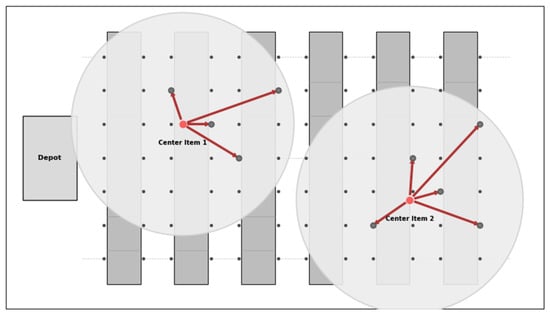
To improve routing efficiency while reducing the computational burden of explicit routing formulations, a clustering-based model is proposed in this section. The formulation minimizes the maximum distance between a selected center item and the remaining items assigned to the same AGV. Instead of explicitly modeling detailed AGV routes, representative center items are utilized to create compact item groupings. From a sustainability perspective, the model primarily supports environmental sustainability through reduced travel distances and operational emissions, while also improving economic sustainability by providing lower computational complexity for large-scale warehouse systems. Figure 1 illustrates the objective structure of the proposed model.
Figure 1.
Illustration of the objective function in the center-based distance model.
Sets and Indices:
where
where s
Parameters:
= weight of item i
= weight capacity of AGV j.
= maximum number of allowable AGVs to be used
= distance between item i and k
Decision Variables:
= whether item i is assigned to AGV j or not
= whether item i is center of AGV j
= whether AGV j is used or not
= boundary for maximum number of items for AGV
= boundary for minimum number of items for AGV
= maximum distance for AGVs
Objective Function:
Constraints:
The objective function minimizes the maximum intra-cluster distance between a selected center item and the remaining items assigned to the same AGV.
Equation (26) ensures that if two items are assigned to the same AGV and one is selected as the cluster center, the distance between them is bounded by the maximum distance variable . Equation (27) guarantees that each item is assigned to exactly one AGV, while Equation (28) enforces vehicle capacity limitations. Equation (29) restricts the number of active AGVs, supporting efficient resource utilization.
Equation (30) ensures that each active AGV has exactly one designated center, and Equation (31) guarantees that only assigned items can be selected as centers. Equations (32)–(34) enforce balanced workload distribution among AGVs. Finally, Equations (35)–(39) define sign restrictions.
This formulation employs a clustering-based approximation of routing decisions, offering a computationally efficient alternative to explicit routing models. By minimizing intra-cluster distances (compact clustering), the model is expected to reduce total travel distance and, consequently, improve environmental performance under the adopted distance-based energy assumption.
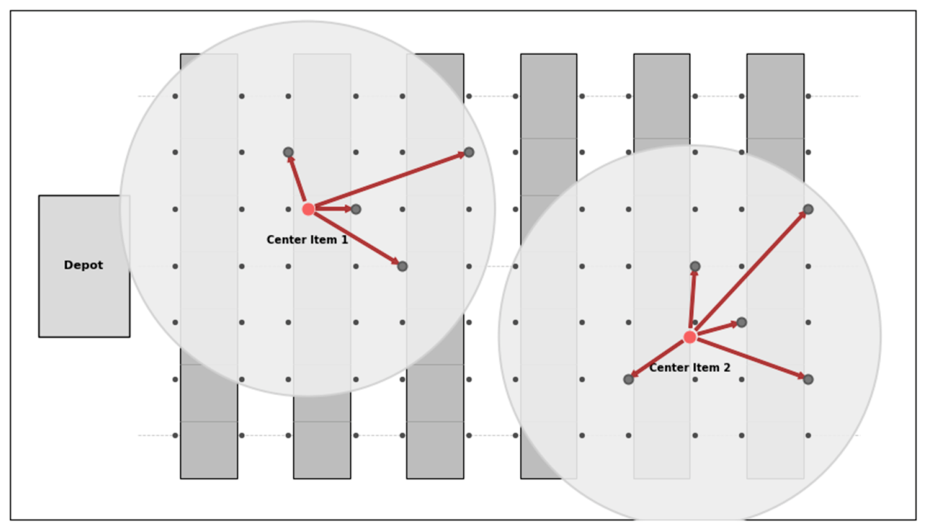
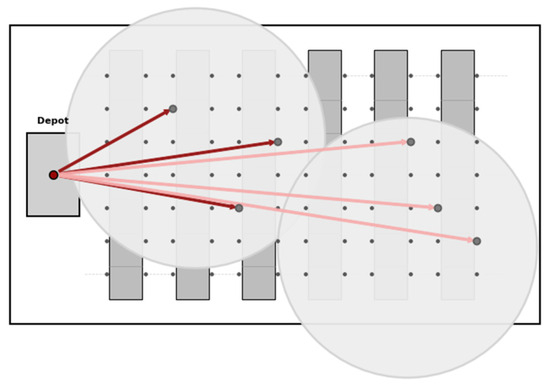
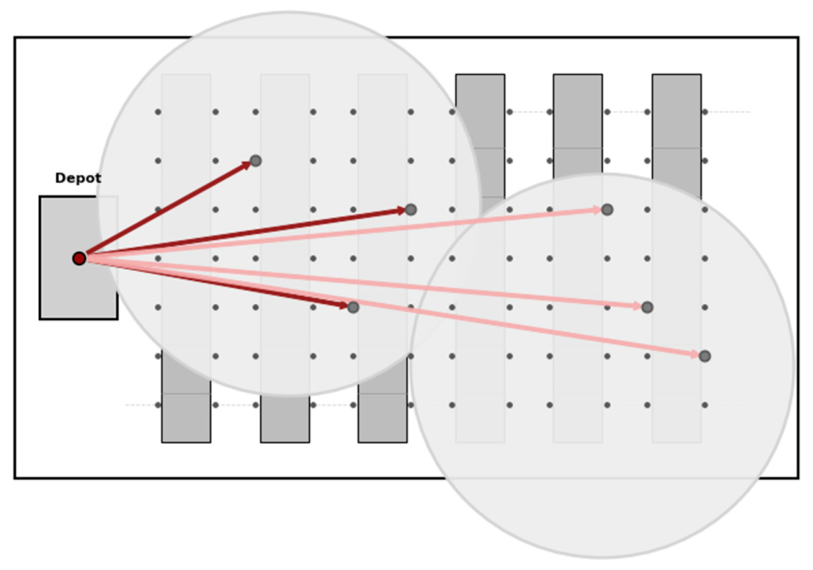
4.4. Distance from Depot Model
To capture distance-related operational efficiency, this model minimizes the maximum total distance between the depot and the items assigned to each AGV as illustrated in Figure 2. Unlike routing-based formulations, this model provides a simplified distance approximation by considering depot-to-item distances. This formulation primarily supports economic sustainability through computational efficiency and simplified decision-making. In addition, its balanced assignment structure contributes to operational stability and workload fairness, thereby supporting social sustainability. The mathematical formulation is presented below.
Figure 2.
Illustration of the objective function in the distance from depot model.
Sets and Indices:
where
where
Parameters:
= weight of item i
= weight capacity of AGV j.
= maximum number of allowable AGVs to be used
= distance between item i and k
= distance between depot and item k
Decision Variables:
= whether item i is assigned to AGV j or not
= whether AGV j is used or not
= boundary for maximum number of items for AGV
= boundary for minimum number of items for AGV
= maximum distance for AGVs
Objective Function:
Constraints:
Equation (42) ensures that each item is assigned to exactly one AGV, while Equation (43) prevents any vehicle from exceeding its capacity. Equation (44) limits the total number of active AGVs, supporting efficient use of available resources. In addition, Equations (45)–(47) maintain a balanced distribution of items among AGVs, avoiding unbalanced workloads. Finally, Equations (48)–(51) are sign restrictions.
Compared with the clustering-based model and the routing-based formulation, this model provides a simpler representation of travel distances. Although routing decisions are not explicitly incorporated as in the routing-based formulation presented in Section 4.2, the formulation still captures distance-related effects through a computationally efficient approximation. This makes the model particularly suitable for large-scale instances, where solving detailed routing formulations may become computationally expensive.
4.5. Compact Clustering Model
In order to further improve distance efficiency, this model integrates ideas from models in Section 4.3 and Section 4.4. Therefore, both depot-based and center-based distance components are integrated. Specifically, it minimizes the total distance between the depot and selected AGV centers, as well as the distances between these centers and the items assigned to the same AGV. This structure aims to create compact and centrally organized assignments, which can reduce overall travel distance and, under the adopted distance-based energy assumption, improve energy efficiency. This formulation integrates environmental, economic, and social sustainability considerations simultaneously by combining routing efficiency, compact clustering behavior, and efficient AGV utilization within a single optimization model. Although the formulation considers all three sustainability dimensions, its primary advantages are observed in environmental and economic performance, whereas workload balancing is treated as a secondary consideration rather than an explicitly optimized objective.
The objective function minimizes two components simultaneously: (i) the distance between the depot and the selected centers of AGVs, and (ii) the total distance between each center and the items assigned to the corresponding AGV. This encourages the formation of compact clusters around centrally located items, thereby reducing overall travel distances.
Sets and Indices:
where
where s
Parameters:
= weight of item i
= weight capacity of AGV j.
= maximum number of allowable AGVs to be used
= distance between item i and k
= distance between depot and item k
Decision Variables:
= whether item i is assigned to AGV j or not
= whether item i is assigned to AGV j as center or not
=
= whether AGV j is used or not
Objective Function:
Constraints:
Equations (53)–(57) follow the same assignment, capacity, and center selection logic introduced in the previous clustering-based model. Equations (58) and (59) establish the relationship between assignment and center variables by ensuring that an item contributes to the distance term only if it is assigned to the same AGV whose center is selected. In other words, becomes active only when item is assigned to the AGV for which item is chosen as the center. The remaining equations are sign restrictions.
Collectively, the proposed models represent different trade-offs between routing accuracy, computational complexity, and sustainability performance in the AGV-assisted order picking problem. Model 1 primarily focuses on social sustainability through workload balancing, whereas Model 2 explicitly addresses environmental sustainability through detailed routing optimization. Model 3 improves environmental and economic sustainability through compact clustering, whereas Model 4 primarily supports economic and social sustainability through computational efficiency and operational stability. Finally, Model 5 integrates environmental, economic, and social sustainability considerations within a unified optimization structure, while allowing trade-offs among these perspectives. Therefore, the proposed framework enables a systematic comparative evaluation of routing efficiency, AGV utilization, workload balancing, and computational tractability under multiple sustainability perspectives. Experimental results for the proposed models are presented in Section 5.
5. Experimental Results
This section presents the computational results obtained from the five proposed models in Section 4. To evaluate the actual performance of the proposed formulations and to gain applicable insights, we construct a benchmark dataset from real-life data. Managerial insights regarding sustainability are also derived from results of computational experiments conducted using this benchmark dataset.
5.1. Real-Life Dataset and Instance Generation Procedure
The dataset used in this study is based on the real-life data from the footwear manufacturing industry introduced in [37] and explained in [38], which provides detailed operational data extracted from a Warehouse Management System, including picking waves, storage locations, and routing structures. The warehouse operates under a random storage policy in which products may be assigned to multiple storage locations simultaneously. Storage locations are represented through Cartesian coordinates obtained from a CAD-based warehouse layout, enabling actual travel distance calculations.
To adapt the original warehouse dataset to the AGV-assisted order picking problem considered in this study, a benchmark instance generation procedure was developed. Customer orders and picking records were first integrated based on order creation dates to construct daily demand pools representing real-life warehouse demand conditions. These pools were then used to generate multiple independent benchmark instances while preserving operational demand characteristics and ensuring experimental reproducibility.
For each generated instance, a daily demand pool was randomly selected, and the required number of items was sampled without replacement according to the targeted instance size category. Since the warehouse follows a random storage policy, each sampled item may correspond to multiple candidate storage locations. Therefore, one storage location was randomly selected among the closest candidate locations to the depot in order to preserve real-life routing behavior while avoiding extreme assignments.
Travel distances between locations were generated using this dataset. Item weights were generated according to three product categories defined in [38] lightweight (1.2 kg), medium (1.8 kg), and heavy (2.6 kg). AGV capacities were fixed at 70.2 kg based on the maximum number of items that an AGV can take in the original warehouse system.
To evaluate scalability, benchmark instances were classified into three categories:
- Small-sized instances containing 10–15 items
- Medium-sized instances containing 16–20 items
- Large-sized instances containing 21–25 items
For each category, 15 independent instances were generated, resulting in a total of 45 benchmark instances. The number of AGVs was determined according to the theoretical minimum fleet size derived from total demand weight and AGV capacity constraints, with additional vehicles introduced to allow alternative routing and assignment structures. Information for one large instance is given in Table 2 as an example.
Table 2.
An example from generated instances.
Compared with a purely synthetic benchmark dataset, the proposed methodology preserves real-life distances, routing behavior, stochastic storage assignments, and actual demand structures. As a result, the generated benchmark instances offer a realistic and reproducible environment for evaluating AGV-assisted order-picking models. They also enable practically relevant insights.
5.2. Computational Results and Sustainability Analysis
This section presents the computational results of the proposed models across the generated benchmark instances described in Section 5.1. The analysis is conducted under environmental, economic, and social sustainability perspectives using performance indicators including total travel distance, normalized energy consumption, AGV utilization, number of active AGVs, workload balancing behavior, and computational runtime. Table 3 summarizes the average computational results across all instance groups, while Figure 3, Figure 4, Figure 5, Figure 6, Figure 7 and Figure 8 present comparative visual analyses of performance metrics.
Table 3.
Summary of average performance metrics across all instance groups.
Due to the combinatorial complexity of the problem, computational difficulty increases significantly as instance size grows. Thus, a time limit of 600 s was imposed for all experiments to reflect the dynamic nature of warehouse operations and the need for rapid decision-making. In particular, larger instances contain substantially higher numbers of decision variables and constraints, making it progressively more difficult to obtain optimal solutions within a practical computational time limit. Nevertheless, feasible and high-quality solutions were obtained for all small-, medium-, and large-sized instances, enabling a comprehensive comparative evaluation of the proposed models across different warehouse scales.
5.2.1. Environmental Sustainability Analysis
Environmental sustainability is primarily evaluated through total travel distance and normalized energy consumption because AGV movement is directly associated with electricity usage and operational emissions in warehouse systems. Figure 3 presents the average total travel distance results across all formulations, while Figure 4 illustrates the distribution of travel distances across individual instances through boxplot representations.
Figure 3.
Total travel distance comparisons across models for each instance size.
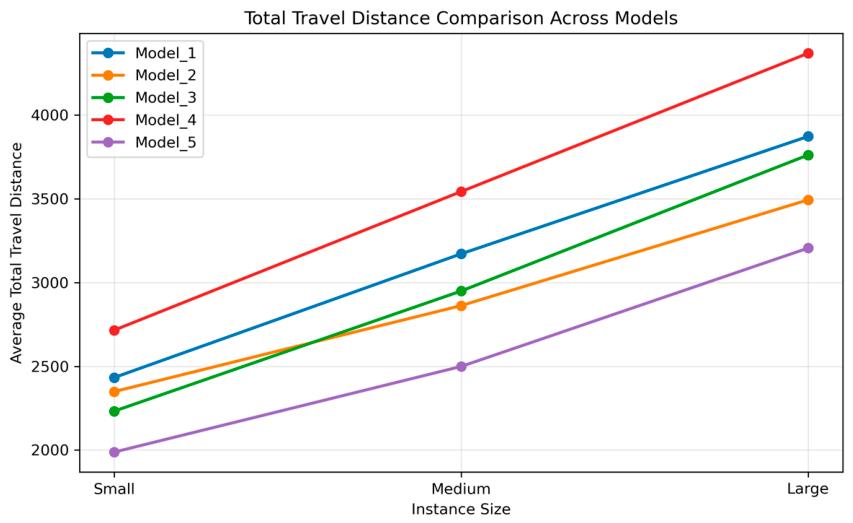
Figure 4.
Distribution of total travel distances across individual instances for small-, medium-, and large-sized instances. The boxes represent the interquartile range (IQR), the horizontal line indicates the median, the green triangles denote the mean, and circles represent outliers.
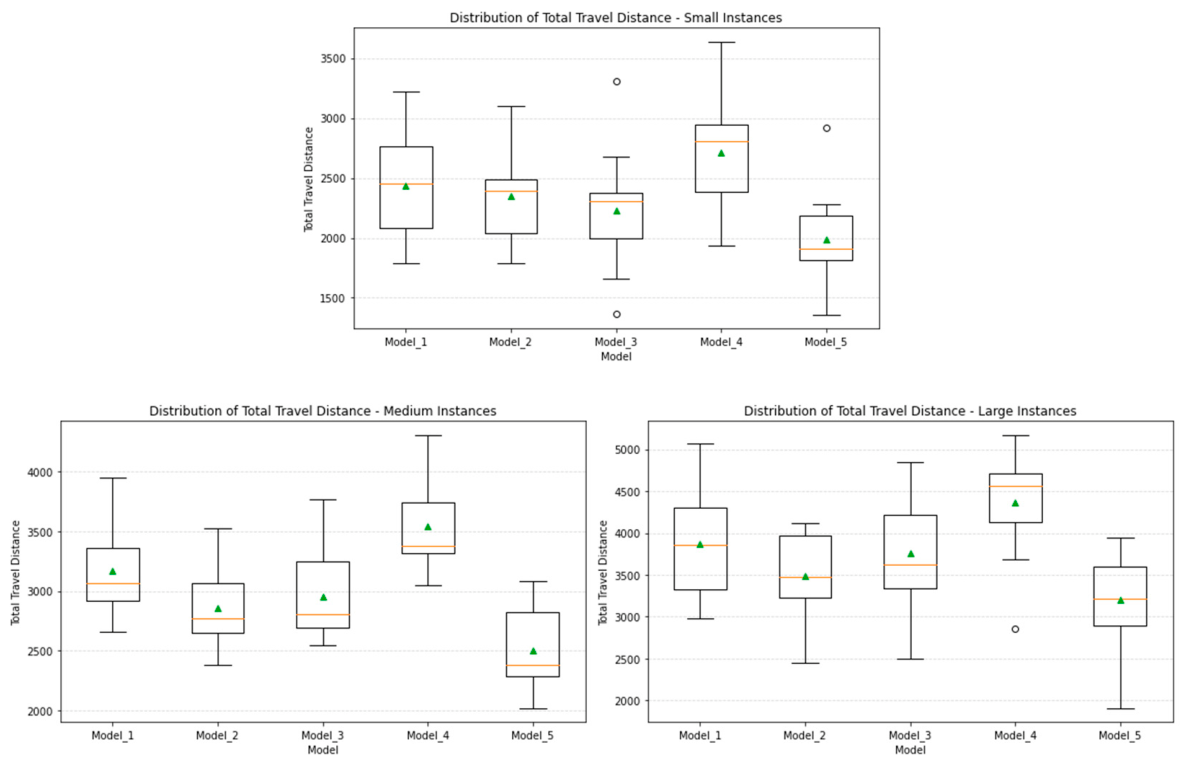
For small-sized instances, all formulations produce relatively stable routing performance, although clear differences remain among the proposed models. Average total travel distances vary between approximately 1988 and 2715 distance units. Model 5 achieves the lowest average travel distance values, whereas Model 4 produces the highest. Compared with Model 4, Model 5 achieves approximately 26.8% reduction in total travel distance. The boxplots presented in Figure 4 further confirm these findings. Model 5 not only achieves the lowest median travel distances but also demonstrates relatively compact distributions, indicating stable routing performance across different instances. In contrast, Model 4 exhibits substantially higher median distances and wider variability, suggesting weaker routing efficiency.
As the problem size increases, the differences between formulations become more pronounced. For medium-sized instances, average travel distances range between approximately 2499 and 3542 distance units. Routing-oriented formulations significantly outperform assignment-based approaches, demonstrating that routing decisions become increasingly important as warehouse complexity grows. Model 5 again achieves the lowest average travel distances, providing approximately 29.5% reduction compared with results from Model 4. Although Model 2 achieves strong routing performance, its distributions remain wider than Model 5, whereas Model 5 maintains both lower median distances and comparatively stable performance.
For large-sized instances, computational complexity becomes substantially higher; however, the relative ranking of models remains consistent. Average travel distances vary between approximately 3205 and 4367 distance units. Model 5 continues to achieve the best routing performance, with approximately 26.6% lower travel distance compared with Model 4. The boxplot analysis demonstrates that Model 5 not only maintains the lowest travel distance values but also preserves relatively robust performance despite increasing problem complexity. In contrast, Models 1 and 3 exhibit wider distributions and longer whiskers, indicating increased variability under large-scale warehouse conditions. Model 4 consistently produces the highest routing costs and variability across almost all benchmark instances.
Figure 5 presents normalized energy consumption values for all formulations. Since AGV energy usage is directly proportional to travel distance, routing efficiency directly affects the environmental sustainability perspective. The normalization procedure enables consistent comparisons across different warehouse scales by expressing energy consumption relative to the worst-performing formulation within each instance group.
Figure 5.
Normalized energy consumption across models and instance sizes.
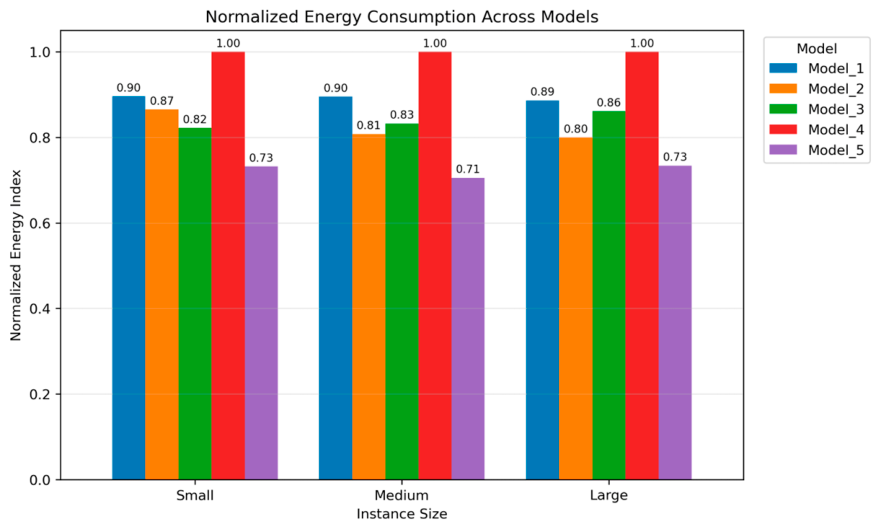
The results reveal a clear advantage of routing-based formulations over the assignment-based matheuristic approach. Model 4 consistently exhibits the highest normalized energy consumption values, while Model 5 achieves the lowest values across all instance groups, ranging approximately between 0.71 and 0.73. These results correspond to nearly 27–29% reduction in normalized energy consumption compared with the baseline formulation. Furthermore, the consistency of Model 5 across both average-based and instance-level analyses demonstrates that its environmental sustainability advantages remain robust under varying warehouse conditions and with increasing problem scales.
Models 2 and 3 demonstrate intermediate environmental performance. Model 2 becomes relatively more effective as instance size increases due to its explicit routing structure, whereas the relative effectiveness of Model 3 gradually decreases for larger warehouses. Model 1 maintains comparatively stable but moderate performance across all instance groups, indicating that workload balancing alone is insufficient for minimizing environmental impacts without explicit routing optimization.
Overall, the environmental sustainability results demonstrate that routing efficiency is one of the primary drivers of sustainability improvement in the AGV-assisted order picking problem. Among the proposed formulations, Model 5 achieves the highest distance related environmental sustainability performance by simultaneously reducing travel distance, energy consumption, and routing variability across different warehouse scales.
5.2.2. Economic Sustainability Analysis
Economic sustainability is evaluated through AGV utilization efficiency, fleet usage, and computational performance. Figure 6 illustrates AGV utilization levels across all models and instance sizes, while runtime results are summarized in Table 3.
Figure 6.
AGV utilization across models and instance sizes.
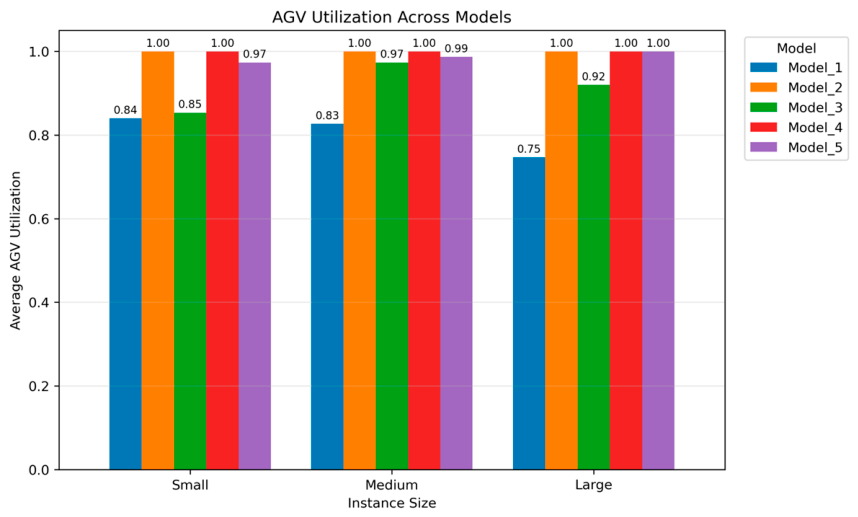
The results indicate that the number of active AGVs remains consistently close to the theoretical lower bound for all formulations. Average AGV utilization values remain high across all instance groups, confirming efficient fleet usage and limited unnecessary resource deployment. Models 2 and 4 frequently utilize AGVs at full capacity, whereas Models 1, 3, and 5 maintain slightly lower but still highly efficient utilization levels.
However, high AGV utilization alone does not necessarily imply superior operational efficiency. Although Model 4 achieves nearly full utilization levels, it simultaneously produces the highest travel distances and energy consumption values. In contrast, Model 5 achieves both high AGV utilization and the lowest travel distances, indicating a more balanced integration of routing efficiency and resource utilization. These findings indicate that efficient fleet management should simultaneously consider routing quality and AGV allocation decisions.
From a computational effort perspective, significant differences are observed among formulations as shown in Table 3. Model 1 consistently achieves the lowest runtime values across all instance groups due to the proposed matheuristic algorithm. In contrast, Model 2 and Model 5 require substantially higher computational effort because of the combinatorial complexity associated with routing optimization.
For medium-sized and large-sized instances, Model 2 frequently approaches the imposed computational time limit of 600 s, while Model 5 also exhibits relatively high runtime values. These results confirm that explicit routing formulations substantially increase computational complexity. Models 3 and 4 reduce decision-space complexity through clustering-based and depot-based approximations, thereby improving computational efficiency.
Although Models 2 and 5 achieve comparable routing performance in terms of travel distance reduction, Model 5 utilizes hybrid depot-based and clustering-based approximation structures that partially reduce routing complexity while preserving high solution quality. This behavior indicates that hybrid formulations can provide more practical large-scale alternatives to fully explicit routing models.
Overall, the economic sustainability analysis reveals a clear trade-off between routing accuracy and computational efficiency. While exact routing formulations offer better operational performance, simplified approximations enable faster solution times for large-scale warehouse systems, for which rapid decision-making is essential.
5.2.3. Social Sustainability Analysis
Social sustainability in AGV-assisted warehouse systems is primarily associated with workload fairness, operational stability, and equitable utilization of active AGVs. Excessive workload concentration on a limited number of AGVs may create operational bottlenecks, unstable resource allocation patterns, and reduced fairness in warehouse operations. Therefore, social sustainability in this study was evaluated using two workload-based indicators calculated among actively utilized AGVs, namely item assignment imbalance and load variability. Item assignment imbalance measures the difference between the most and least assigned AGVs in terms of item quantity, whereas load variability evaluates the dispersion of carried workload among active AGVs. Lower values indicate stronger workload equity and improved social sustainability.
Figure 7 presents the item assignment imbalance results across the proposed formulations. The results reveal substantial differences among models. Model 1 consistently provides the strongest assignment fairness across all instance groups. Item assignment imbalance remains extremely low, ranging from approximately 0.47 for small instances to 0.13 for large instances. These results indicate that active AGVs receive nearly equal numbers of assigned items regardless of warehouse scale. Such behavior is fully consistent with the assignment-oriented structure of Model 1, which explicitly incorporates balanced allocation principles during optimization. Consequently, Model 1 effectively prevents excessive concentration of picking tasks and supports stable utilization of warehouse resources.
Figure 7.
Item assignment imbalance across models and instance sizes.
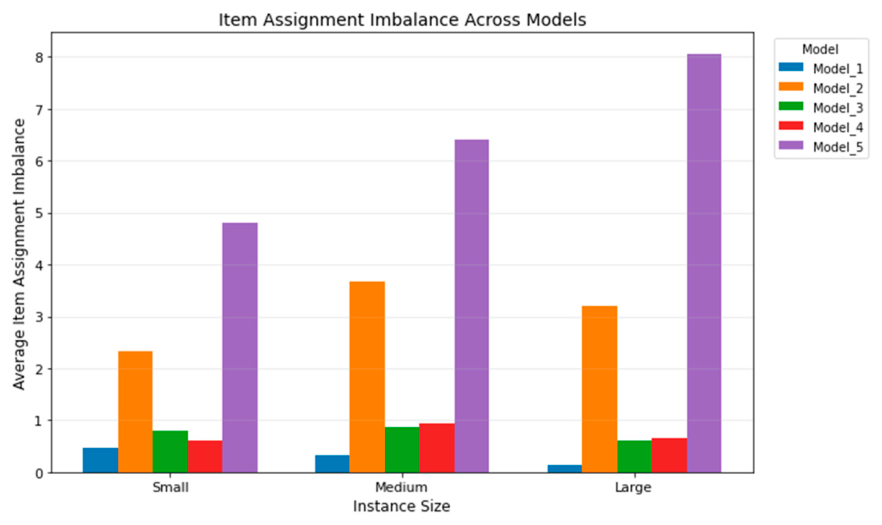
Model 4 also demonstrates strong assignment fairness, maintaining relatively low imbalance values between approximately 0.60 and 0.93 across all dataset sizes. Although Model 4 does not explicitly equalize item assignments, its depot-based distance approximation appears to promote compact and balanced allocation structures. Model 3 achieves a comparable level of assignment fairness, with imbalance values remaining close to those of Model 4. In contrast, Model 2 exhibits noticeably higher imbalance, although its performance remains substantially better than Model 5.
The largest assignment imbalance is observed in Model 5. As shown in Figure 7, imbalance values increase from approximately 4.8 for small instances to over 8.0 for large instances. This trend suggests that workload concentration becomes more pronounced as warehouse size increases. However, this behavior is consistent with the structural characteristics of Model 5 rather than representing a methodological weakness. Since the hybrid formulation integrates compact clustering and depot-based routing structures to improve routing efficiency and environmental performance, it naturally prioritizes geographically concentrated assignments instead of explicitly balancing item quantities among AGVs.
Figure 8 presents the load variability results calculated among active AGVs. Unlike item assignment imbalance, this indicator evaluates the fairness of carried workload rather than assignment quantity alone. The results demonstrate that Model 4 achieves the strongest overall workload balance. Load variability remains remarkably stable across all warehouse scales, with values approximately between 5.1 and 6.0. This finding suggests that the depot-based approximation embedded in Model 4 implicitly promotes equitable workload distribution and prevents excessive workload concentration among active AGVs. Consequently, Model 4 exhibits the strongest social sustainability performance in terms of operational stability and workload fairness.
Figure 8.
Load variability across models and instance sizes.
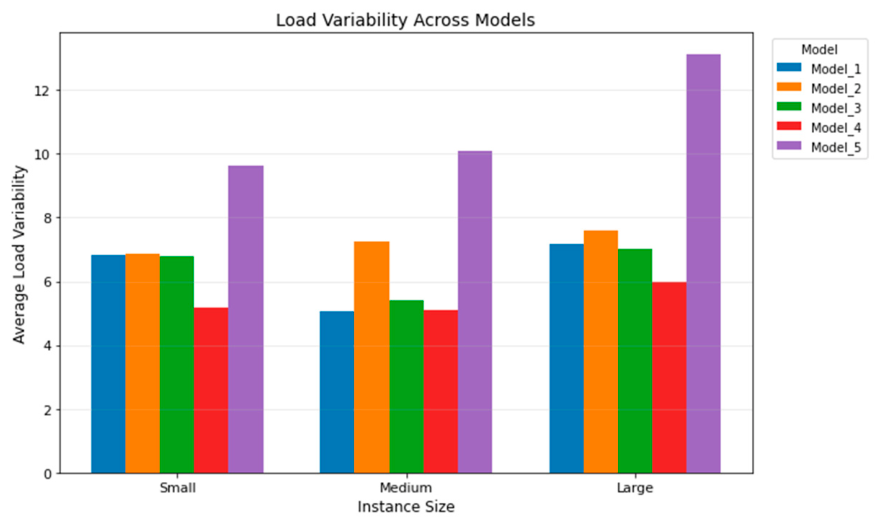
Model 1 also performs competitively with respect to workload balance, particularly for medium-sized instances where load variability reaches its lowest level. These results support the effectiveness of assignment-oriented balancing structures, although equal item distribution does not always imply perfectly equal carried workload due to differences in item weights and spatial configurations.
Models 2 and 3 produce moderate workload variability while prioritizing routing and clustering efficiency. Interestingly, Model 2 demonstrates that routing-oriented optimization does not necessarily reduce social sustainability. Despite emphasizing routing efficiency, workload variability remains within acceptable levels across all dataset groups.
The highest load variability is again observed in Model 5. As illustrated in Figure 8, workload variability increases steadily from approximately 9.6 for small instances to over 13 for large instances. This trend indicates that compact clustering and routing efficiency may create more concentrated workload distributions among active AGVs. As warehouse scale grows and cluster heterogeneity increases, this concentration effect becomes increasingly visible.
Figure 7 and Figure 8 reveal an important sustainability trade-off. Models emphasizing balanced assignment and approximation-based allocation structures, particularly Models 1 and 4, provide stronger social sustainability through improved workload fairness and operational stability. In contrast, environmentally efficient routing and clustering formulations, especially Model 5, may create greater workload concentration while improving travel efficiency and energy-related performance. Therefore, the sustainable AGV-assisted order picking problem should not exclusively focus on travel distance minimization but should simultaneously consider workload fairness and balanced utilization of active AGVs. These findings reinforce the multi-perspective nature of sustainability and highlight the importance of selecting formulations according to managerial priorities and operational requirements.
5.2.4. Comparative Analysis and Managerial Insights
The computational results together reveal clear trade-offs among environmental, economic, and social sustainability perspectives as well as computational complexity. Routing-oriented formulations substantially improve environmental sustainability through reduced travel distance and lower normalized energy consumption; however, these improvements are generally accompanied by increased computational complexity due to explicit routing decisions and subtour elimination requirements. Accordingly, no single formulation universally dominates all sustainability dimensions, and each model exhibits distinct operational strengths.
Assignment-oriented formulations yield computationally efficient and operationally stable solutions. In particular, Model 1 demonstrates strong assignment fairness and relatively balanced workload distribution while maintaining significantly lower computational burden than routing-based formulations. On the other hand, the assignment structure limits routing precision and reduces environmental efficiency compared with routing-oriented and hybrid approaches.
Routing-based formulations, particularly Model 2, achieve strong environmental performance but require substantially greater computational effort due to combinatorial routing decisions. Nevertheless, the results indicate that routing-oriented optimization does not necessarily imply poor social sustainability. Model 2 maintains moderate workload balance while simultaneously improving routing efficiency, demonstrating that explicit routing decisions may support both operational and environmental objectives under appropriate formulations.
Clustering based formulation (Model 3) provides an important intermediate formulation within the proposed framework. Unlike exact routing models, the compact clustering structure reduces routing complexity by organizing item assignments through localized cluster formation while still preserving environmental considerations through compact travel structures. Consequently, Model 3 improves routing efficiency relative to purely assignment-based formulations without incurring the full computational burden associated with explicit routing optimization. This clustering-oriented structure allows the model to balance environmental improvements and computational tractability, thereby occupying a transitional position between exact routing and approximation-based formulations.
Depot-based formulation, Model 4, achieves an effective compromise between computational efficiency and workload stability. Although Model 4 does not achieve the strongest environmental performance, it consistently demonstrates the lowest workload variability and strong assignment fairness across all datasets. These results suggest that depot-based approximation structures implicitly promote equitable workload allocation and operational stability while avoiding excessive computational complexity.
Among all formulations, Model 5 provides the strongest integrated environmental–economic sustainability performance through its hybrid compact clustering and depot-based routing structure. The formulation consistently achieves low travel distances, improved AGV utilization, and strong environmental outcomes by coordinating assignment and routing decisions simultaneously. However, the social sustainability results indicate that these environmental gains may involve moderate workload concentration among active AGVs, particularly for medium- and large-sized warehouse instances. This behavior is consistent with the structural characteristics of Model 5 rather than representing a methodological limitation. Since the hybrid formulation prioritizes compact routing and geographically concentrated assignments, workload equalization is not explicitly optimized.
Therefore, primary contribution of Model 5 lies in balancing environmental efficiency and operational utilization while accepting moderate trade-offs in social sustainability indicators. These findings reinforce the importance of evaluating warehouse optimization models through multiple sustainability dimensions instead of relying solely on travel-distance minimization as seen in Table 4.
Table 4.
Summary of proposed models with respect to sustainability perspectives.
From a managerial perspective, the results suggest that warehouse managers should select optimization formulations according to operational priorities and warehouse characteristics. Assignment-oriented approaches may be preferable in highly dynamic warehouse environments requiring rapid and computationally efficient decision-making. Routing-oriented formulations are more suitable for operations prioritizing environmental sustainability and travel efficiency, whereas depot-based formulations may be preferred when operational stability and workload fairness are emphasized. Hybrid formulations such as Model 5 provide a practical compromise for intelligent warehouse systems seeking integrated environmental and economic sustainability while maintaining acceptable operational balance.
6. Conclusions and Future Research Directions
This study investigated the AGV-assisted order picking problem from environmental, economic, and social sustainability perspectives by proposing a comparative multi-model optimization framework for warehouse operations. The study addressed an important research gap in the literature by systematically evaluating different modeling strategies within a unified sustainability-oriented framework using a real-life dataset.
The computational results demonstrated that the proposed formulations exhibit different trade-offs between routing accuracy, computational efficiency, workload balancing, and sustainability outcomes. Routing-oriented formulations substantially improved environmental sustainability through reduced travel distance and energy consumption, whereas assignment-based formulations provided computationally efficient and operationally balanced solutions. Among the proposed approaches, the hybrid formulation consistently achieved the strongest integrated environmental–economic sustainability performance by maintaining low travel distances, high AGV utilization, and efficient routing behavior while accepting moderate workload concentration across different warehouse scales.
The findings further indicate that sustainability-oriented warehouse optimization should not focus solely on routing efficiency but should also consider resource utilization and workload stability simultaneously. In this respect, the proposed framework provides practical decision support for warehouse managers seeking environmentally sustainable and economically efficient AGV-assisted warehouse systems while explicitly considering workload-related operational trade-offs.
Despite these contributions, several opportunities remain. Future research may extend the proposed framework by incorporating more realistic operational characteristics including traffic congestion, AGV conflicts, battery behavior, or stochastic warehouse conditions. In addition, integration of renewable energy considerations and energy-aware routing strategies may further strengthen sustainability assessment. From a methodological perspective, future studies may investigate multi-objective optimization, adaptive matheuristics, and learning-based solution approaches capable of simultaneously balancing environmental, economic, and social sustainability objectives while preserving scalability for large-scale intelligent warehouse systems.
Overall, this study demonstrates that integrating routing efficiency, AGV utilization, and workload balancing within a unified optimization perspective can substantially improve sustainability performance in AGV-assisted order picking problems while supporting more sustainable and intelligent logistics operations.
Author Contributions
Conceptualization, S.G.E. and M.A.G.; methodology, S.G.E. and M.A.G.; software, S.G.E.; validation, S.G.E. and M.A.G.; formal analysis, S.G.E. and M.A.G.; investigation, S.G.E. and M.A.G.; data curation, S.G.E.; writing—original draft preparation, S.G.E.; writing—review and editing, M.A.G.; visualization, S.G.E.; supervision, M.A.G.; project administration, M.A.G.; funding acquisition, S.G.E. All authors have read and agreed to the published version of the manuscript.
Funding
This research received no external funding.
Institutional Review Board Statement
Not applicable.
Informed Consent Statement
Not applicable.
Data Availability Statement
The raw data supporting the conclusions of this article will be made available by the authors on request.
Acknowledgments
Corresponding author has a funding as a P.H.D. scholarship by the Scientific and Technological Research Council of Türkiye (TÜBİTAK) under the BIDEB 2211/A Graduate Scholarship Program. During the preparation of this study, the authors used OpenAI’s GPT-5.5 model for the purposes of grammatical control. The authors have reviewed and edited the output and take full responsibility for the content of this publication.
Conflicts of Interest
The authors declare no conflicts of interest.
Abbreviations
The following abbreviations are used in this manuscript:
| AGV | Automated Guided Vehicle |
| Model 1 | Balanced Assignment Model |
| Model 2 | Routing Based Model |
| Model 3 | Center Based Distance Model |
| Model 4 | Distance from Depot Model |
| Model 5 | Compact Clustering Model |
References
- Ebrahimi, A.; Jeon, H.W.; Jung, S.Y. Improving Energy Consumption and Order Tardiness in Picker-to-Part Warehouses with Electric Forklifts: A Comparison of Four Evolutionary Algorithms. Sustainability 2023, 15, 10551. [Google Scholar] [CrossRef] [Scilit]
- Rouwenhorst, B.; Reuter, B.; Stockrahm, V.; Van Houtum, G.J.; Mantel, R.J.; Zijm, W.H.M. Invited Review Warehouse Design and Control: Framework and Literature Review. Eur. J. Oper. Res. 2000, 122, 515–533. [Google Scholar]
- de Koster, R.; Le-Duc, T.; Roodbergen, K.J. Design and Control of Warehouse Order Picking: A Literature Review. Eur. J. Oper. Res. 2007, 182, 481–501. [Google Scholar] [CrossRef] [Scilit]
- van Gils, T.; Ramaekers, K.; Caris, A.; de Koster, R.B.M. Designing Efficient Order Picking Systems by Combining Planning Problems: State-of-the-Art Classification and Review. Eur. J. Oper. Res. 2018, 267, 1–15. [Google Scholar]
- Pardo, E.G.; Gil-Borrás, S.; Alonso-Ayuso, A.; Duarte, A. Order Batching Problems: Taxonomy and Literature Review. Eur. J. Oper. Res. 2024, 313, 1–24. [Google Scholar] [CrossRef] [Scilit]
- Boysen, N.; de Koster, R. 50 Years of Warehousing Research—An Operations Research Perspective. Eur. J. Oper. Res. 2025, 320, 449–464. [Google Scholar]
- Bock, S.; Bomsdorf, S.; Boysen, N.; Schneider, M. A Survey on the Traveling Salesman Problem and Its Variants in a Warehousing Context. Eur. J. Oper. Res. 2025, 322, 1–14. [Google Scholar]
- Goeke, D.; Schneider, M. Modeling Single-Picker Routing Problems in Classical and Modern Warehouses. INFORMS J. Comput. 2021, 33, 436–451. [Google Scholar] [CrossRef] [Scilit]
- Schiffer, M.; Boysen, N.; Klein, P.S.; Laporte, G.; Pavone, M. Optimal Picking Policies in E-Commerce Warehouses. Manag. Sci. 2022, 68, 7497–7517. [Google Scholar] [CrossRef] [Scilit]
- Weidinger, F. Picker Routing in Rectangular Mixed Shelves Warehouses. Comput. Oper. Res. 2018, 95, 139–150. [Google Scholar] [CrossRef] [Scilit]
- Heßler, K.; Irnich, S. Exact Solution of the Single-Picker Routing Problem with Scattered Storage. INFORMS J. Comput. 2024, 36, 1417–1435. [Google Scholar] [CrossRef] [Scilit]
- Weidinger, F.; Boysen, N.; Schneider, M. Picker Routing in the Mixed-Shelves Warehouses of e-Commerce Retailers. Eur. J. Oper. Res. 2019, 274, 501–515. [Google Scholar] [CrossRef] [Scilit]
- Valle, C.A.; Beasley, J.E.; da Cunha, A.S. Optimally Solving the Joint Order Batching and Picker Routing Problem. Eur. J. Oper. Res. 2017, 262, 817–834. [Google Scholar] [CrossRef] [Scilit]
- Briant, O.; Cambazard, H.; Cattaruzza, D.; Catusse, N.; Ladier, A.L.; Ogier, M. An Efficient and General Approach for the Joint Order Batching and Picker Routing Problem. Eur. J. Oper. Res. 2020, 285, 497–512. [Google Scholar] [CrossRef] [Scilit]
- van Gils, T.; Caris, A.; Ramaekers, K.; Braekers, K. Formulating and Solving the Integrated Batching, Routing, and Picker Scheduling Problem in a Real-Life Spare Parts Warehouse. Eur. J. Oper. Res. 2019, 277, 814–830. [Google Scholar] [CrossRef] [Scilit]
- Cano, J.A.; Correa-Espinal, A.A.; Gómez-Montoya, R.A. Mathematical Programming Modeling for Joint Order Batching, Sequencing and Picker Routing Problems in Manual Order Picking Systems. J. King Saud. Univ.-Eng. Sci. 2020, 32, 219–228. [Google Scholar] [CrossRef] [Scilit]
- Aerts, B.; Cornelissens, T.; Sörensen, K. The Joint Order Batching and Picker Routing Problem: Modelled and Solved as a Clustered Vehicle Routing Problem. Comput. Oper. Res. 2021, 129, 105168. [Google Scholar] [CrossRef] [Scilit]
- Henn, S.; Schmid, V. Metaheuristics for Order Batching and Sequencing in Manual Order Picking Systems. Comput. Ind. Eng. 2013, 66, 338–351. [Google Scholar] [CrossRef] [Scilit]
- Chen, T.L.; Cheng, C.Y.; Chen, Y.Y.; Chan, L.K. An Efficient Hybrid Algorithm for Integrated Order Batching, Sequencing and Routing Problem. Int. J. Prod. Econ. 2015, 159, 158–167. [Google Scholar] [CrossRef] [Scilit]
- Cheng, C.Y.; Chen, Y.Y.; Chen, T.L.; Yoo, J.J.-W. Using a Hybrid Approach Based on the Particle Swarm Optimization and Ant Colony Optimization to Solve a Joint Order Batching and Picker Routing Problem. Int. J. Prod. Econ. 2015, 170, 805–814. [Google Scholar] [CrossRef] [Scilit]
- Menéndez, B.; Pardo, E.G.; Alonso-Ayuso, A.; Molina, E.; Duarte, A. Variable Neighborhood Search Strategies for the Order Batching Problem. Comput. Oper. Res. 2017, 78, 500–512. [Google Scholar] [CrossRef] [Scilit]
- Wagner, S.; Mönch, L. A Variable Neighborhood Search Approach to Solve the Order Batching Problem with Heterogeneous Pick Devices. Eur. J. Oper. Res. 2023, 304, 461–475. [Google Scholar] [CrossRef] [Scilit]
- Kübler, P.; Glock, C.H.; Bauernhansl, T. A New Iterative Method for Solving the Joint Dynamic Storage Location Assignment, Order Batching and Picker Routing Problem in Manual Picker-to-Parts Warehouses. Comput. Ind. Eng. 2020, 147, 106645. [Google Scholar] [CrossRef] [Scilit]
- Cao, Z.; Zhou, L.; Lin, C.; Zhou, M. Solving an Order Batching, Picker Assignment, Batch Sequencing and Picker Routing Problem via Information Integration. J. Ind. Inf. Integr. 2023, 31, 100414. [Google Scholar] [CrossRef] [Scilit]
- Löffler, M.; Boysen, N.; Schneider, M. Picker Routing in AGV-Assisted Order Picking Systems. INFORMS J. Comput. 2022, 34, 440–462. [Google Scholar] [CrossRef] [Scilit]
- Xie, L.; Li, H.; Luttmann, L. Formulating and Solving Integrated Order Batching and Routing in Multi-Depot AGV-Assisted Mixed-Shelves Warehouses. Eur. J. Oper. Res. 2023, 307, 713–730. [Google Scholar] [CrossRef] [Scilit]
- Žulj, I.; Salewski, H.; Goeke, D.; Schneider, M. Order Batching and Batch Sequencing in an AMR-Assisted Picker-to-Parts System. Eur. J. Oper. Res. 2022, 298, 182–201. [Google Scholar] [CrossRef] [Scilit]
- Vijayakumar, V.; Sgarbossa, F. A Literature Review on the Level of Automation in Picker-to-Parts Order Picking System: Research Opportunities. IFAC-PapersOnLine 2021, 54, 438–443. [Google Scholar]
- Xin, J.; Yuan, Q.; D’Ariano, A.; Guo, G.; Liu, Y.; Zhou, Y. Dynamic Unbalanced Task Allocation of Warehouse AGVs Using Integrated Adaptive Large Neighborhood Search and Kuhn–Munkres Algorithm. Comput. Ind. Eng. 2024, 195, 110410. [Google Scholar] [CrossRef] [Scilit]
- Li, K.; Liu, T.; Ram Kumar, P.N.; Han, X. A Reinforcement Learning-Based Hyper-Heuristic for AGV Task Assignment and Route Planning in Parts-to-Picker Warehouses. Transp. Res. E Logist. Transp. Rev. 2024, 185, 103518. [Google Scholar] [CrossRef] [Scilit]
- Kumar, V.; Adil, G.K. Sustainable Warehouse Management: A Literature Review and Future Research Agenda. Manag. Res. Rev. 2025, 48, 358–382. [Google Scholar] [CrossRef] [Scilit]
- Li, J.; Chen, Y.; Zhou, L.; Dong, R.; Yin, W.; Huang, W.; Zhang, F. Multi-AGV-Driven Pallet-Picking Scheduling Optimization (MADPSO): A Method for Flexible Multi-Level Picking Systems. Appl. Sci. 2024, 14, 1618. [Google Scholar] [CrossRef] [Scilit]
- Popović, V.; Kilibarda, M.; Andrejić, M.; Jereb, B.; Dragan, D. A New Sustainable Warehouse Management Approach for Workforce and Activities Scheduling. Sustainability 2021, 13, 2021. [Google Scholar] [CrossRef] [Scilit]
- Hosseini, Z.; Le Blanc, P.M.; Demerouti, E.; van Gool, P.; van den Tooren, M.; Preenen, P.T.Y. The Impact of Working with an Automated Guided Vehicle on Boredom and Performance: An Experimental Study in a Warehouse Environment. Int. J. Prod. Res. 2024, 64, 1598–1618. [Google Scholar] [CrossRef] [Scilit]
- Tubis, A.A.; Poturaj, H.; Smok, A. Interaction between a Human and an AGV System in a Shared Workspace—A Literature Review Identifying Research Areas. Sustainability 2024, 16, 974. [Google Scholar] [CrossRef] [Scilit]
- Ergin, S.G.; Gökçe, M.A. Matheuristic Algorithm for Automated Guided Vehicle (AGV) Assisted Intelligent Order Picking. In International Conference on Intelligent and Fuzzy Systems; Springer Nature: Cham, Switzerland, 2023; Volume 758, pp. 610–618. [Google Scholar]
- Furlan De Assis, R.; De, W.; Ferreira, P.; Faria, A.F.; Antonio Santa-Eulalia, L.; Ouhimmou, M.; Gharbi, A. Optimising Warehouse Order Picking: Real Case Application in the Shoe Manufacturing Industry. IEEE Access 2024, 12, 170868–170888. [Google Scholar] [CrossRef] [Scilit]
- de Assis, R.F.; de Paula Ferreira, W.; Ouhimmou, M. Order Picking Dataset from a Warehouse of a Footwear Manufacturing Company. Data Brief 2025, 61, 111837. [Google Scholar] [CrossRef] [Scilit] [PubMed]

Disclaimer/Publisher’s Note: The statements, opinions and data contained in all publications are solely those of the individual author(s) and contributor(s) and not of MDPI and/or the editor(s). MDPI and/or the editor(s) disclaim responsibility for any injury to people or property resulting from any ideas, methods, instructions or products referred to in the content. |
© 2026 by the authors. Licensee MDPI, Basel, Switzerland. This article is an open access article distributed under the terms and conditions of the Creative Commons Attribution (CC BY) license.