Article

How Digital Transformation Enables Organizational Agility for Sustainable Manufacturing: A Longitudinal Single-Case Study of CATL
School of Business and Management, Jilin University, Changchun 130012, China
*
Author to whom correspondence should be addressed.
Sustainability 2026, 18(13), 6617; https://doi.org/10.3390/su18136617
Submission received: 27 May 2026 / Revised: 21 June 2026 / Accepted: 25 June 2026 / Published: 30 June 2026

Abstract

Digital transformation has become a critical pathway for manufacturing firms seeking to improve responsiveness, resource efficiency, and long-term sustainability. However, existing studies have paid limited attention to how digital transformation strategies generate organizational agility across different stages of sustainable manufacturing transformation. Drawing on dynamic capability theory, this study develops a stage-contingent Strategy–Ambidexterity–Agility framework and conducts a longitudinal single-case study of Contemporary Amperex Technology Co., Limited (CATL) from 2011 to 2023. The findings show that organizational agility develops cumulatively through three transformation stages. In the initial stage, a lean-oriented strategy supports balanced ambidexterity and cultivates customer agility through production optimization. In the development stage, an enhancement-oriented strategy enables exploitation-dominant combined ambidexterity and builds market agility through cross-functional integration and closed-loop business logic. In the industry-leading stage, a leap-oriented strategy supports exploration-dominant combined ambidexterity and fosters value chain agility through ecosystem orchestration, intelligent operations, and circular value creation. This study contributes to the literature on digital transformation and sustainable manufacturing by showing how stage-contingent digital strategies shape ambidexterity configurations, generate layered agility capabilities, and support sustainability-oriented manufacturing outcomes.

1. Introduction

Manufacturing firms now face intensified geopolitical, market, technological, and demographic pressures. For Chinese manufacturers, rising labor costs, a shrinking working-age population, and the exhaustion of scale-driven growth have made digital transformation an increasingly important basis for renewing competitive advantage [1]. At the same time, manufacturing firms are increasingly expected to pursue resource conservation, lifecycle responsibility, supply chain resilience, and sustainable value creation. These pressures are particularly salient in the power battery industry, where quality control, energy efficiency, recycling, and ecosystem coordination are closely linked to sustainable manufacturing [2]. In this study, digital transformation is treated as a strategic enabler through which manufacturing firms build the data visibility, process connectivity, and coordination capacity required for sustainability-oriented transformation [3,4,5]. Sustainable manufacturing is understood as resource-efficient operations, lifecycle traceability, circular value creation, and value chain coordination [6,7].
This conversion has proven difficult in practice. Although estimates vary, both academic research and industry reports suggest that many digital transformation initiatives fail to achieve their stated objectives despite continued investment [8,9,10]. For manufacturing firms, the problem is not only technology implementation, but also the translation of digital investment into capabilities that support sustainable manufacturing. Digital initiatives may initially increase coordination costs, intensify organizational inertia, or disrupt established routines before generating adaptive benefits [10]. This is where organizational agility becomes theoretically important. Organizational agility refers to the capacity to sense environmental shifts and reconfigure resources fast enough to turn them into opportunities [11]. From a sustainability perspective, agility is not merely a matter of faster response; it also determines whether manufacturing firms can continuously improve resource efficiency, adapt to changing environmental and market requirements, and coordinate value creation across the product lifecycle. Accordingly, this study positions organizational agility as the proximal capability outcome of digital transformation, while sustainable manufacturing is treated as the distal value-oriented outcome domain that such agility helps to support. This raises a central question: why do some digital transformation initiatives fail to generate the agility capabilities needed for sustainable manufacturing?
Existing research offers partial answers but leaves two important gaps. Studies have documented the benefits of digital technologies for decision-making and operational efficiency [12,13], as well as the organizational challenges of transformation, including resource constraints and cultural resistance [9,10]. Process-oriented research has further shown that digital transformation unfolds through stages, maturity levels, or capability development paths rather than as a one-off event [9,11]. However, these accounts often emphasize technology accumulation, system integration, or capability progression, while paying less attention to how movement across stages requires shifts in strategic logic. This leaves a temporality gap: we know that digital transformation unfolds over time, but less about how different stages require different strategic orientations. A second gap concerns the mechanism. Organizational ambidexterity, the simultaneous pursuit of exploration and exploitation, is often used to explain how digital transformation produces agility [14]. Yet prior work has tended to treat balance and combination as relatively static configurations, leaving unclear how firms reconfigure ambidexterity as transformation unfolds. These gaps are especially consequential for sustainable manufacturing because firms must exploit existing production and quality-control routines while exploring new technologies, circular business models, and ecosystem relationships. Without a stage-sensitive explanation of both strategic logic and exploration–exploitation configuration, it remains difficult to explain how digital transformation generates the agility capabilities needed to support sustainable manufacturing.
We address these gaps through a longitudinal case study of Contemporary Amperex Technology Co., Limited (CATL), tracing how a leading power-battery manufacturer navigated digital transformation across three stages between 2011 and 2023. The case is revelatory rather than representative: CATL’s trajectory includes strategic shifts, policy changes, competitive shocks, and technology transitions that allow us to observe how digital strategies, ambidexterity, and agility capabilities co-evolve over time. We use the case for analytical generalization, focusing on a stage-contingent alignment logic relevant to high-tech manufacturing firms facing complex value chain coordination and sustainability pressures.
Against this background, this study asks how digital transformation strategies generate agility capabilities that support sustainable manufacturing transformation. We examine how strategies evolve across stages, how ambidexterity configurations translate these strategies into customer, market, and value chain agility, and how these agility capabilities support resource efficiency, quality consistency, circular value creation, and value chain coordination. Our findings make three contributions. First, we identify a lean–enhancement–leap progression and show that transformation stages differ in strategic logic, not only in technological maturity, thereby extending stage-based digital transformation research [3,15]. Second, we reposition organizational ambidexterity as a dynamic behavioral mechanism whose configuration shifts from balanced to exploitation-dominant combined and then to exploration-dominant combined forms, refining prior studies that treat ambidexterity as relatively static [14,16]. Third, we show how customer, market, and value chain agility develop cumulatively and support sustainability-oriented manufacturing outcomes. The study also offers managers a stage-contingent logic for aligning digital strategy, ambidexterity, and agility capability.

2. Literature Review

2.1. Organizational Agility Under Digital Transformation

The idea of organizational agility grew out of manufacturing research in the 1980s, when scholars began asking how firms might respond quickly to shifting market conditions without sacrificing efficiency [17]. Early work treated agility as a production attribute, something that could be measured through indicators such as setup time reduction or batch size flexibility [18]. This attribute-based view proved useful for benchmarking, but it struggled to explain why two firms with similar production metrics often performed very differently when environments turned volatile.
A second wave of research shifted attention from attributes to practices, linking agility to specific manufacturing paradigms such as lean production and modular design [19,20]. This practice-based view added texture by showing how operational routines enable rapid adjustment, yet it remained confined to the shop floor. When digital technologies began penetrating beyond manufacturing into product development, supply chain coordination, and customer interaction, the practice-based view had little to say about how agility operates across these boundaries.
More recent work has moved toward a capability-based understanding, treating agility as a firm-level capacity to sense opportunities, seize them, and reconfigure resources as conditions shift [21,22]. This third perspective aligns agility with the dynamic capabilities framework [11], which is helpful because it connects agility to broader strategic processes. What remains underdeveloped, however, is the temporal dimension. If agility is a capability that firms build over time, we need to understand not just what it looks like when fully developed but how it emerges through stages, what forms it takes at different points, and whether capabilities built at one stage transfer cleanly to the next.
The literature has also struggled with a more basic tension. Agility is pulled outward by environmental pressures and pushed forward by internal capability building, and firms rarely manage both at the same pace. Sharifi and Zhang [23] captured this tension in their driver-enabler framework, arguing that agility emerges only when environmental sensing, capability evaluation, and internal conditions stay in iterative alignment. Teece et al. [11] sharpened the argument by showing that agility depends on the joint evolution of sensing, seizing, and reconfiguring routines, none of which operate in isolation. Digital transformation intensifies this tension rather than resolving it. On one hand, faster technological cycles and tougher competition raise the bar for responsiveness. On the other hand, the investments meant to make firms more adaptive can produce the opposite effect in the short run, straining resources and forcing difficult trade-offs [9,10].
Empirical evidence on this point remains mixed. Some studies document clear gains in decision speed and operational efficiency [12,13], while others show that transformation stalls when organizational learning lags behind technology adoption [24]. What we do not yet understand is the temporal pattern behind these mixed results—how agility unfolds across different stages of transformation, and how firms realign internal capabilities as external demands evolve. For sustainability-oriented manufacturing, this temporal issue is particularly important [4]. Resource efficiency, quality consistency, circular value creation, and value chain coordination require different forms of responsiveness at different stages of transformation [7]. Early-stage firms may need agility to stabilize production and respond to key customers, whereas more mature firms may need agility to coordinate markets, partners, and circular business processes [7]. Therefore, understanding agility as a capability that emerges and accumulates across stages is essential for explaining how digital transformation supports sustainable manufacturing. To capture this temporal emergence, this study adopts a longitudinal process perspective and examines how different forms of agility develop across analytically distinct stages of transformation. Our study takes up precisely this question.

2.2. Digital Transformation Strategy in Manufacturing Firms

Digital transformation is often reduced to technology adoption, but the term does real analytical work only when we treat it as a strategic phenomenon. Following Matarazzo et al. [25] and Wu et al. [15], we understand digital transformation as the set of strategic plans and initiatives through which firms redesign their business models, processes, and value chains by embedding technologies such as big data, artificial intelligence, the Internet of Things, and cloud computing. What matters in this definition is not the technology itself but the co-evolution of technology and organizational arrangements [10]. When digital tools meet complex organizational systems, friction is inevitable [26], and firms need strategic responses that go well beyond installing new software.
Research on digital transformation strategy has moved through three loosely defined paradigms. Early work took an alignment view, treating digital technology as an operational instrument that should match existing strategies and structures. As technology penetrated further into core activities, scholars shifted toward an integration view, in which digital strategy becomes fused with overall corporate strategy rather than running beside it [27]. More recently, an ecological view has emerged, framing digital strategy as a vehicle for identifying and capturing opportunities across broader ecosystems [28,29]. Each paradigm reflects a different assumption about how deeply digital technology reshapes the logic of competition, and together they trace an evolution from tool to infrastructure to ecosystem platform.
Efforts to classify transformation strategies have taken several forms. Wu et al. [15] proposed a three-stage path moving from localized application through platform consolidation to ecosystem orchestration, arguing that accumulated digital assets eventually trigger shifts in strategic scale. Yang et al. [30] distinguished incremental from leapfrog strategies based on how sharply they break with existing routines. Lopez-Vega and Moodysson [26] offered a finer-grained matrix built on technological breadth and novelty, yielding four archetypes: enhancing, spanning, transforming, and disrupting.
While these frameworks have added valuable texture to the field, three main limitations persist. First, categorizations built primarily on technological depth tend to assume a linear cumulative process, failing to explain the strategic path divergence that occurs during transformation. Second, the current emphasis on technology application often crowds out attention to how managerial cognition and strategic logic co-evolve with technical change. Third, the field still lacks an analytical framework capable of identifying the stage-specific characteristics of strategic paradigms and the conditions under which firms transition between them. To address these gaps, and building on the evolutionary logic from the alignment view to the integration and ecological views, this study develops a stage-contingent understanding of digital transformation strategy [3,5]. Rather than treating transformation stages merely as different levels of technology maturity [2], we conceptualize them as different strategic logics through which firms decide what to digitize, how broadly to transform, and how much organizational risk to tolerate at different points in the transformation process. Specifically, we distinguish three ideal-typical strategic orientations: lean-oriented, enhancement-oriented, and leap-oriented transformation.
Lean-oriented transformation refers to a resource-sensitive and narrow-scope strategy in which firms use localized digital tools to solve urgent operational problems under early-stage resource constraints. It focuses on process standardization, critical-node digitalization, cost control, and quality consistency rather than comprehensive system redesign. Enhancement-oriented transformation refers to a strategy in which firms expand digitalization from isolated operational nodes to cross-functional integration. Its emphasis shifts from localized efficiency improvement to system optimization, platform-based coordination, knowledge integration, and market responsiveness. Leap-oriented transformation refers to a more comprehensive and exploratory strategy in which firms use digital technologies to reshape products, services, business models, production systems, and ecosystem relationships. It emphasizes intelligent operations, interorganizational collaboration, circular value creation, and ecosystem-level coordination.
These three orientations should not be read as a deterministic universal sequence that all firms must follow [10]. Rather, they provide an analytical framework for examining how the dominant logic of digital transformation may shift as firms’ resource positions, competitive pressures, technological foundations, and sustainability requirements change. Table 1 summarizes the main differences among the three strategic orientations.

2.3. Ambidexterity Under Digital Strategies

Ambidexterity research begins with March’s [31] observation that firms must both explore new possibilities and exploit existing competencies, and that the two activities pull in different directions. Scholars have since offered two readings of this tension. One treats exploration and exploitation as rivals for scarce resources, which forces firms to strike a balance [32]. The other sees them as complements that can reinforce one another when designed into the right organizational arrangements [33]. Cao et al. [34] productively distinguished these as the balance dimension and the combined dimension of ambidexterity. Firms emphasizing balance keep exploration and exploitation in rough parity to avoid tilting too far in either direction. Firms emphasizing a combination push both activities hard but channel them into complementary domains, so that they feed rather than starve one another.
Digital transformation changes what this tension looks like in practice. Because transformation reshapes how resources are organized and deployed, the mix of exploration and exploitation inside a firm rarely stays constant [35]. Yoo et al. [36] noted that digital technologies introduce both substitution and synergy effects, which means ambidexterity under digitalization is a moving target rather than a fixed configuration. Three patterns deserve attention. Digital tools often enable exploration and exploitation at the same time, allowing firms to refine existing processes while searching for new paradigms [37]. Digital resources, particularly large volumes of operational data, give firms a sharper lens for deciding when to switch emphasis between the two modes [38]. And as digital strategy iterates, the stock and structure of resources inside the firm shift, which in turn reshapes what configuration of ambidexterity becomes feasible.
Viewed together, these observations suggest that ambidexterity is less a static trait than a dynamic response pattern that evolves with the trajectory of transformation. Yet empirical work has only begun to trace how these shifts unfold. Most studies treat ambidexterity as a choice firms make once and then maintain, which obscures the possibility that the appropriate configuration changes as firms develop. Our study addresses this gap by examining how ambidexterity configurations shift across stages of digital transformation, and by identifying the conditions under which firms transition from one configuration to another. Building on this distinction, we treat ambidexterity not as a fixed organizational attribute but as a stage-contingent behavioral configuration [39,40]. Balanced ambidexterity refers to a configuration in which exploration and exploitation receive comparable attention, often under conditions of resource constraint and market entry uncertainty [34]. Exploitation-dominant combined ambidexterity refers to a configuration in which firms intensively refine and scale existing routines, platforms, and businesses while using exploration to support improvement and expansion. Exploration-dominant combined ambidexterity refers to a configuration in which firms prioritize new technologies, business models, and ecosystem relationships, while relying on existing resources and routines as operational foundations. This distinction provides the theoretical basis for examining how digital transformation strategies are translated into different agility capabilities across stages [40,41].

2.4. Digital Transformation and Sustainable Manufacturing

Sustainable manufacturing has become an important concern for firms facing technological turbulence, resource constraints, and growing environmental expectations. It no longer refers only to pollution control or energy saving, but also involves improving resource efficiency, extending product lifecycles, strengthening supply chain resilience, and coordinating value creation across multiple actors. Digital transformation provides a key pathway for this transition. Technologies such as the Internet of Things, artificial intelligence, big data analytics, cloud computing, and digital twins enable firms to integrate data across production, quality control, logistics, and after-sales activities. Prior studies suggest that these technologies can improve process visibility, reduce waste, support predictive decision-making, and facilitate circular economy practices such as lifecycle traceability, reverse logistics, and recycling coordination [42,43,44].
However, digital transformation does not automatically generate sustainable manufacturing outcomes. Existing research has mainly examined how specific digital technologies improve green performance, operational efficiency, or circular economy implementation, while paying less attention to the organizational process through which digital transformation is converted into sustainability-oriented capabilities [45]. This gap is important because sustainable manufacturing requires firms to exploit existing production and quality-control routines while exploring new technologies, business models, and ecosystem relationships. From this perspective, organizational agility becomes a critical capability linking digital transformation and sustainable manufacturing. It enables firms to sense changes in markets, regulations, technologies, and value chain conditions, and to reconfigure resources accordingly. Therefore, this study views ambidexterity as the behavioral mechanism through which digital transformation strategies are translated into agility capabilities for sustainable manufacturing. This study treats sustainable manufacturing as the value-oriented transformation context and distal outcome domain in which organizational agility becomes meaningful. In this sense, digital transformation strategies generate sustainability-oriented manufacturing outcomes only when they are translated into agility capabilities that allow firms to improve resource efficiency, maintain quality consistency, support circular business logic, and coordinate value creation across the value chain.

2.5. Digital Transformation Strategy from a Dynamic Capability Perspective

Dynamic capability theory offers a useful lens for pulling these strands together. Teece et al. [11] argued that firms sustain advantage by building, integrating, and reconfiguring resources as environments change, and agility represents precisely this kind of adaptive capacity [46]. Digital technologies have raised the volatility of that environment, eroding advantages that once looked secure and pushing firms to search for new coordinative routines [47]. Within this setting, digital transformation operates as the main strategic lever through which manufacturing firms rebuild their capacity to respond.
Transformation does this in two complementary ways. Digital strategies open up new search spaces for information, opportunities, and partners, thereby supporting exploration. They also dismantle internal silos and tighten cross-functional coordination, which aids the reconfiguration and reuse of existing knowledge—a core exploitation activity [48]. The balance between these two effects is not fixed. Zahra and George [49] reminded us that dynamic capabilities are context-dependent and unfold through continuous improvement rather than one-off adjustments. As transformation progresses, the strategic choices available to a firm shift, and with them the mix of exploration and exploitation that best fits current conditions [5,50].
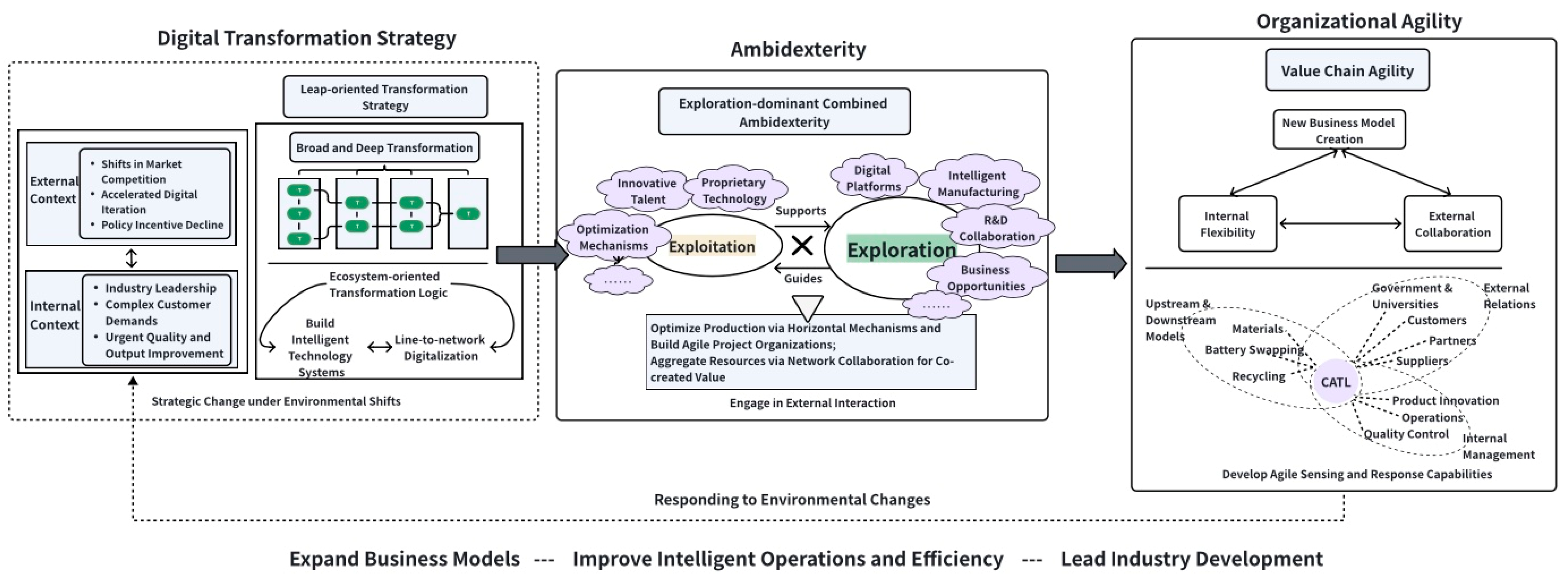
This logic motivates our analytical approach. We adopt a dynamic capability perspective to examine how firms continuously adjust their transformation strategies in response to changing external and internal conditions, and how these adjustments shape the evolution of organizational agility over time. Figure 1 summarizes the theoretical framework that guides our analysis.
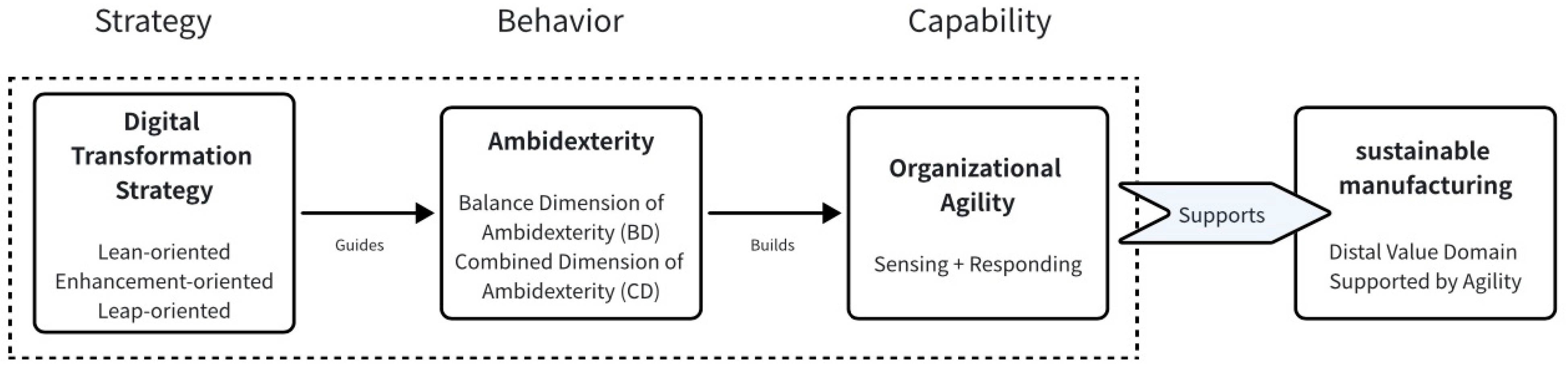
Pulling together the insights reviewed above, we develop a stage-contingent Strategy–Ambidexterity–Agility framework for sustainable manufacturing. The framework treats digital transformation as a recursive alignment process rather than a linear sequence. It links three layers of analysis: digital transformation strategy, ambidexterity configuration and organizational agility capability, within the broader context of sustainable manufacturing transformation. Digital transformation strategy occupies the first layer. It reflects how firms decide what to digitize, how broadly to transform, and how much organizational risk to tolerate under changing resource, competitive, and sustainability conditions [51,52,53]. Ambidexterity configuration occupies the second layer. It explains how firms allocate attention and resources between exploitation and exploration as digital transformation unfolds [11]. Organizational agility occupies the third layer as the proximal capability outcome. Customer agility, market agility, and value chain agility represent different layers of responsiveness that accumulate across stages [54,55]. Rather than treating sustainable manufacturing as a separately measured dependent variable, this framework positions it as the distal value domain in which agility becomes meaningful. In this domain, different layers of agility help support resource efficiency, quality consistency, closed-loop business logic, circular value creation, and value chain coordination. This framework clarifies the theoretical logic guiding the case analysis. Digital transformation supports sustainable manufacturing not through technology adoption alone, but through the stage-contingent alignment of digital strategy, ambidexterity, and organizational agility.

3. Research Design

We adopt an exploratory longitudinal single-case design to examine how digital transformation fosters organizational agility over time in the context of sustainable manufacturing transformation. Processual case work is well-suited to reveal the temporal dynamics and mechanisms underlying transformation [56,57], unlike variance-based methods that struggle with such complexity [58]. A single-case design is justified because this study seeks to explain a process mechanism rather than estimate population-level effects. Capturing a firm’s full transformation arc requires depth over breadth [59,60], and a revelatory case allows close tracing of how digital strategy, ambidexterity, and agility capability are aligned and realigned across time [57,61]. Single-case risks are mitigated by triangulating interviews with archival and public data, clarifying the boundaries of analytical generalization, and actively seeking disconfirming evidence [62].

3.1. Case Selection

We selected CATL through purposive criterion-based case selection [63]. First, CATL offers a revelatory window into manufacturing digital transformation. The case was selected not because it represents a typical manufacturer, but because its development trajectory provides rich process evidence for observing how digital transformation strategies, organizational behaviors, and agility capabilities co-evolve over time. Second, as a Global Lighthouse Factory [64], CATL demonstrates deeply embedded digital initiatives, essential for our research. Its digital transformation is closely connected with production standardization, quality control, recycling, energy storage, intelligent manufacturing, and value chain coordination, making it a suitable setting for examining sustainable manufacturing transformation. We triangulated data to mitigate potential narrative bias. Third, CATL’s trajectory shows clear stage-based variation. This variation allows us to examine not only whether digital transformation supports agility, but also how different strategic logics and ambidexterity configurations become salient at different stages.
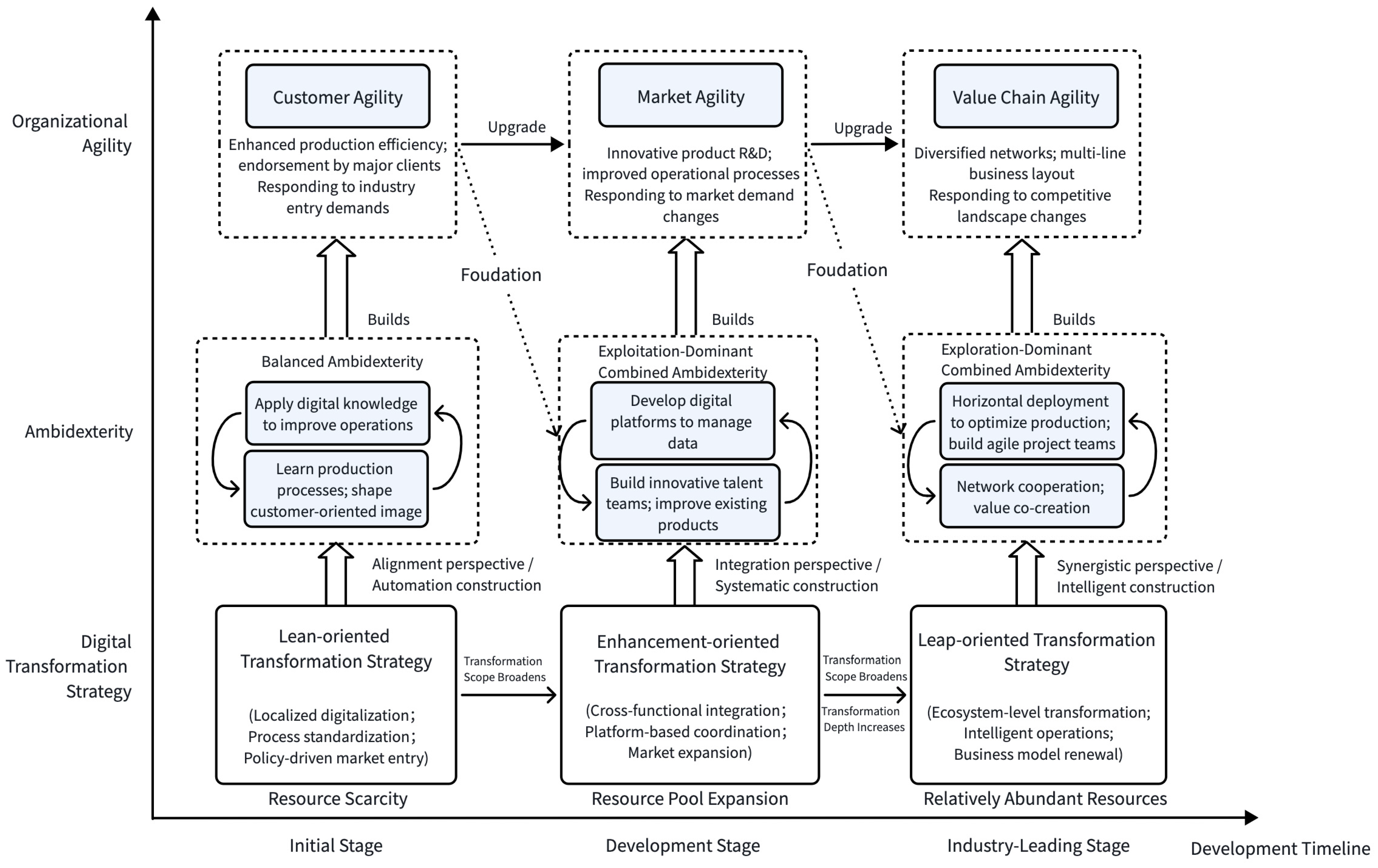
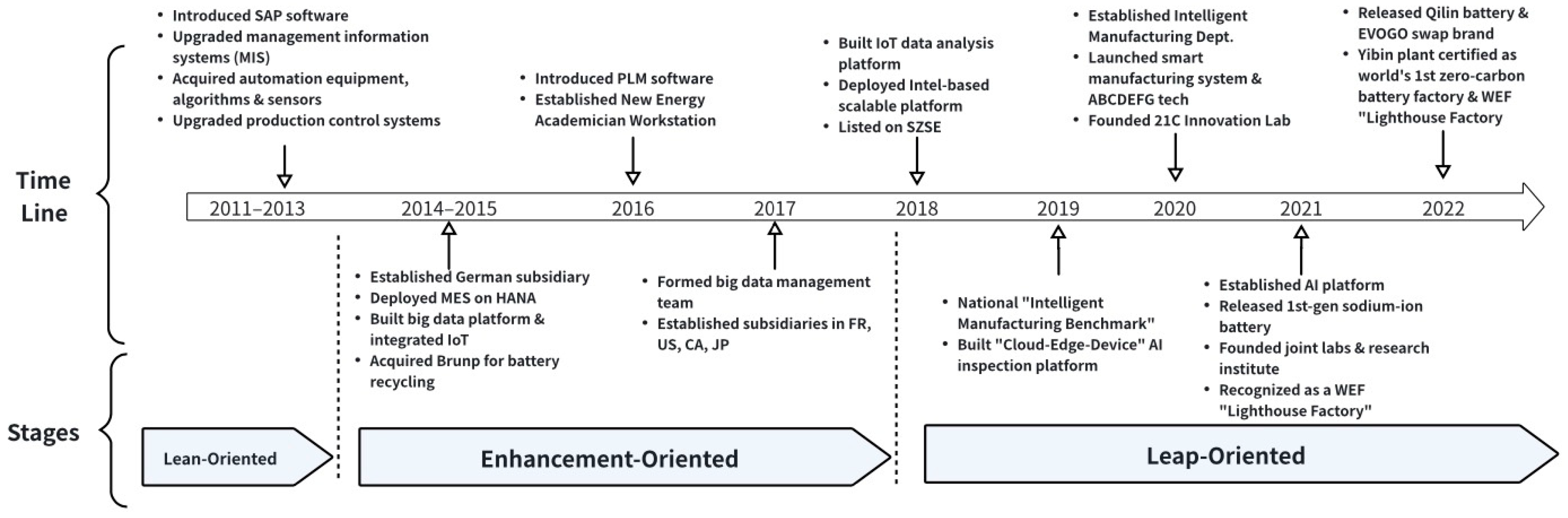
Following the China Electronics Standardization Institute taxonomy, we identify three stages (Figure 2): initial (2011–2013, localized automation), development (2014–2018, IIoT & cross-system integration), and industry-leading (2019 onward, AI & digital twins). These stages mark shifts in strategy and environment [56]. We further checked the stage boundaries against major strategic and technological events in CATL’s transformation trajectory. The initial stage is marked by localized automation and critical-node digitalization; the development stage by platform upgrading, PLM/MES integration, IIoT construction, and cross-system data integration; and the industry-leading stage by AI-enabled intelligent manufacturing, digital-twin applications, and ecosystem-level coordination.

3.2. Data Sources and Collection Process

The case is used for analytical rather than statistical generalization. The proposed framework is most applicable to high-tech manufacturing industries characterized by rapid technological change, significant scale requirements, complex value chains, and strong sustainability pressures. It also assumes that firms have a minimum resource threshold, including basic digital infrastructure, managerial capacity, and organizational routines for transformation. Institutional conditions, including industrial policy, market growth, financing access, and ecosystem maturity, may further affect whether firms can move from localized digitalization to cross-functional integration and ecosystem-level transformation. Therefore, the transferable insight from CATL lies in the stage-contingent alignment logic, not in the direct replication of CATL’s specific practices. Details of the primary coding are presented in Table 2.

3.3. Reliability and Validity of the Study

To ensure the credibility and robustness of findings, this study employed multi-source data collection [65]. We conducted on-site semi-structured interviews at CATL with management and technical personnel [66]. This primary data was cross-referenced with internal archival documents and public secondary data. The interviews involved 11 respondents, including senior managers, product managers, R&D engineers, quality specialists, market center directors, and business analysts. Interviewees are reported by role rather than by name to protect anonymity. The interviews focused on digital strategy implementation, transformation challenges, technology development, quality management, market demand changes, external collaboration, and future business development. The interviews were used together with internal publications, meeting records, company websites, official social media accounts, annual reports, public disclosures, research reports, executive statements, and media interviews.

4. Findings

4.1. Initial Stage: From Lean-Oriented Transformation to Customer Agility Enhancement

Spun off from Amperex Technology Limited (ATL) to target the booming new energy vehicle market, CATL focused exclusively on power and energy storage batteries. This product shift introduced severe production challenges, including discrete manufacturing complexities, low standardization, and stringent quality control demands. Consequently, CATL’s primary objective was to standardize production processes to rapidly secure a market foothold. This stage illustrates how early-stage manufacturing firms may use narrow-scope digitalization to stabilize production, reduce entry barriers, and build customer-facing responsiveness under resource constraints. In this stage, digital transformation is less about comprehensive system redesign than about using localized digital tools to support production standardization and early customer acquisition. The relevant illustrative coding for this stage is presented in Table 3.

4.1.1. Lean-Oriented Transformation Strategy

To resolve early production challenges, CATL implemented a lean-oriented transformation strategy manifested across three dimensions:
Strengthening digital infrastructure. To ensure quality consistency, CATL introduced MES for real-time production monitoring and Enterprise Resource Planning (ERP) systems to optimize resource allocation, establishing its foundational digital production system.
Achieving single-point breakthroughs. Driven by surging policy-backed demand, CATL targeted critical operational nodes for localized digital upgrades. This cost-controlled approach rapidly resolved production bottlenecks and enhanced short-term capacity to fulfill massive orders.
Adopting an alignment perspective. To mitigate structural inertia during the transition from consumer to automotive batteries, CATL aligned its initial technological adoption strictly with localized manufacturing nodes [67]. This minimized organizational resistance and laid a stable empirical groundwork for subsequent large-scale upgrades.

4.1.2. Balance Dimension of Ambidexterity

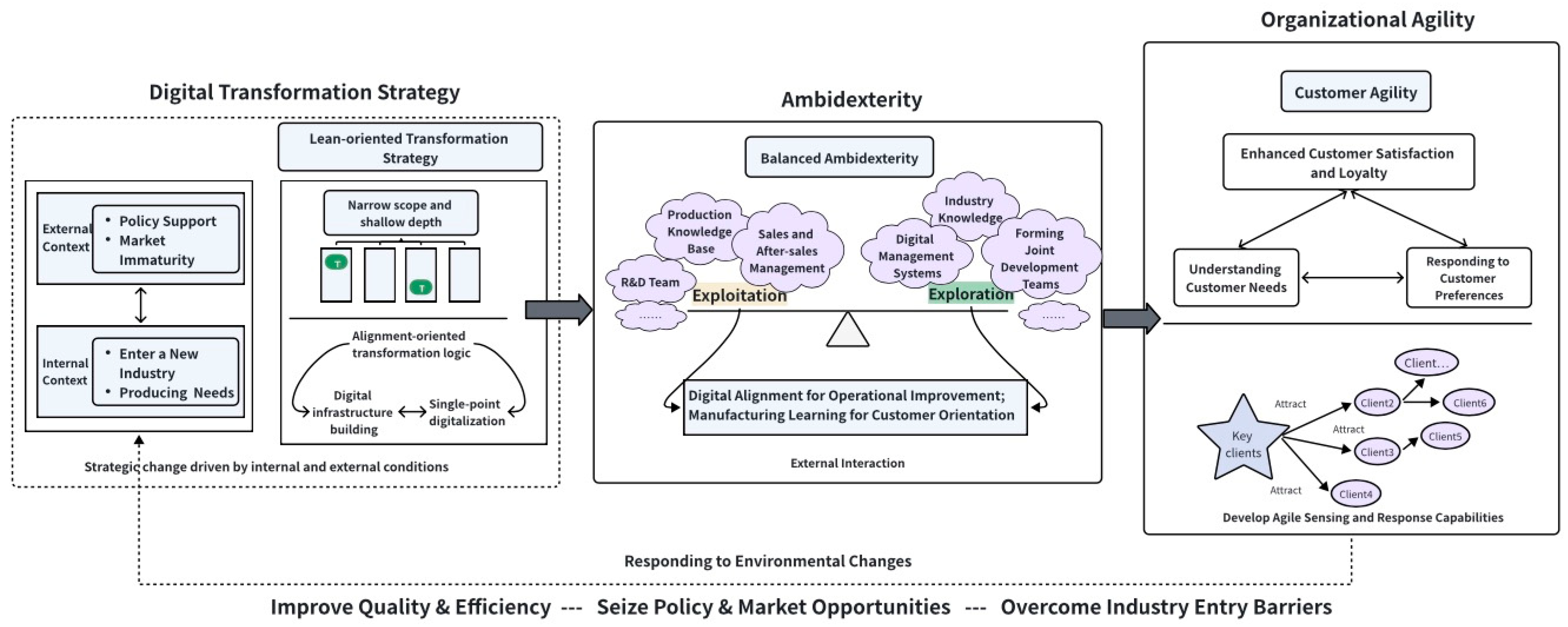
Facing high technological barriers and financial losses (2011–2013), CATL pursued balanced ambidexterity to overcome initial resource constraints by aligning internal capabilities with external opportunities. We interpret this configuration as balanced ambidexterity because the firm simultaneously engaged in exploitation and exploration without clearly prioritizing one over the other [34,39]. The implementation of ERP, SRM, CRM, and production monitoring systems represented exploitation, as these tools standardized existing processes, improved operational control, and refined procurement, production, and sales routines. At the same time, collaboration with BMW and the intensive learning of automotive battery standards represented exploration, as CATL absorbed new customer requirements, product knowledge, and industry certification experience [5,10]. The coexistence of these two activities under resource-constrained conditions supports the interpretation of balanced ambidexterity.
  • Aligning digital technology services to improve production and operational processes
Guided by a lean-oriented strategy, CATL partnered with SAP to implement ERP, SRM, and CRM systems. Integrating these external digital tools with internal manufacturing expertise enabled cost-effective, refined management across procurement, production, and sales nodes.
2.
Learning product manufacturing processes and shaping a customer-oriented image
To expand its market, CATL leveraged its consumer electronics reputation to become BMW’s sole power battery supplier. Co-executing an exhaustive 800-page production standard with BMW engineers allowed CATL to absorb advanced automotive knowledge, significantly elevating its technical capabilities and solidifying a customer-centric industry image.

4.1.3. Enhancement of Customer Agility

Through balanced ambidexterity, CATL enhanced both its production capabilities and industry reputation, successfully cultivating customer agility across three dimensions:
Improvement in production quality and efficiency. By integrating digital management systems, CATL optimized its manufacturing processes and significantly reduced product defect rates, rapidly establishing a mature production system capable of fulfilling massive orders.
Rapidly responding to policy and market opportunities. As global battery demand surged from 2.7 GWh in 2012 to 24.3 GWh in 2015, CATL leveraged the visibility and experience gained from its BMW collaboration to swiftly secure strategic partnerships with major automakers, including Yutong, Geely, Changan, and Dongfeng.
Breaking through industry entry barriers. Recognizing the critical need for B2B client endorsements, CATL focused heavily on R&D for safe and cost-effective lithium batteries. This continuous technological innovation earned the firm prominent industry backing, enabling it to successfully navigate early-stage market uncertainties.

4.1.4. Summary of the Initial Stage

In the initial stage, facing resource constraints and technological thresholds, CATL focused on cultivating customer agility. A lean-oriented digital transformation strategy drove the automation and optimization of production processes [68]. This provided the efficiency foundation necessary to execute balanced ambidexterity—allocating equivalent resources between exploration and exploitation [34]. Ultimately, guided by lean efficiency, balanced ambidexterity rapidly aligned internal resources with customer preferences, enabling the firm to achieve the customer agility required for market entry [13]. In this stage, customer agility contributed to sustainability primarily through production standardization, quality consistency, and resource-efficient capacity expansion. This suggests that early-stage sustainability-oriented manufacturing outcomes do not necessarily begin with circular business models or ecosystem-level coordination. They may first emerge from the ability to stabilize production, reduce quality variation, and respond reliably to key customer requirements. The model diagram for this stage is illustrated in Figure 3.

4.2. Rapid Development Stage: From Enhancement-Oriented Transformation to Market Agility Enhancement

External situational stimuli drove CATL to refine its digital transformation strategy and expand the scope of digital technology application, enabling data, information, and resources to flow enterprise-wide. This facilitated the deep integration of digital technologies with business operations, enhancing the firm’s agile sensing and responding to market changes, thereby building a unique competitive advantage to secure an industry-leading position. The case study reveals that, distinct from the initial stage, this phase is characterized by business optimization based on digitalization. By adopting an enhancement-oriented transformation strategy, the firm drove exploitation-dominant combined ambidexterity to achieve market agility. The relevant illustrative coding for this stage is presented in Table 4.

4.2.1. Enhancement-Oriented Transformation Strategy

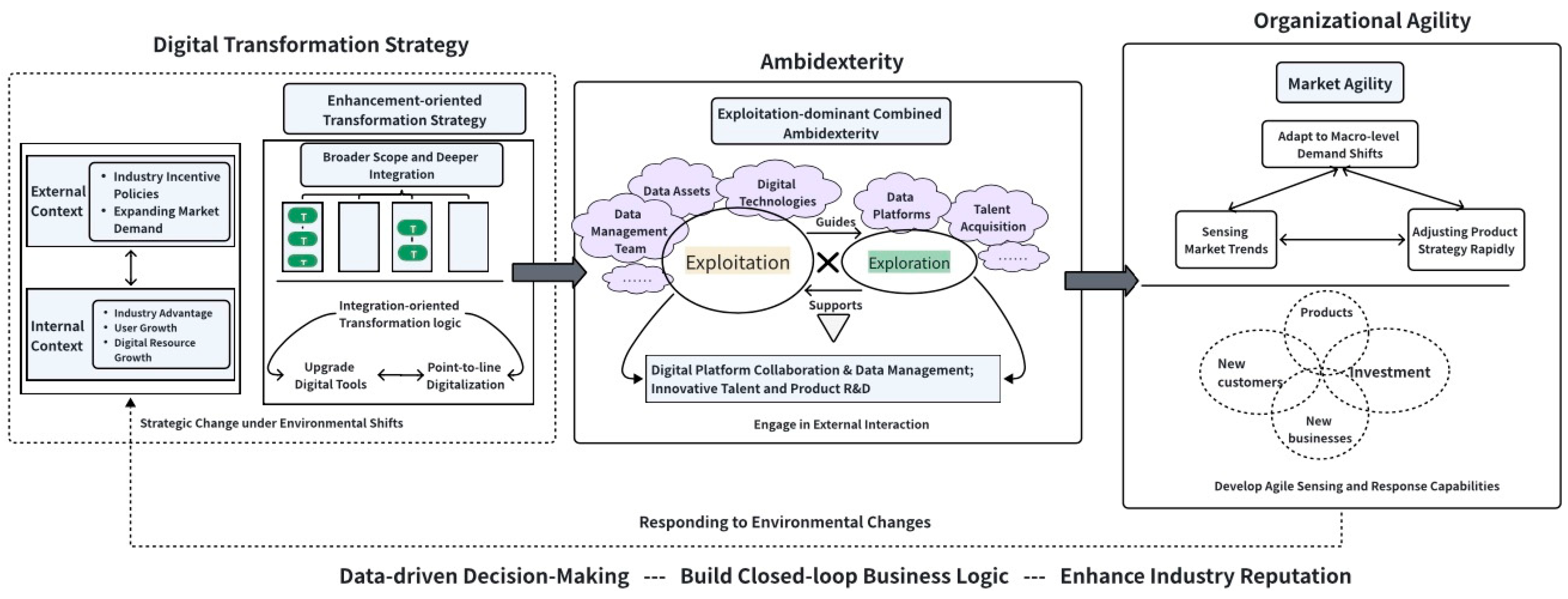
From an internal context perspective, as the initial results of digital transformation became apparent, the firm gained a new understanding of transformation risks and returns. The application scope of digital tools expanded, and data resources were continuously accumulated. Through its lean-oriented transformation, CATL achieved digitalization from scratch, grew its market share, entered a rapid development stage, and secured an industry-leading position. From an external context perspective, the State Council’s issuance of “Made in China 2025” and the “Internet Plus” policies propelled the digitalization of the manufacturing sector. The “white list” policy for power batteries, coupled with measures lifting vehicle purchase and driving restrictions, stimulated growth in battery demand, thereby intensifying industry competition. Based on these changes in the internal and external environments, CATL defined its staged objective as continuously enhancing competitiveness and market share. Through the accumulation of industry experience and technological updates, it advanced a deeper and broader digital transformation, specifically manifested as follows:
First, upgrading digital technology tools. Driven by the global Industry 4.0 wave and the national strategy of manufacturing supremacy, CATL introduced Internet of Things (IoT) technology to support comprehensive control over production processes and full-lifecycle product traceability. Second, advancing the digitalization process from discrete points to continuous lines. The enterprise expanded digital applications from critical localized nodes to the entire industrial chain, encompassing equipment control, on-site management, and lifecycle management, thereby progressively constructing a systematic digital platform. Finally, establishing a transformation philosophy guided by the integration perspective. Distinct from the single-point technology introduction in the initial stage, this phase emphasized the deep integration of digital technologies with business processes. As Chief Manufacturing Officer Ni Jun stated, “If digital technology cannot effectively integrate and solve the problems in our operations, then it is useless”.

4.2.2. Exploitation-Dominant Combined Ambidexterity

Capitalizing on early market advantages, CATL deployed an enhancement-oriented strategy to deeply integrate digital technologies. This drove a shift toward exploitation-dominant combined ambidexterity, maximizing the utility of existing assets while pursuing synergistic new capabilities. We interpret this configuration as exploitation-dominant because the dominant emphasis of this stage was the refinement, scaling, and integration of existing digital and business resources [69]. The construction of data platforms, IoT systems, cloud platforms, and PLM/MES integration reflected the exploitation of accumulated production data and digital infrastructure. Exploratory activities also existed, including external partnerships, talent recruitment, expert and postdoctoral workstations, and product technology development. However, these exploratory activities mainly served the improvement and expansion of CATL’s existing battery business rather than a radical shift away from it. Therefore, the two activities were combined, but exploitation remained the dominant orientation.
Co-building platforms to manage data resources: To maximize its data assets, CATL formed internal teams and pursued external exploratory partnerships with Tianyi Cloud and Intel. These collaborations rapidly upgraded its existing MES system’s computing capabilities, enabling robust data-driven production decisions.
Advancing R&D through talent acquisition: Transitioning from customer-tailored manufacturing to independent innovation, CATL heavily exploited its core battery revenues and 2018 IPO funds to develop advanced high-nickel and carbon-silicon technologies. Concurrently, it explored external knowledge by establishing specialized workstations and recruiting over 3400 technical personnel, ultimately securing over 2000 patents to drive rapid expansion.

4.2.3. Market Agility Enhancement

Data-empowered analytical decision-making. By leveraging data platforms co-developed with Intel and Tianyi Cloud, CATL rapidly translated digital insights into production and R&D actions, effectively resolving urgent capacity shortages driven by explosive sales growth.
Forging a closed-loop business logic. From a sustainable manufacturing perspective, this closed-loop logic shows how market agility can support circular value creation: the firm was not only responding to demand growth, but also reconfiguring its business scope in response to emerging environmental and regulatory requirements related to battery disposal and recycling. To navigate environmental risks and policy shifts regarding battery disposal, CATL acquired Brunp. This strategic expansion into battery recycling transformed a macro-level regulatory challenge into a new driver for performance growth and consolidated its market position.
Enhancing industry prominence. Demonstrating remarkable flexibility and speed of adjustment [70], CATL executed technological breakthroughs (e.g., reducing copper foil thickness) and rapidly adjusted costs amidst electric vehicle subsidy phase-outs. Consequently, it achieved a 112.39% net profit compound annual growth rate (2015–2017), captured top global shipments (21.18 GWh in 2018), and secured major automaker clients like BMW and SAIC.

4.2.4. Summary of the Development Stage

Driven by expanding demand and intensifying competition, CATL shifted its focus to cultivating market agility [71]. An enhancement-oriented transformation strategy systematically reconstructed business operations via IoT and integrated systems [26]. This technological empowerment facilitated exploitation-dominant combined ambidexterity, optimizing existing resources to maximize efficiency while concurrently stimulating exploratory innovation. Market agility further supported sustainable manufacturing by enabling data-driven quality control, process visibility, and a closed-loop business logic around battery recycling. By transitioning from single-customer adjustments to systemic resource integration, this strategic framework enabled CATL to acutely sense and respond to broader market trends, ultimately achieving robust market agility (Figure 4).

4.3. Industry-Leading Stage: From Leap-Oriented Transformation to Value Chain Agility Enhancement

As an established industry leader, CATL faced heightened agility requirements driven by dual pressures. Externally, the abolition of the MIIT “white list” intensified foreign competition. Internally, a rapidly diversifying customer base necessitated new breakthroughs in manufacturing and quality control to sustain market dominance. This stage illustrates how firms with stronger digital and organizational foundations may move from internal integration toward ecosystem-level transformation. In this stage, agility is no longer limited to responding to customers or markets, but increasingly involves coordinating technologies, partners, business models, and value chain activities across organizational boundaries. The relevant illustrative coding for this stage is presented in Table 5.

4.3.1. Leap-Oriented Transformation Strategy

While earlier stages focused on localized cost reduction, the industry-leading stage required a leap-oriented transformation strategy driven by comprehensive strategic exploration. This phase manifested in three dimensions:
Constructing an intelligent technology system. Incorporating “Extreme Manufacturing” into its overarching strategy to build “Lighthouse Factories,” CATL began widely deploying AI technologies (e.g., image recognition, machine learning) in 2019. This leveraged historically accumulated massive data to radically upgrade production lines.
Expanding digitalization from discrete lines to comprehensive networks. Emphasizing deep integration, CATL dismantled data silos to connect platforms across the end-to-end value chain. Specifically, the firm established an AI platform and seamlessly integrated it with existing MES and PLM systems, significantly elevating the intelligent management of production processes.
Adopting an ecosystem-oriented transformation philosophy. To overcome the common challenge of organizational resistance, CATL cultivated a bidirectional (top-down and bottom-up) consensus across all departments—from R&D and supply chain to front-end customers and after-sales. This shared belief in the competitive value of digitalization provided the vital cultural and organizational foundation for comprehensive innovation.

4.3.2. Exploration-Dominant Combined Ambidexterity

Leveraging its robust digital foundation and abundant resources, CATL adopted a collaborative ecological logic. This drove an exploration-dominant combined ambidexterity, synergizing internal operational continuity with aggressive external innovation. We interpret this configuration as exploration-dominant because the firm’s main emphasis shifted toward new technologies, new business models, and ecosystem-level relationships [39,40]. The establishment of intelligent manufacturing departments, horizontal deployment mechanisms, and global production optimization reflected the continued exploitation and scaling of existing digital routines. However, activities such as AI-enabled quality inspection, joint research laboratories, battery swapping, energy storage cooperation, software subsidiary development, and upstream resource investment reflected a stronger exploratory orientation. These exploratory activities extended beyond process improvement and supported the reconstruction of CATL’s value chain position. Specifically:
Optimizing production via agile organizations: To dismantle rigid boundaries, CATL established an Intelligent Manufacturing Department and introduced a “Yokoten” (horizontal deployment) mechanism. This empowered employees to proactively optimize daily production and seamlessly deploy these upgrades across all global manufacturing bases within a two-week cycle.
Aggregating resources through network cooperation: Breaking previous business boundary limitations, CATL constructed a synergistic digital ecosystem via full chain data integration. Key exploratory actions included: deploying AI for real-time quality inspection (collaborating with 4Paradigm), introducing over 200 5G-AGVs for smart logistics, establishing joint research centers with universities, securing upstream raw materials (e.g., North American Lithium), and founding Runzhi Software Technology Co., Limited to drive industry-wide digital empowerment.

4.3.3. Focusing on Value Chain Agility Enhancement

Expanding business models. Leveraging exploration-dominant combined ambidexterity, CATL diversified beyond its core power battery business into energy storage and recycling. Notably, launching the EVOGO battery swap brand in 2022 established a multi-dimensional layout that significantly enhanced its risk resistance and responsiveness to upstream and downstream market demands.
Intelligent operations for cost and efficiency optimization. By seamlessly integrating cutting-edge digital technologies across R&D, manufacturing, and logistics, CATL rapidly iterated product performance—specifically LFP lifespan, NMC energy density, and fast-charging. More concrete evidence from the intelligent manufacturing system shows that CATL shortened the production rhythm to 1.7 s per battery cell, reduced defect rates from ppm to ppb, increased labor productivity by 75%, and reduced energy consumption by 10%. These improvements suggest that value chain agility was not only reflected in business model expansion, but also in the firm’s ability to coordinate production, quality control, energy use, and logistics at scale. These data-driven management efforts significantly reduced manufacturing costs, culminating in its recognition as a WEF “Lighthouse Factory.”
Leading industry development. Demonstrating dynamic capabilities that shape the external environment [72,73], CATL captured a 34% global market share. By pioneering Cell-to-Pack (CTP) technology in 2019 (breaking the 50% volume utilization bottleneck) and iterating to CTP 3.0 by 2022, CATL proved that cultivating end-to-end value chain agility is essential for sustaining continuous expansion and industry dominance.

4.3.4. Summary of the Industry-Leading Stage

In the industry-leading stage, CATL adopted a leap-oriented digital transformation under the ecological perspective, comprehensively reconstructing technological architectures to unearth new market opportunities [26]. This strategic leap empowered exploration-dominant combined ambidexterity, utilizing flexible organizational structures to pioneer new products and business models [10,16]. As competition extended across the ecosystem, these exploratory innovations were rapidly translated into end-to-end synergistic adaptations. Consequently, CATL reconstructed its entire network—from suppliers to delivery—achieving the value chain agility necessary to sustain its industry-leading competitive advantage [74]. Value chain agility became a higher-order capability for sustainable transformation, allowing CATL to coordinate intelligent operations, recycling, energy storage, battery swapping, and ecosystem-level innovation. Compared with customer agility and market agility, value chain agility involves a broader form of coordination across products, processes, partners, and business models. This suggests that sustainability-oriented manufacturing outcomes at advanced stages depend not only on internal efficiency, but also on the firm’s capacity to orchestrate circular and ecosystem-level value creation. The model diagram for this stage is illustrated in Figure 5.

4.4. Cross-Stage Patterns: What the Transitions Reveal

Examining the three stages as a connected sequence rather than separate episodes reveals patterns that none of the individual stages can show. Three observations deserve particular attention.
First, the transitions between stages were triggered by specific combinations of internal readiness and external pressure [2], not by the passage of time alone. Firms often assume that transformation progresses naturally as they accumulate resources, but CATL’s experience suggests that progression requires a more specific alignment. Infrastructure must reach a threshold of completeness. Organizational learning must generate the tacit knowledge needed to interpret data [50,75] and operate integrated systems [3]. And external pressure must intensify enough to override the inertia of established routines. When any of these conditions is missing, firms stall at their current stage, even when they want to move forward.
Second, the relationship between exploration and exploitation shifted in ways that do not match the predictions of mainstream ambidexterity theory. The literature generally suggests that firms should increase exploration as they grow and resources become more abundant [14]. CATL’s trajectory complicates this view. The firm did shift toward exploration over time, but the shift was driven more by changes in the external environment than by internal resource accumulation. During the development stage, when resources were expanding rapidly, the firm actually tilted more heavily toward exploitation than in the initial stage. Only when ecosystem-level competition became the dominant challenge did exploration come to the fore.
Third, agility capabilities developed cumulatively rather than as substitutes. Customer agility did not disappear as market agility emerged, and market agility remained essential even as value chain agility developed. What changed was the relative emphasis and the integration among them. This cumulative logic matters practically because it suggests that firms cannot skip stages. A firm that tries to build value chain agility without first developing customer and market agility will likely find that the ecosystem-level capability lacks the operational foundations it needs to function.
Fourth, sustainability-oriented manufacturing outcomes were supported by the cumulative layering of agility. Customer agility first appeared to support production standardization and quality consistency; market agility then supported data-driven coordination and closed-loop recycling; value chain agility finally extended this logic toward ecosystem-level coordination across recycling, energy storage, battery swapping, and intelligent operations.
Figure 6 summarizes the cross-stage alignment mechanism identified from the case. It shows how digital transformation strategy, ambidexterity, and organizational agility evolve together as the firm moves from resource scarcity to resource pool expansion and then to relatively abundant resources.

5. Conclusions and Future Research

5.1. Conclusions

This paper explores how digital transformation strategies drive the evolution of organizational agility. Our findings contribute to three streams of literature.
First, we extend stage-based digital transformation research by shifting the focus from technology accumulation to strategic logic switching. Prior work has explained digital transformation through stages, maturity levels, or capability accumulation [3]. Compared with these accounts, our study shows that transformation stages differ not only in technological depth but also in strategic priorities, transformation scope, and risk tolerance. The lean–enhancement–leap sequence suggests that firms may shift from localized operational alignment to cross-functional integration, and then to ecosystem-level coordination as their resource bases, competitive pressures, and sustainability requirements change. Thus, sustainable manufacturing transformation is better understood as a stage-contingent alignment process among digital infrastructure, organizational routines, and external sustainability pressures, rather than as the mechanical accumulation of digital technologies.
Second, we reposition organizational ambidexterity as a behavioral bridge rather than a static strategic choice. The ambidexterity literature has long debated whether exploration and exploitation should be balanced or combined, and whether they operate as substitutes or complements [32,34]. Our findings suggest this debate may be framed too narrowly. CATL’s trajectory shows that the appropriate configuration shifts as firms develop, moving from balanced to exploitation-dominant to exploration-dominant forms. This reframing clarifies how manufacturing firms use ambidexterity to balance efficiency-oriented exploitation with opportunity-oriented exploration during sustainable transformation. In this sense, ambidexterity is not only a mechanism for managing innovation tension, but also a behavioral bridge through which digital strategies are translated into resource-efficient production, circular value creation, and ecosystem-level adaptation [40].
Third, we connect digital transformation to the evolution of organizational agility through a capability-layering logic underdeveloped in prior research. Much agility literature treats the construct as a single capability measured through aggregate indicators [13]. Our analysis disaggregates agility into customer, market, and value chain dimensions, and shows how these dimensions develop in sequence, each layer building on those before. This layered view also clarifies the position of sustainable manufacturing in our framework. Organizational agility is treated as the proximal capability outcome of digital transformation, whereas sustainability-oriented manufacturing outcomes constitute the distal value domain that agility helps to support. Customer agility contributes to production standardization, quality consistency, and resource-efficient capacity expansion; market agility supports data-driven coordination and closed-loop business logic; and value chain agility enables intelligent operations, circular value creation, and ecosystem-level coordination [4]. It clarifies why some firms fail to generate sustainable outcomes despite substantial digital investment: without lower-order agility capabilities in place, higher-order capabilities such as circular coordination, intelligent operations, and ecosystem orchestration lack the organizational foundations they require [76].

5.2. Managerial Implications

The practical value of the case lies not in providing a template for directly imitating CATL, but in helping manufacturing firms diagnose their own transformation stage and align digital strategy, ambidexterity and agility capability with sustainability-oriented objectives [5]. What is transferable is the stage-contingent alignment logic, not CATL’s specific resource-intensive practices.
First, executives should begin with stage diagnosis. Firms under tight resource constraints may need localized digital tools to stabilize production, improve quality consistency, and respond to key customers. Firms with accumulated digital resources may shift toward cross-functional data integration and market responsiveness. Firms with stronger digital and organizational foundations may further pursue value chain coordination and circular business opportunities. The key managerial task is therefore to match digital ambition with the firm’s actual digital infrastructure, learning capacity, and competitive pressure.
Second, managers should treat ambidexterity as a sequenced configuration, not as a universal call for more exploration. CATL’s movement from balanced to exploitation-dominant and then to exploration-dominant ambidexterity suggests that each configuration depends on resources and routines built in earlier stages. Early overinvestment in exploration may create coordination overload, whereas late-stage persistence in exploitation-dominant configurations may prevent firms from capturing ecosystem-level opportunities [69].
Third, digital infrastructure should be evaluated as a source of future strategic options, not only by immediate efficiency gains. CATL’s later value chain agility depended on digital capabilities accumulated during earlier production automation and system integration. From a sustainable manufacturing perspective, such infrastructure creates the informational basis for quality control, resource efficiency, closed-loop business logic, and value chain coordination.

5.3. Limitations and Future Research

This study has clear boundary conditions. First, it is most applicable to manufacturing industries with rapid technological change, complex value chains, significant scale requirements, and strong sustainability pressures. Its applicability is more limited in light manufacturing, low-tech processing, or contexts where digital technology plays only a peripheral role. Second, the framework assumes a minimum resource threshold, including basic digital infrastructure, managerial capacity, and organizational routines for transformation; severely resource-constrained SMEs may not follow the same path [77]. Third, policy support, market growth, financing conditions, and ecosystem maturity may affect whether firms can move from localized digitalization to integration and then to ecosystem-level transformation. Finally, firms should not assume that they can skip early capability-building stages, as premature ecosystem orchestration may create digital overextension rather than value chain agility.
The single-case design also carries limitations. CATL operates in a specific industry, historical moment, and institutional context in China. Its trajectory was shaped by early policy support, rapid expansion of the electric vehicle market, access to financing, and its growing ecosystem position. These conditions may not be available to firms in other countries, industries, or institutional environments. Our focus on a successful case also raises questions about survivor bias. CATL represents a successful alignment trajectory, but many firms may fail at different points: they may select a digital strategy that exceeds their resource base, configure exploration and exploitation inappropriately, or fail to translate digital resources into customer, market, or value chain agility.
Several avenues for future research follow. Future research could compare successful and unsuccessful transformation trajectories to identify where alignment breaks down: strategy selection, ambidexterity configuration, agility capability formation, or the translation of agility into sustainability-oriented outcomes. Comparative studies across industries and national contexts could examine whether the lean–enhancement–leap sequence changes under different sustainability pressures, such as carbon reduction, recycling mandates, supply chain resilience, or energy efficiency requirements [6,7]. Research on resource-constrained SMEs could explore whether lower-cost forms of customer or market agility can develop without full ecosystem orchestration. Finally, new technologies such as generative AI and advanced robotics raise further questions: do they allow firms to accelerate ecosystem coordination, or do they increase the need for foundational digital infrastructure? Multi-level research could also examine how firm-level strategic configurations translate into team- and individual-level behaviors [14,78].
Overall, this study should be read as a process theory of stage-contingent alignment rather than as a universal prescription. Its core implication is that digital transformation supports sustainable manufacturing not through technology adoption alone, but through the staged alignment of digital strategy, ambidexterity, and organizational agility.

Author Contributions

Conceptualization, X.S. and B.D.; methodology, X.S.; software, X.S.; validation, X.S. and B.D.; formal analysis, X.S.; investigation, X.S. and B.D.; resources, B.D.; data curation, X.S.; writing—original draft preparation, X.S.; writing—review and editing, X.S. and B.D.; visualization, X.S.; supervision, B.D.; project administration, B.D.; funding acquisition, B.D. All authors have read and agreed to the published version of the manuscript.

Funding

This work was funded by the National Natural Science Foundation of China (NSFC) [grant number 72072068].

Institutional Review Board Statement

Not applicable.

Informed Consent Statement

Not applicable.

Data Availability Statement

The data presented in this study are available upon request from the corresponding author.

Conflicts of Interest

The authors declare no conflicts of interest.

Abbreviations

The following abbreviations are used in this manuscript:
CATLContemporary Amperex Technology Co., Limited
MESManufacturing Execution System
ERPEnterprise Resource Planning
IIoTIndustrial Internet of Things
AIArtificial Intelligence
SRMSupplier Relationship Management
CRMCustomer Relationship Management
B2BBusiness-to-Business
IPOInitial Public Offering
MIITMinistry of Industry and Information Technology
WEFWorld Economic Forum
CTPCell-to-Pack
AGVAutomated Guided Vehicle
EVElectric Vehicle
PLMProduct Lifecycle Management
LFPLithium Iron Phosphate
NMCNickel Manganese Cobal

References

  1. Wang, X.; Mao, X.; Liu, M. The Coupling and Coordination Relationship between Digital Economy and Manufacturing Industry in China: A High-Quality Development Perspective. J. Stat. Inf. 2024, 39, 41–55. (In Chinese) [Google Scholar] [CrossRef]
  2. Verhoef, P.C.; Broekhuizen, T.; Bart, Y.; Bhattacharya, A.; Dong, J.Q.; Fabian, N.; Haenlein, M. Digital Transformation: A Multidisciplinary Reflection and Research Agenda. J. Bus. Res. 2021, 122, 889–901. [Google Scholar] [CrossRef]
  3. Vial, G. Understanding Digital Transformation: A Review and a Research Agenda. J. Strateg. Inf. Syst. 2019, 28, 118–144. [Google Scholar] [CrossRef]
  4. Machado, C.G.; Winroth, M.P.; Ribeiro da Silva, E.H.D. Sustainable Manufacturing in Industry 4.0: An Emerging Research Agenda. Int. J. Prod. Res. 2020, 58, 1462–1484. [Google Scholar]
  5. Warner, K.S.; Wäger, M. Building Dynamic Capabilities for Digital Transformation: An Ongoing Process of Strategic Renewal. Long Range Plan. 2019, 52, 326–349. [Google Scholar] [CrossRef]
  6. Bag, S.; Gupta, S.; Kumar, S. Industry 4.0 Adoption and 10R Advance Manufacturing Capabilities for Sustainable Development. Int. J. Prod. Econ. 2021, 231, 107844. [Google Scholar] [CrossRef]
  7. Lu, H.; Zhao, G.; Liu, S. Integrating Circular Economy and Industry 4.0 for Sustainable Supply Chain Management: A Dynamic Capability View. Prod. Plan. Control 2024, 35, 170–186. [Google Scholar]
  8. McKinsey & Company. Unlocking Success in Digital Transformations; McKinsey & Company: Chicago, IL, USA, 2018. [Google Scholar]
  9. Sebastian, I.; Ross, J.; Beath, C.; Mocker, M.; Moloney, K.; Fonstad, N. How Big Old Companies Navigate Digital Transformation. MIS Q. Exec. 2017, 16, 197–213. [Google Scholar]
  10. Hanelt, A.; Bohnsack, R.; Marz, D.; Antunes Marante, C. A systematic review of the literature on digital transformation: Insights and implications for strategy and organizational change. J. Manag. Stud. 2021, 58, 1159–1197. [Google Scholar] [CrossRef]
  11. Teece, D.; Peteraf, M.; Leih, S. Dynamic Capabilities and Organizational Agility. Calif. Manag. Rev. 2016, 58, 13–35. [Google Scholar] [CrossRef]
  12. Chakravarty, A.; Grewal, R.; Sambamurthy, V. Information Technology Competencies, Organizational Agility, and Firm Performance: Enabling and Facilitating Roles. Inf. Syst. Res. 2013, 24, 976–997. [Google Scholar] [CrossRef]
  13. Tallon, P.; Pinsonneault, A. Competing Perspectives on the Link between Strategic Information Technology Alignment and Organizational Agility: Insights from a Mediation Model. MIS Q. 2011, 35, 463–486. [Google Scholar] [CrossRef]
  14. O’Reilly, C.A., III; Tushman, M.L. Organizational ambidexterity: Past, present, and future. Acad. Manag. Perspect. 2013, 27, 324–338. [Google Scholar] [CrossRef]
  15. Wu, C.Q.; Zhang, K.X.; Chen, X.R. A Study on Transformation Path of Digitalization of the Traditional Manufacturing Firm: A Three-Stage Evolutionary Model Based on Structure-Agency Perspective. J. Shandong Univ. (Philos. Soc. Sci.) 2022, 4, 121–135. (In Chinese) [Google Scholar] [CrossRef]
  16. Escorcia-Caballero, J.P.; Chams-Anturi, O.; Moreno-Luzon, M.D. The Effect of Ambidexterity on Market Performance: A New Perspective and Measurement from the Dynamic Capability Framework. Technol. Anal. Strateg. Manag. 2024, 36, 1538–1550. [Google Scholar]
  17. Brown, J.L.; Agnew, N.M. Corporate agility. Bus. Horiz. 1982, 25, 29–33. [Google Scholar] [CrossRef]
  18. Goldman, S.L. Agile Competitors and Virtual Organizations: Strategies for Enriching the Customer; Van Nostrand Reinhold Series; Wiley: Hoboken, NJ, USA, 1994. [Google Scholar]
  19. Narasimhan, R.; Swink, M.; Kim, S.W. Disentangling leanness and agility: An empirical investigation. J. Oper. Manag. 2006, 24, 440–457. [Google Scholar] [CrossRef]
  20. Walter, A.-T. Organizational Agility: Ill-Defined and Somewhat Confusing? A Systematic Literature Review and Conceptualization. Manag. Rev. Q. 2021, 71, 343–391. [Google Scholar] [CrossRef]
  21. Lu, Y.; Ramamurthy, K. Understanding the Link between Information Technology Capability and Organizational Agility: An Empirical Examination. MIS Q. 2011, 35, 931–954. [Google Scholar] [CrossRef]
  22. Sambamurthy, V.; Bharadwaj, A.; Grover, V. Shaping Agility through Digital Options: Reconceptualizing the Role of Information Technology in Contemporary Firms. MIS Q. 2003, 27, 237–263. [Google Scholar] [CrossRef]
  23. Sharifi, H.; Zhang, Z. Agile Manufacturing in Practice—Application of a Methodology. Int. J. Oper. Prod. Manag. 2001, 21, 772–794. [Google Scholar] [CrossRef]
  24. Kohli, R.; Melville, N.P. Digital Innovation: A Review and Synthesis. Inf. Syst. J. 2019, 29, 200–223. [Google Scholar] [CrossRef]
  25. Matarazzo, M. Digital Transformation and Customer Value Creation in Made in Italy SMEs: A Dynamic Capabilities Perspective. J. Bus. Res. 2021, 123, 642–656. [Google Scholar] [CrossRef]
  26. Lopez-Vega, H.; Moodysson, J. Digital Transformation of the Automotive Industry: An Integrating Framework to Analyse Technological Novelty and Breadth. Ind. Innov. 2023, 30, 67–102. [Google Scholar] [CrossRef]
  27. Bharadwaj, A.; El Sawy, O.A.; Pavlou, P.A.; Venkatraman, N. Digital Business Strategy: Toward a Next Generation of Insights. MIS Q. 2013, 37, 471–482. [Google Scholar] [CrossRef]
  28. Jacobides, M.G.; Cennamo, C.; Gawer, A. Towards a Theory of Ecosystems. Strateg. Manag. J. 2018, 39, 2255–2276. [Google Scholar] [CrossRef]
  29. Quinton, S.; Canhoto, A.; Molinillo, S.; Pera, R.; Budhathoki, T. Conceptualising a digital orientation: Antecedents of supporting SME performance in the digital economy. J. Strateg. Mark. 2018, 26, 427–439. [Google Scholar] [CrossRef]
  30. Yang, Y.; Lei, J.; Chen, H.; Wu, Y. The Mechanisms of Processing and Manufacturing Firms’ Digital Transformation: Case Studies Based on Resource Orchestration. J. Manag. Case Stud. 2022, 15, 198–220. (In Chinese) [Google Scholar] [CrossRef]
  31. March, J.G. Exploration and Exploitation in Organizational Learning. Organ. Sci. 1991, 2, 71–87. [Google Scholar] [CrossRef]
  32. Gupta, A.K.; Smith, K.G.; Shalley, C.E. The Interplay between Exploration and Exploitation. Acad. Manag. J. 2006, 49, 693–706. [Google Scholar] [CrossRef]
  33. Gibson, C.B.; Birkinshaw, J. The antecedents, consequences, and mediating role of organizational ambidexterity. Acad. Manag. J. 2004, 47, 209–226. [Google Scholar] [CrossRef]
  34. Cao, Q.; Gedajlovic, E.; Zhang, H. Unpacking Organizational Ambidexterity: Dimensions, Contingencies, and Synergistic Effects. Organ. Sci. 2009, 20, 781–796. [Google Scholar] [CrossRef]
  35. Klarner, P.; Raisch, S. Move to the beat—Rhythms of change and firm performance. Acad. Manag. J. 2013, 56, 160–184. [Google Scholar] [CrossRef]
  36. Yoo, Y.; Henfridsson, O.; Lyytinen, K. Research Commentary—The New Organizing Logic of Digital Innovation: An Agenda for Information Systems Research. Inf. Syst. Res. 2010, 21, 724–735. [Google Scholar] [CrossRef]
  37. Steiber, A. Digital transformation of industrial firms: An innovation diffusion perspective. Eur. J. Innov. Manag. 2020, 24, 799–819. [Google Scholar] [CrossRef]
  38. Strange, R.; Chen, L.; Fleury, M.T.L. Digital Transformation and International Strategies. J. Int. Manag. 2022, 28, 100968. [Google Scholar] [CrossRef]
  39. Hoessler, S.; Carbon, C.C. Digital Transformation and Ambidexterity: A Literature Review on Exploration and Exploitation Activities in Companies’ Digital Transformation. Int. J. Innov. Manag. 2022, 26, 2230003. [Google Scholar] [CrossRef]
  40. Zhu, X.; Li, Y. The Use of Data-Driven Insight in Ambidextrous Digital Transformation: How Do Resource Orchestration, Organizational Strategic Decision-Making, and Organizational Agility Matter? Technol. Forecast. Soc. Change 2023, 196, 122851. [Google Scholar]
  41. Liang, H.; Wang, N.; Xue, Y. Juggling Information Technology (IT) Exploration and Exploitation: A Proportional Balance View of IT Ambidexterity. Inf. Syst. Res. 2022, 33, 1386–1402. [Google Scholar] [CrossRef]
  42. Beier, G.; Ullrich, A.; Niehoff, S.; Reißig, M.; Habich, M. Industry 4.0: How It Is Defined from a Sociotechnical Perspective and How Much Sustainability It Includes—A Literature Review. J. Clean. Prod. 2020, 259, 120856. [Google Scholar]
  43. Jamwal, A.; Agrawal, R.; Sharma, M.; Giallanza, A. Industry 4.0 Technologies for Manufacturing Sustainability: A Systematic Review and Future Research Directions. Appl. Sci. 2021, 11, 5725. [Google Scholar] [CrossRef]
  44. Kristoffersen, E.; Blomsma, F.; Mikalef, P.; Li, J. The Smart Circular Economy: A Digital-Enabled Circular Strategies Framework for Manufacturing Companies. J. Bus. Res. 2020, 120, 241–261. [Google Scholar] [CrossRef]
  45. Stroumpoulis, A.; Kopanaki, E.; Chountalas, P.T. Enhancing Sustainable Supply Chain Management through Digital Transformation: A Comparative Case Study Analysis. Sustainability 2024, 16, 6778. [Google Scholar] [CrossRef]
  46. Atkinson, P.; Hizaji, M.; Nazarian, A.; Abasi, A. Attaining organisational agility through competitive intelligence: The roles of strategic flexibility and organisational innovation. Total Qual. Manag. Bus. Excell. 2022, 33, 297–317. [Google Scholar] [CrossRef]
  47. Stylos, N.; Zwiegelaar, J.; Buhalis, D. Big data empowered agility for dynamic, volatile, and time-sensitive service industries: The case of tourism sector. Int. J. Contemp. Hosp. Manag. 2021, 33, 1015–1036. [Google Scholar] [CrossRef]
  48. Matt, C.; Hess, T.; Benlian, A. Digital Transformation Strategies. Bus. Inf. Syst. Eng. 2015, 57, 339–343. [Google Scholar] [CrossRef]
  49. Zahra, S.A.; George, G. Absorptive capacity: A review, reconceptualization, and extension. Acad. Manag. Rev. 2002, 27, 185–203. [Google Scholar] [CrossRef]
  50. Nambisan, S.; Wright, M.; Feldman, M. The Digital Transformation of Innovation and Entrepreneurship: Progress, Challenges and Key Themes. Res. Policy 2019, 48, 103773. [Google Scholar] [CrossRef]
  51. Helfat, C.E.; Raubitschek, R.S. Dynamic and integrative capabilities for profiting from innovation in digital platform-based ecosystems. Res. Policy 2018, 47, 1391–1399. [Google Scholar] [CrossRef]
  52. Hess, T.; Matt, C.; Benlian, A.; Wiesböck, F. Options for formulating a digital transformation strategy. Mis Q. Exec. 2016, 15, 123–139. [Google Scholar]
  53. Schilke, O.D. On the contingent value of dynamic capabilities for competitive advantage: The nonlinear moderating effect of environmental dynamism. Strateg. Manag. J. 2014, 35, 179–203. [Google Scholar] [CrossRef]
  54. Cao, C.; Feng, J. The Influence of Slack Resources on the Choice of Green Innovation Mode: An Integrated View of Environmental Regulations. Manag. Rev. 2022, 34, 124. (In Chinese) [Google Scholar] [CrossRef]
  55. Teece, D.; Pisano, G.; Shuen, A. Dynamic Capabilities and Strategic Management. Strateg. Manag. J. 1997, 18, 509–533. [Google Scholar] [CrossRef]
  56. Langley, A. Strategies for Theorizing from Process Data. Acad. Manag. Rev. 1999, 24, 691–710. [Google Scholar] [CrossRef]
  57. Yin, R.K. Case Study Research and Applications; Sage: Thousand Oaks, CA, USA, 2018; Volume 6. [Google Scholar]
  58. Welch, C.; Piekkari, R.; Plakoyiannaki, E.; Paavilainen-Mäntymäki, E. Theorising from Case Studies: Towards a Pluralist Future for International Business Research. In Research Methods in International Business; Springer: Berlin/Heidelberg, Germany, 2019; pp. 171–220. [Google Scholar]
  59. Gao, J.; He, H.; Teng, D.; Wan, X.; Zhao, S. Cross-Border Knowledge Search and Integration Mechanism—A Case Study of Haier Open Partnership Ecosystem (HOPE). CMS 2021, 15, 428–455. [Google Scholar] [CrossRef]
  60. Pettigrew, A.M. Longitudinal Field Research on Change: Theory and Practice. Organ. Sci. 1990, 1, 267–292. [Google Scholar] [CrossRef]
  61. Eisenhardt, K.M.; Graebner, M.E. Theory Building from Cases: Opportunities and Challenges. Acad. Manag. J. 2007, 50, 25–32. [Google Scholar] [CrossRef]
  62. Flyvbjerg, B. Five Misunderstandings about Case-Study Research. Sosiol. Tidsskr. 2004, 12, 117–142. [Google Scholar] [CrossRef]
  63. Eisenhardt, K.M. Building Theories from Case Study Research. Acad. Manag. Rev. 1989, 14, 532–550. [Google Scholar] [CrossRef]
  64. World Economic Forum. Global Lighthouse Network: Reimagining Operations for Growth; World Economic Forum: Cologny, Switzerland, 2021. [Google Scholar]
  65. Yin, R.K. Case Study Research: Design and Methods, 3rd ed.; Sage Publications: Thousand Oaks, CA, USA, 2003. [Google Scholar]
  66. Gioia, D.A.; Corley, K.G.; Hamilton, A.L. Seeking Qualitative Rigor in Inductive Research: Notes on the Gioia Methodology. Organ. Res. Methods 2013, 16, 15–31. [Google Scholar] [CrossRef]
  67. Bresciani, S.; Ferraris, A.; Romano, M.; Santoro, G. Building a Digital Transformation Strategy. In Digital Transformation Management for Agile Organizations: A Compass to Sail the Digital World; Emerald: Leeds, UK, 2021; pp. 5–27. [Google Scholar]
  68. Nazari, Z.; Musilek, P. Impact of Digital Transformation on the Energy Sector: A Review. Algorithms 2023, 16, 211. [Google Scholar] [CrossRef]
  69. Xue, C.; Wang, J. Proactive boundary-spanning search, organizational resilience, and radical green innovation. Bus. Strategy Environ. 2023, 33, 1834–1852. [Google Scholar]
  70. Christofi, M.; Pereira, V.; Vrontis, D.; Tarba, S.; Thrassou, A. Agility and Flexibility in International Business Research: A Comprehensive Review and Future Research Directions. J. World Bus. 2021, 56, 101194. [Google Scholar] [CrossRef]
  71. Yoo, Y.; Boland, R.J., Jr.; Lyytinen, K.; Majchrzak, A. Organizing for Innovation in the Digitized World. Organ. Sci. 2012, 23, 1398–1408. [Google Scholar] [CrossRef]
  72. Fainshmidt, S.; Pezeshkan, A.; Frazier, M.; Nair, A.; Markowski, E. Dynamic Capabilities and Organizational Performance: A Meta-Analytic Evaluation and Extension. J. Manag. Stud. 2016, 53, 1348–1380. [Google Scholar] [CrossRef]
  73. Teece, D. The Foundations of Enterprise Performance: Dynamic and Ordinary Capabilities in an (Economic) Theory of Firms. Acad. Manag. Perspect. 2014, 28, 328–352. [Google Scholar] [CrossRef]
  74. Swafford, P.; Ghosh, S.; Murthy, N. A Framework for Assessing Value Chain Agility. Int. J. Oper. Prod. Manag. 2006, 26, 118–140. [Google Scholar] [CrossRef]
  75. Cenamor, J.; Sjödin, D.R.; Parida, V. Adopting a Platform Approach in Servitization: Leveraging the Value of Digitalization. Int. J. Prod. Econ. 2017, 192, 54–65. [Google Scholar] [CrossRef]
  76. Zhao, W.; Wang, A.; Chen, Y.; Liu, W. Investigating Inclusive Entrepreneurial Ecosystem through the Lens of Bottom of the Pyramid (BOP) Theory: Case Study of Taobao Village in China. CMS 2021, 15, 613–640. [Google Scholar] [CrossRef]
  77. Sagala, G.H.; Őri, D. Toward SMEs Digital Transformation Success: A Systematic Literature Review. Inf. Syst. e-Bus. Manag. 2024, 22, 667–719. [Google Scholar] [CrossRef]
  78. Mom, T.J.; Chang, Y.-Y.; Cholakova, M.; Jansen, J.J. A Multilevel Integrated Framework of Firm HR Practices, Individual Ambidexterity, and Organizational Ambidexterity. J. Manag. 2019, 45, 3009–3034. [Google Scholar]
Figure 1. Theoretical analysis framework.
Sustainability 18 06617 g001
Figure 2. Milestones in CATL’s Digital Transformation.
Sustainability 18 06617 g002
Figure 3. Initial Stage Model: From Lean-oriented Transformation to Customer Agility.
Sustainability 18 06617 g003
Figure 4. Development Stage Model: From Enhancement-oriented Transformation to Market Agility.
Sustainability 18 06617 g004
Figure 5. Industry-leading Stage Model: From Leap-oriented Transformation to Value Chain Agility.
Sustainability 18 06617 g005
Figure 6. Stage-contingent Alignment Mechanism for Sustainable Manufacturing Transformation.
Sustainability 18 06617 g006
Table 1. Strategic Orientations of Stage-contingent Digital Transformation.
DimensionLean-Oriented TransformationEnhancement-Oriented TransformationLeap-Oriented Transformation
Strategic logicAlignment view: digital technology is used as a tool to improve existing business processesIntegration view: digital technologies are deeply integrated with business processesEcosystem view: digitalization drives strategic renewal and opportunity exploration
Breadth of technology applicationLocalized process digitalization, focusing on production or equipment managementMulti-business-unit integration and enterprise-wide data sharingComprehensive digitalization, intelligent decision-making, and predictive analytics
Resource coordinationLocal optimizationInternal end-to-end integrationCross-functional, cross-business-unit, and ecosystem-level coordination
Main focusEfficiency improvement, cost control, process standardization, and quality consistencySystem optimization, knowledge integration, data-driven decision-making, and market responsivenessOrganizational restructuring, ecosystem boundary reconfiguration, business model renewal, and new competitive advantage
Typical practicesBuilding digital infrastructure and adopting localized digital tools such as automation systems and process-control softwareUpgrading digital tools, developing enterprise data platforms, and integrating production and management systemsBuilding intelligent technology systems, opening data interfaces, and coordinating digital resources with external partners
Sustainability relevanceSupports resource-efficient operations and quality consistencySupports process visibility, data-driven coordination, and closed-loop business logicSupports circular value creation, intelligent operations, and value chain coordination
Source: The authors.
Table 2. Data Sources, Coding Classification, and Coded References.
Data SourceData Information Statistics
In-Depth InterviewsParticipant/Document TypeNumber of RespondentsDuration (hours)Transcript Length Interview FocusCodeCoded References
Senior Management22.217,200Understanding the implementation of digital strategy, associated challenges, and strategic collaborations with upstream and downstream enterprisesT1DT: 16; AB: 11; OA: 9
Product Managers, R&D Engineers, Quality Specialists, etc.54.638,300Understanding the development of cutting-edge technologies, quality management systems, and product development and testing processesT2DT: 13; AB: 17; OA: 15
Market Center Directors, Business Analysts, etc.4320,400Understanding external collaborations, market demand changes, business operations, and future market development directionsT3DT: 10; AB: 7; OA: 26;
Archival DocumentsMain Content Transcript Length CodeCoded References
Secondary DataCompany website, official social media accounts, etc.27,000F1DT: 8; AB: 5; OA: 5
Internal publications, meeting records, etc.17,000F2DT: 7; AB: 8; OA: 6
Annual reports, public disclosure information, research reports, literature40,000S1DT: 11; AB: 6; OA: 8
Public statements and interviews of executives, media reports22,000S2DT: 7; AB: 5; OA: 7;
Note: DT = digital transformation strategy; AB = ambidexterity; OA = organizational agility. Coded references indicate the number of qualitative references coded under each core analytical category.
Table 3. Examples of Characteristics in the Initial Stage.
Aggregation DimensionMain CategoryPrimary CodeKey Event Description
Digital Transformation StrategyLean-Oriented TransformationDigital Infrastructure ConstructionPurchased automated equipment; introduced MES for production monitoring (F2)
Breakthroughs at Critical NodesPromoted digital transformation in critical processes as a breakthrough approach (F1)
Alignment Perspective PhilosophyAdjusted automation systems to suit new automotive battery products (F1)
AmbidexterityBalance Dimension of Ambidexterity (BD)Improve Processes via Digital TechPartnered with SAP (2014) to implement ERP, SRM, CRM systems (F2, S1)
Learn Product Processes to Shape Customer-Oriented ImageCollaborated with BMW (2012) on “Zinoro 1E”, studying 800+ page standards (T2, S1, S2)
Organizational AgilityCustomer Agilityquality consistency, resource-efficient capacity expansionReduced independence of each process step, decreased management supervision difficulty, and production line control systems supported real-time monitoring of production plans and processes. (T2)
Capture Policy and Market OpportunitiesLeveraged 2012 NEV policy; demand grew from 2.7 to 24.3 GWh (2012–2015); secured orders from Yutong, etc. (S2)
Breaking Through Industry Entry BarriersGained full-process experience in automotive battery R&D and certification via BMW cooperation (F1)
Note: T2 = product, R&D, and quality-related interviews; F1 = company website and official social media accounts; F2 = internal publications and meeting records; S1 = annual reports, public disclosures, research reports, and academic literature; S2 = executive statements, public interviews, and media reports.
Table 4. Examples of Characteristics in the Rapid Development Stage.
Aggregation DimensionMain CategoryPrimary CodeTypical Illustration
Digital Transformation StrategyStrategy Enhancement-Oriented TransformationUpgrade and Update Digital Tools2015: Partnered with SAP to introduce PLM; became China’s first SAP MES on HANA lighthouse customer (F1, S1)
Expand Digitization from Points to LinesUsed MES/PLM + IoT to make production controllable; integrated management and production data (T2)
Transformation Philosophy Guided by the Integration PerspectiveDigital tech must integrate effectively to solve operational problems and support business
“Fully understanding the industry allows digital technologies to support our business.”
AmbidexterityEnhancement-Oriented TransformationDevelop Digital Platforms to Manage Digital ResourcesBuilt big data platform, IoT system, cloud platforms; established data team; developed OPC UA-based acquisition platform (T1, F2, S2)
Build Talent Teams to Improve ProductsEstablished expert/postdoctoral workstations; >1000 R&D personnel by 2016; signed strategic agreement with Dongfeng (T2, S2, T3)
Organizational AgilityMarket AgilityData-Driven Decision MakingMulti-stage data collection for quality analysis, correlation identification, and full-process traceability (T2, S2)
Establish Closed-Loop Business Logic2015: Acquired Brunp, began planning battery recycling (S2)
Enhance Industry ReputationDeveloped 15 min fast charging battery; 2017: 12 GWh capacity, surpassed Panasonic as world leader; secured VC; JVs with SAIC/GAC (F1, S1, S2)
Note: T1 = senior management interviews; T2 = product, R&D, and quality-related interviews; T3 = market and business interviews; F1 = company website and official social media accounts; F2 = internal publications and meeting records; S1 = annual reports, public disclosures, research reports, and academic literature; S2 = executive statements, public interviews, and media reports.
Table 5. Examples of Characteristics in the Leapfrogging Stage.
Aggregation DimensionMain CategoryPrimary CodeTypical Illustration
Digital Transformation StrategyLeapfrog TransformationBuild Intelligent Technology System2020 strategy: “electrification + intelligence”; R&D incorporates AI + molecular simulation, “model + simulation + intelligence” (T1, T2)
Expand Digitization from Lines to PlanesAI platforms integrated with MES/PLM; collaborated with Intel on “cloud-edge-end” platform; built Fourth Paradigm AI platform (F1, S2)
Ecosystem Perspective PhilosophyInnovation systems include intelligent manufacturing & business model innovation; digitalization enhances competitiveness; shared understanding across all departments (T1, T3)
Ambidexterity Exploration-dominant combined ambidexterityBuild Agile OrganizationAgile Organization Building Horizontal deployment of improvements; by end 2020: 200+ smart devices, 6800+ data points; intelligent manufacturing department established Aug 2020 (T2, F2)
Co-Create Value through Collaboration NetworksEstablished Contemporary Amperex Runzhi Software Technology Co., Limited (2021); joint labs with CAS & Xiamen University; 21C Innovation Lab (2020); co-invested with NIO; gov’t agreements with Zhaoqing, Dongguan, Ordos
Organizational AgilityValue Chain AgilityExpand Business Models2022: Launched EVOGO battery swap brand; explored energy storage cooperation with State Power Investment, Chint, PowerChina (T3, F1, S2)
Smart Operations for Cost Reduction and Efficiency1.7 s/battery cell; defect rate ppm→ppb; labor productivity +75%; energy consumption −10%; mobile digital factory (F2, S2)
Lead Industry Development2019: Pioneered CTP technology (>50% volume utilization); 2022: CTP 3.0 (Kirin battery); September 2021: First battery WEF Lighthouse Factory (F1, S2)
Note: T1 = senior management interviews; T2 = product, R&D, and quality-related interviews; T3 = market and business interviews; F1 = company website and official social media accounts; F2 = internal publications and meeting records; S1 = annual reports, public disclosures, research reports, and academic literature; S2 = executive statements, public interviews, and media reports.
Disclaimer/Publisher’s Note: The statements, opinions and data contained in all publications are solely those of the individual author(s) and contributor(s) and not of MDPI and/or the editor(s). MDPI and/or the editor(s) disclaim responsibility for any injury to people or property resulting from any ideas, methods, instructions or products referred to in the content.