


Abstract
European sustainability transitions are increasingly defined by the convergence of blue, green, and circular economy agendas. Traditionally analysed and governed in isolation, these domains generate important interdependencies, trade-offs, and coordination challenges that remain insufficiently understood. Drawing on the multi-level perspective (MLP) and recent advances in multi-system dynamics, this article introduces the Resource Infrastructure Economy (RIE) as a novel integrative framework. The RIE differs from existing multi-system frameworks by explicitly integrating marine governance as a full socio-technical regime, theorising regulatory-driven regime coupling as a distinct transition pathway, and foregrounding the constitutive role of shared physical and digital infrastructures in shaping value creation, path dependencies, and distributional outcomes. The RIE conceptualises contemporary European transitions as processes of deep regime coupling and infrastructural integration, whereby energy, marine, and material regimes become tightly coordinated through shared physical and digital infrastructures and assertive regulatory steering. Through a systematic integrative literature review (58 core publications selected from over 450 records following PRISMA guidelines, analysed using abductive thematic analysis with MAXQDA 26 software) and comparative analysis of six countries—Portugal, Spain, Denmark, Germany, the Netherlands, and Norway—the study reveals persistent structural gaps between the three agendas alongside emerging patterns of pairwise and triadic regime coupling. While Northern and Central European frontrunners demonstrate more advanced infrastructural coordination, Southern peripheral regions face greater difficulties in governance integration and just transition outcomes. The RIE framework advances sustainability transitions theory in three ways: (1) systematically integrating blue economy scholarship into multi-system analysis; (2) theorising regulatory-driven regime coupling as a distinct transition pathway; and (3) foregrounding the constitutive role of physical and digital infrastructures and environmental data systems in shaping value creation, path dependencies, and distributional outcomes. By reframing European sustainability transitions through the lens of the Resource Infrastructure Economy, this article provides a new conceptual lens to understand uneven transition geographies and offers actionable insights for more integrated and just policy coordination across the European Green Deal.
1. Introduction
The simultaneous expansion of offshore wind farms in the North Sea and the planned lithium mine in Portugal’s Barroso region exemplify the profound interconnections shaping European sustainability transitions today. What was once treated as separate policy domains—the blue economy (marine resources), the green economy (decarbonisation), and the circular economy (resource efficiency)—are now deeply entangled. Offshore wind development reconfigures marine space and governance, accelerates energy system decarburisation, and generates massive demand for critical raw materials, while projects like Barroso risk creating new “green sacrifice zones” in peripheral territories—a term used here following Van Meer & Zografos [1] and rooted in the broader environmental justice literature on “sacrifice zones” [2,3,4]. These dynamics reveal both significant synergies and serious trade-offs that cannot be adequately addressed through siloed approaches.
European sustainability transitions can no longer be fully understood by analysing the blue, green, and circular economies as largely independent domains. Although these agendas have successfully mobilised substantial political and financial resources, their increasing interdependence generates complex interdependencies, trade-offs, and coordination challenges across marine governance, energy systems, material flows, and environmental data infrastructures [5,6,7,8].
Sustainability transitions scholarship has made major advances through the multi-level perspective (MLP), which explains regime destabilisation and niche breakthrough [9,10,11]. More recently, research on multi-system dynamics has begun examining interactions and co-evolution across multiple regimes [12,13,14]. Nevertheless, important gaps persist. The blue economy remains underexplored in multi-system scholarship, and there is still no robust integrative framework capable of theorising the simultaneous reconfiguration of marine, energy, and material regimes under conditions of strong regulatory steering.
This article argues that European sustainability transitions are entering a new phase, characterised by the emergence of a higher-order socio-technical configuration: the Resource Infrastructure Economy (RIE). In the RIE, energy, marine, and material regimes become tightly coupled and deliberately coordinated through shared physical and digital infrastructures and assertive regulatory intervention.
The central purpose of this article is to develop and illustrate the Resource Infrastructure Economy as an integrative conceptual framework. Specifically, we ask: How can the observed convergence of blue, green, and circular economy transitions in Europe be conceptualised as processes of regime coupling and infrastructural integration within sustainability transitions theory?
By addressing this question, the article advances the literature in three principal ways. First, it systematically integrates blue economy scholarship into multi-system transitions research, treating marine governance as a full socio-technical regime with distinct material, spatial, and justice dynamics. Second, it theorises regulatory-driven regime coupling as a distinct transition pathway, complementing existing understandings of niche-regime interactions and organic multi-system emergence. Third, it foregrounds the constitutive roles of physical and digital infrastructures and environmental data systems in shaping value creation, path dependencies, and distributional outcomes.
The remainder of the article is structured as follows. Section 2 develops the theoretical framework. Section 3 presents the research design and methods. Section 4 analyses structural gaps and emerging coupling mechanisms across six European countries. Section 5 introduces the RIE framework. Section 6 discusses theoretical and policy implications, and Section 7 concludes the study.
Key Concepts and Terminology
For clarity, three concepts are central to this article. Regime coupling refers to the alignment of previously distinct socio-technical regimes through shared infrastructures and governance arrangements. System entanglers are actors that operate across regime boundaries and facilitate interactions between socio-technical systems. Power-to-X refers to technologies that convert renewable electricity into alternative energy carriers or chemical products, such as hydrogen or ammonia.
2. Theoretical Framework
This section develops the conceptual foundations for analysing the convergence of blue, green, and circular economy agendas in European sustainability transitions. It draws on the multi-level perspective and recent advances in multi-system dynamics to introduce the notions of regime coupling and infrastructural integration.
2.1. Sustainability Transitions and the Multi-Level Perspective
Sustainability transitions research seeks to explain deep, non-linear shifts in socio-technical systems towards more sustainable modes of production and consumption [15,16]. The multi-level perspective (MLP) has become a central framework in this field, conceptualising transitions as the outcome of interactions between niches (protected spaces for radical innovations), socio-technical regimes (semi-stable configurations of technologies, institutions, practices, and meanings), and the broader exogenous landscape [11]. While the MLP has delivered powerful explanations of single-regime transitions, particularly in energy and mobility, scholars have increasingly highlighted its single-system bias. This has stimulated a growing body of work on multi-system dynamics, which examines interactions, complementarities, and co-evolution across multiple regimes [15,17]. Recent studies address acceleration challenges and “whole systems change” [15], causal processes in net-zero transitions involving technologies, actors and institutions [17], and low-carbon electrification as a multi-system transition spanning maritime transport, construction, chemicals, and the electricity system [18]. Researchers have also explored the construction of multi-system nexuses and interfaces between regimes [13].
2.2. Three Parallel Sustainability Agendas
European sustainability policy has been shaped by three prominent but largely parallel agendas. The blue economy emphasises the sustainable development of marine and coastal resources while reconciling economic activity with ecosystem integrity and social equity. The green economy focuses on decarbonising energy and industrial systems. The circular economy aims to eliminate waste, maintain materials in high-value loops, and regenerate natural capital. Although these agendas have successfully mobilised substantial resources and political attention, their treatment as largely distinct domains increasingly obscures critical interdependencies and trade-offs. Offshore wind development, for instance, simultaneously affects marine governance (blue), energy systems (green), and material requirements (circular) [19,20,21]. Research shows that the blue, green, and circular economies are conceptually complementary but partial, requiring deliberate integration to achieve genuine sustainability transitions [5,22].
Despite its centrality to the article’s argument, the circular economy merits particular attention here. Key circular economy dimensions—including material flows, waste management, remanufacturing, and product lifecycle extension—are directly implicated in both offshore wind development (e.g., turbine blade recycling, rare earth recovery) and marine governance (e.g., marine litter, biobased materials from aquaculture). These linkages are underexplored in multi-system transitions scholarship, and addressing them is one of the primary contributions of the RIE framework.
2.3. Analytical Fragmentation and Its Limitations
The analytical and policy separation of these agendas carries significant costs. It hinders the understanding of cross-regime interactions, infrastructural complementarities, and governance challenges [15,17]. While the multi-system transitions literature has advanced important concepts such as inter-system linkages, complementarity formation, and sites of interaction, it has so far devoted limited attention to the blue economy and to the role of strong, coordinated regulatory steering in actively coupling different regimes [11,17].
2.4. Towards Regime Coupling and the Resource Infrastructure Economy
This article proposes that European sustainability transitions are entering a new phase characterised by the emergence of a higher-order socio-technical configuration—the Resource Infrastructure Economy (RIE). In the RIE, energy, material, and marine regimes become tightly coupled and deliberately coordinated through physical and digital infrastructures, environmental data systems, and assertive regulatory intervention [12,23,24,25,26,27]. The RIE framework highlights three interrelated processes: infrastructural integration as a central mediating mechanism, regulatory-driven regime coupling (distinguishing between pairwise and triadic forms), and the critical importance of governance and justice considerations in shaping distributional outcomes. This framework provides an integrative lens for analysing how previously parallel agendas are co-evolving into an integrated resource infrastructure system.
3. Research Design and Methods
This study employs a conceptual–comparative research design that integrates a systematic integrative literature review [28,29] with cross-national case analysis. The approach was chosen to synthesise insights from previously siloed studies on the blue, green, and circular economies and to develop the Resource Infrastructure Economy (RIE) as a novel integrative framework for multi-system sustainability transitions.
Six European countries were selected following a most-different systems design [30]: Portugal and Spain (Southern peripheral contexts), Denmark, Germany and the Netherlands (Northern and Central European frontrunners), and Norway (non-EU benchmark). The selection maximised variation in geographical location, level of offshore wind deployment, exposure to critical raw materials challenges, and degree of blue–green–circular policy integration. Country selection was guided by four operational criteria: (a) offshore wind deployment scale; (b) circular economy maturity and relevant policy frameworks; (c) institutional capacity for marine governance; and (d) exposure to critical raw material tensions. Norway was included as a non-EU benchmark given its EEA membership, advanced offshore expertise, and significant critical raw material deposits. Its unique characteristics—including hydropower dominance (>90% of electricity generation), substantial Sovereign Wealth Fund fiscal capacity, and distinct governance dynamics—are explicitly addressed in the comparative analysis (see Section 4). This strategy enables robust identification of both generalisable patterns of regime coupling and context-specific divergences.
Data collection adhered to the PRISMA (Preferred Reporting Items for Systematic Reviews and Meta-Analyses) guidelines adapted for integrative reviews. Systematic searches were conducted between October 2025 and February 2026 in Scopus, Web of Science, and Google Scholar. Search strings combined keywords and Boolean operators, including terms such as: (“blue economy” OR “marine governance”) AND (“sustainability transitions” OR “socio-technical regimes”); (“circular economy” OR “resource efficiency”) AND (“multi-system” OR “regime coupling”); (“offshore wind” OR “marine spatial planning”) AND “critical raw materials.” These were complemented by targeted hand-searching of grey literature from the European Commission, IRENA, Eurostat, WindEurope, and national energy agencies. After duplicate removal, the search yielded over 450 records (Scopus: ~190; Web of Science: ~160; Google Scholar: ~100+). Title and abstract screening retained 120 documents for full-text assessment. Following application of pre-defined inclusion and exclusion criteria—which required publications to address at least one of the three economy domains (blue, green, circular) in a European sustainability transitions context, to have been peer-reviewed or from authoritative grey literature sources, and to be published from 2000 onwards—58 core publications were selected for in-depth analysis. Studies were excluded at full-text stage primarily because they focused on regions outside Europe, addressed only one economy domain without reference to cross-domain interactions, or lacked sufficient empirical or conceptual grounding. A PRISMA flow diagram detailing the selection process is provided in Appendix A.
Quantitative indicators on renewable energy deployment and critical raw materials were triangulated from official sources (Eurostat, IRENA, WindEurope, and national transmission system operators). As a result, the 58 documents were analysed using abductive thematic analysis [31,32], supported by MAXQDA 26 qualitative data analysis software. An initial deductive coding framework was constructed based on core concepts from the multi-level perspective and multi-system transitions literature (e.g., socio-technical regimes, landscape pressures, inter-system complementarities, infrastructural interdependencies, and governance mechanisms). This framework was iteratively refined through constant comparison with the data, allowing new inductive codes and themes to emerge organically. Inductive codes were identified through iterative close reading of the selected publications, with themes emerging from recurring patterns across documents. The coding process was conducted solely by the author. To enhance analytical trustworthiness in the absence of inter-coder reliability assessment, the author performed multiple rounds of iterative coding, maintained a detailed audit trail of all coding decisions, produced systematic reflexive memos, and triangulated the qualitative findings with quantitative indicators from official sources (Eurostat, IRENA, WindEurope). A condensed version of the coding framework is provided in Appendix B.
Coding was structured around four central thematic axes: (1) structural gaps and misalignments between the three agendas; (2) mechanisms of pairwise and triadic regime coupling; (3) the mediating functions of physical and digital infrastructures and environmental data systems; and (4) governance arrangements, regulatory steering, and justice implications. To strengthen analytical trustworthiness, multiple rounds of coding were conducted, a detailed audit trail of coding decisions was maintained, and systematic reflexive practice was applied throughout the analytical process. Comparative case analysis was then conducted to identify cross-national patterns and regional divergences (Northern/Central versus Southern Europe). Visual tools, including matrices and figures, were developed to support synthesis and to facilitate the abstraction process leading to the RIE framework.
The comparative assessment across countries was constructed by systematically applying the four thematic axes to each national case. Country profiles were developed drawing on both the literature review and the quantitative indicators triangulated from official sources.
While this study provides a broad, timely, and theoretically informed synthesis, its reliance on secondary sources necessarily limits insight into micro-level actor dynamics and implementation processes. Future research should therefore complement this work with primary methods such as elite interviews, stakeholder workshops, or process-tracing of specific regime coupling initiatives.
4. Empirical Analysis: Structural Gaps and Emerging Coupling Mechanisms
This section presents the empirical findings from the systematic integrative literature review and the comparative case analysis across six European countries. It examines deployment patterns, persistent structural gaps, emerging regime coupling mechanisms, and cross-national differences, with particular attention to the North–South divide. A detailed overview of the 58 studies is provided in Appendix A (Table A1). This comprehensive characterisation follows PRISMA guidelines [33] and serves as the empirical foundation for the subsequent analysis (see Supplementary Materials Table S1. PRISMA 2020 Checklist). The studies confirm a predominance of green transition scholarship, with more limited but growing attention to blue and circular economy dimensions, especially in Northern Europe.
4.1. Deployment Patterns and Material Context
Table 1 summarises key indicators of renewable energy deployment and critical raw materials (CRM) context as of early 2026.
Table 1.
Renewable energy deployment and critical raw materials context (early 2026).
While all countries have made significant progress in renewable energy deployment, major differences remain in the scale of installed offshore wind capacity and the degree of cross-regime integration. Portugal, in particular, exhibits a striking contrast between its very low current installed offshore capacity and its substantial future ambitions and natural resource potential. It is also worth noting that Portugal and Spain, despite being characterised as ‘peripheral’ in terms of current integration levels, possess endogenous strengths: Portugal has a world-leading pilot floating offshore wind installation (WindFloat Atlantic) and significant investment in wave energy, while Spain has rapidly expanded its renewable energy capacity and is developing circular economy strategies. These endogenous capacities challenge any static deficit framing and highlight transition potential that EU cohesion policy and Just Transition Mechanisms could further unlock.
4.2. Structural Gaps
The comparative analysis identifies four interlocking structural gaps that hinder deeper integration [43,44,45,46,47,48,49,50]:
- A persistent mismatch between ambitious green infrastructure targets and material supply security, particularly for critical raw materials required by offshore wind [19,51].
- Uneven blue–green integration, with Northern and Central European countries showing considerably more advanced coordination between offshore wind and marine spatial planning.
- Limited incorporation of circular economy principles into the material demands of large-scale green transitions. This gap is particularly acute with regard to end-of-life management of offshore wind turbine blades, recovery of rare earth elements from wind turbine generators, and the absence of marine-specific circular strategies. The circular economy thus occupies a structurally marginal position in current blue–green governance, despite its centrality to the resource security agenda. Concrete initiatives are, however, beginning to emerge: Vestas launched a zero-waste blade commitment in Denmark in 2021, and Siemens Gamesa developed the RecyclableBlade programme in Germany, both targeting end-of-life turbine blade circularity. WindEurope has specifically reported circularity initiatives in the Rotterdam port region (The Netherlands). These cases remain isolated and have not yet achieved systemic integration, but they signal the direction of travel for a genuinely circular offshore wind sector.
- Acute socio-spatial justice challenges, especially in peripheral regions, where large-scale projects risk creating “green sacrifice zones” (e.g., lithium mining in Portugal’s Barroso region).
4.3. Emerging Coupling Mechanisms
Despite these gaps, several promising mechanisms of regime coupling are observable. Denmark’s Energy Islands represent one of the most advanced examples of blue–green coupling, integrating large-scale offshore wind with power-to-X technologies, hydrogen production, and marine spatial planning. In the Netherlands, industrial symbiosis initiatives demonstrate stronger green–circular linkages, particularly in industrial port zones such as the Rotterdam–Moerdijk cluster, where material and energy flows are shared across sectors, and where end-of-life wind turbine components are beginning to be incorporated into circular value chains. In contrast, Southern European countries show more fragmented efforts, although Portugal and Spain have begun exploring synergies between blue economy strategies, renewables, and circular practices. Digital monitoring platforms and multifunctional infrastructure projects are increasingly acting as key mediators across regimes. It should be noted that triadic coupling—the simultaneous deep integration of blue, green, and circular systems—remains largely aspirational at this stage. No single case reviewed provides unambiguous empirical evidence of full three-way integration. The Blue–Circular pairing, in particular, lacks concrete case study evidence at the system level. Nonetheless, nascent Blue–Circular examples are observable: the MERMAID project (The Netherlands) and the TROPOS project (Denmark) both explored integrated aquaculture within offshore wind parks, combining marine resource production with offshore energy infrastructure—constituting real, if limited, Blue–Circular coupling. In Portugal, the valorisation of bivalve shells in the Algarve region [52] represents an empirical case of Blue–Circular integration at the local level. These initiatives remain isolated and pre-systemic, but they provide empirical grounding for the Blue–Circular pairing in the RIE framework. The coupling typology presented in Table 2 should therefore be read as a conceptual and analytical framework that maps emerging trajectories rather than established realities.
Table 2.
Pairwise versus triadic regime coupling in the RIE framework.
4.4. Comparative Patterns of Regime Coupling
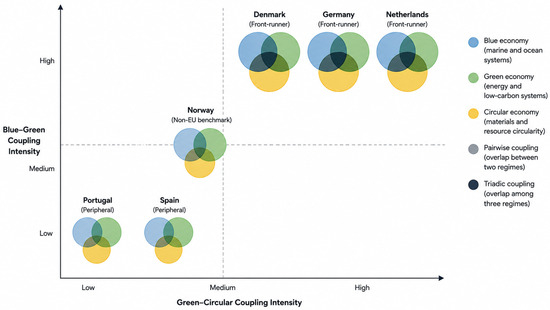
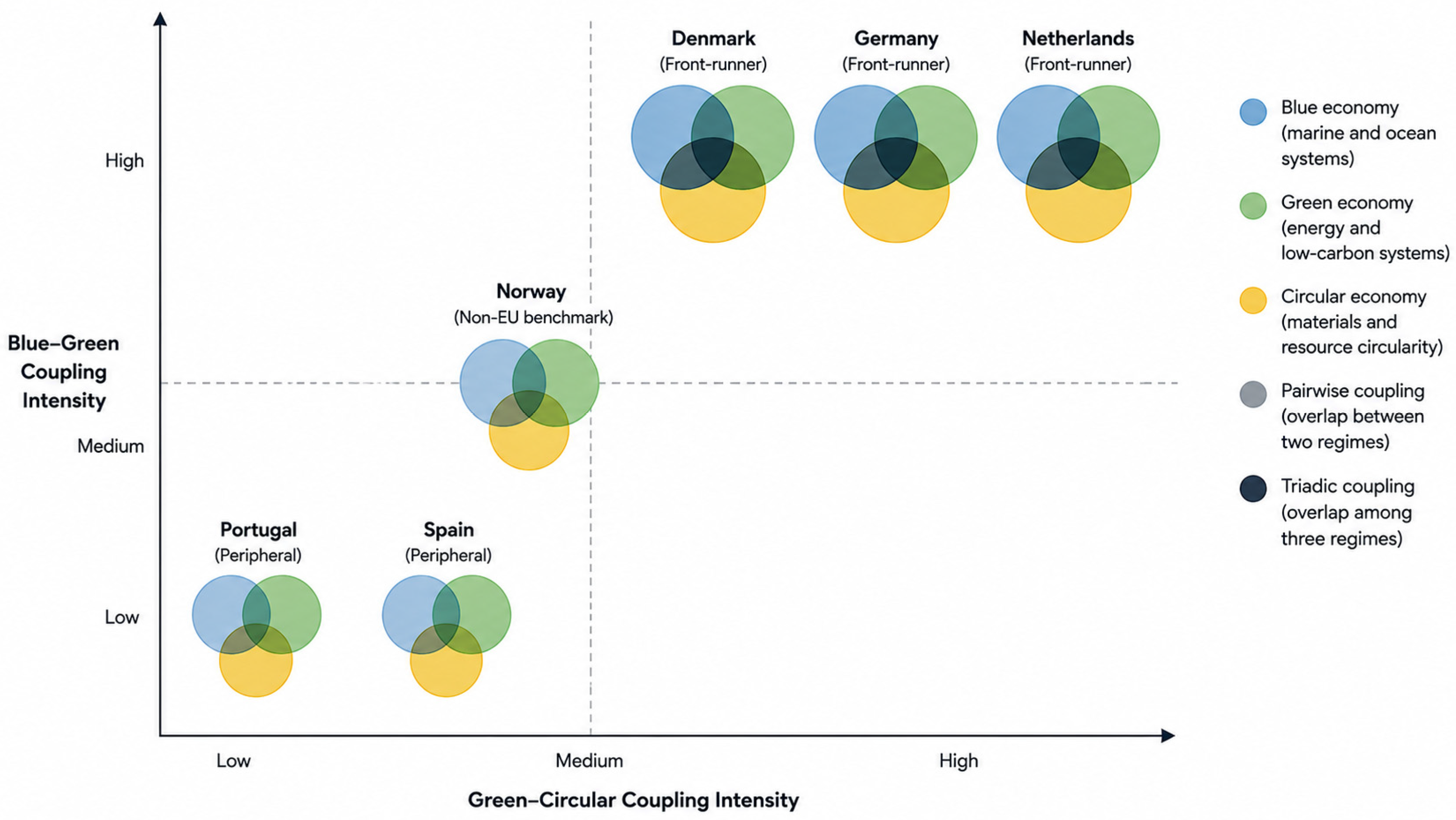
A clear geographical divide emerges in the patterns and depth of regime coupling. Figure 1 shows the degree of pairwise (blue–green and green–circular) and triadic (blue–green–circular) regime coupling across the six countries, differentiating between Northern/Central European frontrunners and Southern peripheral countries.
Figure 1.
Pairwise and triadic coupling patterns across six countries.
The relative positions depicted in Figure 1 reflect qualitative and interpretive judgements grounded in the documentary evidence, rather than a formal scoring system. Figure 1 is therefore best understood as a conceptual and heuristic representation of coupling patterns rather than an empirically measured ranking. Future research could refine these assessments using structured indicators of regime coupling (see Section 5 and Section 6.3).
Countries are positioned on two axes representing blue–green and green–circular coupling intensity. The figure is heuristic and interpretive rather than based on a formal scoring system. Overlapping areas between circles represent degrees of coupling, with darker shading indicating stronger integration. Northern/central European countries cluster towards higher coupling; Southern peripheral countries and Norway occupy intermediate-to-lower positions.
As shown in Figure 1, Northern and Central European countries (Denmark, Germany, and the Netherlands) exhibit higher degrees of pairwise regime coupling—particularly between blue and green regimes—as well as greater institutional capacity for infrastructural coordination. These countries have developed more sophisticated governance arrangements and multifunctional infrastructure projects that actively link marine space, energy systems, and material flows. Southern peripheral regions (Portugal and Spain), despite possessing substantial natural endowments in renewables and critical raw materials, demonstrate significantly weaker integration. Norway occupies an intermediate position as a non-EU benchmark with strong blue–green potential but distinct governance dynamics: its hydropower dominance means the green transition pathway differs fundamentally from other cases, and its greater fiscal capacity (underpinned by the Sovereign Wealth Fund) provides a governance context not directly replicable by EU member states. This North–South pattern underscores that regime coupling is highly contingent on institutional capacity, policy coherence, long-standing offshore experience, and levels of infrastructural investment. These empirical insights provide the foundation for the integrative conceptual framework developed in the following section.
5. Towards a Resource Infrastructure Economy: An Integrative Framework
This section synthesises the structural gaps and emerging coupling mechanisms identified in the empirical analysis into a novel conceptual framework—the Resource Infrastructure Economy (RIE). The RIE conceptualises European sustainability transitions as processes of deep regime coupling and infrastructural integration, in which energy (green), marine (blue), and material (circular) regimes become tightly coordinated through shared physical and digital infrastructures and strong regulatory steering.
5.1. Conceptual Foundations
The RIE framework rests on three interrelated pillars that extend the multi-level perspective and recent advances in multi-system dynamics [17,54,55]. First, infrastructural integration positions physical and digital infrastructures as central coordinating mechanisms rather than mere backdrops [23,24,56]. Offshore wind hubs, Energy Islands, digital monitoring platforms, and industrial symbiosis networks do not simply support individual regimes; they actively mediate resource flows, data exchange, and spatial coordination across blue, green, and circular domains [57,58,59,60,61,62]. These infrastructures create new complementarities while simultaneously generating path dependencies and lock-ins.
Second, regime coupling theorises the deliberate alignment of previously distinct socio-technical regimes. Building on concepts of system linkages and complementarity formation [63,64], the framework distinguishes between pairwise coupling (integration between two regimes) and the more ambitious triadic coupling (involving all three regimes simultaneously). While pairwise couplings emerge more readily, full triadic integration requires intentional coordination and remains rare and fragile.
Third, governance and justice foreground the constitutive role of regulatory steering and distributional outcomes. In the European context, strong top-down policy frameworks (European Green Deal, CRMA, Blue Economy Strategy) actively shape regime coupling. However, as the Portuguese Barroso case illustrates, such steering can exacerbate justice tensions in peripheral regions unless procedural, distributional, and recognitional justice are embedded as core features [1,65]. The Barroso case involves contested lithium extraction plans in a predominantly rural and socio-economically marginalised region. The actors involved include mining companies, national energy authorities, local communities, and environmental NGOs. Key governance tensions concern land use rights, community consent, environmental impact assessment, and benefit-sharing mechanisms. Local resistance movements have contested the project on grounds of territorial justice and inadequate participatory processes, illustrating how green transition policies can reproduce—rather than resolve—spatial inequalities [1,3]. This case concretely demonstrates the contradictions at the heart of the RIE: while lithium is essential for battery storage integral to green and circular transitions, its extraction risks generating new sacrifice zones without adequate governance safeguards.
This regulatory-driven regime coupling constitutes a distinct transition pathway. It differs from the classical pathways proposed by Geels et al. [66], which focus primarily on niche-regime interactions, market-driven substitution, or gradual internal reconfiguration within a single regime. In contrast, the RIE pathway emphasises assertive, top-down regulatory intervention in highly institutionalised contexts to deliberately orchestrate alignment between multiple regimes around shared infrastructures.
5.2. The RIE Framework
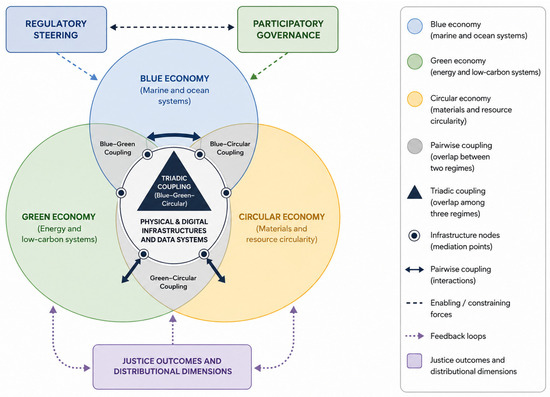
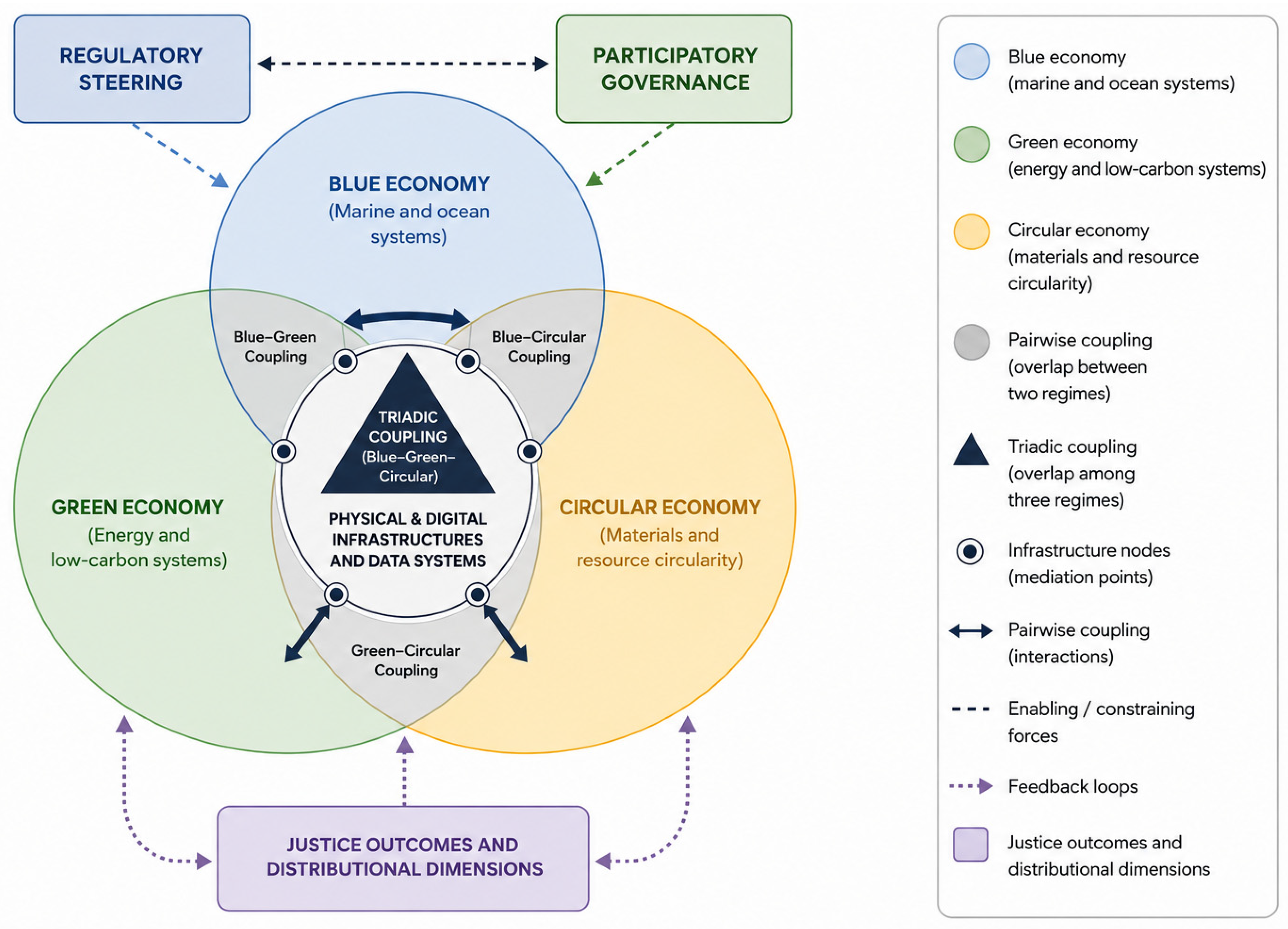
Figure 2 illustrates the Resource Infrastructure Economy framework.
Figure 2.
The Resource Infrastructure Economy (RIE) framework: Regime coupling through infrastructural integration.
The diagram shows the three regimes (Blue, Green, and Circular) as overlapping circles. Physical and digital infrastructures occupy the centre as mediating mechanisms. Bold arrows represent pairwise couplings, while a central triangle denotes the more ambitious triadic coupling. Overarching elements include regulatory steering and participatory governance, which generate feedback loops and address justice implications.
The size of overlapping areas between circles indicates the relative degree of coupling; the central triangle represents triadic coupling, which remains aspirational in current European transitions; dashed arrows from regulatory and participatory governance elements represent enabling and constraining forces. Infrastructure nodes at coupling intersections denote sites where physical and digital systems actively mediate regime interactions. Infrastructures act as the “glue” that enables coordination. Regulatory steering provides directionality and momentum, while participatory governance arrangements help mitigate conflicts and address justice concerns.
5.3. Added Value of the RIE Framework
The RIE framework advances sustainability transitions theory in three important ways:
- It systematically integrates blue economy scholarship into multi-system dynamics, treating marine governance as a full socio-technical regime with its own material, spatial, and justice dynamics, rather than a passive backdrop for green infrastructure.
- It theorises regulatory-driven regime coupling as a distinct transition pathway, complementing (and in some contexts challenging) existing MLP pathways focused on niche-regime interactions or organic multi-system emergence.
- It foregrounds the constitutive roles of physical and digital infrastructures and environmental data systems in value creation, path dependency formation, and distributional outcomes.
To clarify how the RIE framework relates to and differs from existing multi-system concepts, Table 3 provides a structured comparison.
Table 3.
Comparison of the RIE framework with related multi-system concepts.
Empirically, the framework explains the uneven geography of European transitions: more advanced pairwise couplings and infrastructural coordination in Northern and Central Europe, contrasted with persistent gaps and justice challenges in Southern peripheral regions.
6. Discussion
The preceding analysis has shown that European sustainability transitions are characterised by persistent structural gaps between the blue, green, and circular economy agendas, alongside emerging patterns of regime coupling and infrastructural integration. This section discusses the implications of these findings for sustainability transitions theory, reflects on policy challenges, and outlines avenues for future research.
6.1. Theoretical Implications
This study contributes to multi-system transitions research by developing the Resource Infrastructure Economy (RIE) as an integrative framework. The empirical findings also complicate overly optimistic views of multi-system integration. While pairwise connections are observable, full three-way integration remains limited, especially in peripheral regions facing green sacrifice dynamics [1,3].
Three contributions stand out.
First, the framework advances the integration of blue economy scholarship into multi-system dynamics. While recent studies have emphasised interactions between energy, mobility, and industrial systems [13,55,57], the blue regime has remained relatively peripheral. By treating marine governance as a full socio-technical regime with distinct spatial, material, and justice dynamics, the RIE framework reveals how marine considerations actively shape—and are shaped by—green and circular processes.
Second, the analysis highlights regulatory-driven regime coupling as a distinct transition pathway. Existing literature has largely focused on niche-regime interactions, complementarity formation, and bottom-up multi-system emergence [64,67]. In the European context, however, strong regulatory steering (European Green Deal, CRMA, Blue Economy Strategy) plays a constitutive role in deliberately aligning regimes around shared physical and digital infrastructures. This pathway differs from both classical MLP pathways [66] and more organic multi-system processes observed in other contexts.
Third, the RIE framework foregrounds the performative role of infrastructures and environmental data systems. Infrastructures do not merely enable resource flows; they actively mediate regime coupling, create new complementarities, generate path dependencies, and influence distributional outcomes [58,68]. This infrastructural perspective enriches multi-system scholarship by linking material flows, digitalisation, and governance more explicitly.
The empirical findings also refine optimistic accounts of multi-system integration. While pairwise couplings—particularly between blue–green and green–circular systems—are observable, full triadic integration remains limited and fragile, especially in peripheral regions. The RIE framework is therefore better understood at this stage as a promising interpretive lens for understanding emerging patterns of integration rather than as a fully validated transformation already underway. The evidence supports a cautious framing: Europe is moving towards a Resource Infrastructure Economy, but this trajectory is uneven, contested, and far from complete. This underscores important constraints on coupling under current conditions and reflects concerns about cumulative processes and resource limitations highlighted in related studies [55].
6.2. Policy Implications
The RIE framework suggests that pursuing the European Green Deal, Blue Economy Strategy, Circular Economy Action Plan, and Critical Raw Materials Act in parallel risks reproducing structural gaps and unintended trade-offs. Greater policy coordination across domains is necessary, particularly regarding the sequencing of infrastructure investments, the integration of circularity requirements into energy and marine projects, and the development of shared digital monitoring systems. For peripheral regions such as Portugal and Spain, the findings are especially relevant. These regions possess significant potential in renewables, marine space, and critical raw materials (lithium), yet they face heightened risks of socio-environmental conflict and “green sacrifice zones” [1,51,69]. Policies should therefore incorporate stronger mechanisms for procedural and distributional justice, including participatory marine spatial planning, local content requirements, and targeted capacity-building support [44,70,71,72,73]. Policies should therefore incorporate stronger mechanisms for procedural and distributional justice. Concrete examples include participatory marine spatial planning processes that ensure genuine community co-design (e.g., citizens’ assemblies on offshore wind siting); co-management frameworks that grant fishing communities formal governance roles in offshore wind development zones; local content requirements that ensure peripheral regions benefit economically from extractive or energy projects; and targeted EU cohesion policy or Just Transition Mechanism funding to build regional capacity for integrated governance. With regard to sequencing, investment strategies should prioritise capacity-building and institutional development in peripheral regions before or alongside large-scale infrastructure deployment, to ensure that speed of transition does not outpace local governance readiness. The RIE framework can also inform monitoring and evaluation of multi-agency policy coordination by providing a set of coupling indicators (see Section 5.3 and Table 3) against which progress towards integrated governance can be assessed over time.
6.3. Limitations and Future Research
Several limitations should be acknowledged. The study relies primarily on secondary sources and comparative case analysis. While this approach enabled cross-national comparison, it offers limited insight into micro-level actor negotiations and implementation dynamics. The analysis also reflects developments up to early 2026 and is situated within the specific institutional context of Europe. Future research should further operationalise the RIE framework through the development of concrete indicators for each coupling dimension. Potential indicators include institutional coordination mechanisms (e.g., number and scope of cross-sectoral governance bodies); shared infrastructure investments (e.g., proportion of offshore wind projects incorporating power-to-X or circular economy components); policy alignment scores (e.g., degree of regulatory coherence between blue, green, and circular policy instruments); and governance coordination dimensions (e.g., existence of joint monitoring systems across marine, energy, and material agencies). Longitudinal case studies of specific coupling initiatives—such as Denmark’s Energy Islands or emerging Portuguese offshore wind projects—would enable process-tracing of coupling dynamics and empirical validation of the framework. Comparative analysis beyond Europe, including examination of how analogous frameworks develop in different institutional contexts, would also extend the RIE’s generalisability.
7. Conclusions
This article has examined the convergence of blue, green, and circular economy agendas in European sustainability transitions. Through a comparative analysis of developments in Portugal, Spain, Germany, the Netherlands, Denmark, and Norway, it has demonstrated that while important structural gaps persist, nascent patterns of regime coupling and infrastructural integration are emerging. These processes are mediated by physical and digital infrastructures and actively shaped by strong regulatory steering.
To capture these dynamics, the study introduced the Resource Infrastructure Economy (RIE) as an integrative conceptual framework. The RIE conceptualises European sustainability transitions as processes of deep regime coupling, in which energy, marine, and material regimes become increasingly coordinated through shared infrastructures, data systems, and deliberate policy intervention. In doing so, the framework advances transitions theory in three ways: it integrates blue economy scholarship more firmly into multi-system analysis; theorises regulatory-driven regime coupling as a distinct transition pathway; and foregrounds the constitutive roles of infrastructures and environmental data systems in value creation, path dependency, and distributional outcomes.
The comparative analysis reveals a clear North–South divide. Northern and Central European countries demonstrate more advanced pairwise couplings (blue–green and green–circular) and stronger infrastructural coordination. In contrast, Southern peripheral regions, while endowed with significant natural assets and emerging endogenous innovation capacities, face greater challenges in integrated governance and justice, with risks of creating new “green sacrifice zones.” These findings underscore that regime coupling is neither automatic nor uniform; it is highly contingent on institutional capacity, infrastructural development, and political commitment.
The emergence of the Resource Infrastructure Economy signals a broader shift in European sustainability transitions: from isolated sectoral greening towards the reconfiguration of resource infrastructure systems. At this stage, the RIE is best understood as an emerging tendency and an interpretive framework rather than a fully instantiated transformation. Realising the transformative potential of this shift will require moving beyond siloed policy approaches. It demands deliberate coordination across the European Green Deal, Blue Economy Strategy, Circular Economy Action Plan, and Critical Raw Materials Act, as well as greater attention to justice and regional equity.
Future research should further test and refine the RIE framework through longitudinal studies of coupling projects, comparative analysis beyond Europe, and more nuanced examinations of power relations and data governance within emerging resource infrastructure systems. As Europe pursues ambitious climate and ocean objectives, the capacity to design, govern, and legitimise tightly coupled resource infrastructure regimes will be central to achieving socially just and ecologically sustainable transitions.
Supplementary Materials
The following supporting information can be downloaded at: https://www.mdpi.com/article/10.3390/su18136579/s1, Table S1. PRISMA 2020 Checklist.
Funding
This research was funded by the ERA Chair BESIDE project funded by the European Union’s Horizon 2020 research and innovation program under grant agreement No 951389 (https://doi.org/10.3030/951389); and through the projects UID/50017/2025 (https://doi.org/10.54499/UID/50017/2025) and UID/04928/2025 (https://doi.org/10.54499/UID/04928/2025).
Institutional Review Board Statement
Not applicable.
Informed Consent Statement
Not applicable.
Data Availability Statement
No new data were created or analysed in this study. Data sharing is not applicable to this article. No new primary data were generated or analysed in this study. The systematic review is based on publicly available secondary sources. The full list of included studies, coding framework, and supporting matrices are provided in the Appendices. Additional materials (e.g., full MAXQDA codebook) are available from the corresponding author upon reasonable request.
Conflicts of Interest
The author declares no conflicts of interest.
Appendix A. PRISMA Flow Diagram of the Literature Selection Process
Figure A1.
PRISMA 2020 flow diagram detailing the identification, screening, eligibility, and inclusion of studies in the systematic integrative literature review. Adapted from Page et al. (2021) [33].
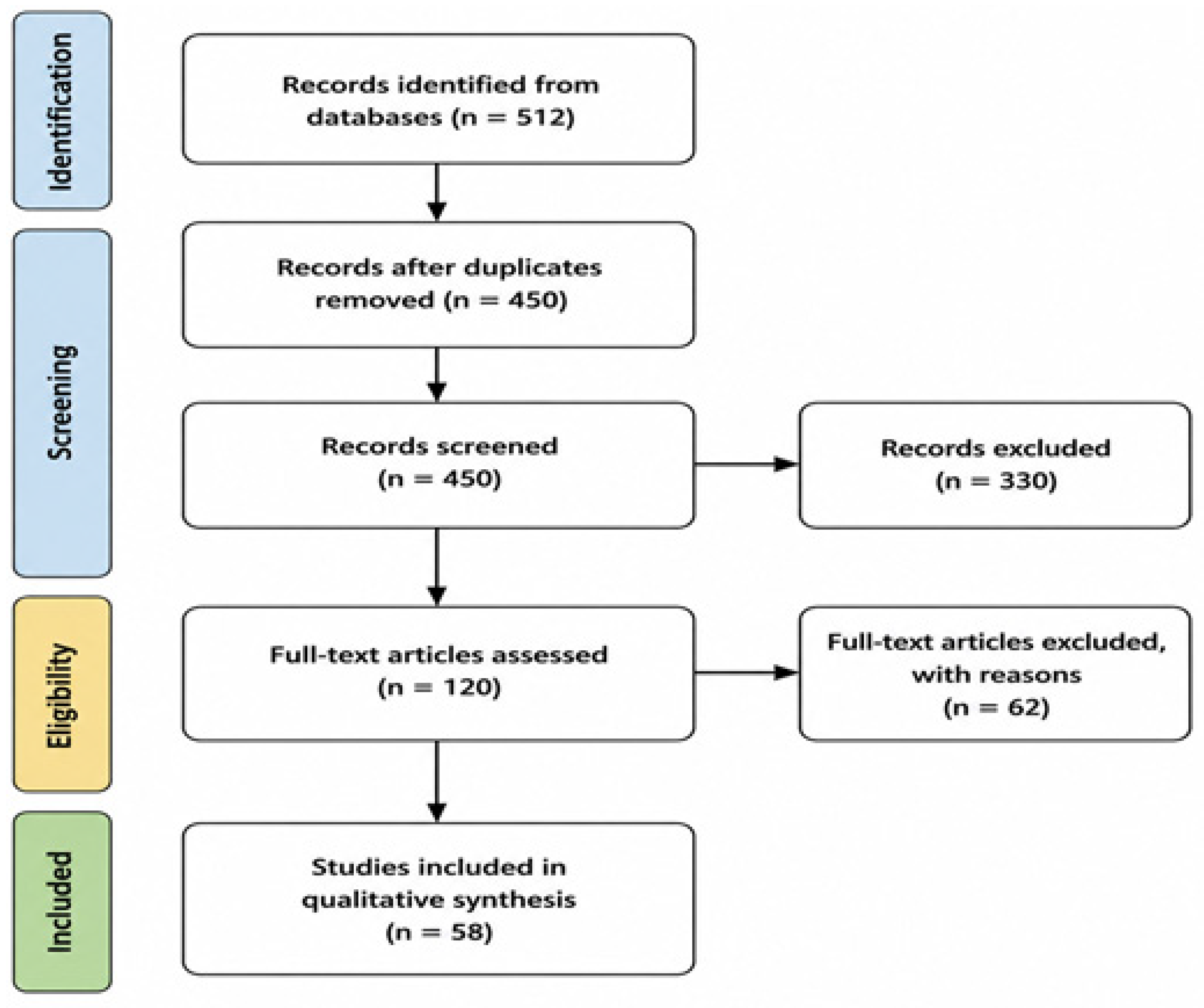
Table A1.
Characteristics of the 58 included studies: authors, title, methodology, main results, and conclusions. Format follows the PRISMA standard for systematic reviews. Domain codes: Blue = blue economy/marine governance; Green = green economy/energy transitions; Circular = circular economy/material flows; Multi = multi-domain. Total included studies: 58.
Appendix B. Condensed Coding Framework
This appendix presents the coding framework used in the abductive thematic analysis (Section 3). The framework was developed iteratively in MAXQDA, combining deductive codes derived from the multi-level perspective and multi-system dynamics literature with inductive codes that emerged organically from close reading of the 58 selected publications. The analysis was structured around four central thematic axes. Table A2 below presents the full codebook excerpt with individual codes, descriptions, types, and illustrative examples. Table A3 provides a condensed summary of the four axes for rapid orientation.
Table A2.
Codebook excerpt: individual codes by thematic axis.
Total codes: 42 first-order codes grouped into 14 second-order themes and 4 main thematic axes. Coding was conducted by the lead author with multiple rounds of internal review. Given the single-author nature of this study, particular attention was paid to reflexivity and transparency. All coding decisions were documented in detail and subjected to repeated critical review by the author. Analytical trustworthiness was strengthened through a detailed audit trail of coding decisions, systematic reflexive memos, and triangulation with quantitative data from official sources (Eurostat, IRENA, WindEurope). The full codebook, including code frequencies, memo notes, and representative quotations, is available upon request from the corresponding author.
Table A3.
Condensed overview of thematic axes, deductive codes, and illustrative inductive codes.
Appendix C. Comparative Matrix of Regime Coupling Across Countries
This appendix presents the comparative assessment matrix underpinning Figure 1 in the main text. Regime coupling intensity was evaluated qualitatively (Low/Medium/High) across three operational dimensions: institutional coordination, infrastructural integration, and policy and regulatory alignment. Assessments are based on triangulation of policy documents, the secondary literature, and quantitative indicators from official sources (Eurostat, IRENA, WindEurope, national agencies). The matrix is explicitly heuristic and interpretive rather than based on a formal scoring system; it is intended to support the qualitative comparative analysis in Section 4 and the conceptual discussion in Section 5.
Table A4.
Comparative assessment of regime coupling by country (early 2026).
References
- Van Meer, D.; Zografos, C. “Take your responsibility”: The politics of green sacrifice for just low-carbon transitions in rural Portugal. Sustain. Sci. 2024, 19, 1313–1326. [Google Scholar] [CrossRef] [Scilit]
- Sovacool, B.K. Who are the victims of low-carbon transitions? Towards a political ecology of climate change mitigation. Energy Res. Soc. Sci. 2021, 73, 101916. [Google Scholar] [CrossRef] [Scilit]
- Riofrancos, T. The security–sustainability nexus: Lithium onshoring in the Global North. Glob. Environ. Politics 2023, 23, 20–41. [Google Scholar] [CrossRef] [Scilit]
- Robertson, G. Futures: Green and blue. In The Routledge International Handbook of Island Studies; Routledge: Oxfordshire, UK, 2018; pp. 416–441. [Google Scholar]
- D’Amato, D.; Korhonen, J. Integrating the green economy, circular economy and bioeconomy in a strategic sustainability framework. Ecol. Econ. 2021, 188, 107143. [Google Scholar] [CrossRef] [Scilit]
- Serpetti, N.; Benjamins, S.; Brain, S.; Collu, M.; Harvey, B.J.; Heymans, J.J.; Hughes, A.D.; Risch, D.; Rosinski, S.; Waggitt, J.J.; et al. Modeling small scale impacts of multi-purpose platforms: An ecosystem approach. Front. Mar. Sci. 2021, 8, 694013. [Google Scholar] [CrossRef] [Scilit]
- Baldassarre, B. Circular economy for resource security in the European Union (EU): Case study, research framework, and future directions. Ecol. Econ. 2025, 227, 108345. [Google Scholar]
- Velenturf, A.P.; Archer, S.A.; Gomes, H.I.; Christgen, B.; Lag-Brotons, A.J.; Purnell, P. Circular economy and the matter of integrated resources. Sci. Total Environ. 2019, 689, 963–969. [Google Scholar] [CrossRef] [Scilit] [PubMed]
- Geels, F.W. Technological transitions as evolutionary reconfiguration processes: A multi-level perspective and a case-study. Res. Policy 2002, 31, 1257–1274. [Google Scholar] [CrossRef] [Scilit]
- Geels, F.W. The multi-level perspective on sustainability transitions: Responses to seven criticisms. Environ. Innov. Soc. Transit. 2011, 1, 24–40. [Google Scholar] [CrossRef] [Scilit]
- Geels, F.W.; Kern, F.; Clark, W.C. Sustainability transitions in consumption-production systems. Proc. Natl. Acad. Sci. USA 2023, 120, e2310070120. [Google Scholar] [CrossRef] [Scilit] [PubMed]
- Rosenbloom, D. Engaging with multi-system interactions in sustainability transitions: A comment on the transitions research agenda. Environ. Innov. Soc. Transit. 2020, 34, 336–340. [Google Scholar] [CrossRef] [Scilit]
- Andersen, A.D.; Geels, F.W.; Steen, M.; Bugge, M.M. Building multi-system nexuses in low-carbon transitions: Conflicts and asymmetric adjustments in Norwegian ferry electrification. Proc. Natl. Acad. Sci. USA 2023, 120, e2207746120. [Google Scholar] [CrossRef] [Scilit] [PubMed]
- Bakhuis, J.; Kamp, L.M.; Barbour, N.; Chappin, É.J.L. Frameworks for multi-system innovation analysis from a sociotechnical perspective: A systematic literature review. Technol. Forecast Soc. Change 2024, 201, 123266. [Google Scholar] [CrossRef] [Scilit]
- Markard, J.; Geels, F.W.; Raven, R. Challenges in the acceleration of sustainability transitions. Environ. Res. Lett. 2020, 15, 081001. [Google Scholar] [CrossRef] [Scilit]
- Markard, J.; Raven, R.; Truffer, B. Sustainability transitions: An emerging field of research and its prospects. Res. Policy 2012, 41, 955–967. [Google Scholar] [CrossRef] [Scilit]
- Andersen, A.D.; Geels, F.W. Multi-system dynamics and the speed of net-zero transitions: Identifying causal processes related to technologies, actors, and institutions. Energy Res. Soc. Sci. 2023, 102, 103178. [Google Scholar]
- Nykamp, H.; Andersen, A.D.; Geels, F.W. Low-carbon electrification as a multi-system transition: A socio-technical analysis of Norwegian maritime transport, construction, and chemical sectors. Environ. Res. Lett. 2023, 18, 094059. [Google Scholar] [CrossRef] [Scilit]
- Velenturf, A.P. A framework and baseline for the integration of a sustainable circular economy in offshore wind. Energies 2021, 14, 5540. [Google Scholar] [CrossRef] [Scilit]
- Gode, P.R.; Aspelund, A. Addressing heterogeneity in the development of circular economy strategies in the offshore wind industry: A review. Heliyon 2024, 10, e39577. [Google Scholar] [CrossRef] [Scilit] [PubMed]
- Knol-Kauffman, M.; Nielsen, K.N.; Sander, G.; Arbo, P. Sustainability conflicts in the blue economy: Planning for offshore aquaculture and offshore wind energy development in Norway. Marit. Stud. 2023, 22, 47. [Google Scholar] [CrossRef] [Scilit]
- Martínez-Vázquez, R.M.; Milán-García, J.; de Pablo Valenciano, J. Challenges of the Blue Economy: Evidence and research trends. Environ. Sci. Eur. 2021, 33, 61. [Google Scholar] [CrossRef] [Scilit]
- Käsbohrer, A.; Hansen, T.; Zademach, H.M. Multi-system interactions and institutional work: Actor interactions at the interface of residential storage systems and electric vehicles in Germany. Environ. Innov. Soc. Transit. 2024, 51, 100844. [Google Scholar] [CrossRef] [Scilit]
- Wainaina, G.K.; Truffer, B.; Murphy, J.T. Structural tensions limiting success of infrastructure upgrading: A multi-regime perspective. Environ. Innov. Soc. Transit. 2023, 48, 100747. [Google Scholar] [CrossRef] [Scilit]
- Kanger, L. Rethinking the Multi-level Perspective for energy transitions: From regime life-cycle to explanatory typology of transition pathways. Energy Res. Soc. Sci. 2021, 71, 101829. [Google Scholar]
- Kazak, T. European green deal. Yearb. Law Dep. 2022, 9, 304–315. [Google Scholar] [CrossRef] [Scilit]
- Markard, J. The life cycle of technological innovation systems. Technol. Forecast Soc. Change 2020, 153, 119407. [Google Scholar] [CrossRef] [Scilit]
- Torraco, R.J. Writing integrative literature reviews: Using the past and present to explore the future. Hum. Resour. Dev. Rev. 2016, 15, 404–428. [Google Scholar]
- Snyder, H. Literature review as a research methodology: An overview and guidelines. J. Bus. Res. 2019, 104, 333–339. [Google Scholar] [CrossRef] [Scilit]
- Przeworski, A.; Teune, H. The Logic of Comparative Social Inquiry. Soc. Forces 1974, 52, 559. [Google Scholar] [CrossRef] [Scilit]
- Dubois, A.; Gadde, L.E. Systematic combining: An abductive approach to case research. J. Bus. Res. 2002, 55, 553–560. [Google Scholar] [CrossRef] [Scilit]
- Langley, A. Strategies for theorizing from process data. Acad. Manag. Rev. 1999, 24, 691–710. [Google Scholar] [CrossRef] [Scilit]
- Page, M.J.; McKenzie, J.E.; Bossuyt, P.M.; Boutron, I.; Hoffmann, T.C.; Mulrow, C.D.; Shamseer, L.; Tetzlaff, J.M.; Akl, E.A.; Brennan, S.E.; et al. The PRISMA 2020 statement: An updated guideline for reporting systematic reviews. BMJ 2021, 372, n71. [Google Scholar] [CrossRef] [Scilit] [PubMed]
- Renewable Energy Statistics. Available online: https://ec.europa.eu/eurostat/statistics-explained/index.php?title=Renewable_energy_statistics (accessed on 24 June 2026).
- Analyser og Statistik|Energistyrelsen. 2024. Available online: https://ens.dk/analyser-og-statistik (accessed on 24 June 2026).
- Data from the Power System. Statnett. Available online: https://www.statnett.no/en/for-stakeholders-in-the-power-industry/data-from-the-power-system/ (accessed on 24 June 2026).
- Power BI Report. Available online: https://app.powerbi.com/view?r=eyJrIjoiNGVhZDc3NGEtYTIzOS00MjUzLTlkZmEtNjUwMjJhOTI2MjIzIiwidCI6ImRlNzMzMTQyLTQ1MjMtNDJlMS1hOGQ0LThlMDRmNzhmOGQ1OSIsImMiOjl9 (accessed on 24 June 2026).
- Read Exclusive Offshore Renewable News Here Today|TGS 4C|4C Offshore. Available online: https://www.tgs4c.com/news/?_gl=1*92dgn2*_up*MQ..*_gs*MQ..&gclid=Cj0KCQjwxvjRBhC2ARIsAI7KJa02CMs1o_XdLVFxv0x-1i-SRFzNiz6H049qtnde9GP3oTswjtzE1WwaAhL2EALw_wcB&gbraid=0AAAAAD0ef1nDB9YFDrcwpQKHcmxNHmWyj (accessed on 24 June 2026).
- BMWE FM for EA and CA|. Renewable Energy. Available online: https://www.bundeswirtschaftsministerium.de/Redaktion/EN/Dossier/renewable-energy.html (accessed on 24 June 2026).
- RVO Celebrates Completion of 2023 Offshore Wind Energy Roadmap. TGS 4C|4c Offshore. Available online: https://www.tgs4c.com/news/rvo-celebrates-completion-of-2023-offshore-wind-energy-roadmap-nid29537.html (accessed on 24 June 2026).
- Statistics. WindEurope. Available online: https://windeurope.org/data/statistics/ (accessed on 24 June 2026).
- Statistics and Energy Balance|Idae. Available online: https://www.idae.es/en/information-and-notifications/studies-reports-and-statistics/statistics-and-energy-balance (accessed on 24 June 2026).
- Domenech, T.; Bahn-Walkowiak, B. Transition towards a resource efficient circular economy in Europe: Policy lessons from the EU and the member states. Ecol. Econ. 2019, 155, 7–19. [Google Scholar] [CrossRef] [Scilit]
- Elston, J.N.; Pinto, H.E.D.R.S.D.C.; Nogueira, C.F.S.V. Charting the Course: Real-World Application of Sustainability and Innovation Principles in the Portuguese Blue Economy Firms. Bus. Strategy Environ. 2025, 35, 4766–4783. [Google Scholar] [CrossRef] [Scilit]
- Elston, J.; Pinto, H.; Nogueira, C. Tides of change for a sustainable blue economy: A systematic literature review of innovation in maritime activities. Sustainability 2024, 16, 11141. [Google Scholar] [CrossRef] [Scilit]
- Lichtenegger, G.; Rentizelas, A.A.; Trivyza, N.; Siegl, S. Offshore and onshore wind turbine blade waste material forecast at a regional level in Europe until 2050. Waste Manag. 2020, 106, 120–131. [Google Scholar] [CrossRef] [Scilit] [PubMed]
- Mhatre, P.; Panchal, R.; Singh, A.; Bibyan, S. A systematic literature review on the circular economy initiatives in the European Union. Sustain. Prod. Consum. 2021, 26, 187–202. [Google Scholar] [CrossRef] [Scilit]
- Pires Manso, J.R.; Martínez Vázquez, R.M.; Milán García, J.; Valenciano, J.d.P. Renewable energies and blue economy: New trends in global research. Energies 2023, 16, 4210. [Google Scholar] [CrossRef] [Scilit]
- Rentizelas, A.; Trivyza, N.; Oswald, S.; Siegl, S. Reverse supply network design for circular economy pathways of wind turbine blades in Europe. Int. J. Prod. Res. 2022, 60, 1795–1814. [Google Scholar]
- Rodrigues, R.I.; Teixeira, N. Measuring Circularity and Sustainability in Southern Europe: A Comparative Empirical Analysis of Portugal, Spain, Italy, and Greece. J. Posthumanism 2025, 5, 4478–4489. [Google Scholar] [CrossRef] [Scilit]
- Pablo-Romero, M.D.P.; Sánchez-Braza, A.; Torreblanca, C. Implementing the Circular Economy in the European Union and Spain: Links to the Low-Carbon Transition. Energies 2024, 17, 5255. [Google Scholar] [CrossRef] [Scilit]
- Magalhães, F.C.; Bellei, P.; Flores-Colen, I.; da Costa, E.M. Blue circular economy—Reuse and valorization of bivalve shells: The case of Algarve, Portugal. Recycling 2024, 9, 27. [Google Scholar] [CrossRef] [Scilit]
- Vestas Underlines Sustainability Leadership by Outlining Pathway to Circularity. Available online: https://www.vestas.com/en/media/company-news/2021/vestas-underlines-sustainability-leadership-by-outlinin-c3431492 (accessed on 24 June 2026).
- Mäkitie, T.; Hanson, J.; Steen, M.; Hansen, T.; Andersen, A.D. Complementarity formation mechanisms in technology value chains. Res. Policy 2022, 51, 104559. [Google Scholar] [CrossRef] [Scilit]
- Magnusson, T.; Kanda, W.; Andersson, H.; Dahlgren, S. Cumulative processes in multi-system transitions: Expanding value chains and limits to growth for sustainable alternatives. Environ. Innov. Soc. Transit. 2026, 60, 101124. [Google Scholar] [CrossRef] [Scilit]
- Dorst, H.; Van Der Jagt, A.; Toxopeus, H.; Tozer, L.; Raven, R.; Runhaar, H. What’s behind the barriers? Uncovering structural conditions working against urban nature-based solutions. Landsc. Urban Plan. 2022, 220, 104335. [Google Scholar] [CrossRef] [Scilit]
- Löhr, M.; Chlebna, C. Multi-system interactions in hydrogen-based sector coupling projects: System entanglers as key actors. Energy Res. Soc. Sci. 2023, 105, 103282. [Google Scholar] [CrossRef] [Scilit]
- Kovacic, Z.; García Casañas, C.; Argüelles, L.; Serrano, P.Y.; Ribera-Fumaz, R.; Prause, L.; March, H. The twin green and digital transition: High-level policy or science fiction? Environ. Plan. E Nat. Space 2024, 7, 2251–2278. [Google Scholar] [CrossRef] [Scilit]
- Bordin, C.; Hridoy, M.A.A.M.; Pathan, M.M.; Islam, S.M.S.; Lima, M.A.; Rahim, T.N.; Mim, T.R.; David, G.S.; Islam, A.-A.U.; Masood, A.; et al. Energy storage in the energy transition and blue economy: Challenges, innovations, future perspectives, and educational pathways. Discov. Appl. Sci. 2025, 7, 1084. [Google Scholar] [CrossRef] [Scilit]
- Ruiz, A.; Vinke-de Kruijf, J.; Santos, J.; Volker, L.; Dorée, A. Sustainability transitions in infrastructure: Understanding causal dynamics in the Dutch asphalt paving sector. Constr. Manag. Econ. 2025, 43, 794–822. [Google Scholar] [CrossRef] [Scilit]
- Sadegh Koohestani, S.; Mukheibir, P.; Wakefield-Rann, R.; Santamouris, M. Adopting a socio-technical perspective on the challenges and barriers in transitioning to Blue-Green Infrastructure (BGI). Blue-Green Syst. 2025, 7, 79–94. [Google Scholar] [CrossRef] [Scilit]
- Wang, X.; Hu, Q.; Zhang, R.; Sun, C.; Wang, M. Ecosystem Services in Urban Blue-Green Infrastructure: A Bibliometric Review. Water 2025, 17, 2273. [Google Scholar] [CrossRef] [Scilit]
- Konrad, K.; Truffer, B.; Voß, J.P. Multi-regime dynamics in the analysis of sectoral transformation potentials: Evidence from German utility sectors. J. Clean. Prod. 2008, 16, 1190–1202. [Google Scholar] [CrossRef] [Scilit]
- Mäkitie, T.; Hanson, J.; Damman, S.; Wardeberg, M. Digital innovation’s contribution to sustainability transitions. Technol. Soc. 2023, 73, 102255. [Google Scholar]
- Avelino, F.; Wijsman, K.; Van Steenbergen, F.; Jhagroe, S.; Wittmayer, J.; Akerboom, S.; Bogner, K.; Jansen, E.F.; Frantzeskaki, N.; Kalfagianni, A. Just sustainability transitions: Politics, power, and prefiguration in transformative change toward justice and sustainability. Annu. Rev. Environ. Resour. 2024, 49, 519–547. [Google Scholar] [CrossRef] [Scilit]
- Geels, F.W.; Kern, F.; Fuchs, G.; Hinderer, N.; Kungl, G.; Mylan, J.; Neukirch, M.; Wassermann, S. The enactment of socio-technical transition pathways: A reformulated typology and a comparative multi-level analysis of the German and UK low-carbon electricity transitions (1990–2014). Res. Policy 2016, 45, 896–913. [Google Scholar]
- Papachristos, G.; Sofianos, A.; Adamides, E. System interactions in socio-technical transitions: Extending the multi-level perspective. Environ. Innov. Soc. Transit. 2013, 7, 53–69. [Google Scholar]
- Van der Vleuten, E. Radical change and deep transitions: Lessons from Europe’s infrastructure transition 1815–2015. Environ. Innov. Soc. Transit. 2019, 32, 22–32. [Google Scholar] [CrossRef] [Scilit]
- Di Vaio, A.; Hasan, S.; Palladino, R.; Hassan, R. The transition towards circular economy and waste within accounting and accountability models: A systematic literature review and conceptual framework. Environ. Dev. Sustain. 2023, 25, 734–810. [Google Scholar] [PubMed]
- Penca, J.; Ertör, I.; Ballesteros, M.; Briguglio, M.; Kowalewski, M.; Pauksztat, B.; Cepić, D.; Piñeiro-Corbeira, C.; Vaidianu, N.; Villasante, S.; et al. Rethinking the Blue Economy: Integrating social science for sustainability and justice. npj Ocean Sustain. 2025, 4, 40. [Google Scholar] [CrossRef] [Scilit] [PubMed]
- Almeida, M.; Laranjeiro, D.; Costa, R.; Lillebø, A.I.; Vieira, H. Blue economy concepts are lagging behind in ocean literacy. Front. Mar. Sci. 2025, 12, 1648508. [Google Scholar] [CrossRef] [Scilit]
- Georgescu, L.P.; Barbuta Misu, N.; Antohi, V.M.; Fortea, C.; Zlati, M.L. Approaches and perspectives on the transition to the circular economy in the European Union. Front. Environ. Sci. 2025, 13, 1533776. [Google Scholar] [CrossRef] [Scilit]
- Lähde, E.; Pohja-Mykrä, M.; Schreck, J. Co-creation of socio-ecological systems knowledge to adopt an Ecosystem-based Approach and Land-Sea Interactions in maritime spatial planning. Mar. Policy 2024, 163, 106079. [Google Scholar] [CrossRef] [Scilit]

Disclaimer/Publisher’s Note: The statements, opinions and data contained in all publications are solely those of the individual author(s) and contributor(s) and not of MDPI and/or the editor(s). MDPI and/or the editor(s) disclaim responsibility for any injury to people or property resulting from any ideas, methods, instructions or products referred to in the content. |
© 2026 by the author. Licensee MDPI, Basel, Switzerland. This article is an open access article distributed under the terms and conditions of the Creative Commons Attribution (CC BY) license.