1. Introduction
People are increasingly worried about the sustainability of the planet. The individual and societal value systems are being rethought, new attitudes are being formed, and a greater willingness to change behavior is being displayed. Identifying the determinants of pro-environmental behavior (PEB) is a key focus area in environmental psychology and sustainability-related research [
1,
2]. As environmental challenges continue to escalate globally, identifying factors that encourage individuals to adopt behaviors constructive to the environment has become increasingly important.
The association between values, attitudes, and pro-environmental behavior is a significant area of study, as these internal factors are often associated with individuals’ willingness to engage in environmentally sustainable actions [
3]. Research in this area examines how ecological values, attitudes toward the environment, and actual pro-environmental behaviors interact, and to what extent values, attitudes, and behaviors are interrelated [
4,
5,
6,
7]. Therefore, it is essential to understand how PEB is conceptualized to contextualize the study of values and attitudes within a broader theoretical framework. It is crucial to define terms before looking at their determinants since different academics have used different phrases—such as ecological behavior or environmentally important conduct—to display behaviors meant to reduce human effect on the environment.
Pro-environmental behavior (PEB) is also referred to as environmentally significant behavior [
8] or ecological behavior, defined as the behavior regarding ecology that consciously seeks to minimize the negative impact of human actions on nature and build the environment [
9].
PEB is a diverse construct; while some studies adopt a unidimensional approach, others attempt to categorize it into different types or subdivisions [
10]. The most comprehensive classification is provided by Stern (2000) [
8], categorizing environmentally significant behavior into public-sphere behavior, which includes environmental activism, and non-activist behavior. The second category is private-sphere environmentalism, which mainly emphasizes green consumerism.
Actual behavior change is complex; effective behavioral change requires a careful selection of critical behaviors, examining its antecedent constructs, and using interventions to change relevant behaviors [
11,
12,
13]. Research has identified different ways to engage people in more PEB, such as creating incentives, punishment, providing feedback and communication [
14,
15].
The antecedent factors may interact and also differ in their impact on specific PEB [
8]. For example, attitudinal antecedents may impact behaviors that are easy to perform; there may be a higher variance for behaviors that are difficult or expensive to undertake. However, there seems to be a consensus among researchers about the categories of determinants. Broadly, they are classified into psychological, socio-demographic, and contextual factors [
8,
16,
17,
18].
An attempt to analyze all influencing factors of pro-environmental behavior increases the complexity of the study. The current study focuses on selected variables of environmental values, and environmental attitudes as the determinants for empirical observation of pro-environmental behavior [
6,
19,
20,
21].
Despite increasing research highlighting the importance of internal factors like values and attitudes in shaping pro-environmental behavior (PEB), a persistent gap remains between what individuals say their environmental values are and their actual engagement in sustainable actions [
22,
23,
24,
25,
26,
27]. Additionally, the potential mediating role of environmental attitudes in linking environmental values to pro-environmental behavior has received limited empirical focus, especially across different populations and types of behavior [
24,
28,
29]. Furthermore, much of the research has been conducted within specific groups or locations and on particular behaviors such as recycling and green purchasing. The ability to generalize these findings to other populations and a wider range of pro-environmental actions remains uncertain [
3,
23,
30]. In this context, it would be beneficial to extend the understanding of the relationship between environmental values, attitudes, and behavior (both conservation and green buying) from the perspective of the consumers in India.
Therefore, this study aims to address these gaps by (1) examining the link between environmental values and pro-environmental behavior, and (2) exploring whether environmental attitudes mediate how environmental values is linked to pro-environmental behavior among young adults (Gen Z) in India. By clarifying these relationships, the research seeks to enhance understanding of the processes that promote or hinder turning environmental concern into tangible pro-environmental actions in this specific context.
The value-attitude-behavior (VAB) hierarchy proposed by Homer & Kahle (1988) follows the sequence: values are associated with attitudes, which are in turn associated with behavior [
31,
32]. The VAB provides a robust framework for understanding interconnecting relationships, as it has been empirically tested using structural equation modeling in consumer contexts [
33]. It is well-cited in environmental psychology and is ideal for exploring value-attitude-behavior associations, in comparison to other models such as Ajzen’s Theory of Planned Behavior (TPB) and Stern’s Value-Belief-Norm Theory (VBN), as it also clarifies mediation [
34]. The norm activation theory by Schwartz suggests that a person’s behavior is an attempt to be consistent with their internalized values. Therefore, stimulating a person’s internal values results in the formation of an attitude toward something or someone, which is then expressed through an action [
35]. Building on this premise, the study uses the value-attitude-behavior framework to examine if environmental values are associated with pro-environmental behavior and whether environmental attitude mediates this relationship.
2. Literature Review
2.1. Pro-Environmental Behavior (PEB)
Pro-environmental behavior (PEB) is defined as behavior that consciously seeks to minimize the negative impact of one’s actions on the natural and built world (e.g., minimize resource and energy consumption, use of non-toxic substances and reduce waste production) [
18]. PEB is also referred to as environmentally significant or responsible behaviors, conservation behaviors, and environmentally sustainable behaviors [
1,
10,
36].
Previous research on PEB covers various types of behaviors, including categorization into public and private sphere actions [
8,
36,
37], environmental protection behavior intention (EPBI), green purchasing behavior intention (GPBI) [
38], recycling [
20], and green consumption or purchase [
21,
39,
40].
Numerous theories and behavioral decision-making models developed over the years have contributed to the knowledge of the factors and processes influencing PEB. One of the earliest is Lewin’s Field theory, which proposed internal (attitudes, values, and knowledge) and external (an individual’s physical and social environment) variables that influence human behavior. Since then, the norm-activation model, the frequently applied theory of planned behavior, and the more recent VBN theory have coexisted [
37,
41,
42], helping researchers understand the reasons behind people’s environmental behavior.
Few theories and models attempt to provide the underlying factors that explain the formation of PEB; researchers largely use Azjen’s Theory of Planned Behavior (TPB) to explain PEB. The core components of subjective norms perceived behavioral control and specifically attitude in varying degrees correlate to environmentally significant behavior [
20,
43]. The other influential model that has its roots in environmentalism is presented by Stern as a part of his value–belief–norm (VBN) theory, listing four types of antecedent variables that researchers have used to correlate with different types of PEB: attitudinal factors, external or contextual forces; and personal capabilities and habits [
5,
44].
The most prominent factors identified in previous studies have been categorized as (a) internal: environmental knowledge, environmental attitudes, pro-environmental values, green identity, personal norms, emotional attachment, and (b) external: social norms, contextual factors, marketing of sustainable lifestyle [
17]. Some studies focus on individual environmental-related variables such as environmental concern and willingness to contribute [
19]; environmental attitude, green identity, social norms, and environmental knowledge [
37]. Demographic factors such as age and gender [
45] also have a considerable impact on PEB. An individual is a part of the larger society and is largely influenced by her orbit of influence; factors such as social norms [
40] and cultural values [
46] have also been considered as determinants in the previous literature.
The ecological behavior of Indians, like that of their global counterparts, is influenced by environmental beliefs and attitudes [
47]. For price-sensitive Indian consumers, the intention to pay a premium and perceived value of eco-friendly products are important factors influencing PEB [
48].
India is not only one of the fastest-growing economies but also has a rapidly growing population which results in environmental problems with global impact. While fulfilling their personal needs is essential to the Indian consumer, conservation of the environment has also become a concern [
5]. Green buying, considered a part of ethical consumption, has received much marketing and academic attention in the developed nations and is gaining its foothold in India as well. The research related to this area in India, however, is few and far between [
48,
49,
50]. In this research endeavor, pro-environmental behavior is operationalized through individuals’ purchasing and consumption decisions like including preference for refillable and green-labelled products, products with minimal packaging, and products made from recycled materials, as well as avoidance of environmentally harmful products.
2.2. Environmental Values (EV)
Values are an individual’s core beliefs about what is important. Values are responsible for shaping our internal motivation which in turn, influences behavior, in this case, PEB [
6,
23]. Prior studies that examine environmental behavior because of values build on the theory proposed by Schwartz with modifications to fit environmental issues [
12]. In his VBN theory, Stern presents values as the basis of environmentalism. He proposes five variables that encourage environmentally significant behavior, the prominent one being altruistic values. With increasing numbers of green consumers, green consumption values—exploring environmental protection through one’s consumption behavior—are gaining significance, affecting attitudes and trust towards green marketing communication [
21,
51]. Environmental values are operationalized as an individual’s concern for the intrinsic value of the natural world; in other words, values that emphasize harmony between man and nature. Hence, it is proposed that:
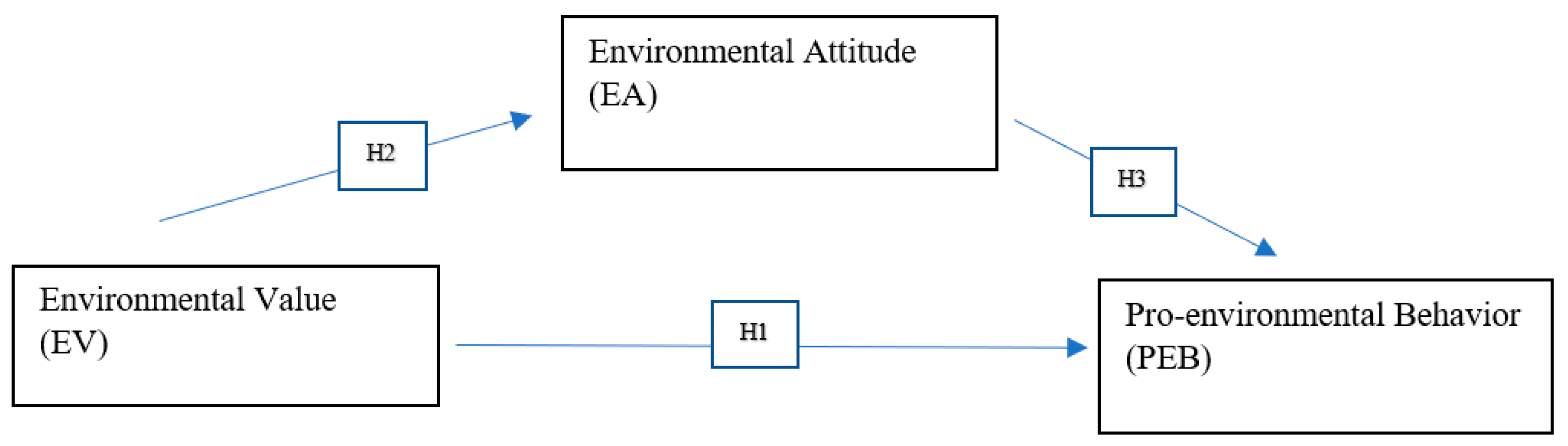
H1. Environmental value (EV) has a significant positive association with pro-environmental behavior (PEB).
The VBN theory proposes a framework to hypothesize the effect of environmental values on environmental attitudes. According to this theory, three different value orientations guide individual attitudes: concern for the natural environment—biospheric, interest in the well-being of all human beings—altruistic, and self-interest—egoistic values [
35].
Biospheric value has been reported as an important factor associated with environmental attitudes and behavioral intentions [
29,
52]. This helps expand our understanding of how values influence certain attitudes and, in turn, affect behavior.
H2. Environmental value (EV) has a significant positive association with environmental attitude (EA).
2.3. Environmental Attitude (EA)
Attitudes are long-term or persistent feelings about a person, object, or subject, responsible for an individual’s behavior. Environmental attitude is the importance an individual places on environmental protection and their perception of responsibility [
35,
40]. Attitude has been consistently associated with pro-environmental behavioral intentions [
30,
49,
53].
Attitude is also a key variable for behavioral change in the TPB framework, proven to have an indirect impact on behavior, via its influence on behavioral intentions [
43]. Certain PEB behaviors are more influenced by attitudes than others [
20]; public sphere PEB, such as signing a petition or taking part in a demonstration, is more influenced by attitudes [
37]. Recent studies focus on green attitudes driving green consumption [
21,
41,
50]. EA is operationalized as the importance an individual places on environmental protection and his/her perception of the responsibility towards environment.
H3. Environmental attitude (EA) has a significant positive association with pro-environmental behavior (PEB).
VBN theory places environmental attitude as one of the key determinants of sustainable behavior. Despite an observed gap between attitude and sustainable consumption [
17,
22,
25,
26] and limited focus on the mediating role of environmental attitude across populations [
24,
28]. Research substantiates that environmental attitudes interact with ecological values and pro-environment behavior [
4,
5,
6].
H4: Environmental attitude (EA) mediates the relationship between environmental value (EV) and pro-environmental behavior (PEB).
The conceptual model for this study (
Figure 1) proposes that environmental value has a positive association with pro-environmental behavior through the presence of the mediating variable, environmental attitude. The model suggests that environmental values are expected to be positively associated with environmental attitudes. This conceptual framework visually presents the proposed connections among variables and provides the foundation for hypothesis formulation along with empirical testing in the study.
3. Method
3.1. Study Design
This study utilizes a quantitative approach and employs a cross-sectional research design. The investigation is structured to examine the relationships among the independent variable, environmental value, the dependent variable, pro-environmental behavior, and the mediating variable, environmental attitude, as outlined in the conceptual framework. The study’s methodology is designed to identify and measure the strength and direction of associations between the variables, providing a comprehensive understanding of their interplay as hypothesized in the research framework.
The quantitative data is gathered from Gen Z using a structured questionnaire with closed-ended questions. Generation Z includes those born between 1997 and 2012; this classification by the independent research agency Pew Research Center is widely recognized by the global scientific community [
45]. According to EY’s analysis of World Bank Population Projections and Estimates data for 2020, India has a predominantly young population, with 27% of the total population being Gen Z [
54]. The generation-specific approach adopted in the study focuses on the cohort labelled the green generation, which shows increased concern about environmental issues compared to preceding generations (Gen X and Millennials) [
51,
55]. Accelerated digital connectivity and exposure to pro-environmental content on social media have aided Gen Z’s growing engagement in adopting a sustainable lifestyle as well as influencing the future direction of the environmental narrative [
5,
56,
57]. To reach this group, the study focused on undergraduate and postgraduate university students across multiple disciplines in Manipal, a diverse, multicultural student town with broad representation from all states in India. The inclusion criterion was students aged from 18 to 25 years, pursuing their undergraduate and post-graduate studies from different disciplines. The exclusion criterion was students aged outside this age bracket.
The study adopted a convenience sampling method. Participants were provided the details of the project, explaining the objective and nature of the study, after which written consent was obtained from them to participate in the survey. On obtaining consent, they were also briefed on the confidentiality of the data collected from them assured them that participation was voluntary. This rigorous approach to consent not only ensured compliance with ethical norms but also fostered transparency and trust with participants. The questionnaire was administered via Google Forms and WhatsApp was used to share the link to eligible respondents who met the screening criteria. The data collection spanned 3 weeks, during which 281 students completed the survey. Participants were assured that the collected data would be used for research purposes and that the data would be sufficiently de-identified. The sample size was generated by multiplying the number of elements on the rating scale by ten (14 × 10 = 140) [
58]. Considering 10% of the unanswered sample (i.e., 14), the required sample size was set at 154. Sample size adequacy was further assessed using GPower 3.1 with an F-test for multiple regression, consistent with the recommendation by [
58] to avoid the ‘10-times rule’. Using a medium effect size (f
2 = 0.15), alpha of 0.05, target power of 0.80, and two exogenous constructs (the maximum pointing to a single endogenous construct), the minimum required sample size was N = 68. The study’s sample of N = 281 substantially exceeds this threshold, yielding an achieved power of 100%, confirming the sample is more than adequate for the analysis. A total of 300 respondents were approached for participation in the study. However, only 281 completed responses were included in the final analysis.
3.2. Measurements
A pretest of 40 participants was conducted. The pilot study results depicted strong reliability and validity values through Cronbach’s alpha and AVE. Face validity was checked to ensure items were appropriate. Content validity of the items was carried out in consultation with 12 subject experts from corporate communications, specializing in sustainability communication, and academic and media professionals working in science and environment-related issues. The assessment rubric for the items included relevance, appropriateness, and clarity. The minor suggestions given by the expert panel were incorporated, followed by the data collection for the main study.
Data for this study were collected using a structured questionnaire. All items were measured on a five-point Likert scale. The questionnaire comprised of 17 items in total, including 3 items pertaining to participants’ demographic information and 14 items assessing the study’s key constructs. Pro-environmental behavior was measured as the dependent variable using a scale adapted from [
9], which demonstrated high internal consistency (Cronbach’s alpha = 0.91). The independent variable, environmental value, was assessed using a scale adapted from [
59], with a Cronbach’s alpha of 0.84. Environmental attitude served as the mediating variable and was measured using a scale adapted from [
60], with a Cronbach’s alpha of 0.80.
4. Results
Structural equation modeling was used to study the measurement model, and structural model analysis was used to evaluate the suggested links in order to determine the validity and reliability of the components. Partial Least Squares Structural Equation Modeling (PLS-SEM) was selected due to its suitability for analyzing complex models involving multiple variables. In recent years, structural equation modeling, particularly PLS, has been more popular [
61,
62,
63,
64,
65].
The final sample exceeded the minimum amount recommended for PLS-SEM, with 281 valid respondents. Samples bigger than the sufficient, for identifying medium to large effect sizes in PLS-SEM analysis with good statistical power, per recommendations [
66,
67]. Consequently, it was determined that 281 was an adequate sample size to ensure the model’s validity and stability. The Smart-PLS 4.0.1.3 application was used to both create and evaluate the model [
68].
As seen in
Table 1, of the 281 respondents to the online survey, 59% were female. Moreover, 75% of respondents were currently pursuing graduation, whereas 58% of the responses were received from a cohort of a metropolitan city.
Measurement items from earlier established studies were utilized to evaluate each construct as shown in
Table 2. The constructs employed around 3 to 5 items from validated sources. To measure the constructs, a 5-point Likert scale, with 1 denoting “strongly disagree” and 5 denoting “strongly agree,” was used.
Prior to the online survey’s introduction, a number of actions were made to increase the questionnaire’s face validity. Face validity for the items was also carried out with the help of 12 experts, followed by the data collection for the main study. These professionals evaluated if the questions addressed the targeted ideas in a clear and logical manner and whether they were in line with the research objectives. This stage assisted in identifying any phrasing or language errors that would cause participants to become confused or misunderstand the questions. The survey was launched after the necessary adjustments were made in response to this feedback, guaranteeing that the questions were not only clear but also likely to elicit significant answers in the study context.
Before doing hypothesis testing, we confirmed total collinearity in accordance with [
69] recommendations. This is an important step to reduce common method bias (CMB) when employing factors from the same dataset. Low multicollinearity among the latent components was found using the VIF test; values ranged from 1.108 to 1.516 (
Table 3), all of which were significantly below the 3.3 threshold [
69].
5. Assessment of Measurement Model
5.1. Convergent Validity
The average variance extracted (AVE) for all constructs exceeded the recommended threshold of 0.50. Cronbach’s alpha and the CR indices both exceeded the anticipated minimum of 0.7 [
70], except for EA (
Table 4).
Environmental Attitude (EA) was retained despite its Cronbach’s alpha (0.587) being below the conventional 0.70 threshold. However, the construct demonstrated acceptable convergent validity (AVE = 0.554) and composite reliability (CR = 0.751). This method is in line with Hair et al. (2021) [
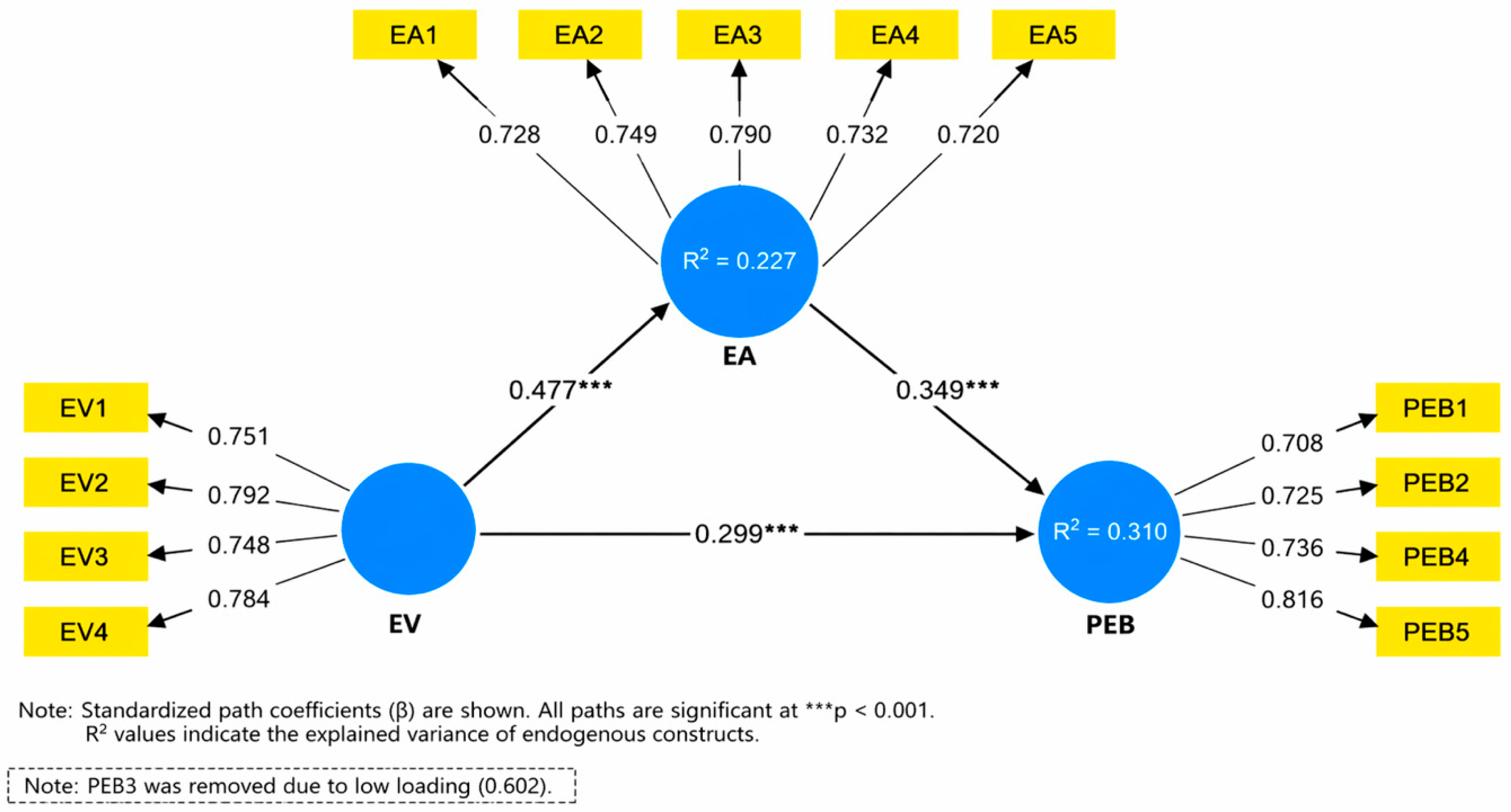
66] suggestions, especially when using exploratory models or culturally complex situations where scale sensitivity may differ. Based on previous research and face validity pilot testing, the measuring items were kept. To enhance transparency, the outer loadings of all measurement items are reported. All retained indicators exhibited loadings above the recommended threshold of 0.70, confirming reliability and validity. Item PEB3 exhibited a loading of 0.602 and was, therefore, removed to improve convergent validity and internal consistency of the construct (
Table 5).
5.2. Discriminant Validity
The Heterotrait–Monotrait Ratio (HTMT) was used to evaluate discriminant validity. The distinctness of the constructs was established when all HTMT values dropped below the 0.85 criterion (
Table 6).
Heterotrait-Monotrait Ratios
In addition to this, cross loadings have also been measured (
Table 7). Each indicator loaded highest on its respective construct compared to other constructs, thereby confirming discriminant validity.
6. Assessment of Structural Model
The structural model was assessed using a number of metrics, such as effect sizes (f2), path coefficients with corresponding t- and
p-values, SRMR value, and coefficient of determination (R
2) (
Figure 2).
The PLS-SEM model’s approximation model fit criterion was the Standardized Root Mean Square Residual (SRMR). The SRMR value was 0.092. This value falls below the threshold of 0.10 and may, therefore, be considered indicative of an acceptable model fit [
71]. The SRMR value of 0.092 falls below the more liberal threshold of 0.10 and may be considered indicative of an acceptable fit. However, it exceeds the more conservative threshold of 0.08 and should, therefore, be interpreted with caution in the context of PLS-SEM.
6.1. R2 Values
The adjusted R
2 and R
2 values show how much of the variance in the dependent variables can be explained by each of the corresponding exogenous constructs (
Table 8). In behavioral research contexts, R
2 values of 0.25, 0.50, and 0.75 are regarded as weak, moderate, and considerable, respectively [
66].
Environmental Attitude (EA): Adjusted R2 = 0.225, R2 = 0.227:
This indicates that Environmental Values (EV) account for 22.7% of the variance in EA. Even while this degree of explanatory power is poor to moderate, it nevertheless shows that individual environmental values have a significant association with the development of environmental attitudes, particularly in social science models where high R2 is not necessarily anticipated.
PEB: R2 = 0.310, Adjusted R2 = 0.305:
This shows that EA and EV together account for 31% of the variance in PEB. This is regarded as a comparatively moderate level of prediction, indicating that a reasonable basis for interpreting environmentally conscious behaviors is provided by the combination of attitude and values. Model stability and little overfitting are demonstrated by the strong relationship between R2 and adjusted R2.
6.2. F2 Scores
Cohen’s (1988) f
2 effect size was computed to evaluate the individual contribution of each exogenous construct to the endogenous variables to supplement the interpretation of path coefficients and R
2 values [
72]. This shows how much a certain exogenous construct, when included in the model, adds to the R
2 value of a dependent construct.
The magnitude of the effect size was interpreted using the following thresholds:
Any values of f
2 above 0.35 are deemed critical, while those above 0.02 are considered acceptable (
Table 9).
EV → EA (f2= 0.294):
The effect size for EV → EA (f2 = 0.294) indicates a medium effect size, suggesting that environmental values are meaningfully associated with environmental attitudes. According to the value–attitude–behavior hierarchy frequently referenced in environmental psychology literature, this validates the theoretical premise that firmly held values serve as a basis for forming attitudes.
EA → PEB (f2= 0.136):
The effect size for EA → PEB (f2 = 0.136) may be interpreted as small-to-moderate and approaches the conventional threshold for a medium effect. This suggests that environmental attitudes are meaningfully associated with pro-environmental behavior.
EV → PEB (f2 = 0.100):
The effect size for EV → PEB (f2 = 0.100) indicates a small-to-moderate effect size, suggesting a modest direct association between environmental values and pro-environmental behavior. Taken together, the effect-size results are consistent with the pattern of associations proposed by the Value–Attitude–Behavior framework. However, the magnitude of the observed effects should be interpreted as modest, particularly for the paths involving pro-environmental behavior.
6.3. Path Coefficients
All of the proposed direct pathways (H1–H3) are supported by the model as statistically significant at
p < 0.001 (
Table 10). To explore the mediating role of EA in the link between EV and PEB, the indirect effect was investigated (H4) (
Table 11).
6.3.1. Direct Effects
EV → PEB (H1): EV also had a significant direct effect on PEB (β = 0.299, t = 4.829, p < 0.001), indicating that values show direct association with behavior beyond attitude.
EV → EA (H2): A strong and substantial effect was shown by the path coefficient, which was β = 0.477, t = 9.240, and p < 0.001. This suggests an association between positive environmental views and environmental values.
EA → PEB (H3): Pro-environmental behavior is significantly favorable association to environmental attitudes, as seen by the path coefficient of β = 0.349, t = 5.658, and p < 0.001.
6.3.2. Mediation Analysis
A bootstrapping approach with 5000 subsamples was used to assess the mediating function of EA in the connection between EV and PEB.
A statistically significant mediating pathway was indicated by the particular indirect relationship of EV → EA → PEB, which was beta equal to 0.166. This is an example of partial mediation since the direct path from EV to PEB (β = 0.299,
p < 0.001) remained significant in addition to the indirect path (β = 0.166,
p < 0.001) [
73]. This implies that attitudes have a direct and indirect relationship with behavior due to environmental values and are linked to environmental actions, providing support to the value–attitude–behavior (VAB) framework. Environmental attitude accounted for approximately 35.7% of the total association between environmental values and pro-environmental behavior, indicating partial mediation. The Variance Accounted For (VAF) was 35.77%, indicating that approximately 35.77% of the total association between Environmental Values (EV) and Pro-Environmental Behavior (PEB) was represented by the indirect pathway through Environmental Attitude (EA). Consistent with [
58], this finding supports partial mediation.
6.4. Hypothesis Analysis
Pro-environmental behavior (PEB) and environmental attitudes (EA) are both strongly associated with environmental values (EV), as demonstrated by H1 and H2. The value–attitude–behavior (VAB) model’s attitudinal pathway is strengthened by H3, which demonstrates that environmental attitude has a positive influence on conduct. The considerable indirect effect shown by H4 suggests that EA mediates the link between EV and PEB to some extent (
Table 12).
These results support the VAB theory by highlighting the fact that internalized environmental values are positively related to attitudes in addition to directly correlating with action. A partial mediation paradigm, in which environmental behavior is associated with both cognitive (attitude) and motivational (value) factors, is supported by the significance of both direct and indirect effects.
7. Discussion
The study expands our understanding of the connection between environmental value and pro-environmental behavior, as well as the mediating role of environmental attitude in this relationship for the specific Indian Gen Z population. All three paths are statistically significant (with
p < 0.001), indicating strong and reliable relationships. The paths from Environmental Value (EV) to Environmental Attitude (EA) and from EA to pro-environmental behavior (PEB) are strong, with high T statistics (9.240 and 5.658, respectively). The evidence aligns with the theoretical framework of the value–attitude–behavior hierarchy [
31], where values are positively associated with attitudes, which in turn promote specific behavior [
4,
5,
6,
32].
Empirical evidence from the study supports the hypothesis that environmental value has a positive association with the environmental attitude of individuals (H2) and is consistent with prior research findings [
29,
35,
52]. The determinants of environmentally significant behavior are both external and internal, with prior research highlighting environmental attitude as a key factor in influencing PEB [
17,
37,
47]. The observed patterns validate the correlation between environmental attitude and the subsequent pro-environmental behavior, providing support to H3. This evidence corresponds with the existing literature on attitude as a significant of pro-environmental behavior in certain contexts [
30,
41,
49].
The results of this study find the path from EV to PEB to be significant, supporting H1 but slightly weaker (T statistic = 4.829), signifying that while the effect is positive, it is not as strong as the other relationships. This reinforces prior conclusions on the value-behavior gap, where individuals’ expressed environmental values don’t exactly translate to sustainable behavior [
22,
23,
24,
25,
26,
27].
The analysis also enhances the understanding of environmental attitude as the mediating variable between EV and PEB. A statistically significant mediating pathway (T statistic = 4.347) suggests that environmental attitudes are related to behavior directly, as well as indirectly through environmental values, thus supporting H4. The research concludes that both environmental values and attitudes have a significant positive association with the pro-environmental behavior within the studied Indian Gen Z cohort. The R2 values obtained in the current empirical work presents a modest but meaningful explanatory power, suggesting that the proposed model explains the meaningful proportion of variance in the endogenous construct. In behavioral and social science research, such level of variance is acceptable as human behavior is complex and multidimensional. This implies that other psychological, social, and environmental factors could contribute to pro-environmental behavior, that are presently not captured in the study. Hence, this lays a significant foundation for future researchers to explore.
Grounding the findings within Homer and Kahle’s Value–Attitude–Behavior model, this study provides empirical support for the hierarchical sequence linking values, attitudes, and behavior in the environmental context. Environmental values are positively associated with environmental attitudes, which is a significant antecedent of pro-environmental behavior, thus supporting that the mediating role of attitudes may help explain the association between values and reported behavior. Environmental values are significantly associated with pro-environmental behavior, indicating a possibility that individuals whose value system supports a pro-environmental stance are more likely to respond proactively towards ecological issues. The weaker strength of the relationship, however, suggests a definite gap in values and action, positing that value alone does not translate consistently into act strengthening environmental values and attitudes may be associated with greater pro-environmental behavior for this specific demographic cohort.
For the studied Gen Z respondents in India, the link between values and shaping attitude, and subsequently, how attitudes influence behavior, indicates a coherent validation for explaining the associative pathway towards pro-environmental behavior and the applicability of the VAB framework. The study contributes to a better understanding of this response pathway or sequence of associations. It adds to the growing body of research exploring sustainability-related views and behaviors among Gen Z, a demographic cohort positioned as highly engaged in environmental and social issues. The findings emphasize the importance of value orientation in understanding the environmentally conscious behavior among this particular demographic within the context of increasing climate discourse. The results also indicate that the environmental attitude may act as an important link between values and behavior, aligning with the prior literature.
The observed associations offer preliminary insights for brands interested in sustainability communication and green marketing. The findings suggest the possibility that value-based sustainability communication may resonate with Gen Z consumers, although communication effectiveness was not directly measured in this study. Customizing communication around the brand’s environmental values and connecting them to personal values and attitudes may prove to be persuasive in capturing Gen Z’s attention and nudging them towards eco-friendly behavior.
The findings may be useful in informing future research in environmental policy initiatives; policymakers and advocacy groups seeking to encourage Gen Z towards specific behavioral outcomes (e.g., reducing, reusing, recycling), there is a possibility to leverage the behavior–attitude congruence by developing early education programs to inculcate pro-environment attitudes for a stronger engagement and address the attitude–action gap.
The findings of this study the highlight the importance of strengthening environmental values and attitudes to encourage pro environmental behavior. Since environmental values were explored in influencing behavior both directly and indirectly, through environmental attitude, policymakers and educational institutions should focus on nurturing these values from early stage. The findings may provide preliminary insights for policymakers interested in environmental education initiatives. Policy makers should incorporate content to be delivered to students which strengthen the environmental values in the form of community activities in the curriculum. This could further develop deeper sense of ownership of environmental responsibility and promote sustainable behavior practice. In addition, policy intervention could be aimed at promoting environmentally responsible behavior beyond ‘cognitive’ to action-oriented behavioral change. Collaborative efforts of all stakeholders will further nurture this behavioral change in the long run.
8. Limitations and Directions for Future Research
Further research can be conducted to examine other factors influencing PEB, such as environmental knowledge, emotions, contextual factors, such as price sensitivity and willingness to pay, and marketing of sustainable lifestyles, to gain a comprehensive understanding of what drives ecological behavior among Gen Z. Qualitative exploration may uncover deeper insights to understand the reasons and solutions for overcoming the value-action gap and the attitude-behavior gap.
Although the study contributes to the existing literature, its scope and generalizability are limited by specific constraints. The sample size of the study may restrict broad predictions related to the Indian Gen Z students. The adoption of convenience sampling technique, a non-probability sampling approach, serves as a limitation and paves way for future researchers to adopt mixed method sampling approach to further strengthen generalizability.
An inherent limitation lies in the sample being skewed in terms of socio-economic representation, which may influence the generalizability of the findings. The study relies on self-reported behavior and not observed or actual behavior; this limits the assessment of actual impact of pro-environmental behavior. The cross-sectional, self-reported nature of the data necessitates that the findings be interpreted as associative rather than predictive. Additionally, future research can consider studying different generational cohorts, such as Indian Millennials, to understand the differences in environmental values and attitudes, and their pro-environmental behavior. An experimental approach could be adopted undertake a causal research approach.
Although Environmental Attitude demonstrated acceptable composite reliability and convergent validity, its Cronbach’s alpha was below the conventional threshold. Therefore, findings involving the mediating role of environmental attitude should be interpreted with appropriate caution and validated in future studies using alternative measurement instruments.
9. Conclusions
The findings offer preliminary insights for sustainability communication initiatives aimed at Generation Z by highlighting the role of environmental values and attitudes in shaping pro-environmental behavior. These results may assist practitioners in developing communication strategies that incorporate value-driven and attitude-based sustainability messages. The study also contributes to the growing body of research examining psychological antecedents of pro-environmental behavior within the context of emerging economies. Future research may examine whether the observed associations extend to educational institutions, workplaces, and other organizational settings. Researchers may also explore potential differences across demographic, cultural, and geographic groups to better understand the generalizability of these relationships. Additionally, future studies could investigate the effectiveness of different sustainability messaging approaches, communication channels, and engagement strategies in fostering pro-environmental attitudes and behaviors. Longitudinal and experimental research designs may further help clarify the stability of these relationships over time and the causal mechanisms through which values and attitudes influence sustainable behavior.
Author Contributions
S.V.S.: Conceptualization, Investigation, Writing—Original Draft Preparation, Methodology, Visualization, Writing—Review and Editing. S.N.: Conceptualization, Investigation, Writing—Original Draft Preparation, Methodology, Visualization, Writing—Review and Editing. S.V.I.D.A.: Formal Analysis, Methodology, Writing—Original Draft Preparation. G.B.K.: Formal Analysis, Methodology, Writing—Review and Editing. R.K.R.: Methodology, Writing—Review and Editing. All authors have read and agreed to the published version of the manuscript.
Funding
This research received no external funding.
Institutional Review Board Statement
This study included a field-level survey and was carried out strictly in compliance with accepted ethical research criteria. The study is exempt from formal ethical approval since it did not involve the collecting of any personally identifiable information and did not provide any physical, psychological, or social hazards to participants. This exception is consistent with DHR registration (EC/NEW/INST/2019/374) and the institutional circular (ECR/146/Inst/KA/2013/RR-19). Studies categorized as pure marketing research that do not involve any invasive procedures or direct health implications for human participants are exempt from obtaining ethical clearance, as per the guidelines established by the Institutional Ethics Committee (IEC) of Kasturba Medical College and Kasturba Hospital, Manipal Academy of Higher Education (MAHE). Therefore, in accordance with the ethical guidelines set for research done in researchers’ institution by IEC Manipal, ethical approval was not required for this study. Accordingly, approval was sought and obtained from the Doctoral Advisory Committee of the Institute, Manipal Academy of Higher Education, India, on 31 March 2022.
Informed Consent Statement
Informed consent for participation was obtained from all subjects involved in the study.
Data Availability Statement
The data that support the findings of this study are available from the corresponding author, Smitha Nayak, upon reasonable request.
Acknowledgments
The authors affirm that this manuscript is the result of their original work. Generative Artificial Intelligence (AI) tools such as ChatGPT (OpenAI, San Francisco, CA, USA;
https://chatgpt.com), Gemini (Google, Mountain View, CA, USA;
https://gemini.google.com), and Grammarly (Grammarly Inc., San Francisco, CA, USA;
https://www.grammarly.com) were used selectively and responsibly during the preparation of this manuscript. These tools assisted primarily in ideation, brainstorming, and refining language and grammar. At no point was the content fully generated by AI, and the intellectual contribution, interpretation of results, and final synthesis are entirely the authors’ own. The authors maintain complete obligation for the accuracy, integrity, and originality of the content presented in this work. After using the above tools, the authors reviewed and edited the content as needed and takes full responsibility for the content of the publication.
Conflicts of Interest
The authors declare no conflicts of interest.
References
- Piao, X.; Managi, S. Determinants of pro-environmental behaviour: Effects of socioeconomic, subjective, and psychological well-being factors from 37 countries. Humanit. Soc. Sci. Commun. 2024, 11, 1293. [Google Scholar] [CrossRef] [Scilit]
- Wild, S.; Heuling, L.S. Exploring the role of identity in pro-environmental behavior: Cultural and educational influences on younger generations. Front. Psychol. 2024, 15, 1459165. [Google Scholar] [CrossRef] [Scilit] [PubMed]
- Tian, H.; Liu, X. Pro-Environmental Behavior Research: Theoretical Progress and Future Directions. Int. J. Environ. Res. Public Health 2022, 19, 6721. [Google Scholar] [CrossRef] [Scilit] [PubMed]
- Cantillo, J.; Astorino, L.; Tsana, A. Determinants of pro-environmental attitude and behaviour among European Union (EU) residents: Differences between older and younger generations. Qual. Quant. 2025, 59, 2623–2659. [Google Scholar] [CrossRef] [Scilit]
- Raman, R.; Das, P.; Mandal, S.; Vijayan, V.; Ar, A.; Nedungadi, P. The impact of Gen Z’s pro-environmental behavior on sustainable development goals through tree planting. Sustain. Futures 2024, 8, 100251. [Google Scholar] [CrossRef] [Scilit]
- Meng, L.; Si, W. Pro-Environmental Behavior: Examining the Role of Ecological Value Cognition, Environmental Attitude, and Place Attachment among Rural Farmers in China. Int. J. Environ. Res. Public Health 2022, 19, 17011. [Google Scholar] [CrossRef] [Scilit] [PubMed]
- Chan, H.-W. When do values promote pro-environmental behaviors? Multilevel evidence on the self-expression hypothesis. J. Environ. Psychol. 2020, 71, 101361. [Google Scholar] [CrossRef] [Scilit]
- Stern, P.C. New Environmental Theories: Toward a Coherent Theory of Environmentally Significant Behavior. J. Soc. Issues 2000, 56, 407–424. [Google Scholar] [CrossRef] [Scilit]
- Kaiser, F.G.; Doka, G.; Hofstetter, P.; Ranney, M.A. Ecological behavior and its environmental consequences: A life cycle assessment of a self-report measure. J. Environ. Psychol. 2003, 23, 11–20. [Google Scholar] [CrossRef] [Scilit]
- Lange, F. What is measured in pro-environmental behavior research? J. Environ. Psychol. 2024, 98, 102381. [Google Scholar] [CrossRef] [Scilit]
- Biresselioglu, M.E.; Demir, M.H. From concept to impact: Strategic guidelines for environmental behavior change interventions. Front. Psychol. 2024, 15, 1392461. [Google Scholar] [CrossRef] [Scilit] [PubMed]
- Gifford, R.; Nilsson, A. Personal and social factors that influence pro-environmental concern and behaviour: A review. Int. J. Psychol. 2014, 49, 141–157. [Google Scholar] [CrossRef] [Scilit] [PubMed]
- Steg, L.; Vlek, C. Encouraging pro-environmental behaviour: An integrative review and research agenda. J. Environ. Psychol. 2009, 29, 309–317. [Google Scholar] [CrossRef] [Scilit]
- Rau, H.; Nicolai, S.; Stoll-Kleemann, S. A systematic review to assess the evidence-based effectiveness, content, and success factors of behavior change interventions for enhancing pro-environmental behavior in individuals. Front. Psychol. 2022, 13, 901927. [Google Scholar] [CrossRef] [Scilit] [PubMed]
- Osbaldiston, R.; Schott, J.P. Environmental Sustainability and Behavioral Science. Environ. Behav. 2012, 44, 257–299. [Google Scholar] [CrossRef] [Scilit]
- Razali, G.; Fatmawati, S.; Hidayat, R.; Mujahid, M.U.F. Psycological Factors Influencing Pro-Environmental Behavior in Urban Areas. West Sci. Interdiscip. Stud. 2023, 1, 408–415. [Google Scholar] [CrossRef] [Scilit]
- Čapienė, A.; Rūtelionė, A.; Tvaronavičienė, M. Pro-Environmental and Pro-Social Engagement in Sustainable Consumption: Exploratory Study. Sustainability 2021, 13, 1601. [Google Scholar] [CrossRef] [Scilit]
- Kollmuss, A.; Agyeman, J. Mind the Gap: Why do people act environmentally and what are the barriers to pro-environmental behavior? Environ. Educ. Res. 2002, 8, 239–260. [Google Scholar] [CrossRef] [Scilit]
- Han, R.; Xu, J. A Comparative Study of the Role of Interpersonal Communication, Traditional Media and Social Media in Pro-Environmental Behavior: A China-Based Study. Int. J. Environ. Res. Public Health 2020, 17, 1883. [Google Scholar] [CrossRef] [Scilit] [PubMed]
- Yang, X.; Chen, L.; Wei, L.; Su, Q. Personal and Media Factors Related to Citizens’ Pro-environmental Behavioral Intention against Haze in China: A Moderating Analysis of TPB. Int. J. Environ. Res. Public Health 2020, 17, 2314. [Google Scholar] [CrossRef] [Scilit] [PubMed]
- Bailey, A.A.; Mishra, A.S.; Tiamiyu, M.F. Application of GREEN scale to understanding US consumer response to green marketing communications. Psychol. Mark. 2018, 35, 863–875. [Google Scholar] [CrossRef] [Scilit]
- Mannoni, E. “I’m worried, but”: Unpacking the gap between environmental concern and pro-environmental behavior. Swiss Political Sci. Rev. 2025, 31, 644–665. [Google Scholar] [CrossRef] [Scilit]
- Portus, R.; Aarnio-Linnanvuori, E.; Dillon, B.; Fahy, F.; Gopinath, D.; Mansikka-Aho, A.; Williams, S.-J.; Reilly, K.; McEwen, L. Exploring the environmental value action gap in education research: A semi-systematic literature review. Environ. Educ. Res. 2024, 30, 833–863, Erratum in Environ. Educ. Res. 2025, 31, 230. [Google Scholar] [CrossRef] [Scilit]
- Shen, T.; Rasdi, I.B.; Ezani, N.E.B.; San, O.T. The mediating role of pro-environmental attitude and intention on the translation from climate change health risk perception to pro-environmental behavior. Sci. Rep. 2024, 14, 9831. [Google Scholar] [CrossRef] [Scilit] [PubMed]
- Colombo, S.L.; Chiarella, S.G.; Raffone, A.; Simione, L. Understanding the Environmental Attitude-Behaviour Gap: The Moderating Role of Dispositional Mindfulness. Sustainability 2023, 15, 7285. [Google Scholar] [CrossRef] [Scilit]
- Farjam, M.; Nikolaychuk, O.; Bravo, G. Experimental evidence of an environmental attitude-behavior gap in high-cost situations. Ecol. Econ. 2019, 166, 106434. [Google Scholar] [CrossRef] [Scilit]
- Tavri, P. A successive pro-environmental behaviour framework. Proc. Inst. Civ. Eng.—Waste Resour. Manag. 2019, 172, 14–27. [Google Scholar] [CrossRef] [Scilit]
- Liu, P.; Teng, M.; Han, C. How does environmental knowledge translate into pro-environmental behaviors?: The mediating role of environmental attitudes and behavioral intentions. Sci. Total Environ. 2020, 728, 138126. [Google Scholar] [CrossRef] [Scilit] [PubMed]
- Tamar, M.; Wirawan, H.; Arfah, T.; Putri, R.P.S. Predicting pro-environmental behaviours: The role of environmental values, attitudes and knowledge. Manag. Environ. Qual. Int. J. 2020, 32, 328–343. [Google Scholar] [CrossRef] [Scilit]
- Wyss, A.M.; Knoch, D.; Berger, S. When and how pro-environmental attitudes turn into behavior: The role of costs, benefits, and self-control. J. Environ. Psychol. 2022, 79, 101748. [Google Scholar] [CrossRef] [Scilit]
- Homer, P.M.; Kahle, L.R. A structural equation test of the value-attitude-behavior hierarchy. J. Pers. Soc. Psychol. 1988, 54, 638–646. [Google Scholar] [CrossRef]
- Shaver, J.; Yan, R.-N. Examining sustainable consumption behaviors through the mass customization context: Emotional product attachment and environmental attitude perspectives. J. Sustain. Res. 2022, 4, e220010. [Google Scholar] [CrossRef] [Scilit]
- Milfont, T.L.; Duckitt, J.; Wagner, C. A Cross-Cultural Test of the Value–Attitude–Behavior Hierarchy. J. Appl. Soc. Psychol. 2010, 40, 2791–2813. [Google Scholar] [CrossRef] [Scilit]
- Tran, M.L.; Nguyen, T.P.L. Environmental values, attitude and employee green behaviour in industrial parks: The moderating role of perceived policy effectiveness. Int. J. Organ. Anal. 2026, Epub ahead of printing. [Google Scholar] [CrossRef] [Scilit]
- YShin, Y.H.; Moon, H.; Jung, S.E.; Severt, K. The effect of environmental values and attitudes on consumer willingness to pay more for organic menus: A value-attitude-behavior approach. J. Hosp. Tour. Manag. 2017, 33, 113–121. [Google Scholar] [CrossRef] [Scilit]
- Teixeira, A.; Gabriel, R.; Martinho, J.; Santos, M.; Faria, A.; Oliveira, I.; Moreira, H. Pro-Environmental Behaviors: Relationship With Nature Visits, Connectedness to Nature and Physical Activity. Am. J. Health Promot. 2023, 37, 12–29. [Google Scholar] [CrossRef] [Scilit] [PubMed]
- Hansmann, R.; Binder, C.R. Determinants of Different Types of Positive Environmental Behaviors: An Analysis of Public and Private Sphere Actions. Sustainability 2020, 12, 8547. [Google Scholar] [CrossRef] [Scilit]
- Lee, J.; Cho, M. The Effects of Consumers’ Media Exposure, Attention, and Credibility on Pro-environmental Behaviors. J. Promot. Manag. 2020, 26, 434–455. [Google Scholar] [CrossRef] [Scilit]
- Wu, M.; Long, R. How does green communication promote the green consumption intention of social media users? Environ. Impact Assess. Rev. 2024, 106, 107481. [Google Scholar] [CrossRef] [Scilit]
- Lin, S.; Niu, H. Green consumption: Environmental knowledge, environmental consciousness, social norms, and purchasing behavior. Bus. Strategy Environ. 2018, 27, 1679–1688. [Google Scholar] [CrossRef] [Scilit]
- Aldaihani, F.M.F.; Islam, A.; Saatchi, S.G.; Haque, A. Harnessing green purchase intention of generation Z consumers through green marketing strategies. Bus. Strategy Dev. 2024, 7, e419. [Google Scholar] [CrossRef] [Scilit]
- Brick, C.; Nielsen, K.S.; Berger, S.; Henn, L.; Wolske, K.S.; Lange, F.; Hanss, D.; Bauer, J.M.; Aldoh, A.; Sachisthal, M.S.; et al. Current research practices on pro-environmental behavior: A survey of environmental psychologists. J. Environ. Psychol. 2024, 97, 102375. [Google Scholar] [CrossRef] [Scilit]
- Al Mamun, A.; Ma, Y.; Reza, M.N.H.; Ahmad, J.; Wan, H.W.M.H.; Lili, Z. Predicting attitude and intention to reduce food waste using the environmental values-beliefs-norms model and the theory of planned behavior. Food Qual. Prefer. 2024, 120, 105247. [Google Scholar] [CrossRef] [Scilit]
- Chen, M. An examination of the value-belief-norm theory model in predicting pro-environmental behaviour in Taiwan. Asian J. Soc. Psychol. 2015, 18, 145–151. [Google Scholar] [CrossRef] [Scilit]
- Nadanyiova, M.; Gajanova, L.; Majerova, J. Green Marketing as a Part of the Socially Responsible Brand’s Communication from the Aspect of Generational Stratification. Sustainability 2020, 12, 7118. [Google Scholar] [CrossRef] [Scilit]
- Chwialkowska, A.; Bhatti, W.A.; Glowik, M. The influence of cultural values on pro-environmental behavior. J. Clean. Prod. 2020, 268, 122305. [Google Scholar] [CrossRef] [Scilit]
- Mago, M.; Yadav, M.; Sharma, S.; Kaur, H. Environmental knowledge influencing pro-environmental behavior among university students: A serial mediation and MGA approach. Int. J. Sustain. High. Educ. 2025, 26, 1072–1095. [Google Scholar] [CrossRef] [Scilit]
- Yadav, R.; Pathak, G.S. Determinants of Consumers’ Green Purchase Behavior in a Developing Nation: Applying and Extending the Theory of Planned Behavior. Ecol. Econ. 2017, 134, 114–122. [Google Scholar] [CrossRef] [Scilit]
- Trivedi, R.H.; Patel, J.D.; Acharya, N. Causality analysis of media influence on environmental attitude, intention and behaviors leading to green purchasing. J. Clean. Prod. 2018, 196, 11–22. [Google Scholar] [CrossRef] [Scilit]
- Paul, J.; Modi, A.; Patel, J. Predicting green product consumption using theory of planned behavior and reasoned action. J. Retail. Consum. Serv. 2016, 29, 123–134. [Google Scholar] [CrossRef] [Scilit]
- Ribeiro, M.A.; Seyfi, S.; Elhoushy, S.; Woosnam, K.M.; Patwardhan, V. Determinants of generation Z pro-environmental travel behaviour: The moderating role of green consumption values. J. Sustain. Tour. 2025, 33, 1079–1099. [Google Scholar] [CrossRef] [Scilit]
- Lee, K. The role of media exposure, social exposure and biospheric value orientation in the environmental attitude-intention-behavior model in adolescents. J. Environ. Psychol. 2011, 31, 301–308. [Google Scholar] [CrossRef] [Scilit]
- Bamberg, S.; Möser, G. Twenty years after Hines, Hungerford, and Tomera: A new meta-analysis of psycho-social determinants of pro-environmental behaviour. J. Environ. Psychol. 2007, 27, 14–25. [Google Scholar] [CrossRef] [Scilit]
- EY Survey: Amid Global Uncertainty, Consumers Are Seeking Local and Live Entertainment Experiences—But Tech Remains a Key Enabler. Available online: https://www.ey.com/en_nl/newsroom/2025/05/ey-survey-amid-global-uncertainty-consumers-are-seeking-local-and-live-entertainment-experiences-but-tech-remains-a-key-enabler (accessed on 24 September 2025).
- Seyfi, S.; Hall, C.M.; Strzelecka, M. Gen Z—Pioneers or paradox in sustainable tourism? J. Sustain. Tour. 2025, 33, 987–1015. [Google Scholar] [CrossRef] [Scilit]
- Seelig, M.I.; Shata, A.; Yang, Z.; Sd, D.; Gao, Y.; Hu, H.; Yang, J. “Making the Environment Like A Cool Thing:” Exploring generation Z and Millennials’ reception of climate change videos on YouTube. Atl. J. Commun. 2026, 34, 181–199. [Google Scholar] [CrossRef] [Scilit]
- Djafarova, E.; Foots, S. Exploring ethical consumption of generation Z: Theory of planned behaviour. Young Consum. 2022, 23, 413–431. [Google Scholar] [CrossRef] [Scilit]
- Hair, J.F.; Hult, G.T.M.; Ringle, C.M.; Sarstedt, M. A Primer on Partial Least Squares Structural Equation Modeling (PLS-SEM), 2nd ed.; Sage: Thousand Oaks, CA, USA, 2017. [Google Scholar]
- Stern, P.C.; Dietz, T.; Abel, T.; Guagnano, G.A.; Kalof, L. A value-belief-norm theory of support for social movements: The case of environmentalism. Hum. Ecol. Rev. 1999, 6, 81–97. [Google Scholar]
- Diekmann, A.; Preisendörfer, P. Green and Greenback. Ration. Soc. 2003, 15, 441–472. [Google Scholar] [CrossRef] [Scilit]
- De Araujo, S.V.I.; Dhaigude, A.S.; Kamath, G.B.; Pai, R.R.; Nayak, S.; Ganesh, S. Influencer credibility and consumer behavior: The mediating role of self-brand congruity and moderating role of involvement. Cogent Bus. Manag. 2025, 12, 2541040. [Google Scholar] [CrossRef] [Scilit]
- Muhammad, M.; Suleiman, W.; Al Mamun, M.A.; Jewel, R.M.; Mozumder, A.S. Mediating effect of appraisal fairness between the relationship of appraisal satisfaction and employee performance appraisal: A case of Bauchi State Teachers Service Commission, Nigeria. Cogent Bus. Manag. 2025, 12, 2450297. [Google Scholar] [CrossRef] [Scilit]
- Cheng, H. Multiple imputation in quantile varying-coefficient SEM with its application in new-quality productivity. Commun. Stat. Simul. Comput. 2025, 1–22. [Google Scholar] [CrossRef] [Scilit]
- Cheah, J.-H.; Magno, F.; Cassia, F. Reviewing the SmartPLS 4 software: The latest features and enhancements. J. Mark. Anal. 2024, 12, 97–107. [Google Scholar] [CrossRef] [Scilit]
- De Araujo, S.V.I.; Kamath, G.B.; Pai, R.R.; Dhaigude, A.S. Consumer mimicry of sports influencers on social media: A study on how influencers’ traits influence consumer buying behaviors. Cogent Bus. Manag. 2024, 11, 2432539. [Google Scholar] [CrossRef] [Scilit]
- Hair, J.F.; Hult, G.T.M.; Ringle, C.M.; Sarstedt, M.; Danks, N.P.; Ray, S. An Introduction to Structural Equation Modeling. In Partial Least Squares Structural Equation Modeling (PLS-SEM) Using R; Springer: Cham, Switzerland, 2021; pp. 1–29. [Google Scholar] [CrossRef] [Scilit]
- Sarstedt, M.; Hair, J.F., Jr.; Cheah, J.-H.; Becker, J.-M.; Ringle, C.M. How to Specify, Estimate, and Validate Higher-Order Constructs in PLS-SEM. Australas. Mark. J. 2019, 27, 197–211. [Google Scholar] [CrossRef] [Scilit]
- Ringle, C.M.; Wende, S.; Becker, J.M. SmartPLS 4. Bönningstedt: SmartPLS. Available online: https://www.smartpls.com/ (accessed on 20 August 2025).
- Kock, N. Common Method Bias: A Full Collinearity Assessment Method for PLS-SEM. In Partial Least Squares Path Modeling; Springer International Publishing: Cham, Switzerland, 2017; pp. 245–257. [Google Scholar] [CrossRef] [Scilit] [PubMed]
- Hair, J.F.; Risher, J.J.; Sarstedt, M.; Ringle, C.M. When to use and how to report the results of PLS-SEM. Eur. Bus. Rev. 2019, 31, 2–24. [Google Scholar] [CrossRef] [Scilit]
- Cho, G.; Schlaegel, C.; Hwang, H.; Choi, Y.; Sarstedt, M.; Ringle, C.M. Integrated Generalized Structured Component Analysis: On the Use of Model Fit Criteria in International Management Research. Manag. Int. Rev. 2022, 62, 569–609. [Google Scholar] [CrossRef] [Scilit]
- Cohen, J. Set Correlation and Contingency Tables. Appl. Psychol. Meas. 1988, 12, 425–434. [Google Scholar] [CrossRef] [Scilit]
- Zhao, X.; Lynch, J.G., Jr.; Chen, Q. Reconsidering Baron and Kenny: Myths and Truths about Mediation Analysis. J. Consum. Res. 2010, 37, 197–206. [Google Scholar] [CrossRef] [Scilit]
| Disclaimer/Publisher’s Note: The statements, opinions and data contained in all publications are solely those of the individual author(s) and contributor(s) and not of MDPI and/or the editor(s). MDPI and/or the editor(s) disclaim responsibility for any injury to people or property resulting from any ideas, methods, instructions or products referred to in the content. |




 ,
,