


Abstract
Amid the ongoing global green transformation and the deepening implementation of the “dual carbon” goals, the sustained enhancement of firms’ green innovation capabilities is crucial for driving high-quality development. This study utilizes panel data from A-share listed companies spanning the period from 2013 to 2023, and conducts an empirical analysis to examine how ESG performance influences firms’ sustained green innovation and its underlying effects and mechanisms. The results reveal that ESG performance exert a statistically significant positive effect on firms’ sustained green innovation. This finding remains robust across a range of robustness checks, including Heckman’s two-step method, propensity score matching (PSM), alternative ESG measures, models incorporating lagged variables, and other checks. The mechanism analysis reveals that ESG performance improves firms’ capacity to maintain green innovation and continuously accumulate its outcomes by alleviating financing constraints and reducing operational risks. Government subsidies and digitalization positively moderate the effect of ESG performance on firms’ sustained green innovation. Furthermore, the heterogeneity analysis demonstrates that the promoting effect of ESG performance on sustained green innovation is more pronounced among non-heavy-polluting firms, large-scale firms, and state-owned firms. The findings of this study provide a theoretical foundation for firms to effectively integrate ESG resources and further enhance sustained green innovation, and they also offer valuable insights into how firms can build a sustainable innovation ecosystem.
1. Introduction
Promoting the green transformation of the development pattern is a global consensus and a necessary approach to facilitating high-quality development. This is especially important given the profound changes in the current global economy and the increasingly severe challenges of climate change. The report delivered at the 20th National Congress of the Communist Party of China clearly underscores the necessity of “advancing green and low-carbon economic and social development.” It also indicates the need to “coordinate efforts to reduce carbon emissions, reduce pollution, expand greenery, and promote growth”. Although the traditional development pattern, characterized by extensive investment in resource factors, generated remarkable economic growth in the past, it also gave rise to a range of issues, including resource inefficiency and environmental pollution. In this context, shifting the economic growth path towards a new development pattern that is green, low-carbon, and efficient is an inevitable choice to mitigate resource and environmental constraints and support the achievement of high-quality economic development. Given that firms are microeconomic entities and major sources of carbon emissions, enhancing their green innovation capability is essential for achieving the “dual carbon” target. Firms’ green innovation focuses on developing and adopting green technologies, production processes, and managerial measures to minimize energy consumption and pollutant emissions throughout business operations. These practices improve firms’ environmental performance while creating new sources of competitive advantage. However, green innovation is characterized by high risk, high upfront costs, and a focus on long-term outcomes [1], which makes management more cautious in decision-making and renders firms more vulnerable to financing constraints and operational challenges. As a result, identifying the factors that drive sustained green innovation has become essential. This is expected to effectively drive the transition toward a greener development pattern.
In recent years, the association between environmental, social, and governance (ESG) performance and enterprise green innovation has attracted considerable attention in academic research. Existing studies have generally found that strong ESG performance contributes to improved enterprise green innovation. ESG serves as a measure of a firm’s sustainability performance [2]. Strong ESG performance conveys to society a firm’s efforts in environmental and social responsibility, as well as in corporate governance, alleviates information asymmetry, and attracts resources for innovation [3], thereby influencing green innovation performance. Nevertheless, some studies have further investigated the non-linear association between ESG performance and firms’ green innovation, revealing a U-shaped pattern that is strengthened by greater information transparency [4]. Regarding the mechanisms through which ESG performance affects green innovation, Zhang et al. [5] found that financing constraints constitute a primary mechanism. From a supply chain spillover perspective, customers’ ESG performance enhances the quality of their suppliers’ green innovation [6]. Meanwhile, due to the short-board effect, ESG rating divergence can increase the quantity of firms’ green innovation rather than improve its quality [7]. From an external environmental perspective, ESG-oriented analysts can raise the expected returns from corporate environmental risk management, reduce managerial short-termism and financing costs, and promote green innovation [8]. From the perspective of firms’ internal governance structure, shareholder activism positively moderates the promoting effect of ESG performance on green innovation [9]. ESG performance reflects a firm’s promise to sustainable development, and green innovation serves as a crucial element in achieving sustainability goals.
Moreover, existing studies have demonstrated that firms’ innovation activities exhibit persistence over time. Past innovation experience significantly affects current innovation behavior, namely state dependence, and such true state dependence remains even after controlling for unobserved firm heterogeneity [10]. Innovation persistence also demonstrates heterogeneous patterns across industries. In high-technology industries, both the probability of innovation and innovation output intensity exhibit true persistence, whereas in low-technology industries, innovation persistence mainly reflects spurious persistence [11]. Scholars have further extended the concept of innovation persistence to the field of eco-innovation. Eco-innovation exhibits a high degree of continuity at the firm level. Past eco-innovation activities are key to explaining a firm’s current eco-innovation orientation, and path dependence exists within the eco-innovation domain [12]. Arranz et al. [13] empirically confirmed the persistence of eco-innovation and conceptualized eco-innovation as an innovation capability characterized by persistence, complementarity, and resource dependence. Green innovation also exhibits clear persistence and constitutes an important part of firms’ green transformation [14]. By further examining the influence of ESG performance on sustained green innovation, we can better reveal the underlying mechanism linking ESG performance to firms’ long-term green transformation.
In summary, the effect of ESG performance on sustained green innovation manifests not only through resource support but also through the establishment of a sustainable innovation ecosystem coordinated both internally and externally. This ecosystem, in turn, ensures the long-term continuity and dynamism of innovation activities. Existing studies have mainly explained the influence of ESG performance on sustained green innovation through the channels of alleviating financing constraints and reducing agency costs [15]. In fact, sustained green innovation, like green innovation in general, relies on substantial resource investment. Simultaneously, innovation persistence requires long-term R&D stability to produce persistent and stable innovators [16]. Stable business operations create favorable conditions for continued engagement in green innovation activities. Hence, further research is needed to clarify whether and through what mechanisms ESG performance promotes sustained green innovation by mitigating operational risk. Moreover, with growing policy support for sustainability and the rapid diffusion of digital technologies, the boundary conditions under which ESG performance fosters sustained green innovation remain unclear.
Accordingly, this study employed data from Chinese listed firms spanning 2013 to 2023 to empirically investigate the impact of ESG performance on firms’ sustained green innovation, as well as the underlying mechanisms and boundary conditions through which this influence operates. Compared with the existing literature, this paper offers several potential marginal contributions. Firstly, this paper further extends the theoretical framework explaining how ESG performance affects sustained green innovation. It incorporates operational risk, a proxy for a firm’s operational stability, into the framework. From a risk governance perspective, the paper reveals how ESG performance strengthens the continuity of firms’ long-term green innovation activities by lowering operational uncertainty. In this way, the paper expands the explanation of the mechanism through which ESG performance drives sustained green innovation. Secondly, this study contributes to the literature by examining the boundary conditions under which ESG performance promotes sustained green innovation and by investigating its heterogeneous effects across different firm groups. Specifically, by introducing government subsidies as a moderator, this study sheds light on how external policy support shapes the relationship between ESG performance and sustained green innovation. Moreover, the study examines whether this effect differs across firms with varying pollution intensities, sizes, and ownership structures. Taken together, these analyses offer a deeper understanding of the boundary conditions under which ESG performance fosters sustained green innovation. Thirdly, the conclusions of this study carry important practical significance for advancing firms’ green and sustainable development. In the context of China’s “dual carbon” goals, these findings enrich the empirical evidence on how ESG performance fosters sustained green innovation. They also provide valuable insights for policymakers seeking to strengthen ESG incentive mechanisms and support the coordinated advancement of green innovation and high-quality corporate development.
2. Theoretical Analysis and Research Hypotheses
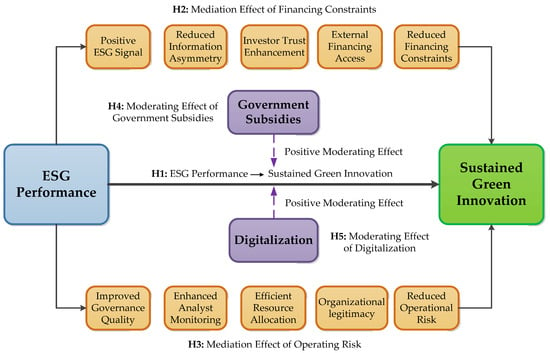
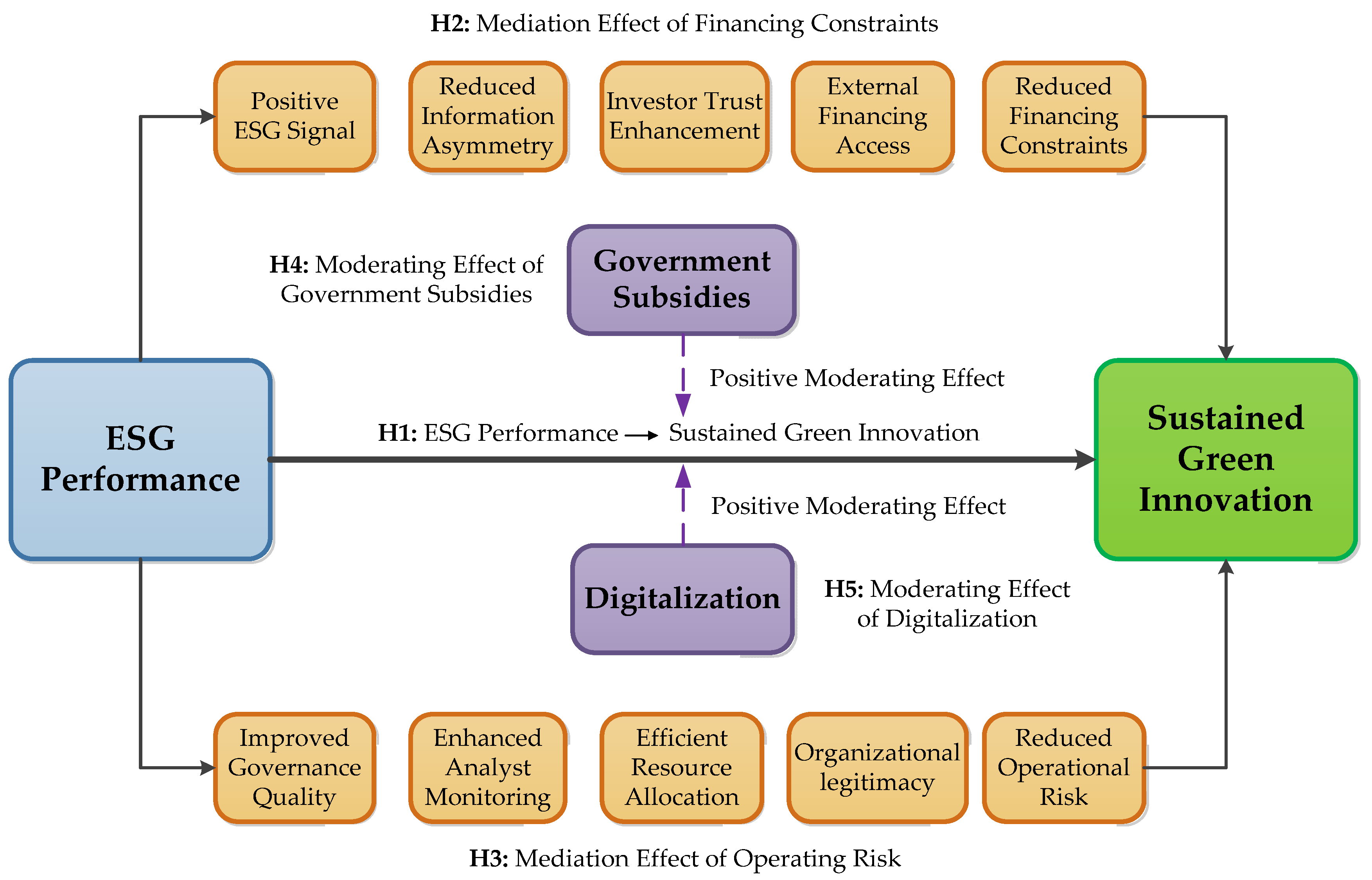
Against the global transition toward sustainable development and China’s pursuit of its “dual carbon” goals, green and low-carbon transformation now constitutes a key avenue for firms to bolster their competitive edge. Whether a firm can sustain its green innovation activities over time is a key issue in this transition process. Figure 1 presents the conceptual framework underlying the relationship between ESG performance and sustained green innovation. The theoretical mechanisms and research hypotheses are developed in the following sections. The framework specifies financing constraints and operational risk as two mediating channels, while government subsidies and digitalization moderate the direct impact of ESG performance on sustained green innovation.
Figure 1.
Theoretical Mechanism by which ESG Performance Promotes Sustained Green Innovation.
2.1. ESG Performance and Sustained Green Innovation of Enterprises
From a theoretical perspective, green innovation and sustained green innovation should be clearly distinguished before formulating the research hypotheses. Sustained green innovation differs from static green innovation in that it focuses not only on the scale and growth of a firm’s green innovation output, but also on the temporal continuity of green innovation activities, the dynamic accumulation of innovation outcomes, and the long-term evolution of such activities. Existing studies have provided theoretical explanations for why firms’ innovation behavior exhibits persistence. First, the “success–breeds–success” assumption [17] suggests that firms’ innovation choices exhibit structural state dependence [16]. This explains the temporal continuity of firms’ innovation behavior. Second, the accumulation of technological capabilities supports future innovation. Through learning effects, a firm’s past innovation activities generate a knowledge stock, which in turn serves as an important foundation for subsequent green innovation [10]. This promotes the sustained accumulation and dynamic growth of green innovation outcomes over time. Moreover, sunk costs create exit barriers that lead firms to continue their R&D activities once they have begun [18]. Finally, the formation of sustained green innovation is closely related to a firm’s dynamic capabilities. Dynamic capabilities refer to a firm’s ability to integrate, build, and reconfigure resources to adapt to changing external environments [19]. Stronger dynamic capabilities enable firms to continuously integrate internal and external resources, hence enhancing their capacity for organizational learning, knowledge absorption, and resource coordination. In this way, the knowledge stock and technological accumulation generated by prior green innovation activities can continuously support subsequent green technology R&D and upgrading, contributing to the sustained growth and dynamic evolution of green innovation outcomes. These theories help explain how ESG performance affects sustained green innovation as well as the mechanisms underlying this relationship.
The essence of ESG practice lies in fulfilling responsibilities to investors while promoting coordinated development across environmental, social, and governance dimensions [20]. Firms can improve their ESG practices by securing resources, advancing green product innovation, and improving corporate governance. These efforts convey credible signals of sustainable development to external stakeholders. In terms of resource security, strong ESG performance sends positive non-financial signals to the market, alleviating information asymmetry among investors and other stakeholders, facilitating firms’ access to financial support [5], and mitigating funding shortages that may hinder the continuity of green innovation activities. In terms of market-based incentives, strong ESG performance signals a firm’s commitment to sustainable development, strengthening suppliers’ trust and increasing their willingness to cooperate, contributing to more resilient and collaborative supply chain relationships [21]. Stable supply chain partnerships facilitate firms’ continuous engagement in green R&D. By doing so, they sustain the accumulation of green technology, knowledge, and innovation experience. In addition, a strong corporate reputation reflects market expectations for a company’s products and services and serves as a key factor for consumers in assessing the quality of these offerings. Existing studies have provided evidence that strong ESG performance increases the likelihood of receiving CSR awards, a proxy for corporate reputation [22]. In terms of internal governance, firms can establish a sound ESG management framework to improve governance structures, decision-making processes, and incentive mechanisms. Building on this, they can integrate sustained green innovation goals into their operational systems and strategic development. Firms can also use diversified incentive methods, such as employee value sharing, to align personal interests with long-term corporate goals. These measures collectively enhance the stability and persistence of firms’ green innovation decisions. They further foster a long-term accumulation mechanism for green innovation knowledge, technology, and organizational experience. This provides stable institutional support and endogenous impetus for sustained green innovation. Therefore, ESG performance supports sustained green innovation through resource support and stronger market collaboration. It also enhances operational stability by improving internal governance. As a result, firms are better positioned to sustain the progression of green innovation activities, accumulate innovation outcomes over time, integrate sustainability into their long-term strategies, and strengthen their long-term competitiveness.
Hypothesis 1.
ESG performance can facilitate sustained green innovation in firms.
2.2. The Role of ESG Performance in Promoting Sustained Green Innovation in Enterprises
2.2.1. The Mediating Role of Financing Constraints
Financing constraints are obstacles that firms face in obtaining adequate external funds at reasonable costs due to factors such as information asymmetry and limited credit support, which restrict firms’ investment and operational development. The stronger the financing constraints firms face, the more limited their access to external finance, inhibiting their sustained development. Firms with strong ESG performance can convey high-quality information to external stakeholders, signal sound operational conditions, and accumulate reputational capital, enhancing investor confidence and improving access to external financing [23]. According to signaling theory, strong ESG performance serves as a credible signal of a firm’s environmental responsibility, social commitment, and governance quality, enhancing investor confidence and increasing its attractiveness to capital providers [24]. Reputation theory suggests that ESG performance can accumulate strong reputational capital [25], which helps to increase stakeholders’ trust and recognition of the company. The market tends to show a stronger preference for products offered by firms with favorable reputations, providing firms with relatively stable revenue sources, improving cash flow expectations, and alleviating financing constraints. Sustained green innovation requires not only periodic R&D investments by firms but also long-term, stable financial support. This is essential to ensure the continuous advancement of green R&D, technological iteration, and the translation of research outcomes into practice. However, green innovation activities possess dual externalities [26], high risk, and require long-term commitment. These features increase firms’ demand for financial resources and create uncertainties in resource acquisition, R&D investment, and the commercialization of innovation outcomes. Yu et al. [27] found that financing constraints significantly hinder firms’ green innovation. From the perspective of the motivation and willingness to sustain green innovation, financing constraints also play an important role in moderating firms’ ongoing green innovation activities [28]. When a firm faces severe financing constraints, its green R&D investments may become unsustainable due to cash flow fluctuations. The weakened motivation for sustained green innovation can also lead to the cessation of green innovation activities and the disruption of technological accumulation. By easing financing constraints and strengthening firms’ long-term funding stability, ESG performance provides stable support for green R&D, continuous technological iteration, and the accumulation of innovation outcomes. In this way, ESG performance facilitates sustained green innovation.
Hypothesis 2.
ESG performance promotes sustained green innovation in firms by alleviating financing constraints.
2.2.2. The Mediating Role of Operational Risk
Operational risk can affect firms’ high-quality development. Operational risk refers to events that firms encounter in the course of their operations, which may result in financial losses or other adverse consequences. It can be categorized into external and internal risks [29]. External risks include the macroeconomic and microeconomic environment, policy orientations, and potential risks that may arise from the actions of various stakeholders; internal risks stem from the internal management processes of the firm, mainly reflected in organizational structure, financial decision-making, strategic choices, and other aspects. Currently, most scholars believe that operational risk deserves more attention. In the context of high information asymmetry, it is difficult for the internal and external supervision and management mechanisms of firms to function effectively, which not only reduces the efficiency of enterprise management but may also increase management’s motivation to hide key information to satisfy its own interests [30]. This tendency can lead them to adopt more aggressive business strategies, which heighten firms’ operational risks. Strong ESG performance requires firms to establish a high-quality governance system [31], which encourages managers to develop a deeper understanding of the firm’s sustainable development objectives and behavioral standards, enhancing their ability to perform their duties. Moreover, by optimizing resource allocation efficiency and cost control, the overall risk of the firm can be reduced. At the same time, a sound and transparent internal governance system can reduce the uncertainty of enterprises in financial, legal, and other aspects, providing institutional support for long-term business stability. In addition, a firm’s strong ESG performance can attract increased attention from external analysts [32]. Analysts can exert supervisory pressure on management through the interpretation and dissemination of firms’ information, prompting them to make more rational use of resources for investment and business activities. This is associated with higher operational efficiency and lower operational risk. Reducing operational risks encourages firms to examine resource and environmental issues through the lens of green and sustainable development, identify new opportunities, and direct resource allocation towards more innovative areas, which enhances their willingness to invest in long-cycle, high-uncertainty green technology research and development projects [33]. Furthermore, strong ESG performance conveys to the market a positive signal of balancing economic returns with environmental responsibility. It caters to the preferences of socially responsible investors, enhancing firms’ image and organizational legitimacy. Enhanced legitimacy reduces the external uncertainty and perceived risk of failure that firms face in green innovation. It also strengthens firms’ confidence in sustaining long-term green R&D investment. This, in turn, provides stable support for the persistent growth and long-term accumulation of green innovation outcomes. Consequently, by lowering operational risk and reinforcing long-term operational stability, ESG performance further fosters sustained green innovation.
Hypothesis 3.
ESG performance promotes sustained green innovation by reducing operational risk.
2.2.3. The Moderating Role of Government Subsidies
Strong ESG performance conveys a firm’s promise to environmental responsibility and sustainable operations, which aligns with local governments’ goals of promoting high-quality development and green transformation, making it easier for firms to obtain preferential policies such as fiscal subsidies and tax incentives [34]. Meanwhile, firms receiving consistently positive policy support signals from the government are motivated to sustain or improve their ESG performance, creating a positive feedback loop between corporate green governance and policy support. In this context, government R&D subsidies can alleviate firms’ underinvestment in research and development [35], directly easing the financial pressure associated with long-term green R&D and mitigating firms’ propensity to reduce green R&D investment under short-term operational constraints. Moreover, government subsidies signal to investors that a firm is worth investing in [36], which enhances external investor confidence, attracts more social capital, and broadens firms’ access to financing, strengthening firms’ ability to sustain green technology R&D over time. Therefore, firms exhibiting stronger ESG performance are more likely to receive greater government subsidies, which further strengthen their incentives and capacity to undertake sustained green innovation. When government subsidy levels are relatively high, the positive impact of ESG performance on sustained green innovation is further strengthened. In other words, government subsidies positively moderate the relationship between ESG performance and sustained green innovation.
Hypothesis 4.
Government subsidies positively moderate the relationship between ESG performance and sustained green innovation.
2.2.4. The Moderating Role of Digitalization
Firms’ engagement in ESG activities can enhance stakeholder trust and build long-term partnerships, but in the short term, instead of generating direct profits, it consumes additional resources and weakens the firm’s motivation to pursue ESG. In the context of the “dual carbon” targets, firms’ digital transformation can improve not only economic performance but also social benefits. The widespread application of digital technologies such as the Internet of Things, big data, and artificial intelligence can enhance firms’ dynamic capabilities, cost control capabilities, and resource utilization efficiency, improving their market competitiveness [37]. The level of digitalization in firms may influence the intrinsic correlation between their ESG performance and sustained green innovation. On the one hand, improvements in the level of digitalization help firms optimize business processes, enhance internal governance capabilities, optimize the combination of production factors, and reduce internal management costs, innovation transaction costs, and contract costs [38]. By improving the efficiency of R&D resource allocation and the coordination of R&D processes, digitalization reduces the risk of R&D fluctuations and innovation disruptions caused by resource misallocation or information delays during long-term green R&D, thereby enhancing the continuity of firms’ green technology R&D activities and their capacity for technological iteration. On the other hand, digital technology can enable firms to accurately identify the preferences and dynamic changes in demand for green products, enabling green innovative products to obtain clearer market orientation. In addition, digital platform deployment is conducive to collaborative cooperation between firms, consumers, industry partners, research institutions, and other stakeholders, enhancing knowledge integration capabilities [39]. Greater knowledge accumulation and more efficient collaborative innovation enable firms to achieve sustained technological accumulation and dynamic growth of innovation outcomes during long-term green R&D. Furthermore, greater digitalization can improve the disclosure of ESG information. Translating complex and technical terminology into content that is easier for stakeholders to understand helps them more clearly recognize the long-term value of a firm’s green R&D projects. This, in turn, enhances their confidence in the firm’s green innovation initiatives. Thus, digitalization enables firms with strong ESG performance to convert resources into green innovation more effectively and to accumulate sustained green innovation outcomes. In other words, digitalization strengthens the direct effect of ESG performance. In firms with lower levels of digitalization, data utilization is inefficient and costly, and clean, efficient, and renewable production methods have yet to be adopted, limiting the effective transformation of ESG-driven resources into green innovation outcomes.
Hypothesis 5.
Digitalization positively moderates the relationship between ESG performance and sustained green innovation.
3. Research Design
3.1. Model Construction
To examine the hypothesis that superior ESG performance facilitates sustained green innovation in firms, this study established the following benchmark regression model (1):
In model (1), GIA indicates firms’ sustained green innovation, and ESG indicates their ESG performance. Control represents the combination of controlled variables; and represent individual and individual fixed effects, respectively; and is a random perturbation term.
3.2. Variable Description
3.2.1. Dependent Variable (GIA)
The dependent variable in this article is the sustained green innovation of firms. Drawing on the research of Triguero & Córcoles [16], the calculation formula for the sustained green innovation of firms is as follows:
In the above equation, represents the sustained green innovation of enterprise in year , and , and represent the number of green patent applications of enterprise in years , , and , respectively. We used green patent application data to measure this indicator, which better reflects firms’ timely innovation decisions and avoids the lag caused by the patent examination process, compared with granted patent data. When , the persistence becomes mathematically undefined because the company did not exhibit green innovation activities in the first two periods. Even if green innovation occurs in the current period, it cannot constitute the continuity of green innovation behavior; thus, these observations were assigned a value of zero. This index reflects both the continuity and the scale of green innovation activities. The ratio term reflects the persistence of green innovation in adjacent periods, while the multiplicative component reflects the scale of accumulated green innovation output. Economically, an increase in GIA indicates that a firm maintains green innovation activities over time, expands the scale of green patenting, and accumulates green innovation outcomes.
3.2.2. Explanatory Variable (ESG)
The explanatory variable in this study is firms’ ESG performance, measured by the Huazheng ESG Composite Index. This rating system covers all A-share listed firms in China and evaluates performance along environmental, social, and governance dimensions. Specifically, the composite score is derived from a bottom-up hierarchical weighting method: performance is first assessed within each dimension and then aggregated using industry-specific fixed weights. These scores are then standardized within industries, and the index has been widely used in empirical studies (e.g., Guoqiang Hu et al. [40]). However, some studies have pointed out that there is significant divergence among different ESG rating agencies [41], and the evaluation results of Huazheng may not be fully consistent with those from sources such as MSCI or Sustainalytics. Since this indicator system fully accounts for China’s policy context (e.g., the “dual-carbon” goals and rural revitalization) and industry characteristics, it is better suited to the Chinese context. Accordingly, this study employed the Huazheng ESG Composite Index as the explanatory variable to measure corporate ESG performance.
3.2.3. Control Variables
Considering that other factors may influence the empirical results, we controlled for the following variables: equity concentration (Top 10), measured by the ownership concentration of the top ten shareholders; Long-term development capability (Sgr), expressed in terms of sustainable growth rate; Firm performance was measured by return on equity (Roe); Board size was measured by the number of board members (Board); Employee quality (Hc), measured by the proportion of employees holding a bachelor’s degree or higher; Return on Assets (Roait) was expressed as the sum of total profit and financial expenses divided by total assets; and R&D intensity (RI) was defined as the ratio of R&D expenditure to total assets.
3.3. Data Sources and Descriptive Statistics
This study employed A-share listed firms spanning the period from 2013 to 2023 as the empirical research sample and processed the data as follows: (1) ST and *ST firms were excluded from the sample; (2) samples of firms with insolvency were excluded; and (3) firm samples with missing data on major variables were excluded. Continuous variables were winsorized at the 1% and 99% levels to mitigate the influence of outliers. The explanatory variable data were obtained from the Huazheng ESG rating agency, the firms’ green technology patent data were obtained from the China National Intellectual Property Administration (SIPO), and other data were obtained from the Guotai’an database. Table 1 presents the descriptive statistics. To further rule out multicollinearity, we calculated the variance inflation factor (VIF) for each variable. All VIF values fell below the standard threshold of 10, ranging from 1.02 to 6.66. The VIF results indicated that multicollinearity was not a serious concern in this study.
Table 1.
Descriptive Statistics of Main Variables.
4. Empirical Analysis
4.1. Benchmark Regression
Table 2 displays the regression results of ESG on the sustained green innovation of firms. Columns (1) and (2) present the regression results without controlling for individual firm and year effects, while column (3) controls for the direct regression of individual firm and year effects. The coefficient on ESG was 0.339 and statistically significant at the 1% level, indicating that strong ESG performance significantly promoted sustained green innovation in firms. When all control variables were included in the regression, the ESG coefficient was 0.321 and remained significant at the 1% level, suggesting that strong ESG performance continued to promote sustained green innovation after controlling for other factors. Therefore, Hypothesis 1 was validated.
Table 2.
Benchmark Regression Results.
4.2. Endogeneity Test
To mitigate potential endogeneity concerns in the baseline regression, this study employed an instrumental variable (IV) approach. We instrumented a firm’s current ESG performance using the same-year industry average ESG score (Peer_ESG), defined as the mean ESG rating of all other firms in the same industry and year, leaving out the focal firm. The instrumental variable satisfies the relevance condition. The mean ESG score of peer firms in that industry affects a firm’s own ESG performance through channels such as industry norms, competitive pressure, and information spillovers. In the first-stage regression, the coefficient on Peer_ESG was 0.676 and was significant at the 1% level. Regarding exogeneity, after controlling for firm fixed effects, year fixed effects, and all covariates from the baseline model, the ESG performance of peer firms is unlikely to directly affect a firm’s sustained green innovation. Table 3 reports the results of the two-stage least squares (2SLS) regression. The Kleibergen–Paap rk LM statistic in the first stage was 329.546 and was significant at the 1% level, strongly rejecting the null hypothesis of underidentification. The Kleibergen–Paap rk Wald F statistic was 336.140, far above the Stock–Yogo critical value (16.38) at the 10% significance level for weak identification, indicating that weak instruments were not a concern. The second-stage regression showed that the ESG coefficient was 1.482 and significant at the 1% level. Compared with the baseline results, the IV estimate was slightly larger, but the sign and significance remained unchanged. These findings further confirmed the positive effect of ESG performance on sustained green innovation.
Table 3.
Instrumental Variable Method.
4.3. Robustness Test
4.3.1. Heckman’s Two-Step Method
As a robustness check, the study applied Heckman’s two-step method [42] to alleviate potential sample selection bias. Table 4 reports the regression results. Firms experiencing financial distress or bankruptcy are generally less likely to sustain green innovation activities and may be excluded from the database, potentially leading to non-random sample selection. In addition, differences in firms’ information disclosure behavior may also affect sample observability. Following Kim and Verrecchia [43], this study measured firms’ information disclosure quality and constructed a dummy variable (KV_dummy). Specifically, KV_dummy equals one if the firm’s KV index exceeds the industry–year median, and zero otherwise. In the first stage, we estimated a Probit model to examine the likelihood of a firm exhibiting relatively high information disclosure quality. The explanatory variables included the instrumental variable, namely the industry–year average ESG score of peer firms (Peer_ESG), together with all control variables used in the baseline regression. The results showed that the coefficient on Peer_ESG was significantly positive, indicating that firms operating in industries with better ESG performance were more likely to exhibit higher information disclosure quality. In the second stage, we incorporated the inverse Mills ratio (IMR) into the baseline regression model as an additional control variable to correct for potential sample selection bias. The second-stage estimation results indicated that the coefficient of ESG remains significantly positive (β = 0.216, p < 0.01). The significant coefficient on IMR suggested that sample selection was a concern. Nevertheless, the corrected model indicated that ESG performance continued to have a significant positive effect on sustained green innovation, thereby supporting the main hypothesis.
Table 4.
Heckman’s Two-stage Regression.
4.3.2. The Method of Propensity Score Matching
To mitigate systematic biases in observable characteristics between the treatment and control groups, we employed a propensity score matching (PSM) approach. The treatment group included firms with GIA > 0, while the control group comprised firms with GIA = 0. The propensity scores were estimated using a Logit model including all control variables from the baseline regression. The matching algorithm adopted one-to-two nearest-neighbor matching and imposed the common support restriction. The common support test showed that only three control observations (0.04% of the control sample) fell outside the common support region, while all treated observations lay within the support region. Table 5 presents the balance test results for the PSM procedure. Following the matching procedure, the absolute standardized biases of all covariates were reduced to below 5% (the largest bias was −5.3% for Hc). Moreover, except for Hc and Roe, the differences between the treatment and control groups for all other matching variables were substantially reduced. To mitigate potential omitted variable bias from Hc and Roe, these variables were controlled for in the subsequent OLS regressions. Table 6 presents the matching quality indicators. After matching, the Ps R2 dropped from 0.040 to 0.001, and the LR chi2 decreased from 1154.35 to 46.44. The mean standardized bias fell from 14.3% to 1.8%, while the median bias declined from 11.6% to 1.3%. The B statistic declined from 48.3 to 8.5, well below the 25% threshold, and the R statistic changed from 1.09 to 0.97, remaining within the acceptable range of [0.5, 2]. These results indicated that the matching effectively eliminated systematic differences in observable characteristics between the treatment and control groups. The estimated average treatment effect on the treated (ATT) from nearest-neighbor matching was 0.014 (t = 13.15). Furthermore, the main regression model was re-estimated using the matched sample. The results, reported in Column (1) of Table 7, showed that the ESG coefficient was 0.216 and was significant at the 1% level. ESG performance had a significant positive effect on sustained green innovation. This finding was consistent with our hypothesis and confirmed the robustness of our conclusions.
Table 5.
Balance Test of PSM.
Table 6.
Overall Matching Quality Indicators.
Table 7.
Additional Robustness Test Results.
4.3.3. Interactive Fixed Effects
To address potential omitted variable bias arising from industry and regional characteristics, this study added industry-by-year and city-by-year fixed effects to the baseline specification. The regression results reported in column (2) of Table 7 showed that the coefficient on ESG was 0.262 and remained statistically significant at the 1% level, indicating that the baseline results remained robust after considering the dynamic impact of industries and regions.
4.3.4. Other Robustness Tests
Columns (3)–(8) of Table 7 report the results of a series of additional robustness tests. First, the annual average ESG comprehensive score (AEC) was adopted as an alternative measure of ESG performance. Second, given the potential lagged effect of ESG performance on sustained green innovation, one-period and two-period lagged ESG variables were introduced into the regressions. Third, additional control variables, including firm size, financial leverage, firm age, and cash flow, were incorporated into the baseline model. Fourth, to reduce the influence of skewness and extreme values in GIA, the dependent variable was transformed into its logarithmic form, log(1 + GIA). Finally, the Bloomberg ESG Score was employed as an alternative ESG measure to alleviate concerns regarding rating bias associated with the Huazheng ESG ratings. Across all robustness specifications, the baseline finding remained significant and stable.
5. Extended Discussion and Analysis
5.1. Mediating Effect Test
The above empirical findings suggested that ESG performance can facilitate sustained green innovation in firms, but the mechanism of action requires further investigation. Building on the preceding theoretical analysis, this study employed a three-step approach to examine the transmission mechanisms of financing constraints and corporate operational risk, and constructed Models (3) and (4):
In models (3) and (4), Mediator represents the mediating variables, namely empirical financing constraints or corporate operational risks.
5.1.1. The Mechanism of Financing Constraints
The FC index was constructed using a Logit model. It uses core indicators, such as firm size, listing age, and cash dividend payout ratio, to capture the likelihood of a firm facing financing constraints. Higher FC values indicate greater difficulty for the firm in obtaining external financing. Following Huang et al. [44], this study used the FC index to reflect the degree of firms’ financing constraints. Columns (1) and (2) of Table 8 report the mechanism test results of financing constraints. The coefficient of ESG performance on financing constraints was significantly negative. The estimated coefficient of financing constraints on GIA was significantly negative. In light of the analysis above, a firm’s strong ESG performance can ease financing constraints and thus promote sustained green innovation. Furthermore, the indirect effect was 0.006 (p = 0.033). The 95% bootstrap confidence interval based on 1000 replications ranged from 0.001 to 0.011, and the Sobel test yielded a p-value of 0.022. These results confirm financing constraints as a significant mediating channel. Hypothesis 2 was verified.
Table 8.
Intermediary Effect Test Results.
5.1.2. Mechanism of Operational Risk
A firm’s earnings volatility reflects, to some extent, its operational risk. When risk is high, earnings volatility tends to be high, and vice versa. Following the approach of Dong and Sun [31], we measured firm’s operating risk using the three-period rolling volatility of the return on assets (ROA), adjusted for industry and year, and based on earnings before interest and taxes (EBIT). A larger value of this measure indicates higher operational risk. The specific calculation methods are shown in Equations (5) and (6):
where is measured by the firm ’s earnings before interest and taxes in year ; is the total assets of firm at the end of year ; is the EBIT-to-assets ratio adjusted by the industry mean; is the total number of firms in the industry of firm in year ; is the operational risk of firm in year ; and is the rolling window length, set to 3.
Columns (3) and (4) of Table 8 report the test results of corporate operational risk. The estimated coefficient of ESG on corporate operational risk was negative and statistically significant. The estimated coefficient of operational risk on sustained green innovation was significantly negative. Furthermore, the mediation effect was 0.018 (p < 0.001), with a 95% confidence interval of [0.009, 0.027] based on 1000 bootstrap replications, and the Sobel test yielded a p-value of less than 0.001, further confirming the significance of operational risk as a mediating channel. The preceding analysis indicated that strong ESG performance mitigates operational risks and fosters sustained green innovation, thereby validating Hypothesis 3.
5.2. Moderating Effect Test
Based on the analysis of government subsidies and digital regulation mechanisms in the previous text, model (7) was constructed to investigate the moderating role of government subsidies and digitalization. In this model, Adj represents the moderating variable.
The measurement of government subsidies (Gov) is conducted in two ways: absolute and relative approaches. Absolute subsidies are usually measured as the natural log of total government subsidies, while relative subsidies are usually measured as the ratio of total subsidies to a firm’s total assets. The same amount of government subsidies can have different incentive effects on firms of different sizes. To address this, following Yao [45], this study uses the ratio of total government subsidies to total assets as a proxy to mitigate the influence of enterprise size. Digitalization (Digtech) is typically measured using text analysis. This article draws on the research of Zhen et al. [46] to summarize the feature word frequency of technology classification, organizational empowerment, and digital application, and measures the digitalization level of firms by adding 1 to the total word frequency and taking the natural logarithm. Finally, Table 9 shows the moderating effect test results for government subsidies and digitalization. Column (1) presents the moderating effect test for government subsidies. We standardized GIA, ESG, and Gov using a Z-score transformation to prevent scale differences from distorting the interaction coefficient. The final results are shown in column (2). Column (3) presents the results for the moderating effect of digitalization.
Table 9.
Moderating Effect Test Results.
Column (1) of Table 9 reports the regression results that include the moderating variable and its interaction term. The coefficient of the interaction term was significantly positive at the 5% level, suggesting that government subsidies reinforced the impact of ESG performance on sustained green innovation. Column (3) reports the moderating effect of digitalization. The interaction term between digitalization and ESG performance was statistically significant at the 5% level. This suggested that digitalization amplified the influence of ESG performance on sustained green innovation. The higher a firm’s level of digitalization, the better the advantages of ESG performance can be channeled into its sustained green innovation. Overall, hypotheses 4 and 5 were supported.
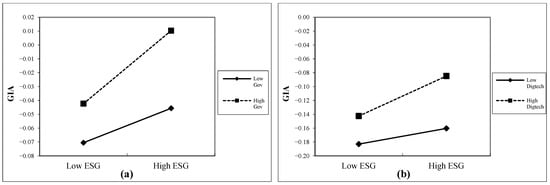
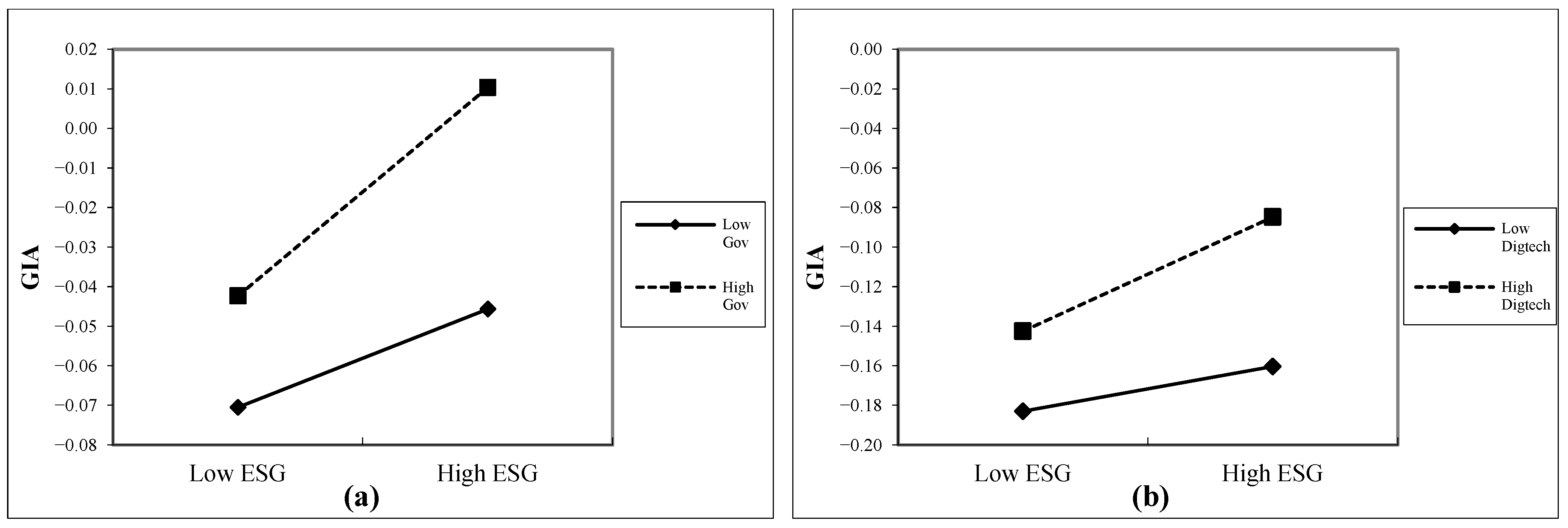
To verify these findings, following Dawson [47], we plotted the moderating effect of government subsidies on the relationship between ESG performance and sustained green innovation at high (M + 1SD) and low (M − 1SD) levels, as shown in Figure 2a. Meanwhile, we plotted the moderating effect of digitalization at high and low levels (M ± 1SD) on this relationship, as shown in Figure 2b. We observed that the association between ESG performance and sustained green innovation exhibited a considerably steeper slope for firms with high government subsidies compared to those with minimal subsidy levels. This indicated that government subsidies strengthened the positive effect of ESG performance on sustained green innovation, consistent with the positive coefficient of the interaction term (ESG × Gov). The negative main effect of subsidies suggests that when ESG performance is relatively low, subsidies may not effectively stimulate sustained green innovation and may even crowd out firms’ own innovation investments. A possible explanation is that firms with weak ESG performance often lack effective governance mechanisms and a long-term sustainability orientation. This reduces their ability to allocate subsidized resources efficiently. Similarly, the slope of this relationship was steeper for firms with higher levels of digitalization, confirming that digitalization strengthened the positive effect of ESG performance on sustained green innovation. The negative main effect of digitalization suggests that at lower levels of ESG performance, digitalization may initially divert financial and managerial resources away from green innovation due to the substantial investment, organizational restructuring costs, and adjustment burdens it entails. However, for firms with stronger ESG performance, digital capabilities tend to align more closely with sustainability objectives. These firms are more likely to leverage digitalization, strengthening the positive influence of ESG performance on sustained green innovation.
Figure 2.
(a) Moderating Effect of Government Subsidies on the Relationship Between ESG Performance and Corporate Sustained Green Innovation; and (b) Moderating Effect of Digitalization on the Relationship Between ESG Performance and Corporate Sustained Green Innovation.
5.3. Heterogeneity Analysis
5.3.1. Pollution Attribute
Based on the classification criteria for firms’ pollution attributes provided by the Guotai’an database, the sample was divided into two groups: heavily polluting firms and non-heavily polluting firms. Separate regressions were then conducted for each subsample. The regression results by pollution attributes are reported in columns (1) and (2) of Table 10. ESG performance had a significantly positive effect on non-heavy-polluting firms, but it was not significant for heavy-polluting firms. This indicated that ESG performance played a stronger role in promoting sustained green innovation in non-heavy-polluting firms. Possible reasons include: firstly, ESG investment, as an important implicit investment for firms, squeezes out some of the firm’s resources, and stringent environmental regulations increase the marginal abatement cost for heavily polluting firms [48], reducing their investment in ESG. Secondly, heavily polluting enterprises are often seen as representatives of “scattered pollution”, and their positive ESG performance is easily interpreted as a response to external public opinion pressure, which makes it difficult for enterprises to gain full trust when carrying out green innovation activities. In addition, heavily polluting industries often exhibit “high pollution, high energy consumption, and high emissions”. In the context of sustainable development, in addition to fulfilling ESG responsibilities, they also need to assume compensation obligations for environmental damage. Their efforts to improve ESG performance are often classified as compensation for environmental damage, which weakens the effect of ESG performance on sustained green innovation.
Table 10.
Heterogeneity Results.
5.3.2. Scale Attribute
We split the sample at the mean firm size into large firms and small- and medium-sized firms and then ran separate regressions for each group. Columns (3) and (4) of Table 10 report the regression results by enterprise size attribute. The ESG coefficient was 0.967 (p < 0.001) for large firms and only 0.083 (p < 0.10) for small and medium-sized firms, with a Chow test of 105.57 (p < 0.001), indicating that the positive effect of ESG on sustained green innovation was much stronger in large enterprises. Possible reasons are as follows, on the one hand, large-scale enterprises usually have more abundant resources and can convert the potential resources obtained from strong ESG performance into green innovation investment; on the other hand, large-scale enterprises receive more attention from investors and other stakeholders and have a stronger motivation to enhance their brand reputation and attract investment by improving ESG performance. Compared to small- and medium-sized enterprises, large enterprises have stronger organizational resilience and greater risk-taking ability when implementing structural and strategic green innovation activities.
5.3.3. Property Attribute
To examine heterogeneity across different ownership types, we divided the sample into state-owned firms (SOEs) and non-state-owned firms (non-SOEs). Columns (5) and (6) of Table 10 report the regression results for these two subsamples. The ESG coefficients were positive and statistically significant in both subsamples, although the coefficient was slightly larger for state-owned firms (SOEs) than for non-state-owned firms (non-SOEs). A Chow test formally rejected the equality of coefficients across the two ownership types (Chow statistic = 2.66, p < 0.070), confirming a marginally significant statistical difference. One possible explanation is that SOEs bear greater social responsibility in their operational objectives and face less pressure for short-term profits, allowing them to allocate resources to green innovation activities aligned with long-term sustainability. Against the backdrop of China’s sustained push for green development and the “dual carbon” goals, SOEs are often expected to play a leading and exemplary role by actively responding to policy guidance and enhancing their legitimacy and public recognition in the green transition through ESG disclosure and improved ESG performance. In contrast, while non-SOEs also value ESG performance, their motivations are more oriented toward enhancing corporate image, strengthening competitive advantage, and ultimately achieving sustainable profits. Consequently, their investments in green innovation tend to be more cautious.
6. Conclusions and Recommendations
Using data on A-share listed firms spanning 2013 to 2023, this study empirically examined the effect of ESG performance on firms’ sustained green innovation and the underlying transmission mechanisms. The findings show that strong ESG performance significantly promoted firms’ sustained green innovation. This conclusion remains robust after addressing endogeneity concerns and conducting a series of robustness checks. The mechanism analysis shows that ESG performance promoted sustained green innovation through two main channels: alleviating financing constraints and reducing operational risk. Strong ESG performance helps firms obtain more favorable financing by improving information transparency and building a responsible market image. This provides stable financial support for green innovation activities, which often involve long development cycles and high uncertainty. Moreover, strong ESG performance promotes effective governance and organizational legitimacy, reducing operational risk and strengthening firms’ incentives to invest in long-term green technological innovation. In addition, government subsidies and digitalization positively moderate the relationship between ESG performance and sustained green innovation. The heterogeneity analysis shows that the positive effect of ESG performance on sustained green innovation is more pronounced among non-heavy-polluting firms, large firms, and state-owned firms. This reflects the influence of firms’ resource endowments, external attention, and policy responsiveness on the sustainability of green innovation.
The findings of this study provide several actionable recommendations for relevant practitioners. From a firm perspective, firms can improve their ESG frameworks, strengthen their risk management systema, and use the moderating effect of digitalization to promote sustained green innovation. Firstly, firms should integrate ESG into long-term green innovation decision-making processes. They should abandon a short-term compliance orientation and set up a dedicated green R&D fund with long-term incentive mechanisms. Meanwhile, they should establish an internal collaboration mechanism for sustained green innovation by linking environmental performance to R&D staff evaluation. This approach fosters an organizational inertia focused on continuous patent output and eventually becomes a dynamic capability to cope with green pressure, thereby building a firm-specific path for sustained green innovation. Secondly, firms should strengthen their risk management systems and integrate ESG objectives into corporate governance practices. Specifically, they can establish ESG-oriented risk identification and early-warning mechanisms, regularly assess environmental, regulatory, and market risks associated with green innovation projects, and incorporate ESG indicators into strategic decision-making and executive performance evaluation. Moreover, improving the quality of ESG disclosure and strengthening communication with investors and other stakeholders can reduce information asymmetry, stabilize external expectations, and mitigate financing and operational risks. By creating a more predictable and resilient business environment, firms can maintain long-term commitments to green R&D and sustain continuous green innovation activities. Thirdly, firms should actively leverage digital transformation to enhance the effectiveness of ESG practices. Digital technologies can improve environmental information processing, resource allocation efficiency, and organizational coordination, facilitating the translation of ESG commitments into sustained green innovation outcomes. However, our results also indicate that digitalization is most effective when supported by strong ESG performance. Therefore, firms should integrate digital initiatives with ESG objectives rather than pursuing digital transformation in isolation.
From an industry perspective, financial institutions can link financing conditions to indicators such as the duration of a firm’s green patent holdings and its continuous green R&D investment, rather than relying solely on current ESG ratings. This would encourage firms to turn their ESG advantages into long-term R&D behavior. For firms that maintain green innovation continuity while improving ESG performance, lenders could offer differentiated terms such as interest rate discounts or fast-track approval processes. Industry associations, together with research institutions, can develop sector-specific evaluation standards for sustained green innovation. These standards could assess a firm’s level of sustained green innovation from several dimensions, including technological continuity, the stability of R&D investment, and the accumulation and transformation cycle of green innovation outputs. The results could serve as a reference for financial institutions and regulatory authorities. Meanwhile, building a shared platform for green technology R&D resources would help reduce the fixed costs of long-term R&D for individual firms.
From a government perspective, authorities should implement differentiated incentive policies for sustained innovation. When allocating subsidies, governments can set up funding mechanisms linked to green innovation persistence, based on a firm’s ESG performance, pollution profile and size. The government could first select subsidy recipients based on firms’ ESG performance. For non-heavily polluting industries and small- and medium-sized enterprises, applicants could be required to provide long-term green R&D plans, and subsidy disbursement could be linked dynamically to sustained green innovation outcomes, discouraging one-off green innovation. In terms of digital empowerment, governments can build public-good green innovation data platforms. These platforms could offer firms basic tools such as carbon footprint tracking and analysis of green technology trends, lowering the barriers for SMEs to access and use environmental data. In addition, heavily polluting firms should be encouraged to connect to environmental monitoring platforms. Digitalization helps reduce compliance costs, build a verifiable environmental reputation, and ease concerns about greenwashing.
Author Contributions
Conceptualization, L.L.; methodology, L.L., X.Z. and Z.W.; software, L.L. and X.Z.; resources, L.L.; data curation, L.L. and X.Z.; writing—original draft preparation, L.L., X.Z. and Z.W.; writing—review and editing, L.L.; visualization, L.L. and X.Z.; supervision, L.L.; project administration, L.L.; funding acquisition, L.L. All authors have read and agreed to the published version of the manuscript.
Funding
This research is supported by the Key Project of the National Social Science Fund of China [grant number 25AJY007].
Institutional Review Board Statement
Not applicable.
Informed Consent Statement
Not applicable.
Data Availability Statement
Readers may contact the corresponding author to obtain the data used here.
Acknowledgments
We would like to express our gratitude to all the individuals and organizations who have supported this study, and we are very grateful for the valuable advice and assistance received during this study.
Conflicts of Interest
The authors declare no conflicts of interest.
References
- Nguyen, Q.M.N.; Do, T.K. Do Financial Constraints Hinder or Spur Green Innovation? Econ. Lett. 2025, 257, 112688. [Google Scholar] [CrossRef] [Scilit]
- Rajesh, R. Exploring the sustainability performances of firms using environmental, social, and governance scores. J. Clean. Prod. 2020, 247, 119600. [Google Scholar] [CrossRef] [Scilit]
- Li, H.Y.; Liu, Q.Y.; Li, S.Y.; Fu, S.Y. Environmental, Social and Governance Information Disclosure and Corporate Green Innovation Performance. Stat. Res. 2022, 39, 38–54. (In Chinese) [Google Scholar] [CrossRef]
- Qin, M.; Lee, E.T. Does Information Transparency Moderate the Relationship Between ESG and Green Innovation? Empirical Evidence from China. Sustainability 2024, 16, 10245. [Google Scholar] [CrossRef] [Scilit]
- Zhang, W.; Zhao, Y.; Meng, F. ESG performance and green innovation of Chinese enterprises: Based on the perspective of financing constraints. J. Environ. Manag. 2024, 370, 122955. [Google Scholar] [CrossRef] [Scilit] [PubMed]
- Sun, Y.; Shen, Y.; Tan, Q. The Spillover Effect of Customers’ ESG Performance on Suppliers’ Green Innovation Quality. China J. Account. Res. 2024, 17, 100362. [Google Scholar] [CrossRef] [Scilit]
- Zhu, F.; Xu, X.; Sun, J. The short board effect of ESG rating and corporate green innovation activities. PLoS ONE 2024, 19, e0299795. [Google Scholar] [CrossRef] [Scilit] [PubMed]
- Gao, H.Y.; Wang, H.; Wang, X.Y.; Wen, H.Y. ESG-oriented analysts and corporate green innovation. Account. Financ. 2024, 64, 4977–5008. [Google Scholar] [CrossRef] [Scilit]
- Zhu, L.; Li, T.; Wang, C.Y.; Huang, J.H. Corporate ESG performance and green innovation: Moderating effect of shareholder activism. J. Environ. Manag. 2025, 383, 125413. [Google Scholar] [CrossRef] [Scilit] [PubMed]
- Peters, B. Persistence of innovation: Stylised facts and panel data evidence. J. Technol. Transf. 2009, 34, 226–243. [Google Scholar] [CrossRef] [Scilit]
- Raymond, W.; Mohnen, P.; Palm, F.; Van Der Loeff, S.S. Persistence of Innovation in Dutch Manufacturing: Is It Spurious? Rev. Econ. Stat. 2010, 92, 495–504. [Google Scholar] [CrossRef] [Scilit]
- Jové-Llopis, E.; Segarra-Blasco, A. Eco-innovation strategies: A panel data analysis of Spanish manufacturing firms. Bus. Strategy Environ. 2018, 27, 1209–1220. [Google Scholar] [CrossRef] [Scilit]
- Arranz, N.; Arroyabe, M.F.; Li, J.; Arranz, C.F.A.; Fernandez de Arroyabe, J.C. An integrated view of eco-innovation in the service sector: Dynamic capability, cooperation and corporate environmentalism. Bus. Strategy Environ. 2023, 32, 2882–2895. [Google Scholar] [CrossRef] [Scilit]
- Jing, R.F.; Liu, R.Z. The impact of green finance on persistence of green innovation at firm-level: A moderating perspective based on environmental regulation intensity. Financ. Res. Lett. 2024, 62, 105274. [Google Scholar] [CrossRef] [Scilit]
- Wang, X.Q.; Shi, Y.D.; Wang, J.X.; Wang, G.L.; Wei, Z.S.; Li, J.Y. Does Corporate ESG Performance Enhance Sustained Green Innovation? Empirical Evidence from China. Economics 2025, 19, 20250167. [Google Scholar] [CrossRef] [Scilit]
- Triguero, Á.; Córcoles, D. Understanding innovation: An Analysis of persistence for Spanish manufacturing firms. Res. Policy 2013, 42, 340–352. [Google Scholar] [CrossRef] [Scilit]
- Geroski, P.A.; Van Reenen, J.; Walters, C.F. How persistently do firms innovate? Res. Policy 1997, 26, 33–48. [Google Scholar] [CrossRef] [Scilit]
- Máñez, J.A.; Love, J.H. Quantifying sunk costs and learning effects in R&D persistence. Res. Policy 2020, 49, 104004. [Google Scholar] [CrossRef] [Scilit]
- Teece, D.J. Explicating dynamic capabilities: The nature and microfoundations of (sustainable) enterprise performance. Strat. Manag. J. 2007, 28, 1319–1350. [Google Scholar] [CrossRef] [Scilit]
- da Cunha, Í.G.F.; Policarpo, R.V.S.; de Oliveira, P.C.S.; Abdala, E.C.; do Nascimento Rebelatto, D.A. A systematic review of ESG indicators and corporate performance: Proposal for a conceptual framework. Future Bus. J. 2025, 11, 106. [Google Scholar] [CrossRef] [Scilit]
- Ren, L.; Gao, S.; Yang, F. ESG performance, supply chain relationship stability and enterprise technology innovation. Ind. Manag. Data Syst. 2025, 125, 1892–1914. [Google Scholar] [CrossRef] [Scilit]
- Uyar, A.; Kuzey, C.; Karaman, A.S. ESG Performance and CSR Awards: Does Consistency Matter? Financ. Res. Lett. 2022, 50, 103276. [Google Scholar] [CrossRef] [Scilit]
- Bancu, A. A Meta-Analysis of ESG Disclosure and Company’s Economic Performance. In Proceedings of the 18th International Conference on Business Excellence (ICBE)—Smart Solutions for a Sustainable Future, Bucharest, Romania, 21–23 March 2024. [Google Scholar] [CrossRef] [Scilit]
- Carè, R.; Agnese, P.; Cerciello, M.; Taddeo, S. Does It Pay Off to Disclose Sustainability Information? The Effect of ESG Disclosure on ESG Controversies in European Banks. Bus. Strategy Environ. 2025, 34, 3294–3310. [Google Scholar] [CrossRef] [Scilit]
- Xu, H.; Li, Y.; Lin, W.; Wang, H. ESG and Customer Stability: A Perspective Based on External and Internal Supervision and Reputation Mechanisms. Humanit. Soc. Sci. Commun. 2024, 11, 981. [Google Scholar] [CrossRef] [Scilit]
- Rennings, K.; Rammer, C. The Impact of Regulation-Driven Environmental Innovation on Innovation Success and Firm Performance. Ind. Innov. 2011, 18, 255–283. [Google Scholar] [CrossRef] [Scilit]
- Yu, C.H.; Wu, X.; Zhang, D.; Chen, S.; Zhang, J. Demand for green finance: Resolving financing constraints on green innovation in China. Energy Policy 2021, 153, 112255. [Google Scholar] [CrossRef] [Scilit]
- Wang, Y.; Liu, J.; Yang, X.; Shi, M.; Ran, R. The mechanism of green finance’s impact on enterprises’ sustainable green innovation. Green Financ. 2023, 5, 452–478. [Google Scholar] [CrossRef] [Scilit]
- Zhu, C.Y.; Liu, L.W.; Zhou, S.J.; Han, L.F. Executive misconduct and corporate operational risk. Financ. Res. Lett. 2025, 84, 107813. [Google Scholar] [CrossRef] [Scilit]
- Dong, X.H.; Sun, Z.H. Head off a Danger or Overreach Itself: Can ESG Performance Reduce Business Risk? J. Cent. Univ. Financ. Econ. 2023, 7, 57–67. (In Chinese) [Google Scholar] [CrossRef]
- Colak, M.; Sarioglu, M. The Effect of Corporate Governance on the Quality of Integrated Reporting and ESG Risk Ratings. Sustainability 2025, 17, 4868. [Google Scholar] [CrossRef] [Scilit]
- Chen, W.; Xie, Z.; Huang, M. Corporate ESG Performance and the Capital Market’s Information Environment: Evidence from Analysts’ Forecasts. J. Appl. Econ. 2025, 28, 2433770. [Google Scholar] [CrossRef] [Scilit]
- Zhou, G.C.; Zhang, L.; Zhang, L.M. Corporate Social Responsibility, the Atmospheric Environment, and Technological Innovation Investment. Sustainability 2019, 11, 481. [Google Scholar] [CrossRef] [Scilit]
- Zhu, W.D.; Hu, X.; Wu, Y.; Zhang, T.J. Relationship between SMEs’ ESG performance and value creation in China: The moderating role of government subsidies. J. Asia Pac. Econ. 2025, 30, 551–574. [Google Scholar] [CrossRef] [Scilit]
- Meuleman, M.; De Maeseneire, W. Do R&D subsidies affect SMEs’ access to external financing? Res. Policy 2012, 41, 580–591. [Google Scholar] [CrossRef] [Scilit]
- Wu, A. The Signal Effect of Government R&D Subsidies in China: Does Ownership Matter? Technol. Forecast. Soc. Change 2017, 117, 339–345. [Google Scholar] [CrossRef] [Scilit]
- Sang, Y.; Loganathan, K.; Sukirthanandan, P. A Study on the Impact of Corporate Digital Transformation on Environmental, Social, and Governance (ESG) Performance: Mechanism Analysis Based on Resource Allocation Efficiency and Technological Gap. Sustainability 2025, 17, 3308. [Google Scholar] [CrossRef] [Scilit]
- Liu, W.; Liu, C.; Luo, J.; Liu, F. How does digital transformation promote total factor productivity? Strategy, technology, and application. Manag. Decis. Econ. 2024, 45, 2739–2750. [Google Scholar] [CrossRef] [Scilit]
- Jovanovic, M.; Sjödin, D.; Parida, V. Co-evolution of platform architecture, platform services, and platform governance: Expanding the platform value of industrial digital platforms. Technovation 2022, 118, 102218. [Google Scholar] [CrossRef] [Scilit]
- Hu, G.; Hou, C.; Wang, H. Do high-quality online interactions improve corporate ESG performance? Evidence from China. Sustain. Account. Manag. Policy J. 2025, 16, 1426–1447. [Google Scholar] [CrossRef] [Scilit]
- Berg, F.; Kölbel, J.F.; Rigobon, R. Aggregate Confusion: The Divergence of ESG Ratings. Rev. Financ. 2022, 26, 1315–1344. [Google Scholar] [CrossRef] [Scilit]
- Heckman, J.J. Sample selection bias as a specification error. Econometrica 1979, 47, 153–161. [Google Scholar] [CrossRef] [Scilit] [PubMed]
- Kim, O.; Verrecchia, R.E. The relation among disclosure, returns, and trading volume information. Account. Rev. 2001, 76, 633–654. [Google Scholar] [CrossRef] [Scilit]
- Huang, K.Y.; Li, Z.F.; Pan, N.P.; Ni, J.W. Enterprise Digital Transformation and Share of Labor Income. Econ. Rev. 2023, 2, 15–30. (In Chinese) [Google Scholar] [CrossRef]
- Yao, P.Y. Research on the Influence Mechanism of Government Subsidy on Small and Medium-sized Enterprises Innovation. J. Technol. Econ. 2022, 41, 26–37. (In Chinese) [Google Scholar] [CrossRef]
- Zhen, H.X.; Wang, X.; Fang, H.X. Administrative Protection of Intellectual Property Rights and Corporate Digital Transformation. Econ. Res. J. 2023, 58, 62–79. (In Chinese) [Google Scholar]
- Dawson, J.F. Moderation in Management Research: What, Why, When, and How. J. Bus. Psychol. 2014, 29, 1–19. [Google Scholar] [CrossRef] [Scilit]
- Zhang, N.; Huang, X.; Qi, C. The effect of environmental regulation on the marginal abatement cost of industrial firms: Evidence from the 11th Five-Year Plan in China. Energy Econ. 2022, 112, 106147. [Google Scholar] [CrossRef] [Scilit]

Disclaimer/Publisher’s Note: The statements, opinions and data contained in all publications are solely those of the individual author(s) and contributor(s) and not of MDPI and/or the editor(s). MDPI and/or the editor(s) disclaim responsibility for any injury to people or property resulting from any ideas, methods, instructions or products referred to in the content. |
© 2026 by the authors. Licensee MDPI, Basel, Switzerland. This article is an open access article distributed under the terms and conditions of the Creative Commons Attribution (CC BY) license.