


Abstract
Shaded Arabica coffee production in agroforestry systems, as opposed to full-sun production, is a nature-based solution improving soil water balance, reducing heat exposure of coffee plants, and supporting sustainable forest management as opposed to deforestation. For this coffee production system in Mexico, which is dominated by smallholders as the largest group of coffee producers, we herein analyze current and estimate future yields. For the first time, to our best knowledge, this is done with a process-based coffee agroforestry model CAF2014 that we adapted for geo-spatial applications and named CAF2014-Rhaobi. Modeling of smallholders’ representative management is based on tree thinning, pruning frequency, and nitrogen supply through fertilizer and litter from nitrogen-fixing shade trees. Modeled historical yields generally agree with the reported numbers; however, there are discrepancies explained by modeling assumptions and simplifications. While shade trees help sustain coffee production, the projected drop in yields under present management is about 30% at the end of the century compared to the present as estimated using an ensemble of CMIP6 SSP5-8.5 climate projections. Economic analysis for three typologies of Mexican small coffee producers (conventional low, high-efficiency, and organic) reveals the major role of farmer associations and organic coffee price premiums in making production economically sustainable. This emphasizes the need for innovative marketing approaches and policies supporting farmers opting for certified production.
1. Introduction
Sustainable crop production has received growing attention in recent decades as a key pillar of circular economy policy frameworks [1] and gained increasing awareness due to growing concerns related to nature protection, sustainable provision of ecosystem services and biodiversity conservation [2,3]. The challenges associated with sustainable production in agriculture are exacerbated by projected impacts of climate change on crop yields [4,5], income loss by local farmers, and resulting regional socio-economic issues [6]. Adverse impacts of climate change, such as higher temperatures and increased extremes, heavy rainfalls, and prolonged droughts are of particular concern to climate-vulnerable regions of the world where livelihoods of predominantly smallholder farmers are dependent on optimal conditions for crop growth [7]. Especially in the tropics, a vast majority of agricultural production is subsistence farming of climate-sensitive perennial crops such as coffee. In these regions, climate change has shown to aggravate existing food insecurity, poverty, and conflicts causing farm labor migration to urban areas as well as emigration to other countries [8,9]. Addressing these complex interlinkages requires an integrated policy framework with multi-dimensional sustainability measures, including aspects of farmers economic and technical adaptation capacity to climate change [10,11].
In this paper, we present the developments within the SAbERES (https://saberesmx.org/ (in Spanish), accessed on 15 May 2026) project, which focuses on the analysis of potential climate change impacts on crop production and financial feasibility of smallholder farmers to adopt sustainable ecosystem-based adaptation measures in selected states of Mexico. While SAbERES covers a wide range of crops and agricultural production systems, the subject of this study is smallholders’ production of coffee (Arabica) in agroforestry systems. This subject is important for several reasons. Firstly, coffee production in Mexico is highly dominated by smallholder farmers: in total, there are 545 thousand individual coffee producers; most coffee farming households consist of 3.3 members, maintaining an average coffee area of under 3 hectares, with around 90% managing 2 hectares or less [12]. Secondly, coffee production is highly diverse in terms of system typology yet can be classified into two broad categories: traditional agroforestry systems, dominated by smallholder producers, and modern systems with a mix of small to large producers that include shaded and full-sun production [13]. In total, up to 90% of coffee in Mexico is produced under shaded systems [13,14]. While typical coffee farm management is system-specific and varies highly in terms of input intensity [15], which is generally increasing with the level of commercialization, farm management is likewise influenced by traditional management practices [16].
Questions related to modeling coffee production in agroforestry systems received great attention in the literature, covering projections of global suitability changes under climate change [17], development of process-based coffee growth models for agroforestry systems [18,19,20], and carrying out focused research on selected Central American countries [21]. A wealth of literature sources can be obtained through dedicated review papers on specific aspects such as ecophysiology [22], sustainability of global supply chains [23,24], and organic coffee production [25]. Earlier analysis of climate impacts and adaptation strategies for coffee production [7] highlights agroforestry as a potential adaptation strategy and emphasizes the need to quantify economic benefits of adaptation measures. Previous spatio-explicit coffee growth modeling work has either employed coarser statistical approaches to derive suitability indicators [17] instead of direct estimation of yields, which allow for economic impact assessment, or covered larger geographical areas without reflecting Mexican smallholders’ specifics [20,21].
In this paper, we focus specifically on Mexico and smallholders growing coffee in ecologically sustainable agroforestry systems, and within that context we focus on two main aspects: (1) obtaining estimates of coffee Arabica yield changes under projected climate change by employing a process-based coffee growth model CAF2014 [18], and (2) analyzing economic sustainability of coffee production in such systems by employing typologies of smallholder producers and retrospectively estimating their profitability. By analyzing both bio-physical and socio-economic components of sustainability of Mexican coffee production, we identify priorities relevant for present and for future development. While the coffee yield modeling results indicate pronounced yield decline under projected climate warming scenarios, the high-quality organic coffee price premiums accessible through farmer associations appear to be a likely potential solution for both short- and long-term development, while other options beyond coffee production alone, e.g., crop diversification and apiculture, are not directly addressed in this analysis and should not be neglected for that reason.
2. Materials and Methods
2.1. Bio-Physical Modeling
To model the complexity of shaded coffee growth, we have employed the state-of-the-art process-based coffee agroforestry model CAF2014 [18,26]. The model requires input of daily weather information via six variables: solar radiation, daily minimum and maximum temperature, air humidity, wind speed, and precipitation. The management of coffee plants and shading trees is described by scheduled fertilizer applications, thinning, and pruning of shade trees. A more recent version of the model, CAF2021 [19,27], supports the modeling of more complex configurations of shading trees of up to three layers including fruit production. In our analysis, because of the data limitations, we could not use these advanced features and therefore applied the more established and proven robust CAF2014 version of the model following the same approach as earlier studies [28]. CAF2014 estimates growth of shade trees and coffee plants and yield formation at a daily time step based on the above inputs. The model includes modulation of tree stand temperature and evapotranspiration, as well as competition for solar radiation, soil water, and nutrients [18].
Modeling climate change impacts on yields can be carried out using two conceptually different approaches: statistical, providing location suitability indicators, and process-based modeling, directly estimating yield potential. The benefits of using a process-based model include transparent outputs expressed in physical units of tons of product per hectare, which is suitable for consequent use in economic estimates (as opposed to unit-less suitability indicator) and explicit accounting for management practices (such as pruning and thinning). While these factors can provide useful information, they are subject to model calibration and validation, which have not been fully carried out for the CAF2014 model, whereas multiple applications of the model have been reported for agro-environmentally and socio-economically similar regions across Central America [21,29]. From that perspective, the results obtained in our exploratory analysis are similar in nature to the state-of-the-art applications published in the literature.
2.1.1. General Model Setup and Evaluation
Coffee yield can be expressed as dry or fresh matter, which needs to be harmonized before data from different sources can be compared. Yields in CAF2014 model output are expressed in tons of dry matter (DM) per hectare [tDM/ha], whereas the official statistics on yields in the Mexican SIAP database [30] employ units of tons of fresh weight (FW) of harvested coffee cherries (“café cereza”). Water content in harvested coffee cherry FW can vary according to the literature (53% in [31], 55–60% in [32], 65% in [33]). We have employed the value of 53% from [31], which is specific to the Chiapas state in Mexico.
Reported yields are influenced by plenty of socio-economic and environmental factors beyond those represented in the model. Pest and diseases such as coffee berry borer and coffee leaf rust (CLR) represent a major threat [34,35]). CLR is one of the main limiting factors of Arabica coffee production worldwide [36]. Its devastating impact during the season 2012/2013 outbreak caused about one billion USD in damage and affected the livelihoods of more than two million people in Latin America [37]. Socio-economic constraints (e.g., labor force availability [34]) can lead to inefficiencies and therefore result in suboptimal yields. From that perspective, modeled yields should be understood as representations of potential yields; therefore, a model’s overestimation of the reported value should not come as a surprise.
While the CAF2014 model is highly configurable through a rich set of parameters (about one hundred values are describing a site/plot), even in the exemplified applications using measured data from research stations at coffee growing plots it was impossible to calibrate the full set of models’ parameters [18], leaving large parts at default values collected from diverse literature sources [38]. In our analysis, we tried to refine key model inputs where possible while reusing the default model parametrization for other inputs, which is not specific to any Mexican state. The local daily weather inputs are provided by the ISIMIP climatic datasets [39,40]. While there is a publicly available database providing historical records from individual weather stations comprising a network covering the territory of Mexico [41], there are issues hindering its use in modeling, e.g., gaps in daily records and a rather sparse set of provided variables (e.g., lack of incident solar radiation data).
Prior to spatially explicit applications of CAF2014 involving adaptation of the original model, to ensure expected qualitative behavior, we carried out location-specific model testing discussed in Appendix A.1.
2.1.2. Geo-Spatial Extension of CAF2014 Model
The original CAF2014 model has been designed for plot-scale applications and employs plain text files to provide site-specific weather information inputs. These files are read in the R scripting environment (https://www.r-project.org/; we used R version 4.5.2) and passed to the Fortran core module of the model. Handling plain text data inputs in the context of geo-spatial applications is associated with technical challenges resulting in slowed down model operation due to (a) large number of relatively small individual files and respectively large number of small read operations downgrading the file system performance in a computing environment, and (b) inefficiency of converting from textual representation of the floating point numbers contained within plain text data files into a binary format used by the model internally each time a model is run. These issues are known from other applications of field-scale crop growth modeling and have been discussed, e.g., in [42]. To address these drawbacks, we extended CAF2014 into a geo-spatial version called CAF2014-Rhaobi. This version uses a more efficient format of the daily weather input data, which is generated by converting the standard ISIMIP3b datasets in NetCDF format [39,40] into a binary format most suitable for the operation mode of CAF2014, a sequential feed of data for a set of map pixels, and for each pixel, a parallel feed of all required weather variables sequentially for each day in the modeled time frame. The climate data processing is based on the CROp Model Emulator Suite (CROMES) data processing pipeline [43], where in the NetCDF-to-binary format conversion routine (which is carried only once before a first run) the original set of two-dimensional maps contained within a NetCDF file is converted to a set of vectors—time series—of individual map pixels relevant to geographic locations of interest.
While the binary weather data format was adopted for the CAF2014-Rhaobi version of the model, the commonly used representation of air humidity in ISIMIP3b datasets [39,40] assumes specific or relative humidity and not vapor pressure as implemented in the original CAF2014. We carried out modifications in the original Fortran source code of the core model to replace the water vapor pressure input parameter with the relative humidity variable without otherwise affecting the model logic and keep the representation of all modeled processes intact. We used the equation linking air relative humidity (RH) with water vapor pressure (VP) and saturated vapor pressure (SVP), estimated by CAF2014 for a given temperature:
RH = VP/SVP.
The last modification that we implemented in the CAF2014-Rhaobi, which is convenient for visualization, is the optional annual output of coffee yield, in addition to accumulated (daily) harvestable cherries in original CAF2014. The source code of the CAF2014-Rhaobi model is available in the form of patches to the original model code [44].
2.1.3. Model Setup for Mexico
The spatial extent in our model setup covers current coffee production areas as informed at municipality level by the SIAP database [30]. While there may exist more areas unexplored or unused, yet suitable for coffee production, the degree of suitability of those potential areas might be hard to estimate, particularly due to a challenge we faced regarding representation of key soil water parameters. After exploring three potential data sources, including SAGARPA/SADER-FAO soil database [45] (which is focused on areas other than those producing Arabica coffee), Harmonized World Soil Database [46], and GEOBENE soil database [47] (which are commonly used for modeling annual crops in lowlands; in a test location in Mexico, they demonstrated a disagreement of about 50% in available water storage capacity (AWC)), and after analyzing uncertainty in pedotransfer functions that are routinely employed to translate soil parameters into key water holding characteristics such as wilting point and water capacity [48] (which demonstrated a wide plausible range for AWC), we decided to stick to default CAF2014 soil representation as it is relevant to coffee growing plots and is compatible with the model [49]. (The uncertainty in wilting point (WP) and field capacity (FC) estimates is approximately ±30% and ±30%, respectively, as visually estimated from Figure 1 (panels (A) and (B)) in [48] for somewhat middle-range values of WP = 0.15 and FC = 0.3. That uncertainty translates into a potential uncertainty of the available water storage capacity (AWC) estimates within the range of AWC = FC − WP = (0.3–30%) − (0.15 + 30%) = 0.2 − 0.2 = 0.0 to (0.3 + 30%) − (0.15–30%) = 0.4 − 0.1 = 0.3. This potential range of 100% uncertainty around the mid value of AWC = 0.3 − 0.15 = 0.15 indicates the scale of variation potentially driving the model input data outside of the feasibility range.)
To derive a description of typical approaches to coffee plantations and shading trees management by small coffee growers in Mexico, at the first step we consulted two LLMs (ChatGPT (https://chatgpt.com/) and DeepSeek (https://chat.deepseek.com/)) by posing to both the same seeding question:
“What are the practices used by small coffee growers in Mexico in terms of shade tree thinning and pruning and also fertilizer application?”
The initial responses were refined and manually checked for consistency with factual data provided in the literature references (see below). The literature review was expanded beyond and independently from the initial point provided by the LLMs. The full interrogation protocol for both ChatGPT and DeepSeek LLM is accessible [50]. Under the limitations of availability of quantitative data in the official publicly accessible databases and literature, the following values reported in the Mexican context [51,52,53] appear to be a reasonable approximation of small shade-grown coffee production management practices in Mexico, which we employed in the consequent modeling:
- Shading cover: 40–50%; pruning once a year; shade tree density 260 trees per hectare.
- Fertilizer application: 0–75 kg N/1000 plants/ha/year. Optionally 20–40 kg N/ha from litter of nitrogen fixing shade tree (Inga).
- Coffee plant density: as low as 800 plants/ha at mean 1900 plants/ha [52].
The smallholders’ management as represented above is quite low intensity compared to management specifications provided in the recent publication [20] for high-intensity commercial polyculture in the Mexican State of Chiapas (about 3300 coffee plants/ha, 100 shade trees (Inga), 70% annual pruning), while fertilizer application rates were beyond the scope of the study [20]. The default N application rate in CAF2014 is 150 kg N/ha, which is slightly higher than in our management representation corresponding to 1500 plants/ha and applying 75 kg N/1000 plants/ha/year, resulting in about 120 kg N/ha. This quantity is close to the lower bound of the range of 140–360 kg N/ha reported in the literature for Central America [54]. Estimation of soil nitrogen supply from nitrogen fixing trees, both through atmospheric N fixed in litter and nitrogen fixation by tree roots, is carried out by default parametrization of the CAF2014 model.
2.2. Economic Modeling
The question driving our economic analysis is potential requirement of operational loans to sufficiently cover financial gaps of coffee producers who are facing market price fluctuations and yield uncertainty induced by adverse weather conditions, pests and diseases. In the context of sustainable production, it is important to evaluate the issue of low access to finances faced by small Mexican coffee producers as coffee farming becomes riskier [55].
There is a substantial volatility of international market price of coffee, which in the past 45 years fluctuated multiple times between 0.75 and 2.50 USD per pound [56]. Data in the Mexican agricultural database SIAP [30] indicate a four-fold increase in rural coffee price in the last 20 years (2003–2023), which correlates with international coffee price development over the same period. However, as Mexican currency, the peso, has lost its value against the US dollar [57] in the past 20 years, and as considerable levels of inflation over this period are reported for Mexico [58], the profits of coffee producers might have experienced substantial stress.
The analysis of spatial patterns of coffee yields and prices at municipality level in Mexico based on official statistics [30] highlights the disentanglement of coffee yield and price as evidenced by high yield–low price, low yield–high price, and “medium” combinations. The factual heterogeneity of coffee producers and growing conditions calls for analysis of respective typologies for a comprehensive economic assessment.
For modeling of agroforestry coffee production systems in Mexico, we employ economic parametrization of three systems: (1) certified organic, (2) conventional intensive, and (3) conventional low input coffee production [59]. The year 2000 serves as a baseline, and producer’s coffee price and costs for the three systems are taken from [59] for the baseline year. The key features of the production systems are summarized in Table 1. Application of historical coffee prices together with adjustments for exchange and inflation rates allows for retrospective annual profit projections for each of the three considered production systems and serves as a basis for systems benchmarking against each other.
Table 1.
Key features of three agroforestry coffee production systems: certified organic (Organic), conventional intensive (Intensive), and conventional low input (Low Input). Values are for the year 2000 and per hectare, where applicable. Summarized from [59].
3. Results
3.1. Climate Impacts on Shaded Coffee Yields
We largely follow the interpretation of CAF2014 model applications in the literature [29], which suggests focusing on identifying the direction of change in coffee yield in the context of climate change adaptation. This accounts for the recognized uncertainty in the absolute yield change due to the aforementioned limitations in data and complexity of cultivation systems. We still report the quantitative yield outputs of the model for transparency and indication of the order of magnitude.
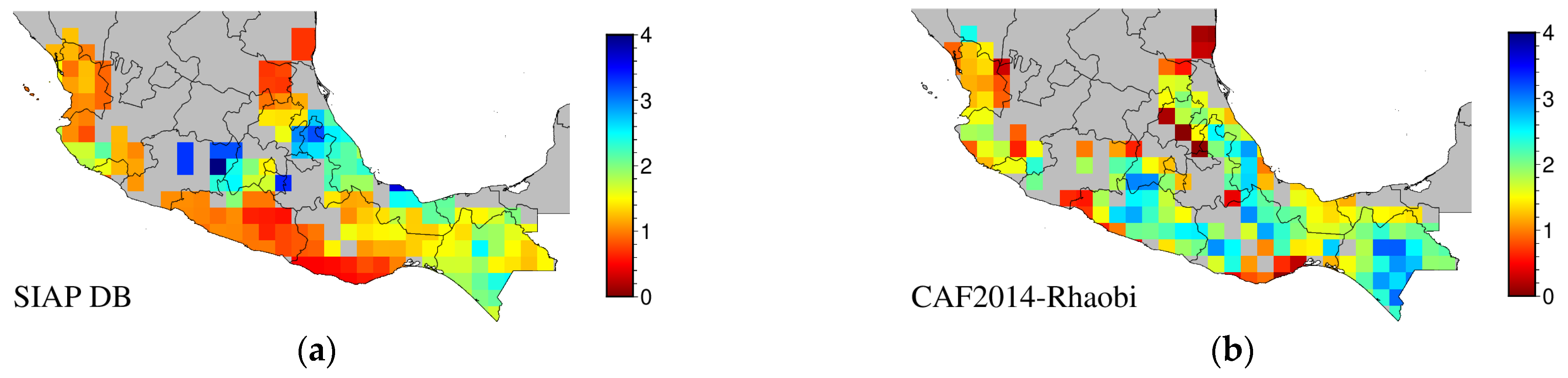
For that purpose, we set up the CAF2014 model to approximately represent the small shade-grown coffee production practices in Mexico, while not directly calibrating absolute yield values. Employing a near-term climate projection for 2021–2030 as a close representative of the average climate observed over historical period 2003–2023, the comparison between reported and modeled period-average yields is presented in Figure 1. While modeled yield potentials are naturally higher than the realized (reported) yields, the model is able to capture the general pattern with relatively lower yields in northern and north-west parts of coffee-producing regions in Mexico and relatively higher yields in north-eastern and south-eastern parts. However, yields in the south-western part (i.e., state of Guerrero) are obviously higher in the simulations, likely indicating deviations larger than elsewhere from the representative approximate management that we employed in the model setup.
Figure 1.
Coffee yield in coffee-producing regions of Mexico (ton fresh matter/ha/year) gridded at 0.5 arc-degree (a) reported at municipality-level (SIAP DB) averaged over 2003–2023 and (b) estimated by CAF2014-Rhaobi model for a BAU-representative management and default CAF2014 soil water characteristics, employing climate dataset ISIMIP3b GFDL-ESM4 SSP585 daily 2021–2030.
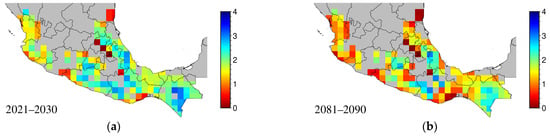
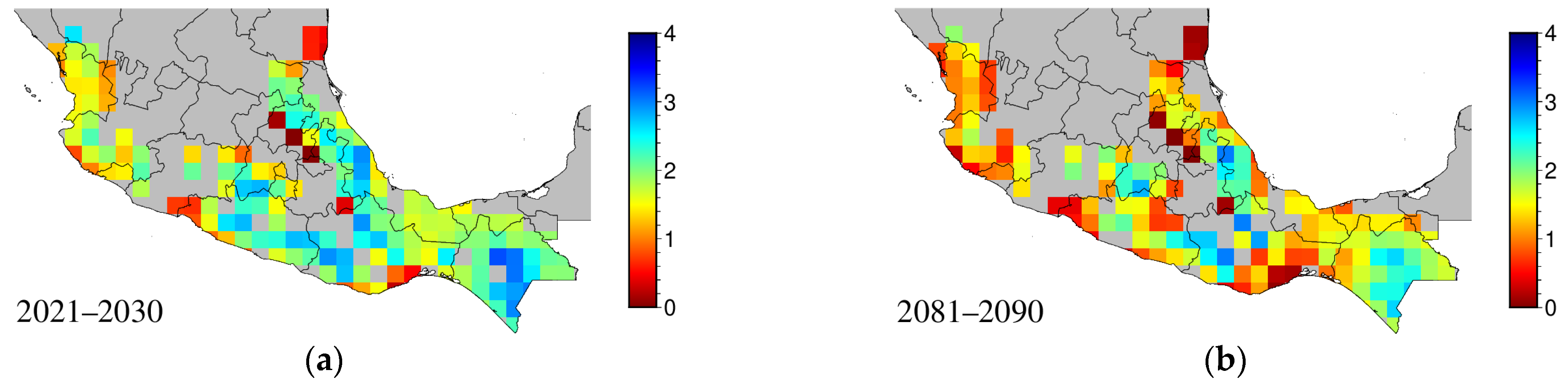
The impact of projected climate change on small-grower coffee yields estimated using an ensemble of five ISIMIP3b climate models (GFDL-ESM4, IPSL-CM6A-LR, MPI-ESM1-2-HR, MRI-ESM2-0, and UKESM1-0-LL) is presented in Figure 2. Visually, the main range of potential yields shifts from 2.0–2.5 ton fm/ha in 2021–2030 to 1.0–2.0 ton fm/ha at the end of the century, which is about a 30% yield reduction, posing a major potential impact.
Figure 2.
Coffee yield in coffee-producing regions of Mexico (ton fresh matter/ha/year) (a) averaged over 2021–2030 and (b) averaged over 2081–2090, gridded at 0.5 arc-degree, ensemble average for the five ISIMIP3b priority climate models for SSP585 scenario as estimated by CAF2014-Rhaobi model for BAU-representative management and default CAF2014 soil water characteristics.
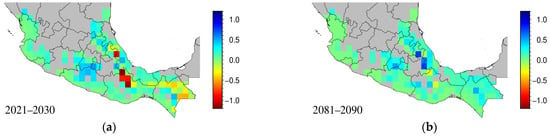
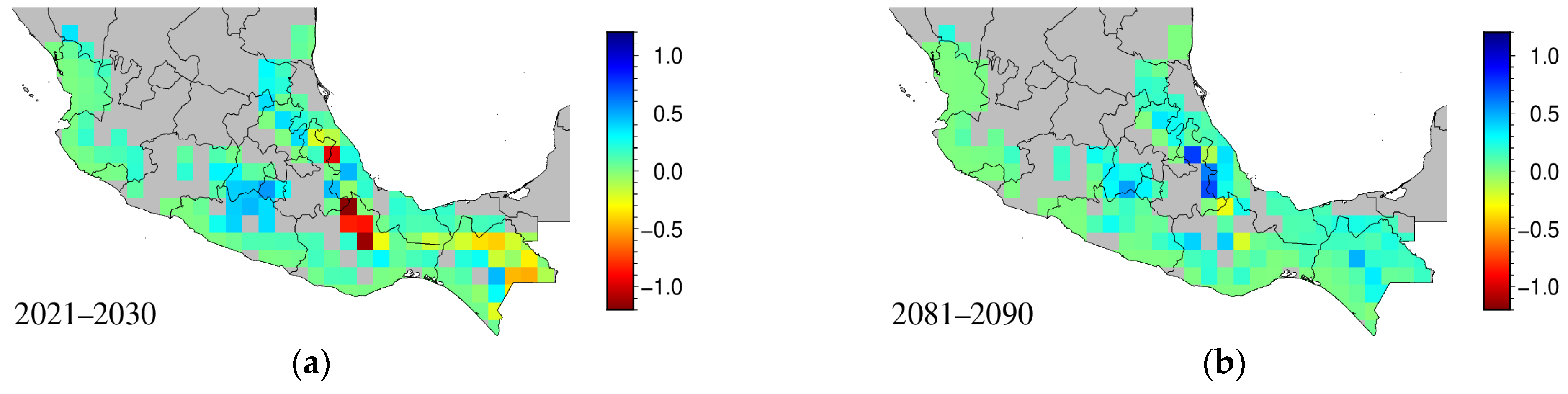
The alleviation effect of shading trees under projected increased temperatures on smallholder coffee yields as estimated by CAF2014-Rhaobi model is presented in Figure 3. While there are currently few spots where coffee plants can benefit from a higher level of sunlight exposure under low input management, under projected future climate, shade-grown coffee becomes a better strategy over the whole study area.
Figure 3.
Difference between shade-grown and full-sun coffee yield potential estimates in coffee-producing regions of Mexico (ton fresh matter/ha/year) (a) averaged over 2021–2030 and (b) averaged over 2081–2090, gridded at 0.5 arc-degree, ensemble average for five ISIMIP3b climate models for SSP585 scenario as estimated by CAF2014-Rhaobi model for BAU-representative management and default CAF2014 soil water characteristics. Positive values indicate shade-grown yield exceeding full-sun yield.
3.2. Economic Analysis of Coffee Production Systems
Economic analysis of long-term perspectives of coffee production would necessarily require projections of domestic and international market prices as well as labor and input cost projections, which pose a major challenge for modeling. While keeping in mind the scale of projected climate impact on coffee yields in the long term, we focus on comparative analysis of medium-term economic sustainability of Mexican coffee production systems using historical data. For systems cross-comparison, we illustratively apply projected climate impact on coffee yields to otherwise constant parametrization of present systems’ economics.
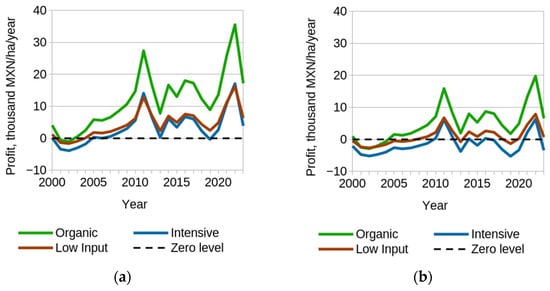
We obtained retrospective profit projections for tree production systems (certified organic, conventional intensive, and conventional low input), employing historical international prices [56] and applying a price discount to the international market price estimated for the base year as a percent difference between international and local price [59]. That discount was applied to international prices from 2001 onward to assess producers’ coffee price in USD. Annual USD/MXN exchange rates [57] were applied for conversion of the USD price to Mexican pesos. Finally, the annual profit estimates corresponding to production systems and presented in Figure 4a were obtained for 2000–2023 by inflating production systems’ baseline costs as informed by the annual Mexican inflation rate [58]. Figure 4 vividly illustrates that the certified organic system outperforms the others apparently due to the organic coffee price premium, since costs per unit output are comparable (Table 1). In the initial part of the profit trajectories, all production systems, to a different extent, experience losses that would require financial coverage, e.g., bank loans, to protect producers from bankruptcy, while paybacks are ensured through positive future profits (yet are conditional on the level of interest rate).
Figure 4.
Retrospective projection of profitability of three Mexican coffee production systems: certified organic (Organic), conventional intensive (Intensive), and conventional low input (Low Input) coffee production (a), and similar estimates corresponding to yields decreased by 30% while keeping respective system costs constant (b).
To indicatively illustrate the economic effect of projected climate impact of 30% decrease in yields (assuming validity of the estimate for considered systems beyond smallholders), we kept the prices and costs constant, decreased the yields, and re-estimated the profits by production system. Figure 4b presents respective profit trajectories. Certified organic production still outperforms the other production systems. The conventional low input system demonstrates higher viability than conventional intensive production as it benefits from cost savings under lowering yields. In the considered context, conventional intensive coffee production becomes unsustainable under long-term climate change, while both closer-to-nature certified organic production and conventional low input systems remain economically profitable. However, the latter provides positive yet minimal profits, which would likely be insufficient as a single income to smallholder farmers, either pushing them to seek alternative sources of income or diversify production to include other crops [12].
4. Discussion
In our climate impact assessments, we did not explicitly include the possible CO2 fertilization effect because it is highly uncertain, whereas according to studies in Africa it can potentially offset 13–21% of the negative climate impact on coffee yields at the midpoint of the century [29]. On the other hand, a warming climate can likely create more favorable conditions for the spread of pests and diseases and thus create additional yield reduction factors for coffee production [60,61].
One of the challenges associated with employing the CAF2014 model is the implicit modeling assumption on the coffee plant density. The literature reporting on various CAF2014 (and CAF2021) applications [18,19,29,38] does not explicate the quantification of this parameter, which is assumed but is not included in the model. From that perspective, coffee yields obtained from the model are subject to adjustment reflecting coffee plant density, and corresponding adjustments may be required to the fertilizer application rate used as an input for the model, as presently it is expressed per one thousand plants per hectare.
Soil nitrogen supply from nitrogen fixing trees is estimated by default parametrization of the CAF2014 model, whereas local growing conditions may vary and be different from default model settings. However, calibration of nutrient balance in the soils would require extensive spatio-temporal coverage of soil samples specific to coffee production areas in Mexico and a sufficiently long time series of controlled experiments in a representative set of plots, which are currently not available.
In our estimates we approximately represent small shade-grown coffee production practices in Mexico, while not directly calibrating the modeled absolute yields, let alone coffee quality indicators. Both are equally important for obtaining reliable economic assessments, whereas representation of coffee bean quality, to our knowledge, is beyond the state-of-the-art modeling capabilities to date.
While long-term climate impact projections on coffee yields indicate a tangible decline of 30% by the end of the century, the four-fold coffee market price fluctuations strongly impact economic sustainability of coffee producers in Mexico in the short and medium term.
Organic price premiums change over time. The premiums of about 40% to conventional coffee, reported for 2000 in the literature [59] for a case study of a small organic producers’ association, are conditional on the negotiating power of the cooperative or association and are location- and coffee-grade-specific. More recent publications indicate lower numbers: certified farmers receive prices only 6–7% higher than those of non-certified farmers, and farmers can obtain a 10–12% higher price by participating in cooperatives [12]. Projection into the future of the premiums, which are derivatives of market price, poses a challenge beyond the scope of the indicative assessment presented in this paper. Similarly, using constant yield and uniform scaling according to the inflation rate of all cost items (e.g., fertilizer, labor, and transportation) is a simplification. Therefore, the presented results should be considered as illustrative, especially because small coffee growers in Mexico are facing the problem of insufficient earnings to support their livelihoods, resulting in a high percentage of them living below the poverty line [12].
In the context of economic sustainability of coffee producers under fluctuating product and input prices, bank loans may be required to cover finance gaps. Loan paybacks are ensured through future profits yet are conditional on interest rate. We did not estimate the admissible interest rate as the profit estimation is rather qualitative due to modeling limitations discussed above.
The economic effect of a projected 30% decrease in coffee yields due to adverse climate change is estimated in a simplified manner. First, the yield decrease is obtained for smallholder management yet is applied to all production systems, while the impact may be different for more intensively managed systems. Second, keeping the cost constant under yield decrease is an approximation that may need refinement. While harvesting labor per plant may likely receive only a minor change, fertilizer application rate may need a downward correction as coffee plants growth would be limited by water and temperature (unless nutrient take-up efficiency of a plant would also suffer, requiring higher N concentration in the soil). Transportation costs for a smaller quantity can likely be reduced for larger producers, whereas it could remain nearly constant for smallholders if calculated per truck carrying a smaller load of harvested coffee beans.
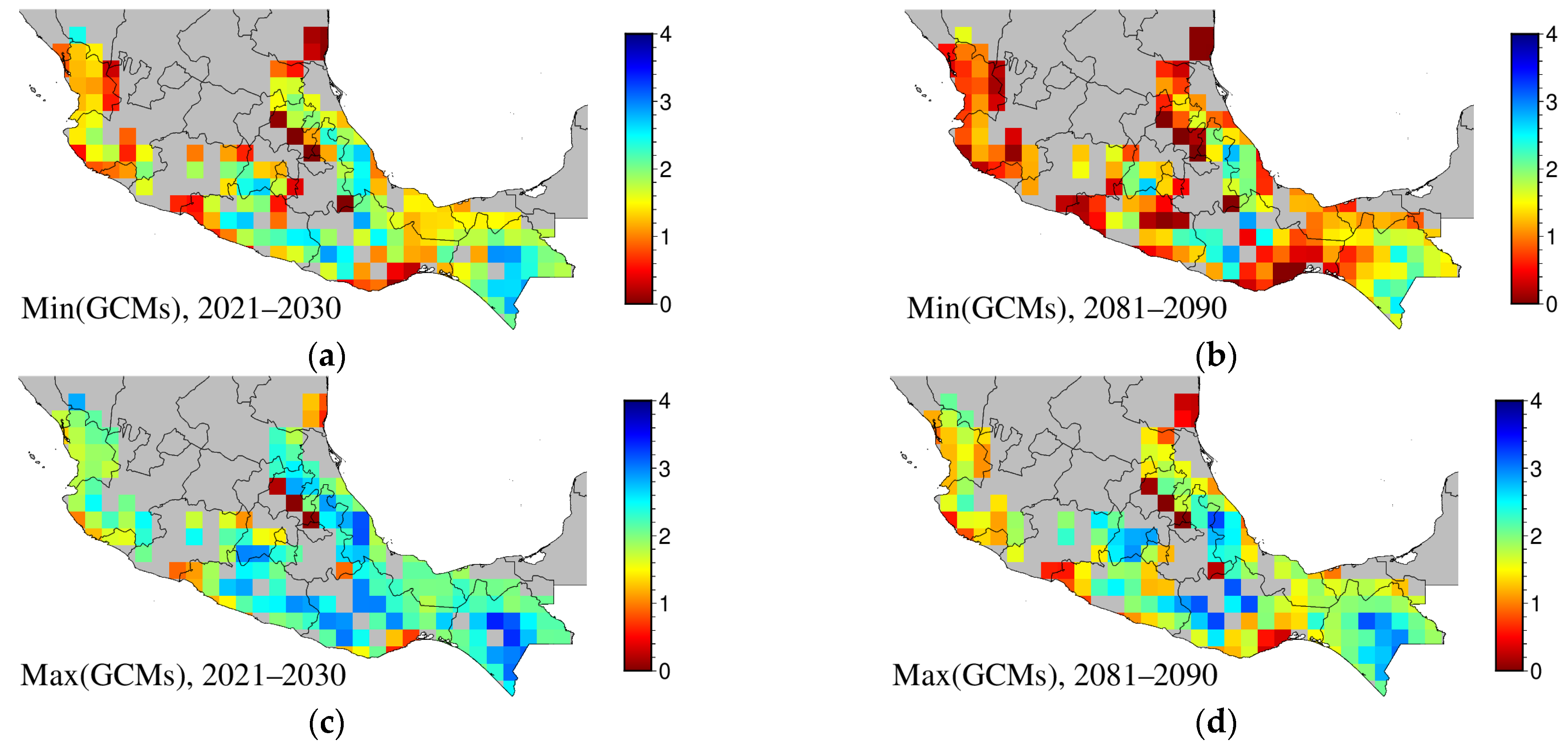
Finally, existing climate uncertainties must be recognized as an overarching frame for obtaining long-term yield assessments. There are substantial deviations from the average impact estimates presented in Figure 2. The minimum and maximum estimates from the considered ensemble of climate models are shown in Figure A2. The topic of climate uncertainty in agricultural yield projections received vast attention in the literature, covering staple crops and crop model ensembles. While in this study we are using only one model, earlier publications in the field, focused on annual crops and generally on sectoral impact models, highlight that uncertainty from impact models is larger than from climate models [62], that climate and crop models may contribute about equally to overall uncertainty [63], and that crop models can be the primary source of uncertainty in agricultural projections [64]. A promising approach for obtaining more robust crop impact estimates is the optimization of model ensemble size and composition [65], which could be explored in the future also for coffee growth modeling.
5. Conclusions
In this paper, we presented, for the first time, spatially explicit shade-grown coffee Arabica yield projections for Mexican smallholders as informed by a process-based coffee growth model for an ensemble of SSP5-8.5 climate projections. Growing coffee under shade trees supports sustainable forest management and provides alleviation to adverse climate change impacts on coffee production yet cannot compensate for about 30% yield reduction at the end of the century compared to the present. Accompanying economic analysis based on typologies of Mexican coffee producers highlights that the organic coffee price premium accessible to farmer associations can play an important role in the economic sustainability of coffee production. Along with other options for increasing income through product diversification, certified organic production appears as a potential means of adaptation to projected yield decline. Coffee varieties tolerant to adverse climate conditions and more resistant to pests and diseases could be a key to keeping production levels. The looming transition would necessarily require financial support both in the form of investment, provision of operational capital, and insurance, hinting the necessity of facilitating farmers’ access to finance. The challenges ahead call for innovative marketing approaches and policies supporting farmers opting for sustainable coffee production.
Author Contributions
Conceptualization, N.K. and C.F.; methodology, N.K.; software, N.K.; validation, N.K., S.L. and C.F.; formal analysis, N.K.; investigation, S.L. and N.K.; data curation, N.K. and C.E.G.-A.; writing—original draft preparation, N.K.; writing—review and editing, N.K., S.L., C.F., R.S., C.E.G.-A. and V.J.-R.; visualization, N.K.; supervision, V.J.-R.; project administration, V.J.-R.; funding acquisition, V.J.-R. All authors have read and agreed to the published version of the manuscript.
Funding
This research was funded by the International Climate Initiative (IKI), supported by the Federal Republic of Germany, represented by the Federal Ministry for the Environment, Nature Conservation, Nuclear Safety and Consumer Protection (BMUV), under the project “Land-use planning and financial innovation (SAbERES: 22_II_180_MEX_A/23-152)”.
Institutional Review Board Statement
Not applicable.
Informed Consent Statement
Not applicable.
Data Availability Statement
The data presented in this study are available on request from the corresponding author.
Acknowledgments
The authors acknowledge Victoria Starkey for administrative support. During the study, the authors used ChatGPT (https://chatgpt.com/) and DeepSeek (https://chat.deepseek.com/) for the purposes of initial data collection as reported in detail in the manuscript. The authors have reviewed and edited the output and take full responsibility for the content of this publication.
Conflicts of Interest
The authors declare no conflicts of interest. The funders had no role in the design of the study; in the collection, analyses, nor interpretation of data; in the writing of the manuscript; nor in the decision to publish the results.
Appendix A
Appendix A.1. Location-Specific Testing and Sensitivity to Inputs
Prior to spatially explicit applications of CAF2014 involving adaptation of the original model, we carried out model testing for two randomly selected locations in coffee-producing Mexican states Oaxaca and Chiapas (selected two locations are in Chiapas/Altamirano (geographic coordinates: 16°44′10″ N 92°02′20″ W) and in Oaxaca/Santiago Xanica (16°00′ N 96°14′ W)). An analysis of model behavior for a fixed location allows for higher flexibility and detail than an application covering a wide geographical area would allow.
We first aimed at estimation of a climate signal and obtained outputs of the CAF2014 model with minimum modifications in configuration from the original version by only replacing weather data with that relevant to the selected two test locations in Mexico. The comparison of the model outputs for historical weather data [39] and SSP585 GFDL ISIMIP climate projection [40], as presented in Figure A1, indicates that soil water availability (WA) shows more intermittence in the projected future, resulting (along with increased temperatures) in degradation of coffee plant leaves (LAI) and lowered yields, respectively. Compared to an open-sun system, tree-shaded coffee production can likely provide more sustainable yields in the future, and while alleviation effect may vary, that would probably not solve the looming problem of declining yields in that particular location. While absolute values of the estimated yields from the default model configuration cannot be expected to reflect actually realized yields due to the discussed model limitations, the relative change appears to qualitatively represent the climate signal—a plausible outcome of the SSP585 (high degree of warming) scenario imposing temperature and water stress on plants.
Figure A1.
Climate signal in coffee yields of the default CAF2014 model driven by historical (a) and SSP585-projected (b) weather data for a location in Chiapas for open-sun (black, red) and tree-shaded (green, blue) production systems. In CAF2014 notation, LAI is the coffee plants leaf area index, harvMDav_year is the coffee yield (ton of dry matter/ha/year), and WA is water availability in the soil.
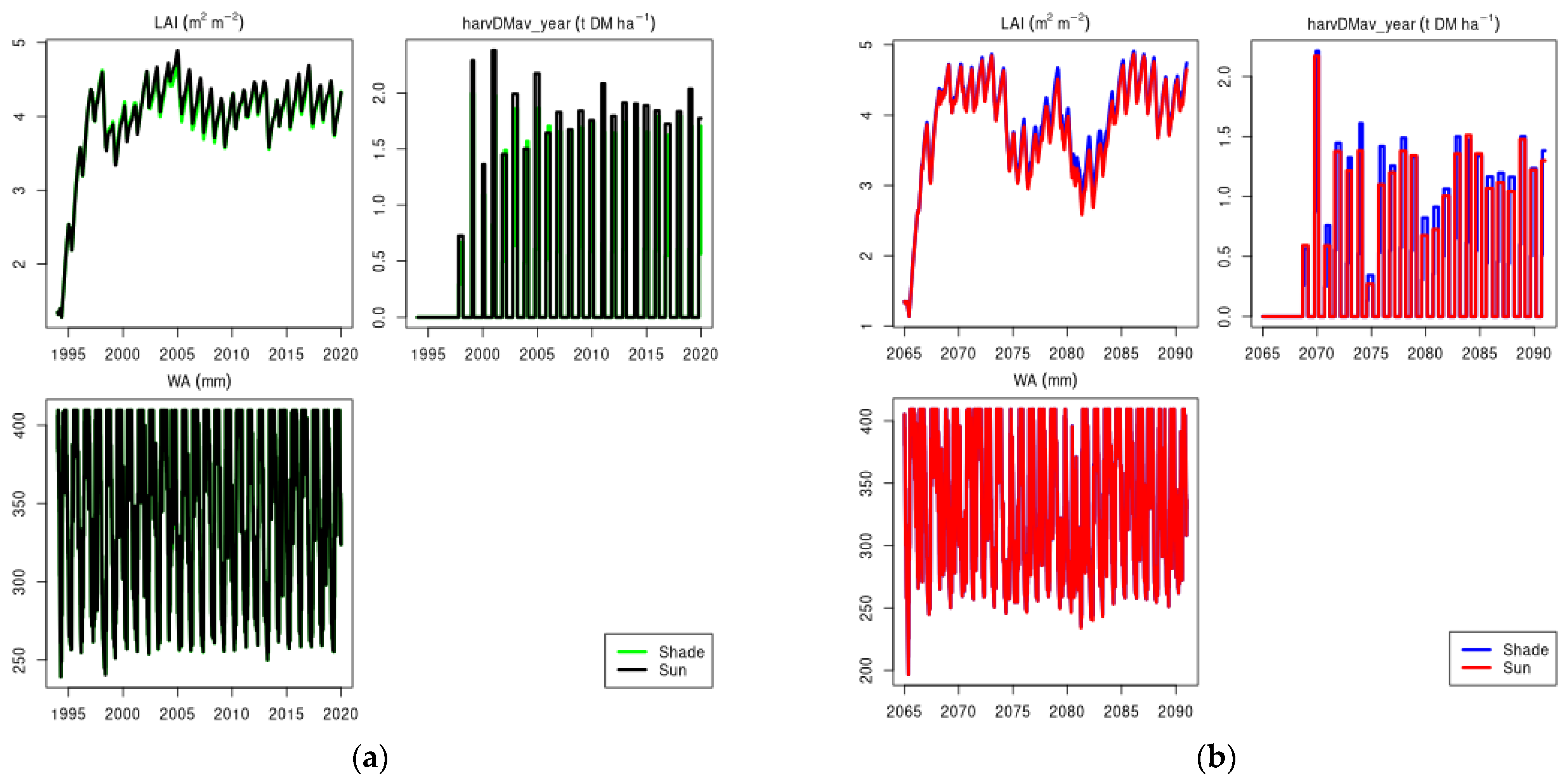
Table A1 illustrates the outputs of the setup of coffee agroforestry model CAF2014 with minimum modifications in the configuration from the original version, limited to (1) specification of geographic location (longitude, latitude) and (2) substituting weather data with location-specific values from the ISIMIP3b dataset [40] corresponding to weather projected by the GFDL-ESM4 climate model for the period 2021–2030 for the SSP5-8.5 scenario. The two randomly chosen municipalities in the Mexican coffee-producing states, Chiapas and Oaxaca, were selected so that the corresponding historical (2003–2023) reported yields [30] differ from each other. The purpose of this illustrative CAF2014 model run is to demonstrate a reasonable scale of deviation of the original model setup output from reported yields, when similar climate conditions are used as inputs.
The default configuration of CAF2014 produced a slight overestimation of the reported yields (13% and 38% for selected locations in Oaxaca and Chiapas respectively; Table A1), which appears to be reasonable, because potential yields are modeled that are hardly achieved in practice. Further sensitivity tests of CAF2014 have proven the expected qualitative response of the model to changes in fertilizer application rates, shade trees thinning and pruning, and soil water parameters [66]. The scale of fertilizer application impact alone was sufficient for the model to reproduce the reported yield under lower fertilizer input.
While modeling effects of shade trees on coffee growth appears to be particularly challenging [20], the CAF2014 model demonstrated reasonable behavior and sensitivity to explored variations in input data and parameters including shade management [66]. The location-specific tests suggest that with suitable adjustments in configuration the model could reproduce reported shaded coffee yields.
Table A1.
Modeled and reported average yields for two tested locations in coffee-producing regions of Mexico: Chiapas/Altamirano (geographic coordinates: 16°44′10″ N 92°02′20″ W) and Oaxaca/Santiago Xanica (16°00′ N 96°14′ W). Averages of annual values over 2003–2015.
Appendix A.2. Range of Ensemble Yield Projections
The minimum and maximum of period-average shaded coffee yield estimates produced by the CAF2014-Rhaobi model for each of the five climate model ensemble members are presented in Figure A2. The future yields (2081–2090, panels (b) and (d)) are consistently lower than the respective historical estimates (2021–2030, panels (a) and (c)), whereas the top row (ensemble minimum) and the bottom row (ensemble maximum) indicate the span in the yield estimates, which are due to only uncertainty in climate projections. Interestingly, comparison between the top left panel (nearly historical period, ensemble minimum) and the bottom right panel (end of century period, ensemble maximum) indicates a slight increase in yields, yet this type of comparison is clearly hypothetical.
Figure A2.
Coffee yield in coffee-producing regions of Mexico (ton fresh matter/ha/year) averaged over 2021–2030 climate ensemble minimum (a) and maximum (c), and averaged over 2081–2090 climate ensemble minimum (b) and maximum (d), gridded at 0.5 arc-degree, for five ISIMIP3b climate models for SSP585 scenario as estimated by CAF2014-Rhaobi model for BAU-representative management and default CAF2014 soil water characteristics.
References
- Circular Economy. An Official Website of the European Union. Available online: https://environment.ec.europa.eu/strategy/circular-economy_en (accessed on 30 April 2026).
- Wang, Z.; Fu, B.; Wu, X.; Wang, S.; Zhang, J.; Zhang, L.; Jiao, L.; Wang, H.; Li, Y.; Luo, Y. Linking Ecological Resilience and Ecosystem Services to Inform Spatial Conservation Planning. Commun. Earth Environ. 2026, 7, 215. [Google Scholar] [CrossRef] [Scilit]
- Tobias, J.A.; Bullock, J.M.; Dicks, L.V.; Forester, B.R.; Razgour, O. Biodiversity Conservation Requires Integration of Species-Centric and Process-Based Strategies. Proc. Natl. Acad. Sci. USA 2025, 122, e2410936122. [Google Scholar] [CrossRef] [Scilit] [PubMed]
- Wang, X. Integrative Strategies for Sustainable Agriculture in the Face of Climate Change. npj Sustain. Agric. 2025, 3, 66. [Google Scholar] [CrossRef] [Scilit]
- Jägermeyr, J.; Müller, C.; Ruane, A.C.; Elliott, J.; Balkovic, J.; Castillo, O.; Faye, B.; Foster, I.; Folberth, C.; Franke, J.A.; et al. Climate Impacts on Global Agriculture Emerge Earlier in New Generation of Climate and Crop Models. Nat. Food 2021, 2, 873–885. [Google Scholar] [CrossRef] [Scilit] [PubMed]
- Hultgren, A.; Carleton, T.; Delgado, M.; Gergel, D.R.; Greenstone, M.; Houser, T.; Hsiang, S.; Jina, A.; Kopp, R.E.; Malevich, S.B.; et al. Impacts of Climate Change on Global Agriculture Accounting for Adaptation. Nature 2025, 642, 644–652. [Google Scholar] [CrossRef] [Scilit] [PubMed]
- Pham, Y.; Reardon-Smith, K.; Mushtaq, S.; Cockfield, G. The Impact of Climate Change and Variability on Coffee Production: A Systematic Review. Clim. Change 2019, 156, 609–630. [Google Scholar] [CrossRef] [Scilit]
- Morton, J.F. The Impact of Climate Change on Smallholder and Subsistence Agriculture. Proc. Natl. Acad. Sci. USA 2007, 104, 19680–19685. [Google Scholar] [CrossRef] [Scilit] [PubMed]
- Burney, J.; Cesano, D.; Russell, J.; La Rovere, E.L.; Corral, T.; Coelho, N.S.; Santos, L. Climate Change Adaptation Strategies for Smallholder Farmers in the Brazilian Sertão. Clim. Change 2014, 126, 45–59. [Google Scholar] [CrossRef] [Scilit]
- Harvey, C.A.; Martínez-Rodríguez, M.R.; Cárdenas, J.M.; Avelino, J.; Rapidel, B.; Vignola, R.; Donatti, C.I.; Vilchez-Mendoza, S. The Use of Ecosystem-Based Adaptation Practices by Smallholder Farmers in Central America. Agric. Ecosyst. Environ. 2017, 246, 279–290. [Google Scholar] [CrossRef] [Scilit]
- Vignola, R.; Harvey, C.A.; Bautista-Solis, P.; Avelino, J.; Rapidel, B.; Donatti, C.; Martinez, R. Ecosystem-Based Adaptation for Smallholder Farmers: Definitions, Opportunities and Constraints. Agric. Ecosyst. Environ. 2015, 211, 126–132. [Google Scholar] [CrossRef] [Scilit]
- International Coffee Organization; Public Private Taskforce; Committee on Sustainability Assessment. Mexico’s Coffee Value Chain. 2025. Available online: https://ico.org/global-knowledge-hub/wp-content/uploads/2025/03/Mexico_Coffee-Value-Chain-Study.pdf (accessed on 30 April 2026).
- Moguel, P.; Toledo, V.M. Biodiversity Conservation in Traditional Coffee Systems of Mexico. Conserv. Biol. 1999, 13, 11–21. [Google Scholar] [CrossRef] [Scilit]
- Muñoz-Villers, L.E.; Geris, J.; Alvarado-Barrientos, M.S.; Holwerda, F.; Dawson, T. Coffee and Shade Trees Show Complementary Use of Soil Water in a Traditional Agroforestry Ecosystem. Hydrol. Earth Syst. Sci. 2020, 24, 1649–1668. [Google Scholar] [CrossRef] [Scilit]
- Haggar, J.; Casanoves, F.; Cerda, R.; Cerretelli, S.; Gonzalez-Mollinedo, S.; Lanza, G.; Lopez, E.; Leiva, B.; Ospina, A. Shade and Agronomic Intensification in Coffee Agroforestry Systems: Trade-Off or Synergy? Front. Sustain. Food Syst. 2021, 5, 645958. [Google Scholar] [CrossRef] [Scilit]
- Beltrán-Vargas, H.J.; Flores-Sánchez, D.; Vázquez-García, V.; Espinosa Calderón, A. Agroecological management of smallholding coffee cropping systems in the highlands of Veracruz, Mexico. Trop. Subtrop. Agroecosyst. 2023, 26, 4604. [Google Scholar] [CrossRef] [Scilit]
- Ovalle-Rivera, O.; Läderach, P.; Bunn, C.; Obersteiner, M.; Schroth, G. Projected Shifts in Coffea arabica Suitability among Major Global Producing Regions Due to Climate Change. PLoS ONE 2015, 10, e0124155. [Google Scholar] [CrossRef] [Scilit] [PubMed]
- van Oijen, M.; Dauzat, J.; Harmand, J.-M.; Lawson, G.; Vaast, P. Coffee Agroforestry Systems in Central America: II. Development of a Simple Process-Based Model and Preliminary Results. Agrofor. Syst. 2010, 80, 361–378. [Google Scholar] [CrossRef] [Scilit]
- van Oijen, M.; Haggar, J.; Barrios, M.; Büchi, L.; Cerda, R.; Cerretelli, S.; López, E.; de Melo Virginio Filho, E.; Ospina, A. Ecosystem Services from Coffee Agroforestry in Central America: Estimation Using the CAF2021 Model. Agrofor. Syst. 2022, 96, 969–981. [Google Scholar] [CrossRef] [Scilit]
- Della Peruta, R.; Mereu, V.; Spano, D.; Marras, S.; Vezy, R.; Trabucco, A. Projecting Trends of Arabica Coffee Yield under Climate Change: A Process-Based Modelling Study at Continental Scale. Agric. Syst. 2025, 227, 104353. [Google Scholar] [CrossRef] [Scilit]
- Ovalle-Rivera, O.; Van Oijen, M.; Läderach, P.; Roupsard, O.; de Melo Virginio Filho, E.; Barrios, M.; Rapidel, B. Assessing the Accuracy and Robustness of a Process-Based Model for Coffee Agroforestry Systems in Central America. Agrofor. Syst. 2020, 94, 2033–2051. [Google Scholar] [CrossRef] [Scilit]
- DaMatta, F.M. Ecophysiological Constraints on the Production of Shaded and Unshaded Coffee: A Review. Field Crops Res. 2004, 86, 99–114. [Google Scholar] [CrossRef] [Scilit]
- Wright, D.R.; Bekessy, S.A.; Lentini, P.E.; Garrard, G.E.; Gordon, A.; Rodewald, A.D.; Bennett, R.E.; Selinske, M.J. Sustainable Coffee: A Review of the Diverse Initiatives and Governance Dimensions of Global Coffee Supply Chains. Ambio 2024, 53, 984–1001. [Google Scholar] [CrossRef] [Scilit] [PubMed]
- De Felice, F.; Rehman, M.; Petrillo, A.; Baffo, I. Decoding the Coffee Supply Chain: A Systematic Review of Stakeholders, Sustainability Opportunities, and Challenges. Sustain. Futures 2025, 10, 101105. [Google Scholar] [CrossRef] [Scilit]
- Jones, K.; Njeru, E.M.; Garnett, K.; Girkin, N.T. Organic Management in Coffee: A Systematic Review of the Environmental, Economic and Social Benefits and Trade-Offs for Farmers. Agroecol. Sustain. Food Syst. 2025, 49, 1368–1402. [Google Scholar] [CrossRef] [Scilit]
- The First Public Release of CAF2014, a Process-Based Model for Coffee Agroforestry Systems. Available online: https://zenodo.org/record/3608877 (accessed on 30 April 2026).
- Source Code of the Model. CAF2021 Version 1.1. Available online: https://zenodo.org/records/5862195 (accessed on 30 April 2026). [CrossRef]
- Ji, R.; Wu, Y.; Li, Y.; Lv, Z.; Wu, M.; Chen, L.; Yang, J. Construction of Growth Model and Growth Simulation of Yunnan Arabica Coffee. BMC Plant Biol. 2026, 26, 235. [Google Scholar] [CrossRef] [Scilit] [PubMed]
- Rahn, E.; Vaast, P.; Läderach, P.; van Asten, P.; Jassogne, L.; Ghazoul, J. Exploring Adaptation Strategies of Coffee Production to Climate Change Using a Process-Based Model. Ecol. Model. 2018, 371, 76–89. [Google Scholar] [CrossRef] [Scilit]
- SIAP Database. Datos Abiertos|Servicio de Información Agroalimentaria y Pesquera|gob.mx|En Esta Sección se Encuentra la Recopilación Principal de Datos Abiertos del SIAP. Available online: http://infosiap.siap.gob.mx/gobmx/datosAbiertos.php (accessed on 30 August 2024).
- Santizo-Díaz, D.; Flores-Prieto, J.J. Thermo-Economic Analysis of Sun Drying Patio Coffee in the Sierra Mariscal, Chiapas-México. Case Stud. Therm. Eng. 2024, 62, 105181. [Google Scholar] [CrossRef] [Scilit]
- Ghosh, P.; Venkatachalapathy, N. Processing and Drying of Coffee—A Review. Int. J. Eng. Res. Technol. 2014, 3, 784–794. [Google Scholar]
- Rotta, N.M.; Curry, S.; Han, J.; Reconco, R.; Spang, E.; Ristenpart, W.; Donis-González, I.R. A Comprehensive Analysis of Operations and Mass Flows in Postharvest Processing of Washed Coffee. Resour. Conserv. Recycl. 2021, 170, 105554. [Google Scholar] [CrossRef] [Scilit]
- Elms, R. Coffee Annual—Mexican Coffee Production Continues to Rebound from Coffee Rust Disease. USDA, Date: 31 May 2019, GAIN Report Number: MX9020. Available online: https://apps.fas.usda.gov/newgainapi/api/report/downloadreportbyfilename?filename=Coffee%20Annual_Mexico%20City_Mexico_5-31-2019.pdf (accessed on 11 October 2024).
- Otero Arnaiz, A.; Chinh, A. Coffee Annual. USDA, Date: 17 May 2024, Report Number: MX2024-0025. Available online: https://apps.fas.usda.gov/newgainapi/api/Report/DownloadReportByFileName?fileName=Coffee+Annual_Mexico+City_Mexico_MX2024-0025.pdf (accessed on 31 October 2024).
- Talhinhas, P.; Batista, D.; Diniz, I.; Vieira, A.; Silva, D.N.; Loureiro, A.; Tavares, S.; Pereira, A.P.; Azinheira, H.G.; Guerra-Guimarães, L.; et al. The Coffee Leaf Rust Pathogen Hemileia vastatrix: One and a Half Centuries Around the Tropics. Mol. Plant Pathol. 2017, 18, 1039–1051. [Google Scholar] [CrossRef] [Scilit] [PubMed]
- Valencia, V.; García-Barrios, L.; Sterling, E.J.; West, P.; Meza-Jiménez, A.; Naeem, S. Smallholder Response to Environmental Change: Impacts of Coffee Leaf Rust in a Forest Frontier in Mexico. Land Use Policy 2018, 79, 463–474. [Google Scholar] [CrossRef] [Scilit]
- van Oijen, M.; Dauzat, J.; Harmand, J.-M.; Lawson, G.; Vaast, P. Coffee Agroforestry Systems in Central America: I. A Review of Quantitative Information on Physiological and Ecological Processes. Agrofor. Syst. 2010, 80, 341–359. [Google Scholar] [CrossRef] [Scilit]
- Frieler, K.; Volkholz, J.; Lange, S.; Schewe, J.; Mengel, M.; del Rocío Rivas López, M.; Otto, C.; Reyer, C.P.O.; Karger, D.N.; Malle, J.T.; et al. Scenario Setup and Forcing Data for Impact Model Evaluation and Impact Attribution within the Third Round of the Inter-Sectoral Impact Model Intercomparison Project (ISIMIP3a). Geosci. Model Dev. 2024, 17, 1–51. [Google Scholar] [CrossRef] [Scilit]
- Frieler, K.; Lange, S.; Schewe, J.; Mengel, M.; Treu, S.; Otto, C.; Volkholz, J.; Reyer, C.P.O.; Heinicke, S.; Jones, C.; et al. Scenario Set-up and the New CMIP6-Based Climate-Related Forcings Provided within the Third Round of the Inter-Sectoral Model Intercomparison Project (ISIMIP3b, Group I and II). Geosci. Model Dev. 2026, 19, 4095–4135. [Google Scholar] [CrossRef] [Scilit]
- Historical Information from the Mexican Conventional Weather Stations Comprising the CONAGUA National Network. Available online: https://smn.conagua.gob.mx/es/climatologia/informacion-climatologica/informacion-estadistica-climatologica (accessed on 12 November 2024).
- Khabarov, N.; Smirnov, A.; Balkovič, J.; Skalský, R.; Folberth, C.; Van Der Velde, M.; Obersteiner, M. Heterogeneous Compute Clusters and Massive Environmental Simulations Based on the EPIC Model. Modelling 2020, 1, 215–224. [Google Scholar] [CrossRef] [Scilit]
- Folberth, C.; Baklanov, A.; Khabarov, N.; Oberleitner, T.; Balkovic, J.; Skalsky, R. CROMES v1.0: A Flexible CROp Model Emulator Suite for Climate Impact Assessment-Frozen Code Repository and Example for Training EPIC-IIASA Global Gridded Crop Model Emulators. Geosci. Model Dev. 2025, 18, 5759–5779. [Google Scholar] [CrossRef]
- Khabarov, N. Source Code of the CAF2014-Rhaobi Model. Available online: https://user.iiasa.ac.at/~khabarov/caf2014-rhaobi/ (accessed on 30 April 2026).
- Arroyo-Cruz, C.E.; Prado, B.; Kolb, M.; Mora-Palomino, L.N.; Todd-Brown, K.; Guevara, M. Synthesis of a National Soil Dataset Across Productive Land in Mexico: The Importance of Making Existing Data Accessible. Eur. J. Soil Sci. 2025, 76, e70116. [Google Scholar] [CrossRef] [Scilit]
- Harmonized World Soil Database v 1.2. Available online: https://www.fao.org/soils-portal/data-hub/soil-maps-and-databases/harmonized-world-soil-database-v12/en/ (accessed on 30 April 2026).
- Skalský, R.; Tarasovičová, Z.; Balkovič, J.; Schmid, E.; Fuchs, M.; Moltchanova, E.; Scholtz, P. GEO-BENE Global Database for Bio-Physical Modeling. GEOBENE Project. 2008. Available online: https://geo-bene.project-archive.iiasa.ac.at/files/Deliverables/Geo-BeneGlbDb10(DataDescription).pdf (accessed on 30 April 2026).
- Saxton, K.E.; Rawls, W.J. Soil Water Characteristic Estimates by Texture and Organic Matter for Hydrologic Solutions. Soil Sci. Soc. Am. J. 2006, 70, 1569–1578. [Google Scholar] [CrossRef] [Scilit]
- Khabarov, N.; Folberth, C.; Javalera Rincon, V. Modeling Coffee in Mexico: CAF2014 Geo-Spatial Setup—Part II, Technical Note on the Implementation of the SAbERES Project. 2025. Available online: https://user.iiasa.ac.at/~khabarov/2025-06-30-saberes/Technical-Note-SAbERES-IIASA-NK-Cofee-CAF2014-GeoSpatial-Calibration-Part-2_v84.pdf (accessed on 30 April 2026).
- Khabarov, N.; Folberth, C.; Javalera Rincon, V. Modeling Coffee in Mexico: CAF2014 Geo-Spatial Setup—Part I, Technical Note on the Implementation of the SAbERES Project. 2025. Available online: https://user.iiasa.ac.at/~khabarov/2025-06-30-saberes/Technical-Note-SAbERES-IIASA-NK-Cofee-CAF2014-GeoSpatial-Calibration-Part-1_v78.pdf (accessed on 30 April 2026).
- Ayala-Montejo, D.; Martínez-Zurimendi, P.; Gallardo-Lancho, J.F.; Sánchez-Hernández, R.; Valdés-Velarde, E.; Santiago-Vera, T.d.J.; Pérez-Nieto, J. Agronomic Management, Socioeconomic Factors, and Carbon and Nitrogen Pools in Avocado–Coffee Systems in Huatusco, Veracruz, México. Resources 2025, 14, 35. [Google Scholar] [CrossRef] [Scilit]
- Soto-Pinto, L.; Perfecto, I.; Castillo-Hernandez, J.; Caballero-Nieto, J. Shade Effect on Coffee Production at the Northern Tzeltal Zone of the State of Chiapas, Mexico. Agric. Ecosyst. Environ. 2000, 80, 61–69. [Google Scholar] [CrossRef] [Scilit]
- Roskoski, J.P. Nitrogen Fixation in a Mexican Coffee Plantation. In Nitrogen Cycling in Ecosystems of Latin America and the Caribbean; Springer: New York, NY, USA, 1982; pp. 283–291. [Google Scholar] [CrossRef] [Scilit]
- Ryan, M.C.; Graham, G.R.; Rudolph, D.L. Contrasting Nitrate Adsorption in Andisols of Two Coffee Plantations in Costa Rica. J. Environ. Qual. 2001, 30, 1848–1852. [Google Scholar] [CrossRef] [Scilit] [PubMed]
- Schroth, G.; Laderach, P.; Dempewolf, J.; Philpott, S.; Haggar, J.; Eakin, H.; Castillejos, T.; Garcia Moreno, J.; Soto Pinto, L.; Hernandez, R.; et al. Towards a Climate Change Adaptation Strategy for Coffee Communities and Ecosystems in the Sierra Madre de Chiapas, Mexico. Mitig. Adapt Strateg. Glob. Change 2009, 14, 605–625. [Google Scholar] [CrossRef] [Scilit]
- Coffee Prices-45 Year Historical Chart (in U.S. Dollars per Pound). Available online: https://www.macrotrends.net/2535/coffee-prices-historical-chart-data (accessed on 30 April 2026).
- US Dollar to Mexican Peso Historical Exchange Rates. Available online: https://www.macrotrends.net/2559/us-dollar-mexican-peso-exchange-rate-historical-chart (accessed on 30 April 2026).
- Mexico Inflation Rate 1960–2024. Available online: https://www.macrotrends.net/global-metrics/countries/MEX/mexico/inflation-rate-cpi (accessed on 30 April 2026).
- Damiani, O. Organic Agriculture in Mexico: Case Studies of Small Farmer Associations in Chiapas and the Yucatan Peninsula; International Fund for Agricultural Development: Rome, Italy, 2001. [Google Scholar] [CrossRef]
- Gullino, M.L.; Albajes, R.; Al-Jboory, I.; Angelotti, F.; Chakraborty, S.; Garrett, K.A.; Hurley, B.P.; Juroszek, P.; Lopian, R.; Makkouk, K.; et al. Climate Change and Pathways Used by Pests as Challenges to Plant Health in Agriculture and Forestry. Sustainability 2022, 14, 12421. [Google Scholar] [CrossRef] [Scilit]
- Avelino, J.; Cristancho, M.; Georgiou, S.; Imbach, P.; Aguilar, L.; Bornemann, G.; Läderach, P.; Anzueto, F.; Hruska, A.J.; Morales, C. The Coffee Rust Crises in Colombia and Central America (2008–2013): Impacts, Plausible Causes and Proposed Solutions. Food Secur. 2015, 7, 303–321. [Google Scholar] [CrossRef] [Scilit]
- Piontek, F.; Müller, C.; Pugh, T.A.M.; Clark, D.B.; Deryng, D.; Elliott, J.; Colón González, F.d.J.; Flörke, M.; Folberth, C.; Franssen, W.; et al. Multisectoral Climate Impact Hotspots in a Warming World. Proc. Natl. Acad. Sci. USA 2013, 111, 3233–3238. [Google Scholar] [CrossRef] [Scilit] [PubMed]
- Müller, C.; Franke, J.; Jägermeyr, J.; Ruane, A.C.; Elliott, J.; Moyer, E.; Heinke, J.; Falloon, P.D.; Folberth, C.; Francois, L.; et al. Exploring Uncertainties in Global Crop Yield Projections in a Large Ensemble of Crop Models and CMIP5 and CMIP6 Climate Scenarios. Environ. Res. Lett. 2021, 16, 034040. [Google Scholar] [CrossRef] [Scilit]
- Wang, B.; Jägermeyr, J.; O’Leary, G.J.; Wallach, D.; Ruane, A.C.; Feng, P.; Li, L.; Liu, D.L.; Waters, C.; Yu, Q.; et al. Pathways to Identify and Reduce Uncertainties in Agricultural Climate Impact Assessments. Nat. Food 2024, 5, 550–556. [Google Scholar] [CrossRef] [Scilit] [PubMed]
- Li, L.; Wang, B.; Feng, P.; Jägermeyr, J.; Asseng, S.; Müller, C.; Macadam, I.; Liu, D.L.; Waters, C.; Zhang, Y.; et al. The Optimization of Model Ensemble Composition and Size Can Enhance the Robustness of Crop Yield Projections. Commun. Earth Environ. 2023, 4, 362. [Google Scholar] [CrossRef] [Scilit]
- Khabarov, N.; Folberth, C.; Skalsky, R.; Javalera Rincon, V. Modeling Coffee Agroforestry Systems with the Process-Based Model CAF2014. Technical Note on the Implementation of the SAbERES Project. 2024. Available online: https://user.iiasa.ac.at/~khabarov/2024-11-19-saberes/Technical-Note-SAbERES-IIASA-NK-Cofee-CAF2014-Modeling_v73.pdf (accessed on 30 April 2026).

Disclaimer/Publisher’s Note: The statements, opinions and data contained in all publications are solely those of the individual author(s) and contributor(s) and not of MDPI and/or the editor(s). MDPI and/or the editor(s) disclaim responsibility for any injury to people or property resulting from any ideas, methods, instructions or products referred to in the content. |
© 2026 by the authors. Licensee MDPI, Basel, Switzerland. This article is an open access article distributed under the terms and conditions of the Creative Commons Attribution (CC BY) license.