


Abstract
Given the growing concerns about climate change and sustainability, uncovering the factors that influence consumers’ decisions to adopt green products remains a pressing inquiry. This study uses the theory of planned behavior (TPB) and the PLS-SEM method to confirm that environmental concern (EC), perceived behavioral control (PBC), attitude (AT) and subjective norms (SN) influence green product purchase intention (PI). According to this research, environmental concern is the main determining factor for the purchase intention of green products. A structured quantitative survey was applied to a sample of 421 people. The analysis was conducted using WarpPLS 8.0. The results show that environmental concern and perceived behavioral control play a crucial role. Individuals’ confidence in their ability to influence environmental conservation efforts is important in their purchasing decisions. Subjective norms play a mediating role and have a smaller impact but contribute significantly to shaping the societal context that influences green purchase decisions. Attitudes have a significant, nonlinear impact on purchase intention. This study encourages green marketing strategies and public policies oriented towards green products, targeting accessibility barriers to green products and changing green purchasing patterns, to contribute to sustainable consumption objectives, offer directions for future research and increase competitiveness.
1. Introduction
Climate change is expected to increasingly influence people’s quality of life in the not-so-distant future, with detrimental effects on people’s lives, and poorer people being especially affected [1]. Consequently, there is a clear need for more sustainable consumption, but finding ways to achieve it is a problem that must be addressed from multiple perspectives. Achieving significant results requires the efforts and cooperation of all economic subjects. Consumers are increasingly aware of the importance of sustainable consumption, but in their purchasing choices, they do not only consider sustainability. Their behavior is also influenced by price levels, product availability, convenience in purchasing them, their habits and values, social norms and a sense of differentiation, but the most important factor turns out to be people’s income [2]. The EU estimates that up to two-thirds of consumers are aware of this need. The new EU action plan covers the entire product life cycle, from design through circular-economy processes to sustainable consumption, so that waste is prevented and resources are used for as long as possible [3]. Despite widespread awareness of these challenges, the gap between knowledge and action remains a critical issue that must be addressed through targeted interventions.
A research gap, which this paper aims to discuss, exists because pro-environmental behavior can function as a signal. Purchasing green products is seen as a way an individual can obtain social status [4,5]; environmentalism benefits everyone, but behaving this way can be costly at the individual level [6]. As such, certain individuals purchase green products even if they do not necessarily have an attitude that favors behaving sustainably. However, they might choose to do so due to social norms. Evidence shows that people tend to exhibit more pro-social or less anti-social behavior when they are seen by other members of society [7]. This can signal to others a person’s willingness to cooperate [6].
The idea that consumers’ intention to purchase green products can be motivated by several factors is also highlighted by Maduku, who shows that people do so because they anticipate positive emotions regarding their sustainable behavior [8]. Media coverage also influences social norms by highlighting sustainability issues, thereby increasing the consumption of green products [9].
The decision to produce green products needs to be communicated clearly by producers to obtain a competitive advantage. By integrating social visibility features, such as eco-certifications and shareable digital badges, companies can enhance the attractiveness of green products among status-conscious consumers. Addressing this perception issue requires companies to invest in branding and certification mechanisms that reassure consumers about the quality and effectiveness of green products. It has been observed that consumers have a lower willingness to pay for reused or recycled products, as they are perceived as risky [10]. Green products can be perceived as underperforming in functionality or effectiveness compared with less ecological alternatives [11].
Environmental knowledge significantly influences individuals’ ecological concerns [12]. Consumers might decide to purchase green products because they imply pro-social behavior [13].
In this study, we aim to verify several hypotheses on green product purchase intention. One hypothesis is that green product purchase intention (PI) is positively influenced by attitude towards green products (AT). Green purchase intention refers to consumers’ predisposition to choose environmentally friendly products. It is significantly influenced by factors such as awareness of environmental issues, willingness to pay a premium price for green products and personal values.
The research in this paper presents a study whose aim is to demonstrate that attitude towards the purchase of green products (AT) is positively influenced by subjective norms (SN) and environmental concern (EC). Attitudes are shaped by beliefs about behavioral outcomes and the value placed on these outcomes. These are strong predictors of behavioral intentions in various cultural and demographic contexts. While attitudes are context-dependent, values remain stable over time [14].
Attitude towards green products and its relationship with purchase intention and behavior provides essential insight into the dynamics of sustainable consumption. Evidence from surveys and studies in various cultural and demographic contexts emphasizes the central role of attitude in forming the intention to purchase green products. However, the relationship between attitude and actual green product purchasing behavior is more complex. Although a favorable attitude towards organic products contributes significantly to purchase intention, it does not always guarantee actual purchase. Factors such as previous satisfaction with green products, the influence of online reviews, demographic and contextual factors and the social influence of family and friends can alter the path from intention to actual purchase behavior [15].
Subjective norms can be a mechanism of social influence on environmentally friendly behavior. Subjective norms, together with attitude, perceived behavioral control and knowledge about green products, form a complex framework that influences both purchase intention and actual purchase behavior of green products. Understanding the interactions among these variables is crucial for developing marketing strategies and public policies that promote environmentally sustainable consumption behavior.
Within TPB, subjective norms are an essential factor influencing the intention to purchase environmentally friendly products. They are defined as perceptions of social pressure to perform or not perform a certain behavior and reflect how close and important those people who can influence their behavior are to an individual [16]. This perception of social pressure can influence consumers to form more favorable behavioral intentions towards purchasing environmentally friendly products when they perceive subjective norms as favorable to this purchase. For these reasons, this research paper aimed to demonstrate that green product purchase intention (PI) is positively influenced by subjective norms (SN).
A further hypothesis is that PBC is positively influenced by subjective norms (SN), and subjective norms (SN) are positively influenced by environmental concern (EC). Some previous research has shown that subjective norms indirectly influence green product purchase intention through other variables and have a significant role in the actual purchasing behavior of green products. There are also other studies suggesting that subjective norms are not a significant indicator of purchase intention.
This study also demonstrates that green product purchase intention (PI) is positively influenced by PBC, and PBC is positively influenced by environmental concern (EC). In addition, green product purchase intention (PI) is positively influenced by environmental concern (EC).
It is assumed that individuals who are aware of environmental issues are more likely to act responsibly. In previous studies, there is no uniform opinion on whether a positive relationship exists between the intention to purchase green products and consumers’ concern about the environment. The relationship between environmental concern and actual green product purchase behavior is very complex. While there is a direct correlation between environmental concern and purchase intention, the transition from intention to actual purchasing behavior can be influenced by several factors. Even if environmental concerns are an important motivating factor, there are other considerations—such as cost, affordability and brand awareness—that may influence consumers’ final decision to purchase green products.
This study uses the PLS-SEM methodology, applied to the TPB extended framework, with the aid of a sample of 421 Generation Z respondents from Romania. It contributes to the existing literature by confirming the influence of environmental concern, attitude and perceived behavioral control on purchase intention. This study also identifies that the relationships are not strictly linear. Furthermore, it identifies a direct effect of subjective norms on purchase intention. This was not confirmed in the previous literature, but was supported using PLS-SEM.
2. Theoretical Background
2.1. Motivation for Choosing TPB Theory
The model used in this paper is based on prior research [17] that employed CFA within an extended TPB framework [18], and the authors found statistically significant effects among attitude (AT), perceived behavior control (PBC) and environmental concern (EC) on the purchase intent of green products. Subjective norms (SN) were not found to be statistically significant [17]. A similar result was reached using a PLS-SEM analysis, in which subjective norms were found to have a mediating effect on environmental attitude and green purchasing intention [19]. In the present research it is assumed that the relationships in this case are not as clear as expected and that, while there is a relationship between the aforementioned variables, it is not necessarily linear. In this analysis, we use PLS-SEM based on the extended TPB framework [17] and WarpPLS 8.0, which has been shown to identify nonlinear relationships [20,21].
TPB has been developed and adjusted to better capture the factors that drive buyers to purchase green products, from individual and social factors to product and market issues. Perceived green value, attitude and green trust significantly positively influence green purchase intentions [22]. Green purchase intention is also influenced by awareness of environmental issues, willingness to pay a premium price for green products and personal values.
Several studies support the predictive validity of the TPB framework in the context of environmental behavior [23]. More recently, TPB has been used in research to explore environmentally friendly behaviors [22,24,25]. Examining observed behaviors provides a measure of adherence to sustainable practices and sheds light on individual actions, aiding in the assessment of existing practices and policies. Although TPB emphasizes the importance of intentions in determining behavior, there is often a gap between intentions and actions, known as the “intention–behavior gap” [26]. TPB-based studies frequently rely on self-reported measures of behavior, which may be subject to social bias or self-perception errors, and frequently use self-reported measures of actual behavior, which could lead to subjective responses and unreliable results [27]. Thus, there is a risk that the data collected may not accurately reflect actual behaviors. Strong emotions related to environmental concerns, such as fear of climate change or emotional connection to nature, may motivate pro-environmental behaviors in a way that is not fully captured by the model. Although TPB allows the inclusion of additional variables to improve predictive ability, this flexibility may be limited when dealing with complex pro-environmental behaviors that are influenced by a wide system of interconnected factors.
The limitations of TPB stem from its tendency towards overly broad generalizations. TPB emphasizes intentions as direct predictors of behavior, potentially overlooking the role of external or contextual influences, such as resource availability, time constraints or governmental policies. Variations in the intention to buy green products across different economic and cultural settings underscore the significance of contextualizing ecological behaviors. Personal attitudes, subjective norms and perceived behavioral control influence the intention to buy green products and, therefore, introduce a personal dimension to behavior modeling.
The theory of planned behavior (TPB) has been used by several researchers to highlight the role of green purchasing in the transition to sustainable consumption.
An analysis of the improvement of understanding the intention to purchase green products was conducted by Maichum et al., using an extended framework of the TPB, for a group of Thai consumers, aged over 18, whose basic education is high school. It was found that the main elements that positively and significantly influence the intention to purchase green products are consumer attitude, subjective norms and perceived behavioral control. In contrast, environmental knowledge does not have a significant effect on the intention to purchase green products but has a distinct indirect effect through attitude towards purchasing green products, subjective norms and perceived behavioral control [28].
An extension of the TPB, to which perceived environmental concern and perceived consumer efficacy were added, was applied by Rehman et al. to identify potential gaps between the purchase intentions and actual purchase behavior of Malaysian consumers of organic products. According to this study, the most important factors of purchase intention and behavior are attitudes towards organic products and subjective norms. Purchase intention is positively correlated with perceived environmental concern and perceived consumer effectiveness and is not influenced at all by perceived behavioral control [29].
Zhang L. et al. compared utilitarian and hedonic green products within an extended TPB framework. Attitude, perceived behavioral control, and environmental concern predicted purchase intention for both product types, while subjective norms mattered mainly for utilitarian green products [30].
In a larger survey study, green purchase intention predicted actual green purchase behavior, with the effect stronger in developing than developed countries. Attitude toward green products, perceived consumer effectiveness, environmental concern, and perceived green image were key antecedents of intention [31].
A study conducted by Laheri et al. extended TPB with environmental concern, environmental knowledge, and environmental values. Environmental consciousness shaped attitudes, attitude and subjective norms predicted intention, and intention predicted behavior; perceived behavioral control did not significantly predict behavior [32].
Another study examined green electronic products using an extended TPB. Attitude, subjective norms, and perceived behavioral control predicted intention, while ethical obligation was also important; environmental concern was not a significant predictor in this context [33].
According to a Mexico study, which extended TPB with ecological conscience, moral obligation, and willingness to pay, perceived purchase control, ecological conscience, and moral obligation directly influenced green purchase intention [34].
A meta-analysis of 90 studies, conducted by Kamalanon et al., integrated TPB and the green purchase behavior model. It found support for the integrated framework and showed that consumer attitude mediates the development of green purchase intention [31].
A meta-analysis across 54 empirical papers found that attitude, green trust, perceived behavioral control, perceived consumer effectiveness, and subjective norms all positively influence green purchase intention, while perceived risk reduces it [35].
Jebarajakirthy et al. conducted a meta-analytic integration combining TPB and value–belief–norm theory across 173 studies. TPB and VBN factors mediated the effects of values on green purchase intention, and cultural factors plus human development status explained some inconsistencies across studies [36].
2.2. Purchase Intention
A study in Hungary showed that students were positively influenced by their environmental knowledge and willingness to pay for green products [37]. Demographic variables such as age and gender were not significant determinants of their green purchasing behavior, and students had sufficient knowledge about environmental issues and were very willing to pay for environmentally friendly products [37]. A study of the attitude of younger generations regarding sustainability, particularly reusable water bottles [38], highlighted the importance of effective communication from businesses to consumers regarding manufactured products to obtain a competitive advantage in the market and, therefore, the importance of educating consumers regarding sustainable consumption and production [38]. A Polish study conducted on students showed that past behavior and attitude are strongly related to green food purchase intention, with social norms and knowledge also exerting a positive effect [39]. A study conducted in Croatia and Sweden revealed that perceptions of the superior quality of organic products and environmental awareness are crucial factors encouraging green purchase intention [40]. There are also studies on sustainable consumption among Generation Z when purchasing jackets online [41]; the most important factors in purchasing green products were their price, design and place of manufacture, followed by eco-labels, social labels, materials used and jacket functionality.
Ewe et al. [42] demonstrated that when Generation Z consumers in Malaysia are familiar with both types of brands, “young consumers are more inclined to favor a familiar ecofriendly brand than a familiar non-eco-friendly one.” However, if young Generation Z consumers are not very familiar with a particular organic product brand, advertising’s effects determine a favorable attitude towards the purchase of organic products and a higher intention to purchase them among those more influenced by advertising. These elements can help retailers and marketers to orient themselves towards the most appropriate ways to design marketing strategies to promote organic brands.
An EY Consumer Index 2023 study [43] on the evolution of consumption in Romania during 2023 revealed that “The top three aspects that respondents agreed on the most are: the effort not to waste food (80%), a better analysis of the need to purchase non-essential products (79%) and the fact that they do not feel the need to be up to date with the latest fashion trends (61%)”. A large proportion of respondents preferred to purchase products made in Romania from trusted brands and brands that promote health and well-being and support the community [43]. Romanian consumers are concerned about adopting ecological consumption behavior [44]. Retailers consider sustainability a personal value for consumers and want to develop new business models by digitizing their business processes. Consumers perceive the increasingly clear orientation of retailers towards sustainability, digitalization and new business models.
2.3. Attitude
A favorable attitude towards organic products does not always guarantee their actual purchase. Factors such as previous satisfaction with green products, the influence of online reviews, demographic and contextual factors and the social influence of family and friends can alter the path from intention to actual purchase behavior [15].
A recent study of the European Parliamentary Research Service showed that younger generations considered that a more sustainable lifestyle was necessary, most likely frugal and minimalist, that is, a voluntary simplicity [2]. In Scandinavian countries, attitude and environmental knowledge are considered more important factors than subjective norms in influencing green behaviors. Attitude has a significant impact on intention and actual purchase behavior of organic products [45]. Analyzing the fashion industry’s transition to a circular economy, it was observed that although Slovak consumers demonstrate a low level of awareness of new fashion industry models, their willingness to engage with and support circular solutions was evident, especially among younger generations [46]. This result can be used by businesses in the field to increase competitiveness. A study conducted mostly on Greek students demonstrated that the impact of positive emotions created by green advertisements differs from that of negative emotions [47]. Advertisements that provoke negative emotions have a significant positive effect on consumers’ intention to purchase the promoted green product, whereas those that provoke positive emotions do not.
H1.
Green product purchase intention (PI) is positively influenced by attitude towards green products (AT).
H2.
Attitude towards the purchase of green products (AT) is positively influenced by subjective norms (SN).
H3.
Attitude towards the purchase of green products (AT) is positively influenced by environmental concern (EC).
2.4. Subjective Norms
Subjective norms are influenced by beliefs about the degree to which people important to an individual encourage or discourage them from performing a behavior [16]. Within TPB and the context of purchasing green products, subjective norms are crucial and serve as a mechanism of social influence for environmentally friendly behavior. If individuals notice that other people who are important to them (e.g., family, friends or opinion leaders) favor ecofriendly behavior and practice it, such as purchasing green products, this may increase their intention to adopt similar behaviors. Subjective norms have a positive impact on the purchase of green products [48]. Subjective norms indirectly influence green product purchase intention through other variables, such as attitudes towards green products, environmental concerns and perceived behavioral control [31]. A separate study demonstrated that subjective norms are not a significant indicator of purchase intention, with variations in the relative importance of this factor in different contexts [49].
Hudayah et al. [50] demonstrated that, for Indonesian consumers from Generation Z, “functional value, conditional value, and environmental concern significantly and positively affect the intention to purchase green products. This indicates that Generation Z consumers are more inclined to choose green products when they perceive them to have good functional value, when specific conditions or requirements support the purchase, and when they have a high environmental concern”. When deciding to buy green products, Generation Z consumers, who are more concerned about environmental issues and are behaviorally oriented towards sustainability, are also more influenced by social value benefits.
Subjective norms might not be a significant predictor of the intention to purchase green products [17]. Thus, subjective norms, together with attitude, perceived behavioral control and knowledge about green products, form a complex framework that influences both purchase intention and actual purchase behavior of green products. This makes them crucial to the development of marketing strategies and public policies that promote environmentally sustainable consumption behavior.
H4.
Green product purchase intention (PI) is positively influenced by subjective norms (SN).
H5.
PBC is positively influenced by subjective norms (SN).
H6.
Subjective norms (SN) are positively influenced by environmental concern (EC).
2.5. Perceived Behavioral Control
Perceived behavioral control (PBC) is the personal assessment of the feasibility of executing a behavior in a given context [16]. Studies indicate a strong link between perceived behavioral control and purchase intention of green products. In developed countries, advanced infrastructure and green technology availability can enhance the relationship between the intention to adopt ecological behaviors and PBC because they make it easier to translate ecological intentions into actual behaviors [51]. Conversely, in developing countries, the absence of ecological infrastructure and limited access to green technologies may weaken the impact of perceived behavioral control on both the intention and implementation of ecological behaviors [52].
In Cambodia, PBC mediates the relationship between environmental issues and customers’ attitudes and values towards green products [53]. Perceived behavioral control and habit are identified as the main determinants of purchase intention [54]. Consumers’ confidence in their ability to make green purchases encourages them to buy such products [22]. The same study demonstrated a moderate correlation between PBC and green purchase intention. When consumers feel they can influence the quality of the environment through their consumption choices, they are more willing to practice sustainable behaviors. Awareness campaigns and initiatives that improve access to green products can increase consumers’ PBC and increase their green product purchase intention.
2.6. Environmental Concern
When individuals are aware of environmental issues, they are more likely to adopt responsible behaviors and purchase green products [55]. Several authors found a positive relationship between the intention to buy green products and consumers concerned about the environment [17,49]. Other authors did not find a significant association between environmental concern and purchase intention of green products [56]. EC influences the purchase intentions of smart home objects [57]. Traditional status orientation is an important factor with significant positive effects on environmental knowledge, attitude towards green products and green product purchase intention, so it is desirable for marketers to primarily target consumers with a high traditional status orientation towards organic products [58].
Green environmental practices have a positive and significant relationship with green purchase intention [59], which can help a company compete more effectively by standing out to consumers and having a positive impact on corporate image. Research predicting Generation Z’s green purchasing intention, with the aim of motivating Greek customers to buy green products more often, found that environmental concern has a positive impact on user-generated content and eco-labeling [60].
H7.
Green product purchase intention (PI) is positively influenced by PBC.
H8.
PBC is positively influenced by environmental concern (EC).
H9.
Green product purchase intention is positively influenced by environmental concern.
On the other hand, the relationship between environmental concern and actual green product purchase behavior is more complex.
Although there is a direct correlation between environmental concern and purchase intention, the transition from intention to actual purchase behavior can be influenced by several factors. For example, Leclercq-Machado [49] showed that attitudes towards the environment directly influence consumer buying behavior. However, although environmental concern is associated with the intention to purchase green products, it does not always determine actual purchase behavior [61]. This indicates that, while environmental concern is an important motivating factor, other considerations—such as cost, affordability, and brand awareness—may influence consumers’ final decision to purchase green products.
Most studies (72%) examined by Yuriev et al. [62] applied expanded versions of the TPB model, introducing new variables as direct predictors of intention or behavior to increase the theory’s predictive capacity, and 29% of the studies examined included an additional variable [62].
Aspects of environmental awareness and environmental values are mentioned in the literature. It is assumed that individuals who are aware of environmental issues are more likely to act responsibly [63]. Morgan et al. [14] argued that values tend to remain stable over time, unlike attitudes, which are specific to a situation. Several authors found a positive relationship between the intention to buy green products and consumers’ concern for the environment [41,43]. However, other authors, including Smith and Paladino [64] and Tan et al. [56], did not find a significant association between environmental concern and purchase intention of green products.
3. Methodology and Data
3.1. Sample Size and Composition
Two methods were used for data collection. An online questionnaire was distributed via various Romanian student groups on Facebook and LinkedIn, with the option to share it with others, which may have extended the reach beyond the initial target. In addition, a number of physical questionnaires were distributed to those enrolled in tertiary education in Bucharest, Romania. A total of 472 questionnaires were collected, of which 421 valid responses were retained after removing those with a large number of missing values, identical responses or ages outside the range 18 to 30. Data were collected from April 2023 to November 2023. Demographic characteristics of the sample are available in Table 1.
Table 1.
Social and demographic information. Source: authors’ own research.
The minimum sample size was determined using WarpPLS 8.0 at a significance level of 0.05 and a power level of 0.990. Based on the inverse-radical and gamma-exponential methods, the minimum required sample size was 407 and 385, respectively [20]. Therefore, the sample size was considered sufficient. The demographic information of respondents can be found in Table 1. Income per person in the household is expressed in euros, at an exchange rate of €1 = 5 RON, rounded to the nearest increment of €50.
3.2. Questionnaire
All constructs in this model are reflexive; therefore, they must be analyzed for indicator reliability, item reliability (factor loadings), internal consistency (composite reliability—CR, and Cronbach’s alpha), convergent validity (average variance extracted—AVE) and discriminant validity (criterion Heterotrait–Monotrait—HTMT) [65,66].
The questionnaire is adapted from the work of Paul et al. [17] after it was translated into Romanian. Most of the questionnaire was retained; however, four items from the PBC scale were omitted because they did not meet the 0.7 minimum threshold. The factor loadings for all items are provided in Table 2 for transparency but do not form part of Section 4.
Table 2.
Factor loadings. Source: authors’ own research.
To assess the potential presence of common method variance, Harman’s single-factor test was performed by entering all measurement items into an unrotated exploratory factor analysis. This part of the analysis was conducted using JASP 0.95.1. The first factor explained 41.4% of the total variance, which is below the 50% threshold commonly used to indicate substantial common method bias, suggesting that common method variance is not likely to materially affect the results [67]. Not all the questions proposed by Maichum, K., Parichatnon, S., Peng, K.-C. [28] were retained. Four questions from the PBC scale were eliminated sequentially, starting with the item with the lowest factor loading. The remaining items had factor loadings ranging between 0.751 and 0.845, all above 0.7, indicating acceptable item reliability [15]. All other items from Paul, J., Modi, A., Patel, J. [17] had factor loadings above 0.7 and were retained.
4. Results
4.1. Inner Model Scale Validity
This study uses PLS-SEM because it offers several advantages over classical CB-SEM methods: it is more robust when applied to small sample sizes [65] and can be used with non-normal data [65] continuing to provide robust results [68]. This is important for the analysis because, when tested for normality using the Jarque–Bera test, only SN was normally distributed. The analysis was performed using WarpPLS 8.0, which was chosen for its ability to identify nonlinear relationships in an SEM [21]. When discussing a PLS-SEM analysis, both the external and internal model must be considered: the outer model concerns questions and their contributions to specific constructs, and the internal model concerns the relationships between the different constructs.
4.2. Measurement Model (Outer Model)
All constructs in this model are reflexive; therefore, they must be analyzed for item reliability (factor loadings), internal consistency (composite reliability—CR; Cronbach’s alpha), convergent validity (average variance extracted—AVE) and discriminant validity (criterion Heterotrait–Monotrait—HTMT) [65,66]. Construct reliability results can be found in Table 3.
Table 3.
Construct reliability. Source: authors’ own research.
CR values ranged between 0.846 and 0.916, above the recommended threshold of 0.7, indicating a high level of reliability, and also below 0.95, indicating no element redundancy. Cronbach’s alpha values ranged between 0.725 and 0.885, all above 0.7, indicating no problems with internal consistency [65].
Convergent validity, as measured by AVE, should be above 0.5; all values exceeded the threshold, indicating the construct converges and can explain item variance [65].
Through the model used in this research, were measured discriminant validity using two instruments, the Fornell–Larcker criterion and the Heterotrait–Monotrait ratio. The Fornell–Larcker criterion assesses discriminant validity by comparing the AVE square root of each factor with its correlations with the other constructs. The correlations are shown in Table 4.
Table 4.
Discriminant validity—Fornell–Larcker criterion. Source: authors’ own research.
It can be observed from Table 4 that the square root of the AVE is greater than the correlations with the other constructs, confirming that each construct shares more variance with its own items than with the other constructs.
Henseler et al. proposed the HTMT ratio as a measure of discriminant validity [66]. Values should be below 0.85, although this threshold can be raised to 0.90 for conceptually similar values. The values for the model are shown in Table 5. All are below the recommended threshold of 0.85, confirming that discriminant validity is satisfied and each construct is clearly distinct from the others.
Table 5.
Discriminant validity—HTMT values. Source: authors’ own research.
4.3. Measurement Model (Inner Model)
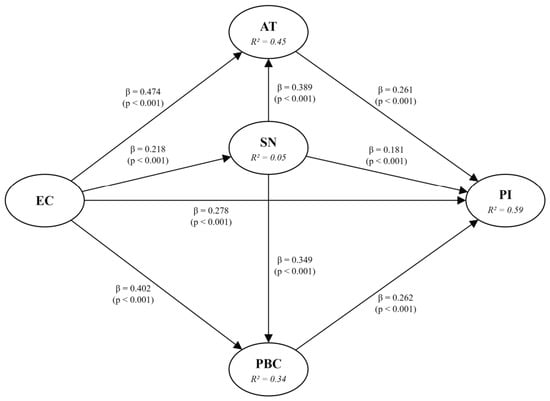
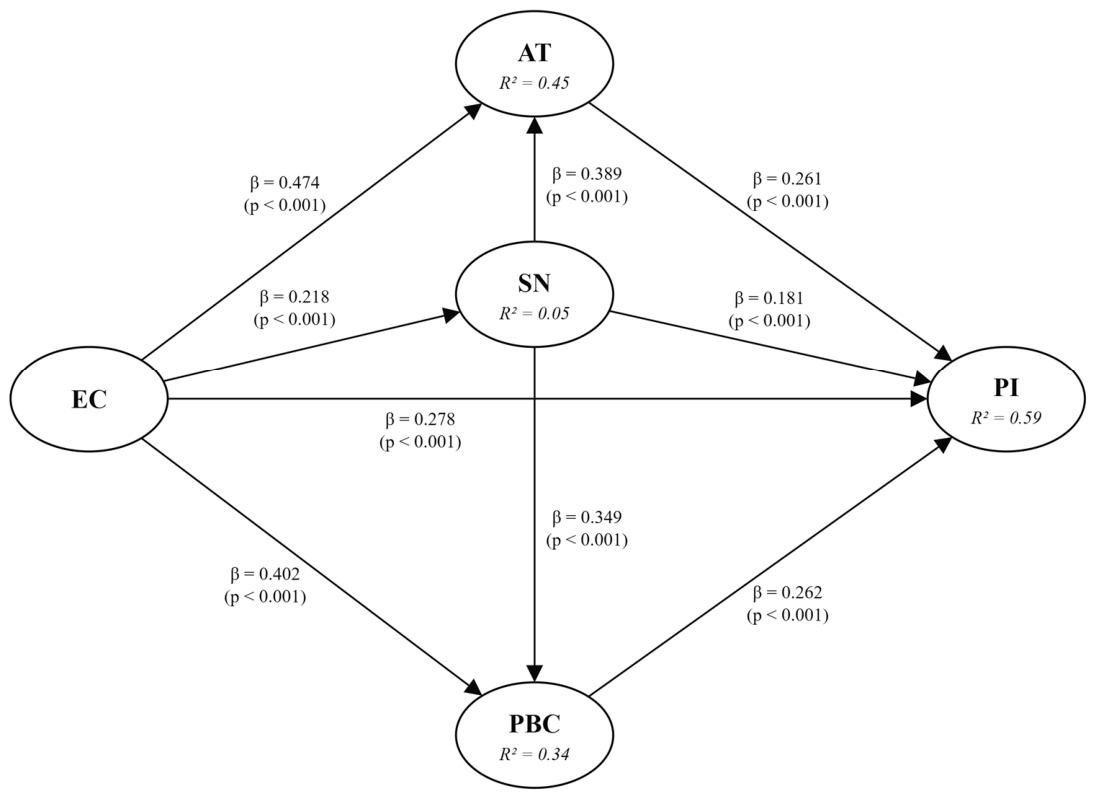
This section presents the structural model (inner model) findings, including model fit indices, a diagram of the model and a discussion of the hypotheses results. The structural (inner) model had an average R2 of 0.356 (adjusted R2 = 0.353); values for each model are available in Table 6. The VIF value was 1.374, below the recommended value of 3.3. The Tenenhaus GoF was 0.494, above 0.36, which is considered large. There are no signs of Simpson’s paradox or statistical suppression. No indication of bivariate causality was detected in the analysis.
Table 6.
Fit indices of the model. Source: authors’ own research.
The structural model results are presented in Figure 1.
Figure 1.
Diagram of the model. Source: authors’ own research.
PI is directly positively influenced by AT (0.261), PBC (0.262) and EC (0.278), thus supporting H1, H7 and H9, as can be seen from Table 7. This confirms the results of Paul et al. [17].
Table 7.
Path coefficients and effect size. Source: authors’ own research.
These results also show that SN is correlated with PI, which is a novel finding using this approach that had not been previously confirmed by Paul et al., J., Modi, A., Patel, J. [17]. The relatively small direct effect is noteworthy: SN influences PI directly (β = 0.181; f2 = 0.086), confirming H4, and is linked with AT (β = 0.389; f2 = 0.188) and PBC (β = 0.349; f2 = 0.150), leading to a higher overall impact on PI (β = 0.374; f2 = 0.178) but a low total effect.
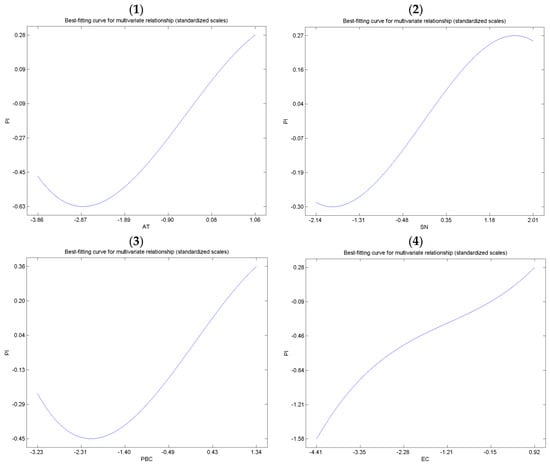
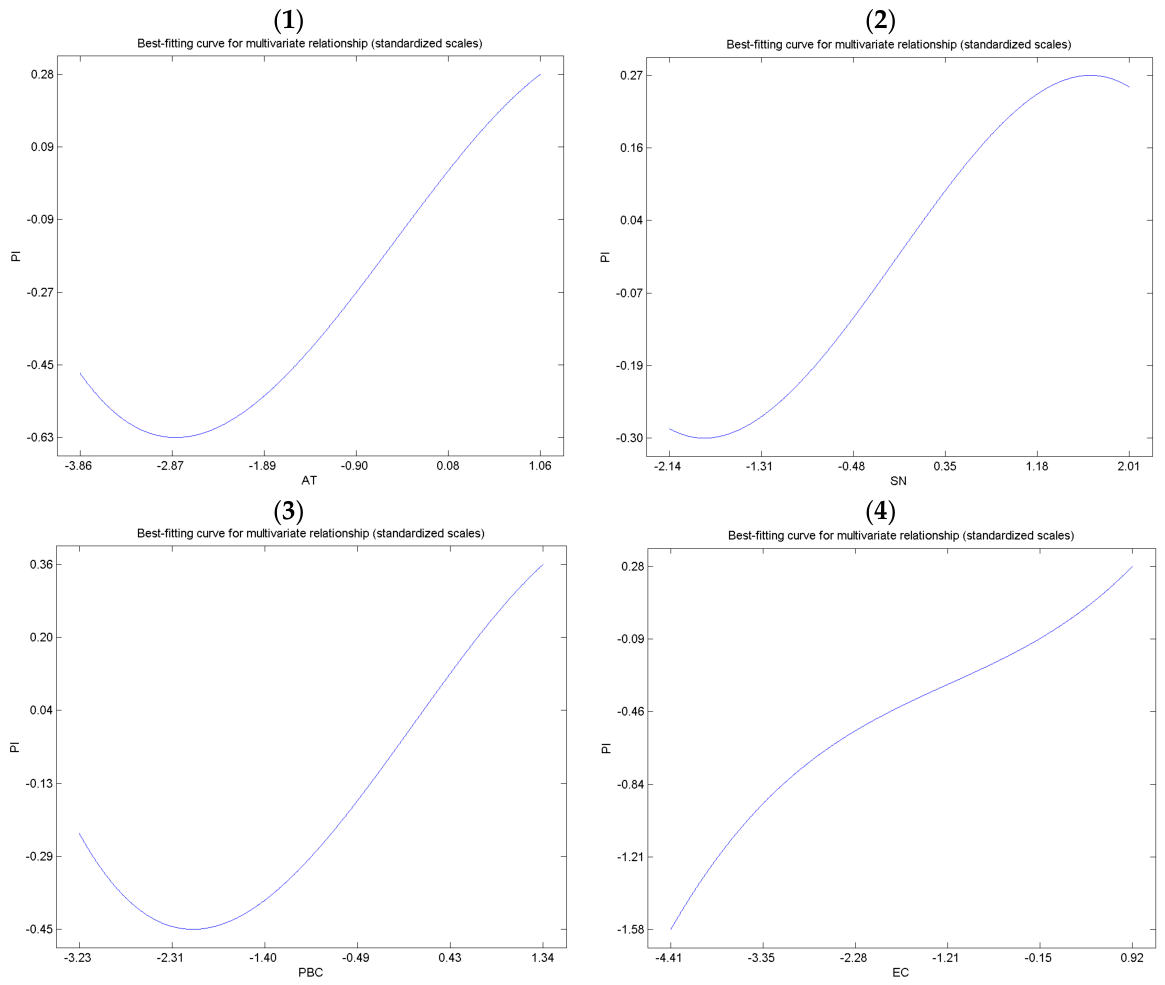
This may be attributable to the curvilinear nature of the relationship between the two concepts. Analysis of the links between the variables revealed that, in most cases, the relationship was nonlinear.
From Figure 2, a nonlinear relationship can be observed between all variables and PI. AT, SN, PBC and EC have an expected influence on PI, meaning that improvements in these areas are expected to have a positive impact on PI.
Figure 2.
Relationship between AT (1), SN (2), PBC (3), EC (4) and PI. Source: authors’ own research.
The relationship is not always straightforward: the findings show clear evidence that individuals with a negative attitude—a low AT towards purchasing green products—nevertheless choose to purchase sustainable products. This also applies to individuals who exhibit low PBC who behave similarly. It can be speculated that they choose to do this because they respond more readily to other social pressures [69,70]. More research in this area is required.
This result is important because it shows that raising awareness of environmental issues can impact people’s purchase decisions. Higher EC values were directly linked with higher PI values (β = 0.278; f2 = 0.163). EC exerted a broader influence because it was also positively associated with AT (β = 0.474; f2 = 0.261), SN (β = 0.218; f2 = 0.047) and PBC (β = 0.402; f2 = 0.189), supporting H3, H6 and H8. Altogether, the findings show that the total impact of EC on PI (β = 0.588; f2 = 0.345) is more complex. More environmental awareness leads not only to higher purchase intentions but also to changes in attitude, norms and confidence that an individual decision can have an impact, thereby influencing the decision to purchase more environmentally friendly products.
A multi-group analysis using the Satterthwaite method was performed to control for social and demographic variables. Some statistically significant differences were identified but discarded, as they did not fit a clear pattern of behavior.
5. Discussion
The findings of this study offer several insights into the factors driving green product purchase intention among Generation Z consumers. In the context of the TPB framework, all three core constructs, attitude, subjective norms and PBC, have been confirmed as significant. Moreover, the model has been extended with environmental concern. This novel variable is the strongest predictor, directly and indirectly, showing the value of extending the classic TPB model by including ecological motivations.
The consumers’ intention to purchase green products is positively influenced, in order, by concern for the environment, perceived behavioral control, attitude and subjective norms, all of which play an important role. A positive relationship between environmental concern and green product purchase intention has been previously identified by Leclercq-Machado, L. et al. [49] and Paul, J. et al. [17], reinforcing the idea that sustainability-driven consumer behavior is shaped by both personal convictions and external societal pressures.
Social norms have an important effect on the intention to purchase green products, as highlighted by Maichum, K. et al. [28], Zhuang, W. et al. [22] and Kamalanon, P. et al. [31]. The role of social media and influencer endorsements in shaping these norms is increasingly significant, as online communities foster the diffusion of pro-environmental behaviors. The perception of the subjective norms can be amplified by marketing campaigns that emphasize the popularity of green products and their social acceptance.
Increased concern for the environment indirectly influences final purchase intention by changing attitudes and understanding the individual’s ability to change and adapt to social norms. The same conclusion was demonstrated by Chen, X. et al. [71]. The results showed that the total effect of concern for the environment on purchase intention was significantly higher than that of other factors, underscoring the importance of accounting for the indirect effects of this variable.
In this study, we used a sample similar to those used in other studies in the field. Data collected through a single questionnaire and subsequent sampling procedures could not be implemented due to anonymity requirements, but the Harman test indicated that this was not a concern. The findings cannot be considered generally valid because the sample did not include participants from a more diverse range of economic, social and demographic groups.
This research validates the results of Paul, J. et al. [17] and extends them by demonstrating that relationships between variables are not always linear. It also shows that the relationship between AT and PI is not straightforward. By using WarpPLS 8.0, which allows for the identification of nonlinear relationships, the model validated the relationship between SN and PI, a finding that was not initially supported by Paul, J. et al. [17], who only identified indirect relationships between SN and PI through AT and PBC. This finding underscores the importance of psychological and personality-based segmentation in green consumer research, enabling more targeted interventions. Understanding the complexity of these motivations can help businesses craft more nuanced, persuasive sustainability messaging to better compete in the market.
6. Conclusions
This study has confirmed that environmental concern, perceived behavioral control, attitude and subjective norms all positively influence green product purchase intention among Generation Z consumers in Romania. The relationships between these variables were found to be nonlinear. Environmental concern is the dominant predictor, both directly and indirectly.
Concern for the environment can be a strong motivator for consumers as an expression of their ecological responsibility. Moreover, this motivation can extend beyond individual actions, influencing broader community engagement in sustainable initiatives. Marketing strategies, public policies and awareness campaigns should better highlight the important role of green products in sustainable economic development. Integrating sustainability education into school curricula and corporate training programs can further amplify awareness and encourage behavioral change. State-granted financial incentives to producers and consumers can facilitate the purchase of green products and facilitate ecological behavior. Such measures not only reduce financial barriers but also serve as strong incentives for long-term sustainable consumption patterns. Companies that offer flexible pricing models, such as green financing or installment plans, can significantly enhance accessibility to sustainable products. Marketing strategies can highlight the personal and environmental benefits of green products to reinforce positive attitudes. By associating green consumption with enhanced personal well-being and social prestige, companies can further leverage these psychological drivers. A company can obtain a competitive advantage through marketing campaigns that emphasize the ecofriendly nature of its products, particularly when paired with campaigns that emphasize the urgency of environmental issues.
Concern for the environment can motivate individuals to overcome perceived barriers to green behaviors, such as cost or affordability. Brands that collaborate with influencers to promote green products can better compete by effectively tapping into consumer trust and aspirational behaviors. The perception of social approval influences the intention to buy green products. This highlights the need for interdisciplinary collaboration among environmental scientists, behavioral economists and policymakers to design more effective interventions. This self-efficacy can be further reinforced by community-led sustainability projects and participatory environmental decision-making. Additionally, aligning corporate social responsibility initiatives with consumer expectations for sustainability could further strengthen brand loyalty. Companies that implement green loyalty programs, offering rewards for ecofriendly purchases, can enhance long-term engagement.
The sample, referring to Romania, while similar to other studies in the field, has a limitation that warrants discussion. Data were gathered using a single questionnaire and are subject to common method bias. Anonymity requirements meant that it was difficult to implement subsequent sampling procedures. Although the research presented in this study conducted Harman’s test and found no concerns, the limitation remains.
Although this study was not focused explicitly on students, the data collection method skewed the data, imposing some limitations. The sample comprised a large number of college students and educated young people, who might be more inclined to give socially acceptable answers [72]. The findings provide valuable insights into the purchasing behavior of young consumers; however, they may not fully capture the perspectives of other demographics, older or less educated, who may have different priorities and financial constraints. The more educated young people are, the more valuable their perspective will be, and they can become more aware of environmental issues and can provide relevant insights into factors influencing the intention to purchase green products. This potential bias underscores the need for methodological approaches that mitigate social desirability effects, such as anonymous surveys or implicit association tests. They could be more open in the future to innovative behaviors related to the adoption of new sustainable solutions and suggest directions for behavior change. Furthermore, businesses targeting this demographic could leverage sustainability education as part of their brand communication strategy to foster long-term consumer loyalty.
Future research can consider implementing a public policy package that highlights the ecological advantages of green products, identifies and overcomes obstacles related to accessing them and encourages changes in purchasing habits in favor of ecological consumption. These measures are essential to support the broader goal of promoting environmentally responsible consumption and chart important directions for future research, green marketing campaigns, and public policy initiatives. Another potential research avenue can look at generalizing these results by including a wider range of participants from various socio-economic and age groups. Companies investing in emerging green technologies could benefit from engaging young consumers early, as they are more likely to adopt and advocate for sustainable innovations. Thus, understanding the differences between individuals could be deepened, which could influence responses to the questionnaire.
Author Contributions
Conceptualization, R.H. and C.N.; Methodology, C.-I.I. and N.M.J.; Writing—original draft, C.-I.I., R.H., C.N. and N.M.J. All authors have read and agreed to the published version of the manuscript.
Funding
This research received no external funding.
Institutional Review Board Statement
The study was conducted in accordance with the Declaration of Helsinki and approved by the Ethics Committee of the University of Bucharest (Decision No. 55/17 May2023, Registration No. 150).
Informed Consent Statement
Informed consent was obtained from all subjects involved in the study.
Data Availability Statement
The data presented in this study are available on request from the corresponding author.
Conflicts of Interest
The authors declare no conflict of interest.
References
- Pérez-Peña, M.d.C.; Jiménez-García, M.; Ruiz-Chico, J.; Peña-Sánchez, A.R. Analysis of Research on the SDGs: The Relationship between Climate Change, Poverty and Inequality. Appl. Sci. 2021, 11, 8947. [Google Scholar] [CrossRef] [Scilit]
- Sajn, N. Sustainable Consumption—Helping Consumers Make Eco-Friendly Choices; European Parliamentary Research Service; European Parliament: Strasbourg, France, 2020. [Google Scholar]
- European Commission. Circular Economy Action Plan. Retrieved from Energy, Climate Change, Environment. 15 December 2024. Available online: https://environment.ec.europa.eu/strategy/circular-economy-action-plan_en (accessed on 29 April 2026).
- Braun Kohlová, M.; Urban, J. Buy green, gain prestige and social status. J. Environ. Psychol. 2020, 69, 101416. [Google Scholar] [CrossRef] [Scilit]
- Nelissen, R.M.A.; Meijers, M.H.C. Social benefits of luxury brands as costly signals of wealth and status. Evol. Hum. Behav. 2011, 32, 343–355. [Google Scholar] [CrossRef] [Scilit]
- Barclay, P.; Barker, J.L. Greener Than Thou: People who protect the environment are more cooperative, compete to be environmental, and benefit from reputation. J. Environ. Psychol. 2020, 72, 101441. [Google Scholar] [CrossRef] [Scilit]
- Brick, C.; Sherman, D.K.; Kim, H.S. “Green to be seen” and “brown to keep down”: Visibility moderates the effect of identity on pro-environmental behavior. J. Environ. Psychol. 2017, 51, 226–238. [Google Scholar] [CrossRef] [Scilit]
- Maduku, D.K. How environmental concerns influence consumers’ anticipated emotions towards sustainable consumption: The moderating role of regulatory focus. J. Retail. Consum. Serv. 2024, 76, 103593. [Google Scholar]
- Chen, Y.; Ghosh, M.; Liu, Y.; Zhao, L. Media Coverage of Climate Change and Sustainable Product Consumption: Evidence from Hybrid Vehicle Market. J. Mark. Res. 2019, 56, 995–1011. [Google Scholar] [CrossRef] [Scilit]
- Hamzaoui-Essoussi, L.; Linton, J. New or recycled products: How much are consumers willing to pay? J. Consum. Mark. 2010, 27, 458–468. [Google Scholar] [CrossRef] [Scilit]
- Luchs, M.; Naylor, R.; Irwin, J.; Raghunathan, R. The Sustainability Liability: Potential Negative Effects of Ethicality on Product Preference. J. Mark. 2010, 74, 18–31. [Google Scholar] [CrossRef] [Scilit]
- Saari, U.A.; Damberg, S.; Frömbling, L.; Ringle, C.M. Sustainable consumption behavior of Europeans: The influence of environmental knowledge and risk perception on environmental concern and behavioral intention. Ecol. Econ. 2021, 189, 107155. [Google Scholar] [CrossRef] [Scilit]
- Chernev, A.; Blair, S. When Sustainability Is Not a Liability: The Halo Effect of Marketplace Morality. J. Consum. Psychol. 2020, 31, 551–569. [Google Scholar] [CrossRef] [Scilit]
- Morgan, M.I.; Hine, D.W.; Bhullar, N.; Loi, N.M. Landholder adoption of low emission agricultural practices: A profiling approach. J. Environ. Psychol. 2015, 41, 35–44. [Google Scholar] [CrossRef] [Scilit]
- Singh, S.; Singh, D.; Thakur, K.S. Consumer’s Attitude and Purchase Intention towards Green Products in the FMCG Sector. Pac. Bus. Rev. Int. 2014, 7, 27–46. [Google Scholar]
- Ajzen, I. The theory of planned behavior. Organ. Behav. Hum. Decis. Process. 1991, 50, 179–211. [Google Scholar] [CrossRef] [Scilit]
- Paul, J.; Modi, A.; Patel, J. Predicting green product consumption using theory of planned behavior and reasoned action. J. Retail. Consum. Serv. 2016, 29, 123–134. [Google Scholar] [CrossRef] [Scilit]
- Ajzen, I. The theory of planned behavior: Frequently asked questions. Hum. Behav. Emerg. Technol. 2020, 2, 314–324. [Google Scholar] [CrossRef] [Scilit]
- Wang, Y.; Zhao, J.; Pan, J. The investigation of green purchasing behavior in China: A conceptual model based on the theory of planned behavior and self-determination theory. J. Retail. Consum. Serv. 2024, 77, 103667. [Google Scholar] [CrossRef] [Scilit]
- Kock, N. Minimum Sample Size Estimation in PLS-SEM: An Application in Tourism and Hospitality Research. In Applying Partial Least Squares in Tourism and Hospitality Research; Ali, F., Mostafa Rasoolimanesh, S., Cobanoglu, C., Eds.; Emerald Publishing Limited: Leeds, UK, 2018; pp. 1–16. [Google Scholar] [CrossRef] [Scilit]
- Memon, M.; Ramayah, T.; Hwa, C.; Ting, H.; Chuah, F.; Cham, T.-H. PLS-SEM statistical programs: A review. J. Appl. Struct. Equ. Model. 2021, 5, i–xiii. [Google Scholar] [CrossRef] [Scilit] [PubMed]
- Zhuang, W.; Luo, X.; Riaz, M.U. On the Factors Influencing Green Purchase Intention: A Meta-Analysis Approach. Front. Psychol. 2021, 12, 644020. [Google Scholar] [CrossRef] [Scilit] [PubMed]
- Trumbo, C.W.; O’Keefe, G.J. Intention to Conserve Water: Environmental Values, Reasoned Action, and Information Effects Across Time. Soc. Nat. Resour. 2005, 18, 573–585. [Google Scholar] [CrossRef] [Scilit]
- Scalco, A.; Noventa, S.; Sartori, R.; Ceschi, A. Predicting organic food consumption: A meta-analytic structural equation model based on the theory of planned behavior. Appetite 2017, 112, 235–248. [Google Scholar] [CrossRef] [Scilit] [PubMed]
- Liobikienė, G.; Bernatonienė, J. Why determinants of green purchase cannot be treated equally? The case of green cosmetics: Literature review. J. Clean. Prod. 2017, 162, 109–120. [Google Scholar] [CrossRef] [Scilit]
- Zhang, S.; Xia, Z.; Zhang, C.; Tian, X.; Xie, J. Green illusions in self-reporting? Reassessing the intention-behavior gap in waste recycling behaviors. Waste Manag. 2023, 166, 171–180. [Google Scholar] [CrossRef] [Scilit] [PubMed]
- de Leeuw, A.; Valois, P.; Ajzen, I.; Schmidt, P. Using the theory of planned behavior to identify key beliefs underlying pro-environmental behavior in high-school students: Implications for educational interventions. J. Environ. Psychol. 2015, 42, 128–138. [Google Scholar] [CrossRef] [Scilit]
- Maichum, K.; Parichatnon, S.; Peng, K.-C. Application of the Extended Theory of Planned Behavior Model to Investigate Purchase Intention of Green Products among Thai Consumers. Sustainability 2016, 8, 1077. [Google Scholar] [CrossRef] [Scilit]
- Rehman, Z.U.; Lohana, S.; Irfan, M. Driving and Deterrent Factors Affecting Green Products’ Consumption. Extended the Theory of Planned Behavior. In Global Conference on Wireless and Optical Technologies (GCWOT); IEEE: Piscataway, NJ, USA, 2024; pp. 1–9. [Google Scholar] [CrossRef] [Scilit]
- Zhang, L.; Fan, Y.; Zhang, W.; Zhang, S. Extending the Theory of Planned Behavior to Explain the Effects of Cognitive Factors across Different Kinds of Green Products. Sustainability 2019, 11, 4222. [Google Scholar] [CrossRef] [Scilit]
- Kamalanon, P.; Chen, J.-S.; Le, T.-T.-Y. “Why Do We Buy Green Products?” An Extended Theory of the Planned Behavior Model for Green Product Purchase Behavior. Sustainability 2022, 14, 689. [Google Scholar] [CrossRef] [Scilit]
- Laheri, V.; Weng, L.; Purushottam, A.; Sanjeev, K. A multidimensional lens of environmental consciousness: Towards an environmentally conscious theory of planned behavior. J. Consum. Mark. 2024, 41, 281–297. [Google Scholar] [CrossRef] [Scilit]
- Rukhsar; Yameen, M.; Khanam, Z. Understanding the consumer purchase behaviour towards green electronic products: Using insight from the theory of planned behaviour. IIM Ranchi J. Manag. Stud. 2024, 4, 31–54. [Google Scholar] [CrossRef] [Scilit]
- Müller, J.; Acevedo-Duque, Á.; Muller, S.; Kalia, P.; Mehmood, K. Predictive Sustainability Model Based on the Theory of Planned Behavior Incorporating Ecological Conscience and Moral Obligation. Sustainability 2021, 13, 4248. [Google Scholar] [CrossRef] [Scilit]
- Kumar, G.; Nayak, J. A Meta-Analysis of TPB Model in Predicting Green Energy Behavior: The Moderating Role of Cross-Cultural Factors. J. Int. Consum. Mark. 2022, 35, 147–165. [Google Scholar] [CrossRef] [Scilit]
- Jebarajakirthy, C.; Achchuthan, S.; Das, M.; Maseeh, H.; Ashaduzzaman, M.; Strong, C.; Sangroya, D. A meta-analytic integration of the theory of planned behavior and the value-belief-norm model to predict green consumption. Eur. J. Mark. 2024, 58, 1141–1174. [Google Scholar] [CrossRef] [Scilit]
- Naz, F.; Oláh, J.; Vasile, D.; Magda, R. Green Purchase Behavior of University Students in Hungary: An Empirical Study. Sustainability 2020, 12, 10077. [Google Scholar] [CrossRef] [Scilit]
- Psurny, M.; Mokry, S.; Langr, A.; Stávková, J. A reusable product from the point of view of a young generation: How companies can increase their competitiveness. J. Compet. 2024, 16, 128–149. [Google Scholar] [CrossRef]
- Witek, L.; Kuźniar, W. Green Purchase Behaviour Gap: The Effect of Past Behaviour on Green Food Product Purchase Intentions among Individual Consumers. Foods 2024, 13, 136. [Google Scholar] [CrossRef] [Scilit] [PubMed]
- Dropulić, B.; Krupka, Z. Are Consumers Always Greener on the Other Side of the Fence? Factors That Influence Green Purchase Intentions—The Context of Croatian and Swedish Consumers. Market-Tržište 2020, 32, 99–113. [Google Scholar] [CrossRef] [Scilit]
- Brand, B.; Rausch, T.; Brandel, J. The Importance of Sustainability Aspects When Purchasing Online: Comparing Generation X and Generation Z. Sustainability 2022, 14, 5689. [Google Scholar] [CrossRef] [Scilit]
- Ewe, S.; Tjiptono, F. Green behavior among Gen Z consumers in an emerging market: Eco-friendly versus non-eco-friendly products. Young Consum. 2023, 24, 234–252. [Google Scholar] [CrossRef] [Scilit]
- Romania Journal. 27 December 2023. Available online: https://www.romaniajournal.ro/society-people/study-old-and-new-habits-in-the-behavior-of-romanian-consumers-in-2023/ (accessed on 29 April 2026).
- Purcărea, T.; Ioan-Franc, V.; Ionescu, Ş.-A.; Purcărea, I.M.; Purcărea, V.L.; Purcărea, I.; Mateescu-Soare, M.C.; Platon, O.-E.; Orzan, A.-O. Major Shifts in Sustainable Consumer Behavior in Romania and Retailers’ Priorities in Agilely Adapting to It. Sustainability 2022, 14, 1627. [Google Scholar] [CrossRef] [Scilit]
- Aral, Ö.H.; López-Sintas, J. Environmental behavior patterns across clusters of European Union countries: Uncovering heterogeneity in the attitude-behavior-context relationship. J. Clean. Prod. 2023, 388, 135936. [Google Scholar] [CrossRef] [Scilit]
- Musova, Z.; Musa, H.; Drugdova, J.; Lazaroiu, G.; Alayasa, J. Consumer Attitudes Towards New Circular Models in the Fashion Industry. J. Compet. 2021, 13, 111–128. [Google Scholar] [CrossRef] [Scilit]
- Balaskas, S.; Panagiotarou, A.; Rigou, M. Impact of Environmental Concern, Emotional Appeals, and Attitude toward the Advertisement on the Intention to Buy Green Products: The Case of Younger Consumer Audiences. Sustainability 2023, 15, 13204. [Google Scholar] [CrossRef] [Scilit]
- Xu, Y.; Du, J.; Khan, M.A.S.; Jin, S.; Altaf, M.; Anwar, F.; Sharif, I. Effects of Subjective Norms and Environmental Mechanism on Green Purchase Behavior: An Extended Model of Theory of Planned Behavior. Front. Environ. Sci. 2022, 10, 779629. [Google Scholar] [CrossRef] [Scilit]
- Leclercq-Machado, L.; Alvarez-Risco, A.; Gómez-Prado, R.; Cuya-Velásquez, B.B.; Esquerre-Botton, S.; Morales-Ríos, F.; Almanza-Cruz, C.; Castillo-Benancio, S.; Anderson-Seminario, M.d.l.M.; Del-Aguila-Arcentales, S.; et al. Sustainable Fashion and Consumption Patterns in Peru: An Environmental-Attitude-Intention-Behavior Analysis. Sustainability 2022, 14, 9965. [Google Scholar] [CrossRef] [Scilit]
- Hudayah, S.; Ramadhani, M.; Sary, K.; Raharjo, S.; Yudaruddin, R. Green perceived value and green product purchase intention of Gen Z consumers: Moderating role of environmental concern. Environ. Econ. 2023, 14, 87–102. [Google Scholar] [CrossRef] [Scilit]
- von Meyer-Höfer, M.; Olea-Jaik, E.; Padilla-Bravo, C.A.; Spiller, A. Mature and Emerging Organic Markets: Modelling Consumer Attitude and Behaviour With Partial Least Square Approach. J. Food Prod. Mark. 2015, 21, 626–653. [Google Scholar] [CrossRef] [Scilit]
- Marquart-Pyatt, S.T. Explaining Environmental Activism Across Countries. Soc. Nat. Resour. 2012, 25, 683–699. [Google Scholar] [CrossRef] [Scilit]
- Limbu, Y.B.; Pham, L.; Nguyen, T.T.T. Predictors of Green Cosmetics Purchase Intentions among Young Female Consumers in Vietnam. Sustainability 2022, 14, 12599. [Google Scholar] [CrossRef] [Scilit]
- Vu, H.N.D.; Nielsen, M.R. Understanding determinants of the intention to buy rhino horn in Vietnam through the Theory of Planned Behaviour and the Theory of Interpersonal Behaviour. Ecol. Econ. 2022, 195, 107361. [Google Scholar] [CrossRef] [Scilit]
- Silva, M.D.; Wang, P.; Kuah, A.T.H. Why wouldn’t green appeal drive purchase intention? Moderation effects of consumption values in the UK and China. J. Bus. Res. 2021, 122, 713–724. [Google Scholar] [CrossRef] [Scilit]
- Tan, C.-S.; Ooi, H.-Y.; Goh, Y.-N. A moral extension of the theory of planned behavior to predict consumers’ purchase intention for energy-efficient household appliances in Malaysia. Energy Policy 2017, 107, 459–471. [Google Scholar] [CrossRef] [Scilit]
- Schill, M.; Godefroit-Winkel, D.; Diallo, M.F.; Barbarossa, C. Consumers’ intentions to purchase smart home objects: Do environmental issues matter? Ecol. Econ. 2019, 161, 176–185. [Google Scholar] [CrossRef] [Scilit]
- Nguyen, P.; Tran, L. The influence of status orientation on green purchase intention: A case of a developing market. Int. J. Sustain. Soc. 2021, 13, 129. [Google Scholar] [CrossRef] [Scilit]
- Ahmed, R.R.; Streimikiene, D.; Sulaiman, Y.; Asim, J.; Streimikis, J. Enhancing competitiveness of green environmental practices and green purchase intentions in Asian markets: Evidence from the extended norm activation model. J. Compet. 2024, 16, 204–220. [Google Scholar] [CrossRef] [Scilit]
- Panopoulos, A.; Poulis, A.; Theodoridis, P.; Kalampakas, A. Influencing Green Purchase Intention through Eco Labels and User-Generated Content. Sustainability 2022, 15, 764. [Google Scholar] [CrossRef] [Scilit]
- Junior, S.S.B.; da Silva, D.; Gabriel, M.L.D.; de Oliveira Braga, W.R. The Effects of Environmental Concern on Purchase of Green Products in Retail. Procedia-Soc. Behav. Sci. 2015, 170, 99–108. [Google Scholar] [CrossRef] [Scilit]
- Yuriev, A.; Dahmen, M.; Paillé, P.; Boiral, O.; Guillaumie, L. Pro-environmental behaviors through the lens of the theory of planned behavior: A scoping review. Resour. Conserv. Recycl. 2020, 155, 104660. [Google Scholar] [CrossRef] [Scilit]
- Blok, V.; Wesselink, R.; Studynka, O.; Kemp, R. Encouraging sustainability in the workplace: A survey on the pro-environmental behaviour of university employees. J. Clean. Prod. 2015, 106, 55–67. [Google Scholar] [CrossRef] [Scilit]
- Smith, S.; Paladino, A. Eating clean and green? Investigating consumer motivations towards the purchase of organic food. Australas. Mark. J. 2010, 18, 93–104. [Google Scholar] [CrossRef] [Scilit]
- Hair, J.F.; Risher, J.J.; Sarstedt, M.; Ringle, C.M. When to use and how to report the results of PLS-SEM. Eur. Bus. Rev. 2019, 31, 2–24. [Google Scholar] [CrossRef] [Scilit]
- Henseler, J.; Ringle, C.M.; Sarstedt, M. A new criterion for assessing discriminant validity in variance-based structural equation modeling. J. Acad. Mark. Sci. 2015, 43, 115–135. [Google Scholar] [CrossRef] [Scilit]
- Podsakoff, P.M.; MacKenzie, S.B.; Lee, J.-Y.; Podsakoff, N.P. Common method biases in behavioral research: A critical review of the literature and recommended remedies. J. Appl. Psychol. 2003, 88, 879–903. [Google Scholar] [CrossRef] [Scilit] [PubMed]
- Cassel, C.; Hackl, P.; Westlund, A. Robustness of Partial Least-Squares Method for Estimating Latent Variable Quality Structures. J. Appl. Stat. 1999, 26, 435–446. [Google Scholar] [CrossRef] [Scilit]
- Konuk, F.A.; Otterbring, T. The dark side of going green: Dark triad traits predict organic consumption through virtue signaling, status signaling, and praise from others. J. Retail. Consum. Serv. 2024, 76, 103531. [Google Scholar] [CrossRef] [Scilit]
- Naderi, I. I’m nice, therefore I go green: An investigation of pro-environmentalism in communal narcissists. J. Environ. Psychol. 2018, 59, 54–64. [Google Scholar] [CrossRef] [Scilit]
- Chen, X.; Rahman, M.; Rana, M.S.; Gazi, M.A.; Rahaman, M.A.; Che Nawi, N. Predicting Consumer Green Product Purchase Attitudes and Behavioral Intention During COVID-19 Pandemic. Front. Psychol. 2022, 12, 760051. [Google Scholar] [CrossRef] [Scilit] [PubMed]
- Kaiser, F.G.; Schultz, P.W.; Berenguer, J.; Corral-Verdugo, V.; Tankha, G. Extending Planned Environmentalism. Eur. Psychol. 2008, 13, 288–297. [Google Scholar] [CrossRef] [Scilit]

Disclaimer/Publisher’s Note: The statements, opinions and data contained in all publications are solely those of the individual author(s) and contributor(s) and not of MDPI and/or the editor(s). MDPI and/or the editor(s) disclaim responsibility for any injury to people or property resulting from any ideas, methods, instructions or products referred to in the content. |
© 2026 by the authors. Licensee MDPI, Basel, Switzerland. This article is an open access article distributed under the terms and conditions of the Creative Commons Attribution (CC BY) license.