Article

Baseline Analysis of TPH and PFAS Contamination in the Yasuní National Park, Ecuador: A Case Study of Off-the-Grid Hydrocarbon Extraction


by
Sofia Hoffman
1,
María Belén Noroña
2,* and
Rachel Brennan
3
1
Department of Energy and Mineral Engineering, Pennsylvania State University, University Park, PA 16802, USA
2
Department of Geography, Pennsylvania State University, University Park, PA 16802, USA
3
Department of Civil and Environmental Engineering, Colorado State University, Fort Collins, CO 80523, USA
*
Author to whom correspondence should be addressed.
Sustainability 2026, 18(13), 6536; https://doi.org/10.3390/su18136536 (registering DOI)
Submission received: 6 March 2026 / Revised: 8 June 2026 / Accepted: 11 June 2026 / Published: 26 June 2026

Abstract

The Yasuní National Park in Ecuador’s Amazon, one of Earth’s most biodiverse regions, faces unprecedented threats from oil extraction and increasing risks to Kichwa communities. This paper provides a baseline analysis of off-the-grid hydrocarbon extraction affecting ecosystems and communities living within Oil Blocks 12 and 43. Our aim is to integrate analysis of per- and polyfluoroalkyl substances (PFAS) and total petroleum hydrocarbons (TPH) to better understand the impacts of oil-extractive contamination at off-the-grid sites in sensitive Amazonian ecosystems. To achieve that, we center the Yasuní Park and Kichwa communities as a case study. Despite Kichwa environmental concerns about contamination, conventional total hydrocarbon testing has failed to detect elevated levels due to hydrocarbon degradation, necessitating testing for other contaminants associated with extractive activities, such as PFAS, a forever chemical commonly used in drilling fluids, and other contaminants from petroleum transportation via pipelines. This research was conducted at the request of and with the participation of Kichwa residents, who needed to understand the nature of contaminants in their environment. Two participatory mapping exercises were conducted in Oil Block 12 to pinpoint 16 sampling locations, given the block’s long history of contamination. In Oil Block 43, where extraction is more recent, we sampled 5 sites where community members had observed contamination in the last year. TPH and PFAS analyses were performed using EPA methods 1633 and 1664. Results revealed 7 PFAS compounds across Oil Blocks, 11 TPH compounds in Oil Block 12, and overlap between TPH and PFAS at 6 sampling locations. Contamination was detected near community housing, food gardens, and swamped forest, which is concerning because communities rely on traditional subsistence activities, including forest gathering, fishing, and gardens for survival. This is the first environmental assessment to examine the combined presence of hydrocarbons and PFAS in the Yasuní Park and the Ecuadorian Amazon, providing communities with empirical evidence of environmental contamination.

1. Introduction

1.1. The Yasuní National Park and Its Importance

The Yasuní National Park is often noted as one of the most biodiverse places on Earth due to the convergence of three unique regions: the Equator, the Andes Mountains, and the Amazon rainforest. The park is home to the world’s richest area of woody plant species, as well as records for the mean number of amphibian, mammal, and bird species [1]. For example, one hectare of Yasuní forest contains an average of 655 tree species, more than the total number of native tree species found in the U.S. and Canada combined [1]. With an area of approximately 10,000 km2, the Park is situated between the rivers Napo and Curaray in the Provinces of Pastaza and Orellana. It also contains an estimated 1.5 billion barrels of subterranean crude oil reserves [2].
In 2024, Oil Block 12 (OB 12), which overlaps with the El Edén Kichwa territory, and Oil Block 43—Yasuní ITT (OB 43), which overlaps with the Boca de Tiputini Kichwa territory, produced 72,802 barrels per day, according to official data [3], corresponding to 21% of Ecuador’s total oil production that year. Opposition to extraction in the Yasuní park dates to 2014 [4], as the park is not only rich in biodiversity but is also home to the last 2 uncontacted tribes in Ecuador, the Tagaeri and the Taromenane. Extraction in OB 12 began in 2000, whereas extraction in OB 43 began around 2018 [5]. Note that seismic operations and construction occurred 4 years in advance in each oil block, thereby increasing the temporal extent of environmental impacts. The El Edén-Yuturi field (OB 12) is located in the northwestern upper corner of the park, while Yasuni-ITT (OB 43) is located at the heart of the park and close to the intangible zone aimed at protecting tribes in voluntary isolation [6].

1.2. Contextualization of the Problem

In 1996, the Occidental Petroleum Corporation claimed to possess technology that would allow it to drill in off-grid extractive areas with minimal environmental impacts while maintaining social responsibility standards among affected communities [7]. Similarly, after the national oil companies Petroamazonas and Petroecuador took over operations of OB 12 in 2008 and operations in OB 43 in 2018, they assured civilians that extraction would use advanced technology to affect only 300 hectares of the park in both blocks, having minimal impact on the surrounding forest [8,9].
Still, scholars such as Judith Kimmerling, activist Federika Peters, community members, and journalists have raised environmental concerns in OB 12 [7] and OB 43 [6,10]. In general, scholars studying off-the-grid extraction in remote areas of Ecuador suggest that accountability is minimal [11], given the remoteness of operations, the limited state and institutional presence, and the uneven power differentials between companies and local communities.
El Eden-Yuturi field (OB 12) comprises 13 platforms, a central facility for crude, water, and gas separation, a large continuous gas flare, 3 river ports, and a sanitary waste disposal site. Each platform features dozens of vertical and horizontal perforations, with approximately 110 producing wells [12]. More concerningly, extraction in the newer Yasuni-ITT (OB 43) already involves 6 platforms with at least 190 producing wells, 11 reinjection wells, a processing station, and an access road [13,14]. Further development of infrastructure in OB 43 has raised concerns and was halted in 2023 by a referendum, in which the Ecuadorian population rejected extraction in the park [8].

Indigenous Environmental Concerns

Residents’ concerns extend beyond crude spills to the treatment and disposal of formation water, and industrial or production water during and after hydraulic fracturing. This is because a significant amount of chemicals present in the drilling fluid are injected during the perforation process. Chemicals are also injected to prevent pipeline corrosion and facilitate the flow of crude oil through pipelines [15,16,17]. Formation water is also present in the reservoir, especially in older oil fields, such as El Eden [16,17]. For example, in the El Eden-Yuturi (OB 12) field, between 2014 and 2015, an average of 20,000 barrels of production water per day were reinjected into each of the reinjection wells to dispose of toxic water while enhancing recovery in more mature wells [18]. While this information pertains to the implementation of enhanced pilot recovery techniques at the time, it is unclear how much production water OB 12 processes. However, we know that achieving 100% clean operations is difficult; during Occidental’s tenure, only 70% of the production water was reinjected [19].
Large volumes of production water then require daily treatment and reinjection, which is the recommended approach for treating produced water in sensitive continental ecosystems [13]. Although studies suggest that even when produced water is reinjected in wells and drilling muds are deposited in landfills, there is still potential for groundwater contamination and other forms of exposure that pose risks to human health [20]. Due to the remoteness of the operations, transportation is challenging, and electricity is generated using diesel power brought by river transport [16,21]. Operational complications and high costs raise concerns about the environmental soundness of extraction and the company’s response to emergencies, particularly pipeline ruptures [22] and accidents during drilling and wastewater storage.
For example, Kimerling [19] documented that drilling muds used in OB 12 were stored in pools adjacent to the perforations and left open for many years across all platforms. And Fassler Carvajal [18] describes how, historically, produced water was left in pools to evaporate, posing grave environmental risks. Given the precipitation conditions in this area, overflowing mud pools from drilling were common between 1996 and 2006 [23]. It is important to note that, besides oil extraction and small-scale production of coffee and cacao—also introduced by oil companies—no other sources of contamination exist in El Edén Yuturi (OB 12) or in Boca del Tiputini (OB 43).
Finally, given that crude exports account for one quarter of Ecuador’s exports and 7.5% of its GDP [24], it is understandable that oil extraction will continue since most crude deposits and extractive operations are located in the Amazon. Therefore, it is key that operations be conducted sustainably, with transparent environmental monitoring, and with comprehensive regulatory frameworks that address the full scope of hydrocarbon and PFAS contamination in sensitive ecosystems.

2. Scientific Gap, Objectives, and Case Study Rationale

2.1. PFAS and TPH in Hydrocarbon Extraction and Literature Gap

Research clarifying the use of PFAS-containing additives and materials during hydraulic fracking and hydrocarbon transportation in the context of oil industry contamination is emerging. It is clear that PFASs are used in polyacrylamide as drilling fluids to reduce oil viscosity and prevent waxing, as resins to facilitate transportation, as corrosion inhibitors, and as foam-based fire-suppressing materials. Indeed, per- and polyfluoroalkyl substances are integral to oil operations through fluoropolymers, which are valued for their thermal stability, chemical inertness, and resistance to degradation. When examining PFAS connections to extractive industries, refineries, military bases, and mines, it is crucial to consider the entire upstream and downstream flux contributing to environmental contamination [20,25,26].
There are several studies aimed at understanding the role of PFAS in hydrocarbon extraction in developed countries. For example, a study conducted in West Virginia found measurable PFAS in 60% of wells and in surface water near gas-producing counties, indicating soil infiltration from accidental spills, leaks from storage pools, or mechanical failures [15]. Another study at the Denver Basin examined petroleum wells for short-chain PFAS, finding PFAS in mixed fracture fluids [27]. And a systematic survey in Dagang Oilfield in China shows a correlation between TPH and PFAs in surface water and sediment [28].
Moreover, a systematic study examining environmental impacts and public health at 69 hydrocarbon extraction sites worldwide identified contaminants, including heavy metals, mercury, and radioactive materials, associated with total hydrocarbons [29]. Eight of the sites assessed in this study are located in the Ecuadorian Amazon, and the authors argue that drilling fluids, slurry, and produced water are sources of contamination. The authors acknowledge gaps in understanding the composition, sources, and pathways of these contaminants [29].
Few scholars have considered assessing TPH and PFAS together to understand contamination, and they argue that contamination by petroleum hydrocarbons could serve as a predictor for PFAS contamination [28,30]. Still, no studies have examined this correlation in the Amazon, except for one on PFAS in the context of a large fire at a petrochemical terminal in Brazil [31]. This gap is more pressing when considering the combined effects of hydrocarbon extraction and PFAS at off-the-grid extractive sites, particularly in sensitive ecosystems where no studies exist.

2.2. Environmental Regulations

The Swedish Chemicals Agency has estimated that approximately 3000 different PFAS compounds are circulating globally, prompting several countries, including the United States, Canada, and the European Union, to begin phasing them out [32]. Around the world, per- and polyfluoroalkyl substances are subject to varying regulations. In the United States, the Environmental Protection Agency has set a limit of 70 ppt for the compounds PFOA and PFOS and is working toward establishing maximum contaminant levels [33].
While the United States has begun implementing regulations, many are applied solely to drinking water, with limits around 10–20 ppt for specific PFAS compounds. Although this represents a promising start, countries that have not yet begun regulating PFAS are instead starting to acknowledge background limits to identify contamination spikes [34]. This is particularly important on military bases, which frequently use large quantities of aqueous film-forming foam (AFFF), commonly identified as a source of PFAS contamination. Additionally, lax environmental regulation and oversight on hydrocarbon extraction and associated PFAS are evident worldwide. Companies like 3M and DuPont were aware of the dangers of PFAS since the 1960s, but no accountability was taken until after the damage was done [35].
While the EPA in the United States has some framework in place to regulate PFAS, the same level of caution is not being considered in Ecuador. Ecuador is a signatory to the Stockholm Convention on Persistent Organic Pollutants (POPs), where some PFAS are monitored through national self-reporting after the country identifies the presence of contaminants on selected products, including water samples, paper, greasers, de-greasers, textiles, leather, coatings, cleaners, metal plating, and pesticides. Samples sent for PFAS assessment under this convention did not include products used in the hydrocarbon industry or water collected near extractive sites [36]. Additionally, national environmental regulations based on environmental impact assessment for hydrocarbon extraction do not consider PFAS testing as a variable for establishing contamination [37].
Indeed, countries in Latin America have limited capacity to test for PFAS in combination with TPH. For example, the authors found that only one commercial laboratory in Mexico and one in Brazil were capable of extracting PFAS from soil and water during the study’s preparation. In terms of environmental regulation, only Brazil and Chile are taking action. Brazil is taking steps to prohibit the disposal of drilling fluid with less than 1% free oil, requiring treatment [20], and it is in the process of debating and passing legislation towards broader regulations [38]. Chile enforces restrictions on PFOS and PFOA through the Stockholm Convention, particularly on firefighting foams [39].

2.3. Research Questions

In response to the lack of attention to the persistence of PFAS in hydrocarbon extractive operations in the Amazon, and lax environmental regulations, our study considers the combined testing of TPH and PFAS in the study areas to answer the following questions: (a) What knowledge about off-the-grid contaminants can be gained from combining total petroleum hydrocarbons and per- and polyfluoroalkyl substance analysis in the Yasuní National Park?, and (b) how might such an understanding help inform environmental regulations?

2.4. Rationale for Conducting Research in the Yasuni Park and with Kichwa Communities

The Ecuadorian Amazon presents a particularly compelling case for combining TPH and PFAS contamination in off-the-grid producing regions, where aging infrastructure and weak regulatory oversight compound environmental risks. According to El Eden residents, accident rates increased after Petroamazonas and Petroecuador took over oil operations in 2008. A lack of investment in infrastructure, particularly the failure to upgrade pipelines with over 61% corrosion [22], has led to continuous infrastructure malfunctions. For example, a 2014 crude spill on platform L required the community and Petroamazonas to spend months cleaning crude from streams and forests [9,40]. In 2019 and 2021, large volumes of produced water spilled onto platform F, releasing toxins into the environment for 2 days [9,40]. These infrastructure failures might have created multiple pathways for PFAS contamination beyond the routine industrial applications. Corroded pipelines and emergency response activities involving AFFF potentially introduce PFAS into pristine ecosystems where detection and remediation are challenging.
When communities request that the state assess environmental contamination, they must follow a lengthy, bureaucratic procedure by filing an official complaint with the nearest city [40,41]. When the complaint reaches the appropriate officials at the Ministry of Environment, which was recently merged with the Ministry of Mining (July, 2025), they appoint a state-accredited laboratory to conduct contamination assessments [37]. By the time the laboratory arrives at the site, hydrocarbons have dissipated through volatilization or biodegradation processes. Thus, communities complain that even when contamination by oil or industrial water is visible, laboratories are unable to detect hydrocarbons above Ecuador’s regulatory limits, leading to the closure of these cases [41].
Given the tropical environment of the Ecuadorian Amazon, with the potential for rapid biodegradation and volatilization of petroleum compounds, additional evaluation standards should be established, including for pernicious contaminants such as PFAS. For example, studies aimed at understanding the transformation of PFAS following oil spill accidents have shown that after 2 years, PFAS in the soil were still capable of biotransformation, further emphasizing their environmental persistence [25].
Moreover, the health implications of co-contamination by heavy metals and hydrocarbons have already been documented in the Ecuadorian Amazon [42,43]. For example, among 80 communities surveyed in Orellana and Sucumbíos provinces, where Ecuador’s mature oil fields are located, a 2003 study found that 87% of families lived in permanent contact with oil industry pollution [42]. TPH examinations in these provinces found that more than 95% of water samples exceeded the 0.2 mg/L drinking water limit under the quality criteria [43]. This and other epidemiological studies associate cancer and other health conditions in the Ecuadorian Amazon with crude, formation, and produced water spills, as well as with contamination emerging from drilling fluids stored in pools or burned in open air [44,45,46]. These authors argue that there is a need for additional research into hydrocarbon-associated contaminants beyond heavy metals, including their potential health consequences for local people. Indeed, PFAS can act as metabolic and endocrine disruptors, and these effects are already being documented in the United States, raising concerns about understudied populations in remote oil-producing regions [29,47].

3. Methods and Materials

3.1. Rationale for Sampling and Logistics

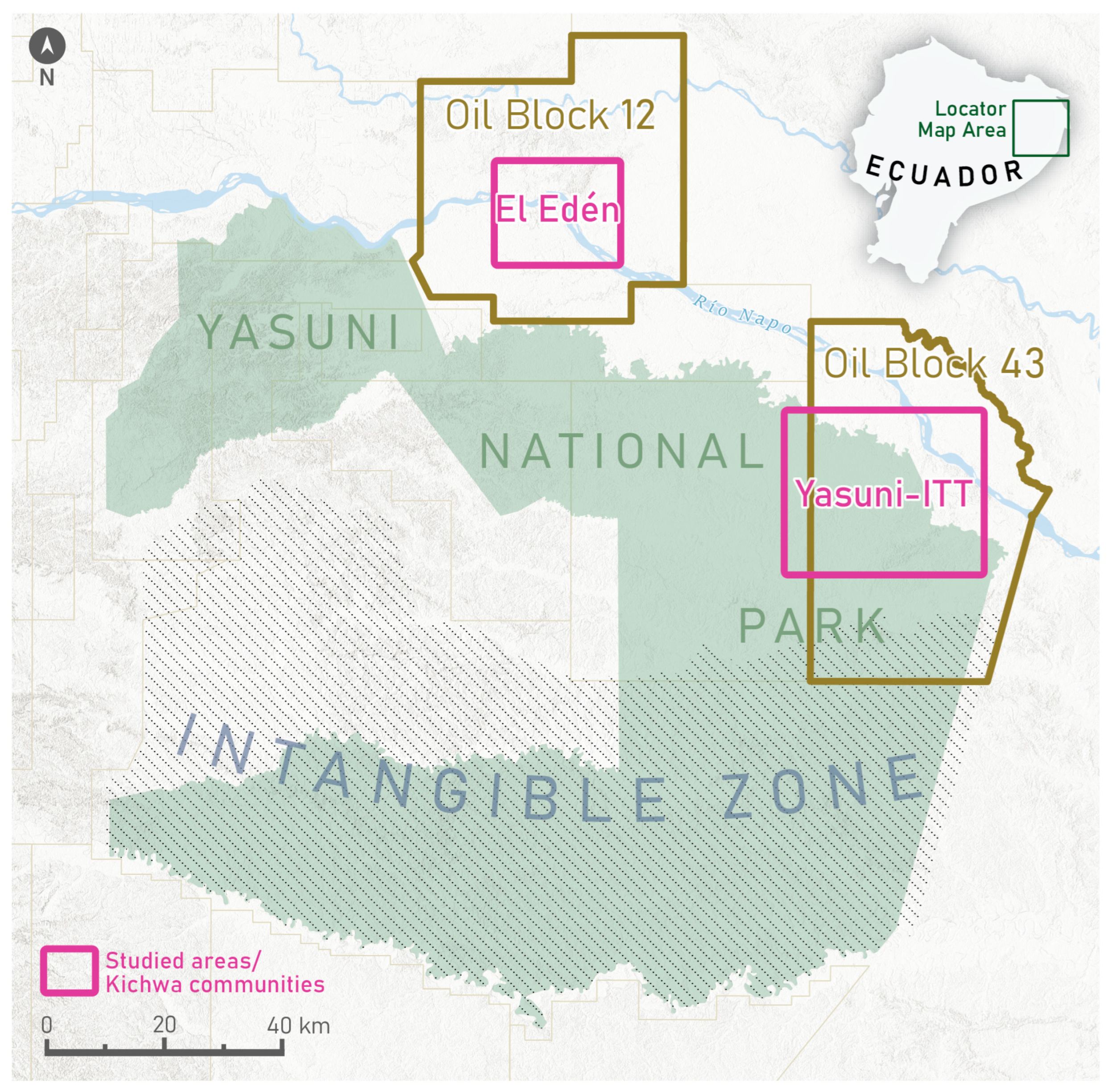
Given that the El Edén Yuturi community (OB 12) has a 26-year history of extractive activity and has documented multiple oil and industrial water spills affecting the northeastern upper border of Yasuní, 16 PFAS and 10 TPH samples were collected in El Edén. The Boca del Tiputini community, located in Yasuni-ITT (OB 43), has only 8 years of extraction, with infrastructure at the heart of Yasuni Park and in proximity to the intangible zone that serves as a boundary protecting the forest where the last 2 uncontacted tribes live (See Figure 1). Then, we collected a subset of 5 PFAS samples in Yasuni-ITT (OB 43). Given the similarities in how off-grid infrastructure has been built in the 2 oil blocks [13,21,22], understanding the environmental impacts in OB 12 can inform assessments of present and future threats in OB 43.
In terms of logistics, the distance between oil blocks is significant; the researcher’s travel time between OB 12 and OB 43 was 4 h each way by motorized canoe, for a total of 8 h of travel in a given day. Because the researchers were based at OB 12, where some electricity was available for freezing the samples, they could not spend extended time in OB 43, where both electricity and the infrastructure to host visitors were lacking. Moreover, while the Kichwa Council of Boca del Tiputini at OB 43 invited the researchers to collect samples, other community members opposed the researchers’ presence, as the finding of contaminants might have damaged local support for the oil industry during a period when the community was receiving oil-related infrastructure investments mandated by law. Then, due to logistical and political constraints, the researchers were able to collect only 5 soil samples in OB 45 for PFAS testing. On the other hand, community members in OB 12 not only requested the study but also fully participated and facilitated it. All these samples were brought back to The Pennsylvania State University for TPH and PFAS analysis.
In addition, a set of 10 parallel TPH samples was collected and analyzed by a local laboratory to comply with Ecuadorian legal requirements for due process in assessing hydrocarbon contamination in OB 12. As mentioned earlier, communities that suspect hydrocarbon contamination file a complaint with the nearest city, prompting an investigation in which a certified laboratory analyzes soil and water samples for TPH. Laboratories must be accredited by the Ecuadorian Accreditation Office (SAE) to conduct these tests. Communities are compelled to use only laboratories that hold this accreditation if they wish to use their results in court to seek compensation for environmental damage [41]. According to the law, accreditation ensures proper sample collection, equipment calibration, methodology, sample transport, and custody [37].

3.2. Participatory Mapping and Community Involvement

3.2.1. El Edén Community (OB 12)

Community leaders in El Edén-Yuturi (OB 12) were recruited to participate in a 2-day workshop to evaluate the oil industry’s impact. Access to the community and trust had already been established over the preceding 5 years through a relationship between the community members and one of the authors; thus, leaders arrived at the meeting ready to share key data to aid their efforts towards environmental accountability. The community nominated 15 leaders, men and women who have witnessed changes over the past 26 years, many of whom have worked for the oil enclave doing manual labor in the last decade.
The first day focused on educating participants about the operations of the oil extractive industry and the various types of pollutants they might encounter in their environment. On the second day, leaders engaged in participatory mapping exercises, working in small groups to document major contamination events. Participatory mapping included Indigenous memory of contamination over the last 10 years, as participants argued that infrastructure malfunctions had increased after the National Oil Company, Petroecuador, took over operations from Occidental. Participants documented that the largest oil and industrial water spills occurred during this timeframe.
Three kinds of spills were identified: small and rapidly contained spills that had occurred since the oil block began operating; medium-scale spills, in which pipelines or drilling machinery malfunctioned and generated spills that were contained within six hours; and large-scale spills, lasting up to 48 h before containment was accomplished [23]. The community members identified all medium and large-scale spills in the last ten years, pointing to 2014 and 2016 crude spills in platform L, 2019 and 2021 produced water spills in platform F, a 2016 crude spill at the main processing plant (or EPF), and a 2023 crude spill in platform K [23]. Given that many of the participants were either hired or volunteered to help clean crude and produced water spills, the group identified not only spill sites but also contamination pathways.
Community-generated maps identified the sites where the spills originated; these were cross-referenced with satellite imagery to pinpoint platforms with frequent spills and other sites where the spills traveled through and accumulated. Through this process, 16 locations were designated for environmental sampling. From all these locations, 10 samples were collected for TPH and PFAS, and 3 additional duplicate samples were collected from the community lakes, for a total of 6 samples to be tested for PFAS only. Note that TPH testing was not completed in the lakes because the authors only had a limited supply of bottles for TPH soil collection, and community members requested that the areas near oil infrastructure be prioritized for TPH sampling.

3.2.2. Boca del Tiputini Community (OB 43)

We traveled to Yasuni-ITT (OB 43) in 2 separate trips. First, we met with community leaders to formally obtain permission to collect samples from areas they believed were contaminated; the Indigenous Council leaders were interested and invited us to return to collect them.
On our second trip, some Indigenous leaders were waiting for us. Still, they did not have the political support to convene representatives for participatory mapping, and they lacked transportation to travel across the oil infrastructure. The president of the Indigenous Council used a motorcycle to help us travel to sites where the council has observed contamination in the last year. The motorcycle was used to help us reach the Tambococha B platform via the main road built by Petroecuador, and from there, we walked back, taking samples at 5 locations at the president’s request.
At the time the soil samples were collected, we did not have additional glass bottles for soil samples intended for TPH analysis. And we could not return to Boca del Tiputini (OB 43) to complete the TPH soil collection due to the political situation. Thus, we were only able to sample soil for PFAS at OB 43.

3.3. Field Sampling Methods Used by the Authors

All high-density polyethylene (HDPE) bottles (Cole-Parmer, Vernon Hills, IL, USA, EW-06035-31) used for PFAS sampling were pre-treated with 70% methanol and DI water, then left to air-dry. For hydrocarbon testing, we used amber glass jars with Teflon-lined caps.
Once in the field, a 12-inch Soil Sample Probe (Sturdy Shape, Int. Ecommerce) was used to extract soil samples. Soil samples were taken by pushing the Soil Probe 6 inches into the soil while avoiding pools of water. Between each sampling, the soil corer was rinsed with methanol and allowed to air-dry. In El Edén-Yuturi (OB 12), 16 PFAS and 10 TPH samples were taken. In Yasuní-ITT (OB 43), five PFAS samples were taken.
All samples were stored at ≤6 °C for 20 days after sampling. During the 12 h journey back to the laboratory, they were kept on ice until processing.

3.4. Field Sampling Method Used by the Local Accredited Laboratory

The Ecuadorian laboratory collected soil samples in parallel with ours in OB 12, using the same sampling sites at our request. This laboratory used a 1 m soil corer, which was inserted 80 cm into the ground for each sample. The soil samples were stored in aluminum foil rather than in sealed containers, and the coring equipment was not cleaned or sanitized between sampling locations. Given that we observed the sampling and storage of soil by the local accredited laboratory, we raise methodological concerns in the discussion section that may compromise the integrity of the data for the samples analyzed by the Ecuadorian laboratory. Note that we did not have access to the extraction process used by the local laboratory; thus, we provide only details of the extractions completed at Pennsylvania State University Laboratories in the following section.

4. Extractions

4.1. Solid Sample TPH Extraction

Analysis for solid sample TPH and PFAS extraction was conducted at the Energy and Environmental Sustainability Laboratories at the Pennsylvania State University. Soil samples were analyzed for total petroleum hydrocarbons (TPH) using a modified GCMS method based on Thermo Fisher Scientific Application Note AN74086. Samples were homogenized and dried overnight at 65 °C on aluminum foil previously rinsed with 85% n-hexane (Sigma-Aldrich, Burlington, MA, USA, #139386-500 mL). Dried samples (2.5 g) were ground and extracted with n-hexane for 30 min. Samples were spiked with TPH standard solution (Restek, Bellefonte, PA, USA, #3126), equilibrated for an additional 30 min and then subjected to ultrasonic extraction for 30 min using a Branson GCX Ultrasonic Generator (Emerson, Clayton, MO, USA). Extracts were centrifuged (2800 rpm, 10 min) and concentrated using a SP Scientific Genevac Rocket Synergy Evaporator (SP Scientific, Warminster, PA, USA) programmed for low-boiling-point solvents and reconstituted in n-hexane before loading onto a TriPlus RSH autosampler (Thermo Fisher Scient, Waltham, MA, USA) that transferred samples into a Thermo Scientific TRACE 1310 Gas Chromatograph (GC) (Thermo Fisher Scient, Waltham, MA, USA) equipped with a TraceGOLD™ TG-5SilMS capillary column (30 m × 0.25 mm × 0.25 µm; Thermo Fisher Scientific Baltics, Vilnius, Lithuania). Helium was used as the carrier gas at a constant flow rate of 1.2 mL/min. The injection temperature was set to 250 °C, with an injection volume of 1.0 µL in split mode using a deactivated splitless liner and a split ratio of 1:10. The oven temperature program was optimized as follows: initial temperature—40 °C (held for 1 min), ramp—15 °C/min to 330 °C, and final hold—10 min. The total run time was 30.33 min. The GC system was coupled to a TSQ 9000 AEI triple quadrupole mass spectrometer (Thermo Fisher Scientific, Milan, Italy) equipped with an Advanced Electron Impact (AEI) ion source. Mass spectra were acquired over the range m/z 35–550. The MS transfer line temperature was maintained at 300 °C, the ion source temperature at 280 °C, and a solvent delay of 1.45 min was applied. The instrument was calibrated and tuned using perfluorotributylamine (PFTBA). Chromatographic data were processed using Thermo Scientific™ Dionex Chromeleon™ 7.2.10 ES Chromatography Data System™ (Version Mus 24543).

4.2. Solid Sample PFAS Extraction

4.2.1. Sample Preparation

Soil samples were homogenized in their original containers by removing debris and mixing thoroughly; vegetation was either removed or cut into small pieces. Approximately 5 g was weighed into 50 mL polypropylene centrifuge tubes and spiked with 50 µL of isotopically labeled internal standard (EIS). Samples were vortexed and equilibrated for 30 min, followed by sequential extraction using 0.3% methanolic hydroxide (10 mL, 15 mL, and 5 mL) with mixing and centrifugation (2800 rpm for 10 min). Supernatants were combined, filtered, and adjusted to 35 mL with UHPLV-grade water. Carbon cleanup was performed using 10 mg EnviCarb (Sigma Aldrich, Burlington, MA, USA), and extracts were concentrated under nitrogen at 55 °C to 7–10 mL to remove excess methanol.

4.2.2. Concentration and Solid Phase Extraction

Extracts were diluted to 40–50 mL with reagent water, with pH adjusted to 6.5 ± 0.5, and processed through WAX-SPE cartridges preconditioned with 15 mL of 1.5% methanolic ammonium hydroxide (v/v), followed by 5 mL of 0.3 M formic acid. No vacuum was used during this step, and the cartridges were not allowed to dry. Samples were poured into the reservoir without using a pipette, taking care to avoid splashing. The vacuum was set to 5 mL/min to pass the samples through the cartridges. After processing, the empty sample bottles were kept and air-dried for later rinsing. The reservoir walls were rinsed twice with 5 mL of reagent water, then once with 5 mL of 0.1 M formic acid. This rinse was drawn through the cartridge under a vacuum. Cartridges were dried by pulling air through them for 15 min, and the rinse solution was discarded. A 50 µL aliquot of Non-Extracted Internal Standard (Wellington, Guelph, ON, Canada, MPFAC-HIS-IS) was added to clean polypropylene collection tubes for each sample. The tubes were placed into the SPE manifold rack, with the extract delivery needles properly positioned for transfer. The inside of the evaporation container was rinsed with 5 mL of 1.5% methanolic ammonium hydroxide, and the rinsate was transferred to the reservoir using a glass pipette to wash the reservoir walls. The vacuum was used to pull the elution solvent through the cartridge into the collection tubes. A 25 μL aliquot of concentrated acetic acid (from ampule) was added to each sample extract, and a 300 μL aliquot of extract was filtered through 0.2 μm nylon syringe filters and transferred to a polypropylene autosampler microvial for LC-MS/MS analysis. The remaining extract in the collection tubes was capped and stored at 0–4 °C for re-analysis if needed.

4.2.3. PFAS Quantification by LC–MS/MS

All solvents used were UHPLC-MS grade to minimize background contamination and ensure analytical integrity. Acetic acid from a Nalgene poly bottle (Rochester, NY, USA) is known to increase PFAS background levels; therefore, 1 mL of Optima LC-MS-grade acetic acid (Thermo Fisher Scientific, Waltham, MA, USA) was used in 1 mL glass ampoules instead. Mobile phase A was prepared by combining 20 mL of PFAS-free LC-MS grade acetonitrile, 20 mL of 100 mM ammonium acetate (prepared by dissolving 770 mg of ammonium acetate in 100 mL of PFAS-free UHPLC-MS grade water), 1 mL of acetic acid, and 959 mL of PFAS-free LC-MS grade water. Mobile phase B was prepared by mixing 20 mL of 100 mM ammonium acetate (from dissolving 770 mg of ammonium acetate in 100 mL of PFAS-free UHPLC-MS grade water), 1 mL of acetic acid, and 979 mL of PFAS-free LC-MS grade acetonitrile. These solutions were sonicated for 15 min (note: fresh mobile phase A was prepared every 5 days, as PFAS LC peaks can shift slightly over time). The Hypersil GOLD 3.0 mm x 50 mm, 1.9 um (Thermo Fisher Scientific, Waltham, MA, USA) was used as a PFAS delay LC Column A, and the Acclaim 120 C18, 2.1 mm × 100 mm, 2.2 um was used as the analytical LC Column. The column temperature was maintained at 40 °C. The injected sample volume was set at 5 µL. The Vanquish UHPLC (Dionex Softron GmbH, Dornierstrasse 4, d-82110, Bayern, Germany) for chromatographic separation was programmed as follows: started at 10% B, then a linear gradient from 10% to 30% B over 1 min, followed by a gradient from 30% to 46% B over 4 min, then from 46% to 76% B over 5 min, and then from 76% to 86% B within 1.5 min. The gradient was maintained at 86% B for 2 min, subsequently decreased to 10% B over 0.4 min, and then held at 10% B for an additional 2.1 min. The flow rate was maintained at 0.4 mL/min, and the total run time was 15 min. Mass spectrometric analysis was conducted using a Thermo Scientific TSQ Altis Plus triple quadrupole instrument (Thermo Fisher Scientific, Waltham, MA, USA) equipped with a heated electrospray ionization (HESI) source operating in negative-ion mode. Ionization parameters were optimized to ensure stable spray and efficient ion transfer, with a spray voltage of 1500 V, a sheath gas pressure of 50 arbitrary units, an auxiliary gas pressure of 12 arbitrary units, and a sweep gas pressure of 0.5 arbitrary units. The ion transfer tube was maintained at 250 °C, while the vaporizer temperature was set to 225 °C. Data acquisition was performed in selected reaction monitoring (SRM) mode, with transitions optimized for each analyte using a compound-optimization workflow. The instrument operated with a dwell time based on a chromatographic peak width of 5 s, a points-per-peak value of 12.5, a minimum dwell time of 1 millisecond per transition, and a cycle time of 0.4 s. Argon was used as the collision gas at 5.5 mTorr, and a resolution of 0.7 FWHM was applied to both Q1 and Q3 quadrupoles to ensure high specificity.

5. Results

5.1. Total Petroleum Hydrocarbons

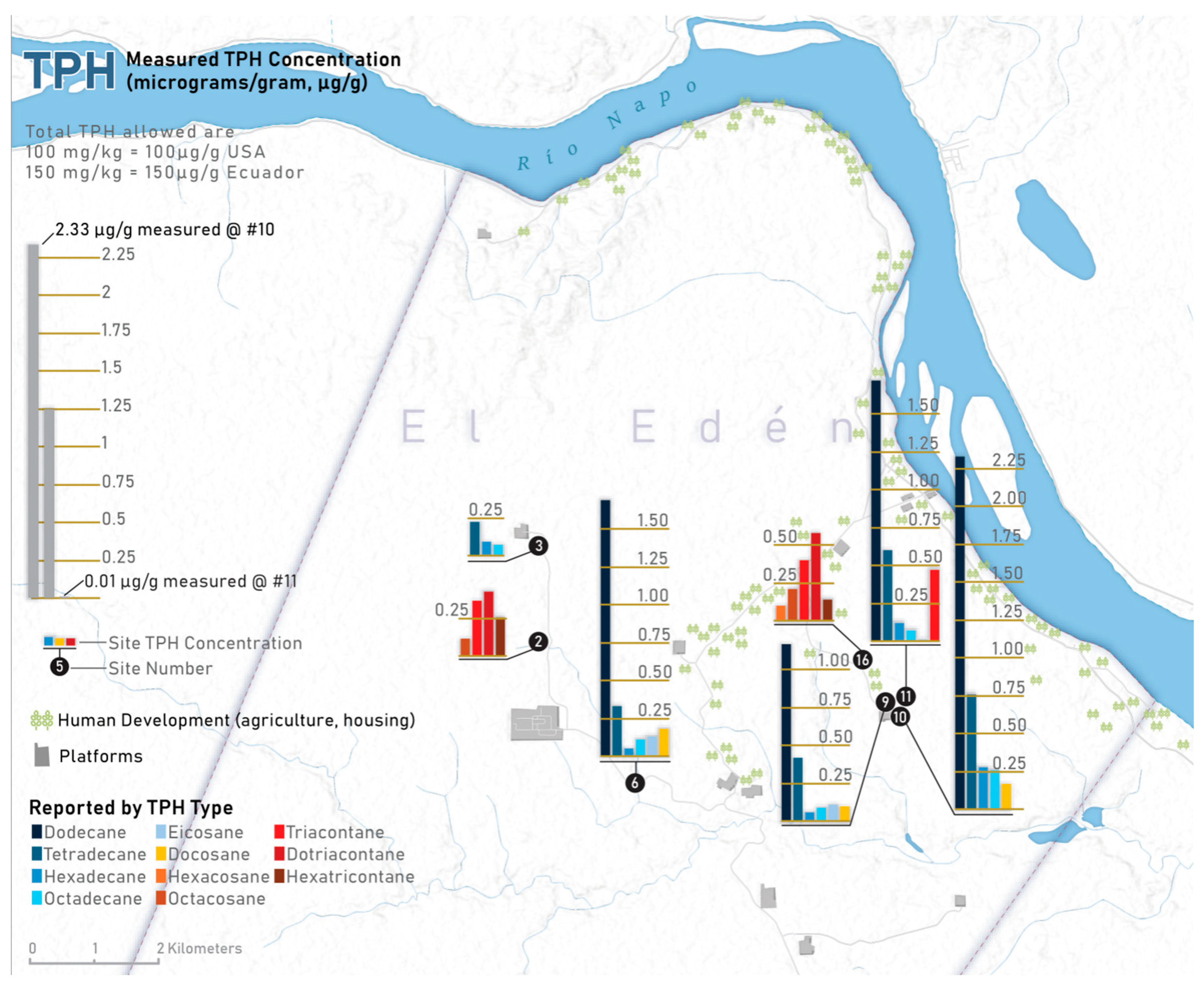
All 10 samples from El Edén-Yuturi (OB 12) evaluated for TPH at the Energy and Environmental Sustainability Laboratories at the Pennsylvania State University were above the limit of detection but below the regulatory threshold. In Figure 2, only 7 sampling sites are depicted because 3 returned clean, with no TPH detected. Although hydrocarbons range from n-dodecane to n-hexatriacontane, crude oil contains C7+ hydrocarbons, which are heavier, indicating that direct oil spills are evident in our sampling results. Spatial analysis indicates that contamination is predominantly concentrated in human development areas, mainly housing and small agricultural areas, where families have homes with food gardens and small plots used for coffee and cacao production (Figure 2).
The colors for each of the hydrocarbons represent the gradient of the length of the carbon chain. “Lighter” or shorter chain hydrocarbons are presented in blue colors, reflecting that a spill might have occurred more recently. The “heavier” or longer chain hydrocarbons presented in red colors reflect a spill that might have occurred longer ago. Lighter hydrocarbons volatize rapidly and easily mix with liquids when exposed to the environment. This process is a mechanism for oil-spill formation in which low-molecular-weight compounds leave the liquid phase, thereby increasing the density and viscosity of the residual liquid [48].
The local laboratory sent results for TPH analysis, indicating that each sample contained less than 76 milligrams per kilogram, and noted that the Ecuadorian regulatory limit is 150 milligrams per kilogram. All samples presented the same result regardless of site, and the laboratory did not disclose the types of hydrocarbons found, even when the authors requested the information.

5.2. Per- and Polyfluoroalkyl Substances

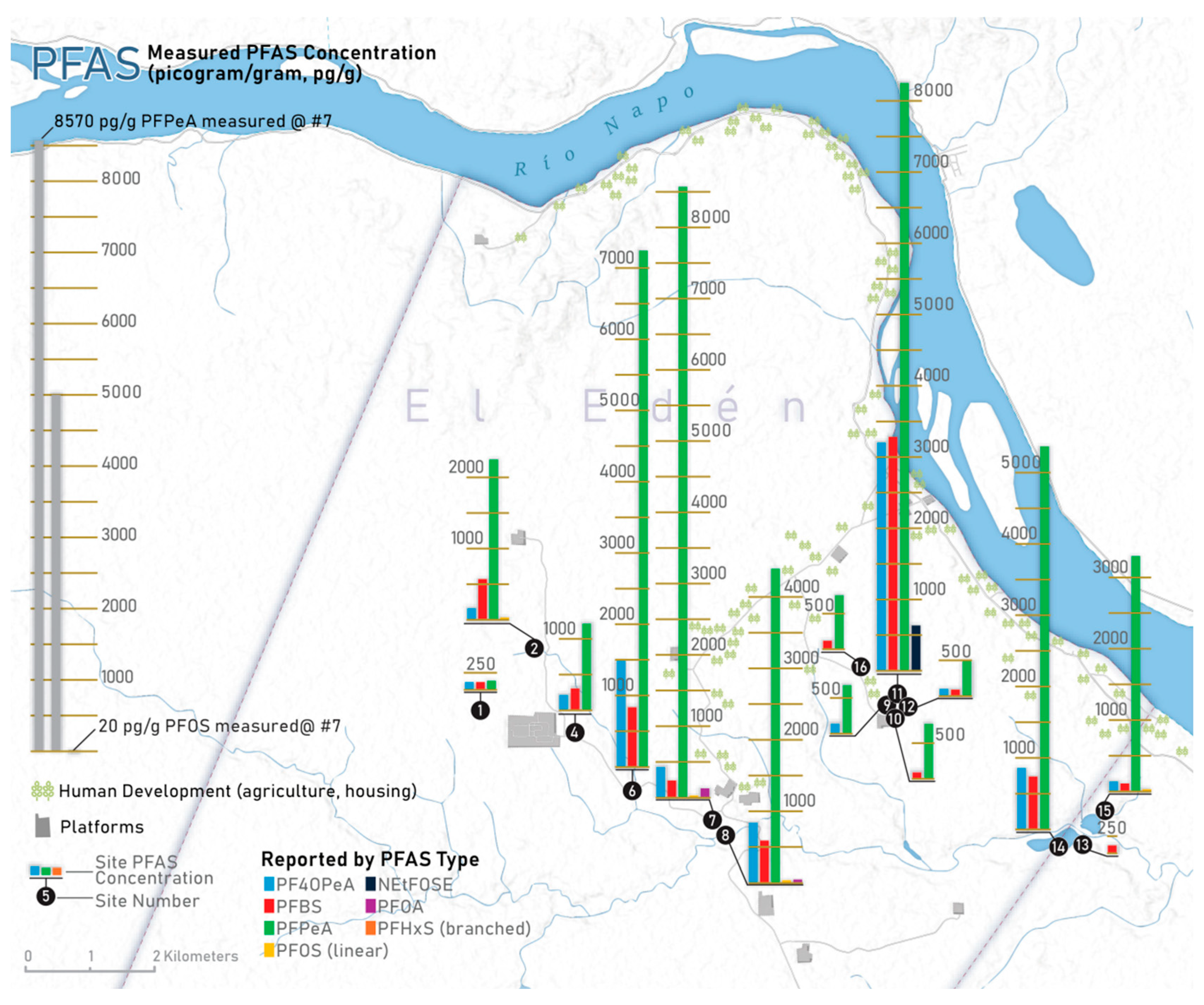
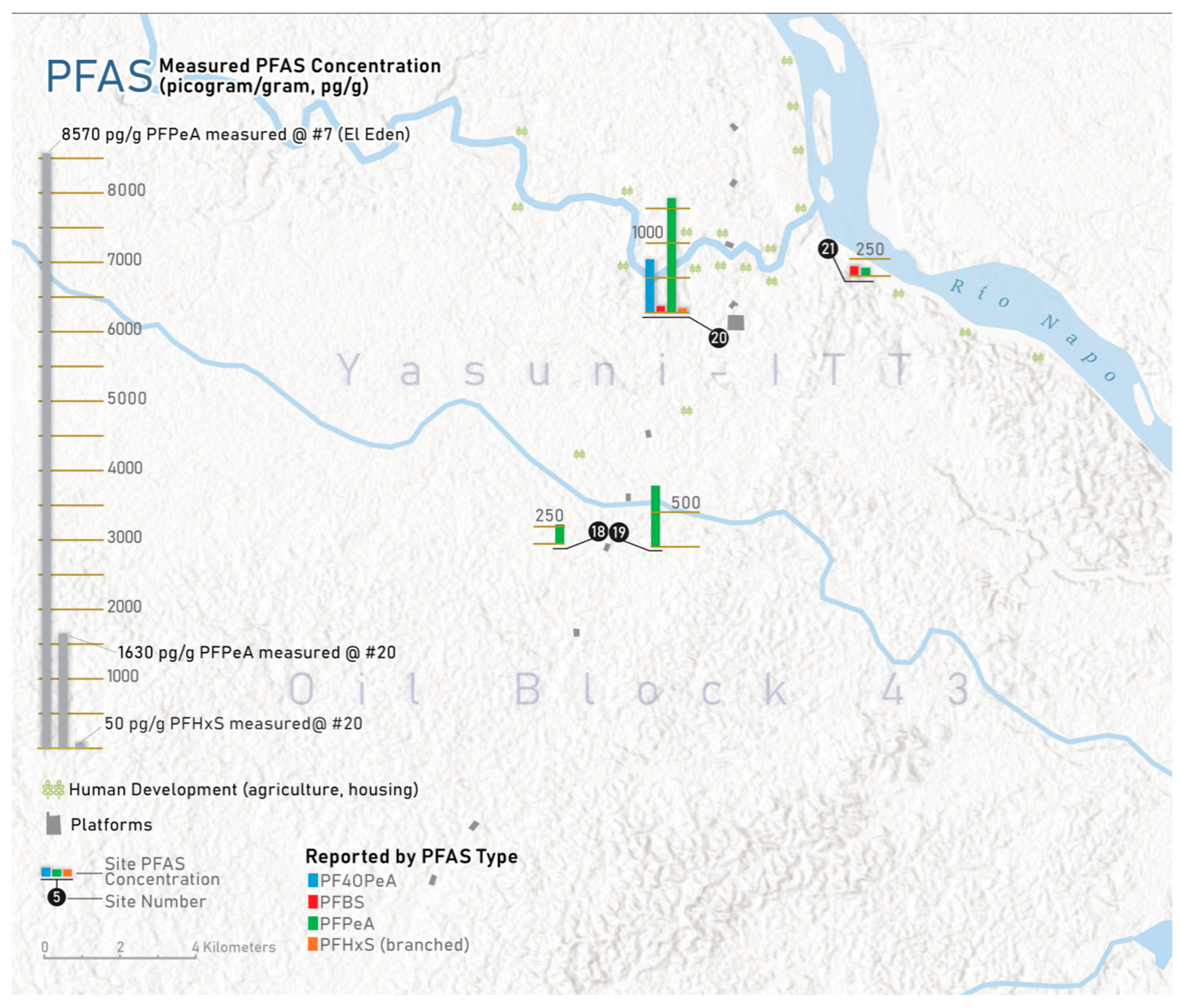
Of the 21 sampling sites, 16 in OB 12 and 5 in OB 43, (Figure 3 and Figure 4), 18 showed elevated PFAS levels compared to the background amount noted in Washington et al.’s study [34]. A total of 7 compounds and 3 homologs were identified, including: PF4OPeA, PFBS, PFPeA, PFOS, NEtFOSE, PFOA, and PFHXS. Samples belonged to Class 1 PFCAs and Class 2 PFSAs (Figure 3 and Figure 4). Of the 10 overlapping collection sites, sampling sites No. 2, 6, 9, 10, 11, and 16 across Figure 2 and Figure 3 correspond to the same site or OB 12; in other words, we sampled soil for TPH and PFAS at the same sites. The highest concentrations were found around platform F and the central processing station known as EPF, and sites No. 3 and 5 tested negative for PFAS in OB 12 (See Figure 3). Note that site No. 17 also tested negative in OB 43 (See Figure 4); thus, they were not included on the map. Contamination is found near housing and agricultural areas in OB 12, close to food gardens and small plots used for coffee and cacao production (Figure 3).
Note that in OB 43 (Figure 4), samples 18 and 19 were collected from a stream where a produced-water spill had occurred 11 days before our arrival.

6. Discussion

6.1. Using TPH and PFAS Combined Assessment in Off-Grid-Extractive Sites

Analysis of PFAS in tandem with TPH is becoming necessary to understand the behavior of off-grid contaminants in remote oilfield environments such as Yasuní National Park. Combining these analyses reveals the spatial footprint and temporal trajectory of contamination in a site where continuous monitoring is not feasible. In our study, of the 16 soil samples tested for PFAS in OB 12, 14 tested positive. Of the 5 sites tested for PFAS in OB 43, 4 tested positive. Lower PFAS concentrations in OB 43 may be due to the fact that oil extraction in this oil block started only 8 years ago, compared with OB 12, which began 26 years ago. Still, understanding TPH and PFAS distribution and accumulation in OB 12 might inform our understanding of potential contamination in OB 43 in the near future, which is important as infrastructure in this oil block is located at the heart of the Yasuní Park and very close to the intangible zone or border protecting uncontacted tribes.
Looking at the overlap of TPH and PFAS in OB 12, of the 10 samples tested for TPH, 6 overlapped with sites that also tested positive for PFAS. Then the distribution of TPH in OB 12 appears to overlap with legacy and short-chain PFAS co-contamination; these observations are consistent with other studies examining the combined presence of TPH and PFAS in hydrocarbon sites, as in the case of the Dagang Oilfield [28]. Our observations are also consistent with emerging studies on PFAS that may be associated with produced water in oil and gas regions, such as the Denver Basin case [27]. The differential persistence of these recalcitrant compounds allows for temporal inference. Given that TPH undergoes rapid volatilization and degradation, PFAS resistance to environmental breakdown might serve as a better record of contamination events in OB 12. Detectable TPH in our study indicates past and recent contamination, validating Indigenous observations of spills even when hydrocarbon compounds were found to be below Ecuador’s regulatory thresholds. Whereas PFAS persistence in the absence of fresh hydrocarbon signatures might better reflect co-contamination persistence, especially when large amounts of these contaminants are found.
In our study, the predominant short-chain compounds PFPeA, PFBS, and PF4OPeA were the most abundant, ranging from 100 to over 8000 pg/g, while PFOS, NEtFOSE, PFOA, and PFHxS, or long-chain compounds, were also found but in lower amounts, ranging from 50 to 600 pg/g. Although only a few studies have examined the presence and persistence of PFAS in hydrocarbon extraction, and no definitive causal effect can be drawn from this baseline study, it is important to note that these contaminants are directly associated with industrial applications. Varonka et al.’s study on the use of produced water in oil and gas extraction found that PF4OeA is used in the fluorochemical industry and, in oil extraction, as an emulsion stabilizer and wetting agent [27]. And PFPeA is highly mobile in soil and water and has surfactant properties that confer resistance to heat, oil, and water [49]. Finally, PFBS acts as a mist suppressant due to its fluorinated surfactant properties [50]. Both PFPeA and PFBS are usually used as aqueous film-forming foams in industrial settings.
Note that we collected a limited amount of samples at sites where oil and industrial spills had occurred and along contaminant pathways. Thus, this study presents the following limitations: First, the sampling methodology is not representative of how hydrocarbon and PFAS contaminants might be distributed in each oil block and within the National Park. Second, fieldwork was conducted during the rainy season, in which sections of the forest were inundated, facilitating the transport of contaminants and limiting our access to areas suspected of contamination. And third, our study results should be understood in the spatial and temporal context in which they were collected. Given that the distribution of contaminants was not addressed in this baseline case study, we will follow up with a second fieldwork to assess the spatial and temporal distribution of contaminants in the territory of the El Edén community based on the geomorphological features and precipitation in the El Eden-Yuturi OB 12.

6.2. Understanding PFAS Soil Concentration in Northern and Southern Hemispheres

Background PFAS soil concentrations are 2× higher in the Northern Hemisphere than in the Southern Hemisphere [34]. Specifically, Northern Hemisphere geometric means of background soil contamination are 930 pg/g for perfluoroalkyl carboxylic acids (PFCAs, like PFOA) and 170 pg/g for perfluoroalkyl sulfonic acids (PFSAs, like PFOS). At the same time, Southern Hemisphere concentrations are notably lower at 190 pg/g for PFCAs and 33 pg/g for PFSAs. This hemispheric disparity reflects historical emission patterns and provides important baseline context when evaluating site-specific contamination.
While long-range atmospheric transport, surface snow, seawater, meltwater, and water irrigation contribute to the global distribution of PFAS in remote areas like the Arctic, Antarctic, the Tibetan Plateau, and remote coastal areas, among others, localized industrial sources are the primary drivers of elevated concentrations at specific sites; thus, the difference in PFAS concentrations between remote and industrial sites is significant [51,52]. Higher PFAS concentrations are associated with industrial sites, airports, military bases, and, as emerging literature suggests, hydrocarbon-extraction sites [27,28,29,30].
While other pathways for PFAS contamination, such as air deposition, are possible, the large quantities identified in this study indicate direct industrial exposure. Given the off-the-grid remote nature of the sites we visited, we suggest that the predominant industrial influence might be directly associated with oil extraction operations. There are no other nearby industries or sources of contamination besides small-scale cacao and coffee production, in which a reduced number of families are engaged. Additionally, the authors reviewed the agrichemicals used by families, identified the brands Cerillos and Guadaña, and found that no PFAS appear to be used in their chemical composition.

6.3. Environmental Regulations and Recommendations

While Ecuador is a signatory to the Stockholm Convention on Persistent Organic Pollutants and self-reports PFAS in certain commodities, it does not track PFAS in hydrocarbon extraction. Moreover, Ecuador’s environmental regulatory frameworks that monitor environmental contamination only target laboratory-accredited analyses of total hydrocarbons conducted by the Ecuadorian Accreditation Office (SAE). Despite accreditation to meet quality standards for sampling, transporting, and analyzing water and soil samples, our observations of the local laboratory’s collection methodology raise concerns. First, the 1 m soil corer was inserted 80 cm into the ground for each sample; thus, the extracted soil came exclusively from the deepest accessible point, potentially missing contamination near the surface where spills occur. Second, after collection, soil samples were stored in aluminum foil rather than in sealed containers, which could lead to the loss of volatile compounds. Third, the coring equipment was not cleaned or sanitized between sampling locations, creating potential for cross-contamination between sites. The testing protocol utilized by the Ecuadorian lab also faces inherent limitations due to environmental conditions and procedural delays.
Testing requests are often fulfilled months after initial contamination reports are filed, allowing lighter hydrocarbons to dissipate through volatilization or biodegradation processes [23,41]. This temporal gap may account for the consistently lower TPH levels detected in laboratory analyses, which fail to corroborate the visual evidence of significant petroleum spills reported by local communities. All analyses for this lab’s samples were performed privately, and given that the samples were collected at the same site as our work, we believe any discrepancy may be due to procedural changes. This lab did not provide us with an account of the different types of hydrocarbons found, even after we requested the information, which prevented the extensive comparison originally planned. The particulars we observed during the environmental monitoring process described here suggest that TPH analysis alone may be insufficient as the sole metric for environmental impact assessment in this region.
Finally, given that Ecuador and the region lack laboratories capable of testing PFAS as a co-contaminant in hydrocarbons, an alternative to TPH testing is the Saturated, Aromatics, Resins, and Asphaltenes (SARA) analysis, which characterizes crude oil by dividing it into four key fractions based on solubility and polarity. While TPH analysis provides a single value, SARA analysis offers more detailed information, leading to a deeper understanding of oil composition. This can provide further insight into its behavior in the environment, help differentiate among crude oil types, and identify sources of contamination. Most importantly, SARA is much more specific regarding potential toxicity, which could assist in risk assessment and cleanup strategies. Finally, given that the state is simultaneously participating in extraction and oversight, we consider that third-party independent parties should be involved in the contamination assessment.

7. Conclusions

This research is the first study to use PFAS to complement total hydrocarbon analysis to document contamination in the context of oil extraction, based on 2 specific case studies in Ecuador’s Amazon region. Our findings reveal potential failures in current environmental monitoring procedures and provide evidence of co-contamination of hydrocarbons and PFAS around hydrocarbon extractive infrastructure in Oil Block 12. Our study also provides evidence of PFAS contamination potentially associated with hydrocarbon extraction in Oil Blocks 12 and 43. Our sampling methodology identified sites where industrial contamination had been visible within the last 10 years, affecting Kichwa communities living near and inside the Yasuní National Park. Although long-range transport and wet deposition could contribute to PFAS’s reach in the Amazonian region, this would not explain the clear indication of industrial contamination found at sites with current order-of-magnitude higher differences.
Our study shows overlap between hydrocarbons and PFAS contaminants at 6 of 10 sites in Oil Block 12 near oil infrastructure and in close proximity to homes and food gardens. Our PFAS results range from 100 to over 8000 pg/g, while Southern Hemisphere background levels are 190 pg/g for PFCAs and 33 pg/g for PFSAs. The predominant compounds detected included the “forever chemicals” PFPeA, PFBS, and PF4OPeA. Given that the concentrations in Oil Blocks 12 and 43 are high and there are no other significant industrial sources in these remote areas of the Amazon, we suggest that the predominant industrial influence might be directly associated with oil extraction operations.
In addition, this work exposes possible flaws in Ecuador’s required TPH analysis protocols for environmental assessment of contamination, as conducted by private accredited laboratories. Our results are important for validating Indigenous environmental concerns and experiences regarding contamination from off-grid extraction that affects vulnerable populations and sensitive ecosystems in Yasuni National Park.
Finally, as global efforts to restrict the use of PFAS in industry continue, we suggest that combined testing of TPH and PFAS can help overcome the limitation of testing only hydrocarbons when local populations suspect contamination and demand environmental accountability. Still, given that Ecuador and South America as a region lack laboratories equipped to perform PFAS testing, we also recommend Saturated, Aromatics, Resins, and Asphaltenes (SARA) analysis as a complement to TPH testing, especially when such data informs environmental legal regulations and accountability in countries like Ecuador.

Author Contributions

Conceptualization, M.B.N. and R.B.; methodology, M.B.N. and R.B.; software, S.H.; validation, S.H.; formal analysis, S.H. and M.B.N.; investigation, M.B.N. and S.H.; data curation, S.H.; writing—original draft preparation, M.B.N. and S.H.; writing—review and editing, M.B.N. and S.H.; supervision, M.B.N.; project administration, M.B.N.; funding acquisition, M.B.N. and R.B. All authors have read and agreed to the published version of the manuscript.

Funding

This research was funded by The Pennsylvania State University’s 2024 Institute of Energy and the Environment No. 460000000825 seed grant.

Institutional Review Board Statement

This study was waived for ethical review by the Human Research Protection Program of the Pennsylvania State University as the proposed activity met the criteria for exempt research according to the policies of this institution and the provisions of applicable federal regulations (Waiver Reason: Exemption Determination, Study ID No. STUDY00025134, dated June 27, 2024). The study was conducted in accordance with the Declaration of Helsinki.

Informed Consent Statement

Informed consent was obtained from all subjects involved in the study.

Data Availability Statement

The data presented in this study are available by request from the corresponding author. The authors need to consult with Kichwa communities before sharing raw data with others.

Acknowledgments

The authors gratefully acknowledge the community members of El Eden and Boca del Tiputini for their collaboration and assistance in the data collection. We also acknowledge the Pennsylvania State University and the Environmental Sustainability Lab Core Facility, Institute of Energy and the Environment at the Pennsylvania State University (RRID: SCR_026734), where all chemical analyses were conducted. We are particularly grateful for the support with extraction and methods from Hlengilizwe Nyoni. We also acknowledge the mapping services provided by Alicia Iverson and Lily Houtman in the GeoGraphics Laboratory, Geography Department, who produced the maps for this publication.

Conflicts of Interest

The authors declare no conflicts of interest.

Abbreviations

The following abbreviations are used in this manuscript:
PFASPer- and polyfluoroalkyl substances
TPHTotal Petroleum Hydrocarbon

References

  1. Bass, M.S.; Finer, M.; Jenkins, C.N.; Kreft, H.; Cisneros-Heredia, D.F.; McCracken, S.F.; Pitman, N.C.A.; English, P.H.; Swing, K.; Villa, G.; et al. Global Conservation Significance of Ecuador’s Yasuní National Park. PLoS ONE 2010, 5, e8767. [Google Scholar] [CrossRef] [PubMed]
  2. Moncado, M.; Proaño, F.; Mejia, L.; Rivadeneira, J.; Melo, M. Línea de Base del Programa para la Conservación y el Manejo Sostenible del Patrimonio Natural y Cultural de la Reserva de la Biosfera Yasuní; Zambrano-Barragan Editores: Quito, Ecuador, 2008; p. 183. [Google Scholar]
  3. Petroecuador, Public Company of Hydrocarbons of Ecuador. Información Bloques Petroleros. 2024. Available online: https://www.eppetroecuador.ec/wp-content/uploads/2024/12/Bloques-petroleros.pdf (accessed on 10 June 2026).
  4. Galvez Mancilla, E.; Bonilla Martínez, O. Yasunidos: Los límites de la devastación (Actualidad). Aportes Andin. 2014, 34, 85–94. [Google Scholar]
  5. Sanchez, J.L.; Bastidas, A.; Herrera, G.; Rivera, C.; Carvajal, F.; Villavicencio, A.; Guayaquil, G.; Villacreces, R.; Cardenas, J.; Peña, M.; et al. Outstanding Drilling Optimization Results in the Iconic Ecuadorian Drilling Project Ishpingo, Tiputini, Tambococha—ITT. In Proceedings of the International Petroleum Technology Conference, Dhahran, Saudi Arabia, 13–15 January 2020. [Google Scholar] [CrossRef]
  6. Cardona, A.P. Demandan al Gobierno Ecuatoriano por la Carretera que Amenaza al Parque Yasuní y a Pueblos Indígenas en Aislamiento. Available online: https://es.mongabay.com/2021/10/demandan-al-gobierno-ecuatoriano-carretera-parque-yasuni/ (accessed on 29 May 2026).
  7. Kimerling, J. Indigenous Peoples and the Oil Frontier in Amazonia: The Case of Ecuador, Chevrontexaco, and Aguinda v. Texaco. Publ. Res. 2006, 159, 413–664. [Google Scholar]
  8. Ávila Santamaría, R.; Aguirre, M.; Jarin, S.; Koeing, K.; Bermeo, P.; Zhongzou, C. China en el Yasuni ITT Block. Latinoam. Sustenable 2023, 34, 1–34. [Google Scholar]
  9. Peters, F. Paraiso en la Nube, Pisadas en la Tierra, Destrucción y Vida en Tierra Naporuna: Ecuador, Bajo Napo, Yasuní (2009–2022); Federica Peters, 2023; ISSN 9789942441584. [Google Scholar]
  10. Monitoring of the Andes Amazon Program. MAAP #150: Plataformas Petroleras se Acercan a la Zona Intangible Parque Nacional Yasuní, Ecuador. Available online: https://www.maapprogram.org/es/yasuni_zona_intangible/ (accessed on 29 May 2026).
  11. Martinez, E.; Rivasés, M.; Weigerther, R. Atlas Amazónico del Ecuador: Agresiones y Resistencias. Inventario de Impactos Petroleros-2; Acción Ecológica: Quito, Ecuador, 2005; p. 227. [Google Scholar]
  12. Gonzalez, G.; David Bermeo, P.; Alvarez, I.T.; Lafournére, J.; Henson, R.; Fonseca, C.; Vinicio Vega, J.; Grijalva, R.; Valdez, A.; Proaño, G. Improving Recovery from a Mature Reservoir by Understanding the Stratigraphy, Eden-Yuturi Field, Oriente Basin, Ecuador. In Proceedings of the SPE Latin American and Caribbean Petroleum Engineering Conference, Quito, Ecuador, 18–20 November 2015. [Google Scholar] [CrossRef]
  13. Sotomayor, A.; Orna, C.; Leon, F.; Pancho, J.; Jaramillo, L.; Ruales, F.; Zumbana, V.; Pintado, C.; Claudio, L. Handling 200,000 BWPD in Yasuni National Park by Using an Integrated Plug & Play Horizontal Pumping System with Skid Package. In Proceedings of the SPE Water Lifecycle Management Conference and Exhibition, Abu Dhabi, United Arab Emirates, 5–7 March 2024. [Google Scholar] [CrossRef]
  14. Galvez Mancilla, E.; Bonilla Martínez, O. Yasunidos Declara Ilegal y Genocida la Explotación del Campo Petrolero Ishpingo. Wambra Medio Comunitario. 19 April 2022. Available online: https://wambra.ec/yasunidos-declara-ilegal-y-genocida-explotacion-ishpingo/ (accessed on 29 May 2026).
  15. Siegel, H.G.; Nason, S.L.; Warren, J.L.; Prunas, O.; Deziel, N.C.; Saiers, J.E. Investigation of Sources of Fluorinated Compounds in Private Water Supplies in an Oil and Gas-Producing Region of Northern West Virginia. Environ. Sci. Technol. 2023, 57, 17452–17464. [Google Scholar] [CrossRef] [PubMed]
  16. Parra, R.; Di Felice, L.J.; Giampietro, M.; Ramos-Martin, J. The metabolism of oil extraction: A bottom-up approach applied to the case of Ecuador. Energy Policy 2018, 122, 63–74. [Google Scholar] [CrossRef]
  17. Pelaez, L.; Calderon, D.A.; Fun Sang, B.A.; Villarroel, L.C. Eden Yuturi’s Hydraulic Fracturing Evolution: Improving Well Performance from Highly Laminated Reservoirs in Ecuador. In Proceedings of the SPE Western Regional Meeting, Bakersfield, CA, USA, 26–28 April 2022. [Google Scholar] [CrossRef]
  18. Fassler Carvajal, R.E. Evaluación de los Consumos de Energía en el Sistema de Inyección de Agua en el Yacimiento M1 en el Campo Edén Yuturi, Bloque 12 Operado por Petroamazonas EP, en el año 2015. Diseño de un Sistema de Recuperación Secundaria Energéticamente Eficiente. Master’s Thesis, Universidad Técnica del Cotopaxi, Latacunga, Ecuador, 2016. [Google Scholar]
  19. Kimerling, J. ¿Modelo o mito? Tecnología de Punta y Normas Internacionales en los Campos Petroleros de la Occidental; FLACSO Ecuador Abya Yala: Quito, Ecuador, 2024. [Google Scholar]
  20. Pereira, L.B.; Sad, C.M.S.; Castro, E.V.R.; Filgueiras, P.R.; Lacerda, V. Environmental impacts related to drilling fluid waste and treatment methods: A critical review. Fuel 2022, 310, 122301. [Google Scholar] [CrossRef]
  21. Campana-Díaz, A.; Moya, M.; Urresta, E.; Harnisth, R. Energy and environmental performance indicators at upstream oil facilities in Ecuador. CienciAmérica 2024, 13, 63–81. [Google Scholar] [CrossRef]
  22. Melo, C. Key Performance Indicators (KPIs) for Evaluation of Corrosion Control Status in the Gathering Pipelines of an Oil Production Field of the Amazon Basin in Ecuador; STEM-Corrosion: Cochrane, AB, Canada, 2017. [Google Scholar]
  23. El Edén Elder’s Council (El Eden, Francisco de Orellana, Ecuador). Personal communication, 2024.
  24. Chau, V. Reducing Vulnerablities to the Global Energy Transition Towards a Low-Carbon Economy. IMF Staff Ctry. Rep. 2024, 2024, 48–54. [Google Scholar]
  25. Li, R.; Munoz, G.; Liu, Y.; Sauvé, S.; Ghoshal, S.; Liu, J. Transformation of novel polyfluoroalkyl substances (PFASs) as co-contaminants during biopile remediation of petroleum hydrocarbons. J. Hazard. Mater. 2019, 362, 140–147. [Google Scholar] [CrossRef] [PubMed]
  26. Chukwuonye, G.N.; Alqattan, Z.A.; Jones, M.; Jones, C.; Brusseau, M.L.; Ramírez-Andreotta, M.D. Toxic layering and compound extremes: Per- and polyfluoroalkyl substances (PFAS) exposure in rural, environmental justice copper mining communities. Sci. Total Environ. 2024, 957, 177767. [Google Scholar] [CrossRef] [PubMed]
  27. Varonka, M.S.; Jubb, A.M.; McDevitt, B.; Shelton, J.L.; Barnhart, E.P.; Akob, D.M.; Cozzarelli, I.M. Per- and polyfluoroalkyl substances in waters associated with oil and gas development in the Denver Basin. Sci. Rep. 2026, 16, 5743. [Google Scholar] [CrossRef] [PubMed]
  28. Meng, Y.; Yao, Y.; Chen, H.; Li, Q.; Sun, H. Legacy and emerging per- and polyfluoroalkyl substances (PFASs) in Dagang Oilfield: Multimedia distribution and contributions of unknown precursors. J. Hazard. Mater. 2021, 412, 125177. [Google Scholar] [CrossRef] [PubMed]
  29. Johnston, J.E.; Lim, E.; Roh, H. Impact of upstream oil extraction and environmental public health: A review of the evidence. Sci. Total Environ. 2019, 657, 187–199. [Google Scholar] [CrossRef] [PubMed]
  30. Zhang, Z.; Liu, Z.; Coulon, F.; Luo, G.; Wang, Q.; Gao, X.; Li, Z.; Song, X. Co-occurrence of PFASs, TPHs, and BTEX in subsurface soils: Impacts on native microbial communities and implications for bioremediation. Environ. Res. 2025, 267, 120650. [Google Scholar] [CrossRef] [PubMed]
  31. Pozo, K.; Moreira, L.B.; Karaskova, P.; Přibylová, P.; Klánová, J.; de Carvalho, M.U.; Maranho, L.A.; de Souza Abessa, D.M. Using large amounts of firefighting foams releases per- and polyfluoroalkyl substances (PFAS) into estuarine environments: A baseline study in Latin America. Mar. Pollut. Bull. 2022, 182, 113938. [Google Scholar] [CrossRef] [PubMed]
  32. Mejia-Avendaño, S.; Munoz, G.; Sauvé, S.; Liu, J. Assessment of the Influence of Soil Characteristics and Hydrocarbon Fuel Cocontamination on the Solvent Extraction of Perfluoroalkyl and Polyfluoroalkyl Substances. Anal. Chem. 2017, 89, 2539–2546. [Google Scholar] [CrossRef] [PubMed]
  33. Simon, J.A.; Abrams, S.; Bradburne, T.; Bryant, D.; Burns, M.; Cassidy, D.; Cherry, J.; Chiang, S.-Y.; Cox, D.; Crimi, M.; et al. PFAS Experts Symposium: Statements on regulatory policy, chemistry and analytics, toxicology, transport/fate, and remediation for per- and polyfluoroalkyl substances (PFAS) contamination issues. Remediat. J. 2019, 29, 31–48. [Google Scholar] [CrossRef]
  34. Washington, J.W.; Rankin, K.; Libelo, E.L.; Lynch, D.G.; Cyterski, M. Determining global background soil PFAS loads and the fluorotelomer-based polymer degradation rates that can account for these loads. Sci. Total Environ. 2019, 651, 2444–2449. [Google Scholar] [CrossRef] [PubMed]
  35. Gaber, N.; Bero, L.; Woodruff, T.J. The Devil they Knew: Chemical Documents Analysis of Industry Influence on PFAS Science. Ann. Glob. Health 2023, 89, 37. [Google Scholar] [CrossRef] [PubMed]
  36. Fiedler, H.; Vega-Bustillos, L.; Arias-Pastrano, J.; Pérez-Aldás, L.V.; Castro-Díaz, J. Snapshot Survey of the Presence of Perfluoroalkyl Substances in Products, Articles, and the Environment in Ecuador. Engineering 2024, 37, 49–61. [Google Scholar] [CrossRef]
  37. Ministry of the Environment of Ecuador. Metodología para el Peritaje Ambiental. Herramienta para la Reparación integral de Daños Ambientales, 2nd ed.; Ministry of the Environment of Ecuador: Quito, Ecuador, 2020. [Google Scholar]
  38. National Congress of Brazil, Bill PL 2726/2023. 2023. Available online: https://www.iaeg.com/documents/iaeg-newsletters/2023/10/bra_pfas_bill_english.pdf (accessed on 10 June 2026).
  39. Biblioteca del Congreso Nacional de Chile, Asesoría Técnica Parlamentaria. PFAS: Contaminantes Permanentes Perfluoroalquilados y Polifluoroalquilados Marco Regulatorio de las PFAS en Estados Unidos, Canadá, la Unión Europea y Chile. Available online: https://obtienearchivo.bcn.cl/obtienearchivo?id=repositorio/10221/38083/1/BCN_Contam.Permanentes_PFAS_EVF_2026_Final.pdf (accessed on 29 May 2026).
  40. El Edén Participatory Mapping Workshop. (El Eden, Francisco de Orellana, Ecuador), Fieldwork. July 2024.
  41. Soliz, X. (Coca, Francisco de Orellana, Ecuador). Personal communication, 2024.
  42. Ramirez, M.I.; Arevalo, A.P.; Sotomayor, S.; Bailon-Moscoso, N. Contamination by oil crude extraction–Refinement and their effects on human health. Environ. Pollut. 2017, 231, 415–425. [Google Scholar] [CrossRef] [PubMed]
  43. Zambrano-Anchundia, J.; Galarza-Alava, J.; Mora-Silva, D.; Sanchez, M.J.; Straface, S.; Jiménez-Oyola, S.; Mestanza-Ramón, C. Total Petroleum Hydrocarbons (TPHs) in Groundwater of the Ecuadorian Amazon: Implications for Human Health. Sustainability 2026, 18, 2016. [Google Scholar] [CrossRef]
  44. Sebastián, M.S.; Armstrong, B.; Córdoba, J.A.; Stephens, C. Exposures and cancer incidence near oil fields in the Amazon basin of Ecuador. Occup. Environ. Med. 2001, 58, 517–522. [Google Scholar] [CrossRef] [PubMed]
  45. San Sebastián, M.; Hurtig, A.-K. Oil exploitation in the Amazon basin of Ecuador: A public health emergency. Pan Am. J. Public Health 2004, 15, 205–211. [Google Scholar] [CrossRef] [PubMed]
  46. Hurtig, A.-K.; San Sebastián, M. Geographical differences in cancer incidence in the Amazon basin of Ecuador in relation to residence near oil fields. Int. J. Epidemiol. 2002, 31, 1021–1027. [Google Scholar] [CrossRef] [PubMed]
  47. Boyd, R.I.; Ahmad, S.; Singh, R.; Fazal, Z.; Prins, G.S.; Madak Erdogan, Z.; Irudayaraj, J.; Spinella, M.J. Toward a Mechanistic Understanding of Poly- and Perfluoroalkylated Substances and Cancer. Cancers 2022, 14, 2919. [Google Scholar] [CrossRef] [PubMed]
  48. Sun, Y.; Cao, J.; Wang, M.; Yang, Z.; Wu, H.; Shang, J.; Ma, J. Chemical composition of headspace vapor from volatilization of ten petroleum samples. Fuel 2025, 396, 135299. [Google Scholar] [CrossRef]
  49. BenchChem Technical Support Team. Perfluoropentanoic Acid (PFPeA): An In-depth Technical Guide on its Role as an Environmental Contaminant. Available online: https://pdf.benchchem.com/52/Perfluoropentanoic_Acid_PFPeA_An_In_depth_Technical_Guide_on_its_Role_as_an_Environmental_Contaminant.pdf (accessed on 10 June 2026).
  50. United States Environmental Protection Agency. Per-and Polyfluoroalkyl Substances (PFAS). Available online: https://www.epa.gov/pfas (accessed on 30 March 2026).
  51. Ahrens, L.; Rakovic, J.; Ekdahl, S.; Kallenborn, R. Environmental distribution of per- and polyfluoroalkyl substances (PFAS) on Svalbard: Local sources and long-range transport to the Arctic. Chemosphere 2023, 345, 140463. [Google Scholar] [CrossRef] [PubMed]
  52. Tang, K.H.D. Hidden Contaminants: The Presence of Per- and Polyfluoroalkyl Substances in Remote Regions. Environments 2025, 12, 88. [Google Scholar] [CrossRef]
Figure 1. Map of El Eden-Yuturi OB 12 and Yasuní ITT OB 43. Map by GeoGraphics Lab, Penn State.
Sustainability 18 06536 g001
Figure 2. TPH concentrations (ug/g) observed in Oil Block 12 soil sampling sites. Map by GeoGraphics Lab, Pennsylvania State University.
Sustainability 18 06536 g002
Figure 3. PFAS concentrations (pg/g) observed in OB 12 soil sampling sites. Map by GeoGraphics Lab, Pennsylvania State University.
Sustainability 18 06536 g003
Figure 4. PFAS concentrations (pg/g) observed in OB 43 soil sampling sites. Map by GeoGraphics Lab, Pennsylvania State University.
Sustainability 18 06536 g004
Disclaimer/Publisher’s Note: The statements, opinions and data contained in all publications are solely those of the individual author(s) and contributor(s) and not of MDPI and/or the editor(s). MDPI and/or the editor(s) disclaim responsibility for any injury to people or property resulting from any ideas, methods, instructions or products referred to in the content.