


Abstract
The present study aims to address critical research gaps in duckweed–microbe symbiotic systems specifically applied to high-load livestock and poultry breeding wastewater. These gaps include the insufficient development of well-characterized, multi-functional, complex microbial consortia adapted to complex livestock wastewater matrices, and the technical challenge of achieving simultaneous efficient wastewater purification and duckweed feed quality enhancement. This study is motivated by the pressing issue of agricultural non-point source pollution, which is caused by large-scale livestock and poultry breeding wastewater discharge, and the high external dependence of the feed industry on protein raw materials. The present study utilised Spirodela as the fundamental material, and a functionally complementary complex symbiotic bacterial consortium consisting of Bacillus subtilis, Bacillus tequilensis and Pseudomonas fluorescens was screened and constructed. An experiment was conducted over a 14-day period in which a range of inoculation ratios were systematically explored. The aim of this experiment was to ascertain the purification efficiency of the duckweed–bacteria symbiotic system on high-load livestock and poultry breeding wastewater. Furthermore, the experiment sought to determine the effect of this purification process on the feed value of duckweed. The results demonstrated that complex bacterial inoculation significantly enhanced wastewater purification efficiency. The final removal rate of ammonia nitrogen in all treatment groups exceeded 90% after 14 days, and the maximum removal rates of total nitrogen and total phosphorus reached 67.0% and 58.9%, respectively, thereby demonstrating superior purification performance in comparison to the control group. The inoculation ratio of 10:1 was identified as the optimal parameter for wastewater purification, while the 5:1 ratio was found to be the maximum for crude protein accumulation in duckweed. The maximum dry-based crude protein content recorded was 38.9% on day 14, representing an increase of 26.3% in comparison with the control group. The established duckweed–bacteria symbiotic system has the capacity to simultaneously achieve the efficient purification of livestock and poultry breeding wastewater and the high-value utilisation of duckweed. The optimal process parameters for a range of application scenarios have been determined. This study contributes to the theoretical framework of aquatic plant–microbe symbiotic remediation and provides technical support for the recycling of wastewater resources and the sustainable development of the livestock and poultry breeding industry.
1. Introduction
The livestock and poultry breeding industry is widely regarded as a fundamental component of the agricultural economy. While the expansion has been shown to guarantee the supply of agricultural products and advance rural revitalisation, it has also resulted in the emergence of wastewater discharges as a key and challenging target for the prevention and control of agricultural non-point source pollution. The annual discharge volume of livestock and poultry breeding wastewater has been estimated to exceed 10 billion tons. The discharge of wastewater containing elevated concentrations of nitrogen, phosphorus, and organic pollutants into the environment without prior treatment can have deleterious effects on ecological and environmental systems. Such practices can trigger a series of adverse outcomes, including water eutrophication and soil quality degradation, which can significantly impede the pursuit of green and sustainable development in the livestock and poultry breeding industry [1,2].
Concomitantly, the global feed industry has experienced persistent challenges due to significant industrial bottlenecks, characterised by shortages of protein feed materials and a substantial reliance on imported raw materials. The development of novel, cost-effective, and grain-free sustainable protein feed ingredients is imperative to ensure the autonomy and reliability of industrial chains in the breeding and feed sectors [3,4,5]. Feed-related issues act as significant constraints at the input stage of livestock and poultry production, whereas pollution from breeding wastewater represents a prominent unresolved problem at the output stage. Collectively, these two factors act as impediments to the economic growth of the breeding industry [6]. The present study has been designed to address the dual bottlenecks that are present at both the input and output links of the industry. The objective is to deliver practical guidance and technical support for production, operation and pollution management within the livestock and poultry breeding sector.
Water ecological restoration technologies have become the mainstream approach for livestock wastewater treatment due to their dual environmental and resource benefits [7]. Among these technologies, Spirodela exhibits rapid growth and strong nitrogen and phosphorus accumulation capacity, with removal efficiencies of total nitrogen (TN) and total phosphorus (TP) from breeding wastewater reaching 40–70% [8]. The plant’s rapid growth cycle and ease of harvesting make it an optimal choice for use in aquatic remediation. Furthermore, the harvested duckweed biomass is rich in nutrients and has great potential for utilisation as a feed resource [9]. However, naturally grown Spirodela contains only 15–20% crude protein, which is significantly lower than that of conventional protein feed ingredients and fails to meet the demands of large-scale production [10]. Consequently, the scientific challenge of enhancing the industrial application of duckweed is twofold: firstly, to enhance its wastewater purification performance, and secondly, to enhance its nutritional quality.
The synergistic interaction between microbes and plants is a pivotal strategy for enhancing the efficacy of aquatic remediation and augmenting nutrient accumulation in plants. Functional microorganisms have been shown to establish mutualistic symbiotic systems with plants via nitrogen and phosphorus transformation, secretion of plant growth-promoting substances and other metabolic processes. These systems have been demonstrated to drastically elevate pollutant removal efficiency and facilitate plant development. This mechanism has been extensively validated in constructed wetlands, aquatic ecological restoration and other associated fields [11,12].
In recent years, a significant number of domestic and international researchers have conducted extensive investigations on duckweed–microbe symbiotic systems. Shen et al. (2019) [13] provided empirical evidence to demonstrate that the combined application of heterotrophic nitrifying bacteria and duckweed significantly enhances the removal efficiency of ammonia nitrogen in water bodies. In a recent study, Hemalatha and Mohan (2022) [14] constructed a system involving duckweed and microbes for the treatment of dairy wastewater. This system was capable of achieving simultaneous microbial protein production and meeting targets for pollutant reduction. It has been demonstrated in other studies that there are multiple plant growth-promoting rhizobacteria (PGPR) to be found in the rhizosphere of wild duckweed. These strains have been shown to enhance duckweed growth, as well as nitrogen and phosphorus uptake and utilisation in poultry wastewater [12,15].
The focus of current studies on duckweed–microbe symbiotic systems is predominantly on the removal efficiency of single pollutants by single functional strains [15]. However, this approach is inadequate for meeting the treatment requirements of high-strength livestock and poultry breeding wastewater. This analysis highlights significant research gaps that require attention to advance the field.
Firstly, research on the screening of duckweed–bacterial symbiotic systems adapted to high-strength livestock wastewater is scarce. To the best of our knowledge, there have been only a limited number of studies that have developed complementary compound bacterial consortia with three functions, including nitrogen transformation, phosphorus solubilisation and plant growth promotion, to cope with the complex water quality characteristics of high-load breeding wastewater. Secondly, the synergistic potential among multiple strains and their rhizosphere colonisation adaptability have not yet been systematically verified, and efficient duckweed–bacteria symbiotic systems tailored for high-strength wastewater have not yet been established [15,16].
In relation to process parameters, extant research predominantly evaluates purification performance under a fixed inoculation dosage, without systematically exploring the regulatory mechanisms of varying inoculation dosages on pollutant removal kinetics, long-term operational stability and nutritional quality of duckweed biomass [17,18]. Consequently, the provision of optimal, targeted process parameters for discrete application scenarios, including wastewater discharge compliance and protein biomass production [19], is not feasible.
From the perspective of multi-objective coordination, the majority of extant studies take pollutant discharge compliance as the sole core objective, while few attempt to coordinate the regulation of advanced wastewater purification and the improvement of duckweed feed quality simultaneously [20]. The full potential for the recovery of resources by duckweed has yet to be realised, and there is a paucity of technical frameworks integrating environmental remediation and resource recycling [21]. Consequently, these studies neglect to address the two fundamental industrial demands of pollution abatement and sustainable protein supply [5,14].
Accordingly, the objective of the present study is twofold: firstly, to purify livestock and poultry breeding wastewater efficiently, and secondly, to improve the feed protein value of duckweed. The following research work is carried out in order to achieve these objectives: A functionally complementary composite symbiotic bacterial consortium consisting of Bacillus subtilis, Bacillus tequilensis and Pseudomonas fluorescens is screened and constructed. Batch culture experiments lasting 14 days are conducted with gradient inoculation ratios to systematically investigate the purification capacity of the duckweed–bacteria symbiotic system for high-strength livestock wastewater and its improvement effect on the feed protein quality of duckweed. The aim is to identify optimal process parameters for different application scenarios.
The objective of this study is twofold: firstly, to construct a three-strain functionally complementary composite bacterial consortium suitable for high-strength livestock wastewater, and secondly, to expand the research system of duckweed–microbe symbiosis. The specific aims are as follows: firstly, to quantify the trade-off relationship between functional enhancement and system stability, and secondly, to determine targeted process parameters for typical application scenarios. The ultimate goal is to simultaneously realise advanced wastewater purification and substantial elevation of crude protein content in duckweed. The findings will contribute to the theoretical framework of aquatic plant–microbe symbiotic remediation, the development of a low-cost and easily operable resource recycling technology for breeding wastewater, and the provision of scientific evidence and technical support for the green and sustainable development of the livestock and poultry breeding industry.
2. Materials and Methods
2.1. Taxonomy and Culture Methodology of Duckweed Species
The species Spirodela was utilised in the present study (Linyi, Shandong, China). Subsequent to collection, the plants were rinsed thrice with sterile distilled water in order to remove attached impurities and plankton. Thereafter, they were acclimated and cultured in culture medium for a period of seven days. The acclimation conditions were meticulously controlled to ensure precise environmental parameters, including a temperature of 22.0 ± 2 °C, light intensity of 4000 ± 1000 l×, a light–dark cycle of 16 h:8 h, and a pH range of 7.0~7.5. Following acclimatisation, healthy plants that exhibited consistent growth status, uniform size, and an absence of diseases or pests were manually selected as experimental materials.
The initial dry-based crude protein content of duckweed was 15.48%, the initial inoculation fresh weight was 0.5914 g/L (i.e., 5.914 g of fresh weight inoculated in a 10 L system), and the initial water surface coverage rate was 50%. The wastewater utilised in the experiment was livestock and poultry breeding biogas slurry (Yantai, Shandong, China). The contents of ammonia nitrogen (NH4+-N), nitrate nitrogen (NO3−-N), total nitrogen (TN), available phosphorus (PO43−-P), total phosphorus (TP) and chemical oxygen demand (COD) in the biogas slurry are shown in Table 1 below, and the pH value of the biogas slurry was 8.2. All other reagents utilised in the experiment were of analytical grade.
Table 1.
Water quality parameters of livestock and poultry breeding wastewater.
2.2. Selection and Preparation of Symbiotic Bacteria
2.2.1. Strain Culture
The three strains were activated and cultured in their respective corresponding media, as follows: Bacillus subtilis was cultivated in nutrient agar (NA) medium (Tianjin Zhonglian, Tianjin, China) and Bacillus tequilensis in lecithin–Tween 80 medium (Tianjin Zhonglian, Tianjin, China). The primary function of this strain is organic phosphorus solubilisation, with its phosphate-solubilizing capacity being contingent on the secretion of extracellular enzymes, such as phospholipase. Culture media fortified with lecithin as the characteristic substrate has been demonstrated to enhance the expression of phosphate-solubilising enzyme systems and preserve the stable functional activity of the strain. As a non-ionic surfactant, Tween 80 facilitates substrate dispersion and extracellular enzyme release, rendering it a classic medium component for activating and culturing organic phosphate-solubilising bacilli) [22]. Pseudomonas fluorescens was cultivated in King’s B (KB) medium (Tianjin Zhonglian, Tianjin, China). The culture conditions were set as a shaking culture at 30 °C and 180 r/min for 24 h.
2.2.2. Preparation of Bacterial Suspension and Sample Collection
The three strains were cultivated separately until they reached the logarithmic growth phase. Thereafter, the optical density was adjusted to OD600 = 1.0, which corresponds to 1 × 10⁸ colony-forming units (CFU) per millilitre. The complex bacterial suspension was prepared by mixing the three single-strain suspensions at a volume ratio of 1:1:1. The suspension was prepared immediately prior to use in order to ensure optimal bacterial activity, and then inoculated into the corresponding culture systems in accordance with the volume ratios specified in the experimental groups.
The experimental period lasted for a period of 14 days. Water samples (50 mL each) were collected on days 0, 2, 4, 6, 8, 10 and 14. All water samples were filtered through a 0.45 μm membrane filter, stored at 4 °C under refrigeration, and analysed within 24 h. Duckweed samples were collected on days 0, 2, 5, 8, 11 and 14, rinsed three times with sterile distilled water, and blotted dry to remove surface moisture. The samples were weighed both in a fresh state and after desiccation, and then dried to constant weight at 65 °C for subsequent nutritional quality analysis.
2.3. Experimental Design
The experiment was conducted within an illuminated incubator, and the cultivation conditions were maintained at constant parameters. These parameters included a water temperature of 22.0 ± 2.0 °C, a light intensity of 4000 ± 1000 l×, a photoperiod of 16 h:8 h, and a pH maintained at 8.2. Each container was filled with livestock and poultry breeding wastewater, which had been diluted 50 times in volume. The mixed symbiotic bacterial suspension was inoculated proportionally to ensure the total culture volume remained stable at 10 L. Ultrapure water was added on a daily basis to compensate for water evaporation and maintain constant system volume throughout the experiment.
The 50-fold diluted breeding wastewater was adopted. The gradient groups were established in accordance with the volume ratio of duckweed to symbiotic bacteria suspension, with three biological replicates allocated for each group. The volume ratios of diluted wastewater to bacterial suspension were set at 0, 5:1, 10:1 and 20:1, with viable bacterial concentrations of 1 × 10⁸ CFU/mL. The groups were designated with the following designations: C-0, C-5, C-10 and C-20, respectively. Group C-0 was inoculated solely with Spirodela, without the addition of bacteria, thereby serving as a control group to ascertain the purification baseline of a solitary duckweed system. Group C-5 represented the ratio of 5:1; Group C-10 was treated with a moderate bacterial dosage at 10:1; and Group C-20 received a low bacterial dosage at 20:1. A control group, devoid of any biological material, consisting solely of diluted wastewater, was also established. During the monitoring period, the contents of ammonia nitrogen, nitrate nitrogen and orthophosphate phosphorus were determined, and pollutant removal rates were calculated accordingly.
The following methodology was employed in the determination process: Nessler’s reagent method was employed for the quantification of ammonia nitrogen, the phenol disulfonic acid method for nitrate nitrogen, alkaline potassium persulfate digestion–ultraviolet spectrophotometry for total nitrogen, ascorbic acid–molybdenum blue spectrophotometry for orthophosphate phosphorus, ammonium molybdate spectrophotometry for total phosphorus, and the alkaline potassium permanganate method for COD.
The expression for the corrected pollutant removal rate, expressed as a percentage, is given by the following formula:
where R is the corrected pollutant removal rate (%), C0 is the initial pollutant concentration (mg/L), and Ct is the pollutant concentration at time t (mg/L).
R = 1 − Ct/C0 × 100%
Statistics and Analysis
All experimental data were expressed as the mean ± standard deviation (mean ± SD). The statistical analysis was conducted utilising SPSS 26.0 software. The differences among the treatment groups were analysed using a one-way analysis of variance (one-way ANOVA), and the significance of these differences was verified using a Duncan’s multiple range test. The significance level was set at p < 0.05 and the extremely significant level at p < 0.01. The data were graphed using Origin 2023, and error bars (mean ± SD) were added to all graphs.
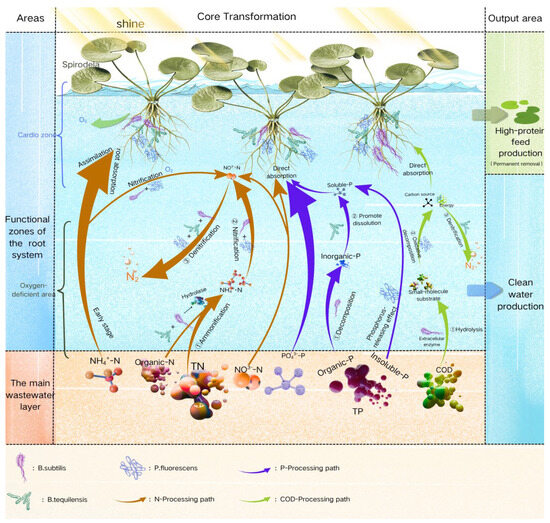
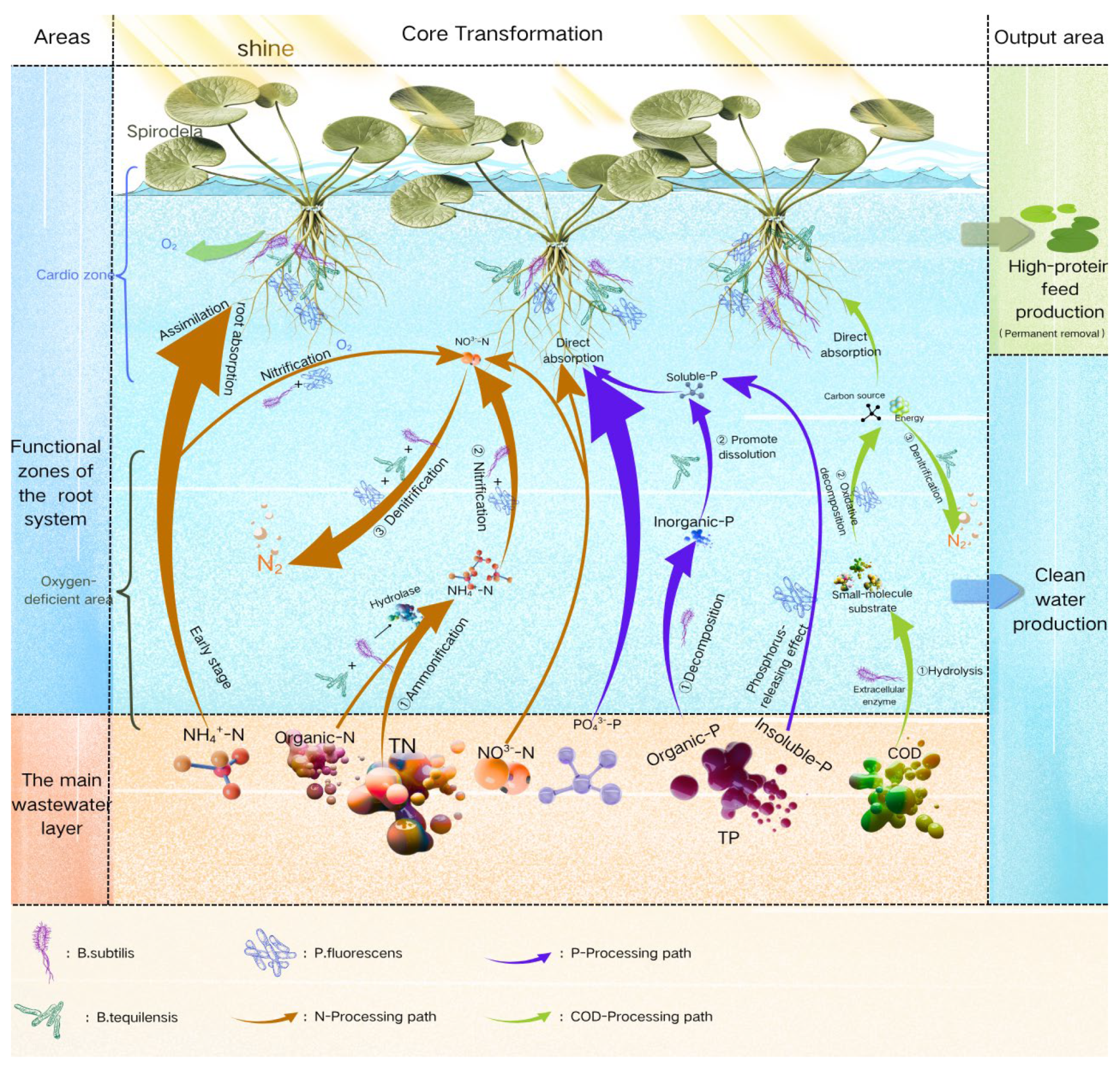
The schematic representation of the nitrogen, phosphorus and COD absorption mechanism of duckweed is illustrated in Figure 1.
Figure 1.
The mechanism by which duckweed removes nitrogen, phosphorus and other substances.
3. Results and Analysis
3.1. Effects of Different Inoculation Multiples of Symbiotic Bacteria on Ammonia Nitrogen Absorption by Spirodela
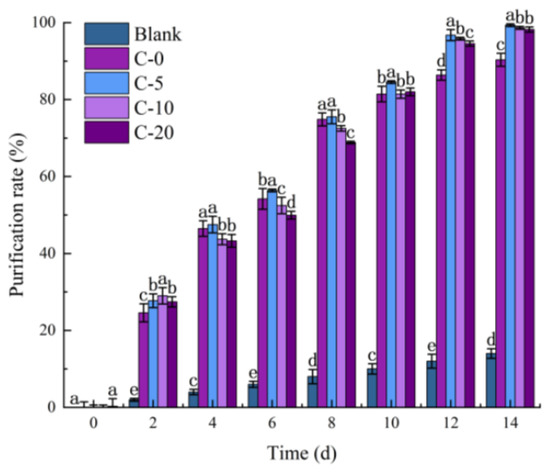
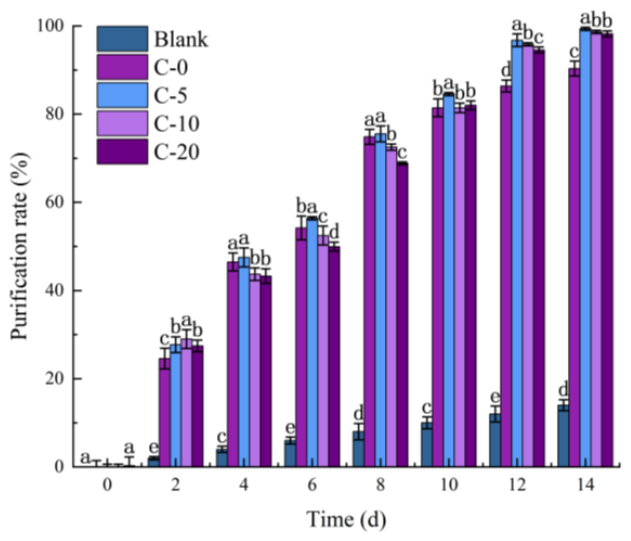
The dynamic variations in ammonia nitrogen removal efficiency in breeding wastewater under different duckweed–bacteria inoculation ratios are presented in Figure 2. During the 14-day cultivation period, the final ammonia nitrogen removal rates of all bacterial treatment groups (C-5, C-10, C-20) exceeded 90%, which was significantly higher than that of the bacteria-free control group C-0 (p < 0.05). The ammonia nitrogen removal rate in the blank group exhibited a gradual increase over the incubation period, yielding a final natural purification efficiency of approximately 13% on day 14. In conditions of static and constant temperature, the natural attenuation of ammonia nitrogen is solely reliant upon the process of ammonia volatilisation at the water surface. The volatilisation efficiency was found to be restricted by the quiescent water surface and the limited gas–liquid exchange area. Consequently, no sharp drop in ammonia nitrogen concentration was observed throughout the entire cultivation cycle. In contradistinction to the final removal efficiency of over 90% observed in treatment groups, it has been confirmed that the highly efficient elimination of ammonia nitrogen in the system is predominantly attributable to biological processes, including assimilative uptake by duckweed and synergistic transformation by microorganisms. The control group demonstrated a significantly lower ammonia nitrogen removal capacity in comparison with the inoculated groups. The findings confirmed that a consortium comprising Bacillus subtilis, Bacillus tequilensis and Pseudomonas fluorescens exhibited a notable capacity to enhance the purification of ammonia nitrogen in Spirodela through synergistic effects.
Figure 2.
The ammonium nitrogen removal efficiency of the duckweed–microbe symbiotic system. (The lowercase letters in the figure represent the corresponding significant differences).
With regard to the absorption sequence, the uptake of ammonia nitrogen by Spirodela occurred primarily within the initial six days of cultivation. Ammonia nitrogen can be absorbed and assimilated directly in order to synthesise amino acids and proteins. The species exhibits a physiological nitrogen metabolism profile that inherently prioritises ammonia nitrogen assimilation. Ammonia nitrogen is involved in protein synthesis in a direct manner via the glutamine synthetase-glutamate synthase (GS-GOGAT) pathway. Conversely, nitrate nitrogen must be reduced into ammonia nitrogen by the enzymes nitrate reductase (NR) and nitrite reductase (NiR) prior to assimilation. The ATP consumption of ammonia nitrogen utilisation is approximately one-third of that for nitrate nitrogen. Consequently, duckweed demonstrates a marked preference for the consumption of ammonia nitrogen in its aqueous phase during the early stage of development, resulting in a precipitous decline in ammonia nitrogen concentration.
Among the groups with varied inoculation ratios, C-5 demonstrated the optimal enhancement effect. The ammonia nitrogen removal rate rapidly reached 56.4% in the first six days, which was significantly higher than the rates achieved by C-10 (52.3%), C-20 (50.0%) and C-0 (54.2%) at the same period (p < 0.05). A favourable synergistic balance was established between duckweed and symbiotic bacteria. The microbes colonized the duckweed roots at an accelerated rate. It has been demonstrated that Bacillus and Pseudomonas fluorescens secrete auxins and organic acids, thereby enhancing root development and increasing nutrient absorption capacity [14]. Phosphate-solubilising bacteria have been shown to convert insoluble phosphorus, thereby alleviating nutrient competition and indirectly facilitating ammonia nitrogen uptake [23]. In return, duckweed provided stable attachment sites for bacteria, and root exudates served as carbon sources for microbial reproduction, ultimately forming a mutually beneficial symbiotic cycle.
3.2. Nitrate Nitrogen Removal Efficiency of the Duckweed–Bacteria Symbiotic System
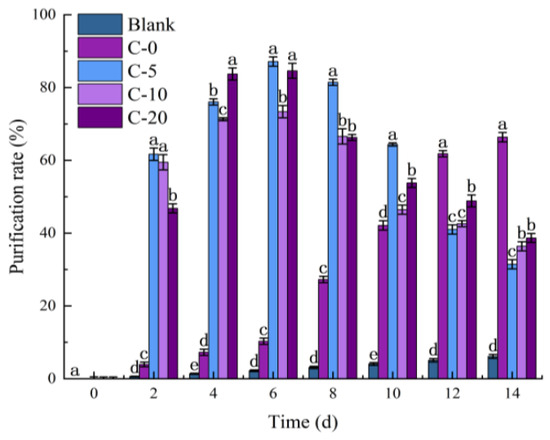
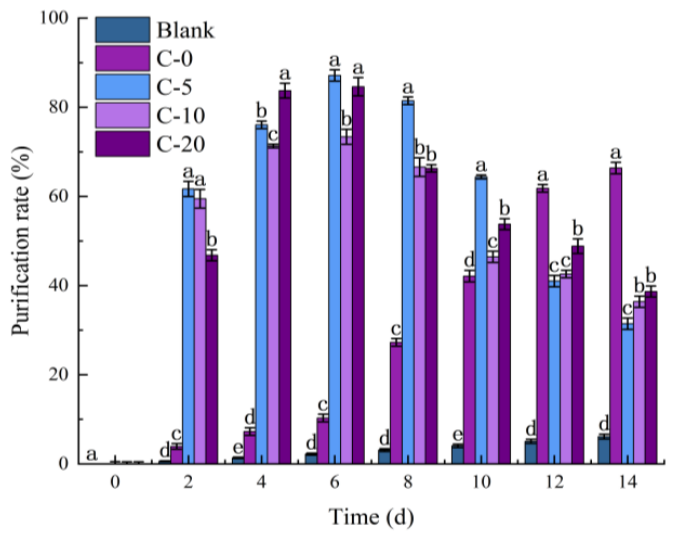
The absorption preference of duckweed for different forms of nitrogen is reflected in the rapid removal of ammonium nitrogen and directly affects the dynamics of nitrate nitrogen purification. Figure 3 shows the variations in nitrate nitrogen removal rate in different treatment groups.
Figure 3.
The nitrate nitrogen removal efficiency of the duckweed–microbe symbiotic system. (The lowercase letters in the figure represent the corresponding significant differences).
The nitrate nitrogen removal rate of the blank group remained extremely mild throughout the cultivation period, with the natural purification efficiency below 10% at day 14. Nitrate nitrogen is a chemically stable, dissolved inorganic nitrogen. In static water systems devoid of plant uptake and functional microbial mediation, nitrate nitrogen is unable to be lost via gaseous volatilisation or converted into precipitates through chemical reactions; only a negligible amount can be adsorbed and settled by suspended particles in the water.
The capacity for nitrate nitrogen removal was markedly enhanced in groups inoculated with compound symbiotic bacteria. Groups C-5, C-10 and C-20 exhibited a consistent trend of a rapid increase within 0–6 days, a peak value on day 6 and a gradual decline during 6–14 days. All three groups exceeded a removal rate of 70% at the peak, which was over twice that of the control group. The maximum peak was reached by group C-5 at 87.1%, followed by groups C-20 at 84.6% and C-10 at 73.3%.
These results prove that exogenous functional bacteria can rapidly initiate the elimination of nitrate nitrogen and greatly reduce hydraulic retention time. Duckweed root exudates supply carbon sources for nitrification and offset the limitations imposed by the low C/N ratio. Growth-promoting substances secreted by bacteria facilitate biomass accumulation and strengthen active nitrate uptake. Microbial assimilation also consumes nitrate nitrogen for protein synthesis, providing an additional removal pathway [13].
The nitrate nitrogen removal rates of all groups declined to varying degrees after reaching peaks, and the extent of this decline was found to correlate with the bacterial inoculation dosage. Group C-10 exhibited the most marginal decline, with a shift from a peak of 73.3% on day 6 to 36.4% on day 14, indicating favourable short-term operational stability. Group C-20 demonstrated the second highest peak of 84.6%, exhibiting a moderate late-stage decline, while retaining a purification rate of 38.7% on day 14. Despite the fact that C-5 demonstrated the maximum peak at 87.1%, it underwent the most significant decline, with the final removal rate declining to only 31.4% on day 14 and exhibiting poor short-term stability.
The late-stage reduction in removal efficiency was attributed to intensified interspecific competition between duckweed and bacteria, nitrogen re-release from decaying microbes and variations in microenvironment. Ammonia nitrogen was found to be almost depleted in the late cultivation stage, thereby suppressing nitrification, which was dominated by Bacillus subtilis. The proliferation of functional bacteria was rapid, and these bacteria competed vigorously with duckweed for dissolved oxygen and residual nutrients. This was especially evident in the high-inoculation group C-5, where it hindered active nitrate nitrogen uptake by duckweed. Concurrently, the presence of nutrient deficiency resulted in the transition of heterotrophic microbes into a state of decay. The process of cell lysis resulted in the release of intracellular stored nitrate nitrogen and organic nitrogen. This, in turn, led to a rebound in the aqueous nitrate nitrogen concentration. Consequently, the apparent removal rate decreased with cultivation time, and the magnitude of the decline was positively correlated with symbiotic bacteria dosage.
3.3. Total Nitrogen Removal Efficiency of the Duckweed–Bacteria Symbiotic System
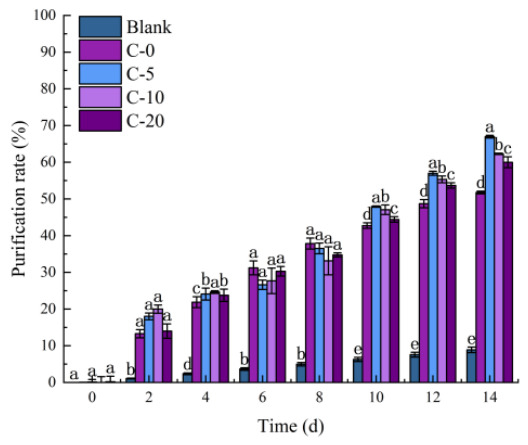
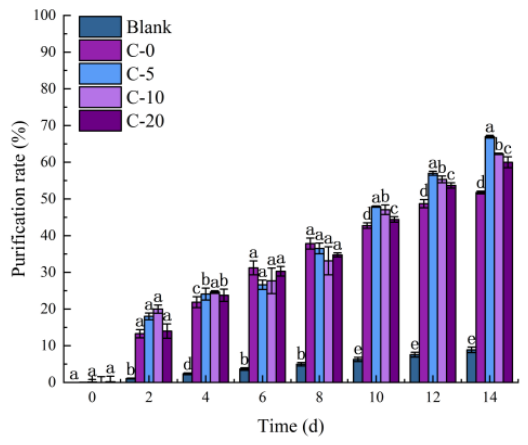
The dynamic purification characteristics of ammonia, nitrogen and nitrate nitrogen collectively determine the overall total nitrogen removal performance of the system. The variations in total nitrogen removal rate among different groups are illustrated in Figure 4.
Figure 4.
Total nitrogen removal efficiency of the duckweed–microbe symbiotic system. (The lowercase letters in the figure represent the corresponding significant differences).
The total nitrogen removal rate of all groups increased continuously throughout the cultivation period without late decline, which differed distinctly from the rise-then-fall trend of nitrate nitrogen. This phenomenon is indicative of the full-chain removal characteristics of total nitrogen.
The total nitrogen removal efficiency of the blank group was only approximately 9% on day 14, and remained at an extremely low elimination level during the whole cultivation process. Total nitrogen comprises a number of distinct nitrogen forms, including ammonia nitrogen, nitrate nitrogen, and particulate organic nitrogen. The natural attenuation of the system is primarily attributable to three factors: firstly, minor volatilisation, which results in the loss of ammonia nitrogen; secondly, physical sedimentation of particulate organic nitrogen; and thirdly, these two factors combined result in an overall weak removal effect.
The total nitrogen removal rate of the control group (C-0) exhibited a gradual increase throughout the experiment, reaching a maximum of 37.8% on day 8 and attaining the lowest final value of 51.7% on day 14. The single duckweed system relies on plant assimilation of inorganic nitrogen for nitrogen removal, and lacks efficient pathways for organic nitrogen mineralisation, nitrification and denitrification. As a consequence of the preferential utilisation of ammonia nitrogen, the uptake efficiency of nitrate and organic nitrogen remained low in the early phase.
It is evident that all groups inoculated with compound symbiotic bacteria exhibited higher total nitrogen removal rates in comparison to the control group, with final removal rates exceeding 60% after 14 days. This represents an increase of 21–29% compared with C-0. The removal rates of all groups increased to 13–21% within the first two days, with no significant inter-group differences, primarily attributable to the rapid assimilation of the initial high-concentration ammonia nitrogen by duckweed. A significant widening of the gap between the experimental and control groups was observed from day 2 to day 10. The removal rates of C-5 and C-10 were 47.9% and 47.0%, respectively, on day 14, and these were superior to the removal rates of the other treatments. It was observed that all groups exhibited consistent removal rates from day 10 to day 14. The final total nitrogen removal rates of C-5 and C-10 were 67.0% and 62.3%, respectively, which were marginally higher than the 60.0% rate of C-20.
3.4. Orthophosphate Phosphorus Removal Efficiency of the Duckweed–Bacteria Symbiotic System
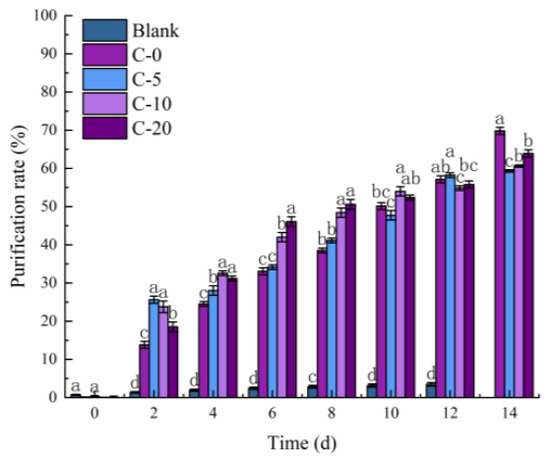
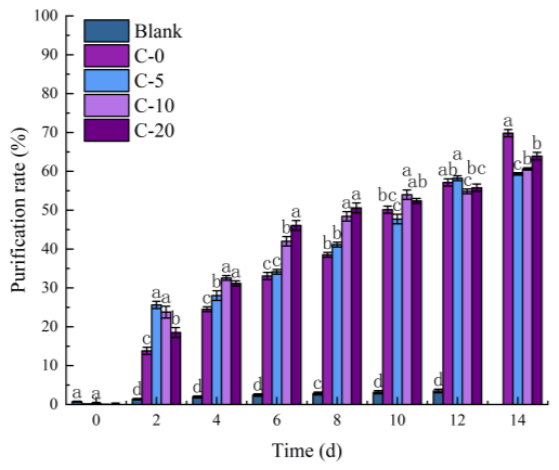
The synergistic effect observed in the nitrogen purification process also occurred in the phosphorus removal process. The dynamic changes in the orthophosphate phosphorus removal rate in each treatment group are illustrated in Figure 5. The rate of removal of orthophosphate phosphorus exhibited a consistent increase over the duration of the cultivation period, with no subsequent decline. The variation pattern exhibited by this substance shared similarities with that of ammonia nitrogen and total nitrogen, yet there were also significant differences. As a vital nutrient for duckweed growth, phosphorus was found to be continuously immobilised in biomass along with biological accumulation.
Figure 5.
Active phosphorus removal efficiency of the duckweed–microbe symbiotic system. (The lowercase letters in the figure represent the corresponding significant differences).
The soluble reactive phosphorus removal efficiency of the blank group was only approximately 5% on day 14, with no obvious decline in concentration throughout the incubation period. Water-soluble reactive phosphorus is chemically stable under the pH conditions set in this experiment and barely undergoes chemical precipitation reactions. In the absence of biological uptake and consumption, the natural attenuation remains at an extremely low level.
The apparent removal rate of orthophosphate phosphorus in the control group C-0 was found to be 69.8% after 14 days, thus ranking this group at the highest level in comparison to the other groups. The single duckweed system is only able to utilise water-soluble orthophosphate phosphorus; it is unable to utilise the insoluble phosphorus that constitutes a significant proportion of breeding wastewater. The preferential absorption of ammonia nitrogen in the early stage had a significant impact on the phosphorus uptake rate, which remained comparatively low [9]. The absorption efficiency exhibited a significant increase only after the depletion of ammonia nitrogen, accompanied by continuous accumulation of biomass in the subsequent period.
Groups inoculated with complex symbiotic bacteria exhibited significantly higher orthophosphate removal rates than the control group from day 0 to day 10, with prominent advantages. On the second day, the removal rates of C-5 and C-10 reached approximately 25.0%, rising to as high as 78.6% compared with the control group. On the eighth day, the values of C-20 and C-10 were recorded at 50.6% and 48.4%, respectively, marking an increase of 30.8% and 28.2% compared to the baseline values. This observation coincided with the period of peak separation between the treatment and control groups.
The phosphorus removal rate of inoculated groups exhibited a gradual decline from day 10 to day 14. The final apparent removal rates of C-20, C-10 and C-5 were 63.9%, 60.6% and 59.3%, respectively. The late overtaking of the control group did not indicate stronger overall phosphorus removal capacity. The complex bacteria could continuously convert insoluble phosphorus into available orthophosphate. While the initial soluble phosphorus was consumed, new phosphorus substrates were supplemented steadily, thereby slowing the decline of aqueous phosphorus concentration. In contrast, the control group exhibited an absence of exogenous phosphate-solubilising bacteria. Subsequent to the absorption of the original soluble phosphorus, no additional phosphorus was supplied, resulting in a continuous concentration drop and a higher apparent removal rate in the late stage.
3.5. Total Phosphorus Removal Efficiency of the Duckweed–Bacteria Symbiotic System
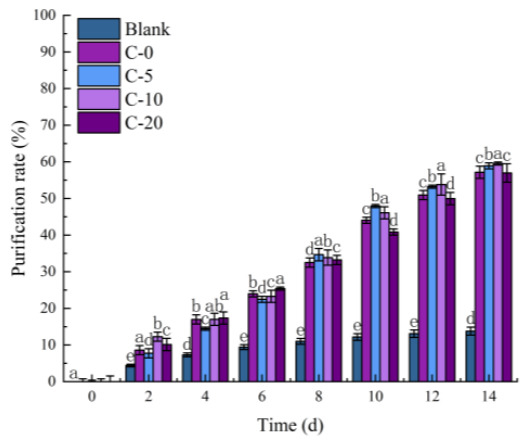
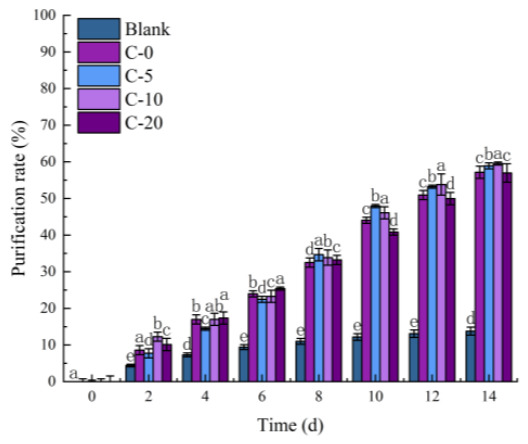
The dynamic changes in the total phosphorus (TP) removal rate in each treatment group are shown in Figure 6. The TP removal rate of all groups exhibited a linear increase with cultivation time, devoid of any late decline or concentration rebound. This phenomenon stood in contrast to the rise–fall pattern of nitrate nitrogen, indicative of the irreversible removal characteristic of phosphorus, which was predominantly governed by biological assimilation and immobilisation.
Figure 6.
Total phosphorus removal efficiency of the duckweed–microbe symbiotic system. (The lowercase letters in the figure represent the corresponding significant differences).
The total phosphorus removal rate of the blank group exhibited a gradual increase over time, attaining a final natural purification efficiency of approximately 15% on day 14. The particulate phosphorus contained within total phosphorus undergoes a gradual process of gravitational sedimentation following an extended static incubation period. This constitutes the primary pathway for natural attenuation of total phosphorus. Conversely, dissolved phosphorus, which constitutes a more substantial proportion, exhibits minimal natural loss. In comparison with the total phosphorus removal efficiency of nearly 60% observed in treatment groups, biological assimilation and immobilisation by duckweed and microorganisms are found to be the predominant factors in total phosphorus elimination. Natural sedimentation contributes less than one-quarter of the total phosphorus removal, indicating that natural processes exert quite limited overall effects.
The total phosphorus removal rate of the control group C-0 exhibited an upward trend, characterised by an initial gradual increase, followed by a subsequent acceleration in removal. The purification process was characterised by a gradual progression over the initial 10 days, followed by a pronounced acceleration from day 10 to day 14. This phase culminated in a final removal rate of 57.2% on day 14. The duckweed system is only capable of absorbing soluble orthophosphate; it cannot transform insoluble phosphorus, which constitutes a significant proportion of wastewater. The phosphorus removal process is contingent on plant assimilation, with the availability of substrates being a limiting factor. The process of phosphorus uptake was found to be restricted by preferential ammonia nitrogen assimilation, and thus occurred at a reduced rate in the early stage. However, this rate did exhibit a slight acceleration following the depletion of ammonia nitrogen and the continuous accumulation of biomass.
The experimental groups inoculated with compound symbiotic bacteria exhibited distinctly higher TP removal efficiency than the control group, and the inter-group gap gradually widened over time. On the fourth day, the removal rate of C-5 was 14.4%, which indicated a clear advantage. On the eighth day, the removal rates of the experimental groups exceeded 33.0%. The C-5 and C-10 groups achieved rates of 34.7% and 33.9%, respectively, representing an increase of 6.1% and 3.0% over the control group. Following the conclusion of the 14-day cultivation period, C-10 exhibited the optimal TP removal rate of 59.5%, with C-5 demonstrating a rate of 58.9%, both of which surpassed the control group.
A dose–effect relationship was observed between inoculation dosage and purification performance. The removal capacity of TP increased in proportion to the bacterial dosage, and the high-inoculation group C-5 maintained prominent purification advantages throughout the experiment.
3.6. COD Removal Efficiency of the Duckweed–Bacteria Symbiotic System
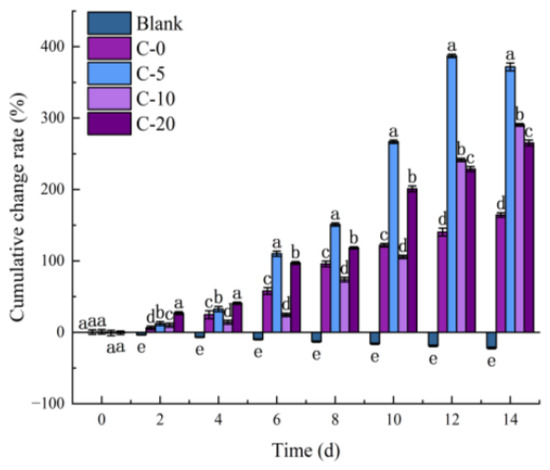
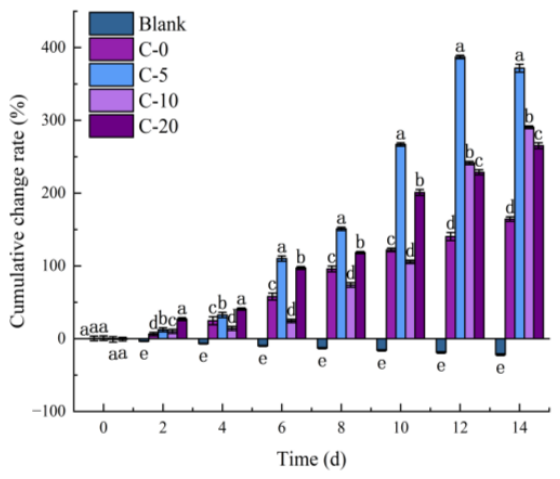
The COD removal pattern exhibited a marked divergence from the nitrogen and phosphorus purification patterns, demonstrating an antithetical dynamic tendency. The variations in COD removal rate across the groups are illustrated in Figure 7. The removal rate of all groups increased gradually with cultivation time, while significant discrepancies existed among treatments. The bacteria-free control group exhibited a significantly higher COD removal efficiency in comparison to all symbiotic experimental groups over the entire study period.
Figure 7.
COD removal efficiency of the duckweed–microbe symbiotic system. (The lowercase letters in the figure represent the corresponding significant differences).
The cumulative percentage change in COD of the blank group remained below 100% throughout the experiment, indicating a mild natural removal trend, with a natural removal efficiency of approximately 22% on day 14 (represented as −22% in cumulative variation data). In a static system containing raw wastewater alone, natural COD reduction is primarily attributable to gravitational sedimentation of suspended organic matter, in conjunction with hydrolysis of a minor fraction of readily degradable organics and weak biodegradation by indigenous microorganisms inherently present in the wastewater. The overall removal rate demonstrated stability, exhibiting no discernible fluctuations. In sharp contrast, the cumulative percentage change in COD relative to the initial concentration increased in all biologically amended treatment groups, and this value increased progressively with the increase in bacterial inoculation dosage.
The apparent COD removal rates of the experimental groups were consistently lower than those of the control group, following the order C-5 > C-10 > C-20, with no declining trend. All groups exhibited a mild increase, with minor variations observed before day 8, and C-20 attained the maximum value of 22.0% among the treatments on day 8. Subsequent to this, the intergroup gaps underwent a substantial expansion.
The higher apparent removal rate exhibited by the control group did not suggest a stronger organic degradation capacity. The reduction of COD was found to be a dynamic balance between organic decomposition and biologically originated COD generation. In experimental groups, functional bacteria secreted extracellular enzymes with the capacity to degrade refractory macromolecular organics. Concurrently, the release of microbial metabolites and intracellular substances from deceased cells resulted in the continuous generation of new COD, thereby counteracting a proportion of the degradation effect. The control group, which received no exogenous bacteria, exhibited negligible biological COD production, thereby demonstrating a higher apparent removal rate.
3.7. The Second Point to Consider Is the Effect of Symbiotic Bacteria on the Crude Protein Content of Spirodela
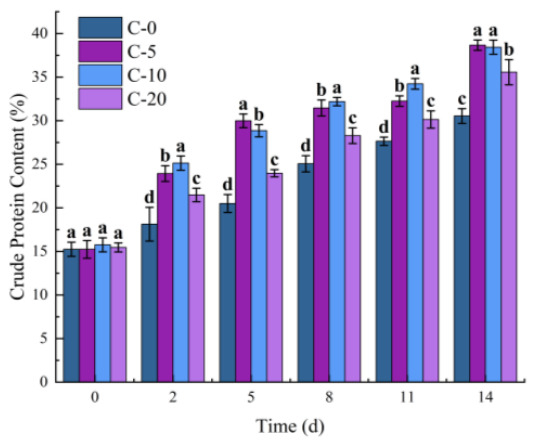
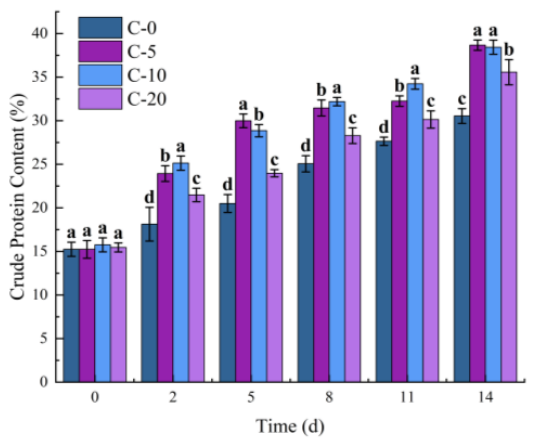
In the course of the purification process for breeding wastewater, there was a notable enhancement in the nutritional quality of Spirodela. The dynamic changes in dry-based crude protein content in duckweed from different groups are demonstrated in Figure 8.
Figure 8.
Protein content of Spirodela under different inoculation ratios. (The lowercase letters in the figure represent the corresponding significant differences).
The crude protein content exhibited a consistent linear upward trend across all groups, without a subsequent decline. The results indicated that duckweed maintained favourable growth status during the 14-day cultivation period, and that it continuously assimilated aquatic nitrogen into endogenous protein, resulting in gradual improvement of nutritional quality. The crude protein content of the bacteria-inoculated groups was found to be significantly higher than that of the control group throughout the experiment, with the inter-group difference gradually widening as cultivation proceeded.
The crude protein content in bacterial inoculation groups exhibited a marked increase in comparison to the control throughout the cultivation process, with the disparity between the two groups gradually increasing over time. On day 14, Group C-5 exhibited the maximum crude protein content of 38.9%, representing a 26.3% increase compared with the 30.5% protein level observed in the control group, which was equivalent to the protein content of soybeans. The values of C-10 and C-20 were found to be 37.2% and 35.6%, respectively. The pronounced protein accumulation was closely associated with nitrogen transformation and growth-promoting effects of the symbiotic system. Functional bacteria mineralized organic nitrogen into ammonia nitrogen, continuously supplying preferentially utilizable nitrogen substrates for protein synthesis [14]. Plant growth-promoting rhizobacteria secreted auxins and cytokinins to facilitate root development and nutrient uptake area, and enhanced activities of key nitrogen assimilation enzymes including nitrate reductase and glutamine synthetase, accelerating nitrogen conversion into protein [24]. Continuously activated available phosphorus also supported energy metabolism and genetic transmission during protein synthesis, jointly boosting crude protein accumulation [23,25].
4. Discussion
Nitrogen is the primary pollutant in livestock breeding wastewater and the fundamental substrate for duckweed protein synthesis. In this study, the compound bacteria groups exhibited significantly higher removal efficiencies of ammonia nitrogen, total nitrogen and total phosphorus than the bacteria-free control group (p < 0.05). The results obtained corroborated the synergistic enhancement of pollutant elimination that was mediated by interactions between aquatic plants and functional microorganisms. This finding was consistent with the core findings on duckweed–microbe symbiosis reported by Laurich et al. [26]. The constructed mixed strain system overcame the functional limitation of single bacteria, and achieved coordinated regulation of pollutant remediation and crude protein accumulation in duckweed [1,24].
The nitrogen removal capacity of the single duckweed system is contingent on the plant’s assimilation of inorganic nitrogen, a process that is constrained by two pivotal bottlenecks. On the one hand, duckweed has been observed to exhibit a preference for the utilisation of ammonia nitrogen, resulting in low early utilisation efficiency of nitrate and organic nitrogen with simple nitrogen removal pathways [27]. Conversely, the low C/N ratio of livestock wastewater hinders nitrification and denitrification, thereby impeding the comprehensive elimination of gaseous nitrogen [2]. Based on the macroscopic pollutant removal results, we propose that the constructed compound bacterial system may form a complete nitrogen circulation chain (including organic nitrogen mineralisation, plant assimilation and microbial immobilisation) via functional complementation and rhizosphere niche adaptation. Bacillus subtilis is presumed to possess considerable ammonification and aerobic denitrification capabilities [28]. The process of nitrification involves the conversion of organic nitrogen into ammonia nitrogen, which is then absorbed preferentially. This continuous supply of substrates for duckweed protein synthesis forms a positive cycle from microbial mineralisation to plant assimilation. The process of simultaneous nitrification and denitrification is driven by aerobic–anaerobic microzones located around duckweed roots. Notably, this process occurs without the need for exogenous carbon addition, thereby achieving comprehensive gaseous nitrogen removal and addressing the challenge of carbon deficiency in low C/N wastewater denitrification.
As plant growth-promoting rhizobacteria, Pseudomonas fluorescens may use auxins and siderophores to facilitate root development and biomass accumulation, enhancing the absorption capacity for diverse nitrogen forms [29]. In return, small-molecule root exudates could potentially furnish carbon and energy sources for microbial reproduction. This mutually beneficial symbiotic relationship is inferred to be the core ecological driver underlying the enhanced nitrogen purification performance, which still needs to be further verified at the molecular and microbial community levels in subsequent studies [30].
The contrasting trends exhibited by nitrate nitrogen and total nitrogen can be attributed to the temporal discrepancy in the transformation pathways of nitrogen. The process of nitrate nitrogen decrease is attributable to plant assimilation and denitrification following the exhaustion of ammonia nitrogen. The subsequent decline in removal efficiency can be attributed to intensified nutrient competition under conditions of elevated bacterial dosage and the release of nitrogen from decaying microbial cells. The steadily rising total nitrogen removal rate proves irreversible nitrogen immobilisation in biomass and gaseous loss, which cannot be reversed by slight nitrate rebound. This provides a theoretical foundation for the stable operation of plant–microbe symbiotic systems.
The monitoring of the results of the blank control group further verified the dominant role of biological effects. In conditions of static temperature and constant temperature, the natural purification efficiencies of ammonia nitrogen, nitrate nitrogen and total nitrogen on day 14 were found to be 13%, 10% and 9%, respectively. The attenuation exhibited by these systems is attributed to the natural volatilisation of ammonia and the physical sedimentation of particulate nitrogen, with minimal loss through chemical transformation. In comparison with the removal efficiencies of over 90% for ammonia nitrogen and more than 60% for total nitrogen in treatment groups, natural processes contributed negligibly to nitrogen purification of the system. The efficient elimination of nitrogen is entirely reliant on synergistic biological processes, including duckweed assimilation, composite bacteria-mediated mineralisation of organic nitrogen, and simultaneous nitrification and denitrification [31].
From the perspective of a physiological regulation mechanism, the mixed bacterial consortium substantially increases crude protein content of duckweed via a multidimensional synergistic network. Firstly, the necessity of continuous substrate supply is paramount. Functional bacteria mineralise organic nitrogen into ammonium nitrogen through a process known as ammonification, thereby providing sufficient nitrogen sources for protein synthesis that are preferentially available. This process overcomes the limitations posed by insufficient nitrogen supply and low protein content under natural conditions [3]. Secondly, metabolic pathway activation. It has been demonstrated that auxins and gibberellins, secreted by plant growth-promoting rhizobacteria (PGPR), enhance the activities of key nitrogen assimilation enzymes, including glutamine synthetase (GS), glutamate synthase (GOGAT) and nitrile reductase (NR), thereby greatly improving the conversion efficiency of nitrogen into protein. Thirdly, the provision of support for energy metabolism. The bioavailable form of phosphorus is continuously activated by symbiotic bacteria, thereby supplying essential energy for the processes of transcription and translation during protein synthesis. The coordination of these three aspects has been demonstrated to result in a significant increase in the protein content of duckweed.
Phosphorus is a critical factor triggering water eutrophication and an essential nutrient for duckweed growth and protein synthesis. The control group presented a higher apparent orthophosphate removal rate than all inoculated groups on day 14, yet its total phosphorus removal efficiency was markedly lower. This apparent discrepancy stemmed from the reconstructed phosphorus speciation transformation balance at the water–rhizosphere interface after bacterial inoculation.
A single duckweed system can only utilize soluble orthophosphate rather than insoluble phosphorus in wastewater. Orthophosphate was merely consumed via plant assimilation without supplementary supply [32], resulting in a continuous concentration decline and high apparent removal rate. Nevertheless, it suffered inherent limitations of few available substrates and a single removal pathway. It is inferred that Bacillus tequilensis in the symbiotic consortium may activate insoluble phosphorus by secreting organic acids and phosphatase, and together with the growth-promoting effect of Pseudomonas fluorescens and microbial assimilation, form a dual-path phosphorus removal system. This inference is currently only supported by macroscopic water quality data, and direct evidence from enzyme activity assays and functional gene quantification is still lacking. Insoluble organic and inorganic phosphorus may be continuously converted into bioavailable orthophosphate. New soluble phosphorus supplements slow down the concentration reduction rate while facilitating phosphorus transformation. Ultimately, total phosphorus is efficiently eliminated through synergistic immobilisation by duckweed and microorganisms [22,25]. The overtaking phenomenon in orthophosphate removal only reflects the continuous solubilisation of refractory phosphorus. In terms of total phosphorus elimination, the experimental groups possessed superior overall phosphorus purification performance.
The elimination of interference from abiotic processes was achieved by utilising data from the blank control group. The natural purification efficiency of soluble reactive phosphorus was found to be approximately 5% on day 14. Water-soluble phosphorus demonstrated chemical stability under the pH conditions of the experiment, exhibiting minimal loss via natural precipitation. The natural purification efficiency of total phosphorus was approximately 15% on day 14, which was solely attributable to weak gravitational sedimentation of particulate phosphorus. Consequently, the transformation and elimination of phosphorus fractions were found to be entirely driven by biological processes. This finding serves to further corroborate the sustained solubilisation effect of the composite bacterial consortium on insoluble phosphorus, which is identified as the primary factor responsible for the lower apparent removal efficiency of soluble reactive phosphorus in treatment groups. This outcome contradicts the hypothesis that the insufficient phosphorus removal capacity of the symbiotic system is the underlying cause.
The apparent carbon dioxide removal performance of the single duckweed control group exhibited deviation from the nitrogen and phosphorus purification trends, maintaining a higher level than that of the symbiotic groups throughout the experiment. Conventional livestock wastewater treatment programmes are principally concerned with the removal of inorganic pollutants, with the COD removal rate serving as a primary indicator of the efficacy of the treatment process [33]. Nevertheless, the environmental behaviour and evaluation criteria of the COD changed fundamentally in this coupled wastewater remediation and feed recycling system.
The phenomenon of COD variation is governed by the dynamic equilibrium between refractory organic degradation and biological soluble organic release. The elimination of the COD in the single duckweed system is contingent on root adsorption, direct uptake of small molecular organics, and degradation by indigenous rhizosphere microbes. In the absence of substantial exogenous microbial input, biologically derived COD accumulates only marginally, contributing to a steady increase in the apparent removal rate, which only experiences a slight decline towards the late stage due to partial duckweed senescence.
The provision of direct evidence for this phenomenon is provided by the blank control group. In the static blank system filled with raw wastewater only, the COD exhibits a slow natural removal trend, with a natural removal efficiency of approximately 22% on day 14, which merely results from gravitational sedimentation of suspended organic matter and weak biodegradation by indigenous microorganisms in the wastewater. In contrast, the cumulative percentage change in the COD relative to the initial concentration demonstrates a positive increase across all treatment groups, and this value rises progressively as the bacterial inoculant dosage increases (C-5 > C-10 > C-20 > C-0). This finding directly corroborates the hypothesis that biogenic COD, encompassing extracellular polymeric substances secreted through microbial metabolism and intracellular organic matter released from senescent bacterial cells in the late cultivation stage [34], serves as the pivotal factor counterbalancing the apparent degradation effect and resulting in a diminished apparent COD removal efficiency in treatment groups compared to the blank control group.
The inoculation of bacteria into the substrate results in the secretion of extracellular enzymes, which facilitate the breakdown of macromolecular refractory organics and enhance organic bioavailability. Concurrently, microbial extracellular metabolites and intracellular substances released from cell lysis generate new biological COD and offset partial degradation effects [35]. The inferior apparent COD removal does not imply weak degradation capacity, but possibly organic speciation transformation and resource utilisation, which require further verification.
Degraded small molecular organics act as carbon sources for denitrifiers and enhance nitrogen purification [36]. Furthermore, these substances are absorbed by duckweed roots and converted into biomass and protein. Consequently, aquatic organic pollutants are recycled into high-protein feed resources, rather than being mineralised into carbon dioxide as in traditional treatment processes [37].
The reduction in COD in the single duckweed system is only achieved through root adsorption, direct uptake of small-molecule organic compounds, and feeble biodegradation by indigenous rhizosphere microorganisms. The substrates that are available for use are restricted to those that are readily biodegradable. This means that the transformation of macromolecular refractory COD is not possible. However, in the absence of substantial proliferation of exogenous functional bacteria, the increase in biogenic COD derived from microbial metabolites and lysed bacterial cells remains minimal. Consequently, this system exhibits a higher apparent COD removal efficiency yet limited overall degradation depth.
In contrast, the composite bacterial system facilitates the activation of macromolecular refractory COD into bioavailable small molecules via extracellular enzymes secreted by functional strains [38,39]. It has been established that a proportion of the degraded organics are assimilated into biomass by duckweed and microorganisms. In contrast, the remainder act as carbon sources for denitrification, thereby supporting gaseous nitrogen removal. This process engenders thorough transformation and resource recovery of refractory COD. However, the secretion of extracellular polymeric substances during microbial metabolism, along with the release of intracellular organic matter from senescent bacterial cells in the late culture period, has been shown to replenish biogenic COD [40,41]. This has the effect of offsetting part of the apparent degradation effect, resulting in a lower apparent removal efficiency compared with the blank control group.
It is imperative that the inoculation ratio of the duckweed–bacteria symbiotic system is maintained within a reasonable range. A dosage that is insufficiently low fails to achieve effective microbial colonisation and synergistic effects, while a dosage that is excessively high disrupts the mutually beneficial balance and triggers interspecific competition. The moderate inoculation proportion has been shown to maximise the synergistic interaction that bacteria promote in duckweed growth, and duckweed facilitates microbial reproduction. A trade-off exists between functional performance and system stability for the two inoculation ratios. It was demonstrated that, at an inoculation ratio of 5:1, the rapid colonisation of the rhizosphere and the enhancement of the metabolic functions of microorganisms increased the removal rates of ammonia nitrogen and nitrate nitrogen in the early cultivation stage by 7.8% and 18.8%, respectively. The final crude protein content of duckweed reached 38.9%. However, intensified resource competition between bacteria and duckweed emerged in the later stage, and massive microbial lysis triggered a sharp rebound of nitrate nitrogen, which significantly impaired system stability.
For the medium inoculation ratio of 10:1, although the accumulated crude protein was slightly lower (37.2%), the retention rate of nitrate nitrogen removal efficiency in the late phase rose by 38.1%, the total phosphorus removal efficiency peaked at 59.5%, and the dosage cost of bacterial agents was reduced by 50%. This ratio was achieved through a judicious compromise that balanced comprehensive purification capacity and long-term operational stability.
Flexible selection can be implemented in practical engineering according to core operational objectives. In scenarios targeting compliant wastewater discharge with a hydraulic retention time of 10–12 days, the 10:1 mixing ratio is prioritised. For protein-oriented production, with duckweed harvested in advance at days 8–10 to avoid the risk of water quality deterioration in the later cultivation period, the 5:1 ratio is adopted.
A comprehensive evaluation system was established with the objective of determining the optimal parameters for practical application. This system was based on two key factors: pollutant removal efficiency and duckweed protein content. In the context of wastewater purification, the optimal ratio was determined to be 10:1, indicating the proportion of the two components required for achieving compliance. The group exhibited superior nitrogen and phosphorus removal in the early and middle stages, the slightest late nitrate nitrogen decline, and the lowest COD accumulation among the experimental groups. In the context of high-protein duckweed feed production, the optimal ratio was determined to be 5:1, which resulted in the greatest ammonia nitrogen removal efficiency and crude protein content. As demonstrated in Table 2. The final dry-based crude protein content reached 38.9%, a figure comparable to that of soybean.
Table 2.
Comparison of protein content on dry weight basis among different crops.
From the perspective of industrial value, the estimated annual protein yield of Spirodela reached 3.12 t/hm2 based on the 14-day cultivation cycle, which is 3.15 times that of soybean and 6.24 times that of corn. This finding suggests that the duckweed cultivation system has the potential to yield a protein yield that is several times higher than that of conventional grain crops cultivated on an equivalent land area.
It is important to note that the production of protein is entirely dependent on the presence of nitrogen and phosphorus pollutants in the breeding wastewater. The system enables the large-scale production of protein raw materials without the need for arable land or the application of chemical fertilisers and pesticides. This effectively addresses the scarcity of land resources and ecological concerns associated with traditional protein raw material production. The established duckweed recycling technology demonstrates considerable application potential when subjected to laboratory conditions.
Despite the findings of the present study, which demonstrated the capacity of compound symbiotic bacteria to collaborate with Spirodela to achieve two objectives—namely, wastewater purification and the enhancement of feed nutritional value—several limitations remain.
With regard to the experimental design, all trials were conducted under controlled laboratory batch culture conditions, with constant temperature and illumination. This eliminated interferences such as fluctuating temperature and light intensity, as well as competition from indigenous microorganisms under field conditions. Furthermore, it should be noted that only a single wastewater load was the subject of the study. Consequently, the applicability of the optimal inoculation ratio, as determined in this study, necessitates further validation through continuous-flow pilot-scale experimentation.
In terms of mechanistic interpretation, the present study established a theoretical framework for synergistic interactions covering rhizosphere recruitment via root exudates, coupled nitrification–denitrification, phosphorus solubilisation and plant growth promotion. However, key mechanistic indicators were not measured, including root morphology, microbial abundance and community structure, rhizosphere dissolved oxygen distribution, activities of critical functional enzymes, organic acid secretion flux, nitrogen transformation rates and functional gene expression levels. The prevailing mechanistic explanations are merely logical deductions derived from apparent water quality parameters, and there is an absence of direct molecular evidence at the microbial, enzymatic and gene levels. This constitutes the most prominent limitation of this research. Subsequent research should supplement determinations of the above indicators to systematically elucidate the molecular-scale synergistic mechanism of the duckweed–bacteria interaction. In the present study, the evaluation of feed was conducted exclusively on the basis of crude protein content. Key feed safety indicators were not assessed, such as amino acid balance, anti-nutritional factors, and enrichment risks of heavy metals and antibiotics. Furthermore, the absence of animal feeding trials to validate practical feeding performance is notable.
From the perspective of engineering translation, only inoculation ratio parameters were clarified in this research. Exploration of large-scale harvesting strategies, mass production technology for bacterial agents and full life-cycle economic assessment has not yet been undertaken, resulting in a significant gap before practical on-site application.
5. Conclusions
Spirodela was selected as the research material for this study, and a three-strain symbiotic consortium with nitrification, phosphorus-solubilising and growth-promoting functions was constructed. The present study investigates the effects of different inoculation concentrations on the purification of high-strength livestock wastewater and the quality of duckweed feed. Furthermore, this study preliminarily reveals the synergistic law of duckweed–bacteria symbiosis and proposes a putative mechanistic framework based on macroscopic experimental data. The primary conclusions that can be drawn from this analysis are outlined below.
The co-occurrence of Bacillus subtilis, Bacillus tequilensis and Pseudomonas fluorescens strains has been demonstrated to result in a state of functional complementarity, thereby establishing a symbiotic relationship with duckweed that is characterised by mutual benefit. The consortium has been demonstrated to achieve a significantly higher level of pollutant removal and plant growth-promoting capacity in comparison to the control group (p < 0.05), with prominent synergistic effects being observed.
A remarkable dose–effect relationship has been observed in relation to the inoculation ratio of plants and microbes. It is evident that a moderate inoculation concentration delivers optimal comprehensive purification performance, thus serving as the preferred parameter for wastewater remediation. It has been demonstrated that a high inoculation concentration maximises crude protein accumulation, which is suitable for protein-oriented production.
Author Contributions
G.L., X.L. and S.W. conducted the experiment and data processing. D.L. conceived and supervised the project. All authors have read and agreed to the published version of the manuscript.
Funding
This work was supported by the University-Local Integration Development Project of Yantai City (2024XDRHXMPT11).
Institutional Review Board Statement
Not applicable.
Informed Consent Statement
Not applicable.
Data Availability Statement
The datasets used and/or analysed during the current study are available from the corresponding author on reasonable request.
Conflicts of Interest
The authors declare no conflicts of interest.
References
- Cheng, H.Y.; Long, J.X.; Liu, Z. Aquaculture wastewater treatment with immobilized microorganisms-aquatic plants strengthened purification system. In Proceedings of the 2nd International Conference on Power and Energy Engineering (ICPEE), Xiamen, China, 3–5 September 2018; Volume 192. [Google Scholar]
- Zhou, J.; Sun, Q.Y. Performance and microbial characterization of aerobic granular sludge in a sequencing batch reactor performing simultaneous nitrification, denitrification and phosphorus removal with varying c/n ratios. Bioprocess Biosyst. Eng. 2020, 43, 663–672. [Google Scholar] [CrossRef] [Scilit] [PubMed]
- Baek, G.; Saeed, M.; Choi, H.K. Duckweeds: Their utilization, metabolites and cultivation. Appl. Biol. Chem. 2021, 64, 73. [Google Scholar] [CrossRef] [Scilit] [PubMed]
- Takács, K.; Végh, R.; Mednyánszky, Z.; Haddad, J.; Allaf, K.; Du, M.Y.; Chen, K.W.; Kan, J.Q.; Cai, T.; Molnár, P.; et al. New insights into duckweed as an alternative source of food and feed: Key components and potential technological solutions to increase their digestibility and bioaccessibility. Appl. Sci. 2025, 15, 884. [Google Scholar] [CrossRef] [Scilit]
- Lambert, M.; Devlamynck, R.; de Souza, M.F.; Vermeir, P.; Raes, K.; Eeckhout, M.; Meers, E. A pilot-scale evaluation of duckweed cultivation for pig manure treatment and feed production. Plants 2025, 14, 2680. [Google Scholar] [CrossRef] [Scilit] [PubMed]
- Pinotti, L.; Cheli, F.; Govoni, C.; Rulli, M.C.; Premarajan, P.; Cattaneo, D. The ‘one nutrition’ approach: Connecting crop production, animal nutrition and human nutrition. Ital. J. Anim. Sci. 2025, 24, 978–987. [Google Scholar] [CrossRef] [Scilit]
- Zhou, Y.Z.; Stepanenko, A.; Kishchenko, O.; Xu, J.M.; Borisjuk, N. Duckweeds for phytoremediation of polluted water. Plants 2023, 12, 589. [Google Scholar] [CrossRef] [Scilit] [PubMed]
- Li, Y.; Zhang, F.T.; Daroch, M.; Tang, J. Positive effects of duckweed polycultures on starch and protein accumulation. Biosci. Rep. 2016, 36, e00380. [Google Scholar] [CrossRef] [Scilit] [PubMed]
- Zhao, Y.G.; Fang, Y.; Jin, Y.L.; Huang, J.; Bao, S.; Fu, T.; He, Z.M.; Wang, F.; Zhao, H. Potential of duckweed in the conversion of wastewater nutrients to valuable biomass: A pilot-scale comparison with water hyacinth. Bioresour. Technol. 2014, 163, 82–91. [Google Scholar] [CrossRef] [Scilit] [PubMed]
- Yosef, A.F.; Ghazaryan, L.; Klamann, L.; Kaufman, K.S.; Baubin, C.; Poodiack, B.; Ran, N.Y.; Gabay, T.; Didi-Cohen, S.; Bog, M.; et al. Diversity and differentiation of duckweed species from Israel. Plants 2022, 11, 3326. [Google Scholar] [CrossRef] [Scilit] [PubMed]
- Adesemoye, A.O.; Kloepper, J.W. Plant-microbes interactions in enhanced fertilizer-use efficiency. Appl. Microbiol. Biotechnol. 2009, 85, 1–12. [Google Scholar] [CrossRef] [Scilit] [PubMed]
- Boonmak, C.; Kettongruang, S.; Buranathong, B.; Morikawa, M.; Duangmal, K. Duckweed-associated bacteria as plant growth-promotor to enhance growth of spirodela polyrhiza in wastewater effluent from a poultry farm. Arch. Microbiol. 2024, 206, 43. [Google Scholar] [CrossRef] [Scilit] [PubMed]
- Shen, M.; Yin, Z.F.; Xia, D.; Zhao, Q.X.; Kang, Y.J. Combination of heterotrophic nitrifying bacterium and duckweed (Lemna gibba L.) Enhances ammonium nitrogen removal efficiency in aquaculture water via mutual growth promotion. J. Gen. Appl. Microbiol. 2019, 65, 151–160. [Google Scholar] [CrossRef] [Scilit] [PubMed]
- Hemalatha, M.; Mohan, S.V. Duckweed biorefinery-potential to remediate dairy wastewater in integration with microbial protein production. Bioresour. Technol. 2022, 346, 126499. [Google Scholar] [CrossRef] [Scilit] [PubMed]
- Iwashita, T.; Makino, A.; Nakai, R.; Yoneda, Y.; Kamagata, Y.; Toyama, T.; Mori, K.; Tanaka, Y.; Tamaki, H. Diverse members of the phylum armatimonadota promote the growth of aquatic plants, duckweeds. Int. J. Mol. Sci. 2025, 26, 9824. [Google Scholar] [CrossRef] [Scilit] [PubMed]
- Song, Y.J.; Chen, Q.X.; Luo, S.S.; Li, S.; He, R.M.; Yang, X.Y.; Shen, D.C.; Long, C.L.; Liu, S.Z.; Zhong, G.H.; et al. Ecology-guided bacillus SynCom from a rice—Duckweed core reveals division of labor for concurrent growth promotion and sheath blight suppression. Microbiome 2026, 14, 80. [Google Scholar] [CrossRef] [Scilit] [PubMed]
- Liu, Z.P.; Feng, L.; Liu, C.X. Effect of bacteria-algae ratio on treatment of anaerobic digested wastewater by symbiotic coupling of bacteria and algae under the background of carbon neutralization. Environ. Res. 2024, 251, 118771. [Google Scholar] [CrossRef] [Scilit] [PubMed]
- Satiro, J.; Gomes, A.; Florencio, L.; Simoes, R.; Albuquerque, A. Effect of microalgae and bacteria inoculation on the startup of bioreactors for paper pulp wastewater and biofuel production. J. Environ. Manag. 2024, 362, 121305. [Google Scholar] [CrossRef] [Scilit] [PubMed]
- Coughlan, N.E.; Walsh, É.; Bolger, P.; Burnell, G.; O’Leary, N.; O’Mahoney, M.; Paolacci, S.; Wall, D.; Jansen, M. Duckweed bioreactors: Challenges and opportunities for large-scale indoor cultivation of Lemnaceae. J. Clean. Prod. 2022, 336, 130285. [Google Scholar] [CrossRef] [Scilit]
- Walsh, É.; Cialis, E.; Dillane, E.; Jansen, M. Lemnaceae clones collected from a small geographic region display diverse traits relevant for the remediation of wastewater. Environ. Technol. Innov. 2022, 28, 102599. [Google Scholar] [CrossRef] [Scilit]
- Redmond, C.; Coughlan, N.E.; Purcell, A.; Jansen, M. Optimisation of dairy soiled water as a novel duckweed growth medium. Plants 2025, 14, 110. [Google Scholar] [CrossRef] [Scilit] [PubMed]
- Pan, L.; Cai, B.Y. Phosphate-solubilizing bacteria: Advances in their physiology, molecular mechanisms and microbial community effects. Microorganisms 2023, 11, 2904. [Google Scholar] [CrossRef] [Scilit] [PubMed]
- Wani, P.A.; Singh, G. Phosphate Solubilizing Microorganisms for Augmenting Crop Nutrition. In Agriculture Issues and Policies; Nova Science Publishers: New York, NY, USA, 2009; pp. 337–355. ISBN 978-1-60876-112-8. [Google Scholar]
- Zhou, Y.Z.; Kishchenko, O.; Stepanenko, A.; Chen, G.M.; Wang, W.; Zhou, J.; Pan, C.Z.; Borisjuk, N. The dynamics of NO3- and NH4+ uptake in duckweed are coordinated with the expression of major nitrogen assimilation genes. Plants 2022, 11, 11. [Google Scholar] [CrossRef] [Scilit] [PubMed]
- Elhaissoufi, W.; Ghoulam, C.; Barakat, A.; Zeroual, Y.; Bargaz, A. Phosphate bacterial solubilization: A key rhizosphere driving force enabling higher p use efficiency and crop productivity. J. Adv. Res. 2022, 38, 13–28. [Google Scholar] [CrossRef] [Scilit] [PubMed]
- Laurich, J.R.; Lash, E.; O’Brien, A.M.; Pogoutse, O.; Frederickson, M.E. Community interactions among microbes give rise to host-microbiome mutualisms in an aquatic plant. mBio 2024, 15, e00972-24. [Google Scholar] [CrossRef] [Scilit] [PubMed]
- Wang, W.G.; Yang, C.; Tang, X.Y.; Gu, X.J.; Zhu, Q.L.; Pan, K.; Hu, Q.C.; Ma, D.W. Effects of high ammonium level on biomass accumulation of common duckweed Lemna minor L. Environ. Sci. Pollut. Res. Int. 2014, 21, 14202–14210. [Google Scholar] [CrossRef] [Scilit] [PubMed]
- Saavedra-Tralma, D.; Gaete, A.; Merino-Guzmán, C.; Parada-Ibáñez, M.; Ferrari, F.; Jofré-Fernández, I. Functional and genomic evidence of l-arginine-dependent bacterial nitric oxide synthase activity in Paenibacillus nitricinens sp. nov. Biology 2025, 14, 733. [Google Scholar] [CrossRef] [Scilit] [PubMed]
- Liu, Y.; Xie, X.F.; Tian, Y.; Yue, L.; Zhao, X.; Zhou, Q.; Wang, Y.; Zhang, Y.B.; Jin, L.; Guan, Q.X.; et al. An attapulgite-bacillus amyloliquefaciens biocontrol agent increases growth and medicinal metabolite content in angelica sinensis by modulating hormonal and phenylpropanoid pathways. BMC Plant Biol. 2025, 26, 150. [Google Scholar] [CrossRef] [Scilit] [PubMed]
- Zheng, S.M.; Wang, Y.D.; Chen, C.H.; Zhou, X.J.; Liu, Y.; Yang, J.M.; Geng, Q.J.; Chen, G.; Ding, Y.Z.; Yang, F.X. Current progress in natural degradation and enhanced removal techniques of antibiotics in the environment: A review. Int. J. Environ. Res. Public Health 2022, 19, 10919. [Google Scholar] [CrossRef] [Scilit] [PubMed]
- Lu, Y.F.; Kronzucker, H.J.; Shi, W.M. Stigmasterol root exudation arising from pseudomonas inoculation of the duckweed rhizosphere enhances nitrogen removal from polluted waters. Environ. Pollut. 2021, 287, 117587. [Google Scholar] [CrossRef] [Scilit] [PubMed]
- Paolacci, S.; Stejskal, V.; Toner, D.; Jansen, M. Integrated multitrophic aquaculture; Analysing contributions of different biological compartments to nutrient removal in a duckweed-based water remediation system. Plants 2022, 11, 3103. [Google Scholar] [CrossRef] [Scilit] [PubMed]
- Zhao, D.H.; Chen, C.; Yang, J.Q.; Zhou, S.Y.; Du, J.; Zhang, M.; An, S.Q. Mutual promotion of submerged macrophytes and biofilms on artificial macrophytes for nitrogen and COD removal improvement in eutrophic water. Environ. Pollut. 2021, 277, 116718. [Google Scholar] [CrossRef] [Scilit] [PubMed]
- Chen, J.; Zhou, Y.Q.; Zhang, Y.L.; Guo, Q.Z.; Zhang, S.L.; Ge, G.H.; Jin, W.T. Succession of particle-attached and free-living microbial communities in response to the degradation of algal organic matter in lake Taihu, China. Environ. Microbiol. Rep. 2025, 17, e70094. [Google Scholar] [CrossRef] [Scilit] [PubMed]
- Li, F.; Xu, M.B.; Pan, L.H.; Li, J.; Lan, C.B.; Li, Z.; Lu, S.; Lai, J.X.; Li, P.F. Ammonifying and phosphorus-solubilizing function of Aliikangiella maris sp. Nov. Isolated from Phaeocystis globosa bloom and algal-bacterial interactions. Front. Microbiol. 2025, 16, 1516993. [Google Scholar] [CrossRef] [Scilit] [PubMed]
- Yan, Z.C.; Xu, Y.N.; Yang, H.; Fu, X.Y. Effect of micro-aeration stirring on nitrogen removal in anammox reactor. Sci. Rep. 2026, 16, 6561. [Google Scholar] [CrossRef] [Scilit] [PubMed]
- Al-Dakhil, M.; Ben Romdhane, W.; Alghamdi, S.; Ali, A. Differential morpho-physiological and biochemical responses of duckweed clones from Saudi Arabia to salinity. Plants 2023, 12, 3206. [Google Scholar] [CrossRef] [Scilit] [PubMed]
- Dan, W.; Zhu, X.B.; Xi, W.X.; Pan, H.Z.; Yao, H.M.; Du, Y.L. Purification capacity of natural biofilms and their physiochemical and biological properties: A case study in the Jishan river, a heavily polluted river. Water Supply 2023, 23, 1611–1625. [Google Scholar] [CrossRef] [Scilit]
- Sousa, J.F.; Amaro, H.M.; Ribeirinho-Soares, S.; Esteves, A.F.; Salgado, E.M.; Nunes, O.C.; Pires, J. Native microalgae-bacteria consortia: A sustainable approach for effective urban wastewater bioremediation and disinfection. Microorganisms 2024, 12, 1421. [Google Scholar] [CrossRef] [Scilit] [PubMed]
- Fard, M.B.; Wu, D. Potential interactive effect on biomass and bio-polymeric substances of microalgal-bacterial aerobic granular sludge as a valuable resource for sustainable development. Bioresour. Technol. 2023, 376, 128929. [Google Scholar] [CrossRef] [Scilit] [PubMed]
- Song, W.; Ryu, J.; Jung, J.; Yu, Y.; Choi, S.; Kweon, J. Dispersive biofilm from membrane bioreactor strains: Effects of diffusible signal factor addition and characterization by dispersion index. Front. Microbiol. 2023, 14, 1211761. [Google Scholar] [CrossRef] [Scilit] [PubMed]
- Food and Agriculture Organization of the United Nations (FAO). FAOSTAT Statistical Database 2024. Available online: https://www.fao.org/faostat/en/ (accessed on 20 June 2024).

Disclaimer/Publisher’s Note: The statements, opinions and data contained in all publications are solely those of the individual author(s) and contributor(s) and not of MDPI and/or the editor(s). MDPI and/or the editor(s) disclaim responsibility for any injury to people or property resulting from any ideas, methods, instructions or products referred to in the content. |
© 2026 by the authors. Licensee MDPI, Basel, Switzerland. This article is an open access article distributed under the terms and conditions of the Creative Commons Attribution (CC BY) license.