


Abstract
Agricultural reconversion has become a key strategy for the continuity and competitiveness of primary-sector productive units, confronting scenarios such as low profitability, environmental pressures, and changes in agri-food markets. The objective of this study was to identify the economic, social, and environmental factors that influenced the agricultural reconversion to lemon cultivation (Citrus limon) in production units in the municipality of Calvillo, Aguascalientes, Mexico. During 2023 and 2024, a total of 32 semi-structured interviews were conducted with producers who had undertaken restructuring processes, from which perception variables were constructed across three dimensions: economic, social, and crop management. Through cluster analysis, three distinct profiles were identified based on their perceptions, resource use, and organizational characteristics (p < 0.05). Results indicate that economic factors are the main driver of productive change (low crop profitability p = 0.0035); however, environmental dimension and efficient resource management, particularly water, are crucial to consolidating the conversion. Furthermore, government support, production experience, and membership in organizations influence perceptions of viability and the prospects of the new crop. The findings suggest that agricultural production restructuring does not follow a uniform pattern, but is shaped by structural, perceptual, and contextual factors, highlighting the importance of targeted public policies and integrated strategies for technical and organizational support.
1. Introduction
Productive reconversion in agricultural units is a strategy for change and innovation that modifies rural dynamics, either in order to achieve better productive or organizational performance [1]. Some authors point out that reconversion: (1) raises the competitiveness of the agri-food sectors; (2) increases the productivity of agribusinesses; (3) diversifies marketing options; and (4) generates changes in social, economic and environmental factors [2]. The implementation of agricultural production reconversion processes seeks to change traditional production patterns or incorporate alternative crops to obtain better results. Currently, the main studies on production reconversion suggest environmental, social, and economic advantages in soil nutrient management, agricultural biodiversity, and consistent low-input production [3]. In the agricultural production reconversion, different criteria have been considered for the evaluation in the implementation of new crops, such as the contribution to family income, ease of sale, technical knowledge of the crop, lower production cost, environmental impact and government support [4].
In Mexico, public policies, including the Law on Sustainable Rural Development, have proposed that productive reconversion in the agricultural sector be oriented toward changing crops, varieties, or species, incorporating technological changes and processes that contribute to increasing the income of the country’s agricultural producers through support and complementary investments to improve their profitability and competitiveness [5]. Nori & Farinella [6] refer to the term agricultural restructuring as changes in production, labor organization, technologies, markets, and other activities that have been modified in production units, including the adaptation of productive activities to changes in economic, social, and technological conditions. Crop diversification (rotations, multiple cropping, or intercropping) has been identified as an alternative in agricultural practices to address difficulties in agricultural production units such as low economic yields, soil degradation, or abandonment of productive activity [7]. In addition to the above, Hazra [8] points out that crop substitution can result from agents of change occurring within production units (both internal and external), such as decreased availability of resources like water and soil fertility, as well as factors affecting productivity, including technological and financial factors, increased input prices, production infrastructure, and marketing, among others. Therefore, the term “agricultural production conversion,” as defined in this study, is considered a mechanism for strengthening farmers’ productivity. This could involve crop rotation, complementary production on the same land (crop diversification), and the agricultural restructuring of production units.
Economic factors are one of the main motivations for productive reconversion within economic units. Kurlavicius et al. [9] identify that higher levels of education and sales are associated with greater resilience to various threats (competitors, markets, policies, etc.). Therefore, decision-making based on financial aspects in agricultural units increases the likelihood of finding a successful alternative in productive reconversion. In this sense, product prices play an important role in decisions involving change; when there are low economic incomes from the sale of agri-food products, the owners of agricultural units are forced to look for alternatives to obtain greater profitability [10]. In recent years, agricultural units have turned to complementary activities such as agritourism as an alternative to generate additional income [11]. However, Nguyen et al. [12] warn that changes in businesses in the sector can face implementation difficulties if they are not carried out with adequate infrastructure, planning, organization, and additional support.
In the study of social and cultural factors in agricultural environments, it has been discovered that educational level influences decisions to implement productive reconversion. This is due to the access to information that farm owners with higher levels of education may have. Rosli et al. [13] emphasize that when there is support in the educational sphere, community participation is promoted, and the changes are more likely to be successful. Similarly, Assan [14] highlights the adaptation to new technologies within the local culture as a factor that influences reconversion. Likewise, studies such as that of Markiewicz-Keszycka [15] indicate that family values, personal beliefs, and life experiences also represent factors that affect the decision to transform an agroecological production system into one less dependent on the global market and external forces for its implementation.
Another aspect to consider in agricultural production reconversion is environmental revaluation and the dynamics that develop to protect the environment. In this regard, Rodríguez-Robayo et al. [16] observe that producers who prioritize environmental stewardship are more open and readily implement changes on their plots, thereby promoting positive dynamics toward agricultural reconversion. Farmers who have experienced the consequences of climate change, such as droughts or extreme rainfall, tend to orient their decision-making toward environmental protection [17], and the continuity of their farms.
One of the factors affecting the competitiveness and profitability of guava cultivation is price volatility in the market [18]. This, coupled with the crop’s seasonality, has led to the adoption of agricultural management techniques that contribute to reducing water consumption during certain months of the year. The agricultural area in the municipality is 9592.20 hectares, of which 46.6% is dedicated to perennial crops. Of these, more than 85% of the cultivated area corresponds to four types of products: guava (61.03%), prickly pear cactus (13.6%), pasture (6.13%), and lemon (5.51%). The remaining perennial crops grown in the municipality of Calvillo are avocado, alfalfa, asparagus, apple, orange, and walnut [19].
The guava from Calvillo competes directly with that produced in other states of the country, mainly Michoacán, which has a cultivated area of guava four times larger than that of the municipality of Calvillo [19]. It has been identified [20] that the guava from Calvillo has a lower economic value compared to the guava produced in the state of Michoacán. This represents a factor that producers should consider when diversifying their crops.
Furthermore, it has been previously shown [21] that guava cultivation has been affected in recent years by the increase in operating costs, which has resulted in a loss of profitability and competitiveness.
For some years now, the government in the state of Aguascalientes has been promoting the reconversion of agricultural areas to more economically profitable ones with lower water requirements, which would foster the transition to sustainable agricultural production [22]. However, the agricultural reconversion on individual plots has not been evaluated, considering the different characteristics of the production units, their organization, perspectives, and market impact, as well as the environmental factors that affect their production.
Having examined the scope, perspectives, strategies, and dynamics of productive reconversion, this study focuses on engaging with guava and other crop producers in the state of Aguascalientes. These producers had modified their farms’ production structures to implement lemon cultivation as an alternative for the continuity of their agricultural operations. This crop requires similar cultivation practices, with a lower level of mechanized tillage and enjoys greater appreciation in local, national, and international markets. To analyze the effects of this reconversion, an analysis was conducted on the organizational characteristics of agricultural production units in the municipality of Calvillo that introduced the new crop. This analysis also examined the relationship between these characteristics and the reasons for the permanence of and management practices of the farms, as well as the government support received to promote agricultural reconversion. The objective of this study was to identify the economic, social, and environmental factors that influenced the agricultural reconversion to lemon cultivation (Citrus limon) in production units in the municipality of Calvillo, Aguascalientes, Mexico.
2. Materials and Methods
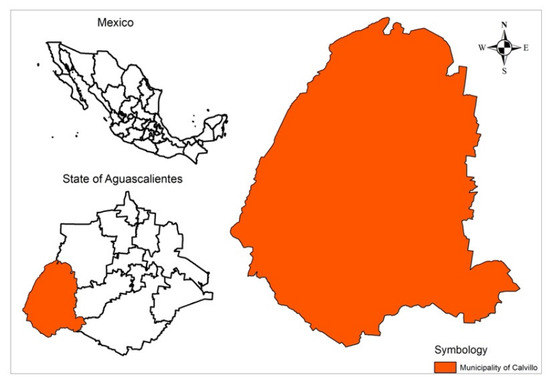
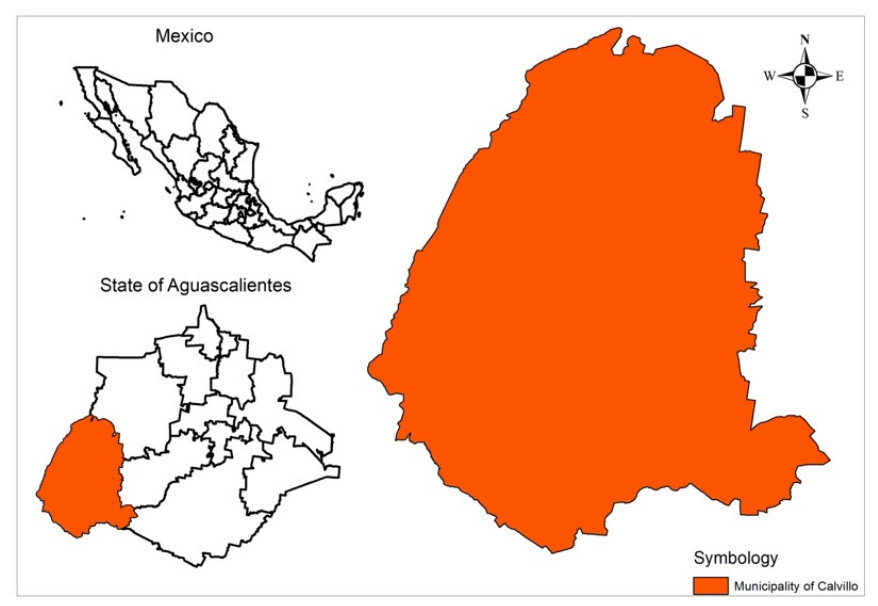
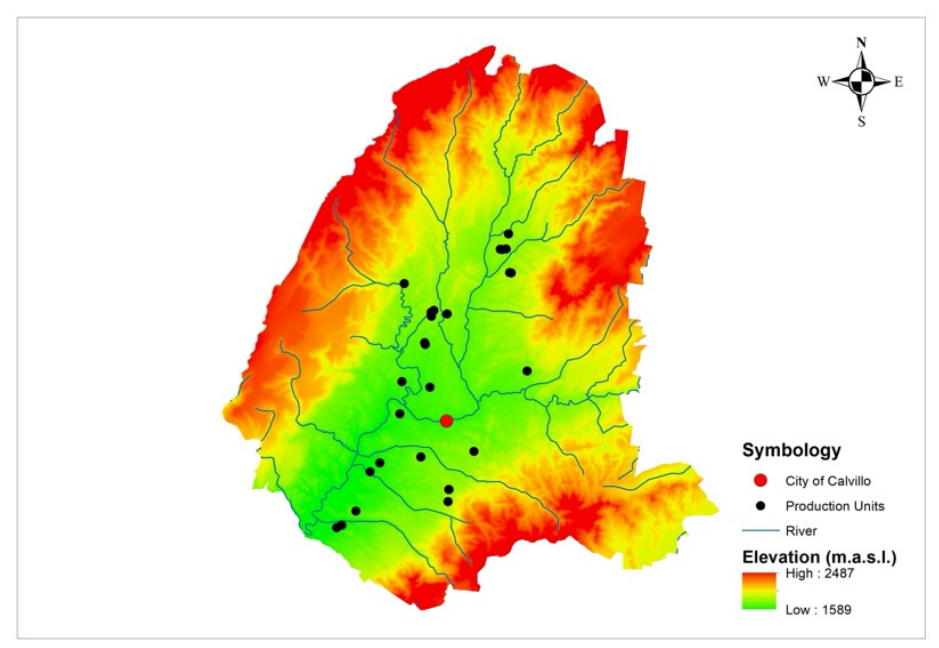
The study was carried out in the municipality of Calvillo in the state of Aguascalientes (2023 and 2024), 32 semi-structured interviews were conducted with producers who implemented lemon cultivation on their plots (Figure 1). The sampling was carried out by convenience (non-probabilistic).
Figure 1.
Location of Calvillo, Aguascalientes, México [23].
The producers interviewed gave their consent to provide information on the characteristics and management of the production units, socioeconomic traits of the owners, perceptions on the implementation of lemon cultivation compared to previous crops in the Economic (E), Social (S) and Environmental Resources and Crop Management (AC) dimensions. They were also questioned about their motivations or factors that led them to introduce the new crop (low profitability, high water demand, infrastructure problems, market problems, success of the crop with other producers, government support, testing the new crop, among others).
The variables used to assess producers’ perceptions of the three dimensions (E, S, and AC) were formulated based on a literature review. A 5-point Likert scale was used to evaluate the perception of these variables in relation to the previous crop; a score of 1 indicated the lowest level of positive acceptance of the new crop, and a score of 5 indicated the highest level of acceptance.
The Economic variable involved 9 questions to the producers (E1, E2, …, E9) regarding: the economic profit per hectare, economic profit in the first year, selling price of the product, variation in input prices, product market, competition with other producers, dependence on buyers for the definition of the selling price, sellers define the acquisition price of inputs and financial problems [24,25,26,27,28].
The Social variable grouped 4 aspects on the organization and employment of the workforce used in the production units (S1, S2, S3 and S4), total employed personnel, temporary employed personnel, family employed personnel and problems with employees [25,28,29].
The variable Environmental Resources and Crop Management involved 17 questions to producers about crop or environmental management (AC1, AC2, …, AC17), water volume per year, use of irrigation equipment, selection of quality seed or seedling, plant density per hectare, soil quality, use of fertilizers, crop damage by pests, pesticides used per year, total tillage of the land per year, degree of incorporation of organic matter, degree of mechanization of the crop, post-harvest operations of the product, availability of inputs to carry out production, availability of qualified technical advisors specific to the crop, care of the crop during its establishment stage in the field, care at the time of harvest and problems in production [28,29,30].
In order to verify whether each of these dimensions was internally consistent, Cronbach’s coefficient was calculated with the “psych” package from the R Core Team statistical software [31]. Also, based on the item-total correlation calculated for each item with respect to the scale excluding that item, the items to be retained were determined.
For the perception of producers in dimension Economic, it was constructed from the indicators E1, E2, E3, E5 and E6, having a Cronbach’s Alpha of 0.6653. Although this value is below 0.70, some authors indicate that a value greater than or equal to 0.6 is acceptable for scales with 10 or fewer items, in exploratory research [32,33]. For the perception of producers in the Social dimension, 4 indicators were used: S1, S2, S3 and S4 (number of total employees, number of temporary employees, number of family employees and the difficulties with the employees), with which a Cronbach’s Alpha of 0.7888 was obtained. Regarding the perception of producers in the Environmental Resources and Crop Management dimension, it was integrated with AC1, AC2, AC3, AC4, AC5, AC6, AC7, AC8, AC9, AC12, AC14, AC15, AC16 and AC17 (annual water demand, use of pesticides, fertilizers and irrigation equipment, use of quality seed or plant, plant density/ha, soil quality, pest damage, crop tillage, post-harvest production operations, availability of qualified technical advisors, general crop and production care and problems during the agricultural cycle); with which, a Cronbach’s Alpha of 0.7103 was obtained.
2.1. Methodological Process
The methodological process for analyzing the variables was as follows:
- Defining the object of the study.
- Based on a literature review, constructing and validating the variables.
- Interviews with producers.
- Verifying the internal consistency of items in each dimension.
- Cluster analysis to classify producer groups according to their use of available resources within their economic unit and their perceptions of implementing productive reconversion on their plots.
- Evaluating and interpreting the resulting clusters.
2.2. Statistical Analysis
To identify the technical, organizational, perceptual and performance areas and conditions in agricultural production units, a Cluster Analysis was carried out to determine the common characteristics among producers [34]. Cluster analysis was used to classify relatively homogeneous producer groups with similar characteristics among themselves and different from the characteristics of the other producer groups that carried out the implementation of lemon cultivation in the state of Aguascalientes [35].
The process for this analysis was as follows: (1) The main key variables for grouping producers with similar perceptions of reconversion (Economic, Social, Environmental Resources and Crop Management) were identified. (2) Choosing a measure of distance. Clustering refers to grouping similar objects, and for this purpose, a measure is used to assess how similar or different the objects are. The most common measure is distance; in our case, Euclidean distance (square root of the sum of squared differences in the values of each variable) was used to assess the similarities among lemon producers. Prior to this calculation, the variables were standardized to prevent the units of measurement from influencing the groupings. (3) Choosing a clustering procedure. A hierarchical procedure was chosen, specifically complete-linkage clustering. This means a procedure was used that develops a hierarchy or tree-like structure where the algorithm begins with each producer in a separate cluster, then groups producers into increasingly larger clusters, and ends when all producers are members of a single cluster. Complete linkage refers to the fact that it measures the proximity between two clusters by calculating the distance between their most distant producers. (4) Decide the number of clusters. Different criteria were used to select the number of clusters: the first using the dendrogram, the second using the sedimentation diagram, and the third by determining the optimal number of clusters through the Silhouette coefficient [36]. (5) Based on the number of clusters previously found, perform a k-means non-hierarchical cluster analysis to define the final groups. (6) Evaluate whether significant differences and associations exist between the variables and the clusters, through one-way ANOVA, Kruskal–Wallis and Fisher’s exact test.
3. Results
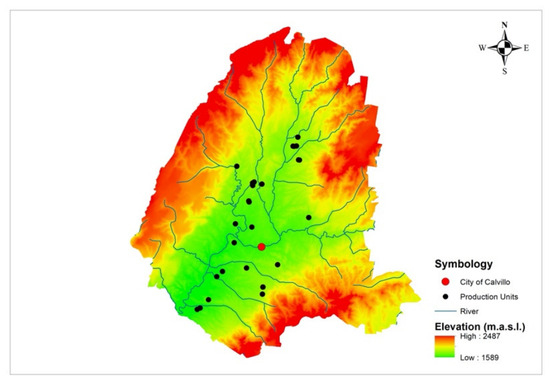
Guava was the most common crop in the municipality [20,37]. However, the sample included 32 producers with different crops (peach, guava, prickly pear cactus, pasture, and tomato) who implemented changes in the organizational and productive structure of their farms (Figure 2). The results obtained in this study show that, on average, the agricultural producers in the municipality of Calvillo who adopted the new crop (Citrus limon) have dedicated more than half their lives to agricultural activities. Of the producers interviewed, production units were evaluated (60 hectares), which represents 25% of the harvested area of lemon, according to the records of the 2022 Agricultural Census [19].
Figure 2.
Identification of the altitude of the production zone [38].
The integration of new crops contributes to the economic stability of farms and, in some cases, to mitigating the ecological damage caused by the exploitation of natural resources. This is comparable to what has been done in other agricultural contexts, where agricultural land is defined as land not intended for cereal production, which often ends up abandoned or overgrown with high-input cash crops [39].
It was observed that 44% of producers stated that “testing the new crop” was the main reason for changing their traditional crops. Another reason for the change was “the low profitability” of the previous crop, with 38% of farmers who underwent agricultural reconversion arguing that it was to improve their income.
This aligns with the findings of several authors [9,10], who point out that various economic factors are crucial for the competitive success of agricultural units. However, existing needs and/or opportunities created by government agencies have led them to experiment with alternative crops that share similar management practices and offer the potential to explore new and better markets. This is consistent with the 2017–2030 government plan to expand biodiversity, improve soil productivity, and support the functions and services of Mexican ecosystems [40].
Similarities were also found with the findings of [41], who identified three organizational styles for establishing and operating agricultural production activities: (1) those based on market dependence and low levels of technological production; (2) those with greater investment in infrastructure that manage to place their production in nearby markets; and (3) those with greater reach, as they have the commercial impact to distribute their products in local and regional markets. Other factors mentioned by producers for implementing change were related to water demand, infrastructure difficulties, limited market access, and government support (Table 1).
Table 1.
Characteristics of production units.
Economic, social, cultural, and environmental factors are key elements identified for assessing the openness to new production practices in companies and organizations [42]. Similarly, this study demonstrates the importance of economic, social, cultural, and environmental factors for the implementation of new crops, primarily with the aim of envisioning a positive future through the organizational and productive reconfiguration of agricultural units in the state of Aguascalientes. Furthermore, it has been suggested [43] that changes in agricultural production structures can be influenced by factors external to the cultivation activities themselves, such as urban growth, competition for land use, or the intensification of industrial processes in areas near population centers.
With the intention of exploring agricultural production reconversion more broadly, data were analyzed for the integration of clusters that could help define producer profiles with similar characteristics to carry out the productive reconfiguration of their plots.
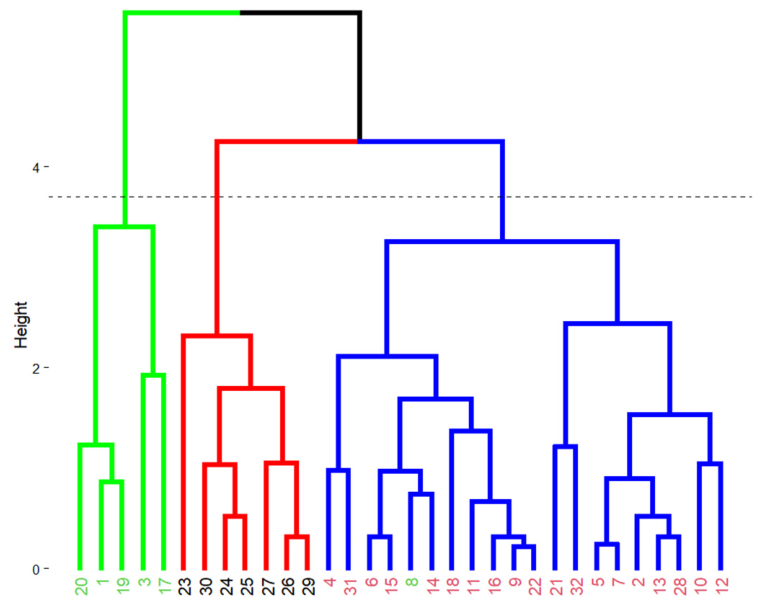
To determine the number of clusters, fviz_dend and fviz_nbclust from the factoextra package were used to generate the dendrogram, the scree plot and, the Silhouette coefficient plot.
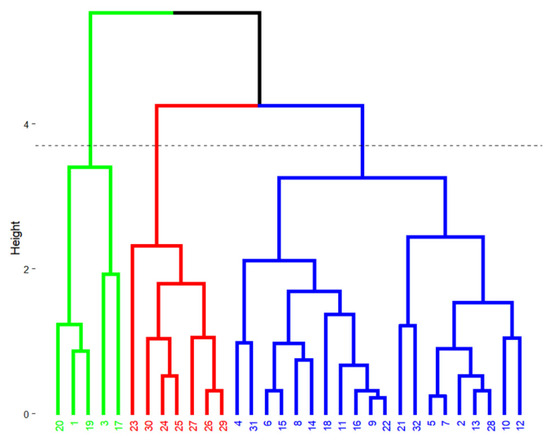
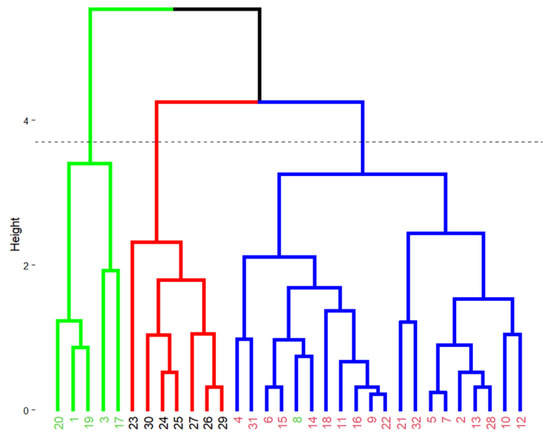
In the dendrogram (Figure 3), the vertical lines represent the clusters that have merged. At the base are the producers; as you move up the structure, pairs of producers merge, forming branches. By drawing a dashed line at y = 3.7, three large branches or cluster are identified by the colors green, red and blue.
Figure 3.
A dendrogram, representing the hierarchical conglomeration of producers.
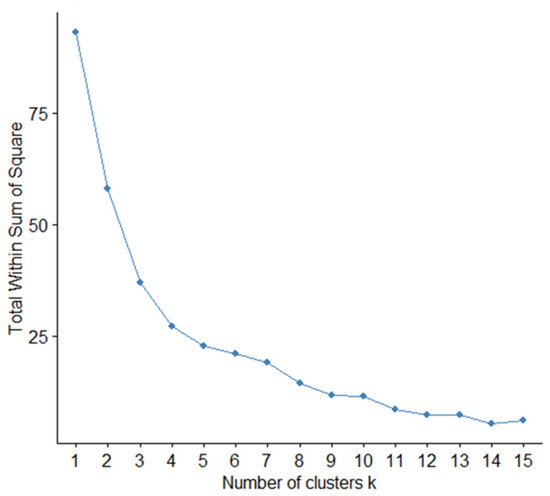
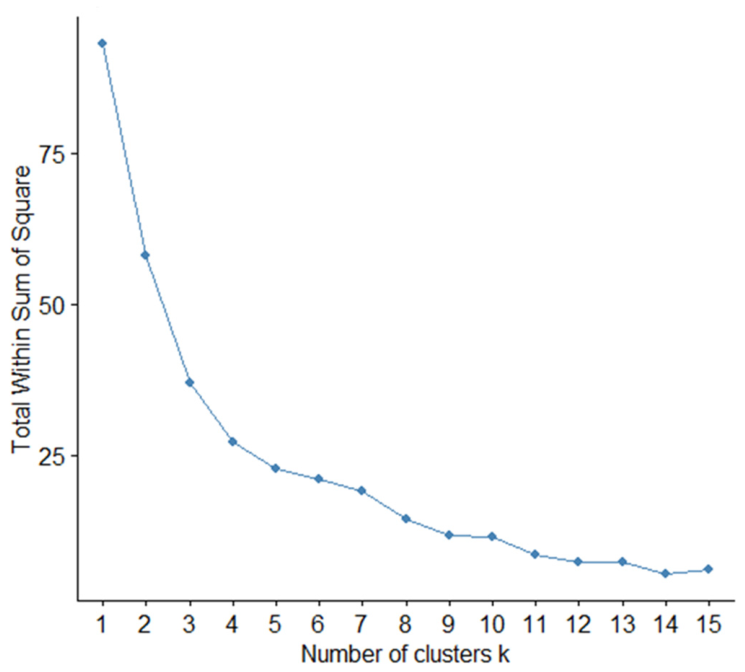
The scree plot (Figure 4) is based on the elbow method, which uses the ratio between the total within-group variance and the between-group variance. The plot identifies the number of clusters where the reduction in the total within-group variance appears to stabilize. In this case, this occurs when considering 3 or 4 clusters.
Figure 4.
Scree plot, showing the optimal number of clusters.
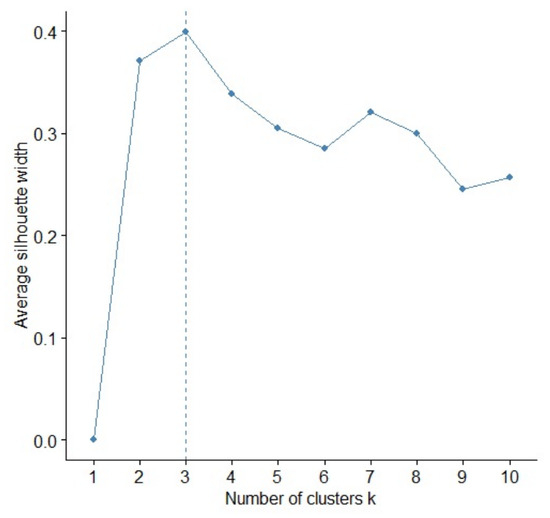
Another method for determining the optimal number of clusters is through the Silhouette coefficient, which measures the quality of a cluster [36]. The optimal number of clusters, k, is the one that maximizes the average Silhouette measure over a range of possible values for k. The following graph (Figure 5) shows that, according to this method, the optimal number of clusters is 3.
Figure 5.
Optimal number of clusters, determined using the Silhouette method.
As an exploratory phase, hierarchical cluster analysis helped to determine a priori the number of groups that naturally form the data. Once the number of groups (k) was defined in the previous step, the non-hierarchical k-means method was then applied.
In the previous analysis, the clusters were visually identified by applying a cut at a height of 3.7, as indicated by the dashed line. Comparison of the hierarchical and non-hierarchical clustering solutions reveals only one discrepancy: producer 8 is classified into the blue cluster by the hierarchical method, while it is assigned to the green cluster by the non-hierarchical method (Figure 6).
Figure 6.
A dendrogram, showing hierarchical and non-hierarchical conglomeration.
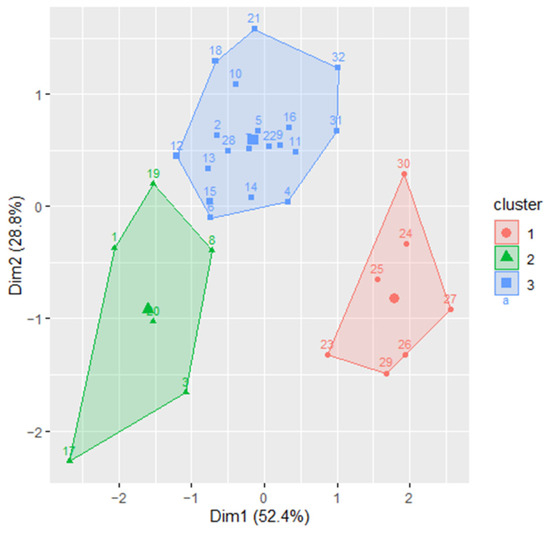
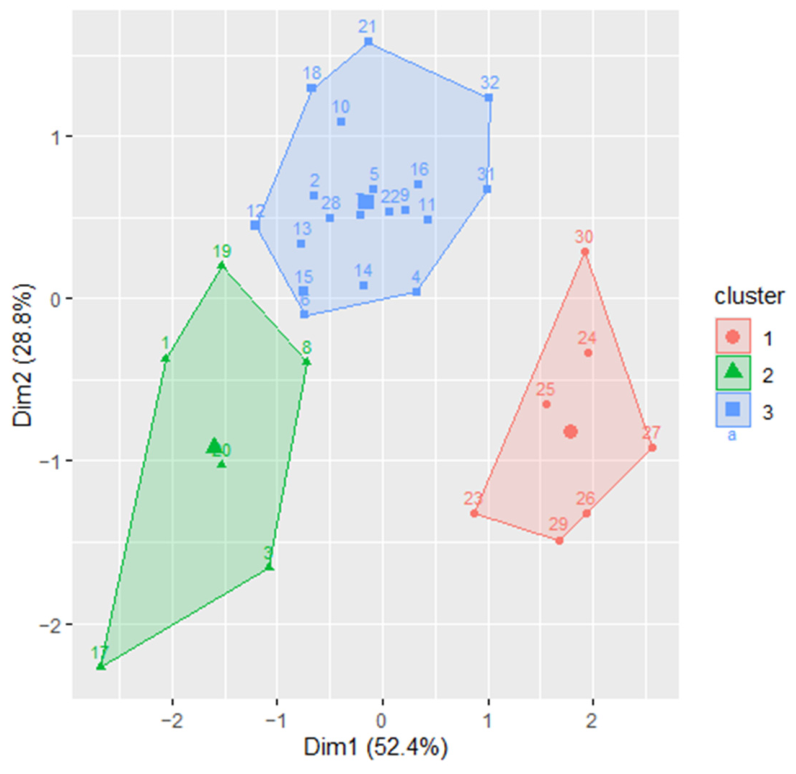
For the k-means method and using fviz_cluster from the factoextra package, an additional visual representation can be generated that highlights several important aspects of the data structure and the quality of the partitioning into three groups (Figure 7).
Figure 7.
Clusters of producers.
Cluster analysis identified three relatively distinct groups. The first dimension explained 52.4% of the variability, and the second 28.8%, together accounting for 81.2% of the data. The blue cluster exhibited the greatest internal heterogeneity, while the red cluster showed the greatest separation from the other groups, particularly regarding the first dimension. The minimal overlap between clusters suggests adequate discrimination among the classified individuals.
Thus, three groups or clusters of producers were identified, sharing similarities in the different areas of their organizations’ performance, as well as in technical, organizational, and productive constraints, and their perceptions of agricultural production reconversion (Figure 7).
In order to make comparisons between the groups for different variables of interest, only the assumptions of normality and homoscedasticity were verified, considering that, due to the way of collecting data, independence is met. For this purpose, the shapiro.test command was used to verify normality; bartlett.test and fligner.test were used to verify homoscedasticity depending on whether normality was met. This determines whether the tests to be verified were an ANOVA or a Kruskal–Wallis test, and their respective multiple comparisons (post hoc tests through Tukey Honest Significant Differences (HSD) or pairwise Mann–Whitney). The commands used were aov, TukeyHSD, kruskal.test, pairwise.wilcox.test.
Regarding the producers’ perceptions of the three areas for evaluating organizational and productive reconfiguration in agricultural units, it was found that “Group 1,” or the first cluster, had the highest positive perception in the economic sphere (E) and the lowest positive perception in the social sphere (S). “Group 2” of producers showed a greater influence on the perception of the environmental sphere (AC) for crop change, and finally, “Group 3” was identified as those production reconfiguration styles with the greatest strength in the social sphere (S).
As shown in Figure 2, agricultural production takes place in the low-lying areas of the municipality of Calvillo (“h” ≈ 1600 m), relying on the natural flow of available water resources as an essential resource for agricultural activity. This has been facilitated by the cultivation techniques used in the area [44]. The limited use of specialized machinery contributes to the conservation of soil physical properties, as well as the efficient use of available resources for sustainable agricultural production [45,46]. According to Murugan and Dhivya [47], farmers’ perceptions and attitudes toward water scarcity remain under-researched.
Some crops characterized by low profitability present a high risk of abandonment, leading farmers to seek alternatives. Arana-Coronado et al. [48] state that identifying crops with higher economic returns makes producers more willing to switch to alternative crops. In Mexico, significant shifts in production have been observed, driven by falling commodity prices [2].
The emergence of new market trends, such as organic products, presents an opportunity for economic growth for producers in Mexico, since there is great international demand, and the selling prices represent a higher income for farmers [49]. In various Latin American countries, policies and strategies supported by government actors have been created, which seek to provide, mainly, economic, financial and technical support for the success of production units, creating incentives for the change to productive reconversion [50] (Table 2).
Table 2.
Producer groups (quantitative variables).
For the analysis of dichotomous variables and their association with clusters, Fisher’s exact tests of independence were verified (fisher.test) (Table 3).
Table 3.
Producer groups (dichotomous variables).
Significant associations were found between the identified clusters and categorical variables analyzed. Specially, “low crop profitability” was associated with cluster membership at the 5% significance level, while “water origin” was associated with cluster membership at the 10% significance level, according to Fisher’s exact tests.
The sociodemographic variables of the participants provide information regarding behavior and decision-making. Nazario-Lezema et al. [51] found that the age of producers has a negative influence on the decision to reconvert production, arguing that older farmers tend to prefer more traditional forms of work and show greater resistance to change, in addition to the investment considerations in resources and finances that this may entail, and that their productive horizon is shorter.
In contrast, younger producers show a greater willingness and openness to take risks, provided this can lead to quick profitability, making them more likely to adopt approaches such as restructuring. In line with the above, this study found that the group with the lowest average age had a more positive perception of reorganizing their production units across all three areas evaluated (Economic, Social, Environmental Resources and Crop Management).
Production experience has an ambivalent effect, producers who have maintained stable conditions and possess extensive experience often lack motivation to make changes in their crops. On the other hand, those who have experienced uncertainty and crisis tend to show greater motivation to implement alternative strategies for improvement [51]. Additionally, Vilakazi et al. [52] highlight the interaction with other variables, such as public policies and resource availability, which can influence the final decision to change.
Changes in agricultural production patterns require technical support and government assistance, mainly through the provision of plants or seedlings, largely through social programs geared toward the sector, to mitigate the challenges faced by the most vulnerable producers (Figure 8). Similarly, in the second group identified through cluster analysis, characterized by their perception of the environmental context, farmers’ water use strategies are based on their access to water wells, leading to the efficient use of water resources due to the cost of long-term agroecosystem conservation. Farmers’ perceptions of water availability for their agricultural activities have become more important in recent years and are recognized as key factors for the development of adaptation strategies to change, such as productive reconversion.
Therefore, it is advisable that existing regulations ensure access to and redistribution of water resources among representative agricultural users. In this regard, Franco & Rodríguez [53] point to a significantly higher probability of success when institutional support exists. In addition to strategies fostered by public policies, the formation of productive organizations that focus on mutual cooperation, collective work, and the formulation of agreements for the benefit of all members significantly impacts the decision to explore productive reconversion [16].
Figure 8.
Evolution of land use in Calvillo, Aguascalientes [54,55,56].
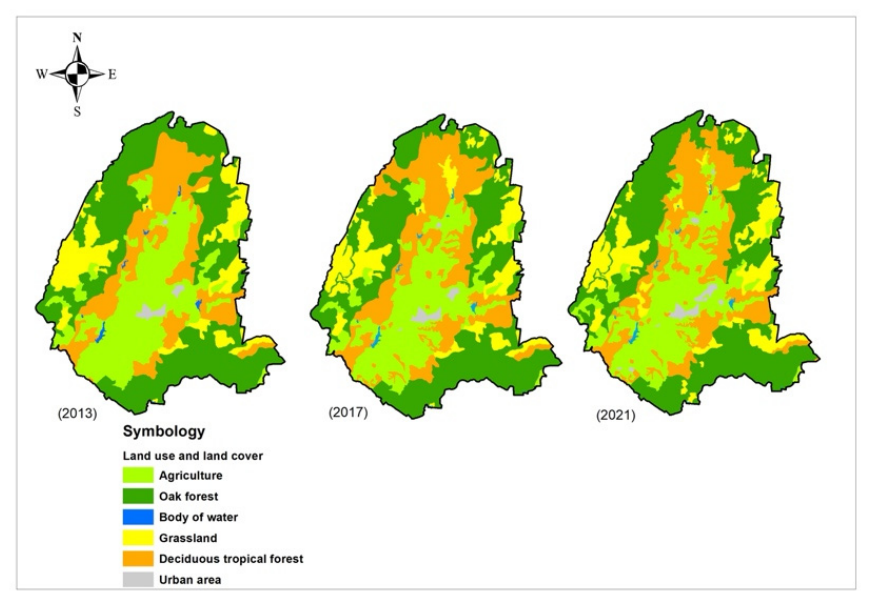
In recent years (2013–2021), the agricultural area of the municipality of Calvillo decreased by approximately 5% [54,55,56]. In the medium term, fruit production in the municipality is projected to be at risk of vulnerability due to climate change and the reconfiguration of land use. These challenges necessitate efficient production processes and/or the search for sustainable alternatives for agricultural plots [17,57]. In rural contexts, and due to existing limitations, many producers have adopted strategies that combine agricultural and non-agricultural activities. These strategies not only contribute to greater stability in family income but also allow for the accumulation of resources, which is directly linked to producers’ decision-making capacity regarding crop reconversion and diversification [58].
Efficiency in the management of available resources reinforces the notion that the reconversion of agricultural production is manifested through various organizational styles, according to Infante and Paz [40].
The environmental dimension, particularly the perception of water resource availability and management, is a key factor in decision-making and in evaluating the performance of new crops. According to Rodríguez-Robayo et al. [16] and Murugan and Dhivya [47], the results show that producers who perceive greater water use efficiency and improved agronomic management tend to value the productive reconversion more highly, strengthening their intention to change in the medium and long term. This finding is relevant in contexts of climate threats and water scarcity, where environmental sustainability becomes fundamental for the continuity of cultivation. As evidenced by this, small-scale, low-input agriculture must be addressed and designed according to the specific context of the main needs (i.e., profitability/environmental cost ratio, social participation).
Likewise, sociodemographic and organizational variables play a determining role in the intention to change. Age, production experience, and membership in organizations influence the perception and adoption of reconversion in different ways, which coincides with the findings of Nazario-Lezama et al. [51] and Vilakazi et al. [52]. Younger producers with a greater openness to risk have a more favorable perception of production reconfiguration, while those with longer track records tend to evaluate the change based on criteria of stability and security. However, accumulated experience also contributes to a greater capacity to manage the reconversion process when adequate technical and financial support is available.
Government support is identified as a factor influencing both the decision to convert to a new crop and its continued use. In agreement with Franco and Rodríguez [53] and Samaniego et al. [50], producers who received economic, technical, or institutional support exhibit a greater perception of the viability of the reconversion. These results underscore the importance of public support not only as an initial incentive but also as a mechanism for organizational strengthening and risk reduction throughout the entire production transformation process.
It would be important to consider implementing sustainable strategies in Mexico. These strategies should adopt key indicators to ensure the integration of financial and environmental aspects with the operational procedures of agricultural holdings [59]. Similarly, the incorporation of innovative, sustainable practices should be implemented by professionals who not only seek mass production but also prioritize the long-term viability of production units and the conservation of available natural resources [60].
This study identified groups of producers with an affinity for implementing crop diversification or productive reconversion on their farms. Environmental conditions, market pressures, and even the organizational structure of the production units influence the specific conditions of each producer’s production reconfiguration. The participation of different actors in the agricultural production chain is reorganized in a way that allows for the continuity of agricultural activities in the region. This ensures the continued viability of future generations through an agenda focused on reducing environmental damage caused by the overexploitation of available resources.
Aspects such as access to water, plant type, density per hectare, soil care, use of fertilizers and pesticides, agricultural techniques, mechanization of cultivation, availability of inputs and technical capacity are relevant aspects for the perception of the environment, as the results show, the future of reconversion from the regenerative field must be supported with government support, since they are the cluster with the least government coverage.
4. Conclusions
The results suggest that lemon cultivation is not an isolated decision, but rather the result of multiple productive reasons that reflect the capabilities and perceptions of agricultural producers.
It is important to highlight the sustainable framework of the producer groups analyzed. On the one hand, the cluster with a strong environmental focus represents agricultural units that promote the strategic use of natural resources within the ecosystem, encouraging the long-term use of ecosystem services. On the other hand, the group with a stronger social focus emphasizes the social viability of its community participation as an agricultural unit, which is crucial for continuing regenerative production as part of its agricultural activity.
The findings of this study suggest that agricultural production reconversion in Calvillo could be considered by some producers as a strategy for addressing various adverse economic, environmental, and territorial situations, while also representing an opportunity to reconfigure production units. The reorganization of producers, resources, and production practices favors the continuity of agricultural activity, addressing both economic and environmental sustainability.
5. Implications
5.1. Theoretical Implications
The results of this study contribute to strengthening the theoretical approach to agricultural production reconversion by analyzing it as an organizational process through different dimensions. The identification of producer clusters with differentiated profiles confirms that reconversion is not solely an economic matter, but rather the result of a relationship between perceptions, organizational capacities, and environmental constraints. The study expands the literature by showing that the perception of natural resource management, particularly water, not only influences the adoption of reconversion but also its consolidation and future projection, thus reinforcing the relationship between environmental sustainability and productive viability.
5.2. Managerial Implications
From a business perspective, the findings suggest that productive reconversion is a decision aimed at improving the economic resilience of agricultural units, provided it is accompanied by an appropriate strategic organizational reconfiguration. Therefore, it is essential that farmers engage in activities that add value to their agricultural products to enhance the effects of agricultural reconversion focused on high-return market niches with greater environmental performance.
5.3. Governmental Implications
In the area of public policy, the results show the need to design and implement support programs for agricultural production reconversion that are adapted to the diversity of contexts and production profiles existing in the country, particularly in the state. The findings suggest that reconversion policies should not be limited to short-term financial support but should instead focus on a comprehensive approach that includes technical assistance, organizational strengthening, and sustainable management of natural resources, particularly water. Furthermore, it is essential to create reconversion programs with strategies that promote environmental sustainability, the continued operation of farms, and the continuity of the sector, while addressing the challenges posed by climate change and the scarcity of production factors.
6. Limitations
The main limitation of this study was the small sample size and non-probability convenience sampling, which limits the generalizability of the results. Furthermore, there is no registry of active lemon growers. Consequently, the results cannot be generalized to all growers implementing conversion programs on their farms. However, the findings of this study highlight key elements for the analysis of agricultural production units seeking alternatives to strengthen their economic, social, and environmental opportunities.
Author Contributions
Conceptualization, C.E.R.B. and T.A.M.G.; methodology, M.d.C.M.L.; software, M.d.C.M.L.; validation, M.d.C.M.L.; formal analysis, M.d.C.M.L.; investigation, C.E.R.B., M.d.C.M.L. and T.A.M.G.; resources, C.E.R.B. and H.A.T.; data curation, M.d.C.M.L.; writing—original draft preparation, C.E.R.B., M.d.C.M.L., N.P.M. and H.A.C.P.; writing—review and editing, C.E.R.B., N.P.M. and H.A.C.P.; visualization, C.E.R.B. and N.P.M.; supervision, C.E.R.B. and T.A.M.G.; project administration, C.E.R.B. and T.A.M.G.; funding acquisition, C.E.R.B. All authors have read and agreed to the published version of the manuscript.
Funding
The APC was funded by the Autonomous University of Aguascalientes with grant number PIAL22-3.
Institutional Review Board Statement
The study was conducted in accordance with the Declaration of Helsinki, and the protocol was approved by the Ethics Committee of the Autonomous University of Aguascalientes (DI-PL-NO-522) on 20 June 2022.
Informed Consent Statement
Informed consent was obtained from all subjects involved in the study.
Data Availability Statement
The data are not publicly available due to privacy concerns regarding the data provided by the interviewed producers.
Acknowledgments
The authors would like to express their gratitude to the producers who participated in this study, as well as the associations and organizations of producers linked to productive programs in the state of Aguascalientes. Special thanks are extended to the State Agri-Food Council and the Autonomous University of Aguascalientes for their valuable support and contributions. Additionally, the authors wish to recognize the contribution of M.C. Jorge Alejandro Torres González for his expert technical assistance in the design and generation of the cartographic material and maps used in this study.
Conflicts of Interest
The authors declare no conflicts of interest.
References
- García Bernado, R.; Vértiz, P. Tendencias económicas y sociales recientes en la agricultura pampeana. Una crítica al enfoque de producción en red. Mundo Agrar. 2022, 22, e181. [Google Scholar] [CrossRef] [Scilit]
- Ortíz Caldera, H.; Montes Torres, M.L.; Jiménez González, A. La reconversión productiva: ¿Desarrollo o retroceso? Rev. Educ. 2016, 10, 13–25. [Google Scholar] [CrossRef] [Scilit]
- Molina Benavides, R.A.; Campos Gaona, R.; Stanislao Atzori, A.; Sánchez, L.F.; Sánchez Guerrero, H. Application of a system dynamics model to evaluate the implementation of payment for environmental services as a reconversion mechanism in high mountain farming. Ecol. Model. 2023, 484, 110469. [Google Scholar] [CrossRef] [Scilit]
- Olguín, P.; Kartzow, A.; Huenchuleo, C. Sustainability of Quinoa in Rainfed Agricultural Systems: A Case Study on the O’Higgins Region, Chile. Cienc. Investig. Agrar. 2019, 46, 197–207. [Google Scholar] [CrossRef] [Scilit]
- Cámara de Diputados del H. Congreso de la Unión. Ley de Desarrollo Rural Sustentable. Diario Oficial de la Federación. Available online: https://dof.gob.mx/nota_detalle.php?codigo=756874&fecha=07/12/2001#gsc.tab=0 (accessed on 10 June 2026).
- Nori, M.; Farinella, D. Restructuring of Agriculture and the Rural World in Mediterranean EU Countries. In Migration, Agriculture and Rural Development; IMISCOE Research Series; Springer: Cham, Switzerland; pp. 17–38. [CrossRef] [Scilit]
- Di Bene, C.; Gómez-López, M.D.; Francaviglia, R.; Farina, R.; Blasi, E.; Martínez-Granados, D.; Calatrava, J. Barriers and Opportunities for Sustainable Farming Practices and Crop Diversification Strategies in Mediterranean Cereal-Based Systems. Front. Environ. Sci. 2022, 10, 861225. [Google Scholar] [CrossRef] [Scilit]
- Hazra, C.R. Crop diversification in India. In Crop Diversification in the Asia-Pacific Region; Papademetriou, M.K., Dent, F.J., Eds.; Food and Agriculture Organization of the United Nations. Regional Office for Asia and the Pacific: Bangkok, Thailand; pp. 32–50.
- Kurlavičius, A.; Žukovskis, J.; Gozdowski, D.; Wójcik-Gront, E. Economic, social, and environmental factors impacting resilience and disturbances of Lithuanian family farms. Agriculture 2024, 14, 1088. [Google Scholar] [CrossRef] [Scilit]
- Ruiz-López, K.I.; Garrido de la Calleja, A. Transiciones productivas en el municipio de Coatepec, Veracruz (2003–2018). Quivera Rev. Estud. Territ. 2021, 23, 27–47. [Google Scholar]
- Kurniawan, T.; Khademi-Vidra, A. Transforming agricultural land into agrotourism area: Environmental, economic and socio-cultural perspectives. J. Infrastruct. Policy Dev. 2024, 8, 9251. [Google Scholar] [CrossRef] [Scilit]
- Nguyen, H.T.T.; Tran, V.T.; Bui, Q.T.; Man, Q.H.; de Vries, W.T. Socio-economic effects of agricultural land conversion for urban development: Case study of Hanoi, Vietnam. Land Use Policy 2016, 54, 583–592. [Google Scholar] [CrossRef] [Scilit]
- Rosli, M.N.; Mutalib, M.A.; Shamsuddin, A.S.; Lani, M.N.; Ariffin, I.A.; Tan, S.G.H. Navigating the environmental, economic and social impacts of sustainable agriculture and food systems: A review. Front. Agric. Sci. Eng. 2024, 11, 424–436. [Google Scholar] [CrossRef] [Scilit]
- Assan, J.K. Socio-cultural, economic, and environmental implications for innovation in sustainable food in Africa. Front. Sustain. Food Syst. 2023, 7, 1192422. [Google Scholar] [CrossRef] [Scilit]
- Markiewicz-Keszycka, M.; Macken-Walsh, Á.; Carter, A.; Mooney, S.; Devereux, E.J.; Henchion, M.; Hynds, P. Farmers’ Experiences of Transitioning Towards Agroecology: Narratives of Change in Western Europe. Agriculture 2025, 15, 625. [Google Scholar] [CrossRef] [Scilit]
- Rodríguez-Robayo, K.J.; Pulido-Blanco, V.C.; Martínez-Camelo, F.E.; Meneses-Buitrago, D.H. Restructuring the agricultural production in the Tota Lake Basin (Colombia). Trop. Subtrop. Agroecosystems 2024, 27, 072. [Google Scholar] [CrossRef] [Scilit]
- Piñeiro, V.; Arias, J.; Elverdin, P.; Ibáñez, A.M.; Kinengyere, A.; Morales, C.; Owoo, N.; Page, J.; Prager, S.; Torero, M. A scoping review on incentives for the adoption of agroecological practices. Nat. Sustain. 2020, 3, 809–820. [Google Scholar] [CrossRef] [Scilit]
- Ramos-Sandoval, I.N.; García-Salazar, J.A.; Borja-Bravo, M.; Guajardo-Hernández, L.G.; Almeraya-Quintero, S.X.; Arana-Coronado, Ó.A. El mercado de la guayaba en Aguascalientes: Un análisis para reducir la volatilidad de los precios. Rev. Mex. Cienc. Agríc. 2017, 8, 3755–3767. [Google Scholar] [CrossRef] [Scilit]
- INEGI. Instituto Nacional de Estadística y Geografía. Censo Agropecuario 2022. Resultados Definitivos. Available online: https://www.inegi.org.mx/programas/ca/2022/#datos_abiertos (accessed on 7 June 2026).
- Suárez-Toledo, J.R.; Hernández-Aguilar, C.; Domínguez-Pacheco, F.A.; Aceves-Hernandez, F.J. Caracterización de la guayaba cultivada en México. Rev. Mex. Cienc. Agríc. 2022, 13, 1233–1245. [Google Scholar] [CrossRef] [Scilit]
- Borja Bravo, M.; García Salazar, J.A.; Almeraya Quintero, X.; Cuevas Reyes, V. El gasolinazo y el sector agrícola: Un estudio de caso de los efectos sobre la competitividad de guayaba (Psidium guajava L.) en Aguascalientes. Acta Univ. 2019, 29, 1–13. [Google Scholar] [CrossRef] [Scilit]
- Gobierno de México. Blog Representación Agricultura Aguascalientes. Reconversión Productiva, una Opción Para Diversificar Cultivos. 26 July 2018. Available online: https://www.gob.mx/agricultura/aguascalientes/articulos/reconversion-productiva-un-opcion-para-diversificar-cultivos?idiom=es (accessed on 25 May 2026).
- INEGI. Marco geoestadístico. In Conjunto de Datos Geoespaciales; Formato electrónico; Instituto Nacional de Estadística y Geografía: Aguascalientes, Mexico, 2025; Available online: https://www.inegi.org.mx/app/biblioteca/ficha.html?upc=794551163061 (accessed on 3 February 2026).
- Calle Quintana, M.C. Analysis of Productive Reconversion to Increase Agricultural Competitiveness. Case of Organic Rice to Banana in the Chiclayochongoyape Axis in Lambayeque. Bachelor’s Thesis, Universidad Nacional de Piura, Piura, Peru, 2019. [Google Scholar]
- Linares-Bravo, B.C.; Zapata Martelo, E.; Nazar Beutelspacher, A.; Suárez San Román, B. Productive reconversion to oil palm in the Tulijá Valley, Chiapas, México. Differentiated impact by gender. Agric. Soc. Dev. 2019, 15, 545–571. [Google Scholar] [CrossRef] [Scilit]
- Porter, M.E. Competitive Advantage: Creating and Sustaining Superior Performance; Harvard Business Review: Brighton, MA, USA, 1985. [Google Scholar]
- Romero-Mora, M.M.; Meza-Picado, V.H.; Barrantes-Rodríguez, A.; De Camino-Velozo, R. Factors that influence producer behavior to adopt a productive system in subsistence farms, Costa Rica. Rev. Cienc. Ambient. 2024, 58, 1–28. [Google Scholar] [CrossRef] [Scilit]
- Londoño, F.; Guerrero, G.; Flórez, A. Bases Conceptuales, Metodológicas y Lineamientoes de la Reconversión Productiva Agropecuaria; UPRA: Bogotá, Colombia, 2021.
- Brígido Morales, R. Social and Economic Dilemmas of Productive Reconversion: The Case of the Apple in Ixtacamaxtitlán. Master’s Thesis, Colegio de Postgraduados, Puebla, Mexico, 2020. [Google Scholar]
- Rivera, N.A. Methodological strategies for the analysis of the reconversion and productive diversification of sugarcane regions. Cuad. Geográficos 2017, 56, 172–192. Available online: https://revistaseug.ugr.es/index.php/cuadgeo/article/view/3936 (accessed on 15 June 2026).
- R Core Team. R: A Language and Environment for Statistical Computing_, version 4.5.2; R Foundation for Statistical Computing: Vienna, Austria, 2026. Available online: https://www.R-project.org/ (accessed on 5 May 2026).
- Huth, J.; DeLorme, D.E.; Reid, L.N. Perceived third-person effects and consumer attitudes on preventing and banning DTC advertising. J. Consum. Aff. 2006, 40, 90–116. [Google Scholar] [CrossRef] [Scilit]
- Loewenthal, K.M. An Introduction to Psychological Test and Scales; UCL Press: London, UK, 1996. [Google Scholar]
- Kassambara, A. Practical Guide to Cluster Analysis in R: Unsupervised Machine Learning, 1st ed.; STHDA: Montpellier, France, 2017; Volume 1, Available online: https://xsliulab.github.io/Workshop/2021/week10/r-cluster-book.pdf (accessed on 15 June 2026).
- Malhotra, N.K. Investigación de Mercados, 2nd ed.; Prentice Hall Hispanoamericana: Naucalpan de Juárez, Mexico, 1997; pp. 250–265. [Google Scholar]
- Kaufman, L.; Rousseeuw, P.J. Finding Groups in Data: An Introduction to Cluster Analysis; John Wiley & Sons: Hoboken, NJ, USA, 2009; pp. 1–32. [Google Scholar]
- Abarca, O.R.; Martínez, J.H.; Elías, M.G. Análisis económico de la guayaba en Calvillo, Aguascalientes, México. Rev. Mex. Agronegocios 2022, 51, 267–276. [Google Scholar]
- INEGI. Relieve continental y territorial insular de los Estados Unidos Mexicanos. In Conjunto de Datos Geoespaciales; Formato Electrónico; Instituto Nacional de Estadística y Geografía: Aguascalientes, Mexico, 2025; Available online: https://www.inegi.org.mx/temas/relieve/continental/ (accessed on 15 June 2026).
- Wang, Y.; Zhang, Y.; Yang, H.; Niu, J.; Chen, X. Effects of Payments for Ecosystem Services and Livelihoods on Non-Grain Agricultural Land Use. Forests 2024, 15, 521. [Google Scholar] [CrossRef] [Scilit]
- Santini, N.S.; Cuervo-Robayo, A.P.; Adame, M.F. Agricultural Land Degradation in Mexico. In Impact of Agriculture on Soil Degradation I: Perspectives from Africa, Asia, America and Oceania; Pereira, P., Muñoz-Rojas, M., Bogunovic, I., Zhao, W., Eds.; Springer: Cham, Switzerland, 2023; pp. 301–323. [Google Scholar] [CrossRef] [Scilit]
- Infante, C.M.; Paz, R.G. Estilos agrícolas como prácticas vitales para la construcción de circuitos agroalimentarios alternativos en el contexto de la modernización. Mundo Agrar. 2023, 24, e204. [Google Scholar] [CrossRef] [Scilit]
- Hill, R.; Vortkamp, M.; Hilker, F.M. Farmers’ land-use decision-making: A dynamical modelling approach that integrates qualitative knowledge about social norms into a quantitative model. People Nat. 2023, 5, 980–993. [Google Scholar]
- Zhang, Z.; Ghazali, S.; Miceikiené, A.; Zejak, D.; Choobchian, S.; Pietrzykowski, M.; Azadi, H. Socio-economic impacts of agricultural land conversion: A meta-analysis. Land Use Policy 2023, 132, 106831. [Google Scholar] [CrossRef] [Scilit]
- Borja Bravo, M.; Vélez Izquierdo, A.; Ramos González, J.L. Tipología y diferenciación de productores de guayaba (Psidium guajava L.) en Calvillo, Aguascalientes, México. Región Soc. 2018, 30. [Google Scholar] [CrossRef] [Scilit]
- Kar, S.K.; Patra, S.; Singh, R.M.; Sankar, M.; Kumar, S.; Singh, D.; Madhu, M.; Singla, S. Impact of land use reformation on soil hydraulic properties and recovery potential of conservation tillage in India’s North-West Himalayan region. Ecohydrol. Hydrobiol. 2023, 23, 290–303. [Google Scholar] [CrossRef] [Scilit]
- Kar, S.K.; Singh, R.M.; Patra, S.; Singh, R.J.; Sankar, M.; Samal, S.K.; Singh, G.; Devarajan, R. Rebuilding soil hydrological functioning by adopting conservation agriculture in the degraded lands of India’s North-West Himalayan region. CATENA 2026, 262, 109671. [Google Scholar] [CrossRef] [Scilit]
- Murugan, P.P.; Dhivya, C. Farmer perceptions and adaptation strategies to water scarcity in agriculture: A bibliometric analysis. Int. J. Adv. Biochem. Res. 2025, 9, 22–28. [Google Scholar] [CrossRef] [Scilit]
- Arana-Coronado, J.J.; Hernández-Ruíz, E.; García-Sánchez, R.C.; Mondragón-Hernández, R. Real options and productive reconversion by low-income producers: The case of hibiscus in Guerrero, Mexico. Agrociencia 2024, 58, 145–167. [Google Scholar] [CrossRef] [Scilit]
- Villafán-Vidales, K.B.; Ortiz-Paniagua, C.F.; Infante-Jiménez, Z.T. Mercado internacional de alimentos y reconversión productiva: El caso del aguacate orgánico michoacano. Inceptum 2007, 2, 129–153. [Google Scholar] [CrossRef] [Scilit]
- Samaniego, J.L.; Martínez, E.; Galarza, E.; Rodríguez, A. Incentivos a la Inversión y Transformación Productiva Sostenible en América Latina; Documento de trabajo N.° 4; Comisión Económica para América Latina y el Caribe (CEPAL): Santiago, Chile, 2022. [Google Scholar]
- Nazario-Lezama, N.; Estrella-Garcia, A.; Ramírez-Martínez, A.; Sánchez-Hernández, S.; Osorio-Acosta, F. Factores que inciden en la reconversión productiva de Coffea arabica A Citrus latifolia en Tlaltetela, Veracruz, México. Trop. Subtrop. Agroecosystems 2025, 28, 63. [Google Scholar] [CrossRef] [Scilit]
- Vilakazi, B.; Odindo, A.O.; Phophi, M.M.; Mafongoya, P.L. Socioeconomic Factors Influencing Crop Diversification Among Smallholder Farmers in Bergville, South Africa. Agriculture 2025, 15, 914. [Google Scholar] [CrossRef] [Scilit]
- Franco-Martínez, J.A.; Rodríguez-Entrena, M. Adopción y difusión de la agricultura ecológica en España. Factores de reconversión en el olivar andaluz. Cuad. Econ. 2009, 32, 137–158. [Google Scholar] [CrossRef] [Scilit]
- INEGI. Conjunto de Datos Vectoriales de Uso del Suelo y Vegetación, Escala 1:250,000, Serie V (Conjunto Nacional); Instituto Nacional de Estadística y Geografía: Aguascalientes, Mexico, 2013; Available online: https://www.inegi.org.mx/contenidos/temas/mapas/usosuelo/metadatos/guia_interusosuelov.pdf (accessed on 15 May 2026).
- INEGI. Conjunto de Datos Vectoriales de Uso del Suelo y Vegetación, Escala 1:250,000, Serie VI (Conjunto Nacional); Instituto Nacional de Estadística y Geografía: Aguascalientes, Mexico, 2017; Available online: https://www.inegi.org.mx/app/biblioteca/ficha.html?upc=889463173359 (accessed on 15 May 2026).
- INEGI. Conjunto de Datos Vectoriales de Uso del Suelo y Vegetación, Escala 1:250,000, Serie VII (Conjunto Nacional); Instituto Nacional de Estadística y Geografía: Aguascalientes, Mexico, 2022; Available online: https://www.inegi.org.mx/contenidos/productos/prod_serv/contenidos/espanol/bvinegi/productos/nueva_estruc/889463902836.pdf (accessed on 15 May 2026).
- Romo-Bacco, C.E.; Parga-Montoya, N.; Montoya-Landeros, M.d.C.; Cortés-Palacios, H.A.; García-Vidales, M.Y. Analysis of the Establishment, Development and Future of Agricultural Reconversion. J. Hum. Earth Future 2024, 5, 543–559. [Google Scholar] [CrossRef] [Scilit]
- Custodio-González, C.A. Productive reconfiguration, reproduction strategies and social capital in rural spaces: An exploratory analysis in the northwest of the State of Mexico. Cuad. Desarro. Rural 2020, 17. [Google Scholar] [CrossRef] [Scilit]
- Honcharuk, I.; Chikov, I.; Okhota, Y.; Biletska, N. Strategic Management and ESG Impact Assessment in Sustainable Agribusiness Development Model. Econ. Ecol. Socium 2025, 9, 109–128. [Google Scholar] [CrossRef] [Scilit]
- Boincean, B.; Pacurariu, R.L.; Rhazzali, A.L.; Cebanu, D. Circular Economy and Sustainable Practices in Regenerative Agricultural Productivity. Econ. Ecol. Socium 2025, 9, 1–19. [Google Scholar] [CrossRef] [Scilit]

Disclaimer/Publisher’s Note: The statements, opinions and data contained in all publications are solely those of the individual author(s) and contributor(s) and not of MDPI and/or the editor(s). MDPI and/or the editor(s) disclaim responsibility for any injury to people or property resulting from any ideas, methods, instructions or products referred to in the content. |
© 2026 by the authors. Licensee MDPI, Basel, Switzerland. This article is an open access article distributed under the terms and conditions of the Creative Commons Attribution (CC BY) license.