


Abstract
This study critically addresses the challenge of selecting optimal insulation materials for contemporary, energy-efficient building envelopes, a decision with profound environmental, structural, and occupational health consequences. The paper responds to the growing demand for sustainable, resilient solutions by comparing wool, a bio-based, regenerative material, and expanded polystyrene (EPS), a synthetic polymer widely implemented in the construction industry, and advanced laboratory testing (thermal conductivity, moisture buffering, freeze–thaw resistance) is discussed in a comprehensive synthesis of the recent literature. Also, field evaluations from European retrofits and pilot projects (UK, Denmark, Finland, Iceland, Norway, Sweden, Germany and France) further contextualize performance outcomes, and life cycle impacts are considered. Recent results reveal that wool insulation achieves a moisture buffering value (MBV) between 1.8 and 2.7 (g/m2) % RH, minimal vapor resistance (mvr = 1–2), and preserves functional and structural integrity through more than 100 freeze–thaw cycles, leading to significant stabilization of the interior microclimate and enhanced durability. In contrast, EPS delivers lower thermal conductivity (0.032–0.037 (W/mK), critical for reducing heating/cooling demand, but exhibits limited vapor permeability (lvp = 60–150 MN·s/(g·m)), increased risk of condensation and mold, and reduced compressive strength (<22% after 30 cycles), especially when ventilation details are inadequate. Hybrid envelope systems leveraging both EPS and wool are demonstrated to optimize energy efficiency (up to 23% seasonal savings) and reduce interior humidity fluctuations, while lifecycle and recycling assessments show wool panels to be markedly superior in carbon footprint reduction and circularity. The stratification of insulation layers incorporating wool for vapor and moisture control, and EPS for pure thermal resistance is emerging as best practice in sustainable retrofit and new-build projects. Recommendations highlight the necessity for rigorous laboratory validation, international standards alignment, and integrated material design for robust hygrothermal comfort and environmental performance. The review also covers wool- and EPS-based hybrid composites, showing how natural fibers can improve key mechanical properties without compromising thermal insulation performance or environmental benefits.
1. Introduction
The construction sector is currently the main contributor to environmental degradation through its intensive consumption of non-renewable resources and generation of solid waste [1]. In this context, this work aims to provide a critical analysis of the existing literature, covering the main aspects of the theoretical foundations, analytical methodologies, and Life Cycle Assessment (LCA) of sheep wool and expanded polystyrene in construction.
Global statistics are alarming: this sector is responsible for approximately 50% of carbon dioxide emissions, 50% of total solid waste production, and up to 50% of global energy and natural resource consumption, as highlighted by Parlato et al. [1] and corroborated by Ali et al., 2024 [2].
In this context, energy conservation in buildings has become one of the most critical priorities today because, despite global efforts to develop renewable sources, electricity generation remains 70% dependent on fossil fuels (coal, natural gas, oil), which are the largest contributors to carbon emissions [3]. In 2016, it was estimated that 39.5% of global energy was used solely for heating and cooling indoor spaces [3], while in the European Union, buildings account for 40% of final energy consumption and 36% of greenhouse gas emissions [4].
To counteract these effects, the European Commission has formulated ambitious strategies such as the European Green Deal, aiming to achieve net-zero emissions by 2050, a process that involves decoupling economic growth from the use of natural resources [5]. The implementation of Directive 2010/31/EU on the energy performance of buildings (EPBD) introduced the concept of “nearly zero-energy buildings” (NZEB), a complex theoretical model that requires the use of high-efficiency materials and advanced technical systems to minimize energy requirements [6].
The Construction Products Regulation (CPR) No. 305/2011 introduced sustainability as a basic requirement, stipulating that works must be designed to ensure the sustainable use of natural resources through recycling and the use of environmentally friendly secondary raw materials [5]. Currently, it is estimated that 75% of the EU’s building stock is energy inefficient, highlighting the urgent need for insulation solutions that reduce economic and environmental impacts [7].
Insulating the exterior envelope is recognized as a key step toward ensuring a structure’s energy efficiency, representing the most sustainable option for reducing heat loss, pollution, and emissions [8]. Proper insulation can reduce fuel consumption by 25% to 50% [9].
The current market is dominated by inorganic fibrous materials (glass wool, basalt wool) and organic petrochemical foams, particularly expanded polystyrene (EPS) and extruded polystyrene (XPS), which hold a significant market share due to their consistent physicochemical properties and low cost [2,8]. However, traditional materials face limitations, including toxicity, a high carbon footprint, and difficulties with recycling. Thus, research is focusing on the use of local natural resources and waste, such as sheep’s wool, cotton, hemp, or coconut fibers, to create insulators with minimal impact on health and the environment [10].
Sheep’s wool is not a new material in construction, but with the development of sustainable management practices, it has begun to gain priority due to its annual renewal [11]. In Romania, sheep farming is a widespread traditional activity, with the country ranking third in Europe in terms of sheep numbers, with approximately 10 million head, making wool an abundant resource [11].
Since approximately 95% of the wool produced is considered waste unsuitable for the fine textile industry, its transformation into building materials represents a circular-economy opportunity that can replace hydrocarbon-based products [11,12]. Evaluating these materials through LCA and multi-criteria decision-making (MCDM) methods is essential to demonstrate their ecological superiority over conventional synthetic insulators [13].
Accordingly, this review has four main objectives: (i) to synthesize current knowledge on the physical–chemical and microstructural characteristics of sheep wool and EPS used as building insulation; (ii) to compare their hygrothermal and acoustic performance under realistic operating conditions; (iii) to assess their environmental performance through Life Cycle Assessment and multi-criteria decision-making frameworks; and (iv) to examine recent developments in hybrid composites and material reinforcement, where wool fibers and other natural wastes are incorporated into mineral and polymer matrices to enhance mechanical performance while maintaining high thermal efficiency.
2. Physical-Chemical and Microstructural Characterization
2.1. Sheep Wool
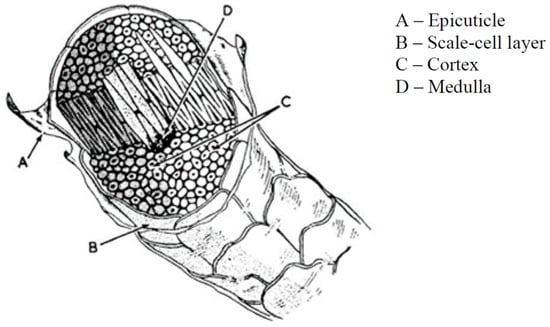
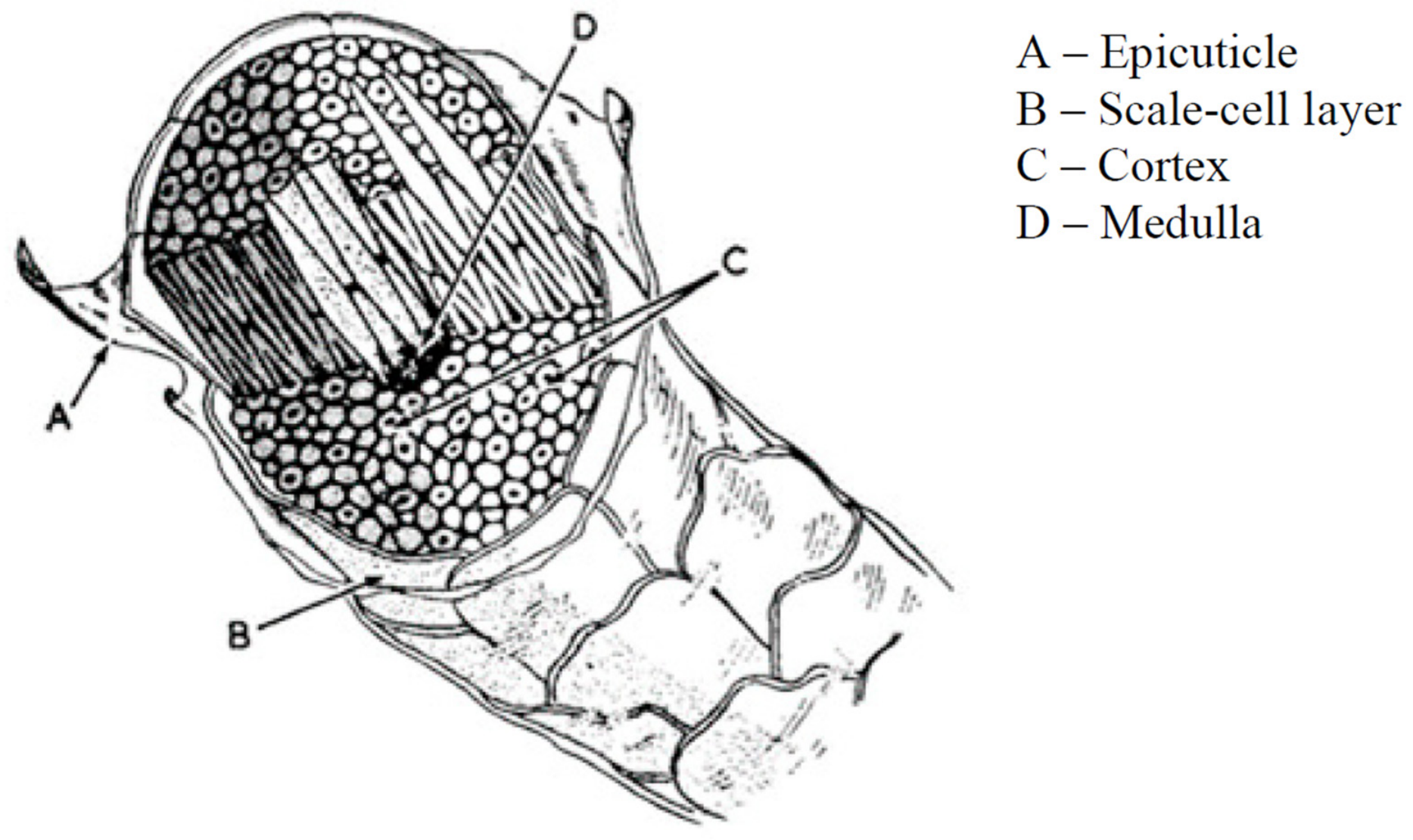
Sheep wool is a natural protein fiber with a highly complex microscopic architecture, optimized for thermal insulation by trapping air in its porous structure. The morphology of wool fiber consists of four distinct regions: the epicuticle (thin outer layer), the layer of scaly cells (cuticle), the cortex (the main part of the fiber), and the medulla (the central canal), as shown in Figure 1 [11]. This tubular structure is responsible for the low density and high air storage capacity.
Figure 1.
Structure of wool fiber. Reprinted with permission from ref. [11].
Chemically, wool consists predominantly of keratin (approx. 60%), an animal protein rich in amino acids. Elemental analysis by energy-dispersive spectroscopy (EDX) reveals a composition dominated by carbon and nitrogen, the latter being essential for the material’s natural fire resistance [9]. Table 1 presents the elemental composition of the sheep wool fiber.
Table 1.
Elemental composition of sheep wool fiber [9].
A remarkable biochemical property highlighted by Dénes et al. is the presence of active functional groups, such as amides. These not only attract water molecules, thereby facilitating humidity regulation through hysteresis, but also facilitate air purification through chemisorption, neutralizing pollutants such as formaldehyde [11].
Air purification is a passive and continuous process that lasts for the entire life of the material (80–100 years). Replacement or cleaning is not necessary, since the neutralization of pollutants by chemisorption is permanent, and the material has a hygrothermal stability superior to conventional insulators, not being affected by the accumulation of harmful substances in the form of residues that would require evacuation [14].
2.2. Polystyrene (EPS/XPS)
Unlike the fibrous structure of wool, polystyrene is a synthetic petrochemical polymer whose efficiency depends strictly on the geometry of the air cells. The main types of polystyrene used in construction for insulation purposes are expanded polystyrene (EPS) and extruded polystyrene (XPS). The thermal efficiency of polystyrene depends strictly on the geometry of the cells because this determines the immobilization of air (eliminating convection) and the attenuation of infrared radiation through the cell wall. This statement emphasizes the fact that, unlike the fibrous structure of wool that allows active hygrothermal regulation by adsorption/desorption, polystyrene functions as a passive barrier whose performance is dictated by the size and tightness of the micro-pores. Any degradation of this geometry (through aging, gas diffusion or compression) directly and irreversibly affects its insulation capacity.
EPS consists of hydrophobic polystyrene granules welded together. However, there are interstices (empty spaces) between these granules that allow air and water to infiltrate (water absorption is 2–3%), which can degrade thermal performance over time [11,14].
On the other hand, XPS has a much denser and more uniform closed-cell structure, offering superior compressive strength and a much more effective barrier against water vapor diffusion [15]. Table 2 presents a comparison of the main physical and chemical properties of wool, EPS, and XPS.
Table 2.
Comparative physical, chemical and mechanical properties: wool vs. polystyrene (Synthesis based on [15,16]).
2.3. Microstructural Analysis of Wool-Polymer Hybrid Composites
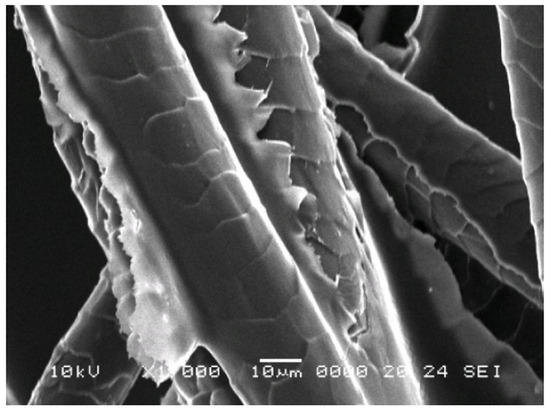
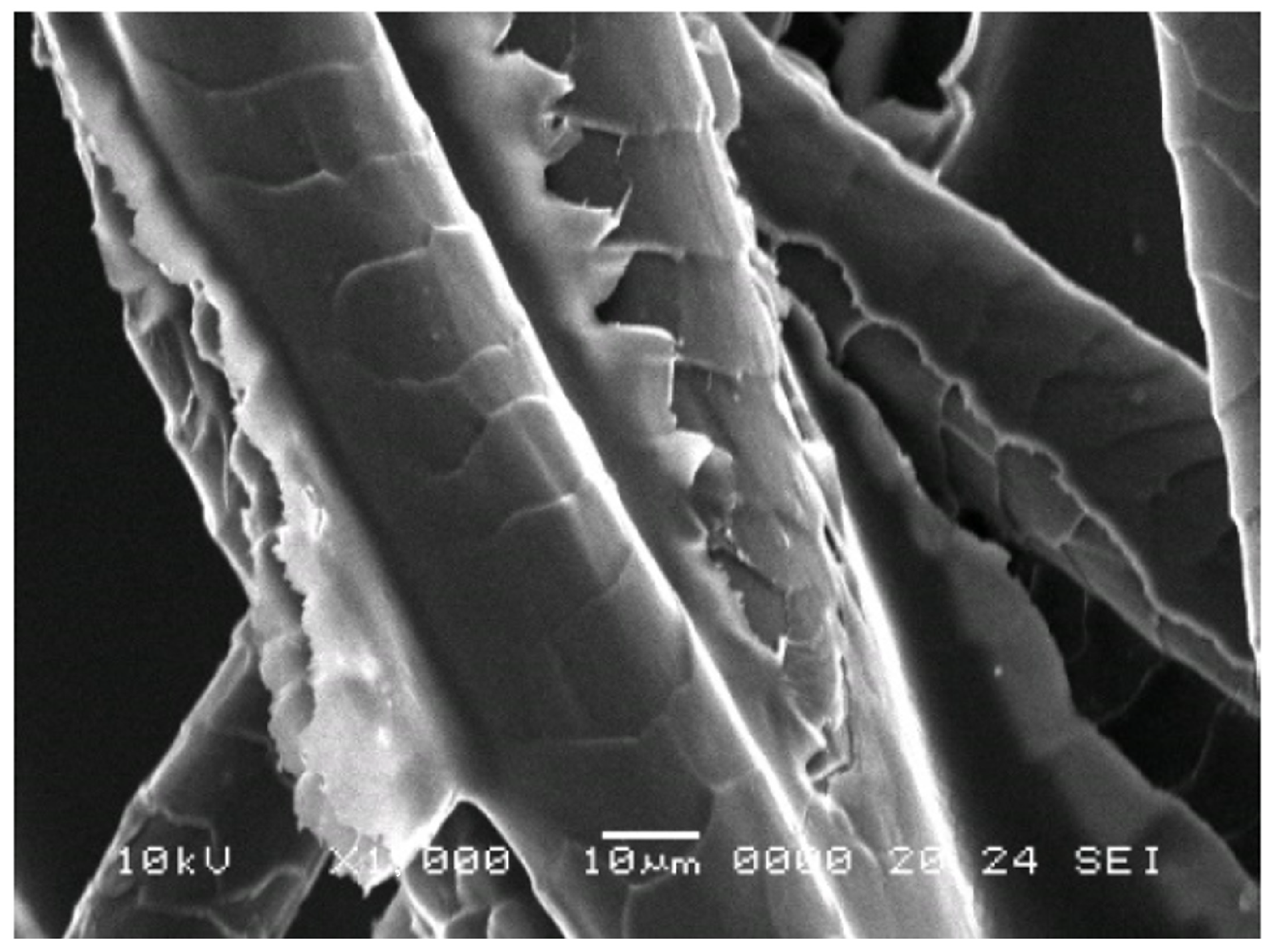
Innovation in this field focuses on creating hybrid panels that combine wool fibers with various polymer binders to improve mechanical stability. Advanced research published by Dénes et al. [9] used scanning electron microscopy (SEM) to observe the interface between fibers and binders (such as natural latex or acrylic-polyurethane resin) as shown in Figure 2. SEM images at ×1000 magnification revealed a homogeneous dispersion of the binder on the fiber surface, confirming that spray application methods are effective. However, at higher magnifications, binder exfoliation from the wool fiber and areas where fibers were only partially covered was observed, indicating the need to optimize the ratio of natural to synthetic components to maximize adhesion (Table 3) [9].
Figure 2.
Wool–resin composite (1:2) at ×1000 magnification. Adapted with permission from ref. [9].
Table 3.
Characteristics of binders used in wool hybridization [9].
This detailed characterization demonstrates that, while polystyrene provides a stable, predictable cellular structure, sheep’s wool offers greater chemical complexity, providing functional benefits (air purification, humidity regulation) that pure synthetic materials cannot replicate.
3. Thermal Performance Under Variable Conditions
The thermal performance of insulating materials is not a static parameter but a dynamic one, governed by temperature fluctuations, humidity levels, and structural aging. Under variable conditions, thermal conductivity (λ) undergoes significant changes that can lead to an underestimation of energy consumption in traditional simulations using constant values. Specifically, defining accurate dynamic boundary conditions [17] (;) and using standardized approaches (e.g., EN ISO 15026) is essential to provide practical guidelines on the hygrothermal performance of insulated walls [18].
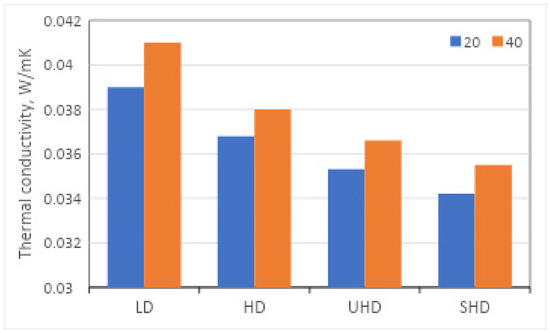
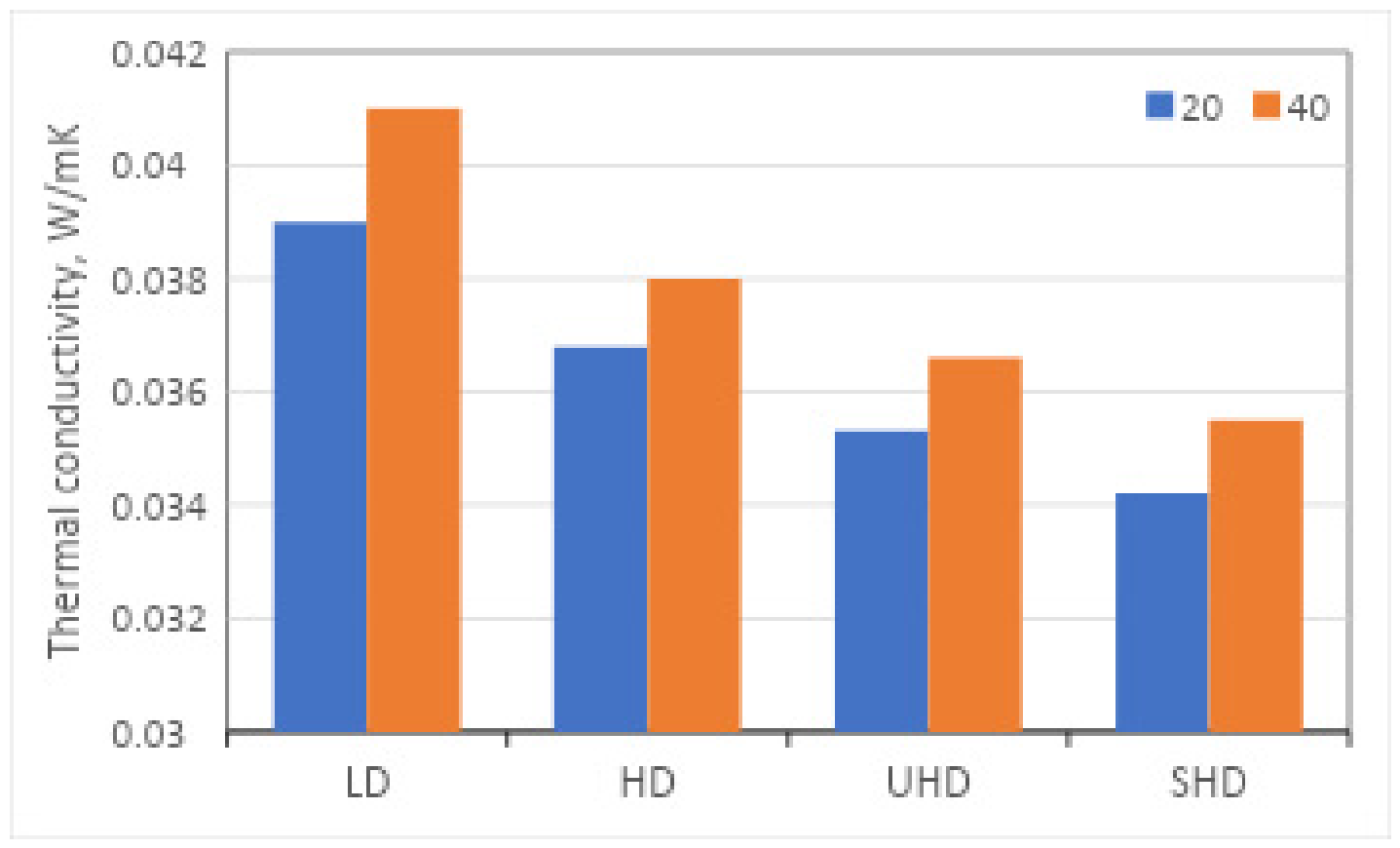
Fundamental research conducted by Khoukhi et al. [19] demonstrates that λ increases linearly with the average operating temperature for all polystyrene densities. This variation is essential in hot climates, where the temperature at the center of the insulation layer can exceed standard laboratory thresholds (24 °C). The main results from [19] are summarized in Table 4 and Figure 3, where it can be observed that the linear equations modeling λ as a function of temperature exhibit a high determination coefficient.
Table 4.
Regression equations for thermal conductivity (λ) as a function of temperature (T) at different polystyrene densities [19].
Figure 3.
Thermal conductivity and density dependence at two values of temperature (based on data reported for polystyrene insulation in ref. [19]).
For sheep wool, similar behavior is observed, but it is heavily influenced by its high porosity [6]. The sensitivity of wool to temperature decreases as density increases (in the range of 20–40 kg/m3), because air flow within the porous structure is restricted. The conductivity values reported by Parlato et al. range from 0.0318 to 0.054 W/mK, with performance comparable to that of polystyrene [1]. However, wool has a different thermal sensitivity because its fibrous structure traps air in the medulla (central channel), reducing internal convection. As reported in the literature, the maximum density of sheep wool is ranged between 18 and 27 kg m−3, in dependence to its hygroscopicity. Thermal conductivity coefficient varies in the range of 0.034–0.067 W m−1 K−1. The highest reported value for wool hygroscopicity is 0.35 kg water/kg dry material [1]. Similar values are also reported in DIN 52615—1987-11 standard: Testing of thermal insulating materials; determination of water vapor (moisture) permeability of construction and insulating materials.
The variation in the correlation equations at three operating temperatures is presented in Table 5.
Table 5.
Variation for sheep wool as a function of bulk density (ρ) at specific temperatures [6].
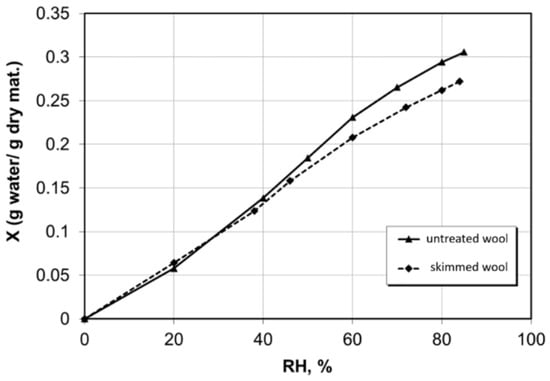
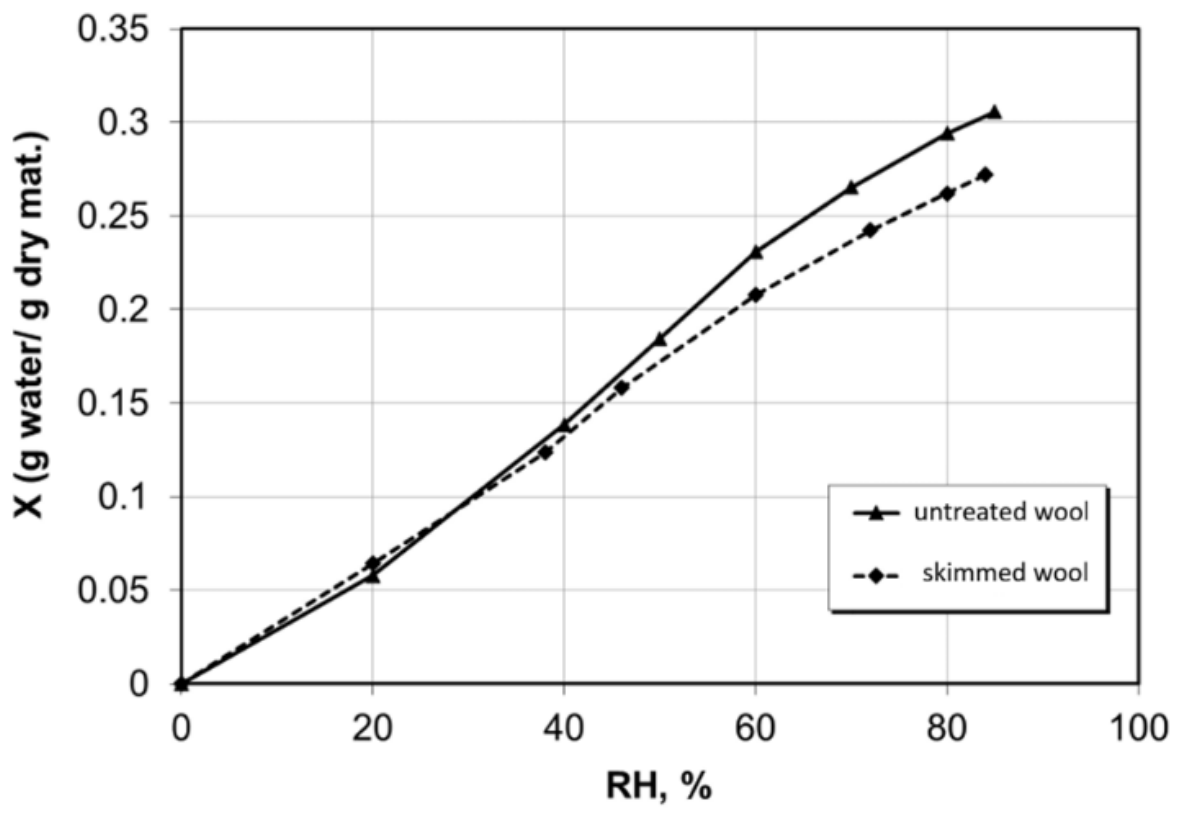
Unlike polystyrene, which is a hydrophobic organic foam, sheep’s wool is a hygroscopic material. Wool can absorb up to 35–40% of its own weight in water, with its thermal conductivity being only slightly affected up to a moisture threshold of 20% [9]. EPS suffers severe degradation when water infiltrates; a humidity of 10% vol. can increase the thermal conductivity from 0.036 to 0.054 W/mK (a 50% decrease in efficiency) [20]. Iacob-Tudose et al. reported water vapor isotherms on untreated and skimmed wool, respectively, as shown in Figure 4 [21].
Figure 4.
Sorption isotherms at 40 °C for untreated and skimmed wool, respectively. Adapted with permission from ref. [21].
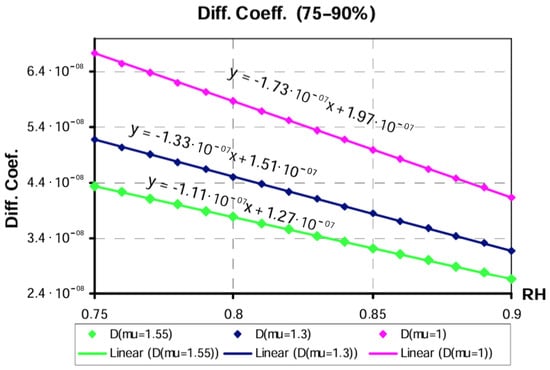
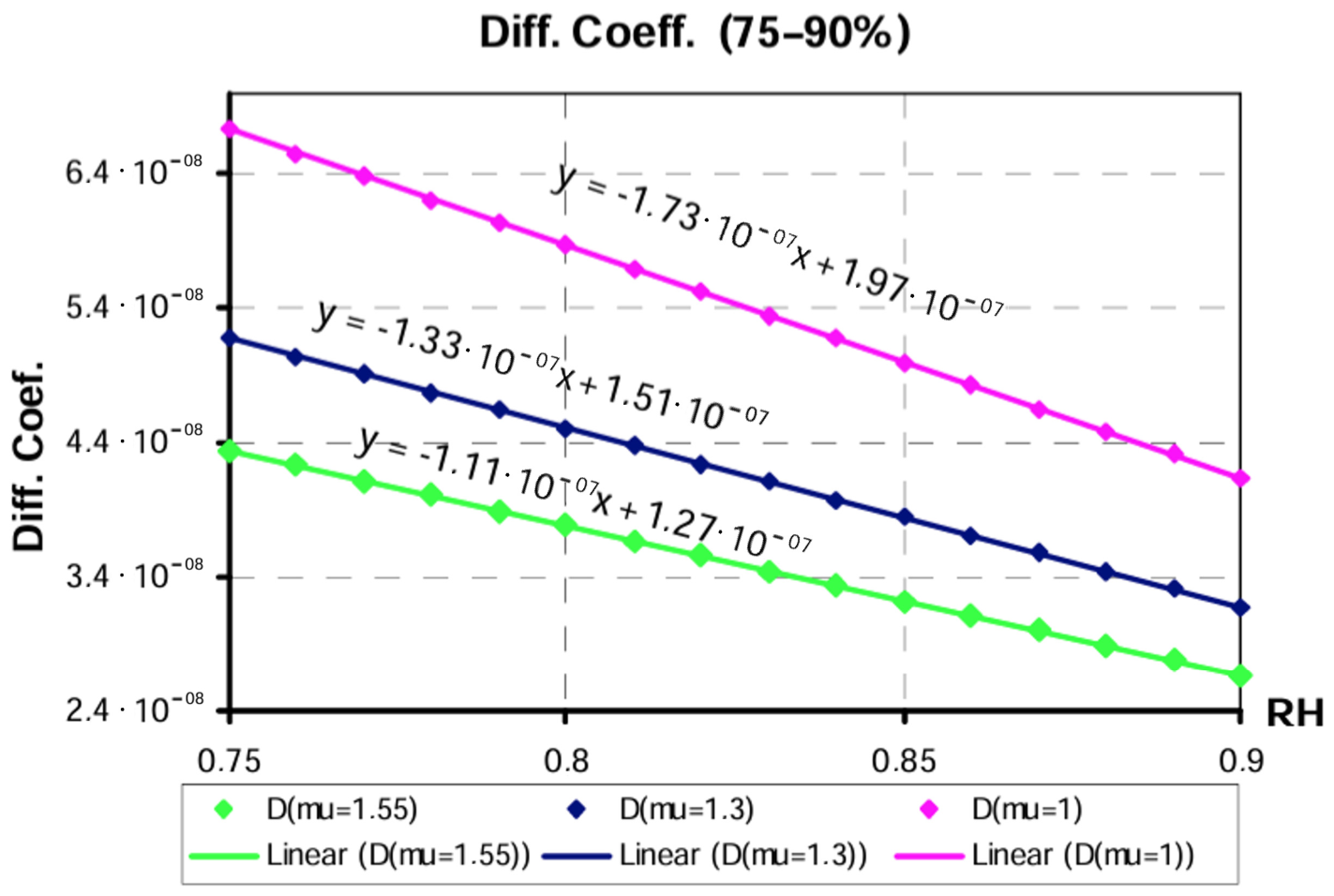
Besides absorption, all insulation materials provide resistance to water vapor diffusion. The µ-factor is a measure of this characteristic, indicating the resistance relative to that of still air. Figure 5 exemplifies a simulation of the dependence of the diffusion coefficient on the relative humidity (ranged between 75 and 90%) in the case of sheep wool insulation at several assumed values of µ-factor as reported by Tuzcu [22].
Figure 5.
Diffusion coefficients for the range 75–90% RH for sheep wool insulation. Adapted with permission from ref. [22].
Values of thermal diffusivity are presented in Table 6.
Table 6.
Effective thermal diffusivities values [20].
An innovative aspect introduced by Basok et al. is the “thermal conductivity degradation coefficient” (Dt), which assesses the loss of efficiency after long periods of use. The study conducted on facades after 11 years of service reveals that synthetic and mineral materials lose their properties at different rates (Table 7) [23].
Table 7.
Degradation coefficients (Dt) after 11 years of operation [23].
Determining the optimal thickness is a multi-criteria process that correlates material cost with heating degree days (HDD). Kan proposes a formula for calculating the optimal thickness (× opt) based on the net present value of fuel savings [24]. Table 8 presents the influence of the thickness of the expanded polystyrene (EPS) insulation layer on the thermal and economic performance of the building element.
Table 8.
Optimal thickness and U-value impact for EPS [23].
Through simulations with SEnergEd software (version 5.07), it was demonstrated that in very cold climates (e.g., Iceland) the optimal thickness of EPS for environmental sustainability often exceeds 40 cm, whereas, from a strictly economic perspective, it is limited to 25 cm [25].
In field tests conducted by Altin and Yildirim, the behavior of three materials on identical facades was compared [26]. The results showed an average difference between the outside and inside wall temperatures of 7.69 °C for wool, compared to 6.05 °C for polystyrene and 3.58 °C for mineral wool, demonstrating wool’s superior ability to block heat flow in winter conditions.
When space restrictions do not allow for thick wool or EPS, research is turning to Vacuum Insulation Panels (VIP). Jelle points out that 6 cm of VIP is thermally equivalent to 35 cm of sheep’s wool, achieving a conductivity of only 4 mW/mK. However, vulnerability to puncture and high costs mean that hybrid solutions (wool–polymers) remain the most reliable for current renovations [16].
4. Acoustic Performance and Indoor Comfort
The evaluation of insulation materials from an indoor environmental quality (IEQ) perspective goes beyond simple thermal resistance, involving their ability to absorb sound, attenuate vibrations, and passively regulate the hygrothermal microclimate.
Sound absorption capacity is essential for reducing noise transmission through the building envelope and improving acoustic comfort. A material is considered an effective absorber if it has a sound absorption coefficient (α) greater than 0.75.
- Sheep’s wool: Due to its porous structure and internal channels (medulla), wool fibers are superior to petrochemical polymers in dissipating sound energy. Hetimy and colleagues note that wool exhibits excellent properties at medium and high frequencies (500–2000 Hz), although performance decreases at low frequencies [8].
- Hybrid Composites: Wool panels with an acrylic-polyurethane resin (P13) can achieve a maximum absorption coefficient (αmax) of 0.999, significantly exceeding those with natural latex (αmax = 0.83) [9].
- Comparison with polystyrene: In experimental field tests, Altin and Yildirim demonstrated that a room insulated with boron-doped wool provided an average sound insulation difference of 29.09 dB, while EPS achieved only 26.03 dB [26].
Table 9 presents values of sound absorption coefficients and NRC for different materials and thicknesses.
Table 9.
Sound absorption coefficients and NRC for different thicknesses [9].
The thickness of the material has a direct relationship with absorption at low frequencies, but an insignificant influence at high frequencies. Midolo et al. emphasize that greater thickness increases the “tortuosity” of the sound path through the material, leading to greater friction losses and, consequently, a higher absorption coefficient [12]. For maximum efficiency in the 500–2000 Hz range, a wool thickness of 170 mm is considered optimal, with any value above this threshold offering no additional benefits.
Thermal comfort is often considered more important to occupants than visual or acoustic comfort. Sheep’s wool can absorb moisture up to 35–40% of its weight without feeling damp to the touch, preventing condensation and mold growth. The phenomenon of hysteresis (the lag between absorption and release) helps maintain a constant indoor climate during winter when humidity is low.
Unlike polystyrene, which is inert or can release volatile compounds in case of fire, wool acts as a natural filter, absorbing formaldehyde and other indoor pollutants. In agro-industrial buildings, sheep’s wool is recommended for insulating floors (concrete slabs) because it insulates machine vibrations much better than mineral wool or fiberglass.
In sustainability studies using MCDM (Electre TRI-rC) methods, Kadziński et al. classified materials according to “discomfort degree-hours” [13]. In this classification, several materials, including sheep wool, hemp, glass wool, EPS, rockwool and PUR, are placed in the top class C3; however, wool and hemp stand out within this group due to their particularly favorable combination of low health impacts, reduced life cycle emissions and superior hygrothermal comfort.
Below the threshold of 60% relative humidity (RH), wool maintains a stable water content, only beginning to absorb in large amounts at RH > 80%, thereby stabilizing the perceived temperature through exothermic absorption processes [9].
While polystyrene provides an effective barrier against airborne sound transmission, sheep’s wool is the superior solution for comfort, combining high-performance acoustic absorption with active humidity regulation and air purification.
5. Hybrid Composites and Material Reinforcement
In line with the fourth objective of this review, this section focuses on hybrid composites and material reinforcement strategies that combine sheep wool fibers and other natural wastes with mineral or polymer matrices to achieve a better balance between thermal insulation and mechanical performance. The transition from homogeneous insulating materials to hybrid composites is a major research direction, aimed at balancing thermal performance with mechanical properties and sustainability. Abu-Jdayil et al. emphasize that the new trend is the development of structural materials with low thermal conductivity that maintain the strength capabilities required for construction [3].
The use of wool fibers as dispersed reinforcement in mortars and concretes has been extensively studied to reduce the environmental impact of synthetic fibers. Atbir et al. developed a porous plaster reinforced with twisted wool yarns in a network form. The results indicated an optimal technical compromise at a 4% wool addition, which generated a 67% increase in flexural strength (up to 2.24 MPa), although it caused a 58% decrease in compressive strength due to increased porosity [27].
Fantilli et al. demonstrated that treating wool with atmospheric plasma (ionized gas) improves adhesion to the cement matrix [28]. Adding 1% by volume of treated wool increased flexural strength by 23% and fracture toughness by 300%. Moreover, low-quality wool fibers can successfully replace polymers in stabilized earth construction components, improving their ductility [29].
The integration of natural waste into polymer matrices allows the creation of rigid panels with superior insulating properties. Raza et al. investigated composites made of expanded polystyrene (PS) and palm fibers (DSF) [30]. It was found that compressive strength increases progressively up to 30% DSF, reaching a maximum of 22.66 MPa, compared to 15 MPa for pure PS. Exceeding this threshold results in poor dispersion and reduced strength. In another study, natural latex and acrylic-polyurethane resin were used as binders for wool fibers [9]. The composites obtained by mixing and spraying achieved excellent thermal conductivities between 0.0324 and 0.0436 W/mK, falling within European standards for insulation [9].
Hybrid composites are also used to stabilize state-of-the-art materials, which are often fragile or expensive. For example, glass fiber reinforcement enables flexible “blankets” that eliminate aerogel’s inherent fragility while maintaining a conductivity of 0.01–0.02 W/mK [2].
To reduce the cost of vacuum insulation panels (VIPs), several composite cores were analyzed. For example, a hybrid core made of wood pulp and glass fibers offers a more sustainable alternative to purely synthetic cores, although aging performance remains an area for optimization [31].
The integration of phase change materials (PCMs) into polyurethane foams or gypsum boards enables the composite to store thermal energy as latent heat. The dimensional stability of hybrid composites is directly influenced by the concentration of PCM microcapsules [32].
Jelle introduces NanoCon, a hybrid building material that combines Nano Insulation Materials (NIMs) with carbon nanotubes [16]. This theoretical combination would allow for a conductivity below 4 mW/(mK) while offering tensile strength exceeding that of traditional steel reinforcements.
The use of wool and other natural waste materials is no longer limited to raw forms (mattresses). Still, it is evolving toward complex composite matrices in which the interface between the fiber and the binder (verified by SEM/EDX analysis) ensures the durability and efficiency required by modern construction.
Table 10 provides a critical analysis of the physicomechanical and hygrothermal properties of unconventional hybrid composites, illustrating how the synergy between natural fibers and various binders (such as natural latex, resins or biopolymers) optimizes the balance between low thermal conductivity and the structural strength required for sustainable insulation applications.
Table 10.
Physicomechanical and hygrothermal properties of unconventional hybrid composites [3,9,10,15]. (N/A means not available).
6. Life Cycle Assessment
LCA is the fundamental methodological tool for rigorously assessing the environmental impact of insulation materials, providing a concrete perspective from raw material extraction to final disposal. This section details the environmental performance of sheep’s wool and styrene polymers, using technical data extracted from the bibliographic sources provided.
According to ISO 14040 and ISO 14044, an LCA analysis is structured into four phases: objective definition, inventory analysis (LCI), impact assessment (LCIA), and interpretation of results. In the construction sector, the choice of Functional Unit is critical for the comparability of materials. The most commonly used FUs identified in the literature are
- The mass required to provide a thermal resistance of R = 1 m2 K/W;
- 1 m3 of insulating material;
- 1 m2 of habitable floor space per year, considering a building lifetime of 50 years.
Impact assessment uses methods such as ReCiPe (Midpoint and Endpoint), CML, or Eco-indicator 99 to convert inventory flows into common impact units. Table 11 summarizes the main impact categories used in LCA, along with their units of measurement and a brief technical description of the meaning of each indicator.
Table 11.
Major impact categories in LCA [4,7,33,34,35].
The major difference between sheep wool and polystyrene (EPS/XPS) is the origin of the raw material and the energy intensity of processing.
Natural sheep wool is considered an annually renewable resource that can act a carbon sink, storing carbon in the natural fiber. In contrast, polystyrene (EPS/XPS) is derived from crude oil, a non-renewable resource, and its production is an emission-intensive process. Michalak et al. demonstrate that ETICS systems based on mineral wool can have an even more negative impact than EPS in certain categories, highlighting the complexity of material selection [5].
Ali et al. emissions for 100 m2 at R = 5 [2]:
- XPS: ~4937 kg CO2 eq (Highest impact);
- EPS: ~288 kg CO2 eq;
- Sheep wool: ~114 kg CO2 eq;
- Hemp fiber/wood: Values are negative (−70 to −218), demonstrating carbon sequestration.
The use of insulation reduces the building’s long-term impact by reducing energy consumption during the operational phase. Although insulation manufacturing has an initial environmental cost, the net benefits over 50 years are always positive [25]. Moreover, the GWP payback period depends on the type of fuel used, being shortest when coal is used as a heat source, due to the high emissions avoided using insulation [35].
Identifying the processes with the greatest impact enables sustainability optimization. For inorganic materials (glass/rock wool), the critical point is the production phase, especially the melting and fibrillation process, which consumes a lot of energy. In the case of polymers (EPS/XPS), the main issue is the extraction and processing of petrochemical raw materials. Regarding bio-based materials (wool, hemp), the major impact comes from binders and additives (polyester, flame retardants) and, in the case of crops, from fertilizers used in cultivation. For wool, Dickson and Pavía suggest that cleaning and animal husbandry are the most impactful stages [36].
Sustainability is also defined by recyclability. Polystyrene, although theoretically recyclable, has a low actual recycling rate in construction (6.7–10%), often limited by the presence of additives such as HBCD. Sheep’s wool is 100% biodegradable and can be reused as fertilizer or in new production cycles, eliminating pressure on landfills.
Choosing the optimal material requires balancing LCA data with economic and technical factors. Streimikiene et al. used the TOPSIS method and demonstrated that, in scenarios with a high environmental weighting, sheep’s wool ranks first, followed by recycled glass [10]. Similarly, Kadziński et al. classified wool as “excellent” (C3) in terms of overall sustainability, outperforming synthetic materials in criteria related to health and ecosystem quality [13]. LCA analysis confirms that sheep wool is the superior insulator from an ecological perspective, offering a minimal carbon footprint and the capacity for regeneration that supports the European Green Deal’s climate-neutrality goals by 2050.
7. Multi-Criteria Decision Making (MCDM) in the Selection of Insulating Materials
Selecting the optimal material for insulating a building is a complex problem that cannot be solved by analyzing a single parameter, such as thermal conductivity. The decision-making process must balance trade-offs between technical and economic characteristics and the impact on the environment and health [10]. To this end, the use of Multi-Criteria Decision Making (MCDM) methods is essential for aggregating the various dimensions of sustainability and identifying the solution with the best overall performance.
An innovative approach to evaluating “green” materials is the use of the Interval TOPSIS method, as applied by Streimikiene et al. to address the uncertainty in data from economic and technical measurements [10]. In this case, a normalization process (based on the minimum and maximum values) was applied because the criteria are expressed in different dimensions, resulting in dimensionless numbers. The method identifies the positive ideal solution (maximum performance for benefits and minimum for costs) and the negative ideal solution. The authors tested four weighting schemes to ensure the certainty of the analysis: (i) Uniform (Equal weights): Weight of 1/7 for each criterion; (ii) Balanced: Divides the weight equally (50–50%) between the group of technological and environmental criteria; (iii) Technological: Gives 75% importance to physical parameters; and (iv) Ecological: Gives 75% importance to LCA impact and health. Based on these steps, the sheep’s wool was ranked first as the most desirable option [10]. Although XPS excels in thermal conductivity, it ranks lower overall due to its carbon emissions and negative health impacts.
Unlike linear rankings, Kadziński et al. propose a group decision framework based on multi-criteria sorting, which divides materials into three ordered classes: C1 (low sustainability), C2 (medium), and C3 (high) [13]. The study involved 38 rural homeowners who assessed the importance of criteria using the revised Simos procedure, using cards to rank priorities. The experts defined profiles for each class (e.g., the profile represents the representative performance for the elite class C3). To avoid arbitrary weight selection, a Monte Carlo simulation was used. The resulting classification is presented in Table 12.
Table 12.
Sorting of materials according to the group model [13].
Iqbal et al. [37] used a more direct but rigorous method to evaluate material assemblies in cold climates. Ten factors were evaluated, including space efficiency, ease of application, nature conservation, and useful life. Weights were assigned following interviews with 20 local residents, architects, and industry technical experts. In the scorecard results, polyethylene achieved the maximum score (90.0), while XPS was considered the least efficient in the specific context analyzed, with a score of 54.04 [38].
Integrated research by Giusi Midolo et al. [12], referring to the study by Ulutas et al. [36], confirms the high potential of wool waste. In a comparison of 20 insulation boards (including hemp, cellulose, cotton, and wood fiber), the MCDM algorithm placed sheep’s wool at the top of the ranking. The criteria that placed wool at the top of the MCDM analysis include (i) health and toxicity, as wool has the lowest negative impact on human health compared to petrochemical materials; (ii) impact (LCA): wool is recognized as the best option for reducing life cycle emissions; and (iii) hygrothermal performance: the ability to regulate humidity through hysteresis, which reduces hours of indoor discomfort.
In the decision on optimal insulation thickness, it was shown that prioritizing different perspectives can radically change the decision outcome [21]. The SEnergEd software was used to visualize these trade-offs and it was observed that: (i) from an economic perspective, the tendency is toward lower thicknesses (e.g., 8–14 cm) to maximize net present value (NPV); and (ii) from an environmental perspective, the decision leans toward thicknesses above 40 cm, as the benefit of reducing operational emissions outweighs the environmental cost of manufacturing the material.
All the multi-criteria decision-making frameworks analyzed (TOPSIS, ELECTRE, Scorecard) converge on the idea that, although synthetic materials such as polystyrene are competitive from a technical and economic point of view, sheep’s wool is the optimal solution for a truly sustainable construction, dominating the rankings when environmental and health criteria are taken into account.
8. Conclusions
The construction sector is at a turning point, moving from a strictly technical assessment of insulation materials to a paradigm based on sustainability and LCA. The implementation of European strategies, such as the European Green Deal, requires achieving net-zero emissions by 2050, transforming the energy efficiency of building envelopes from an option into a rigorous legislative requirement.
Research shows that sheep’s wool is not only a viable substitute for synthetic insulators but also offers unique functional advantages, such as the ability to purify indoor air through chemisorption and to actively regulate humidity through hysteresis. Although styrene polymers (EPS/XPS) remain dominant in the market due to their low cost and superior mechanical strength (up to 22.66 MPa in reinforced variants), their environmental impact is significantly higher, with a GWP that can reach 13.22 kg CO2 eq/kg. Sheep’s wool acts as a carbon sink, often yielding a negative or zero GWP balance, consistently placing it first in MCDM analyses for green buildings.
Future directions in the field of thermal insulation are oriented towards three major technological pillars identified in sources:
- Hybrid composites and nanomaterials: Integrating natural fibers into cementitious or polymeric matrices to create semi-rigid panels solves the problem of structural instability in raw wool, while maintaining excellent thermal conductivity (0.032–0.043 W/mK). The development of nano insulation materials (NIM) and vacuum insulation panels (VIP) promises to reduce insulation layer thickness from 35 cm to just 6 cm, although current costs remain a barrier to widespread adoption;
- Smart materials: The implementation of dynamic insulation materials (DIMs) and phase change materials (PCMs) will allow buildings to adapt their thermal resistance in real time, optimizing energy consumption according to external climate fluctuations;
- Circular economy and GIS logistics: The recovery of wool waste in regions with high sheep density, such as Romania (3rd in Europe) or Italy (Sardinia, Sicily), through the use of Geographic Information Systems (GISs) to optimize supply chains, is key to transforming agricultural waste into a sustainable technological resource.
In the future, sources emphasize the need to harmonize Environmental Product Declarations and LCA calculation methods, as current data discrepancies can create uncertainty in the design process. Future regulations, such as RE2020 in France, will force builders to consider not only operational energy but also the energy embodied in materials, thus favoring bio-based solutions.
Polystyrene offers predictable stability, and the future of sustainable construction belongs to renewable materials and active hybrid composites that ensure superior indoor comfort with minimal impact on the global ecosystem.
Sustainability assessment must go beyond the static analysis of raw materials, integrating the impact of hygrothermal degradation on the long-term U-value. Moisture accumulation not only compromises thermal resistance by increasing conductivity, but also alters the direct results of LCA by requiring a larger amount of material to meet the Functional Unit standard and by reducing the useful life due to the risk of biological degradation. Thus, the hygrothermal stability of hybrid systems ensures the integrity of environmental performance and the entire life cycle.
The objectives of this review have been fulfilled, and the synthesis of hygrothermal, mechanical and life-cycle evidence delineates clear research perspectives for wool-based hybrid insulation systems that can reconcile energy efficiency, structural performance and long-term environmental sustainability.
Author Contributions
A.-M.A.: Conceptualization, methodology, formal analysis, investigation, writing—original draft preparation; S.G.M.: formal analysis, review and editing; C.E.A.: formal analysis, review and editing; M.S.S.: conceptualization, methodology, investigation, formal analysis, review and editing; I.M.: conceptualization, methodology, validation, writing, review and editing, supervision; D.-N.I.: writing, formal analysis, review and editing. All authors have read and agreed to the published version of the manuscript.
Funding
This research received no external funding.
Data Availability Statement
The original contributions presented in this study are included in the article. Further inquiries can be directed to the corresponding authors.
Conflicts of Interest
The authors declare no conflicts of interest.
References
- Parlato, M.C.M.; Porto, S.M.C.; Valenti, F. Assessment of sheep wool waste as new resource for green building elements. Build. Environ. 2022, 225, 109596. [Google Scholar] [CrossRef] [Scilit]
- Ali, A.; Issa, A.; Elshaer, A.A. Comprehensive review and recent trends in thermal insulation materials for energy conservation in buildings. Sustainability 2024, 16, 8782. [Google Scholar] [CrossRef] [Scilit]
- Abu-Jdayil, B.; Mourad, A.H.; Hittini, W.; Hassan, M.; Hameedi, S. Traditional, state-of-the-art and renewable thermal building insulation materials: An overview. Constr. Build. Mater. 2019, 214, 709–735. [Google Scholar]
- Hill, C.; Norton, A.; Dibdiakova, J. A comparison of the environmental impacts of different categories of insulation materials. Energy Build. 2018, 162, 12–20. [Google Scholar] [CrossRef] [Scilit]
- Michalak, J.; Czernik, S.; Marcinek, M.; Michałowski, B. Environmental burdens of external thermal insulation systems. Expanded polystyrene vs. mineral wool: Case study from Poland. Sustainability 2020, 12, 4532. [Google Scholar] [CrossRef] [Scilit]
- Zach, J.; Korjenic, A.; Petránek, V.; Hroudová, J.; Bednar, T. Performance evaluation and research of alternative thermal insulations based on sheep wool. Energy Build. 2012, 49, 246–253. [Google Scholar] [CrossRef] [Scilit]
- Schulte, M.; Lewandowski, I.; Pude, R.; Wagner, M. Comparative life cycle assessment of bio-based insulation materials: Environmental and economic performances. GCB Bioenergy 2021, 13, 979–998. [Google Scholar] [CrossRef] [Scilit]
- Hetimy, S.; Megahed, N.; Abu Eleinen, O.; Elgheznawy, D. Exploring the potential of sheep wool as an eco-friendly insulation material: A comprehensive review and analytical ranking. Sustain. Mater. Technol. 2024, 39, e00812. [Google Scholar] [CrossRef] [Scilit]
- Dénes, T.O.; Iştoan, R.; Tǎmaş-Gavrea, D.R.; Manea, D.L.; Hegyi, A.; Popa, F.; Vasile, O. Analysis of Sheep Wool-Based Composites for Building Insulation. Polymers 2022, 14, 2109. [Google Scholar] [CrossRef] [Scilit] [PubMed]
- Streimikiene, D.; Skupskis, V.; Balezentis, T.; Agnusdei, G.P. Uncertain multi-criteria sustainability assessment of green building insulation materials. Energy Build. 2020, 219, 110021. [Google Scholar] [CrossRef] [Scilit]
- Dénes, O.; Florea, I.; Manea, D.L. Utilization of Sheep Wool as a Building Material. Procedia Manuf. 2019, 32, 236–241. [Google Scholar] [CrossRef] [Scilit]
- Midolo, G.; Del Zoppo, M.; Porto, S.M.C.; Valenti, F. Recycling of wasted wool fibers from sheep shearing for green building components: A review. Case Stud. Constr. Mater. 2024, 21, e03623. [Google Scholar] [CrossRef] [Scilit]
- Kadziński, M.; Rocchi, L.; Miebs, G.; Grohmann, D.; Menconi, M.E.; Paolotti, L. Multiple criteria assessment of insulating materials with a group decision framework incorporating outranking preference model and characteristic class profiles. Group Decis. Negot. 2018, 27, 33–59. [Google Scholar]
- Kabun, K.; Reinhold, K. Improving indoor air quality and mitigating health risks with sheep wool as a sustainable material. Indoor Environ. 2025, 2, 100111. [Google Scholar] [CrossRef] [Scilit]
- Asdrubali, F.; D’Alessandro, F.; Schiavoni, S. A review of unconventional sustainable building insulation materials. Sustain. Mater. Technol. 2015, 4, 1–17. [Google Scholar] [CrossRef] [Scilit]
- Jelle, B.P. Traditional, state-of-the-art and future thermal building insulation materials and solutions—Properties, requirements and possibilities. Energy Build. 2011, 43, 2549–2563. [Google Scholar]
- Urso, A.; Evola, G.; Costanzo, V.; Nocera, F. A critical analysis on the use of different weather datasets to assess moisture-related risks in building components for a Mediterranean location. J. Build. Eng. 2023, 760, 107177. [Google Scholar] [CrossRef] [Scilit]
- Cristaudo, A.; Nicoletti, F.; Carpino, C.; Bruno, R. Dynamic Hygrothermal Analysis for Retrofitting Opaque Envelopes in Humid Climates: From Simulations to Guidelines. Buildings 2026, 16, 419. [Google Scholar] [CrossRef] [Scilit]
- Khoukhi, M.; Fezzioui, N.; Draoui, B.; Salah, L. The impact of changes in thermal conductivity of polystyrene insulation material under different operating temperatures on the heat transfer through the building envelope. Appl. Therm. Eng. 2016, 105, 669–674. [Google Scholar] [CrossRef] [Scilit]
- Cai, S.; Zhang, B.; Cremaschi, L. Review of moisture behavior and thermal performance of polystyrene insulation in building applications. Build. Environ. 2017, 123, 50–65. [Google Scholar] [CrossRef] [Scilit]
- Iacob-Tudose, E.T.; Mindru, T.B.; Mamaliga, I. Wool and Leather Waste Materials with Thermo-Insulating Properties. Rev. Chim. 2020, 71, 70–78. [Google Scholar] [CrossRef] [Scilit]
- Tuzcu, T.M. Hygro-Thermal Properties of Sheep Wool Insulation. Doctoral Dissertation, Delft University of Technology, Delft, The Netherlands, June 2007. [Google Scholar]
- Basok, B.I.; Goncharuk, S.M.; Danishevskyi, A.S.; Goman, Y.I. Thermal physical characteristics dynamics in thermal insulation materials of buildings facade. Energy Technol. Resour. Sav. 2025, 3, 119–128. [Google Scholar] [CrossRef] [Scilit]
- Kan, M. Comparison of Different Insulation Materials with Thermal Conductivity Coefficients Based on Density and Temperature for Two Climate Zones. Int. J. Thermophys. 2022, 43, 174. [Google Scholar] [CrossRef] [Scilit]
- Raimundo, A.M.; Sousa, A.M.; Oliveira, A.V.M. Assessment of energy, environmental and economic costs of buildings’ thermal insulation–influence of type of use and climate. Buildings 2023, 13, 279. [Google Scholar] [CrossRef] [Scilit]
- Altin, M.; Yildirim, G.Ş. Investigation of usability of boron doped sheep wool as insulation material and comparison with existing insulation materials. Constr. Build. Mater. 2022, 331, 127303. [Google Scholar] [CrossRef] [Scilit]
- Atbir, A.; Khabbazi, A.; Cherkaoui, M.; Ibaaz, K.; El Wardi, F.Z.; Chebli, S. Improvement of thermomechanical properties of porous plaster reinforced with a network of Morocco sheep wool skeletons for Energy efficiency. Build. Environ. 2023, 234, 110171. [Google Scholar] [CrossRef] [Scilit]
- Fantilli, A.P.; Jóźwiak-Niedźwiedzka, D.; Gibas, K.; Dulnik, J. The compatibility between wool fibres and cementitious mortars. In Proceedings of the 2nd International Conference on Bio-Based Building Materials, RILEM PRO 119, Clermont-Ferrand, France, 21–23 June 2017; pp. 42–47. [Google Scholar]
- Parlato, M.C.M.; Cuomo, M.; Porto, S.M.C. Natural fibers reinforcement for earthen building components: Mechanical performances of a low quality sheep wool (Valle del Belice sheep). Constr. Build. Mater. 2022, 326, 126855. [Google Scholar] [CrossRef] [Scilit]
- Raza, M.; Al Abdallah, H.; Kozal, M.; Al Khaldi, A.; Ammar, T.; Abu-Jdayil, B. Development and characterization of Polystyrene–Date palm surface fibers composites for sustainable heat insulation in construction. J. Build. Eng. 2023, 75, 106982. [Google Scholar] [CrossRef] [Scilit]
- Zhao, J.R.; Zheng, R.; Tang, J.; Sun, H.J.; Wang, J. A mini-review on building insulation materials from perspective of plastic pollution: Current issues and natural fibres as a possible solution. J. Hazard. Mater. 2022, 438, 129449. [Google Scholar] [CrossRef] [Scilit] [PubMed]
- Yoo, S.; Kandare, E.; Shanks, R.; Al-Maadeed, M.A.; Khatibi, A.A. Thermophysical properties of multifunctional glass fibre reinforced polymer composites incorporating phase change materials. Thermochim. Acta 2016, 642, 25–31. [Google Scholar] [CrossRef] [Scilit]
- Densley Tingley, D.; Hathway, A.; Davison, B. An environmental impact comparison of external wall insulation types. Build. Environ. 2015, 85, 182–189. [Google Scholar] [CrossRef] [Scilit]
- Jang, H.; Jang, Y.; Jeong, B.; Cho, N.K. Comparative Life Cycle Assessment of Marine Insulation Materials. J. Mar. Sci. Eng. 2021, 9, 1099. [Google Scholar] [CrossRef] [Scilit]
- Akyüz, M.K. Enviroeconomic optimization of insulation thickness for building exterior walls through thermoeconomic and life cycle assessment analysis. Case Stud. Therm. Eng. 2025, 65, 105606. [Google Scholar] [CrossRef] [Scilit]
- Dickson, T.; Pavía, S. Energy performance, environmental impact and cost of a range of insulation materials. Renew. Sustain. Energy Rev. 2021, 140, 110752. [Google Scholar] [CrossRef] [Scilit]
- Iqbal, A.; Mubin, S.; Gavrishyk, E.; Masood, R.; Roy, K.; Moradibistouni, M. A Comparative Performance Analysis of Different Insulation Materials Installed in a Residential Building of a Cold Region in Pakistan. J. Compos. Sci. 2022, 6, 165. [Google Scholar] [CrossRef] [Scilit]
- Ulutaş, A.; Balo, F.; Topal, A. Identifying the most efficient natural fibre for common commercial building insulation materials with an integrated PSI, MEREC, LOPCOW and MCRAT model. Polymers 2023, 15, 1500. [Google Scholar] [CrossRef] [Scilit] [PubMed]

Disclaimer/Publisher’s Note: The statements, opinions and data contained in all publications are solely those of the individual author(s) and contributor(s) and not of MDPI and/or the editor(s). MDPI and/or the editor(s) disclaim responsibility for any injury to people or property resulting from any ideas, methods, instructions or products referred to in the content. |
© 2026 by the authors. Licensee MDPI, Basel, Switzerland. This article is an open access article distributed under the terms and conditions of the Creative Commons Attribution (CC BY) license.