


Abstract
Small and medium-sized enterprises (SMEs) face mounting pressure to advance their digital transformation while integrating sustainability practices. However, the relationship between digital maturity and ESG (Environmental, Social, and Governance) integration in SMEs remains insufficiently comprehended, especially in regional contexts. This study examines how digital maturity shapes the scope and development of ESG practices in six Quebec SMEs using a qualitative multiple-case study design guided by Yin’s framework. Data were collected through a structured 54-item diagnostic protocol generating Digital Maturity Scores (DMSs), Sustainability Management Indices (SMIs), and Digital Literacy Indices (DLIs), complemented by thematic coding in NVivo. Cross-case analysis reveals that higher digital maturity is broadly associated with more diversified ESG practices, though this alignment is uneven and conditioned by governance mechanisms, firm size, and sectoral dynamics. An inductive typology distinguishes three profiles: compliance-oriented firms, ESG diversifiers, and strategic integrators. Findings further indicate that governance structures are necessary but not sufficient conditions for sustainability outcomes, as their effectiveness depends on alignment with operational routines and data practices. This study contributes to the literature by providing a combined digital maturity–ESG diagnostic framework adapted to the realities of SMEs. It also advances three theoretical propositions suitable for testing in larger and more diverse samples.
1. Introduction
Small and medium-sized enterprises (SMEs) account for nearly 99% of all businesses in Québec and contribute almost half of private-sector employment and value added [1]. They are central to regional development but face mounting pressure to digitalize and integrate sustainability practices simultaneously. These dual transitions are recognized as critical for competitiveness, resilience, and legitimacy in the context of Québec’s ecological transition and digital economy [2,3].
Digital transformation in SMEs is a multidimensional construct. From a technological perspective, it denotes the integration of digital tools, platforms, and infrastructure [2]. From an organizational/dynamic capabilities perspective, it implies strategic reconfiguration of routines through digital means, enabling firms to sense and seize opportunities [4,5]. From a socio-material perspective, it reflects the entanglement of human practices and technological artifacts [6]. This study distinguishes “digitalization” (the conversion of analog activities to digital) from “digital transformation” (strategic organizational renewal enabled by digital technologies), with the digital maturity model capturing progress along the latter dimension [7]. In this study, dynamic capabilities theory [4] serves as the primary theoretical lens, framing digital maturity as a firm-level capability that enables SMEs to sense, seize, and reconfigure resources to pursue sustainability objectives. Socio-materiality [6] plays a supporting role, illuminating how digital tools become embedded in, and constitutive of, organizational routines rather than merely supplementing them. Governance frameworks such as COBIT 2019 [8], ISO/IEC 38500 [9] or INTOSAI [10] function as operational anchors, providing the institutional scaffolding through which digital capabilities are directed toward ESG outcomes. This theoretical hierarchy guides the interpretation of findings throughout the paper. Digital maturity models have been widely used to evaluate how organizations evolve in their use of technology. However, most of these frameworks, including the Capability Maturity Model Integration (CMMI) [11] and the Gartner Digital Maturity Model [12], were originally designed for large, resource-intensive organizations with dedicated IT departments and formal governance structures, making them difficult to apply to SMEs operating with limited budgets, informal management practices, and constrained digital literacy. The PME 4.0 diagnostic grid addresses these limitations by simplifying the scoring logic, incorporating sector-specific items adapted to Quebec regional SMEs, and explicitly linking digital maturity dimensions to ESG indicators, a linkage absent from most existing frameworks. Recent contributions propose SME-specific approaches that emphasize interconnection, data utilization, and technological adoption as key drivers of maturity [11,12]. In parallel, sustainability-oriented frameworks integrate ESG principles into SME practices, bridging digitalization with sustainable management [13,14].
Brozzi et al. [15] demonstrate that Industry 4.0 applications can improve resource efficiency in manufacturing SMEs. Similarly, Pemer ([16], p. 32) shows that digital service innovation enhances sustainability-oriented capabilities, while Gamache et al. [17] caution that digitalization may exacerbate resource gaps when governance mechanisms are misaligned. Governance-oriented frameworks such as COBIT 2019 [8] and ISO/IEC 38500 [9] position data as a strategic asset, yet Abilakimova et al. [18] observe that SMEs rarely operationalize these recommendations in practice. From a theoretical perspective, dynamic capabilities theory emphasizes firms’ ability to reconfigure resources in the face of uncertainty [4]. In contrast, socio-materiality conceptualizes transformation as the entanglement of human practices and technological artifacts [6].
Despite growing research on digital maturity and ESG practices, three gaps remain. First, most maturity models have been designed and validated for large organizations rather than SMEs [2,18]. Second, ESG frameworks targeting SMEs rarely integrate digital maturity as an enabling condition, instead treating digitalization and sustainability as parallel organizational agendas [19,20]. Third, no prior study has applied a combined digital maturity–ESG diagnostic framework to regional SMEs in a Canadian context. This study addresses these three gaps simultaneously.
The present study examines how these dynamics unfold in Quebec SMEs. Using six case studies and a structured 54-question grid, it explores the relationship between digital maturity and sustainability practices. Specifically, this study is guided by the following research question:
(RQ1) How do digital maturity levels shape the scope and sophistication of ESG practices among SMEs in regional Quebec?
(RQ2) How do governance mechanisms condition the relationship between digital maturity and sustainability outcomes?
These ‘how’ questions are framed consistently with Yin’s [21] guidance on matching research questions to case study methodology. The contribution lies in adapting maturity and ESG assessments to the realities of SMEs and in offering an emerging typology that distinguishes among compliance-oriented, ESG-diversifying, and strategically integrating SMEs.
2. Materials and Methods
This section articulates both the research methodology (the philosophical and epistemological rationale) and the research method (the empirical strategy). The study adopts a constructivist–interpretivist epistemological stance. The qualitative multiple-case study is selected as the most appropriate for ‘how’ questions about complex organizational phenomena in bounded real-world contexts [21,22]. The multiple-case structure enables within-case depth and cross-case comparison through replication logic, distinct from survey sampling logic.
2.1. Research Design
This research adopts a qualitative multiple-case study design, following Yin’s [21] framework. Each SME was treated as a case unit, allowing for within-case analysis and cross-case synthesis. Cases were selected to reflect variation in sector, size, and maturity levels, enabling literal replication (similar results across comparable firms) and theoretical replication (contrasting results across different contexts). The epistemological aim is analytical generalization to theory, deriving theoretical propositions extending beyond the six cases, rather than statistical inference or population-level generalization, consistent with Yin [21] and Fortin and Gagnon [23]. Formal hypotheses are not posited; instead, three theoretical propositions are articulated in Section 4 to situate findings in broader international literature.
Case selection followed a purposive sampling strategy consistent with Yin’s [21] replication logic. Firms were recruited through two regional partner networks, including Promotion Saguenay and the Réseau des SADC du Québec, which facilitated access to a pool of twelve SMEs that had previously used the PME 4.0 online assessment tool. From this pool, six firms were retained based on three criteria: (1) willingness to participate in a structured research interview; (2) availability of at least one key informant with cross-functional knowledge of both digital and sustainability practices; and (3) the ability to achieve variation across sector (manufacturing vs. professional services and retail), firm size (1–19 vs. 20–49 employees), and expected digital maturity range (from low to advanced). The six firms that were not retained either declined participation after initial contact (n = 4) or had incomplete assessment data that precluded reliable scoring (n = 2). No firms were excluded based on digital maturity level or sustainability performance, to avoid selection bias toward more advanced cases.
2.2. Data Collection
Data was collected between January and March 2025 using a 54-item structured case protocol consistent with Yin’s [21] case study protocol design. The items function as a diagnostic grid, generating systematic qualitative profiles for each case unit. Responses construct interpretive within-case profiles and enable cross-case comparisons following replication logic, not sampling logic. Each item maps onto a sub-dimension: Interconnection (Q15–Q20, Q26–Q33), Data (Q21–Q24, Q33–Q43, Q53), Technologies (Q44–Q49). Complementary indices: Digital Literacy Index (Q25) and Sustainability Management Index (Q44, Q47, Q50–Q53). See Appendix B for the full instrument.
Responses were imported into NVivo (v.20) and coded along three dimensions, producing a digital maturity score (DMS), a Sustainability Management Index (SMI), and a digital literacy index (DLI). Each respondent was defined as a Case Node with metadata including firm size, sector, and maturity level.
2.3. Index Construction and Scoring Logic
The Digital Maturity Score (DMS) is computed as follows: DMS = 0.35 × (Interconnection score) + 0.35 × (Data score) + 0.30 × (Technology score). The sub-dimension weights (0.35 for Interconnection, 0.35 for Data, and 0.30 for Technology) were established through an iterative process of expert consultation conducted during the development of the PME 4.0 tool [3]. Twelve digital economy practitioners and regional SME advisors from the Saguenay–Lac-Saint-Jean region were consulted to weigh dimensions according to their relative importance for SME digital transformation in a Quebec regional context. Interconnection and Data received equal and higher weights, reflecting the consensus that relational and informational capabilities are the primary drivers of SME maturity, while Technology adoption, though important, is contingent on these foundational dimensions. All items use a response scale from 0 (practice absent) to 5 (practice fully implemented and systematically monitored). Missing or unanswered items are treated as 0, representing the absence of the practice, consistent with the diagnostic intent of the tool. These weights have not yet been validated through confirmatory statistical procedures; their refinement in larger samples is identified as a direction for future research. Each sub-dimension score is the average of normalized item responses (scale 0–5). Maturity benchmarks: Level 0 Traditional (0.0–0.9); Level 1 Beginner (1.0–1.9); Level 2 Developing (2.0–2.9); Level 3 Intermediate (3.0–3.9); Level 4 Advanced (4.0–4.4); Level 5 Mature (4.5–5.0). The Sustainability Management Index (SMI) is computed from Q44, Q47, Q50–Q53 as a percentage of the maximum possible score. The Digital Literacy Index (DLI) is derived from Q25. All scores were normalized to percentages for cross-case comparability. The six cases are organized into two size groups: SMEs with 1–19 employees (micro-enterprises) and 20–49 employees (small enterprises), following the Government of Quebec’s [1] official SME classification criteria.
2.4. Data Analysis
The analysis followed two parallel but complementary layers. In the quantitative layer, structured scalar responses to the 54 items were processed by the PME 4.0 scoring algorithm to generate DMS, SMI, and DLI scores. These enabled systematic within-case profiling and cross-case comparison. In the qualitative layer, contextual elaborations and open-ended notes were imported into NVivo (v.20) and coded in two stages. First, deductive coding was applied across the three predefined PME 4.0 dimensions (Interconnection, Data, Technology), using a structured codebook developed before the analysis. Second, inductive coding was conducted to capture emergent themes, including governance dynamics, sustainability awareness, and sectoral constraints. Two coders participated: one co-author conducted primary coding of all six cases, and a trained research assistant independently coded a random subset of 20% of the items. Intercoder agreement was assessed for this subset; discrepancies were resolved through structured discussion. Representative codes include: “formal sustainability policy absent,” “ESG monitoring automated via ERP,” “sustainability awareness decoupled from digital infrastructure,” and “governance structure present but not operationalized.” The codebook is available from the authors upon request. NVivo coding served to enrich, triangulate, and interpret the quantitative profiles, not to re-derive the scores. A full analytical workflow is provided in Appendix A. The analysis proceeded in three steps:
- (1)
- Intra-case analysis: coded responses synthesized into descriptive profiles;
- (2)
- Cross-case comparison: matrix coding queries conducted to identify patterns linking DMS with sustainability outcomes;
- (3)
- Typology development: cases grouped into three profiles based on recurring patterns (see Section Typology Construction Logic).
2.5. Reliability and Rigor
Internal consistency measures such as Cronbach’s alpha apply to psychometric survey scales, not to structured qualitative case protocols [21]. Rigor is established through four qualitative criteria. First, credibility was ensured with sustained engagement with the six SMEs, systematic NVivo coding, and triangulation across data sources. Second, to ensure inter-coder reliability, a structured coding review was conducted by one of the co-authors and a research assistant to cross-check all NVivo codes, and any discrepancies were resolved through discussion. Member checking was conducted with two case participants, who reviewed the interpretive summaries for accuracy. To ensure transferability, we use thick descriptions of firm characteristics and contextual details of the Saguenay–Lac-Saint-Jean region. Dependability was ensured with systematic documentation of coding procedures and a journal trail. Finally, confirmability is demonstrated through the explicit linkage of data to results via comparative tables and triangulated coding outputs.
3. Results
3.1. Portrait by Cases
The following section presents a synthesis of each case, ranked by digital maturity score (DMS) from Level 0 (Traditional) to Level 5 (Mature), with Levels 1, 2, 3, and 4 in between. Cases 1 through 5 are presented in ascending order of Digital Maturity Score (DMS = 1.3, 2.2, 3.2, 4.0, and 4.4, respectively). Case 6 (DMS = 0.8) is intentionally presented last, despite having the lowest DMS, for analytical reasons: its profile constitutes a theoretically significant outlier, combining the lowest digital maturity in the sample with a Sustainability Management Index (13%) that exceeds those of Cases 1 and 2. Introducing Case 6 after the main DMS-to-ESG trajectory has been established allows the reader to better appreciate the nature and implications of this divergence, which is central to the cross-case argument developed in Section 3.2.
Nevertheless, in each case, the analysis description follows a consistent, systematic order to ensure comparability across firms and methodological rigor. Following Yin’s [21] recommendations for multiple-case studies, each SME is treated as a standalone unit and then compared using replication logic. Firstly, the digital maturity level is presented, highlighting the main technologies and digital practices adopted. Secondly, the case description details the firm’s interconnection mechanisms, including training activities, designated responsibilities, and digital presence. Thirdly, attention is given to data practices and governance structures, such as strategic planning, dashboards, and cybersecurity. Fourthly, the use of technologies and work methods is described to illustrate operational digitalization. Finally, the firm’s sustainability practices are examined, including policies, ESG initiatives, and monitoring processes. Consistent with Fortin and Gagnon’s [23] criteria for qualitative rigor, additional contextual comments are provided to triangulate interpretations and enhance credibility. This structured approach enables a holistic profile of each SME and supports analytical generalization by clarifying how digital maturity and sustainability practices intersect within their organizational context.
3.1.1. Case 1: DMS 1.3
This microenterprise (1–19 employees) displayed a low digital maturity score (1.3), relying mainly on basic cloud services and limited AI tools. No formal digital training was offered, and responsibility for digitalization rested with the owner and a trainee. Despite maintaining a transactional website accounting for 15–20% of revenue and a multichannel presence (Facebook, Instagram, TikTok, newsletters, SMS), governance remained informal: strategic planning was “under discussion,” and no sustainability monitoring was conducted. Data were siloed with minimal dashboarding, and no cybersecurity measures were in place. Sustainability practices were communicated publicly, yet documentation and systematic follow-up were absent. This profile reflects a compliance-oriented approach, in which sustainability is acknowledged but is weakly supported by digital capabilities or governance mechanisms. With respect to RQ1, this case illustrates that low digital maturity constrains ESG scope to symbolic compliance. With respect to RQ2, the near-total absence of governance structures limits any conditioning effect on sustainability outcomes, placing this firm squarely in the compliance-oriented profile.
3.1.2. Case 2: DMS 2.2
This medium-sized manufacturer (20–49 employees) reached a modest maturity score (2.2). Although the firm deployed a variety of digital tools (cloud, dashboards, ERP, robotics), the digital transformation lacked coherence because no formal training was provided, and responsibility was limited to a production supervisor. The company had no e-commerce activities and only a limited digital presence (LinkedIn, X). Strategic planning was underway, but sustainability monitoring was absent. Data sharing occurred across departments via two dashboards, yet no cybersecurity measures were in place. Sustainability practices focused on equity, employment, and local sourcing, though no formal reporting was in place. Overall, Case 2 demonstrates partial digitalization and uneven governance, with sustainability emerging but not strategically integrated. With respect to RQ1, Case 2 shows that moderate use of digital tools alone does not lead to diversified ESG practices without strategic intent. With respect to RQ2, governance level 2 is achieved but remains inactivated for sustainability purposes, confirming the compliance-oriented classification despite a higher governance capacity than in Case 1.
3.1.3. Case 3: DMS 3.2
This small professional service firm (1–19 employees) achieved an intermediate maturity score (3.2). The company offered digital training on CRM, SharePoint, and Copilot and designated an internal programmer-analyst to oversee digital initiatives. With more than 50% of revenue online and strong multichannel engagement (Facebook, LinkedIn, newsletters, WhatsApp), interconnectivity was well established. Strategic planning was formalized, but sustainability monitoring was absent. Data sharing was established, with limited dashboards and basic cybersecurity. The firm experimented with advanced digital tools (cloud, SaaS, chatbot, data warehouse), yet inventory management remained unmanaged. Sustainability practices existed (equity, partnerships, local procurement) but were not institutionalized in policies or reporting. This case illustrates how higher digital maturity can support diversified sustainability practices even without formal ESG governance. With respect to RQ1, this case demonstrates that intermediate-to-high digital maturity can broaden the scope of ESG practice even in the absence of formalized governance, supporting the ESG diversifier classification. With respect to RQ2, the absence of formal governance structures does not preclude sustainability diversification, suggesting that digital capabilities can partially substitute for the formalization of governance at this maturity level.
3.1.4. Case 4: DMS 4
This small manufacturing firm (1–19 employees) presented a high digital maturity score (4.0). Digital training was provided, and the CEO and IT manager shared digital responsibility, along with an external consultant. The company used a range of technologies (CRM, IoT, VR, SaaS), with partial online sales (5–10%) and multichannel presence. Strategic planning was under discussion, but sustainability monitoring was automated through ERP and CRM systems. Despite relying on siloed data, the firm maintained 10 dashboards and implemented cybersecurity. Internal policies and automated reporting mechanisms supported sustainability practices, though formal ESG documentation remained limited. This case represents a transition toward a strategic integrator, in which sustainability is increasingly embedded in operations through digital tools. With respect to RQ1, Case 4 illustrates how advanced digital tools (ERP, CRM, IoT) begin to automate sustainability monitoring, supporting a transition toward strategic ESG integration. With respect to RQ2, governance structures are emerging but not yet fully operationalized, placing this firm at the ESG diversifier–strategic integrator boundary.
3.1.5. Case 5: DMS 4.4
This medium-sized manufacturer (20–49 employees) attained the highest maturity score (4.4). Training on ERP systems was provided, and multiple roles (executives, CPAs, engineers, and interns) were assigned to the digitalization effort. Despite a weak online presence and no e-commerce, the firm invested in advanced technologies (ERP, robotics, 3D printing, big data). Governance structures were formalized, with updated strategic planning and defined objectives, though sustainability reporting was not systematically followed up on. Data sharing was extensive, supported by seven dashboards and robust cybersecurity measures. Sustainability practices were well developed and well known internally, but lacked documented follow-up. Case 5 exemplifies an advanced strategic integrator in which governance and technology strongly support sustainability practices, although systematic ESG reporting remains incomplete. With respect to RQ1, Case 5 exemplifies how advanced digital maturity supports the broadest and most structured ESG practices in the sample. With respect to RQ2, governance level 3—the highest in the sample—enables more systematic alignment between digital capabilities and sustainability outcomes, confirming the strategic integrator classification.
3.1.6. Case 6: DMS 0.8
This medium-sized manufacturer (20–49 employees) scored very low on digital maturity (0.8), despite having access to cloud and ERP tools. Digital training was provided, but relied heavily on external support. The company maintained only a limited online presence (Facebook, Instagram) with no e-commerce. Strategic planning was discussed, but sustainability monitoring was absent. Data remained siloed, with no dashboards or cybersecurity measures in place, and inventory was managed manually on paper. Nevertheless, sustainability practices were widely recognized among managers, employees, and suppliers, with a focus on equity, employment, and energy use, though without systematic tracking. This case highlights the paradox of a firm with nascent digitalization but comparatively stronger sustainability awareness, illustrating how sectoral and organizational constraints can decouple digital maturity from ESG progress. With respect to RQ1, Case 6 challenges a simple positive DMS–ESG relationship: despite the lowest digital maturity in the sample, sustainability awareness is relatively strong, driven by sectoral norms and managerial culture rather than digital infrastructure. With respect to RQ2, the complete absence of governance structures (level 0) means sustainability practices are not institutionalized, reinforcing the compliance-oriented classification despite relatively higher ESG awareness.
3.2. Cross-Case Comparison
Moving from individual portraits to comparative synthesis, cross-case analysis was conducted following Yin’s [21] replication logic. Firm size influenced the trajectories of digital and sustainability integration [2,15,24]. Among smaller SMEs (1–19 employees), service firms demonstrated higher digital maturity and more diversified sustainability practices, whereas manufacturing firms encountered structural constraints. Among medium-sized SMEs (20–49 employees), sharper divergences emerged. Sectoral dynamics played a decisive role as professional service firms advanced more quickly, consistent with OECD [2] and Abilakimova et al. [18]. Higher digital maturity was consistently associated with stronger sustainability alignment, consistent with George et al. [20] and Garzoni et al. [19].
A notable finding is the disjunction between governance and sustainability. Four out of six firms reached governance level 2, yet their SMI scores remained below 30%. It should be noted that given the early-stage ESG integration observed across all cases, a score of 20% represents the upper bound of performance within this sample and should be interpreted as relatively high in this regional SME context, not in absolute terms. This reflects a dynamic capabilities argument [4]: the existence of governance structures does not automatically translate into sustainability outcomes without deliberate resource commitment and strategic alignment. Governance mechanisms are necessary but not sufficient conditions for ESG integration. Their activation requires organizational routines that connect data practices to sustainability monitoring, routines that are only partially developed in these cases.
The robustness of this comparison was reinforced by triangulation at three levels: (a) by comparing coded responses from the structured grid with emergent codes generated in NVivo; (b) by contrasting these codes with the descriptive case portraits developed for each SME; (c) by synthesizing patterns in comparative matrices across sectors and firm sizes. This multi-level triangulation strengthened credibility by ensuring consistency across data sources, while the use of detailed case descriptions enhanced transferability, consistent with Fortin and Gagnon’s [23] criteria for qualitative rigor.
Typology Construction Logic
The typology was constructed inductively following Yin’s [21] replication logic through four steps: (1) Initial pattern identification through matrix coding queries in NVivo, generating thematic clusters. (2) Criteria application: cases were assigned based on three jointly applied criteria: DMS threshold, presence of formal ESG policies, and governance level. Specifically, compliance-oriented firms are characterized by DMS 0–1.9, absence of formal ESG policy, and governance level 0–1; ESG diversifiers display DMS 2.0–3.9, informal or emerging ESG practices, and governance level 1–2; and strategic integrators exhibit DMS ≥ 4.0, embedded sustainability reporting (automated or formalized), and governance level 2–3. Case 2 (DMS 2.2, governance level 2) remains compliance-oriented because, despite reaching governance level 2, its sustainability practices are limited to basic equity measures and local sourcing with no formal reporting mechanism or strategic intent. Case 4 is classified as an ESG Diversifier transitioning toward strategic integration: its DMS (4.0) meets the strategic integrator threshold, but formal ESG documentation remains limited and strategic planning was still under discussion at the time of data collection. (3) Cross-case validation: the first two authors independently reviewed assignments and resolved discrepancies through structured discussion. (4) Literature grounding: categories resonate with Garzoni et al. [19], Silva et al. [25], and George et al. [20]. Table 1 presents the case-by-typology assignment matrix.
Table 1.
Case-by-typology assignment matrix.
3.3. Supporting Comparative Evidence
To complement the cross-case comparison, the six SMEs were also examined in sub-groups according to firm size. This step does not replace the qualitative case portraits but provides a structured view of how indices of digital maturity (DMS), sustainability (SMI) and literacy (DLI) vary across contexts.
3.3.1. Case Group 1: SMEs with 1–19 Employees
Table 2 summarizes Cases 1, 3, and 4. These smaller firms displayed divergent trajectories: Case 1 remained at an early stage (DMS = 1.3; SMI = 2%), while Cases 3 and 4 achieved higher maturity (DMS = 3.2 and 4.0; SMI = 19% and 20%). Digital literacy (DLI) and sustainability awareness progressed together, with professional service firms showing fewer structural barriers than manufacturing firms [24,26,27,28].
Table 2.
Digital maturity, sustainability, and literacy indices for SMEs with 1–19 employees.
Table 3 presents Cases 2, 5, and 6. Case 5 stood out with the highest maturity (DMS = 4.4; SMI = 20%). Case 2 remained at a modest stage (DMS = 2.2; SMI = 10%), while Case 6 showed very low maturity (DMS = 0.8) despite higher sustainability alignment (SMI = 13%). These uneven outcomes suggest that medium-sized firms do not follow linear trajectories; sectoral conditions and governance mechanisms shape digital-sustainability pathways [24,28].
Table 3.
Digital maturity, sustainability, and literacy indices for SMEs with 20–49 employees.
3.3.2. Governance, Sustainability, and Data Interplay
Table 4 illustrates the relationship between governance, digital maturity, and sustainability across the six SMEs.
Table 4.
Governance levels compared to sustainability (SMI) and digital maturity (DMS).
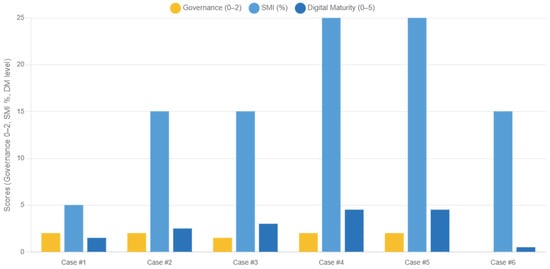
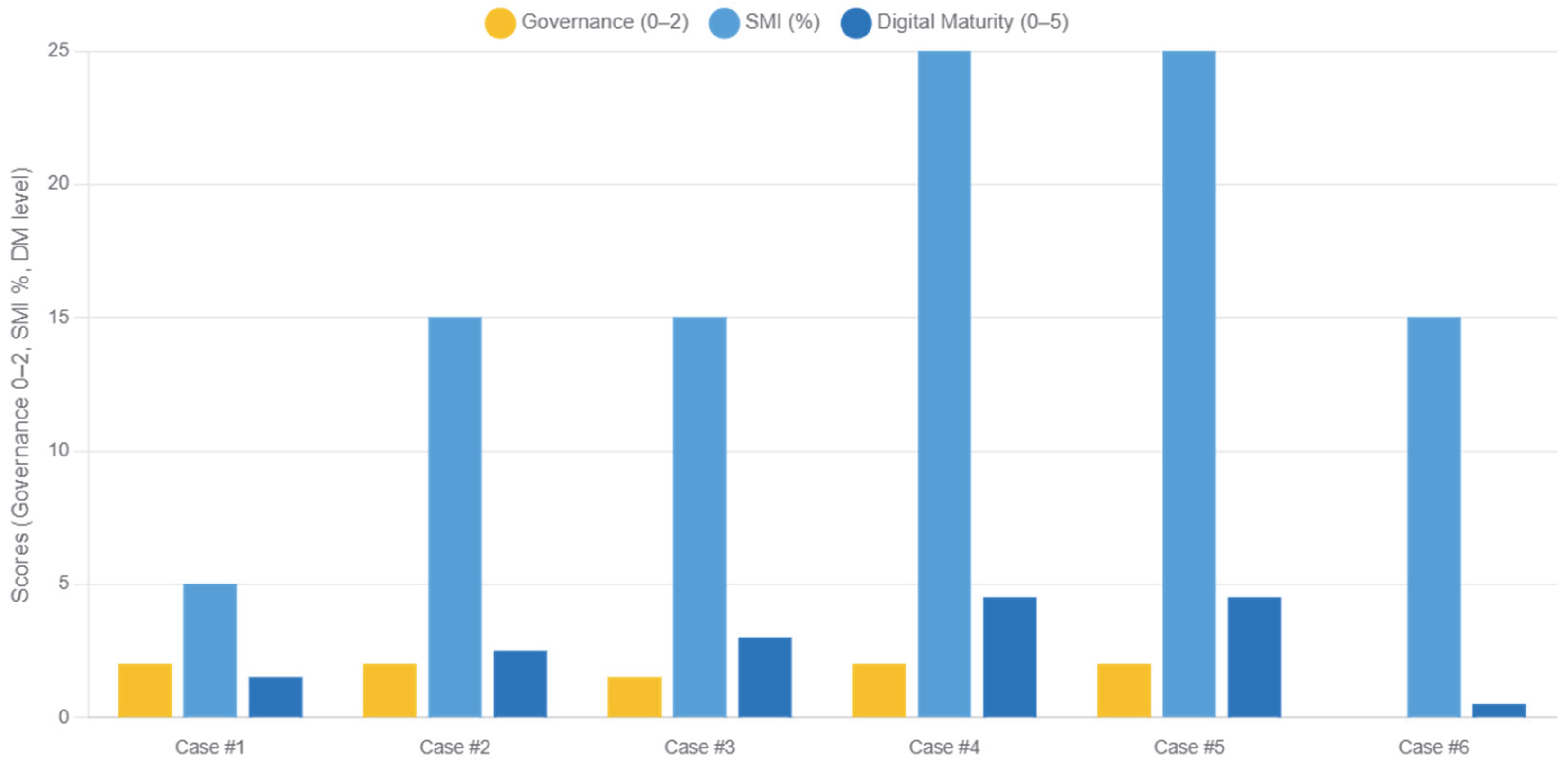
Figure 1 illustrates the interplay between governance, digital maturity, and sustainability across the six SMEs. Higher SMI scores tended to coincide with greater digital maturity, as observed in Cases 3, 4, and 5; Cases 4 and 5 also displayed stronger governance structures. However, this alignment was inconsistent: in Cases 3, 4, and 6, average SMI scores did not correspond to governance levels, which remained low to moderate in Cases 2 and 3. Case 1 stands apart, combining an almost equivalent governance and maturity score with the lowest SMI score, underscoring the uneven relationships among these three dimensions.
Figure 1.
Interplay between digital maturity, sustainability maturity index (SMI), and governance levels across the six SMEs.
Figure 1 reveals three distinct patterns across the six cases. First, Cases 4 and 5 show the strongest three-way alignment: high DMS, the highest SMI scores in the sample (20%), and the most developed governance structures (levels 2 and 3, respectively). Second, Cases 3 and 6 represent divergent trajectories: Case 3 achieves a relatively high SMI (19%) with intermediate digital maturity and limited governance formalization. In comparison, Case 6 attains an SMI of 13% despite the lowest DMS and the absence of a formal governance structure, suggesting that non-digital drivers of sustainability can partially compensate for limited digitalization. Third, Cases 1 and 2, despite different DMS levels (1.3 and 2.2), both record very low SMI scores (2% and 10%), reinforcing the association between low governance activation and minimal ESG integration regardless of digital tool availability. Together, these patterns support the argument that governance mechanisms condition rather than determine sustainability outcomes, and that the DMS–SMI relationship is moderated by sectoral and organizational context. The analytical workflow that provides evidence of the progression from raw data to typology construction is shown in Appendix A.
4. Discussion
The findings indicate that SMEs’ digital transformation trajectories are shaped by both internal capabilities and external constraints, resulting in heterogeneous pathways for sustainability integration [26]. As digital maturity increases, firms tend to expand the scope and structuration of their ESG practices, although this progression remains uneven and contingent on organizational and sectoral conditions. Case 6 is particularly instructive in this regard. Despite recording the lowest DMS in the sample (0.8), this firm achieved a Sustainability Management Index of 13%, higher than Cases 1 and 2, which display considerably greater digital maturity. This divergence suggests that digital infrastructure is not a prerequisite for basic ESG practice. In Case 6, sustainability awareness is driven by sectoral norms (manufacturing regulations on energy use and local employment), managerial commitment, and supplier relationships, rather than by digital monitoring systems. Drawing on dynamic capabilities theory [4], this illustrates that when sustainability routines are embedded in sectoral expectations and organizational culture rather than digital tools, ESG practices can emerge even in the absence of strong digital maturity. This finding suggests that while digital maturity broadly supports ESG integration, the relationship is moderated by the extent to which sustainability is already institutionalized through non-digital mechanisms, particularly in manufacturing SMEs operating under sector-specific regulatory and social pressures.
Building on these observations, three theoretical propositions are advanced. These propositions are exploratory: they are grounded in patterns observed across six cases and intended to generate hypotheses for future quantitative testing rather than to assert confirmed relationships. They are offered in the spirit of Yin’s [21] analytical generalization, extending insights beyond the immediate cases to broader theoretical contexts, and should not be interpreted as statistically validated claims:
- (P1) Digital maturity positively influences the scope and sophistication of ESG practices in SMEs, as firms evolve from compliance-oriented approaches toward more integrated and strategic forms of sustainability;
- (P2) Governance mechanisms condition the relationship between digital maturity and sustainability outcomes; while necessary, governance structures alone do not guarantee results, as their effectiveness depends on alignment with operational routines and decision-making processes.
- (P3) Firm size and sector moderate this relationship, with professional service firms generally facing fewer structural constraints than manufacturing firms, and larger SMEs exhibiting greater governance capacity.
These propositions contribute to the literature by linking digital maturity models with sustainability integration through a combined perspective that accounts for governance and sectoral variation. They extend prior work by emphasizing that digital transformation and sustainability should not be treated as parallel processes, but as interdependent dynamics embedded in organizational practices.
From a practical standpoint, the findings suggest that SMEs benefit from aligning digitalization initiatives with ESG objectives, rather than approaching them as separate agendas. For policymakers and support organizations, this implies that interventions should go beyond promoting technology adoption to include capability development in data governance and digital literacy. At the regional level, integrated programs combining digital training with ESG measurement and reporting may support more coherent transformation pathways, particularly for firms facing structural constraints.
The study is limited by its small sample size and regional focus, and the findings should therefore be interpreted as analytical rather than statistical generalizations. Future research could extend this work through larger samples and longitudinal designs to examine how digital maturity and sustainability co-evolve over time. The proposed propositions are suitable for testing using survey-based approaches and econometric methods, such as structural equation modeling or regression analysis, across diverse contexts. Further refinement of the measurement grid, particularly regarding data governance and digital literacy, may enhance its usefulness as a diagnostic tool. Mixed-method designs combining quantitative analysis with qualitative insights could also provide a deeper understanding of how digital maturity and sustainability become embedded in everyday organizational practices.
5. Conclusions
Within the boundaries of this six-case study, and consistent with Yin’s [21] standard for analytical generalization, the analysis suggests that digital maturity and sustainability practices follow recognizable but uneven pathways shaped by firm size, sectoral dynamics, and governance structures. These findings should not be extrapolated to all Quebec SMEs; rather, they offer theoretical propositions that can guide future hypotheses for testing the hybrid framework in larger, more diverse samples.
The findings demonstrate that digital maturity and sustainability do not evolve in lockstep. While higher levels of digitalization often coincide with more diversified ESG practices, governance mechanisms remain only partially mobilized. This reinforces the need to address digital transformation and sustainability as interdependent rather than parallel agendas. By combining structured indices with qualitative case portraits, the analysis highlighted uneven but interpretable trajectories. The cross-case synthesis led to an emergent typology distinguishing compliance-oriented firms, ESG diversifiers, and strategic integrators, which can support further research at scale.
The study contributes theoretically by linking maturity models with broad dynamic capabilities and socio-materiality, and practically by underscoring the importance of aligning digitalization with ESG frameworks [28,29,30]. Future research should test the proposed typology in larger, more diverse samples, refine the measurement grid, and adopt longitudinal and mixed-methods approaches.
Author Contributions
Conceptualization, S.V. and M.E.; methodology, S.V. and M.E.; software, S.V.; validation, S.V. and M.E.; formal analysis, S.V.; investigation, S.V.; resources, M.E.; data curation, S.V.; writing—original draft preparation, S.V.; writing—review and editing, H.Z., S.V. and M.E.; visualization, S.V. and H.Z.; supervision, M.E.; project administration, M.E.; funding acquisition, M.E. All authors have read and agreed to the published version of the manuscript.
Funding
This research was funded by MITACS [grant number IT34955], Social Sciences and Humanities Research Council (SSHRC) [grant number CRSH-SI-2022_25], Canada, and The Foundation of the University of Quebec at Chicoutimi (FUQAC) [grant number 321157].
Institutional Review Board Statement
The study was conducted in accordance with the Declaration of Helsinki, and approved by the Institutional Review Board of Comité d’éthique en recherche (CÉR) (Protocol code 2022-796 and date of 15 December 2022 approval).
Informed Consent Statement
Informed consent was obtained from all subjects involved in the study.
Data Availability Statement
Authors will make the anonymized data available upon reasonable request.
Acknowledgments
The authors would like to acknowledge support from Promotion Saguenay and the SADC network for data collection using the online assessment tool. During the review of this manuscript/study, the author(s) used generative AI for the purposes of revising source citations and copy editing. The authors have reviewed and edited the output and take full responsibility for the content of this publication.
Conflicts of Interest
The authors declare no conflicts of interest.
Abbreviations
The following abbreviations are used in this manuscript:
| SME | Small and Medium-sized Enterprise |
| ESG | Environmental, Social, and Governance |
| DMS | Digital Maturity Score |
| SMI | Sustainability Management Index |
| CSR | Corporate Social Responsibility |
| IT | Information Technology |
| ERP | Enterprise Resource Planning |
| CRM | Customer Relationship Management |
| PME | Petite ou Moyenne Entreprise [Small and Medium-sized Enterprise] |
| IoT | Internet of Things |
| VR | Virtual Reality |
| SaaS | Software as a Service |
| CEO | Chief Executive Officer |
| CPA | Chartered Professional Accountant |
| SADC | Sociétés d’Aide au Développement des Collectivités [Community Development Assistance Companies] |
| DM | Digital Maturity |
Appendix A. Analytical Workflow Diagram
The following chart clarifies the link between the NVivo qualitative coding layer and the quantitative index construction layer.
Appendix B. Full 54-Item Structured Case Protocol (Representative Items)
The complete instrument is provided below. Each item includes the question number, sub-dimension, item description, response format, and source reference. The full instrument is available from the corresponding author upon request.
References
- Government of Quebec. Portrait Statistique des PME au Québec 2023; Ministry of Economy, Innovation and Energy: Québec, QC, Canada, 2023. Available online: https://www.economie.gouv.qc.ca/ (accessed on 23 September 2025).
- OECD. Going Digital in Canada: SME Perspectives; OECD Publishing: Paris, France, 2021. [Google Scholar] [CrossRef]
- Vallée, S. Offrir aux PME régionales un outil d’autoaudit pour arrimer virage numérique et développement durable: Le projet PME 4.0 au Saguenay–Lac-Saint-Jean. Organ. Territ. 2023, 32, 141–144. [Google Scholar] [CrossRef] [Scilit]
- Teece, D.J. Explicating dynamic capabilities: The nature and microfoundations of sustainable enterprise performance. Strateg. Manag. J. 2007, 28, 1319–1350. [Google Scholar] [CrossRef] [Scilit]
- Mikalef, P.; Krogstie, J.; Pappas, I.O.; Pavlou, P.A. Exploring the relationship between big data analytics capability and competitive performance: The mediating roles of dynamic and operational capabilities. Inf. Manag. 2020, 57, 103169. [Google Scholar] [CrossRef] [Scilit]
- Orlikowski, W.J. Sociomaterial practices: Exploring technology at work. Organ. Stud. 2007, 28, 1435–1448. [Google Scholar] [CrossRef] [Scilit]
- Verhoef, P.C.; Broekhuizen, T.; Bart, Y.; Bhattacharya, A.; Dong, J.Q.; Fabian, N.; Haenlein, M. Digital transformation: A multidisciplinary reflection and research agenda. J. Bus. Res. 2021, 122, 889–901. [Google Scholar] [CrossRef] [Scilit]
- ISACA. COBI4 2019 Framework: Governance and Management Objectives; ISACA: Schaumburg, IL, USA, 2019. [Google Scholar]
- ISO/IEC 38500; Information Technology—Governance of IT for the Organization. ISO: Geneva, Switzerland, 2015.
- INTOSAI. Guidelines on Information Technology Audit; International Organization of Supreme Audit Institutions: Vienna, Austria, 2020. [Google Scholar]
- CMMI Institute. Capability Maturity Model Integration (CMMI), version 2.0; Carnegie Mellon University: Pittsburgh, PA, USA. Available online: https://cmmiinstitute.com (accessed on 23 September 2025).
- Gartner. Digital Maturity Model; Gartner Research: Stamford, CT, USA, 2019. [Google Scholar]
- Ertz, M. Le Marketing Responsable; Les Éditions JFD Inc.: Montréal, QC, Canada, 2021. [Google Scholar]
- Ertz, M.; Vallée, S.; Aboki, K.D.; Bourgeois, G.; Cheriet, M. Numérique Responsable au Québec [Responsible Digitalization in Quebec]. 12 May 2026. Available online: https://www.chairetds.ca/wp-content/uploads/2026/05/rapport-numerique-responsable-au-quebec.pdf (accessed on 23 September 2025).
- Brozzi, R.; Forti, D.; Rauch, E.; Matt, D.T. The advantages of Industry 4.0 applications for sustainability: Results from a sample of manufacturing SMEs. Procedia Manuf. 2020, 42, 512–519. [Google Scholar] [CrossRef] [Scilit]
- Pemer, F. Enabling digital transformation in professional service firms: The role of service innovation and service quality. J. Serv. Manag. 2020, 31, 249–272. [Google Scholar] [CrossRef] [Scilit]
- Gamache, S.; Abdul-Nour, G.; Baril, C. Étude du potentiel de l’Industrie 4.0 quant à la transformation de la PME manufacturière québécoise: Une analyse littéraire et expérimentale. Génie Ind. Prod. 2019, 2, 62–73. [Google Scholar] [CrossRef] [Scilit]
- Abilakimova, A.; Raithatha, M.; Streimikis, J. Digital and green maturity models: A systematic literature review. Int. J. Sustain. Eng. 2025, 18, 244–265. [Google Scholar] [CrossRef] [Scilit]
- Garzoni, A.; De Turi, I.; Secundo, G.; Del Vecchio, P. Fostering digital transformation in SMEs: A four-level approach. J. Bus. Res. 2020, 112, 283–364. [Google Scholar] [CrossRef] [Scilit]
- George, G.; Merrill, R.K.; Schillebeeckx, S.J.D. Digital sustainability and entrepreneurship: How digital innovations are helping tackle climate change and sustainable development. Entrep. Theory Pract. 2021, 45, 999–1027. [Google Scholar] [CrossRef] [Scilit]
- Yin, R.K. Case Study Research: Design and Methods, 5th ed.; Sage: Thousand Oaks, CA, USA, 2014. [Google Scholar]
- Eisenhardt, K.M. Building theories from case study research. Acad. Manag. Rev. 1989, 14, 532–550. [Google Scholar] [CrossRef] [Scilit]
- Fortin, M.F.; Gagnon, J. Fondements et Étapes du Processus de Recherche Qualitative; Chenelière Éducation: Montréal, QC, Canada, 2016. [Google Scholar]
- Ghobakhloo, M.; Iranmanesh, M. Digital transformation success under Industry 4.0: A strategic guideline for manufacturing SMEs. J. Manuf. Technol. Manag. 2021, 32, 1533–1556. [Google Scholar] [CrossRef] [Scilit]
- Silva, S.; Nuzum, A.; Schaltegger, S. Stakeholder expectations on sustainability performance measurement and assessment. J. Clean. Prod. 2020, 246, 119086. [Google Scholar] [CrossRef] [Scilit]
- Cardinali, S.; Pagano, A.; Carloni, E.; Giovannetti, M.; Governatori, L. Digitalization processes in small professional service firms: Drivers, barriers and emerging organisational tensions. J. Serv. Theory Pract. 2023, 33, 237–256. [Google Scholar] [CrossRef] [Scilit]
- Chin, T.; Jin, J.; Wang, S.; Caputo, F.; Rowley, C. Cross-cultural legitimacy for orchestrating ecosystem-based business models in China: A Yin–Yang dialectical systems view. Asia Pac. Bus. Rev. 2025, 31, 892–915. [Google Scholar] [CrossRef] [Scilit]
- Hoang, H. Navigating the digital landscape: An exploration of the relationship between technology-organization-environment factors and digital transformation adoption in SMEs. SAGE Open 2024, 14, 21582440241276198. [Google Scholar] [CrossRef] [Scilit]
- Quenum, G.G.Y.; Vallée, S.; Ertz, M. The digital maturity of small and medium-sized enterprises in the Saguenay-Lac-Saint-Jean region. Machines 2025, 13, 835. [Google Scholar] [CrossRef] [Scilit]
- Vallée, S.; Ertz, M.; Ouerghemmi, C.; Périn, A. Fostering sustainability through socioecological digital evolution: Evaluating Industry 5.0 preparedness in Quebec’s regional SMEs. In Accelerating the Socio-Ecological Transition: Strategies and Innovations for Sustainable Development; Boucher, J.-F., Frayret, J.-M., Gondim de Almeida Guimarães, L., Cheriet, M., Eds.; Springer: Cham, Switzerland, 2025; pp. 259–293. [Google Scholar] [CrossRef] [Scilit]
- DAMA International. DAMA-DMBOK: Data Management Body of Knowledge, 2nd ed.; Technics Publications: Basking Ridge, NJ, USA, 2017. [Google Scholar]
- Fitzgerald, M.; Kruschwitz, N.; Bonnet, D.; Welch, M. Embracing digital technology: A new strategic imperative. MIT Sloan Manag. Rev. 2013, 55, 1–12. [Google Scholar]
- Dremel, C.; Herterich, M.M.; Wulf, J.; Brenner, W. How AUDI AG established big data analytics in its digital transformation. MIS Q. Exec. 2017, 16, 81–100. [Google Scholar]
- Rodrigues, M.; Silva, A.; Antunes, D.; Rodrigues, A. The role of small and medium-sized enterprises (SMEs) in sustainable development: Case studies. Account. Manag. Rev. 2025, 29, 55–84. [Google Scholar] [CrossRef] [Scilit]
- Bocken, N.M.P.; Short, S.W.; Rana, P.; Evans, S. A literature and practice review to develop sustainable business model archetypes. J. Clean. Prod. 2014, 65, 42–56. [Google Scholar] [CrossRef] [Scilit]
- Kaplan, R.S.; Norton, D.P. The Balanced Scorecard: Translating Strategy into Action; Harvard Business School Press: Boston, MA, USA, 1996. [Google Scholar]

Disclaimer/Publisher’s Note: The statements, opinions and data contained in all publications are solely those of the individual author(s) and contributor(s) and not of MDPI and/or the editor(s). MDPI and/or the editor(s) disclaim responsibility for any injury to people or property resulting from any ideas, methods, instructions or products referred to in the content. |
© 2026 by the authors. Licensee MDPI, Basel, Switzerland. This article is an open access article distributed under the terms and conditions of the Creative Commons Attribution (CC BY) license.