Article

The Mediating Role of Psychological Well-Being in the Relationship Between Organizational Identification and Green Organizational Behavior

by
Habibe Reşat Cica
1,*,
Kerim Güvendi
2,* and
Ahu Tuğba Karabulut
3
1
Independent Researcher, Istanbul 34330, Türkiye
2
Independent Researcher, Istanbul 34146, Türkiye
3
Department of Economics and Finance, Faculty of Economics, Administrative and Social Sciences, Istanbul Kent University, Istanbul 34406, Türkiye
*
Authors to whom correspondence should be addressed.
Sustainability 2026, 18(12), 6130; https://doi.org/10.3390/su18126130 (registering DOI)
Submission received: 3 April 2026 / Revised: 6 June 2026 / Accepted: 11 June 2026 / Published: 15 June 2026
(This article belongs to the Section Sustainable Management)

Abstract

This study aims to investigate the effect of organizational identification (OI) on green organizational behavior (GOB) and the mediating role of psychological well-being (PWB) in this relationship. To achieve this research goal, a quantitative study was conducted using a structured questionnaire designed to assess the relevant variables. Data was collected from 264 white-collar employees in the service sector in Istanbul. Surveys were collected from participants face-to-face, using a judgmental sampling method. Hypotheses were tested using AMOS22, SPSS 24 and PROCESS Macro. The significance of indirect effects was analyzed by employing the bootstrapping technique. The results indicate that OI has positive and significant direct effects on GOB and PWB. Furthermore, PWB was found to significantly predict GOB. The bootstrapping analysis revealed that the indirect effect was significant, supporting a partial mediation model. This research illustrates that OI increases GOB both directly and indirectly through PWB. The findings are considered to be of relevance to the literature because this is one of the few studies that addresses the concept of green organizational behavior, which is a focal point in the organizational behavior literature, and it emphasizes the importance of psychological resources in promoting environmentally friendly behaviors within organizations.

1. Introduction

Today, issues like climate change, environmental pollution, the depletion of natural resources, and the disruption of ecological balance constitute a significant global agenda. These problems are prompting not only individuals but also organizations to assume responsibility for environmental sustainability [1]. Developing environmentally friendly policies and practices within organizations, protecting and sustaining natural resources, and having a sustainable future perspective are critical factors [2]. Within this framework, it is acknowledged that the environmentally conscious behavior of employees plays a significant role in organizations’ ability to achieve their sustainability goals [2,3].
In this context, studies in the business literature aimed at explaining how employees’ environmentally friendly behaviors in the workplace have increased significantly in recent years, and the concept of GOB has become central to these studies [4]. GOB refers to employee behaviors that contribute to environmental sustainability within the organization, reduce environmental damage, and support the conservation of natural resources [2]. Behaviors such as recycling, energy saving, or environmental awareness exhibited by employees in the workplace are among the important factors that increase the environmental sustainability performance of organizations [1].
It is believed that the psychological bond employees form with the organization is a significant determinant in exhibiting such behaviors [5,6]. In this context, OI is defined as an individual seeing themselves as part of the organization, adopting the organization’s goals and values, and integrating with organizational identity [5,7,8]. It is stated that employees who experience strong identification with their organizations are more inclined to exhibit behaviors that support the organization’s aims and values [9]. In this regard, it is argued that when employees strongly identify with their organizations, this encourages the internalization of organizational values and norms, which, in turn. supports the adoption of environmentally friendly behaviors in the workplace [10].
Furthermore, employees’ psychological resources are also considered an important determinant of this process. Specifically, PWB is defined as an individual finding meaning in his life, experiencing positive emotions, and having healthy psychological functioning [11]. It is evaluated that the level of PWB is related to the organizational commitment and motivation of employees and that this relationship can support behaviors for the benefit of the organization. Accordingly, PWB is considered an important factor that can strengthen the relationship between OI and GOB.
The contributions of this research for academics and practitioners can be grouped under three headings. First, this study responds to calls in the literature for a more comprehensive examination of the social outcomes of GOB [4,12]. Second, OI, GOB and PWB are considered the main outputs of the research and the relationships between these structures were analyzed with a holistic approach. Third, empirical testing was conducted to assess whether PWB plays a mediating role in the relationship between OI and GOB. The theoretical contribution of the study is based on its application as an inclusive framework that supports the projected relations based on Social Exchange Theory and Social Identity Theory.

2. Literature Review and Developing Hypotheses

2.1. Green Organizational Behavior

In recent years, with the increasing awareness of how climate change threatens the natural environment, there is a growing interest in studies of GOB to support environmental sustainability [2,4,13,14,15,16], reduce people’s negative impacts on the environment, and increase environmental performance [17]. Studies on employees’ green behaviors (EGB) have broadened the focus of sustainability efforts in organizations from the organization as a whole to individual actions. The significant contribution of employees to sustainability programs has also been acknowledged [3]. GOB is defined as employee behaviors that cause the least harm to the environment, as well as those that benefit it [18]; employee actions and behaviors that are related to and contribute to environmental sustainability or negatively impact it [2]; work behaviors exhibited by employees at all levels of the organization that protect or improve the natural environment, create value for the organization, or do not create value for the organization [19]. Additionally, it refers to attitudes and actions of employees that greatly help the organization in achieving its environmental sustainability goals [2,17].
In the literature, this concept is generally referred to as GOB [20,21,22,23,24,25], EGB [2,4,12,26,27,28,29] and pro-environmental behavior [16,30,31,32,33,34,35,36,37,38,39]. In addition, it is used to assess employees’ pro-environmental behavior [1,40,41], employee workplace green behavior [42,43], green workplace behavior [44], workplace green behavior [45], and eco initiatives [13,14]. When the literature examines how and why GOB emerged, it is supported by studies [13,41,46] that show it is based on various organizational and psychological theories [17,41]. This concept is examined based on normative, attitudinal, motivational, and exchange theories [17]. Research shows that GOB has been examined through various dimensions and classifications. In the literature, this concept has primarily been examined in two main areas. Green behaviors exhibited by employees in the workplace [14,16,38,47] and at home [18] have been considered voluntary behaviors [17]. Conversely, it has been stated that EGBs in the organization are not only performed voluntarily [48], but employees can also perform them as mandatory behaviors as part of their jobs [17,39]. Accordingly, GOB has been studied in terms of voluntary and mandatory aspects, and the studies conducted have supported this distinction [12,39].
In addition, Ref. [2] examined this concept in five dimensions: sustainability of work, resource conservation, influencing others, taking initiative, and avoiding harm. Ref. [49] addresses the concept in three dimensions: recycling activities, energy-saving activities, and activities that reduce printer output. Ref. [50] describes the concept in four dimensions: individual application, green learning, organizational voices, and influencing others. In the local literature, Ref. [21] develops a green behavior scale, categorizing the concept into five dimensions: environmental participation, environmental sensitivity, green purchasing, economic sensitivity and technological sensitivity.
From an organizational perspective, environmentally friendly practices can help employees solve environmental problems [39], contribute to organizational sustainability goals [3,17,51], improve the organization’s performance [1,47,52,53] and minimize the organization’s impact on harmful environmental changes [37].

2.2. Organizational Identification

The concept of identification is described by [54] as “an emotional tie with another person” [55]. It has been defined in the organizational behavior literature [56] as the process by which an employee’s goals become more integrated with the organization to which they feel a sense of belonging [7]. The first modeling of this concept, its multi-level structure, and the study of its antecedents and successors were carried out by [57] and included in the management literature [58].
Based on Social Identity Theory, OI refers to employees’ sense of belonging to the organization, their perception of integrity with the organization in both success and failure, the increasing alignment of individual and organizational goals, and the process of integration of the individual’s and organization’s identities [5,7,8]. When this alignment and integration increase, employees adopt organizational goals and values, internalize activities related to their organizational roles, and increase their commitment to their organizations [59]. Employees perceive the organization’s success as their own success and its failure as their own failure, considering themselves identical with the organization [60].
When employees identify with their organizations, they believe that behaviors beneficial to their organizations will also benefit them [61] and therefore [6] they begin to care more about the organization in which they are a part of and make extra efforts for its benefit [62]. According to [6], employees form a cognitive link in identifying their personal characteristics with the characteristics of the organization, and with this link, the individual feels like a part of the organization. Ref. [63] emphasized that when employees identify with their organizations, they willingly engage in behaviors that support their organizations and voluntarily strive for their organization’s benefit.
When employees feel connected to their organizations, they are loyal to their organizations as members and are proud of this, support their organizations, share organizational goals and values, and are excited about organizational goals [64]. The concept of organizational identification, developed by [65], has been taken to another dimension by [5] Social Identity Theory [5]; social identity and self-classification theories have formed the theoretical foundations of the concept of OI [9]. Studies have shown that the degree of an individual’s commitment to an organization is firmly related to the level of OI and is influenced by many positive factors within the organization, such as motivation, cooperation, and group work [58,66].

2.3. Psychological Well-Being

Mental health refers to a state where a person can understand their own strengths, manage the everyday challenges in life, perform their tasks efficiently, and support their community. In this respect, it is considered a structure that forms the basis of well-being and effective functioning at both the individual and societal levels [67]. Increasing interest in the positive dimensions of mental health contributes to the development of an approach to evaluating individuals’ psychological experiences within a more comprehensive and functional framework. In this regard, it is emphasized that an assessment understanding that focuses not only on the negative aspects but also on the positive dimensions of mental health is becoming increasingly widespread [68,69,70,71,72].
Ref. [73]’s study on the structure of PWB was the first study that clearly separates positive and negative emotions [74]. This study aimed to understand the effects of macro-level social transformations (e.g., differences in education levels, employment patterns, urbanization processes, or political tensions) on individuals’ living standards and, consequently, their perceptions of PWB [11]. Refs. [75,76] examined the question of well-being from a lifelong perspective; in this context, they defined well-being as “the striving for perfection that represents the realization of one’s true potential” [77,78]. PWB has expanded to include not only the individual’s emotional state but also dimensions related to how they make sense of their lives and how they pursue personal development [11,79]. This conceptual expansion is highlighted by [11] eudaimonic model, which treats PWB as a multidimensional structure. This model explains PWB through the dimensions of accepting oneself, positive interpersonal relationships, environmental mastery, autonomy, life purpose, and individual development [11]. This six-part view of PWB is seen as a process of self-actualization [11,80]. Psychological well-being is defined as a multidimensional construct encompassing the presence of positive indicators such as positive emotionality and eudaimonic functioning, as well as the absence of negative conditions such as negative emotionality and psychopathological symptoms [81]. Consequently, identifying basic psychological needs not only determines the minimum requirements for psychological health but also reveals the conditions that the social environment must provide for individuals to develop and achieve PWB [78].
PWB is considered a multidimensional construct that expresses the optimal psychological functioning and experience of the individual [78]. At the organizational level, well-being is mostly associated with job satisfaction from a hedonic point of view, and from an edamonic point of view, it is associated with the individual’s realization of his potential and finding meaning and purpose at work [82]. In this regard, it is considered that employees’ levels of PWB can be shaped in relation to the social and organizational environment in which they operate. Within the framework of the Social Exchange Theory approach, it is pointed out that the support and positive experiences that employees perceive from their organization may be related to their PWB levels.

2.4. Development of Hypotheses

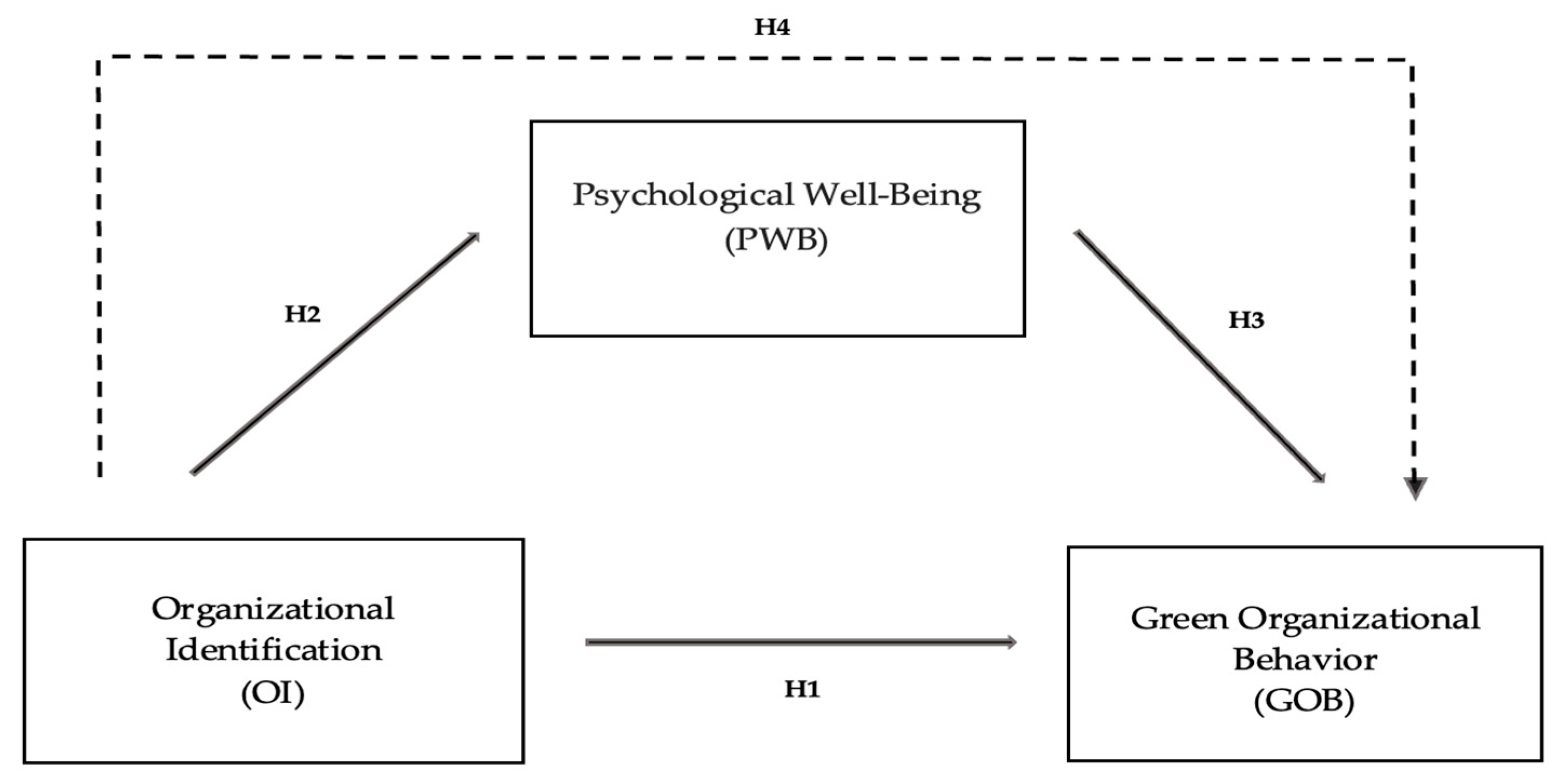
Individuals who identify themselves with their organizations think that behaviors beneficial to the organization will also benefit them [61], and therefore, tend to place greater importance on the organization’s goals and interests, making extra efforts for the benefit of the organization [62,63]. In this context, employees are expected to be in solidarity with other employees and provide more behavioral and attitudinal support to the organization [64]. Especially when it comes to organizations’ environmental sustainability goals, employees who develop a strong identification with the organization are expected to adopt the organization’s environmental goals and values and exhibit more green organizational behaviors. Research in the literature also shows a positive and significant relationship between OI and GOP [10,24,83,84,85,86,87,88,89]. Accordingly, the following hypothesis has been developed:
Hypothesis 1 (H1).
OI positively affects GOB.
OI positively influences PWB through an individual’s integration with the organization [5] and the adoption of organizational goals [5,7]. Empirical findings confirm that this relationship is statistically significant and that as identification increases, employees’ purpose in life, health, and emotional resilience are strengthened [90,91,92,93]. Accordingly, the following hypothesis has been formulated:
Hypothesis 2 (H2).
OI positively affects PWB.
Positive organizational psychology studies have shown that they offer a critical theoretical framework for explaining the individual determinants of employees’ environmentally friendly behaviors [94,95,96]. In particular, EGB has been defined as a significant predictor of PWB; environmentally conscious behaviors have been shown to contribute to employee welfare by increasing self-esteem [50]. Furthermore, a positive and statistically significant relationship has been found between PWB and GOB [25,97]. Based on these findings, the following hypotheses have been developed.
Hypothesis 3 (H3).
PWB positively affects GOB.
Hypothesis 4 (H4).
PWB mediates the positive relationship between IO and GOB.
The research model, including the proposed variables and hypotheses, is presented in Figure 1, offering a comprehensive conceptual framework for the study.

3. Research Method

3.1. Data Collection

This article takes the form of quantitative field research conducted among 264 white-collar employees in the service sector in Istanbul. Due to time and cost constraints, a non-random sampling method, judgmental sampling, was applied. This was used because the participants to be selected for the research have certain characteristics, making sample selection easier for the researcher [98]. The sampling method chosen by the researcher is judgmental sampling because the sample consists of specific private-sector employees. The surveys were administered to participants in person.
The research survey included demographic questions regarding participants’ personal information and scale questions related to the variables. Its analysis was based on data collected from 264 respondents.
In the first stage, descriptive statistics regarding demographic and occupational characteristics were determined using the SPSS 24 program. Confirmatory Factor Analysis (CFA) was performed in order to test whether the factor structure was supported by the observed data to assess the psychometric properties of the measurement instruments using AMOS 22. Based on the CFA results, one item with a low factor loading was removed to improve the overall measurement quality of the variables.
Model fit was assessed using multiple goodness-of-fit indices. In addition, internal consistency reliability was explored by using Cronbach’s alpha and Composite Reliability (CR), while Average Variance Extracted (AVE) values were calculated to assess convergent validity. Pearson correlation analysis was performed to explore the relationships between the variables after the validity and reliability of the measurement model were established.
Mediation relation results were analyzed using PROCESS Macro to test the research hypotheses and investigate the mediating role of PWB in the relationship between OI and GOB, following Hayes’ recommendations [99]. The significance of indirect effects was assessed using a bootstrap method with 5000 resamples and 95% confidence intervals. An indirect effect was considered statistically significant when the confidence interval did not include zero. This calculation tool provided a positive baseline for the variable. Table 1 presents the demographic characteristics of the participants.
The demographic characteristics of the sample reveal that the survey of private-sector employees represents a relatively educated and young set of participants. There are more female participants (57.20%) and more than half of the participants are single (58.33%). A large group of the participants (39.39%) is between 26 and 35 years old, highlighting a population in the early or middle stages of their career.
Most of the participants hold bachelor’s, master’s and Phd degrees, which highlights the prominence of higher education. The five years or less working duration of the participants underlines the high workforce mobility in the private sector. However, the total work experience of participants is more evenly distributed, and a large group of them has 16 years or more experience.

3.2. Sample Size

There are many scientific opinions in the literature regarding the determination of sample size. In this research, the number of participants to be reached was planned by considering the number of scale items included in the questionnaire. According to [100], a sample size that is three to six times the number of items on the scale is important for the reliability of the research [101].
In this context, since the questionnaire consists of 43 questions, collecting data from 215 participants, which is five times the number of questions, would be appropriate for ensuring reliability. Therefore, analyses were carried out using data obtained from 264 participants.

3.3. Scales of Research

The variables are OI, GOB, and PWB. The scales of these variables were adopted from studies translated into Turkish to ensure the rationality of the survey structure in the study. The items of OI and GOB were measured using a five-point Likert scale (1 = strongly disagree; 5 = strongly agree). On the other hand, the items of PWB were measured using a seven-point Likert scale (1 = strongly disagree; 7 = strongly agree).

3.3.1. OI

The study used the “Organizational Identification Scale”, which was developed by [102] and adapted into Turkish by [103]. The scale includes six items. The internal consistency coefficient (Cronbach’s alpha) of the scale was identified as 0.80.

3.3.2. GOB

The study used the “Green Organizational Behavior Scale”, which was developed in Turkish by [21]. The scale includes twenty-seven items. The internal consistency coefficient (Cronbach’s alpha) of the scale was identified as 0.81.

3.3.3. PWB

The study used the “Psychological Well-Being Scale”, which was developed by [104,105] and adapted into Turkish by [106]. The scale has a single dimension and eight items. The internal consistency coefficient (Cronbach’s alpha) of the scale was identified as 0.87.

3.4. Statistical Analyses

3.4.1. Confirmatory Factor Analysis (CFA)

Confirmatory Factor Analysis (CFA) was conducted to test whether the hypothesized factor structure fits the data, as presented in Table 2.
The overall fit indices highlight that the proposed model shows an acceptable level of fit. The χ2/df ratio (2.838) is within the recommended threshold, which reveals an adequate balance between model complexity and explanatory power. Both RMSEA (0.074) and SRMR (0.071) are below the accepted upper limit of 0.08, highlighting an acceptable absolute and residual-based model fit. Also, the CFI value (0.901) remains slightly above the conventional cutoff of 0.90, reflecting an acceptable absolute model fit. These results reveal that the model presents an acceptable prediction of the data.

3.4.2. Confirmatory Factor Analysis (CFA) Factor Loadings

CFA factor loadings are calculated in Table 3 to determine how well each observed item represents its underlying latent construct and to assess the measurement model’s validity.
The Confirmatory Factor Analysis results highlight that the model shows generally satisfactory item-level validity across determined constructs. Standardized factor loadings for PWB, environmental sensitivity (ES), environmental participation (EP), economic sensitivity (ECS), green purchasing (GP), technological sensitivity (TS) and OI are predominantly above the recommended threshold of 0.50. They are also statistically significant (p < 0.001) and support the convergent validity. GOB 19 was excluded from the analysis due to its very low standardized factor loading (0.142), which did not meet acceptable criteria and could adversely affect the construct’s measurement quality. After removing this item, the remaining indicators were standardized, and regression weights, acceptable standard errors, and statistically significant proportions were calculated. These results demonstrate that the reliability and validity requirements were met.

3.4.3. Confirmatory Factor Analysis (CFA) Measurement Model

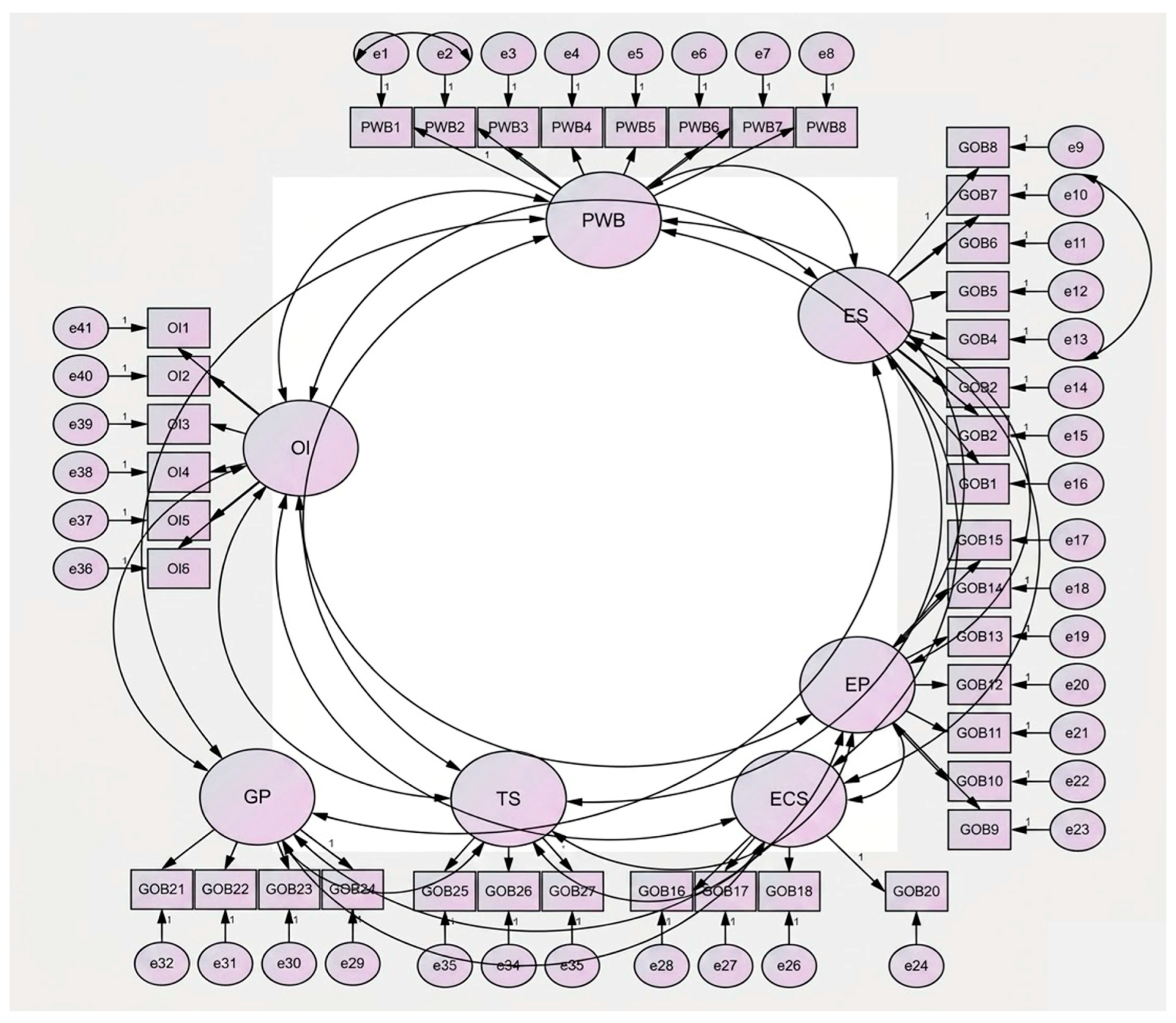
Figure 2 illustrates a comprehensive structural equation model in which OI and PWB are linked to multiple dimensions of GOB, including ES, EP, ECS, GP and TS. Each latent construct is measured by its observed indicators, with directional paths representing the hypothesized relationships among the constructs.

3.4.4. Validity and Reliability Analysis

In this analysis, internal consistency reliability was assessed using Cronbach’s alpha and Composite Reliability (CR), while convergent validity was evaluated by examining Average Variance Extracted (AVE) values, as presented in Table 4.
The reliability and validity results highlight that the measurement model demonstrates overall acceptable psychometric properties. Cronbach’s alpha values for various structures were found to be in the range of 0.50 to 0.70. Although some Cronbach’s alpha values were slightly below the recommended threshold of 0.70, values around 0.50–0.60 can be considered acceptable in exploratory research and for newly adapted scales [107,108,109]. Furthermore, while the presence of several constructs shows Cronbach’s alpha values below the 0.60 threshold, this is considered acceptable in exploratory and complex models, particularly when Composite Reliability (CR) values exceed the recommended cutoff of 0.60 or 0.70 [107,110]. According to [111], a Composite Reliability (CR) value of 0.70 or higher indicates adequate internal consistency of the latent construct, meaning that the indicators reliably represent the underlying factor. In this study, all constructs exhibit satisfactory CR values, which supports the reliability of internal consistency. Mean Variance Inference (AVE) values above or equal to the recommended threshold of 0.50 for the constructs indicate that adequate internal consistency and convergent validity have been confirmed and that a sufficient part of the variance in the indicators of hidden units is explained [111]. Although the AVE for ES is marginally below 0.50, its strong CR value still suggests adequate convergent validity [110]. These findings strengthen the reliability and convergent validity of the scales of the study by highlighting that the measurement model is suitable for subsequent structural analyses.

3.4.5. Correlation Analysis

Pearson correlation analysis examines the direction and strength of the linear relationship between two variables. These coefficients are between −1 and +1. Values close to ±1 indicate strong relationships. This is used to explore relationships among variables before conducting more advanced statistical analyses [112].
Table 5 illustrates the correlation matrix and highlights that GOB is positively related to its core dimensions and that all relationships are statistically significant at the 0.01 level by pointing out a coherent construct. Moderate-to-strong correlations among these dimensions show that they represent related but distinct findings of environmentally responsible behavior. PWB has weak yet significant positive relationships with most variables, showing a limited but positive association with green behaviors. PWB exhibits relatively weak but statistically significant positive correlations with most variables, implying that higher levels of well-being are associated with green behaviors, although the strength of these relationships is limited. In contrast, OI demonstrates consistently positive and significant correlations with both GOB and PWB, highlighting its meaningful role in fostering employees’ environmental engagement and psychological attachment to the organization.

3.4.6. Mediation Effect Analysis

The mediation analysis was conducted using PROCESS Model 4 with a bootstrapping procedure of 5000 resamples, following Hayes’ recommendations. A 95% confidence interval was utilized to estimate the indirect effect without relying on normality assumptions. The results indicate a significant mediating effect because the bootstrap confidence interval does not include zero, as presented in Table 6. This bootstrapping approach is widely accepted as a method for testing mediation effects in behavioral and social science research [99].

4. Results

Based on the values presented in the table, the results of the study’s hypotheses can be explained as follows:
The results present strong support for H1 by highlighting that OI has a positive and statistically significant direct effect on GOB (β = 0.1946, p < 0.001). The confidence interval does not include zero [0.1102, 0.2791], confirming the robustness of this relationship. This suggests that employees who have strong connections to their organizations demonstrate more environmentally conscious behaviors, even if the effect size is not large.
Hypothesis 2 is supported due to the positive and enhancing effect of OI on PWB (β = 0.4172, p < 0.001). This strong effect size reveals that OI is a significant precursor of PWB in employees. The narrow confidence interval [0.2958, 0.5386] shows the significance and stability of this relationship.
PWB has a significant and positive direct effect on GOB (β = 0.1888, p < 0.001), which is consistent with H3. The confidence interval [0.1107, 0.2668] points out that higher levels of PWB are related to greater engagement in green behaviors. This finding underlines the role of individual psychological resources in promoting environmentally responsible organizational actions.
Consequently, hypothesis H4 is supported due to the mediation of PWB in the relationship between OI and GOB. The indirect effect is significant and positive (β = 0.0788) and has a zero-exclusion bootstrap confidence interval [0.0353, 0.1269]. This reveals a significant calculation for mediation. These results show partial mediation and strengths that OI affects GOB both directly and indirectly by increasing PWB with a significant direct effect.
The results of the PROCESS Model 4 analysis reveal that OI has a significant direct effect on GOB (H1) and PWB (H2), while PWB exerts a significant positive effect on GOB (H3). The bootstrapped indirect effect of OI on GOB through PWB is statistically significant and the intervals do not include zero. This provides support for the mediating role of PWB (H4). These findings demonstrate partial mediation, indicating that OI affects GOB both directly and indirectly via PWB.

5. Discussion

This research investigated the effects of OI on GOB, and the analysis underlined a significant and positive relationship between the two variables. In this context, employees who identify with their organizations are expected to exhibit more GOB towards achieving the environmental goals of their organizations, as they perceive the success of their organizations as their own success. A review of the literature reveals that studies by [10,24,83,84,85,86,88,89,94,113] have found a significant and positive relationship between OI and GOB. These studies support the findings of this research.
Additionally, this study examined the effect of OI on PWB, and the analysis revealed a positive and significant relationship between the two variables. This finding indicates that employees who develop a strong identification with their organizations perceive their organizations as part of their own identity, which can positively affect their PWB. The adoption of organizational goals and values by employees can contribute to individuals feeling more meaningful and valuable within the organization, thus supporting their PWB. The results obtained in this regard are parallel to the findings of earlier studies, which show that OI positively affects employees’ well-being [90,91,92,93]. These results suggest that the psychological bond employees develop with their organizations can play a prominent role in shaping their individual well-being.
This research also examined the effect of PWB on GOB, and the analysis results show that PWB has significant and positive effects on GOB. Studies in the literature indicate that environmental awareness and relationships with nature are related to individuals’ well-being and pro-environmental attitudes [114]. Furthermore, it is stated that awareness-based practices implemented by organizations can improve employees’ psychological resources and green performance [115]. Similarly, positive relationships are observed between environmental organizational citizenship behavior and PWB, job satisfaction and emotional commitment [116]. Recent studies also show that employees’ levels of well-being positively influence green behaviors and green human resource practices can support employee well-being through green behaviors [117,118]. These results are parallel to the findings of earlier studies and support the relationships mentioned in the literature.
The research results show that OI has a significant effect on GOB; PWB has a significant effect on GOB; and PWB has a partial mediating effect on the impact of OI on employees’ green organizational behavior.
To strengthen the impact of OI and PWB levels on GOB, practices can be conducted that encourage all organization members to participate in environmentally friendly activities (such as tree planting events). Such activities can increase integration among employees and contribute to strengthening organizational ties. Furthermore, sharing environmental goals and values can strengthen employees’ sense of belonging to the organization and support the retention of organizational membership.
The establishment and systematic monitoring of environmental goals and strategies by organizational management can significantly contribute to improving the environmental performance of organizations. In this context, developing practices that encourage employee participation in the dissemination of environmentally friendly practices, the creation of participatory processes that support the emergence of new environmental ideas, and implementation of reward systems that encourage environmentally friendly behaviors can be beneficial for organizations. Furthermore, the effective planning and management of organizational resources can significantly contribute to increasing energy efficiency and preventing resource waste within the organization.
Considering the relationship between the PWB of employees, both OI and GOB are crucial for organizations to develop green environmental activities. Accordingly, encouraging employees to adopt environmental goals and strategies set by the organization and actively participate in these processes can contribute to environmental sustainability. Additionally, implementing organizational policies and procedures with managerial support and developing reward systems that support environmentally friendly behaviors can play an encouraging role in increasing GOB among employees.
The findings obtained within the framework of Social Exchange Theory and Social Identity Theory indicate that levels of OI may be related to employees’ PWB and the GOB they exhibit in the workplace. Furthermore, it is considered that high levels of PWB appear to be linked to employees’ tendencies to engage in GOB in the workplace.

6. Conclusions

This study examined the relationships between OI, PWB and GOB within a holistic structural model framework and presented empirical findings on the direct and indirect effects between the variables. The findings show that the research model has generally acceptable fit values and that the measurement model exhibits sufficient measurement characteristics in terms of validity and reliability.
The research results show that OI has a significant and positive direct effect on GOB. This finding indicates that as the level of belonging and integration that employees establish with their organizations increases, their tendency to exhibit environmentally conscious and sustainable behaviors also strengthens. Similarly, the significant and positive effect of OI on PWB reveals that the level of identification that employees establish with the organization acts as a mechanism to increase their PWB.
This finding provides support for the idea that organizational belonging strengthens an individual’s psychological resources, thereby supporting their perception of mental health and life satisfaction.
The positive and significant impact of PWB on GOB reveals that individual psychological resources play a significant role in shaping environmentally friendly behaviors. This finding indicates that sustainability-oriented behaviors are related not only to corporate policies and practices but also to individual psychological factors such as employees’ levels of PWB.
Mediation analyses showed that PWB plays a partial mediating role in the relationship between OI and GOB. In other words, OI affects employees’ green behaviors both directly and indirectly by increasing PWB. This finding suggests that PWB is a critical variable in developing sustainable organizational behaviors.
Overall, the research findings indicate that structural and policy-based adjustments alone are insufficient for organizations to achieve their environmental sustainability goals; employees’ levels of OI and PWB are also strategic determinants. In this context, managers’ focus on practices that strengthen organizational belonging and human resource policies that support PWB contribute to the sustainable institutionalization of green organizational behavior.
In conclusion, this study provides a holistic model explaining the relationships between organizational identification, PWB and GOB, offering both theoretical and empirical contributions to the literature and emphasizing the importance of individual psychological processes in the context of sustainability.
This study offers important insights, particularly for the private sector. However, the fact that the study was conducted exclusively among private-sector employees means it was constrained by time and cost limitations, and that some of the scales used had relatively low reliability scores; these can be considered among the study’s main limitations. Therefore, future validation studies conducted on different samples could contribute to retesting the reliability of the measurement tools and strengthening the robustness of the findings.
In future studies, increasing the sample size, including participants from different sectors and countries, and analyzing the subdimensions of GOB separately can enable a more comprehensive assessment of the relationships between concepts and enhance the explanatory power of the findings. This will also enable a more detailed assessment of the validity of the findings in different organizational and cultural contexts.
This study is significant because it addresses green organizational behavior (GOB) and psychological well-being (PWB), which are relatively new research areas in the organizational behavior literature, and contributes to the literature on environmental sustainability and green organizations. Accordingly, a comprehensive understanding of organizational awareness and the effects of awareness on employees’ environmentally friendly behaviors is needed for future studies.
These concepts, which are gaining increasing importance in the field of organizational sciences, offer a broad scope for future research. Therefore, researchers are encouraged to examine the subject more comprehensively using more advanced statistical analysis techniques and different research designs.

Author Contributions

Conceptualization, H.R.C. and K.G.; Methodology, H.R.C. and K.G.; Software, K.G.; Formal analysis, K.G.; Data curation, A.T.K., H.R.C. and K.G.; Writing—review and editing, H.R.C. and K.G.; Project administration, A.T.K. All authors have read and agreed to the published version of the manuscript.

Funding

This research received no external funding.

Institutional Review Board Statement

The study was conducted in accordance with the Declaration of Helsinki, and approved by the Ethics Committee of Istanbul Kent University (Protocol Code: 2026/03; date: 15 March 2026).

Informed Consent Statement

Informed consent was obtained from all subjects involved in the study.

Data Availability Statement

The datasets presented in this article are not readily available because the data are part of an ongoing study. Requests to access the datasets should be directed to [habisko@yahoo.com].

Conflicts of Interest

The authors declare no conflicts of interest.

References

  1. Robertson, J.L.; Barling, J. Greening organizations through leaders’ influence on employees’ pro-environmental behaviors. J. Organ. Behav. 2013, 34, 176–194. [Google Scholar] [CrossRef]
  2. Ones, D.S.; Dilchert, S. Employee green behaviors. In Managing Human Resources for Environmental Sustainability; Jackson, S.E., Ones, D., Dilchert, S., Eds.; Jossey-Bass: San Francisco, CA, USA, 2012; pp. 85–116. Available online: https://psycnet.apa.org/record/2012-23825-005 (accessed on 2 February 2026).
  3. Ones, D.S.; Wiernik, B.M.; Dilchert, S.; Klein, R.M. Multiple domains and categories of employee green behaviors: More than conservation. In Research Handbook on Employee Pro-Environmental Behavior; Wells, V., Gregory-Smith, D., Manika, D., Eds.; Edward Elgar Publishing: Cheltenham, UK, 2018; pp. 13–38. [Google Scholar]
  4. Zhang, X.; Patnaik, S.A.; Zhang, N. Employee green behavior: Bibliometric-content analysis. Heliyon 2024, 10, e31045. [Google Scholar] [CrossRef]
  5. Ashforth, B.E.; Mael, F. Social identity theory and the organization. Acad. Manag. Rev. 1989, 14, 20–39. [Google Scholar] [CrossRef]
  6. Dutton, J.E.; Dukerich, J.M.; Harquail, C.V. Organizational images and member identification. Adm. Sci. Q. 1994, 39, 239–263. [Google Scholar] [CrossRef]
  7. Hall, D.T.; Schneider, B.; Nygren, H.T. Personal factors in organizational identification. Adm. Sci. Q. 1970, 15, 176–190. [Google Scholar] [CrossRef]
  8. Li, J.; Xin, K.; Pillutla, M. Multicultural leadership teams and organizational identification in international joint ventures. Int. J. Hum. Resour. Manag. 2002, 13, 320–337. [Google Scholar] [CrossRef]
  9. Van Dick, R. Identification in organizational contexts: Linking theory and research from social and organizational psychology. Int. J. Manag. Rev. 2001, 3, 265–283. [Google Scholar] [CrossRef]
  10. Kim, B.J.; Lee, S.H.; Lee, J. The impact of work overload on pro-environmental behavior at work: The mediating role of organizational identification and the moderating role of corporate social responsibility. Sustain. Dev. 2025, 33, 6418–6435. [Google Scholar] [CrossRef]
  11. Ryff, C.D. Happiness is everything, or is it? Explorations on the meaning of psychological well-being. J. Pers. Soc. Psychol. 1989, 57, 1069–1081. [Google Scholar] [CrossRef]
  12. Norton, T.A.; Zacher, H.; Ashkanasy, N.M. Organisational sustainability policies and employee green behavior: The mediating role of work climate perceptions. J. Environ. Psychol. 2014, 38, 49–54. [Google Scholar] [CrossRef]
  13. Ramus, C.A.; Killmer, A.B.C. Corporate greening through prosocial extrarole behaviors: A conceptual framework for employee motivation. Bus. Strategy Environ. 2007, 16, 554–570. [Google Scholar] [CrossRef]
  14. Daily, B.F.; Bishop, J.W.; Govindarajulu, N. A conceptual model for organizational citizenship behavior directed toward the environment. Bus. Soc. 2009, 48, 243–256. [Google Scholar] [CrossRef]
  15. Boiral, O.; Paillé, P. Organizational citizenship behaviour for the environment: Measurement and validation. J. Bus. Ethics 2012, 109, 431–445. [Google Scholar] [CrossRef]
  16. Paillé, P.; Boiral, O. Pro-environmental behavior at work: Construct validity and determinants. J. Environ. Psychol. 2013, 36, 118–128. [Google Scholar] [CrossRef]
  17. Norton, T.A.; Parker, S.L.; Zacher, H.; Ashkanasy, N.M. Employee green behavior: A theoretical framework, multilevel review and future research agenda. Organ. Environ. 2015, 28, 103–125. [Google Scholar] [CrossRef]
  18. Steg, L.; Vlek, C. Encouraging pro-environmental behaviour: An integrative review and research agenda. J. Environ. Psychol. 2009, 29, 309–317. [Google Scholar] [CrossRef]
  19. Ciocirlan, C.E. Environmental workplace behaviors: Definition matters. Organ. Environ. 2017, 30, 51–70. [Google Scholar] [CrossRef]
  20. Erbaşı, A.; Özalp, Ö. Çevre tutkusu ve yeşil örgütsel davranışın örgütsel bağlılık üzerindeki etkisi. Eurasian Bus. Econ. J. 2016, 2, 297–306. [Google Scholar]
  21. Erbaşı, A. Yeşil örgütsel davranış ölçeği: Bir ölçek geliştirme çalışması. Istanb. Manag. J. 2019, 86, 1–23. [Google Scholar] [CrossRef]
  22. Sönmez, R.V. Okul yöneticilerinin yeşil örgütsel davranışlarını belirlemeye yönelik bir araştırma. Anemon Mus Alparslan Univ. J. Soc. Sci. 2020, 8, 1107–1119. [Google Scholar] [CrossRef]
  23. Erbaşı, A.; Çalışkan, A.; Akdeniz, G. The effect of personality traits on green organizational behavior. Cankiri Karatekin Univ. J. F. Econ. Adm. Sci. 2022, 12, 154–185. [Google Scholar] [CrossRef]
  24. Cica, H.R.; Karabulut, T. Çalışanların örgütsel bağlılık ile örgütsel özdeşleşme davranışının yeşil örgütsel davranış üzerindeki etkisinde çevre tutkusunun aracı rolü. Gaziantep Univ. J. Soc. Sci. 2024, 23, 304–326. [Google Scholar] [CrossRef]
  25. Güvendi, K.; İyigün, N.Ö. Algılanan yönetici desteğinin yeşil örgütsel davranış üzerinde etkisinde psikolojik iyi oluşun düzenleyici rolü. Erciyes Akad. 2024, 38, 228–247. [Google Scholar] [CrossRef]
  26. McConnaughy, J.C. Development of an Employee Green Behavior Descriptive Norms Scale. Master’s Thesis, California State University, San Bernardino, CA, USA, 2014. [Google Scholar]
  27. Akandere, G. Çalışanların çevresel tutkusunun yeşil davranışları üzerindeki etkisi. Manisa Celal Bayar Univ. J. Soc. Sci. 2019, 17, 387–404. [Google Scholar] [CrossRef]
  28. Durmuş, Ş. Çalışanların yeşil davranışlarına yönelik araştırmaların bibliyometrik açıdan incelenmesi. Strat. Sos. Arast. Derg. 2025, 9, 93–113. [Google Scholar] [CrossRef]
  29. Kerse, G.; Maden, Ş.; Selçuk, E.T. Yeşil dönüştürücü liderlik, yeşil içsel motivasyon ve çalışanın yeşil davranışı: ölçek uyarlama ve ilişki tespiti. J. Bus. Res. Turk. 2021, 13, 1574–1591. [Google Scholar] [CrossRef]
  30. Peng, J.; Chen, X.; Zou, Y.; Nie, Q. Environmentally specific transformational leadership and team pro-environmental behaviors. Hum. Relat. 2021, 74, 1864–1888. [Google Scholar] [CrossRef]
  31. Zibarras, L.D.; Coan, P. HRM practices used to promote pro-environmental behavior: A UK survey. Int. J. Hum. Resour. Manag. 2015, 26, 2121–2142. [Google Scholar] [CrossRef]
  32. Afsar, B.; Badir, Y.; Kiani, U.S. Linking spiritual leadership and employee pro-environmental behavior. J. Environ. Psychol. 2016, 45, 79–88. [Google Scholar] [CrossRef]
  33. Ng, L.P.; Choong, Y.O.; Tee, C.W.; Kuar, L.S.; Teoh, S.Y.; Chen, I.C. Green work climate and pro-environmental behaviour among academics: The mediating role of harmonious environmental passion. Int. J. Manag. Stud. 2019, 26, 77–97. [Google Scholar] [CrossRef]
  34. Perano, M.; Aisha, R.; Channa, N.A.; Casali, G.L. The nexus between green HRM and environmental performance for sustainable business excellence: The role of employees’ environmental passion and pro-environmental behavior. Total Qual. Manag. Bus. Excell. 2025, 36, 1–25. [Google Scholar] [CrossRef]
  35. Sembiring, M.J.; Eliyana, A.; Ningrum, L.S.W. Effect of workplace spirituality on pro-environmental behaviour mediated by environmental passion. Syst. Rev. Pharm. 2020, 11, 1282–1290. [Google Scholar]
  36. Ali, M.A.; Khan, A.Z.; Azeem, M.U.; Inam, U.H. How does environmental corporate social responsibility contribute to the development of a green corporate image? The sequential mediating roles of employees’ environmental passion and pro-environmental behavior. Bus. Ethics Environ. Responsib. 2023, 32, 896–909. [Google Scholar] [CrossRef]
  37. Saifulina, N.; Carballo-Penela, A.; Ruzo-Sanmartin, E. Harmonious environmental passion and voluntary pro-environmental behavior at home and at work: A moderated mediation model to examine the role of cultural femininity. Environ. Dev. Sustain. 2026, 28, 6103–6123. [Google Scholar] [CrossRef]
  38. Blok, V.; Wesselink, R.; Studynka, O.; Kemp, R. Encouraging sustainability in the workplace: A survey on the pro-environmental behaviour of university employees. J. Clean. Prod. 2015, 106, 55–67. [Google Scholar] [CrossRef]
  39. Bissing-Olson, M.J.; Iyer, A.; Fielding, K.S.; Zacher, H. Relationships between daily affect and pro-environmental behavior at work: The moderating role of pro-environmental attitude. J. Organ. Behav. 2013, 34, 156–175. [Google Scholar] [CrossRef]
  40. Li, Z.; Xue, J.; Li, R.; Chen, H.; Wang, T. Environmentally specific transformational leadership and employees’ pro-environmental behavior: The mediating roles of environmental passion and autonomous motivation. Front. Psychol. 2020, 11, 1408. [Google Scholar] [CrossRef]
  41. Young, W.; Davis, M.; McNeill, I.M.; Malhotra, B.; Russell, S.; Unsworth, K.; Clegg, C.W. Changing behavior: Successful environmental programmes in the workplace. Bus. Strategy Environ. 2015, 24, 689–703. [Google Scholar] [CrossRef]
  42. Dumont, J.; Shen, J.; Deng, X. Effects of green HRM practices on employee workplace green behavior: The role of psychological green climate and employee green values. Hum. Resour. Manag. 2017, 56, 613–627. [Google Scholar] [CrossRef]
  43. Mughal, M.F.; Cai, S.; Faraz, N.A.; Haiying, C.; Poulova, P. Green servant leadership and employees’ workplace green behavior: Interplay of green self-efficacy, green work engagement, and environmental passion. Curr. Psychol. 2024, 43, 26806–26822. [Google Scholar] [CrossRef]
  44. He, W.; Mushtaq, N.; Jan, L. Unlocking the dual black box of GHRMP and EGOC for sustainable environmental performance in developing economies: Can green workplace behavior and green passion transmit the real change? Environ. Dev. Sustain. 2024, 26, 16025–16055. [Google Scholar] [CrossRef]
  45. Xing, S.; Zainal, S.R.B.M.; Iqbal, Q. Servant leadership, environmental passion and workplace green behavior in higher education institutions. J. Infrastruct. Policy Dev. 2024, 8, 3290. [Google Scholar] [CrossRef]
  46. Stern, P.C. New environmental theories: Toward a coherent theory of environmentally significant behavior. J. Soc. Issues 2000, 56, 407–424. [Google Scholar] [CrossRef]
  47. Ramus, C.A.; Steger, U. The roles of supervisory support behaviors and environmental policy in employee “eco-initiatives” at leading-edge European companies. Acad. Manag. J. 2000, 43, 605–626. [Google Scholar] [CrossRef]
  48. Ones, D.S.; Dilchert, S. Environmental sustainability at work: A call to action. Ind. Organ. Psychol. 2012, 5, 444–466. [Google Scholar] [CrossRef]
  49. Manika, D.; Wells, V.; Gregory-Smith, D.; Gentry, M. The impact of individual attitudinal and organizational variables on workplace environmentally friendly behaviors. J. Bus. Ethics 2015, 126, 663–684. [Google Scholar] [CrossRef]
  50. Zhang, B.; Yang, L.; Cheng, X.; Chen, F. How does employee green behavior impact employee well-being? An empirical analysis. Int. J. Environ. Res. Public Health 2021, 18, 1669. [Google Scholar] [CrossRef]
  51. Zacher, H.; Rudolph, C.W.; Katz, I.M. Employee green behavior as the core of environmentally sustainable organizations. Annu. Rev. Organ. Psychol. Organ. Behav. 2023, 10, 465–494. [Google Scholar] [CrossRef]
  52. Sobaih, A.E.E.; Hasanein, A.; Gharbi, H.; Abu Elnasr, A.E. Going Green Together: Effects of Green Transformational Leadership on Employee Green Behaviour and Environmental Performance in the Saudi Food Industry. Agriculture 2022, 12, 1100. [Google Scholar] [CrossRef]
  53. Zibarras, L.; Ballinger, C. Promoting environmental behavior in the workplace: A survey of UK organisations. In The Psychology of Sustainability in the Workplace; Bartlett, D., Ed.; British Psychological Society: London, UK, 2011; pp. 84–90. [Google Scholar]
  54. Freud, S. Group Psychology and the Analysis of the Ego; Norton: New York, NY, USA, 1922. [Google Scholar]
  55. Gautam, T.; Van Dick, R.; Wagner, U. Organizational identification and organizational commitment: Distinct aspects of two related concepts. Asian J. Soc. Psychol. 2004, 7, 301–315. [Google Scholar] [CrossRef]
  56. Tolman, E.C. Identification in the post-war world. J. Abnorm. Soc. Psychol. 1943, 38, 141–148. [Google Scholar] [CrossRef]
  57. March, J.G.; Simon, H.A. Organizations; Wiley: New York, NY, USA, 1958. [Google Scholar]
  58. Ashforth, B.E.; Harrison, S.H.; Corley, K.G. Identification in organizations: An examination of four fundamental questions. J. Manag. 2008, 34, 325–374. [Google Scholar] [CrossRef]
  59. Buchanan, B. Building organizational commitment: The socialization of managers in work organizations. Adm. Sci. Q. 1974, 19, 533–546. [Google Scholar] [CrossRef]
  60. Koçel, T. İşletme Yöneticiliği, 17th ed.; Beta Basım Yayım: İstanbul, Türkiye, 2018. [Google Scholar]
  61. Dukerich, J.M.; Golden, B.R.; Shortell, S.M. Beauty is in the eye of the beholder: The impact of organizational identification, identity, and image in the cooperative behaviors of physicians. Adm. Sci. Q. 2002, 47, 507–533. [Google Scholar] [CrossRef]
  62. Christ, O.; Van Dick, R.; Wagner, U.; Stellmacher, J. When teachers go the extra mile: Foci of organisational identification as determinants of different forms of organizational citizenship behaviour among school teachers. Br. J. Educ. Psychol. 2003, 73, 329–341. [Google Scholar] [CrossRef] [PubMed]
  63. İşcan, Ö.F. Dönüştürücü/etkileşimci liderlik algısı ve örgütsel özdeşleşme ilişkisinde bireysel farklılıkların rolü. Akdeniz IIBF Derg. 2006, 11, 160–177. [Google Scholar]
  64. Miller, V.D.; Allen, M.; Casey, M.K.; Johnson, J.R. Reconsidering the organizational identification questionnaire. Manag. Commun. Q. 2000, 13, 626–658. [Google Scholar] [CrossRef]
  65. Tajfel, H.; Turner, J.C. The social identity theory of intergroup behavior. In Psychology of Intergroup Relations, 2nd ed.; Worchel, S., Austin, W.G., Eds.; Nelson-Hall: Chicago, IL, USA, 1985; pp. 7–24. [Google Scholar]
  66. Van Knippenberg, D.; Van Schie, E.C.M. Foci and correlates of organizational identification. J. Occup. Organ. Psychol. 2000, 73, 137–147. [Google Scholar] [CrossRef]
  67. World Health Organization. Promoting Mental Health: Concepts, Emerging Evidence, Practice (Summary Report); WHO Press: Geneva, Switzerland, 2004; p. 12. Available online: https://www.who.int/publications/i/item/9241562943 (accessed on 5 February 2026).
  68. Seligman, M.E.P.; Csikszentmihalyi, M. Positive psychology: An introduction. Am. Psychol. 2000, 55, 5–14. [Google Scholar] [CrossRef]
  69. Ryan, R.M.; Deci, E.L. Self-determination theory and the facilitation of intrinsic motivation, social development, and well-being. Am. Psychol. 2000, 55, 68–78. [Google Scholar] [CrossRef]
  70. Brown, K.W.; Ryan, R.M. The benefits of being present: Mindfulness and its role in psychological well-being. J. Pers. Soc. Psychol. 2003, 84, 822–848. [Google Scholar] [CrossRef]
  71. Springer, K.W.; Hauser, R.M. An assessment of the construct validity of Ryff’s scales of psychological well-being: Method, mode, and measurement effects. Soc. Sci. Res. 2006, 35, 1080–1102. [Google Scholar] [CrossRef]
  72. Keyes, C.L.M. Promoting and protecting mental health as flourishing: A complementary strategy for improving national mental health. Am. Psychol. 2007, 62, 95–108. [Google Scholar] [CrossRef]
  73. Bradburn, N.M. The Structure of Psychological Well-Being; Aldine Publishing: Chicago, IL, USA, 1969. [Google Scholar] [CrossRef]
  74. Ryff, C.D.; Keyes, C.L.M. The structure of psychological well-being revisited. J. Pers. Soc. Psychol. 1995, 69, 719–727. [Google Scholar] [CrossRef]
  75. Ryff, C.D.; Singer, B. The contours of positive human health. Psychol. Inq. 1998, 9, 1–28. [Google Scholar] [CrossRef]
  76. Ryff, C.D.; Singer, B. Interpersonal flourishing: A positive health agenda for the new millennium. Pers. Soc. Psychol. Rev. 2000, 4, 30–44. [Google Scholar] [CrossRef]
  77. Ryff, C.D. Psychological well-being in adult life. Curr. Dir. Psychol. Sci. 1995, 4, 99–104. [Google Scholar] [CrossRef]
  78. Ryan, R.M.; Deci, E.L. On happiness and human potentials: A review of research on hedonic and eudaimonic well-being. Annu. Rev. Psychol. 2001, 52, 141–166. [Google Scholar] [CrossRef]
  79. Warr, P. A study of psychological well-being. Br. J. Psychol. 1978, 69, 111–121. [Google Scholar] [CrossRef]
  80. Weiss, L.A.; Westerhof, G.J.; Bohlmeijer, E.T. Can we increase psychological well-being? The effects of interventions on psychological well-being: A meta-analysis of randomized controlled trials. PLoS ONE 2016, 11, e0158092. [Google Scholar] [CrossRef]
  81. Houben, M.; Van Den Noortgate, W.; Kuppens, P. The relation between short-term emotion dynamics and psychological well-being: A meta-analysis. Psychol. Bull. 2015, 141, 901–930. [Google Scholar] [CrossRef]
  82. Guest, D.E. Human resource management and employee well-being: Towards a new analytic framework. Hum. Resour. Manag. J. 2017, 27, 22–38. [Google Scholar] [CrossRef]
  83. De Roeck, K.; Farooq, O. Corporate social responsibility and ethical leadership: Investigating their interactive effect on employees’ socially responsible behaviors. J. Bus. Ethics 2018, 151, 923–939. [Google Scholar] [CrossRef]
  84. Afsar, B.; Cheema, S.; Javed, F. Activating employees’ pro-environmental behaviors. Corp. Soc. Responsib. Environ. Manag. 2018, 25, 904–911. [Google Scholar] [CrossRef]
  85. İyigün, N.; Cica, H.R.; Güvendi, K.; Şensoy Büyükaslan, B. Çalışanların örgütsel vatandaşlık davranışının yeşil örgütsel davranış üzerindeki etkisinde örgütsel özdeşleşmenin aracı rolü. In 28. Ulusal Yönetim ve Organizasyon Kongresi Bildiriler Kitabı; Ankara Sosyal Bilimler Üniversitesi: Ankara, Türkiye, 2020; pp. 784–799. Available online: https://www.researchgate.net/publication/399126648_Calisanlarin_Orgutsel_Vatandaslik_Davranisinin_Yesil_Orgutsel_Davranis_Uzerindeki_Etkisinde_Orgutsel_Ozdeslesmenin_Rolu_Bir_Kamu_Kurumunda_Arastirma (accessed on 2 February 2026).
  86. May, A.Y.C.; Hao, G.S.; Carter, S. Intertwining corporate social responsibility, employee green behavior, and environmental sustainability. The Mediation Effect of Organizational Trust and Organizational Identity. Econ. Manag. Financ. Mark. 2021, 16, 32–61. [Google Scholar] [CrossRef]
  87. Zhu, J.; Tang, W.; Wang, H.; Chen, Y. The influence of green human resource management on employee green behavior: A study on the mediating effect of environmental belief and green organizational identity. Sustainability 2021, 13, 4544. [Google Scholar] [CrossRef]
  88. Ribeiro, N.; Gomes, D.R.; Ortega, E.; Gomes, G.P.; Semedo, A.S. The impact of green HRM on employees’ eco-friendly behavior: The mediator role of organizational identification. Sustainability 2022, 14, 2897. [Google Scholar] [CrossRef]
  89. Çelik, N.; Erbaşı, A. The effect of organizational identification on green organizational behavior. Istanb. Bus. Res. 2023, 52, 233–250. [Google Scholar] [CrossRef]
  90. Steffens, N.K.; Haslam, S.A.; Schuh, S.C.; Jetten, J.; van Dick, R. A meta-analytic review of social identification and health in organizational contexts. Pers. Soc. Psychol. Rev. 2017, 21, 305–335. [Google Scholar] [CrossRef]
  91. Hameed, I.; Ijaz, M.U.; Sabharwal, M. The impact of human resources environment and organizational identification on employees’ psychological well-being. Public Pers. Manag. 2022, 51, 71–96. [Google Scholar] [CrossRef]
  92. Avanzi, L.; Savadori, L.; Fraccaroli, F.; Ciampa, V.; Van Dick, R. Too much of a good thing? The curvilinear relation between identification, overcommitment, and employee well-being. Curr. Psychol. 2022, 41, 1256–1266. [Google Scholar] [CrossRef]
  93. Öztürk, F.; Eryürek, A.; Çiçek, H. Çalışanların örgütsel özdeşleşme ve psikolojik iyi oluş düzeylerinin işe adanmışlıklarına etkisi. Gumushane Univ. J. Soc. Sci. 2024, 15, 412–428. [Google Scholar]
  94. Su, L.; Swanson, S.R. Perceived corporate social responsibility’s impact on the well-being and supportive green behaviors of hotel employees: The mediating role of the employee–corporate relationship. Tour. Manag. 2019, 72, 437–450. [Google Scholar] [CrossRef]
  95. Meyers, M.C.; Rutjens, D. Applying a positive (organizational) psychology lens to the study of employee green behavior: A systematic review and research agenda. Front. Psychol. 2022, 13, 840796. [Google Scholar] [CrossRef]
  96. Bodhi, R.; Chaturvedi, S.; Purohit, S. The influence of organizational commitment on employee green behavior: Mediating role of work-related social media use. Int. J. Manpow. 2025, 46, 605–631. [Google Scholar] [CrossRef]
  97. Güvendi, K. The Role of Perceived Supervisor Support and Psychological Well-Being in the Effect of Personality Traits on Green Organizational Behavior. Ph.D. Thesis, Istanbul Commerce University, Istanbul, Türkiye, 2024. [Google Scholar]
  98. De Vaus, D. Survey in Social Research, 2nd ed.; Unwin Hyman: London, UK, 1990. [Google Scholar]
  99. Hayes, A.F. Introduction to Mediation, Moderation, and Conditional Process Analysis: A Regression-Based Approach, 3rd ed.; Guilford Press: New York, NY, USA, 2022. [Google Scholar]
  100. Cattell, R.B. The Scientific Use of Factor Analysis in Behavioral and Life Sciences; Plenum Press: New York, NY, USA, 1978. [Google Scholar] [CrossRef]
  101. MacCallum, R.C.; Widaman, K.F.; Zhang, S.; Hong, S. Sample size in factor analysis. Psychol. Methods 1999, 4, 84–99. [Google Scholar] [CrossRef]
  102. Mael, F.; Ashforth, B.E. Alumni and their alma mater: A partial test of the reformulated model of organizational identification. J. Organ. Behav. 1992, 13, 103–123. [Google Scholar] [CrossRef]
  103. Arıkoğlu, E. Çalışanların İş Tatmini, Örgütsel Bağlılık, Örgütsel Özdeşleşme ve Örgütsel Vatandaşlık Davranışı Açısından Değerlendirilmesi: Finans Sektöründe Bir Araştırma. Master’s Thesis, Istanbul Commerce University, Istanbul, Türkiye, 2019. [Google Scholar]
  104. Diener, E.; Wirtz, D.; Biswas-Diener, R.; Tov, W.; Kim-Prieto, C.; Choi, D.W.; Oishi, S. New measures of well-being. In Assessing Well-Being: The Collected Works of Ed Diener; Social Indicators Research Series; Diener, E., Ed.; Springer: Dordrecht, The Netherlands, 2009; pp. 247–266. [Google Scholar] [CrossRef]
  105. Diener, E.; Wirtz, D.; Tov, W.; Kim-Prieto, C.; Choi, D.W.; Oishi, S.; Biswas-Diener, R. New well-being measures: Short scales to assess flourishing and positive and negative feelings. Soc. Indic. Res. 2010, 97, 143–156. [Google Scholar] [CrossRef]
  106. Telef, B.B. Psikolojik iyi oluş ölçeği: Türkçeye uyarlama, geçerlik ve güvenirlik çalışması. Hacet. Univ. J. Educ. 2013, 28, 374–384. [Google Scholar]
  107. Nunnally, J.C.; Bernstein, I.H. Psychometric Theory, 3rd ed.; McGraw-Hill: New York, NY, USA, 1994. [Google Scholar]
  108. Hinton, P.R.; Brownlow, C.; McMurray, I.; Cozens, B. SPSS Explained; Routledge: London, UK, 2004. [Google Scholar]
  109. Hair, J.F.; Black, W.C.; Babin, B.J.; Anderson, R.E. Multivariate Data Analysis, 7th ed.; Pearson Education Limited: New York, NY, USA, 2010. [Google Scholar]
  110. Hair, J.F.; Black, W.C.; Babin, B.J.; Anderson, R.E. Multivariate Data Analysis, 8th ed.; Cengage: Boston, MA, USA, 2019. [Google Scholar]
  111. Fornell, C.; Larcker, D.F. Evaluating structural equation models with unobservable variables and measurement error. J. Mark. Res. 1981, 18, 39–50. [Google Scholar] [CrossRef]
  112. Field, A.P. Discovering Statistics Using IBM SPSS Statistics, 5th ed.; Sage: London, UK, 2018. [Google Scholar]
  113. Xiang, L.; Yang, Y.C. Factors influencing green organizational citizenship behavior. Soc. Behav. Personal. 2020, 48, 1–2. [Google Scholar] [CrossRef]
  114. MacIntyre, T.E.; Walkin, A.M.; Beckmann, J.; Calogiuri, G.; Gritzka, S.; Oliver, G.; Donnelly, A.A.; Warrington, G. An exploratory study of extreme sport athletes’ nature interactions: From well-being to pro-environmental behavior. Front. Psychol. 2019, 10, 1233. [Google Scholar] [CrossRef]
  115. Panditharathne, P.N.K.W.; Chen, Z. An integrative review on the research progress of mindfulness and its implications at the workplace. Sustainability 2021, 13, 13852. [Google Scholar] [CrossRef]
  116. Kanbur, E.; Kanbur, A.; Özdemir, B. Çevresel örgütsel vatandaşlık davranışı: Bir ölçek uyarlama çalışması. SDU Vizyoner Derg. 2022, 13, 16–28. [Google Scholar] [CrossRef]
  117. Rajabi, M.; Ghaderi, Z.; Abdollahnezhad, F.; Mahdavizadeh, M.J. The effect of transformational leadership style and organizational identity on employees’ green behavior with the mediating role of well-being. Iran. J. Manag. Stud. 2023, 16, 667–680. [Google Scholar] [CrossRef]
  118. Gyensare, M.A.; Adomako, S.; Amankwah-Amoah, J. Green HRM practices, employee well-being, and sustainable work behavior: Examining the moderating role of resource commitment. Bus. Strategy Environ. 2024, 33, 3129–3141. [Google Scholar] [CrossRef]
Figure 1. Conceptual model and hypotheses.
Sustainability 18 06130 g001
Figure 2. Measurement model.
Sustainability 18 06130 g002
Table 1. Demographic variables (n = 264).
Demographic ItemsFrequency(%)
Gender
Female15157.20
Male11342.80
Marital Status
Single15458.33
Married11041.67
Age Group
25 and Below3212.13
26–3510439.39
36–456424.24
46 and Above6424.24
Education
High School62.30
Associate Degree93.40
Bachelor’s Degree8933.70
Master’s Degree9435.60
Doctorate6625.00
Length of Service in the Current Institution
0–5 Years18971.59
6–10 Years3011.36
11–15 Years124.55
16 years and Above3312.50
Total Work Experience
0–5 Years6524.62
6–10 Years6223.48
11–15 Years5119.32
16 Years and Above8632.58
Table 2. Confirmatory Factor Analysis (CFA) Fit Index Values.
Fit IndexAcceptable Thresholds (Literature)Obtained ValueModel Fit
CMIN (χ2)Lower values indicate better fit2035.058
DF717
CMIN/DF (χ2/df)≤3 acceptable; ≤5 acceptable 2.838Acceptable
CFI≥0.90 acceptable; ≥0.95 good0.901Acceptable
RMSEA≤0.08 acceptable; ≤0.05 good0.074Acceptable
SRMR≤0.08 acceptable; ≤0.05 good0.071Acceptable
Table 3. Standardized factor loadings from CFA.
Scale ItemsPathScales and Dims* SRWS.E.C.R.p
PWB1<---Psychological Well-Being (PWB)0.736
PWB2<---0.6750.06413.115<0.001
PWB3<---0.6580.08610.222<0.001
PWB4<---0.6580.06710.371<0.001
PWB5<---0.8110.07412.901<0.001
PWB6<---0.7830.07612.438<0.001
PWB7<---0.680.10110.74<0.001
PWB8<---0.7980.07512.685<0.001
GOB8<---Environmental Sensitivity (ES)0.685
GOB7<---0.7520.11210.901<0.001
GOB6<---0.6760.129.935<0.001
GOB5<---0.6890.11610.102<0.001
GOB4<---0.6920.11310.1<0.001
GOB3<---0.6570.0989.54<0.001
GOB2<---0.5220.1287.799<0.001
GOB1<---0.6060.1238.984<0.001
GOB15<---Environmental Participation (EP)0.668
GOB14<---0.4760.0965.493<0.001
GOB13<---0.6780.1019.716<0.001
GOB12<---0.7880.09211.026<0.001
GOB11<---0.5250.0736.327<0.001
GOB10<---0.6610.0939.508<0.001
GOB9<---0.7750.10610.885<0.001
GOB20<---Economic Sensitivity (ECS)0.451
GOB18<---0.510.334.187<0.001
GOB17<---0.660.3314.911<0.001
GOB16<---0.5230.2384.245<0.001
GOB24<---Green Purchasing (GP)0.5
GOB23<---0.7310.2996.172<0.001
GOB22<---0.5280.2025.463<0.001
GOB21<---0.6370.2585.897<0.001
GOB27<---Technological Sensitivity (TS)0.666
GOB26<---0.5950.1346.744<0.001
GOB25<---0.550.1157.268<0.001
O16<---Organizational Identification (OI)0.635
OI5<---0.8290.12810.647<0.001
OI4<---0.6950.1049.371<0.001
OI3<---0.6790.1159.209<0.001
OI2<---0.5680.1157.958<0.001
OI1<---0.8180.13510.562<0.001
* Standardized regression weights (SRWs).
Table 4. Validity and Reliability Analysis Results.
Scales and
Dimensions
Cronbach’s
Alpha
CRAVE
GOB0.5880.9010.587
ES0.6010.8610.599
ECS0.6170.8220.613
EP0.5990.7160.587
GP0.6460.6980.645
TS0.6030.5980.597
PWB0.5680.8990.618
OI0.5780.8570.565
Table 5. Pearson’s correlation coefficients of variables.
Scales and Dims.GOBESEPECSGPTSPWBOI
GOB1
ES0.718 **1
EP0.838 **0.505 **1
ECS0.790 **0.395 **0.531 **1
GP0.859 **0.388 **0.551 **0.575 **1
TS0.823 **0.330 **0.503 **0.533 **0.583 **1
PWB0.187 **0.138 **0.238 **0.138 **0.135 **0.129 *1
OI0.252 **0.257 **0.159 **0.185 **0.235 **0.188 **0.321 **1
** Correlation is significant at the 0.01 level (2-tailed). * Correlation is significant at the 0.05 level (2-tailed).
Table 6. Mediation analysis results (PROCESS Model 4).
HEffect TypeEffect (β)S.E.tp95% CI
(LLCI–ULCI)
Result
H1OI → GOB
(Direct Effect)
0.19460.04294.5384<0.001[0.1102, 0.2791]Supported
H2OI → PWB
(Direct Effect)
0.41720.06176.7660<0.001[0.2958, 0.5386]Supported
H3PWB → GOB
(Direct Effect)
0.18880.03964.7616<0.001[0.1107, 0.2668]Supported
H4OI → PWB → GOB (Indirect Effect) 0.07880.0234[0.0353, 0.1269]Supported
Disclaimer/Publisher’s Note: The statements, opinions and data contained in all publications are solely those of the individual author(s) and contributor(s) and not of MDPI and/or the editor(s). MDPI and/or the editor(s) disclaim responsibility for any injury to people or property resulting from any ideas, methods, instructions or products referred to in the content.