


Abstract
This study investigates the relationship between toxic workplace culture and voluntary employee turnover, undermining workforce sustainability in Ghana’s construction industry. While some previous research has found a relationship between a toxic working environment and employee withdrawal habits, few studies have investigated the psychological processes between the toxic work culture and employee turnover in Global South construction companies. Based on the theories of Conservation of Resources and Social Exchange, this research examines the possible mediating factors between the toxic work culture and employee turnover: employee burnout, psychological safety, and job dissatisfaction. Structured questionnaires were used to design a quantitative cross-sectional survey, which was administered to 174 construction workers in Ghana. The data were analysed using mediation regression models based on Ordinary Least Squares (OLS). The findings show that a hostile work environment and a lack of organisational support were the two highest dimensions of work culture assessed as negatively impacting employee burnout, psychological safety, and attrition intentions. Employee burnout was the only significant predictor for voluntary employee attrition (β = 0.3628, p < 0.001), and psychological safety had a significant protective effect (β = −0.1785, p = 0.016). Mediation accounted for 67.4% of the variance in attrition outcomes. This paper shows how a negative organisational climate can undermine the stability of human resources, psychological well-being, and the social dimension of sustainability in construction companies. The results indicate that organisational support, leadership accountability and psychologically safe working environments are important for increasing employee retention and long-term organisational resilience.
1. Introduction
As construction firms around the world pledge allegiance to sustainability, a critical question remains largely unanswered: Can an industry deliver sustainable infrastructure while tolerating toxic work cultures? The construction industry is widely recognised as a pillar of economic development and infrastructure delivery, yet many workers continue to confront a hidden layer of psychological hazards ranging from unsafe and substandard working conditions to abusive practices, strained social relations, relentless performance pressures and weak organisational support [1,2]. These features of a toxic work environment threaten the social pillar of sustainability by fuelling burnout, eroding psychological safety, diminishing employee satisfaction and, ultimately, accelerating voluntary attrition. Examining how these psychosocial conditions drive workers’ intentions to leave is thus essential for moving the sector from rhetorical commitments to genuinely sustainable employment practices.
Although there is high demand for skilled labour and for projects to be delivered on time, the construction industry in Ghana is also plagued by workforce instability [3,4]. The ongoing turnover of employees negatively affects project continuity, recruitment and training expenses, organisational learning and long-term business resilience [5,6]. Past studies also indicate that the project-based nature of construction projects, the rigid organisational hierarchy, time pressure, and confrontational workplace culture increase workers’ psychosocial stress [7,8]. This is a particular challenge in developing economies, where employees’ rights to work are weak, and there are fewer employee welfare and organisational support systems [9]. Toxic work culture is an important setting to explore in the Ghanaian construction industry, as working relationships are usually project-based, temporary, and unstable. Moreover, low psychosocial protection systems, poor employee well-being policies, and high labour informality can increase employees’ vulnerability to workplace harassment, burnout, and neglect. The accelerating growth of the construction industry and the greater pressure on project delivery exacerbate these conditions.
Previous research in construction management and organisational psychology has found that negative employee outcomes, such as Emotional Exhaustion, Disengagement, and intentions to leave, are correlated with toxic leadership, workplace bullying, organisational injustice, and weak support systems [10,11,12,13]. In high-stress jobs, burnout and reduced psychological safety also turn out to be crucial predictors of employee withdrawal behaviours [14,15,16]. However, the majority of current research investigates these topics individually or examines the direct effects of organisational culture, often without elaborating on the psychological mechanisms that explain how negative culture can lead to employee attrition, particularly in the construction industry in the Global South.
This lacuna is significant because employee attrition cannot be fully explained by either structural or managerial factors. Poor work environments can drain employees’ psychological capacities; lower trust, interpersonal safety, and work commitment; and boost turnover intentions [17,18]. In the Ghanaian construction industry, where project performance relies heavily on team coordination and workforce continuity, these psychosocial processes can significantly impact organisational sustainability.
This study investigates the relationship between toxic workplace culture and voluntary employee turnover, undermining workforce sustainability in Ghana’s construction industry. The study used the Conservation of Resources (COR) theory and the Social Exchange Theory to account for the role of toxic work culture in employees’ voluntary psychological attrition from their jobs. The COR theory proposes that stressors will exhaust emotional and psychological resources of the worker, resulting in withdrawal behaviours and burnout [19]. In addition, Social Exchange Theory suggests that if employees feel mistreated or inadequately supported by the organisation, they are more likely to withdraw from reciprocal workplace relationships and consider quitting [20].
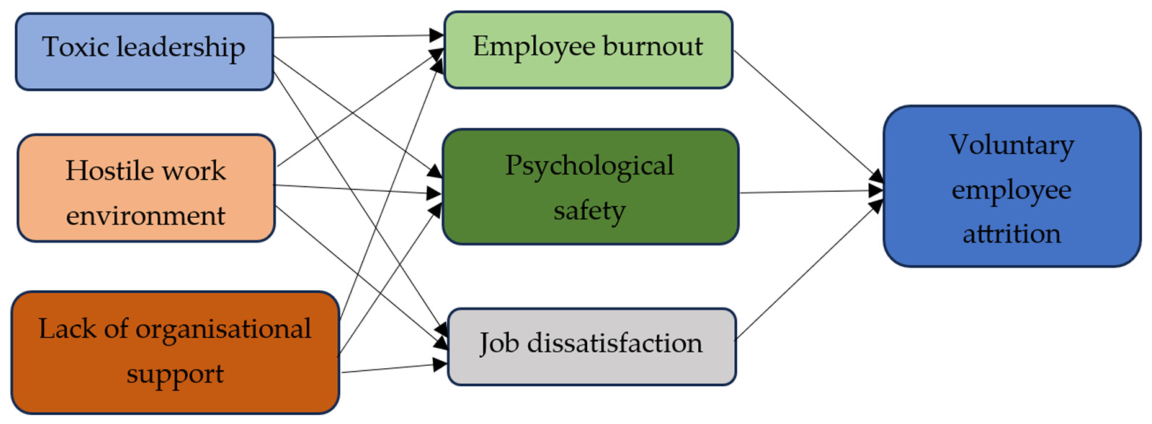
In this study, toxic work cultures are defined as an overarching, higher-order organisational condition, which is indicated by toxic leadership, hostile work environment and lack of organisational support. Three psychological mechanisms (employee burnout, psychological safety, and job dissatisfaction) are explored in relation to these dimensions. Burnout refers to emotional exhaustion and reduced effectiveness at work resulting from prolonged work-related stress [14]. Psychological safety is about the employee’s sense of being able to voice concerns and engage in workplace activities with the confidence that he or she will not be humiliated or retaliated against [21]. A negative assessment of working conditions and organisational experiences that affects motivation and commitment is job dissatisfaction [22].
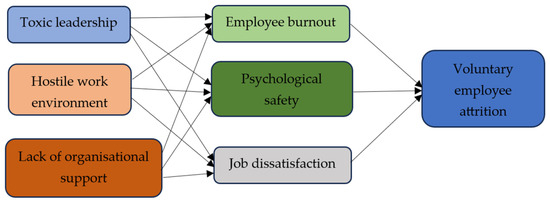
The study suggests that negative organisational culture is associated with increases in employee burnout, decreases in employee satisfaction and psychological safety, and reductions in employee willingness to turnover. The conceptual framework of this study is shown in Figure 1.
Figure 1.
Conceptual Framework of Employee Voluntary Attrition. Author’s Construct, 2026.
Based on the framework, the following hypotheses are proposed:
H1.
Toxic work culture significantly increases employee burnout and job dissatisfaction while negatively affecting psychological safety.
H2.
Employee burnout and job dissatisfaction significantly increase voluntary employee attrition.
H3.
Psychological safety significantly reduces voluntary employee attrition.
H4.
Employee burnout, psychological safety, and job dissatisfaction significantly mediate the relationship between toxic work culture and voluntary employee attrition.
The aim of this study is to investigate the effect of toxic work culture on voluntary attrition among public and private built-up construction workers in Ghana, with burnout, psychological safety, and job dissatisfaction as mediating factors. This study examines the relationship between toxic leadership, hostile work environments, lack of organisational support and psychological experience and withdrawal planning among employees in project-based construction organisations.
This study also makes several contributions to existing literature. First, it brings together the culture of workplace toxicity and psychological mechanisms under a single umbrella to explain employee turnover in construction organisations. Second, it contributes to the body of research on sustainability by analysing workforce attrition not only as a human resource problem but also as a social sustainability problem. Third, this offers empirical evidence from an under-researched context, the construction industry in Ghana. The results provide practical guidance for enhancing organisational support and help, increasing leadership accountability, improving workplace psychological safety, and implementing measures to foster workforce stability and long-term organisational sustainability.
Following this introduction and literature review in Section 1, Section 2 describes the research design, data collection procedures, and analytical methods employed in the study. Section 3 reports the empirical results, while Section 4 discusses the findings in light of the extant literature. Section 5 highlights the practical and theoretical implications. Finally, Section 6 concludes the paper by synthesising the main contributions and outlining key limitations and directions for future research.
2. Research Methods
This study used measurement methods and adopted a cross-sectional quantitative research design to analyse the relationship between a toxic work culture and employee attrition in the Ghanaian construction industry, with burnout, psychological safety, and job dissatisfaction as mediators. The quantitative approach was deemed appropriate for the study because efforts were made to measure relationships between well-defined constructs of the organisational and psychological structures in Table 1, using statistically testable procedures. The study used a structured, closed-ended questionnaire to collect data from employees at various construction firms and project sites across the Republic of Ghana.
Table 1.
Constructs and measurement items.
The study defined an organisational toxic culture as a second-order phenomenon manifested in three areas: toxic leadership, a hostile work environment, and the absence of organisational support. Modelling of the psychological mediators was conducted to represent employee burnout, psychological safety, and job dissatisfaction, respectively, and the dependent outcome variable was voluntary employee attrition. This was a structure designed to fit the study and conceptual pathways of mediation.
Purposive sampling was used to select respondents engaged in operational- and project-level construction tasks, including general labourers, skilled tradespersons, supervisors, safety officers, and project engineers/site managers. Purposive sampling was deemed appropriate given the nature of construction projects, which are often beset by many temporary, mobile, and role-specific requirements that would not benefit from probability-based sampling. One hundred and seventy-four questionnaires were returned (96.7% response rate) and were analysed. It was considered sufficient for the previously mentioned group of studies to perform regression-based mediation analyses, and the sample size was deemed sufficient for statistical estimation and model stability [23,24].
The initial test included 15 construction professionals, who were asked to evaluate the clarity, content, and conceptual validity of the items. The participants in the pilot were construction workers, skilled tradespersons, site supervisors, safety workers and project managers. The results of the pilot phase were used to fine-tune the wording of the questionnaires and to enhance the instrument’s contextual appropriateness in Ghana’s construction context.
The questionnaire items were modified to align with the existing literature in organisational behaviour, occupational psychology, and construction management. Each construct was assessed using 5-point Likert-scale items (from strongly disagree to strongly agree). While responses to individual items on the scales can be ordinal, composite measures based on multiple validated items are commonly used in behavioural and social science studies and are treated as approximately continuous, especially in regression and mediation analyses involving latent variables of organisational constructs. Such a method is similar to that used in previous organisational and construction management studies, which have employed Ordinary Least Squares (OLS) estimation for compound psychological indices.
The study mainly focused on psychosocial and organisational mechanisms associated with toxic work culture and employee attrition. The present analysis did not explicitly model salary level, financial incentives, contract category, or demographic moderation effects because it was necessary to keep the model simple in terms of parameter count and to focus on the proposed psychological pathways. These variables, however, might affect attrition behaviour and warrant further multilevel and moderation studies.
The data analysis was carried out in multiple stages, including descriptive and inferential statistical techniques. Respondent characteristics and the construction of behaviour were summarised using descriptive statistics, including frequencies, percentages, means, and standard deviations. Internal consistency reliability was assessed using Cronbach’s alpha coefficients, and content validity was enhanced through pilot testing and expert review [25]. Harman’s one-factor test was also applied to assess potential common method variance (CMV) in self-reported survey data [26]. The test was primarily used to determine whether 1 latent factor accounted for a significant portion of the covariance among the measurement items.
For statistical analysis, Python 3.12 and Google Colab were used, along with SPSS version 26.0. Mediation analysis was conducted using Baron and Kenny’s [27] procedures, employing regression-based Ordinary Least Squares (OLS) estimation. The OLS mediation model was chosen because it is an interpretable and statistically efficient method for estimating direct, indirect, and total effects among observed composites. Given the present study’s small sample size, exploratory-explanatory design, and aggregated composite construct scores, OLS regression was considered appropriate relative to more parameter-intensive methods such as Structural Equation Modelling (SEM).
Prior to estimating the model, the following tests were conducted to assess multicollinearity among the variables, the normality of the residuals, the homogeneity of variance and the presence of autocorrelation. Multicollinearity among predictors was assessed using the variance inflation factor (VIF) statistics, and the robustness of the models and their assumptions was assessed using residual diagnostic statistics. The following regression equations were hypothesised to estimate the proposed mediation relationships:
- (1)
- Mediation Path A: Toxic Work Culture → Psychological MediatorsBurnout ModelPsychological Safety ModelJob Dissatisfaction Model
- (2)
- Mediation Path B: Psychological Mediators → Voluntary Employee Attrition
- (3)
- Total Effect Path C: Toxic Work Culture → Voluntary Employee Attrition
- (4)
- Direct Effect Path C′: Toxic Work Culture → Voluntary Employee Attrition (Controlling for Mediators)Variable Definitions
- TC = Composite Toxic Work Culture Index derived from toxic leadership, hostile work environment, and lack of organisational support indicators.
- EB = Employee Burnout.
- PS = Psychological Safety.
- JD = Job Dissatisfaction.
- VA = Voluntary Employee Attrition.
- α, β, γ, τ, δ, θ = Regression coefficients representing the direction and magnitude of relationships between variables.
- ε = Error terms representing unexplained variance within each regression equation.
The study was conducted in accordance with ethical guidelines for research with human subjects. Responses were anonymous, and the purpose of participating was explained to respondents before the questionnaires were distributed. All participants provided informed consent, and anonymity and confidentiality were ensured during data collection and reporting. Before beginning field data collection, permission was obtained from construction organisations involved in the study.
3. Results
3.1. Respondent Description
Table 2 presents the demographic data for the 174 respondents, including age, gender, education, employment, and roles. Many of the respondents were aged 25–44 years, the active age group in Ghana’s construction industry. 56.9% females and 43.1% males were sampled. The male-dominated image of the construction industry is not necessarily reflected in the gender distribution; the study aimed to convey different occupational experiences at the operational and project levels.
Table 2.
Demographic Information.
As for education, the results showed that almost half of the respondents (48.9%) had SHS/Technical/Vocational qualifications, suggesting a high proportion of middle-skilled labour in the sample. The top two occupations were project engineers/site managers (38.5%) and site supervisors/foremen (34.5%). The impact of a temporary, project-based construction workforce is highlighted by the proportion of workers in contract/project-based roles (40.8%). The respondents also reported different years of work, with the largest percentage groups being 7 to 10 years and over 10 years.
3.2. Measurement Reliability and Validity Test Analysis
The findings of the reliability test are presented in Table 3, which indicates that all constructs had excellent internal consistency. Cronbach’s alpha for the Toxic Culture Markers scale and the Psychological Pathways and Employee Attrition scale was 0.926 and 0.899, respectively, and the scales had 9 and 12 items, respectively. Both values exceed the commonly cited threshold of 0.70, the recommended minimum reliability level by Nunnally and Bernstein [25], indicating that the items in each construct are highly consistent and will reliably measure their intended dimensions.
Table 3.
Cronbach’s alpha reliability test.
Table 4 presents the results of a single-factor test by Harman to assess the presence of common method bias among the study’s constructs. The analysis indicates that one factor explained 47.511% of the total variance, which is not equal to the generally accepted value of 50%, to show that common method variance is not a serious risk to the integrity of the dataset. This suggests that no single factor had disproportionate effects on the responses, and that the measurement items assessed different underlying constructs as intended [23].
Table 4.
Common method bias using Harman’s single-factor test.
3.3. Multicollinearity Test Analysis
Table 5 presents collinearity statistics to assess multicollinearity between the independent and mediating variables in the regression equations, using Tolerance and Variance Inflation Factor (VIF). There are no signs of constructs being too large, as the tolerance values are above 0.10 and the VIF values are very low, below the usual limit of 10; thus, there is no evidence of multicollinearity [28]. In particular, the independent variables, Toxic Leadership (VIF = 3.026), Hostile Work Environment (VIF = 4.208), and Lack of Organisational Support (VIF = 2.87), are moderately but satisfactorily correlated, whereas the mediators have even lower VIF values, which support the stability and reliability of the regression estimates. The findings affirm that the predictors are not so large that they significantly overlap and thus can be viewed as meaningful when used in mediation analysis.
Table 5.
Collinearity statistics.
3.4. Summary of Construct Measures
The construct indicator statistics are summarised in Table 6 for the toxic work culture, psychological pathways and voluntary employee attrition measures. There were no statistically significant indicators (p < 0.05), with t-statistics at or above the recommended threshold of 1.96, suggesting acceptable indicator reliability and contribution to the construct. Organisational support shortcomings, such as not recognising contributions (O = 0.524) and limited career growth opportunities (O = 0.507), had relatively high loadings, indicating that a key aspect of the toxic work environment in the sample organisations was perceived organisational neglect. The same applied to the search for alternative employment (O = 0.440) and the final resignation decision (O = 0.568), which appeared to be strong indicators of voluntary employee attrition. Also, the relatively small variability in the variable values and the proximity of the scores to the original mean further indicated good measurement stability across the constructs.
Table 6.
Summary statistics of indicators.
3.5. Model Fit Analysis
Table 7 presents the model fit statistics for the three mediators: Job Dissatisfaction (JD), Psychological Safety (PS), and Employee Burnout (EB). The R-square values ranged from 0.282 to 0.306, indicating that the toxic work culture accounted for about 28–31% of the variance in the psychological variables. The number of valued adjusted R-squared was close to the corresponding R-squared, implying a good level of model consistency. All F-statistics for the mediator models were statistically significant (p < 0.001), suggesting that variation in the mediator constructs was explained by the predictor variables collectively [28]. Among the mediator models, Psychological Safety had the highest explanatory power (R2 = 0.306).
Table 7.
Model Fit Statistics—Mediator Paths.
Table 8 presents complete regression fit statistics predicting voluntary employee attrition for both total-effect and direct-mediator regression models. When both the toxic work culture and the psychological mediators were entered simultaneously, the direct-mediator model accounted for approximately 67.4% of the variance in voluntary attrition (R2 = 0.674), indicating considerable explanatory power. The overall model accounted for 50.3% of the variance in attrition, indicating that the toxic work culture fully explained a significant share of employees’ withdrawal intentions from the firm. Both models had statistically significant F-statistics (p < 0.001), indicating that the set of predictors together accounted for meaningful variance in attrition outcomes. The results indicate that the use of psychological mediators enhanced the model’s explanatory power for attrition.
Table 8.
Model Fit Statistics—Direct-mediator and total paths.
Table 9 presents the regression diagnostic statistics for the mediator paths, job dissatisfaction (JD), psychological safety (PS), and employee burnout (EB), and the results indicate that the models generally meet acceptable diagnostic thresholds for regression analysis. For JD and EB, the Omnibus and Jarque–Bera tests show non-significant p-values, suggesting normality of residuals, whereas PS shows significant deviations (p < 0.001), indicating mild non-normality, which is not uncommon in social science data and is generally tolerated in large samples [28]. Skewness and kurtosis values for all three mediators fall within acceptable ranges (±1 for skew and ±3 for kurtosis), confirming that distributional assumptions are reasonably satisfied. The Durbin–Watson statistics fall between 1.45 and 2.12, indicating no serious autocorrelation concerns. Additionally, the condition number (30.1) remains below the critical threshold of 30–100, indicating no harmful multicollinearity in the models [28].
Table 9.
Regression Diagnostic Statistics—Mediator Paths.
The regression diagnostic statistics for both direct/mediator and total path models are provided in Table 10 and indicate acceptable overall statistical adequacy. The indicators of normality reveal that the direct/mediator model has borderline values, with an Omnibus p-value of 0.051 and a Jarque–Bera value of 0.019, indicating a slight violation of normality. On the other hand, the total path model exhibits stronger normality, with both tests yielding non-significant results (p > 0.05), which is in line with the recommended thresholds by [28]. Both models have skewness and kurtosis values within the acceptable ranges (absolute skew < 1, kurtosis < 5), indicating that the residuals are not severely skewed. Diagnostic statistics of autocorrelation indicate that Durbin–Watson is close to the optimal autocorrelation value of 2 (1.68 and 1.69), meaning that there are no severe autocorrelation problems. Lastly, the condition indices (44.5 and 30.1) are below 50, which is the conservative threshold for problematic multicollinearity. All these findings support the conclusion that the regression models satisfy the necessary diagnostic assumptions for validity [28].
Table 10.
Regression diagnostic statistics.
3.6. Summary of Hypothesis Testing
Table 11 shows the results of the OLS regression analysis of the association between toxic work culture, psychological mediators, and employees’ voluntary attrition. The regression estimates can be interpreted as follows: beta coefficients between −1 and +1 indicate relatively strong associations, and a value of 0 indicates a relatively weak association between variables. In general, the results provide partial support for the formulated hypotheses and suggest that the dimensions of toxic work culture exert varying degrees of influence on the psychological outcomes studied.
Table 11.
OLS Regression Coefficients.
Regarding H1, the results showed that feeling part of a toxic work culture is positively related to employee burnout and job dissatisfaction and is associated with lower psychological safety. All three toxic work culture indicators had positive coefficients for employee burnout. The former effect, however, was the strongest, close to the 5% significance level (β = 0.2470, p = 0.054), whereas the latter effect was close to the 10% significance level (β = 0.2411, p = 0.090). No statistically significant relationship was found between toxic leadership and burnout (β = 0.1826, p = 0.151). In the same way, hostile work environment scores were the only statistically significant predictor of job dissatisfaction (β = 0.2581, p = 0.019), whereas toxic leadership and lack of organisational support scores were not statistically significant.
Hostile work environment and Toxic leadership showed a statistically significant relationship in predicting psychological safety (β = 0.2289, p = 0.039) and (β = 0.1851, p = 0.062), respectively, and Toxic leadership demonstrated marginal significance in predicting psychological safety (p = 0.062). Psychological safety was not significantly predicted by a lack of organisational support (β = −0.1040, p = 0.294). The regression coefficients were positive, but the psychological safety indicators were reverse-coded, with higher scores indicating lower perceived psychological safety. In turn, higher exposure to negative work environments was associated with less employee trust and openness in the workplace. The results of this study partially support H1 and indicate that, during construction projects, a hostile interpersonal climate may be the main factor leading employees to perceive a lack of psychological security.
Specifically, for H2 and H3, the regression analysis revealed a significant positive effect of employee burnout on voluntary employee attrition (β = 0.3628, p < 0.001) and a significant negative effect of psychological safety on attrition intentions (β = −0.1785, p = 0.016). An employee’s level of burnout showed the greatest predictive power in the mediation model in predicting intention to withdraw and possibly exit tendencies. The negative correlation between psychological safety and the perceived need to leave the organisation also shows that a lack of interpersonal safety and openness was associated with a higher likelihood of employees considering leaving their organisations. The results are in favour of both H2 and H3.
Surprisingly, job dissatisfaction showed a negative coefficient (β = −0.1384, p = 0.046), indicating a small, statistically significant negative association with the study. This discovery contradicts the hypothesised positive association and could be due to suppressor effects between the mediating variables, or to shared variance within the larger regression model. The cross-over among burnout, psychological safety, and job dissatisfaction could have affected the coefficient estimate once the other mediators were controlled for, due to multicollinearity issues. Therefore, this conclusion should be taken with a grain of salt and may need further investigation using different modelling approaches in the future.
The mediation analysis also revealed that the direct effects of toxic leadership, hostile work environment and voluntary employee attrition were no longer statistically significant when the psychological mediators were added, but lack of organisational support remained (β = 0.2673, p < 0.001). The results of this pattern indicated that the connection between toxic work culture and employee attrition was partially mediated by employee burnout and psychological safety. Thus, the results lend partial support to H4 and suggest that toxic organisational environments partially influence employees’ withdrawal intentions in construction organisations through their psychological effects.
4. Discussion
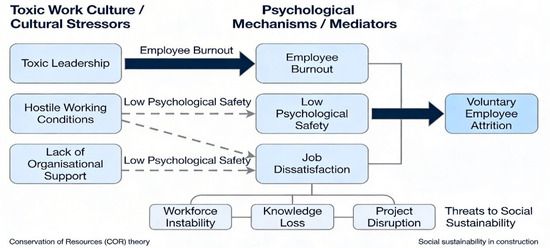
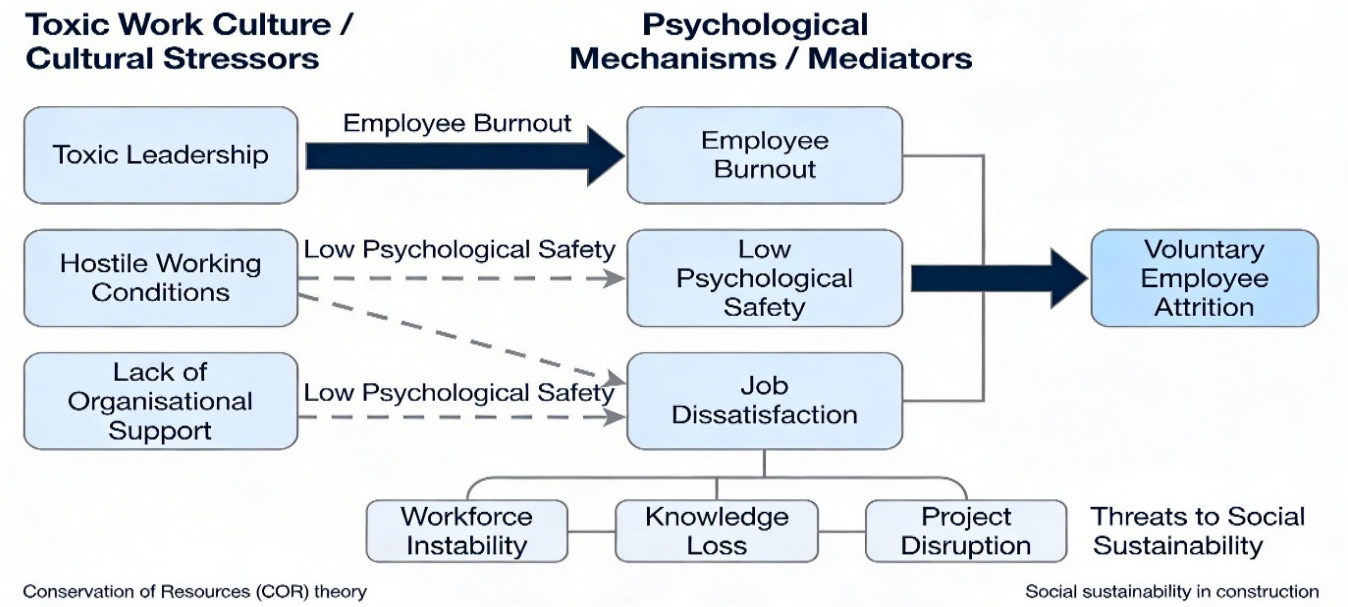
This study developed and tested a proposed framework specific to the construction industry in Ghana on how a toxic work culture leads to voluntary employment attrition, with employee burnout, psychological safety, and job dissatisfaction as the mechanisms through which this is mediated, as illustrated in Figure 2. The results indicate that there is more than just managerial effects at play, as psychological stress and reduced interpersonal security bring the workforce down, making the organisation toxic. Employee burnout and psychological safety were most strongly associated with intent to leave, suggesting that psychosocial well-being is a critical enabler of workforce sustainability in the construction industry.
Figure 2.
A framework on toxic work cultures and social sustainability. Source: Author’s Construct, 2026.
The results corroborate the assumptions of the Conservation of Resources (COR) Theory [18], which suggests that when an employee is continuously exposed to workplace stress, he or she depletes emotional and psychological resources, thereby escalating withdrawal behaviour and disengagement. Staff who had been exposed to a negative work environment and had less support from the organisation experienced higher levels of burnout and a stronger intention to leave. The results indicate that constant exposure to an employee’s toxic organisational environment may gradually reduce their ability to cope, organisational attachment, and long-term organisational commitment in project-based construction environments. The findings also corroborate the Social Exchange Theory, which suggests that if an employee feels a low level of support within the organisation and that their efforts are not being fairly rewarded, then they will be less strongly committed to the organisation [29,30]. In general, the results of these regression models suggest a strong, consistent effect of perceived organisational neglect on workforce instability in construction companies in Ghana, which may be one of the most important factors driving labour force instability in these companies.
The results also show that negative workplace environments do not affect all psychological aspects equally. Toxic work culture was the most consistent indicator of lower psychological safety and higher job dissatisfaction, indicating that interpersonal hostility, bullying, incivility, and adversarial interactions with others at work may have a unique and detrimental effect on employee well-being in construction work settings. The results align with previous construction management research, which links negative relationships with supervisors and peers to emotional exhaustion, lower morale, disengagement, and intentions to leave the job [31,32,33]. The results also indicate that a psychological safety atmosphere could hinder open expression, trust, and team problem-solving, which are crucial in project-based construction operations.
As suggested by previous research, employee burnout was the most significant predictor in the mediation model of voluntary employee attrition, confirming that emotional exhaustion is a key determinant of job withdrawal in high-stress environments [18,34]. Workers in the construction industry who continuously experience high job demands, low levels of support, and challenging project conditions may come to see organisational exit as an effective means of maintaining psychological well-being. This was also confirmed in psychological safety, where a significant protective effect was observed against talent attrition: employees who feel safer in their work environment regarding interpersonal communication, trust, and openness are less likely to report intentions to leave their organisation. The results further support the claim that psychological support at work is crucial for maintaining workforce continuity and organisational resilience in construction companies.
An unexpected finding was job dissatisfaction, which showed a small but statistically significant negative relationship to employee attrition, even after controlling for the other mediating variables. This result is unexpected compared with many previous turnover studies and should therefore be viewed with caution. One possible reason is suppressor effects or shared variance among burnout, psychological safety, and dissatisfaction in the complete mediation model. When all mediators are included in the model, dissatisfaction can overlap significantly with the components of emotional exhaustion and perceptions of psychological insecurity, which may influence test-directionality when all mediators are estimated simultaneously in high-pressure construction settings. The result indicates that the psychological mechanisms underlying employee withdrawal behaviour are not as independent as previously thought, despite multicollinearity diagnostics being within acceptable limits. These relationships could be better understood through further research using a different modelling strategy, such as a longitudinal or structural equation approach.
The study adds to the social sustainability debate in the construction industry. The results not only indicate a cultural approach to sustainable organisational performance, encompassing the workforce’s wellbeing, psychological safety and employee retention, but also to environmental performance and economic productivity. If burnout continues, organisational neglect or a lack of a psychologically safe workplace can create weaknesses in knowledge continuity, project coordination, hiring and training costs, and overall long-term organisational resilience. In this context, voluntary employee turnover should be viewed as both a human resources issue and a sustainability problem affecting the long-term sustainability of construction organisations.
In practice, the results indicate that it is important to adopt broader organisational measures to mitigate toxic work cultures in construction organisations, as well as to provide traditional leadership training. Organisational support systems could be reinforced; anti-bullying policies and guidelines, and grievance reporting procedures could be implemented; communication climates could be enhanced; and policies for employee wellbeing activities to tackle emotional exhaustion and psychosocial stress could be adopted. Fostering a workplace environment where employees feel psychologically safe through organisational policies that encourage and support fair treatment, mental health awareness and whose decisions consider employee participation could help overcome psychological safety and decrease workplace instability. In the context of a project-based, high-pressure working environment in the construction industry, implementing these interventions could be highly significant for securing the retention of skilled personnel in construction companies in Ghana and for improving long-term project performance.
The results of this study, however, should be considered in light of its limitations. The cross-sectional design precludes causal inference, and despite diagnostic procedures, reliance on self-reported survey data may introduce response bias. The study also lacked direct modelling of potentially important moderating factors such as salary level, contract type, years of service, gender, organisational fairness, psychological resilience, and job control. These attributes can affect employees’ perceptions of toxic workplace culture and their responses to workplace stress. Longitudinal research, mixed-methods analyses, and moderation analyses could be the next steps to replicate and further illuminate the intricate psychological and organisational aspects of turnover among construction workers.
5. Implications for Policy, Research, and Practice
The results obtained in this study are relevant to the development of construction industry policies in Ghana, particularly regarding workforce well-being and social sustainability. The findings indicate that toxic work culture, particularly a hostile work environment and a lack of organisational support, is associated with increased employee burnout, decreased psychological safety, and a higher intention to quit in construction companies. Regulatory institutions, such as the Ministry of Employment and Labour Relations, the Ministry of Works and Housing, and professional construction associations, may therefore be required to improve monitoring resources and working-environment norms in the construction industry with respect to psychosocial working conditions. Organisational policies and procedures relating to accountability for leaders, protection of employee welfare, anti-bullying policies and procedures and policies for respectful behaviour in the workplace may be useful in addressing negative organisational behaviours in the context of project-based construction. The results also indicate a need to incorporate psychosocial risk management into the existing Occupational Health and Safety (OHS) framework to establish a healthier, more sustainable construction work environment.
This research contributes to the growing body of work on psychosocial well-being, workforce sustainability, and organisational behaviour in the construction industries of the Global South. The research brings together multiple concepts of a toxic workplace, employee burnout, psychological safety, and employee turnover in a single mediation. In doing so, the study also moves beyond the typically human resource-based explanations of employee turnover. The results also emphasise the importance of considering workforce sustainability at the psychological and organisational levels, rather than solely at the economic and productivity levels. Still, several restrictions present opportunities for further research. The inherent limitations of a cross-sectional design further restrict causal interpretations. Future research can therefore be guided by a longitudinal methodology that explores the relationship between toxic organisational climates and employee well-being and turnover over time. Moderating factors, such as salary level, contract type, years of service, organisational justice, psychological resilience, gender, employment status, job control, and others, are also considered in future studies to better understand the complexity of attrition behaviour in construction settings. In addition, future research could adopt alternative analytical methods, such as Structural Equation Modelling (SEM), multilevel modelling, or mixed-method designs, to explore the relationships among the organisational, psychological, and behavioural variables in more depth.
The study also has implications for construction companies seeking to enhance employee retention, business resilience, and overall project outcomes. The results suggest that a change in toxic workplace culture needs to involve more than leadership development as the organisation’s overall approach. Organisation, communication climate, grievance reporting, and anti-bullying procedures at the organisational and project levels might therefore need to be enhanced within construction companies. Burnout can be alleviated and employee psychological safety fostered through practical measures such as employee well-being programmes, psychosocial support initiatives, mentorship systems, mental health awareness training and fair performance management procedures. Other on-site campaigning and support measures, such as respectful workplace campaigns, peer groups, and anonymous reporting systems, can also help reduce interpersonal hostility and workplace incivility. The interventions can help increase workforce retention, reduce turnover-related costs, enhance knowledge and skills transfer, and promote long-term organisational efficiency in Ghana’s construction industry.
6. Conclusions
The study examined the effect of toxic work culture on employees’ voluntary attrition in Ghanaian construction firms, moderated by employees’ burnout, psychological safety, and job dissatisfaction. The results showed a hostile work environment and lack of organisational support to be the most consistent dimensions related to negative psychological outcomes and intentions to withdraw from the organisation. Employee burnout was most strongly associated with voluntary employee attrition (β = 0.3628, p < 0.001), while psychological safety showed a significant inverse relationship with voluntary employee attrition (β = −0.1785, p = 0.016). Moreover, 67.4% of the variance in employee attrition outcomes was accounted for by the mediation model (R2 = 0.674), indicating a high level of explanatory power. The conclusions of this research indicate that unhealthy working cultures can negatively affect the workforce, project, and sustainability continuity in project-based construction.
This study contributes to the literature on construction management and organisational behaviour by proposing a unique, Ghanaian-context framework of psychosocial pathways that underlie employee attrition in the Ghanaian construction industry. Specifically, the findings build on existing research on sustainability and place workforce wellbeing, psychological safety, and employee retention as key factors in social sustainability in construction organisations. The results also indicate that harmful work cultures can create direct and indirect pressures that limit employees’ attachment, cause emotional stress and hinder staff stability.
The results, however, should be applied within the study’s limitations. As is common in cross-sectional research, the study is limited to causal conclusions, and the survey instrument included self-reported data, which can introduce response bias despite the diagnostic procedures used. Moreover, the negative association between job satisfaction and the psychological mediators of job dissatisfaction suggests potential suppressor effects and/or overlap in variance among the mediators, warranting further study using alternative modelling methods and longitudinal data. Further research, incorporating broader organisational and demographic covariates and more sophisticated analytical models, can help shed new light on the links between toxic work culture and workforce sustainability in construction settings.
The study concludes that enhanced organisational support, decreased workplace hostility, and increased psychological safety can benefit organisations by improving workplace health and sustainability, thereby aiding the retention of work colleagues and the sustainability of organisations in Ghana’s construction industry.
Author Contributions
Conceptualisation, M.L. and F.K.B.; methodology, F.K.B. and M.L.; software, F.K.B.; validation, K.O.A., M.L. and F.K.B.; formal analysis, F.K.B. and K.O.A.; investigation, K.O.A. and F.K.B.; resources, M.L.; data curation, F.K.B.; writing—original draft preparation, M.L. and F.K.B.; writing—review and editing, K.O.A.; visualisation, K.O.A.; project administration, F.K.B.; funding acquisition, M.L. All authors have read and agreed to the published version of the manuscript.
Funding
This research received no external funding.
Institutional Review Board Statement
Ethical review and approval were waived for this study due to the study is regarded as a minimal-risk, non-interventional survey investigation involving competent adult participants, and that it would not ordinarily require full formal ethics committee review under prevailing institutional practice for this category of research.
Informed Consent Statement
Informed consent was obtained from all subjects involved in the study.
Data Availability Statement
The raw data supporting the conclusions of this article will be made available by the authors on request.
Conflicts of Interest
The authors declare no conflicts of interest.
References
- Tambunan, W.; Partiwi, S.G.; Sudiarno, A. Impact of toxic work environment on employee engagement mediated by employee well-being and supportive work culture. J. Infrastruct. Policy Dev. 2024, 8, 5532. [Google Scholar] [CrossRef] [Scilit]
- Rasool, S.F.; Wang, M.; Tang, M.; Saeed, A.; Iqbal, J. How Toxic Workplace Environment Effects the Employee Engagement: The Mediating Role of Organizational Support and Employee Wellbeing. Int. J. Environ. Res. Public Health 2021, 18, 2294. [Google Scholar] [CrossRef] [Scilit]
- Amankwa, E. Burnout and Intent to Stay Moderated by Intrinsic Motivation. Doctoral Dissertation, Grand Canyon University, Phoenix, AZ, USA, 2025. [Google Scholar]
- Surikpe, B.S. Lean on Me: A Phenomenological Study of Coworker Social Support in Reducing Employee Burnout in Ghanaian Workplaces. Master’s Thesis, New Mexico State University, Las Cruces, NM, USA, 2025. [Google Scholar]
- Bondinuba, F.K.; Bondinuba, N.; Adjei, K.O.; Liphadzi, M. Nexus between sustainability practices, business and green continuity management towards improving construction business resilience. Built Environ. Proj. Asset Manag. 2026, 1–16. [Google Scholar] [CrossRef] [Scilit]
- Frimpong, S.Y.; Antwi, A.B.; Boateng, E.S.; Hagan, J.A.; Mensah, P.A. The State of Youth Health in Ghana’s Construction Industry; Participatory Development Associates (PDA) Ltd.: Accra, Ghana, 2021; pp. 1–12. [Google Scholar]
- Bondinuba, F.K.; Godawatte, G.A.G.R.; Liphadzi, M. From Diversification to Digitalisation: The Impact of Strategic Survival Models on Construction Business Resilience in Emerging Markets. Sustainability 2026, 18, 5007. [Google Scholar] [CrossRef] [Scilit]
- Tepper, B.J.; Simon, L.; Park, H.M. Abusive supervision. Annu. Rev. Organ. Psychol. Organ. Behav. 2017, 4, 123–152. [Google Scholar] [CrossRef] [Scilit]
- Yokouchi, N.; Ambe, T.; Fujisaki-Sueda-Sakai, M.; Ozawa, K. Workplace bullying and harassment in the Japanese construction industry: Prevalence and associations with subjective health and work attractiveness. Constr. Manag. Econ. 2024, 42, 741–757. [Google Scholar] [CrossRef] [Scilit]
- Masino, S.; von Jacobi, N.L.; Akuffobea-Essilfie, M. Labour standards in the Ghanaian construction industry: An investigation of the governance landscape. Int. J. Manpow. 2023, 44, 543–557. [Google Scholar] [CrossRef] [Scilit]
- Lim, H.W.; Francis, V. A conceptual model of cognitive and behavioral processes affecting mental health in the construction industry: A systematic review. J. Constr. Eng. Manag. 2023, 149, 04023114. [Google Scholar] [CrossRef] [Scilit]
- Rafique, M.; Jaafar, M.; Zafar, A.; Ahmed, S. Time pressure, emotional exhaustion and project manager abusive supervision in the construction industry: The role of psychological resilience. Int. J. Organ. Theory Behav. 2023, 26, 132–151. [Google Scholar] [CrossRef] [Scilit]
- Abudu, H.D.; Mewomo, C.M.; Bondinuba, F.K.; Liphadzi, M.; Adjei, K.O. PLS-SEM assessment of the effect of using standardized blocks on artisans’ health in the construction industry. J. Asian Archit. Build. Eng. 2025, 25, 2080–2096. [Google Scholar] [CrossRef] [Scilit]
- Abdolmaleki, G.; Naismith, N.; Ghodrati, N.; Poshdar, M.; Babaeian Jelodar, M. An analysis of the literature on construction employee turnover: Drivers, consequences, and future direction. Constr. Manag. Econ. 2024, 42, 822–846. [Google Scholar] [CrossRef] [Scilit]
- Bilau, A.A.; Ajagbe, M.A.; Sholanke, A.B.; Sani, T.A. Impact of employee turnover in small and medium construction firms: A literature review. Int. J. Eng. Res. Technol. 2015, 4, 976–978. [Google Scholar]
- Walker, A. Project Management in Construction; John Wiley & Sons: Hoboken, NJ, USA, 2015. [Google Scholar]
- Zaman, U.; Florez-Perez, L.; Anjam, M.; Ghani Khwaja, M.; Ul-Huda, N. At the end of the world, turn left: Examining toxic leadership, team silence and success in mega construction projects. Eng. Constr. Archit. Manag. 2023, 30, 2436–2462. [Google Scholar] [CrossRef] [Scilit]
- Hobfoll, S.E.; Halbesleben, J.; Neveu, J.P.; Westman, M. Conservation of resources in the organisational context: The reality of resources and their consequences. Annu. Rev. Organ. Psychol. Organ. Behav. 2018, 5, 103–128. [Google Scholar] [CrossRef] [Scilit]
- Teow, H.H.; Au, W.C. The Relationship Between Burnout and Turnover Intention Among Early-Career Employees in Malaysia: The Role of the Supervisor. In Employee Wellbeing in the Global South: A Critical Overview; Springer Nature: Cham, Switzerland, 2024; pp. 43–65. [Google Scholar] [CrossRef] [Scilit]
- Collins, A.; Beauregard, A. The effect of breaches of the psychological contract on the job satisfaction and well-being of doctors in Ireland: A quantitative study. Hum. Res. Health 2020, 18, 89. [Google Scholar] [CrossRef] [Scilit]
- Cheng, J.; Zhang, L.; Lin, Y.; Guo, H.; Zhang, S. Enhancing employee wellbeing by ethical leadership in the construction industry: The role of perceived organisational support. Front. Public Health 2022, 10, 935557. [Google Scholar] [CrossRef] [Scilit]
- Martinko, M.J.; Harvey, P.; Brees, J.R.; Mackey, J. A review of abusive supervision research. J. Organ. Behav. 2013, 34, S120–S137. [Google Scholar] [CrossRef] [Scilit]
- Podsakoff, P.M.; MacKenzie, S.B.; Lee, J.Y.; Podsakoff, N.P. Common method biases in behavioural research: A critical review and recommended remedies. J. Appl. Psychol. 2003, 88, 879–903. [Google Scholar] [CrossRef] [Scilit]
- Hilbe, J.M.; Robinson, A.P. Methods of Statistical Model Estimation; CRC Press: Boca Raton, FL, USA, 2013. [Google Scholar]
- Nunnally, J.C.; Bernstein, I.H. Psychometric Theory; McGraw-Hill: New York, NY, USA, 1994. [Google Scholar]
- Fuller, C.M.; Simmering, M.J.; Atinc, G.; Atinc, Y.; Babin, B.J. Common methods variance detection in business research. J. Bus. Res. 2016, 69, 3192–3198. [Google Scholar] [CrossRef] [Scilit]
- Baron, R.M.; Kenny, D.A. The moderator–mediator variable distinction in social psychological research. J. Pers. Soc. Psychol. 1986, 51, 1173–1182. [Google Scholar] [CrossRef] [PubMed]
- Hair, J.F.; Black, W.C.; Babin, B.J.; Anderson, R.E. Multivariate Data Analysis, 7th ed.; Pearson: Upper Saddle River, NJ, USA, 2010. [Google Scholar]
- Rayton, B.A.; Yalabik, Z.Y. Work engagement, psychological contract breach and job satisfaction. Int. J. Hum. Resour. Manag. 2014, 25, 2382–2400. [Google Scholar] [CrossRef] [Scilit]
- Mak, C.K.; Li, R.Y.M. How does social exchange theory, perceived organisational support and leader-member exchange affect construction practitioners’ perception of construction safety? In Construction Safety: Economics and Informatics Perspectives; Springer Nature: Singapore, 2022; pp. 1–26. [Google Scholar] [CrossRef] [Scilit]
- Khan, N.A.; Khan, A.N. Exploring the impact of abusive supervision on employee voice behaviour in the Chinese construction industry: A moderated mediation analysis. Eng. Constr. Archit. Manag. 2022, 29, 3051–3071. [Google Scholar] [CrossRef] [Scilit]
- Ehsan, I.; Safdar, S.; Faiz, S.; Saghir, H. Does leadership go wrong? Investigating the effect of abusive leadership on project success: The mediating role of workplace deviance. J. Posit. Sch. Psychol. 2023, 7, 1283–1295. [Google Scholar]
- Nana Ama, A. Effects of Staff Bullying on Turnover Intention Among Employees of Engineering Firms in Tarkwa: The Mediating Role of Supervision. Doctoral Dissertation, University of Mines and Technology, Tarkwa, Ghana, 2023. [Google Scholar]
- Koroglu, Ş.; Ozmen, O. The mediating effect of work engagement on innovative work behaviour and the role of psychological well-being in the JD-R model. Asia Pac. J. Bus. Adm. 2022, 14, 124–144. [Google Scholar] [CrossRef] [Scilit]

Disclaimer/Publisher’s Note: The statements, opinions and data contained in all publications are solely those of the individual author(s) and contributor(s) and not of MDPI and/or the editor(s). MDPI and/or the editor(s) disclaim responsibility for any injury to people or property resulting from any ideas, methods, instructions or products referred to in the content. |
© 2026 by the authors. Licensee MDPI, Basel, Switzerland. This article is an open access article distributed under the terms and conditions of the Creative Commons Attribution (CC BY) license.