


Abstract
Developing bifunctional non-noble metal electrocatalysts with high activity, stability, and cost-effectiveness is essential for large-scale sustainable water splitting, yet remains challenging. Herein, 2P-FeCoNi-MOF was synthesized via hydrothermal reaction of FeCoNi-LDH followed by phosphidation. Its layered structure, integrated with 3D nickel foam, creates a hierarchical porous architecture that increases surface area and accelerates electron transport. Synergistic effects among Fe, Co, Ni in the trimetallic phosphides, together with an amorphous carbon layer, boost catalytic performance. Moreover, superhydrophilic and superaerophobic surfaces enhance mass transfer. In 1 M KOH, 2P-FeCoNi-MOF achieves low overpotentials of 70 mV for HER and 225 mV for OER at 10 mA cm−2, with excellent stability for 100 h at 100 mA cm−2. For the overall water splitting, it requires only 1.54 V to reach 10 mA cm−2 and maintains stability for 100 h at 100 mA cm−2. Therefore, this study provides a new approach for the preparation of high-performance self-supported non-noble metal-based electrocatalysts for water splitting.
1. Introduction
In recent years, the excessive consumption of non-renewable energy sources, primarily coal and petroleum, has resulted in a global energy crisis and severe environmental pollution [1]. Hydrogen, recognized for its high calorific value and clean combustion properties, is regarded as a promising alternative to fossil fuels [2]. Currently, electrolytic water splitting has emerged as an efficient hydrogen production technology due to its abundant reactant availability, high product purity, and absence of greenhouse gas emissions [3]. Noble metal-based electrocatalysts, owing to their exceptional catalytic performance, are the most widely utilized commercial catalysts in water electrolysis. Among them, platinum-based materials are commonly employed for the hydrogen evolution reaction (HER), while ruthenium-based and iridium-based oxides are predominantly used for the oxygen evolution reaction (OER) [4]. However, the large-scale industrial application of these catalysts is significantly constrained by their natural scarcity, high cost, and relatively poor stability [5]. Furthermore, the general requirement for distinct electrocatalysts at the anode and cathode leads to additional challenges such as poor compatibility, structural complexity, and elevated costs [6]. Therefore, the development of efficient, stable, and cost-effective bifunctional non-noble metal electrocatalysts is of crucial research significance and practical value for advancing the scalable implementation of water electrolysis technology.
A range of non-noble metal-based electrocatalysts, particularly transition metal-based materials such as iron (Fe), cobalt (Co), and nickel (Ni), have been regarded as highly promising candidates to replace noble metal-based catalysts due to their excellent catalytic activity toward both the hydrogen evolution reaction and oxygen evolution reaction [7]. Recent studies have revealed that transition metal phosphides (TMPs) are considered outstanding electrocatalysts for water splitting owing to the abundance of transition metal ions and phosphorus atoms, which optimize the local electronic structures and provide numerous active sites [8]. Moreover, the good electrical conductivity of TMPs further facilitates efficient electron transfer, accelerates reaction kinetics, and enhances overall catalytic efficiency [9]. Furthermore, recent research has demonstrated that introducing additional metal elements to form bi- or trimetallic TMPs can significantly modify the coordination environment and electronic structure, leading to further improvements in catalytic performance [10]. Sun et al. synthesized an iron–cobalt–nickel trimetallic phosphide supported on nitrogen-doped graphene (FeCoNiP@NC) via a MOF-derived method [11]. Through high-temperature carbonization and low-temperature phosphorization, heterojunctions were formed among FeP, CoP, and Ni2P, facilitating electron transfer. The catalyst delivered HER overpotentials of 93 mV in 0.5 M H2SO4 and 187 mV in 1.0 M KOH at 10 mA cm−2, and an OER overpotential of 266 mV at 10 mA cm−2 in 1.0 M KOH. For overall water splitting, a cell voltage of only 1.73 V was required to reach 10 mA cm−2, along with good long-term stability. Zhang et al. successfully constructed a self-supporting FeCoNiP@C/NF nanosheet array by in situ growth of ZIF-67 nanosheets on nickel foam, followed by etching with K3[Fe(CN)6] and low-temperature phosphorization [12]. The catalyst exhibited excellent HER and OER performance in 1.0 M KOH, with overpotentials of 136 mV and 227 mV, respectively, at 100 mA cm−2. For overall water splitting, a voltage of 1.60 V was sufficient to achieve 100 mA cm−2.
Layered double hydroxides (LDHs) are ideal precursors for the synthesis of metal–organic frameworks (MOFs) because of their adjustable and suitable interlayer spacing, which allows organic ligands to enter the interlayer and combine with the internal metal ions [13]. For instance, when Cai et al. converted CoFe-LDH into a two-dimensional CoFe-MOF, the resulting electrocatalyst exhibited excellent OER performance, demonstrating a low overpotential of 274 mV at a current density of 10 mA cm−2 along with stable operation for 70 h [14]. Serving as a modulatable metal source, LDH precursors can regulate the heterogeneous nucleation process of MOFs, effectively mitigating the strong coordination between metal ions and organic ligands [15]. Chen et al. proposed a novel strategy involving the in situ transformation of ultrathin two-dimensional Co-LDH@CC into a 2D/3D Co-ZIF@CC, which was subsequently pyrolyzed at low temperature to yield a composite material, Co@N-CS/N-HCP@CC [16]. This composite consists of ultrafine cobalt nanoparticles embedded in two-dimensional nitrogen-doped carbon nanosheets and three-dimensional nitrogen-doped carbon polyhedra. The material requires overpotentials of only 66 mV and 248 mV to achieve a current density of 10 mA cm−2 for HER and OER, respectively; for overall water splitting, a cell voltage of merely 1.545 V is needed to reach the same current density.
In this study, a self-supported trimetallic phosphide electrocatalyst (denoted as 2P-FeCoNi-MOF) was synthesized through a three-step procedure for water electrolysis. First, FeCoNi-LDH nanowire arrays were grown in situ on nickel foam (NF) via a hydrothermal method. Subsequently, the FeCoNi-LDH was etched with terephthalic acid to form FeCoNi-MOF. Finally, a phosphidation treatment was applied to obtain the 2P-FeCoNi-MOF catalyst. The layered structure of 2P-FeCoNi-MOF provides abundant active sites. Its integration with the three-dimensional porous NF substrate results in a hierarchical porous architecture, which significantly increases the specific surface area and facilitates rapid electron transfer. The synergistic effects among the multiple metal elements in the trimetallic phosphide, along with the amorphous carbon layer formed during phosphidation, collectively enhance the catalytic performance. Moreover, the concurrent superhydrophilicity and superaerophobicity of the 2P-FeCoNi-MOF surface promote a synergistic effect that accelerates mass transport during the reaction. Benefiting from these advantages, the 2P-FeCoNi-MOF electrode exhibits outstanding electrocatalytic performance in 1 M KOH. It achieves low overpotentials of 70 mV for HER and 225 mV for OER at a current density of 10 mA cm−2. Furthermore, it demonstrates excellent stability, maintaining continuous operation for 100 h even at a high current density of 100 mA cm−2. Owing to its remarkable bifunctional activity, the catalyst requires only 1.54 V to reach a current density of 10 mA cm−2 in overall water splitting (OWS), outperforming the commercial benchmark system Pt/CǁRuO2. It also shows sustained stability over 100 h at 100 mA cm−2. The above demonstrates that low-cost transition metal phosphides hold broad application prospects in alkaline water splitting.
2. Experimental Section
2.1. Pretreatment of NF
The NF (3 × 3 cm) was immersed sequentially in absolute ethanol, a 3 mol·L−1 hydrochloric acid solution, and ultrapure water, with each step involving ultrasonic cleaning for 15 min. It was then dried overnight in a vacuum oven(Shanghai Yiheng Technology Co., Ltd., Shanghai, China) at 40 °C. This pretreatment process aims to remove surface impurities and oxide layers.
2.2. Synthesis of FeCoNi-LDH
A total of 0.3 mmol Fe(NO3)3·9H2O (0.121 g), 1.5 mmol Co(NO3)2·6H2O (0.436 g), 0.3 mmol Ni(NO3)2·6H2O (0.087 g), 0.222 g NH4F (6 mmol), and 0.45 g urea (H2NCONH2, 7.5 mmol) was added to 40 mL of ultrapure water and stirred for 30 min until complete dissolution. The resulting solution was transferred into a 100 mL Teflon-lined hydrothermal autoclave(Lichen Scientific Instruments Co., Ltd., Changsha, China). A pre-cleaned NF substrate was immersed vertically into the solution, placed along the inner wall of the autoclave, and allowed to soak at room temperature for 30 min. The autoclave was then heated at 120 °C for 10 h. After the system cooled to room temperature, the sample was retrieved, rinsed three times with deionized water, and finally dried overnight in a vacuum oven at 40 °C.
2.3. Synthesis of FeCoNi-MOF
A total of 2 mmol (0.332 g) of TPA was dissolved in 40 mL of DMF under stirring for 30 min. The resulting solution was transferred into a 100 mL Teflon-lined autoclave. A piece of FeCoNi-LDH was vertically placed against the inner wall of the autoclave. The hydrothermal reaction was carried out at 120 °C for 8 h. After cooling to room temperature, the product was rinsed sequentially with DMF and anhydrous ethanol three times each, and then dried overnight in a vacuum oven at 40 °C.
2.4. Synthesis of 2P-FeCoNi-MOF
A total of 2 g of NaH2PO2·H2O was placed at the upstream end of a quartz boat, while the FeCoNi-MOF was positioned at the downstream end. Prior to the reaction, nitrogen gas was introduced into the tube furnace(Hefei Kejing Materials Technology Co., Ltd., Hefei, China) at a flow rate of 100 cm3·min−1 for 20 min to thoroughly purge the system of air. The temperature was then raised to 350 °C at a heating rate of 4 °C·min−1 and maintained for 2 h. The 2P-FeCoNi-LDH was synthesized using the same method as described above, with the only modification being the substitution of FeCoNi-MOF with FeCoNi-LDH as the precursor. Following the same procedure as for 2P-FeCoNi-MOF, the monometallic control 2P-Ni-MOF (only Ni(NO3)2·6H2O added) and the bimetallic control 2P-CoNi-MOF (Co(NO3)2·6H2O and Ni(NO3)2·6H2O added, no Fe salt) were synthesized. To systematically investigate the influence of the phosphorous source (NaH2PO2·H2O) dosage on the material’s performance, control samples labeled as 1.5P-FeCoNi-MOF and 2.5P-FeCoNi-MOF were synthesized by following the same procedure but with varying masses of NaH2PO2·H2O at 1.5 g and 2.5 g, respectively.
2.5. Preparation of Pt/C and RuO2 Electrodes
A total of 10 mg of Pt/C was mixed with 400 μL of deionized water, 450 μL of absolute ethanol, and 50 μL of Nafion (5 wt%), and the resulting mixture was sonicated for 30 min to obtain Pt/C ink. The ink was then drop-cast evenly onto a pre-cleaned nickel foam substrate using a micropipette and dried at room temperature to obtain the Pt/C electrode. The RuO2 electrode was fabricated following the same procedure.
3. Results and Discussion
3.1. Characterization of Prepared Sample
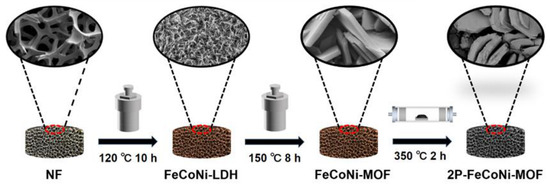
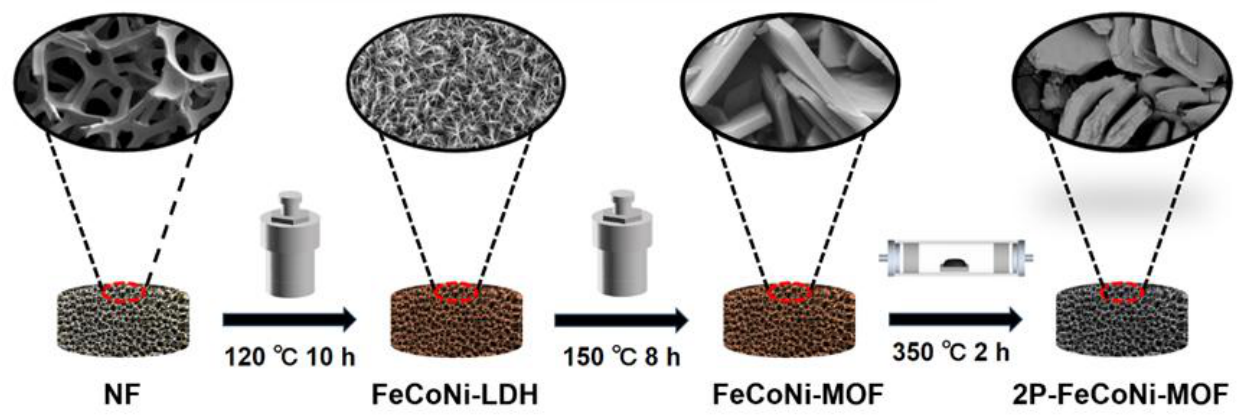
The overall synthesis procedure is illustrated in Figure 1. Initially, ternary FeCoNi-LDH nanowire arrays were grown in situ on nickel foam via a hydrothermal method. Subsequently, using the LDH as a sacrificial precursor, FeCoNi-MOF nanosheets were obtained through etching with terephthalic acid. Finally, the phosphidation of FeCoNi-MOF yielded the 2P-FeCoNi-MOF trimetallic phosphide. The material was firmly anchored onto the nickel foam substrate through chemical bonding, resulting in a stable, self-supported electrocatalyst.
Figure 1.
Schematic illustration of the synthesis of 2P-FeCoNi-MOF.
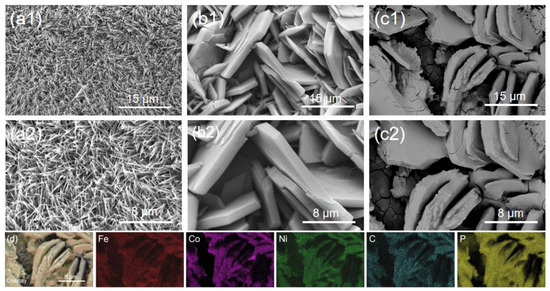
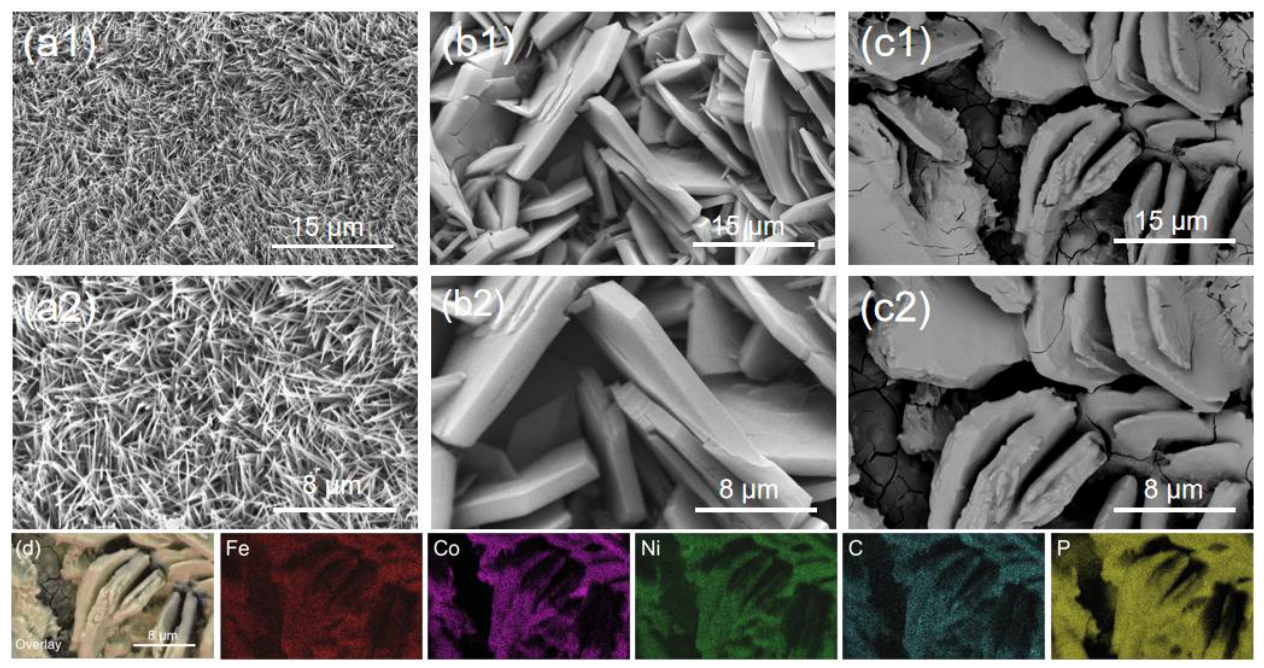
The scanning electron microscopy (SEM) image of NF (Figure S1) reveals a three-dimensional network structure with a smooth surface, making it suitable as a substrate for self-supported water electrolysis electrodes [17]. The surface structures and morphologies of FeCoNi-LDH, FeCoNi-MOF, and 2P-FeCoNi-MOF are shown in Figure 2. After the first reaction step, FeCoNi-LDH nanowire arrays were observed to grow along different directions on the substrate (Figure 2(a1,a2)). During the second reaction step, the nanowires were gradually etched by H+ ions released from the dissociation of the organic ligand terephthalic acid, followed by the subsequent growth of FeCoNi-MOF sheet-like structures (Figure 2(b1,b2)) [12,14,15]. The resulting sheets exhibited an average thickness of approximately 2 μm after the reaction. Compared with the morphology before P doping, the introduction of P atoms did not disrupt the overall layered morphology of the MOF but rendered the originally smooth surface rough, which increased the specific surface area, provided more active sites, and enhanced the reaction kinetics (Figure 2(c1,c2)) [18]. Figure S2 presents the SEM morphology of 2P-FeCoNi-LDH. The results indicate that the nanowire array structure of the FeCoNi-LDH precursor is well preserved. Furthermore, energy-dispersive X-ray spectroscopy (EDS) results (Figure 2d) revealed a homogeneous distribution of Fe, Co, Ni, C, and P elements throughout the 2P-FeCoNi-MOF material. These characteristics provide compelling evidence for successful phosphidation.
Figure 2.
SEM images of FeCoNi-LDH (a1,a2), FeCoNi-MOF (b1,b2), and 2P-FeCoNi-MOF (c1,c2), along with the EDS mapping and the corresponding element mapping images of 2P-FeCoNi-MOF (d).
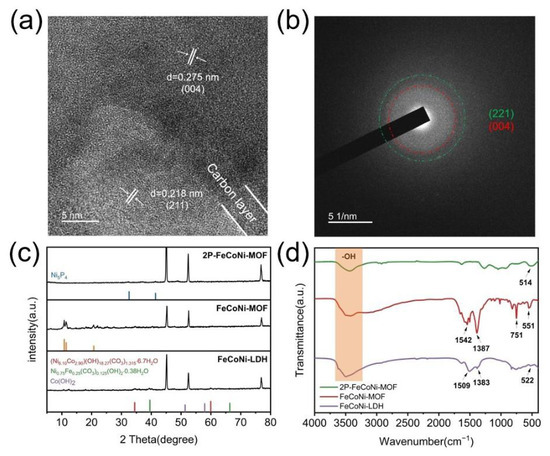
The material was separated from the nickel foam substrate via ultrasonication and examined by high-resolution transmission electron microscopy (HRTEM) to reveal its detailed structure. Figure 3a shows the HRTEM image of 2P-FeCoNi-MOF, in which distinct lattice fringes are visible. The measured interplanar spacings of 0.275 nm and 0.218 nm correspond to the (004) and (211) crystal planes of Ni5P4, respectively [19]. Discontinuities observed in the lattice fringes suggest the presence of crystal defects, which together with exposed lattice sites can facilitate electron transfer and thereby enhance the catalytic activity of 2P-FeCoNi-MOF [20]. During the phosphidation process at 350 °C, amorphous carbon derived from the MOF precursor was formed in situ, well preserving the sheet-like architecture. The HRTEM image in Figure 3a confirms the existence of an amorphous carbon layer about 6 nm thick on the surface of 2P-FeCoNi-MOF. This amorphous carbon layer can serve as an efficient electron transport pathway, promoting electron transfer from active sites to reactants [21]. The selected-area electron diffraction (SAED) pattern of 2P-FeCoNi-MOF (Figure 3b) displays bright rings composed of discrete spots, which are well indexed to the (004) and (211) planes of Ni5P4. These results collectively demonstrate the successful preparation of the 2P-FeCoNi-MOF catalytic electrode.
Figure 3.
(a) HRTEM image and (b) SAED pattern of 2P-FeCoNi-MOF; (c) XRD patterns and (d) FT-IR spectra of FeCoNi-LDH, FeCoNi-MOF, and 2P-FeCoNi-MOF.
As shown in Figure 3c, the crystal structures of the materials were analyzed by X-ray diffraction (XRD), and the specific crystal planes corresponding to each diffraction peak were identified. The strong diffraction peaks at 45.2°, 52.3°, and 76.82° are attributed to the nickel foam substrate, corresponding to the (111), (200), and (220) planes, respectively [22]. The XRD pattern of FeCoNi-LDH confirms its hydrotalcite-like crystal structure with interlayer anions of and OH−. The diffraction peaks at 51.2° and 57.4° are assigned to the (102) and (110) planes of Co(OH)2, respectively [23]; those at 34.2° and 59.8° correspond to the (101) and (110) planes of Ni0.75Fe0.25(CO3)0.125(OH)2·0.38H2O [24]; and the peaks at 39.3° and 66.2° are indexed to the (015) and (116) planes of (Ni6.10Co2.90)(OH)18.27(CO3)1.315·6.7H2O [25]. In the XRD pattern of FeCoNi-MOF, the characteristic peaks of FeCoNi-LDH disappear, and new peaks typical of a MOF structure emerge, which is consistent with the morphological evolution observed by SEM and further confirms the successful synthesis of FeCoNi-MOF. The diffraction peaks at 10.8°, 11.5°, and 20.7° correspond to the (101), (010), and (011) planes of FeCoNi-MOF, respectively [26]. After phosphidation, the MOF characteristic peaks disappear, and new diffraction peaks appear at 32.6° and 41.4°, which are assigned to the (004) and (211) planes of Ni5P4 [27]. These results are consistent with the lattice fringes observed in the HRTEM images of 2P-FeCoNi-MOF, indicating the successful formation of Ni5P4 metal phosphide via phosphidation. The weak intensity of the diffraction peaks suggests low crystallinity and possibly an amorphous-like structure with abundant defect sites, which enhances the accessibility of active sites and thereby significantly improves the intrinsic activity of the catalyst [28].
The Fourier transform infrared (FT-IR) spectra of FeCoNi-LDH, FeCoNi-MOF, and 2P-FeCoNi-MOF are presented in Figure 3d. In the spectrum of FeCoNi-LDH, the absorption peak at 3442 cm−1 is attributed to the O-H stretching vibration. The characteristic peaks at 1509 cm−1 and 1383 cm−1 are assigned to the stretching vibrations of the interlayer anions, while the peak at 522 cm−1 arises from the stretching vibration of M-O bonds (where M represents Fe, Co, and Ni) [29]. For FeCoNi-MOF, the absorption peaks at 1542 cm−1 and 1387 cm−1 correspond to the stretching vibrations of carboxyl groups. The peak observed at 751 cm−1 is associated with the C-H vibration of the benzene ring, and the absorption at 551 cm−1 is assigned to the M-O stretching vibration [30]. In the FT-IR spectrum of 2P-FeCoNi-MOF, the peak at 514 cm−1 corresponds to the M–P stretching vibration [31]. A comparison of the infrared spectra reveals that the characteristic peaks of FeCoNi-LDH at 1509 cm−1 and 1383 cm−1 disappear in the FeCoNi-MOF spectrum, indicating the hydrolysis of LDH [32]. Meanwhile, new peaks appear at 1542 cm−1 and 1387 cm−1, which are characteristic of the C-H bonds in the aromatic ring of the organic ligand. These findings are consistent with the morphological evolution observed by SEM. During the phosphating process, the organic ligands decompose, and subsequently M-P bonds are formed.
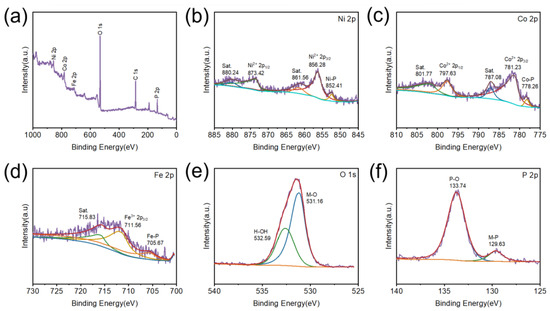
The elemental composition and chemical states of 2P-FeCoNi-MOF were investigated by X-ray photoelectron spectroscopy (XPS), as shown in Figure 4. The survey spectrum (Figure 4a) exhibits characteristic peaks of P 2p, C 1s, O 1s, Fe 2p, Co 2p, and Ni 2p, confirming the successful loading of 2P-FeCoNi-MOF onto the nickel foam substrate. The high-resolution Ni 2p spectrum (Figure 4b) can be deconvoluted into five peaks: the binding energy peaks at 873.42 eV and 856.28 eV are assigned to Ni2+ 2p1/2 and Ni2+ 2p3/2, respectively [33]; the peak at 852.41 eV is attributed to the Ni-P bond; and the two satellite peaks are located at 880.24 eV and 861.56 eV [34]. In the Co 2p spectrum (Figure 4c), the peaks at 797.63 eV and 781.23 eV correspond to Co2+ 2p1/2 and Co2+ 2p3/2, respectively [35], the peak at 778.26 eV is assigned to the Co-P bond, and the satellite peaks appear at 801.77 eV and 787.08 eV [36]. The Fe 2p spectrum (Figure 4d) shows the main peak of Fe3+ 2p3/2 at 711.56 eV with a satellite peak at 715.83 eV [37], while the peak at 705.67 eV is identified as the Fe-P bond [38]. In the O 1s spectrum (Figure 4e), the peaks at 532.59 eV and 531.16 eV are attributed to surface-adsorbed water (H-OH) and M-O bonds, respectively [39]. The P 2p spectrum (Figure 4f) displays a peak at 133.74 eV, which is associated with P-O species, likely due to surface oxidation, and a peak at 129.63 eV originating from phosphorus in metal phosphides [40]. The XPS results verify the presence of three metal phosphides, whereas only one type of metal phosphide diffraction peak was observed in the XRD pattern, suggesting that Fe and Co may be incorporated into the Ni5P4 lattice via isomorphous substitution.
Figure 4.
XPS analysis of 2P-FeCoNi-MOF: (a) Full survey spectrum; high-resolution spectra for (b) Ni 2p, (c) Co 2p, (d) Fe 2p, (e) O 1s, and (f) P 2p.
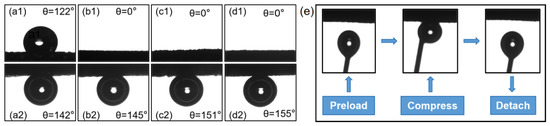
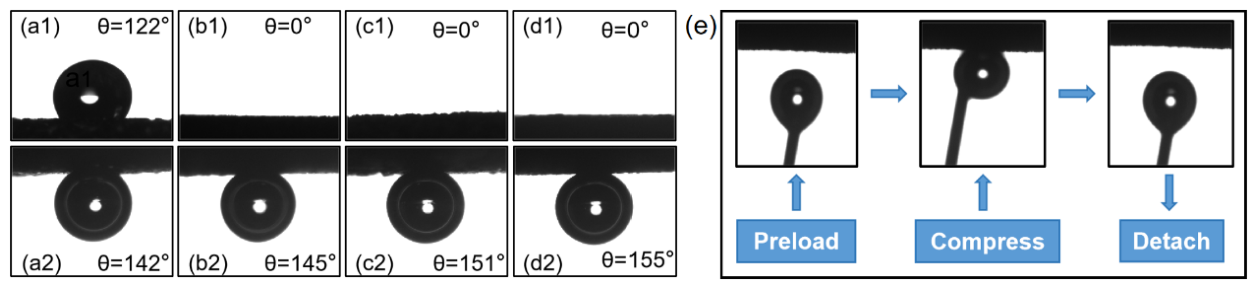
Figure 5 presents the water contact angle (WCA) and underwater bubble contact angle measurements for NF and the as-prepared materials. NF exhibits a WCA of 120°, indicating certain hydrophobicity. In contrast, the prepared FeCoNi-LDH, FeCoNi-MOF, and 2P-FeCoNi-MOF all show a WCA of 0°, demonstrating superhydrophilic surface properties. Due to the immediate penetration of water droplets upon contact with the electrode surface, no stable droplet state could be captured by high-speed photography [41]. The superhydrophilicity promotes the formation of a wetting film, which effectively isolates bubbles from the electrode surface and reduces bubble adhesion [42]. Meanwhile, the underwater bubble contact angles of FeCoNi-MOF and 2P-FeCoNi-MOF are measured to be 151° and 155°, respectively, significantly higher than those of NF (142°) and FeCoNi-LDH (145°), confirming the superaerophobic nature of these electrodes in an aqueous environment [43]. The dynamic bubble adhesion test of 2P-FeCoNi-MOF (Figure 5e) shows that a bubble gradually approaches the electrode surface, deforms under compression, and then rapidly detaches, indicating that the bubbles generated during HER and OER can readily desorb from the electrode surface. The contact angle results highlight the advantage of the 2P-FeCoNi-MOF electrode in mass transfer during water electrolysis: the electrolyte can fully access the active sites, while bubbles detach easily before extensive growth, thereby accelerating the reaction kinetics [44]. The incorporation of nonmetal phosphorus can modulate the surface electronic structure of the catalyst, increase its surface polarity, and enhance hydrophilicity, facilitating complete wetting of the catalyst surface by the electrolyte [45].
Figure 5.
Surface wettability and bubble behavior of different electrodes: Water contact angles and underwater bubble contact angles for (a1,a2) NF, (b1,b2) FeCoNi-LDH, (c1,c2) FeCoNi-MOF, and (d1,d2) 2P-FeCoNi-MOF; (e) dynamic bubble adhesion process on 2P-FeCoNi-MOF.
3.2. Electrocatalytic Hydrogen Evolution Performance
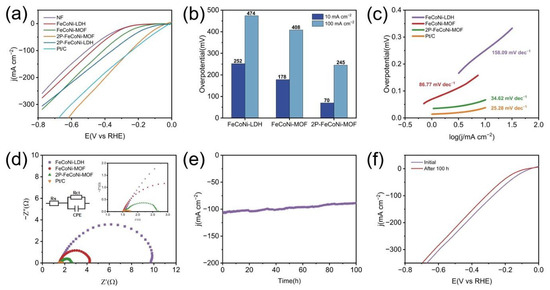
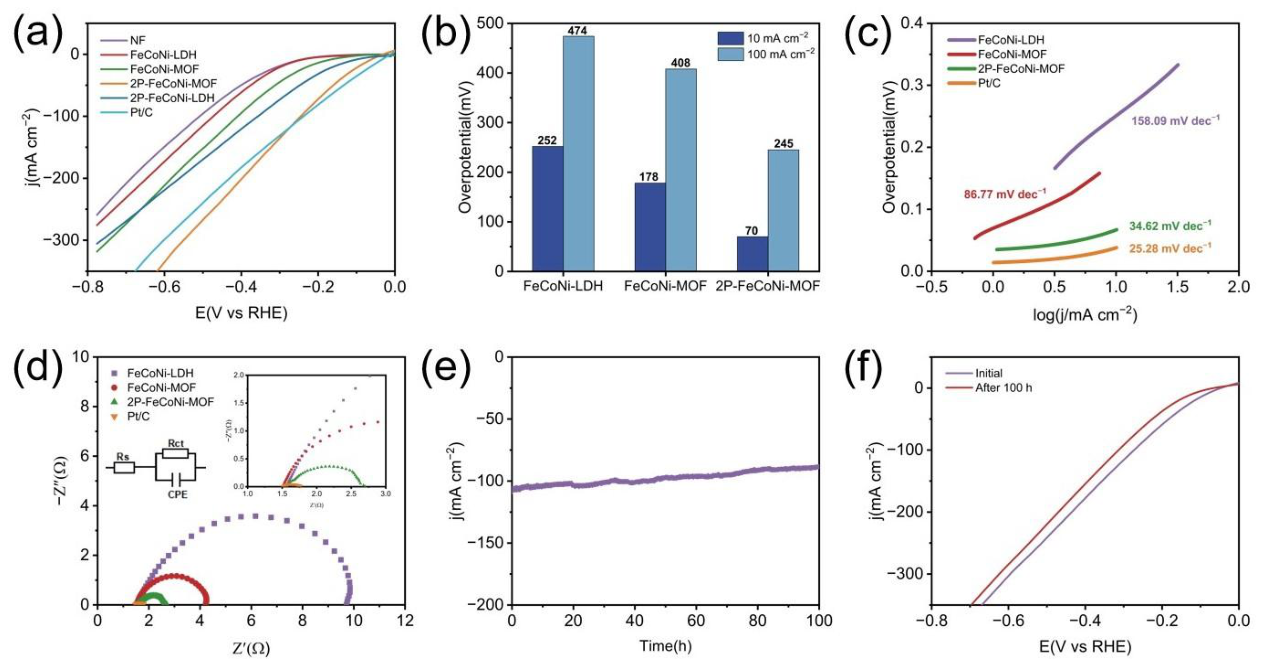
The HER performance of the as-prepared FeCoNi-LDH, FeCoNi-MOF, and 2P-FeCoNi-MOF samples was systematically evaluated. Among the three samples, 2P-FeCoNi-MOF exhibited the best catalytic performance. Linear sweep voltammetry (LSV) curves obtained using a three-electrode system (Figure 6a) reveal that at a current density of 10 mA cm−2, the overpotential of 2P-FeCoNi-MOF is only 70 mV, which is considerably lower than those of NF (266 mV), FeCoNi-LDH (252 mV), FeCoNi-MOF (178 mV) and 2P-FeCoNi-LDH (112 mV), and slightly higher than that of the commercial Pt/C electrode (42 mV) (Figure 6b). Similarly, at a current density of 100 mA cm−2, the overpotential of 2P-FeCoNi-MOF is 245 mV, the lowest among the four as-synthesized samples and close to that of Pt/C (236 mV). To quantitatively distinguish the contributions of the trimetallic synergy and the amorphous carbon layer to the HER performance, monometallic (2P-Ni-MOF) and bimetallic (2P-CoNi-MOF) control samples were synthesized for comparison with the trimetallic 2P-FeCoNi-MOF. At 10 mA cm−2, the overpotentials of 2P-Ni-MOF and 2P-CoNi-MOF are 149 mV and 91 mV, respectively, while that of 2P-FeCoNi-MOF is only 70 mV (Figure S3). The dramatic decrease of 79 mV from the monometallic to the trimetallic sample directly demonstrates a strong synergistic effect among Fe, Co, and Ni, which is the primary reason for the enhanced intrinsic activity. Compared with 2P-FeCoNi-LDH, the enhanced performance of 2P-FeCoNi-MOF is primarily attributed to the amorphous carbon layer introduced during the phosphidation of the MOF precursor, which effectively facilitates electron transport [46]. Among the three samples, 1.5P-FeCoNi-MOF, 2P-FeCoNi-MOF and 2.5P-FeCoNi-MOF, the performance of 2P-FeCoNi-MOF is also the best (Figure S3a). When the current density reaches 10 mA cm−2, the overpotential of 1.5P-FeCoNi-MOF is 87 mV and that of 2.5P-FeCoNi-MOF is 92 mV. At a current density of 100 mA cm−2, the overpotential of 1.5P-FeCoNi-MOF is 290 mV and that of 2.5P-FeCoNi-MOF is 285 mV (Figure S3b). These results demonstrate that phosphidation can significantly enhance the catalytic performance, and the synergistic effect among the three metal phosphides accelerates the adsorption and desorption of hydrogen-containing intermediates, thereby promoting hydrogen generation and release [47].
Figure 6.
HER electrocatalytic performance: (a) LSV curves; (b) overpotentials derived from the LSV curves at 10 mA cm−2 and 100 mA cm−2; (c) Tafel slopes; (d) EIS spectra; (e) chronoamperometry (i–t) curve of 2P-FeCoNi-MOF; (f) comparison of LSV curves for 2P-FeCoNi-MOF before and after the stability test.
The Tafel slope, an important parameter reflecting the HER mechanism and catalytic efficiency, was derived from the LSV curves. As shown in Figure 6c, the Tafel slope of 2P-FeCoNi-MOF is 34.62 mV dec−1, suggesting a Volmer–Heyrovsky pathway [35], significantly lower than those of FeCoNi-LDH (158.09 mV dec−1) and FeCoNi-MOF (86.77 mV dec−1), and slightly higher than that of Pt/C (25.28 mV dec−1). The lower Tafel slope indicates that 2P-FeCoNi-MOF can achieve a higher current density at a lower overpotential, suggesting faster HER kinetics and demonstrating that phosphidation effectively enhances the electron transfer rate [48].
Electrochemical impedance spectroscopy (EIS) was further employed to investigate the electrocatalytic kinetics of the catalysts (Figure 6d, inset shows an enlarged view). The solution resistance (Rs) of all catalysts is approximately 1.54 Ω, but their charge transfer resistance (Rct) differs significantly. The Rct of 2P-FeCoNi-MOF is only 1.15 Ω, much lower than those of FeCoNi-LDH (8.25 Ω) and FeCoNi-MOF (2.67 Ω), and slightly higher than that of Pt/C (0.27 Ω). The minimal charge transfer resistance highlights the excellent electron transfer capability and catalytic performance of 2P-FeCoNi-MOF [49], consistent with the LSV results.
Stability is a key criterion for evaluating catalyst performance. The long-term stability of 2P-FeCoNi-MOF was tested at 100 mA cm−2 using chronoamperometry (i-−t) (Figure 6e). During continuous HER operation for 100 h, only a slight decay in current density was observed. Post-stability LSV measurement (Figure 6f) confirmed that the electrocatalytic activity decreased only marginally compared to the initial performance. These results indicate that 2P-FeCoNi-MOF possesses not only high HER activity but also excellent long-term stability.
Figure S4 displays the cyclic voltammetry (CV) curves of the samples obtained at each preparation step, measured at scan rates ranging from 20 to 100 mV s−1. All CV curves of 2P-FeCoNi-MOF exhibit symmetrical shapes and similar profiles, indicating excellent electrochemical reversibility [50]. The CV curves were used to calculate the double-layer capacitance (Cdl) of the catalysts. By linearly fitting the data obtained from the CV curves of each catalyst, the Cdl values were determined (Figure S5a). Specifically, the Cdl value of 2P-FeCoNi-MOF is 86.57 mF cm−2, which is considerably higher than those of FeCoNi-LDH (6.64 mF cm−2) and FeCoNi-MOF (7.85 mF cm−2). Since the electrochemical active surface area (ECSA) is proportional to the double-layer capacitance, the ECSA of 2P-FeCoNi-MOF was calculated to be 2157 cm−2 (Figure S5b), significantly larger than those of FeCoNi-LDH (76 cm−2) and FeCoNi-MOF (108 cm−2). This remarkable enhancement can be attributed to the incorporation of P, which disrupts the lattice integrity, creates a roughened surface morphology, and modifies the local electronic structure, thereby converting inert sites into electrochemically active sites [51].
3.3. Electrocatalytic Oxygen Evolution Performance
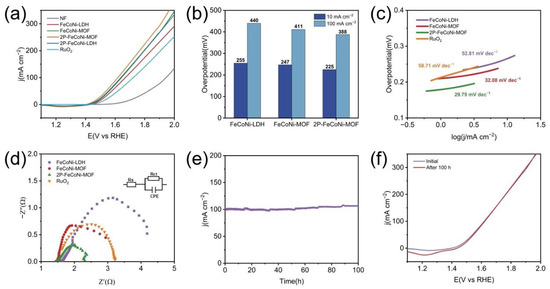
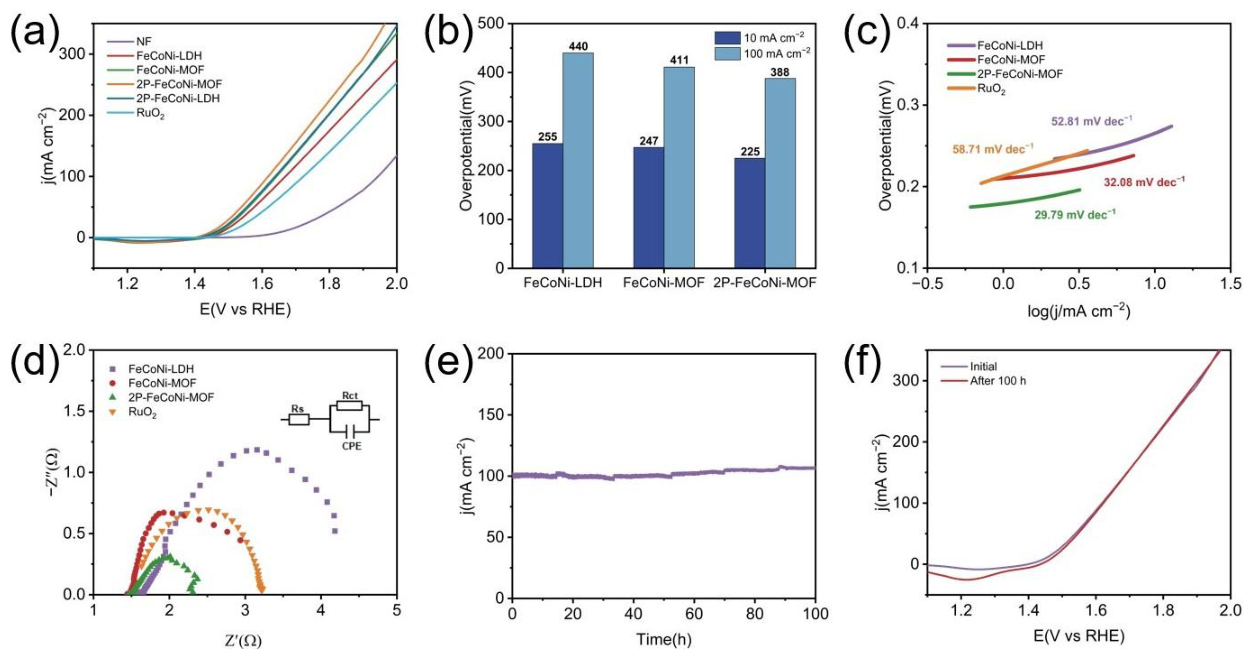
The OER performance of the catalysts prepared at each step was also evaluated using a three-electrode system. As shown in Figure 7a, at a current density of 10 mA·cm−2, the overpotential of 2P-FeCoNi-MOF is 225 mV, which is lower than those of NF (434 mV), FeCoNi-LDH (255 mV), FeCoNi-MOF (247 mV) and 2P-FeCoNi-LDH (238 mV), and even superior to the commercial benchmark RuO2 electrode (278 mV). Additionally, a distinct anodic oxidation peak is observed around 1.27 V, indicating strong charge transfer capability of the catalyst, which is one of the reasons for its excellent OER performance [52]. To minimize the influence of the anodic peak, the LSV data were acquired using a reverse scan, resulting in a downward-protruding curve. Figure 7b further compares the overpotentials of the materials at a current density of 100 mA·cm−2, the overpotential of 2P-FeCoNi-MOF is 388 mV, the lowest among the as-prepared samples and lower than that of RuO2 (494 mV), suggesting higher energy efficiency for the OER process. For the OER, the control samples were also evaluated. At 10 mA cm−2, the overpotential of 2P-Ni-MOF is 281 mV, that of 2P-CoNi-MOF is approximately 258 mV, and that of 2P-FeCoNi-MOF is 225 mV (Figure S7). The trimetallic sample significantly outperforms the bimetallic and monometallic counterparts, confirming that the Fe–Co–Ni trimetallic synergy is also essential for OER. Among the three samples, 1.5P-FeCoNi-MOF, 2P-FeCoNi-MOF and 2.5P-FeCoNi-MOF, the performance of 2P-FeCoNi-MOF is also the best (Figure S8a). When the current density reaches 10 mA cm−2, the overpotential of 1.5P-FeCoNi-MOF is 229 mV and that of 2.5P-FeCoNi-MOF is 234 mV. At a current density of 100 mA cm−2, the overpotential of 1.5P-FeCoNi-MOF is 410 mV and that of 2.5P-FeCoNi-MOF is 428 mV (Figure S8b). The Tafel slopes of FeCoNi-LDH, FeCoNi-MOF, 2P-FeCoNi-MOF, and RuO2 were derived from the LSV curves (Figure 7c), and are 54.81, 32.08, 29.79, and 58.71 mV·dec−1, respectively. The smallest Tafel slope of 2P-FeCoNi-MOF indicates the fastest OER kinetics.
Figure 7.
OER electrocatalytic performance: (a) LSV curves; (b) overpotentials at 10 mA cm−2 and 100 mA cm−2; (c) Tafel slopes; (d) EIS spectra; (e) chronoamperometry (i–t) curve of 2P-FeCoNi-MOF; (f) comparison of LSV curves for 2P-FeCoNi-MOF before and after stability testing.
Figure 7d shows the EIS of FeCoNi-LDH, FeCoNi-MOF, 2P-FeCoNi-MOF, and RuO2, which were used to investigate the reaction kinetics at the electrolyte-electrocatalyst interface. The fitted charge transfer resistance of 2P-FeCoNi-MOF is 0.8 Ω, lower than those of FeCoNi-LDH (2.59 Ω), FeCoNi-MOF (1.47 Ω), and RuO2 (1.71 Ω), further demonstrating that the rapid electron transfer process at the electrode/electrolyte interface significantly enhances the OER catalytic activity of 2P-FeCoNi-MOF [53]. This excellent electrical conductivity is attributed to the formation of ternary metal phosphides and amorphous carbon layers during the phosphating process.
The OER stability was evaluated using the same method as employed for the HER test. As shown in Figure 7e, a chronoamperometry (i–t) stability test was conducted on 2P-FeCoNi-MOF. When tested continuously for 100 h at a current density of 100 mA·cm−2, no decay in current density was observed; instead, a gradual increasing trend was noted. This phenomenon can be explained by the oxidation of metal phosphides in the catalyst during the OER process, leading to phosphorus leaching into the electrolyte, which enhances the electrolyte conductivity and consequently results in a slow rise in current density [54]. Meanwhile, the LSV curves of 2P-FeCoNi-MOF before and after the long-term stability test (Figure 7f) almost overlap, indicating that the catalytic performance has hardly changed.
After the 100-h stability test, the morphology and composition of the 2P-FeCoNi-MOF electrode were further investigated. As shown in the SEM image in Figure S9a, the catalyst retained its layered structure, but with reduced thickness and increased surface roughness. This morphological evolution could expose more active sites, thereby enhancing the intrinsic activity of the catalyst, which is mainly attributed to surface reconstruction during the OER process [55]. In addition, the XRD results in Figure S9b show no significant structural changes, but the diffraction peak at 32.6° disappeared, indicating reduced crystallinity. This phenomenon may result from the continuous oxygen evolution under high current density during the long-term stability test, which disrupted the initial structure and electronic configuration of the catalyst, leading to a higher degree of oxidation of the metal phosphides [56]. The electrode surface likely underwent corrosion and reconstruction, rapidly converting phosphides into phosphates and MOxHy [57]. Research has shown that MOxHy species are the true active sites in the OER [58]. Furthermore, when the surface metal phosphides are oxidized to MOxHy, they can form a protective barrier within the catalyst, preventing further corrosion of the inner phosphides. This not only maintains the high conductivity of the catalyst but also establishes a favorable interface between the phosphides and MOxHy, enabling efficient electron transfer within the electrode [59]. The superaerophobic property (underwater bubble contact angle of 155°) enables rapid bubble detachment during HER/OER, significantly reducing mechanical impact and physical detachment of the catalyst layer [60]. Meanwhile, the 6 nm thick amorphous carbon layer uniformly coated on the material surface acts as a protective barrier that effectively inhibits oxidative dissolution of the metal phosphides by the electrolyte without compromising electronic conductivity [61].
3.4. Overall Water Splitting Performance
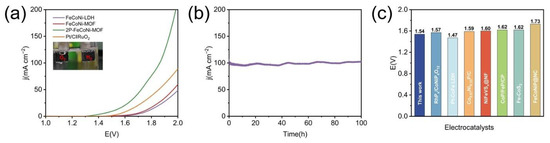
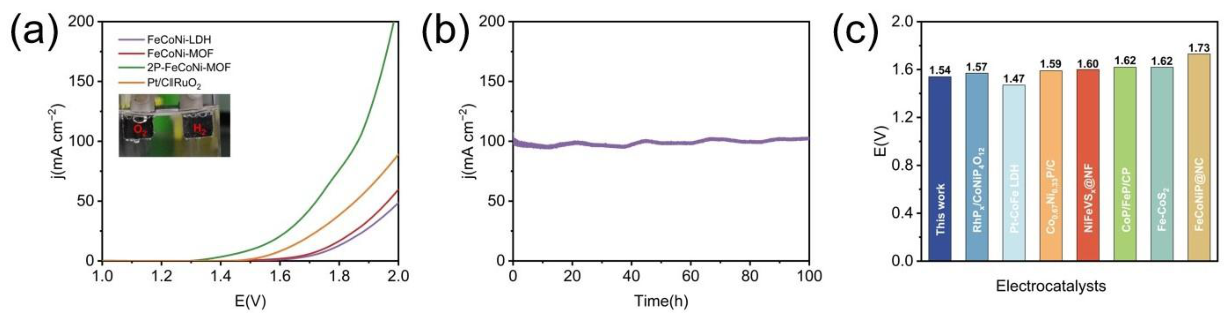
Owing to the excellent bifunctional electrocatalytic performance of 2P-FeCoNi-MOF for HER and OER, a two-electrode electrolyzer was constructed using 2P-FeCoNi-MOF as both the cathode and anode, and its OWS performance was systematically evaluated. For comparison, a Pt/CǁRuO2 noble-metal electrode system was fabricated, employing Pt/C as the cathode and RuO2 as the anode. As shown in Figure 8a, 2P-FeCoNi-MOF achieved a current density of 10 mA·cm−2 at a voltage of 1.54 V, which is lower than those of FeCoNi-LDH (1.78 V), FeCoNi-MOF (1.74 V), and the noble metal system Pt/CǁRuO2 (1.61 V). As illustrated in the inset, evident bubble evolution was observed on both the anode and cathode surfaces during the OWS experiment, corresponding to the generated oxygen and hydrogen, respectively. Benefiting from the superaerophobic nature of the material, the bubbles detach rapidly before growing large [62]. Furthermore, the stability of 2P-FeCoNi-MOF during overall water splitting was investigated (Figure 8b). At a current density of 100 mA·cm−2, the catalyst exhibited almost no obvious degradation over 100 h of continuous operation, with only minor fluctuations observed, indicating its potential to replace noble metal electrocatalysts in practical applications and demonstrating promising prospects for industrial implementation. Meanwhile, the results from Figure 8c and Table S1 demonstrate that 2P-FeCoNi-MOF exhibits competitive catalytic activity for overall water splitting when compared with the recently reported electrocatalysts listed therein.
Figure 8.
(a) LSV curves for overall water splitting with different catalysts; (b) i–t stability test curve of 2P-FeCoNi-MOF; (c) The potential of 2P-FeCoNi-MOF catalyst compared with those of other recently reported catalysts for OWS at a current density of 10 mA cm−2.
The excellent electrocatalytic water splitting performance of 2P-FeCoNi-MOF can be attributed to the following factors. First, the binder-free in situ growth of the material on nickel foam enables direct contact with the three-dimensional network structure, which effectively promotes electron transfer, reduces interfacial charge carrier recombination, and enhances structural stability. Second, the trimetallic TMPs generated through phosphidation significantly improve the poor charge transfer capability of the MOF derived from the hydrothermal method, while the synergistic effect among the three metal elements further enhances charge transfer efficiency. Third, the amorphous carbon formed during the phosphidation process crucially enhances the electron transport within the catalyst. Finally, the concurrent superhydrophilic and superaerophobic properties of the material work synergistically to markedly accelerate the mass transfer kinetics during the reaction.
4. Conclusions
In summary, a FeCoNi-LDH nanowire array was successfully prepared on nickel foam via a hydrothermal method, and then converted into FeCoNi-MOF through etching with terephthalic acid, followed by phosphidation to obtain an efficient and durable self-supported trimetallic phosphide electrode of 2P-FeCoNi-MOF. The as-prepared 2P-FeCoNi-MOF catalyst exhibits remarkable electrocatalytic activity and stability in 1.0 M KOH electrolyte, achieving overpotentials of only 70 mV for the HER and 225 mV for the OER at a current density of 10 mA cm−2. Furthermore, when employed as a bifunctional electrocatalyst for overall water splitting, it requires a voltage of only 1.54 V to reach 10 mA cm−2, outperforming the noble metal-based Pt/CǁRuO2 system. It also demonstrates excellent durability, showing almost no degradation after 100 h of continuous operation at 100 mA cm−2. The layered structure grown in situ on NF not only provides abundant active sites but also ensures high stability due to the strong interaction with the substrate. The superhydrophilic and superaerophobic properties significantly enhance mass transport, while the synergistic effect among Fe, Co, and Ni atoms, coupled with the incorporation of amorphous carbon, improves electron transfer efficiency, which collectively contributes to the enhanced intrinsic catalytic activity. This study provides a reference for the preparation of highly active, cost-effective, and ultra-durable materials for water splitting.
Supplementary Materials
The following supporting information can be downloaded at: https://www.mdpi.com/article/10.3390/su18115229/s1. Figure S1. SEM image of NF: (a) scale bar: 100 µm; (b) scale bar: 40 µm; Figure S2. SEM image of 2P-FeCoNi-LDH. (a) scale bar:15 µm; (b) scale bar: 8 µm; Figure S3. HER electrocatalytic performance: (a) LSV curves and (b) overpotentials; Figure S4. HER electrocatalytic performance: (a) LSV curves and (b) overpotentials; Figure S5. CV curves of (a) FeCoNi-LDH, (b) FeCoNi-MOF, and (c) 2P-FeCoNi-MOF at different scan rates; Figure S6. (a) Cdl values and (b) ECSA values for FeCoNi-LDH, FeCoNi-MOF, and 2P-FeCoNi-MOF; Figure S7. OER electrocatalytic performance: (a) LSV curves and (b) overpotentials; Figure S8. OER electrocatalytic performance: (a) LSV curves and (b) overpotentials; Figure S9. (a) SEM image and (b) XRD pattern of 2P-FeCoNi-MOF after the stability test; Table S1. The potential of 2P-FeCoNi-MOF catalyst compared with those of other recently reported catalysts for OWS at a current density of 10 mA cm−2. References [63,64,65,66,67,68] are cited in the Supplementary Materials.
Author Contributions
X.M.: Conceptualization, visualization, methodology, writing—original draft, formal analysis, writing—review and editing. X.S.: Conceptualization, visualization, methodology, supervision, writing—review and editing. X.W.: Conceptualization, supervision, writing—review and editing. C.L.: Writing and editing, analysis, review, and visualization. X.L.: Writing and editing, analysis. H.W.: review, and visualization. L.M.: Review and editing, Supervision, Resources, Project administration, Funding acquisition. All authors have read and agreed to the published version of the manuscript.
Funding
This research was funded by Sichuan Science and Technology Support Program (2025ZNSFSC0377, 2024ZYD0138, 2025ZNSFSC1405, 2025NSFSC2016), Open Fund (PLN2023-16) of National Key Laboratory of Oil and Gas Reservoir Geology and Exploitation (Southwest Petroleum University), Sichuan Province Central Guidance for Local Science and Technology Development Special Project (2024ZYD0302) and Ministry of Education Industry-University-Research Collaborative Talent Cultivation Project (230805940223731).
Institutional Review Board Statement
Not applicable.
Informed Consent Statement
Not applicable.
Data Availability Statement
The data that support the findings of this study are available from the corresponding author upon reasonable request.
Acknowledgments
The lead author is thankful to the supervisory team for their support.
Conflicts of Interest
The authors declare no conflicts of interest.
References
- Fu, X.T.; Liao, H.Y.; Zhang, Z.; Zheng, Y.F.; Lu, J.N.; Cheng, S.Y.; Jiang, Y.M.; Gao, Y.H. Medium-Entropy heterostructure of crystalline NiCoFeP @ amorphous NiCoFe-LDH for Industrial-Current density and ultrastable overall water splitting. Chem. Eng. J. 2025, 505, 11. [Google Scholar] [CrossRef] [Scilit]
- Bie, C.B.; Jiang, C.C.; Yang, J.D.; Sun, X.; Zeng, X.K.; Zhang, J.J.; Zhu, B.C. Side reactions in photocatalytic H2 production by overall water splitting. J. Mater. Sci. Technol. 2025, 229, 48–57. [Google Scholar] [CrossRef] [Scilit]
- Yu, M.F.; Huang, J.H.; Niu, Q.; Li, L.Y.; Yu, Y.; Bi, J.H. Asymmetric Structural Design in Cobaloxime-Integrated Covalent Organic Frameworks to Facilitate Photocatalytic Overall Water Splitting. Angew. Chem. 2025, 64, 8. [Google Scholar]
- Wang, F.; Pei, Z.; Xu, Z.; Qin, T.T.; Xin, O.Y.; Li, D.Y.; Hou, Y.; Guo, X.Z. Constructing Mn-Co-Fe Ternary Metal Phosphides Nanosheet Arrays as Bifunctional Electrocatalysts for Overall Water Splitting. Adv. Sci. 2025, 12, 10. [Google Scholar] [CrossRef] [Scilit] [PubMed]
- Liu, J.; Wan, Y.Y.; Xie, Y.; Dong, F.; Yang, K.; Li, X.B. Boosting photocatalytic overall water splitting by β-NiS/TiO2−x Ohmic junction. Appl. Catal. B Environ. Energy 2025, 379, 10. [Google Scholar] [CrossRef] [Scilit]
- Zhao, D.M.; Wang, Y.Q.; Dong, C.L.; Huang, Y.C.; Chen, J.; Xue, F.; Shen, S.H.; Guo, L.J. Boron-doped nitrogen-deficient carbon nitride-based Z-scheme heterostructures for photocatalytic overall water splitting. Nat. Energy 2021, 6, 388–397. [Google Scholar] [CrossRef] [Scilit]
- Liu, Y.Q.; Zhang, Z.H.; Zhang, L.; Xia, Y.G.; Wang, H.Q.; Liu, H.; Ge, S.G.; Yu, J.H. Manipulating the d-band centers of transition metal phosphides through dual metal doping towards robust overall water splitting. J. Mater. Chem. A 2022, 10, 22125–22134. [Google Scholar] [CrossRef] [Scilit]
- Kang, Q.L.; Li, M.Y.; Shi, J.W.; Lu, Q.Y.; Gao, F. A Universal Strategy for Carbon-Supported Transition Metal Phosphides as High-Performance Bifunctional Electrocatalysts towards Efficient Overall Water Splitting. ACS Appl. Mater. Interfaces 2020, 12, 19447–19456. [Google Scholar] [CrossRef] [Scilit]
- Sun, X.P.; Wei, P.; He, Z.M.; Cheng, F.Y.; Tang, L.; Han, J.T.; He, J.H. Novel transition-metal phosphides@N, P-codoped carbon electrocatalysts synthesized via a universal strategy for overall water splitting. J. Alloys Compd. 2023, 932, 8. [Google Scholar] [CrossRef] [Scilit]
- An, B.H.; Li, X.; Li, L.P.; Dai, Z.X.; Li, N.; Gao, Y.Q.; Ge, L. Review and perspective on the rational design and structural modulation of transition metal phosphides for efficient electrocatalytic water splitting. Coord. Chem. Rev. 2026, 550, 61. [Google Scholar] [CrossRef] [Scilit]
- Sun, J.R.; Li, S.S.; Zhang, Q.Q.; Guan, J.Q. Iron-cobalt-nickel trimetal phosphides as high-performance electrocatalysts for overall water splitting. Sustain. Energy Fuels 2020, 4, 4531–4537. [Google Scholar] [CrossRef] [Scilit]
- Zhang, X.L.; Hu, J.S.; Cheng, X.F.; Nartey, K.A.; Zhang, L. Double metal-organic frameworks derived Fe-Co-Ni phosphides nanosheets as high-performance electrocatalyst for alkaline electrochemical water splitting. Electrochim. Acta. 2021, 367, 137536. [Google Scholar] [CrossRef] [Scilit]
- Zhu, Y.; Zhao, Y.; Xi, C.; Hu, K.R.; Han, S.; Jiang, J.B. Cationic defect engineering induces LOM-enhanced electrocatalysts derived from in situ semi-transformed NiFe-LDH/MOF heterostructure for efficient overall water-splitting. Compos. Part B Eng. 2025, 298, 15. [Google Scholar] [CrossRef] [Scilit]
- Cai, M.K.; Liu, Q.L.; Xue, Z.Q.; Li, Y.L.; Fan, Y.A.; Huang, A.P.; Li, M.R.; Croft, M.; Tyson, T.A.; Ke, Z.F.; et al. Constructing 2D MOFs from 2D LDHs: A highly efficient and durable electrocatalyst for water oxidation. J. Mater. Chem. A 2020, 8, 190–195. [Google Scholar] [CrossRef] [Scilit]
- Qin, H.L.; Cheng, J.; Zhou, P.; Ji, Z.Y.; Peng, H.Y.; Shen, X.P.; Zhou, H.; Zhu, G.X.; Yang, J. In situ semi-etching of bimetallic LDH nanosheet arrays into FeNi-LDH/ MOF to boost oxygen evolution reaction. Chem. Eng. J. 2024, 493, 152721. [Google Scholar] [CrossRef] [Scilit]
- Chen, Z.L.; Ha, Y.; Jia, H.X.; Yan, X.X.; Chen, M.; Liu, M.; Wu, R.B. Oriented Transformation of Co-LDH into 2D/3D ZIF-67 to Achieve Co-N-C Hybrids for Efficient Overall Water Splitting. Adv. Energy Mater. 2019, 9, 13. [Google Scholar] [CrossRef] [Scilit]
- Li, X.P.; Huang, C.; Han, W.K.; Ouyang, T.; Liu, Z.Q. Transition metal-based electrocatalysts for overall water splitting. Chin. Chem. Lett. 2021, 32, 2597–2616. [Google Scholar] [CrossRef] [Scilit]
- Li, Y.T.; Yi, J.H.; Qin, R.G.; Xie, C.X.; Zhao, L.J.; Lang, X.Y.; Jiang, Q. CeO2 for modulating the electronic structure of nickel-cobalt bimetallic phosphides to promote efficient overall water splitting. J. Colloid Interface Sci. 2024, 661, 690–699. [Google Scholar] [CrossRef] [Scilit]
- Wan, W.B.; Xia, Y.J.; Zhu, X.X.; Pei, Y.R.; Lang, X.Y.; Jiang, Q. Self-supported Ni5P4/Co3O4 electrode with optimized electron structure as an efficient electrocatalyst for alkaline hydrogen evolution reaction. J. Alloys Compd. 2025, 1022, 179916. [Google Scholar] [CrossRef] [Scilit]
- Sibiya, S.G.; Ayom, G.E.; Khan, M.D.; Choi, J.; Bhoyate, S.; Gupta, R.K.; Revaprasadu, N. Metal-Organic Precursors for Transition-Metal-Doped Ni2P via Pyrolysis for Efficient Overall Water Splitting and Supercapacitance. Eur. J. Inorg. Chem. 2023, 26, e202300087. [Google Scholar] [CrossRef] [Scilit]
- Qin, X.N.; Yu, Z.B.; Zhang, Z.M.; Qin, Z.Y.; Pang, H.; Zhang, B.G.; Hou, Y.P.; Huang, J.; Jiang, R.H.; Qu, J.Y. Vacancy engineering-induced spin polarization in heterogeneous phosphides by simple iron salt infiltration for efficient overall water splitting. Chem. Eng. J. 2024, 498, 155159. [Google Scholar] [CrossRef] [Scilit]
- Su, X.D.; Shao, X.; Zhao, J.; Wang, Z.H.; Zhang, C.X.; Song, C.X.; Wang, D.B. Self-supporting high-performance nickel-cobalt phosphides as bifunctional catalysts for efficient overall water and seawater splitting. Int. J. Hydrogen Energy 2025, 105, 638–645. [Google Scholar] [CrossRef] [Scilit]
- Yang, X.; Cheng, J.; Xu, Y.; Li, H.; Tu, W.F.; Zhou, J.H. Heterogeneous ultra-thin FeCo-LDH@Co(OH)2 nanosheets facilitated electrons transfer for oxygen evolution reaction. Chem. Eng. J. 2023, 472, 145076. [Google Scholar] [CrossRef] [Scilit]
- Abazari, R.; Sanati, S.; Fan, W.K.; Tahir, M.; Nayak, S.; Parida, K.; El-Shaha, M.; Abdelhameed, R.M.; Nesterov, D.S.; Kirillov, A.M.; et al. Design and engineering of MOF/LDH hybrid nanocomposites and LDHs derived from MOF templates for electrochemical energy conversion/storage and environmental remediation: Mechanism and future perspectives. Coord. Chem. Rev. 2025, 523, 216256. [Google Scholar] [CrossRef] [Scilit]
- Altalhi, A.A.; Mohamed, E.A.; Negm, N.A. Recent advances in layered double hydroxide (LDH)-based materials: Fabrication, modification strategies, characterization, promising environmental catalytic applications, and prospective aspects. Energy Adv. 2024, 3, 2136–2151. [Google Scholar] [CrossRef] [Scilit]
- Mourdikoudis, S.; Dutta, S.; Kamal, S.; Gómez-Graña, S.; Pastoriza-Santos, I.; Wuttke, S.; Polavarapu, L. State-of-the-Art, Insights, and Perspectives for MOFs-Nanocomposites and MOF-Derived (Nano)Materials. Adv. Mater. 2025, 37, 2415399. [Google Scholar] [CrossRef] [Scilit]
- Li, C.F.; Zhao, J.W.; Xie, L.J.; Wu, J.Q.; Li, G.R. Fe doping and oxygen vacancy modulated Fe-Ni5P4/NiFeOH nanosheets as bifunctional electrocatalysts for efficient overall water splitting. Appl. Catal. B Environ. Energy. 2021, 291, 119987. [Google Scholar] [CrossRef] [Scilit]
- An, B.H.; Dong, J.P.; Su, H.; Liu, W.L.; Li, N.; Gao, Y.Q.; Ge, L. Electron redistributed vanadium anchored CoFe phosphides as effective electrocatalysts for boosting overall water splitting. Int. J. Hydrogen Energy 2024, 51, 292–302. [Google Scholar] [CrossRef] [Scilit]
- Ma, J.Z.; Wang, Y.Q.; Pan, W.; Zhang, J.T. Preparation of Hierarchical Cube-on-plate Metal Phosphides as Bifunctional Electrocatalysts for Overall Water Splitting. Chem.-Asian J. 2020, 15, 1500–1504. [Google Scholar] [CrossRef] [Scilit]
- Xu, Z.F.; Chen, C.W.; Jing, Y.N.; Liu, D.Q.; Li, L.L.; Yin, X.L.; Wen, J.H. In-situ confinement strategy for constructing CoP-NiP2 QDs/NC as an efficient and robust bifunctional electrocatalyst for overall water splitting in a wide pH range. J. Alloys Compd. 2025, 1022, 179680. [Google Scholar] [CrossRef] [Scilit]
- Liu, X.Y.; Huang, T.T.; Xiao, J.; Liu, N.N.; Yu, Z.W.; Zhang, L.; Xu, G.C. Co2P/MnP Nanoarrays Loaded on Coal-Based Carbon Nanofibers Serve as Effective Bifunctional Catalysts for Overall Water Splitting. ACS Appl. Nano Mater. 2025, 8, 13139–13148. [Google Scholar] [CrossRef] [Scilit]
- Yang, G.; Liang, J.; Lei, T.; Zhang, Y.X.; Zhang, L. Formic acid-assisted electrochemical deposition of CoMo-P on ZIF-67 derived NiCo LDH towards enhanced overall water splitting performance. Surf. Interf. 2025, 63, 106329. [Google Scholar] [CrossRef] [Scilit]
- Zhang, M.F.; Xu, H.M.; Yang, H.M.; Shang, X.G.; Yuan, M.; Fu, Y.; Xiao, Y.; Wang, S.; Wang, X.; Jia, B.H.; et al. Electronic Modulation of Nickel Cobalt Phosphide Nanosheets by Ce Doping for Efficient Overall Water Splitting. Small 2025, 21, 2504837. [Google Scholar] [CrossRef] [Scilit] [PubMed]
- Wang, L.; Fan, J.Y.; Liu, Y.; Chen, M.Y.; Lin, Y.; Bi, H.C.; Liu, B.X.; Shi, N.E.; Xu, D.D.; Bao, J.C.; et al. Phase-Modulation of Iron/Nickel Phosphides Nanocrystals “Armored” with Porous P-Doped Carbon and Anchored on P-Doped Graphene Nanohybrids for Enhanced Overall Water Splitting. Adv. Funct. Mater. 2021, 31, 2010912. [Google Scholar] [CrossRef] [Scilit]
- Tan, W.X.; Qin, M.Y.; Ma, G.Y.; Fan, Z.H.; Li, X.; Xin, X. Efficient Overall Water Splitting Using NiFe-LDH Nanosheets Modified with CoP-Ni5P4 Heterojunction Nanoarray Electrodes. ACS Sustain. Chem. Eng. 2024, 12, 5139–5149. [Google Scholar] [CrossRef] [Scilit]
- Li, Z.D.; Zhang, C.Y.; Yang, Y.; Pi, S.S.; Yu, Y.J.; Wan, C.F.; Zhou, B.Q.; Chao, W.X.; Lu, L. Molten-salt-induced phosphorus vacancy defect engineering of heterostructured cobalt phosphides for efficient overall water splitting. Inorg. Chem. Front. 2022, 10, 325–334. [Google Scholar] [CrossRef] [Scilit]
- Yuan, Y.Q.; Wang, K.; Zhong, B.; Yu, D.K.; Ye, F.; Liu, J.; Dutta, J.; Zhang, P. MOF-Derived Iron-Cobalt Phosphide Nanoframe as Bifunctional Electrocatalysts for Overall Water Splitting. Energy Environ. Mater. 2024, 7, e12747. [Google Scholar] [CrossRef] [Scilit]
- Huang, T.T.; Xu, G.C.; Ding, H.; Liu, X.; Zhang, L. NiFeP nanosheet arrays supported on nickel nitrogen codoped carbon nanofiber as an efficient bifunctional catalyst for overall water splitting. Sep. Purif. Technol. 2025, 354, 129094. [Google Scholar] [CrossRef] [Scilit]
- Zhu, L.Q.; Wang, R.Z.; Liu, X.H.; Yang, S.H.; Liu, H.Z.; Xing, B.; Wang, K.K. Three-dimensional heterostructured MnNiCoP/FeOOH cross-linked nano-flake supported by Ni Foam as a bifunctional electrocatalysts for overall water splitting. Appl. Surf. Sci. 2024, 656. [Google Scholar] [CrossRef] [Scilit]
- Cui, W.; Cui, S.X.; Tang, Y.F.; Zhou, C.Y.; Li, G.C.; Han, L. Trimetallic Phosphide Nanostructures Derived from In Situ Coated ZIF-L Film for Overall Water Splitting. ACS Appl. Nano Mater. 2024, 7, 23860–23870. [Google Scholar] [CrossRef] [Scilit]
- Li, N.; Dong, Y.; Ma, B.; Zhang, J.T.; Qiu, Y.P.; Gao, Y.Q.; Liu, Z.F.; Ge, L. Mn-Doped CoFeP Nanosheets as Effective Electrocatalysts for Superior Overall Water Splitting. Energy Technol. 2025, 13, 2401512. [Google Scholar] [CrossRef] [Scilit]
- Wang, G.; Zhang, H.; Xiang, J. Component regulation in flower-like FexCoNiP/C nanohybrids as bifunctional efficient electrocatalysts for overall water splitting. Electrochim. Acta. 2024, 500, 144751. [Google Scholar] [CrossRef] [Scilit]
- Yu, J.; Dai, Y.W.; He, Q.J.; Zhao, D.Q.; Shao, Z.P.; Ni, M. A mini-review of noble-metal-free electrocatalysts for overall water splitting in non-alkaline electrolytes. Mater. Rep. Energy 2021, 1, 100024. [Google Scholar] [CrossRef] [Scilit]
- Xu, H.Y.; She, X.L.; Li, H.L.; Wang, C.H.; Chen, S.; Diao, L.P.; Lu, P.; Li, L.W.; Tan, L.W.; Sun, J.; et al. Electronic Structure Regulated Nickel-Cobalt Bimetal Phosphide Nanoneedles for Efficient Overall Water Splitting. Molecules 2024, 29, 657. [Google Scholar] [CrossRef] [Scilit]
- Wang, Z.H.; Wei, C.Y.; Zhu, X.B.; Wang, X.B.; He, J.L.; Zhao, Y. A hierarchical carbon nanotube forest supported metal phosphide electrode for efficient overall water splitting. J. Mater. Chem. A 2021, 9, 1150–1158. [Google Scholar] [CrossRef] [Scilit]
- Yang, L.J.; Zhang, L. N-enriched porous carbon encapsulated bimetallic phosphides with hierarchical structure derived from controlled electrodepositing multilayer ZIFs for electrochemical overall water splitting. Appl. Catal. B Environ. 2019, 259, 118053. [Google Scholar] [CrossRef] [Scilit]
- Liu, Y.; Gui, Y.W.; Nie, X.X.; Jia, Y.F.; Li, W.H.; Li, M.Y.; Ma, D.D.; Chen, Y.; Shi, J.W. Three-Dimensional Sea Urchin-Like Structured Self-Supported Electrode Ru-NiCoP as Efficient Bifunctional Electrocatalyst for Overall Water Splitting. ChemCatChem 2026, 18, e01756. [Google Scholar] [CrossRef] [Scilit]
- Kumar, L.; Antil, B.; Kumar, A.; Das, M.R.; López-Estrada, O.; Siahrostami, S.; Deka, S. Experimental and Computational Insights into the Overall Water Splitting Reaction by the Fe-Co-Ni-P Electrocatalyst. ACS Appl. Mater. Interfaces 2023, 15, 54446–54457. [Google Scholar] [CrossRef] [Scilit]
- Li, D.X.; Guo, Z.M.; Zhao, R.H.; Ren, H.; Huang, Y.B.; Yan, Y.; Cui, W.; Yao, X. An efficient cerium dioxide incorporated nickel cobalt phosphide complex as electrocatalyst for All-pH hydrogen evolution reaction and overall water splitting. J. Colloid Interface Sci. 2024, 653, 1725–1742. [Google Scholar] [CrossRef] [Scilit]
- Zhang, Y.Z.; Song, X.Y.; Guo, X.; Li, X. Design of molybdenum phosphide @ nitrogen-doped nickel-cobalt phosphide heterostructures for boosting electrocatalytic overall water splitting. J. Colloid Interface Sci. 2023, 648, 585–594. [Google Scholar] [CrossRef] [Scilit]
- Wang, M.; Wang, Y.G.; Xie, W.J.; Wang, G.Z.; Li, T.H. ZIF-67-derived nickel-cobalt phosphide nanocubes/N-doped carbon/nickel form composite for efficient overall water splitting. Int. J. Hydrogen Energy 2023, 48, 19995–20005. [Google Scholar] [CrossRef] [Scilit]
- Guo, F.Y.; Li, W.H.; Liu, Y.F.; Chen, Q.Q.; Zhong, Q. Heterogeneous Fe-Doped NiCoP-MoO3 Efficient Electrocatalysts for Overall Water Splitting. Langmuir 2023, 39, 1042–1050. [Google Scholar] [CrossRef] [Scilit] [PubMed]
- Li, L.; Chao, K.; Liu, X.W.; Zhou, S.Y. Construction of La decorated CoMoP composite and its highly efficient electrocatalytic activity for overall water splitting in alkaline media. J. Alloys Compd. 2023, 941, 168952. [Google Scholar] [CrossRef] [Scilit]
- Liu, J.L.; Gao, Y.; Tang, X.X.; Zhan, K.; Zhao, B.; Xia, B.Y.; Yan, Y. Metal-organic framework-derived hierarchical ultrathin CoP nanosheets for overall water splitting. J. Mater. Chem. A. 2020, 8, 19254–19261. [Google Scholar] [CrossRef] [Scilit]
- Guo, R.Q.; Shi, J.L.; Ma, K.W.; Zhu, W.X.; Yang, H.W.; Sheng, M.Q. Superhydrophilicity boron-doped cobalt phosphide nanosheets decorated carbon nanotube arrays self-supported electrode for overall water splitting. J. Colloid Interface Sci. 2023, 651, 172–181. [Google Scholar] [CrossRef] [Scilit]
- Liu, H.C.; Yan, X.R.; Yang, F.; Che, S.; Wang, J.F.; Qian, J.X.; Zhang, X.Y.; Sun, S.Y.; Sun, Y.; Wu, N.; et al. Electronic synergy between CoP/NiCoP heterostructure and Co, Ni single atoms for efficient hydrogen evolution and overall water splitting. Int. J. Hydrogen Energy 2024, 56, 725–734. [Google Scholar] [CrossRef] [Scilit]
- Wu, J.C.; Wang, Z.F.; Guan, T.T.; Zhang, G.L.; Zhang, J.; Han, J.; Guan, S.Q.; Wang, N.; Wang, J.L.; Li, K.X. Optimizing band structure of CoP nanoparticles via rich-defect carbon shell toward bifunctional electrocatalysts for overall water splitting. Carbon Energy 2023, 5, e268. [Google Scholar] [CrossRef] [Scilit]
- Zhang, Y.Q.; Liu, H.B.; Ge, R.Y.; Yang, J.C.; Li, S.; Liu, Y.; Feng, L.Y.; Li, Y.; Zhu, M.Y.; Li, W.X. Mo-induced in-situ architecture of NixCoyP/Co2P heterostructure nano-networks on nickel foam as bifunctional electrocatalysts for overall water splitting. Sustain. Mater. Technol. 2022, 33, e00461. [Google Scholar] [CrossRef] [Scilit]
- Ji, L.L.; Wang, J.Y.; Teng, X.; Meyer, T.J.; Chen, Z.F. CoP Nanoframes as Bifunctional Electrocatalysts for Efficient Overall Water Splitting. ACS Catal. 2020, 10, 412–419. [Google Scholar] [CrossRef] [Scilit]
- Nie, Y.; Chen, T.W.; Tian, M.Q.; Zhang, Y.P.; Ruan, X.R.; Baibars, I.O.; Wei, D.H.; Zhao, C.; Zhang, G.H. A Superaerophobic 3D Array Electrode Promotes Gas Bubble Management in Alkaline Water Splitting. ACS Appl. Mater. Interfaces 2025, 17, 53460–53469. [Google Scholar] [CrossRef] [Scilit]
- Xie, J.Y.; Zhao, H.Y.; Dong, Y.W.; Wu, Y.; Liu, D.P.; Chai, Y.M.; Dong, B. Hollow Fe4C/FeP Nanoboxes with Heterostructure and Carbon Armor for Efficient and Stable Hydrogen Evolution. Chin. J. Struct. Chem. 2022, 41, 2207053–2207058. [Google Scholar]
- Liu, H.M.; Jin, M.M.; Zhan, D.; Wang, J.M.; Cai, X.Y.; Qiu, Y.T.; Lai, L.F. Stacking faults triggered strain engineering of ZIF-67 derived Ni-Co bimetal phosphide for enhanced overall water splitting. App. Catal. B Environ. 2020, 272, 118951. [Google Scholar] [CrossRef] [Scilit]
- Guo, B.R.; Zhao, J.Y.; Xu, Y.; Wen, X.X.; Ren, X.Q.; Huang, X.X.; Niu, S.Q.; Dai, Y.L.; Gao, R.H.; Xu, P.; et al. Noble Metal Phosphides Supported on CoNi Metaphosphate for Efficient Overall Water Splitting. ACS Appl. Mater. Interfaces 2024, 16, 8939–8948. [Google Scholar] [CrossRef] [Scilit] [PubMed]
- Xu, H.Y.; Li, Q.; Yang, H.F.; Pu, J.J.; Zhou, J.W.; Ye, H.C.; Peng, R.; Liu, X.Y.; He, Y.Z.; Wei, S.P. Ultralow Pt loading on CoFe layered double hydroxides achieves superior alkaline hydrogen evolution through interfacial synergistic catalysis. Catal. Sci. Technol. 2025, 15, 6231–6239. [Google Scholar] [CrossRef] [Scilit]
- Li, G.H.; Zhao, M.T.; Yang, F.; Liu, H.C.; Wang, J.; Ren, J.T.; Li, Y.F. Size controllable CoNiP nanoparticle supported on porous carbon for highly-efficient electrocatalytic overall water splitting. Int. J. Hydrogen Energy. 2025, 105, 1–9. [Google Scholar] [CrossRef] [Scilit]
- He, Y.J.; Shen, J.; Li, Q.; Zheng, X.Z.; Wang, Z.X.; Cui, L.; Xu, J.T.; Liu, J.Q. In-situ growth of VS4 nanorods on Ni-Fe sulfides nanoplate array towards achieving a highly efficient and bifunctional electrocatalyst for total water splitting. Chem. Eng. J. 2023, 474, 145461. [Google Scholar] [CrossRef] [Scilit]
- Zeng, L.; An, L.; Zhang, Z.J.; Zheng, J.; Chen, W.X.; Liu, C.; Zheng, Y.Y.; Dang, D.; Liu, Z.Q. Heterogeneous strategy constructing a built-in electric field: CoP/FeP bifunctional electrode for overall water splitting. Chem. Eng. J. 2024, 491, 152084. [Google Scholar] [CrossRef] [Scilit]
- Qiang, S.H.; Li, Z.Y.; He, S.Q.; Zhou, H.; Zhang, Y.; Cao, X.; Yuan, A.H.; Zou, J.S.; Wu, J.C.; Qiao, Y.X. Modulating electronic structure of CoS2 nanorods by Fe doping for efficient electrocatalytic overall water splitting. Nano Energy 2025, 134, 110564. [Google Scholar] [CrossRef] [Scilit]
Disclaimer/Publisher’s Note: The statements, opinions and data contained in all publications are solely those of the individual author(s) and contributor(s) and not of MDPI and/or the editor(s). MDPI and/or the editor(s) disclaim responsibility for any injury to people or property resulting from any ideas, methods, instructions or products referred to in the content. |
© 2026 by the authors. Licensee MDPI, Basel, Switzerland. This article is an open access article distributed under the terms and conditions of the Creative Commons Attribution (CC BY) license.