1. Introduction
In the context of profound structural transformations, employment serves as a mechanism through which economic growth and social integration are combined, forming the foundation of sustainable development. Labour market dynamics are determined by the interaction of three groups of factors: productive employment as a condition for achieving SDG 8 “Decent Work and Economic Growth”, the development of the digital economy and innovation activity corresponding to SDG 9 “Industry, Innovation and Infrastructure”, and the expansion of participation of diverse social groups in economic activity, reflecting SDG 10 “Reduced Inequalities”. Employment parameters capture the outcomes of these processes, reflecting the effectiveness of structural transformations and the level of inclusiveness of economic development.
Economic development in the 21st century is increasingly shaped by technological innovation, demographic change, and institutional transformation. In particular, technological progress and digitalisation are transforming labour demand and production systems [
1,
2], while demographic ageing and changes in labour force structure affect the long-term functioning of labour markets and social systems [
3]. Technological change directly affects the structure of the labour market. Automation, digital platforms, and the use of artificial intelligence are transforming the balance between different types of employment, increasing demand for highly skilled labour while reducing the importance of routine tasks. Empirical studies indicate that automation not only displaces labour but also complements it, generating new forms of economic activity and stimulating labour demand in sectors related to information processing and communication [
1]. This implies that digitalisation transforms the structure of employment by changing the nature of jobs and skill requirements, rather than merely reducing the number of jobs.
Alongside technological change, demographic transformations are also taking place. European Union countries are characterised by a steady increase in the share of older population groups, which affects labour supply and the long-term functioning of labour markets. Changes in the age structure are accompanied by a growing burden on the economically active population and require the adaptation of economic systems to new conditions of labour force reproduction.
Labour market inequality remains an important dimension of these transformations. Differences in access to employment persist across age groups, gender, migration status, and physical ability. Older workers, young people entering the labour market, persons with disabilities, and migrants often face structural barriers to stable employment and access to digital forms of work [
2,
3,
4]. Under conditions of digital transformation, these disparities may either deepen or decline depending on access to digital infrastructure, education, and opportunities for skills development.
Innovation activity plays a significant role in shaping labour market dynamics. Investments in research and development contribute to technological modernization, the expansion of knowledge-intensive sectors, and the creation of jobs requiring advanced skills and competencies. Under these conditions, the development of human capital and the capacity for continuous skill acquisition determine the ability of economies to adapt to structural change and sustain employment.
The increasing focus on the quality of economic growth necessitates analysing the labour market through the lens of inclusiveness, which involves not only job creation but also broader participation in productive employment. An inclusive labour market constitutes an important component of sustainable development and is associated with reducing inequalities in access to economic opportunities [
4,
5,
6]. In this regard, digitalisation facilitates new forms of employment, increases labour market adaptability, and expands opportunities for groups previously limited in their participation in economic activity.
A modern labour market is closely linked to the objectives of sustainable development, which require the integration of economic growth, social cohesion, and the reduction of inequalities. Employment serves as one of the mechanisms for achieving the Sustainable Development Goals, particularly SDG 8 “Decent Work and Economic Growth”, SDG 9 “Industry, Innovation and Infrastructure”, and SDG 10 “Reduced Inequalities”. Interactions between digitalization, innovation activity, and demographic processes shape the conditions for achieving these goals by influencing access to employment, its structure, and its quality.
Digital transformation, population ageing, and innovation dynamics are reshaping the conditions of employment formation in European Union countries. The growing role of digital technologies is associated not only with the emergence of new economic opportunities but also with increasing disparities in access to them. At the same time, the decline in the share of the working-age population and structural shifts in the economy raise the requirements for the quality of human capital and the ability of workers to adapt to new forms of employment. Consequently, a contradiction emerges between the expansion of technological opportunities and their uneven distribution across different population groups. This highlights the need to assess how digitalization, demographic pressure, and innovation activity jointly influence employment levels and the inclusiveness of labour market outcomes at the macroeconomic level.
The aim of this article is to evaluate the impact of digitalization, demographic dependency, and innovation activity on employment levels in European Union countries based on an econometric analysis of macroeconomic determinants. The analysis is based on panel data and is focused on identifying the determinants of employment under conditions of structural transformation and their implications for sustainable development. Although the empirical investigation is limited to European Union countries, the findings may also provide broader policy relevance for economies undergoing structural transformation and labour market recovery, including Ukraine in the context of post-war reconstruction.
The theoretical contribution of the study lies in the integrated consideration of digitalisation, demographic dependency, innovation activity, and macroeconomic factors as interconnected determinants of employment dynamics within the framework of sustainable development. The practical significance of the research is related to the formulation of evidence-based implications for labour market policy, digital inclusion, innovation support, and human capital development under conditions of structural economic transformation.
Based on the above theoretical and empirical arguments, the following research hypotheses are formulated:
H1. A higher old-age dependency ratio is expected to have a negative association with employment. This hypothesis is based on the assumption that population ageing reduces the labour resource base, increases the demographic burden on the working-age population, and may negatively affect labour market dynamics.
H2. A higher level of digitalisation is positively associated with employment. This hypothesis is grounded in empirical evidence demonstrating a positive relationship between digital investments, hiring intensity, and the development of new forms of employment, although this effect may vary across occupational and skill groups.
H3. A higher level of economic development is positively associated with employment. This hypothesis follows from the macroeconomic assumption that more productive and wealthier economies have a broader capacity for job creation and more resilient labour markets.
H4. An increase in public expenditure on education positively affects employment. This hypothesis is based on the view of education as a key mechanism for human capital accumulation and for enhancing the adaptability of the workforce to structural labour market changes.
H5. Higher investment in research and development is positively associated with employment. This hypothesis is grounded in the perspective that innovation activity stimulates technological upgrading, the expansion of knowledge-intensive sectors, and the emergence of new forms of economic activity, which support employment in the long run.
These hypotheses provide the conceptual basis for the subsequent empirical analysis of employment determinants and their relationship with sustainable and inclusive labour market development in European Union countries.
2. Literature Review
Digital transformation in the European Union is becoming systemic in nature and affects not only productivity and competitiveness but also the mechanisms of labour market functioning. In EU strategic documents, digitalisation is considered a component of socio-economic development that combines technological progress with the objectives of social inclusion and expanded access to employment [
7].
In the theoretical dimension, the impact of digital technologies on employment is explained through changes in the structure of labour demand. The works of E. Brynjolfsson and A. McAfee demonstrate that digital innovations transform the organisation of production and increase the role of knowledge and competencies in ensuring economic efficiency [
2]. D. Autor further refines this perspective by showing that automation does not have a uniform effect: it displaces routine tasks while simultaneously increasing demand for complex cognitive and non-routine skills [
1]. This approach is consistent with the findings of D. Autor, F. Levy, and R. Murnane, who demonstrate that computerization reshapes the structure of employment by replacing routine labour and increasing the importance of analytical and communicative skills [
8]. This implies that digitalisation transforms the structure of employment by changing the nature of jobs and skill requirements, rather than being limited solely to job reduction.
Empirical studies confirm the heterogeneous impact of digitalisation on employment. In particular, C. Frey and M. Osborne assessed the potential risk of automation across occupations and found that a significant share of jobs in advanced economies may be automated in the long term [
9]. At the same time, other studies emphasize that technological progress is accompanied by the creation of new jobs in sectors related to digital technologies and innovation. G. Graetz and G. Michaels show that robotization contributes to productivity growth and does not have a statistically significant negative impact on overall employment, while reshaping its structure through a reduction in the share of low-skilled labour [
10]. Thus, digitalisation does not have a linear effect but instead generates a complex dynamic of labour market transformation.
A separate strand of research focuses on the inclusiveness of the labour market under conditions of digitalization. OECD studies indicate that the development of digital skills and access to digital infrastructure influence opportunities for participation in employment and may both reduce and exacerbate inequality [
11]. World Bank analyses emphasize that digital platforms and remote work expand opportunities for economic participation for population groups with limited access to traditional forms of employment [
12,
13]. In EU countries, this is reflected in the development of digital labour platforms that create new forms of work organisation and transform traditional employment relations, particularly through changes in workers’ status and employment conditions [
14].
Alongside technological transformations, demographic processes exert a significant influence on the functioning of the labour market. Most European Union countries are characterised by a trend toward population ageing, reflected in an increasing share of older age groups and a rising demographic burden on the working-age population. Changes in the age structure may affect labour supply, the level of economic activity, and the long-term prospects of economic development [
15]. At the same time, countries experiencing more rapid population ageing do not necessarily exhibit lower rates of economic growth [
16], which may be associated with a more active adoption of automation technologies. These findings allow demographic changes to be interpreted as a potential stimulus for technological upgrading of the economy, aimed at compensating for labour shortages and increasing the efficiency of labour utilization.
Innovation activity is considered another important factor in the transformation of employment. Investments in research and development contribute to the creation of new technologies, the development of high-tech industries, and the enhancement of economic competitiveness. Within the framework of endogenous growth theory, innovation determines the long-term dynamics of economic development [
3]. Empirical studies also indicate that increased expenditures on research and development may contribute to employment growth, particularly in knowledge-intensive and technologically dynamic sectors of the economy [
17]. At the same time, innovation can act as a compensatory mechanism for potential labour displacement caused by automation.
Human capital plays a crucial role in these processes. The quality of education and the level of acquired skills determine workers’ ability to adapt to changes in the labour market. Hanushek and Woessmann demonstrate that the qualitative characteristics of education have a decisive impact on long-term productivity and economic growth [
18]. Within the framework of human capital theory, Becker argues that investments in education, training, and skill acquisition should be viewed as economic decisions aimed at increasing productivity and income [
19]. In the digital economy, this relationship becomes even more pronounced, as labour demand is increasingly determined by the level of qualifications and the capacity for lifelong learning.
The analysis of these processes is particularly important within the framework of sustainable development, where the labour market serves as a mechanism for ensuring economic and social resilience. Employment determines not only the level of economic activity but also the degree of social integration, access to income, and the reduction of inequality. In this regard, digitalization, innovation, and demographic changes shape the conditions for achieving the Sustainable Development Goals, particularly SDG 8 “Decent Work and Economic Growth”, SDG 9 “Industry, Innovation and Infrastructure”, and SDG 10 “Reduced Inequalities”. At the same time, these processes have mixed effects: alongside expanding employment opportunities, they may intensify structural inequalities, digital divides, and labour market segmentation. This requires an assessment not only of quantitative changes in employment but also of its quality and inclusiveness.
Despite the substantial body of research, most studies examine digitalization, demographic change, and innovation activity separately, focusing on individual dimensions of labour market transformation. However, their combined impact on employment and its inclusiveness remains insufficiently explored. This study addresses this gap by adopting an integrated approach that considers these factors simultaneously in the context of sustainable development. Based on the identified research gap, the study formulates hypotheses regarding the effects of digitalization, innovation activity, demographic dependency, and human capital factors on employment dynamics and labour market inclusiveness.
3. Materials and Methods
3.1. Data and Model Specification
The study employs panel data for 27 European Union countries over the period 2015–2023, forming a total of 243 observations. The dataset combines cross-sectional and time-series observations, making it possible to analyse generalized relationships between demographic, economic, technological, and innovation-related factors and employment across the sample of EU countries. All statistical data are obtained from the official Eurostat database, ensuring cross-country comparability.
The empirical analysis is based on pooled OLS estimation used as a baseline specification for identifying generalized relationships across the sample of EU countries. The use of pooled OLS in this study is primarily aimed at estimating average statistical associations between demographic, technological, innovation-related, and economic factors and employment dynamics within the analysed panel.
At the same time, pooled OLS does not fully account for unobserved country-specific and time-specific heterogeneity. Therefore, the obtained coefficients should be interpreted as generalized statistical associations rather than country-specific causal effects. This limitation is acknowledged in the interpretation of the empirical results and outlines directions for further research using alternative panel estimators.
In this study, the selection of model variables is aligned with the Sustainable Development Goals. Employment is used as the dependent variable and corresponds to SDG 8 “Decent Work and Economic Growth”. Indicators of digitalisation and innovation activity, including research and development expenditures, reflect technological transformation and are associated with SDG 9 “Industry, Innovation and Infrastructure”. Education variables capture the development of human capital and are linked to both SDG 8 and SDG 9. Demographic indicators, particularly the age dependency ratio, reflect structural constraints on labour market participation and correspond to SDG 10 “Reduced Inequalities”.
The dependent variable in the model is the employment rate, which reflects the share of employed individuals in the total population of the relevant age group. This indicator is widely used in labour market research as a measure of the efficiency of labour resource utilization and the level of economic activity [
20].
One of the key explanatory variables is the old-age dependency ratio, which represents the ratio of the population aged 65 and over to the working-age population. This indicator is used to assess the impact of demographic ageing on labour market functioning, as an increasing share of older individuals may affect labour supply and the structure of employment [
21].
An important factor in labour market transformation is the level of digitalization. Since digitalisation is a multidimensional phenomenon, an integral digitalisation index is constructed to capture various aspects of digital development.
To control for the level of economic development, GDP per capita is included in the model [
22]. A logarithmic transformation of this variable is applied to stabilize variance and allow interpretation of coefficients in relative terms.
The model also includes variables reflecting human capital development and innovation activity:
Government expenditure on education, representing the share of general government spending allocated to the education sector;
Gross domestic expenditure on research and development (GERD), capturing the innovation capacity of the economy and the level of investment in scientific and technological development.
The model is specified as follows:
Table 1 summarizes the variables used in the empirical analysis, including the dependent variable, explanatory variables, and data sources. The composite digitalisation index is constructed based on three indicators reflecting business digital activity, the level of digital skills in the labour market, and the availability of digital infrastructure.
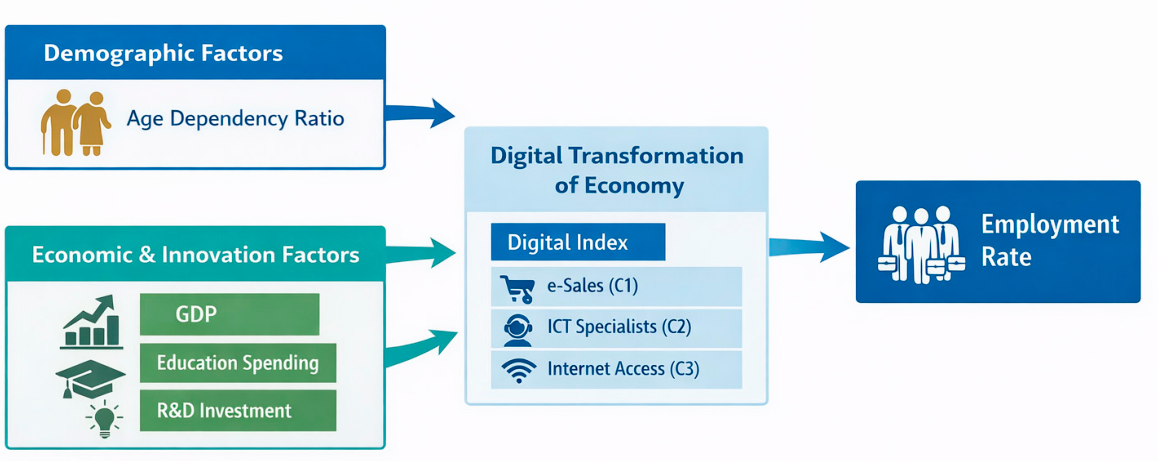
To analyse the relationships between the studied variables, a conceptual research model (
Figure 1) is developed, illustrating the key factors that may influence employment levels. The proposed model is based on the assumption that contemporary labour market transformations are driven by the interaction of demographic processes, digital transformation of the economy, and macroeconomic development factors related to human capital and technological progress.
The conceptual research model reflects the influence of three groups of factors on employment: demographic processes, digital transformation, and macroeconomic and innovation-related factors. Demographic dependency captures changes in the age structure of the population, digitalisation reflects the technological transformation of the economy, while GDP, education, and R&D indicators represent the level of economic development and the adaptive capacity of the economy.
3.2. Construction of the Digitalisation Index
Digitalisation of the economy is a multidimensional phenomenon that encompasses the development of digital infrastructure, the use of information and communication technologies in business, and the level of digital competencies of the workforce. To capture the complex nature of this process, an integral digitalisation index is employed in the study.
The index is constructed based on three statistical indicators:
C1—the percentage of enterprises conducting e-sales, reflecting the use of digital technologies in business activities;
C2—the percentage of total employment in ICT specialists, capturing the level of digital human capital development;
C3—the percentage of households with internet access, indicating the development of digital infrastructure and population access to digital services.
The PCA procedure was applied to the full panel dataset covering 27 EU countries over the period 2015–2023 in order to capture generalized patterns of digital development across both cross-sectional and temporal dimensions.
Since these indicators are measured in different units and have different value ranges, they are normalized at the first stage using the min–max method, which is widely applied in the construction of composite indices in international comparative studies [
28,
29]:
where
—normalized value of the indicator;
—actual value of the indicator for country
in period
;
—minimum and maximum values of the indicator in the sample, respectively.
As a result of normalization, all variables take values in the range from 0 to 1, ensuring their comparability and enabling further aggregation.
To determine the weights and construct the composite digitalisation index, Principal Component Analysis (PCA) is applied. The use of PCA allows for dimensionality reduction and the extraction of a latent component that explains the largest share of the common variation in digitalisation indicators.
The digitalisation index is constructed based on the first principal component, which is interpreted as a generalized measure of the level of digital development of the economy:
where
are weights determined based on the factor loadings of the first principal component.
This method accounts for the contribution of each indicator to the overall level of digitalisation and provides a more robust construction of the composite index compared to the use of equal weights.
3.3. Econometric Estimation Procedure and Diagnostic Tests
The empirical analysis is based on pooled ordinary least squares (OLS) estimation applied to panel data for EU countries over the period 2015–2023:
where
—employment rate in country
in period
;
—old-age dependency ratio;
—composite digitalisation index;
—logarithm of GDP per capita;
—government expenditure on education (% of GDP);
—research and development expenditure (% of GDP);
—error term of the model.
The index denotes the country, and denotes the time period.
Given the different scales of the variables and the presence of correlations among regressors, the model employs a combination of transformations, including mean-centering of variables and logarithmic transformation of GDP.
Mean-centering of explanatory variables is performed according to the following formula:
where
—value of the variable for country
in period
;
—mean value of the variable across all observations;
—mean-centered variable.
Mean-centering is applied to reduce multicollinearity and improve the numerical stability of coefficient estimates, without altering the distribution of the variables.
Logarithmic Transformation of GDP
For the GDP variable, the natural logarithm is applied:
where
—GDP per capita for country
in period
.
The logarithmic transformation reduces distributional asymmetry, smooths the variation in the indicator, and allows the estimated coefficients to be interpreted as approximate elasticities.
Taking into account the applied transformations, the model is specified as follows:
The applied transformations are methodologically justified, as
Mean-centering does not alter the distribution of the variables but reduces multicollinearity among regressors;
Logarithmic transformation of GDP already performs normalization and scaling functions, making additional centering of this variable unnecessary.
The use of pooled OLS for panel data allows for estimating the overall relationship between variables under the assumption of homogeneity in structural characteristics across countries and the absence of individual fixed effects. This approach is appropriate for comparative macroeconomic analysis aimed at identifying average effects within the sample [
30]. Since the empirical analysis is based on panel data, the use of pooled OLS implies the assumption of homogeneity across countries and time periods. Therefore, the estimated coefficients should be interpreted as generalized average effects within the sample rather than country-specific causal relationships.
At the same time, pooled OLS does not fully account for unobserved country-specific and time-specific heterogeneity that may affect employment dynamics. Future research may extend the analysis through the application of fixed-effects, random-effects, and two-way fixed-effects models, as well as specification tests such as the Hausman test and the Breusch–Pagan Lagrange Multiplier test, in order to compare alternative panel-data specifications and assess the robustness of the obtained results.
Prior to estimating the regression model, a series of diagnostic tests is conducted to assess the statistical properties of the variables and the adequacy of the model specification. The application of these diagnostic procedures ensures the statistical reliability of the obtained results and confirms the validity of the econometric model used to analyse the impact of digitalization, demographic ageing, and innovation activity on employment in European Union countries.
Multicollinearity
To assess multicollinearity among explanatory variables, the Variance Inflation Factor (VIF) is used:
where
is the coefficient of determination from an auxiliary regression in which the
-th variable is regressed on all other explanatory variables.
High values of indicate a strong linear relationship among regressors, which may lead to instability in the estimated model coefficients.
Heteroskedasticity
Heteroskedasticity of residuals is tested using the Breusch–Pagan test:
where
is the number of observations, and
is the coefficient of determination from an auxiliary regression in which the squared residuals are regressed on the explanatory variables.
The null hypothesis of the test assumes homoskedasticity of residuals. Its rejection indicates the presence of heteroskedasticity.
Normality of Residuals
To test the normality of residuals, the Jarque–Bera test is applied:
where
is the skewness coefficient and
is the kurtosis coefficient. The null hypothesis assumes that the residuals are normally distributed.
Autocorrelation
Autocorrelation of residuals is assessed using the Durbin–Watson statistic:
Values of the statistic that deviate significantly from 2 indicate the presence of autocorrelation.
Model Fit
The quality of the model is evaluated using the coefficient of determination:
as well as the F-test, which allows testing the joint statistical significance of the explanatory variables.
The application of these diagnostic procedures ensures the statistical reliability of the estimates and confirms the validity of the econometric model used.
All statistical calculations, including normalization procedures, principal component analysis (PCA), regression estimation, diagnostic tests, and visualization of results, were performed using Microsoft Excel (version 2021, Microsoft Corporation, Redmond, WA, USA).
4. Results
Within the framework of contemporary EU economic policy, digitalisation performs a dual function: on the one hand, it acts as a driver of productivity and economic growth; on the other, it serves as a tool for expanding access to the labour market for diverse social groups. The development of digital infrastructure, the spread of digital skills, and the adoption of information and communication technologies create new employment opportunities while simultaneously transforming its structure and the requirements for human capital. This is particularly important for the formation of an inclusive labour market, which implies the integration of individuals with different skill levels, social statuses, and capabilities into economic activity. In particular, the development of digital skills, the expansion of remote work, and digital platforms create new opportunities for the inclusion of vulnerable population groups, including persons with disabilities, migrants, older individuals, and other groups facing barriers to labour market participation, into economic participation.
In this study, digitalisation is considered a factor that contributes to employment through human capital development, the expansion of employment forms, and the reduction of barriers to labour market access. At the same time, it functions as a mechanism for promoting inclusive economic growth and achieving the Sustainable Development Goals, particularly SDG 8 “Decent Work and Economic Growth”, SDG 9 “Industry, Innovation and Infrastructure”, and SDG 10 “Reduced Inequalities”.
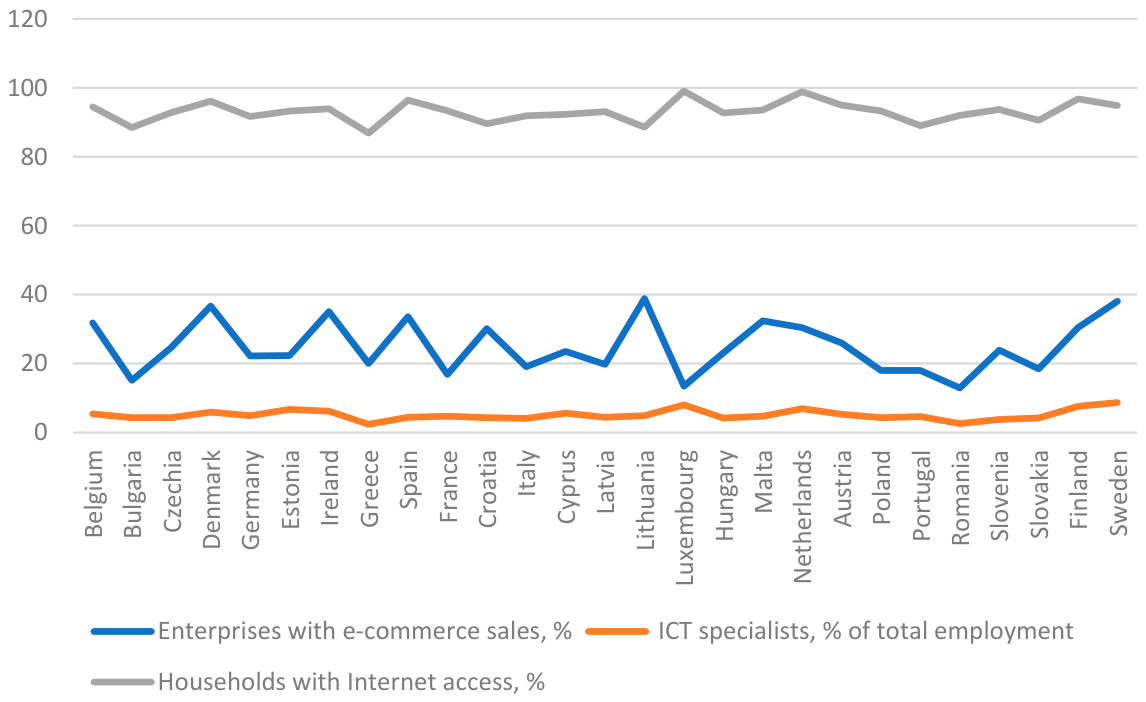
The empirical analysis of digitalisation in European Union countries is based on a system of three indicators reflecting different dimensions of digital development: business digital activity, the structure of employment, and access to digital infrastructure (
Figure 2).
As shown by the data (
Figure 2), the level of e-commerce usage varies significantly across EU countries—from 12.92% in Romania to over 38% in Lithuania and Sweden. High values of this indicator are also observed in Denmark (36.67%) and Ireland (35.07%), indicating a deeper integration of digital technologies into business processes. At the same time, in the countries of South-Eastern Europe, the level of e-commerce adoption remains lower.
The share of ICT employment ranges from 2.4% in Greece to 8.7% in Sweden. High values are also characteristic of Finland (7.6%), the Netherlands (6.9%), and Estonia (6.7%), reflecting the structural features of their economies and their orientation toward digital sectors. In countries with lower values of this indicator, the digital transformation of the labour market is slower.
The level of household Internet access is relatively high in most EU countries, ranging from 86.9% in Greece to 99.06% in Luxembourg. This indicates a generally well-developed digital infrastructure that provides the basic conditions for the development of the digital economy. At the same time, even minor differences in access may affect the level of population participation in the digital economy.
Based on the combined characteristics of digitalisation and labour market performance, EU countries can be conditionally grouped into three categories:
Countries with high levels of digital development and strong employment performance (Sweden, Finland, the Netherlands, Denmark);
Countries with moderate digitalisation and transitional labour market characteristics (Germany, France, Spain, Austria);
Countries with lower levels of digitalisation accompanied by weaker labour market adaptability and employment dynamics (Romania, Bulgaria, Greece).
The obtained results indicate that digitalisation has a multidimensional nature and manifests through various aspects—business digital activity, employment structure, and access to digital infrastructure. The lack of full consistency between individual indicators (e.g., high Internet access combined with a lower share of ICT employment) confirms the need for an integrated approach to measuring digitalization.
This justifies the construction of an integral digitalisation index that aggregates different components of digital development and is used in further econometric analysis. The index is constructed using principal component analysis. At the first stage, all indicators were normalized to ensure comparability, after which the relationships between variables were analysed based on the correlation matrix (
Table 2).
The correlation matrix (
Table 2) indicates the presence of moderate positive relationships among all digitalisation indicators.
The highest correlation is observed between the share of ICT specialists and Internet access (0.731), reflecting the interconnection between the development of digital infrastructure and the formation of digital human capital. Other coefficients are also positive (0.54–0.58), confirming the consistent nature of digital development, while at the same time indicating the absence of perfect multicollinearity among the indicators.
The identified moderate correlations between variables justify the application of principal component analysis. To assess the suitability of the data for factor analysis, the Kaiser–Meyer–Olkin (KMO) measure was used to evaluate sampling adequacy, along with Bartlett’s test of sphericity, which tests the null hypothesis that the variables are uncorrelated in the population.
The calculation of these statistical measures was based on the correlation matrix of digitalisation indicators derived from Eurostat data:
The results of testing the suitability of the data for applying PCA are presented in
Table 3.
The obtained value of the Kaiser–Meyer–Olkin (KMO) coefficient is 0.65, which exceeds the minimum recommended threshold of 0.6 and indicates adequate sampling adequacy for applying principal component analysis. The results of Bartlett’s test of sphericity are statistically significant (p < 0.05), confirming the presence of correlations among the analysed variables. Therefore, the use of PCA for constructing the integral digitalisation index is statistically justified.
Construction of the Digitalisation Index
The next step involved determining the eigenvalues and the proportion of explained variance for each component. The results are presented in
Table 4.
The results of the analysis show that the first principal component explains 74.7% of the total variance of the indicators, while the contribution of the other components is significantly lower. According to the Kaiser criterion, only components with eigenvalues greater than one should be retained for further analysis. In this case, only the first component (PC1) satisfies this condition.
The factor loadings of the variables in the principal components are presented in
Table 5.
The obtained values reflect the contribution of each indicator to the formation of the principal component. The largest contribution to the first component comes from the share of ICT specialists in employment, followed by household Internet access and the share of enterprises engaged in e-sales.
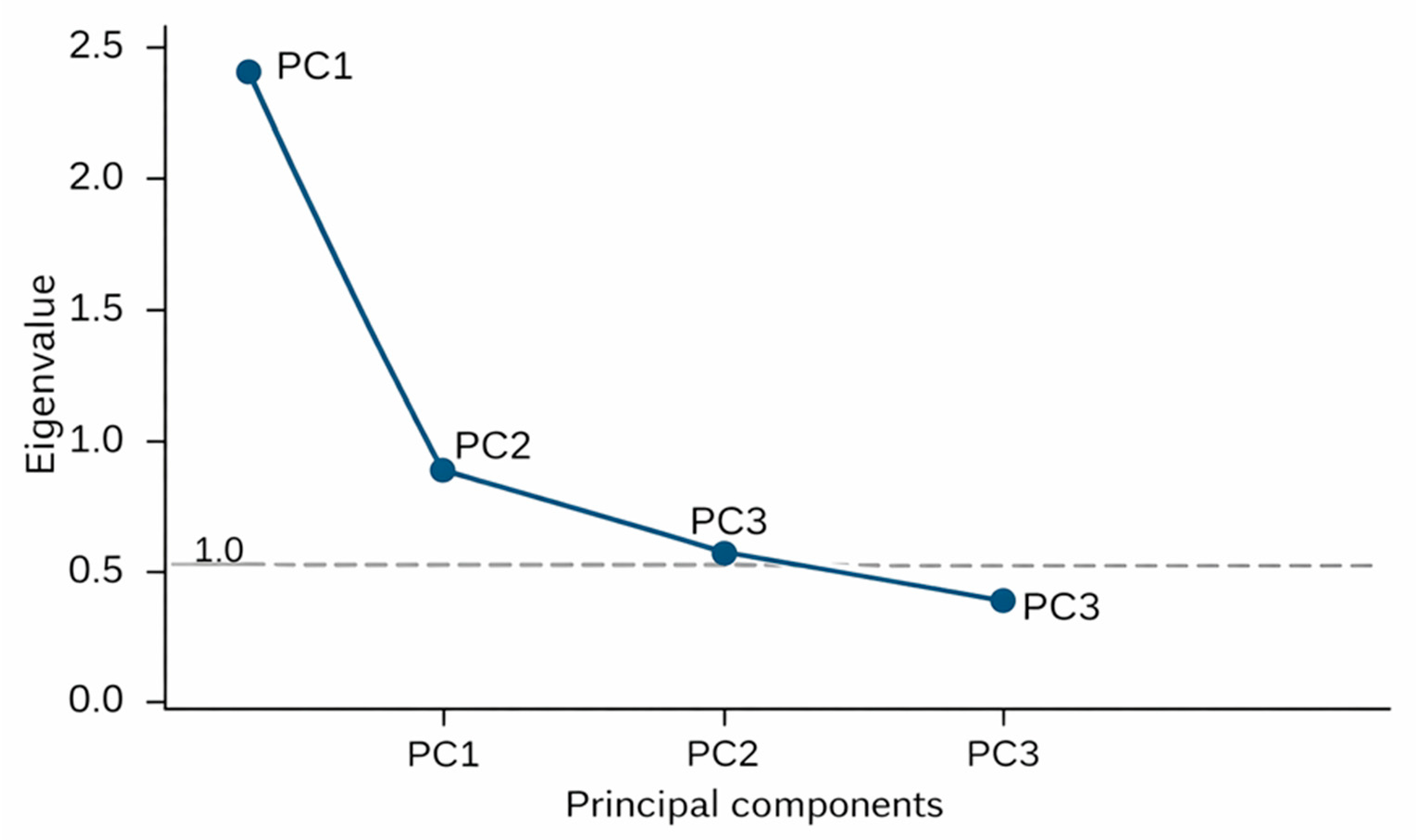
The eigenvalue plot (scree plot), which allows for a visual assessment of the contribution of each component to explaining the total variance of the original indicators, is presented in
Figure 3.
The scree plot shows a sharp decline in eigenvalues after the first principal component. This indicates that the first component captures the majority of the information contained in the original digitalisation indicators. The eigenvalue of the first component exceeds one, while the subsequent components contribute significantly less to explaining the total variance.
Therefore, according to the Kaiser criterion, only the first principal component was retained for further analysis and used to construct the integral digitalisation index.
The final weights of the index components are presented in
Table 6.
Construction of the Digitalisation Index
The integral digitalisation index is calculated as a weighted sum of normalized indicators:
where Digital_it—integral digitalisation index for country
i in period
t; C1—enterprises conducting e-sales; C2—ICT specialists in employment; C3—households with internet access.
Since the digitalisation index is based on PCA factor loadings rather than normalized additive weights, its resulting values are not strictly limited to the interval between 0 and 1. Accordingly, values exceeding one reflect the specifics of the aggregation procedure and the relative contribution of the standardized indicators included in the index. The obtained coefficients should therefore be interpreted as PCA factor loadings rather than normalized weights, meaning that their sum is not required to equal one within the structure of the latent digitalisation construct.
The results indicate that digitalisation affects employment not only through its level but also by changing the conditions of access to the labour market. The development of digital skills, the transformation of employment forms, and the reduction of entry barriers expand the participation of diverse social groups in economic activity. This pattern reflects the relationship between technological change, employment dynamics, and the distribution of opportunities and is consistent with SDG 8 “Decent Work and Economic Growth”, SDG 9 “Industry, Innovation and Infrastructure”, and SDG 10 “Reduced Inequalities”.
4.1. Descriptive Statistics
The first stage of the empirical analysis involves assessing the descriptive statistics of the variables used in the model (
Table 7). The analysis of descriptive characteristics makes it possible to evaluate the overall structure of the data, identify potential asymmetry, and determine the scale of variation in the indicators across countries and over time.
The average level of employment in the sample is 73.44%, with values ranging from 54.80% to 83.50%. This range indicates substantial differentiation in labour markets across European Union countries.
The old-age dependency ratio has a mean value of 29.82% and varies from 19.70% to 37.80%, reflecting heterogeneity in demographic structures and different paces of population ageing. In a number of Western European countries, ageing processes are significantly more advanced than in Central and Eastern Europe, creating additional challenges for labour markets and social protection systems.
The integral digitalisation index has a mean value of 0.86 with a standard deviation of 0.30. The observed range (0.13–1.60) indicates significant differences in the level of digital transformation across EU economies. This variation confirms the uneven development of the digital economy within the European Union. In particular, Northern and Western European countries demonstrate higher levels of digital transformation, while Southern and Eastern European economies exhibit comparatively lower values. Such heterogeneity has been consistently highlighted in studies by the European Commission and international organizations.
The indicators forming the digitalisation index display a consistent yet uneven dynamic. The share of enterprises conducting e-sales ranges from 7.21% to 42.47%, the share of ICT specialists from 1.60% to 8.70%, while household Internet access varies within a narrower range—from 59.14% to 99.18%. This suggests that basic digital infrastructure is largely established in most countries, whereas the digitalisation of business processes and employment structures remains uneven.
The logarithm of GDP per capita exhibits a relatively narrow range (9.52–11.46), reflecting the effect of logarithmic transformation, which smooths cross-country differences and reduces the influence of extreme values.
Public expenditure on education and R&D expenditures demonstrate noticeable variability (from 2.50% to 7.80% and from 0.45% to 3.64%, respectively), indicating different models of investment in human capital and innovation across EU countries.
The descriptive statistics confirm sufficient variation in the panel dataset, providing a solid basis for further econometric analysis of the relationships between demographic processes, digitalization, innovation activity, and employment levels.
Prior to econometric modelling, additional data preprocessing was conducted. In particular, the explanatory variables were mean-centered. Centering was performed by subtracting the mean value of each variable from its observations. This procedure is widely used in econometric analysis as it helps reduce potential multicollinearity among regressors and improves the interpretability of regression coefficients. It should be noted that the descriptive statistics reported in
Table 7 are calculated based on the original (non-centered) values of the variables.
4.2. Correlation Analysis of Variables
To preliminarily assess the relationships between the variables included in the econometric model, a correlation analysis was conducted using Pearson pairwise correlation coefficients. Such analysis represents an important step in preparing for econometric modelling, as it allows for the identification of potential relationships between variables and provides an initial check for multicollinearity among the explanatory variables. The results of the correlation analysis are presented in
Table 8.
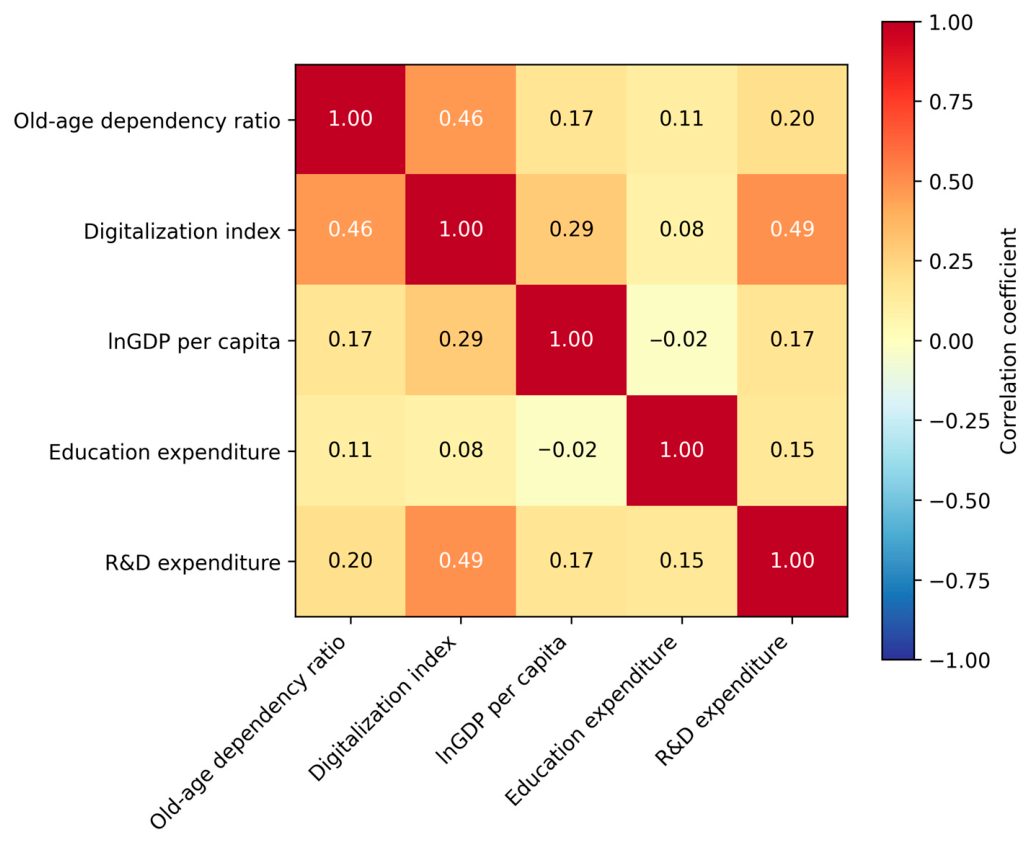
For better interpretation of the obtained results and clearer visualization of the structure of relationships between variables, the correlation matrix was additionally presented in the form of a heatmap (
Figure 4).
The analysis of the correlation matrix indicates the predominance of weak to moderate linear relationships among the model variables. The highest correlation coefficient is observed between the digitalisation index and R&D expenditure (0.488), reflecting the link between digital transformation and innovation activity.
A moderate positive relationship is also identified between the digitalisation index and the age dependency ratio (0.463). This result may be explained by the fact that more economically developed countries, characterised by higher levels of digitalization, also tend to experience more pronounced population ageing.
A weak positive relationship is observed between the digitalisation index and the level of economic development (ln GDP per capita) (0.289), suggesting a general but not decisive association between these variables.
Other correlation coefficients remain low. In particular, the relationship between education expenditure and ln GDP per capita is practically absent (−0.023), indicating the lack of a direct linear relationship within the sample.
None of the correlation coefficients exceed the threshold value of 0.7, which indicates the absence of critical multicollinearity among the explanatory variables and supports their inclusion within a single regression model.
At the same time, it should be emphasised that correlation analysis captures only pairwise linear relationships and does not allow for conclusions regarding causal links. A more comprehensive assessment of the effects of the studied factors is conducted within the framework of econometric modelling.
4.3. Multicollinearity Diagnostics
Before estimating the parameters of the regression model, multicollinearity among the explanatory variables was tested using the Variance Inflation Factor (VIF). This indicator allows assessing the extent to which the variance of a given explanatory variable can be explained by other variables included in the model. The results are presented in
Table 9.
The obtained coefficients of determination from the auxiliary regressions remain relatively low, ranging from 0.034 to 0.402. This range indicates that none of the explanatory variables can be substantially explained by a combination of the other variables included in the model.
The highest explanatory power is observed for the variable “digitalisation index” (R2 = 0.402), reflecting its partial association with other model characteristics, particularly indicators of innovation activity and economic development. However, this relationship is not strong enough to generate multicollinearity concerns.
The lowest value of the coefficient of determination is recorded for the variable “general government expenditure on education” (R2 = 0.034), indicating a weak relationship with other explanatory variables. This result can be attributed to the fact that public expenditure on education largely depends on country-specific budgetary policies, institutional arrangements of education systems, and national socio-economic priorities.
The VIF values for all variables range from 1.035 to 1.673, which is well below the commonly accepted thresholds (5 or 10). The highest VIF is associated with the digitalisation index (1.673), which is consistent with the findings of the correlation analysis.
Overall, the results do not indicate the presence of multicollinearity among the explanatory variables. The low VIF values confirm the absence of substantial overlap in information across the factors and support their simultaneous inclusion in the regression model.
4.4. Results of Regression Analysis
To empirically test the hypotheses, a multiple regression model was estimated using the Ordinary Least Squares (OLS) method on panel data for European Union countries over the period 2015–2023. The total sample size comprises 243 observations.
The model is specified as follows:
where X
1—old age dependency ratio; X
2—digitalisation index; X
3—ln GDP per capita; X
4—education expenditure; X
5—R&D expenditure.
Model Fit
The economic and mathematical interpretation of the regression results is presented in
Table 10.
The results of the analysis of variance (
Table 10) indicate that the model is statistically significant overall (F = 110.80,
p < 0.001).
The obtained results indicate a high explanatory power of the model: approximately 70% of the variation in employment levels is explained by the included factors. The adjusted coefficient of determination does not differ significantly from R2 (Adjusted R2 = 0.694), confirming the stability of the estimates.
The strongest statistical association with employment is observed for the digitalisation index. The coefficient for the variable Digital is positive and statistically significant at the 1% level. This indicates a positive statistical association between digitalisation and employment, confirming the important role of digital transformation in shaping modern labour markets.
The coefficient for the age dependency ratio is also positive and statistically significant (p = 0.025). This result suggests that, in EU countries, higher levels of population ageing are not associated with a decline in employment. It likely reflects labour market adaptation mechanisms, including increased participation of older age groups in economic activity.
The variable ln GDP per capita has a positive coefficient and is statistically significant at the 10% level (p = 0.093), indicating a moderate relationship between economic development and employment.
Education expenditure exhibits a negative and statistically significant coefficient (p < 0.001). This result should be interpreted with caution, as education expenditure as a share of GDP may reflect not only the delayed effects of human capital investment, but also differences in budget structure, demographic composition, institutional arrangements, and countercyclical public expenditure patterns across EU countries. Consequently, the empirical results do not support hypothesis H4 regarding the expected positive relationship between public expenditure on education and employment.
R&D expenditure has a positive and statistically significant effect (p < 0.001), confirming the role of innovation activity in supporting employment growth.
Model Diagnostics
The results of the preliminary diagnostic tests confirm the correctness of the model specification. In particular, the VIF values for all variables are below the critical thresholds, indicating the absence of multicollinearity. Thus, the estimated coefficients are not distorted by interdependence among regressors.
According to the model estimation results, the F-statistic is F = 110.80 with the corresponding level of statistical significance p = 5.47 × 10−60.
The overall statistical significance of the model is confirmed by the F-test, while the results of the t-tests indicate that the majority of explanatory variables are statistically significant.
4.5. Residual Diagnostics
To verify the correctness of the model specification, residual diagnostics were conducted, including tests for normality, homoskedasticity, and autocorrelation.
Normality of Residuals
The normality of residuals was tested using the Jarque–Bera test (
Table 11).
The value of the Jarque–Bera statistic is low, and the p-value (0.828) significantly exceeds the 0.05 significance level. Therefore, there is no basis to reject the null hypothesis of normality of the residuals. Thus, the assumption of normality is not violated, ensuring the validity of the t- and F-statistics.
Heteroskedasticity
The homoskedasticity of residuals was tested using the Breusch–Pagan test (
Table 12).
The test results show that the p-value (p = 0.055) is slightly above the 0.05 threshold, although very close to it. At the same time, the proximity of the p-value to the critical level may indicate weak signs of heteroskedasticity; therefore, the model results should be interpreted as generalized statistical associations.
Autocorrelation
To assess autocorrelation of residuals, the Durbin–Watson statistic was applied. Its value for the estimated model is DW = 1.461. Since the value is below 2, this may indicate moderate positive autocorrelation of residuals. Given the use of panel data and the time dimension of the dataset, such a result is expected; however, it may affect the accuracy of standard errors.
Overall, the residual diagnostics confirm an acceptable quality of the estimated model. In particular:
The distribution of residuals does not deviate from normality (Jarque–Bera test);
Significant heteroskedasticity is not confirmed at the 5% significance level (Breusch–Pagan test);
The Durbin–Watson statistic indicates possible moderate positive autocorrelation, which should be taken into account when interpreting the results. These results suggest that the estimated standard errors may be sensitive to heteroskedasticity and within-country correlation effects typical for panel data structures.
In general, the model satisfies the basic assumptions of classical regression; however, the identified features of the residuals require caution in interpreting statistical estimates. Future research may improve the reliability of statistical inference through the application of heteroskedasticity-robust and country-clustered standard errors, allowing for more reliable estimation in the presence of heteroskedasticity and within-country error dependence.
The estimated relationships should be interpreted as generalized statistical associations rather than direct causal effects. Although the model identifies significant relationships between digitalization, innovation activity, demographic factors, and employment, the possibility of reverse causality and other endogeneity-related effects cannot be fully excluded within the current specification.
The obtained results confirm that digitalization, innovation activity, and the level of economic development are statistically significant factors associated with employment in European Union countries. At the same time, the relationship between public expenditure on education and employment appears more complex and should be interpreted with caution, as education expenditure may reflect possible time lags between investments in human capital and labour market outcomes, as well as differences in budget structure, demographic composition, institutional arrangements, and public expenditure priorities across EU countries.
Overall, the empirical findings support most of the proposed research hypotheses. However, hypotheses H1 and H4 are not confirmed in the expected direction, indicating the more complex nature of the relationship between population ageing, education expenditure, and employment dynamics.
5. Discussion
The obtained results allow employment to be interpreted as a central outcome of labour market transformation, reflecting the achievement of SDG 8 “Decent Work and Economic Growth”.
The identified statistical relationships reflect broader structural changes in the labour market associated with digitalization, innovation activity, and changes in the structure of human capital. In this sense, the results are consistent with the fundamental provisions of human capital theory, according to which investments in education, knowledge, and skills generate economic returns in the form of increased productivity, income, and employment opportunities [
19].
The modern economy is characterised by a shift in emphasis from traditional growth factors toward knowledge, technology, and innovation. Within the framework of endogenous growth theory, technological change is viewed as the result of purposeful investments in research and development [
3]. Employment is increasingly associated not only with economic growth per se, but also with the capacity of an economy to generate and implement new technological solutions.
The obtained results are consistent with this logic: the digitalisation index demonstrates the strongest positive statistical association with employment. This suggests that digitalisation occupies an important place in contemporary labour market transformation processes. Its impact is realized through several channels, including the reduction in transaction costs of labour market entry, the development of remote employment, the expansion of digital labour platforms, and the emergence of new sectors of economic activity. Similar conclusions are presented in international studies emphasizing the role of digital transition in reshaping skill demand and expanding employment opportunities [
13,
31,
32]. From the perspective of SDG 9 “Industry, Innovation and Infrastructure”, digitalisation and innovation activity are closely associated with employment dynamics and structural change.
In this process, digitalisation transforms not only the means of production but also the very nature of employment. The labour market is gradually losing its rigid dependence on geography, physical presence, and traditional organisational structures. As a result, conditions are created for the inclusion of population groups that previously had limited access to employment. This constitutes its inclusive potential: the digital environment lowers entry barriers, expands employment options, and makes economic participation more flexible. Therefore, the high coefficient of the digitalisation index should be interpreted not only as evidence of technological progress but also as empirical confirmation that digital transformation constitutes an important factor associated with inclusive human capital development [
32]. The findings also have implications for SDG 10 “Reduced Inequalities”, as they indicate that digitalisation influences access to employment and the distribution of labour market opportunities across different social groups.
The positive and statistically significant impact of R&D expenditures also carries important implications. It indicates that innovation activity not only enhances the technological level of the economy but is also associated with the expansion of employment opportunities, the development of new economic activities, and increased demand for skilled labour. The innovation-driven economy forms a qualitatively new employment structure, where digital competencies, analytical thinking, and lifelong learning become increasingly important. Theoretically, this result aligns well with the approaches of Romer (1990) and Aghion and Howitt (1992), where innovation is viewed as the primary mechanism of long-term structural change [
3,
33].
At the same time, the results show that economic growth alone does not guarantee a proportional expansion of employment. The logarithm of GDP per capita has a positive but statistically weak effect. This leads to an important conclusion: without structural changes associated with digitalisation and innovation, income growth does not automatically translate into increased employment opportunities. In highly developed economies, productivity gains may be accompanied by the automation of certain functions and, consequently, may not result in proportional job creation. Thus, inclusive development requires not only increasing output but also transforming the technological and institutional architecture of the labour market.
Particular attention should be paid to the negative coefficient of education expenditure. At first glance, this result may appear to contradict the traditional view of the positive role of education in human capital formation. However, it does not negate the importance of education; rather, it points to a more complex relationship between educational investment and current labour market outcomes. First, education generates effects with a time lag, while the model captures short- to medium-term relationships. Second, the effectiveness and quality of educational outcomes matter more than the sheer volume of spending. In addition, education expenditure as a share of GDP may also capture differences in demographic structure, institutional organisation of education systems, fiscal priorities, and countercyclical public expenditure responses rather than the immediate effectiveness of education policy. As emphasised by Hanushek and Woessmann (2020), it is not the formal duration of education but actual cognitive skills and learning outcomes that are decisive for economic growth and productivity [
18]. Therefore, the practical implication is not to reduce education spending, but to shift the focus from quantity to effectiveness, adaptability, and alignment with the needs of the digital economy.
The obtained positive relationship differs from the initially expected negative association between population ageing and employment formulated in hypothesis H1. This suggests that in EU countries, demographic ageing is accompanied by labour market adaptation, including increased labour force participation among older individuals, rising retirement ages, and the development of active ageing policies. Consequently, an increasing share of older population does not necessarily lead to a decline in employment; in some cases, it may stimulate higher economic activity and longer participation in the labour market [
34,
35].
Interpreting the results through the lens of the Sustainable Development Goals (SDGs) reveals their systemic significance for shaping an inclusive labour market. In particular, the identified impact of digitalisation is directly linked to SDG 8 “Decent Work and Economic Growth”, SDG 9 “Industry, Innovation and Infrastructure”, and SDG 10 “Reduced Inequalities”. With respect to SDG 9, the results indicate that digitalisation and innovation activity support the diffusion of technology and the development of knowledge-intensive activities, which reshape employment structure and skill demand. In terms of SDG 10, digitalisation influences the distribution of labour market opportunities by expanding access to employment for groups that face structural constraints.
The nature of digitalization’s impact highlights its role in transforming the conditions of labour market access. The development of remote work, digital platforms, and new organisational models expands opportunities for integrating population groups with limited access to traditional employment, including persons with disabilities, internally displaced persons, veterans, and residents of remote areas. In this sense, digitalisation functions not only as an economic driver but also as an instrument of social inclusion.
The findings also demonstrate that traditional macroeconomic indicators, particularly GDP per capita, do not play a decisive role in determining employment outcomes. This reinforces the argument that achieving SDG 8 cannot rely solely on economic growth but requires structural transformation driven by digitalisation and innovation. Similarly, the short-term negative effect of education expenditure underscores the need to shift focus from the volume of funding to its quality, effectiveness, and alignment with the demands of the digital economy—factors that are critical for sustainable employment.
Accordingly, the results of the study can be interpreted in relation to SDG 8, SDG 9, and SDG 10 (
Table 13).
Overall, the findings confirm that digitalisation functions as a key structural driver of labour market transformation and increasing inclusiveness. In combination with innovation activity, digital development contributes to the creation of new employment opportunities and supports the adaptation of labour markets to technological change. At the same time, traditional macroeconomic factors appear to exert a more moderate influence on employment dynamics compared to digital and innovation-related determinants. Therefore, the obtained findings may also provide broader policy insights for discussions on inclusive labour market development in Ukraine, particularly in relation to digitalization, innovation policy, and flexible instruments for human capital development.
At the same time, several methodological limitations should be acknowledged. Since the empirical analysis is based on pooled OLS estimation for panel data, the model does not fully account for unobserved country-specific and time-specific heterogeneity that may influence employment dynamics across EU countries. In addition, the Durbin–Watson statistic suggests the possibility of moderate positive autocorrelation, while the Breusch–Pagan test indicates potential heteroskedasticity effects close to the conventional significance threshold. Therefore, the estimated coefficients should be interpreted as generalized statistical associations within the analysed sample rather than country-specific causal effects.
Further refinement of the empirical analysis may involve the application of heteroskedasticity-robust and country-clustered standard errors, alternative panel-data estimators such as fixed-effects, random-effects, and two-way fixed-effects models, as well as additional diagnostic procedures, including the Hausman test, Wooldridge autocorrelation test, Breusch–Pagan Lagrange Multiplier test, and Pesaran cross-sectional dependence test. Additional robustness assessment may also include comparing alternative specifications of the digitalisation indicator, including equal-weight approaches and models based on separate digitalisation variables.
6. Conclusions
The article examines the impact of digitalization, innovation activity, demographic factors, and macroeconomic parameters on employment under conditions of contemporary structural economic transformations. The constructed regression model made it possible to identify the key determinants of employment and assess the direction and strength of their effects.
The results of the study contribute to the achievement of SDG 8, SDG 9, and SDG 10 by substantiating the relationships between digitalization, innovation activity, and the inclusiveness of the labour market.
The results indicate that digitalisation demonstrates the strongest positive statistical association with employment. This confirms that the modern labour market is increasingly shaped by technological change, which not only enhances productivity but also transforms the structure of employment itself. Digital technologies create new forms of economic activity, expand opportunities for remote work, and reduce barriers to labour market entry, thereby strengthening its inclusive character.
A substantial positive effect is also demonstrated by R&D expenditures, confirming the role of innovation as a source of job creation and demand for highly skilled labor. The innovation-driven economy generates new employment segments that require advanced competencies and stimulate the development of human capital.
At the same time, economic growth, measured by GDP per capita, does not exhibit a statistically significant impact on employment within the model. This suggests the limitations of the traditional growth paradigm in the context of forming an inclusive labour market. Without structural changes associated with digitalisation and innovation, economic growth alone does not ensure the expansion of employment.
A negative short-term effect of public expenditure on education indicates the complex nature of its relationship with the labour market. This does not negate the importance of education but highlights the need to account for possible time lags between investments in human capital and labour market outcomes, as well as to improve the effectiveness of educational policy. Thus, not only the volume of education funding matters, but also its efficiency, practical orientation, institutional organization, and alignment with the evolving needs of the labour market. The negative short-term relationship may also reflect institutional mismatches between educational systems and rapidly changing digital labour market requirements, differences in demographic structure, and variations in public expenditure priorities across EU countries.
Demographic factors, particularly the age dependency ratio, demonstrate a positive, though less pronounced, effect on employment. This may reflect adaptation mechanisms in modern economies, including prolonged labour market participation among older age groups and the development of active ageing policies.
At the same time, substantial differences in life expectancy across EU countries indicate that the extension of labour market participation cannot be considered a universal solution to demographic challenges. This underscores the importance of flexible employment models, lifelong learning, and policies supporting healthy ageing rather than solely increasing the duration of working life.
Considerable cross-country differences are also observed in the interaction between digitalisation and labour market performance across the EU. Countries with higher levels of digital development generally demonstrate stronger employment adaptability and broader opportunities for labour market participation, whereas economies with lower levels of digitalisation exhibit weaker labour market flexibility and slower structural adjustment processes.
Several general conclusions can be drawn from the analysis:
Employment in the modern economy is more strongly associated with technological and innovation factors than solely with traditional macroeconomic parameters.
Digitalisation appears to play an important role in labour market inclusiveness by expanding access to employment for diverse population groups.
Innovation activity reshapes the structure of labour demand and increases the importance of human capital.
Economic growth without structural transformation does not provide sufficient conditions for employment expansion.
Thus, digitalisation can be considered one of the important components associated with progress toward the Sustainable Development Goals. At the same time, the results of the study emphasize that achieving these goals requires a comprehensive policy combining the development of digital infrastructure, support for innovation activity, and reform of the education system in line with the demands of the digital economy.
For the European Union, the findings highlight the importance of policies aimed at reducing disparities in digital infrastructure, innovation capacity, and access to digital skills across member states. Strengthening investment in digital inclusion, lifelong learning, and innovation ecosystems may enhance labour market adaptability and support more balanced employment opportunities within the EU. Reducing disparities in R&D investment across EU member states requires stronger coordination of innovation policy, support for knowledge transfer, and broader access to technological and research infrastructure. Particular importance is attached to policies facilitating labour market participation for older individuals, migrants, persons with disabilities, and other groups facing structural barriers to employment.
Although Ukraine was not included in the empirical sample, the obtained findings may provide broader policy implications for post-war labour market recovery. In particular, the EU experience suggests that the development of digital infrastructure, support for innovation activity, remote employment opportunities, and digital skills programs may contribute to improving labour market adaptability and expanding employment opportunities for veterans, internally displaced persons, and other vulnerable groups. At the same time, the applicability of these approaches to Ukraine requires separate empirical investigation taking into account country-specific institutional and post-war conditions.
These implications should be interpreted as policy-oriented reflections derived from the broader EU experience rather than direct empirical conclusions for Ukraine. In this context, the following practical implications may be considered in discussions on post-war labour market recovery and inclusive economic transformation in Ukraine:
- (1)
Digitalisation as a tool for veteran reintegration—The development of digital infrastructure, employment platforms, and remote work opportunities creates conditions for engaging individuals with mobility constraints or the need for flexible working arrangements. This reduces physical barriers to employment and provides alternative forms of labour market participation, which is particularly important for veterans transitioning to civilian life.
- (2)
Innovation policy as a source of job creation—Supporting research and development, fostering startup ecosystems, and developing technological clusters create an environment for the emergence of new types of economic activity. These sectors are characterised by higher flexibility and growth potential, offering additional employment and reskilling opportunities, including for individuals with military experience.
- (3)
Reorientation of education policy—The findings highlight the need to shift the focus from the volume of education expenditure to its effectiveness. This involves developing rapid reskilling programs, short-term educational courses, and applied digital skills that correspond to current labour market demands.
- (4)
Formation of an inclusive labour market model—Employment policy should account for demographic challenges and the need to activate various population groups. This includes creating conditions for the participation not only of veterans but also internally displaced persons, older individuals, and other vulnerable groups. Digital tools serve as a key mechanism for reducing barriers and expanding opportunities for labour market participation.
The practical significance of the study lies in its applicability to the design of policies for inclusive economic recovery in Ukraine. In post-war conditions, particular importance is attached to the development of digital infrastructure, support for innovation ecosystems, creation of opportunities for rapid reskilling, and integration of vulnerable groups into the labour market. The combination of digitalization, innovation policy, and human capital development should form the foundation of a resilient and inclusive employment model.
One limitation of the study is the use of pooled OLS estimation for panel data, which does not fully account for unobserved country-specific and time-specific effects that may influence employment dynamics across EU countries. Therefore, the obtained estimates should be interpreted as generalized relationships within the analysed sample rather than country-specific causal effects.
Another limitation of the study concerns the potential presence of autocorrelation and heteroskedasticity in the pooled OLS specification. Future research may apply heteroskedasticity-robust and cluster-robust standard errors, as well as additional panel diagnostic procedures, including Wooldridge autocorrelation tests and Pesaran cross-sectional dependence tests, in order to strengthen the robustness of statistical inference.
Further studies could extend the analysis by examining employment quality, sectoral labour market characteristics, and the long-term effects of digitalisation and innovation in the context of economic recovery.




 ,
,