


Abstract
As a sustainable alternative to petroleum-based plastics, psyllium gum, a natural hydrocolloid from Plantago ovata seeds, is reviewed for its application in packaging. This review focuses on the material properties of psyllium gum, including its film-forming capacity, water-binding capacity of 12–15 g/g, and rheological behavior (consistency index K = 10–50 Pa·sn, flow behavior index n = 0.3–0.6), which are critical for packaging applications. We discuss how its performance can be enhanced through interactions with plasticizers, cross-linking agents, and blending with other biopolymers (e.g., polyvinyl alcohol and starch), as well as through nanocomposite reinforcement, to improve mechanical strength (tensile strength 5–15 MPa in native films; up to 48 MPa in thermoplastic starch composites), and barrier properties (e.g., oxygen permeability < 0.001 g/m2 s). The review also provides a comparative analysis of psyllium-based films with other polysaccharide films and discusses the environmental benefits, such as a lower carbon footprint (GWP ≈ 1.2 kg CO2-eq/kg) compared to PET (≈3.0 kg CO2-eq/kg). Key challenges, including moisture sensitivity (equilibrium moisture content ~25% at 75% RH), raw material molecular-weight variability (±20%), and scalability, are outlined, along with future research directions, such as enzymatic extraction and the development of water-resistant, compostable formulations aimed at advancing psyllium gum toward viable next-generation sustainable food packaging materials.
1. Introduction
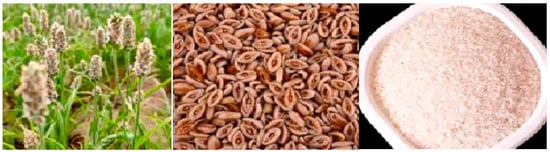
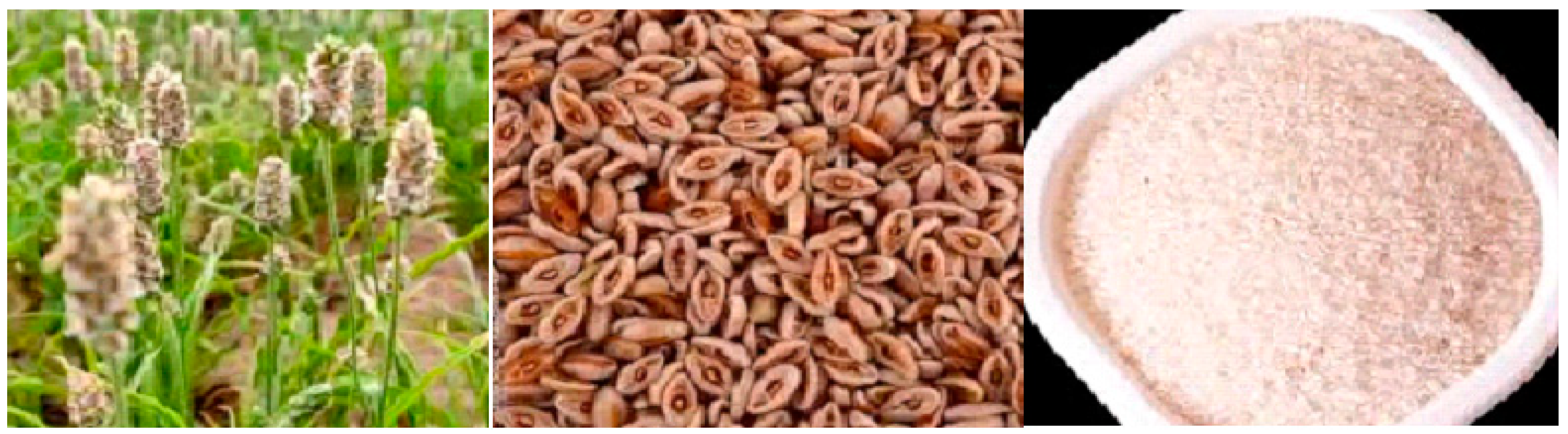
Psyllium gum, also known under many common names, including blond plantain, desert Indian wheat, blond psyllium, and isabghol, is a high-molecular-weight, mucilaginous polysaccharide hydrocolloid primarily extracted from the outer husk of the seeds of Plantago ovata. The plant (Figure 1) is an annual herb cultivated predominantly in arid and semi-arid regions, with India accounting for nearly 70% of the global supply, followed by Pakistan, Iran, and parts of the Mediterranean basin [1]. The gum is mainly composed of highly branched arabinoxylans, which are responsible for its exceptional water-binding and gel-forming capacity, making it a promising candidate for biodegradable materials and packaging technologies [2]. This review specifically focuses on the application of psyllium gum in sustainable packaging, exploring its properties, modifications, and potential to replace conventional petroleum-based plastics.
Figure 1.
Psyllium plant, seeds, and husk.
2. Production and Extraction of Psyllium Gum
Psyllium gum is primarily extracted from the outer husk of Plantago ovata seeds. The cultivation of Plantago ovata occurs in winter (rabi) crops in well-drained, sandy-loamy soils under dry conditions, with planting density and limited irrigation optimizing seed yield after 100–120 days. After harvesting, the crops are dried to reduce moisture to below 8% for safe storage and processing purposes [3].
The psyllium seed consists of an embryo, endosperm, and a mucilage-rich outer husk. Husk production involves cleaning and mechanical dehulling of the seeds to separate the mucilage-rich husk from other seed components. This yields crude husk at 20–30% of seed weight. The separated husk is subsequently cleaned and graded according to particle size, forming the raw material for extraction [4].
Extraction of psyllium gum relies primarily on aqueous swelling and solubilization, capitalizing on the inherent hydrophilicity of arabinoxylan polymers. The process involves hydrating milled husk in agitated tanks using distilled water at 40–80 °C and pH 6–8 to form a 5–10% viscous slurry. The slurry, after complete hydration, undergoes sieving for coarse separation, followed by centrifugation (e.g., 5000 rpm) or decantation to isolate the mucilage-rich supernatant from insoluble residues. Alkaline aids (0.5–2.0 M NaOH) or enzymatic treatments (e.g., xylanase) can enhance extraction efficiency by 25% through selective hydrolysis of impurities [5]. Purification refines the crude extract to over 90% purity, often involving precipitation with ethanol (70–95%) or acetone, followed by washing to remove impurities. The resulting polysaccharide exhibits a high molecular weight in the range of 1.5–2.0 × 10⁶ Da, a parameter directly correlated with viscosity, film-forming capacity, and mechanical integrity [6].
The purity and quality of extracted psyllium gum are typically assessed using a combination of physicochemical and advanced analytical methods. Moisture content and ash are determined gravimetrically to evaluate inorganic and extraneous impurities, while swell volume and viscosity measurements provide functional indicators of mucilage content and polymer integrity. Fiber analysis and monosaccharide profiling by HPLC or GC-MS are used to quantify polysaccharide yield and confirm the arabinoxylan composition. FT-IR spectroscopy and gel-permeation chromatography characterize the chemical fingerprint and molecular-weight distribution, respectively, whereas NMR spectroscopy is employed in research to elucidate backbone linkages and branching patterns, collectively ensuring both compositional purity and structural authenticity of the gum.
Drying is conducted at approximately 50 °C, frequently under vacuum, fluidized bed, spray, or freeze methods, to remove water (<10% moisture) and residual solvent while preventing thermal degradation [7]. Advanced options like dialysis, membrane ultrafiltration, or pre-precipitation enzymatic clarification reduce solvent use and support greener processes, aligning with regulatory standards [8].
3. Physicochemical Properties of Psyllium Gum for Packaging Applications
The global shift away from petroleum-based plastics has accelerated research into renewable, biodegradable biopolymers for packaging applications. Among plant-derived hydrocolloids, psyllium gum has emerged as a particularly promising candidate [6]. Traditionally valued for its dietary and pharmaceutical functions, psyllium is now recognized for its advanced material performance, especially in film formation, barrier functionality, and compostability [9]. Its suitability for sustainable packaging is fundamentally linked to its arabinoxylan-rich composition, exceptional water absorption, viscosity-building capacity, and rapid biodegradation profile [10].
3.1. Chemical Characteristics
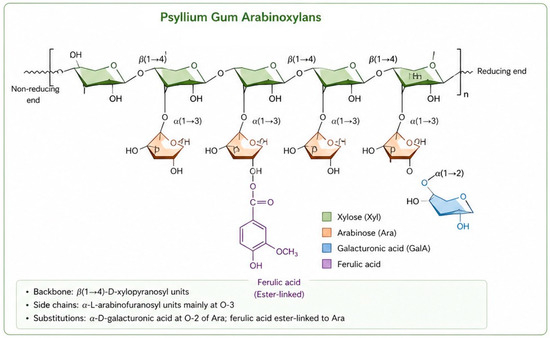
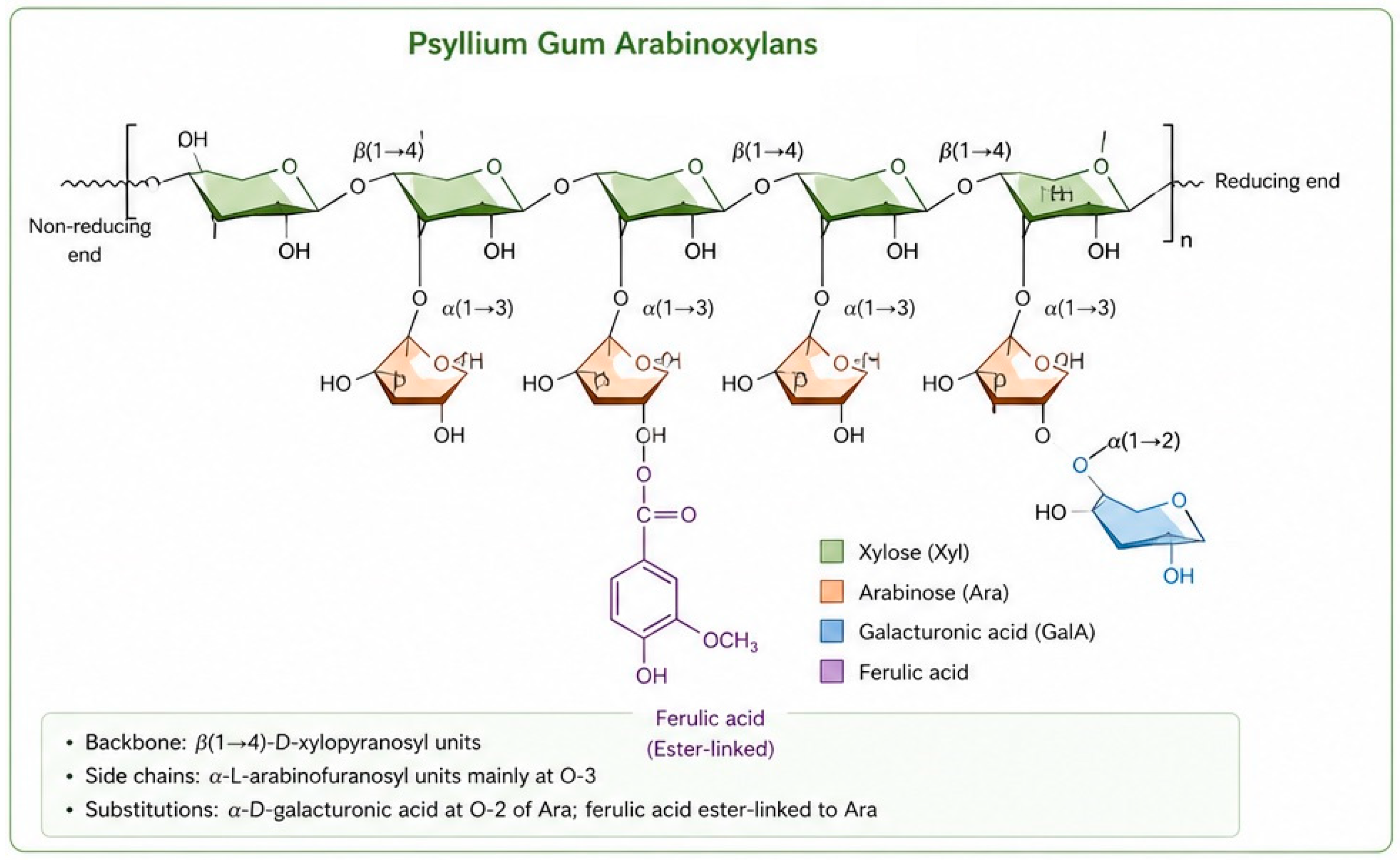
Psyllium gum is a complex, water-soluble polysaccharide that mainly consists of highly branched arabinoxylans with a β-(1→4)-linked xylose backbone and arabinose side chains (xylose: arabinose ratio ~3:1), plus minor rhamnose and galacturonic acid (Figure 2). Psyllium gum also contains small amounts of cellulose, hemicellulose, and trace proteins, with additional minor neutral sugars and a small fraction of non-polysaccharidic matter [2].
Figure 2.
Chemical structures of psyllium gum arabinoxylans.
Its neutral charge and abundant hydroxyl groups enable strong hydrogen bonding, ensuring water solubility. This hydration process enables the formation of highly viscous dispersions, which can be cast into continuous films [7]. The polymer chains uncoil, entangle, and form dense three-dimensional networks through hydrogen bonding and intermolecular interactions. This gel network serves as the structural backbone of psyllium-based films. Upon drying, the hydrogel matrix collapses into a cohesive and flexible layer with respectable tensile strength [11]. Compared with many synthetic hydrocolloids, psyllium offers strong gelation at relatively low concentrations and without harsh chemical cross-linking. Gelation becomes more pronounced above 40 °C, facilitating thermal processing and film consolidation [12].
3.2. Physical Characteristics
Psyllium gum exhibits a water-binding capacity of 12–15 g/g, forming viscous gels via swelling, which enables the formation of cohesive film matrices, promotes adhesion in coating applications, and supports hydrogel-based active packaging systems [13].
Rheology shows pseudoplastic (shear-thinning) flow behavior with consistency index K = 10–50 Pa (n < 1) (and flow behavior index n = 0.3–0.6), meaning viscosity decreases under applied shear stress but recovers once stress is removed. This is advantageous for industrial processes such as coating, spraying, or extrusion, where controlled flow during application enables smooth film casting, supports uniform edible coating application, prevents sagging or dripping during processing, and allows tunable thickness control. High viscosity at low concentrations improves film continuity and barrier performance [14].
Cast films display tensile strength (TS) of 5–15 MPa, elongation at break (EB) of 20–50% (plasticized), transparency, and flexibility from polymer entanglement [15]. These mechanical properties place psyllium-based films within a functional range suitable for biodegradable packaging and edible coatings, particularly when plasticizers such as glycerol are incorporated. Blending with other polymers (e.g., proteins or polyvinyl alcohol) can further enhance mechanical performance and flexibility.
3.3. Barrier Properties and Shelf-Life Extension
One of the primary objectives of food packaging is to regulate gas and moisture transfer, thereby slowing spoilage and oxidation. Psyllium-based films demonstrate competitive oxygen barrier properties, with reported oxygen permeability (OP) values of <0.001 g/m2 s, depending on formulation and thickness [16].
The dense polysaccharide matrix restricts oxygen diffusion, reducing oxidative degradation of lipids and preserving color and freshness in perishable goods. In practical applications, psyllium coatings have demonstrated measurable improvements in produce preservation. For example, edible coatings applied to tomatoes have been shown to extend shelf life by approximately 20%, primarily by moderating oxidative reactions and limiting moisture loss [17].
Although pure psyllium films are hydrophilic, their moisture sensitivity can be engineered through blending with lipids, proteins, or biodegradable polyesters. These composite systems balance moisture management with structural stability, enabling broader applicability across food categories.
3.4. Rheological Tunability and Processing Advantages
The arabinoxylan structure of psyllium allows precise control of viscosity and gel strength through adjustments in concentration, pH, temperature, or plasticizer content (e.g., glycerol). This tunability supports multiple packaging formats, including edible films and coatings, biodegradable composite sheets, active packaging matrices, and encapsulation layers for antimicrobial agents.
The ability to rapidly build viscosity is particularly valuable in coating operations, ensuring uniform film formation without excessive dripping or uneven thickness. Once applied, the gel network stabilizes quickly, forming an effective barrier layer [18].
3.5. Biodegradability and Environmental Performance
A defining advantage of psyllium-based packaging lies in its environmental compatibility. Being a plant-derived polysaccharide, it is inherently biodegradable under aerobic composting conditions.
In standardized composting assessments aligned with ASTM D6400 criteria [19], psyllium-based materials have demonstrated up to 95% mass loss within 180 days, outperforming several synthetic and semi-synthetic alternatives [9]. Unlike petroleum-derived plastics, which persist for decades or fragment into microplastics, psyllium decomposes into biomass and carbon dioxide, returning nutrients to the soil without toxic residues [20]. This complete biodegradation cycle supports renewable resource utilization and reduces reliance on fossil feedstocks.
3.6. Comparison with Synthetic Hydrocolloids and Other Polysaccharide Films
While synthetic polymers often provide excellent mechanical strength and moisture resistance, they lack biodegradability and frequently require energy-intensive processing. Currently, various polysaccharides such as alginate, chitosan, and carrageenan are used to produce food packaging films. A comparative perspective is important to situate psyllium gum within this competitive landscape and to identify its distinct advantages and limitations.
Alginate films offer excellent oxygen barrier performance and straightforward ionic gelation with calcium ions, but are sourced from marine macroalgae, making supply subject to seasonal and geopolitical variability. Chitosan films provide well-documented intrinsic antimicrobial activity and good film-forming ability, but their raw material (crustacean-shell waste) raises allergenicity concerns and limits acceptability in some markets. Carrageenan, also derived from red seaweed, forms strong, transparent films but shares the marine-sourcing limitations of alginate and tends to be brittle without plasticizer addition [21].
Psyllium gum offers several comparative benefits, such as renewable, mild processing requirements, strong gel formation without synthetic crosslinkers, superior compostability, and shear-thinning behavior beneficial for industrial coating [22]. Psyllium has GRAS (Generally Recognized As Safe) status, and its established safety record supports rapid regulatory acceptance for food-contact applications. In terms of mechanical performance, psyllium native films (tensile strength 5–15 MPa) are broadly comparable to alginate (5–20 MPa) and carrageenan (8–25 MPa) films, and lower than chitosan (20–60 MPa) [21].
However, challenges remain, particularly moisture sensitivity (water vapor transmission rate > 12 g/m2/day unmodified) and mechanical reinforcement under high humidity, which are also common issues for other hydrophilic polysaccharide films. Ongoing research into nanocomposites and biopolymer blends continues to improve its performance envelope [23]. Dedicated microbiological shelf-life studies on unloaded psyllium packaging films, comparable to those available for chitosan, represent a critical gap for future research.
4. Performance Enhancement Strategies for Psyllium-Based Films
Native psyllium films often exhibit moderate tensile strength, high water vapor transmission, and pronounced moisture sensitivity due to the abundance of hydrophilic hydroxyl groups in their branched arabinoxylan structure. Plasticizers enhance flexibility but may reduce barrier properties [24]. Cross-linking improves strength and moisture resistance but can reduce elongation [25]. Blending introduces synergistic improvements but requires careful control of phase behavior and miscibility [26]. The performance enhancement of psyllium-based films is not governed by a single modification route, but by the synergistic interplay of molecular interactions involving plasticizers, cross-linking agents, blending partners, nanofillers, and chemical functionalization. Integrating these strategies transforms native psyllium gum from a moisture-sensitive biopolymer into a high-performance biodegradable material that has significantly improved mechanical strength, barrier efficiency, and dimensional stability suitable for packaging and advanced applications.
4.1. Plasticization and Cross-Linking
Plasticizers such as glycerol or sorbitol are incorporated to enhance film flexibility by increasing polymer chain mobility and preventing brittleness. Glycerol, in particular, interacts with psyllium chains through hydrogen bonding between its hydroxyl groups and those of the arabinoxylan matrix, thereby disrupting intermolecular hydrogen bonding, increasing free volume, and enhancing elongation at break by up to 200% [27]. However, excessive plasticizer content may increase water vapor transmission due to enhanced chain mobility [28]. Therefore, optimal plasticizer concentration must balance ductility and barrier performance.
Cross-linking techniques improve film strength and moisture resistance. Divalent ions such as Ca2+ can interact with hydroxyl and, where present, carboxyl functionalities within the polysaccharide network. Ca2+ cross-linking can raise tensile strength by approximately 150% and reduce swelling in humid conditions. Ionic cross-linking results in a denser polymer matrix, enhanced dimensional stability, and improved mechanical integrity [29].
Covalent cross-linkers (e.g., citric acid or sodium trimetaphosphate) form ester or ether linkages between adjacent chains. This reaction builds a three-dimensional network, reducing solubility and improving thermal and mechanical resistance. Cross-link density must be carefully controlled. Excessive cross-linking may decrease flexibility and impair film transparency, while insufficient cross-linking limits moisture resistance [30].
4.2. Blending with Complementary Biopolymers
Blending represents a scalable and cost-effective approach to enhance film performance through synergistic polymer interactions [31].
Blending with polyvinyl alcohol (PVA) is one of the most effective strategies to enhance mechanical flexibility and oxygen barrier performance [32]. High miscibility (>80%) in psyllium–PVA systems arises from strong hydrogen bonding between hydroxyl-rich chains and possible ester-type interactions during thermal processing [33]. In optimized 70:30 (psyllium: PVA) formulations, elongation at break (EB) values up to 320% have been achieved, demonstrating a substantial improvement in flexibility compared with neat psyllium films. This balanced enhancement in strength and elasticity results from the extensive intermolecular hydrogen bonding, improved chain entanglement and structural cohesion, reduced microcrack formation, and greater film homogeneity [33]. PVA incorporation also reduces oxygen permeability and enhances stability under fluctuating humidity conditions. When integrated into multilayer systems, the cohesive hydrogen-bonded matrix provides superior mechanical integrity and barrier efficiency suitable for biodegradable packaging applications [34].
Starch-based blends offer a cost-effective and biodegradable reinforcement strategy. In optimized 60:40 weight % (psyllium: starch) systems, tensile strength values of approximately 28 MPa have been reported, significantly higher than those of neat psyllium films [35]. The mechanical improvement is attributed to hydrogen bonding between starch amylose chains and psyllium arabinoxylans, enhanced molecular entanglement, and denser microstructural packing with reduced microvoids. Despite the hydrophilic nature of both components, their structural compatibility produces homogeneous matrices with improved mechanical integrity and moderate barrier enhancement [36].
Similarly, incorporation of whey protein isolate (WPI) introduces additional intermolecular hydrogen bonding between polysaccharide and protein chains, further improving tensile strength and modulating oxygen permeability. These synergistic interactions make psyllium–starch/WPI systems particularly relevant for food packaging applications requiring controlled oxygen transmission and improved structural performance [16].
Blending psyllium with Chitosan introduces electrostatic interactions in addition to hydrogen bonding. Under acidic conditions, the cationic amine groups of chitosan interact with the neutral hydroxyl-rich psyllium matrix, reinforcing interpolymer cohesion and stabilizing multilayer structures. Blending chitosan with psyllium provides reduced water vapor transmission rate (WVTR), enhanced film cohesion and mechanical stability, and intrinsic antimicrobial functionality [37]. These films have demonstrated practical benefits in food preservation, including reduced produce weight loss (~30%) and decay (~50%). Electrostatic stabilization and antimicrobial properties make these systems particularly suitable for active and protective packaging applications [38].
These synergistic networks across PVA, starch/WPI, and chitosan systems significantly enhance tensile strength, flexibility, oxygen barrier efficiency, and moisture resistance, positioning psyllium-based blends as promising materials for sustainable packaging technologies.
4.3. Chemical Modification
Chemical modification directly tailors the hydroxyl-rich arabinoxylan backbone of psyllium to regulate intermolecular interactions, water affinity, and network compactness. By reducing free –OH accessibility or introducing functional groups, these treatments significantly improve moisture resistance and structural stability [39].
Quaternization introduces quaternary ammonium groups along the polymer chains, increasing intermolecular packing and electrostatic interactions while reducing effective hydrophilicity [40]. This modification increases matrix density and chain compaction, reduces free hydroxyl availability, improves compatibility with oppositely charged polymers, and enhances barrier performance in humid environments. By engineering surface charge, quaternized derivatives enable tighter molecular organization and stronger interpolymer cohesion, particularly in multilayer or composite systems.
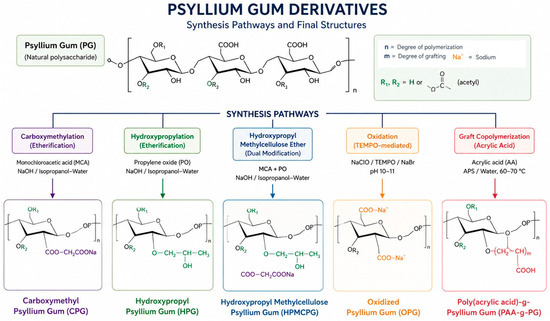
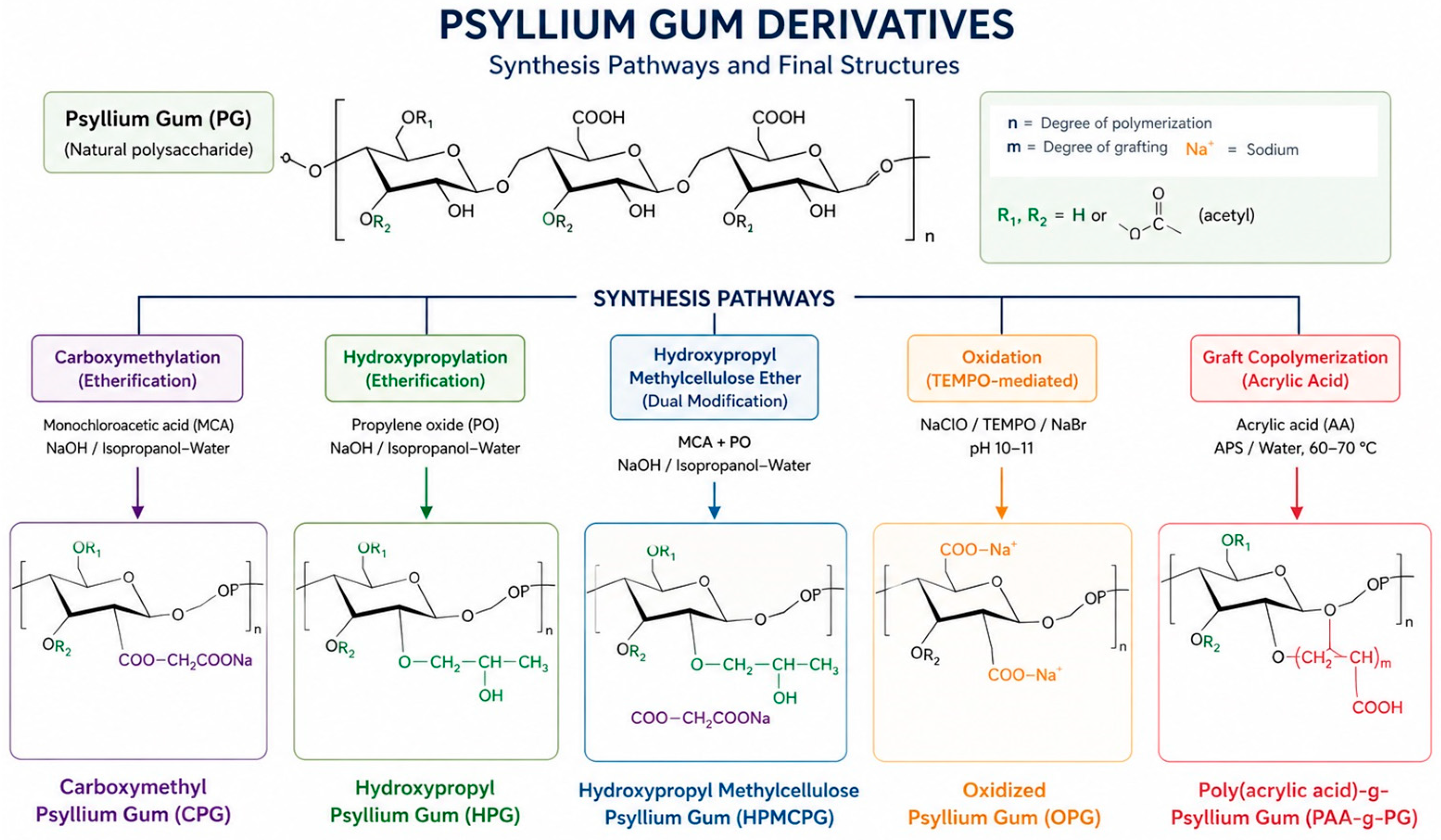
Esterification (e.g., acetylation) and etherification (e.g., carboxymethylation) partially substitute hydrophilic hydroxyl groups with less polar moieties. These treatments decrease moisture uptake and swelling, lower water solubility, improve tensile strength, and enhance dimensional stability. Importantly, controlled substitution preserves biodegradability while enabling films suitable for moisture-sensitive packaging applications [41]. Figure 3 summarizes synthesis pathway and final structures of some psyllium gum derivatives.
Figure 3.
Synthesis pathway of psyllium gum derivatives.
4.4. Nanocomposite Reinforcement
Nanocomposite incorporation represents one of the most transformative advances in psyllium-based packaging. Unlike chemical modification, which primarily reduces water vapor transmission, nanofillers provide substantial mechanical reinforcement and multifunctionality [42].
Incorporating cellulose nanocrystals (CNC) significantly improves mechanical and barrier performance due to strong interfacial hydrogen bonding and their high aspect ratio. Additionally, exfoliated CNC dispersion reduces oxygen permeability by creating tortuous diffusion pathways that hinder gas transport, limiting permeation and improving shelf-life performance [43].
Layered silicate fillers such as Montmorillonite reduce moisture uptake. The platelet morphology extends diffusion pathways for water vapor, increases Young’s modulus, and improves dimensional stability. Optimal dispersion is critical for maximizing reinforcement [44].
Other nanofillers such as graphene oxide or metal oxide nanoparticles, including titanium dioxide and zinc oxide, provide multifunctional enhancements at low loadings (<5 wt%), including antimicrobial activity, UV shielding, and improved thermal stability [45]. These additions could shift psyllium films from passive barriers toward active and smart packaging systems.
Table 1 shows the effect of some modifications on the psyllium mechanical properties.
Table 1.
Comparative Mechanical Benchmarking for Psyllium.
5. Processing into Films, Coatings, and Composites
The versatility of psyllium gum in packaging systems is supported by adaptable processing routes that preserve molecular integrity while enabling scalable production. These include solvent casting for films, dip- or spray-coating for various substrates, and extrusion for thermoplastic composites.
Psyllium gum is typically dissolved in distilled water at concentrations ranging from 1 to 3% (w/v), sometimes with mild heating and stirring to ensure homogeneity. In certain cases, ethanol–water mixtures are used to aid solubility. Psyllium-based films are commonly produced via solvent casting, yielding thicknesses between 50 and 200 µm depending on polymer concentration and casting volume [47]. Controlled plasticization and partial cross-linking tailor tensile strength, flexibility, and barrier performance while preventing brittleness. The hydroxyl-rich arabinoxylan network forms cohesive, hydrogen-bonded matrices that can be structurally tuned for moisture resistance and gas control. This method is particularly suitable for laboratory-scale optimization and high-value functional films.
The pseudoplastic (shear-thinning) rheology of psyllium solutions enables uniform dip- or spray-coating. Under shear, viscosity decreases for smooth spreading, and rapid viscosity recovery stabilizes the coating on substrates such as fruits, biodegradable trays, or paper-based packaging [50]. Hydration of the mucilage produces adherent, semi-permeable layers (typically 50–100 µm thick) that reduce transpiration and moisture loss, moderate O2/CO2 exchange, reduce the oxidative reactions, and provide a physical barrier against microbial contamination [51].
In thermoplastic systems, psyllium can function as either a matrix or a reinforcing phase. Its hydroxyl-rich structure enhances adhesion to hydrophilic fillers, enabling extrusion-based production of biodegradable sheets and molded items. Controlled plasticization and limited cross-linking are critical to maintaining melt processability under moderate thermal conditions. Extrusion scalability positions psyllium composites as viable alternatives to single-use plastics in retail, e-commerce, and perishable goods packaging [52]. These materials contribute to circular economy goals by reducing marine litter and lowering postharvest losses, while active functionalities can reduce overall food waste by an estimated 15–25% [53].
6. Applications in Sustainable Packaging Systems
Through molecular modification and composite engineering, psyllium-based materials increasingly approach the mechanical and barrier performance of conventional plastics such as low-density polyethylene (LDPE), widely used for flexible packaging.
6.1. Edible Films and Coatings for Food Preservation
Psyllium’s gel-forming capacity and strong hydrogen-bonded network enable the formation of cohesive, semi-permeable edible films and coatings. It is crucial to distinguish between edible films, which are standalone packaging materials used to wrap or contain food items, and edible coatings, which are applied directly to food surfaces (e.g., whole tomatoes or apple slices) and regulated as food ingredients or food additives, not as packaging materials in the legal sense. Both application forms are discussed in this review; direct-application edible coatings are food-preservation aids, while free-standing films and wraps are biodegradable packaging alternatives.
Edible coatings, when applied to produce such as apples, strawberries, and tomatoes, have demonstrated weight loss reduction of up to 30%, decay reduction of up to 50%, and shelf-life extension of 20–30% [54]. These improvements arise from reduced oxidative reactions, humidity regulation, and reduced microbial contamination. Cross-linked variants (e.g., with citric acid) improve resistance to dissolution under high relative humidity, making them suitable for cold-chain storage [30]. Given that a significant fraction of global produce is lost postharvest, such coatings directly address food waste reduction and sustainability challenges.
6.2. Active Packaging with Controlled Antimicrobial Release
Psyllium’s hydrogel-like mucilage network enables encapsulation and sustained release of bioactive compounds (essential oils, antioxidants, and antimicrobials). Release kinetics are governed by swelling behavior, cross-link density, and diffusion within the hydrated matrix. For example, thymol-loaded films exhibit controlled antimicrobial release (k ≈ 0.05 h−1), effectively inhibiting Listeria monocytogenes in ready-to-eat foods over extended storage [55]. The matrix prevents rapid volatilization while maintaining effective antimicrobial concentrations. Additional incorporation of silver nanoparticles or metal oxides provides UV shielding and synergistic antibacterial activity, expanding applicability to high-risk perishable products [55].
6.3. Safety, Regulatory Aspects, and Microbiological Studies
For psyllium gum films to be widely adopted as food packaging materials, their safety and shelf-life performance must be rigorously validated. Psyllium gum is generally recognized as safe (GRAS) by regulatory bodies such as the FDA. However, its application as a direct-food-contact material requires specific toxicological and migration studies to ensure compliance with food packaging regulations.
While the direct extensive literature on microbiological studies specifically addressing psyllium gum films and determining their shelf life as a food product is still emerging, research on active packaging systems incorporating psyllium gum with antimicrobial agents (as discussed in Section 6.2) demonstrates its potential. For instance, films loaded with thymol have shown effectiveness against Listeria monocytogenes [55]. Further dedicated studies focusing on the intrinsic antimicrobial properties of psyllium gum films, their interaction with food matrices, and their performance under various storage conditions are needed to establish comprehensive shelf-life data and regulatory compliance. This area represents a critical future research direction to fully validate psyllium gum’s role in food packaging.
7. Environmental Sustainability and Life Cycle Assessment (LCA)
The transition from petroleum-derived plastics to bio-based materials requires rigorous life-cycle validation rather than isolated performance claims. Psyllium-derived materials demonstrate strong sustainability potential when assessed across cultivation, processing, the use phase, and end-of-life; particularly in comparison with synthetic or fossil-based polymers [56].
7.1. Renewability and Agricultural Footprint
Psyllium is sourced from Plantago ovata, an annual crop cultivated primarily in arid regions of India (≈70% of the global supply). It yields approximately 800–1200 kg/ha within a 6-month rain-fed cycle, requiring minimal irrigation, fertilizers, or mechanized inputs.
Key sustainability attributes include [1]:
- Rapid regeneration without fossil feedstocks
- CO2 sequestration during biomass growth
- Utilization of husk byproducts (≈25–30% of seed weight)
- Limited land-use competition due to short seasonal cycles
In contrast, synthetic and fossil-based polymers originate from non-renewable resources and rely on energy-intensive extraction and polymerization processes.
7.2. Carbon Footprint and Energy Demand
LCA assessments indicate a Global Warming Potential (GWP) of ≈1.2 kg CO2-eq/kg (psyllium) vs. ≈3.0 kg CO2-eq/kg (PET). Extraction energy was ≈2.5 MJ/kg (aqueous/ethanol extraction) vs. 70–80 MJ/kg for petrochemical polymers [57].
This represents roughly a 60% reduction in carbon footprint relative to PET. Low cultivation emissions (rain-fed, minimal tillage) and recyclable process water further decrease the environmental burden. End-of-life composting credits and avoidance of landfill methane enhance overall life-cycle benefits.
7.3. Biodegradability and End-of-Life Performance
Under composting conditions defined by ISO 14855-1 [58], psyllium-based materials achieve up to 95–98% mass loss within 180 days, fully mineralizing into CO2, water, and biomass without microplastic residue. By contrast, PET and polyethylene degrade by less than 5% over centuries in natural environments [59]. Psyllium composites, therefore, support soil reintegration and circular bioeconomy pathways while reducing long-term landfill persistence and marine pollution risks.
7.4. Contribution to Food Waste Reduction
Moisture-sensitive spoilage is a major driver of food loss. Modified psyllium coatings and films regulate humidity and gas exchange, reducing postharvest weight loss by ≈30% and decay by ≈50% in produce systems [38]. Active films with controlled antimicrobial release (e.g., thymol systems) inhibit pathogens such as Listeria monocytogenes, extending shelf life and lowering spoilage. Because food waste carries a higher carbon footprint than packaging itself, these indirect benefits significantly improve overall environmental impact [56].
7.5. Industrial Substitution Potential
Recent developments demonstrate measurable displacement of petroleum polymers, including high-bio-content blends replacing up to 85% of synthetic polymer in flexible films and nanocomposites, reducing rigid plastic tray usage by ≈60% [60]. Reinforced systems are approaching the tensile and barrier performance benchmarks of conventional plastics [61,62]. Extrusion-compatible psyllium–starch systems further enable integration into existing manufacturing infrastructure at competitive cost ranges [63].
7.6. Comparative Sustainability Overview
Table 2 demonstrates a comparative sustainability overview of Psyllium compared with PET.
Table 2.
Comparative Sustainability Overview.
Psyllium-based materials offer a more sustainable alternative to PET due to their renewable agricultural origin, lower carbon footprint and energy demand, and high biodegradability, allowing them to reintegrate into natural cycles within months. In contrast, PET relies on finite fossil resources, requires significantly more energy to produce, and persists in the environment for centuries, contributing to pollution. While psyllium may not fully replace PET in all applications, it can substantially reduce plastic use and support more circular end-of-life options such as composting, provided agricultural impacts are responsibly managed.
7.7. Broader Sustainability Impact
Psyllium-based systems align with key sustainability drivers:
- Reduction in petroleum dependency
- Compostability and microplastic avoidance
- Edible and bio-integrated packaging options
- Food waste minimization through barrier and antimicrobial functions
- Compatibility with circular economy models
While challenges remain, particularly moisture sensitivity and supply-chain optimization, advances in chemical modification, blending, and nanocomposite engineering have substantially narrowed the performance gap with synthetic plastics [64].
7.8. Performance Radar Comparison
Table 3 demonstrates the performance comparison of psyllium and psyllium-CNC compared with LDPE and PET.
Table 3.
Comparative performance Overview.
The comparison highlights a clear trade-off between sustainability and performance: psyllium-based materials excel in renewability, biodegradability, and low carbon footprint, making them environmentally superior to LDPE and PET, but they lag in mechanical strength and moisture resistance, which limits their standalone use in demanding applications. The incorporation of cellulose nanocrystals (CNC) significantly improves these functional properties, bringing psyllium-CNC composites closer to conventional plastics in performance while largely retaining their sustainability advantages. In contrast, LDPE and PET offer superior durability and moisture resistance but score poorly in environmental metrics, underscoring the potential of psyllium–CNC as a more balanced, eco-friendly alternative for packaging and related uses.
8. Current Challenges and Limitations
Despite significant advances in the application of psyllium gum, several technical, economic, and infrastructural barriers must be addressed before widespread industrial adoption can occur.
As an agricultural product, psyllium exhibits molecular weight (Mw) fluctuations of approximately ±20%, influenced by crop genetics, soil conditions, and harvest timing. This variability directly impacts film tensile strength (5–35 MPa range), elongation, and barrier properties, leading to batch-to-batch inconsistency [65]. For regulated food-packaging applications, such variability poses a major standardization challenge.
Psyllium’s hydroxyl-rich arabinoxylan structure results in high water affinity, with equilibrium moisture content (EMC) reaching ~25% at 75% relative humidity. High moisture content causes film swelling and softening, reduced dimensional stability, and increased water vapor transmission (>12 g/m2/day in unmodified films) [66]. While plasticization improves flexibility, it can further elevate permeability. Thus, balancing flexibility and moisture resistance remains a central materials engineering challenge.
Current psyllium gum processing costs range between $1.1–4/kg, compared to ~$1–1.7/kg for low-density polyethylene (LDPE). Although the extraction energy (~2.5 MJ/kg) is lower than that of petrochemical polymerization, the overall cost is affected by limited extraction yield (10–15%), purification requirements, and smaller-scale supply chains. Cost reduction through yield optimization and biorefinery integration is essential for market penetration.
Laboratory-scale solution casting is well established, but high-throughput extrusion and multilayer integration remain technically demanding. Challenges include limited solvent recovery systems for alkaline extraction and rheological incompatibility with conventional plastic processing lines [15]. Also, supply-chain concentration (≈70% of production occurring in India) increases vulnerability to climate and market fluctuations. Without scalable and geographically diversified production, industrial reliability remains constrained.
Although compostability is a strong advantage, standardized life-cycle assessments aligned with ISO 14040 [67] are still limited at an industrial scale. Existing studies often omit real-world variables such as transportation emissions and regional composting conditions. Regulatory approval for food-contact materials also requires comprehensive toxicological validation and migration testing. Furthermore, the legal definition of packaging varies significantly across regions and product categories, influencing material requirements and acceptance. Future research needs to address these regulatory frameworks to ensure psyllium-based materials meet specific market standards.
9. Future Research Directions
Enzymatic treatments (e.g., xylanase-assisted extraction) could improve yield by up to 30% while producing more uniform molecular-weight distributions. Such approaches support greener manufacturing and cost reduction simultaneously.
Targeted chemical modifications combined with nanofillers can reduce WVTR by up to 65% while maintaining biodegradability. Future systems must achieve moisture resistance during service life yet degrade efficiently post-use.
Blending with lignin, cellulose nanocrystals, chitosan, or biodegradable synthetics can yield multifunctional composites, which are essential for replacing multilayer fossil-plastic packaging without sacrificing performance.
Expanded LCAs incorporating cultivation, processing, transport, and composting scenarios are necessary to validate the reported GWP (~1.2 kg CO2-eq/kg) against materials like Polyethylene terephthalate.
Future research should focus on compatibility with extrusion-based multilayer architectures and active packaging technologies, including controlled release of antimicrobials or antioxidants. Maintaining compostability while integrating functional layers is a key engineering objective.
10. Conclusions
Psyllium gum, derived from Plantago ovata, represents a scientifically robust and renewable bio-based hydrocolloid with strong potential for next-generation sustainable packaging. Its highly branched arabinoxylan structure, neutral charge, and thermal stability provide molecular integrity and processing compatibility, while its high water-binding capacity (12–15 g/g), pseudoplastic rheology (K ≈ 10–50 Pa·sn), and cohesive hydrogen-bonding network enable effective film formation.
In practical applications, psyllium films exhibit tensile strengths of 5–15 MPa and elongation at break of 20–50% in native form, with moderate water vapor transmission (≈8–12 g/m2/day) and good oxygen barrier performance suitable for controlling lipid oxidation in foods. Through chemical modification, plasticization, blending with complementary biopolymers (e.g., starch and whey protein), and nanocomposite reinforcement, these properties can be substantially enhanced, approaching the mechanical and barrier performance of conventional plastics in selected applications.
Beyond material functionality, psyllium-based systems align strongly with environmental sustainability goals. They are renewable, compostable, and capable of integration into circular economy models. Applications in edible coatings and active packaging extend food shelf life, reduce postharvest losses, and mitigate overall carbon footprint, addressing both packaging waste and food waste simultaneously.
Challenges remain, particularly regarding moisture sensitivity, raw material variability, industrial scalability, and cost competitiveness relative to petroleum-derived polymers. However, ongoing studies are progressively narrowing these gaps.
Overall, psyllium gum is evolving from a niche laboratory biopolymer into a strategically important hydrocolloid for sustainable packaging innovation. With continued research and industrial integration, it has the capacity to significantly reduce dependence on fossil-based plastics while contributing to environmentally responsible, high-performance packaging solutions.
Author Contributions
All authors writing—original draft, writing—review and editing the final review. All authors have read and agreed to the published version of the manuscript.
Funding
This research received no external funding.
Institutional Review Board Statement
Not applicable.
Informed Consent Statement
Not applicable.
Data Availability Statement
No new data were created or analyzed in this study.
Conflicts of Interest
The author declares that the research was conducted in the absence of any commercial or financial relationships that could be construed as a potential conflict of interest.
References
- Scaria, S.S.; Kurian, J.T.; Dandin, V.S.; Joseph, K.S. Production of Blond Plantain (Plantago). In Biodiversity and Genetic Improvement of Medicinal and Aromatic Plants I; Springer: Berlin/Heidelberg, Germany, 2025; p. 93. [Google Scholar]
- Strkalj, L.; Yakubov, G.E.; Burton, R.A.; Cowley, J.M. Structural and Functional Properties of Fiber from Psyllium (Plantago ovata) Husk: Current Knowledge and Strategies to Expand Its Application in Food and Beyond. Compr. Rev. Food Sci. Food Saf. 2025, 24, e70297. [Google Scholar] [CrossRef] [Scilit]
- Rao, G.S.; Araia, W.; Brima, F.I. Principles and Practices of Seed Production Technology; Clever Fox Publishing: London, UK, 2024. [Google Scholar]
- Kaczmarczyk, K.; Kruk, J.; Ptaszek, P.; Ptaszek, A. Plantago ovata Husk: An Investigation of Raw Aqueous Extracts—Osmotic, Hydrodynamic and Complex Rheological Characterisation. Molecules 2023, 28, 1660. [Google Scholar] [CrossRef] [Scilit]
- Yu, L.; Yakubov, G.E.; Zeng, W.; Xing, X.; Stenson, J.; Bulone, V.; Stokes, J.R. Multi-layer mucilage of Plantago ovata seeds: Rheological differences arise from variations in arabinoxylan side chains. Carbohydr. Polym. 2017, 165, 132–141. [Google Scholar] [CrossRef] [Scilit]
- Guo, Q.; Cui, S.W.; Wang, Q.; Young, J.C. Fractionation and Physicochemical Characterization of Psyllium Gum. Carbohydr. Polym. 2008, 73, 35–43. [Google Scholar] [CrossRef] [Scilit]
- Belorio, M.; Gómez, M. Psyllium: A Useful Functional Ingredient in Food Systems. Crit. Rev. Food Sci. Nutr. 2021, 62, 527–538. [Google Scholar] [CrossRef] [Scilit] [PubMed]
- Husain, M.; Mahmood, H.S.; Md-Tahir, H.; Mirani, A.A.; Nawaz, Q.; Niazi, B.M.; Islam, M.A.; Khan, A.A.; Saad, A. Design Development and Performance Evaluation of Psyllium (Ispaghol) Husk Separator Cum Grader. Pak. J. Sci. 2024, 76, 389. [Google Scholar] [CrossRef] [Scilit]
- Xie, D.; Ma, H.; Xie, Q.; Guo, J.; Liu, G.; Zhang, B.; Li, X.; Zhang, Q.; Cao, Q.; Li, X.; et al. Developing Active and Intelligent Biodegradable Packaging from Food Waste and Byproducts: A Review. Compr. Rev. Food Sci. Food Saf. 2024, 23, e13334. [Google Scholar] [CrossRef] [Scilit] [PubMed]
- Vela-Albarran, M.; Santos, J.; Calero, N.; Carrillo, F.; Trujillo-Cayado, L.A. Phycocyanin–Psyllium Gel Systems: Rheological Insights and Functional Applications in Algae Oil Emulgels. Food Bioprocess Technol. 2025, 18, 6365–6377. [Google Scholar] [CrossRef] [Scilit]
- Zhang, Y.; Luo, Y.; Gao, B.; Yu, L. Psyllium: A Nutraceutical and Functional Ingredient in Foods. Annu. Rev. Food Sci. Technol. 2025, 16, 355–377. [Google Scholar] [CrossRef] [Scilit] [PubMed]
- Niazi, M.K.; Hassan, F.; Ismail, M.A. Food Hydrocolloids: Functional Properties, Nutritional Benefits and Future Trends. Int. J. Nat. Med. Health Sci. 2024, 3, 26–33. [Google Scholar]
- Geremew Kassa, M.; Alemu Teferi, D.; Asemu, A.M.; Belachew, M.T.; Satheesh, N.; Abera, B.D.; Erku, E.G. Review on Psyllium Husk: Nutritional, Functional, Health Benefits, Food Industry Applications, Waste Treatment and Potential Negative Effects. CyTA—J. Food 2024, 22, 2409174. [Google Scholar] [CrossRef] [Scilit]
- Sánchez-Sánchez, R.; Rodríguez-Rego, J.M.; Macías-García, A.; Mendoza-Cerezo, L.; Díaz-Parralejo, A. Relationship between Shear-Thinning Rheological Properties of Bioinks and Bioprinting Parameters. Int. J. Bioprint. 2023, 9, 687. [Google Scholar] [CrossRef] [Scilit]
- Beer-Lech, K.; Skic, A.; Skic, K.; Stropek, Z.; Arczewska, M. Effect of Psyllium Husk Addition on Biodegradable Thermoplastic Starch Film Properties. Materials 2022, 15, 4459. [Google Scholar] [CrossRef] [Scilit]
- Zhang, X.; Zhao, Y.; Li, Y.; Zhu, L.; Fang, Z.; Shi, Q. Physicochemical, Mechanical and Structural Properties of Composite Edible Films Based on Whey Protein Isolate/Psyllium Seed Gum. Int. J. Biol. Macromol. 2020, 153, 892–901. [Google Scholar] [CrossRef] [Scilit]
- Salehi, F. Edible Coating of Fruits and Vegetables Using Natural Gums: A Review. Int. J. Fruit Sci. 2020, 20, S570–S589. [Google Scholar] [CrossRef] [Scilit]
- Tewari, K.; Thapliyal, D.; Bhargava, C.K.; Verma, S.; Mehra, A.; Rana, S.; Gautam, A.K.; Verros, G.D.; Arya, R.K. Innovative Coating Methods for Industrial Applications. In Functional Coatings: Innovations and Challenges; Arya, R.K., Verros, G.D., Davim, J.P., Eds.; John Wiley & Sons, Inc.: Hoboken, NJ, USA, 2024; pp. 23–50. [Google Scholar] [CrossRef] [Scilit]
- ASTM D6400-23; Standard Specification for Labeling of Plastics Designed to be Aerobically Composted in Municipal or Industrial Facilities. ASTM International: West Conshohocken, PA, USA, 2023.
- Khezerlou, A.; Zolfaghari, H.; Banihashemi, S.A.; Forghani, S.; Ehsani, A. Plant Gums as Functional Compounds for Edible Films and Coatings. Polym. Adv. Technol. 2021, 32, 2306–2326. [Google Scholar] [CrossRef] [Scilit]
- Bourtoom, T. Edible Films and Coatings: Characteristics and Properties. Int. Food Res. J. 2008, 15, 237–248. [Google Scholar]
- Bagul, V.S.; Mutha, R.E.; Bari, S.B. Mucilage and Gums: Natural Polymers, Biodegradability, and Sustainable Development; Walter de Gruyter: Berlin, Germany, 2026. [Google Scholar]
- Ballesteros-Mártinez, L.; Pérez-Cervera, C.; Andrade-Pizarro, R. Effect of glycerol and sorbitol concentrations on mechanical, optical, and barrier properties of sweet potato starch film. NFS J. 2020, 20, 1–9. [Google Scholar] [CrossRef] [Scilit]
- Vieira, M.G.A.; Da Silva, M.A.; Dos Santos, L.O.; Beppu, M.M. Natural-Based Plasticizers and Biopolymer Films: A Review. Eur. Polym. J. 2011, 47, 254–263. [Google Scholar] [CrossRef] [Scilit]
- Nielsen, L.E. Cross-Linking—Effect on Physical Properties of Polymers. J. Macromol. Sci. Part C 1969, 3, 69–103. [Google Scholar] [CrossRef] [Scilit]
- Ajitha, A.R.; Thomas, S. Polymer Blends and Compatibilization. In Compatibilization of Polymer Blends; Elsevier: Amsterdam, The Netherlands, 2020; pp. 1–29. [Google Scholar]
- Ahmadi, R.; Kalbasi-Ashtari, A.; Oromiehie, A.; Yarmand, M.S.; Jahandideh, F. Development of Biodegradable Psyllium Seed Edible Film. J. Food Eng. 2012, 109, 745–751. [Google Scholar] [CrossRef] [Scilit]
- Eslami, Z.; Elkoun, S.; Robert, M.; Adjallé, K. Effect of Plasticizers on the Physical and Mechanical Properties of Alginate-Based Films: A Review. Molecules 2023, 28, 6637. [Google Scholar] [CrossRef] [Scilit]
- Wurm, F.; Rietzler, B.; Pham, T.; Bechtold, T. Multivalent Ions as Reactive Crosslinkers for Biopolymers—A Review. Molecules 2020, 25, 1840. [Google Scholar] [CrossRef] [Scilit]
- Yammine, P.; El Safadi, A.; Kassab, R.; El-Nakat, H.; Obeid, P.J.; Nasr, Z.; Tannous, T.; Sari-Chmayssem, N.; Mansour, A.; Chmayssem, A. Types of Crosslinkers and Their Applications in Biomaterials and Biomembranes. Chemistry 2025, 7, 61. [Google Scholar] [CrossRef] [Scilit]
- Mohamed, S.A.; Mekkey, S.D.; Othman, A.M.; El-Sakhawy, M. Novel Antimicrobial Biodegradable Composite Films as Packaging Materials Based on Shellac/Chitosan and ZnAl2O4 or CuAl2O4 Spinel Nanoparticles. Sci. Rep. 2024, 14, 27824. [Google Scholar] [CrossRef] [Scilit]
- Mohamed, S.A.; El-Sakhawy, M.; Fahmy, H.M. Preparation of Antibacterial Cellulose of Non-Woven Cotton Fabric Treated with Curcumin/Shellac Based on Polyvinyl Alcohol/Sodium Caseinate Blends for Potential Packaging Purposes. Sci. Rep. 2025, 15, 15335. [Google Scholar] [CrossRef] [Scilit] [PubMed]
- Fakhrara, S.; Ganjloo, A.; Bimakr, M. Preparation and Characterization of Blend Film Based on Psyllium Seed Mucilage and Polyvinyl Alcohol as a New Eco-Friendly Packaging Material. J. Food Process. Preserv. 2025, 2025, 4664613. [Google Scholar] [CrossRef] [Scilit]
- Sankaranarayanan, R.V.; Menon, S.H.; Maniyeri, S.C.; Periya, V.K.; Naveenchandra Prabhu, S. Gas Barrier Polymer Nanocomposites: Materials, Characterization, Synthesis, Applications and Modelling Approaches. ChemistrySelect 2025, 10, e04165. [Google Scholar] [CrossRef] [Scilit]
- Askari, F.; Sadeghi, E.; Mohammadi, R.; Rouhi, M.; Taghizadeh, M.; Shirgardoun, M.H.; Kariminejad, M. Physicochemical and Structural Properties of Psyllium Gum/Modified Starch Composite Edible Film. J. Food Process. Preserv. 2018, 42, e13715. [Google Scholar] [CrossRef] [Scilit]
- Krystyjan, M.; Khachatryan, G.; Ciesielski, W.; Buksa, K.; Sikora, M. Preparation and characteristics of mechanical and functional properties of starch/Plantago psyllium seeds mucilage films. Starch-Stärke 2017, 69, 1700014. [Google Scholar] [CrossRef] [Scilit]
- Beheshti, F.; Ahangar, H.A.; Poorazizi, E. Fabrication and Characterization of Plantago psyllium Mucilage/Chitosan Composite Scaffold: Physico-Mechanical and Antibacterial Properties. J. Mater. Res. 2022, 37, 1440–1450. [Google Scholar] [CrossRef] [Scilit]
- Das, S.; Bera, D.; De, D.; Mondal, D.; Karmakar, P.; Das, S.; Dey, A. Thymoquinone Incorporated Chitosan–Sodium Alginate/Psyllium Husk Derived Biopolymeric Composite Films: Comparative Antibacterial and Anticancer Profile. Eur. Polym. J. 2022, 180, 111608. [Google Scholar] [CrossRef] [Scilit]
- Gunwant, D. Moisture Resistance Treatments of Natural Fiber-Reinforced Composites: A Review. Compos. Interfaces 2024, 31, 979–1047. [Google Scholar] [CrossRef] [Scilit]
- Kumar, K.; Chauhan, G.S.; Chauhan, S.; Sharma, S. Epichlorohydrin/Triethylamine Modified Psyllium as a Highly Efficient Adsorbent for Selective Adsorption of Anionic Dyes. Int. J. Biol. Macromol. 2025, 294, 139386. [Google Scholar]
- Al-Maharma, A.Y.; Al-Huniti, N. Critical Review of the Parameters Affecting the Effectiveness of Moisture Absorption Treatments Used for Natural Composites. J. Compos. Sci. 2019, 3, 27. [Google Scholar] [CrossRef] [Scilit]
- Strachota, B.; Strachota, A.; Barbosa, S.M.; Pavlova, E.; Tohamy, H.A.; El-Sakhawy, M.; Kamel, S. Potential Environmental Application of a Tough and Temperature-Responsive Nanocomposite Hydrogel Based on Poly(N-Isopropylacrylamide-co-Sodium Methacrylate) and Clay. Int. J. Environ. Res. 2025, 19, 7. [Google Scholar] [CrossRef] [Scilit]
- Wang, J.; Gardner, D.J.; Stark, N.M.; Bousfield, D.W.; Tajvidi, M.; Cai, Z. Moisture and Oxygen Barrier Properties of Cellulose Nanomaterial-Based Films. ACS Sustain. Chem. Eng. 2018, 6, 49–70. [Google Scholar] [CrossRef] [Scilit]
- Singha, S.; Hedenqvist, M.S. Barrier Properties of Poly(Lactic Acid)/Clay Nanocomposites: A Review. Polymers 2020, 12, 1095. [Google Scholar] [CrossRef] [Scilit]
- El-Shafai, N.; El-Khouly, M.E.; El-Kemary, M.; Ramadan, M.; Eldesoukey, I.; Masoud, M. Graphene Oxide Decorated with Zinc Oxide Nanoflower, Silver and Titanium Dioxide Nanoparticles: Fabrication, Characterization, DNA Interaction and Antibacterial Activity. RSC Adv. 2019, 9, 3704–3714. [Google Scholar] [CrossRef] [Scilit]
- Beer-Lech, K.; Kołodziej, P.; Skic, A.; Branco, R. Strength Analysis Aspects of Psyllium/Thermoplastic Starch Films under Impact Loading Conditions. Adv. Sci. Technol. Res. J. 2024, 18, 385–393. [Google Scholar] [CrossRef] [Scilit]
- Hajivand, P.; Aryanejad, S.; Akbari, I.; Hemmati, A. Fabrication and Characterization of Oregano-Extract/Psyllium-Seed Mucilage Edible Film for Food Packaging. J. Food Sci. 2020, 85, 2481–2490. [Google Scholar] [CrossRef] [Scilit]
- Callister, W.D.; Rethwisch, D.G. Materials Science and Engineering: An Introduction; John Wiley & Sons: Hoboken, NJ, USA, 2020. [Google Scholar]
- Osswald, T.A.; Menges, G. Materials Science of Polymers for Engineers; Carl Hanser Verlag: Munich, Germany, 2012. [Google Scholar]
- Kunam, P.K.; Ramakanth, D.; Akhila, K.; Gaikwad, K.K. Bio-Based Materials for Barrier Coatings on Paper Packaging. Biomass Convers. Biorefin. 2024, 14, 12637–12652. [Google Scholar] [CrossRef] [Scilit]
- Jam, S.; Ashfaq, M.; Ghorbanpour, M.; Ehtesabi, H. Synthesis of Multifunctional Bilayer Wound Dressing Using Alyssum homalocarpum Seed Mucilage, Sambucus ebulus Plant Extract and Zinc Oxide Nanoparticles. Ind. Crops Prod. 2025, 226, 120678. [Google Scholar] [CrossRef] [Scilit]
- Saini, P.; Patel, P.; Chatterjee, H.; Biswas, S.; Bhati, S.S.; Dutt, D. Polymer-Based Composites for Future Packaging Materials. In Polymers and Composite Materials for Packaging: Smart Food Packaging and Solutions; Springer Nature: Singapore, 2025; pp. 197–227. [Google Scholar]
- Gonçalves, M.L.; Maximo, G.J. Circular Economy in the Food Chain: Production, Processing and Waste Management. Circ. Econ. Sustain. 2023, 3, 1405–1423. [Google Scholar] [CrossRef] [Scilit]
- Pham, T.T.; Nguyen, L.L.; Dam, M.S.; Baranyai, L. Application of Edible Coating in Extension of Fruit Shelf Life. AgriEngineering 2023, 5, 520–536. [Google Scholar] [CrossRef] [Scilit]
- Ramos, M.; Beltran, A.; Fortunati, E.; Peltzer, M.; Cristofaro, F.; Visai, L.; Valente, A.J.; Jiménez, A.; Kenny, J.M.; Garrigós, M.C. Controlled Release of Thymol from Poly(Lactic Acid)-Based Silver Nanocomposite Films with Antibacterial and Antioxidant Activity. Antioxidants 2020, 9, 395. [Google Scholar] [CrossRef] [Scilit] [PubMed]
- Lima, N.P.; Maciel, G.M.; Pinheiro, D.F.; Lima, N.F.; Ribeiro, I.S.; Pedro, A.C.; Haminiuk, C.W.I. Polysaccharide-Based Psyllium Dressings: Sustainable and Bioactive Solutions for Healing and Biomedical Innovation. Next Mater. 2026, 10, 101378. [Google Scholar] [CrossRef] [Scilit]
- Seile, A.; Spurina, E.; Sinka, M. Reducing Global Warming Potential Impact of Bio-Based Composites Based on Life Cycle Assessment. Fibers 2022, 10, 79. [Google Scholar] [CrossRef] [Scilit]
- ISO 14855-1:2012(E); Determination of the Ultimate Aerobic Biodegradability of Plastic Materials Under Controlled Composting Conditions—Method by Analysis of Evolved Carbon Dioxide—Part 1: General Method. International Organization for Standardization: Geneva, Switzerland, 2012.
- Wadhera, P.; Jindal, R.; Dogra, R. Evaluation of Flocculation Characteristics and Biodegradation Studies of Reduced Gum Rosin and Psyllium-Based Hydrogel. Polym. Eng. Sci. 2020, 60, 1231–1243. [Google Scholar] [CrossRef] [Scilit]
- Adak, B.; Baidya, S.; Teramoto, Y. Biopolymers and Their Nanocomposites Coated Paper-Based High Barrier and Sustainable Food Packaging Materials. Carbohydr. Polym. 2025, 367, 123966. [Google Scholar] [CrossRef] [Scilit] [PubMed]
- Chauhan, V.; Kärki, T.; Varis, J. Natural Fiber-Reinforced Engineering Plastic Composites and Their Applications in the Transportation Sector: A Review. J. Thermoplast. Compos. Mater. 2022, 35, 1169–1209. [Google Scholar] [CrossRef] [Scilit]
- Mohamed, S.A.A.; El-Sakhawy, M.; Diab, M.A. Enhancement of Bagasse Paper Properties for Sustainable Packaging via Bentonite and Alginate Loading in Shellac coatings. Sci. Rep. 2025, 15, 39412. [Google Scholar] [CrossRef] [Scilit] [PubMed]
- Qiu, C.; Hu, H.; Chen, B.; Lin, Q.; Ji, H.; Jin, Z. Research Progress on the Physicochemical Properties of Starch-Based Foods by Extrusion Processing. Foods 2024, 13, 3677. [Google Scholar] [CrossRef] [Scilit] [PubMed]
- Jamwal, V.; Mittal, A. Recent Progress in Nanocomposite Films for Food Packaging Applications: Synthesis Strategies, Technological Advancements, Potential Risks and Challenges. Food Rev. Int. 2024, 40, 3634–3665. [Google Scholar] [CrossRef] [Scilit]
- Gong, X.; Li, J.; Liu, Z.; Xu, X.; Li, Y.; Zhang, Y.; Wang, F.; Tong, L.T. Effects of Psyllium Polysaccharide with Different Molecular Weights on the Digestibility and Physicochemical Properties of Rice Starch and Their Interaction Forces. Int. J. Biol. Macromol. 2025, 309, 142911. [Google Scholar] [CrossRef] [Scilit]
- Aslan Kaya, D.; Ceylan, H.G.; Atasoy, A.F. Probiotic Edible Films Supplemented with Psyllium (Plantago ovata) Mucilage Containing Lacticaseibacillus rhamnosus GG as Coating for Fresh Apple Slices. Food Bioprocess Technol. 2025, 18, 1692–1706. [Google Scholar] [CrossRef] [Scilit]
- ISO 14040:2006; Environmental Management—Life Cycle Assessment—Principles and Framework. International Organization for Standardization: Geneva, Switzerland, 2006.

Disclaimer/Publisher’s Note: The statements, opinions and data contained in all publications are solely those of the individual author(s) and contributor(s) and not of MDPI and/or the editor(s). MDPI and/or the editor(s) disclaim responsibility for any injury to people or property resulting from any ideas, methods, instructions or products referred to in the content. |
© 2026 by the authors. Licensee MDPI, Basel, Switzerland. This article is an open access article distributed under the terms and conditions of the Creative Commons Attribution (CC BY) license.