Article

Redefinition of Energy Efficiency and Utilization Coefficients for Human-Centered Lighting: A Must for Urban Sustainability


by
Antonio Peña-García
1,2
1
Department of Civil Engineering, University of Granada, 18071 Granada, Spain
2
Research Group “Lighting Technology for Safety and Sustainability”, University of Granada, 18071 Granada, Spain
Sustainability 2026, 18(10), 4645; https://doi.org/10.3390/su18104645
Submission received: 13 March 2026 / Revised: 27 April 2026 / Accepted: 30 April 2026 / Published: 7 May 2026
(This article belongs to the Section Energy Sustainability)

Abstract

The main target of street and road lighting is to ensure the safety and the well-being of pedestrians and drivers. Regulations and standards on lighting installations establish minimum photometric requirements to achieve it. Thus, the main parameters concern the average luminance or illuminance, overall uniformity, longitudinal uniformity, threshold increment, edge illuminance ratio, and minimum energy efficiency or its equivalent. Although they have well-defined minimum and maximum values, their compliance, especially in urban and peri-urban environments, strongly depends on the heterogeneous characteristics of the street and its surroundings, depends on human physiological and psychological aspects, and/or faces remarkable uncertainties and problems of definition. The coefficient of utilization, Cu, and energy efficiency, ε, are key quantifiers taking account of the installation capability to provide luminous flux on the visual work plane with respect to the flux emitted and the power consumed by the light sources, respectively. However, contradictions between accurate values of these coefficients and the real visual performance of people or the rational use of energy are frequent. This is a problem because the binomial safety–sustainability requires consideration of these parameters in the design to enhance pedestrian and driver safety, as well as energy efficiency for sustainability. This work highlights the uncertainties and limitations of Cu and ε, redefines them through a human-centered approach that opens new perspectives on other parameters and quantities involved in lighting, and optimizes the binomial safety–sustainability.

1. Introduction

The critical importance of road and street lighting (in the following “public lighting”) has been assumed for years since the performance of any task carried out by drivers, pedestrians and other users of roads and streets can benefit from good lighting. Thus, as pointed out by Prof. van Bommel: “For motorized traffic, road lighting should provide visual performance and visual comfort and help to keep the driver alert. Many different studies have shown that good road lighting can reduce night-time accidents. In countries with peak hours in the hours of darkness, road lighting can increase the capacity of a motorway. In built-up and residential areas, road lighting should also provide visual information for slow-moving traffic such as pedestrians, cyclists, and moped users so that they can find their path without the risk of colliding with or stumbling over potentially dangerous hazards. In these areas, road lighting should also be aimed at discouraging violence, vandalism, and crime. Indeed, crime statistics indicate that there exists a relation between road lighting and crime reduction” [1].
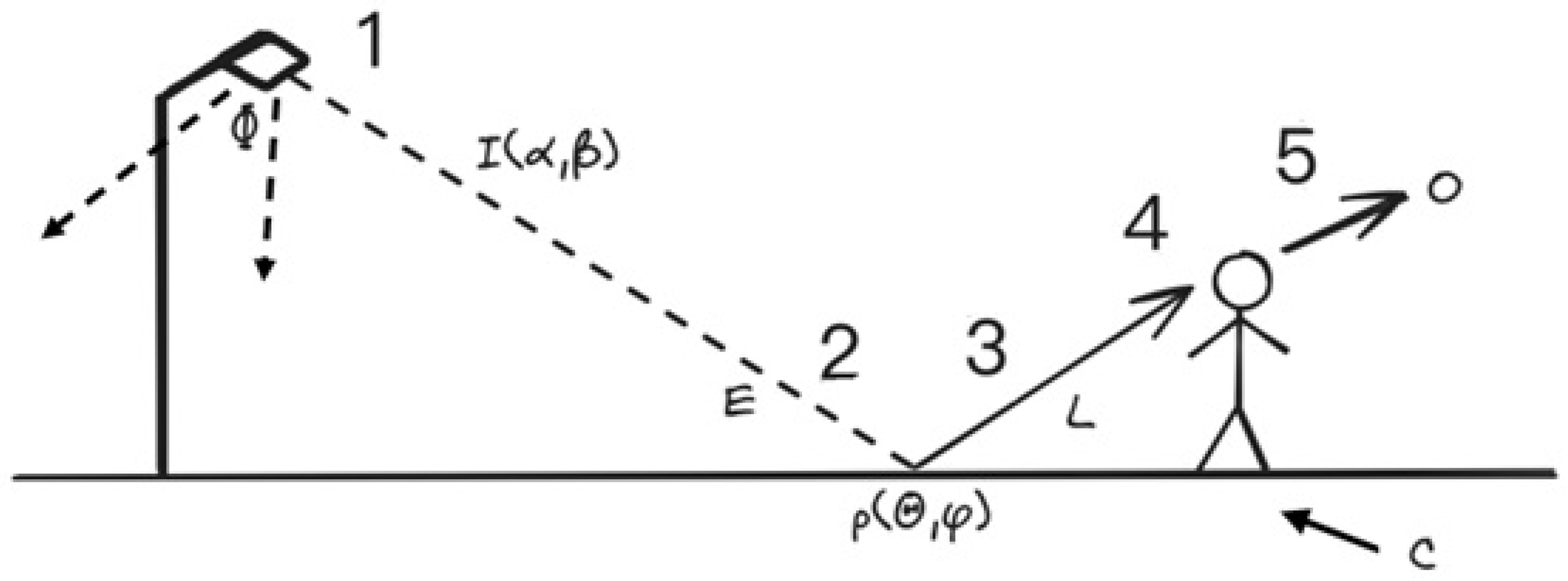
In this scenario, the illumination of infrastructures follows the Basic Process in Lighting (BPL) [2], which consists of the five steps shown in Figure 1:
1.
Luminaires emit luminous flux, Φ, with a given luminous intensity distribution I (α, β).
2.
The visual plane receives illuminance, E.
3.
Its surface reflects the flux according to its reflectance, ρ (θ, φ), and spectral absorptance.
4.
Luminance, L (θob, φob), (L for simplicity) is reflected towards the eyes of each observer.
5.
According to the visual input, L, and other circumstances related to the situation, C, each observer will have a physical and behavioral output, O. Schematically, L + C ➔ O.
Figure 1. The Basic Process in Lighting (BPL) in street and road lighting (adapted from [2]).
Sustainability 18 04645 g001
The BPL takes place in outdoor and indoor lighting and presents a human-centered link between physical processes (radiation, propagation, and reflection) and physiological and psychological ones, also including the output from the installation users.
The scheme of the BPL highlights one fact that, although known, must be always kept on the minds of designers, maintainers and administrations in charge of traffic and urban facilities: in infrastructure lighting, most of the visual tasks are carried out by reflection. Users rarely receive luminous flux emitted by primary sources but almost exclusively light reflected by secondary ones. Direct sight of primary sources like traffic lights or warnings has low presence when compared to the continuous visual tasks of looking at the road, sidewalks, pedestrians, vehicles, facades, etc.
As shown in Figure 1, our perception of the visual planes is determined by the luminance, our visual input. It produces a retinal illuminance [3] and, hence, the visual sensation (visual path) and non-visual effects (non-visual paths). Requirements on minimum L are the choice in road lighting, where there is one single visual work plane between 60 and 160 m ahead of the driver. However, in urban environments, roads with straight visibility lower than 60 m and traffic circles, the requirements focus on minimum illuminance because there are more visual planes (road, sidewalk, faces of people, facades…) and tasks, which makes it impossible to ensure a fixed luminance from everywhere [1]. So, E is the choice quantity when L-based requirements are not feasible.
This is the reason why most national regulations and standards, like EN 13201-2 [4], BS 5489-1:2020 [5] or RD 1890/2008 [6], establish luminance (ME and MEW) or illuminance (C, P) classes according to the traffic volume, intensity and other characteristics of the road or street. They also establish important requirements concerning light distribution, uniformity or glare that have a deep impact in a correct visual perception of drivers and pedestrians. Other key parameters like the contrast, although mentioned in the standards, need more attention because many new asphaltic mixtures have been used in the last years attending to their mechanical properties, carbon footprint and recycling but leaving reflection aside. Thus, the wide range of reflectance going from clear concrete to dark bituminous is affecting the contrast with the consequent impact on visibility and visual performance of drivers and pedestrians. These arguments make it necessary to carry out a deep analysis of the reflective properties of pavements and their relationship with key parameters in street and road lighting.
The luminance reflected by one surface is related to the illuminance on it by the luminance coefficient, q, [7] that can involve directionality, spectral selectivity, etc. This relationship is expressed as
q ( α , β , γ ) = L E
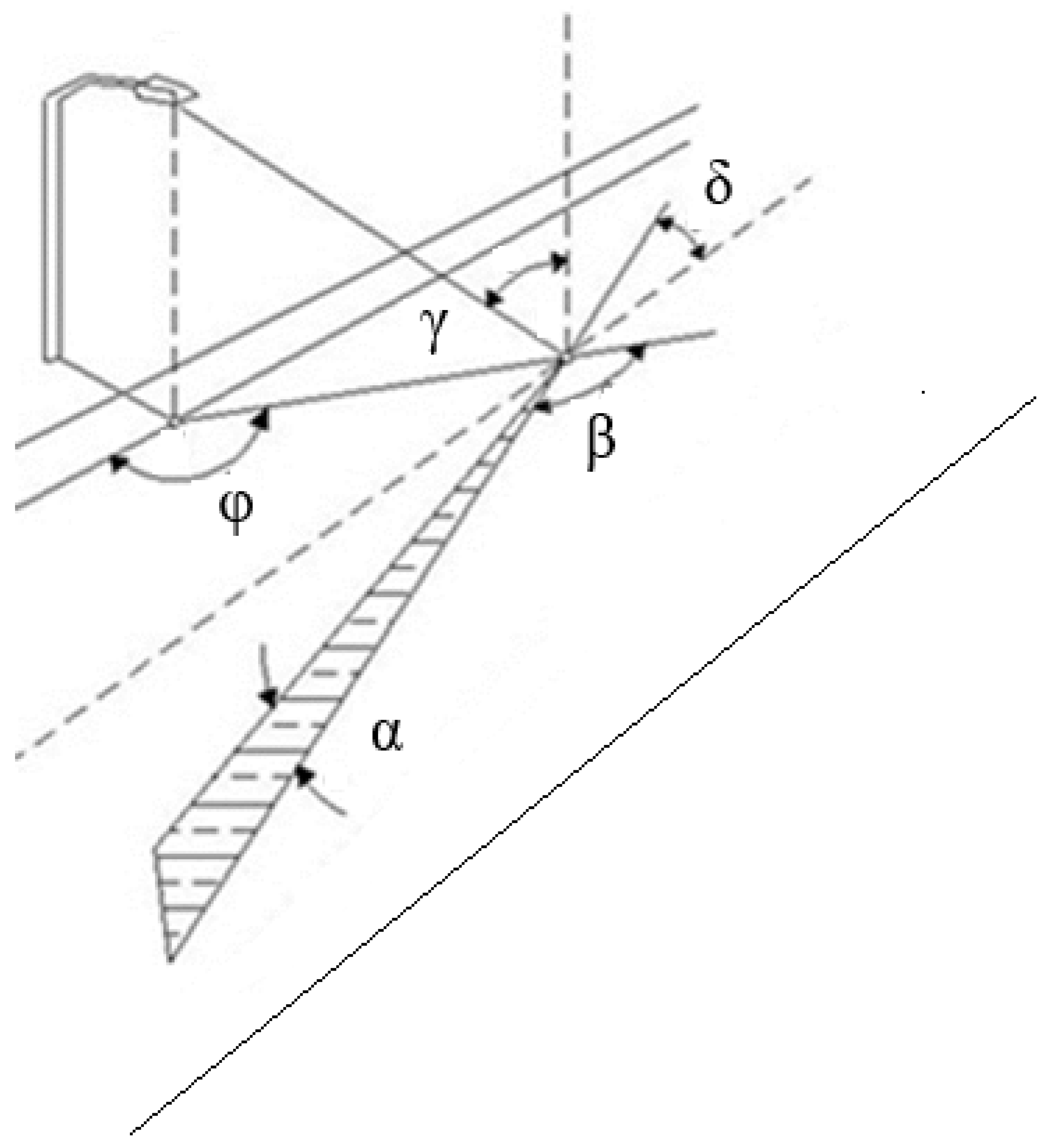
where α is the angle between the horizontal and the observer eye, β is the azimuthal angle with the line along the road, and γ is the angle of flux incidence with the luminaire nadir. This dependence of q on the physical properties of the surface and its relative position with the light source and observer makes it a complex parameter, as shown in Figure 2 [8].
Despite deviations in wet pavements and other conditions [9,10], the reflective properties of road pavements have been approached by r-tables [11], bidirectional reflection functions [12] and Lambertian surfaces [7] that reflect the same luminance in all directions. In this last case, q and L can be reduced to scalar quantities, and the general relation between the incident illuminance and the reflected luminance expressed by Equation (1) becomes simpler:
L = ρ π E
where the reflectance, ρ, is a constant scalar under this reasonable approach.
Despite the model, the reflective properties of pavements, surfaces and urban furniture play a key (and somehow underrated) role in the visual tasks of people. Given that L highly determines the output, O, in the BPL (visual reaction time, facial recognition, differentiation of stimuli, etc.) and that it depends on the reflective properties of the visual work plane, the pavement characteristics must be present in the core parameters used in design and maintenance.
In indoor lighting, despite the increasing load of information provided by primary sources like displays and screens, the role of surface reflectance is still central [13].
In addition to the reflective properties of surfaces, there are two parameters that have been considered fundamental in road and street lighting: the coefficient of utilization (Cu) and energy efficiency (ε). Although there are some similar energy-related coefficients, this work will take ε as a paradigm because they are equivalent.
Cu and ε are independent from pedestrian and driver characteristics and are also affected by uncertainties in their current definition and boundaries, as analyzed in the next sections. These uncertainties can be classified into three groups linked between each other:
(1)
User dependent: different visual needs depending on age groups, sociocultural factors, habits depending on daily or seasonal factors, etc.
(2)
Fixed parameters of roads or streets: materials of pavements and sidewalks, dimensions, the presence and nature of facades, the presence of trees and bushes, urban furniture, etc.
(3)
Variable parameters of roads and streets: changes in pavement reflectance due to rain or snow, parked vehicles in one given moment, eventual alternance of side parking, etc.
Among these, there are two major ones: Cu and ε do not consider the reflectance of the visual working planes nor the presence of elements in the street and road that highly influence the safety of people.
The result is inaccurate lighting levels, low U0 [14], light pollution [15], excessive energy consumption [16], and glare [17].
As presented in this work, there is a deep connection between Cu and ε. Thus, it is not surprising that their individual limitations to describe the performance of installations are also connected; so, any redefinition must affect both. In this complex framework, the goal of this work is to clearly identify these limitations and, departing from their analysis, redefine the coefficients in a framework of human-centered lighting.

2. Visual Performance in Public Lighting from the Perspective of Cu

As shown in Figure 1, not all the luminous flux emitted by the luminaires is received on the road and sidewalks, the main visual work planes where the users of streets and roads carry out their visual tasks. There are losses of flux between the light sources and the planes; that is, between steps 1 and 2 of the BPL. This is due to two main causes: (1) dirtying and aging of luminaires and (2) incidence of flux out of the work planes.
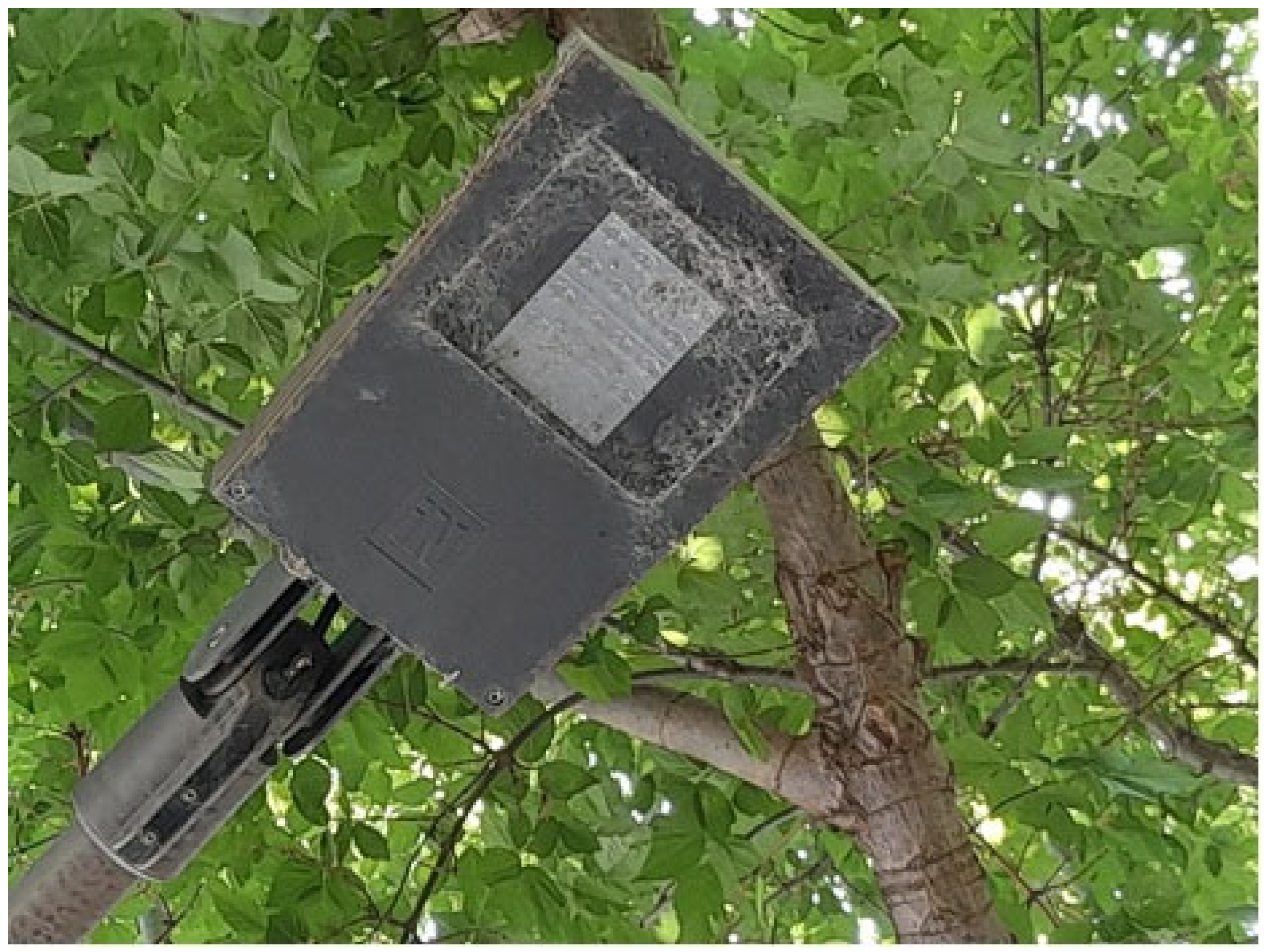
The first cause of losses is considered by the coefficient of maintenance or maintenance factor, Cm, settled by the luminaire manufacturers around 0.8–0.9 for LED technology [18]. It multiplies the flux of the lamp to compensate for absorption, scattering and other dissipative phenomena caused by source and luminaire aging, inner condensation, UV degradation, attached dust, dirt, bird droppings, etc. (Figure 3). Thus, the average illuminance or luminance is kept above the minimum between maintenance operations of cleaning and the replacement of damaged elements.
To minimize the over-illumination caused by the introduction of Cm, some adaptive luminaires set it high but periodically raise the voltage and flux between consecutive maintenances.
The second cause of losses between light sources and visual work planes is the emission towards other directions. It is quantified by the coefficient of utilization or utilization factor, Cu, or Fu, the ratio of luminous flux received on the work plane to the total flux emitted by the lamps [19]. The definition of the International Commission on Illumination (CIE) is equivalent [7]. It is expressed by (3)
C u = Φ W i Φ L S i
where Φw is the luminous flux received on the visual work plane and ΦLS–i is the flux emitted by the i-th light source of one given luminaire.
Cu represents the efficiency of the installation to provide illuminance on the visual work plane from the flux emitted by the light sources, ΦLS. It plays a central role since the average illuminance Eav, produced by N luminaires on a plane with area A, depends on it through Equation (4).
E a v = N Φ L S C u C m A
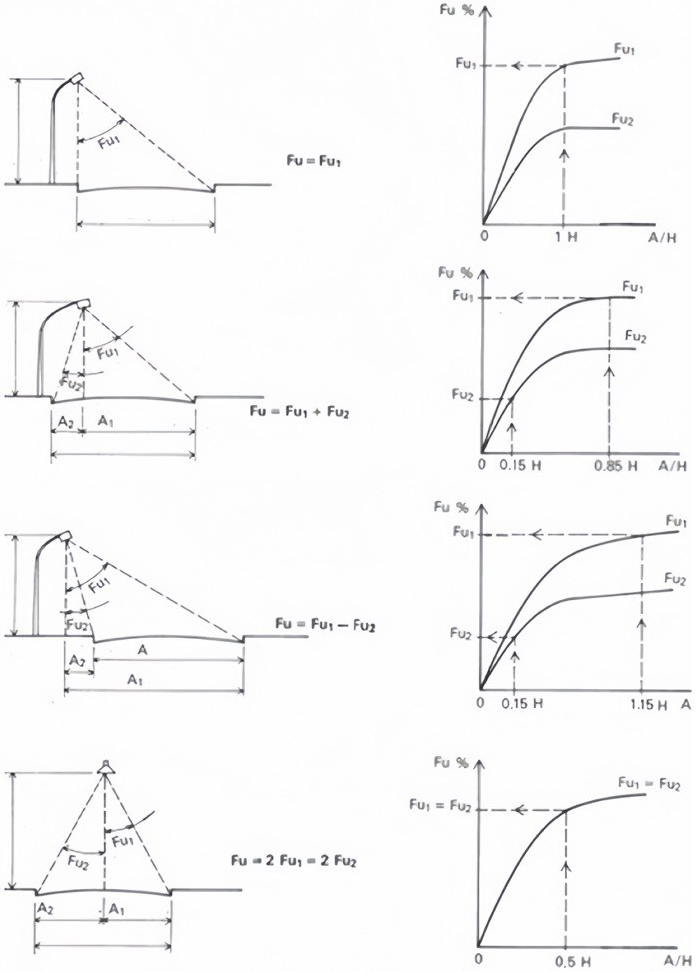
As currently defined, Cu clearly depends on geometric parameters of the street and luminaire like height (H), the width of the road or sidewalk (A), or the luminaire position with respect to the sidewalk and road and is frequently represented as a function of the ratio (A/H), as seen in Figure 4 [20].
However, this purely geometric approach to Cu ignores factors with a high impact on it, like intensity distribution in planes C0–180 and C90–270, the reflectance of facades, and the presence of trees, parked cars, and different kinds of urban furniture like dumpsters that can influence the flux reaching the pavement. Thus, Ayaz et al. [21] demonstrated that the simulated light level on a street could vary by about 30%, and this is due to the interreflection of luminous flux and anthropogenic spill light from the adjacent establishments. In addition, Ren et al. [22] used vehicle-mounted LiDAR data to study light obstruction in street lighting systems based on illuminance distribution.
All these considerations make it evident that imprecise inputs of Cu in programs like DIALux [23] may result in serious discrepancies between estimated and real Eav, that is, between project and reality.
Furthermore, in the approach of Lambertian pavement, the combination of (2) and (4) yields:
L a v = ρ N Φ L S C u C m π   A
This means that wrong estimations of Cu also impact the luminance towards the users and thus the compliance with regulations, visual inputs, reaction time, and the safety and well-being of people. As a consequence, Cu also affects energy consumption, economic and environmental impact through its weight in number and spacing of luminaires, installed power, mounting height, etc.
So, it seems necessary to deeply understand this coefficient, how to calculate it, and how optimize it with the target of designing better and more sustainable lighting installations. The first step is the identification and compilation of its undefinitions and uncertainties:
(1)
In streets with wide sidewalks, the required Eav and U0 on road surfaces are different from those for sidewalks.
(2)
The geometry of the installation combined with reflective elements like facades deviates from the measured values of Eav and U0 compared to the projected ones.
(3)
Frequently, luminaires simultaneously light the sidewalk behind, the road ahead, and even the opposite sidewalk, especially in one-sided arrangements. It is done with asymmetric intensity patterns in plane C90-270 across the street. The mentioned asymmetries of light pattern and street and the presence of facades result in different values of Cu for road and sidewalks. They can be measured once the lighting installation is working (Figure 4), but their precise prediction may present uncertainties.
These three considerations, present even in the simplest models of lighting installation, suggest that Cu should not be an input but a carefully designed intermediary parameter to achieve the incident Eav and reflected Lav by the sidewalk and road when required.
In addition to the above, the following must be considered:
(4)
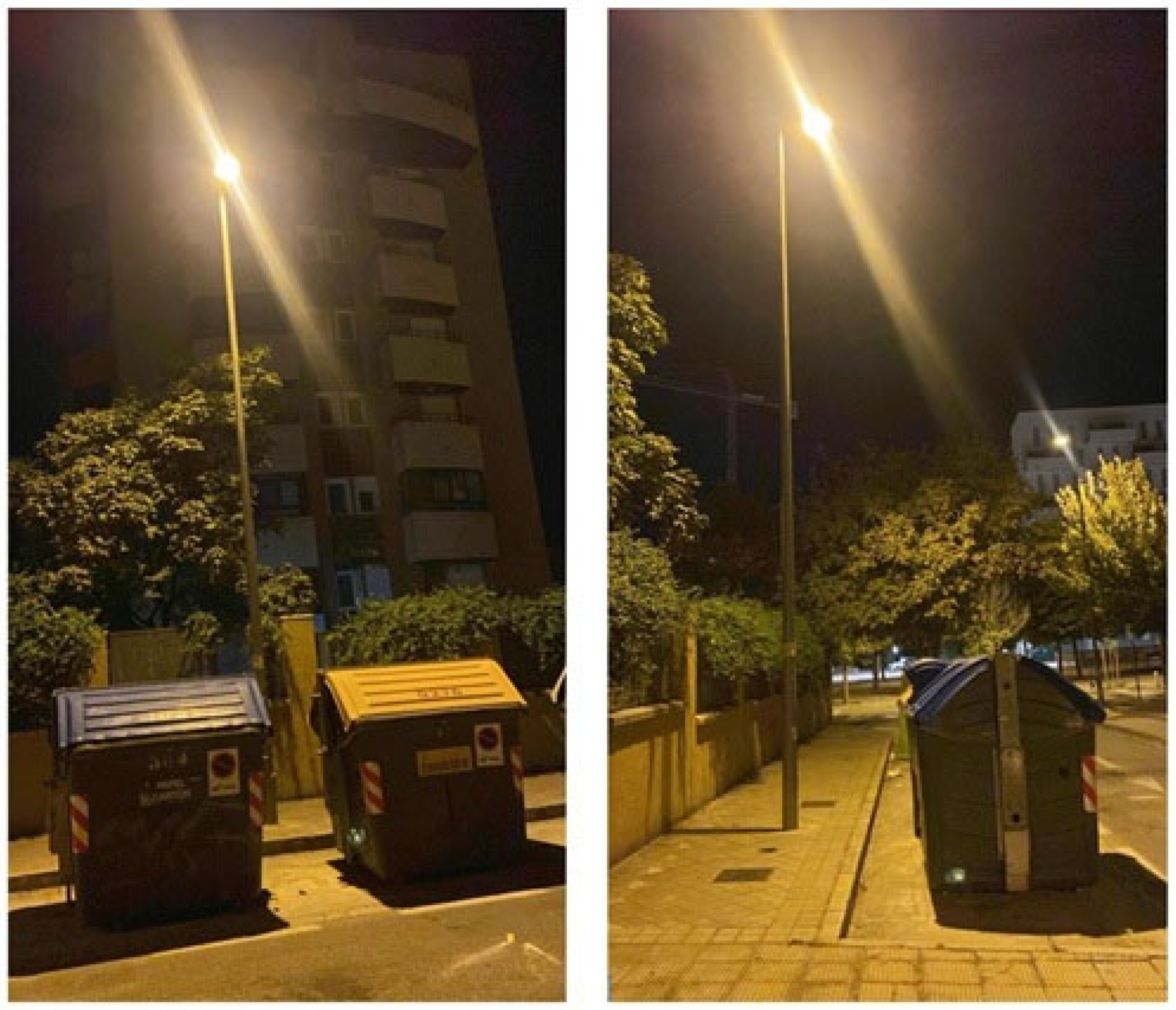
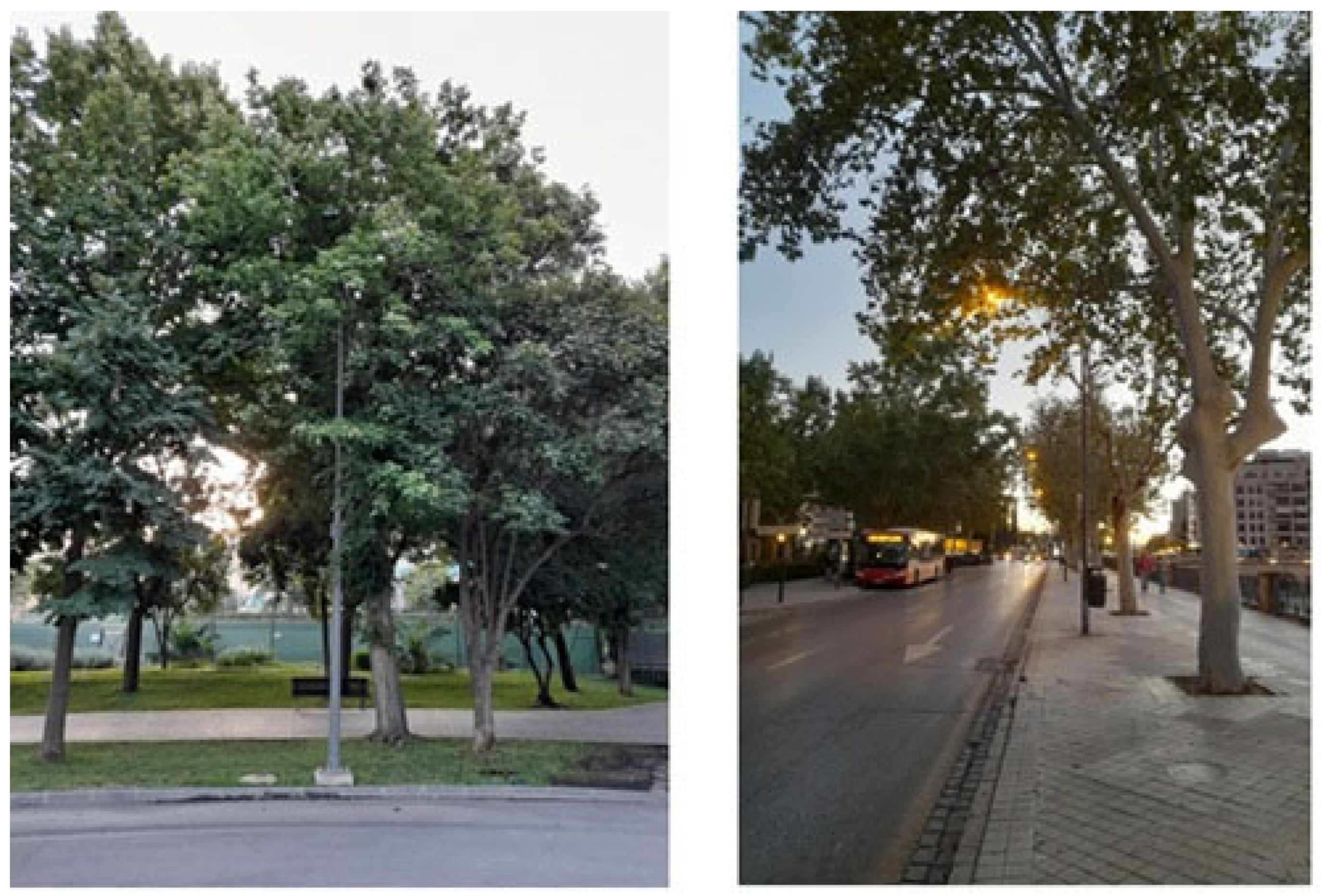
In real streets, the presence of elements like trees (Figure 5) [24], parked cars, street-based newsstands, kiosks, trash cans (Figure 6), etc., not foreseen in the original design of the lighting installation, remarkably impacts Cu. This influence is variable depending on leaf seasonality, alternance in parking sides, etc.
(5)
These elements can produce positive or negative contrasts depending on their relative position to the luminaires (Figure 6). The nature of the contrast affects visual perception [1].
Figure 5. Luminaires hidden by trees.
Sustainability 18 04645 g005
Figure 6. Trash cans under luminaires partially darkening the road. The luminance contrast is positive for their covers and negative for their bodies.
Sustainability 18 04645 g006
These uncertainties make it complex to determine the actual Eav on the work planes and thus Cu. But even if it were known with precision, a major problem arises: Eav does not determine the visual input due to the reflective properties of the pavement and ground.
Some consequences of all these considerations are the following:
(1)
The users of two identical streets and installations with the same values of Eav on the visual planes, that is, identical values of Cu, can receive different values of Lav and have different outputs.
(2)
There are two situations where a high Cu does not guarantee the required Lav: (1) low reflectance of pavement, producing low L despite accurate E; (2) an inadequate reflectance pattern, sending flux towards unnecessary or undesired directions.
(3)
A high Cu can produce light pollution if the pavement has a moderate to strong reflective component upwards.
(4)
Typical streets have luminaires of the same model in stretches of remarkable length. But their morphology and the factors influencing the flux on the visual plane usually vary along with them. This is the case of very white and bright facades, or, on the other hand, very dark ones and vacant plots, that do not reflect light towards the street. Thus, treating Cu as a constant factor in the whole installation (luminaire + street) is incorrect and may lead to mistakes.
(5)
Even if Cu is known with precision, the reflected luminance can meet obstacles like cars, impairing visual sensation.
(6)
Depending on their positions, these obstacles can also have different contrasts (positive or negative), which makes the visual task even more complex.
(7)
Cu can be different in similar streets depending on the presence of trees, leaf seasonality, parked cars and other elements. It means that more installed power can be necessary to reach the requested Eav. And even in this case, the minimum U0 could not be reached, impairing the visual tasks.
This all means that the current definition of Cu is not always useful for lighting design.

3. Energy Efficiency in Public Lighting from the Perspective of Dp and ε

The efforts to make public lighting more sustainable have been continuous in the last two decades, especially after the massive installation of LED luminaires became a reality around the world. Once the savings in consumed energy replacing discharge lamps by LED were clear [25,26], additional savings related with the human visual system were studied. Thus, Brons and collaborators [27] demonstrated that LEDs output could be reduced by a factor of 1.21 to match the visual brightness perception because their white light makes illuminated streets appear brighter than the yellowish light from HPS lamps. Further reductions in flux output proved to be feasible in some circumstances, including the consideration of mesopic conditions where visual tasks in streets actually take place [15,28,29].
However, in spite of the numerous works on the reduction in installed and consumed power, lower attention has been paid to one important fact that can be concluded from the BPL: the conversion of electrical energy into light (step 1) should be efficient, producing the desired output of installation users (step 5), like a short visual reaction time, accurate facial recognition, decisions to avoid potential problems, etc.
Attending to the intermediate steps, there is some heterogeneity in the definition of parameters quantifying the conversion of electrical power into luminous flux on the visual plane. Two main and equivalent parameters are found in the literature.
The Power Density Indicator (PDI or Dp) is defined as the value of the system power divided by the value of the product of the surface area to be lit and the calculated maintained Eav on this area [30,31]. It is given by
D p = P i A i E a v i
where P is the total power of the lighting installation, Eav is the average illuminance specified or measured in the area or sub-area considered, and Ai is the size of the area or sub-area to be lit. Its unit is Wlux−1·m−2.
Some authors like van Bommel [1] give a more general definition including Lav instead of Eav for luminance-based requirements. This last definition specifically applies to required illuminance or luminance levels (units Wcd−1), not measured ones. In this framework, Dp also allows one to quantify the efficiency to convert electrical power into visual sensation but does not take account of the real conditions that can be rather different.
On the other hand, the energy efficiency (ε) [6], also denominated installation luminous efficacy (ηinst) [30], is defined by
ε = A T E a v P T
where AT is the total illuminated surface and P T is the total electrical power installed, including the light sources and the electrical auxiliary devices.
Independently from this heterogeneity, the comparison between (6) and (7) highlights that, although Dp and ε are inverse quantities, their target is to estimate the installation performance: the ratio between the luminous flux on the working plane and the electrical power to get such flux (or the inverse). Thus, international standards like EN 13201-5 [30] establish typical values of Dp, whereas countries like Spain establish mandatory requirements for ε. So, although they are equivalent to approach the core problem of efficient lighting installations, this work will refer to ε.
As in the case of Cu, a deep comprehension of ε requires identification of its undefinitions and uncertainties:
(1)
Energy efficiency, ε, depends on the illuminated area, a non-trivial concept, especially in urban contexts. It is the case of installations where sidewalks and roads have different requirements of Eav. Since the luminaires illuminate the sidewalk behind them, the road ahead, and even the opposite sidewalk (one-sided arrangements), it is impossible to determine with precision how much flux goes to the sidewalk and how much goes to the road.
(2)
The consideration of sub-areas in some standards, even if they have precise geometric boundaries, presents the same problem: the luminaires simultaneously light several sub-areas, and the precise determination of the power used to illuminate each one is not feasible.
(3)
The parameter ε does not take account of lighting installations with vertical visual work planes, which is essential for important visual tasks like facial recognition or the quantification of light pollution.
(4)
Since ε is defined from Eav, it does not guarantee good visual performance because the reflective properties of the ground may reflect low L, which means poor visual stimuli.
(5)
According to the argument above, a high ε can be even a cause of light pollution in the case of excessive upward reflection.
One frequent but non-standard way to avoid the undefinition between sidewalks and roads is to consider one single street when sidewalks are narrower than 3 m. This approach is reasonable because the visual field of pedestrians includes both, but it can fail due to parked cars and does not apply in wider sidewalks.
This all means that the current definition of ε (or its equivalent Dp) is not always useful for public lighting design.

4. The Relationship ε-Cu: Linked Problems and Solutions

The combination of (4), (7), (8) and (9) shows the deep connection between ε and Cu through the following steps:
(1)
The product A T E a v , (or i A i E a v i ) gives the total luminous flux on the work planes ( Φ W ):
A T E a v = Φ W
(2)
The efficacy of a light source is defined as the ratio between the luminous flux emitted by that same light source ( Φ L S ) and the power consumed by the light source and the auxiliary devices ( P ):
η L S = Φ L S P
(3)
The ratio between (8) and (9) gives:
ε = C u C m η L S
This shows the direct relationship between the parameters studied in this research.
Correspondingly, standard EN 13201-5 defines in its informative Annex B, the “Installation luminous Efficacy” (ηinst), similar to ε, in a slightly different way:
η i n s t = C u C L C m η L S η p
Given the heterogeneity of definitions, some clarifications are necessary in (11):
CL is the correction factor, where a design is based on luminance or hemispherical illuminance instead of illuminance.
Cu, as defined by CIE Publ. S017, includes the optical efficiency of the luminaire (RLO), that is, how much flux emitted by the light sources leaves it.
η l s is the luminous efficacy of the light source alone, that is, the ratio between the luminous flux emitted by one light source and the consumed power.
η P is the power efficiency of the luminaire and accounts for power losses in control gear and other auxiliary devices.
The product η l s η P appears sometimes in the literature as one single factor accounting for the total efficacy of the light source and the electrical auxiliary devices to transform electrical power into luminous flux. This makes sense because these devices are usually inside the light source.
Independently from the definition, according to (10) and (11), the capability of one installation to convert electrical power into useful luminous flux is proportional to its capability to direct the flux from light sources to the visual plane. The proportionality factors are related to power and light losses.
Thus, the uncertainties and problems with the definitions of Cu and ε presented in this work affect each other. In particular, the following must be addressed:
(1)
The uncertainties to define the illuminated areas and sub-areas included in the expressions of ε or Dp also affect Cu.
(2)
Both coefficients can be constant in one street or change along it. This may be the same for roads and sidewalks or not if the Eav requirements are different.
(3)
Two light sources with different η l s values can provide the same Eav on the work planes. Thus, there can be different values of ε for the same Cu depending on η l s .
(4)
Two luminaires with different values of Cm can provide the same Eav on the work planes. Thus, there can be different values of Cu for the same ε depending on Cm.
(5)
Cu and ε are functions of Eav on the visual work plane but do not determine the visual performance and output of users because these depend on the luminance reflected towards their eyes. The reason is that these coefficients do not depend on pavement reflectance or urban furniture.
(6)
Installations where a high Cu guarantees a high Eav on the visual plane, accurate Lav, and even accurate ε can produce light pollution because of upward reflection, which is not considered by these parameters.
Hence, the meaning of Cu is deep, and the optimization of its impact, controversial since Cu ≈ 1, does not mean a better performance of the installation, but the opposite. The same happens with ε.
Independently from these arguments, not reported up to date, some efforts to quantify the light pollution due to upward reflections have been made.
The Upper Flux Ratio (UFR) considers the luminous flux reflected upwards [32]. Indeed, despite the higher or lower capability of the pavement to reflect flux, the UFR takes account of the flux reflected towards inaccurate directions. It is defined by [33]
U F R = E a v E a v C m 1 + U L O R ρ 1 C u + ρ 2 ρ 1 D L O R C u C u
where the components of the equation are as follows:
Eav and E’av are the average illuminances achieved and required, respectively.
Cm and Cu are the maintenance and utilization factors.
ULOR and DLOR are the upward and downward ratios to luminaire flux.
ρ1 and ρ2 are the respective reflectance of the visual plane and surroundings.
Equation (12) expresses the deviation between projected and real upward flux.
Although this parameter has been used to quantify light pollution, it does not take account for installations efficiency to produce visual performance from consumed energy and/or emitted luminous flux.
In summary, the capability of pavements to reflect light can indicate good conversion of electrical power in flux on the pavement, but this does not mean good visual performance, and it can sometimes omit energy waste and light pollution due to high luminance levels or inaccurate spectral distribution and color temperature [15]. These circumstances are a real threat for ecosystems containing all kinds of animal [34,35,36] and vegetal life [37,38]. Other consequences of non-accurate luminance distribution, even if the amount of luminous flux on the pavement is high, is glare, which has been classically divided into disability and discomfort, although some research has also differentiated the so-called dazzling glare [39].
Hence, it must be the luminance towards the eyes of road and street users that defines the coefficients quantifying any kind of efficiency in installations. In the next section, luminance-corrected coefficients of utilization and energy efficiency will be proposed.

5. Luminance-Based Coefficients and Redefinition of Required Illuminance: Towards Visually Efficient Public Lighting

According to some regulations and standards [6], the observation points for users of streets and roads where luminance criteria apply (mostly those with long straight stretches ahead) are located at 60 m. The measurement procedure in this and other international standards [40] requests the luminance meter to be set at 1.5 m on the ground and 1/4 of the width of the road. It means one measurement angle between the pavement and eye, α = atan (1.5/60) = 1.43°.
Other research and standards specify similar indexes measured from shorter distances. One of them is the luminance coefficient in diffuse illumination, Qd, defined as the “quotient of the luminance of a field and the illuminance on the plane of that field, for a diffused lighting and an observation direction forming a grazing angle with the road surface” [7]. In some cases, it is particularized to the ratio between the luminance measured at 30 m from the observation point and 1.2 m height, that is, an angle α = 2.29° [41].
Despite its variability in distance and height [42], the literature indicates that the zone of the road between 30 m and 60 m plays a key role in the most frequent visual tasks of road users. In other words, the luminance L30–60 reflected with angles between 1.4° and 2.3° (rounded to 1.3° and 2.5°) with the ground produces significant visual input, determining the output (reaction time, decisions, etc.). Thus, it should be considered when determining the real efficiency of lighting installations.
Let there be the luminance-corrected coefficient of utilization, Cu–L, defined as
C u L = C u L 30 60 L L
where L30–60 is the average luminance measured from 30 to 60 m (1.4° to 2.3°) from one 1.5 m height observer according to the measurement procedures in the different national regulations or technical recommendations. LL is the luminance from one Lambertian surface given by (2). It is equivalent to the total L reflected in all directions. The Lambertian approach is useful because of its easy calculation with (2), and it allows a comparison with the ideal pattern of isotropically distributed luminance.
The coefficient can be also expressed as
C u L = π E W A L 30 60 Φ L E W ρ = π A L 30 60 Φ L ρ
where EW is the illuminance on the work plane. Cu-L is dimensionless like Cu, a necessary condition for calculations by the lumens method and other methods.
The introduction of Cu-L in Equation (4) leads to another luminance-corrected parameter:
E a v L = N Φ L C u L C m A
The meaning of the quantity defined in (15) is an illuminance with a correction factor quantifying the useful visual input towards the users’ eyes after reflection in the pavement. Thus, although illuminance lacks information on the reflective properties of the work plane, the L-based illuminance proposed in this work includes for the first time an estimation of the foreseen visual input produced by a given illuminance.
Concerning energy efficiency, a luminance-based redefinition is also necessary. The relationship (10) will now turn into
ε L = C u L C m η L S
From their definition, including the Lambertian approach, Cu-L and εL are also a measure of deviation with respect to an ideal situation, where reflectance is not a matrix but a constant scalar and luminance is not a vector but also a constant scalar.
Furthermore, the redefined coefficients include the ratio L 30 60 L L , which has a deep meaning: the ratio between the useful luminance and the predominant luminance. This delves into their capability to quantify the flux contributing to our visual task.
Finally, according to Equation (13), Cu-L < Cu. It means that its consideration in (15) yields lower values of Eav-L and, for fixed Eav, the number of required luminaires should be higher. In the same way, εL < ε because the useful flux is lower. This apparent disadvantage of the luminance-based coefficients happens because now the reflective properties of the pavement are considered through the introduction of L30–60, and the worthless flux is disregarded. Nevertheless, the inclusion of luminance from the area between 30 and 60 m can orientate on the choice of luminaires according to their intensity distribution. If it is accurate, Cu-L will be higher and the number of luminaires will be optimized.
Another pro of this model is that it is applicable to sloped streets since the angle can be added or subtracted to reach the considered interval (1.3°–2.5°).

6. Discussion

This work highlights the need for human-centered metrics improving the quantification of visual performance and energy efficiency in public lighting, especially in streets and roads. Due to the deep connection between both concepts, the pros and cons of working with the coefficients established in current standards and regulations, are common.
It is demonstrated that, from a human-centered perspective, Cu is not always a good indicator of visual performance and ε is not a good indicator or rational use of energy. Furthermore, they consider some main street elements like the road, but there is no well-defined coefficient involving the global infrastructure to be illuminated: road, sidewalks, bikeways, if any, and all together.
Departing from these limitations and the relationship between Cu and ε, two luminance-corrected coefficients of utilization (Cu-L) and energy efficiency (εL) are proposed.
Future research should adapt the values of the current illuminance classes to the L-corrected ones. In addition, since the new parameters depart from classical photometric quantities, they can be defined for their photopic, scotopic and mesopic range depending on the V(λ) used. It means that future improvements of mesopic or even melanopic V(λ) are directly exportable to the proposed framework.
As cons, since Cu-L and εL are proposed in this research for the first time, the available software does not admit them as input and in general does not provide luminance in specific angular ranges but overall luminance in the whole space. Hence, future research must also focus on field measurements and methodologies with different pavements and street typologies to program and calibrate software that, having Cu-L and εL as input, can calculate reliable values of L30–60 and other parameters of the installations. These field measurements and the adaptation of software will be also of maximum importance due to the variability in the reflectance of different pavements. In addition to new software, this line of work can also be useful to adapt current programs to the proposed coefficients and luminance outputs.
As a second limitation, in short, narrow and zigzagging streets where the straight line of vision could be relatively short and luminance criteria do not apply, the redefined coefficients are useless. The development of models improving the accuracy of the classical Cu and ε in this kind of street is an open point that must be approached with field tests on pedestrians and other tools that will be developed in future projects.

7. Conclusions

The following conclusions can be deduced from the results and discussion above:
(1)
The coefficient of utilization or utilization factor Cu currently used determines the efficiency of the installation to produce illuminance on the ground. It provides worthy information in ideal urban environments with illuminance-based requirements, but fails in real situations:
Interurban roads or main streets with minimum luminance requirements.
Even in urban environments (illuminance requirements), real streets present elements like parked cars, trees and a wide variety of furniture that obstruct the reflected flux, impacting visual perception.
(2)
The energy efficiency ε currently used determines the efficiency of the installation to convert electrical power into illuminance on the ground. It is a good estimation of how much energy is converted into illuminance on the visual plane but fails when dealing with users’ visual and non-visual perception and performance.
(3)
Reasonable values of these coefficients do not guarantee the control of light pollution.
(4)
The redefinition of these coefficients, including the luminance towards users’ eyes, is more realistic.
(5)
The redefined coefficients Cu-L and εL consider for the first time the real luminance towards the street users’ eyes and thus the capacity of the installation to produce visual perception from emitted flux and consumed power, as well as quantifying the deviation from ideal situations.
(6)
In addition, the average illuminance on the pavement (Eav) required in regulations and standards has been redefined, including the luminance-corrected coefficient of utilization (Cu-L). The proposed Eav-L links the flux reaching the work plane, which lacks information of reflective properties with the useful flux to produce visual input.
As a main conclusion and starting point for a new field of research, the human-centered design in road and street lighting must depart from the useful luminous input for users and contribute to quantifying the useless flux with the target of minimizing it.

Funding

This research received no external funding.

Data Availability Statement

No new data were created or analyzed in this study. Data sharing is not applicable to this article.

Acknowledgments

The author thanks Zaida Núñez Troya, Corporal of the Spanish Army, for the outstanding pictures used for public lighting illustrations.

Conflicts of Interest

The author declares no conflicts of interest.

References

  1. Van Bommel, W. Road Lighting: Fundamentals, Technology and Applications; Springer: Cham, Switzerland, 2015. [Google Scholar]
  2. Peña-García, A.; Castillo-Martínez, A.; Ernst, S. The Basic Process of Lighting as Key Factor in the Transition towards More Sustainable Urban Environments. Sustainability 2024, 16, 4028. [Google Scholar] [CrossRef]
  3. Watson, A.; Yellott, J. A unified formula for light-adapted pupil size. J. Vis. 2012, 12, 12. [Google Scholar] [CrossRef]
  4. EN 13201-2:2015; Road Lighting—Part 2: Performance Requirements. European Committee for Standardization (CEN): Brussels, Belgium, 2016.
  5. BS 5489-1:2020; Design of Road Lighting. Part 1: Lighting of Roads and Public Amenity Areas—Code of Practic. The British Standards Institution: London, UK, 2020.
  6. Ministry of Industry; Tourism and Trade of Spain. Royal Decree 1890/2008; Ministry of Industry, Tourism and Trade of Spain: Madrid, Spain, 2008. [Google Scholar]
  7. Commission Internationale de l’’Eclairage, CIE. ILV: International Lighting Vocabulary, 2nd ed.; CIE Publ. S017/E:2020; Commission Internationale de l’’Eclairage, CIE: Vienna, Austria, 2020. [Google Scholar]
  8. Bodmann, H.W.; Schmidt, H.J. Road surface reflection and road lighting: Field investigations. Light. Res. Technol. 1989, 21, 159–170. [Google Scholar] [CrossRef]
  9. Bassett, M.G.; Dmitrevsky, D.; Kremer, P.C. Measurement of reflection properties of wet pavement samples. J. Illum. Eng. Soc. 1988, 17, 99–104. [Google Scholar] [CrossRef]
  10. Gibbons, R.B.; Adrian, W.K. Influence of Observation Angle on Road Surface Reflection Characteristics. J. Illum. Eng. Soc. 1997, 26, 139–149. [Google Scholar] [CrossRef]
  11. Boucher, V.; Greffier, F. Space of basis functions to retrieve road surface reflection tables from luminance maps. Light. Res. Technol. 2022, 56, 4–22. [Google Scholar] [CrossRef]
  12. Vincent, B.; Steve, L.; Laure, L.; Florian, G. Road BRDF Construction From Measured R-Tables. In Proceedings of the 2021 Joint Conference—11th International Conference on Energy Efficiency in Domestic Appliances and Lighting & 17th International Symposium on the Science and Technology of Lighting (EEDAL/LS:17), Toulouse, France, 1–3 June 2022; pp. 1–5. [Google Scholar]
  13. Peña-García, A.; Salata, F. Indoor Lighting Customization Based on Effective Reflectance Coefficients: A Methodology to Optimize Visual Performance and Decrease Consumption in Educative Workplaces. Sustainability 2021, 13, 119. [Google Scholar] [CrossRef]
  14. Lindh, U.; Jägerbrand, A. Impact of qualitative and quantitative methods on the evaluation of street lighting uniformity. In Proceedings of the CIE 2021 Conference, Virtually, 27–29 September 2021; pp. 413–422. [Google Scholar]
  15. Peña-García, A.; Sedziwy, A. Optimizing lighting of rural roads and protected areas with white light: A compromise among light pollution, energy saving and visibility. Leukos 2019, 16, 147–156. [Google Scholar] [CrossRef]
  16. Kostic, M.; Djokic, L. Recommendations for energy efficient and visually acceptable street lighting. Energy 2009, 34, 1565–1572. [Google Scholar] [CrossRef]
  17. Tyukhova, Y. Discomfort glare in outdoor environments after dark—A review of methods, measures, and models. Build. Environ. 2024, 263, 111850. [Google Scholar] [CrossRef]
  18. Montoya, F.G.; Peña-García, A.; Juaidi, A.; Manzano-Agugliaro, F. Indoor Lighting Techniques: An overview of evolution and new trends for energy saving. Energy Build. 2017, 140, 50–60. [Google Scholar] [CrossRef]
  19. IES Nomenclature Committee. ANSI/IES RP-16-17, Nomenclature and Definitions for Illuminating Engineering; Illuminating Engineering Society: New York, NY, USA, 2017. [Google Scholar]
  20. Urraca, J.I. Tratado de Alumbrado Público; Donostiarra: Gipuzkoa, Spain, 1988. [Google Scholar]
  21. Ayaz, R.; Roy, S.; Bhattacharya, S. An assessment of general road illumination system simulation methods and comparison of simulation outcomes with photometric measurements conducted on a public road with anthropogenic sources of peripheral illumination. J. Opt. 2024, 53, 4405–4422. [Google Scholar] [CrossRef]
  22. Ren, J.; Li, Y.; Liu, H.; Li, K.; Hao, D.; Wang, Z. Analysis of Light Obstruction from Street Lighting in Road Scenes. Remote Sens. 2023, 15, 5655. [Google Scholar] [CrossRef]
  23. DIALux. Available online: https://www.dialux.com/en-GB/ (accessed on 3 June 2025).
  24. Castillo-Martínez, A.; Peña-García, A. Influence of Groves on Daylight Conditions and Visual Performance of Users of Urban Civil Infrastructures. Sustainability 2021, 13, 12732. [Google Scholar] [CrossRef]
  25. Djuretic, A.; Kostic, M. Actual energy savings when replacing high-pressure sodium with LED luminaires in street lighting. Energy 2018, 157, 367–378. [Google Scholar] [CrossRef]
  26. Chang, Y.; Wei, Y.; Zhang, J.; Xu, X.; Zhang, L.; Zhao, Y. Mitigating the greenhouse gas emissions from urban roadway lighting in China via energy-efficient luminaire adoption and renewable energy utilization. Resour. Conserv. Recycl. 2021, 164, 105197. [Google Scholar] [CrossRef]
  27. Brons, J.A.; Bullough, J.D.; Frering, D.C. Rational Basis for Light Emitting Diode Street Lighting Retrofit Luminaire Selection. Transp. Res. Rec. 2021, 2675, 634–638. [Google Scholar] [CrossRef]
  28. Fryc, I.; Czyżewski, D.; Fan, J.; Gălăţanu, C.D. The Drive towards Optimization of Road Lighting Energy Consumption Based on Mesopic Vision—A Suburban Street Case Study. Energies 2021, 14, 1175. [Google Scholar] [CrossRef]
  29. Bhattacharya, S.; Satvaya, P. On the appropriacy of retrofitting conventional discharge lamps with light-emitting diodes for municipal public road lighting projects. Proc. Indian Natl. Sci. Acad. 2025. [Google Scholar] [CrossRef]
  30. EN 13201-5:2015; Road Lighting—Part 5: Energy Performance Indicators. European Committee for Standardization (CEN): Brussels, Belgium, 2016.
  31. Sikora, R.; Markiewicz, P.; Pabjanczyk, W. Computing active power losses using a mathematical model of a regulated street luminaire. Energies 2018, 11, 1386. [Google Scholar] [CrossRef]
  32. Soardo, P.; Iacomussi, P.; Rossi, G.; Fellin, L. Compatibility of road lighting with star visibility. Light. Res. Technol. 2008, 40, 307–322. [Google Scholar] [CrossRef]
  33. Skarżyński, K.; Rutkowska, A. The Interplay between Parameters of Light Pollution and Energy Efficiency for Outdoor Amenity Lighting. Energies 2023, 16, 3530. [Google Scholar] [CrossRef]
  34. Davies, T.W.; Bennie, J.; Gaston, K.J. Street lighting changes the composition of invertebrate communities. Biol. Lett. 2012, 8, 764–767. [Google Scholar] [CrossRef] [PubMed]
  35. Rich, C.; Longcore, T. Ecological Consequences of Artificial Night Lighting; Island Press: Washington, DC, USA, 2005. [Google Scholar]
  36. van Geffen, K.G.; van Grunsven, R.H.A.; van Ruijven, J.; Berendse, F.; Veenendaal, E.M. Artificial light at night causes diapause inhibition and sex-specific life history changes in a moth. Ecol. Evol. 2014, 4, 2082–2089. [Google Scholar] [CrossRef] [PubMed]
  37. Bennie, J.; Davies, T.W.; Cruse, D.; Gaston, K.J. Ecological effects of artificial light at night on wild plants. J. Ecol. 2016, 104, 611–620. [Google Scholar] [CrossRef]
  38. Bennie, J.; Davies, T.W.; Cruse, D.; Bell, F.; Gaston, K.J. Artificial light at night alters grassland vegetation species composition and phenology. J. Appl. Ecol. 2018, 55, 442–450. [Google Scholar] [CrossRef]
  39. Voos, J. Reflections on glare. Light. Res. Technol. 2003, 35, 163–176. [Google Scholar] [CrossRef]
  40. Commission Internationale de l’Éclairage (CIE). Guide for the Lighting of Road Tunnels and Underpasses; CIE Publ. 88; Commission Internationale de l’Éclairage (CIE): Vienna, Austria, 2004. [Google Scholar]
  41. UNE-EN 1436:2018; Technical Committee CTN 135 Road Signalisation Equipment. Road Marking Materials. Road Marking Performance for Road Users and Test Methods. Asociacion Espanola de Normalizacion: Madrid, Spain, 2018.
  42. Lee, C. Driver Eye Height and Related Highway Design Features. In Proceedings of the Thirty-Ninth Annual Meeting of the Highway Research Board, Washington, DC, USA, 11–15 January 1960. [Google Scholar]
Figure 2. Dependence of reflected luminance with flux incidence and observer position.
Sustainability 18 04645 g002
Figure 3. Accumulation of dirt and cobwebs on urban luminaire.
Sustainability 18 04645 g003
Figure 4. Cu versus ratio of width/height for some arrangements. Reprinted with permission from Ref. [20]. Copyright 1988 Ed. Donostiarra.
Sustainability 18 04645 g004
Disclaimer/Publisher’s Note: The statements, opinions and data contained in all publications are solely those of the individual author(s) and contributor(s) and not of MDPI and/or the editor(s). MDPI and/or the editor(s) disclaim responsibility for any injury to people or property resulting from any ideas, methods, instructions or products referred to in the content.