Advancing Sustainable Smart Manufacturing: A Comprehensive Review of Machine Learning Techniques in Assembly Lines


Abstract
1. Introduction
2. Review Scope
3. Trends in AI and ML Applications in Assembly Lines
4. Assembly Line Challenges Addressed by AI and ML
5. AI and ML Algorithms and Models Employed in Assembly Lines
6. Evaluation Metrics Used in Assembly Line Research
7. Available AI and ML Datasets for Assembly Line Research
7.1. Assembly Process and Human Activity Datasets
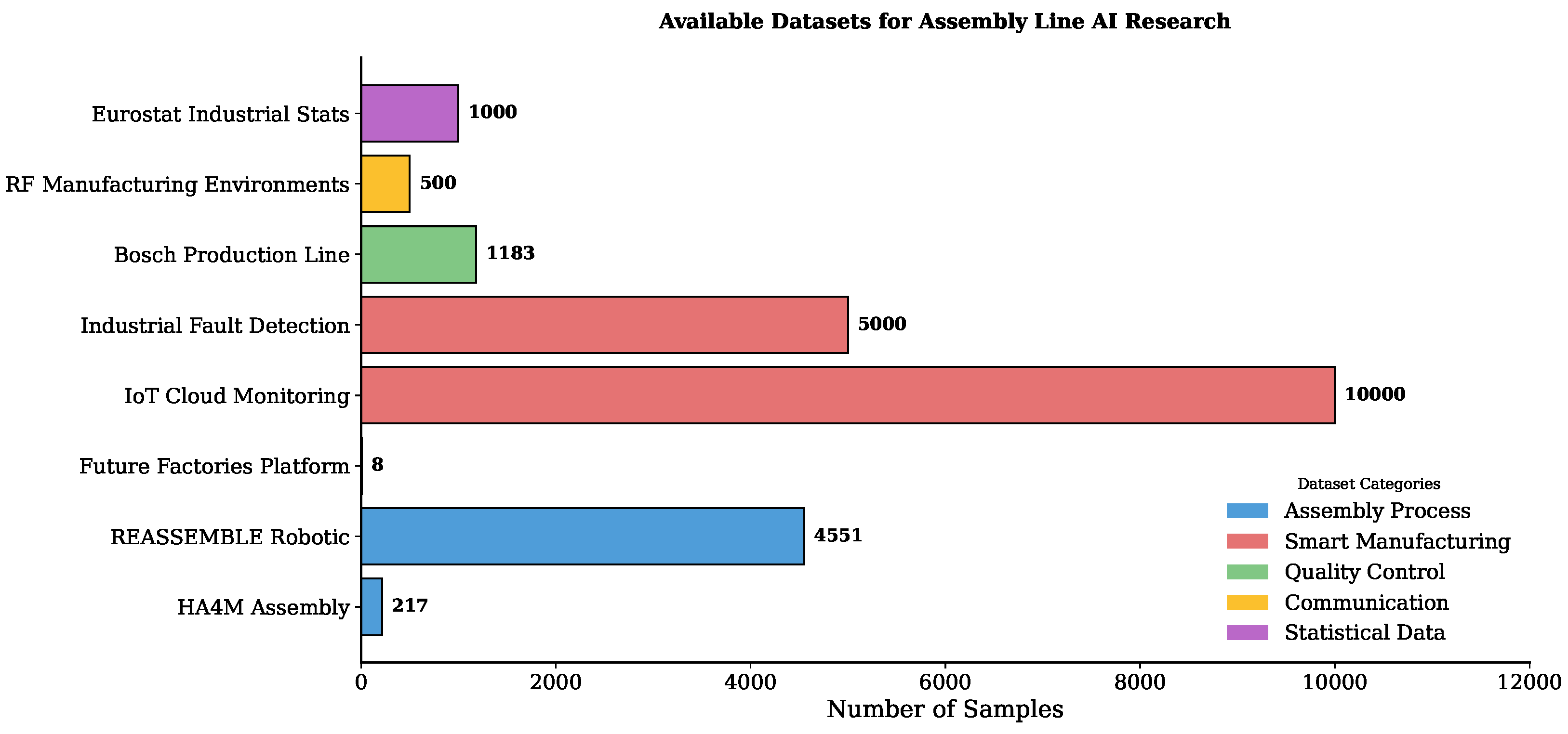
- HA4M Dataset—Multimodal Monitoring of an Assembly Task: A comprehensive multimodal dataset containing 217 videos of 12 assembly actions performed by 41 subjects building an Epicyclic Gear Train. It includes synchronized RGB frames, depth maps, IR frames, point clouds, and skeleton data for human action recognition and motion analysis in manufacturing contexts [90].
- –
- Industrial Applications: Operator behavior analysis, ergonomic risk evaluation, and human action recognition.
- REASSEMBLE—Multimodal Dataset for Contact-rich Robotic Assembly: A dataset containing 4551 demonstrations (4035 successful) of robotic assembly and disassembly tasks based on the NIST Assembly Task Board 1 benchmark. It features multimodal sensor data including event cameras, force–torque sensors, microphones, and multi-view RGB cameras across 781 min of operation [91].
- –
- Industrial Applications: Robotic precision assembly, peg-in-hole tasks, force- controlled assembly, and training robotic manipulation models.
- Future Factories Platform Manufacturing Dataset V2: Industry-grade datasets captured during an 8-h continuous manufacturing assembly line operation. It includes both analog time-series data and multimodal synchronized system data with images, covering communication protocols, actuators, sensors, and cameras adhering to industry standards [92].
- –
- Industrial Applications: Smart factory monitoring, digital twin synchronization, and equipment coordination in multi-stage assembly lines.
- ProMQA-Assembly—Multimodal Procedural QA Dataset: A dataset containing 391 question–answer pairs requiring multimodal understanding of human activity recordings and instruction manuals for assembly tasks. It focuses on toy vehicle assembly with instruction task graphs and a semi-automated QA annotation approach using LLMs [93].
- –
- Industrial Applications: Operator assistance, assembly instruction verification, and human–machine collaborative training systems.
- Event-based Dataset of Assembly Tasks (EDAT24): A dataset featuring manufacturing primitive tasks (idle, pick, place, screw) captured using a DAVIS240C event camera. It contains 100 recorded samples per task type, totaling 400 samples of basic assembly actions performed by human operators [94].
- Industrial Applications: High-speed assembly detection, real-time activity monitoring, and lightweight AI for embedded manufacturing devices.
7.2. Smart Manufacturing and IoT Datasets
- Smart Manufacturing IoT–Cloud Monitoring Dataset: Real-time sensor data for predictive maintenance and anomaly detection containing 10,000 time-stamped observations at one-minute intervals. It includes temperature, machine speed, production quality score, vibration level, energy consumption, and optimal conditions binary flags [95].
- –
- Industrial Applications: Predictive maintenance, energy optimization, fault detection, and real-time line balancing.
- Industrial IoT Fault Detection Dataset: Sensor data focusing on vibration, temperature, and pressure measurements with corresponding fault labels for industrial fault detection applications in manufacturing environments [96].
- –
- Industrial Applications: Motor bearing diagnosis, pump and compressor fault detection, and vibration-based predictive maintenance.
- Real-Time IoT-Driven Production System Dataset: Comprehensive sensor data for digital twin machine learning optimization containing 15,000+ observations with 10+ features collected at 30 s intervals for production efficiency analysis [97].
- –
- Industrial Applications: Digital twin calibration, model-based scheduling, and throughput optimization.
- Multi-stage Continuous-Flow Manufacturing Process Dataset: Real process data from Detroit-area production line featuring high-speed continuous manufacturing with parallel and series stages. It contains time-stamped observations with temperature, speed, quality scores, vibration, and energy consumption metrics [97].
- –
- Industrial Applications: Continuous-process optimization, energy modeling, and bottleneck analysis in high-speed lines.
7.3. Quality Control and Computer Vision Datasets
- Excavators Computer Vision Dataset (Roboflow Universe): Computer vision dataset for construction equipment detection containing 2000+ annotated images with YOLO-format annotations for object detection and recognition applications in industrial environments [98].
- –
- Industrial Applications: Industrial object detection, workplace safety detection, and equipment tracking.
- Bosch Production Line Performance Dataset: Industrial dataset with 1183 samples and 968 features designed for predicting parts quality control in automotive manufacturing. It features a binary classification target for production line performance assessment [99].
- –
- Industrial Applications: Part defect prediction, quality control in automotive electronics, and anomaly detection.
- Mercedes-Benz Greener Manufacturing Dataset: Anonymized dataset with 4209 samples and 378 features aimed at reducing time cars spend on test benches. It focuses on optimizing manufacturing processes and implementing sustainable production practices [100].
- Industrial Applications: Sustainable automotive testing, reducing cycle time, and optimizing inspection workflows.
7.4. Communication and RF Datasets
- Radio Frequency Measurements for Manufacturing Environments: NIST dataset containing RF measurements at 2.4 GHz and 5 GHz in industrial environments using PN code sounding methodology. It includes complex impulse responses and spectrum analysis traces validated through ray tracing for wireless system design in manufacturing [101].
- –
- Industrial Applications: Wireless reliability studies, smart factory communication, and IIoT network design.
- Wireless Systems for Industrial Environments Dataset: Comprehensive RF propagation measurements covering factory communication systems, network performance analysis, and industrial IoT connectivity assessment in real manufacturing facilities [102].
- Industrial Applications: Factory-wide IoT connectivity modeling and industrial robot communication reliability.
7.5. Statistical and Economic Datasets
- Eurostat Industrial Production Statistics (TEIIS090): European statistical database containing monthly and annual industrial production indices covering 27 EU countries. It includes manufacturing statistics, production volumes, value-added metrics, and sectoral breakdowns for economic analysis [103].
- –
- Industrial Applications: Macro-level manufacturing forecasting, sustainability benchmarking, and sector productivity analysis.
- US Manufacturing Efficiency and Consumption Dataset: Government dataset providing consumption efficiency statistics, energy utilization metrics, and manufacturing performance indicators across various industrial sectors in the United States [104].
- –
- Industrial Applications: Energy benchmarking, equipment efficiency comparison, and sustainability KPI reporting.
7.6. Specialized Manufacturing Datasets
- Fraunhofer Production ML Datasets Collection: Curated collection including bearing failure experiments, milling machine operations, CFRP composite testing, mechanical analysis for fault diagnosis, and cylinder printing process data for various manufacturing applications [105].
- –
- Industrial Applications: Milling optimization, composite defect detection, and mechanical system prognostics.
- Smart Manufacturing Temperature Regulation Dataset: Dataset on fuzzy PID control applications in industrial temperature regulation systems, containing control parameters, temperature profiles, and system response data for process control optimization. Reference: [106].
- –
- Industrial Applications: Process control optimization, smart thermal regulation, and adaptive PID design in manufacturing.
8. Challenges and Prospects
9. Conclusions
Funding
Institutional Review Board Statement
Informed Consent Statement
Data Availability Statement
Conflicts of Interest
References
- Elyasi, M.; Thevenin, S.; Cerqueus, A. Use of AI in assembly line design and worker and equipment management: Review and future directions: M. Elyasi et al. Flex. Serv. Manuf. J. 2025, 37, 367–408. [Google Scholar] [CrossRef] [Scilit]
- Fordal, J.M.; Schjølberg, P.Ø.; Helgetun, H.; Skjermo, T.; Wang, Y.; Wang, C. Application of sensor data based predictive maintenance and artificial neural networks to enable Industry 4.0. Adv. Manuf. 2023, 11, 248–263. [Google Scholar] [CrossRef] [Scilit]
- Sotskov, Y.N. Assembly and production line designing, balancing and scheduling with inaccurate data: A survey and perspectives. Algorithms 2023, 16, 100. [Google Scholar] [CrossRef] [Scilit]
- Rakholia, R.; Suárez-Cetrulo, A.L.; Singh, M.; Carbajo, R.S. Advancing Manufacturing Through Artificial Intelligence: Current Landscape, Perspectives, Best Practices, Challenges and Future Direction. IEEE Access 2024, 12, 131621–131637. [Google Scholar] [CrossRef] [Scilit]
- Alam, M.D.; Kabir, G.; Mirmohammadsadeghi, S. A digital twin framework development for apparel manufacturing industry. Decis. Anal. J. 2023, 7, 100252. [Google Scholar] [CrossRef] [Scilit]
- Hijry, H.; Naqvi, S.M.R.; Javed, K.; Albalawi, O.H.; Olawoyin, R.; Varnier, C.; Zerhouni, N. Real time worker stress prediction in a smart factory assembly line. IEEE Access 2024, 12, 116238–116249. [Google Scholar] [CrossRef] [Scilit]
- Chen, S.; Gao, D.; Tan, L. Smarter and Greener: How Does Intelligent Manufacturing Empower Enterprise’s Green Innovation? Sustainability 2025, 17, 7230. [Google Scholar] [CrossRef] [Scilit]
- Murtaza, A.A.; Saher, A.; Zafar, M.H.; Moosavi, S.K.R.; Aftab, M.F.; Sanfilippo, F. Paradigm shift for predictive maintenance and condition monitoring from Industry 4.0 to Industry 5.0: A systematic review, challenges and case study. Results Eng. 2024, 24, 102935. [Google Scholar] [CrossRef] [Scilit]
- Jin, L.; Zhai, X.; Wang, K.; Zhang, K.; Wu, D.; Nazir, A.; Jiang, J.; Liao, W.H. Big data, machine learning, and digital twin assisted additive manufacturing: A review. Mater. Des. 2024, 244, 113086. [Google Scholar] [CrossRef] [Scilit]
- Guo, H.; Zhang, Y.; Zhu, K. Interpretable deep learning approach for tool wear monitoring in high-speed milling. Comput. Ind. 2022, 138, 103638. [Google Scholar] [CrossRef] [Scilit]
- Sikora, C.G.S. Balancing mixed-model assembly lines for random sequences. Eur. J. Oper. Res. 2024, 314, 597–611. [Google Scholar] [CrossRef] [Scilit]
- Lopes, T.C.; Sikora, C.G.S.; Michels, A.S.; Magatão, L. An iterative decomposition for asynchronous mixed-model assembly lines: Combining balancing, sequencing, and buffer allocation. Int. J. Prod. Res. 2020, 58, 615–630. [Google Scholar] [CrossRef] [Scilit]
- Ameri, R.; Hsu, C.C.; Band, S.S. A systematic review of deep learning approaches for surface defect detection in industrial applications. Eng. Appl. Artif. Intell. 2024, 130, 107717. [Google Scholar] [CrossRef] [Scilit]
- Carvalho, T.P.; Soares, F.A.; Vita, R.; Francisco, R.d.P.; Basto, J.P.; Alcalá, S.G. A systematic literature review of machine learning methods applied to predictive maintenance. Comput. Ind. Eng. 2019, 137, 106024. [Google Scholar] [CrossRef] [Scilit]
- Huber, J.; Stuckenschmidt, H. Daily retail demand forecasting using machine learning with emphasis on calendric special days. Int. J. Forecast. 2020, 36, 1420–1438. [Google Scholar] [CrossRef] [Scilit]
- Hildebrandt, F.D.; Thomas, B.W.; Ulmer, M.W. Opportunities for reinforcement learning in stochastic dynamic vehicle routing. Comput. Oper. Res. 2023, 150, 106071. [Google Scholar] [CrossRef] [Scilit]
- Suszyński, M.; Peta, K. Assembly sequence planning using artificial neural networks for mechanical parts based on selected criteria. Appl. Sci. 2021, 11, 10414. [Google Scholar] [CrossRef] [Scilit]
- Chen, M.; Sun, W.; Guo, W.G. Adaptive Online Continual Learning for In-Situ Quality Prediction in Manufacturing Processes. J. Manuf. Sci. Eng. 2025, 147, 061001. [Google Scholar] [CrossRef] [Scilit]
- Hoi, S.C.; Sahoo, D.; Lu, J.; Zhao, P. Online learning: A comprehensive survey. Neurocomputing 2021, 459, 249–289. [Google Scholar] [CrossRef] [Scilit]
- Ismail, A.; Truong, H.L.; Kastner, W. Manufacturing process data analysis pipelines: A requirements analysis and survey. J. Big Data 2019, 6, 1–26. [Google Scholar] [CrossRef] [Scilit]
- van den Broek, E. Unpacking AI at work: Data work, knowledge work, and values work. Inf. Organ. 2025, 35, 100584. [Google Scholar] [CrossRef] [Scilit]
- Sofianidis, G.; Rožanec, J.M.; Mladenic, D.; Kyriazis, D. A review of explainable artificial intelligence in manufacturing. In Trusted Artificial Intelligence in Manufacturing: A Review of the Emerging Wave of Ethical and Human Centric AI Technologies for Smart Production; Now Publishers Inc.: Delft, The Netherlands, 2021; pp. 93–113. [Google Scholar]
- Holzinger, A.; Keiblinger, K.; Holub, P.; Zatloukal, K.; Müller, H. AI for life: Trends in artificial intelligence for biotechnology. New Biotechnol. 2023, 74, 16–24. [Google Scholar] [CrossRef] [Scilit] [PubMed]
- Holzinger, A.; Fister, I.; Kaul, H.P.; Asseng, S. Human-centered AI in smart farming: Toward agriculture 5.0. IEEE Access 2024, 12, 62199–62214. [Google Scholar] [CrossRef] [Scilit]
- Kudelina, K.; Vaimann, T.; Asad, B.; Rassõlkin, A.; Kallaste, A.; Demidova, G. Trends and challenges in intelligent condition monitoring of electrical machines using machine learning. Appl. Sci. 2021, 11, 2761. [Google Scholar] [CrossRef] [Scilit]
- Wuest, T.; Weimer, D.; Irgens, C.; Thoben, K.D. Machine learning in manufacturing: Advantages, challenges, and applications. Prod. Manuf. Res. 2016, 4, 23–45. [Google Scholar] [CrossRef] [Scilit]
- Fathi, M.; Sepehri, A.; Ghobakhloo, M.; Iranmanesh, M.; Tseng, M.L. Balancing assembly lines with industrial and collaborative robots: Current trends and future research directions. Comput. Ind. Eng. 2024, 193, 110254. [Google Scholar] [CrossRef] [Scilit]
- Rai, R.; Tiwari, M.K.; Ivanov, D.; Dolgui, A. Machine learning in manufacturing and industry 4.0 applications. Int. J. Prod. Res. 2021, 59, 4773–4778. [Google Scholar] [CrossRef] [Scilit]
- Manta-Costa, A.; Araújo, S.O.; Peres, R.S.; Barata, J. Machine learning applications in manufacturing-challenges, trends, and future directions. IEEE Open J. Ind. Electron. Soc. 2024, 5, 1085–1103. [Google Scholar] [CrossRef] [Scilit]
- Sircar, A.; Yadav, K.; Rayavarapu, K.; Bist, N.; Oza, H. Application of machine learning and artificial intelligence in oil and gas industry. Pet. Res. 2021, 6, 379–391. [Google Scholar] [CrossRef] [Scilit]
- Louis, A.; Alpan, G.; Penz, B.; Benichou, A. Mixed-model sequencing versus car sequencing: Comparison of feasible solution spaces. Int. J. Prod. Res. 2023, 61, 3415–3434. [Google Scholar] [CrossRef] [Scilit]
- Zhu, X.; Xu, Z.; Wang, J.; Yang, X. An Improved Variable Neighborhood Search for the Reconfigurable Assembly Line Reconfiguring Problem. Appl. Sci. 2024, 14, 9130. [Google Scholar] [CrossRef] [Scilit]
- Alakoc, N.P.; Mhalla, H. A Heuristic Approach for Solving Robotic Assembly Line Balancing Problems. Eng. Technol. Appl. Sci. Res. 2025, 15, 20912–20918. [Google Scholar] [CrossRef] [Scilit]
- Lei, D.Y.; Jiang, F.; Yang, C.F. Simulation and Optimization of Production Scheduling in Multivariety Small-batch Mixed-flow Assembly Workshops Using IoT. Sens. Mater. 2025, 37, 711–1721. [Google Scholar] [CrossRef] [Scilit]
- Gavish, N.; Gutiérrez, T.; Webel, S.; Rodríguez, J.; Peveri, M.; Bockholt, U.; Tecchia, F. Evaluating virtual reality and augmented reality training for industrial maintenance and assembly tasks. Interact. Learn. Environ. 2015, 23, 778–798. [Google Scholar] [CrossRef] [Scilit]
- Trstenjak, M.; Opetuk, T.; Đukić, G.; Cajner, H. Use of Artificial Intelligence (AI) in the Workplace Ergonomics of Industry 5.0. Teh. Glas. 2025, 19, 335–340. [Google Scholar] [CrossRef] [Scilit]
- Chen, B.; Wan, J.; Shu, L.; Li, P.; Mukherjee, M.; Yin, B. Smart factory of industry 4.0: Key technologies, application case, and challenges. IEEE Access 2017, 6, 6505–6519. [Google Scholar] [CrossRef] [Scilit]
- Lu, Y.; Liu, C.; Kevin, I.; Wang, K.; Huang, H.; Xu, X. Digital Twin-driven smart manufacturing: Connotation, reference model, applications and research issues. Robot. -Comput.-Integr. Manuf. 2020, 61, 101837. [Google Scholar] [CrossRef] [Scilit]
- Zhang, H.Y. An improved immune algorithm for simple assembly line balancing problem of type 1. J. Algorithms Comput. Technol. 2017, 11, 317–326. [Google Scholar] [CrossRef] [Scilit]
- Kwade, A.; Haselrieder, W.; Leithoff, R.; Modlinger, A.; Dietrich, F.; Droeder, K. Current status and challenges for automotive battery production technologies. Nat. Energy 2018, 3, 290–300. [Google Scholar] [CrossRef] [Scilit]
- Erol, S.; Jäger, A.; Hold, P.; Ott, K.; Sihn, W. Tangible Industry 4.0: A scenario-based approach to learning for the future of production. Procedia CIRP 2016, 54, 13–18. [Google Scholar] [CrossRef] [Scilit]
- Cameron, L.D. The making of the “good bad” job: How algorithmic management manufactures consent through constant and confined choices. Adm. Sci. Q. 2024, 69, 458–514. [Google Scholar] [CrossRef] [Scilit]
- Aslan, Ş. Mathematical model and a variable neighborhood search algorithm for mixed-model robotic two-sided assembly line balancing problems with sequence-dependent setup times. Optim. Eng. 2023, 24, 989–1016. [Google Scholar] [CrossRef] [Scilit]
- Busogi, M.; Song, D.; Kang, S.H.; Kim, N. Sequence based optimization of manufacturing complexity in a mixed model assembly line. IEEE Access 2019, 7, 22096–22106. [Google Scholar] [CrossRef] [Scilit]
- Naresh, R.; Kanagaraj, G.; Giri, J.; Yu, V.F.; Fatehmulla, A.; Mallik, S. Cost-efficient design and optimization of robotic assembly lines using a non-dominated sorting genetic algorithm framework. Sci. Rep. 2025, 15, 9367. [Google Scholar] [CrossRef] [Scilit]
- Roldán, J.J.; Crespo, E.; Martín-Barrio, A.; Peña-Tapia, E.; Barrientos, A. A training system for Industry 4.0 operators in complex assemblies based on virtual reality and process mining. Robot. -Comput.-Integr. Manuf. 2019, 59, 305–316. [Google Scholar] [CrossRef] [Scilit]
- Fan, B.; Liu, J.; Qin, Y.; Kuang, W.; Liu, Z. Real-time Determination and Correction of Multi-source Multi-modal Heterogeneous Data Quality. In Proceedings of the 2024 IEEE Smart World Congress (SWC), Nadi, Fiji, 2–7 December 2024; pp. 2499–2505. [Google Scholar]
- Janardhanan, M.N.; Li, Z.; Nielsen, P. Model and migrating birds optimization algorithm for two-sided assembly line worker assignment and balancing problem: MN Janardhanan et al. Soft Comput. 2019, 23, 11263–11276. [Google Scholar] [CrossRef] [Scilit]
- Zheng, X.; Ning, S.; Sun, H.; Zhong, J.; Tong, X. Solving multi-objective two-sided assembly line balancing problems by harmony search algorithm based on pareto entropy. IEEE Access 2021, 9, 121728–121742. [Google Scholar] [CrossRef] [Scilit]
- Li, D.; Zhang, C.; Tian, G.; Shao, X.; Li, Z. Multiobjective program and hybrid imperialist competitive algorithm for the mixed-model two-sided assembly lines subject to multiple constraints. IEEE Trans. Syst. Man Cybern. Syst. 2016, 48, 119–129. [Google Scholar] [CrossRef] [Scilit]
- Yang, W.; Cheng, W. A Mathematical Model and a Simulated Annealing Algorithm for Balancing Multi-manned Assembly Line Problem with Sequence-Dependent Setup Time. Math. Probl. Eng. 2020, 2020, 8510253. [Google Scholar] [CrossRef] [Scilit]
- Yao, X.; Zhou, J.; Lin, Y.; Li, Y.; Yu, H.; Liu, Y. Smart manufacturing based on cyber-physical systems and beyond. J. Intell. Manuf. 2019, 30, 2805–2817. [Google Scholar] [CrossRef] [Scilit]
- Zhang, H.; Liu, Q.; Chen, X.; Zhang, D.; Leng, J. A digital twin-based approach for designing and multi-objective optimization of hollow glass production line. IEEE Access 2017, 5, 26901–26911. [Google Scholar] [CrossRef] [Scilit]
- Sellami, B.; Hakiri, A.; Yahia, S.B.; Berthou, P. Energy-aware task scheduling and offloading using deep reinforcement learning in SDN-enabled IoT network. Comput. Netw. 2022, 210, 108957. [Google Scholar] [CrossRef] [Scilit]
- Zhao, R.; Yan, R.; Chen, Z.; Mao, K.; Wang, P.; Gao, R.X. Deep learning and its applications to machine health monitoring. Mech. Syst. Signal Process. 2019, 115, 213–237. [Google Scholar] [CrossRef] [Scilit]
- Rao, Y. Leveraging Deep Learning for Multimodal Predictive Maintenance: A Hybrid CNN-LSTM Approach for Enhanced Equipment Failure Prediction in Automated Assembly Lines. In Proceedings of the 2024 IEEE 6th International Conference on Power, Intelligent Computing and Systems (ICPICS), Shenyang, China, 26–28 July 2024; pp. 1293–1299. [Google Scholar]
- Rahman, A.; Hossain, M.S.; Muhammad, G.; Kundu, D.; Debnath, T.; Rahman, M.; Khan, M.S.I.; Tiwari, P.; Band, S.S. Federated learning-based AI approaches in smart healthcare: Concepts, taxonomies, challenges and open issues. Clust. Comput. 2023, 26, 2271–2311. [Google Scholar] [CrossRef] [Scilit]
- Hassanien, A.E.; Emary, E. Swarm Intelligence: Principles, Advances, and Applications; CRC Press: Boca Raton, FL, USA, 2018. [Google Scholar]
- Hamzadayi, A.; Yildiz, G. Modeling and solving static m identical parallel machines scheduling problem with a common server and sequence dependent setup times. Comput. Ind. Eng. 2017, 106, 287–298. [Google Scholar] [CrossRef] [Scilit]
- Dey, S.; Sharma, P. Predictive Maintenance for Smart Manufacturing: An AI and IoT-Based Approach. In Library of Progress-Library Science, Information Technology & Computer; A.K. Sharma: Dehli, India, 2024; Volume 44. [Google Scholar]
- Liu, M.; Liu, Z.; Chu, F.; Liu, R.; Zheng, F.; Chu, C. Risk-averse assembly line worker assignment and balancing problem with limited temporary workers and moving workers. Int. J. Prod. Res. 2022, 60, 7074–7092. [Google Scholar] [CrossRef] [Scilit]
- Khalili, S.; Mohammadzade, H.; Fallahnezhad, M. A new approach based on queuing theory for solving the assembly line balancing problem using fuzzy prioritization techniques. Sci. Iran. 2016, 23, 387–398. [Google Scholar] [CrossRef] [Scilit]
- Pérez-Wheelock, R.M.; Ou, W.; Yenradee, P.; Huynh, V.N. A demand-driven model for reallocating workers in assembly lines. IEEE Access 2022, 10, 80300–80320. [Google Scholar] [CrossRef] [Scilit]
- Kim, D.; Moon, D.H.; Moon, I. Balancing a mixed-model assembly line with unskilled temporary workers: Algorithm and case study. Assem. Autom. 2018, 38, 511–523. [Google Scholar] [CrossRef] [Scilit]
- Li, Z.; Janardhanan, M.N.; Tang, Q.; Ponnambalam, S. Model and metaheuristics for robotic two-sided assembly line balancing problems with setup times. Swarm Evol. Comput. 2019, 50, 100567. [Google Scholar] [CrossRef] [Scilit]
- Nie, L.; Bai, Y.W.; Jiang, X.; Pang, C.T. An Approach for Level Scheduling Mixed Models on an Assembly Line in A JIT Production System. Appl. Mech. Mater. 2015, 697, 473–477. [Google Scholar] [CrossRef] [Scilit]
- Mansour, H.; Abohashima, H.; Elkhouly, H.I. Integrating between Taguchi methodology and boosted decision trees machine learning: A case study in enhancing quality electrical conductor manufacturing. Jordan J. Mech. Ind. Eng. 2024, 18. [Google Scholar] [CrossRef] [Scilit] [PubMed]
- Syafrudin, M.; Alfian, G.; Fitriyani, N.L.; Rhee, J. Performance analysis of IoT-based sensor, big data processing, and machine learning model for real-time monitoring system in automotive manufacturing. Sensors 2018, 18, 2946. [Google Scholar] [CrossRef] [Scilit] [PubMed]
- Tabernik, D.; Šela, S.; Skvarč, J.; Skočaj, D. Segmentation-based deep-learning approach for surface-defect detection. J. Intell. Manuf. 2020, 31, 759–776. [Google Scholar] [CrossRef] [Scilit]
- Kamble, S.; Gunasekaran, A.; Dhone, N.C. Industry 4.0 and lean manufacturing practices for sustainable organisational performance in Indian manufacturing companies. Int. J. Prod. Res. 2020, 58, 1319–1337. [Google Scholar] [CrossRef] [Scilit]
- Çınar, Z.M.; Abdussalam Nuhu, A.; Zeeshan, Q.; Korhan, O.; Asmael, M.; Safaei, B. Machine learning in predictive maintenance towards sustainable smart manufacturing in industry 4.0. Sustainability 2020, 12, 8211. [Google Scholar] [CrossRef] [Scilit]
- Yin, Y.; Stecke, K.E.; Li, D. The evolution of production systems from Industry 2.0 through Industry 4.0. Int. J. Prod. Res. 2018, 56, 848–861. [Google Scholar] [CrossRef] [Scilit]
- Huang, A. A Framework and Metrics for Sustainable Manufacturing Performance Evaluation at the Production Line, Plant and Enterprise Levels. Ph.D. Thesis, University of Kentucky, Lexington, KY, USA, 2017. [Google Scholar]
- Karim, A.M.; Tuan, S.T.; Emrul Kays, H. Assembly line productivity improvement as re-engineered by MOST. Int. J. Product. Perform. Manag. 2016, 65, 977–994. [Google Scholar] [CrossRef] [Scilit]
- Fathi, M.; Fontes, D.B.M.M.; Urenda Moris, M.; Ghobakhloo, M. Assembly line balancing problem: A comparative evaluation of heuristics and a computational assessment of objectives. J. Model. Manag. 2018, 13, 455–474. [Google Scholar] [CrossRef] [Scilit]
- Dobra, P.; Josvai, J. Assembly line overall equipment effectiveness (OEE) prediction from human estimation to supervised machine learning. J. Manuf. Mater. Process. 2022, 6, 59. [Google Scholar] [CrossRef] [Scilit]
- Dobra, P.; Josvai, J. Cumulative and rolling horizon prediction of Overall Equipment Effectiveness (OEE) with machine learning. Big Data Cogn. Comput. 2023, 7, 138. [Google Scholar] [CrossRef] [Scilit]
- Hassani, I.E.; Mazgualdi, C.E.; Masrour, T. Artificial intelligence and machine learning to predict and improve efficiency in manufacturing industry. arXiv 2019, arXiv:1901.02256. [Google Scholar] [CrossRef] [Scilit]
- Mohan, T.R.; Roselyn, J.P.; Uthra, R.A.; Devaraj, D.; Umachandran, K. Intelligent machine learning based total productive maintenance approach for achieving zero downtime in industrial machinery. Comput. Ind. Eng. 2021, 157, 107267. [Google Scholar] [CrossRef] [Scilit]
- Silva, B.; Marques, R.; Faustino, D.; Ilheu, P.; Santos, T.; Sousa, J.; Rocha, A.D. Enhance the injection molding quality prediction with artificial intelligence to reach zero-defect manufacturing. Processes 2022, 11, 62. [Google Scholar] [CrossRef] [Scilit]
- Riccio, C.; Menanno, M.; Zennaro, I.; Savino, M.M. A new methodological framework for optimizing predictive maintenance using machine learning combined with product quality parameters. Machines 2024, 12, 443. [Google Scholar] [CrossRef] [Scilit]
- Martinek, P.; Illes, B.; Codreanu, N.; Krammer, O. Investigating machine learning techniques for predicting the process characteristics of stencil printing. Materials 2022, 15, 4734. [Google Scholar] [CrossRef] [Scilit]
- Adipraja, P.F.; Chang, C.C.; Wang, W.J.; Liang, D. Prediction of per-batch yield rates in production based on maximum likelihood estimation of per-machine yield rates. J. Manuf. Syst. 2022, 62, 249–262. [Google Scholar] [CrossRef] [Scilit]
- Wang, Y.; Liu, Y.; Sun, Y. A hybrid intelligence technique based on the Taguchi method for multi-objective process parameter optimization of the 3D additive screen printing of athletic shoes. Text. Res. J. 2020, 90, 1067–1083. [Google Scholar] [CrossRef] [Scilit]
- Chambi, N.; Sanga, C.; Ortiz, J.; Sanga, A.; Sanga, P.; Manrique, R.; Lu-Chang-Say, J. Predictive Maintenance in Underground Mining Equipment Using Artificial Intelligence. Eng 2025, 6, 261. [Google Scholar] [CrossRef] [Scilit]
- Qureshi, M.S.; Umar, S.; Nawaz, M.U. Machine learning for predictive maintenance in solar farms. Int. J. Adv. Eng. Technol. Innov. 2024, 1, 27–49. [Google Scholar]
- Savsar, M. Reliability and availability analysis of a manufacturing line system. J. Appl. Phys. Sci. 2016, 2, 96–106. [Google Scholar] [CrossRef] [Scilit]
- Daruka, P.; Agarwal, T.; Sharma, D. Productivity Improvement Using MTTR And MTBF Methodology. Int. J. Mech. Eng. Technol. 2017, 8, 1338–1347. [Google Scholar]
- Kolte, T.S.; Dabade, U. Machine operational availability improvement by implementing effective preventive maintenance strategies—A review and case study. Int. J. Eng. Res. Technol. 2017, 10, 700–708. [Google Scholar]
- Cicirelli, G.; Marani, R.; Romeo, L.; Dominguez, M.G.; Heras, J.; Perri, A.G.; D’Orazio, T. The HA4M dataset: Multi-Modal Monitoring of an assembly task for Human Action recognition in Manufacturing. Sci. Data 2022, 9, 745. [Google Scholar] [CrossRef] [Scilit]
- Sliwowski, D.; Jadav, S.; Stanovcic, S.; Orbik, J.; Heidersberger, J.; Lee, D. Reassemble: A multimodal dataset for contact-rich robotic assembly and disassembly. arXiv 2025, arXiv:2502.05086. [Google Scholar] [CrossRef] [Scilit]
- Harik, R.; Kalach, F.E.; Samaha, J.; Clark, D.; Sander, D.; Samaha, P.; Burns, L.; Yousif, I.; Gadow, V.; Tarekegne, T.; et al. Analog and multi-modal manufacturing datasets acquired on the future factories platform. arXiv 2024, arXiv:2401.15544. [Google Scholar] [CrossRef] [Scilit]
- Hasegawa, K.; Imrattanatrai, W.; Asada, M.; Holm, S.; Wang, Y.; Zhou, V.; Fukuda, K.; Mitamura, T. ProMQA-Assembly: Multimodal Procedural QA Dataset on Assembly. arXiv 2025, arXiv:2509.02949. [Google Scholar]
- Duarte, L.; Neto, P. Event-based dataset for the detection and classification of manufacturing assembly tasks. Data Brief 2024, 54, 110340. [Google Scholar] [CrossRef] [Scilit]
- Smart Manufacturing IoT-Cloud Monitoring Dataset. Kaggle Datasets. 2025. Available online: https://www.kaggle.com/datasets/ziya07/smart-manufacturing-iot-cloud-monitoring-dataset (accessed on 2 March 2025).
- Industrial IoT Fault Detection Dataset. Kaggle Datasets. 2025. Available online: https://www.kaggle.com/datasets/ziya07/industrial-iot-fault-detection-dataset (accessed on 9 March 2025).
- Real-Time IoT-Driven Production System Dataset. Kaggle Datasets. 2025. Available online: https://www.kaggle.com/datasets/programmer3/real-time-iot-driven-production-system-dataset (accessed on 15 March 2025).
- Sabek, M. Excavators Dataset. 2022. Available online: https://universe.roboflow.com/mohamed-sabek-6zmr6/excavators-cwlh0 (accessed on 18 September 2025).
- Risdal, M.; Prasanth; RumiGhosh; soundar; W, S.; Cukierski, W. Bosch Production Line Performance. 2016. Available online: https://kaggle.com/competitions/bosch-production-line-performance (accessed on 9 December 2025).
- Novy, A.; H1Mercedes, C.; Drescher, C.; Pfaundler, C.; KOESIM; Cukierski, W. Mercedes-Benz Greener Manufacturing. 2017. Available online: https://kaggle.com/competitions/mercedes-benz-greener-manufacturing (accessed on 9 December 2025).
- Candell, R. Radio Frequency Measurements for Selected Manufacturing and Industrial Environments; Technical Report; National Institute of Standards and Technology (NIST): Gaithersburg, MD, USA, 2016. [Google Scholar]
- National Institute of Standards and Technology (NIST). Project Data: Wireless Systems for Industrial Environments. NIST Technical Note 1951; NIST Communications Technology Laboratory, Smart Connected Systems Division: Gaithersburg, MD, USA, 2021. [Google Scholar] [CrossRef] [Scilit]
- Eurostat. Industrial Production Statistics—Statistics Explained; Eurostat: Luxembourg, 2024. [Google Scholar]
- U.S. Energy Information Administration (EIA). Consumption & Efficiency Data and Statistics; U.S. Energy Information Administration: Washington, DC, USA, 2021. Available online: https://www.eia.gov/consumption/data.php (accessed on 9 March 2025).
- Fraunhofer Big Data and Artificial Intelligence Alliance. Machine Learning Datasets for Production. Available online: https://www.bigdata-ai.fraunhofer.de/s/datasets/index.html (accessed on 9 December 2025).
- Kaggle Datasets. Smart Manufacturing Temperature Regulation Dataset. 2025. Available online: https://www.kaggle.com/datasets/ziya07/smart-manufacturing-temperature-regulation-dataset (accessed on 9 December 2025).
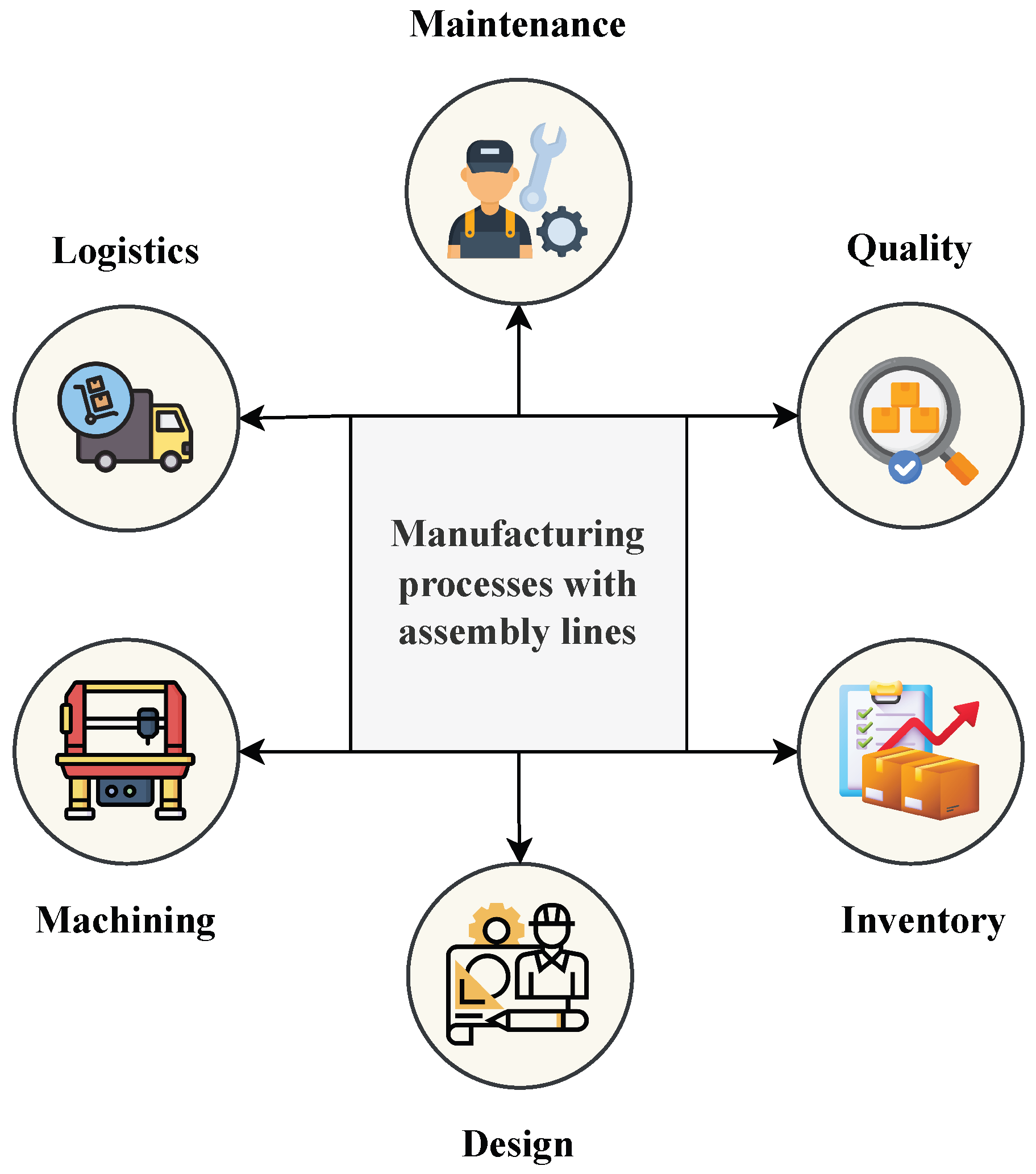


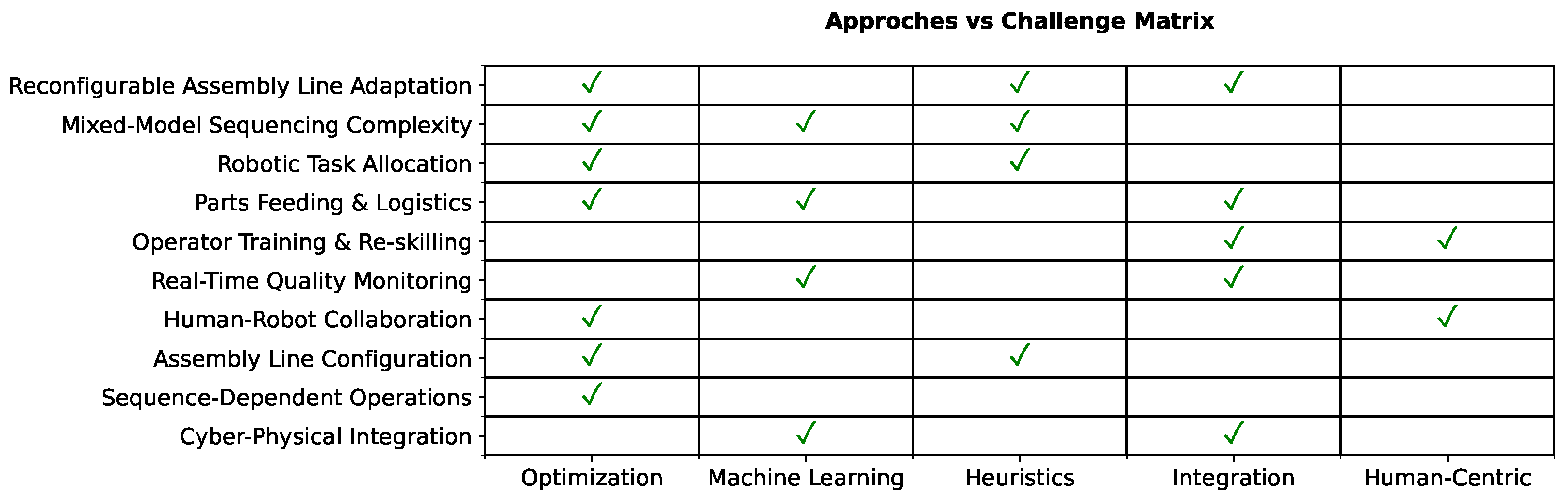



| Challenge | Proposed AI/ML Solution | Supporting Studies |
|---|---|---|
| Reconfigurable Assembly Line Adaptation | Mixed-Integer Programming with Improved Variable Neighborhood Search (MILP + VNS) | [32,43] |
| Mixed-Model Sequencing Complexity | Comparative Evaluation of MMS vs. Car Sequencing under AI-based Heuristics | [31,44] |
| Robotic Task Allocation and Cost Minimization | Heuristic Algorithm for RALBP (Robotic Assembly Line Balancing Problem) | [33,45] |
| Parts Feeding and Logistical Variability | AI-Based Decision Support for Feeding Tactics (Line Stocking, Kitting, Batching) | [1,34] |
| Operator Training and Re-skilling in Industry 4.0 | VR/AR Enhanced Training Programs; Scenario-Based Learning; AI-Guided Worker Engagement | [35,41,42,46] |
| Real-Time Quality Monitoring from Heterogeneous Data | ML-Driven Monitoring and Forecasting Systems (Deep Belief Networks, LSTM, Anomaly Detection) | [26,47] |
| Human–Robot Collaboration and Ergonomic Optimization | AI for Ergonomic Task Assignment; Contextual Ergonomics Models using ML; Individual-Centric Optimization | [8,36] |
| High Variability in Assembly Line Configurations (TALBP/MOALBP) | Bio-Inspired Metaheuristics (Modified Bees Optimization, Harmony Search, Immune Algorithms) | [39,48,49] |
| Sequence-Dependent Idle Time in Two-Sided Lines | Multi-Objective Mathematical Models; Pareto-Based Optimization Techniques | [50,51] |
| Workforce Competency Gap in Industry 4.0 | Scenario-Based Hands-On Training Frameworks; Tangible I4.0 Learning Environments | [41,42,46] |
| Integration of Cyber–Physical Systems (CPSs) in Smart Factories | AI-Based Frameworks for Device Communication, Dynamic Reconfiguration, Real-Time Data Processing | [37,52] |
| Energy Efficiency and Sustainability in Assembly Lines | Reinforcement Learning for Energy-Aware Scheduling; Multi-Objective Optimization (Energy vs. Throughput) | [53,54] |
| Predictive Maintenance for Assembly Equipment | Deep Learning on Sensor Data (Vibration, Acoustic, Thermal); Digital Twin Integration | [55,56] |
| Edge AI for Real-Time Assembly Optimization | Lightweight ML Models for On-Device Decision-Making; Federated Learning in Distributed Assembly Lines | [38,57] |
| Swarm Intelligence for Multi-Robot Coordination | Ant Colony and Particle Swarm Optimization for Task Allocation and Synchronization | [58,59] |
| Algorithmic Approach | Methods Found in This Review | Strengths | Limitations | Typical Assembly Scenarios | Industrial Sectors |
|---|---|---|---|---|---|
| Machine Learning (ML) | ANN/CNN, LSTM, Random Forest, SVM, XGBoost | Learns nonlinear patterns; strong predictive accuracy; supports anomaly detection and adaptation | Needs large labeled datasets; limited interpretability; sensitive to noisy data | Predictive maintenance; quality inspection; operator-state monitoring; adaptive control | Automotive, electronics, sensor-rich industries |
| Metaheuristics | GA, Harmony Search, Immune Algorithms, ACO/PSO, Hybrid Imperialist Competitive | Handles NP-hard problems; flexible; supports multi-objective optimization; robust to local minima | No guarantee of optimality; requires careful tuning; can be computationally heavy | Line balancing; sequencing; robotic task allocation; reconfigurable assembly lines | Electronics, appliances, mixed-model manufacturing |
| Mathematical Optimization | MILP, Integer Programming, Multi-Objective Mathematical Models | Provides optimal solutions; transparent structure; strong for deterministic planning | Limited scalability; rigid modeling assumptions; weak in dynamic environments | Workforce assignment; deterministic line design; throughput planning | Automotive chassis; white-goods; stable product-mix assembly |
Disclaimer/Publisher’s Note: The statements, opinions and data contained in all publications are solely those of the individual author(s) and contributor(s) and not of MDPI and/or the editor(s). MDPI and/or the editor(s) disclaim responsibility for any injury to people or property resulting from any ideas, methods, instructions or products referred to in the content. |
© 2025 by the authors. Licensee MDPI, Basel, Switzerland. This article is an open access article distributed under the terms and conditions of the Creative Commons Attribution (CC BY) license.
Share and Cite
Hijry, H. Advancing Sustainable Smart Manufacturing: A Comprehensive Review of Machine Learning Techniques in Assembly Lines. Sustainability 2026, 18, 348. https://doi.org/10.3390/su18010348
Hijry H. Advancing Sustainable Smart Manufacturing: A Comprehensive Review of Machine Learning Techniques in Assembly Lines. Sustainability. 2026; 18(1):348. https://doi.org/10.3390/su18010348
Chicago/Turabian StyleHijry, Hassan. 2026. "Advancing Sustainable Smart Manufacturing: A Comprehensive Review of Machine Learning Techniques in Assembly Lines" Sustainability 18, no. 1: 348. https://doi.org/10.3390/su18010348
APA StyleHijry, H. (2026). Advancing Sustainable Smart Manufacturing: A Comprehensive Review of Machine Learning Techniques in Assembly Lines. Sustainability, 18(1), 348. https://doi.org/10.3390/su18010348