Blockchain Adoption Strategies in Dual-Channel Supply Chains Under Different Leadership Structures and Asymmetric Market Shares


Abstract
1. Introduction
- (1)
- When should blockchain technology be adopted under different leadership structures?
- (2)
- How does blockchain adoption affect prices, demands, and profits of supply chain participants?
- (3)
- How do leadership structures shape blockchain adoption strategies?
2. Literature Review
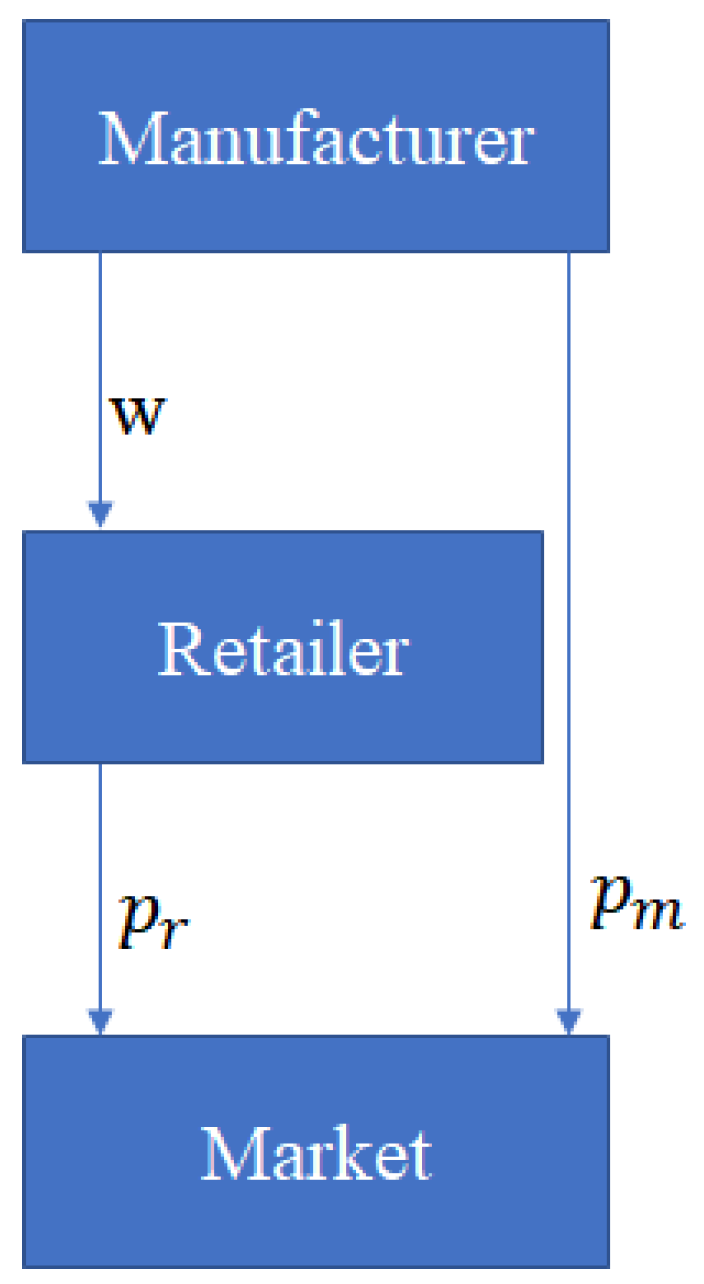
3. The Model

| Notation | Description |
|---|---|
| Decision variables | |
| B | Blockchain-based information level |
| w | Wholesale price |
| Retailer’s retail price | |
| Manufacturer’s retail price | |
| Parameters | |
| Consumer preference in the reselling channel | |
| b | The intensity of channel competition, |
| The cost coefficient of blockchain investment | |
| c | Unit operational cost of using blockchain |
| s | The market share of the reselling channel, < 1 |
| The market share of the direct channel, | |
| Functions | |
| The reselling channel’s demand | |
| The direct channel’s demand | |
| The retailer’s profit | |
| The manufacturer’s profit | |
| The profit of the whole supply chain |
4. No Blockchain Adoption (Scenario N)
- (1)
- the optimal price strategies are , and ;
- (2)
- the demand and profit are , , and .
5. Equilibrium Results of Blockchain Adoption Decision
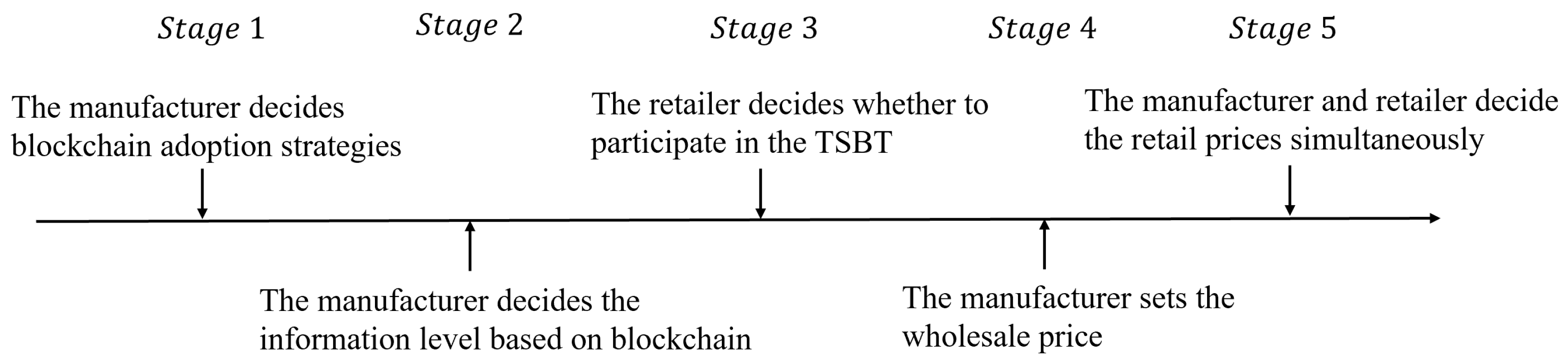
5.1. Retailer Leadership (Scenario R)
- (1)
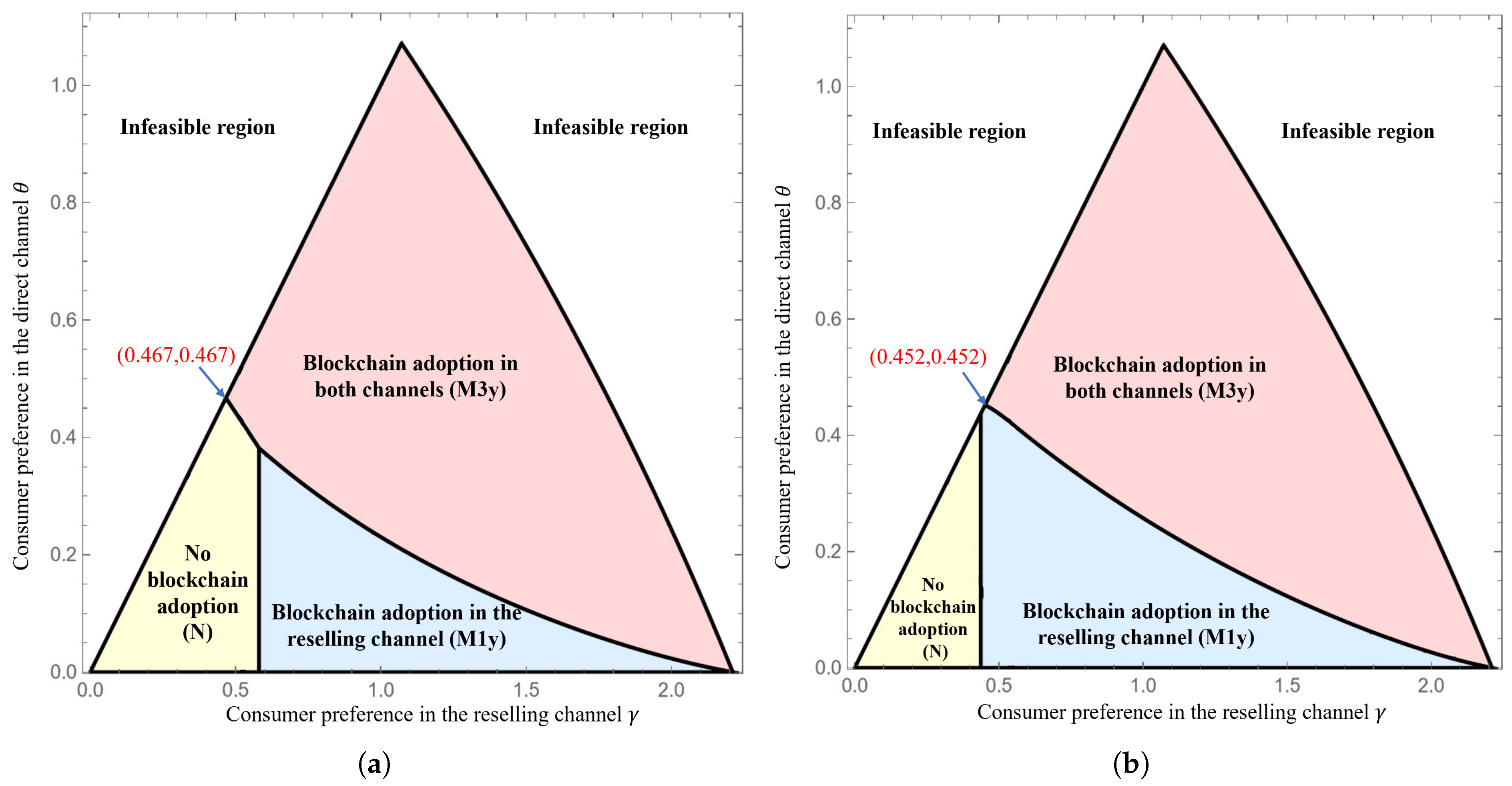
- If consumer preference in the reselling channel exceeds a certain threshold (i.e., ), the retailer adopts TSBT with the manufacturer’s participation (strategy ) and sets the information level as .
- (2)
- Otherwise, the retailer opts out of TSBT (strategy N).
- (1)
- The optimal information level decreases.
- (2)
- The manufacturer’s retail price decreases. The retailer’s retail price and the wholesale price also decrease when consumer preference in the reselling channel is high (i.e., for and for ).
- (3)
- Demand in the reselling channel decreases. Demand in the direct channel decreases when consumer preference in the reselling channel is high (i.e., for ).
- (4)
- The profits of both the retailer and the manufacturer decrease.
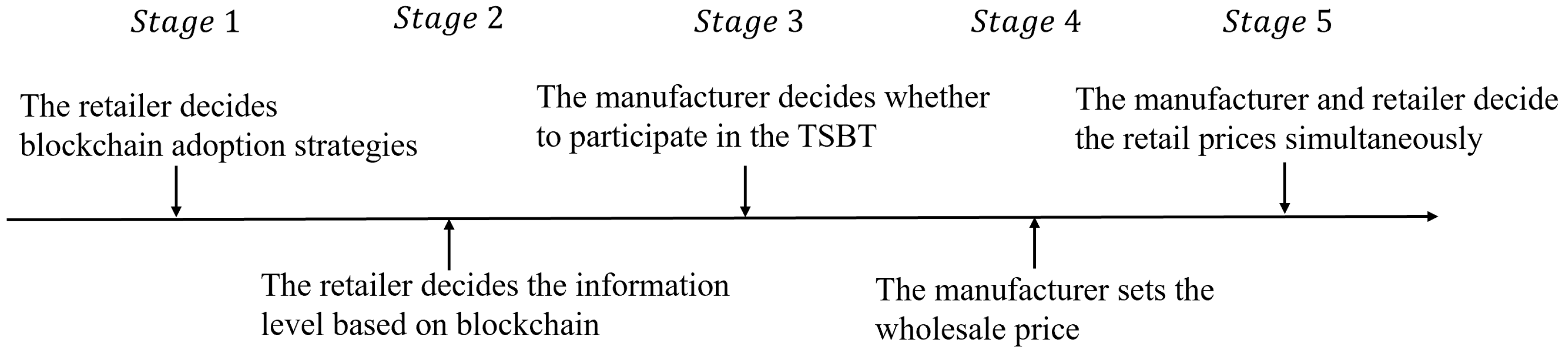
5.2. Manufacturer Leadership (Scenario M)
| Scenario | Member | Demand | Profit |
|---|---|---|---|
| r | |||
| m | |||
| r | |||
| m | |||
| r | |||
| m | |||
| r | |||
| m | |||
| r | |||
| m |
- (1)
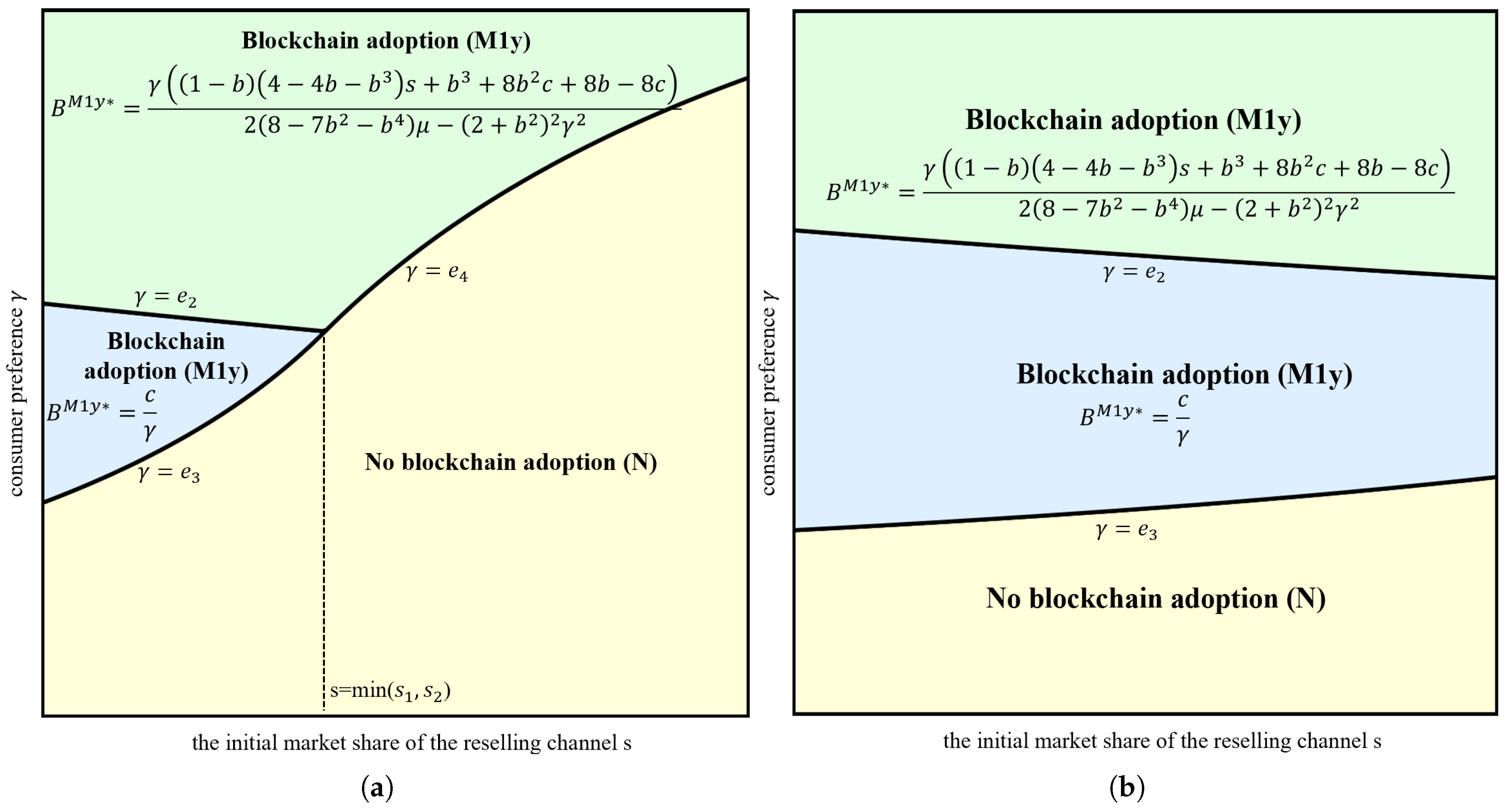
- If and , or , then
- (i)
- for , the manufacturer adopts the TSBT in the reselling channel and sets to ensure retailer participation (strategy );
- (ii)
- for , the manufacturer adopts the TSBT in the reselling channel and sets with retailer participation (strategy );
- (iii)
- otherwise, the manufacturer does not adopt the TSBT (strategy N).
- (2)
- If and , then
- (i)
- for , the manufacturer adopts the TSBT in the reselling channel and sets with retailer participation (strategy );
- (ii)
- otherwise, the manufacturer does not adopt the TSBT (strategy N).
6. Comparative Analysis Across Different Leadership Structures
- (1)
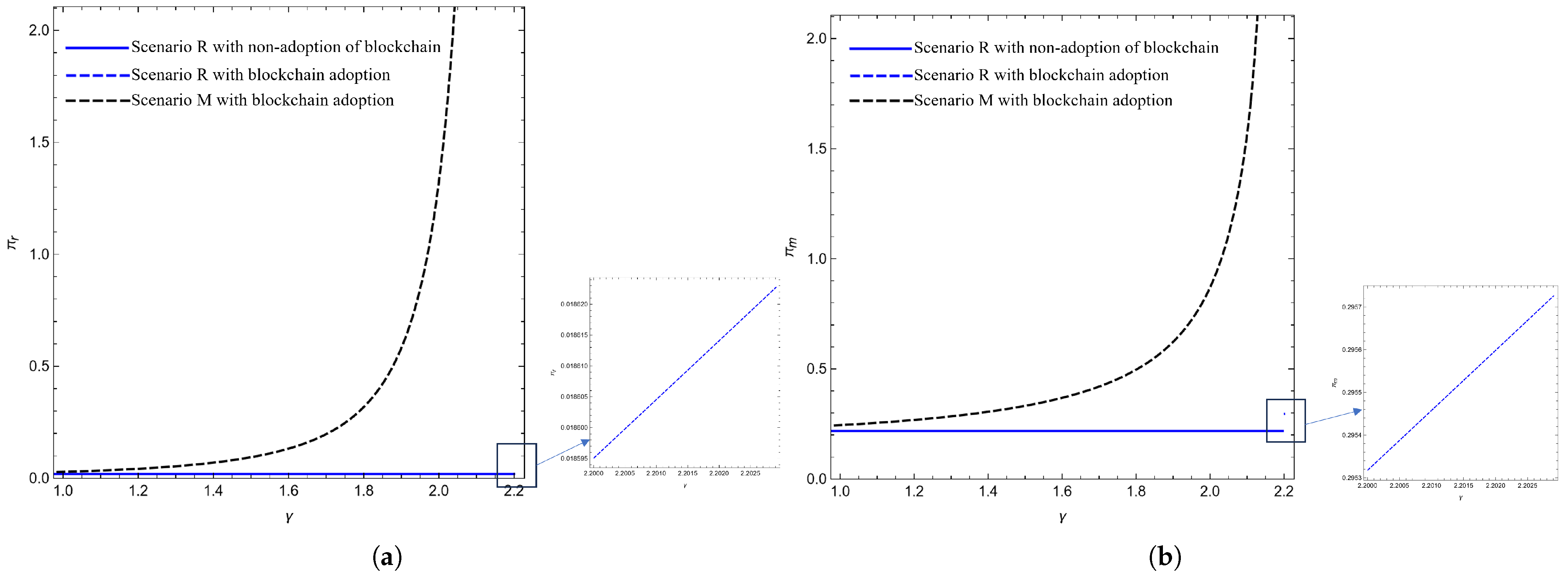
- Leaders under both leadership structures do not adopt blockchain if consumer preference γ is low.
- (2)
- Under scenario M, the manufacturer adopts blockchain, while under scenario R, the retailer withdraws it if consumer preference is medium.
- (3)
- Leaders under both leadership structures adopt blockchain if the unit operational cost of using blockchain is low and consumer preference is high (i.e., and ).
7. Extension

8. Conclusions
8.1. Summary
8.2. Theoretical and Managerial Implications
8.3. Limitations and Further Research
Author Contributions
Funding
Institutional Review Board Statement
Informed Consent Statement
Data Availability Statement
Conflicts of Interest
Appendix A. Expressions Used in the Manuscript
- be the value of such that .
- ,
- is the second root of equation
- is the second root of equation
Appendix B. Proof of Main Results
| Results |
|---|
- (1)
- .
- (2)
- . By calculating the first-order conditions, we have . By solving , we can obtain one threshold . Simultaneously, the feasible region of the blockchain adoption should be met. Thus, if max{,} < < , then ; otherwise, . Similarly, we can obtain the remaining results.
| Results |
|---|
- (1)
- The intensity of channel competition is low and the initial market share of the reselling channel is relatively high: , ;
- (2)
- The intensity of channel competition and the initial market share of the reselling channel are low, and consumer preference in the reselling channel is high: , , and ;
- (3)
- The intensity of channel competition and consumer preference in the reselling channel are high: and .
- (1)
- Leaders under both leadership structures do not adopt blockchain if consumer preference is low. Specifically,
- (i)
- , , and ;
- (ii)
- and ;
- (iii)
- , , and .
- (2)
- Under scenario M, the manufacturer adopts blockchain, while under scenario R, the retailer withdraws it if consumer preference is medium. Specifically,
- (i)
- , , and ;
- (ii)
- , , and ;
- (iii)
- and .
- (3)
- Leaders under both leadership structures adopt blockchain if the unit operational cost of using blockchain is low and consumer preference is high (i.e., and ).
References
- Saberi, S.; Kouhizadeh, M.; Sarkis, J.; Shen, L. Blockchain technology and its relationships to sustainable supply chain management. Int. J. Prod. Res. 2019, 57, 2117–2135. [Google Scholar] [CrossRef]
- Zou, Z.; Liu, M.; Gong, Y.; Dong, X.; Duan, J. Examining the effects of blockchain technology on sales models: A study from the dual perspectives of economy and environment. Int. J. Prod. Econ. 2025, 281, 109502. [Google Scholar] [CrossRef]
- Yazıcılar Sola, F.G.; Güzel, D. The Role of Supply Chain Transparency and Supplier Trust in the Impact of Blockchain Technology Adoption on New Product Development. Sustainability 2025, 17, 5171. [Google Scholar] [CrossRef]
- De Giovanni, P. Blockchain and smart contracts in supply chain management: A game theoretic model. Int. J. Prod. Econ. 2020, 228, 107855. [Google Scholar] [CrossRef]
- Zhang, T.; Dong, P.; Chen, X.; Gong, Y. The impacts of blockchain adoption on a dual-channel supply chain with risk-averse members. Omega 2023, 114, 102747. [Google Scholar] [CrossRef]
- Zhou, Y.; Fu, Y.; Wang, K.; Min, J.; Zhang, X. Competition in the online platform: Impacts of blockchain technology adoption. Int. Trans. Oper. Res. 2024, 31, 4105–4127. [Google Scholar] [CrossRef]
- Fang, C.; Chi, M.; Fan, S.; Choi, T.M. Who should invest in blockchain technology under different pricing models in supply chains? Eur. J. Oper. Res. 2024, 319, 777–792. [Google Scholar] [CrossRef]
- Zhu, S.; Li, J.; Wang, S.; Xia, Y.; Wang, Y. The role of blockchain technology in the dual-channel supply chain dominated by a brand owner. Int. J. Prod. Econ. 2023, 258, 108791. [Google Scholar] [CrossRef]
- Zhong, Y.; Yang, T.; Yu, H.; Zhong, S.; Xie, W. Impacts of blockchain technology with government subsidies on a dual-channel supply chain for tracing product information. Transp. Res. Part E Logist. Transp. Rev. 2023, 171, 103032. [Google Scholar] [CrossRef]
- Zhang, M.; Yi, Y.; Fu, A.; Li, Y. Optimal investment and coordination strategies for digital technology adoption in a dual-channel supply chain. Comput. Ind. Eng. 2024, 193, 110289. [Google Scholar] [CrossRef]
- Yuan, M.; Qiu, R.; Sun, M.; Shao, S.; Fan, Z.P.; Xu, H. Blockchain implementation decisions in a dual-channel supply chain under different market power structures. Int. J. Prod. Res. 2025, 63, 5238–5262. [Google Scholar] [CrossRef]
- Isaja, M.; Nguyen, P.; Goknil, A.; Sen, S.; Husom, E.J.; Tverdal, S.; Anand, A.; Jiang, Y.; Pedersen, K.J.; Myrseth, P.; et al. A blockchain-based framework for trusted quality data sharing towards zero-defect manufacturing. Comput. Ind. 2023, 146, 103853. [Google Scholar] [CrossRef]
- Huynh, T.T.; Nguyen, T.D.; Tan, H. A Survey on Security and Privacy Issues of Blockchain Technology. In Proceedings of the 2019 International Conference on System Science and Engineering (ICSSE), Dong Hoi, Vietnam, 20–21 July 2019; pp. 362–367. [Google Scholar] [CrossRef]
- Niu, B.; Dong, J.; Liu, Y. Incentive alignment for blockchain adoption in medicine supply chains. Transp. Res. Part E Logist. Transp. Rev. 2021, 152, 102276. [Google Scholar] [CrossRef]
- Zhang, H.; Lou, Z.; Hou, F.; Yan, Y. Blockchain adoption strategy in a platform dual-channel supply chain with risk-averse sellers. Int. Trans. Oper. Res. 2024, 31, 4199–4228. [Google Scholar] [CrossRef]
- Shao, S.; Li, Y.; Cheng, X.; Qu, J. Green Investment Strategies and Pricing Decisions in a Supply Chain Considering Blockchain Technology. Sustainability 2025, 17, 6491. [Google Scholar] [CrossRef]
- Li, Z.; Gilbert, S.M.; Lai, G. Supplier Encroachment as an Enhancement or a Hindrance to Nonlinear Pricing. Prod. Oper. Manag. 2015, 24, 89–109. [Google Scholar] [CrossRef]
- Ha, A.Y.; Luo, H.; Shang, W. Supplier Encroachment, Information Sharing, and Channel Structure in Online Retail Platforms. Prod. Oper. Manag. 2022, 31, 1235–1251. [Google Scholar] [CrossRef]
- Li, W.; Zhao, X. Competition or coopetition? Equilibrium analysis in the presence of process improvement. Eur. J. Oper. Res. 2022, 297, 180–202. [Google Scholar] [CrossRef]
- Gao, J.; Xiao, Z.; Wei, H. Competition and coordination in a dual-channel green supply chain with an eco-label policy. Comput. Ind. Eng. 2021, 153, 107057. [Google Scholar] [CrossRef]
- Sarkar, M.; Dey, B.K.; Ganguly, B.; Saxena, N.; Yadav, D.; Sarkar, B. The impact of information sharing and bullwhip effects on improving consumer services in dual-channel retailing. J. Retail. Consum. Serv. 2023, 73, 103307. [Google Scholar] [CrossRef]
- Zhu, H.; Ni, Y.; Xiao, Y. Information sharing across competing platforms with varying information capabilities. Eur. J. Oper. Res. 2024, 323, 125–138. [Google Scholar] [CrossRef]
- Pi, Z.; Fang, W.; Zhang, B. Service and pricing strategies with competition and cooperation in a dual-channel supply chain with demand disruption. Comput. Ind. Eng. 2019, 138, 106130. [Google Scholar] [CrossRef]
- Chen, K.Y.; Kaya, M.; Özer, O. Dual Sales Channel Management with Service Competition. Manuf. Serv. Oper. Manag. 2008, 10, 654–675. [Google Scholar] [CrossRef]
- Xu, S.; Tang, H.; Lin, Z.; Lu, J. Pricing and sales-effort analysis of dual-channel supply chain with channel preference, cross-channel return and free riding behavior based on revenue-sharing contract. Int. J. Prod. Econ. 2022, 249, 108506. [Google Scholar] [CrossRef]
- Taleizadeh, A.A.; Adeli, M.; Abedsoltan, H. Sustainability, pricing and marketing in a dual channel supply chain with different retailing scenarios and carbon emission reduction. J. Clean. Prod. 2025, 496, 145149. [Google Scholar] [CrossRef]
- Shou, Y.; Zhao, X.; Dai, J.; Xu, D. Matching traceability and supply chain coordination: Achieving operational innovation for superior performance. Transp. Res. Part E Logist. Transp. Rev. 2021, 145, 102181. [Google Scholar] [CrossRef]
- Ahmed, W.A.; MacCarthy, B.L. Blockchain-enabled supply chain traceability—How wide? How deep? Int. J. Prod. Econ. 2023, 263, 108963. [Google Scholar] [CrossRef]
- Wu, L.; Wang, H.; Zhu, D.; Hu, W.; Wang, S. Chinese consumers’ willingness to pay for pork traceability information—The case of Wuxi. Agric. Econ. 2016, 47, 71–79. [Google Scholar] [CrossRef]
- Wu, L.; Gong, X.; Qin, S.; Chen, X.; Zhu, D.; Hu, W.; Li, Q. Consumer preferences for pork attributes related to traceability, information certification, and origin labeling: Based on China’s Jiangsu Province. Agribusiness 2017, 33, 424–442. [Google Scholar] [CrossRef]
- de Kok, A.; van Donselaar, K.; van Woensel, T. A break-even analysis of RFID technology for inventory sensitive to shrinkage. Int. J. Prod. Econ. 2008, 112, 521–531. [Google Scholar] [CrossRef]
- Sahin, E.; Dallery, Y. Assessing the impact of inventory inaccuracies within a Newsvendor framework. Eur. J. Oper. Res. 2009, 197, 1108–1118. [Google Scholar] [CrossRef]
- Lee, J.; Palekar, U.S.; Qualls, W. Supply chain efficiency and security: Coordination for collaborative investment in technology. Eur. J. Oper. Res. 2011, 210, 568–578. [Google Scholar] [CrossRef]
- Whang, S. Timing of RFID Adoption in a Supply Chain. Manag. Sci. 2010, 56, 343–355. [Google Scholar] [CrossRef]
- Rao, S.; Chen, F.; Hu, W.; Gao, F.; Huang, J.; Yi, H. Consumers’ valuations of tea traceability and certification: Evidence from a blockchain knowledge experiment in six megacities of China. Food Control 2023, 151, 109827. [Google Scholar] [CrossRef]
- Doanh, D.C.; Tram, T.B.; Vu, P.Q.; Linh, L.T.N.; Huong, N.T.T. Blockchain-based Food Traceability System and Green Brand Image: Enhancing Product Trust and Purchase Intentions for Online Agricultural Products. Clean. Responsible Consum. 2025, 20, 100368. [Google Scholar] [CrossRef]
- Duan, Y.; Zhu, Q. Blockchain empowerment: Enhancing consumer trust and outreach through supply chain transparency. Int. J. Prod. Res. 2025, 63, 5358–5382. [Google Scholar] [CrossRef]
- Yu, J.; Yan, Y.; Meng, L.M.; Huang, R. The impact of blockchain technology on competing suppliers on an E-commerce platform. Inf. Manag. 2025, 62, 104160. [Google Scholar] [CrossRef]
- Wu, X.; Fan, Z.; Cao, B. An analysis of strategies for adopting blockchain technology in the fresh product supply chain. Int. J. Prod. Res. 2023, 61, 3717–3734. [Google Scholar] [CrossRef]
- Xia, L.; Wang, L.; Xiao, R.; Wang, J.; Hou, P. Blockchain and pricing strategies in supply chains considering consumer traceability preference and power structure. Int. J. Prod. Res. 2025, 63, 10147–10166. [Google Scholar] [CrossRef]
- Li, Z.; He, J.; Xue, Q. Modeling Blockchain Investment in Data-Intensive Supply Chains: A Game-Theoretic Analysis of Power Structures. Systems 2025, 13, 1029. [Google Scholar] [CrossRef]
- Sun, Z.; Xu, Q.; Liu, J. Is blockchain technology desirable? When considering power structures and consumer preference for blockchain. INFOR Inf. Syst. Oper. Res. 2024, 62, 53–99. [Google Scholar] [CrossRef]
- Chang, S.; Ma, H.; Hou, P.; Cao, L. Who should adopt blockchain? The interplay between blockchain adoption and online channel under competition. Electron. Commer. Res. Appl. 2023, 62, 101316. [Google Scholar] [CrossRef]
- Gong, B.; Liu, X.; Zhang, Z. Blockchain introduction and channel leadership to combat counterfeit with an e-commerce platform supply chain. Kybernetes 2025. [Google Scholar] [CrossRef]
- Choi, T.M. Supply chain financing using blockchain: Impacts on supply chains selling fashionable products. Ann. Oper. Res. 2023, 331, 393–415. [Google Scholar] [CrossRef]
- Chen, H.; Hao, Y.; Yan, Y. The introduction strategy of the emerging online marketplace considering risk attitude and channel power. Int. J. Gen. Syst. 2020, 49, 470–496. [Google Scholar] [CrossRef]
- Song, H.; Shu, Y.; Dai, Y.; Zhou, L.; Li, H. Big data service investment choices in a manufacturer-led dual-channel supply chain. Comput. Ind. Eng. 2022, 171, 108423. [Google Scholar] [CrossRef]
- Ju, H.; Zeng, Q.; Chu, X.; Li, Y. Cooperative investment strategies of ports and shipping companies in blockchain technology. Oper. Res. 2024, 24, 32. [Google Scholar] [CrossRef]
- Zhang, Q.; Li, Y.; Hou, P.; Wang, J. Price signal or blockchain technology? Quality information disclosure in dual-channel supply chains. Eur. J. Oper. Res. 2024, 316, 126–137. [Google Scholar] [CrossRef]
- Liu, J.; Zhao, H.; Chen, J. Blockchain-driven win–win strategy of economy and environment in the asymmetric competitive supply chain. Comput. Ind. Eng. 2023, 176, 108978. [Google Scholar] [CrossRef]


| Paper | Channel Features | Features Related to Blockchain | Leadership Structure | Key Contribution | |||
|---|---|---|---|---|---|---|---|
| Competition | Market Share | Information Level | Operational Cost | Varied Impacts | |||
| Yuan et al. [11] | ✓ | ✓ | ✓ | ✓ | Incorporate the price-matching policy into the blockchain adoption model for dual-channel supply chains under different leadership structures. | ||
| Zhou et al. [6] | ✓ | ✓ | ✓ | Examine blockchain adoption strategies in dual-channel supply chains under cost-sharing schemes and different leadership structures considering customer information traceability preferences. | |||
| Zhang et al. [10] | ✓ | ✓ | ✓ | Study digital technology adoption and supply chain coordination in a dual-channel supply chain. | |||
| Zhong et al. [9] | ✓ | ✓ | ✓ | ✓ | Investigate blockchain adoption under government subsidies, incorporating heterogeneous effects across online and offline channels and asymmetric market shares. | ||
| Gong et al. [44] | ✓ | ✓ | Explore blockchain adoption strategies under manufacturer-led, platform-led, and cooperative structures to combat counterfeiting. | ||||
| Sun et al. [42] | ✓ | ✓ | Consider heterogeneous consumer preferences for blockchain-enabled products (i.e., interested, averse, and neutral) under different leadership structures (i.e., supplier–led, retailer-led, and vertical Nash). | ||||
| Shao et al. [16] | ✓ | ✓ | Investigate manufacturers’ green investment decisions and retailers’ blockchain adoption in dual-channel supply chains with asymmetric market shares. | ||||
| Xia et al. [40] | ✓ | ✓ | Examine blockchain investment and pricing strategies under manufacturer-led and retailer-led structures, considering asymmetric consumer traceability preferences between the retailer and the manufacturer. | ||||
| Li et al. [41] | ✓ | ✓ | Consider supplier-led, manufacturer-led, and balanced power structures and propose a coordination mechanism for blockchain adoption | ||||
| This work | ✓ | ✓ | ✓ | ✓ | ✓ | ✓ | Consider heterogeneous blockchain effectiveness across channels and asymmetric market shares in a dual-channel supply chain under manufacturer-led and retailer-led structures. |
| Scenario | Member | Demand | Profit |
|---|---|---|---|
| r | |||
| m | |||
| r | |||
| m | |||
| r | |||
| m | |||
| r | |||
| m | |||
| r | |||
| m |
Disclaimer/Publisher’s Note: The statements, opinions and data contained in all publications are solely those of the individual author(s) and contributor(s) and not of MDPI and/or the editor(s). MDPI and/or the editor(s) disclaim responsibility for any injury to people or property resulting from any ideas, methods, instructions or products referred to in the content. |
© 2025 by the authors. Licensee MDPI, Basel, Switzerland. This article is an open access article distributed under the terms and conditions of the Creative Commons Attribution (CC BY) license.
Share and Cite
Li, R.; Ni, Y.; Zhu, H. Blockchain Adoption Strategies in Dual-Channel Supply Chains Under Different Leadership Structures and Asymmetric Market Shares. Sustainability 2026, 18, 350. https://doi.org/10.3390/su18010350
Li R, Ni Y, Zhu H. Blockchain Adoption Strategies in Dual-Channel Supply Chains Under Different Leadership Structures and Asymmetric Market Shares. Sustainability. 2026; 18(1):350. https://doi.org/10.3390/su18010350
Chicago/Turabian StyleLi, Ruiqing, Yaodong Ni, and Haoruo Zhu. 2026. "Blockchain Adoption Strategies in Dual-Channel Supply Chains Under Different Leadership Structures and Asymmetric Market Shares" Sustainability 18, no. 1: 350. https://doi.org/10.3390/su18010350
APA StyleLi, R., Ni, Y., & Zhu, H. (2026). Blockchain Adoption Strategies in Dual-Channel Supply Chains Under Different Leadership Structures and Asymmetric Market Shares. Sustainability, 18(1), 350. https://doi.org/10.3390/su18010350