


Abstract
Digital Game-Based Learning (DGBL) promises to support learning processes and behavioral change, which are fundamental to sparking change towards sustainable behaviors. The present study aimed to examine how a gamified educational activity—Play IT Cool—affects students’ emotions, motivation, and enjoyment. This novel tool, developed by integrating self-determination theory and the Mechanics, Dynamics, Aesthetics (MDA) model of game design, harnesses the power of storytelling and interactivity to engage learners regarding climate change issues and sustainable behaviors. The aim was to assess how students’ experiences with Play IT Cool differ from those with a comparable non-gamified sustainability program, and two studies were conducted. The first study involved 28 university students (5 males) divided into two conditions: gamified and non-gamified. The second study involved 37 participants (8 males) divided into four experimental conditions: individual gameplay, group gameplay, individual non-gamified learning, and group non-gamified learning. Self-reporting pre- and post-surveys were administered in both studies to evaluate the impact on learners. The results showed that Play IT Cool had an impact on enjoyment, emotions, and needs satisfaction, although it was not substantially different from that under the non-gamified condition. These findings suggest that while the use of game elements alone may not enhance outcomes compared to non-gamified tools, the activities promote positive emotional and motivational experiences. Furthermore, working in a group provides additional benefits for relatedness. In conclusion, some observations are drawn about the significant and non-significant results as well.
1. Introduction
Advancements in technology opened the way for the engaging educational format that is digitally enhanced gamified learning. Such a method of learning is commonly referred to as Digital Game-Based Learning (DGBL), which involves a game with the primary goal of achieving learning objectives [1]. The potential of this method resides in its ability to spark instant emotional experiences [2] in a way that is particularly engaging for students [3]. Given that education plays a vital role in raising awareness of the climate crisis and promoting sustainable behavior, the advantages of DGBL for climate change and sustainability education have inspired a thriving field of research [4,5,6]. Overall, gamified education about sustainability seems to be both popular and effective [7], especially when it involves some form of group interaction, whether it is competitive or collaborative [8]. Multiplayer educational games about climate change integrate gamified activities, collaborative learning, and environmental education, offering an engaging way to raise awareness while fostering citizen participation [6]. This is far from a surprising breakthrough, as the value of collaborative learning has been confirmed for a variety of contexts and subjects [9]. More specifically, technology-enhanced collaboration fosters active learning [10], ownership over learning, and teamwork skills [11,12]. However, the evidence regarding digitally enhanced collaborative educational programs for sustainability is a subject of debate. This matter was appreciably tackled by Vizvizi and Daniela [13], who raised the question of whether the technology-enhanced education allows students to become global citizens and actively work towards the Sustainable Development Goals (SDGs) [14,15]. After all, technology definitely has the potential to promote connectivity and collaboration among students [16]. However, the effects of collaborative learning environments still need to be assessed to evaluate students’ engagement in such educational programs. As put by Makind et al. [17], research needs to prioritize experiential learning that fosters collaborative skills. Moreover, DGBL’s effectiveness still needs to be fully proved [18]. The value of DGBL as an educational tool has been questioned multiple times [5,19,20], even for DGBL focusing on sustainability and green-friendly behaviors [21]. A major point of contention for DGBL is that it should always be compared to other instructional methods to estimate its advantages, but the inclusion of a control group is unusual in studies on DGBL [22]. It appears clear that, for DGBL to be effectively evaluated, the study design should isolate variables through multiple experimental conditions [23].
Considering the research gap about the effects of collaboration in DGBL about sustainability and the dispute about comparison to traditional non-gamified tools, the objectives of the present study are threefold. First, we aim to investigate the effects of participating in a sustainability-focused educational activity on university students’ emotions, enjoyment, and satisfaction of basic psychological needs, as defined by the Self-Determination Theory (SDT) [24]. As will be detailed later, the satisfaction of these needs constituted a central aim that guided the design decisions. Therefore, the satisfaction of these needs was also adopted as a key metric for the tool’s effectiveness. The deliberate connection between game design and evaluation aimed to ensure that the DGBL is consistent from its conception through its implementation. Second, we aim to examine the specific impact of Play IT Cool—a DGBL tool specifically developed for sustainability education—compared to a non-gamified learning activity on the same topic. By directly contrasting the DGBL tool with an equivalent non-gamified activity, this study addresses the documented lack of comparative evidence in the field. This comparative approach allows us to compare the added value of DGBL for sustainability, thereby contributing novel empirical insights. Finally, we compare the impact of solo learning with the impact of collaborative learning in the context of sustainability education. Three research questions were formulated to guide this research:
- (RQ1) How does participating in an educational activity on sustainability affect university students’ emotions, motivation, and enjoyment?
- (RQ2) How does the impact of Play IT Cool compare to that of a non-gamified educational program about sustainability?
- (RQ3) What is the difference between completing the sustainability activities, both gamified and non-gamified, in a collaborative group setting and individually?
To address these research questions, we conducted two studies. In the first study, students completed the activity in small groups and participated in either the gamified or the non-gamified version. In the second study, university students from a separate sample participated in one of four experimental conditions: gamified individual, non-gamified individual, gamified collaborative, and non-gamified collaborative. The present research adopted a pilot study design to preliminarily test the functioning of Play IT Cool in both the individual and the collaborative conditions before large-scale implementation. Given the novelty of the DGBL tool, a small-scale pilot approach was the most suited as a first step to investigate the suitability of instruments, procedure, and game design.
2. Materials and Methods
Play IT Cool. The main device involved in the present study was the DGBL web platform Play IT Cool. This DGBL tool was designed and developed by a multidisciplinary team of game designers, educational psychologists, and game developers. Such interdisciplinarity ensured a balanced integration of engaging gameplay with sound pedagogical principles. This represents a strength of Play IT Cool, as many previous educational programs on sustainability predominantly drew from either educational theory or game design practices, or even designed DGBL without any theoretical grounding [25,26]. By integrating both disciplines, Play It Cool aims to integrate educational goals and engaging features, thus bridging the gap between meaningful learning and sustained motivation [27,28,29]. This interdisciplinary collaboration resulted in the integration of SDT [24] with the Mechanics, Dynamics, Aesthetics (MDA) model of game design [30]. The MDA model describes games in terms of their Mechanics—that is, the game’s rules and resources—Dynamics—the behaviors elicited by the mechanics—and, finally, Aesthetics—the feelings and sensations that arise from the dynamics. From the perspective of the SDT, an engaging learning environment should be designed to satisfy the three basic psychological needs of autonomy, competence, and relatedness. In this way, it can foster motivation and engagement with the learning content. While the MDA model is traditionally applied linearly—from Mechanics to Aesthetics—the integration with the SDT required starting from the Aesthetics to align the game design with the core psychological objectives. In particular, the Aesthetics for the game were defined as the feelings of satisfaction derived from shared experiences, acquired competence and autonomous choices. These Aesthetics were then honed in light of the constraints and opportunities offered by the available platform capabilities. Subsequently, the aesthetics were operationalized into coherent game Dynamics supporting players’ collaboration and decision-making, as well as scaffolding learning. Finally, the game Mechanics were constructed and adjusted to enable the desired game dynamics. The matching of game mechanics and dynamics was made based on the literature. In fact, we found that quizzes and minigames are proven to support learning, branching scenarios support decision-making, and shared gameplay supports collaboration [30,31,32,33,34]. This design approach was ultimately realized in Play IT Cool, a game environment that operationalizes the MDA model and SDT principles into a cohesive narrative and gameplay experience.
The game presents Utopia, a twin planet of the Earth that faces the same issues, such as air pollution, water contamination and resource scarcity, but the citizens all strive for a more sustainable environment. Every region of Utopia represents a different sustainability issue, and a separate learning module. Every module is self-contained and independent, as each region breaks down the main facet of climate change: Hydronis pertains to water usage and contamination of freshwater sources, Thermodra includes content about the effects of climate change on global warming, Nubira explains the problem of carbon dioxide emissions and their effect on air pollution, Toxalon, explains the five Rs sustainability rules, that is Reduce, Reuse, Recycle, Retrieve, Regenerate, and finally Energetia illustrates and compares energy sources.
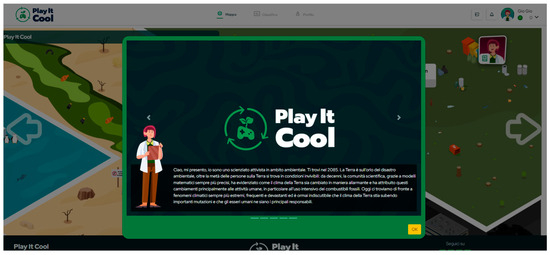
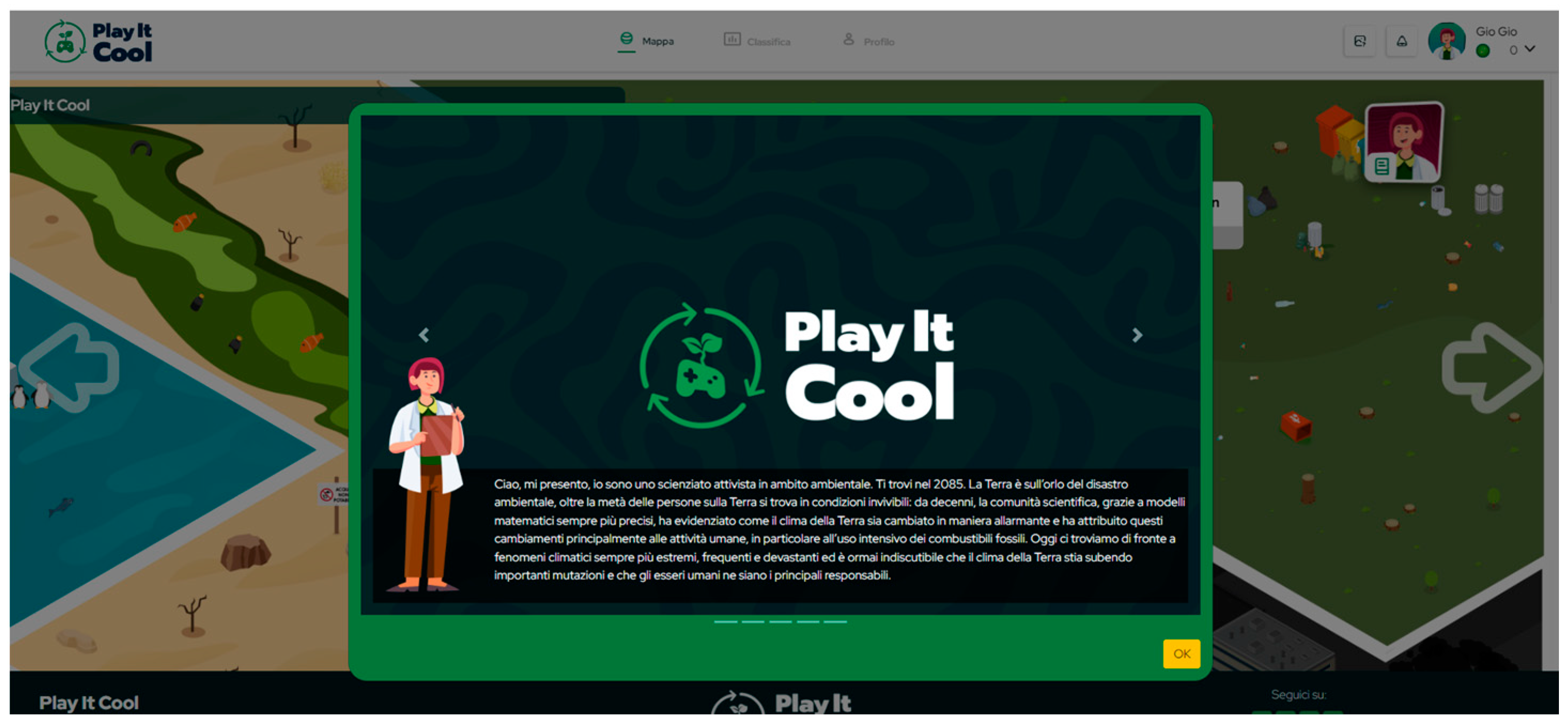
Each of the learning modules starts with a storytelling introduction, where the player comes to understand the main issue faced by that specific region of Utopia. Figure 1 represents an example of storytelling in Play IT Cool.
Figure 1.
An example of introductory storytelling to one of the regions of Utopia.
In particular, in Figure 1 the main character—the scientist exploring Utopia—is introduced, and the main purpose of her exploration is presented. The purpose of this type of introduction is to engage players in the game story and provide some background about the sustainability issues addressed during the experience.
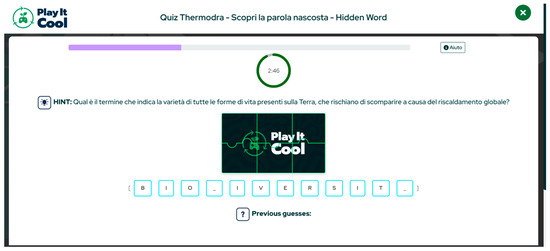
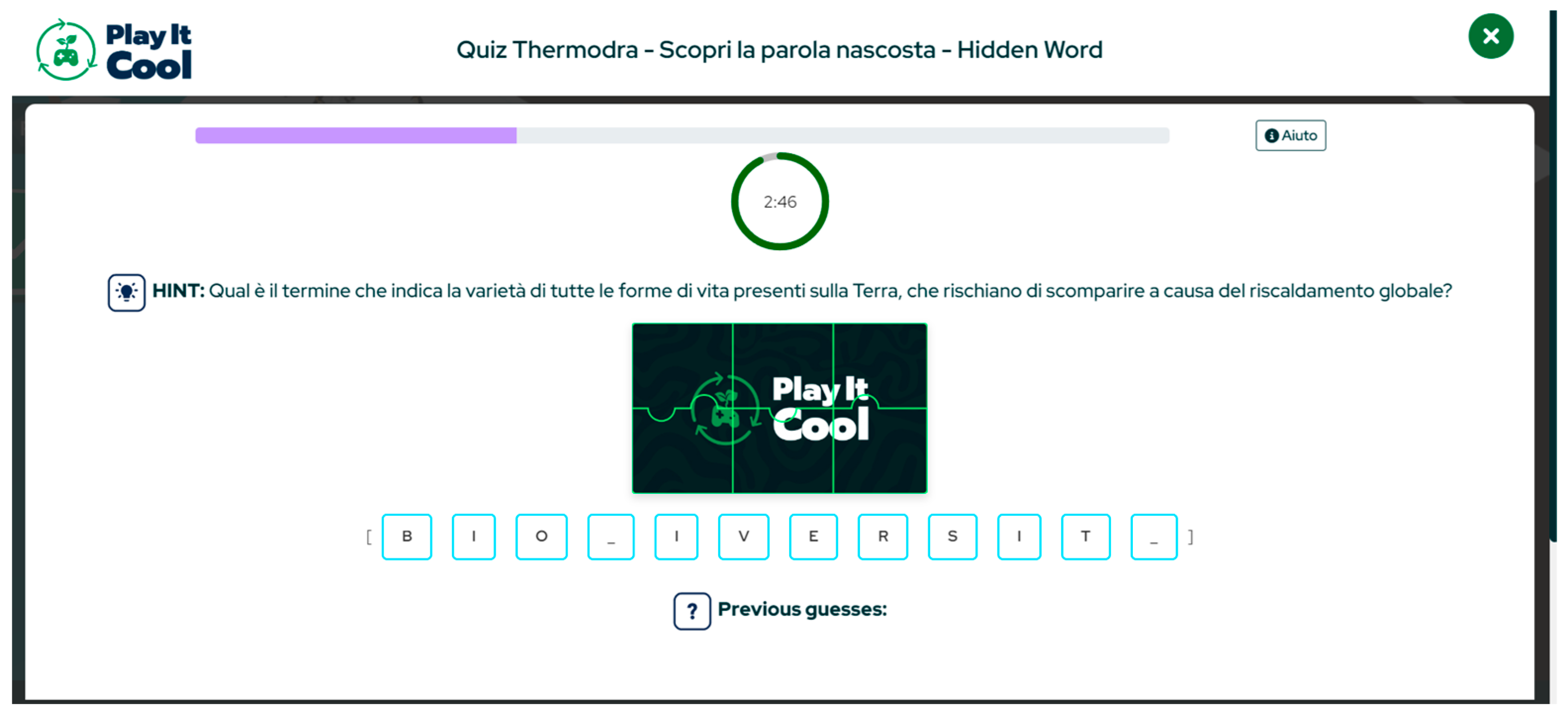
The acquired knowledge about the environmental issue is tested with a short quiz. The player is provided with contingent feedback on their answers, whether they are correct or not. Then, the player chooses among a set of activities all themed around the main topic of the module. These activities include quizzes, short stories with branching scenarios, and minigames such as hangman and word puzzle. An example of a word puzzle is displayed in Figure 2.
Figure 2.
An example of a word puzzle in Play IT Cool. The hint says “What is the term indicating the variety of all life forms on Earth that risk extinction as a result of global warming?”.
Figure 2 presents the progression bar in the activity at the top of the screen. The progression bar is used to provide feedback about the player’s progress and encourage them to carry the activity to the term. The player can consult the time left to complete the activity while playing the word puzzle, which conveys a sense of urgency and maintains the player’s attention. The player is assisted in completing the word by a hint, presented as a question that leads to the correct answer. The hint has the purpose to connect the hangman-style game with a relevant topic of sustainability, as it guides the players to enrich their vocabulary on sustainability.
The short stories with branching scenarios narrate an everyday sustainability dilemma. The player is called to make the most sustainable choice considering the situation at hand. For example, the player is asked by their roommate to choose the best lighting solution from LEDs, halogen light bulbs, and incandescent light bulbs. The player has to consider the advantages and costs of each solution. Other stories pertain to the best commute to move around the city, where to purchase groceries, and how long the household heater should be on.
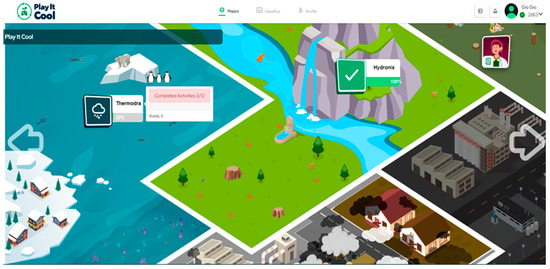
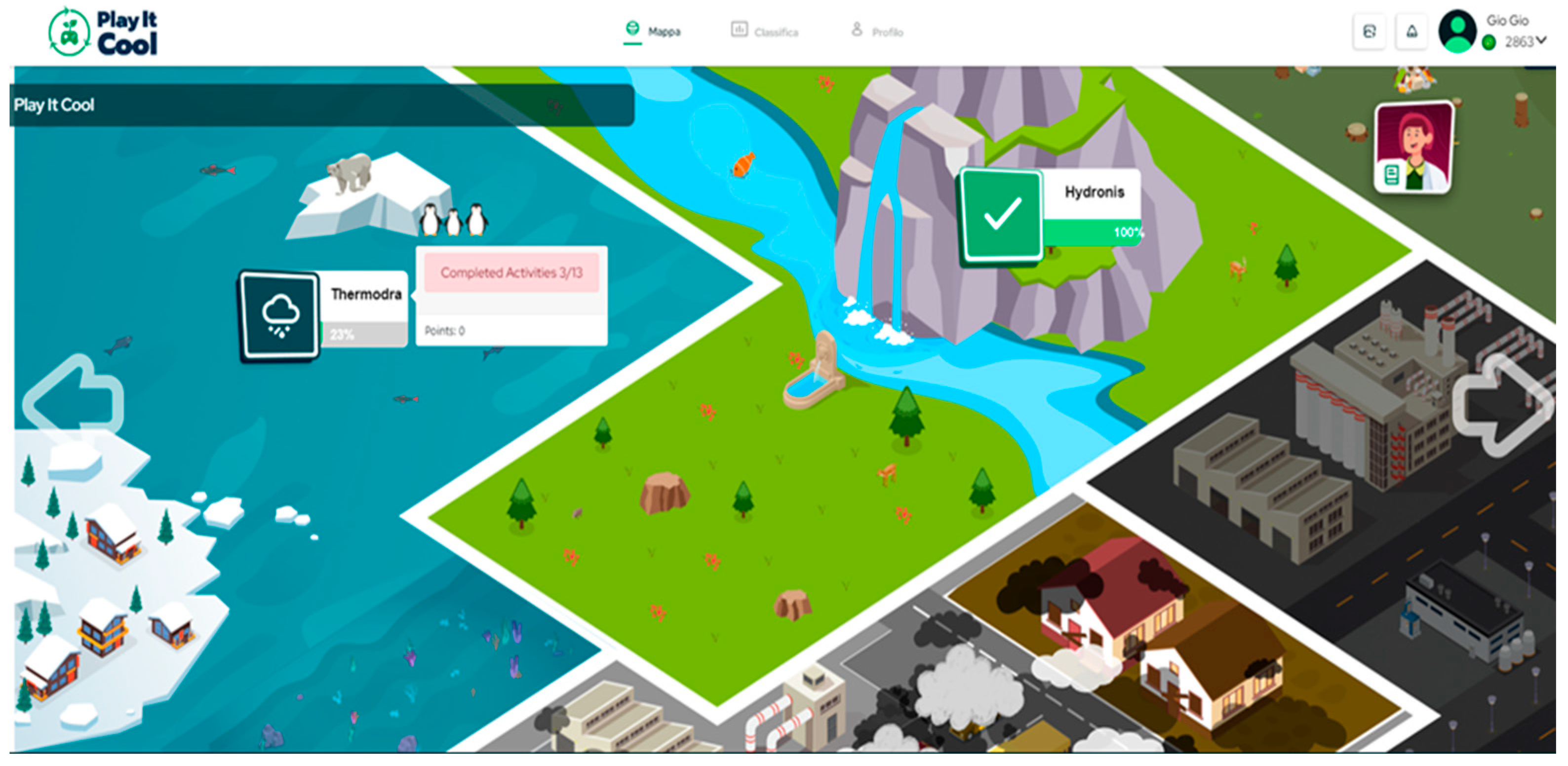
All the activities allow players to gather points and collect badges, which are awarded based on the excellence of their performance. For instance, a badge might be attributed to an exceptionally fast completion, or to a flawless one. To successfully complete an activity, the player must reach a 70% threshold of correct answers. After every activity in the module is completed, the player is rewarded with a change on the map as the region corresponding to the module transforms into a bright, green, and sustainable environment. Such progress in the gameplay is represented not only by this visual clue but also by the progression bar, which fills up every time an activity is completed, as represented in Figure 3.
Figure 3.
The map of Utopia with partial completion.
Figure 3 displays a screen capture of a typical gameplay on Play IT Cool. The player profile and score appear on the upper right corner. The map is divided into the aforementioned regions. In the case of Figure 3, the player has completed Hydronis and is in the process of completing Thermodra. The areas that are not completed yet appear gray and polluted. The differences in the regions’ outlook serve as a visual feedback for players on their progress throughout the sustainability missions and enhance their sense of competence and engagement.
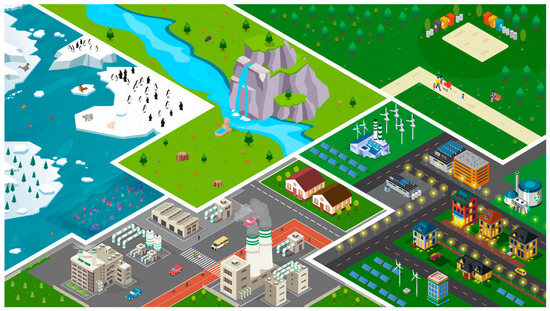
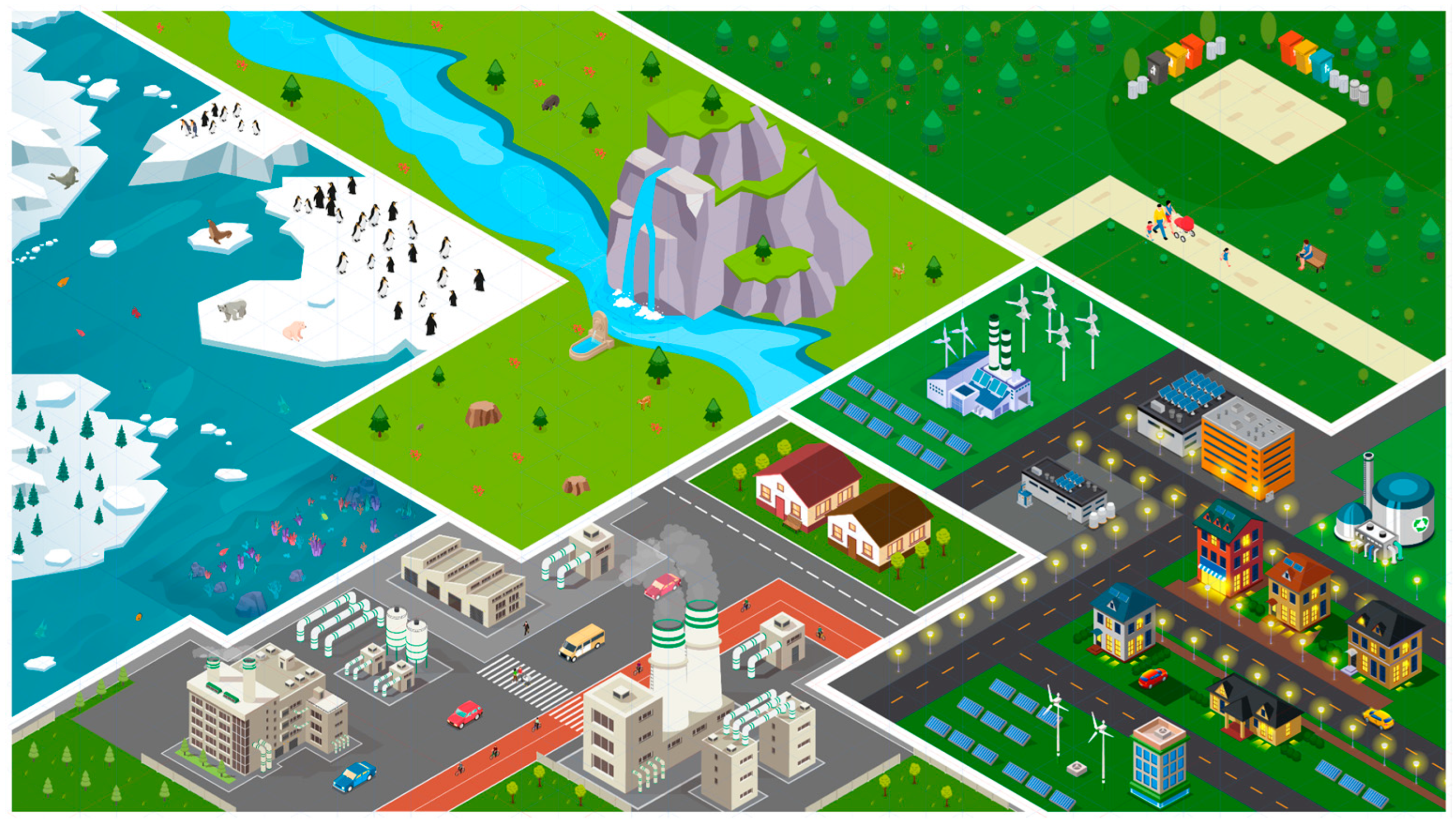
Once each module is completed, the players are encouraged to act out in real life what they have learned in Utopia, leveraging the sense of responsibility for a more sustainable environment. The map as it finally appears is displayed in Figure 4.
Figure 4.
The final map of Utopia.
The player is rewarded with a vision of how the world of Utopia is transformed in a positive way once sustainability is achieved. The glacier area is populated and healthy, greenery and nature are flourishing, the city is well-lit and powered by renewable energy resources. The final map in Figure 4 visually represents the outcomes of players’ actions and reinforces a sense of achievement and responsibility for environmental restoration.
Participants. The participants in the first study were 28 Italian university students, of whom 5 were male (18%) and 23 were female (82%), aged between 20 and 25 years (M = 21.37, SD = 0.99). Regarding educational level, all the students had a high school diploma. In terms of gaming habits, six participants (21%) reported playing video games regularly. As for the use of educational applications or video games, 9 students (32%) had never used them, 13 (46%) used them occasionally, 3 students (11%) used them often, and 3 participants (11%) used them daily.
The second study involved 37 Italian university students of whom eight were male (22%) and 29 were female (78%), aged between 19 and 28 years (M = 21.76, SD = 1.88). Regarding educational level, 30 students (81%) had a high school diploma, six (16%) had completed at least one year of a university program or held a first-level degree, and one student (3%) had a second-level degree. In terms of gaming habits, 11 participants (30%) reported playing video games regularly. As for the use of educational applications or video games, seven students (19%) had never used them, 20 (55%) used them occasionally, seven (19%) used them often, and three participants (8%) used them daily.
Procedure. The first and second studies started with the presentation of the project Play IT Cool as an example of an educational program aimed to promote awareness of sustainability through digital education. The only information that was omitted is the difference between the two conditions of the study, since it could potentially generate a bias in the students’ experience and affect the data collection negatively. The study was conducted in accordance with the ethical standards of the Declaration of Helsinki and was approved by the Ethics Committee of University of Campania Luigi Vanvitelli (approval Number 8, 11 March 2025). The participants were then asked to fill in the informed consent form of the study and were informed that they could withdraw their participation at any time. After providing consent, participants completed a pre-test survey on their personal devices, assessing the baseline of study constructions.
In both studies, the participants were randomly assigned to the experimental conditions without pairing for any variable, and each participant completed only one version of the sustainability activity. In the first study, the gamified condition consisted of completing the sustainability activity through Play IT Cool. They explored one of the areas previously described, Energetia. Students could not freely choose which module to explore, as completing the entire game would have required a substantially longer time commitment. The non-gamified tool is a slide-based platform with the same content and modules as Play IT Cool but without any game elements. In particular, the non-gamified condition presented exactly the same instructional content and included only a basic level of interactivity through multiple-choice tests, but it did not include any gamified elements. Differences between the gamified and non-gamified conditions are detailed in Table 1.
Table 1.
Comparison of the gamified (Play IT Cool) and non-gamified conditions.
Although the non-gamified version also utilized a multiple-choice test as an interactive element, its design principles and framing diverged significantly from those employed in the Play IT Cool quizzes. Indeed, the non-gamified version was consistent with the principles of traditional e-learning tools, as it was presented as a test of knowledge. Moreover, the non-gamified test did not include visible score or detailed feedback. Conversely, Play IT Cool’s quizzes were presented as challenges to progress in storytelling, and provided visual cues, score count, sounds and so on, in addition with detailed feedback whether the answer was correct or not.
The conditions of the first study are represented in Table 2.
Table 2.
Representation of the first study conditions.
In the second study, the individual condition allowed participants to complete the sustainability activity individually, whereas in the collaborative condition, participants were placed in small groups of two or three and completed the activity together. Both the individual and collaborative conditions were further randomly divided into two sub-conditions: gamified and non-gamified versions. The latter was the same as the first study’s non-gamified activity. The experimental conditions of the second study are synthesized in Table 3.
Table 3.
Representation of the second study conditions.
In both studies, participants were informed that the activity would take about 45 min, but extra time was granted until the task was completed. At the end of the activity, participants filled out the post-activity questionnaires, which included the same scales as the pre-test to allow for the assessment of changes in the target constructs.
At the end of the experimental session, participants were debriefed about the two conditions of the experimentation, which was the only information concerning the research that was concealed during the initial presentation of the research. The participants also had the opportunity to ask clarification questions or concerns and to reflect on their experience as participants in the study, providing informal feedback on the learning activity. The debriefing included a short discussion and clarification about how the data would be used. Finally, participants were again informed about the possibility of withdrawing their data after the debriefing.
Instruments. Both studies employed the same survey, which included measures of enjoyment, motivation, and emotions to compare the experience before and after the educational activity on sustainability. All the scales included in the survey were translated into Italian through a back-translation process for the purpose of administering the survey in the participants’ native language.
The personal experience of the activity was assessed through an adapted version of the Basic Psychological Need Satisfaction and Frustration Scale (BPNSFS—adapted version) [35,36] to examine how the activity contributed to satisfying basic needs. This instrument has been widely used in various forms; in this study, it was modified to reflect the context of the educational activity, with each item referring to the participants’ experiences with the gamified and non-gamified versions of the learning tool. This self-reported scale is based on SDT and the basic psychological needs that it proposes, that is, autonomy, relatedness, and competence [37]. The adapted version of the BPNSFS includes 18 items describing the aforementioned psychological needs. The respondents indicated how they felt during the activity, evaluating each item on a five-point Likert scale where 1 signified “not true at all” and 5 signified “completely true”. The internal reliability was α = 0.78 for autonomy, α = 0.76 for competence, and α = 0.86 for relatedness.
The participants’ enjoyment was evaluated through the interest/enjoyment subscale from the Intrinsic Motivation Inventory (IMI) [38]. This subscale includes four items regarding the interest sparked by the sustainability activity and the enjoyment that it provoked. The respondents were instructed to indicate their degree of agreement on a seven-point Likert scale, where 1 meant “not at all true” and 7 meant “very true”. The internal reliability was α = 0.82.
The Achievement Emotions Questionnaire—Elementary School (AEQ-ES) [39,40,41,42] was administered to assess the emotions experienced by the participants during the activity. This questionnaire is a self-reported measure of the emotions experienced in learning contexts and relates achievements to positive and negative emotions. Every item is rated on a five-point Likert scale from 1 “strongly agree” to 5 “strongly disagree”. In our study population, the internal reliability was α = 0.88 for joy, α = 0.88 for boredom, α = 0.72 for helplessness, and α = 0.82 for pride.
Data analysis. Data analyses were conducted using the Statistical Package for Social Science-21 version (IBM SPSS-Statistics 21).
For the first study, a multiple one-way ANCOVA was conducted to assess the effect of the collaborative condition (gamified vs. non-gamified) on enjoyment, and multiple one-way MANCOVAs were used to assess the effect on emotions (joy, boredom, pride, and helplessness) and on basic psychological needs (autonomy, competence, and relatedness). In the second study, the same analyses were conducted to assess the effects of both the collaborative condition (gamified vs. non-gamified) and the activity version (individual vs. collaborative) on the dependent variables of interest.
Both studies 1 and 2 employed repeated-measures MANOVAs/ANOVAs—activity: pre vs. post and emotions, basic psychological needs, and enjoyment—to analyze changes across time.
3. Results
First study. Descriptive statistics have been conducted to define the variability range of dependent variables, which are represented in Table 4.
Table 4.
Descriptive statistics of the first study for the dependent variables.
Results of the ANCOVA show there was no significant difference between the gamified and non-gamified condition on enjoyment (F(1,25) = 0.26, p = 0.62, ηp2 = 0.01). A multivariate analysis of covariance (MANCOVA) was conducted to examine potential differences due to emotions. There were no significant differences between the gamified and non-gamified conditions (Wilks’s λ = 0.72, F(4,19) = 1.81, p = 0.17, ηp2 = 0.28) on joy, on boredom, and on pride. Whilst there was a small significant difference on helplessness when comparing the gamified and non-gamified conditions (F(1,22) = 6.28, p = 0.02, ηp2 = 0.22), with higher level on the gamified condition (M = 1.71) compared to the non-gamified condition (M = 1.05). Moreover, there were no significant differences between the gamified and non-gamified conditions considering the basic psychological needs (Wilks’s λ = 0.86, F(3,21) = 1.14, p = 0.36, ηp2 = 0.14). For a detailed overview of the ANCOVA and MANCOVAs results, see Table 5.
Table 5.
Results of ANCOVAs and MANCOVAs between gamified vs. non-gamified conditions on Enjoyment, Emotions and Basic Psychological Needs.
Data analysis then focused on the activities’ outcomes on emotions, psychological needs and enjoyment. Repeated-measures MANOVAs/ANOVAs (activity: pre vs. post × emotions, basic psychological needs, and enjoyment) were conducted to analyze pre- and post-activity changes. Although the interaction effect between activity and condition was not significant on enjoyment, analysis of pre-activity equivalence across conditions have shown a difference between conditions, with higher enjoyment in the gamified condition (M = 3.07, SD = 0.70) compared to non-gamified condition (M = 3.71, SD = 0.78) in the pre-activity. However, results of repeated-measures ANOVA revealed a significant main effect of activity on enjoyment (Wilks’s λ = 0.83, F(1,26) = 5.33, p = 0.03, ηp2 = 0.17), indicating that students reported higher enjoyment at post-activity (M = 3.85, SD = 0.17) compared to pre-activity (M = 3.41, SD = 0.14).
Regarding emotions, although the interaction effect between activity and condition was not significant, analysis of pre-activity equivalence across conditions have shown a difference between conditions, with higher boredom (M = 3.00, SD = 0.21) and lower pride (M = 3.16, SD = 0.14) in the gamified condition compared to boredom (M = 2.00, SD = 0.22) and pride (M = 3.60, SD = 0.15) of the non-gamified condition in the pre-activity. However, results of repeated-measures MANOVA revealed a significant main effect of the activity on emotions (Wilks’s λ = 0.41, F(2,23) = 8.31, p = 0.00, ηp2 = 0.60), indicating that students reported lower levels of boredom at post-activity (M = 1.82, SD = 0.17) compared to pre-activity (M = 2.50, SD = 0.15) and lower levels of helplessness at post-activity (M = 1.38, SD = 0.10) compared to pre-activity (M = 2.06, SD = 0.14).
Concerning the satisfaction of the three basic psychological needs, the interaction effect between activity and condition was not significant, and analysis of pre-activity equivalence across conditions have shown no differences between conditions. However, there was a significant main effect of activity on all three basic psychological needs (Wilks’s λ = 0.14, F(3,24) = 49.14, p = 0.00, ηp2 = 0.86), indicating that students reported higher levels of autonomy, relatedness and competence at post-activity compared to pre-activity. In synthesis, in all the activities there was an increase in enjoyment, a decrease in boredom and helplessness, and satisfaction in basic psychological needs. However, there was no increase in feelings of joy and pride. For a detailed overview of the means and standard deviations of repeated-measures ANOVA and MANOVAs results, see Table 6.
Table 6.
Means and standard deviations for enjoyment, emotions, and basic psychological needs before and after the activity in the first study.
Second study. Descriptive statistics have been conducted to define the variability range of dependent variables, which are represented in Table 7.
Table 7.
Descriptive statistics of the second study for the dependent variables.
An analysis of covariance (ANCOVA) was performed, and results show there was no significant difference between the gamified and non-gamified conditions on enjoyment (F(1,34) = 1.38, p = 0.25, ηp2 = 0.04). Two multivariate analyses of covariance (MANCOVA) showed no significant differences between the gamified and non-gamified conditions in terms of emotions (Wilks’s λ = 0.91, F(4,28) = 0.71, p = 0.60, ηp2 = 0.09) and basic psychological needs (Wilks’s λ = 0.93, F(3,30) = 0.67, p = 0.56, ηp2 = 0.07). In synthesis, there were no significant differences between gamified and non-gamified conditions on enjoyment, emotions, and psychological needs. For a detailed overview of the ANCOVA and MANCOVAs results, see Table 8.
Table 8.
Results of ANCOVAs and MANCOVAs between the gamified and non-gamified conditions on enjoyment, emotions, and basic psychological needs.
An analysis of covariance (ANCOVA) was performed, and results show there was no significant difference between individual and collaborative versions in terms of enjoyment (F(1,34) = 0.55, p = 0.46, ηp2 = 0.27). A multivariate analysis of covariance (MANCOVA) shows no significant differences between two conditions—individual vs. collaborative—on emotions (Wilks’s λ = 0.91, F(4,28) = 0.91, p = 0.57, ηp2 = 0.10). Results of another MANCOVA show significant multivariate effect of activity condition on basic psychological needs (Wilks’s λ = 0.67, F(3,30) = 4.36, p = 0.01, ηp2 = 0.30). Subsequent univariate tests indicated a significant difference on relatedness (F(1,32) = 8.16, p = 0.00, ηp2 = 0.20), with higher scores in the collaborative condition (M = 4.08) compared to the individual condition (M = 3.43). Moreover, there was no significant difference between the two activity conditions on autonomy and on competence. In synthesis, there were no significant differences between individual and collaborative conditions on enjoyment, emotions, need for autonomy and need for competence. However, in the collaborative condition there were higher levels of need for relatedness compared to individual conditions. For a detailed overview of the ANCOVA and MANCOVAs results, see Table 9.
Table 9.
Results of ANCOVAs and MANCOVAs between the individual vs. collaborative conditions on enjoyment, emotions, and basic psychological needs.
Repeated-measures MANOVAs/ANOVAs (activity: pre vs. post × emotions, basic psychological needs, and enjoyment) were conducted to analyze pre- and post-activity changes. The interaction effect between activity and individual/collaborative version and between activity and gamified/non-gamified version were not significant, and analysis of pre-activity equivalence across conditions have shown no differences between conditions on enjoyment and emotions. However, results show a significant main effect of activity on enjoyment (Wilks’s λ = 0.52, F(1,33) = 30.91, p = 0.00, ηp2 = 0.48), indicating that students reported higher enjoyment at post-activity (M = 4.32, SD = 0.13) compared to pre-activity (M = 3.62, SD = 0.14). There was significant main effect of activity on emotions (Wilks’s λ = 0.42, F(4,30) = 10.43, p = 0.00, ηp2 = 0.58), indicating that students reported higher levels of joy and pride at post-activity compared to pre-activity, and lower levels of boredom and helplessness at post-activity compared to pre-activity. Regarding basic psychological needs, although the interaction effect between activity and individual/collaborative condition, and activity with gamified/non-gamified version were significant, analysis of pre-activity equivalence across conditions have shown no differences among conditions in all the basic needs. However, results of repeated-measures MANOVA also show significant main effect of activity on all three basic psychological needs (Wilks’s λ = 0.27, F(3,31) = 27.53, p = 0.00, ηp2 = 0.73), indicating that students reported higher levels of autonomy, relatedness and competence at post-activity compared to pre-activity. In synthesis, in all the activities there was an increase in enjoyment, joy and pride, with a decrease in boredom and helplessness, and satisfaction of basic psychological needs. For a detailed overview of the means and standard deviations of repeated-measures ANOVA and MANOVAs results, see Table 10.
Table 10.
Means and standard deviations for enjoyment, emotions, and basic psychological needs before and after the activity in the second study.
4. Discussion
The aims of the pilot studies were to analyze the effects of DGBL on sustainability, focusing in particular on how gamified learning and group collaboration can influence learners’ enjoyment, satisfaction of basic needs and emotions. The reduced sample size of both studies lowers statistical power, making it difficult to detect subtle effects and increasing the risk that sampling variability influences the findings. Moreover, the imbalance between conditions and the small number of participants might affect the strength of causal effects resulting from analysis. These constraints invite caution in the interpretation of results and prevent generalization to a broader population of students. Nevertheless, the results provide interesting insights, as they offer an initial indication of the potentialities of DGBL tools. Moreover, they contribute to the scarce comparative evidence between gamified and non-gamified sustainability education. The results of both studies will now be discussed in relation to how they address the research questions.
In regard to the first research question—how does participating in an educational activity on sustainability affect university students’ emotions, motivation, and enjoyment?—the proposed sustainability activity contributed to changes in several of the measured dimensions, impacting students’ experiences. Across both studies, participants reported increased enjoyment and more positive emotions—higher joy and pride with lower boredom and helplessness—after completing the activity. Moreover, the satisfaction of psychological needs increased. This means that students felt more attuned with other people, competent, and autonomous than before. These results are consistent with literature suggesting that sustainability education can positively influence students’ motivation, emotional experience, and sense of competence and connectedness with others [2,3,7]. However—as will become clearer in the answer to the next research question—this effect was achieved by both activities, whether they featured game mechanics or not. This suggests that the gamified version of Play IT Cool showed comparable benefits over the non-gamified activity. To summarize the discussion based on the first research question, it can be argued that sustainability education activities have the potential to retain learners’ motivation, impact their emotions, and satisfy their psychological needs, with or without gamified elements.
Next, we address the second research question—how does the impact of Play IT Cool compare to that of a non-gamified educational program about sustainability? For most of the dimensions investigated, the gamified and non-gamified education programs performed equally in terms of emotions, needs, and enjoyment. This aligns with prior findings that gamified activities can sometimes fail to enhance learning experiences [20,21,39,40], especially when the design does not meet learners’ intrinsic motivations [39]. In this sense, the inclusion of game design elements may not be sufficient per se to make a difference in students’ motivation or in their emotional experience. While it is not possible to identify the specific game design that caused such results, a possible explanation could concern the general experience. For instance, the perceived similarity of the gamified and non-gamified conditions may have caused a lack of differentiation. Both conditions, in fact, were digital, featured quizzes and had the same instructional content. Therefore, they could have been equally perceived as novel and intriguing by the participants. Future experimental endeavors might choose to employ educational activities with greater divergence or investigate individual game elements separately to better understand their specific effects [41]. Another possible explanation could refer to the complexity of the DGBL, which might have been intensified by the short timeline of the experimentation (45 min). These factors were previously identified as hindrances to learning effectiveness [42,43] and therefore should be monitored and minimized in future studies.
The feeling of helplessness experienced by participants of the first study was significantly higher under the gamified condition. This effect on helplessness leads us to further consider the challenge posed by Play IT Cool, which might have been too unbalanced. In particular, students informally reported having difficulties with some of the minigames, which they found to be too difficult or unfamiliar for them. The cognitive load imposed by complex tasks or unclear instructions might have further contributed to this outcome, as excessive challenge can undermine learners’ sense of competence and control [27,44,45,46]. Nevertheless, in future research, strategies can be adopted to control the effect on helplessness. For example, players might choose the difficulty level for their gameplay. Moreover, providing additional feedback to players might help them monitor their performance and act accordingly toward their goals, enhancing self-efficacy. More specifically, feedback about the overall performance could be provided through a dashboard with the player’s statistics. Play IT Cool provided a visualization of the overall score of each learner, but more detailed feedback could contribute to reduced helplessness and favor the satisfaction of competence needs. Moreover, some strategies can be implemented to further satisfy the need for autonomy. For instance, more decision-making activities might be implemented to satisfy this need—such as branching stories or the creation of multiple paths to complete an activity.
Finally, the third research question—what is the difference between completing the sustainability activities, both gamified and non-gamified, in a collaborative group setting and individually?—displays mixed results. The answer to this research question derives exclusively from the second study. In this study, no significant differences emerged between the conditions, gamified vs. non-gamified. The exception is represented by the satisfaction of the need for relatedness, which appeared higher after participation in collaborative activities, regardless of the activity type. According to this finding, collaboration can enhance learners’ sense of relatedness in a sustainability-focused educational program, regardless of whether the program is gamified or not. This result aligns with the previous literature highlighting the value of collaborative learning in a digital environment [9,10]. In the context of environmental sustainability, collaboration can be considered a fundamental skill that global citizens should acquire in the pursuit of sustainability [13]. The lack of an effect of the gamified version on relatedness could be due to the fact that the DGBL tool does not include specific collaborative features. Future iterations of Play IT Cool might include structured collaboration activities, such as collaborative quizzes, shared score counts, and timed group challenges. Nevertheless, the results align with previous research, as collaboration satisfies the need for relatedness in sustainability education—regardless of the instructional format or gamified elements [47,48]. Future iterations of DGBL tools about sustainability could incorporate structured collaboration activities to further enhance players’ sense of relatedness. For instance, collaborative quizzes could be introduced to vote collectively on the answer of a quiz. Additionally, shared scoreboards and timed group challenges might foster shared goals and a sense of collective responsibility. Finally, the game could prompt players to discuss the topic either in person or online and explore alternative solutions to sustainability issues. Since the effect size of collaboration on relatedness was small, future research could test whether enhancing collaborative features produces a more robust effect.
Even if gamified and non-gamified tools produce comparable effects on enjoyment and motivation in students, practitioners might choose collaborative activities to support feelings of community and cooperation. For education about sustainability, this distinction is fundamental, as learners might develop insights into the importance of collective engagement and community action. Practitioners might consider employing structured collaborative activities to further enhance a sense of community cooperation in the matter of climate change. At the same time, it may be worth considering including specific collaborative features in Play IT Cool, which could further enhance learners’ sense of relatedness.
5. Conclusions
In conclusion, we believe our findings provide initial, context-specific insights useful to improve theories supporting DGBL design, new sustainability-focused tools and new larger-scale implementations. In this section, we will describe how the insights from the two pilot studies may contribute to sharpening the SDT and supporting scalability, further educational practice and achievement of more generalizable effects.
Our pilot studies extend SDT by showing that sustainability-focused DGBL and comparable non-gamified activities can reliably enhance the satisfaction of autonomy, competence, and relatedness needs, alongside increases in positive emotions and enjoyment. These results reinforce SDT’s proposition that well-designed learning contexts—rather than gamification per se—are crucial for supporting basic psychological needs and fostering intrinsic motivation [49]. Moreover, the finding that collaborative settings selectively boosted relatedness highlights the contextual specificity of need fulfillment, offering evidence that social design features may be more impactful than game mechanics in shaping motivational outcomes.
The lack of advantage of DGBL over non-gamified activities suggests that, despite some meaningful advantages, it is not conclusively proven to be better than other, more traditional approaches. While this study does not provide definitive proof due to the small effect sizes and non-significant results, this points to the challenges inherent in the design of DGBL. In fact, DGBL might require top-notch innovative strategies to sustain motivation and emotional engagement. These strategies should go beyond the careful and consistent application of established theories and models that guided the development of Play IT Cool. Future research might test whether more advanced strategies or innovative game design can provide solid evidence that DGBL can outperform other existing approaches to sustainability education or if it should be considered an equally valid alternative. Moreover, grounding Play IT Cool and its evaluation in the SDT extends previous research by suggesting that collaborative gameplay can fulfill learners’ relatedness needs. This finding provides actionable insights for designers and educators, highlighting the importance of explicitly addressing learners’ need for social connection. In practice, considering basic psychological needs in game design invites collaborative game design for sustainability learning. In sum, the interaction with Play IT Cool had benefits comparable to those of the non-gamified activity, indicating that the potential of DGBL should be further leveraged for stronger engagement.
Overall, the findings suggest that the need for relatedness experienced by the participants cannot be attributed solely to the gamified elements of the intervention. A possible explanation could be that collaborative tasks, gamified or not, promote mutual support and shared knowledge building, fostering learners’ sense of connection and belonging [50,51]. Our results are aligned with those of previous works stating that gamified collaborative learning environments can be effective, but some precautions need to be taken. For instance, for gamified collaborative activities to have appreciable effects on learners, first of all, collaboration should be supported through purposeful group tasks, roles, and goals to engage learners in meaningful cooperation. Secondly, gamified features should ensure high levels of interactivity to promote proactivity but not be so complex as to result in reinforced helplessness. Finally, clear matching of the background, goals, content, and game mechanics ensures that DGBL on sustainability fosters reflection on real-world environmental issues rather than distracting from them.
Building on these findings, several practical recommendations can be drawn for educators and designers developing learning interventions for sustainability education, regardless of the use of educational DGBL technologies or the implementation of game design elements. Structuring educational activities in groups could help to promote a greater sense of connection and closeness with others, an element that contributes to greater autonomous motivation to learn. Based on these premises, structured collaborative tasks could be explicitly integrated into traditional learning to enhance the need for relatedness and support meaningful peer interaction. Collaborative tasks could also be implemented, defining clear group roles and shared goals, promoting cooperation and a sense of belonging.
The study has some limitations that should be acknowledged.
As previously mentioned in the discussion, though significant, the observed effect sizes did not have sufficient statistical power to detect medium or small effects because of the limited number of participants and the nature of this pilot study. Therefore, these results should be interpreted with caution and verified in future studies with larger samples. Nevertheless, these effects still hold practical relevance in an educational setting, as even a modest improvement in students’ motivation and emotions can meaningfully impact engagement. Another limitation concerns the baseline equivalence between conditions. In both Study 1 and Study 2, groups were not perfectly equivalent at the pre-activity, which may have partially influenced the observed outcomes. Although pre-test scores were statistically controlled as covariates in the analyses, future research should strengthen randomization procedures to ensure baseline equivalence across conditions and minimize potential sampling biases.
The limits of this study include the employment of self-reported measures, which might not relate to the full extent of the participants’ experience. This limitation can be addressed by combining self-reported measures with quantitative data, such as the in-game score, and qualitative methods. For instance, future studies on the effectiveness of Play IT Cool envisage observation during gameplay as a method to counterbalance the subjectivity of self-reports. Observation could also be carried out through screen recording during gameplay, and the footage could be analyzed to gather detailed data about the modality of interaction. Moreover, learning transfer might be investigated through follow-up questionnaires or by asking participants to maintain a diary of pro-environmental behaviors. Such strategies would provide crucial insights into the long-term effects of Play IT Cool on learners’ behavior and attitudes towards sustainability. For future studies, it would also be important to consider evaluating the baseline expertise of participants about sustainability and their prior experiences with gamified learning, as these factors may influence learning. Furthermore, the small sample number of participants hinders the generalization of the results, and several studies with bigger samples are planned for the future. Finally, long-term interventions might be programmed to raise environmental awareness, as a one-off experience might not achieve the same impact on attitudes and behaviors. To further test game mechanics, future studies could adopt more fine-grained experimental designs in which single gamified elements are systematically isolated and evaluated. While the two conditions we considered differed in their storytelling, minigames, scoring, and general interactivity, examining one mechanic at a time would allow for a clearer understanding of how each feature contributes to motivational and learning outcomes.
Author Contributions
Conceptualization, S.T. and J.N.; methodology, G.R.; software, J.N. and G.R.; formal analysis, J.N.; investigation, G.R.; data curation, J.N.; writing—original draft preparation, S.T.; writing—review and editing, S.T. and M.B.L.; supervision, M.B.L. and G.R.; project administration, G.R. and M.B.L.; funding acquisition, G.R. and M.B.L. All authors have read and agreed to the published version of the manuscript.
Funding
The research leading to these results was supported by the Project “Play IT Cool: Psycho-educational processes of gamification to support the transition toward a climate-neutral society”-Code: P2022NF9E8_002—funded by the European Union—Next Generation EU, Mission 4 for the PRIN 2022 PNRR CALL of the Ministero dell’Università e della Ricerca (MUR) with components of the Units of the Università degli Studi della Campania “Luigi Vanvitelli”—CUP: B53D23029940001 and the Università degli Studi di BARI “ALDO MORO”—CUP: H53D23009770001.
Institutional Review Board Statement
The study was conducted in accordance with the Declaration of Helsinki, and approved by the Ethics Committee of University of Campania “Luigi Vanvitelli” (protocol code 08 and date of approval 11 March 2025).
Informed Consent Statement
Informed consent was obtained from all subjects involved in the study.
Data Availability Statement
Data is shared upon request to the corresponding author.
Conflicts of Interest
The authors declare no conflicts of interest.
References
- Shaffer, D.W.; Squire, K.R.; Halverson, R.; Gee, J.P. Video games and the future of learning. Phi Delta Kappan 2005, 87, 105–111. [Google Scholar] [CrossRef] [Scilit]
- Gabriel, S. Why digital game based learning should be included in teacher education. Reflecting Educ. 2016, 10, 26–36. [Google Scholar]
- Lampropoulos, G.; Anastasiadis, T.; Siakas, K.; In, L.E. Digital game-based learning in education: Significance of motivating, engaging and interactive learning environments. In Proceedings of the 24th International Conference on Software Process Improvement-Research into Education and Training (INSPIRE 2019), Southampton, UK, 16 April 2019; pp. 117–127. [Google Scholar]
- Douglas, B.D.; Brauer, M. Gamification to prevent climate change: A review of games and apps for sustainability. Curr. Opin. Psychol. 2021, 42, 89–94. [Google Scholar] [CrossRef] [Scilit] [PubMed]
- Fernández Galeote, D.; Rajanen, M.; Rajanen, D.; Legaki, N.Z.; Langley, D.J.; Hamari, J. Gamification for climate change engagement: Review of corpus and future agenda. Environ. Res. Lett. 2021, 16, 063004. [Google Scholar] [CrossRef] [Scilit]
- Ouariachi, T.; Li, C.Y.; Elving, W.J. Gamification approaches for education and engagement on pro-environmental behaviors: Searching for best practices. Sustainability 2020, 12, 4565. [Google Scholar] [CrossRef] [Scilit]
- Ouariachi, T.; Van Dam, M. Educational innovation to address climate change issues: The emerging trend of (online) escape rooms. In Handbook of Research on Using Disruptive Methodologies and Game-Based Learning to Foster Transversal Skills; IGI Global: Hershey, PA, USA, 2022; pp. 263–278. [Google Scholar]
- Ho, S.-J.; Hsu, Y.-S.; Lai, C.-H.; Chen, F.-H.; Yang, M.-H. Applying game-based experiential learning to comprehensive sustainable development-based education. Sustainability 2022, 14, 1172. [Google Scholar] [CrossRef] [Scilit]
- Rutherford, S.M. Collaborative Learning: Theory, Strategies and Educational Benefits; Nova: Hauppauge, NY, USA, 2014. [Google Scholar]
- Dvorak, J.D.; Buchanan, K. Using Technology to Create and Enhance Collaborative Learning. In Proceedings of the ED-MEDIA 2002 World Conference on Educational Multimedia, Hypermedia & Telecommunications, Denver, CO, USA, 24–29 June 2002. [Google Scholar]
- Blau, I.; Shamir-Inbal, T.; Avdiel, O. How does the pedagogical design of a technology-enhanced collaborative academic course promote digital literacies, self-regulation, and perceived learning of students? Internet High. Educ. 2020, 45, 100722. [Google Scholar] [CrossRef] [Scilit]
- Männistö, M.; Mikkonen, K.; Kuivila, H.; Virtanen, M.; Kyngäs, H.; Kääriäinen, M. Digital collaborative learning in nursing education: A systematic review. Scand. J. Caring Sci. 2020, 34, 280–292. [Google Scholar] [CrossRef] [Scilit]
- Visvizi, A.; Daniela, L. Technology-enhanced learning and the pursuit of sustainability. Sustainability 2019, 11, 4022. [Google Scholar] [CrossRef] [Scilit]
- Law, N.; Woo, D.; Wong, G. A Global Framework of Reference on Digital Literacy Skills for Indicator 4.4.2; Information Paper No. 51; UNESCO: Paris, France, 2018. [Google Scholar]
- UNESCO. Education for Sustainable Development Goals Learning Objectives; UNESCO: Paris, France, 2017. [Google Scholar]
- Martinez, E. Promoting cultural exchange through technology-enabled collaboration. J. Intercult. Commun. 2023, 25, 189–202. [Google Scholar]
- Makinde, S.O.; Ajani, Y.A.; Abdulrahman, M.R. Smart learning as transformative impact of technology: A paradigm for accomplishing sustainable development goals (SDGs) in education. Indones. J. Educ. Res. Technol. 2024, 4, 213–224. [Google Scholar]
- Greipl, S.; Moeller, K.; Ninaus, M. Potential and limits of game-based learning. Int. J. Technol. Enhanc. Learn. 2020, 12, 363–389. [Google Scholar] [CrossRef] [Scilit]
- Hallinger, P.; Wang, R.; Chatpinyakoop, C.; Nguyen, V.T.; Nguyen, U.P. A bibliometric review of research on simulations and serious games used in educating for sustainability, 1997–2019. J. Clean. Prod. 2020, 256, 120358. [Google Scholar] [CrossRef] [Scilit]
- dos Santos, A.D.; Strada, F.; Bottino, A. Approaching sustainability learning via digital serious games. IEEE Trans. Learn. Technol. 2018, 12, 303–320. [Google Scholar] [CrossRef] [Scilit]
- Sylado, E. A Systematic Literature Review of Game-Based Learning for Sustainable Urban Planning in Society 5.0. Int. J. Transform. Pedagog. Multidiscip. Educ. 2024, 1, 8–19. [Google Scholar]
- All, A.; Castellar, E.P.N.; van Looy, J. Assessing the effectiveness of digital game-based learning: Best practices. Comput. Educ. 2016, 92, 90–103. [Google Scholar] [CrossRef] [Scilit]
- All, A.; Castellar, E.N.P.; van Looy, J. Digital Game-Based Learning effectiveness assessment: Reflections on study design. Comput. Educ. 2021, 167, 104160. [Google Scholar] [CrossRef] [Scilit]
- Deci, E.L.; Ryan, R.M. Intrinsic Motivation and Self-Determination in Human Behavior; Plenum Press: New York, NY, USA, 1985. [Google Scholar]
- Krath, J.; Schürmann, L.; Von Korflesch, H.F. Revealing the theoretical basis of gamification: A systematic review and analysis of theory in research on gamification, serious games and game-based learning. Comput. Hum. Behav. 2021, 125, 106963. [Google Scholar] [CrossRef] [Scilit]
- Torre, S.; Napolitano, J.; Ritella, G.; Ligorio, M.B. Play It Cool: Development of a Digital Game-Based Learning Tool for Sustainability Education. In Methodologies and Intelligent Systems for Technology Enhanced Learning, 15th International Conference (MIS4TEL 2025); Lecture Notes in Networks and Systems; Looi, C.K., Santos, C., Pellegrino, M.A., Aresta, M., Vittorini, P., Gennari, R., Mascio, D.T., Temperini, M., de la Prieta, F., Nongaillard, A., Eds.; Springer: Cham, Switzerland, 2025; Volume 1619. [Google Scholar] [CrossRef] [Scilit]
- Gee, J.P. What Video Games Have to Teach Us About Learning and Literacy; Palgrave Macmillan: New York, NY, USA, 2003. [Google Scholar]
- Plass, J.L.; Homer, B.D.; Kinzer, C.K. Foundations of game-based learning. Educ. Psychol. 2015, 50, 258–283. [Google Scholar] [CrossRef] [Scilit]
- Qian, M.; Clark, K.R. Game-based learning and 21st century skills: A review of recent research. Comput. Hum. Behav. 2016, 63, 50–58. [Google Scholar] [CrossRef] [Scilit]
- Liu, Y.C.; Wang, W.-T.; Lee, T.-L. An Integrated View of Information Feedback, Game Quality, and Autonomous Motivation for Evaluating Game-Based Learning Effectiveness. J. Educ. Comput. Res. 2021, 59, 073563312095204. [Google Scholar] [CrossRef] [Scilit]
- Brom, C.; Stárková, T.; Bromová, E.; Děchtěrenko, F. Gamifying a Simulation: Do a Game Goal, Choice, Points, and Praise Enhance Learning? J. Educ. Comput. Res. 2019, 57, 1575–1613. [Google Scholar] [CrossRef] [Scilit]
- Wee, S.-C.; Choong, W.-W. Gamification: Predicting the effectiveness of variety game design elements to intrinsically motivate users’ energy conservation behaviour. J. Environ. Manag. 2019, 233, 97–106. [Google Scholar] [CrossRef] [Scilit]
- Ofosu-Ampong, K.; Boateng, R.; Kolong, E.; Anning-Dorson, T. Motivation in Gamified Social Media Learning: A Psychological Need Perspective. J. Inf. Syst. Educ. 2021, 32, 199–212. [Google Scholar]
- Sailer, M.; Hense, J.U.; Mayr, S.K.; Mandl, H. How gamification motivates: An experimental study of the effects of specific game design elements on psychological need satisfaction. Comput. Hum. Behav. 2017, 69, 371–380. [Google Scholar] [CrossRef] [Scilit]
- Hunicke, R.; LeBlanc, M.; Zubek, R. MDA: A formal approach to game design and game research. In Proceedings of the AAAI Workshop on Challenges in Game AI, San Jose, CA, USA, 25–26 July 2004; Volume 4, p. 1722. [Google Scholar]
- Chen, B.; Vansteenkiste, M.; Beyers, W.; Boone, L.; Deci, E.L.; Van der Kaap-Deeder, J.; Duriez, B.; Lens, W.; Matos, L.; Mouratidis, A.; et al. Basic psychological need satisfaction, need frustration, and need strength across four cultures. Motiv. Emot. 2015, 39, 216–236. [Google Scholar] [CrossRef] [Scilit]
- Costa, S.; Ingoglia, S.; Inguglia, C.; Liga, F.; Coco, A.L.; Larcan, R. Psychometric Evaluation of the Basic Psychological Need Satisfaction and Frustration Scale (BPNSFS) in Italy. Meas. Eval. Couns. Dev. 2017, 51, 193–206. [Google Scholar] [CrossRef] [Scilit]
- Ryan, R.M.; Mims, V.; Koestner, R. Relation of reward contingency and interpersonal context to intrinsic motivation: A review and test using cognitive evaluation theory. J. Personal. Soc. Psychol. 1983, 45, 736–750. [Google Scholar] [CrossRef]
- Lichtenfeld, S.; Pekrun, R.; Stupnisky, R.H.; Reiss, K.; Murayama, K. Measuring students’ emotions in the early years: The Achievement Emotions Questionnaire—Elementary School (AEQ-ES). Learn. Individ. Differ. 2012, 22, 190–201. [Google Scholar] [CrossRef] [Scilit]
- Raccanello, D.; Brondino, M.; Moè, A.; Stupnisky, R.; Lichtenfeld, S. Enjoyment, boredom, anxiety in elementary schools in two domains: Relations with achievement. J. Exp. Educ. 2019, 87, 449–469. [Google Scholar] [CrossRef] [Scilit]
- Xu, W.; Xu, G.-R.; Xing, Q.-W. The impact of different combinations of game elements for gamified learning in higher education on student learning outcomes: A multilevel meta-analysis. Stud. High. Educ. 2024, 50, 2376–2403. [Google Scholar] [CrossRef] [Scilit]
- Cress, B.D. Design and Development of a Digital Game-Based Learning Module on Transportation. Master’s Thesis, Bowling Green State University, Bowling Green, OH, USA, 2009. [Google Scholar]
- Kaimara, P.; Fokides, E.; Oikonomou, A.; Deliyannis, I. Potential barriers to the implementation of digital game-based learning in the classroom: Pre-service teachers’ views. Technol. Knowl. Learn. 2021, 26, 825–844. [Google Scholar] [CrossRef] [Scilit]
- Zaccoletti, S.; Altoè, G.; Mason, L. The interplay of reading-related emotions and updating in reading comprehension performance. Br. J. Educ. Psychol. 2020, 90, 663–682. [Google Scholar] [CrossRef] [Scilit] [PubMed]
- Riedmann, A.; Schaper, P.; Lugrin, B. Integration of a social robot and gamification in adult learning and effects on motivation, engagement, and performance. AI Soc. 2022, 39, 369–388. [Google Scholar] [CrossRef] [Scilit]
- Sweller, J. Cognitive load during problem solving: Effects on learning. Cogn. Sci. 1988, 12, 257–285. [Google Scholar]
- Bieleke, M.; Gogol, K.; Goetz, T.; Daniels, L.; Pekrun, R. The AEQ-S: A short version of the Achievement Emotions Questionnaire. Contemp. Educ. Psychol. 2021, 65, 101940. [Google Scholar] [CrossRef] [Scilit]
- Mekler, E.D.; Brühlmann, F.; Tuch, A.N.; Opwis, K. Towards understanding the effects of individual gamification elements on intrinsic motivation and performance. Comput. Hum. Behav. 2017, 71, 525–534. [Google Scholar] [CrossRef] [Scilit]
- Ryan, R.M.; Deci, E.L. Intrinsic and extrinsic motivations: Classic definitions and new directions. Contemp. Educ. Psychol. 2000, 25, 54–67. [Google Scholar]
- Dillenbourg, P. Collaborative Learning: Cognitive and Computational Approaches; Elsevier: Oxford, UK, 1999. [Google Scholar]
- Johnson, D.W.; Johnson, R.T. An educational psychology success story: Social interdependence theory and cooperative learning. Educ. Res. 2009, 38, 365–379. [Google Scholar] [CrossRef] [Scilit]

Disclaimer/Publisher’s Note: The statements, opinions and data contained in all publications are solely those of the individual author(s) and contributor(s) and not of MDPI and/or the editor(s). MDPI and/or the editor(s) disclaim responsibility for any injury to people or property resulting from any ideas, methods, instructions or products referred to in the content. |
© 2025 by the authors. Licensee MDPI, Basel, Switzerland. This article is an open access article distributed under the terms and conditions of the Creative Commons Attribution (CC BY) license (https://creativecommons.org/licenses/by/4.0/).