


Abstract
Drawing on the JD-R model, this study examines the influence of error management climate (EMC) on the job stress of frontline aeronautical employees. It also analyzes the moderating role of psychological capital (PsyCap) dimensions (i.e., hope, optimism, self-efficacy, and resilience) for the relationship between error management climate and job stress. The data was collected from 208 individuals through a questionnaire survey and was analyzed using a partial least squares structural equation modeling (PLS-SEM) approach. The results revealed that employees’ perceptions of error management climate have a significant negative impact on job stress. PsyCap optimism and PsyCap self-efficacy were found to have a negative moderating influence on the relationship between EMC and job stress. The other two dimensions of hope and resilience were found to have a moderating influence in the same direction as expected, but not at statistically significant levels. The findings of this study provide a unique perspective in realizing the part national and organizational cultures could play in either enhancing or attenuating the influence of an individual’s psychological resources such as psychological capital.
1. Introduction
Occupational accidents are a tremendous burden on organizations and result in substantial pain and suffering [1]. Understanding that organizational environment impinges on workers’ performance and safety, researchers have been increasingly interested in identifying variables that are fundamental in creating havoc for individuals and organizations. A number of studies have found that occupational stress has negative consequences and has rapidly affected organizational members’ productivity, particularly within complex systems such as aeronautical organizations, construction firms, and the hospital industry [2,3,4]. Further, job stress is a cause of turnover intention and a poor level of employee well-being [5]. In a recent study conducted by Wang et al. [6], safety-related stress was found to have a negative effect on safety participation, thereby compromising the overall safety performance of individuals. Job stress and its link with safety is further established by the fact that Dupont’s [7] Human Performance Model considers stress as one of the twelve precursors to accidents. Project-based organizations operate in an extremely competitive environment, where projects are designed, executed, and are required to be delivered within the stipulated time and cost. Working in these organizations is emotionally and psychologically challenging and stressful [8]. In project-based organizations, job stress mainly depends on a demanding work environment characterized by peak work loads, complex tasks, and high uncertainty [9,10], and on interpersonal and role conflict [11].
The aeronautical industry has a complex organizational structure and the technology used in this industry has changed remarkably over the past few years [12]. In the aeronautical industry, the human factor is very important in handling these complexities and advancements. In human activity, errors and mistakes are natural consequences, particularly in complex systems which lead to job stress [13]. Total elimination of errors is a difficult task as it is nearly impossible to fully eliminate errors from an organization. Where one stream of organizational and management literature connotes error with a negative event that can be life-threatening, inefficient, and costly in some cases [14], the other stream considers errors to be helpful in learning, decision making, and system improvement [15]. Within the latter stream of error management, error management climate refers to shared perceptions of individuals about organizational procedures and practices related to support that individuals provide others in error situations, communicating about errors, sharing error knowledge, and quick detection and handling of errors [15]. A strong error management climate in an organization encourages employees to communicate about errors openly and in a well-coordinated manner. Owing to the error management climate, individuals are more likely to communicate about error occurrence as they feel confident that they will not be blamed, leading to mutual trust and respect [16]. Organizational members who have psychological strengths or personal resources such as psychological capital are more confident in handling negative events [17].
Although previous research has identified that error management climate is negatively related to stress, there is scant work explaining the relationship between error management climate (EMC) and job stress [16] as a function of individuals’ predisposition to manage challenges and adversities. Personal resources are theorized to have positive behavioral outcomes such as dedication, job commitment, and work engagement [18]. According to Luthans, Youssef and Avolio [17], psychological capital is a positive psychological state that is reflective of: (1) an individual’s confidence in his/her abilities in relation to the successful execution of a task at hand (self-efficacy); (2) the individual’s ability to set goals and strategize alternative pathways to surmount challenges in a bid to achieve goals successfully (hope); (3) the individual’s tendency to realistically appreciate one’s control of life events in order to succeed now and in future (optimism); and (4) the individual’s capacity to keep one’s mission alive despite challenges and to remain steadfast in the face of adversities (resilience). Therefore, psychological capital is a psychological resource that provides a basis for individuals to succeed at work as they find themselves better equipped to manage daily stressors of work-life. Psychological capital as a psychological resource invokes positive emotions which in turn play their role in influencing positive attitudes such as work engagement [19]. Conversely, empirical studies in the general management literature suggest that psychological resources such as self-efficacy can negatively moderate the relationship between organizational-level variables and individual-level outcomes. For example, Kacmar et al. [20] found that the negative relationship between perceived organizational politics and an individual’s job performance is exacerbated by core self-evaluations such as self-efficacy. In another study conducted by Bozeman et al. [21], self-efficacy was found to intensify the negative effects of perceived politics on job satisfaction. Therefore, besides investigating the relationship between EMC and job stress, this study also aims to contribute to psychological capital theory by determining the role PsyCap dimensions play in moderating the relationship between EMC and job stress.
In the extant research, there is ample empirical evidence which suggests that the non-implementation of work-related policies or plans provides the breeding ground for job-related stress [22]. Another stream of research indicates that error also leads to the development of stress in large projects [23]. It is, therefore, important not only to have a climate that promotes the implementation of safety practices but also an environment or climate that provides the basis for error to be managed productively.
Using the job demands-resource (JD-R) model, the present study investigates the impact of error management climate on job stress. It further investigates the moderating role of psychological capital dimensions (hope, optimism, self-efficacy, resilience) for the relationship between error management climate and job stress. Based on the JD-R theory [18], error management climate (EMC) is conceptualized as a potential job resource and psychological capital (PsyCap) as a potential personal resource for the mitigation of employees’ job stress.
2. Literature Review
2.1. Theoretical Foundation of Variables
2.1.1. Job Stress
In the past few decades, stress has been a critical problem for organizations [4]. Stress can be categorized as either a stimulus or a response [24]. Job stress refers to psychological strain that leads to tension, anxiety, frustration, job-related hardness, and worry that have roots in one’s work [25]. Stress literature points out a lot of key factors, such as workload, management support, psychological support, and work environment, that can affect employees’ mental health and psychological emotions [26]. The notion of job stress has gained traction in industrial and organizational management as stress has been found to have a negative influence on the health of working people [11] and to have a role in the impairment of their work performance [27,28].
In organizations, when stress is a result of occupational factors such as required expectations mismatching employees’ capabilities, resources, needs, and job demands, it is known as occupational or job stress [23]. Stress exists in every organization either small or big and the place of work becomes complex due to the presence of stress [29].
2.1.2. Error Management Climate
Organizations that follow the “learning from errors” approach have more productive and innovative opportunities [15] and improved safety behavior [30]. Van Dyck, Frese, Baer and Sonnentag [15] argue that error management is comparatively a suitable and supportive approach for an organization as it allows quick error detection, damage control, and learning. Capitalizing on the concept of climate, error management climate is a concept that refers to the shared perception of individuals with regard to error management practices and procedures such as quick error detection and handling of errors, communicating about errors, sharing error knowledge, and helping others in error situations [15].
Error management climate deals with stress and reduces it through reporting, communicating, and sharing with management and other colleagues [16]. A strong error management climate is based on organizational resources such as error communication, error analysis, error competency, and learning from errors [15]. Such resources not only allow employees to improve on their tasks but also provide a basis for handling problems effectively and rendering help when needed. Therefore, the mentioned outcomes of error management climate reduce the employee’s turnover intention and job stress [16].
2.1.3. Psychological Capital (PsyCap)
Psychological capital (PsyCap) as a positive psychological state comprises personal resources of hope, efficacy, resilience, and optimism [31]. According to Luthans, Youssef and Avolio [17], Psychological capital is an individual’s positive psychological state reflective of the individual’s ability to: (1) bounce back from adversity (resilience); (2) strategize alternative pathways with the aim of achieving goals (hope); (3) attribute the reasons for success in a just manner (optimism); and (4) to execute tasks with confidence (self-efficacy).
Psychological capital recognizes the individual’s capital and refers to an individual’s psychological character development, measurement, and effective management [31,32]. PsyCap has recently received more attention from organizational scholars due to its role in fostering positive behavior and its beneficial effects for an organization [33]. There is a wide range of research in which the relationship between some desirable variables and PsyCap has been examined [6,19,32,34]. The results gathered from the surveys and panel data describe the direct relationship between employees’ well-being and psychological capital [35]. Combining the results of different studies into a single study, the coherent analysis showed that there is a strong and direct relationship between PsyCap and workers’ behavior, including a worker’s psychological well-being, organizational commitment, and job satisfaction [34].
2.2. Research Model and Development of Hypothesis
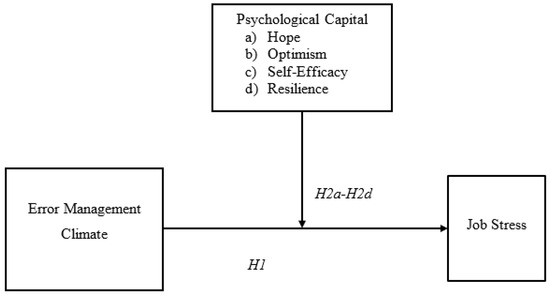
In this section, the research framework and theoretical basis for hypotheses development are presented. This section presents the relationship between research variables. The current study argues that error management climate (EMC) reduces job stress and that psychological capital (PsyCap) plays a moderating role in the relationship between EMC and job stress.
2.2.1. Job Demands-Resource (JD-R) Model
The job demands-resource (JD-R) model [36] posits that the additive effect of job demands and job resources drives individuals toward either positive or negative behavioral outcomes. Schaufeli and Taris [37] argue that the JD-R model assumes that employee wellbeing and stress are based on the balance between demands (negative) and resources (positive).
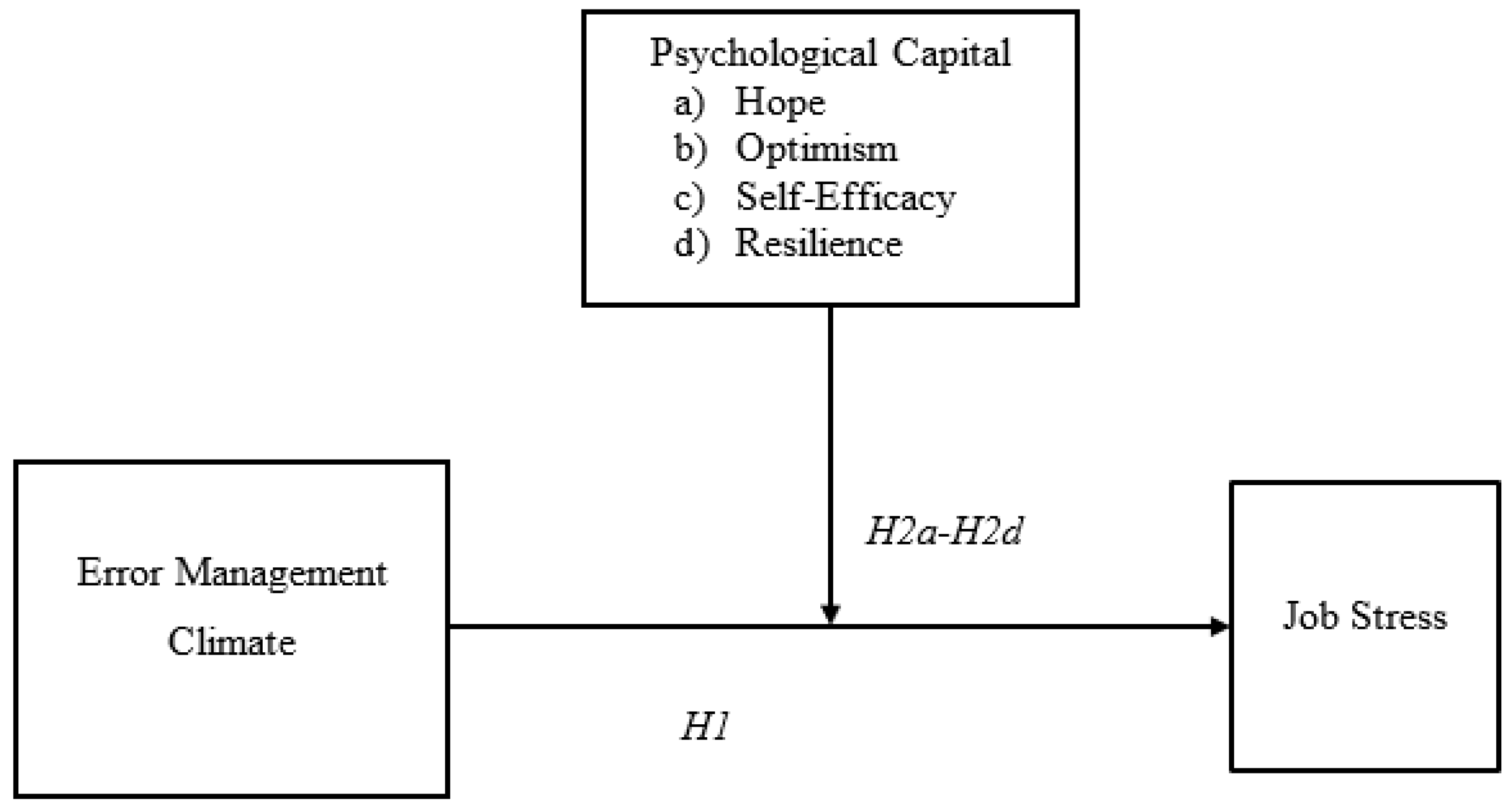
Based on the JD-R model, Demerouti et al. [38] argue that every job includes demands as well as resources. Job demands are reflective of elements of a working environment that can lead to stress whereas job resources facilitate work, growth, and learning, and decrease stress levels and stressors of the job [36,39]. Job demands refer to “those physical, social, or organizational aspects of the job that require sustained physical or mental effort and are therefore associated with certain physiological and psychological costs (e.g., exhaustion)” (p. 501). Generally these are energy-consuming efforts at work such as job insecurity, work overload, conflicts, a tense environment, and error-free work requirements. Job resources refer to “those physical, psychological, social, or organizational aspects of the job that may do any of the following: (a) be functional in achieving work goals; (b) reduce job demands at the associated physiological and psychological costs; (c) stimulate personal growth and development”(p. 501) [38]. Job resources are the helping factors in achieving work goals and meeting job demands positively such as social support, performance feedback (which may enhance learning), and job control (which might reduce job demands). Hence, by increasing resources such as job autonomy, job control, social support, climate, a positive workplace, and coworker support, two birds are killed with one stone: stress and negative events are decreased or prevented and positive events are increased [40]. These resources are helpful and stimulate personal growth, development, and learning [38]. The research model is presented in Figure 1.
Figure 1.
Research model.
2.2.2. Error Management Climate and Job Stress
According to Demerouti, Bakker, Nachreiner and Schaufeli [38], resources are helpful in work engagement and decreasing negative events such as stress, burnout, and turnover intentions. Error management climate provides an environment and resources and policies to members so that they can handle and deal with errors more effectively. An error management climate can provide job resources for organizational employees to work in an environment in which they share errors willingly with coworkers and others and seek help and advice from coworkers. At organizations in which strong error management is applied, employees feel more confident and manage errors effectively [15,41]. Error management climate provides a positive organizational environment in which employees help others, gain knowledge about causes of errors, and openly communicate and share their experience about errors. This error-related behavior is helpful for safety compliance [42] and safety citizenship behavior [43].
Guchait, Paşamehmetoğlu and Madera [16] studied the service industry and noted that strong error management may reduce employees’ stress and turnover intention. In a similar vein, Hodges and Gardner [44] have shown that error management climate is negatively related to stress. Error management climate does not remove the errors but instead focuses on changing employees’ responses to errors and dealing with an error after its occurrence [16]. When an individual perceives that job demands are high and beyond his perceived ability and resources are not available to achieve goals then the individual b stressed [45]. According to the JD-R model, when job resources are available then organizational members experience less job stress [46]. Thus, a supportive environment enables organizational members to cope with stress. Empirical evidence found that a supportive environment is negatively related to exhaustion, burnout, anxiety, and stress [47]. Given the theoretical reasoning and empirical evidence, it is hypothesized that:
Hypothesis 1.
Error management climate is negatively related to job stress.
2.2.3. Psychological Capital Dimensions (Hope, Optimism, Efficacy, Resilience) as Moderators
Credible empirical evidence points out that PsyCap as a higher-order construct plays a significant role in suppressing stress and anxiety. For example, Avey et al.’s [34] meta-analysis and other studies indicate that PsyCap as a personal psychological resource plays an important role in suppressing stress and anxiety and that it is negatively related to undesirable attitudes such as cynicism, turnover intentions, stress, and anxiety. However, there is emerging evidence that suggests that PsyCap’s influence as a potential psychological resource becomes diluted under different aspects of organizational and national cultures. For example, in their seminal study, Kacmar, Collins, Harris and Judge [20] found that when perceived organizational politics are combined with core self-evaluations (CSE) such as self-efficacy and locus of control, the deleterious effects of perceived politics on job performance are intensified. Similarly, Rego et al.’s [48] study points out numerous aspects of national culture as potential neutralizers of PsyCap as a resource. They note that organizational cultural aspects such as the absence of performance feedback and lack of clarity on goals could neutralize the positive influence of PsyCap as a resource. Similarly, Rego, Marques, Leal, Sousa and Pina e Cunha [48] note that national cultures characterized by high power distance do not promote proactive and assertive individuals and thus highly self-efficacious individuals find it suitable to be obedient and less assertive.
Referring to Hofstede’s [49] insights on national cultures, developing countries such as Pakistan score high on the dimensions of power distance, uncertainty avoidance, and collectivism. People from these cultures are likely to find politics to be high in organizations owing to unequal distribution of power, ambiguity, and chaos, and strong in-groups [50,51,52]. Hofstede’s (2001) insights on the culture of developing countries provide reasonable ground to consider organizational politics to be an inevitable part of organizations working in these countries. This context, therefore, holds a fundamental importance for hypothesizing the moderating role of PsyCap dimensions for the relationship between EMC and job stress.
The concept of locus of control provides a meaningful theoretical distinction between the two similar yet different constructs of hope and optimism [53]. Hope is theorized to be driven by an internal locus of control as opposed to the outer locus of control that feeds optimism. Individuals with an internal locus of control (agency and pathway approach) expect the turn of events as a function of their agency and pathway approach [54]; and hence, they are less susceptible to forces emanating from organizational contexts. It is therefore expected that individuals with high PsyCap hope and PsyCap optimism will yield to negative organizational contexts differently. Hope signifying an individual’s ability to strategize alternative pathways in the face of adversities [55,56] and its connection with an internal locus of control [53] is expected to allow individuals to fare better even when the organizational politics impede their expectations to achieve goals and achievements. Therefore, hopeful individuals are expected to take advantage of the prevailing error management climate, resulting in effective management of job stress. In contrast, PsyCap optimism as a function of external locus of control [53] may not be of value to individuals as expectations attached to significant others are compromised in an environment rife with organizational politics [57]. Therefore, optimistic individuals are expected to remain insulated from the theorized benefits of EMC, resulting in poor management of job stress.
Self-efficacy is reflective of an individual’s confidence in him/herself to succeed at work [17]. Organizational politics interfering with an individual’s chances of succeeding at work is likely to lead an individual to find alternative opportunities where one could employ skills and abilities in the advancement of professional goals. For example, Allen and Griffeth [58] note that high performing individuals are more likely to quit when they find salaries not commensurate with the promotion policies and practices; with this line of reasoning, it is plausible to argue that self-efficacious individuals find organizational politics a hindrance for the advancement of professional goals and so are not expected to capitalize on the benefits of EMC, resulting in the poor management of job stress. Lastly, PsyCap resilience reflective of an individual’s capacity to bounce back from adversity [59,60] is expected to provide the basis for individuals to carry on even in a politicized organizational environment. Furthermore, because that resilience plays an important role in replenishing the energy levels of employees and rendering them able to find solutions in difficult organizational circumstances [60], the odds that resilient individuals perceive organizational politics as an obstacle to their work are less [40]. It is therefore expected that individuals with high PsyCap resilience are expected to fare better in cultures characterized by high power distance, uncertainty avoidance, and collectivism. With this line of reasoning, PsyCap resilience is argued to provide the basis for individuals to harness the benefits EMC offers, resulting in the effective management of job stress.
Based on the above theoretical reasoning and empirical evidence it is hypothesized that:
Hypothesis 2a.
Hope positively moderates the relationship between error management climate and job stress.
Hypothesis 2b.
Optimism negatively moderates the relationship between error management climate and job stress.
Hypothesis 2c.
Self-efficacy negatively moderates the relationship between error management climate and job stress.
Hypothesis 2d.
Resilience positively moderates the relationship between error management climate and job stress.
3. Research Methodology
3.1. Research Participants
This study analyzes the effect of error management climate on the job-related stress of employees employed in industries related to the development of aerospace and avionics engineering works. The respondents of the current study work in all departments of aerospace and avionics, such as manufacturing, production, support, and light aircraft group.
3.2. Sample and Data Collection Procedure
In this study, the sample is drawn from the employees of the Pakistan aeronautical complex. A sample size of 260 respondents was drawn. The questionnaire was developed with the help of past literatures and empirical studies. Items of the questionnaire were adapted from already developed scales used in the previous researches. The questionnaire was translated into Urdu using the standard translation-back translation procedure [61], as the respondents included frontline workers.
A cross-sectional survey method has been used for data collection in the current study. A total of 250 questionnaires were floated among aeronautical employees, out of which 208 were returned that reflects an 84.8% response rate. Out of 208 responses, 141 respondents were workers (67.8%), 52 respondents were supervisors (25%), and only 14 engineers participated in responding to the questionnaire survey. The demographic characteristics of the sample are summarized in Table 1. After the data was collected from these employees, it was coded into numeric form.
Table 1.
Demographic characteristics.
3.3. Measures
The questionnaire developed for this study was divided into four parts. The first part included the demographic factors of respondents. It included age, education, total job experience, tenure in the current department, employment status, and designation. The second part included elements of error management climate (EMC), which is the independent variable of this study. The third part included questions related to psychological capital (PsyCap) which is the moderator. The last part included items of job-related stress, which is the dependent variable of this study. All the questions except those of part one were based on a 5-point Likert scale ranging from 1 to 5, where 1 represented “strongly disagree” and 5 represented “strongly agree”. Items are scaled because they help the respondent to give an appropriate response by consuming less time [62]. Questionnaires in English as well as in Urdu are reported as Appendix A and Appendix B respectively.
3.4. Error Management Climate
In this study, error management climate (EMC), being the independent variable of the study, was measured by sixteen items adapted from the previous study [15,30]. In this scale, one item–“For us, errors are very useful for improving the work process”—was omitted due to a lower internal consistency threshold value (0.6). The Cronbach alpha was 0.976 for 15 items-based EMC in this study (Table 2).
Table 2.
Results Summary of measurement model.
3.5. Job Stress
In this study, job stress, being the dependent variable, was measured by sixteen items adapted from the study by Parker and DeCotiis [63]. This variable measured the short-term psychological state of job stress. This job stress measure has been used in various previous studies, e.g., [64]. Two items—“My job gets to me more than it should” and “I feel relaxed when I take time off from my job”—were omitted due to a lower internal consistency threshold value (0.6). The Cronbach alpha was 0.944 for 13 items-based job stress measure employed in this study.
3.6. Psychological Capital
Psychological capital (PsyCap), playing the moderating role in the current study, consists of four subscales (i.e., optimism, hope, resilience, and self-efficacy). The PsyCap was measured with the shortened version of the psychological capital questionnaire PCQ-12 developed and validated by Luthans, Avolio, Avey and Norman [31]. In this study hope (4 items), optimism (2 items), self-efficacy (3 items), and resilience (3 items) found Cronbach’s alpha value of 0.937, 0.929, 0.844, and 0.870 respectively. The four subscales of PsyCap were measured separately in this study model.
3.7. Data Analysis Technique
Partial Least Squares Structural Equation Modeling (PLS-SEM) was adopted, using the Smart PLS 3.0 software package. PLS-SEM has been used successfully in various researches of a similar kind for assessing the interrelationships among the latent variables [65].
The results of PLS-SEM are based on two sets of models. The first is the measurement model that deals with interrelationships between measurement items and latent constructs. The second is the structural model that shows the relationship results among the latent constructs. The measurement model was assessed by internal consistency reliability convergent validity and discriminant validity [66]. For the assessment of the structural model, path coefficients’ t-values and p-values were used. Path coefficients were assessed by adopting bootstrapping. Bootstrapping is a resampling procedure in which the original sample serves as the population.
4. Results
4.1. Measurement Model Evaluation
The measurement model is primarily concerned with the assessment of convergent validity, discriminant validity, and the internal consistency reliability of the constructs of the research model. It is to be noted that the two parameters of loadings of indicator variables and the average variance extracted (AVE) are used to evaluate convergent validity [66]. For convergent validity, the average variance extracted (AVE) threshold should be >0.50. Similarly, the two parameters of Fornell and Larcker and cross-loadings of indicator variables are used to evaluate the discriminant validity.
Table 2 shows the summary of the measurement model. The result shows the Cronbach’s alpha and composite reliability of this study to be >0.7 threshold value, which shows the high level of internal consistency and reliability of reflective constructs [67]. Additionally, all outer loadings were greater than 0.50 with the t-values greater than 2.3.
Only four reflective measures are omitted, i.e., EMC1, HOP4, JS3, and JS10. Omitting these reflective measures resulted in an increase in AVE and composite reliability (CR) above the suggested threshold value [68]. Most of the items’ outer loading in this study is >0.708 whereas the minimum outer loading of measurement items is equal to 0.664. Three items (EMC9, JS5, JS6) were retained because deletion did not increase AVE and CR above the suggested threshold values. Further, the value of AVE is greater than 0.5 for all constructs that indicate the maximum convergent validity of all constructs (Table 2).
For discriminant validity evaluation, values of cross-loadings and Fornell and Larcker criterion correlation were assessed. Table 3 shows that all the diagonal values are high as compared to the off-diagonal elements in the corresponding rows and columns, indicating that Fornell and Larcker criterion is met and the constructs demonstrate discriminant validity [69]. Table 4 shows that all indicators load on their respective constructs, thereby establishing discriminant validity at the indicator variable level.
Table 3.
Correlation Matrix and Square Root of AVE Fornell and Larcker Criterion.
Table 4.
Cross loadings analysis.
4.2. Structural Model Evaluation
The structural model was assessed by examining the path coefficients. The R2 value was used to evaluate the model’s predictive accuracy, f2 to assess the substantial impact of the exogenous variable on an endogenous variable, and Q2 to evaluate the model’s predictive relevance [68].
Structural model prediction power is assessed by the value of R2 (coefficient of determination). Table 5 shows that the R2 value for this study is 0.383, that is the combined variation of all independent or exogenous variables can cause 38.3% variance in job stress (endogenous variable), and the Q2 is larger than zero, which shows the predictive relevance of the model (Table 5).
Table 5.
R2 and Q2 results.
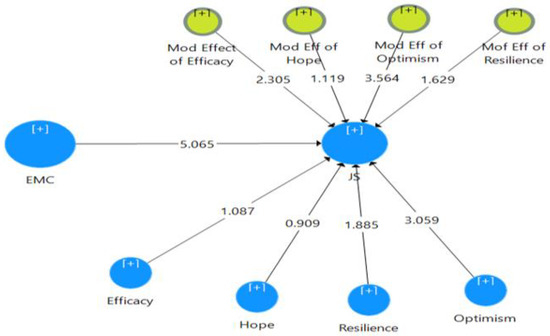
The path coefficient is used for structural model assessment and is checked by bootstrapping in Smart PLS. Path coefficient explains how strong one variable influences the other variable; its value must be higher than 0.20 [65]. It is found that three paths (EMC → Job Stress, Optimism → Job Stress, and Efficacy → Job Stress) are significant; on the other side, two paths (Hope → Job Stress and Resilience → Job Stress) are insignificant. However, path relevance is determined by the magnitude of the path coefficients. In this study, the highest path coefficient is that of Mod eff of Optimism → Job Stress (−0.418), followed by EMC → Job Stress (−0.328), and Mod eff of Efficacy → Job Stress (−0.242).
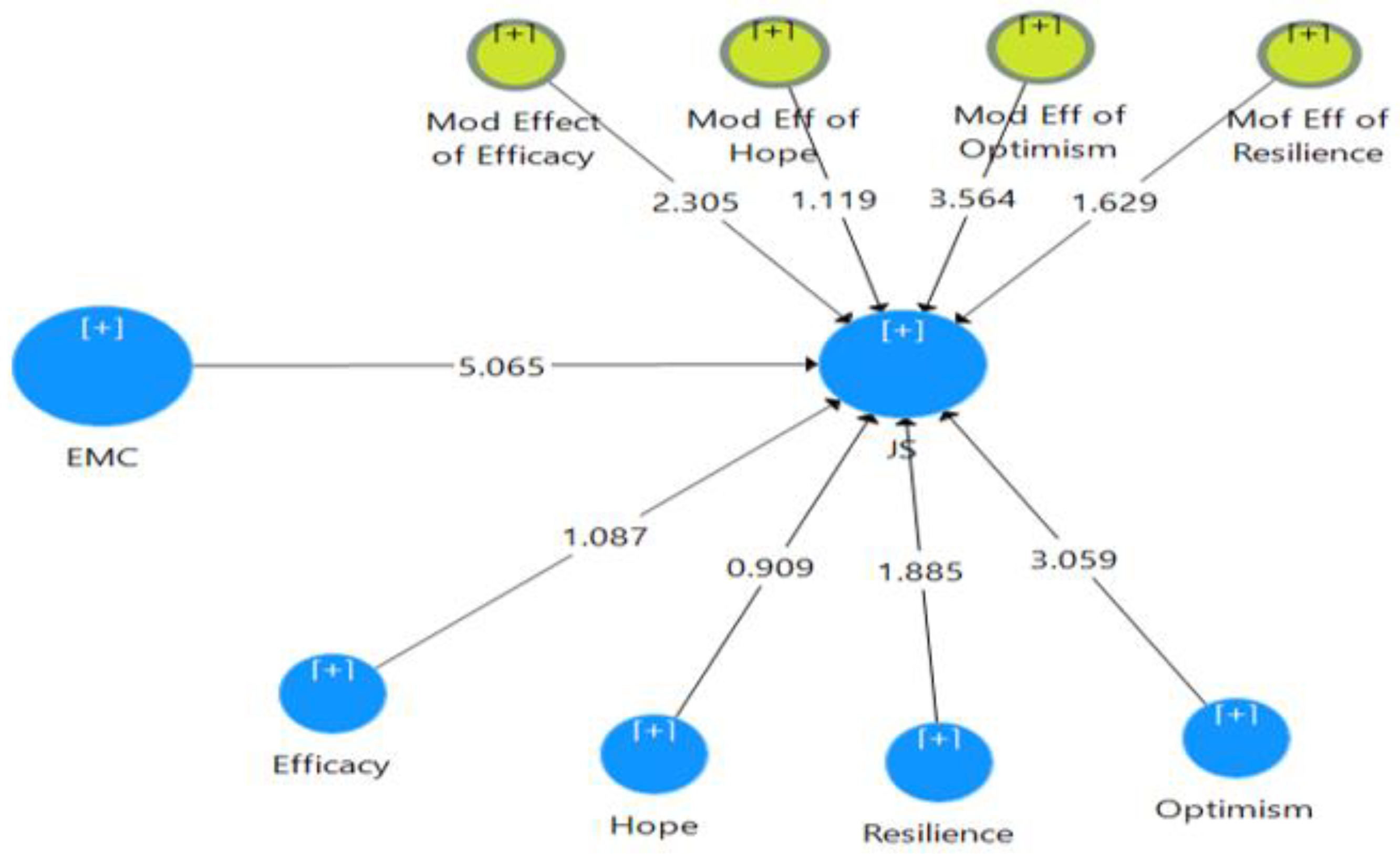
Figure 2 shows the relationship between the studied variables (error management climate, job stress, and psychological capital dimensions). As per the bootstrapping procedure, the significance of path coefficient, p-statistics, and t-values of this study model are shown in Table 6.
Figure 2.
Model constructs relationships.
Table 6.
Structural model—Path Coefficients, T-Statistics and Significance of Hypotheses.
4.3. Hypothesis Testing
After the validity of the structural model is confirmed, the next step is to assess the paths of the proposed structural model. A total of five hypotheses were proposed in this study. Out of these five hypotheses, one hypothesis is predictive of the direct relationship of the exogenous variable (EMC) on the endogenous variable (Job stress). The other four hypotheses reflect the moderating effect of PsyCap dimensions (hope, optimism, efficacy, and resilience) on the relationship between EMC and the dependent variable (job stress). The hypotheses’ results are provided in Table 6 below.
5. Discussion
The purpose of this research was to explore the relationship between error management climate (EMC) and employees’ job-related stress. A sample of Pakistani aeronautical employees was used to evaluate error management climate, psychological capital dimensions, and job stress relationships. This study found that error management climate is negatively related to job stress.
Referring to Table 6, the path coefficient for the relationship between EMC and job stress is −0.328, which shows that the individual’s perceived organizational error management climate is negatively and significantly associated with job stress [38]. Consistent with the above and in the specific case of the aeronautical employees, it has been found that those who find the organizational climate to be supportive of error management tend to feel low job stress [14]. This study’s findings are consistent with the previous study results, e.g., [15,30]. In other words, it could be said that in organizations in which a strong error management climate is provided, employees feel more confident and manage errors effectively [41].
For the moderating role of PsyCap dimensions, Optimism (β = −0.418, p = 0.000) and self-efficacy (β = −0.242 p = 0.016) are found to have a significant negative moderating effect. Therefore, H2b and H2c are accepted. These findings are in line with the findings of Abbas et al.’s [70] study which was also conducted in Pakistan’s context. The current study is conducted in the largest and the only aircraft manufacturing facility in Pakistan. This facility operates in the public sector and the personnel’s job nature is governed by the Government’s policies. Jobs in the public sector at the working-staff level may not appear lucrative owing to tough working environments, continuous pressure to meet deadlines, and almost no incentives on achieving goals and targets. Furthermore, lack of proper feedback and guidance, poor communication, and ambiguous policies and procedures fuel perceived organizational politics [70]. It is possible to argue that organizational politics is a dominant part of Pakistani public sector organizations considering Hofstede’s [49] insights on Pakistani culture. Therefore, it could be argued that perceptions of organizational politics when combined with employees’ psychological state of self-efficacy and optimism have a role to play in retarding the influence of EMC on job stress.
Results indicate that hope (β = 0.130, p = 0.254) and resilience (β = 0.167 p = 0.110) moderate the relationship between EMC and job stress as hypothesized, but not at statistically significant levels. Therefore, both H2a and H2d are rejected. Results are of significance for understanding that hope and resilience might play a significant role in strengthening the relationship between EMC and job stress provided that organizations are supportive of individuals and provide systemic help in the development and maintenance of psychological resources such as hope and resilience. These results also highlight that the JD-R model in tandem with Hofstede’s [49] insights on national cultures holds more relevance in hypothesizing the relationships involving PsyCap dimensions and individual-level outcomes.
6. Conclusions
Current study findings demonstrated that within the context of aeronautical project organizations, error management climate has a direct impact on job stress. This study further suggests that core self-evaluations of individuals in the form of optimism and self-efficacy could have a negative moderating effect on the relationship between EMC and job stress. Thus, it is important to note that the cultivation of an error management climate may not work in combating an individual’s stress when an individual’s psychological resources are threatened in the wake of organizational politics.
This study’s findings are in-line with Kacmar, Collins, Harris and Judge’s [20] and Bozeman, Hochwarier, Perrewe and Brymer’s [21] findings whereby core self-evaluation in the form of self-efficacy has been found to have counter-productive effects. Furthermore, the results of the study lend support to Avey et al.’s [34] conclusion that industry type and sample base (the US vs non-US) have a significant influence on the effects of PsyCap. This study, nonetheless, provides an alternative perspective on psychological capital which must be investigated further in other countries with similar profiles of power distance and uncertainty avoidance.
The present study has important theoretical implications of error management in several directions. First, it is one of the first studies to investigate the relationship between error management climate (EMC) and job-related stress. Although EMC and stress have been studied independently as important organizational factors [71], their role in the aeronautical industry has been largely neglected. Second, this study is the first to empirically examine error management climate (EMC) in an aeronautical project-based industry context, asserting that EMC principles are relevant to aeronautical employee job stress and need to be applied more extensively. Third, the current study has contributed to the literature on job-related stress by considering the combination of psychological capital (PsyCap) and error management climate (EMC) in the conceptual model.
From a practical perspective, this study’s results suggest that interventions can be made from the perspective of error management climate in job-related stress. Considering the negative effect of errors on employee stress, managers should be aware of the benefits error management provides and the effects employees may experience, allowing them to take measures to reduce the errors. In complex organizations, managers should handle error as an event that can provide knowledge and learning, rather than blaming or punishing anyone. Additionally, organizations should promote an environment in which rewards for excellent error recoveries, sharing information, and assisting situations are provided. Where it is important to develop procedures and norms that would be fundamental in cultivating perceptions of error management, it is equally important for management to introduce structural changes in a system for the cultivation of a just culture. Adhering to important elements of justice such as substantive justice, procedural justice, and restorative justice could prove critical in aligning management’s efforts to cultivate error management climate. For example, substantive justice underscores the importance of morality and the legitimacy of rules’ content [72]. Rules made in isolation and neglecting the requirements of reality may induce pressure on workers to get the job done, paving way for errors that may lead to serious accidents. In a similar vein, procedural justice is what individuals witness and internalize in their subconscious. This internalization later provides a guide for individuals’ actions. The cultivation of procedural justice is thought to have a significant role in the successful cultivation of error management climate.. Individuals should be able to witness the investigations in relation to error occurrence through impartial mechanisms. For example, the appointment of objective judges [72] may go a long way in allowing workers to have faith in the procedural justice of the organization, thereby allowing individuals to develop attitudes considered optimum for error management. Lastly, an accountability system based on restorative justice could potentially provide a strong basis for error management climate to develop and thrive. Restorative justice deals with the idea of healing whereby the victims of accidents and those being alleged in accident causation are provided with the opportunity to have their voices heard. Organizations have a crucial role in demonstrating that organizations are not focused on holding individuals responsible for the errors or accidents, rather that their main concern is to understand the principal practices, norms, and work routines that have led to such procedural lapses, errors or accidents. Such an all-inclusive approach is expected to provide firm foundations for EMC to take hold in the organization.
Limitations and Future Directions
The findings of this study like any other research study are not without limitations. The hypothesized moderating influence of hope and resilience did not find support from the data at the statistically significant levels. Although the sample size of this study was determined following the guidelines provided by [73], the relationships must be studied with a larger sample size. Furthermore, this study conducted in the air crafts manufacturing industry may have been influenced by peculiar job routines which may be uncommon in the service industry. Therefore, a similar study in the service industry is recommended to broaden our perspective in understanding the role PsyCap plays in reducing job stress.
Author Contributions
Conceptualization, H.A. and A.M.; methodology, T.T.J.; software, H.A.; validation, R.F.T.; formal analysis, A.M.; investigation, H.A.; resources, A.M.; data curation, T.T.J.; writing—original draft preparation, T.T.J., R.F. and H.A.; writing—review and editing, A.M, R.F., M.A.U.R.T. and R.F.T.; supervision, H.A. and M.A.U.R.T.; project administration, H.A. All authors have read and agreed to the published version of the manuscript.
Funding
This research received no external funding.
Data Availability Statement
Not applicable.
Conflicts of Interest
The authors declare no conflict of interest.
Appendix A. Measures Used in the Study (English Version)
Table A1.
Error Management Climate.
Table A2.
Job Stress.
Appendix B. Measures Used in the Study (Urdu Version)
Table A3.
Error Management Climate.
Table A4.
Job Stress.
References
- Peng, L.; Chan, A.H. Adjusting work conditions to meet the declined health and functional capacity of older construction workers in Hong Kong. Saf. Sci. 2020, 127, 104711. [Google Scholar] [CrossRef] [Scilit]
- Lee, C.; Huang, G.-H.; Ashford, S.J. Job Insecurity and the Changing Workplace: Recent Developments and the Future Trends in Job Insecurity Research. Annu. Rev. Organ. Psychol. Organ. Behav. 2018, 5, 335–359. [Google Scholar] [CrossRef] [Scilit]
- Santos, L.; Melicio, R. Stress, Pressure and Fatigue on Aircraft Maintenance Personal. Int. Rev. Aerosp. Eng. 2019, 12, 35–45. [Google Scholar] [CrossRef] [Scilit]
- Wang, W.; Sakata, K.; Komiya, A.; Li, Y. What Makes Employees’ Work So Stressful? Effects of Vertical Leadership and Horizontal Management on Employees’ Stress. Front. Psychol. 2020, 11, 340. [Google Scholar] [CrossRef] [Scilit] [PubMed]
- Vui-Yee, K.; Yen-Hwa, T. When does ostracism lead to turnover intention? The moderated mediation model of job stress and job autonomy. IIMB Manag. Rev. 2020, 32, 238–248. [Google Scholar] [CrossRef] [Scilit]
- Wang, D.; Wang, X.; Xia, N. How safety-related stress affects workers’ safety behavior: The moderating role of psychological capital. Saf. Sci. 2018, 103, 247–259. [Google Scholar] [CrossRef] [Scilit]
- Dupont, G. The dirty dozen errors in aviation maintenance. In Proceedings of the Eleventh Federal Aviation Administration Meeting on Human Factors Issues in Aircraft Maintenance and Inspection “Human Error in Aviation Maintenance”, San Diego, CA, USA, 12–13 March 1997; pp. 45–49. [Google Scholar]
- Gemünden, H.G.; Lehner, P.; Kock, A. The project-oriented organization and its contribution to innovation. Int. J. Proj. Manag. 2018, 36, 147–160. [Google Scholar] [CrossRef] [Scilit]
- Turner, R.; Huemann, M.; Keegan, A. Human resource management in the project-oriented organization: Employee well-being and ethical treatment. Int. J. Proj. Manag. 2008, 26, 577–585. [Google Scholar] [CrossRef] [Scilit]
- Liu, J.Y.; Low, S.P. Work–family conflicts experienced by project managers in the Chinese construction industry. Int. J. Proj. Manag. 2011, 29, 117–128. [Google Scholar] [CrossRef] [Scilit]
- Bowen, P.; Edwards, P.; Lingard, H.; Cattell, K. Occupational stress and job demand, control and support factors among construction project consultants. Int. J. Proj. Manag. 2014, 32, 1273–1284. [Google Scholar] [CrossRef] [Scilit]
- Ciampa, P.D.; Nagel, B. AGILE Paradigm: The next generation collaborative MDO for the development of aeronautical systems. Prog. Aerosp. Sci. 2020, 119, 100643. [Google Scholar] [CrossRef] [Scilit]
- Silva, A.V.; Trabasso, L.G. Design for Automation within the aeronautical domain. J. Braz. Soc. Mech. Sci. Eng. 2019, 41, 292. [Google Scholar] [CrossRef] [Scilit]
- Guchait, P.; Paşamehmetoğlu, A.; Dawson, M. Perceived supervisor and co-worker support for error management: Impact on perceived psychological safety and service recovery performance. Int. J. Hosp. Manag. 2014, 41, 28–37. [Google Scholar] [CrossRef] [Scilit]
- Van Dyck, C.; Frese, M.; Baer, M.; Sonnentag, S. Organizational Error Management Culture and its Impact on Performance: A Two-Study Replication. J. Appl. Psychol. 2005, 90, 1228–1240. [Google Scholar] [CrossRef] [Scilit] [PubMed]
- Guchait, P.; Paşamehmetoğlu, A.; Madera, J. Error management culture: Impact on cohesion, stress, and turnover intentions. Serv. Ind. J. 2016, 36, 124–141. [Google Scholar] [CrossRef] [Scilit]
- Luthans, F.; Youssef, C.M.; Avolio, B.J. Psychological Capital: Developing the Human Competitive Edge; Oxford University Press: Oxford, UK, 2007. [Google Scholar]
- Bakker, A.B.; Demerouti, E. Job demands–resources theory. In Wellbeing: A Complete Reference Guide; Cooper, C.L., Ed.; John Wiley & Sons, Ltd.: Hoboken, NJ, USA, 2014; pp. 1–28. [Google Scholar]
- Avey, J.B.; Wernsing, T.S.; Luthans, F. Can positive employees help positive organizational change? Impact of psychological capital and emotions on relevant attitudes and behaviors. J. Appl. Behav. Sci. 2008, 44, 48–70. [Google Scholar] [CrossRef] [Scilit]
- Kacmar, K.M.; Collins, B.J.; Harris, K.J.; Judge, T.A. Core self-evaluations and job performance: The role of the perceived work environment. J. Appl. Psychol. 2009, 94, 1572–1580. [Google Scholar] [CrossRef] [Scilit]
- Bozeman, D.P.; Hochwarier, W.A.; Perrewe, P.L.; Brymer, R.A. Organizational politics, perceived control, and work outcomes: Boundary conditions on the effects of politics. J. Appl. Soc. Psychol. 2001, 31, 486–503. [Google Scholar] [CrossRef] [Scilit]
- Casey, T.W.; Krauss, A.D. The role of effective error management practices in increasing miners’ safety performance. Saf. Sci. 2013, 60, 131–141. [Google Scholar] [CrossRef] [Scilit]
- De Silva, N.; Samanmali, R.; De Silva, H.L. Managing occupational stress of professionals in large construction projects. J. Eng. Des. Technol. 2017, 15, 488–504. [Google Scholar] [CrossRef] [Scilit]
- Matteson, M.T.; Ivancevich, J.M. Controlling Work Stress: Effective Human Resource and Management Strategies; Jossey-Bass: San Francisco, CA, USA, 1987. [Google Scholar]
- Misis, M.; Kim, B.; Cheeseman, K.; Hogan, N.L.; Lambert, E.G. The impact of correctional officer perceptions of inmates on job stress. Sage Open 2013, 3, 2158244013489695. [Google Scholar] [CrossRef] [Scilit]
- George, E.; Zakkariya, K.A. Job related stress and job satisfaction: A comparative study among bank employees. J. Manag. Dev. 2015, 34, 316–329. [Google Scholar] [CrossRef] [Scilit]
- Leung, M.-Y.; Chan, I.Y.S.; Yu, J. Preventing construction worker injury incidents through the management of personal stress and organizational stressors. Accid. Anal. Prev. 2012, 48, 156–166. [Google Scholar] [CrossRef] [Scilit] [PubMed]
- Wei, W.; Guo, M.; Ye, L.; Liao, G.; Yang, Z. Work-family conflict and safety participation of high-speed railway drivers: Job satisfaction as a mediator. Accid. Anal. Prev. 2016, 95, 97–103. [Google Scholar] [CrossRef] [Scilit] [PubMed]
- Tiyce, M.; Hing, N.; Cairncross, G.; Breen, H. Employee Stress and Stressors in Gambling and Hospitality Workplaces. J. Hum. Resour. Hosp. Tour. 2013, 12, 126–154. [Google Scholar] [CrossRef] [Scilit]
- Cigularov, K.P.; Chen, P.Y.; Rosecrance, J. The effects of error management climate and safety communication on safety: A multi-level study. Accid. Anal. Prev. 2010, 42, 1498–1506. [Google Scholar] [CrossRef] [Scilit]
- Luthans, F.; Avolio, B.J.; Avey, J.B.; Norman, S.M. Positive psychological capital: Measurement and relationship with performance and satisfaction. Pers. Psychol. 2007, 60, 541–572. [Google Scholar] [CrossRef] [Scilit]
- Sweetman, D.; Luthans, F.; Avey, J.B.; Luthans, B.C. Relationship between positive psychological capital and creative performance. Can. J. Adm. Sci./Rev. Can. Des Sci. De L’adm. 2011, 28, 4–13. [Google Scholar] [CrossRef] [Scilit]
- Kang, H.J.; Busser, J.A. Impact of service climate and psychological capital on employee engagement: The role of organizational hierarchy. Int. J. Hosp. Manag. 2018, 75, 1–9. [Google Scholar] [CrossRef] [Scilit]
- Avey, J.B.; Reichard, R.J.; Luthans, F.; Mhatre, K.H. Meta-analysis of the impact of positive psychological capital on employee attitudes, behaviors, and performance. Hum. Resour. Dev. Q. 2011, 22, 127–152. [Google Scholar] [CrossRef] [Scilit]
- Wu, C.-M.; Chen, T.-J. Collective psychological capital: Linking shared leadership, organizational commitment, and creativity. Int. J. Hosp. Manag. 2018, 74, 75–84. [Google Scholar] [CrossRef] [Scilit]
- Bakker, A.B.; Demerouti, E. The job demands-resources model: State of the art. J. Manag. Psychol. 2007, 22, 309–328. [Google Scholar] [CrossRef] [Scilit]
- Schaufeli, W.B.; Taris, T.W. A critical review of the Job Demands-Resources Model: Implications for improving work and health. In Bridging Occupational, Organizational and Public Health; Springer: Dordrecht, Germany, 2014; pp. 43–68. [Google Scholar]
- Demerouti, E.; Bakker, A.B.; Nachreiner, F.; Schaufeli, W.B. The job demands-resources model of burnout. J. Appl. Psychol. 2001, 86, 499–512. [Google Scholar] [CrossRef] [PubMed]
- Bakker, A.B.; Demerouti, E.; Verbeke, W. Using the job demands-resources model to predict burnout and performance. Hum. Resour. Manag. Adv. Hum. Resour. Res. Pract. 2004, 43, 83–104. [Google Scholar] [CrossRef] [Scilit]
- Crawford, E.R.; LePine, J.A.; Rich, B.L. Linking job demands and resources to employee engagement and burnout: A theoretical extension and meta-analytic test. J. Appl. Psychol. 2010, 95, 834–848. [Google Scholar] [CrossRef] [Scilit]
- Schaufeli, W.B. Applying the job demands-resources model: A ‘how to’ guide to measuring and tackling work engagement and burnout. Organ. Dyn. 2017, 2, 120–132. [Google Scholar] [CrossRef] [Scilit]
- Burke, M.J.; Sarpy, S.A.; Tesluk, P.E.; Smith-crowe, K. General Safety Performance: A Test of a Grounded Theoretical Model. Pers. Psychol. 2002, 55, 429–457. [Google Scholar] [CrossRef] [Scilit]
- Nahrgang, J.D.; Morgeson, F.P.; Hofmann, D.A. Safety at work: A meta-analytic investigation of the link between job demands, job resources, burnout, engagement, and safety outcomes. J. Appl. Psychol. 2011, 96, 71–94. [Google Scholar] [CrossRef] [Scilit]
- Hodges, M.E.; Gardner, D. Examining the influence of error climate on aviation maintenance performance. Australas. J. Organ. Psychol. 2014, 7, E1. [Google Scholar] [CrossRef] [Scilit]
- Liu, C.; Li, H. Stressors and stressor appraisals: The moderating effect of task efficacy. J. Bus. Psychol. 2018, 33, 141–154. [Google Scholar] [CrossRef] [Scilit]
- Steinhardt, M.A.; Dolbier, C.L.; Gottlieb, N.H.; McCalister, K.T. The relationship between hardiness, supervisor support, group cohesion, and job stress as predictors of job satisfaction. Am. J. Health Promot. 2003, 17, 382–389. [Google Scholar] [CrossRef] [Scilit] [PubMed]
- Halbesleben, J.R. Sources of social support and burnout: A meta-analytic test of the conservation of resources model. J. Appl. Psychol. 2011, 96, 182. [Google Scholar] [CrossRef] [Scilit]
- Rego, A.; Marques, C.; Leal, S.; Sousa, F.; Pina e Cunha, M. Psychological capital and performance of Portuguese civil servants: Exploring neutralizers in the context of an appraisal system. Int. J. Hum. Resour. Manag. 2010, 21, 1531–1552. [Google Scholar] [CrossRef] [Scilit]
- Hofstede, G. Culture’s Consequences: Comparing Values, Behaviors, Institutions and Organizations Across Nations, 2nd ed.; Sage Publications: Thousand Oaks, CA, USA, 2001. [Google Scholar]
- Romm, T.; Drory, A. Political behavior in organizations—A cross-cultural comparison. Int. J. Value Based Manag. 1988, 1, 97–113. [Google Scholar] [CrossRef] [Scilit]
- Vigoda, E. Reactions to organizational politics: A cross-cultural examination in Israel and Britain. Hum. Relat. 2001, 54, 1483–1518. [Google Scholar] [CrossRef] [Scilit]
- Drory, A.; Vigoda-Gadot, E. Organizational politics and human resource management: A typology and the Israeli experience. Hum. Resour. Manag. Rev. 2010, 20, 194–202. [Google Scholar] [CrossRef] [Scilit]
- Carifio, J.; Rhodes, L. Construct validities and the empirical relationships between optimism, hope, self-efficacy, and locus of control. Work 2002, 19, 125–136. [Google Scholar]
- Gallagher, M.W.; Lopez, S.J. Positive expectancies and mental health: Identifying the unique contributions of hope and optimism. J. Posit. Psychol. 2009, 4, 548–556. [Google Scholar] [CrossRef] [Scilit]
- Snyder, C.R.; Rand, K.L.; Sigmon, D.R. Hope theory. In Handbook of Positive Psychology; Snyder, C.R., Rand, K.L., Lopez, S.J., Eds.; Oxford University Press: New York, NY, USA, 2002; pp. 257–276. [Google Scholar]
- Luthans, F.; Youssef, C.M.; Avolio, B.J. Psychological Capital and Beyond; Oxford University Press: New York, NY, USA, 2015. [Google Scholar]
- Poon, J.M. Situational antecedents and outcomes of organizational politics perceptions. J. Manag. Psychol. 2003, 18, 138–155. [Google Scholar] [CrossRef] [Scilit]
- Allen, D.G.; Griffeth, R.W. Job performance and turnover: A review and integrative multi-route model. Hum. Resour. Manag. Rev. 1999, 9, 525–548. [Google Scholar] [CrossRef] [Scilit]
- Luthans, F. The need for and meaning of positive organizational behavior. J. Organ. Behav. 2002, 23, 695–706. [Google Scholar] [CrossRef] [Scilit]
- Youssef, C.M.; Luthans, F. Positive organizational behavior in the workplace the impact of hope, optimism, and resilience. J. Manag. 2007, 33, 774–800. [Google Scholar] [CrossRef] [Scilit]
- Douglas, S.P.; Craig, C.S. Collaborative and iterative translation: An alternative approach to back translation. J. Int. Mark. 2007, 15, 30–43. [Google Scholar] [CrossRef] [Scilit]
- Allen, I.E.; Seaman, C.A. Likert scales and data analyses. Qual. Prog. 2007, 40, 64–65. [Google Scholar]
- Parker, D.F.; DeCotiis, T.A. Organizational determinants of job stress. Organ. Behav. Hum. Perform. 1983, 32, 160–177. [Google Scholar] [CrossRef] [Scilit]
- Jamal, M.; Baba, V.V. Shiftwork and department-type related to job stress, work attitudes and behavioral intentions: A study of nurses. J. Organ. Behav. 1992, 13, 449–464. [Google Scholar] [CrossRef] [Scilit]
- Wong, K.K.-K. Partial least squares structural equation modeling (PLS-SEM) techniques using SmartPLS. Mark. Bull. 2013, 24, 1–32. [Google Scholar]
- Hair, J.F.; Ringle, C.M.; Sarstedt, M. PLS-SEM: Indeed a silver bullet. J. Mark. Theory Pract. 2011, 19, 139–152. [Google Scholar] [CrossRef] [Scilit]
- Hair, J.F.; Sarstedt, M.; Ringle, C.M.; Mena, J.A. An assessment of the use of partial least squares structural equation modeling in marketing research. J. Acad. Mark. Sci. 2012, 40, 414–433. [Google Scholar] [CrossRef] [Scilit]
- Hair, J.F., Jr.; Sarstedt, M.; Hopkins, L.; Kuppelwieser, V.G. Partial least squares structural equation modeling (PLS-SEM) An emerging tool in business research. Eur. Bus. Rev. 2014, 26, 106–121. [Google Scholar] [CrossRef] [Scilit]
- Henseler, J.; Ringle, C.M.; Sarstedt, M. A new criterion for assessing discriminant validity in variance-based structural equation modeling. J. Acad. Mark. Sci. 2015, 43, 115–135. [Google Scholar] [CrossRef] [Scilit]
- Abbas, M.; Raja, U.; Darr, W.; Bouckenooghe, D. Combined effects of perceived politics and psychological capital on job satisfaction, turnover intentions, and performance. J. Manag. 2014, 40, 1813–1830. [Google Scholar] [CrossRef] [Scilit]
- Lei, Z.; Naveh, E.; Novikov, Z. Errors in Organizations: An Integrative Review via Level of Analysis, Temporal Dynamism, and Priority Lenses. J. Manag. 2016, 42, 1315–1343. [Google Scholar] [CrossRef] [Scilit]
- Dekker, S.W.; Breakey, H. ‘Just culture:’Improving safety by achieving substantive, procedural and restorative justice. Saf. Sci. 2016, 85, 187–193. [Google Scholar] [CrossRef] [Scilit]
- Cohen, J. A power primer. Psychol. Bull. 1992, 112, 155–159. [Google Scholar] [CrossRef]

Publisher’s Note: MDPI stays neutral with regard to jurisdictional claims in published maps and institutional affiliations. |
© 2022 by the authors. Licensee MDPI, Basel, Switzerland. This article is an open access article distributed under the terms and conditions of the Creative Commons Attribution (CC BY) license (https://creativecommons.org/licenses/by/4.0/).