


Abstract
Municipal solid waste management is considered one of the major environmental challenges. Organic waste, especially food waste, usually accounts for over 50 wt% of municipal solid waste, yet, in most countries, it is the least recovered material. Decentralized composting aims to develop a new framework of waste management, building a closed-loop system for the composting of home, community, and commercial organic waste in urban environments. However, in some cases, decentralized composting is not economically and/or environmentally viable. Even when it is viable, various barriers and challenges need to be addressed in many cases. Different models in the literature address certain aspects of organic waste management, such as food waste treatment technology, recovery of energy, site selection, or environmental impact. The objective of this study is to provide guidelines and a methodological framework to quantify economic, social, operational, environmental, and regulatory aspects, in order to examine the viability and feasibility of decentralized composting projects at any given location. The decentralized composting analysis model proposed in this study has been developed with an innovative approach to decentralized composting project planning and design, an approach that is both holistic and very practical. The innovative model incorporates various aspects to examine the viability of decentralized composting projects based on benefit/cost criteria. In this respect, a result obtained through another model that examines a specific aspect of decentralized composting can be used as input for the model presented here. The decentralized composting analysis model provides a powerful tool for decision makers, based on the quantification of the decentralized composting project characteristics, and a benefit/cost index that takes into account the various impact variables. The decentralized composting analysis model allows examining the viability of the decentralized composting project in different scenarios, locations and options, and can help indicate the most viable alternative. In this paper, we describe the decentralized composting analysis model and its methodological framework, along with numerical examples to demonstrate its implementation.
1. Introduction
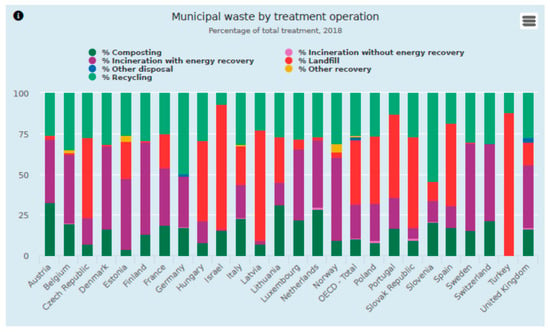
Over the past few decades, municipal solid waste management (MSWM) has been considered one of the major environmental challenges [1,2,3,4]. Organic waste (OW), especially food waste, is usually the most significant component of municipal solid waste [5,6], and its reduction has been ranked 3rd of 100 solutions to reducing climate change [7]. However, in most countries, it is the least recovered material [8,9,10]. According to Eurostat [11], about 17% of the municipal waste in the EU-27 countries was composted in 2018. In countries belonging to the Organisation for Economic Co-operation and Development (OECD), composting is also relatively uncommon compared to other treatment and disposal methods. The municipal waste by-treatment operations in OECD countries are presented in Figure 1. In countries in Europe and the Mediterranean, OW usually accounts for about 35 wt%–57 wt% of the MSW; thus, the treatment of OW has received increased attention for over two decades [12], and there has been growing attention to improving its management [5,6,8,13,14,15,16]. One prominent approach for treating organic waste is decentralized composting (DC) [13,17]. Despite the relevance of DC, the research developed worldwide on the subject does not address, for the most part, many aspects involved with such projects—technical, environmental, social, and economic [17]—but rather addresses certain aspects of OW management, such as treatment technology [18,19,20], recovery of energy/organic fertilizer [21], plant site selection [22], or environmental/life-cycle impacts [23,24].
Figure 1.
OECD municipal waste by treatment operation in 2018. Source: OECD (2020) [15].
OW management solutions should be analysed in an integrative manner by considering economic, social, operational, environmental, and regulatory aspects [1,2,17,25,26,27,28]. In this paper, we present a decentralized composting analysis model (DCAM) that takes those aspects—economic, social, operational, environmental, and regulatory— into account to examine the viability and feasibility of decentralized composting projects at any given location.
The innovation in the DCAM presented in this paper is that it incorporates various aspects, and examines the viability of DC projects, based on benefit/cost criteria. In this respect, results obtained through other models that examine specific aspects of DC—such as technologies, for example—can be used as input for the DCAM presented here.
2. Decentralized Composting
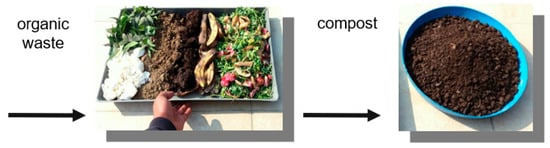
Decentralized composting (DC) aims to develop a new framework of waste management, build a closed-loop system of OW valorisation, and integrate decentralized home, community, and commercial composting systems [13,27]. DC also has the potential to reduce landfill volumes, save on collection, transportation, and treatment costs, and reduce conventional emissions as well as greenhouse gases, mainly methane [5,8,13,27]. In addition, OW management in the community is important in terms of education for sustainability and environmental protection, especially if the products of the process are used by the local community, to grow local edible plants for example. A schematic illustration of organic waste composting is presented in Figure 2.
Figure 2.
Schematic illustration of organic waste composting.
The DCAM aims to provide guidelines and a methodological framework to quantify economic, social, operational, environmental, and regulatory aspects, in order to examine the feasibility of DC projects. The DCAM has been developed with an innovative approach to planning and designing DC projects, an approach that is both holistic and very practical.
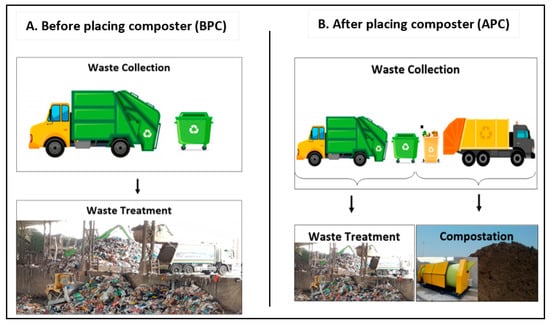
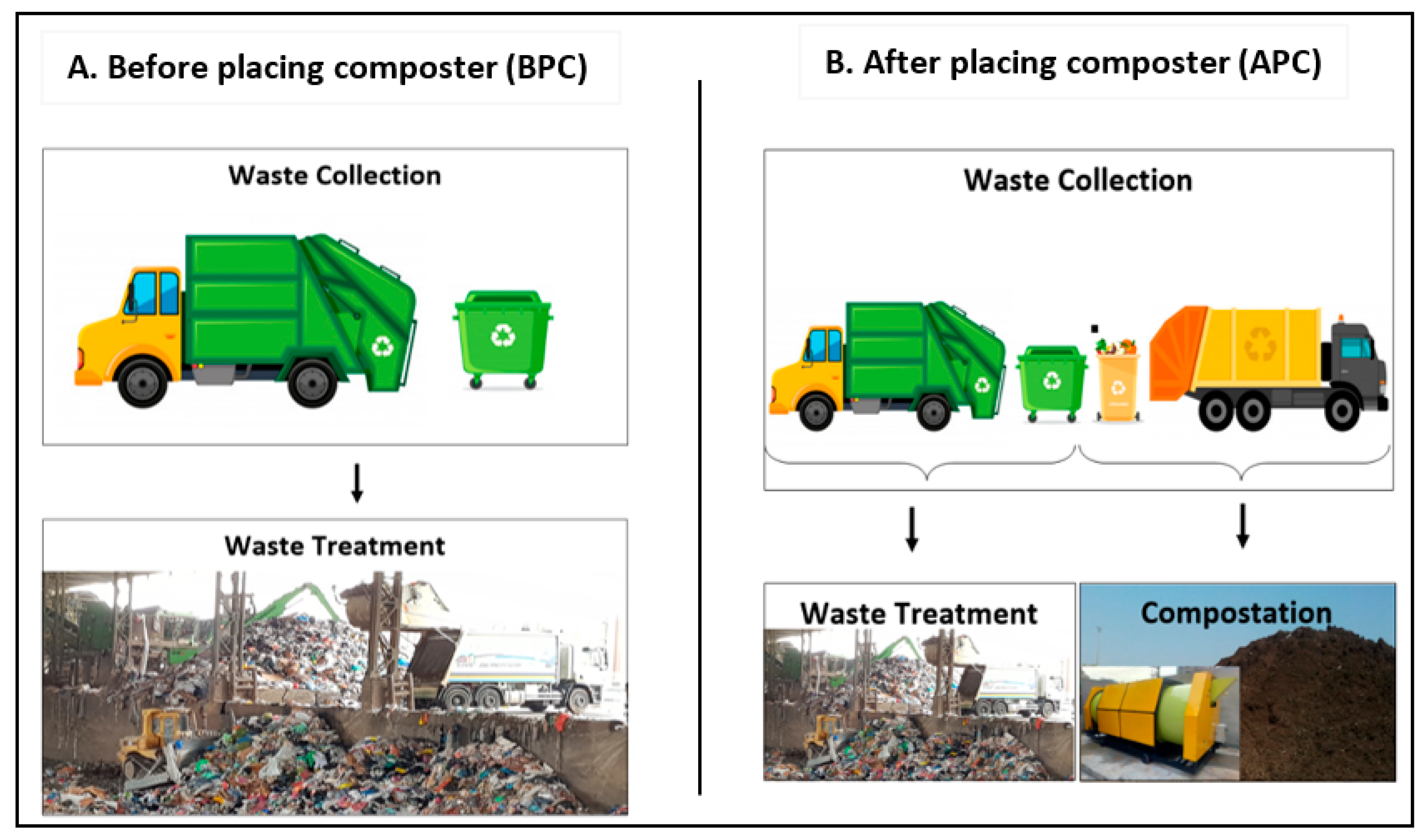
A DC project can generate additional expenditures or it can generate savings. The DCAM enables the quantification of cost and benefit components for examining expenditures/savings related to DC for various alternatives and scenarios by comparing the situation before placing the composter (BPC) to the situation after placing the composter (APC)—a schematic illustration is presented in Figure 3. The DCAM provides a powerful tool for decision making based on a Benefit/Cost (B/C) index, and can be applied for a specific period or over time. The B/C index is a pseudo-cost–benefit ratio defined for assessing economic, social, operational, environmental, and regulatory viability, taking into account the various impact variables.
Figure 3.
Schematic illustration of MSW collection and treatment BPC and APC.
In this paper, we describe the DCAM and its methodological framework, along with numerical examples to demonstrate its implementation. As such, we focus this paper on the quantitative analysis of DC.
3. Methodological Framework
The methodological framework is based on the model developed to examine the feasibility of DC, the decentralized composting analysis model (DCAM). The DCAM is based on the quantification of various characteristics of DC projects, and on performing a cost–benefit analysis to quantitatively assess the impact of these projects. A qualitative analysis is used as a complementary tool to support decision making in cases where the quantitative analysis is unequivocal. The paper does not aim to recommend a specific DC technology, nor to compare DC technologies, but presents a model for assessing the viability of such projects.
The suggested methodological framework can be implemented to address the short-term and/or long-term viability of DC projects by calculating the B/C indices for the different scenarios for a specific period or over time. The feasibility timeline can be assessed according to different criteria, alternatives, and pre-defined scenarios, and can serve as a decision-making support tool for planning the initial set-up of the project and its evolution over time.
The DCAM consists of several orderly stages, each of which uses a specific methodology to examine the feasibility of the project and its effectiveness. The DCAM provides methodological tools and guidelines for both quantitative and qualitative analyses to support decision making. In this paper, we focus on quantitative analysis. A schematic description of the DCAM stages is presented in Figure 4.
Figure 4.
Schematic description of the DCAM stages.
3.1. Data Collection
A major challenge in DC planning and design is collecting and accessing relevant data to evaluate the impact of the project. MSW generation and management data, when available, are usually aggregated to the city, region, or state, while estimating the impact of DC projects requires data to be disaggregated to community or household levels [8].
The DCAM requires a variety of data, including specific data regarding the number and characteristics of participants in the DC project, to enable the quantification of the project’s costs and benefits. This includes, for example, the amount of MSW generated by the participants, the percentage of OW in that stream, and the quality of the OW (e.g., from a typical household, supermarket, or restaurant). The DCAM takes into account various aspects, including economic, social, operational, and environmental elements, as well as the regulations in place. As detailed in the following sections, the DCAM defines the required data, and provides guidelines for its collection. Figure 5 shows the main categories of required input for the DCAM.
Figure 5.
Main categories of required input for the DCAM.
3.1.1. Data on Project Characteristics
There are several categories associated with the DC project characteristics. Pai et al. [8] defined four such categories and their desired impact, as follows:
- Operational characteristics—DC should drastically reduce the transportation requirements for waste processing and treatment. Additionally, the resultant product should be used onsite, or by members of the local community.
- Environmental characteristics—DC should enable the reuse of organic matter, with the compost providing a substitute for energy-intensive fertilizers, and it should engage the local community in the separation at source of food waste, which has been shown to reduce the generation of food waste.
- Economic characteristics—DC should reduce the collection, transportation, and treatment costs.
- Social characteristics—DC should stimulate local economies by creating local small-scale enterprises.
To collect the relevant data on the DC project characteristics, we have defined a set of questions, arranged as a questionnaire—see Appendix A.
3.1.2. Data on Regulation
Regulation has a profound impact on the implementation of MSWM [2,3,29]. Extended producer responsibility (EPR), waste collection fees, such as Pay as You Throw (PAYT), landfill tax and other regulatory tools, have a significant impact on the economic viability of the different MSWM solutions [1,2,17]. Thus, to examine the feasibility of DC projects, the analysis should entail quantifying the impact of the relevant regulation on the costs and benefits. Regulation may motivate or limit the implementation of various waste treatment solutions. For example, businesses that are required to pay a weight-based waste collection fee will strive to promote local solutions that reduce the amount of waste. Therefore, it is likely that businesses that produce large amounts of OW, such as restaurants, hotels, hospitals, etc., will collaborate with DC projects. Local authorities that pay the landfill levy will also strive to increase the amount of waste treated and decrease the amount of waste sent to the landfill, resulting in better cooperation with DC projects. Similarly, residents who pay according to the amount of waste they generate (PAYT) are more likely to collaborate over time with DC projects relative to residents who pay a flat rate. This emphasizes the need for quantification of the regulatory impact when examining the costs and benefits of the DC project. It is noted that this DCAM is a generic “cookbook”; therefore, each city/community wishing to adopt and implement DC can follow the guidelines using its own data.
Regulations that may be relevant to DC projects, along with examples, are presented in Table 1.
Table 1.
Regulation that may be relevant to DC projects.
An example of the mapping of regulations in Israel is given in Appendix B.
3.1.3. Data on Costs and Benefits
To evaluate the costs and benefits of a DC project, the data should relate to the participants in the project only and reflect the change as a result of the DC project (i.e., before and after placing the composter) in order to be relevant. The data include the organic fraction or mixed waste, in case there is no waste separation at the source, before implementing the DC project. Other source-separated fractions (plastic, glass, etc.) that are not expected to change due to the DC project are irrelevant.
The participation rate is reflected in the amount of OW directed to composting, and thus can be quantified accordingly. The required data for benefit-cost analysis and the calculation of the B/C indices are as follows:
- The total costs of waste collection, transportation and treatment, before placing the composter (BPC), and after placing the composter (APC).
- The monthly amount of organic waste directed to composting BPC and APC (in some cases, the amount BPC is 0).
The DCAM includes detailed templates that are built for gathering the relevant data for calculating the costs and benefits—see Appendix C.
3.2. Go/No-Go Criteria
Go/No-go criteria are the necessary criteria for the DC project to exist (pass/fail criteria), and must all be met cumulatively. Thus, examining the Go/No-go criteria is the first step in the DCAM.
Four Go/No-go criteria are identified:
- Suitable location—The first Go/No-go criterion is the existence of a suitable area for placing the composter. Locating a suitable area depends on the project characteristics, the land use designations, and various regulatory restrictions. To locate a suitable area, it is advisable to work in cooperation with the local authority and the relevant regulatory bodies.
- Willingness of participants—The second Go/No-go criterion is the willingness of the organic waste generators to participate in the DC project. For this purpose, suitable participants must be found and their consent to participate in the project must be obtained. These participants can be domestic or commercial waste producers. To find suitable participants, it is recommended to examine the regulations and their impact on potential participants, as well as the possible incentives, challenges, and limitations. However, without the willingness of participants, it is not possible to carry out the DC project.
- Regulator approval—To place composters and carry out the DC project, it is necessary to meet various regulatory requirements and obtain the approval of the regulator, which is the third Go/No-go criterion. The regulators, and the regulations they enact, are crucial for setting areas aside for DC projects, for subsidizing such projects, for establishing incentives and regulatory tools to encourage DC.
- Funding—The fourth Go/No-go criterion is funding. A DC project requires funding for the purchase of composters and their ongoing operation and maintenance; without such funding, the project cannot be carried out.
The four Go/No-go criteria that were identified are summarized in Table 2.
Table 2.
Go/No-go Criteria.
3.3. Barriers and Their Removal
Despite local and global efforts to produce a public perception of “turning waste from nuisance to resource”, most of the public still treats waste as something that needs to be disposed of as quickly and remotely as possible. The literature describes different approaches and methods regarding how to increase public involvement in waste management, as well as assess the public’s willingness to cooperate [30,31,32,33,34,35,36,37,38,39]. For a community composting project to be successful, it is strongly advisable to map out the barriers and explore ways to overcome them, motivate waste producers with incentives, and act to reduce objections.
Different countries and regions have different barriers, and thus, different ways to overcome them, along with the costs involved in those actions. For example, some challenges can be overcome through proper maintenance (to keep the composter area clean, prevent odour hazards, etc.), which has associated costs. Other costs, such as public information and awareness costs, personnel costs, costs of adequate facilities etc., should also be taken into account in the pricing of the project. Barriers that cannot be addressed quantitatively should be addressed qualitatively.
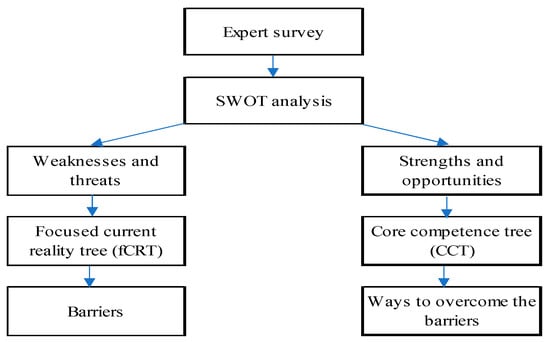
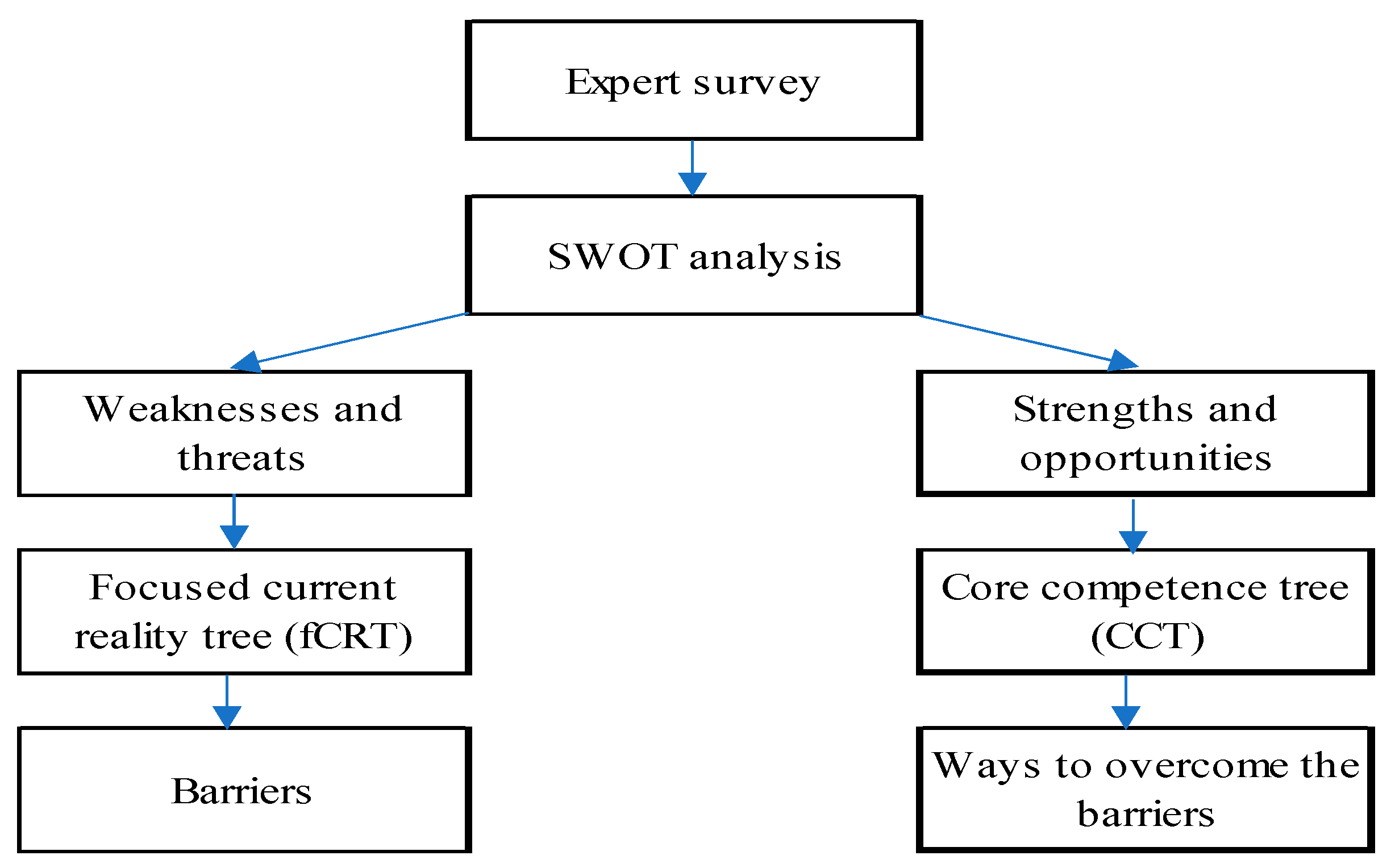
A common practical way to map barriers and ways to overcome them is to conduct an expert survey. The survey results can be analysed by various tools. A strategic tool that allows the mapping of major barriers and ways to remove them is the Strengths, Weaknesses, Opportunities, and Threats (SWOT) methodology [40,41,42,43].
The main barriers can be deduced from the Weaknesses and Threats, using the Focused Current Reality Tree (fCRT) methodology. The method involves taking the Weaknesses and Threats from the SWOT analysis, which are unwanted effects. The fCRT is then constructed by making logical connections between these unwanted phenomena, and identifying one (1) to three (3) strategic root problems, which are essentially the main barriers.
Similarly, ways to overcome barriers can be deduced from the Strengths and Opportunities, using the Core Competence Tree (CCT) methodology. The method is to take the Strengths and Opportunities from the SWOT analysis, which are desirable effects, to construct the CCT by making logical connections between these desirable phenomena, and identifying one (1) to three (3) strategic ways to overcome the barriers.
Daskal et al. [2] used this methodology to analyse barriers and ways to overcome them in the MSW market in Israel. A schematic description of the process is shown in Figure 6.
Figure 6.
The framework for identifying barriers and ways to overcome them.
Table 3 below presents possible barriers and suggested ways to overcome them.
Table 3.
Barriers and suggested ways to overcome them.
3.4. Quantitative Analysis
3.4.1. The Costs
In the MSW field, it is customary to have monthly payment arrangements with the various contractors. Accordingly, the cost components in the DCAM were also determined on a monthly basis. To evaluate the B/C index of a DC project, the total monthly costs should be evaluated before and after placing the composter, as follows:
- The total actual monthly cost of the waste collection, transfer, and treatment, before placing the composter (BPC), and
- The total estimated monthly cost of the waste collection, transfer, and treatment after placing the composter (APC).
The estimated monthly cost APC may be assessed according to various implementation options, including a long-term forecast for assessing feasibility according to the expected participation rate, and/or other criteria.
Various cost components that may be relevant to the cost analysis of the DC project are shown in Table 4, sorted into social, operational, environmental, and regulatory categories. Various alternatives and scenarios are presented in Section 3.4.4.
Table 4.
Key cost components.
3.4.2. The Benefits
The benefits of DC projects derive from the treatment of OW through composting. This is reflected by the reduction of collection, transportation, and treatment costs, and embodies environmental benefits such as reduced transportation operations and decreased landfilling. Thus, the quantification of the benefits is directly based on the amount of organic waste directed to composting. The total monthly benefit should be evaluated before and after placing the composter using the following:
- The actual monthly OW amount directed to composting BPC (if it exists), and
- The estimated monthly OW amount directed to composting APC.
The amount of OW directed to composting can also indicate the growth in participation rate, for a specific area with a fixed number of participants. When the amount directed to composting APC increases, it is likely the result of an increased participation rate in that specific area. Therefore, the amount of OW directed to composting is an indicator of the feasibility of the DC project at different participation rates, both for a specific period and over time.
3.4.3. The Benefit/Cost Index
The B/C index is a pseudo-cost-benefit ratio defined for assessing the DC project viability, taking into account the various impact variables. The B/C index allows a comparison between different alternatives and scenarios by measuring the cost/benefit ratio for each of them before and after placing the composter. The cost refers to the total monthly expenditure or savings for waste collection, transportation, and treatment. The benefit refers to the monthly amount of organic waste directed to composting. We refer to the cost in Euros and the benefit in tons.
Table 5 presents the methodology for calculating the B/C indices and Table 6 presents a numerical example for calculating benefit/cost indices.
Table 5.
The benefit/cost index calculation.
Table 6.
Example for calculating benefit/cost indices.
Following in Table 6 is a synthetic example of calculating the B/C indices using the methodology in Table 5. The two APC options differ in the type of composter, which is reflected in the cost and amount of organic waste treated.
Since In.APC2 > In.APC1 > In.BPC, the calculations show that APC Option 2 is the most effective of the three options.
The model can be implemented for comparing different options that reflect various alternatives and scenarios. These may include taking into account budget constraints, different technological solutions, different collection methods, transportation alternatives, implementing different regulatory tools, examining different scenarios of participation rates, and more.
3.4.4. Comparison between Different Alternatives and Scenarios
The Benefit/Cost index is a practical and effective tool for comparing different alternatives and scenarios. The comparison conclusions are made according to the index calculations for each option, as demonstrated in Section 3.4.3.
The efficiency of the DC project can be evaluated according to different characteristics, alternatives, and scenarios, which include, but are not limited to, the following:
- Countries
- Cities/regions
- Composters/technological solutions
- Numbers of participants
- Participation rates (at a specific time and/or over time)
- Amounts of organic waste
- Operation and maintenance procedures
- Home, community, or commercial composting (or combinations thereof)
- Waste collection methods
- Waste collection frequencies
- Transportation alternatives
- Regulatory tools
3.5. Qualitative Analysis
Qualitative analysis is a complementary tool to support decision making in cases where quantitative analysis is unequivocal. The DCAM qualitative analysis involves obtaining information from experts in the field and analysing that information to identify root problems, as well as the ways and means to solve these problems. To locate the main “players” relevant to the project, the start is the identification and mapping of stakeholders, followed by the construction of the market arena. Next, information is obtained from these stakeholders and is used to perform a SWOT analysis as the final step. To collect and process the information, a methodology has been defined that allows the classification of desirable and undesirable phenomena. This paper focuses on the methodological framework of quantitative analysis.
3.6. Summary
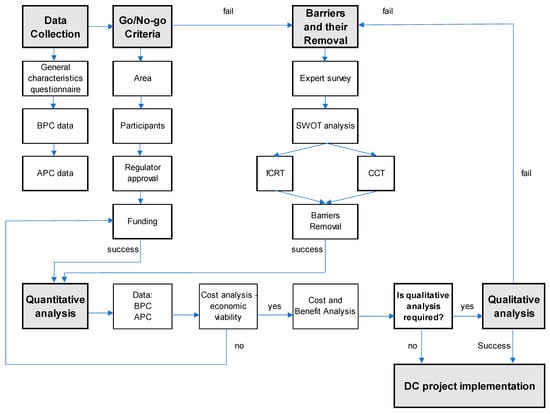
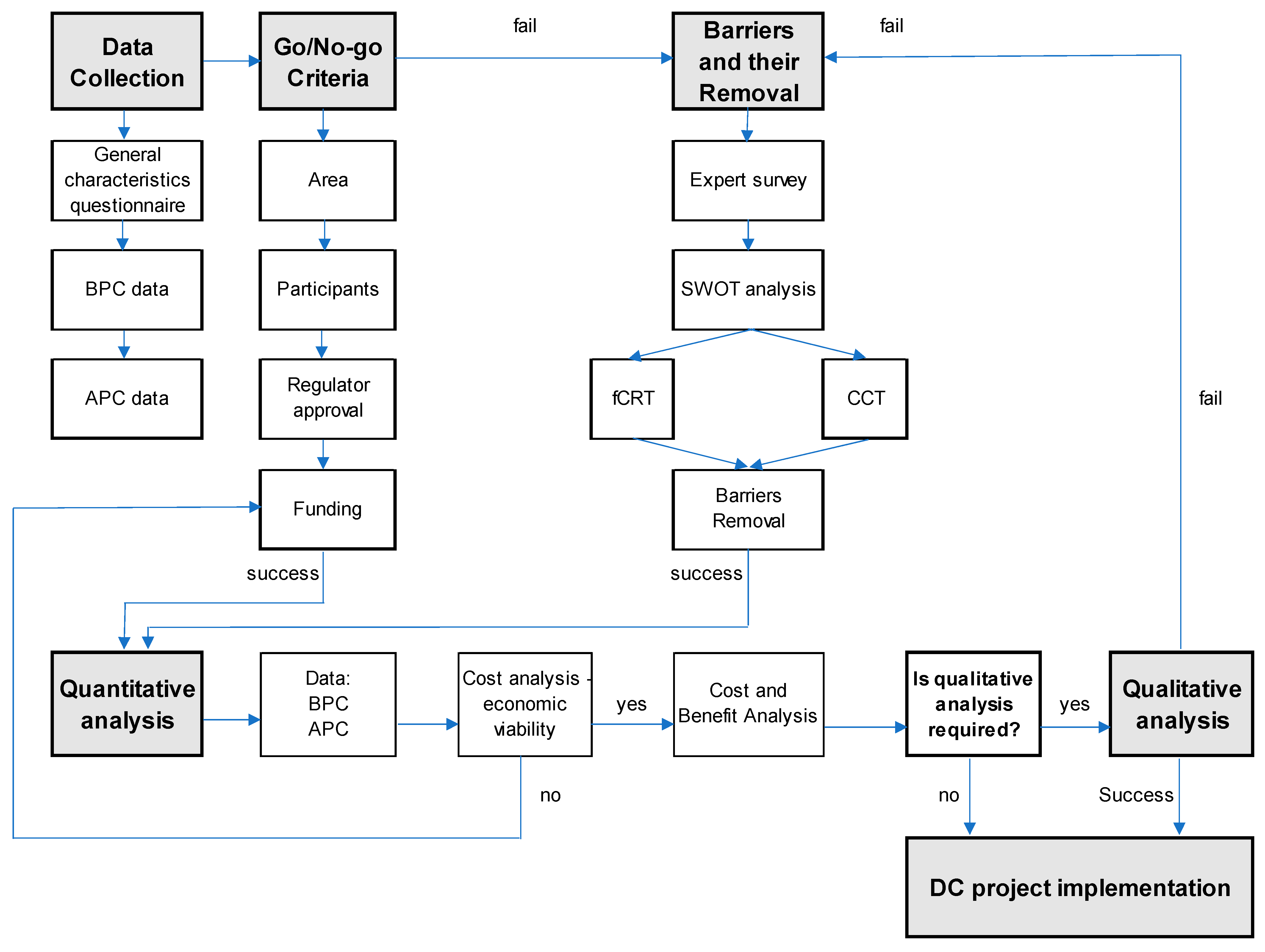
In this section, we have presented the DCAM and how to apply the methodologies in each step. A schematic description of the DCAM framework is presented in Figure 7.
Figure 7.
Schematic description of the DCAM framework.
The DCAM has been implemented in Spain, Italy, Israel, Jordan, and Palestine, as part of the ‘Decentralised Composting in Small Towns’ (DECOST) project [44]. As part of the implementation, various alternatives were compared, including sensitivity tests. Although the model has not yet been implemented in large cities, it can be easily implemented in any country, region, city, or area.
4. Results for the City of Shefar’am in Israel
The following are the results of the DC analysis for the city of Shefar’am in Israel, using the DCAM. Three DC options were analysed and compared to determine the most viable option for Shefar’am, with the options being commercial composting, community composting and home composting.
4.1. The City of Shefar’am
Shefar’am is an Arab city in the northern district of Israel, located at the entrance to the Galilee region. In 2019, Shefar’am had a population of about 42 thousand residents [45]. Approximately 32,000 tons of waste are produced in Shefar’am each year, of which 18,000 tons are classified, according to municipal records, as mixed household waste. This includes the waste collected from businesses located in the heart of the city and the residential neighbourhoods [18]. The DCAM was generated for three (3) options: commercial composting, community composting and home composting.
4.2. Commercial Composting
The main characteristics of the DC project for the composting of commercial OW are described below.
- General project characteristics
- ○
- Country: Israel
- ○
- City: Shefar’am
- ○
- Type of MSW: Commercial
- ○
- Participants: 15 Greengrocers
- Regulation
- ○
- Landfill tax of EUR 32.40 per ton
- ○
- There is no direct waste collection fee for businesses
- Collection and treatment BPC
- ○
- 15 × 1100-Litre plastic bins (one per greengrocer)
- ○
- Mixed waste
- ○
- 2/3 of the mixed waste is organic waste
- ○
- Total amount of waste ~4.5 tons per day (~300 kg per greengrocer)
- ○
- Total cost per ton— EUR 153.50 (including 17% VAT)
- Collection and treatment APC
- ○
- Composter type and model: HotRot 1811
- ○
- Waste collection
- ▪
- 1100-Litre bins for OW
- ▪
- 360-Litre bins for residual waste
The monthly cost and benefit for Shefar’am’s commercial composting are presented in Table 7.
Table 7.
Commercial composting cost and benefit results for Shefar’am.
Since In.APC > In.BPC, the calculations show that option APC is more viable than option BPC; thus, commercial composting is worthwhile.
4.3. Community Composting
The main characteristics of the DC project for community composting of domestic OW are described below.
- General Project characteristics
- ○
- Country: Israel
- ○
- City: Shefar’am
- ○
- Type of MSW: Domestic
- ○
- Participants
- ▪
- Population—731
- ▪
- No. of apartments—180
- Regulation
- ○
- Landfill tax of EUR 32.40 per ton
- ○
- There is no direct waste collection fee
- Collection and treatment BPC
- ○
- 360 and 1100-Litre plastic bins
- ○
- Mixed waste
- ○
- Total cost per ton—EUR 153.50 (including 17% VAT)
- Collection and treatment APC
- ○
- Composter type and model: CtTec—Bio—Bi I.3.X—4 composters
- ○
- 360-Litre bins for OW and residual waste
The cost and benefit results are presented in Table 8.
Table 8.
Community composting cost and benefit results for Shefar’am.
Since In.APC > In.BPC, the calculations show that option APC is more viable than option BPC, thus community composting is worthwhile.
4.4. Home Composting
The main characteristics of the DC project for home composting of domestic OW are described below.
- General Project characteristics
- ○
- Country: Israel
- ○
- City: Shefar’am
- ○
- Type of MSW: Domestic
- ○
- Participants:
- ▪
- Population—731
- ▪
- No. of apartments—180
- Regulation
- ○
- Landfill tax of EUR 32.40 per ton
- ○
- There is no direct waste collection fee.
- Collection and treatment BPC
- ○
- 360 and 1100-Litre plastic bins
- ○
- Mixed waste
- ○
- Total cost per ton—EUR 153.50 (including 17% VAT)
- Collection and treatment APC
- ○
- 180 home composters
- ○
- 360-Litre bins for residual waste
The cost and benefit results are presented in Table 9.
Table 9.
Home composting cost and benefit results for Shefar’am.
Since In.APC > In.BPC, the calculations show that option APC is more viable than option BPC, thus home composting is worthwhile.
4.5. Comparison
In comparing the three examined DC options for Shefar’am, relevant conclusions can be made when rating the options based on their respective B/C indices. A summary of the calculated results is presented in Table 10.
Table 10.
Summary of the results of the three DC options for Shefar’am.
The results show that the best option is commercial composting, with the highest B/C index of 0.0067 (In.1 > In.3 > In.2). As for community composting vs. home composting, results show that the index for home composting (0.0019) is higher than the index for community composting (0.0014); thus, home composting is preferable to community composting. That said, other qualitative factors, not discussed in this paper, must be taken into account, for example, the ability to reach participants for home composting, maintaining a high participation rate over time, and more.
5. Discussion
OW management solutions should be analysed in an integrative manner by considering economic, social, operational, environmental, and regulatory aspects [1,2,17,25,26,27,28]. The DCAM provides a unique and innovative methodological framework along with detailed guidelines for examining the feasibility of DC projects, taking into account these aspects. The model provides methodological tools for both quantitative and qualitative analyses that result in B/C indices to support decision making. The B/C index methodology allows the comparison between different alternatives and scenarios. The index is based on universal values—monetary costs and the amount of waste in tons—so it allows comparison across countries, regions, time periods, and so on. To facilitate the use of the model by various parties, such as regulators and local authorities, a specific questionnaire and templates were developed for the collection and analysis of the relevant data.
Beyond performing the analyses, trust between the local authority and the residents is a crucial factor in the success of DC projects [30,31,32,33,34,35,36,37,38,39]. It is recommended, therefore, to conduct a satisfaction survey as a preliminary step before the DC project implementation. As there is sometimes a gap between the authority’s perception of the residents’ trust and the actual situation, it is recommended that the satisfaction survey be performed by an external party/consultant to prevent bias.
6. Conclusions
A prominent approach for treating organic waste is decentralized composting (DC). Despite its relevance, the existing research does not address, for the most part, the various aspects involved with DC projects.
Examining the viability of DC is critical as it involves financial investment and building trust with the public. The DCAM allows the feasibility analysis of DC projects through quantitative and qualitative analyses. The model takes into account economic, social, operational, environmental, and regulatory aspects. The methodology is generic and offers tools based on universal values; thus, it allows comparison between different countries, regions, municipal authorities, time periods, and scenarios. As such, this unique and innovative model provides a powerful tool for decision makers to pre-evaluate DC projects, rather than making a comparison based on different scenarios only, or post-evaluate them after they have already been implemented.
In the present study, the benefit was defined as the amount of organic waste treated. Future research can expand this definition to include the usage of compost, urban agriculture, reduction in greenhouse gas emissions, and more.
Author Contributions
Conceptualization, S.D., I.S., O.A. (Ofira Ayalon) and K.B.-K.; Data curation, O.A. (Omar Asi); Formal analysis, S.D.; Funding acquisition, I.S. and K.B.-K.; Investigation, K.B.-K.; Methodology, S.D. and O.A. (Ofira Ayalon); Supervision, I.S., O.A. (Ofira Ayalon) and K.B.-K.; Validation, O.A. (Omar Asi) and K.B.-K.; Writing—original draft, S.D.; Writing—review & editing, S.D., O.A. (Omar Asi), I.S., O.A. (Ofira Ayalon) and K.B.-K. All authors have read and agreed to the published version of the manuscript.
Funding
This research was funded by The European Union under the ENI CBC Mediterranean Sea Basin Programme, under grant number [A_B.4.2_0095].
Institutional Review Board Statement
Not applicable.
Informed Consent Statement
Not applicable.
Data Availability Statement
Not applicable.
Acknowledgments
This paper has been prepared, and the research was carried out, with the financial assistance of the European Union under the ENI CBC Mediterranean Sea Basin Programme—Project grant contract number A_B.4.2_0095 “DECOST—Decentralised Composting in Small Towns”. The authors would also like to thank Khalid Farah for reviewing the manuscript and for contributing his valuable comments.
Conflicts of Interest
The authors declare no conflict of interest.
Acronyms
| APC | after placing composter |
| BPC | before placing composter |
| B/C | benefit/cost |
| CCT | core competence tree |
| DC | decentralized composting |
| DCAM | decentralized composting analysis model |
| DECOST | Decentralised Composting in Small Towns |
| EPR | extended producer responsibility |
| fCRT | focused current reality tree |
| MSW | municipal solid waste |
| MSWM | municipal solid wate management |
| OECD | Organisation for Economic Co-operation and Development |
| OW | organic waste |
| PAYT | pay as you throw |
| SWOT | strengths, weaknesses, opportunities, and threats |
Appendix A. The DCAM General Characteristics Questionnaire
These questions relate to the participants in the DC project and the characteristics of the potential project site.
- Country/State: _____________
- Region/City/Town: _____________
- Name of Neighborhood (if applicable): ___________________
- Area characteristics: Residential (neighborhood)/Commercial/Industrial/Other: ______
- Size of the area in square meters: ___________ m2
- National socio-economic status: High/Medium/Low/Other: ______________
- Household waste: Yes/No
- Commercial waste: Yes/No
- No. of businesses: _____
- No. of households: _____
- Average number of persons per household: ___________
- No. of high-rise buildings: _____/______% of total participants
- No. of single homes: _____/______% of total participants
- Mode of waste management payment by households: within general municipal taxes/any mode of Pay as You Throw/Other: ________________
- Mode of waste management payment by businesses: in general municipal taxes/any mode of Pay as You Throw/Other: _______________
- Waste collection payment method: per bin or container hauling/per ton/Other: _____
- Waste treatment payment method: tipping fee per ton/Other: ___________
- Landfill levy: Yes/No
- No. of composters in the project: ________________
- Composter location: Coupled with each household/Community composter in public areas/Other: __
- Allocated area for each composter: _______ m2
- Operational responsibility for the OW transportation: Residents/Businesses/Local authority/Other: _______
- Operational responsibility for composting: Residents/Businesses/Local authority/Other: _______
- Means of collecting the organic waste: bins/plastic bags/paper bags/bio-plastic bags/other: ___
- Monthly amount of organic waste directed to composting: _____ tons
- Composter type: _____________
Appendix B. Analysis of Waste and Recycling Legislation in Israel, 1984–2017
This table is an example of legislation mapping in Israel and identifying the relevant regulations for a DC project.

Appendix C. The DCAM Templates for Gathering Data for Cost and Benefit Calculations
| Waste Properties | |
| Source of the waste: Domestic/Commercial/Industrial | |
| Type of waste: Mixed/Organic */Packaging */Other | |
| * separated at source. | |
| Waste Collection Data | |
| Type of receptacle: can/bin/container/underground container | |
| Volume (Litres) | |
| No. of waste collection bins (WCB) | |
| Weekly collection frequency | |
| Total no. of monthly collections | |
| The cost of one-time collection from one receptacle | |
| Total monthly cost | |
| Waste hauler (private/municipal) | |
| The payer: local authority/business/resident | |
| Waste Treatment Data | |
| Name of the site that receives the waste | |
| Distance of the site from the local authority/area of the project | |
| Tipping fee to the waste site | |
| Levy/tax | |
| Cost per ton | |
| Total Monthly amount (ton) | |
| Total cost (according to total tons) | |
| Fees/Other Related Payments | |
| Fill this part in cases where the local authority bears the cost of waste collection and treatment, but charges a direct fee/payment (businesses/PAYT/other) | |
| Service provider: local authority/contractor | |
| Name of the local authority/contractor | |
| A fee is charged for service by the local authority (Yes/No) | |
| Fee per Ton | |
| Composter & Composting Data—General Properties | |
| Composter provider | |
| Composter type and model | |
| Capacity (tons per month) | |
| Composter Dimensions | |
| Volume | |
| Area size required for placing the composter | |
| Property rights on the land | |
| Lifetime (Years/months) | |
| Composter & Composting Data—Investment Cost | |
| Cost of purchasing the composter | |
| Site development and construction cost | |
| Biofilter cost | |
| Total monthly cost | |
| Composter & Composting Data—Operation and Maintenance | |
| Composter operation and maintenance cost | |
| OW transportation cost | |
| OW Loading cost | |
| Cost of application/s for access & control | |
| Biofilter cost | |
| Benefit |
| Monthly Amount of OW Directed to Composting (Tons) |
References
- Daskal, S.; Ayalon, O.; Shechter, M. The state of municipal solid waste management in Israel. Waste Manag. Res. J. A Sustain. Circ. Econ. 2018, 36, 527–534. [Google Scholar] [CrossRef] [Scilit] [PubMed]
- Daskal, S.; Ayalon, O.; Shechter, M. Closing the loop: The challenges of regulation in municipal solid waste management. Detritus 2019, 5, 3–10. [Google Scholar] [CrossRef] [Scilit]
- Ghosh, S.K. Sustainable Waste Management: Policies and Case Studies; Springer: Singapore, 2020. [Google Scholar] [CrossRef] [Scilit]
- Di Maria, F.; Daskal, S.; Ayalon, O. A methodological approach for comparing waste water effluent’s regulatory and management frameworks based on sustainability assessment. Ecol. Indic. 2020, 118, 106805. [Google Scholar] [CrossRef] [Scilit]
- Awasthi, S.K.; Sarsaiya, S.; Awasthi, M.K.; Liu, T.; Zhao, J.; Kumar, S.; Zhang, Z. Changes in global trends in food waste composting: Research challenges and opportunities. Bioresour. Technol. 2020, 299, 122555. [Google Scholar] [CrossRef] [Scilit]
- Wei, Y.; Li, J.; Shi, D.; Liu, G.; Zhao, Y.; Shimaoka, T. Environmental challenges impeding the composting of biodegradable municipal solid waste: A critical review. Resour. Conserv. Recycl. 2017, 122, 51–65. [Google Scholar] [CrossRef] [Scilit]
- Hawken, P. (Ed.) Drawdown: The Most Comprehensive Plan Ever Proposed to Reverse Global Warming; Penguin: London, UK, 2017. [Google Scholar]
- Pai, S.; Ai, N.; Zheng, J. Decentralized community composting feasibility analysis for residential food waste: A Chicago case study. Sustain. Cities Soc. 2019, 50, 101683. [Google Scholar] [CrossRef] [Scilit]
- World Bank. What a Waste 2.0–A Global Snapshot of Solid Waste Management to 2050. 2018. Available online: https://openknowledge.worldbank.org/bitstream/handle/10986/30317/9781464813290.pdf (accessed on 1 November 2022).
- World Bank. Trends in Solid Waste Management. 2020. Available online: https://datatopics.worldbank.org/what-a-waste/trends_in_solid_waste_management.html (accessed on 1 November 2022).
- Eurostat. Municipal Waste Treatment, EU-27, 1995–2018. 2020. Available online: https://ec.europa.eu/eurostat/statistics-explained/index.php?title=File:Municipal_waste_treatment,_EU-27,_1995-2018_(million_tonnes).png&oldid=495406 (accessed on 1 November 2022).
- Ayalon, O.; Avnimelech, Y.; Shechter, M. Solid waste treatment as a high-priority and low-cost alternative for greenhouse gas mitigation. Environ. Manag. 2001, 27, 697–704. [Google Scholar]
- Bruni, C.; Akyol, Ç.; Cipolletta, G.; Eusebi, A.L.; Caniani, D.; Masi, S.; Fatone, F. Decentralized Community Composting: Past, Present and Future Aspects of Italy. Sustainability 2020, 12, 3319. [Google Scholar] [CrossRef] [Scilit]
- EEA. Bio-Waste in Europe—Turning Challenges into Opportunities. 2020. Available online: https://www.eea.europa.eu/publications/bio-waste-in-europe (accessed on 1 November 2022).
- OECD. “Waste: Municipal Waste”, OECD Environment Statistics (Database). 2022. Available online: https://www.oecd-ilibrary.org/environment/data/oecd-environment-statistics/municipal-waste_data-00601-en (accessed on 1 November 2022).
- Siebert, S.; Gilbert, J.; Ricci-Jürgensen, M. Compost Production in Europe. ECN Report. 2020. Available online: https://www.compostnetwork.info/wordpress/wp-content/uploads/190823_ECN-Compost-Production-in-Europe_final_layout-ECN.pdf (accessed on 1 November 2022).
- de Souza, L.C.G.; Drumond, M.A. Decentralized composting as a waste management tool connect with the new global trends: A systematic review. Int. J. Environ. Sci. Technol. 2022, 19, 12679–12700. [Google Scholar] [CrossRef] [Scilit]
- Asi, O. Analysis of the Economic and Environmental Impacts of the Treatment of Commercial Organic Waste by Distributed Composting Systems-City of Shefar’am as a Case Study. Master Thesis, University of Haifa, Haifa, Israel, 2020. (In Hebrew) [Google Scholar]
- Rani, P.; Mishra, A.R.; Saha, A.; Hezam, I.M.; Pamucar, D. Fermatean fuzzy Heronian mean operators and MEREC-based additive ratio assessment method: An application to food waste treatment technology selection. Int. J. Intell. Syst. 2022, 37, 2612–2647. [Google Scholar] [CrossRef] [Scilit]
- Yunus, S.; Muis, R.; Anggraini, N.; Ariani, F. A Multi-Criteria Decision Analysis for Selecting Waste Composting Technology in Makassar, Indonesia. J. Southwest Jiaotong Univ. 2020, 55. [Google Scholar] [CrossRef] [Scilit]
- Vlachokostas, C.; Achillas, C.; Diamantis, V.; Michailidou, A.V.; Baginetas, K.; Aidonis, D. Supporting decision making to achieve circularity via a biodegradable waste-to-bioenergy and compost facility. J. Environ. Manag. 2021, 285, 112215. [Google Scholar]
- Yeo, D.; Dongo, K.; Angoua, E.L.E.; Mertenat, A.; Lüssenhop, P.; Zurbrügg, C.; Körner, I. Combining multi-criteria decision analysis with GIS approaches for decentralized organic wastes composting plants site selection in Tiassalé, Southern Côte d’Ivoire. Waste Manag. Res. 2022, 40, 706–720. [Google Scholar] [CrossRef] [Scilit] [PubMed]
- Sardarmehni, M. Advancing Sustainable Decision-Making for the Organic Fraction of Municipal Solid Waste. Ph.D. Thesis, North Carolina State University, Raleigh, NC, USA, 2022. Available online: https://repository.lib.ncsu.edu/bitstream/handle/1840.20/39615/etd.pdf?sequence=1 (accessed on 1 November 2022).
- Sánchez, A. Decentralized Composting of Food Waste: A Perspective on Scientific Knowledge. Front. Chem. Eng. 2022, 38. Available online: https://www.frontiersin.org/articles/10.3389/fceng.2022.850308/full (accessed on 1 November 2022). [CrossRef] [Scilit]
- Daskal, S.; Ayalon, O.; Shechter, M. Implementation of Municipal Solid Waste Regulations in Israel. In Sustainable Waste Management: Policies and Case Studies; Springer: Singapore, 2020; pp. 279–290. [Google Scholar]
- Hoornweg, D.; Bhada-Tata, P. What a Waste: A Global Review of Solid Waste Management; Urban Development Series; Knowledge Papers no. 15; World Bank: Washington, DC, USA, 2012; Available online: https://openknowledge.worldbank.org/handle/10986/17388 (accessed on 1 December 2022).
- Jenkins, R.R.; Kopits, E.; Simpson, D. Policy Monitor—The Evolution of Solid and Hazardous Waste Regulation in the United States. Rev. Environ. Econ. Policy 2009, 3. [Google Scholar] [CrossRef] [Scilit]
- Tsai, F.M.; Bui, T.D.; Tseng, M.L.; Lim, M.K.; Hu, J. Municipal solid waste management in a circular economy: A data-driven bibliometric analysis. J. Clean. Prod. 2020, 275, 124132. [Google Scholar] [CrossRef] [Scilit]
- Daskal, S.; Ayalon, O. Circular Economy—Situation in Israel. In Circular Economy: Global Perspective; Springer: Singapore, 2020; pp. 187–200. [Google Scholar]
- Broitman, D.; Ayalon, O.; Kan, I. One size fits all? An assessment tool for solid waste management at local and national levels. Waste Manag. 2012, 32, 1979–1988. [Google Scholar] [CrossRef] [Scilit] [PubMed]
- Harring, N.; Jagers, S.C. Should we trust in values? Explaining public support for pro-environmental taxes. Sustainability 2013, 5, 210–227. [Google Scholar] [CrossRef] [Scilit]
- Martin, M.; Williams, I.; Clark, M. Social, cultural and structural influences on household waste recycling: A case study. Resour. Conserv. Recycl. 2006, 48, 357–395. [Google Scholar] [CrossRef] [Scilit]
- Matsui, Y.; Tanaka, M.; Ohsako, M. Study of the effect of political measures on the citizen participation rate in recycling and on the environmental load reduction. Waste Manag. 2007, 27, 9–20. [Google Scholar] [CrossRef] [Scilit]
- Palatnik, R.; Ayalon, O.; Shechter, M. Household Demand for Waste Recycling Services. J. Environ. Manag. 2005, 35, 121–129. [Google Scholar] [CrossRef] [Scilit] [PubMed]
- Shaw, P. Nearest neighbour effects in kerbside household waste recycling. Resour. Conserv. Recycl. 2008, 52, 775–784. [Google Scholar] [CrossRef] [Scilit]
- Timlett, R.; Williams, I. Public participation and recycling performance in England: A comparison of tools for behaviour change. Resour. Conserv. Recycl. 2008, 52, 622–634. [Google Scholar] [CrossRef] [Scilit]
- Williams, I.; Kelly, J. Green waste collection and the public’s recycling behaviour in the Borough of Wyre, England. Resour. Conserv. Recycl. 2003, 38, 139–159. [Google Scholar] [CrossRef] [Scilit]
- Wilson, C.; Williams, I. Kerbside collection: A case study from the north-west of England. Resour. Conserv. Recycl. 2007, 52, 381–394. [Google Scholar] [CrossRef] [Scilit]
- Woodard, R.; Harder, M.; Bench, M. Participation in curbside recycling schemes and its variation with material types. Waste Manag. 2006, 26, 914–919. [Google Scholar] [CrossRef] [Scilit]
- Yuan, H. A SWOT analysis of successful construction waste management. J. Clean. Prod. 2013, 39, 1–8. [Google Scholar] [CrossRef] [Scilit]
- Livas, L.M. A SWOT Analysis: City of Covina’s Organic Waste Disposal Reduction Ordinance. Ph.D. Thesis, California State Polytechnic University, Pomona, CA, USA, 2022. [Google Scholar]
- Kartini, A.Z.; Hasibuan, H.S.; Tumuyu, S.S. A SWOT Analysis of Takakura Compost as a Treatment for Household Food Waste (Case Study in Pondok Labu Urban Village). In IOP Conference Series: Earth and Environmental Science; IOP Publishing: Bristol, UK, 2021; Volume 940, p. 012075. [Google Scholar]
- Paes, L.A.B.; Bezerra, B.S.; Deus, R.M.; Jugend, D.; Battistelle, R.A.G. Organic solid waste management in a circular economy perspective—A systematic review and SWOT analysis. J. Clean. Prod. 2019, 239, 118086. [Google Scholar] [CrossRef] [Scilit]
- Decentralised Composting in Small Towns (DECOST). 2022. Available online: https://www.enicbcmed.eu/projects/decost (accessed on 1 November 2022).
- Israel Central Bureau of Statistics. Population in the Localities. 2020. Available online: https://www.cbs.gov.il/he/publications/doclib/2017/population_madaf/population_madaf_2019_1.xlsx (accessed on 1 November 2022).
- Maintenance of Cleanliness Law; Israeli Ministry of Environmental Protection: Jerusalem, Israel, 1984. (In Hebrew)
- Collection and Disposal of Waste for Recycling Law; Israeli Ministry of Environmental Protection: Jerusalem, Israel, 1993. (In Hebrew)
- Regulations for Collection and Removal of Waste for Recycling; Israeli Ministry of Environmental Protection: Jerusalem, Israel, 1998. (In Hebrew)
- Deposit on Beverage Containers; Israeli Ministry of Environmental Protection: Jerusalem, Israel, 1999. (In Hebrew)
- Amendment to Maintenance of Cleanliness Law, 2007: Landfill Levy; Israeli Ministry of Environmental Protection: Jerusalem, Israel, 2007. (In Hebrew)
- Tire Disposal and Recycling Law; Israeli Ministry of Environmental Protection: Jerusalem, Israel, 2007. (In Hebrew)
- Packaging Treatment Law 2011; Israeli Ministry of Environmental Protection: Jerusalem, Israel, 2011. (In Hebrew)
- Electrical and Electronic Equipment and Batteries Law; Israeli Ministry of Environmental Protection: Jerusalem, Israel, 2012. (In Hebrew)
- The Law for the Reduction of the Use of Disposable Carrying Bags; Israeli Ministry of Environmental Protection: Jerusalem, Israel, 2016. (In Hebrew)
- The Criteria for Collecting Basic Waste and Excess Waste from Businesses; Israeli Ministry of Environmental Protection: Jerusalem, Israel, 2017. (In Hebrew)
- Daskal, D. Regulatory Impact Analysis and Assessment of the Municipal Solid Waste Market in Israel. Ph.D. Thesis, University of Haifa, Haifa, Israel, 2018. (In Hebrew) [Google Scholar]




Publisher’s Note: MDPI stays neutral with regard to jurisdictional claims in published maps and institutional affiliations. |
© 2022 by the authors. Licensee MDPI, Basel, Switzerland. This article is an open access article distributed under the terms and conditions of the Creative Commons Attribution (CC BY) license (https://creativecommons.org/licenses/by/4.0/).