


Abstract
Social prescribing (SP) is an approach that promotes the use of local non-clinical activities by people. The referral is usually made by primary health-care professionals, in a process wherein local providers play a pivotal role. The main objective of this study was to identify domains of intervention and evidence about the effectiveness of SP programs regarding health-related outcomes. A systematic literature review was carried out following Preferred Reporting Items for Systematic Reviews and Meta-Analyses (PRISMA) guidelines. A literature search was conducted in PubMed, CINHAL, and SCOPUS. Inclusion criteria of the reviewed papers were as follows: (i) effectiveness studies of interventions designated as SP or interventions entailing SP conceptual components; (ii) interventions with adults. Quality assessment was performed with the Cochrane tool for assessing risk of bias in randomized trials; an assessment tool developed by the US National Heart, Lung and Blood Institute was applied to observational studies. Overall, 13 articles were included for analysis, with a total of 4603 patients. Although three studies comprised a control group, only two followed a randomized controlled trials (RCT) design. Nine principal domains of intervention within SP were identified, with three categories of outcome measures: Physical and psychological wellbeing; Health behaviors and self-efficacy; and Health care resources end economic evaluation. SP is an emergent and promising health-care intervention, and it has been used to promote different health behaviors. Evidence of SP effectiveness on patient’s health and wellbeing is not strong. Further research is needed for understanding how SP can be applied efficiently.
1. Introduction
Gains in life expectancy increased dramatically within the last century, raising more and more attention on the wellbeing that needs to be ensured throughout the extra years of life expectancy [1]. These public health gains put additional pressure on the health-care system. Actions to promote a healthy and sustainable environmental health-care context are essential, alongside articulated and intersectoral responses and adequate health and social policies.
The aging processes raise several non-clinical needs of intervention, which are related to health and wellbeing [2]. Some of these needs are linked to a sedentary lifestyle, social isolation, low community cohesion and participation, poor cognitive stimulation, and loneliness, among other factors [3]. As these factors are typically considered out of the scope of clinical interventions, they are not met with a suitable response in the context of the services traditionally provided by existing health structures, which are mostly centered on the disease and its manifestations. Nevertheless, both clinical and non-clinical interventions targeting people’s real needs are depicted as pivotal actions in the 2030 Agenda for Sustainable Development [4]. Within this framework, there is a need for complex interventions in complex systems, which are adapted to the different contexts in which the health intervention is implemented [5,6].
Creating healthy environments can be complex and should rely on continuing research of the effects of exposure to environmental hazards on people’s health. These hazards can be of social nature, such as deprived socioeconomic conditions, and not inclusive and disruptive societies. Acting upon these ecological pathogenic and inequity-promoting factors and maintaining a healthy environment is crucial to efficiently promote public health and to increase the quality of life and more years of healthy life [7,8]. A key determinant for promoting mental and physical health is the stability of social connections (i.e., social cohesion), such as the existence of a stable and supportive local social environment [9].
Social prescribing (SP) is a relatively new approach in health-care. Shortly, SP can be described as the creation of referral pathways that enable connecting people with health, social, or practical needs with local (i.e., accessible) providers of non-clinical services [10]. The referral is mainly done by primary health care professionals (e.g., doctors, nurses, social service workers), who prescribe activities developed by the tertiary sector (councils, cultural and recreational associations, parishes, etc.) in the local services or the community [11]. By recognizing that people’s health is determined synergistically by several biological, social, economic, and environmental factors, SP seeks to respond to health needs in a holistic way, also aiming to help people assume a greater control and self-management ability over their health. There are different models of SP referral pathways, including (1) direct referral from primary care or (2) referral mediated through link-worker-based models [12]. In this last type of SP model, the link-worker supports patients to establish their personal needs, sets goals, and attempts to keep patients’ motivation high. The link-worker may be located within a GP practice, in the local community, or a mix of these alternatives, depending on how the SP scheme has been developed [13]. Some examples of SP-promoted activities include volunteering, artistic activities, group learning, gardening, cooking, advice on healthy eating, or involvement in physical or sports activities. The SP approach offers the population a greater possibility of community participation, social inclusion and social cohesion, and the possibility to enhance, by the community itself, individuals’ health and wellbeing [14]. SP is also proposed as a contribution for increasing the efficiency and utilization of already existent resources, in the community, reducing pressure on health-care services [15].
Social prescribing has been developed mostly in the United Kingdom (UK), having been considered by the National Health Service (NHS) as an innovative approach to support the sustainability of the health system [16]. It also has the potential to promote partnerships between community structures, thus contributing to link health and social sectors [17], forming a local SP system [18,19]. As SP is rapidly growing in the UK, it is also attracting international interest. Yet outside the United Kingdom (UK), SP is still not a common practice. So, it is important to learn from what has been done in the UK in order to understand what type of programs and SP interventions are most effective. Indeed, a current challenge is to systematically collate information about how SP is conceptualized, operationalized, and assessed in terms of its effectiveness regarding health and wellbeing indicators, and health services productivity [20]. SP has been associated with patient’s reduced anxiety and depression, better social relationships, and increased optimism and hope [20], with reduction of depletion of services and products (medicines, medical appointments, etc.) [21] and with revitalizing the link between the social and health sectors (i.e., promoting the emergence of new community partners) [17]. However, there is still limited evidence on which activities are more suitable to each population group and culture, and about SP’s real impact in terms of the health and wellbeing of patients.
The finality of this study was to contribute to the understanding of how SP interventions may be effectively applied in different population and cultural contexts, taking into consideration the cumulative evidence about this health-care approach. The main objective was to locate and summarize evidence regarding the effectiveness of SP targeting the adult population assisted in primary health-care settings. Secondary objectives were to identify domains of SP interventions and outcomes most frequently used to assess its effectiveness.
2. Materials and Methods
2.1. Study Design
A systematic literature review (SLR) was carried out following the reporting guidelines of Preferred Reporting Items for Systematic Reviews and Meta-Analyses (PRISMA) [22]. First, a scoping review was undertaken to ascertain which were the most frequently used study designs for evaluating the effectiveness of SP interventions. Since we found a diversity of study designs, we decided to include in this SLR all papers reporting SP interventions with any kind of assessment of effectiveness outcomes.
2.2. Search Methods
The literature search was conducted in three electronic databases: PubMed, CINHAL, and SCOPUS. To obtain the most current up-to-date evidence, a set of keywords divided into two main word-blocks was selected: equivalent or proxy terms regarding SP and equivalent or proxy terms about effectiveness. Each word of each block was combined pairwise with the words of the other block (see Appendix A). The selection of terms was based on the scoping review (taking into account the keywords of papers’ abstracts) and was defined with the consensus of the research team. For PubMed, keywords were, whenever possible, Medical Subject Headings (MeSH) terms. There was not a temporal limit imposed for the search as well as there was no restriction of languages of the papers. The search was conducted on 21 May 2020 in PubMed, on 25th 2020 in CINHAL, and on 1 June 2020 in SCOPUS. All located titles were exported into an excel file and then gathered into a single file. Then, duplicated entries were removed.
2.3. Selection of Articles and Inclusion and Exclusion Criteria
To identify relevant articles that could meet the objectives of this SLR, an initial selection by title and abstract was completed by two members of the research team. Then, the selected articles were triaged by reading the full text of the articles. In addition, a manual search was used to identify additional papers from the references of the studies initially selected, and from other SLR about SP. These SLRs were not included in the RSL analysis but were used for locating additional papers not retrieved by the keyword-based search. Papers were included if they met the following inclusion (cumulative) criteria: (i) any methodological design evaluating an SP intervention; (ii) addressing interventions designated as “Social Prescribing” or interventions entailing SP principles (namely, mentioning a referral from the primary care sector, activity agents/facilitators/link-worker within the community, or with a continuity and accessibility’s perspective within the community); (iii) assessing the impact of interventions; and (iv) including the adult population. Exclusion criteria included study protocols, narrative reviews, systematic reviews, and gray literature (e.g., reports, dissertations, thesis).
2.4. Data Extraction, Quality Appraisal, and Data Synthesis
Two investigators assessed independently the full text of the articles. A third reviewer was required to achieve consensus about studies to be included when the first two investigators were not in agreement.
Data were extracted, by the same two investigators, using a synoptic table with predefined variables (regarding identification of the paper, study design, SP pathway, participants, outcomes, materials, main results, limitations, and future recommendations).
The ROB2.0 tool [23] was used to assess the quality of articles describing randomized controlled trials (RCT), by two researchers. To assess the quality of articles describing observational longitudinal designs (with pre- and post-assessment of outcomes, with or without a control group), or articles describing mixed-methods designs, a quality assessment tool developed by US National Heart, Lung, and Blood Institute was applied [24].
Finally, a narrative synthesis of the evidence was performed, summarizing the intervention domains (i.e., activities proposed, through SP), models, selected outcomes, and conclusions about SP effectiveness.
3. Results
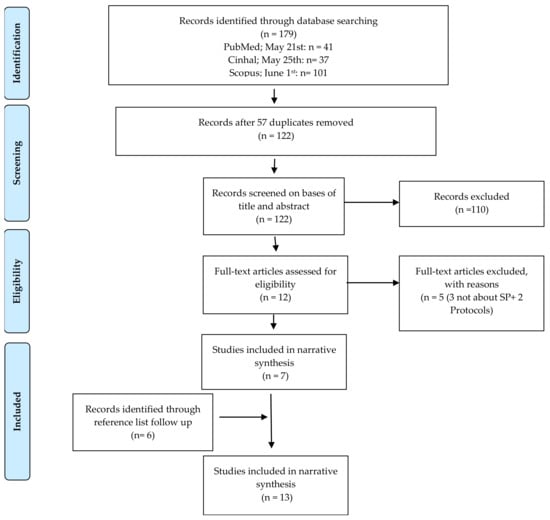
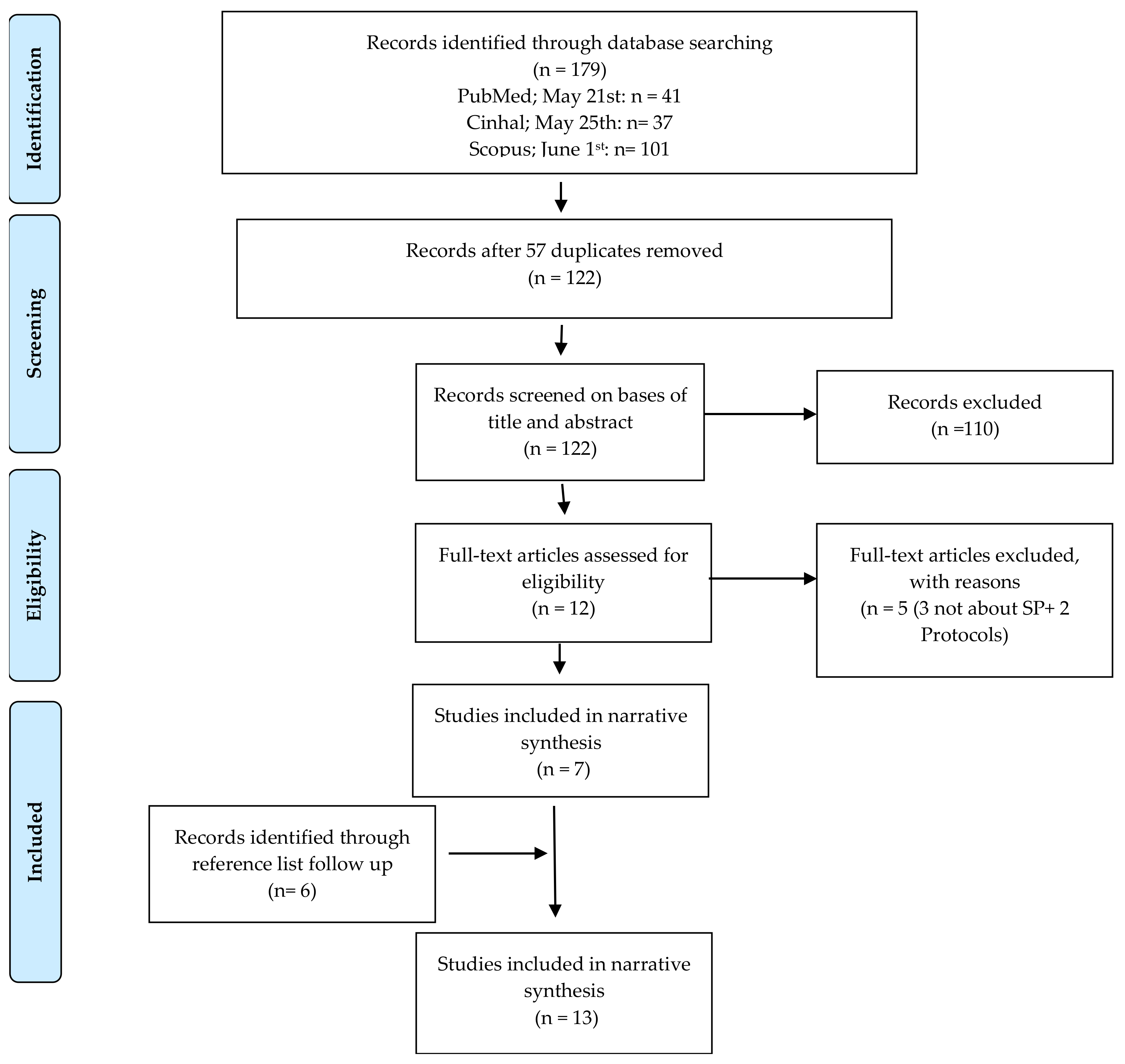
Overall, 13 articles were considered eligible for data extraction and narrative synthesis (Figure 1).
Figure 1.
Preferred Reporting Items for Systematic Reviews and Meta-Analyses (PRISMA) flow diagram.
These selected articles include two RCT, five non-controlled before and after studies (one of them with a longer-term follow-up), and six with mixed-methods (quantitative and qualitative) approach, one of them using a matched control group (Table 1).
Table 1.
Social prescribing studies characteristics.
A total of 4603 participants were involved in the papers. The sample size, age, and gender of participants are presented in Table 2. In every included paper, more women than men were involved as participants, and two papers report exclusively participants above 60 years old.
Table 2.
Overview of participants, domains of social prescribing (SP) activities, duration of SP interventions, and principal outcomes.
Three of the papers [26,36,37] refer patients to art-related activities as SP, while another study refers to physical activities [27]. All of the other remaining studies use several resources of the third sector, which are based on voluntary and community services, without specified activities prescribed [20,25,28,29,30,32,33,34,35].
In all articles, referrals to SP programs are mostly made by health-care professionals, namely by a General Practitioner (GP). In nine articles, a link-worker (LW) is involved to make the bridge between GP, patients, and the third sector [20,25,27,28,29,30,32,34,35]. The characteristics of the LW were not always specifically referenced [20,25,30,35,36,37]. In one of the articles, LWs are known as physical exercise professionals [27], in another, they are known as mental health workers [34], and in another paper, the LW is described as an individual with community-development work experience [28,29].
Articles report an adherence to SP interventions rates ranging from 30% to 78%. Most of the included papers report only two moments for data collection, before and after the intervention. The period of data collection varies between 9 and 84 months. The length of interventions is not reported in a well-defined manner, in the majority of papers, taking place between 6 and 12 sessions or between 8 to 24 weeks. In six papers, this information is not reported at all [20,28,29,30,33,34]. The follow-up questionnaire was administrated at different moments: in some cases [25,36], this was done immediately at the end of the intervention; other articles [28,29,30,32] report that the second moment of observations was done up to 12 months later. One of the studies [27] has three points of data collection, being the only one that has a long-term follow-up post-intervention (52 weeks, 1 year).
Ten of the included papers describe changes in wellbeing [20,26,27,29,30,33,34,35,36,37], two [25,27] focused on changes in physical activity, six [20,29,30,32,34,35] highlight the usage of primary health-care services and the economic impact of SP. Four papers [20,27,30,34] report studies focusing on the impact of SP on general health, and five [27,28,29,34,36] measured the impact on the quality of life or patients’ self-efficacy or adoption of health behaviors. Finally, one article described attendance and engagement with the SP program [26], and another focused on the improvement of health outcomes and in the social network [36].
Nine domains of interventions were identified (Table 2). The most frequently reported domain of interventions in SP programs is art-related activities (used in eight of thirteen studies [20,25,26,28,32,33,36,37], followed by physical activities [20,25,27,28,29,32] and personal development (used in six studies) [20,25,28,29,32,33]. Social interaction activities were reported in five studies [20,25,28,29,32] and cultural, religious [29], and technological/technical activities [32] were used in only one study each. Three articles do not specify the domains of interventions within SP programs.
3.1. Quality of the Evidence
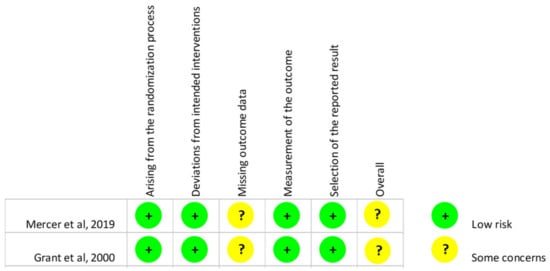
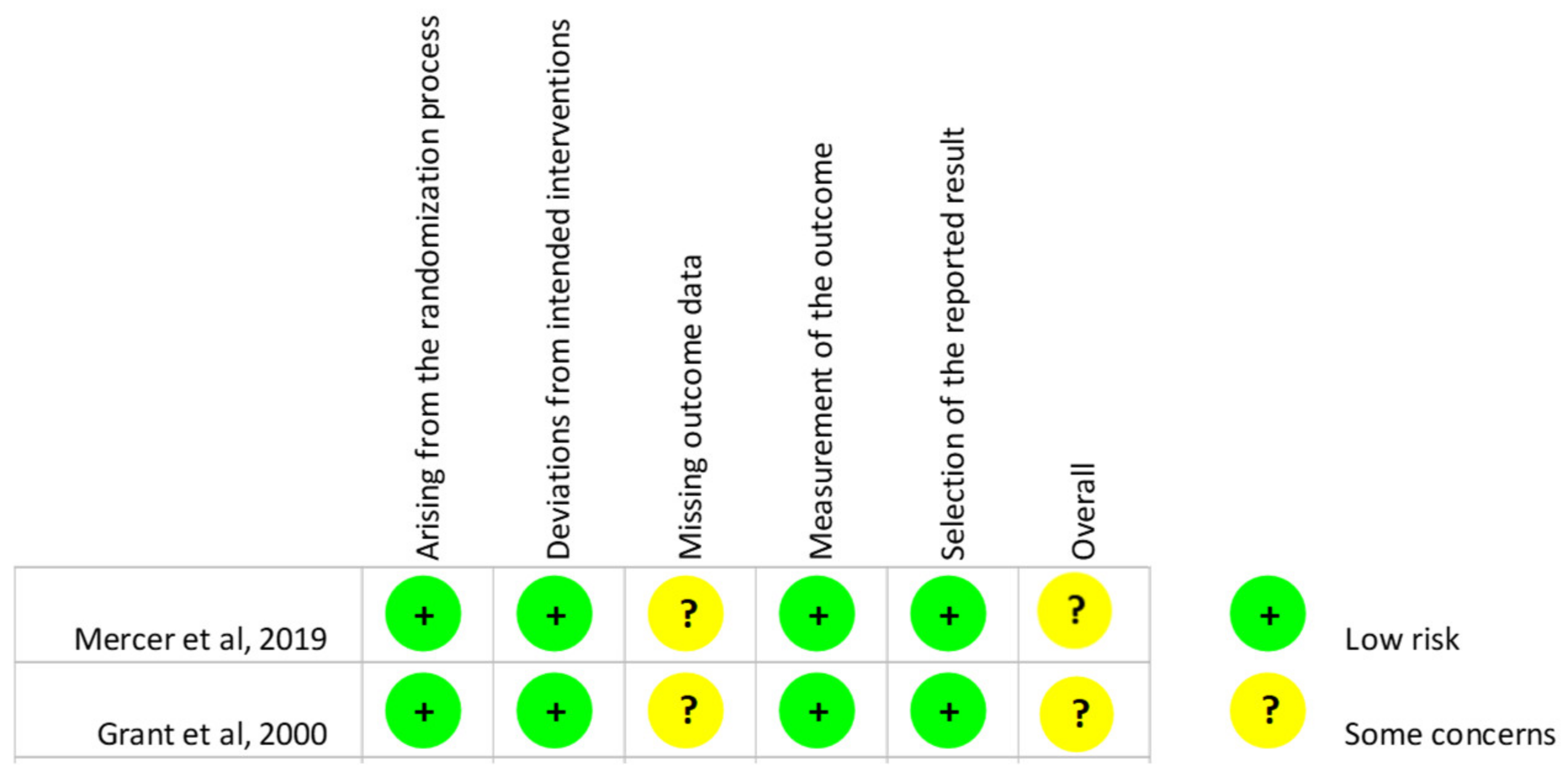
The assessment of the quality of the included articles is presented in Figure 2 and Table 2 (for the two papers describing randomized controlled trials), and in Table 3 (for the observational observational and quasi-experimental study) and in Table 4 (for observational studies). Some of the articles do not provide detailed information on recruitment and sampling strategies [37] or answer or attrition rate [36]. Furthermore, most of the studies reported in the selected articles lacked detailed information regarding the duration and specificities of interventions and details of results. This lack of information resulted in a lower appreciation of methodological reporting quality, according to the tools that have been used for this purpose.
Figure 2.
Quality assessment for randomized controlled trials (RoB 2.0) [38].
Table 3.
Quality assessment of papers describing observational and quasi-experimental study [29].
Table 4.
Quality assessment of before–after studies with no control group, included in systematic review.
None of the described studies obtained a representative sample of the studied population. All studies have a relevant percentage of study dropouts.
3.2. SP Domains and Results of the Effectiveness Assessment
Outcomes assessed in the selected articles can be grouped into three categories: (1) Physical and psychological wellbeing; (2) Health behaviors and self-efficacy; and (3) Health care resources used end health-related economic evaluation.
Ten studies [20,26,27,28,29,30,32,33,36,37] assessed physical or psychological wellbeing. Eight of these studies [20,26,27,30,32,33,36,37] show a positive impact of SP; the remaining two studies [28,29] were unable to prove any improvement on wellbeing after SP.
In the two studies that include specific populations with mental health problems such as anxiety, stress, or depression, Grant et al., 2000 [35] and Morton et al., 2015 [33] found an improvement in quality of life and show a positive impact of SP or similar programs in the measures of self-efficacy.
Finally, six of the articles assess the impact of SP within primary health-care resources, in terms of prescribed medications, the number of appointments with professionals, and economic impact of SP on the health services budget [20,29,30,32,34,35]. Kellezi et al., 2019 [30] is the only article showing that SP can reduce primary care usage through increasing social connectedness.
The qualitative study presented in this article shows that both providers and patients report negative effects of social isolation on health and health-care usage as well as positive benefits of social inclusion/belonging [30].
4. Discussion
This review aimed to identify SP domains of intervention and summarize the scientific evidence about the effectiveness of SP interventions among adults in primary health-care, regarding health and wellbeing outcomes. Overall, we identified and examined thirteen papers describing thirteen SP interventions, all of them conducted in the UK.
4.1. SP: Definition, Boundaries, and Key Elements
A universal definition of SP was not found, as each article adopted different conceptualizations. For this reason, we decided to include studies referenced as SP and/or studies that used its conceptual components and characteristics, namely interventions conducted in a primary health context, with primary health professionals, attending no clinical direct needs, and promoting access to community activity. The definition of SP as presented in the reviewed papers has slight differences in terms of prescription, prescriptors, providers, and users. For example, in the studies where arts were prescribed (e.g., Sumner et al., 2020 [26]), the activities were not pre-existent within the community setting; instead, those activities took place in the GP’s office, which differs with regard to the continuum-perspective concept of community-based activities. Therefore, it is important to note that the definition and concept of SP may influence the obtained results, as this may change the perspective and the approach of interventions.
Another important point to consider when assessing the effectiveness of an intervention is whether all the interventions are similar or not. If not, it is important to understand which pathway leads to better results. For example, it is relevant to consider if the pathway is using or not a LW as a mediator within the prescribing process. Summer et al., 2020 does not use a LW or a therapist, simply referring patients to artists in the community. Although that study shows good results regarding the improvement of psychological wellbeing. The use of an LW appears to be a key feature of SP [12], although the LW role varied significantly between projects [39].
Moreover, it is important to consider the differences between workforce models and how they are organized, i.e., including volunteers or paid staff as LW, the number of sessions with LW, duration of the intervention, and type of support (face-to-face, telephone, text) of SP programs. The length of the intervention was also different between studies, oscillating between 8 and 24 weeks. Moreover, in several papers, this was not even reported. As a result, this difference can also be a bias of obtained results.
A theme that seems to be relevant to SP interventions emerged from this SLR: local infrastructure and population characteristics. Indeed, the characteristics of the population and local community may also be relevant to the role of SP. Given that SP interventions usually include service providers of the third sector to deliver care to the users, the existence of resources and dynamics of local infrastructure was identified as a factor influencing, facilitating, or hindering the implementation process of SP interventions [40]. A range of methods can be used to address SP as a complex intervention [41]. Therefore, they can be used successively or combined at various steps of the evaluation approach [42]. These specificities make systematic reviews difficult to execute, harshening the exercises of summarizing, comparing results, and finding robust evidence. The growing interest in alternative methods for evidence-based research must be accompanied by an in-depth conceptual reflection in order to clearly define their principles of use [42].
4.2. Main Findings Regarding Domains of Interventions
The nine domains of intervention that were identified in this SLR can be seen as priority areas for health promotion. The more frequent domain in the SP programs was “Art activities” (used in eight out of thirteen studies). In fact, over the last few years, this domain has been associated with an improvement of mental health and wellbeing [43]. “Physical activities” was another identified domain, not surprisingly as this is a recognized area of health promotion. Several articles concluded that the prescription of physical activity with local community providers is associated to health positive outcomes, which is in line with the evidence that this activity has benefits on mental health-related issues [44]. Personal development activities have also been suggested, and self-care education can be effective in improving the patient condition to face a variety of chronic diseases [45]. Social interaction activities were in the third place, although this component is at the essence of SP [13]. Religious, cultural, touristic, and technological-related activities were less used in the studies reported by the included studies.
4.3. Main Findings Regarding Outcomes
The outcomes can be placed in three groups: (1) Physical and mental wellbeing; (2) Health behaviors and self-efficacy; and (3) Investment of health care resources and economic evaluation.
With regard to physical and mental wellbeing, outcomes were put together concerning psychological wellbeing, general mental health, anxiety or depression, as well as physical clinical outcomes.
Summer et al. (2019) show that younger participants had greater improvements in their wellbeing scores. They also revealed that people who started with a lower psychological wellbeing score benefited from the SP intervention [26]. A finding by Van de Venter et al. [37] identified that female participants and participants from ethnic minority backgrounds appeared to have had greater improvements in wellbeing score. This can be relevant in areas of mixed ethnic cultures, suggesting that SP promotes social inclusion and health equity.
In all studies included in this SRL, more women were getting involved in SP programs than men. In some studies, the difference was very high, as in Sumner et al. [26], which shows an engaged group composed of 82.5% of females, although Van de Venter et al. [37] found that participants from minority ethnicities and females appeared to show greater improvement in wellbeing scores. In another study [20], men had a greater benefit than women from SP intervention, although no significant difference was found between genders in terms of improvement in psychological wellbeing.
Furthermore, several factors were considered regarding health behaviors and self-efficacy outcomes, such as improvement in quality of life, active living, reduced social isolation, as well as improvements in social networks, self-value, and self-confidence. Best health outcomes are effectively related to the sense of self-efficacy [33] as generally pointed in the literature as very useful to symptoms of self-management [46].
A study highlighted the importance of maintaining physical activity in older people [47]. Older people tend to be less active; thus, the predispositions to have other health-related problems results in a reduction in activity levels; hence, it is important to intervene [48].
Few of the included studies have a long term follow-up, but an encouraging fact in the studies that had a longer-term follow-up is that they evidenced an increase in the maintenance of health behavior alterations and positive outcomes gained with SP, even though there are a lack of data available with the type of follow-up received.
Finally, regarding health-care resources used and economic evaluation, the number of consultations, impact in polypharmacy, and costs of interventions were considered. The concept of delivering social interventions on the theoretical assumption that building social self-efficacy can relieve congestion in the GP office, may be misguided cost improved [35].As in another community public interventions, SP interventions can improve costs in the first development phase [49].
4.4. Strengths and Limitations
Our review is distinct to other reviews of this nature already undertaken, in view of the fact that we analyzed different interventions of SP as we pretend to assess the effectiveness of SP as a concept and to identify domains of interventions. The focus of our review was to identify and analyze interventions of SP, with different research designs, with the aim of assessing the effectiveness of SP to better characterize the SP interventions that have been developed elsewhere.
Notwithstanding, this review has some limitations that have to be taken into consideration. Firstly, we did not include gray literature. The lack of consensus regarding the definition of SP may have had implications for both the identification of studies and interpretation of reported findings. There was also a possibility that relevant studies may not have been identified if authors did not use terms that we included; nevertheless, this is not so probable because we used a comprehensive search strategy (Appendix A).
Our decision to jointly present findings of all studies included, independently of which design or quality, may also be considered a limitation. However as we aimed to summarize the scientific evidence regarding SP, we wanted to include all published studies to facilitate the overview of the type of SP and related outcomes.
4.5. Future Recommendations
Further work would need to be done to obtain more robust evidence regarding the effectiveness of SP. More robust qualitative and quantitative research, addressing the identified methodological shortcomings is needed to understand the real potential of SP [17].
More studies are needed to establish the adequate and more standardized outcome measurement tools and the appropriate timescale for data collection. In addition, well-designed studies are required to conduct health economic analyses [50]. It will be helpful to conduct more studies with similar designs to address similar people needs. Particularly gender and age-sensitive studies can be important to achieve supported effectiveness.
In addition, there is a heterogeneity of intervention models, as there is still a lack of clarity about which components of SP are more effective; thus, a complex intervention mapping approach would be suitable. Further studies with appropriate intervention designs and more randomized control trials would be useful. Furthermore, adequate statistical models of analysis are required, using a more generalized linear model, which allows for the adjustment/control of confounding variables.
More work is also necessary to ensure optimal pathways of SP and to understand their potential effects. As other authors also refer, data such as type of services and activities referred, number of sessions attended, adherence to the service, and dropout rates may be of interest in future studies to assess who received which services, the duration, and with what effect [12]. To achieve these aims, future studies should have built-in SP schemes and be planned from the beginning. The evidence about effectiveness requires more long-term evaluations to confirm these findings. Another important recommendation for the assessment of effectiveness in this initial phase of implementation of SP is to operationalize reasons for referral in a more clinically meaningful manner. Furthermore, it is imperative to evaluate more diverse populations, so, it is necessary to conduct studies in different countries and different health systems.
As to LW, as they appear to be a key feature of SP, future studies should also be able to identify the set of skills and level of training that this SP figure should have for this role to be effectively fulfilled. These recommendations may provide more robust evidence for policymakers and commissioners with regard to SP, such as a useful service provision for community services, health care, and patients.
5. Conclusions
Our systematic review has identified the need for well-conducted studies to improve the evidence base regarding the effectiveness of SP. We also conclude that the concept of SP is still under development, certainly more advanced in the UK, and that the implementation in other countries, if it exists, has not yet been translated into scientific production.
Consistent with the findings of other reviews of SP, currently, there is little evidence for the effectiveness of SP. The principal domains of interventions that we found were art activities, physical activities, social interaction activities, technological and technical activities, personal development, and cultural and or tourist activities. The pathway of application of SP can differ, but a robust local infrastructure and a link worker seem to contribute to higher effectiveness. SP initiatives that focus on the location of their patients within their communities create more sustainable community environments and appear to be more effective.
Our SLR shows that SP may be a promissory health procedure that may contribute to health promotion and improvements of health-care systems in the face of the challenge that the evolution of society brings upon us. The existent evidence is enough, but more studies are needed; SP appears to have potential in improving wellbeing, reducing anxiety and depression levels, reducing isolation, and promoting health behaviors. Certainly, SP is not a “miracle drug”, it will always depend on a complex interaction of many factors, between health services, community, and patients. In the future, stakeholders must collaborate to address the identified evidence gaps.
The evidence regarding the effectiveness of SP continues to be unclear, but this synthesis of evidence can be useful to inform practice, policy, and future research in this field.
Author Contributions
Conceptualization, A.C., P.R.C.S., A.V., O.S., J.L., A.H., P.N., V.A.; methodology, A.V., O.S., A.H., V.A., validation, CJ.S., A.V., O.S.; formal analysis, A.C., CJ.S., P.R.C.S., A.V., O.S., J.L., A.H., P.N., V.A.; writing—original draft preparation, C.J.S.; writing—review and editing A.C., CJ.S., P.R.C.S., A.V., O.S., J.L., A.H., P.N., V.A.; supervision, A.C.; project administration, A.C., A.V., J.L., V.A.; funding acquisition, A.C. All authors have read and agreed to the published version of the manuscript.
Funding
This review was funded by the Portuguese Directorate-General of Health through the CENIE project (Fundo Europeu de Desenvolvimento Regional (FEDER), Programa Interreg V-A Espanha-Portugal (POCTEP) 2014/2020.
Institutional Review Board Statement
Not applicable.
Informed Consent Statement
Not applicable.
Data Availability Statement
Not applicable.
Acknowledgments
The authors would like to thank Catarina Rebelo for helping with the articles selection and data extraction.
Conflicts of Interest
The authors declare no conflict of interest.
Appendix A. Comprehensive Search Strategy of SRL
| Search | Query | PubMed Items Found | CINHAL Found | Scopus |
| #1 | “social prescribing” [Title/Abstract] | 125 | 133 | 159 |
| #2 | “social prescription” [Title/Abstract] | 23 | 16 | 85 |
| #3 | “community referral” [Title/Abstract] | 97 | 60 | 211 |
| #4 | “wellbeing program” OR “well being program” OR “well-being program” [Title/Abstract] | 131 | 42 | 236 |
| #5 | “Community prescribing” [Title/Abstract] OR “community prescription” [Title/Abstract] | 54 | 32 | 89 |
| #6 | “social referral” [Title/Abstract] | 4 | 2 | 31 |
| #7 | “non-medical referral” [Title/Abstract] | 0 | 4 | 5 |
| #8 | #1 OR #2 OR #3 OR #4 OR #5 OR #6 OR #7 | 415 | 274 | 781 |
| #9 | “link worker” [Title/Abstract] | 34 | 33 | 114 |
| #10 | “care navigators” [Title/Abstract] | 29 | 43 | 57 |
| #11 | #9 OR #10 | 63 | 76 | 169 |
| #12 | #8 OR #11 | 466 | 345 | 931 |
| #13 | “community care” [Title/Abstract] | 4677 | 3709 | 65,644 |
| #14 | “primary care” [Title/Abstract] OR “primary-care” [Title/Abstract] | 114,652 | 73,391 | 135,678 |
| #15 | “primary health services” [Title/Abstract] | 340 | 173 | 631 |
| #16 | general practice [Title/Abstract] | 37,966 | 16,537 | 110,772 |
| #17 | primary health care [Title/Abstract] OR “primary healthcare” [Title/Abstract] | 32,179 | 15,804 | 110,713 |
| #18 | “community activities” [Title/Abstract] | 672 | 506 | 2,173 |
| #19 | #13 OR #14 OR #15 OR #16 OR #17 OR #18 | 174,316 | 101,311 | 345,138 |
| #20 | #12 AND #19 | 98 | 90 | 215 |
| #21 | #20 AND trial [Title/Abstract] | 11 | 10 | 19 |
| #22 | #20 AND RCT [Title/Abstract] | 1 | 1 | 3 |
| #23 | #20 AND controlled [Title/Abstract] | 8 | 7 | 41 |
| #24 | #20 AND effectiveness [Title/Abstract] | 18 | 10 | 31 |
| #25 | #20 AND efficacy [Title/Abstract] | 2 | 1 | 4 |
| #26 | #20 AND evaluation [Title/Abstract] | 26 | 23 | 52 |
| #27 | #20 AND (# 21 OR #22 OR #23 OR #24 OR #25 OR #26) | 41 | 37 | 101 |
References
- Crimmins, E.M. Lifespan and Healthspan: Past, Present, and Promise. Gerontologist 2015, 55, 901–911. [Google Scholar] [CrossRef] [Scilit] [PubMed]
- MacLeod, S.; Schwebke, K.; Hawkins, K.; Ruiz, J.; Hoo, E.; Yeh, C.S. Need for Comprehensive Health Care Quality Measures for Older Adults. Popul. Health Manag. 2018, 21, 296–302. [Google Scholar] [CrossRef] [Scilit]
- Finlay, J.M.; Kobayashi, L.C. Social isolation and loneliness in later life: A parallel convergent mixed-methods case study of older adults and their residential contexts in the Minneapolis metropolitan area, USA. Soc. Sci. Med. 2018, 208, 25–33. [Google Scholar] [CrossRef] [Scilit]
- The Sustainable Development Agenda—United Nations Sustainable Development. Available online: https://www.un.org/sustainabledevelopment/development-agenda/ (accessed on 10 October 2020).
- Costa, A.; Lopes, J.; Seabra, P.; Henriques, A.; Alarcão, V.; Virgolino, A.; Nogueira, P.; Arriaga, M. Is there a link between Social Prescribing and touristic activities involving older individuals: Insights from a scoping review. In Creative Tourism Dynamics: Connecting Travellers, Communities, Cultures and Places; Coimbra Editora: Coimbra, Portugal, 2020; pp. 49–64. [Google Scholar]
- Norris, S.L.; Rehfuess, E.A.; Smith, H.; Tunçalp, Ö.; Grimshaw, J.M.; Ford, N.P.; Portela, A. Complex health interventions in complex systems: Improving the process and methods for evidence-informed health decisions. BMJ Glob. Health 2019, 4, e000963. [Google Scholar] [CrossRef] [Scilit]
- Woolf, S.H.; Aron, L. Health in International Perspective: Shorter Lives, Poorer Health. In Physical and Social Environmental Factors; National Academies Press: Washington, DC, USA, 2013. [Google Scholar]
- Office of Disease Prevention and Health Promotion NWS-10.4 Data Details—Healthy People. Available online: http://www.healthypeople.gov/2020/topicsobjectives2020/DataDetails.aspx?hp2020id=NWS-10.4 (accessed on 11 May 2014).
- De Silva, M.J.; McKenzie, K.; Harpham, T.; Huttly, S.R.A. Social capital and mental illness: A systematic review. J. Epidemiol. Community Health 2005, 59, 619–627. [Google Scholar] [CrossRef] [Scilit]
- Pilkington, K.; Loef, M.; Polley, M.; Simmons, R.; Portillo, M.C. Searching for Real-World Effectiveness of Health Care Innovations: Scoping Study of Social Prescribing for Diabetes. J. Med Internet Res. 2017, 19, e20. [Google Scholar] [CrossRef] [Scilit]
- Pescheny, J.; Randhawa, G.; Pappas, Y. Patient uptake and adherence to social prescribing: A qualitative study. BJGP Open 2018, 2, 101598. [Google Scholar] [CrossRef] [Scilit] [PubMed]
- Husk, K.; Blockley, K.; Lovell, R.; Bethel, A.; Lang, I.; Byng, R.; Garside, R. What approaches to social prescribing work, for whom, and in what circumstances? A realist review. Health Soc. Care Community 2020, 28, 309–324. [Google Scholar] [CrossRef] [Scilit]
- Polley, M.J.; Fleming, J.; Anfilogoff, T.; Carpenter, A. Making Sense of Social Prescribing; University of Westminster: London, UK, 2017. [Google Scholar]
- Fancourt, D.; Steptoe, A.; Cadar, D. Community engagement and dementia risk: Time-to-event analyses from a national cohort study. J. Epidemiol. Community Health 2020, 74, 71–77. [Google Scholar] [CrossRef] [Scilit] [PubMed]
- Torjesen, I. Social prescribing could help alleviate pressure on GPs. BMJ 2016, 352, i1436. [Google Scholar] [CrossRef] [Scilit] [PubMed]
- NHS England » Social Prescribing in Practice. Available online: https://www.england.nhs.uk/personalisedcare/upc/comprehensive-model/case-studies/social-prescribing-in-practice/ (accessed on 10 October 2020).
- Bickerdike, L.; Booth, A.; Wilson, P.M.; Farley, K.; Wright, K. Social prescribing: Less rhetoric and more reality. A systematic review of the evidence. BMJ Open 2017, 7, e013384. [Google Scholar] [CrossRef] [Scilit]
- NHS England NHS England » Social Prescribing. Available online: https://www.england.nhs.uk/contact-us/privacy-notice/how-we-use-your-information/public-and-partners/social-prescribing/ (accessed on 11 October 2020).
- Fixsen, A.; Seers, H.; Polley, M.; Robins, J. Applying critical systems thinking to social prescribing: A relational model of stakeholder “buy-in. ” BMC Health Serv. Res. 2020, 20, 1–13. [Google Scholar] [CrossRef] [Scilit] [PubMed]
- Woodall, J.; Trigwell, J.; Bunyan, A.-M.; Raine, G.; Eaton, V.; Davis, J.; Hancock, L.; Cunningham, M.; Wilkinson, S. Understanding the effectiveness and mechanisms of a social prescribing service: A mixed method analysis. BMC Health Serv. Res. 2018, 18, 604. [Google Scholar] [CrossRef] [Scilit]
- Maughan, D.L.; Patel, A.; Parveen, T.; Braithwaite, I.; Cook, J.; Lillywhite, R.; Cooke, M. Primary-care-based social prescribing for mental health: An analysis of financial and environmental sustainability. Prim. Health Care Res. Dev. 2016, 17, 114–121. [Google Scholar] [CrossRef] [Scilit] [PubMed]
- Liberati, A.; Altman, D.G.; Tetzlaff, J.; Mulrow, C.; Gøtzsche, P.C.; Ioannidis, J.P.A.; Clarke, M.; Devereaux, P.J.; Kleijnen, J.; Moher, D. The PRISMA statement for reporting systematic reviews and meta-analyses of studies that evaluate healthcare interventions: Explanation and elaboration. BMJ 2009, 339, b2700. [Google Scholar] [CrossRef] [Scilit] [PubMed]
- Risk of Bias Tools. Available online: https://www.riskofbias.info/ (accessed on 26 January 2021).
- Study Quality Assessment Tools|NHLBI, NIH. Available online: https://www.nhlbi.nih.gov/health-topics/study-quality-assessment-tools (accessed on 26 January 2021).
- Pescheny, J.V.; Gunn, L.H.; Randhawa, G.; Pappas, Y. The impact of the Luton social prescribing programme on energy expenditure: A quantitative before-and-after study. BMJ Open 2019, 9, e026862. [Google Scholar] [CrossRef] [Scilit] [PubMed]
- Sumner, R.C.; Crone, D.M.; Baker, C.; Hughes, S.; Loughren, E.A.; James, D.V.B. Factors associated with attendance, engagement and wellbeing change in an arts on prescription intervention. J. Public Health 2020, 42, E89–E96. [Google Scholar] [CrossRef] [Scilit]
- Prior, F.; Coffey, M.; Robins, A.; Cook, P. Long-Term Health Outcomes Associated With an Exercise Referral Scheme: An Observational Longitudinal Follow-Up Study. J. Phys. Act. Health 2019, 16, 288–293. [Google Scholar] [CrossRef] [Scilit]
- Mercer, S.W.; Fitzpatrick, B.; Grant, L.; Chng, N.R.; McConnachie, A.; Bakhshi, A.; James-Rae, G.; O’Donnell, C.A.; Wyke, S. Effectiveness of Community-Links Practitioners in Areas of High Socioeconomic Deprivation. Ann. Fam. Med. 2019, 17, 518–525. [Google Scholar] [CrossRef] [Scilit] [PubMed]
- Carnes, D.; Sohanpal, R.; Frostick, C.; Hull, S.; Mathur, R.; Netuveli, G.; Tong, J.; Hutt, P.; Bertotti, M. The impact of a social prescribing service on patients in primary care: A mixed methods evaluation. BMC Health Serv. Res. 2017, 17, 1–9. [Google Scholar] [CrossRef] [Scilit]
- Kellezi, B.; Wakefield, J.R.H.; Stevenson, C.; McNamara, N.; Mair, E.; Bowe, M.; Wilson, I.; Halder, M.M. The social cure of social prescribing: A mixed-methods study on the benefits of social connectedness on quality and effectiveness of care provision. BMJ Open 2019, 9, e033137. [Google Scholar] [CrossRef] [Scilit]
- Halder, M.M.; Wakefield, J.R.; Bowe, M.; Kellezi, B.; Mair, E.; McNamara, N.; Wilson, I.; Stevenson, C. Evaluation and exploration of a social prescribing initiative: Study protocol. J. Health Psychol. 2018, 26, 345–356. [Google Scholar] [CrossRef] [Scilit]
- Loftus, A.; McCauley, F.; McCarron, M. Impact of social prescribing on general practice workload and polypharmacy. Public Health 2017, 148, 96–101. [Google Scholar] [CrossRef] [Scilit]
- Morton, L.; Ferguson, M.; Baty, F. Improving wellbeing and self-efficacy by social prescription. Public Health 2015, 129, 286–289. [Google Scholar] [CrossRef] [Scilit] [PubMed]
- Grayer, J.; Cape, J.; Orpwood, L.; Leibowitz, J.; Buszewicz, M. Facilitating access to voluntary and community services for patients with psychosocial problems: A before-after evaluation. BMC Fam. Pr. 2008, 9, 27. [Google Scholar] [CrossRef] [Scilit]
- Grant, C.; Goodenough, T.; Harvey, I.; Hine, C. A randomised controlled trial and economic evaluation of a referrals facilitator between primary care and the voluntary sector. BMJ 2000, 320, 419–423. [Google Scholar] [CrossRef] [Scilit] [PubMed]
- Vogelpoel, N.; Jarrold, K. Social prescription and the role of participatory arts programmes for older people with sensory impairments. J. Integr. Care 2014, 22, 39–50. [Google Scholar] [CrossRef] [Scilit]
- Van De Venter, E.; Buller, A. Arts on referral interventions: A mixed-methods study investigating factors associated with differential changes in mental well-being. J. Public Health 2015, 37, 143–150. [Google Scholar] [CrossRef] [Scilit]
- Sterne, J.A.C.; Savović, J.; Page, M.J.; Elbers, R.G.; Blencowe, N.S.; Boutron, I.; Cates, C.J.; Cheng, H.-Y.; Corbett, M.S.; Eldridge, S.M.; et al. RoB 2: A revised tool for assessing risk of bias in randomised trials. BMJ 2019, 366, l4898. [Google Scholar] [CrossRef] [Scilit] [PubMed]
- Moffatt, S.; Steer, M.; Lawson, S.; Penn, L.; O’Brien, N. Link Worker social prescribing to improve health and well-being for people with long-term conditions: Qualitative study of service user perceptions. BMJ Open 2017, 7, e015203. [Google Scholar] [CrossRef] [Scilit]
- Sims-Gould, J.; McKay, H.A.; Hoy, C.L.; Nettlefold, L.; Gray, S.M.; Lau, E.Y.; Bauman, A. Factors that influence implementation at scale of a community-based health promotion intervention for older adults. BMC Public Health 2019, 19, 16–19. [Google Scholar] [CrossRef] [Scilit] [PubMed]
- Petticrew, M. When are complex interventions ‘complex’? When are simple interventions ‘simple’? Eur. J. Public Health 2011, 21, 397–398. [Google Scholar] [CrossRef] [Scilit]
- Minary, L.; Trompette, J.; Kivits, J.; Cambon, L.; Tarquinio, C.; Alla, F. Which design to evaluate complex interventions? Toward a methodological framework through a systematic review. BMC Med Res. Methodol. 2019, 19, 92. [Google Scholar] [CrossRef] [Scilit] [PubMed]
- Jensen, A.; Bonde, L.O. The use of arts interventions for mental health and wellbeing in health settings. Perspect. Public Health 2018, 138, 209–214. [Google Scholar] [CrossRef] [Scilit] [PubMed]
- Gomes, A.; Ramos, S.; Ferreira, A.R.; Montalvão, J.; Ribeiro, I.; Lima, F. A efetividade do exercício físico no tratamento da depressão. Rev. Port. Enferm. Saúde Ment. 2019, 58–64. [Google Scholar] [CrossRef] [Scilit]
- Bhuyan, K.K. Health promotion through self-care and community participation: Elements of a proposed programme in the developing countries. BMC Public Health 2004, 4, 1–31. [Google Scholar] [CrossRef] [Scilit] [PubMed]
- Hoffman, A.J. Enhancing Self-efficacy for Optimized Patient Outcomes through the Theory of Symptom Self-management. Cancer Nurs. 2013, 36, E16–E26. [Google Scholar] [CrossRef] [Scilit] [PubMed]
- Langhammer, B.; Bergland, A.; Rydwik, E. The Importance of Physical Activity Exercise among Older People. BioMed Res. Int. 2018, 2018, 7856823. [Google Scholar] [CrossRef] [Scilit] [PubMed]
- McPhee, J.S.; French, D.P.; Jackson, D.; Nazroo, J.; Pendleton, N.; Degens, H. Physical activity in older age: Perspectives for healthy ageing and frailty. Biogerontology 2016, 17, 567–580. [Google Scholar] [CrossRef] [Scilit]
- Sohn, H.; Tucker, A.; Ferguson, O.; Gomes, I.; Dowdy, D. Costing the implementation of public health interventions in resource-limited settings: A conceptual framework. Implement. Sci. 2020, 15, 86. [Google Scholar] [CrossRef] [Scilit]
- Dayson, C.; Bashir, N. The Social and Economic Impact of the Rotherham Social Prescribing Pilot Main Evaluation Report; Sheffield Hallam University: Sheffield, UK, 2014. [Google Scholar]

Publisher’s Note: MDPI stays neutral with regard to jurisdictional claims in published maps and institutional affiliations. |
© 2021 by the authors. Licensee MDPI, Basel, Switzerland. This article is an open access article distributed under the terms and conditions of the Creative Commons Attribution (CC BY) license (http://creativecommons.org/licenses/by/4.0/).