


Abstract
Increasing the relative availability of plant-based (versus animal source) foods seems promising in shifting consumption, but it remains unknown how and under what circumstances this happens. We performed two availability manipulations including different foods. The impact on food choice, social norm perceptions about what others do (descriptive) or approve of (injunctive), and salience was assessed. Non-vegetarian participants were visually (Study 1, n = 184) or physically (Study 2, n = 276) exposed to (a) four plant-based and two animal source foods or (b) vice versa. Participants chose one food item, either hypothetically (Study 1) or actually (Study 2), and reported the perceived social norms and salience of plant-based and animal source foods. The results showed no direct effects on food choice, injunctive norms, or salience. An increased proportion of plant-based (versus animal source) foods was interpreted in Study 1 as plant-based foods being less often chosen by others, whereas in Study 2, these foods were interpreted as being more often chosen (marginally significant), while animal source foods were interpreted as being less often chosen. The results suggest that a higher availability of plant-based foods influences descriptive norms, but future research should examine aspects potentially contributing to the contradictory normative interpretations (e.g., norm salience).
1. Introduction
In an era when unhealthy and unsustainable food consumption patterns pose a global risk to people and planet, transitioning to healthier and more sustainable diets is one of the biggest global challenges. Recommendations for these so-called ‘win-win’ diets emphasize mainly an increase in the consumption of plant-based foods and a decrease in the consumption of animal source foods [1], with ruminant meats (e.g., beef), for example, having an environmental impact that is 20–100 times greater than that of plant-based foods [2]. Consequently, an increasing body of research focuses on strategies promoting dietary shifts towards plant-based foods and/or lowering demand for animal source foods (e.g., see systematic reviews by Bianchi, Garnett, Dorsel, Aveyard, and Jebb [3]; Bianchi, Dorsel, Garnett, Aveyard, and Jebb [4]).
It is increasingly acknowledged that the organization of physical micro food environments (e.g., worksite cafeterias, supermarkets) plays a major role in transitioning current diets towards healthier and more sustainable consumption patterns, rather than putting all responsibility on the consumer and solely targeting conscious determinants of behavior (e.g., information provision) [3,4]. Particularly, it has been shown that physical cues—physical aspects of environments [5]—influence consumers’ food choices in these micro food environments. One such physical cue that has repeatedly been identified as a key driver of food selection is in-store food availability (e.g., see systematic review by Pitt, Gallegos, Comans, Cameron, and Thornton [6]). In-store food availability refers to the number of instances of a product within the physical micro environment [7]. Given the impact of food availability on consumption, a substantial number of studies have addressed and shown the impact of increasing the availability of low-calorie foods—thereby decreasing the number of high-calorie foods—to stimulate healthy food selection (e.g., see Cochrane systematic review by Hollands et al. [8]). Limited attention has been paid to understanding the circumstances under which food availability influences the consumption of more sustainable foods in micro food environments [3,9]. Furthermore, little is known about the psychological mechanisms that underlie the effect of altering availability on food selection [7,8]. The present paper aims to tackle these gaps in the literature by investigating the circumstances under which, and how, the selection of plant-based versus animal source foods is influenced by food availability.
Interventions altering the number of available food products can be executed in various ways: By (a) providing a larger or smaller number of different product options to alter the product range, (b) providing a larger or smaller number of available units of a product (while the range remains similar), or (c) a combination of both strategies [8]. The present paper is inspired by the observed trend of meat substitutes gaining more shelf space in Dutch supermarkets in recent years [10,11]. We aim to investigate the effect of further increasing the number of units of plant-based food products available to a situation in which more units of plant-based alternatives are available than units of animal source food products. To do so, we manipulate the proportion of units of plant-based food products available relative to the proportion of units of animal source food products available, without altering the range of products available [7,8]. We are not aware of other studies aiming to keep the product range constant, although previous interventions have tried to keep the absolute (overall) number of options similar. For instance, an intervention study including six worksite cafeterias showed that increasing the proportion of low-calorie (to high-calorie) food options available—by removing high-calorie options and introducing low-calorie options—decreased the amount of energy (kcal) purchased, although results varied by site (significant differences were observed in two of the six sites) [12]. Regarding sustainable food consumption, as far as we know, only one observational and one experimental field study conducted in three college cafeterias investigated the effect of proportionally providing a larger or a smaller number of different vegetarian meal options on meal selection [9]. The results showed that doubling the number of vegetarian meal options available increased the sales of vegetarian meals by between 41% and 79%. To illustrate, the number of vegetarian meal options was, for example, increased from 1 in 4 to 2 in 4 by removing an animal source meal option and introducing a vegetarian meal option [9].
One may argue, however, that the effectiveness of such subtle changes in the choice architecture in stimulating more sustainable choices depends on consumers’ affective connection towards meat, which is associated with consumers’ willingness to shift towards a more plant-based diet [13], and may be interpreted as a continuum: One end referring to disgust associated with negative affect and repulsion towards meat and the other end referring to a meat attachment pattern associated with positive affect and dependency towards meat [14]. We reason that people with higher levels of meat attachment are less affected by an availability intervention stimulating plant-based food selection, whereas people with lower levels of meat attachment could be more susceptible towards these initiatives [13,14]. Therefore, in this article, consumers’ differences in meat attachment are assessed as a potential moderator in the effect of altering sustainable food availability on food selection.
In the literature, it has been suggested (rather than tested) that availability can affect consumer choices in different ways, as altering the proportion of foods may for instance influence how consumers pay attention to, and evaluate, these products [7,8]. To our knowledge, this is the first study to empirically test potential underlying mechanisms of the availability effect. We thereby focus on explanations other than altering the range of different product options (e.g., a greater range might increase consumer satisfaction as there is more variety [7,15]). Rather, we reason that an increased availability of plant-based foods relative to animal source foods may increase the salience of plant-based foods when they take up a larger space in the visual field (e.g., supermarket shelves) [5,7,15]. This greater visual space dedicated to plant-based foods may increase the likelihood of the presumably more salient plant-based foods being observed by consumers, as consumers often focus on the most salient product [7,16]. This may, in turn, encourage the selection of plant-based foods [7].
An increased availability of plant-based foods can consequently serve as a cue that implies a consumption norm or even a new (or updated) social norm, and thereby alter behavior [7,12,15,17]. Two types of social norms that are conceptually and motivationally different may be influenced by increasing the relative availability of plant-based foods: Descriptive norms and injunctive norms [18]. Consumers may interpret the availability of a higher proportion of plant-based foods as representing what other people in that environment are typically consuming. Consumers observing a relatively greater supply of plant-based foods may believe that these products are popular because of a high demand (i.e., greater consumption of these products by others) [7]. This explanation is related to a descriptive norm indicating what other people normally do in that environment [18]; it is supported by previous studies suggesting that descriptive norms can influence behavior through physical aspects in food environments without seeing others [17,19,20,21]. Likewise, we argue that consumers may (also) infer that a greater availability of plant-based foods signals what other people consider as the appropriate choice in that environment. This explanation is related to an injunctive norm indicating what other people approve of in that environment [18] and is built upon the idea that consumers interpret the number of products available as a deliberate decision by the food provider (e.g., supermarket) [19]. This normative interpretation of availability as a reflection of the choice that consumers are supposed to make according to others is consistent with previous research showing that consumers believe that a served portion size in a given situation is chosen after some deliberation, determining their food intake 24 h later [19].
In this article, we propose that a relatively high availability of plant-based (versus animal source) food products will (a) increase the likelihood of plant-based (versus animal source) foods being chosen, (b) increase (versus decrease) the perceived salience of plant-based (versus animal source) foods, (c) increase (versus decrease) perceived descriptive norms signaling that others typically choose plant-based (versus animal source) foods, and (d) increase (versus decrease) perceived injunctive norms signaling that plant-based (versus animal source) foods ought to be chosen according to others. Furthermore, we examined whether perceptions of salience, descriptive norms, and injunctive norms mediate the relationship between the availability condition and food choice. Across two different experimental manipulations simulating (online) supermarket settings and using different meat reduction practices, we tested our hypothesis by visually (Study 1) and physically (Study 2) exposing non-vegetarian participants to an increased availability of plant-based foods or to a more actual situation in which animal source foods were highly available.
2. Study 1
2.1. Methods
2.1.1. Design
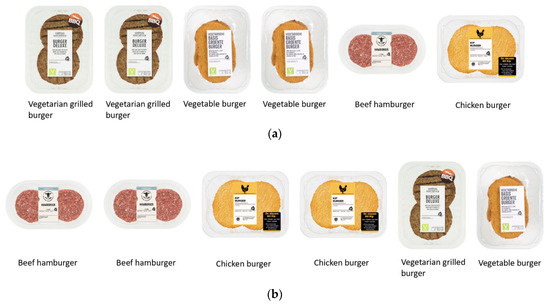
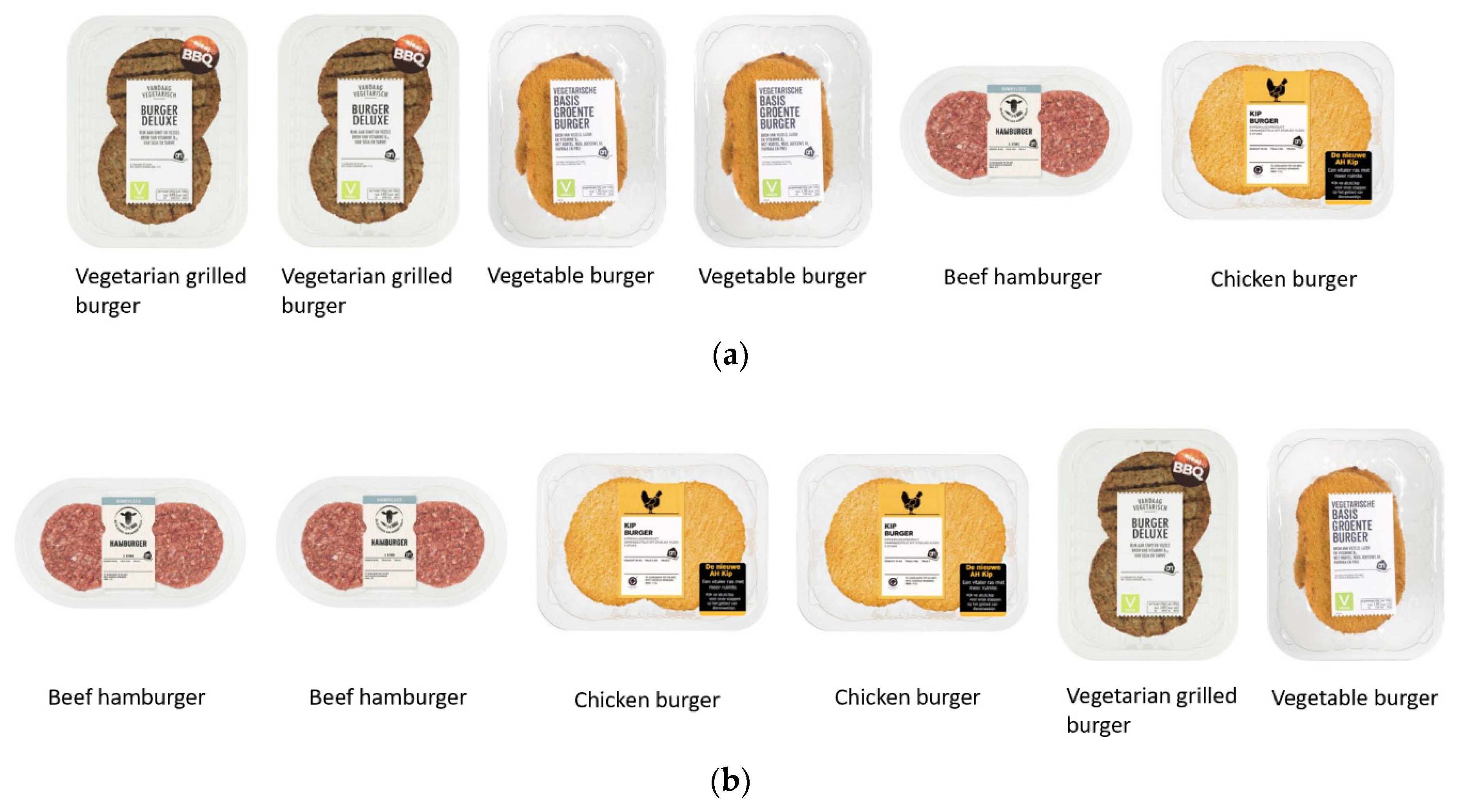
A between-subjects design with two conditions was utilized in an online study (inspired by an online experiment by Pechey and Marteau [5]). Across conditions, participants were visually exposed to an array of images depicting two different plant-based and two different animal source food products (product range: Four different options); all images were similar in size and were shot from the same angle. The number of available units of plant-based and animal source food products was manipulated between conditions (keeping the product range similar to eliminate potential effects of the introduction of new products): (a) Four plant-based and two animal source food products (increased availability of plant-based foods, Figure 1a), and (b) two plant-based and four animal source food products (increased availability of animal source foods, Figure 1b). From the array of food items, participants were asked to select one food product that they would choose to eat. Additionally, their perceptions of salience, descriptive norms, and injunctive norms of both the plant-based and the animal source foods were measured as potential mediators. Furthermore, meat attachment and sex were measured as potential moderators. Study approval was obtained from the research ethics committee of Wageningen University and Research (CoC number 09215846; Raghoebar 2019–23). We preregistered the study on the Open Science Framework (https://osf.io/bqmzg/) before data collection.
Figure 1.
Examples of the availability manipulation keeping the product range on offer unchanged between conditions: (a) Increased availability of plant-based foods; (b) increased availability of animal source foods.
2.1.2. Participants and Sample Size
We recruited Dutch participants aged ≥18 years on the online survey platform Prolific Academic. Participants who considered themselves as vegetarians were excluded from participation. Based on power estimations of a Monte Carlo power analysis for indirect effects [22] (see Supplementary Materials (Methods: Study 1)), it was planned to recruit 200 participants (roughly 100 participants in each condition).
2.1.3. Materials (Food Options: Burgers)
Burgers (Albert Heijn Supermarket) were used as food stimuli, thereby presenting participants with a meal format in which the protein source (e.g., meat) is usually the main component of the meal [23]. Instant meat substitutes (specifically produced and labeled to substitute (imitate) meat) were offered as plant-based alternatives to their animal source options, as these plant-based burgers are gaining more shelf space in Dutch supermarkets. They were selected based on the results of an online pilot study (see Supplementary Materials (Methods: Study 1)), including 100 Dutch students and employees of Wageningen University and Research who considered themselves as non-vegetarians (88% students, 83% female, M age = 23.66 years, SD = 5.41). Participants reported their liking for, and familiarity with, the different burgers (measured on 7-point scales (range 1–7)), as these product-related factors have been identified as key barriers to consumer acceptance [24]. Two different options of plant-based and animal source food products that scored highest on these liking and familiarity items were selected for inclusion in the experiment. The plant-based food products included were (each product included two burgers (portions)) vegetarian grilled burgers (based on soy protein and wheat protein: 180 g, 279 kcal; M liking = 4.46 (SD = 1.28), M familiarity = 2.49 (SD = 1.70)) and vegetable burgers (vegetable mix including carrots, garden peas, corn and bell pepper: 200 g, 340 kcal; M liking = 4.54 (SD = 1.40), M familiarity = 2.76 (SD = 1.95)). The animal source food products included were (each product included two burgers (portions)) beef hamburgers (200 g, 530 kcal; M liking = 5.49 (SD = 1.21), M familiarity = 5.42 (SD = 1.77)) and chicken burgers (205 g, 584 kcal; M liking = 5.13 (SD = 1.29), M familiarity = 4.42 (SD = 2.05)).
2.1.4. Measures
Hypothetical Food Choice
One image of each different food option (two plant-based and two animal source food products) was presented on a single line as the response scale for the hypothetical food choice item (Table 1). The position of images was randomized to eliminate order effects, and participants responded by selecting one food option. A dichotomous variable was created with two categories: Plant-based and animal source foods.
Table 1.
Items used to measure hypothetical food choice, perceptions of salience, descriptive norms, and injunctive norms.
Proposed Mediators
The items measuring perceptions of salience, descriptive norms, and injunctive norms are presented in Table 1. For each proposed mediator variable, participants completed the corresponding item separately for the two plant-based and the two animal source foods. This resulted in four ratings for each mediator variable (12 ratings in total). Then, for each mediator variable, two single scores were calculated including the sum of (a) two ratings of plant-based foods and (b) two ratings of animal source foods. This ultimately resulted in a plant-based and an animal source measure for each mediator variable (six measures in total).
Meat Attachment
Meat attachment was assessed on a 16-item scale developed by Graça, Calheiros, and Oliveira [13], consisting of four subscales: Hedonism (e.g., ‘to eat meat is one of the good pleasures in life’; including four items), affinity (e.g., ‘by eating meat I’m reminded of the death and suffering of animals’; including four items, all reverse coded), entitlement (e.g., ‘to eat meat is an unquestionable right of every person’; including three items), and dependence (e.g., ‘I don’t picture myself without eating meat regularly’; including five items, one item was reverse coded). Responses ranged from 1: Strongly disagree to 7: Strongly agree. Cronbach’s α was 0.92, and a mean score was calculated for the 16 items.
2.1.5. Procedure
The various stages of the online experiment are outlined in Table 2. Regarding Stage 5a, in which the participant was instructed to choose one burger, the availability manipulation (i.e., the number of units of plant-based and animal source burgers available per option) to which the participant was visually exposed was dependent upon his/her randomly assigned condition (via Qualtrics). The burgers were presented on a single line, and the order of presentation of categories (plant-based burgers versus animal source burgers) was evenly randomized, as well as the order of presentation of burgers within each category (keeping analogous options together). Furthermore, the product names were placed directly below the product images, corresponding to the product names provided by the supermarket (Figure 1). Regarding Stages 5b and 5c, in which the participant was instructed to hypothetically choose his/her bun and toppings, in each condition one product per option was shown on a single line.
Table 2.
The various stages of the online experiment.
2.1.6. Statistical Procedure
IBM SPSS Statistics 24 (IBM corp., Armonk, NY, USA) was used for data analyses. Participants who identified the study aim were excluded from analyses, as well as participants who indicated any food allergies or intolerances for the included burgers, participants who incorrectly answered the quality control question, and participants who did not follow instructions (planned a priori).
A Pearson chi-square analysis was conducted to test whether hypothetical food choice differed significantly between conditions. Six separate univariate ANOVAs were run to assess whether condition affected perceptions of (a) salience, (b) descriptive norms, and (c) injunctive norms, run for both the plant-based and the animal source foods.
The conditions for mediation were checked [29] by conducting six linear regressions to examine the effect of experimental condition on perceptions of (a) salience, (b) descriptive norms, and (c) injunctive norms, run for both the plant-based and the animal source foods, and the effect of each proposed mediator on hypothetical food choice was assessed by conducting six logistic regressions, again run for both the plant-based and the animal source foods. Proposed mediators that showed significant effects for both components of the indirect effect were included in mediation analyses using the PROCESS macro for SPSS (Model 4) [30], generating 95% percentile bootstrap confidence intervals for the indirect effect, based on 10,000 bootstrap resamples.
PROCESS macro for SPSS (Model 1) was used to examine (1) the interaction between condition and sex on hypothetical food choice and (2) the interaction between condition and meat attachment on hypothetical food choice, generating 95% percentile bootstrap confidence intervals for the interaction effect, based on 10,000 bootstrap resamples.
Potential covariates were identified by running correlation analyses between descriptive variables (demographics, hunger, liking, familiarity, meat attachment, frequency of meat consumption) and hypothetical food choice or the proposed mediator variables. We repeated primary analyses adjusting for significantly correlated covariates. Only results of primary analyses that were significantly impacted by the inclusion of these covariates were reported as a sensitivity analysis.
2.2. Results
2.2.1. Participant Characteristics
In total, 370 Dutch Prolific Academic participants were eligible to participate in the study, of which 188 participants completed the questionnaire on a desktop or laptop computer (response rate: 49%, all participants passed the quality control question), although it was a priori planned to reach a total sample size of 200 participants. A total of 184 participants were included in the final analytic sample after planned exclusions (see Supplementary Figure S1). In Table 3, descriptive statistics per condition are presented.
Table 3.
Descriptive statistics per condition (n = 184).
2.2.2. Hypothetical Food Choice
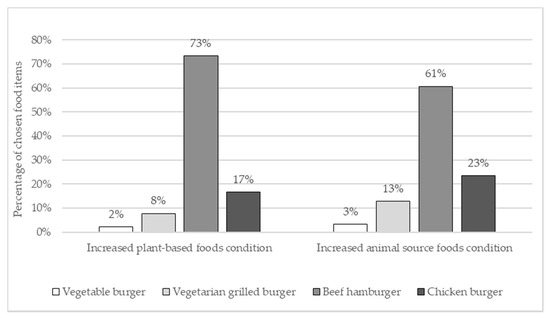
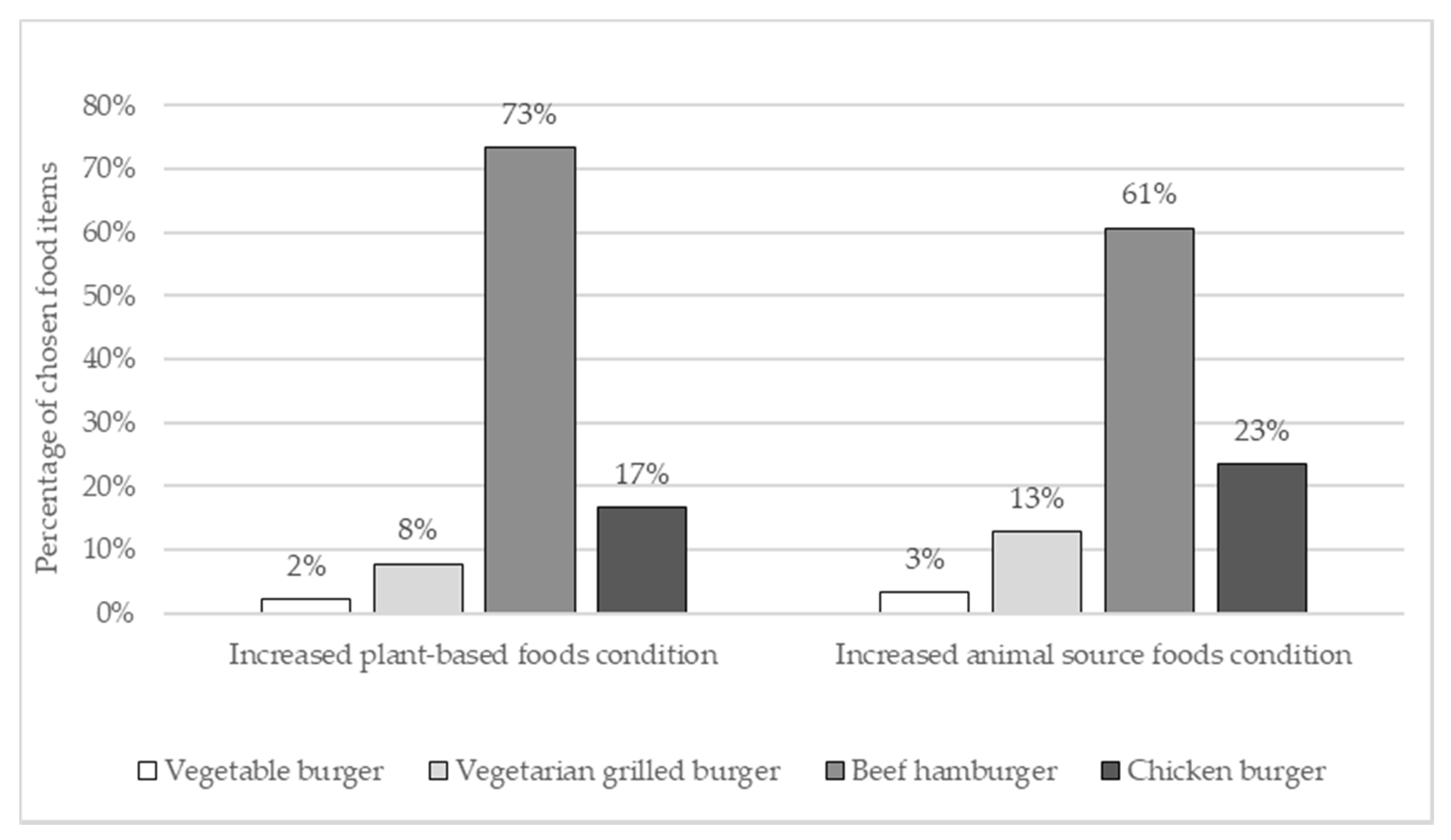
In total, 13.0% of the participants chose a plant-based food option (see Figure 2 for the percentage of chosen items of each food option per condition). No significant difference in hypothetical food choice was observed between participants who were visually exposed to an increased availability of plant-based (versus animal source) foods (Table 4).
Figure 2.
Percentage of chosen items of each food option per condition (n = 184).
Table 4.
Hypothetical food choice and the proposed mediators per condition (n = 184).
2.2.3. Proposed Mediators
No significant differences in perceptions of salience and injunctive norms (regarding either plant-based or animal source foods) were observed between participants who were visually exposed to an increased availability of plant-based (versus animal source) foods (Table 4). A significant difference in perceptions of descriptive norms regarding plant-based foods, but not animal source foods, was observed between the conditions (Table 4). Participants who were visually exposed to an increased availability of plant-based (versus animal source) foods reported a lower likelihood of other participants selecting a plant-based food option. However, the effect became non-significant when covariates were included in the model (see Supplementary Materials (Results: Study 1, Table S1)).
Perceived descriptive norms of the plant-based foods were included in mediation analyses (see Supplementary Table S2 for the components of the indirect effect). The analyses indicated a significant indirect effect of visual exposure to an increased availability of plant-based (versus animal source) foods on hypothetical food choice through perceived descriptive norms of the plant-based foods (indirect effect = −0.28, SE = 0.15, 95% CI (−0.63, −0.04)). However, when covariates were included in the model, the conditions for mediation were no longer met (see Supplementary Materials (Results: Study 1, Table S1)).
2.2.4. Proposed Moderators
The effect of availability on food choice was not significantly moderated by sex (interaction effect = −0.6, 95% CI (−2.50, 1.26), p = 0.52) or meat attachment (interaction effect = −0.86, 95% CI (−2.07, 0.36), p = 0.17).
2.3. Discussion
Visual exposure to a relatively high availability of plant-based (versus animal source) food products did not affect hypothetical food choice, neither did it change perceptions of salience and injunctive norms. It did, however, change perceived descriptive norms of the plant-based (not animal source) foods, but in a direction contrary to our expectations. Participants who were visually exposed to an increased availability of instant meat substitutes reported a lower probability of others choosing a meat substitute than did participants who were exposed to a higher availability of meat products. Furthermore, the effect of condition on hypothetical food selection may be mediated by perceived descriptive norms of the plant-based foods. However, as planned, we repeated our primary analyses by including significantly correlated covariates in the model, and this revealed that all significant effects disappeared. This may suggest that the effects are not robust against a greater precision of the estimation, and the results should therefore be interpreted with some caution.
Two main explanations can be offered for the current results. First, it may be possible that the availability manipulation was interpreted by some participants as products being scarce (e.g., caused by interpretations of empty places in the assortment or products being limited available) rather than products being abundantly available. To illustrate, a high availability of plant-based foods may also have suggested that other participants more often chose an animal source food product, whereas the current study is based on the rationale that a high availability of products can increase the choice of abundantly available products [8,9,12]. Previous research has shown that product scarcity can also increase the choice of scarce products [31,32,33], and this possibly affected our manipulation. Second, it could be that participants were not that open and willing to shift towards an instant meat substitute, as the majority of participants chose a meat burger (specifically the beef option), reported a high meat consumption (almost six days a week), and indicated a relatively lower liking for, and familiarity with, instant meat substitutes. Previous research, for instance, showed that environmental changes aimed at stimulating healthy choices (decreasing soft drink consumption for example) did not influence behavior when individuals held strong personal preferences (e.g., a high liking for soft drinks) that were incongruent with the targeted behavioral change [34]. Moreover, when consumers are unwilling to shift towards a plant-based diet (i.e., when the intervention differs from their personal goals), the intervention may be at risk of being accused of undermining consumers’ right to consume what they want [35,36,37]. Possibly, some participants felt threatened in their autonomy and this may have led to reactance in that some participants, for instance, selected the opposite of what was being promoted [15,36].
3. Study 2
In Study 2, we tested our hypothesis with a different experimental manipulation. Non-vegetarian participants were exposed to an increased availability of physically present plant-based (versus animal source) food products in a lab-in-the-field setting (measuring actual food choice). Furthermore, a different meal format was used in which meat was treated as a secondary meal ingredient rather than a dominant meal component [23]. Moreover, we attempted to diminish interpretations of products being scarce caused by perceptions of empty places in the assortment (by showing an equally filled shelf within a clear border) or by products being limitedly available (by explicitly stating that all products were in stock [38]), thereby making the availability manipulation more salient, as we aim to encourage a transition from animal source diets to plant-based diets for large groups of consumers rather than promoting plant-based foods as an exclusive product. Moreover, for exploratory purposes, we examined whether the availability manipulation affected participants’ perceptions of autonomy in selecting their food product, as a lower perceived autonomy may reduce the effectivity of the intervention [35,36,37].
3.1. Methods
3.1.1. Design
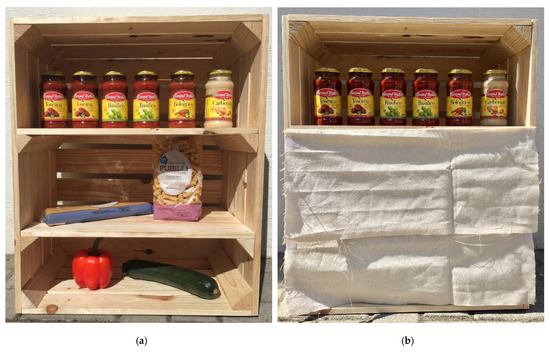
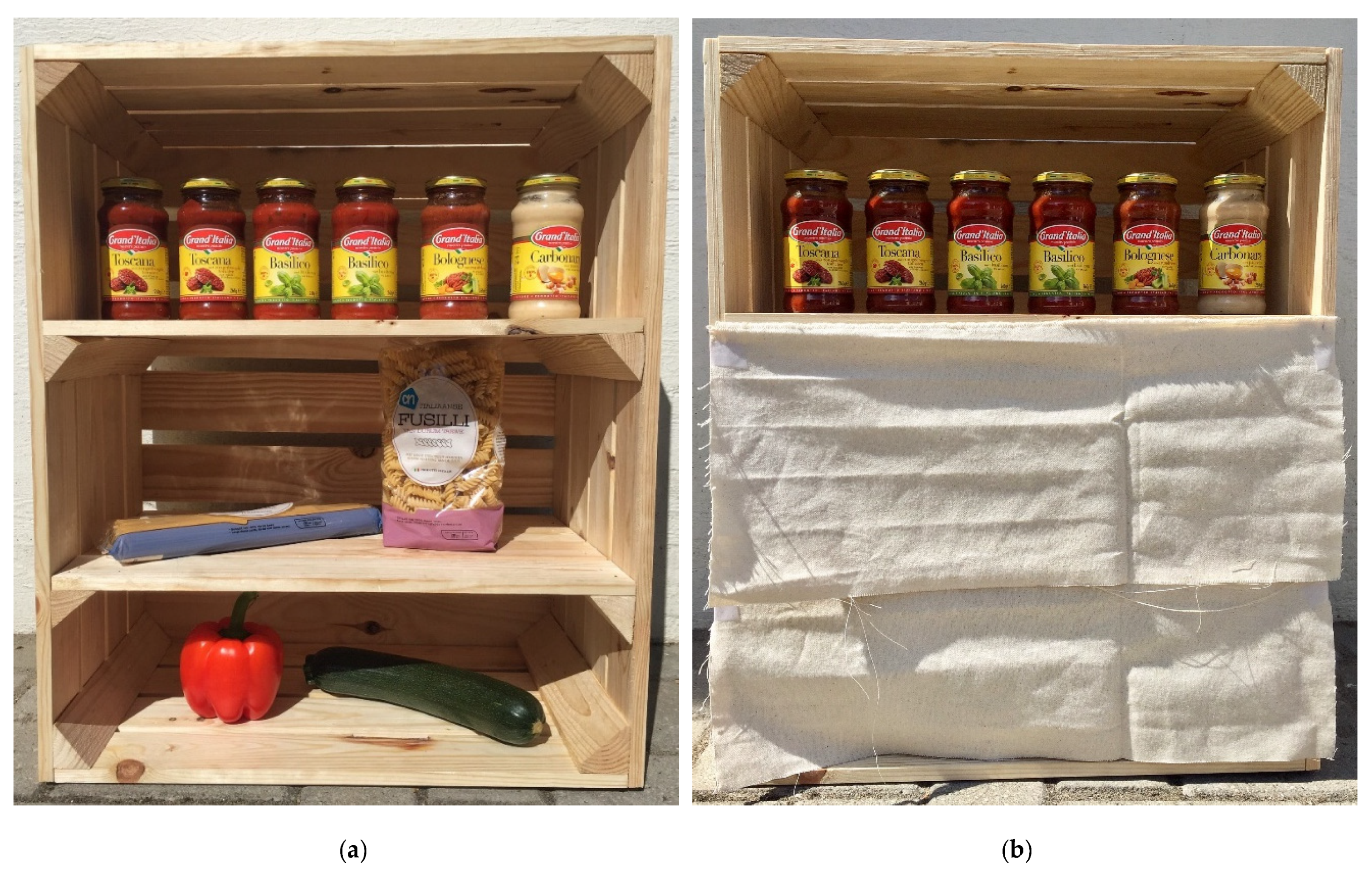
A between-subjects design with three conditions was utilized in a lab-in-the-field setting. Across conditions, participants were exposed to an array of physically present food options, including two different plant-based and two different animal source food products (product range: Four different options). Like in Study 1, the number of available units of plant-based and animal source food products was manipulated between conditions (keeping the product range similar to eliminate potential effects of the introduction of new products): (a) Four plant-based and two animal source food products (increased availability of plant-based foods), (b) two plant-based and four animal source food products (increased availability of animal source foods), and (c) two plant-based and two animal source food products (control condition). From a product display (Figure 3), like in Study 1, participants were asked to select one food product that they would choose to eat (products in this study included or excluded meat). Additionally, their perceptions of salience, descriptive norms, and injunctive norms of both the plant-based and the animal source foods were measured as potential mediators. Meat attachment was also measured as a potential moderator. In addition to the measures in Study 1, participants’ perceived autonomy in selecting their food product was measured for exploratory purposes. Moreover, a control condition was added to the design—showing one unit of each food option—to be able to disentangle the direction of potential effects. In comparison with a control condition, we propose that a relatively high availability of plant-based (versus animal source) food products will increase the likelihood of plant-based (versus animal source) food products being chosen and vice versa. Study approval was obtained from the research ethics committee of Wageningen University and Research (CoC number 09215846; Raghoebar 2019–29). We preregistered the study on the Open Science Framework (https://osf.io/3aqnk/) before data collection.
Figure 3.
Example of the availability manipulation showing an increased availability of plant-based foods: (a) Product display consisting of three shelves, with the middle and the bottom shelf functioning as a hypothetical selection task; (b) example of the middle and the bottom shelf covered by white canvas, with the upper cover removed in order to select one pasta sauce.
3.1.2. Participants and Sample Size
The study was conducted at a women’s summer fair (in Dutch: Libelle Zomerweek) held from 23 May to 29 May 2019. At this fair, Dutch participants aged≥16 years could register to participate in the study. Male participants were not eligible to participate (and could thus not register to participate), as females were the main visitors to the women’s summer fair (approximately 82,000 female visitors during the fair, mainly aged > 30 years) [39]; this enabled a more specific examination of the effect. A maximum of 315 participants could register to participate in the study, and we aimed to reach this number (roughly 105 participants in each condition). Power estimations of a Monte Carlo power analysis for indirect effects indicate that a power of 0.85 (p < 0.05) is reached with 315 participants in a model with two parallel mediators [22] (see Supplementary Materials (Methods: Study 2)). As we planned to include three mediators in our analyses (i.e., perceptions of salience, descriptive norms, and injunctive norms) and to exclude participants who considered themselves as vegetarians and participants who identified the study aim, we expected a medium effect size.
3.1.3. Materials (Food Options: Pasta Sauces)
Readymade pasta sauces (Grand‘Italia) were used as food stimuli instead of burgers for practical and food safety reasons as we could distribute only shelf-stable products at the women’s summer fair. Consequently, this study was focused on the inclusion or exclusion of animal source ingredients in the pasta sauces, rather than targeting instant meat substitutes. The pasta sauces were selected based on the results of an online pilot study (see Supplementary Materials (Methods: Study 2)), including 60 Dutch female students and employees of Wageningen University and Research who considered themselves as non-vegetarians (86.7% students, M age = 23.50 years, SD = 4.26). Like in Study 1, two different options of plant-based and animal source food products that scored highest on liking and familiarity items (measured on 7-point scales (range 1–7)) were selected for inclusion in the experiment. The plant-based food products included were (each product included two portions) Basilico with basil (tomato sauce with basil: 260 g, 187 kcal; M liking = 5.72 (SD = 1.20), M familiarity = 4.73 (SD = 2.01)) and Toscana with sundried tomatoes (tomato sauce with sundried tomatoes: 260 g, 231 kcal; M liking = 5.02 (SD = 1.35), M familiarity = 3.02 (SD = 1.89)). The animal source food products included were (each product included two portions) Bolognese with beef (tomato sauce with beef: 260 g, 265 kcal; M liking = 4.92 (SD = 1.20), M familiarity = 3.78 (SD = 1.98)) and Carbonara with pancetta (cream sauce with bacon: 260 g, 569 kcal; M liking = 4.10 (SD = 1.62), M familiarity = 3.35 (SD = 1.95)).
3.1.4. Measures
Food Choice
The selected pasta sauce was observed and reported by the researcher. A dichotomous variable was created with two categories: Plant-based and animal source foods.
Proposed Mediators
The items measuring perceptions of salience, descriptive norms, and injunctive norms were similar to those in Study 1 and are presented in Table 1. Again, for each proposed mediator variable, participants completed the corresponding item separately for the two plant-based and the two animal source foods. This resulted in four ratings for each mediator variable (12 ratings in total). Then, for each mediator variable, two single scores were calculated including the sum of (a) two ratings of plant-based foods and (b) two ratings of animal source foods. This ultimately resulted in a plant-based and animal source measure for each mediator variable (six measures in total). Different from Study 1, norm items referred to ‘visitors to the Libelle Zomerweek’, a situation-specific group, instead of referring to ‘participants similar to you’ (e.g., ‘how likely is it that other visitors to the Libelle Zomerweek would choose this pasta sauce?’).
Meat Attachment
Meat attachment was assessed with the same 16-item scale as used in Study 1. Cronbach’s α was 0.89, and a mean score was calculated for the 16 items.
Perceptions of Autonomy
Based on the categorization of three types of autonomy, i.e., freedom of choice, agency, and self-constitution [40], eight items were included to report freedom of choice (e.g., ‘I felt that I had a choice’; including two items), agency (e.g., ‘I had my own reasons for making this choice’; including three items), and self-constitution (e.g., ‘the choice is typical for me’; including three items). Responses ranged from 1: Strongly disagree to 7: Strongly agree. Cronbach’s α was 0.84, and a mean score was calculated for the eight items.
3.1.5. Procedure
In mass media communications about the women’s summer fair and at the women’s summer fair itself, the study was promoted as follows: Participate in a shopping game and bring your own collected groceries home. The study was conducted over a 7-day period (Thursday–Wednesday), including six testing times a day (10.30 a.m., 11.30 a.m., 12.30 p.m., 2.30 p.m., 3.30 p.m., 4.30 p.m.), and 15 cubicles were available for participation. The study was conducted by three female researchers.
The various stages of the lab-in-the-field experiment are outlined in Table 5. Regarding Stage 6a, in which the participant was instructed to choose one readymade pasta sauce, the availability manipulation (i.e., the number of units of plant-based and animal source pasta sauces available per option) to which the participant was exposed was dependent upon her randomly assigned condition (according to a predetermined computerized random sequence of conditions). The pasta sauces were presented on a single line, and the order of presentation of categories (plant-based pasta sauces versus animal source pasta sauces) was evenly randomized, as well as the order of presentation of pasta sauces within each category (keeping analogous options together). Regarding Stages 6b and 6c, in which the participant was instructed to hypothetically choose her carbohydrate (pasta) and vegetable, in each condition one product per option was offered on a single line (Figure 3a). To diminish scarcity effects, the upper shelf was equally filled with pasta sauces and was presented within a clear border (diminishing interpretations of empty places in the assortment). Furthermore, it was explicitly stated that all pasta sauces were in stock (diminishing interpretations of products being limitedly available (inspired by Van Herpen, Pieters, and Zeelenberg [38]). To bolster the cover story, it was mentioned that all carbohydrate (pasta) and vegetable products were in stock.
Table 5.
The various stages of the lab-in-the-field experiment.
3.1.6. Statistical Procedure
IBM SPSS Statistics 24 (IBM corp., Armonk, NY, USA) was used for data analyses. Participants who identified the study aim were excluded from analyses, as well as participants who considered themselves as vegetarians, indicated any food allergies or intolerances for the included pasta sauces, participants aged <16 years, and participants who did not follow instructions (planned a priori).
A Pearson chi-square analysis was conducted to test whether food choice differed significantly between conditions. Thereafter, two binary logistic regression analyses were conducted to predict the likelihood of participants selecting a plant-based (versus animal source) food product depending on the availability condition to which they were assigned (three dummy variables were created for each condition). The animal source foods condition was the reference group in the first analysis, and the control condition was the reference group in the second analysis. The statistical procedure for the proposed mediators was similar to that in Study 1, running six separate univariate ANOVAs and, unlike in Study 1, Bonferroni-corrected pairwise comparisons were checked when significant effects were found.
A similar statistical procedure for the examination of the conditions for mediation was also performed in Study 2 [29], although, in Study 2, 12 multiple linear regressions were performed instead of the six linear regressions performed in Study 1 (as condition has three levels in Study 2). Like in Study 1, mediation analyses were conducted using the PROCESS macro for SPSS (Model 4) [30]. Given that condition has three levels in Study 2, the PROCESS macro generated two dummy coded variables using indicator coding [41], entering the increased animal source foods condition as the reference group in the first analysis and the control condition as the reference group in the second analysis.
Like in Study 1, PROCESS macro for SPSS (Model 1) was used to examine the interaction between condition and meat attachment on food choice. Unlike in Study 1, two dummy coded variables using indicator coding were generated, entering the increased animal source foods condition as the reference group in the first analysis and the control condition as the reference group in the second analysis. The PROCESS macro generated coefficient estimates of condition on food choice at three levels of meat attachment: Low (1 SD below the mean), average (mean), and high (1 SD above the mean).
The same statistical procedure as in Study 1 for the sensitivity analysis was performed for Study 2. For exploratory purposes, a separate univariate ANOVA was run to assess whether condition affected perceptions of autonomy. Bonferroni-corrected pairwise comparisons were checked when a significant effect was found.
3.2. Results
3.2.1. Participant Characteristics
In total, 311 Dutch females participated in the study. A total of 276 participants were included in the final analytic sample after planned exclusions (see Supplementary Figure S2). In Table 6, descriptive statistics per condition are presented.
Table 6.
Descriptive statistics per condition (n = 276).
3.2.2. Food Choice
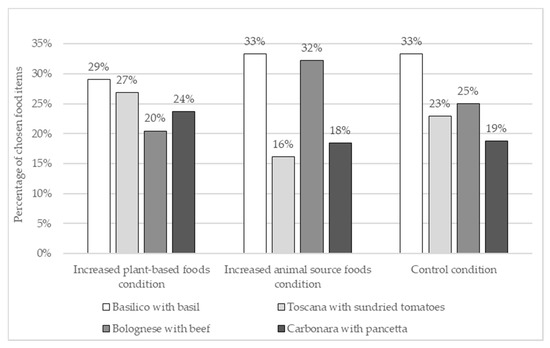
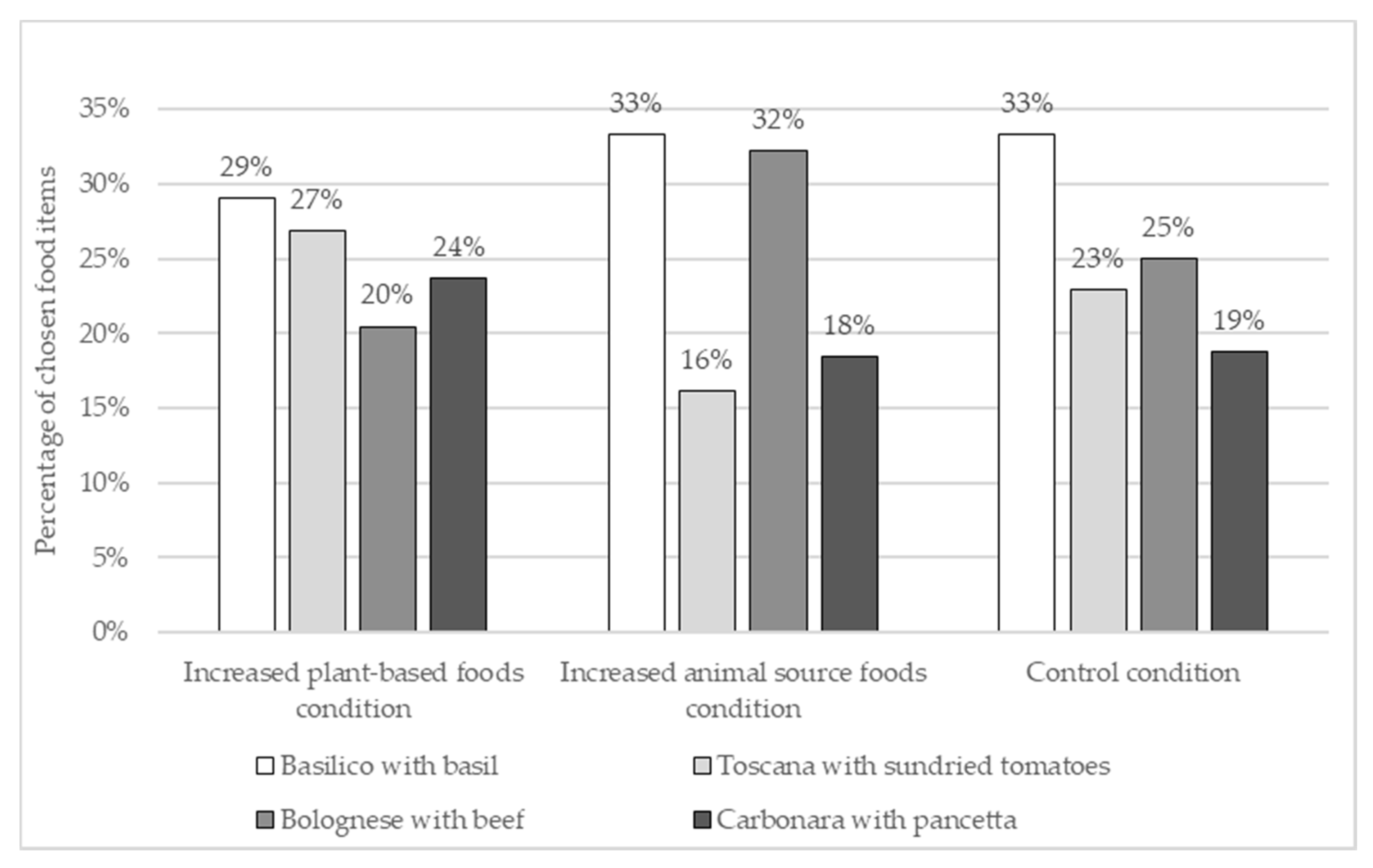
In total, 54.0% of the participants chose a plant-based food option (see Figure 4 for the percentage of chosen items of each food option per condition). No significant differences in food choice were observed between the conditions (Table 7). Compared to the increased animal source foods condition, participants in the increased plant-based foods condition (ORanimal source foods→plant-based foods = 1.30, Wald = 0.76, 95% CI (0.72, 2.33), p = 0.38) and the control condition (ORanimal source foods→control = 1.32, Wald = 0.85, 95% CI (0.74, 2.36), p = 0.36) did not show a significantly higher likelihood of choosing a plant-based food product; neither were differences in food choice found between the control condition and the increased plant-based foods condition (ORcontrol→plant-based foods = 0.99, Wald = 0.002, 95% CI (0.56, 1.75), p = 0.96).
Figure 4.
Percentage of chosen items of each food option per condition (n = 276).
Table 7.
Food choice, the proposed mediators, and perceptions of autonomy per condition (n = 276).
3.2.3. Proposed Mediators
Again, no significant differences in perceptions of salience and injunctive norms (regarding either plant-based or animal source foods) were observed between the conditions (Table 7). Consistent with our hypothesis, a marginally significant difference in perceptions of descriptive norms of the plant-based foods, as well as a significant difference in perceptions of descriptive norms of the animal source foods, were observed between the conditions (Table 7). Specifically, participants who were physically exposed to an increased availability of plant-based (versus animal source) foods reported a marginally significantly higher likelihood of other participants selecting a plant-based food option (p = 0.055) and a significantly lower likelihood of other participants selecting an animal source food option (p = 0.03). No significant differences were observed between the control condition and (a) the increased plant-based foods condition (descriptive norms regarding plant-based (p = 0.97) and animal source foods (p = 0.15)) and (b) the increased animal source foods condition (descriptive norms regarding plant-based (p = 0.47) and animal source foods (p = 1.00)). For outcomes of the sensitivity analysis, see the Supplementary Materials (Results: Study 2, Table S3).
Perceptions of descriptive norms of both the plant-based and the animal source foods were included in mediation analyses (see Supplementary Table S4 for the components of the indirect effect). Relative to the increased animal source foods condition, physical exposure to an increased availability of plant-based foods indirectly affected food choice through perceptions of descriptive norms of both the plant-based (relative indirect effect = 0.14, SE = 0.08, 95% CI (0.02, 0.33)) and the animal source foods (relative indirect effect = 0.14, SE = 0.07, 95% CI (0.02, 0.30)). No significant indirect effects were observed in relation to the control condition (see Supplementary Materials (Results: Study 2)). However, when covariates were included in the model, the conditions for mediation were no longer met (see Supplementary Materials (Results: Study 2, Table S3)).
3.2.4. Proposed Moderator
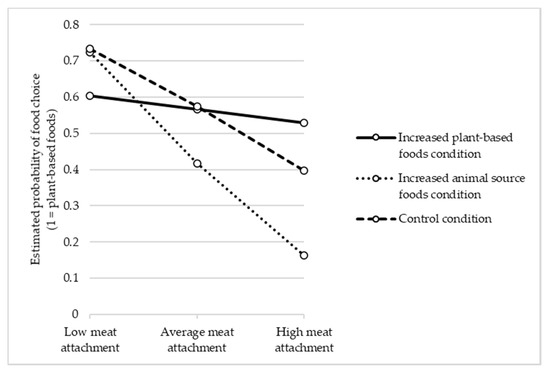
The interaction between condition (increased animal source versus plant-based foods condition) and meat attachment on food choice was significant (interaction effect = 1.12, SE = 0.38, 95% CI (0.38, 1.87)). Probing the significant interaction showed that, among participants who reported a high meat attachment (1 SD above the mean), increasing the availability of plant-based (versus animal source) foods significantly increased the likelihood of selecting a plant-based food option (B = 1.76, SE = 0.54, 95% CI (0.70, 2.81), p < 0.01). No significant difference between the increased animal source and plant-based foods condition was observed among participants who reported a low meat attachment (1 SD below the mean) (B = −0.55, SE = 0.49, 95% CI (−1.51, 0.42), p = 0.27). The interaction between condition (increased animal source foods condition versus control condition) and meat attachment on food choice was non-significant (interaction effect = 0.57, SE = 0.38, 95% CI (−0.17, 1.31), p = 0.13). The interaction between condition (control condition versus increased plant-based foods condition) and meat attachment on food choice was marginally significant (interaction effect = 0.55, SE = 0.33, 95% CI (−0.09, 1.19), p = 0.09). However, when significant effects were probed, no significant differences were observed between the specific conditions (all p’s > 0.18). See Figure 5 for a visualization of the interaction effect. For outcomes of the sensitivity analysis, see the Supplementary Materials (Results: Study 2, Table S3).
Figure 5.
Interaction between condition and meat attachment on the estimated probability of food choice (1 = plant-based foods) (n = 276).
3.2.5. Perceptions of Autonomy (Exploratory Purposes)
No significant difference in perceptions of autonomy was observed between the conditions (Table 7).
3.3. Discussion
Like in Study 1, no effects of physical exposure to a relatively high availability of plant-based (versus animal source) food products on food choice, perceptions of salience, and injunctive norms were observed in Study 2. The results did show—although we expected the opposite pattern—that the availability intervention was effective among participants who reported high levels of meat attachment. These participants had a higher likelihood of choosing a pasta sauce excluding (versus including) meat when they were exposed to a relatively high availability of pasta sauces excluding meat. Furthermore, in contrast to the results of our online study, physical exposure to an increased availability of plant-based (versus animal source) foods affected perceived descriptive norms of both the plant-based and the animal source foods in the predicted direction. The effect of condition (increased animal source versus plant-based foods condition) on food selection may even be mediated by these perceived descriptive norms of both the plant-based and the animal source foods, although the mediation results again should be interpreted with some caution (like in Study 1 the significant effects disappeared after inclusion of covariates). No significant differences were observed in relation to a situation where plant-based and animal source pasta sauces were equally available (i.e., the control condition). Neither did we observe significant differences in perceived autonomy in selecting the plant-based or the animal source foods, suggesting that the availability intervention is rather subtle.
4. Discussion
The present research shows that visual (Study 1) and physical (Study 2) exposure to an increased proportion of plant-based (versus animal source) foods available in imaginary supermarket settings did not directly affect the hypothetical food choice (Study 1) and the actual food choice (Study 2) of non-vegetarian participants. We found, however, that participants who reported high levels of meat attachment had a higher likelihood of choosing a plant-based food option when physically (but not visually) exposed to more available plant-based (versus animal source) foods. Moreover, the proportion of plant-based (versus animal source) foods available affected the participants’ perceived descriptive norms about what other people typically choose (Studies 1 and 2). Perceived injunctive norms about the appropriate/inappropriate choice according to other people were not influenced by the availability manipulation, nor was the perceived salience of plant-based (versus animal source) foods (Studies 1 and 2). In the following sections, we discuss how and under what circumstances the selection of plant-based versus animal source foods is influenced by our two availability interventions, aiming to shift non-vegetarian consumers towards more environmentally friendly and healthier consumption patterns [2,9,42].
As far as we are aware, this is the first study to empirically examine different psychological responses towards an increased proportion of plant-based foods available in assortment structures [7,8]. We particularly showed that descriptive norms can be inferred from the number of plant-based foods available, providing further evidence for the proposition that social norms are embedded in physical aspects of food environments [17,19,25]. The proportion of plant-based (versus animal source) foods available may serve as a cue that implies a consumption norm reflecting what other people typically choose, rather than reflecting the appropriate choice according to others (i.e., an injunctive norm). This finding shows potential for the idea that assortment structures may shift (or shape) social consumption norms for plant-based foods in supermarket settings. It remains unclear, however, how the relatively increased number of plant-based foods is perceived by individuals, as the availability cue was interpreted in contradictory directions in our online study compared to our lab-in-the-field study. In the online setting, against our predictions, individuals interpreted the relatively increased availability of plant-based (versus animal source) foods as a sign that plant-based foods were less often the favorite choice of others. Conversely, and in line with our predictions, in the lab setting, a trend was observed of participants indicating these more greatly available plant-based foods as being more often chosen by others, and they reported a lower likelihood of others choosing an animal source food. The observed inconsistency in interpretations ties in with the results of a recent photo study in which contradictory normative connotations were associated with availability cues [17].
How can the conflicting interpretations of the availability manipulation in the online and the lab setting be explained? One answer may be related to the presence of counter nudges (i.e., approaches that steer people in contradictory directions) [43]. Our study is built upon the rationale that abundantly available products are perceived as being the popular choice [7,8,9,12]. By relatively increasing the number of target products, inevitably the number of non-target products is decreased. The accordingly limitedly available products may be considered as a counter ‘nudge’ to the availability cue, suggesting that the less available products are more popular, as advocated by the scarcity principle [31,32,33]. Following social norm theory, people tend to adhere to the norm that is most focal in attention (i.e., most salient) when different norms are present in a similar situation [18,44,45]. Unlike in our online study, we purposely increased the salience of the abundantly available products in the lab experiment by diminishing potential interpretations of scarcity of the relatively less available products. Now, this indeed resulted in participants perceiving descriptive norms promoting the consumption of abundantly available products (rather than limitedly available products), underlining the importance of making norms salient [18,44,45]. We did not observe any significant differences in perceptions of salience of the plant-based and the animal source foods in either study; this may suggest that perceived salience is not a separate mechanism that underlies the availability effect, but indeed a prerequisite for descriptive norms to be perceived [18,44,45]. This needs to be further investigated in future research.
Remarkably, the (contradictory) perceived descriptive norms observed in both studies did guide the food choice of some individuals, but the mediating pathway disappeared when covariates were included in the model. The availability intervention was thus less effective in steering behavior than expected (both directly and indirectly), and several reasons may be responsible for this. Focusing on the indirect effect, from a social norm perspective, one may reason that the adult participants were less sensitive to social norms (compared to younger people) or had a weak identification with the norm referent group [46,47]. Focusing on the direct effect, to shift the dietary choices of meat eaters towards plant-based alternatives, one may reason whether a single exposure occasion to the availability manipulation is adequate to affect their food choice, although this seemed to be sufficient to change perceived descriptive norms. Previous comparable availability interventions indeed utilized the availability manipulation for a prolonged period, making repeated exposure to the manipulation more likely [9,12]. One could further argue that strong pre-intervention preferences have determined people’s food choice, making the availability intervention ineffective [34,43]. It may even be possible that people did not notice the increased availability of plant-based foods when they were actively searching for an animal source food product (referred to as inattentional blindness) [7,48]. To support the development of successful interventions stimulating plant-based food consumption, future research needs to unravel the specific aspects that are responsible for the low direct and indirect impact of our availability interventions on consumer choice.
Promisingly, but unexpectedly, our results suggest that the availability intervention stimulating plant-based food choices is most effective among the subgroup of participants showing high meat attachment patterns. This seems hopeful, as the reduction of meat consumption is regarded as more difficult among people who show a high affect and dependency towards meat [13]. Our findings are in line with Garnett et al.’s [9] availability studies, showing that an increased availability of vegetarian meals resulted in more vegetarian sales, especially among people who initially chose a vegetarian meal less often. The interaction effect was, however, observed only in our lab-in-the-field experiment in which meat was treated as a secondary meal ingredient rather than a dominant meal component, such as in the online study. It may be argued whether people explicitly chose a meal excluding meat, as the absence of meat in a dish in which meat is typically a secondary meal ingredient (such as the pasta sauce) is probably less pronounced and may be less important compared to the absence of meat in a dominant meal component (such as the burger). The pasta sauces excluding meat were rated as a more equivalent (and attractive) alternative to animal source foods than the instant meat substitutes. As expected, both meat reduction practices were thus not comparable in terms of liking and familiarity, and these observations may also explain the inconsistent results between both studies. This may suggest that intermediate steps to get people out of their routinized meat eating practices may be more effective than strategies promoting the consumption of rather unknown and less preferred instant meat substitutes [13,23,49,50,51]. Previous availability interventions encouraging sustainable food choices indeed included such a step-by-step approach (e.g., stimulating the consumption of meat products with a relatively lower environmental impact (poultry)) [9,50]. From an environmental sustainability perspective, it should be noted that these intermediate approaches may also lead to undesirable effects. For example, the greater availability of poultry products did increase their sales in a supermarket butchers’ section, but did not decrease the sales of less sustainable meat products [50]. Future research should compare the effectiveness of availability interventions testing different meat reduction strategies, among people with different levels of meat attachment, and taking possibly undesirable environmental effects into account.
This research uniquely contributes to the current knowledge in the domain of availability research and social norms: First, by focusing on the relation between product availability and sustainable food consumption, rather than focusing solely on energy intake [7,8,12]; second, by empirically testing different psychological mechanisms, including social norms, that may be changed by changes in the proportion of products available. We acknowledge that there may be other mechanisms that are relevant for the availability effect (e.g., (expected) liking for the target option), such as described in Pechey et al.’s [7] conceptual framework. A methodological strength of this research is that we isolated the availability effect by keeping the product range on offer unchanged between conditions, which is yet rather uncommon (see for example [5,9,12,15]). This may also be an explanation for the absence of a direct or an indirect effect on food choice in our study, as the introduction of new product options in the increased availability condition, for example, may result in more people selecting these items as they are novel, or as there is more variety [7,15,52].
This research is also subject to some limitations. As already outlined in the previous sections, both intervention studies differed in many aspects (e.g., exposure type (visual/physical), meat reduction strategies, the target groups involved, the participants’ educational level); this may be observed as a limitation of this research, as we cannot assign the inconsistent results across studies to specific aspects. Future studies should disentangle how and to what extent particular components of the availability intervention influence their psychological interpretations and subsequently food choice. Furthermore, the use of an online survey platform to perform the online experiment is associated with several limitations, including lack of attention (although a quality control question was included). A different limitation of Study 1 is that we did not measure participants’ perceptions of autonomy in selecting their food product, which seems especially relevant given the inclusion of relatively less preferred and less familiar meat substitutes in this study. Further, it remains unclear whether the results of Study 2 are generalizable to males, as only females were included. Also, the Carbonara with pancetta pasta sauce included in Study 2 was very different in appearance from the three other red-colored pasta sauces selected for this study (Figure 3; pasta sauces were included based on the highest liking and familiarity ratings rather than their similarity in appearance (see Supplementary Materials (Methods: Study 2)), and this may have affected the results of Study 2. Furthermore, a comparable availability intervention in an actual supermarket setting is recommended, as many previous successful availability studies were conducted in more naturalistic settings allowing repeated exposure to the availability manipulation [9,12]. Such a study could also shed light on the effect of availability on descriptive norms outside controlled settings.
5. Conclusions
This research presented a novel test of how and under what circumstances the selection of plant-based versus animal source foods is influenced by exposure to a relatively greater availability of plant-based foods in imaginary supermarket settings. Our results suggest that the proportion of plant-based foods available in assortment structures may shift (or shape) the ideas of non-vegetarians about what other people typically choose (i.e., descriptive norms about ‘normal’ consumption among meat eaters). The direction of the descriptive norm effect remains unclear, however, and seems to depend upon the operationalization of the availability intervention. Further, among the subgroup of participants showing high meat attachment patterns, our results suggest that an increased availability of physically present plant-based (versus animal source) foods increased the likelihood of a person choosing a plant-based food option. We did not observe a direct effect of exposure to our availability manipulation on food choice. These findings empirically underscore the importance of carefully designing and implementing availability interventions, as an apparently comparable availability cue may lead to contradictory normative interpretations.
Supplementary Materials
The following are available online at https://www.mdpi.com/2071-1050/12/13/5371/s1, Methods: Study 1 and Study 2. Results: Study 1 and Study 2. Figure S1: Participant flowchart (Study 1). Figure S2: Participant flowchart (Study 2). The main reason for exclusion because of noncompliance with the instructions was quitting during the experiment and/or being incapable of filling in the questionnaire. The exclusion because of a manipulation error was caused by an incorrect presentation of the availability manipulation given the condition to which the participant was assigned. Table S1: Pearson correlations between primary variables (n = 184, Study 1). Table S2: Individual components of the indirect effect of condition on hypothetical food choice for perceptions of salience, descriptive norms, and injunctive norms (n = 184, Study 1). Table S3: Pearson correlations between primary variables (n = 276, Study 2). Table S4: Individual components of the indirect effect of condition on food choice for perceptions of salience, descriptive norms, and injunctive norms (n = 276, Study 2).
Author Contributions
Conceptualization, S.R., E.V.K., and E.D.V.; Formal analysis, S.R.; Funding acquisition, E.D.V.; Investigation, S.R.; Methodology, S.R., E.V.K., and E.D.V.; Supervision, E.V.K. and E.D.V.; Writing—original draft, S.R.; Writing—review & editing, E.V.K. and E.D.V. All authors have read and agreed to the published version of the manuscript.
Funding
This research was funded by The Netherlands Organization for Scientific Research (NWO), grant number 452-14-014.
Acknowledgments
We would like to thank Joyce Copier for helping in collecting data for Study 2.
Conflicts of Interest
The authors declare no conflict of interest. The funders had no role in the design of the study; in the collection, analyses, or interpretation of data; in the writing of the manuscript, or in the decision to publish the results.
References
- Willett, W.; Rockström, J.; Loken, B.; Springmann, M.; Lang, T.; Vermeulen, S.; Garnett, T.; Tilman, D.; DeClerck, F.; Wood, A.; et al. Food in the Anthropocene: The EAT–Lancet Commission on healthy diets from sustainable food systems. Lancet 2019, 393, 447–492. [Google Scholar] [CrossRef] [Scilit]
- Clark, M.; Tilman, D. Comparative analysis of environmental impacts of agricultural production systems, agricultural input efficiency, and food choice. Environ. Res. Lett. 2017, 12, 064016. [Google Scholar] [CrossRef] [Scilit]
- Bianchi, F.; Garnett, E.; Dorsel, C.; Aveyard, P.; Jebb, S.A. Restructuring physical micro-environments to reduce the demand for meat: A systematic review and qualitative comparative analysis. Lancet Planet. Health 2018, 2, e384–e397. [Google Scholar] [CrossRef] [Scilit]
- Bianchi, F.; Dorsel, C.; Garnett, E.; Aveyard, P.; Jebb, S.A. Interventions targeting conscious determinants of human behaviour to reduce the demand for meat: A systematic review with qualitative comparative analysis. Int. J. Behav. Nutr. Phys. Act. 2018, 15, 102. [Google Scholar] [CrossRef] [Scilit] [PubMed]
- Pechey, R.; Marteau, T.M. Availability of healthier vs. less healthy food and food choice: An online experiment. BMC Public Health 2018, 18, 1296. [Google Scholar] [CrossRef] [Scilit] [PubMed]
- Pitt, E.; Gallegos, D.; Comans, T.; Cameron, C.; Thornton, L. Exploring the influence of local food environments on food behaviours: A systematic review of qualitative literature. Public Health Nutr. 2017, 20, 2393–2405. [Google Scholar] [CrossRef] [Scilit] [PubMed]
- Pechey, R.; Hollands, G.J.; Carter, P.; Marteau, T.M. Altering the availability of products within physical micro-environments: A conceptual framework. BMC Public Health 2020, 20, 986. [Google Scholar] [CrossRef] [Scilit]
- Hollands, G.J.; Carter, P.; Anwer, S.; King, S.E.; Jebb, S.A.; Ogilvie, D.; Shemilt, I.; Higgins, J.P.; Marteau, T.M. Altering the availability or proximity of food, alcohol, and tobacco products to change their selection and consumption. Cochrane Database Syst. Rev. 2019. [Google Scholar] [CrossRef] [Scilit]
- Garnett, E.E.; Balmford, A.; Sandbrook, C.; Pilling, M.A.; Marteau, T.M. Impact of increasing vegetarian availability on meal selection and sales in cafeterias. Proc. Natl. Acad. Sci. USA 2019, 116, 20923–20929. [Google Scholar] [CrossRef] [Scilit]
- NOS. Vleesvervangers Bezig Met Snelle Opmars, Verkoop Vlees Daalt. Available online: https://nos.nl/artikel/2297492-vleesvervangers-bezig-met-snelle-opmars-verkoop-vlees-daalt.html (accessed on 8 April 2020).
- ABN AMRO. Meer Innovatie Zorgt Voor Groei Van Vleesvervangers. Available online: https://insights.abnamro.nl/2019/05/meer-innovatie-zorgt-voor-groei-van-vleesvervangers/ (accessed on 8 April 2020).
- Pechey, R.; Cartwright, E.; Pilling, M.; Hollands, G.J.; Vasiljevic, M.; Jebb, S.A.; Marteau, T.M. Impact of increasing the proportion of healthier foods available on energy purchased in worksite cafeterias: A stepped wedge randomized controlled pilot trial. Appetite 2019, 133, 286–296. [Google Scholar] [CrossRef] [Scilit]
- Graça, J.; Calheiros, M.M.; Oliveira, A. Attached to meat?(Un) Willingness and intentions to adopt a more plant-based diet. Appetite 2015, 95, 113–125. [Google Scholar] [CrossRef] [Scilit] [PubMed]
- Graça, J.; Oliveira, A.; Calheiros, M.M. Meat, beyond the plate. Data-driven hypotheses for understanding consumer willingness to adopt a more plant-based diet. Appetite 2015, 90, 80–90. [Google Scholar] [CrossRef] [Scilit] [PubMed]
- Van Kleef, E.; Otten, K.; van Trijp, H.C.M. Healthy snacks at the checkout counter: A lab and field study on the impact of shelf arrangement and assortment structure on consumer choices. BMC Public Health 2012, 12, 1072. [Google Scholar] [CrossRef] [Scilit]
- Itti, L.; Koch, C. Computational modelling of visual attention. Nat. Rev. Neurosci. 2001, 2, 194–203. [Google Scholar] [CrossRef] [Scilit] [PubMed]
- Raghoebar, S.; van Rongen, S.; Lie, R.; de Vet, E. Identifying social norms in physical aspects of food environments: A photo study. Appetite 2019, 143, 104414. [Google Scholar] [CrossRef] [Scilit] [PubMed]
- Cialdini, R.B.; Reno, R.R.; Kallgren, C.A. A focus theory of normative conduct: Recycling the concept of norms to reduce littering in public places. J. Pers. Soc. Psychol. 1990, 58, 1015–1026. [Google Scholar] [CrossRef]
- Raghoebar, S.; Haynes, A.; Robinson, E.; Van Kleef, E.; De Vet, E. Served portion sizes affect later food intake through social consumption norms. Nutrients 2019, 11, 2845. [Google Scholar] [CrossRef] [Scilit]
- Burger, J.M.; Bell, H.; Harvey, K.; Johnson, J.; Stewart, C.; Dorian, K.; Swedroe, M. Nutritious or delicious? The effect of descriptive norm information on food choice. J. Soc. Clin. Psychol. 2010, 29, 228–242. [Google Scholar] [CrossRef] [Scilit]
- Prinsen, S.; de Ridder, D.T.D.; de Vet, E. Eating by example. Effects of environmental cues on dietary decisions. Appetite 2013, 70, 1–5. [Google Scholar] [CrossRef] [Scilit]
- Schoemann, A.M.; Boulton, A.J.; Short, S.D. Determining power and sample size for simple and complex mediation models. Soc. Psychol. Personal. Sci. 2017, 8, 379–386. [Google Scholar] [CrossRef] [Scilit]
- Schösler, H.; De Boer, J.; Boersema, J.J. Can we cut out the meat of the dish? Constructing consumer-oriented pathways towards meat substitution. Appetite 2012, 58, 39–47. [Google Scholar] [CrossRef] [Scilit] [PubMed]
- Hoek, A.C.; Luning, P.A.; Weijzen, P.; Engels, W.; Kok, F.J.; De Graaf, C. Replacement of meat by meat substitutes. A survey on person- and product-related factors in consumer acceptance. Appetite 2011, 56, 662–673. [Google Scholar] [CrossRef] [Scilit]
- Raghoebar, S.; Van Kleef, E.; De Vet, E. How subtle cues surrounding foods influence snack consumption: The case of covering foods. Manuscript submitted for publication. 2020.
- Maas, J.; de Ridder, D.T.D.; de Vet, E.; De Wit, J.B.F. Do distant foods decrease intake? The effect of food accessibility on consumption. Psychol. Health 2012, 27, 59–73. [Google Scholar] [CrossRef] [Scilit] [PubMed]
- Feitosa, J.; Joseph, D.L.; Newman, D.A. Crowdsourcing and personality measurement equivalence: A warning about countries whose primary language is not English. Pers. Individ. Dif. 2015, 75, 47–52. [Google Scholar] [CrossRef] [Scilit]
- De Boer, J.; Hoogland, C.T.; Boersema, J.J. Towards more sustainable food choices: Value priorities and motivational orientations. Food Qual. Prefer. 2007, 18, 985–996. [Google Scholar] [CrossRef] [Scilit]
- Yzerbyt, V.; Muller, D.; Batailler, C.; Judd, C.M. New recommendations for testing indirect effects in mediational models: The need to report and test component paths. J. Pers. Soc. Psychol. 2018, 115, 929–943. [Google Scholar] [CrossRef] [Scilit]
- Hayes, A.F. Introduction to Mediation, Moderation, and Conditional Process. Analysis: A Regression-Based Approach, 2nd ed.; Guilford Publications: New York, NY, USA, 2017. [Google Scholar]
- Brock, T.C. Implications of commodity theory for value change. In Psychological Foundations of Attitudes; Greenwald, A.G., Brock, T.C., Ostrom, T.M., Eds.; Academic Press: New York, NY, USA, 1968; pp. 243–275. [Google Scholar]
- Van Herpen, E.; Pieters, R.; Zeelenberg, M. When less sells more or less: The scarcity principle in wine choice. Food Qual. Prefer. 2014, 36, 153–160. [Google Scholar] [CrossRef] [Scilit]
- Gierl, H.; Huettl, V. Are scarce products always more attractive? The interaction of different types of scarcity signals with products’ suitability for conspicuous consumption. Int. J. Res. Mark. 2010, 27, 225–235. [Google Scholar] [CrossRef] [Scilit]
- Venema, T.A.G.; Kroese, F.M.; De Vet, E.; De Ridder, D.T.D. The One that I Want: Strong personal preferences render the center-stage nudge redundant. Food Qual. Prefer. 2019, 78, 103744. [Google Scholar] [CrossRef] [Scilit]
- Lea, E.J.; Crawford, D.; Worsley, A. Consumers’ readiness to eat a plant-based diet. Eur. J. Clin. Nutr. 2006, 60, 342–351. [Google Scholar] [CrossRef] [Scilit]
- Brehm, S.S.; Brehm, J.W. Psychological Reactance: A Theory of Freedom and Control; Academic Press: New York, NY, USA, 1981. [Google Scholar]
- Lea, E.J.; Crawford, D.; Worsley, A. Public views of the benefits and barriers to the consumption of a plant-based diet. Eur. J. Clin. Nutr. 2006, 60, 828–837. [Google Scholar] [CrossRef] [Scilit] [PubMed]
- Van Herpen, E.; Pieters, R.; Zeelenberg, M. When demand accelerates demand: Trailing the bandwagon. J. Consumer Psychol. 2009, 19, 302–312. [Google Scholar] [CrossRef] [Scilit]
- Libelle Zomerweek. CIJFERS&WEETJES. Available online: http://www.libellezomerweekexposanten.nl/cijfersweetjes/ (accessed on 6 April 2020).
- Vugts, A.; Van den Hoven, M.; De Vet, E.; Verweij, M. How autonomy is understood in discussions on the ethics of nudging. Behav. Public Policy 2018, 1–16. [Google Scholar] [CrossRef] [Scilit]
- Hayes, A.F.; Preacher, K.J. Statistical mediation analysis with a multicategorical independent variable. Br. J. Math. Stat. Psychol. 2014, 67, 451–470. [Google Scholar] [CrossRef] [Scilit]
- Poore, J.; Nemecek, T. Reducing food’s environmental impacts through producers and consumers. Science 2018, 360, 987–992. [Google Scholar] [CrossRef] [Scilit]
- Sunstein, C.R. Nudges that fail. Behav. Public Policy 2017, 1, 4–25. [Google Scholar] [CrossRef] [Scilit]
- Jacobson, R.P.; Mortensen, C.R.; Cialdini, R.B. Bodies obliged and unbound: Differentiated response tendencies for injunctive and descriptive social norms. J. Pers. Soc. Psychol. 2011, 100, 433–448. [Google Scholar] [CrossRef] [Scilit]
- Cialdini, R.B.; Kallgren, C.A.; Reno, R.R. A focus theory of normative conduct: A theoretical refinement and reevaluation of the role of norms in human behavior. Adv. Exp. Soc. Psychol. 1991, 24, 201–234. [Google Scholar] [CrossRef] [Scilit]
- Higgs, S. Social norms and their influence on eating behaviours. Appetite 2015, 86, 38–44. [Google Scholar] [CrossRef] [Scilit]
- Stok, F.M.; de Vet, E.; de Ridder, D.T.D.; de Wit, J.B.F. The potential of peer social norms to shape food intake in adolescents and young adults: A systematic review of effects and moderators. Health Psychol. Rev. 2016, 10, 326–340. [Google Scholar] [CrossRef] [Scilit]
- Simons, D.J.; Chabris, C.F. Gorillas in our midst: Sustained inattentional blindness for dynamic events. Perception 1999, 28, 1059–1074. [Google Scholar] [CrossRef] [Scilit] [PubMed]
- De Boer, J.; Schösler, H.; Aiking, H. “Meatless days” or “less but better”? Exploring strategies to adapt Western meat consumption to health and sustainability challenges. Appetite 2014, 76, 120–128. [Google Scholar] [CrossRef] [Scilit] [PubMed]
- Coucke, N.; Vermeir, I.; Slabbinck, H.; Van Kerckhove, A. Show Me More! The Influence of Visibility on Sustainable Food Choices. Foods 2019, 8, 186. [Google Scholar] [CrossRef] [Scilit] [PubMed]
- Lea, E.; Worsley, A. Benefits and barriers to the consumption of a vegetarian diet in Australia. Public Health Nutr. 2003, 6, 505–511. [Google Scholar] [CrossRef] [Scilit] [PubMed]
- Pechey, R.; Jenkins, H.; Cartwright, E.; Marteau, T.M. Altering the availability of healthier vs. less healthy items in UK hospital vending machines: A multiple treatment reversal design. Int. J. Behav. Nutr. Phys. Act. 2019, 16, 114. [Google Scholar] [CrossRef] [Scilit] [PubMed]

© 2020 by the authors. Licensee MDPI, Basel, Switzerland. This article is an open access article distributed under the terms and conditions of the Creative Commons Attribution (CC BY) license (http://creativecommons.org/licenses/by/4.0/).