


Abstract
This paper presents the results of an empirical study investigating the relationship between Total quality management (TQM) practices, Just-in-time (JIT) production practices, and flexibility performance in manufacturing companies. Correlation and regression analysis are applied to analyze the data collected from 280 manufacturing plants in 12 countries including China, Finland, German, Italy, Israel, Japan, Korea, Spain, Sweden, Taiwan, United Kingdom, and Vietnam from 2013 to 2015 in the framework of a High Performance Manufacturing Project. The analytical results confirm the closed linkage between TQM, JIT production practices and flexibility performance. Moreover, this study indicates that the effect of JIT production practices on flexibility performance can be strengthened with a higher level of TQM practices. The main findings of this study suggest that flexibility performance can be built up by implementing both TQM and JIT production practices, and TQM should be regarded as the platform to maximize the effect of JIT production on flexibility performance.
1. Introduction
Today, market demands require manufacturing companies to operate under a dynamic and flexible system, which is responsive to changes and uncertainties. Flexibility has gained more attention as one of the competitive advantages to enhance organizational performance [1]. Moreover, flexibility provokes a trend of globalization to provide large product variety. In addition, as firms have been tried to achieve high-quality, low-cost production, flexibility is considered the last stage toward manufacturing excellence. Since the 1990s, flexible manufacturing has become imperative for firms that have to deal with changing demand in the global market. Therefore, research about flexibility has emerged to determine critical factors that affect the achievement of flexibility, as well as to proactively apply flexibility management in manufacturing firms [2].
Empirical studies have found several factors that drive flexibility performance such as strategy, communication, supplier, technology, or human factors such as knowledge, skills, and availability [3,4,5,6]. Recently, researchers tried to find out practices to achieve manufacturing agility. Total quality management (TQM) and Just-in-time (JIT) practices are found to be powerful tools to do so. TQM focuses on continuous improvement and process management to deliver a sustainable high-quality product that satisfies or exceeds customer expectations. Meanwhile, JIT aims at eliminating inefficiencies in the manufacturing cycle by reducing wastes such as inventory cost, which optimizes movement in the working place [7]. The impact of TQM and JIT on manufacturing performance has been shown in several studies, which indicates that TQM and JIT practices bring higher product quality, lower cost of production, and faster delivery [8,9,10,11]. By reducing delivery time and redundant steps, JIT production was found to be critical for achieving agile manufacturing [12,13]. It is also suggested that agility can be achieved through TQM with the necessary implementation of JIT [14]. Therefore, JIT production is often regarded as the foundation to obtain manufacturing flexibility performance, and the effect could be strengthened if JIT practices are implemented in the companies that emphasized on TQM.
The implementation of TQM and JIT should be extended to the supply chain level rather than internal level since the development of the production process should be integrated throughout the supply chain to sustain supply chain performance. Because JIT and TQM are significant drivers of agility, it is necessary to study how to maximize the benefits of those practices to obtain high flexibility performance. Many studies confirmed the association between TQM and JIT, since they support each other to achieve higher quality and JIT performance [15]. Regarding the field of flexibility, the study that considers how TQM and JIT practices elevate each other in relationship with agility is still limited. Those discussions above lead this study to aim at following question: Do higher implementation level of TQM practices play as the platform to strengthen the effect of JIT production practices on flexibility performance, at an internal, upstream, and downstream level? Studying the supporting role of specific TQM practices in maximizing the impact of specific JIT production practices on flexibility performance is important to both researchers and managers because it helps understand the moderate effect of TQM on the relationship between JIT production practices and flexibility performance. The authors would like to propose an analytical framework to study the relationship between TQM practices, JIT production practices, and flexibility performance as well as apply statistical methods such as ANOVA, correlation analysis, and regression analysis to analyze data collected from the High Performance Manufacturing (HPM) project. The results of this study enrich the literature.
The remainder of this paper is structured as follows. The next section summarizes empirical literature on flexibility, TQM, and JIT. The analytical framework and hypotheses development are then presented, which is followed by descriptions of data collection and analysis. The last two sections show the main findings, discussions, implications, limitation of the results, and conclusion.
2. Literature Review
This section summarizes the concepts and recent literature on flexibility and flexibility’s dimensions, importance of flexibility in manufacturing, JIT production practices and flexibility, Total quality management practices and flexibility, and the interaction effect of TQM and JIT on flexibility.
2.1. Flexibility and Flexibility’s Dimensions
Manufacturing flexibility has been defined by many researchers, which presents as a mean to achieve manufacturing responsiveness. In the 1980s, based on the idea of Mandelbaum [16], several authors have viewed flexibility as the capability of a system to adapt to changing situations and uncertainty derived from the business environment [17,18]. Later, flexibility tended to be broken down into specific categories for better understanding of this concept. Upton [19] indicated that flexibility is about increasing product range as well as improving mobility and the uniform of performance when manufacturing different product types. Other than that, Olhager [20] differentiated flexibility based on the time perspective. In the short run, flexibility is considered the firm’s ability to cope with a fast-changing environment by utilizing available resources. However, in the long run, flexibility presents the ability to introduce new products to the market, use new resources, and develop a new production process within a production system. More recently, authors focus on flexibility performance to fulfill customers’ requirements. Zhang et al. [21] stated that flexibility is a sort of organizational capability to manage available resources, control production, and uncertainty to satisfy customers’ needs. From the rationale that the quantity of products demanded and the nature of products required are varied constantly, Mishra [22] proposed that manufacturing flexibility should be concentrated on volume and product mix. In general, it is common among research studies that flexibility or agility is how manufacturing firms react to changes in customer demands [4].
In addition, researchers advocated that flexibility is a complex and multi-dimensional concept that is difficult to measure [23]. Toni and Tonchia [24] showed that there are diverse ways to classify flexibility dimensions including horizontal classification, vertical classification, temporal classification, classification by objects of the variations, and mixed-logic classification. Upton [19] classified flexibility into two broad dimensions that are internal flexibility and external flexibility. While the former is inner ability and resources such as machine and materials to meet customer’s requirement, the latter is how it satisfies customers in an efficient way such as product and volume flexibility to improve firm’s position in the market [22]. Other than that, flexibility can be divided into three levels, which are basic level (includes machine, material, and operation flexibility), system level (including process and volume flexibility), and aggregated level (includes program, production, and market flexibility).
2.2. Importance of Flexibility in Manufacturing
Flexibility has been accepted widely in many studies as an element of firm’s competitive advantage over the rivals in the market [15,25,26,27]. Due to environmental uncertainty, highly competitive pressure and output variability, flexibility is crucial in organizational success in term of quickly responding to customer’s demand as well as reacting innovatively to emerging challenges [28]. Other than reactive capability, flexibility enables the firm to satisfy increasingly sophisticated customer’s requirements without incurring quality defects, higher cost, long delivery time, and process disruptions [21]. Volume and product mix flexibility enables firms to provide product’s features that customers want, as well as supply proper product volume when demand fluctuates to eliminate excess inventory and time delays. Therefore, firms with a high level of flexibility and capability will achieve higher customer satisfaction [21,29]. Overall, it is essential to improve flexibility to build up innovative capabilities and ensure firm’s competitiveness [30].
This paper focuses on manufacturing flexibility performance as firm’s ability to meet customers’ needs regarding flexibility. According to Olhager [20], the dimension of flexibility that customers want in production are volume, product mix, and lead time flexibility. Volume flexibility refers to firm’s ability to offer enough products with changing demand from customers. Product mix flexibility is the ability to change over quickly in the production system from a product to others, such as shifting in customers’ requirements of product mix. In addition, lead time flexibility is how the manufacturers deliver the products to retailers or customers based on demand to ensure on-time product delivery to customers [31]. Hence, flexibility performance in this paper is measured how the manufacturing firm satisfies customers’ needs in manufacturing flexibility.
2.3. JIT Production Practices and Flexibility
JIT is often seen as a methodology derived from the Japanese production system in the 1960s and 1970s, which was initiated from the Toyota Corporation. JIT production aims at increasing productivity and profitability by eliminating wastes as well as response time in the manufacturing process. JIT facilitates internal and external communication, then allows manufacturing plants to purchase raw materials just-in-time to be used and deliver products just-in-time as customers require, which lead to stockless, cost-saving, and responsive production [32]. Furthermore, it was commonly found that JIT helps to increase the quality level of product, process, and customer service [11]. There is a consensus among researchers that JIT significantly influences organizational performance [33,34]. It can be divided into three categories including JIT manufacturing, JIT purchasing, and JIT selling. Common detailed JIT practices can be presented as equipment layout, Kanban, lot size reduction, setup time reduction, repetitive master schedule, daily schedule adherence, JIT delivery by suppliers, and JIT link to customers [35,36,37].
The studies on the relationship between JIT and flexibility indicated that JIT practices help reduce lead time and then enhance customer responsiveness [38]. Since JIT is aimed toward a continuous production flow, flexible product mix manufacturing can be achieved by using several small machines and a quick-arranged setup [39]. Furthermore, several studies have been tried to propose an effective Kanban system as a JIT practice to improve volume flexibility, in order to cope with fluctuated market demand [40]. Summary of supporting literature on JIT and flexibility is presented in Table 1.
Table 1.
Summary of empirical studies on determinants for customer satisfaction and customer loyalty in the service sector.
2.4. TQM Practices and Flexibility
The concept of Total quality management (TQM) has been studied and applied by many organizations to improve quality performance [45]. The early objective of TQM aims to achieve a superior quality of products through the involvement of all functions within the organization to create continuous improvement, which enables firms to exceed customers’ expectations [46,47]. García et al. [48] indicated that companies implement quality management practices that can influence its result, which enhance service quality. Effects of TQM on financial as well as non-financial performance have been approved by many research studies by characterizing the TQM program into several practices [15,46]. Those TQM practices are applied differently among studies to investigate the impact of TQM on various types of performances. Common TQM practices are top management support, strategic planning, product design, process control, quality information usage, continuous improvement and learning, training for quality, rewards, customer focus, customer involvement, and supplier involvement [15,49,50]. It is consistent that TQM practices can positively improve competitive performance including quality, cost, delivery performance [10,51], enhance customer satisfaction [52], and play as a critical process to foster sustainability [53,54]. It is suggested that there should be more studies focusing on the interaction of TQM practices and other practices, as well as the relationship of TQM practices with different types of performances [55].
TQM practices implementation is closely related to flexibility management since these two concepts share common orientations. Firms apply TQM to ensure product’s quality, reducing cost, and improving customer satisfaction. Similarly, organizations try to achieve flexibility performance that avoids excessive production and unnecessary expense, advocated by Volberda [56]. TQM implementation encourages continuous improvement in the daily routine, which leads to better organizational learning, firm capabilities, and the potential to adapt to environmental change. The work of Gras and Jover [57] states that TQM provides firms’ higher adjustment ability to market requirements in their strategies and the administration of structure. During the stream of TQM research studies, it is recognized by scholars that, rather than firm-centric, quality management (QM) should be expanded to both upstream and downstream supply chain partners to cope with a high-velocity business environment [58,59,60].
Recent research studies relate to a linkage between TQM and flexibility, which are summarized in Table 2.
Table 2.
Literature on relationship between quality management and flexibility performance.
2.5. Interaction Effect of TQM and JIT on Flexibility
JIT has been found to play a central role in operations’ management. In other words, JIT is a connection between other practices such as Human Resources Management (HRM), quality management, manufacturing strategy to create synergy effects, and achieving high-performance manufacturing. Especially, JIT and TQM are indicated to have a significant joint effect, as explained in several studies [8,9,66]. JIT implementation reduce inventory level as much as possible. Thus, it reduces the potential of incurring damage and other exposed quality issues. TQM practices such as process control are profound in reducing process variance and rework it so that JIT performance is improved [8]. Jasti and Kodali [67] proposed that TQM and JIT production are two pillars of a unified lean manufacturing model. Even though TQM and JIT are viewed as two separated concepts and are defined by different characteristics, they share common organizational objectives that eliminate waste and create an effective production system. Hence, TQM and JIT practices jointly contribute to an integrated operations strategy.
The integrated effect of TQM and JIT has been studied to be significant for improving firm’s competitive performance including cost efficiency, quality, delivery, and flexibility [9]. While JIT implementation ensures continuous material flow, TQM practices prevent rework to reduce a redundant step in the production process. As a result, cycle time is shortened, and firms can respond faster to market demands with better flexibility and capability. Additionally, TQM decreases defects and strengthens the relationship with suppliers and customers, which complements with JIT delivery by the supplier and JIT link to customers to achieve higher volume flexibility [68]. It can be seen that, to improve responsiveness, it requires the synergy of TQM and JIT techniques based on the relationship of firms with partners in supply chain management. It explains close correlation between TQM, JIT, and Supply chain management (SCM) practices [69].
Supporting literature on the relationship between the interaction effect of TQM and JIT on flexibility is described in Table 3.
Table 3.
Recent studies on relationship of TQM, JIT, and flexibility.
In general, the literature review shows that researchers have paid great attention to the relationship of JIT and other manufacturing practices such as TQM, SCM, HRM, and how those practices drive operational performance. Limited studies are aimed at how JIT practices affect flexibility performance as one of the competitive advantages. Moreover, JIT has been proposed as a vital precursor of agile manufacturing, and the firm’s operation is more elevated if the company focuses on continuous improvement and supply chain integration. It is essential to investigate how TQM practices a moderate effect of JIT practices on flexibility under SCM perspective. It is also essential to check whether TQM is a fundamental philosophy that accelerates its effect of JIT on agility as one of a competitive advantage to achieve business excellence.
3. Analytical Framework and Hypotheses Development
3.1. Analytical Framework
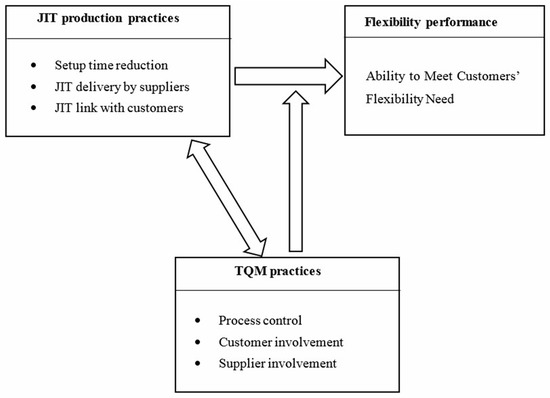
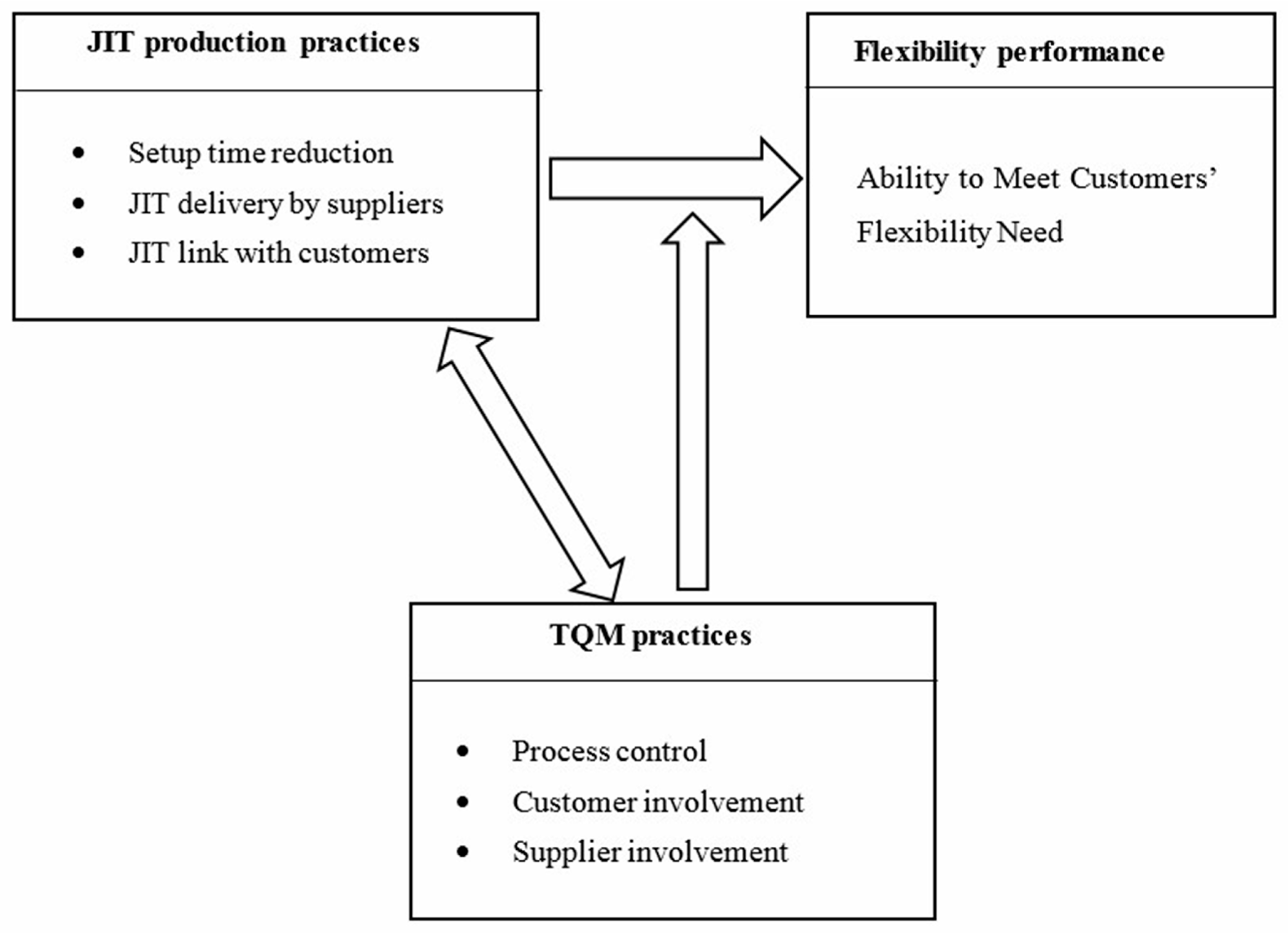
Based on a literature review, the authors propose an analytical framework to study the relationship between JIT practices, TQM practices, and flexibility in manufacturing firms (as shown in Figure 1).
Figure 1.
Framework of the study.
To study the moderating effect of TQM on the relationship between JIT production and flexibility, the authors focus on TQM practices that have been highlighted in the cited literature as process control, customer involvement, and supplier involvement. Process control is often regarded as the critical element of internal quality management, which is concerned with the utilization of tools and techniques such as statistical process control to manage the manufacturing process and meet the needs of production [73]. Furthermore, process control contains safety activities that ensure employee’s protection, and there is no equipment breakdown. Supplier involvement is considered an upstream quality management practice, which assists firms in making certain the quality of raw materials and utilize suppliers’ capabilities in quality improvement [35]. Customer involvement has been viewed as important and a necessary practice because it helps increase customer’s acceptance and customer satisfaction. Specifically, customer involvement helps firms detect quality problems through customer feedback, which also develops new product ideas by cooperating with customers [35,73]. This study investigates such JIT production practices, which have been highlighted in JIT literature as Setup time reduction, JIT delivery by suppliers, and JIT link with customers. As described in the research of Matsui [36], setup time reduction is how the firms take measures to shorten time of preparation before production, as well as reduce lot sizes to enable JIT production. JIT delivery by suppliers and JIT links with customers ensure firms to receive and make frequent delivery, which also integrate suppliers and customers via the JIT system. In this study, we consider flexibility at an aggregate level, so that flexibility performance is measured as the ability of firms to satisfy customers’ needs regarding flexibility. The description of TQM, JIT production, and a flexibility performance variable is illustrated in Table 4.
Table 4.
Description of variables.
3.2. Hypotheses Development
Many studies have confirmed the synergistic linkage of TQM and JIT practices because they share common objectives and are solid pillars of the manufacturing system [8]. A company that apply both TQM and JIT practices was found to outperform another that applies only one or considers them separately [66]. TQM practices such as process control makes sure the production schedule is implemented as planned and it reduces process variation that is crucial for JIT implementation [79]. During the manufacturing process, defects usually happen because the production is disrupted, and there is postponement in fulfilling orders. JIT keeps production in continuous flow, minimizes waste, and results in a lower defect rate. Cooperation with suppliers and customers in quality improvement enhance the mutual relationship of firms with external partners. Hence, this facilitates JIT delivery. As Vokurka et al. [71] stated, JIT and TQM have a close relationship since they share the ultimate firm’s target of achieving customer satisfaction. Eker and Pala [80] found a positive effect of JIT practices on TQM practices. Based on the discussion above, the first hypotheses can be stated as follows.
H1a:
There is a positive linkage between process control implementation and the setup time reduction level.
H1b:
There is a positive linkage between supplier involvement level and the level of JIT delivery by suppliers.
H1c:
There is a positive linkage between the customer involvement level and the level of JIT link with customers.
TQM has been applied widely in companies as a philosophy to ensure product and service quality, productivity, and customer satisfaction. Many researchers have confirmed the positive effect of TQM practices on operational performance [15,49,73]. For example, by using tools and measures to manage the production process, process control aims to create an effective production chain, which can respond quickly to environmental changes. This is a customer requirement. Implementation of process control facilitates production prevents postponement. Therefore, it increases the firm’s agility [14]. Furthermore, a close relationship with customers enables the ability of firms to accelerate the delivery process and be sensible of customers’ needs to respond quickly in a cost-effective operation [10]. Firms have to contend for changes in customer requests in case of new product reintroduction, product return, and product modification. To do that, it is crucial to have fast delivery and high-quality raw materials from suppliers, as well as their contribution to quality improvement initiatives. Therefore, supplier involvement not only improves quality performance, but it also leverages the firm’s capability to cope with turbulent market demands. Thus, the relationship between TQM practices and flexibility can be hypothesized as follows.
H2a:
Process control implementation has a positive linkage with flexibility performance.
H2b:
Supplier involvement has a positive linkage with flexibility performance.
H2c:
Customer involvement has a positive linkage with flexibility performance.
Primary objective of lean or JIT production is to eliminate all kinds of waste related to an excess of inventory and redundant steps. From that, it brings benefits such as lower level of stock, shortened throughput time, and higher financial performance [44,75]. Because setup time reduction implementation reduces process times, small lots are required, which lead to shorter lead times. Consequently, firms can quickly respond to customers [81]. Moreover, JIT delivery by suppliers and JIT link with customer implementation lessens Takt time, which is time required per unit of customer demands. Bartezzaghi et al. [82] provided a result that JIT production implementation benefits firms in terms of mix flexibility, working-capital productivity, and productivity. This result is advocated by Zhu and Meredith [83], who indicated that JIT practices help achieve a small lot size, which results in less work-in-process (WIP) inventory as well as smaller working space required. Ultimately, the JIT system performs effectively, which leads to an increase in flexibility. It is also emphasized by Cua et al. [84] and Matsui [36] that JIT practices set up time reduction and JIT delivery by suppliers contributes significantly to competitive performance, especially volume flexibility and product mix flexibility. From those arguments above, we can establish the following hypotheses:
H3a:
Setup time reduction implementation has a positive linkage with flexibility performance.
H3b:
JIT delivery by supplier’s implementation has a positive linkage with flexibility performance.
H3c:
JIT link with customers implementation has a positive linkage with flexibility performance.
Because JIT production practices interrelate with other operation areas, there are prerequisites such as quality management, HRM, technology, and information management that need to be implemented for effective JIT practices implementation [36]. Since JIT requires the use of technology and working with hard data, quality control by using a statistical tool in process management is necessary. Hence, emphasizing the process control shows firms are capable of necessary technology for JIT implementation in reducing setup time as well as lots size. A study from Soo [85] showed that the Statistical Process Control (SPC) practice plays a mediating role between JIT practice and production performance. When it comes to the supply side, JIT encourages frequent, fast, and high-quality delivery from suppliers. To do that, it requires constant communication between firms and suppliers. TQM practices such as supplier involvement accelerate supplier cooperation and create the supplier’s commitment in delivering high-quality materials. Consequently, upstream QM can be the lever for efficient JIT purchasing, which is critical to create an agile manufacturing [86]. Furthermore, external integration such as customer involvement benefits firms significantly through JIT information, JIT selling, enhancing elements such as logistics speed, responsiveness, and flexibility [87]. From the discussion above, the following hypotheses are argued and tested.
H4a:
Relationship between setup time reduction and flexibility performance is stronger with higher process control implementation.
H4b:
Relationship between JIT delivery by suppliers and flexibility performance is stronger with higher supplier involvement implementation.
H4c:
Relationship between the JIT link with customers and flexibility performance is stronger with higher customer involvement implementation.
The next section presents the data collection and analysis for hypotheses testing.
4. Data Collection
This study explores the database of the High Performance Manufacturing (HPM) project. HPM is an ongoing international joint research project that was initiated in the 1980s by focusing on exploring best practices for manufacturing companies to achieve superior operational performance within global competition. Selected plants in each country have more than 100 employees and operate in one of three industries (electrical and electronics, machinery, and automobile).
In each country, based on business and financial information, the researchers identified and selected manufacturers as having either a ‘non-world-class manufacturer’ or a ‘world-class manufacturer’ reputation. Then researchers invited each manufacturer to select one typical plant for participating in the project. This selection criterion would allow for the construction of a sample with sufficient variance to study the high-performance manufacturing practices [27,88]. The three rounds of data collection have been made during 1988, 1995–1996, and 2003–2004. Our study uses Round 4 data collected during 2013–2015, consisting of 280 manufacturing plants in 12 countries: China (30), Finland (17), German (28), Italy (29), Israel (26), Japan (22), Korea (26), Spain (25), Sweden (9), Taiwan (30), United Kingdom (13), and Vietnam (25). The HPM survey covers many managerial aspects of manufacturing plants such as strategy, production, quality, JIT, supply chain, new product development, HRM, and more. To evaluate the degree of implementation of different manufacturing management practices, in each plan, people in 12 positions from plant superintendent, managers, supervisors, engineers, and laborers were asked to answer the questionnaire items developed by experts and an extensive literature review. In addition, quantitative data on accounting, business, and operational performance have been collected. More details on the HPM framework and project can be found by Schroeder and Flynn [27].
This study utilizes seven HPM measurement scales to evaluate TQM practices, JIT production practices, and flexibility performance of manufacturing companies. These measurement scales have been intensively used in the HPM study during the 1990s and 2000s [26,36,43]. In each manufacturing plant, the survey respondents are production control, process engineer, quality manager, new product development team member, upstream supply chain manager, and downstream supply chain manager. The questionnaire items were answered in five-point Likert scales. All of the questionnaire items are provided in Table A1 (Appendix A).
5. Data Analysis
5.1. Measurement Test
The collected data was first tested to ensure its reliability and validity.
- Reliability of the construct was tested by analyzing the internal consistency between items with the criteria such as Cronbach’s Alpha values having to be greater than 0.6, as suggested in the literature.
- Content validity makes sure all questionnaire items used to measure scales have a solid scientific foundation. In this paper, content validity was ensured by extensive literature review including theoretical and empirical research studies related to JIT, TQM, and flexibility performance.
- Construct validity is tested to make certain that questionnaire items are measuring the same scale. Factor analysis is performed to check whether each scale is one-dimensional. The test results indicate that all of the criteria are satisfied. Within-scale factor loadings should be greater than 0.4 (provided in Appendix A), Eigenvalues are required to be larger than 1, and the minimum percentage of variance is 50%).
Measurement test results are presented in Table 5 and Appendix A show that data is reliable and valid and can be used for further analysis.
Table 5.
Measurement test and descriptive analysis.
Table 5 exhibits that mean values of TQM variables are relatively higher than JIT production variables. It means TQM practices are implemented at a higher level than JIT production practices in manufacturing plants, based on respondents’ perspective. Supplier involvement exhibits the highest mean value while JIT link with customers and JIT delivery by suppliers show relatively smaller mean values when compared to other practices.
5.2. Correlation Analysis
Bivariate correlation with Pearson correlation coefficients is performed to test the relationship between measurement scales and the results are summarized in Table 6.
Table 6.
Correlation analysis.
Table 6 shows the positive linkage among setup time reduction, JIT delivery by suppliers, and JIT link with customers. Internal QM (process control), upstream QM (supplier involvement), and downstream QM (customer involvement) are found to be significantly correlated with each other. Moreover, a significant relationship between JIT practices and TQM practices is confirmed. The most robust linkage is found between setup time reduction and process control, which exhibits a correlation coefficient of 0.46. Furthermore, the correlation result indicates that JIT and TQM practices have significant correlations with flexibility performance, in which supplier involvement and flexibility shows the strongest association.
5.3. Regression Analysis
Regression analysis is conducted to test the impact of TQM practices and JIT production practices on flexibility performance. In addition, the author adopts the approach suggested by Hayes [89] to test the moderate effect of TQM on the relationship between JIT production practices and flexibility performance using the “PROCESS” tool for SPSS software, version 22.0 (IBM, New York, US). This add-in is beneficial in testing causal effect using linear models. To test each hypothesis, the regression model is formulated. Each model includes three independent variables: a JIT production practice, a TQM practice and interaction variable between JIT production practice, and a TQM practice (calculated by multiplying JIT practice and corresponding TQM practice). The moderating effect is examined with the followings criteria.
- Positive and significant coefficients of interaction variables confirm a moderating effect of TQM practices on the relationship between JIT production practices and flexibility performance. The regression result is presented in Table 7.
- Simple slope test shows whether JIT production practices significantly influence flexibility performance at low, average, and high level of TQM practices implementation. The result of slope test is presented in Table 8.
Table 7.
Regression analysis.
Table 8.
Slope test for the moderating effect of TQM practices on JIT practices—flexibility performance relationship.
Dependent Variable: Flexibility Performance
Model 1 indicates the significant impact of process control and interaction of setup time reduction and process control on flexibility performance.
Model 2 indicates the significant impact of JIT delivery by suppliers and supplier involvement on flexibility performance.
Model 3 indicates the significant impact of customer involvement and interaction of JIT link with customers and customer involvement on flexibility performance.
Based on the results of Model 1 and Model 2, as shown in Table 7, the simple slope test is performed to check whether the relationship between a specific JIT practice and flexibility performance is significant at a particular value of corresponding TQM practice. The authors adopt Hayes [89] to evaluate how the effect of JIT practice on flexibility performance changes when TQM practice (as a moderator) increases from a low value to a high value.
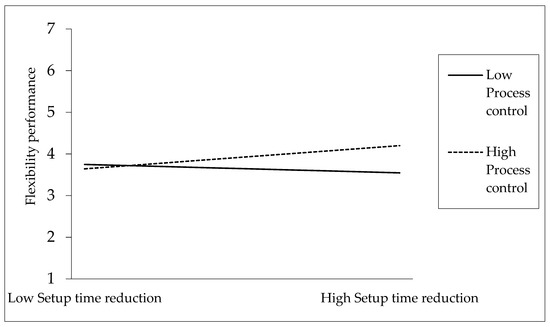
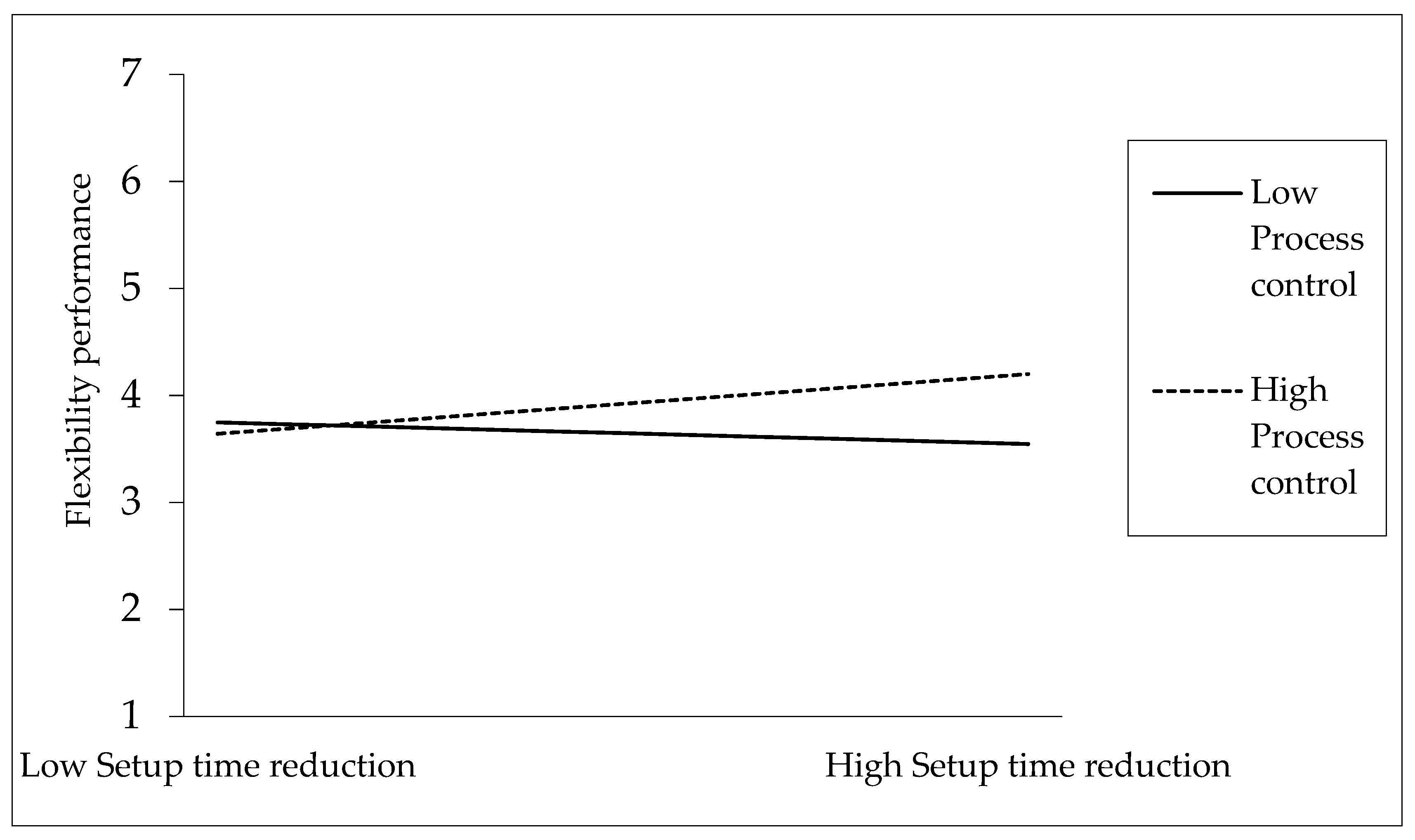
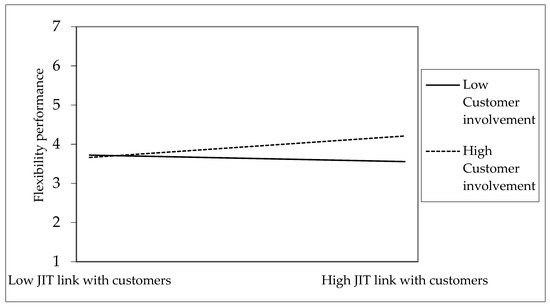
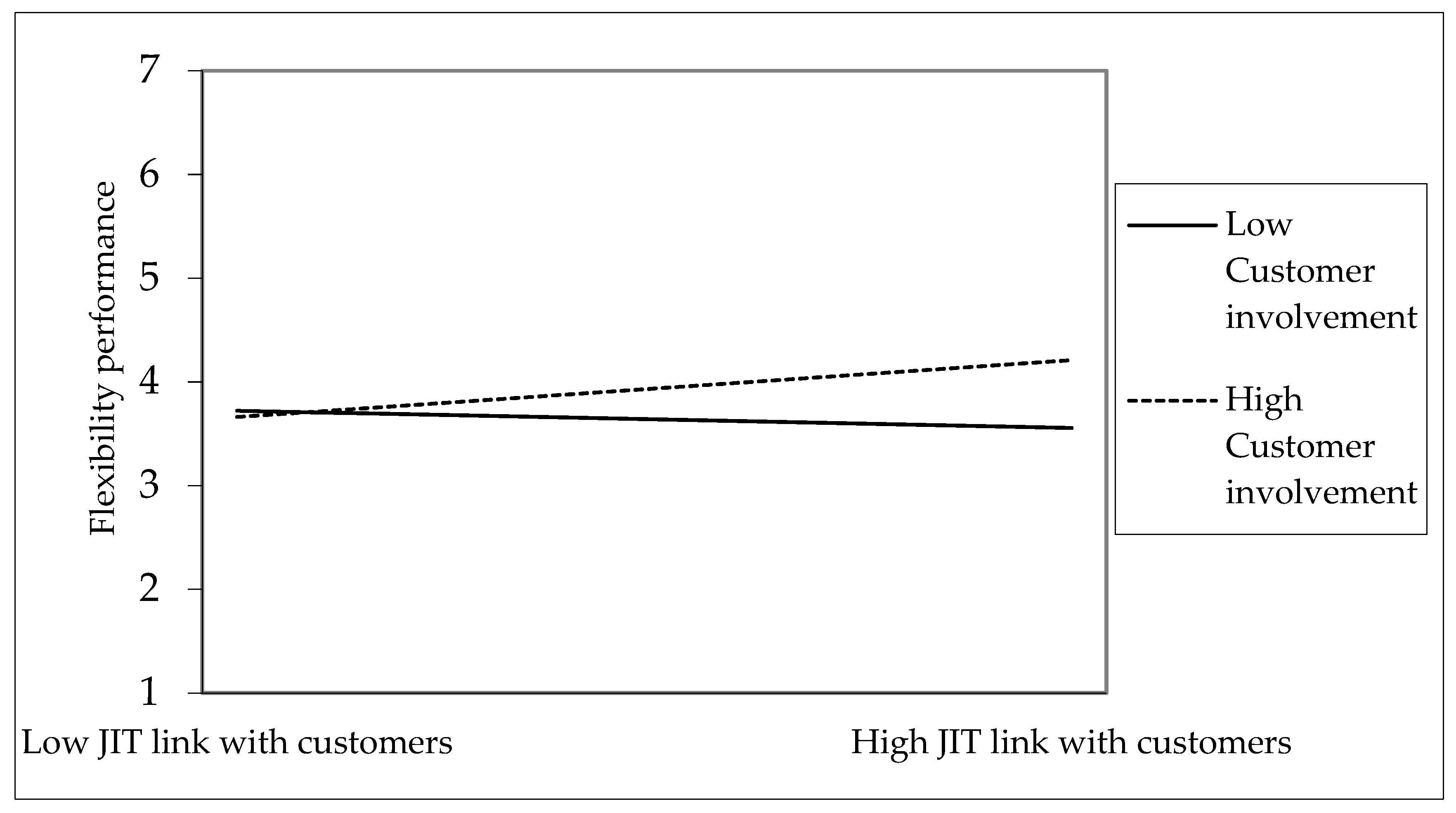
A simple slope test result presented in Table 8 shows that, when the firm implements process control at a low level, setup time reduction has no significant impact on flexibility performance (p-value = 0.205). As a higher level of process control implementation, the setup time reduction—flexibility performance relationship becomes significant (p-value = 0.003) and positive, as shown in Figure 2. Similarly, the effect of the JIT link with customers on flexibility performance becomes significant (p-value = 0.002) with a positive slope (as presented in Figure 3) when customer involvement implementation increases from a low to a high level.
Figure 2.
Moderating effect of process control on setup time reduction—flexibility performance relationship.
Figure 3.
Moderating effect on customer involvement on JIT link with customers—flexibility performance relationship.
The results of regression and a simple slope test can be summarized as follows:
- TQM practices as supplier involvement and customer involvement are significantly impacted on flexibility performance of manufacturing plants.
- JIT production practices as JIT delivery by suppliers is significantly impacted on the flexibility performance of manufacturing plants.
- Relationship between JIT production practices and flexibility performance is stronger with higher TQM practices implementation in cases of setup time reduction and process control, JIT delivery by suppliers and supplier involvement.
The results of correlation analysis, regression analysis, and simple slope tests suggest that hypotheses H1a, H1b, H1c, H2a, H2b, H2c, H3a, H3b, H3c, H4a, and H4c should be accepted.
6. Discussion, Implications, and Limitations
6.1. Discussion and Implications
Joint implementation of TQM and JIT practices has been studied widely by researchers to determine a holistic approach for better quality performance, which eliminates waste in a firm’s operation. Our study analyzes the HPM database and provides new empirical evidence on the effects of TQM and JIT production on flexibility performance, which is crucial for manufacturing firms in today’s turbulent business environment. The main findings of this paper can be summarized below.
First, this study confirms the significant linkages between TQM practices and JIT production practices. All JIT practices are strongly correlated with process control, supplier involvement, and customer involvement. The relationship between TQM and JIT has been found in existing literature [36,80,90]. JIT production always seeks to eliminate waste through small lots and keeps the smallest amount of stock. Since small lots require less space and time, it is easier for inspection and defects detection. Thus, it improves quality performance. TQM can handle problems happened during JIT implementation. For example, in case of no safety stock, operational production can be disrupted if there is an issue related to the quality of materials [81]. Therefore, supplier involvement in quality helps reduce a rejected rate of inputs and facilitates JIT implementation. Similarly, customers could assist firms in quality inspection, which results in lowering the products’ return rate. Without customer involvement, a minimal number of inventories can make customers feel insufficient to purchase products because they feel less product variety. In general, JIT and TQM should be concentrated simultaneously to improve operational performance.
Second, this study indicates the positive linkage between JIT practices, TQM practices, and flexibility performance. Firms will achieve higher ability to meet customer’s flexibility needs if they focus strongly on TQM and JIT. Relationship between TQM and flexibility found in this paper is in line with previous research studies such as seen in References [57,62]. It is recommended that, to achieve manufacturing agility, QM should be implemented at the supply chain level, including internal QM (process control), upstream QM (supplier involvement), and downstream QM (customer involvement). In addition, positive linkage between JIT practices and flexibility performance corroborates the ideas of many previous studies [42,43]. This finding makes significant sense since JIT production has been found to keep continuous flow and improve process mobility by reducing setup time, lot size, and delivery time [19]. Moreover, JIT practices can leverage new product flexibility and enhance the firm’s ability to meet changes in customers’ needs [42]. In short, TQM and JIT are two important determinants of flexibility. It is implied for managers to focus on both concepts if firms want to build flexibility.
The third finding is the moderating effects TQM practices on relationship between JIT production practices and flexibility performance. The authors have tested the impact of JIT production practices on flexibility performance with different aspects of TQM (internal, upstream, and downstream). If we look at an internal aspect of TQM, this study affirms that, with a higher level of process control implementation, setup time reduction will have a more direct impact on flexibility performance. Because setup time reduction will result in small lots and less space, process management has to be adjusted to fit with JIT implementation. Thus, it requires tool such as statistical process control, to make certain that the process is performing as intended and bring what the customer wants [85]. Process control detects problems and takes corrective action, which helps to perform setup time reduction more smoothly. Regarding the upstream level of TQM, although we cannot confirm the interaction effects of upstream QM and JIT, upstream QM (supplier involvement) and upstream JIT (JIT delivery by suppliers) show an individual significant impact on flexibility performance. When it comes to the downstream level of TQM, we found a significant interaction effect of customer involvement and JIT link with customers on flexibility performance. Zelbst et al. [14] stated that flexibility is what creates value because it enables organization to be more responsive. Their study also argued that responsive capability must be achieved through a combined effect of JIT and TQM. As customer involvement improves market understanding and provide customer’s concern and feedback, firms are capable of linking the customer in an operational system, which provides on-time delivery. All of those factors contribute to the ability of being responsive to any customer’s inquiry or change in their demands. In general, JIT could be the foundation to improve flexibility performance, and the relationship will become stronger and more remarkable if JIT practices are implemented in the working environment that focus on TQM practices such as process control and customer involvement. Mangers at manufacturing companies that are implementing JIT practices are encouraged to adopt TQM practices in operations, which can support JIT activities and then lead to higher flexibility performance. In the situation that firms have not applied JIT or TQM but desire flexibility, it is recommended to concentrate on TQM practices initially. Inman et al. [86] suggested that, before implementing JIT, there are several obstacles that need to be removed such as a large container size, unleveled production schedules, bottlenecks, and more. Implementation of TQM not only benefits firms in terms of higher quality and cost performance, but it also presents as a platform to better put JIT into practice. Therefore, this helps companies to be able to meet customers’ flexibility needs.
To summarize, it is crucial to view JIT production and TQM as mandatory determinants of flexibility performance. Previous studies perceive JIT production as a cost focus strategy and TQM as a quality focus strategy, and their integration is an important foundation of the lean production system [90]. This study extends that perspective by stating that JIT production and TQM are interdependent. In addition, these are two solid bases that can be implemented in case firms are pursuing a flexibility focus strategy.
6.2. Limitations
This paper contains limitations that can be overcome in future studies. First, due to lack of time and resources, the current study acquires a relatively small data sample. It restricts some methodologies of data analysis such as path analysis or adding control variables. Future work can address this problem by collecting more data to re-examine the framework. Furthermore, since flexibility is becoming more important in a competitive world, more variables could be added in the model to investigate their impact on this type of competitive performance. The second limitation is that this study mainly utilizes data collected from a self-reported questionnaire and personal bias, therefore, may exist. The HPM Project collected both subjective and objective data from manufacturing plants. Because of the differences in products of companies that belong to three different industries, only subjective data was used in this study. In the future, researchers can use both subjective and objective data when investigating specific HPM practices in a specific industry. Lastly, regression analysis in this paper shows relatively small R2 value (under 10%), which indicates a low explanatory power of models. A possible explanation is that we check the interaction effect of individual TQM and JIT production practice on flexibility performance. This problem happened in some other empirical studies that utilized data from the HPM project. It can be overcome by enlarging the sample size in the future.
7. Conclusions
This paper contributes to the research field related to TQM, JIT production, and flexibility by providing empirical evidence of a relationship between TQM and JIT production practices and flexibility performance. An analytical framework was proposed, which includes four practices of TQM, three practices of JIT, and one practice of flexibility performance as the firm’s ability to meet customers’ flexibility needs. The data sample was adapted from the HPM project. A reliability test, a validity test, and regression analysis were used to examine the data, as well as test the validation of hypotheses. This study emphasizes the strong correlation of TQM practices and JIT production practices as well as their significant impact on flexibility performance. Moreover, flexibility performance can be built through the joint effect of three pairs of TQM and JIT production practices: process control and setup time reduction, supplier involvement, and JIT delivery by suppliers, customer involvement, and JIT link with customers. The study concludes that implementation of JIT production under an organizational culture emphasized on TQM creates a strong foundation of firm’s responsiveness to the market. It is suggested that plants should implement TQM practices and JIT production practices as two complementary concepts to achieve higher flexibility performance when compared to other plants, which apply only one of those two.
This study includes some limitations regarding problems of small data sample, the nature of a self-reported questionnaire, and a limitation in the statistical result. Future research can collect more data and use various methods of the construct measurement to implement further analysis for deeper understanding of the relationship between TQM, JIT, and flexibility. Moreover, future works can also extend the analytical framework of this study to explore the relationship of more TQM and JIT practices on flexibility. It is also helpful to explore how flexibility can drive other firm performance factors such as innovation or financial performance. In addition, researchers can follow up the quantitative result of this study to further conduct research using case studies, which would provide more useful practical implications for manufacturing companies in applying TQM and JIT practices.
Author Contributions
A.C.P., H.T.N., H.A.N., and Y.M. conceived and designed the experiments. A.C.P., H.T.N., and Y.M. collected the data and performed the experiments. A.C.P., H.T.N., and H.A.N. analyzed the data. A.C.P. and H.A.N. wrote the paper. A.C.P., H.T.N., and Y.M. provided valuable comments and revisions.
Funding
“This research is funded by Vietnam National Foundation for Science and Technology Development (NAFOSTED) under grant number 502.02-2016.04”.
Conflicts of Interest
The authors declare no conflicts of interest.
Appendix A. Measurement Scales
The appendix provides questionnaire items used in this study. Values within the bracket show factor loading of each corresponding item.
Table A1.
Survey’s questionnaire items.
References
- Iqbal, T.; Huq, F.; Bhutta, M.K.S. Agile manufacturing relationship building with TQM, JIT, and firm performance: An exploratory study in apparel export industry of Pakistan. Int. J. Prod. Econ. 2018, 203, 24–37. [Google Scholar] [CrossRef] [Scilit]
- Mishra, R.; Pundir, A.K.; Ganapathy, L. Empirical assessment of factors influencing potential of manufacturing flexibility in organization. Bus. Proc. Manag. J. 2018, 24, 158–182. [Google Scholar] [CrossRef] [Scilit]
- Chaudhuri, A.; Boer, H.; Taran, Y. Supply chain integration, risk management and manufacturing flexibility. Int. J. Oper. Prod. Manag. 2018, 38, 690–712. [Google Scholar] [CrossRef] [Scilit]
- Alcaraz, J.L.G.; Macías, A.A.M.; Hernandez, G.A.; Macías, E.J.; Muro, J.C.S.D.; Fernández, J.B. Impact of human factor on flexibility and supply chain agility of La Rioja wineries. Eur. J. Ind. Eng. 2017, 11, 663–682. [Google Scholar] [CrossRef] [Scilit]
- Fantazy, K.A.; Kumar, V.; Kumar, U. An empirical study of the relationships among strategy, flexibility, and performance in the supply chain context. Supply Ch. Manag. Int. J. 2009, 14, 177–188. [Google Scholar] [CrossRef] [Scilit]
- Lau, R.S.M. Critical factors for achieving manufacturing flexibility. Int. J. Oper. Prod. Manag. 1999, 19, 328–341. [Google Scholar] [CrossRef] [Scilit]
- Wakchaure, V.D.; Nandurkar, K.N.; Kallurkar, S.P. In Relationship between Implementation of TQM, JIT, TPM and SCM and Manufacturing Performance: Empirical Evidences from Indian Context. In Proceedings of the International Manufacturing Science and Engineering Conference, Detroit, MI, USA, 9–13 June 2014. [Google Scholar]
- Flynn, B.B.; Sakakibara, S.; Schroeder, R.G. Relationship between JIT and TQM: Practices and performance. Acad. Manag. J. 1995, 38, 1325–1360. [Google Scholar]
- Cua, K.O.; Sweet, K.E.M.; Schroeder, R.G. Improving Performance through an Integrated Manufacturing Program. Qual. Manag. J. 2006, 13, 45–60. [Google Scholar] [CrossRef] [Scilit]
- Kaynak, H.; Hartley, J.L. A replication and extension of quality management into the supply chain. J. Oper. Manag. 2008, 26, 468–489. [Google Scholar] [CrossRef] [Scilit]
- Chen, Z.X.; Tan, K.H. The perceived impact of JIT implementation on operations performance: Evidence from Chinese firms. J. Adv. Manag. Res. 2011, 8, 213–235. [Google Scholar] [CrossRef] [Scilit]
- Lucherini, F.; Rapaccini, M. Exploring the Impact of Lean Manufacturing on Flexibility in SMEs. J. Ind. Eng. Manag. 2017, 10, 919–945. [Google Scholar] [CrossRef] [Scilit]
- Mazanai, M. Impact of Just-in-time (JIT) inventory system on efficiency, quality and flexibility among manufacturing sector, small and medium enterprise (SMEs) in South Africa. Afr. J. Bus. Manag. 2012, 6, 5786–5791. [Google Scholar] [CrossRef] [Scilit]
- Zelbst, P.J.; Green, K.W., Jr.; Abshire, R.D.; Sower, V.E. Relationships among market orientation, JIT, TQM, and agility. Ind. Manag. Data Syst. 2010, 110, 637–658. [Google Scholar] [CrossRef] [Scilit]
- Flynn, B.B.; Schroeder, R.; Sakakibara, S. The impact of quality management practices on performance and competitive advantage. Decis. Sci. 1995, 26, 659–691. [Google Scholar] [CrossRef] [Scilit]
- Mandelbaum, M. Flexibility in Decision Making—An Exploration and Unification. University of Toronto: Toronto, ON, Canada, 1980. [Google Scholar]
- Mascarenhas, B. Planning for flexibility. Long Range Plan. 1981, 14, 78–82. [Google Scholar] [CrossRef] [Scilit]
- Gupta, Y.P.; Goyal, S. Flexibility of manufacturing systems: Concepts and measurements. Eur. J. Oper. Res. 1989, 43, 119–135. [Google Scholar] [CrossRef] [Scilit]
- Upton, D.M. What Really Makes Factories Flexible? Harv. Bus. Rev. 1995, 7, 74–84. [Google Scholar]
- Olhager, J. Manufacturing flexibility and profitability. Int. J. Prod. Econ. 1993, 30–31, 67–78. [Google Scholar] [CrossRef] [Scilit]
- Zhang, Q.; Vonderembse, M.A.; Lim, J.S. Manufacturing flexibility: defining and analyzing relationships among competence, capability, and customer satisfaction. J. Oper. Manag. 2003, 21, 173–191. [Google Scholar] [CrossRef] [Scilit]
- Mishra, R. A comparative evaluation of manufacturing flexibility adoption in SMEs and large firms in India. J. Manuf. Technol. Manag. 2016, 27, 730–762. [Google Scholar] [CrossRef] [Scilit]
- Montes, F.J.L.; Morales, V.J.G.; Jover, A.J.V. Flexibility and quality management in manufacturing: An alternative approach. Prod. Plan. Control: Manag. Oper. 2004, 15, 525–533. [Google Scholar] [CrossRef] [Scilit]
- Toni, A.D.; Tonchia, S. Manufacturing flexibility: A literature review. Int. J. Prod. Res. 1998, 36, 1587–1617. [Google Scholar] [CrossRef] [Scilit]
- Lee, D.; Park, B. Impact of manufacturing systems on quality management practices, competitive advantages, and operational performance. Int. J. Prod Qual. Manag. 2016, 19, 301–318. [Google Scholar] [CrossRef] [Scilit]
- Phan, A.C.; Abdallah, A.B.; Matsui, Y. Quality management practices and competitive performance: Empirical evidence from Japanese manufacturing companies. Int. J. Prod. Econ. 2011, 133, 518–529. [Google Scholar] [CrossRef] [Scilit]
- Schroeder, R.G.; Flynn, B.B. High Performance Manufacturing: Global Perspectives; John Wiley & Sons: New York, NY, USA, 2001. [Google Scholar]
- Bessant, J.; Kaplinsky, R.; Lamming, R. Putting supply chain learning into practice. Int. J. Oper. Prod. Manag. 2003, 23, 167–184. [Google Scholar] [CrossRef] [Scilit]
- Jack, E.P.; Raturi, A. Sources of volume flexibility and their impact on performance. J. Oper. Manag. 2002, 20, 519–548. [Google Scholar] [CrossRef] [Scilit]
- Camisón, C.; López, A.V. An examination of the relationship between manufacturing flexibility and firm performance: The mediating role of innovation. Int. J. Oper. Prod. Manag. 2010, 30, 853–878. [Google Scholar] [CrossRef] [Scilit]
- Cakanyildirim, M.; Luo, S. Stochastic inventory system with lead time flexibility: offered by a manufacturer/transporter. J. Oper. Res. Soc. 2017, 68, 1533–1552. [Google Scholar] [CrossRef] [Scilit]
- Wafa, M.A.; Yasin, M.M. A conceptual framework for effective implementation of JIT: An empirical investigation. Int. J. Oper. Prod. Manag. 1998, 18, 1111–1124. [Google Scholar] [CrossRef] [Scilit]
- Salehi, M.; Alipour, M. Impact Of JIT On Firms‘ Financial Performance: Some Iranian Evidence. Glob. J. Manag. Bus. Res. 2010, 10, 21–29. [Google Scholar]
- Zhao, W.; Yu, Q.; Li, H.; Tian, Y. Study on the relationship between JIT practices and operational performance based on the cost leading strategy. In Proceedings of the International Conference on Management Science & Engineering, Helsinki, Finland, 17–19 August 2014. [Google Scholar]
- Flynn, B.B.; Schroeder, R.G.; Flynn, E.J.; Sakakibara, S. A Framework for Quality Management Research and an Associate measurement instrument. J. Oper. Manag. 1994, 11, 339–366. [Google Scholar] [CrossRef] [Scilit]
- Matsui, Y. An empirical analysis of just-in-time production in Japanese manufacturing companies. Int. J. Prod. Econ. 2007, 108, 153–164. [Google Scholar] [CrossRef] [Scilit]
- Bortolotti, T.; Danese, P.; Romano, P. Assessing the impact of just-in-time on operational performance at varying degrees of repetitiveness. Int. J. Prod. Res. 2013, 51, 1117–1130. [Google Scholar] [CrossRef] [Scilit]
- Singh, R.J.; Sohani, N.; Marmat, H. Effect of Lean/JIT Practices and Supply Chain Integration on Lead Time Performance. J. Supply Chain Manag. Syst. 2013, 2, 34–41. [Google Scholar]
- Slack, N.; Chambers, S.; Johnston, R. Operations Management; Prentice Hall: New Jersey, NJ, USA, 2007. [Google Scholar]
- Husseini, S.M.M.; Brien, C.O.; Hosseini, S.T. A method to enhance volume flexibility in JIT production control. Int. J. Prod. Econ. 2006, 104, 653–665. [Google Scholar] [CrossRef] [Scilit]
- Gurahoo, N.; Salisbury, R.H. Lean and agile in small- and medium-sized enterprises: Complementary or incompatible? S. Afr. J. Bus. Manag. 2018, 49. [Google Scholar] [CrossRef] [Scilit]
- Swink, M.; Narasimhan, R.; Kim, S.W. Manufacturing Practices and Strategy Integration: Effects on Cost Efficiency, Flexibility, and Market-Based Performance. Decis. Sci. 2005, 36, 427–457. [Google Scholar] [CrossRef] [Scilit]
- McKone, K.E.; Schroeder, R.G.; Cua, K.O. The impact of total productive maintenance practices on manufacturing performance. J. Oper. Manag. 2001, 19, 39–58. [Google Scholar] [CrossRef] [Scilit]
- Kazazi, A.; Keller, A.Z. Benefits Derived from JIT by European Manufacturing Companies. Ind. Manag. Data Syst. 1994, 94, 12–14. [Google Scholar] [CrossRef] [Scilit]
- Zehir, C.; Ertosun, O.; Zehir, S.; Müceldilli, B. Total Quality Management Practices’ Effects on Quality Performance and Innovative Performance. Procedia—Soc. Behav. Sci. 2012, 41, 273–280. [Google Scholar] [CrossRef] [Scilit]
- Powel, T.C. Total Quality Management as competitive advantage: a review and empirical study. Strateg. Manag. J. 1995, 16, 15–27. [Google Scholar] [CrossRef] [Scilit]
- Ahire, S.L.; Golhar, D.Y.; Waller, M.A. Development and validation of TQM implementation constructs. Dec. Sci. 1996, 27, 23–56. [Google Scholar] [CrossRef] [Scilit]
- García, J.A.; Rama, M.C.R.; Rodríguez, M.M.M. How Do Quality Practices Affect the Results? The Experience of Thalassotherapy Centres in Spain. Sustainability 2017, 9, 671. [Google Scholar] [CrossRef] [Scilit]
- Kaynak, H. The relationship between total quality management practices and their effects on firm performance. J. Oper. Manag. 2003, 21, 405–435. [Google Scholar] [CrossRef] [Scilit]
- Zeng, J.; Phan, C.A.; Matsui, Y. Supply chain quality management practices and performance: An empirical study. Oper. Manag. Res. 2013, 6, 19–31. [Google Scholar] [CrossRef] [Scilit]
- Femenías, L.B.; Perramon, J.; Villanueva, M.O. Effects of Service Quality Policies in the Tourism Sector Performance: An Empirical Analysis of Spanish Hotels and Restaurants. Sustainability 2019, 11, 872. [Google Scholar] [CrossRef] [Scilit]
- Chen, S.H.; Hsu, C.C.; Wu, I.P. The effects of total quality management implications on customer satisfaction and customer loyalty: an empirical study in the Taiwanese security industry. Eur. J. Ind. Eng. 2017, 11, 1–21. [Google Scholar] [CrossRef] [Scilit]
- Nguyen, M.H.; Phan, A.C.; Matsui, Y. Contribution of Quality Management Practices to Sustainability Performance of Vietnamese Firms. Sustainability 2018, 10, 375. [Google Scholar] [CrossRef] [Scilit]
- Aquilani, B.; Silvestri, C.; Ruggieri, A. Sustainability, TQM and Value Co-Creation Processes: The Role of Critical Success Factors. Sustainability 2016, 8, 995. [Google Scholar] [CrossRef] [Scilit]
- Sousa, R.; Voss, C.A. Quality management re-visited: A reflective review and agenda for future research. J. Oper. Manag. 2002, 20, 91–109. [Google Scholar] [CrossRef] [Scilit]
- Volberda, H.W. Building the Flexible Firm: How to Remain Competitive. Corp. Reput. Rev. 1998, 2, 94–96. [Google Scholar]
- Gómez-Gras, J.M.; Verdú-Jover, A.J. TQM, structural and strategic flexibility and performance: an empirical research study. Total Qual. Manag. Bus. Excell. 2005, 16, 841–860. [Google Scholar] [CrossRef] [Scilit]
- Ross, D. Competing Through Supply Chain Management; Chapman & Hall: New York, NY, USA, 1998. [Google Scholar]
- Flynn, E.; Flynn, B. Synergies between supply chain management and quality management: Emerging implications. Int. J. Prod. Res. 2005, 43, 3421–3436. [Google Scholar] [CrossRef] [Scilit]
- Sila, I.; Ebrahimpour, M.; Birkholz, C. Quality in supply chains: an empirical analysis. Supply Chain Manag. Int. J. 2006, 11, 491–502. [Google Scholar] [CrossRef] [Scilit]
- Abdallah, A.B.; Nabass, I.H. Supply chain antecedents of agile manufacturing in a developing country context: An empirical investigation. J. Manuf. Technol. Manag. 2018, 29, 1042–1064. [Google Scholar] [CrossRef] [Scilit]
- Alolayyan, M.N.; Ali, K.A.M.; Idris, F. Total quality management and operational flexibility impact on hospitals performance: a structural modelling approach. Int. J. Prod. Qual. Manag. 2013, 11, 212–227. [Google Scholar] [CrossRef] [Scilit]
- Escrig-Tena, A.B.; Bou-Llusar, J.C.; Roca-Puig, V. Does quality management drive labour flexibility? Total Qual. Manag. Bus. Excell. 2012, 23, 159–176. [Google Scholar] [CrossRef] [Scilit]
- Alolayyan, M.N.; Ali, K.A.M.; Idris, F. The influence of total quality management (TQM) on operational flexibility in Jordanian hospitals: Medical workers’ perspectives. Asian J. Qual. 2011, 12, 204–222. [Google Scholar] [CrossRef] [Scilit]
- Anderson, M.; Sohal, A.S. A study of the relationship between quality management practices and performance in small businesses. Int. J. Qual. Reliab. Manag. 1999, 16, 859–877. [Google Scholar] [CrossRef] [Scilit]
- Vuppalapati, K.; Ahire, S.L.; Gupta, T. JIT and TQM: a case for joint implementation. Int. J. Oper. Prod. Manag. 1995, 15, 84–94. [Google Scholar] [CrossRef] [Scilit]
- Jasti, N.V.K.; Kodali, R. Lean manufacturing frameworks: review and a proposed framework. Eur. J. Ind. Eng. 2016, 10, 547–573. [Google Scholar] [CrossRef] [Scilit]
- Phan, C.A.; Matsui, Y. Contribution of quality management and just-in-time production practices to manufacturing performance. Int. J. Prod. Qual. Manag. 2010, 6, 23–47. [Google Scholar] [CrossRef] [Scilit]
- Kannan, V.R.; Tan, K.C. Just in time, total quality management, and supply chain management: understanding their linkages and impact on business performance. Omega 2005, 33, 153–162. [Google Scholar] [CrossRef] [Scilit]
- Tesfaye, G.; Kitaw, D. A TQM and JIT Integrated Continuous Improvement Model for Organizational Success: An Innovative Framework. J. Optim. Ind. Eng. 2017, 22, 15–23. [Google Scholar]
- Vokurka, R.J.; Lummus, R.R.; Krumwiede, D. Improving Manufacturing Flexibility: The Enduring Value of JIT. SAM Adv. Manag. J. 2007, 72, 14–21. [Google Scholar]
- Fullerton, R.R.; McWatters, C.S. The production performance benefits from JIT implementation. J. Oper. Manag. 2001, 19, 81–96. [Google Scholar] [CrossRef] [Scilit]
- Hong, J.; Zhang, Y.; Shi, M. The impact of supply chain quality management practices and knowledge transfer on organisational performance: an empirical investigation from China. Int. J. Log. Res. Appl. 2017, 21, 259–278. [Google Scholar] [CrossRef] [Scilit]
- Saraph, J.V.; Benson, G.P.; Schroeder, R.G. An instrument for measuring the critical factors of quality management. Dec. Sci. 1989, 20, 810–829. [Google Scholar] [CrossRef] [Scilit]
- Shah, R.; Ward, P.T. Lean manufacturing: context, practice bundles, and performance. J. Oper. Manag. 2003, 21, 129–149. [Google Scholar] [CrossRef] [Scilit]
- Forza, C. Achieving superior operating performance from integrated pipeline management: an empirical study. Int. J. Phys. Distrib. Logist. Manag. 1996, 26, 36–63. [Google Scholar] [CrossRef] [Scilit]
- Narasimhan, R.; Swink, M.; Kim, S.W. Disentangling leanness and agility: An empirical investigation. J. Oper. Manag. 2006, 24, 440–457. [Google Scholar] [CrossRef] [Scilit]
- Prince, J.; Kay, J.M. Combining lean and agile characteristics: Creation of virtual groups by enhanced production flow analysis. Int. J. Prod. Econ. 2003, 85, 305–318. [Google Scholar] [CrossRef] [Scilit]
- Sower, V.; Bimmerle, C. Statistical process control: a prerequisite for MRP and JIT. NAPM Mat. Manag. Group Newsl. 1991, 6, 3–6. [Google Scholar]
- Eker, M.; Pala, F. The effect of competition, just-in-time production, and total quality management on the use of multiple performance measures: an empirical study. J. Econ. Soc. Res. 2008, 10, 35–72. [Google Scholar]
- Zelbst, P.J.; Green Jr, K.W.; Sower, V.E.; Abshire, R.D. Impact of RFID and information sharing on JIT, TQM and operational performance. Manag. Res. Rev. 2014, 37, 970–989. [Google Scholar] [CrossRef] [Scilit]
- Bartezzaghi, E.; Turco, F.; Spina, G. The Impact of the Just-in-Time Approach on Production System Performance: A Survey of Italian Industry. Int. J. Oper. Prod. Manag. 1992, 12, 5–17. [Google Scholar] [CrossRef] [Scilit]
- Zhu, Z.; Meredith, P.H. Defining critical elements in JIT implementation: a survey. Ind. Man. Data Syst. 1994, 94, 3–10. [Google Scholar] [CrossRef] [Scilit]
- Cua, K.O.; McKone, K.E.; Schroeder, R.G. Relationships between implementation of TQM, JIT, and TPM and manufacturing performance. J. Oper. Manag. 2001, 19, 675–694. [Google Scholar] [CrossRef] [Scilit]
- Soo, P.J. The Moderate Effect of SPC on the Relations Between Practicing JIT and Production Performance. Asian J. Qual. 2009, 10, 107–113. [Google Scholar]
- Inman, R.A.; Sale, R.S.; Green, K.W.J.; Whitten, D. Agile manufacturing: Relation to JIT, operational performance and firm performance. J. Oper. Manag. 2011, 29, 343–355. [Google Scholar] [CrossRef] [Scilit]
- Green, K.W., Jr.; Inman, R.A.; Birou, L.M.; Whitten, D. Total JIT (T-JIT) and its impact on supply chain competency and organizational performance. Int. J. Prod. Econ. 2014, 147, 125–135. [Google Scholar] [CrossRef] [Scilit]
- Roth, A.V.; Schroeder, R.G.; Huang, X.; Kristal, M.M. Handbook of Metrics for Research in Operations Management: Multi-item Measurement Scales and Objective Items; SAGE Publications: Thousand Oaks, CA, USA, 2007. [Google Scholar]
- Hayes, A.F. Introduction to Mediation, Moderation, and Conditional Process Analysis, Second Edition: A Regression-Based Approach; The Guilford Press: New York, NY, USA, 2017. [Google Scholar]
- Chen, Z. The relationships among JIT, TQM and production operations performance: An empirical study from Chinese manufacturing firms. Bus. Process Manag. J. 2015, 21, 1015–1039. [Google Scholar] [CrossRef] [Scilit]

© 2019 by the authors. Licensee MDPI, Basel, Switzerland. This article is an open access article distributed under the terms and conditions of the Creative Commons Attribution (CC BY) license (http://creativecommons.org/licenses/by/4.0/).