

Potential Role of Mosses in Evaluating Airborne Microplastic Deposition in Terrestrial Ecosystems


Abstract
1. Introduction
2. Mosses as Bioindicators and Bioaccumulators of Persistent Atmospheric Contaminants
3. Microplastic Concentrations in Native and Exposed Mosses
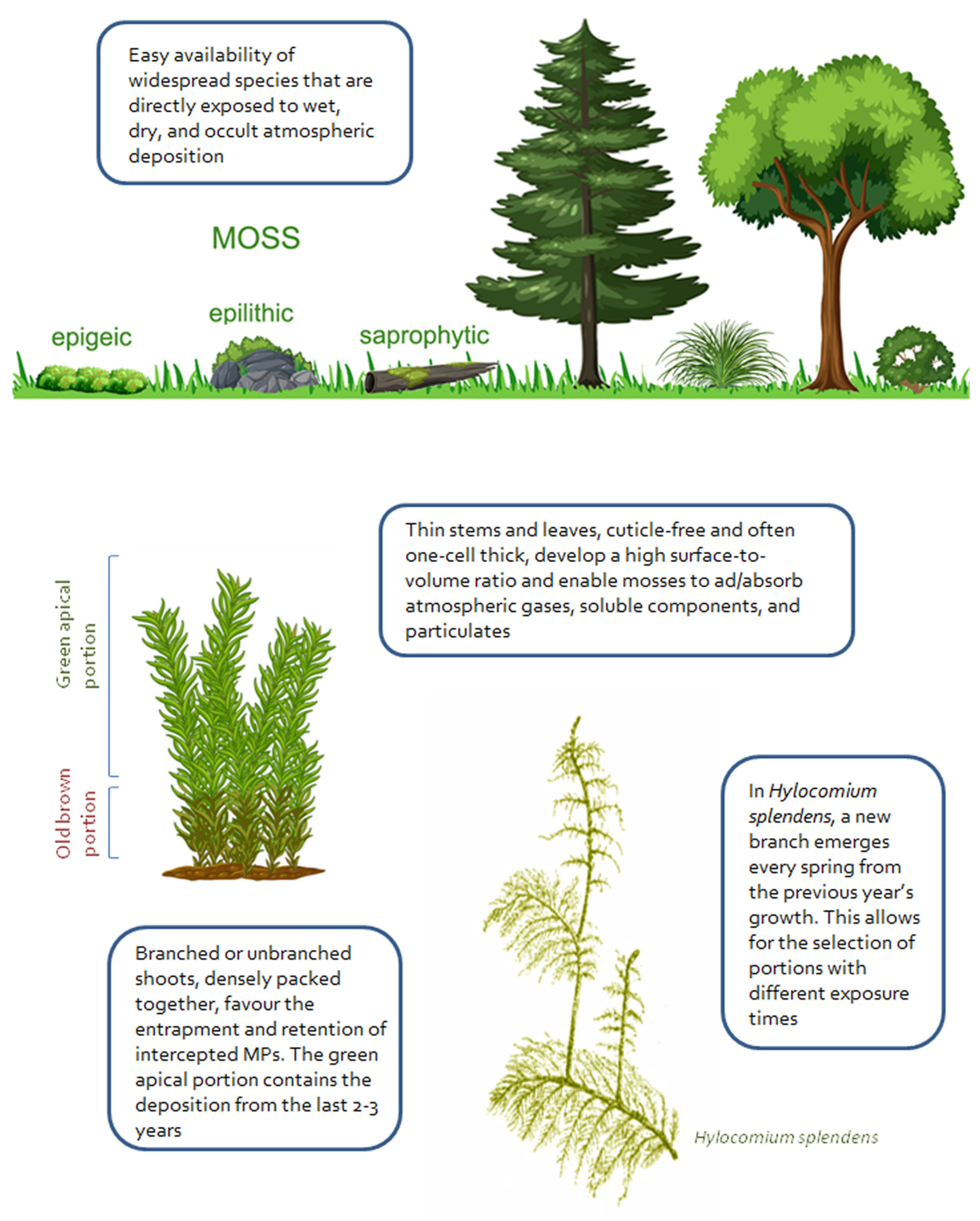
4. Features Making Mosses Potential Biomonitors of Microplastics
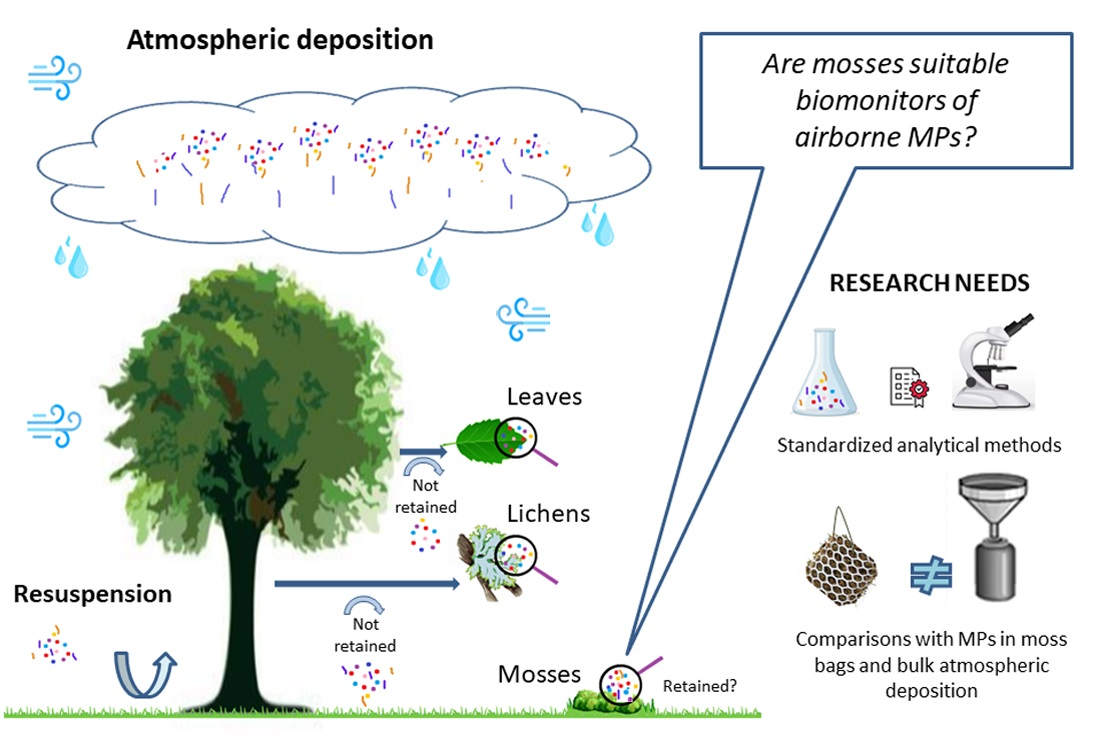
5. Research Needed to Evaluate the Potential of Mosses as MP Biomonitors
6. Conclusions
Author Contributions
Funding
Institutional Review Board Statement
Informed Consent Statement
Data Availability Statement
Conflicts of Interest
Abbreviations
| GPIB | Global Plastic Ingestion Bioindicators |
| LRTAP | Long-Range Transboundary Air Pollution |
| MFs | Microfibers |
| MPs | Microplastics |
| NPs | Nanoplastics |
References
- OECD. Policy Scenarios for Eliminating Plastic Pollution by 2040; Organisation for Economic Co-operation and Development Publishing: Paris, France, 2024. [Google Scholar] [CrossRef]
- Lau, W.W.Y.; Shiran, Y.; Bailey, R.M.; Cook, E.; Stuchtey, M.R.; Koskella, J.; Velis, C.A.; Godfrey, L.; Boucher, J.; Murphy, M.B.; et al. Evaluating scenarios toward zero plastic pollution. Science 2020, 369, 1455–1461. [Google Scholar] [CrossRef]
- Peries, S.D.; Sewwandi, M.; Sandanayake, S.; Kwon, H.-H.; Vithanage, M. Airborne transboundary microplastics—A swirl around the globe. Environ. Pollut. 2024, 353, 124080. [Google Scholar] [CrossRef]
- Thompson, R.C.; Courtene-Jones, W.; Boucher, J.; Pahl, S.; Raubenheimer, K.; Koelmans, A.A. Twenty years of microplastic pollution research—What have we learned? Science 2024, 386, 2746. [Google Scholar] [CrossRef] [PubMed]
- Herzke, D.; Schmidt, N.; Lervik, A.E.; Schulze, D.; Celentano, S.; Eckhardt, S.; Arp, H.P.H.; Evangeliou, N. Airborne microplastics on the move: Urban Europe as a source to remote regions. Environ. Pollut. 2026, 388, 127380. [Google Scholar] [CrossRef]
- Zhao, J.; Lan, R.; Tan, H.; Wang, J.; Ma, Y.; Chen, Q.; Jiang, F.; Wang, Z.; Xing, B. Detection and characterization of microplastics and nanoplastics in biological samples. Nat. Rev. Bioeng. 2025, 3, 1019–1033. [Google Scholar] [CrossRef]
- Stevens, S.; McPartland, M.; Bartosova, Z.; Skåland, H.S.; Völker, J.; Wagner, M. Plastic food packaging from five countries contains endocrine- and metabolism-disrupting chemicals. Environ. Sci. Technol. 2024, 58, 4859–4871. [Google Scholar] [CrossRef] [PubMed]
- Earth Action. Leakage of Microplastics into Oceans and Land. EA’s Global Assessment & Benchmark of Literature–2023 Update. Available online: https://www.e-a.earth/wp-content/uploads/2024/05/EA_2024_Update_Primary_Microplastics.pdf (accessed on 3 June 2025).
- Horton, A.A.; Walton, A.; Spurgeon, D.J.; Lahive, E.; Svendsen, C. Microplastics in freshwater and terrestrial environments: Evaluating the current understanding to identify the knowledge gaps and future research priorities. Sci. Total Environ. 2017, 586, 127–141. [Google Scholar] [CrossRef]
- Wang, K.; Wang, F.; Yu, Y.; Yang, S.; Han, Y.; Yao, H. Microplastics and soil microbiomes. BMC Biol. 2025, 23, 273. [Google Scholar] [CrossRef]
- Li, Y.; Zhang, J.; Xu, L.; Li, R.; Zhang, R.; Li, M.; Ran, C.; Rao, Z.; Wei, X.; Chen, M.; et al. Leaf absorption contributes to accumulation of microplastics in plants. Nature 2025, 641, 666–673. [Google Scholar] [CrossRef]
- Shealy, C.; Fernandez, G.; Vito, D.; Maione, C. From sea to plate: The plastic pollution problem in the food chain. Med. Sci. Forum 2025, 33, 4. [Google Scholar] [CrossRef]
- Liu, Y.; Nie, Z.; Meng, Y.; Liu, G.; Chen, Y.; Chai, G. Influence of meteorological conditions on atmospheric microplastic transport and deposition. Environ. Res. 2025, 265, 120460. [Google Scholar] [CrossRef]
- Bargagli, R. Trace Elements in Terrestrial Plants: An Ecophysiological Approach to Biomonitoring and Biorecovery; Springer: Berlin, Germany, 1998; 324p. [Google Scholar]
- Roblin, B.; Aherne, J. Moss as a biomonitor for the atmospheric deposition of anthropogenic microfibers. Sci. Total Environ. 2020, 715, 136973. [Google Scholar] [CrossRef]
- Loppi, S.; Roblin, B.; Paoli, L.; Aherne, J. Accumulation of airborne microplastics in lichens from a landfill dumping site (Italy). Sci. Rep. 2021, 11, 4564. [Google Scholar] [CrossRef]
- Bertrim, C.; Aherne, J. Moss bags as biomonitors of atmospheric microplastic deposition in urban environments. Biology 2023, 12, 149. [Google Scholar] [CrossRef]
- Capozzi, F.; Sorrentino, M.C.; Granata, A.; Vergara, A.; Alberico, M.; Rossi, M.; Spagnuolo, V.; Giordano, S. Optimizing moss and lichen transplants as biomonitors of airborne anthropogenic microfibers. Biology 2023, 12, 1278. [Google Scholar] [CrossRef] [PubMed]
- Vaid, M.; Sarma, K.; Gupta, A. Exploiting the potential of terrestrial and freshwater organisms for biomonitoring of microplastics: Challenges and prospects. Trends Anal. Chem. 2024, 178, 117854. [Google Scholar] [CrossRef]
- Jahedi, F.; Fard, N.J.H.; Turner, A. A systematic review of biomonitoring microplastics in environmental matrices: Emphasis on airborne particles, dry deposits, and comparative analysis with traditional methods. Environ. Adv. 2025, 19, 100609. [Google Scholar] [CrossRef]
- Leonard, J.; Borthakur, A.; Koutnik, V.S.; Brar, J.; Glasman, J.; Cowger, W.; Dittrich, T.M.; Mohanty, S.K. Challenges of using leaves as a biomonitoring system to assess airborne microplastic deposition on urban tree canopies. Atmos. Pollut. Res. 2023, 14, 101651. [Google Scholar] [CrossRef]
- Nistal, A.; Coviella, C.; Gomez, J. Methodological predicament: Distinguishing between the accumulated and deposited microplastics in lichen thalli. Environ. Monit. Contam. Res. 2025, 5, 76–82. [Google Scholar] [CrossRef]
- Bargagli, R.; Rota, E. Microplastics in lichen thalli: A photo or a movie of local atmospheric deposition? Microplastics 2025, 4, 85. [Google Scholar] [CrossRef]
- Ernst, W.H.O. Geobotanical and biogeochemical prospecting for heavy metal deposits in Europe and Africa. In Plants as Biomonitors: Indicators for Heavy Metals in the Terrestrial Environment; Markert, B., Ed.; VCH: Weinheim, Germany, 1993; pp. 107–126. [Google Scholar]
- International Cooperation Programme (ICP) Vegetation. Heavy Metals, Nitrogen and POPs in European Mosses: 2020 Survey, Monitoring Manual; International Cooperation Programme (ICP) Vegetation: Bangor, UK, 2020; Available online: http://icpvegetation.ceh.ac.uk (accessed on 5 October 2025).
- Bargagli, R. Atmospheric chemistry of mercury in Antarctica and the role of cryptogams to assess deposition pattern in coastal ice-free areas. Chemosphere 2016, 163, 202–208. [Google Scholar] [CrossRef]
- Aboal, J.R.; Fernández, J.A.; Boquete, T.; Carbaillera, A. Is it possible to estimate atmospheric deposition of heavy metals by analysis of terrestrial mosses? Sci. Total Environ. 2010, 408, 6291–6297. [Google Scholar] [CrossRef] [PubMed]
- Varela, Z.; Boquete, M.T.; Fernández, J.A.; Martínez-Abaigar, J.; Núñez-Olivera, J.; Aboal, J.R. Mythbusters: Unravelling the pollutant uptake processes in mosses for air quality biomonitoring. Ecol. Indic. 2023, 148, 110095. [Google Scholar] [CrossRef]
- Bargagli, R.; Brown, D.H.; Nelli, L. Metal biomonitoring with mosses: Procedures for correcting for soil contamination. Environ. Pollut. 1995, 89, 169–175. [Google Scholar] [CrossRef]
- Capozzi, F.; Sorrentino, M.C.; Cascone, E.; Iuliano, M.; De Tommaso, G.; Granata, A.; Giordano, S.; Spagnuolo, V. Biomonitoring of airborne microplastic deposition in semi-natural and rural sites using the moss Hypnum cupressiforme. Plants 2023, 12, 977. [Google Scholar] [CrossRef]
- Jafarova, M.; Grifoni, L.; Aherne, J.; Loppi, S. Comparison of lichens and mosses as biomonitors of airborne microplastics. Atmosphere 2023, 14, 1007. [Google Scholar] [CrossRef]
- Khodabakhshloo, N.; Abbasi, S.; Oleszczuk, P.; Turner, A. Biomonitoring of airborne microplastics and microrubbers in Shiraz, Iran, using lichens and moss. Environ. Geochem. Health 2024, 46, 244. [Google Scholar] [CrossRef]
- Jafarova, M.; Aherne, J.; Loppi, S. Regional sources drive atmospheric microplastic deposition at rural background sites. Environ. Res. 2025, 285, 122663. [Google Scholar] [CrossRef] [PubMed]
- Ramadani, M.; Lepitkova, S.; Ismaili, V.; Paçarizi, M. Potentially toxic elements and microplastics in mosses around the industrial zone of Obiliq in the Republic of Kosovo. Ecol. Eng. Environ. Technol. 2025, 26, 103–112. [Google Scholar] [CrossRef] [PubMed]
- Leonard, J.; El Rassi, L.A.; Samad, M.A.; Prehn, S.; Mohanty, S.K. The relative importance of local climate and land use on the deposition rate of airborne microplastics on terrestrial land. Atmos. Environ. 2024, 318, 120212. [Google Scholar] [CrossRef]
- Wang, Y.; Xu, L.; Bai, P.; Zhang, X.; Zhang, L.; Qi, X.; Hu, M.; Huang, Y.; Nagao, S.; Tang, N. Origins and ecological risks of atmospheric microplastics at a remote background site in Japan. Sci. Total Environ. 2025, 1008, 181033. [Google Scholar] [CrossRef]
- Li, R.; Wontor, K.; Olubusoye, B.S.; Brewer, S.J.; Cizdziel, J.V. Direct µ-FTIR analysis of microplastics deposited on silicon in indoor air environment. Npj Emerg. Contam. 2025, 1, 11. [Google Scholar] [CrossRef]
- Klein, M.; Bechtel, B.; Brecht, T.; Fischer, E.K. Spatial distribution of atmospheric microplastics in bulk-deposition of urban and rural environments—A one-year follow-up study in northern Germany. Sci. Total Environ. 2023, 901, 165923. [Google Scholar] [CrossRef]
- Bargagli, R.; Monaci, F.; Borghini, F.; Bravi, F.; Agnorelli, C. Mosses and lichens as biomonitors of trace elements. A comparison study on Hypnum cupressiforme and Parmelia caperata in a former mining district in Italy. Environ. Pollut. 2002, 116, 279–287. [Google Scholar] [CrossRef] [PubMed]
- Ancora, S.; Dei, R.; Rota, E.; Mariotti, G.; Bianchi, N.; Bargagli, R. Altitudinal variation of trace elements deposition in forest ecosystems along the NW side of Mt. Amiata (central Italy): Evidence from topsoil, mosses and epiphytic lichens. Atmos. Pollut. Res. 2021, 12, 101200. [Google Scholar] [CrossRef]
- Capozzi, F.; Carotenuto, R.; Giordano, S.; Spagnuolo, V. Evidence on the effectiveness of mosses for biomonitoring of microplastics in fresh water environment. Chemosphere 2018, 205, 1–7. [Google Scholar] [CrossRef]
- Jiao, M.; Wang, Y.; Yang, F.; Zhao, Z.; Wei, Y.; Li, R.; Wang, Y. Dynamic fluctuations in plant leaf interception of airborne microplastics. Sci. Total Environ. 2024, 906, 167877. [Google Scholar] [CrossRef]
- Khalid, Z.; Singh, B. Looking at moss through the bioeconomy lens: Biomonitoring, bioaccumulation, and bioenergy potential. Environ. Sci. Pollut. Res. 2023, 30, 114722–114738. [Google Scholar] [CrossRef]
- Jafarova, M.; Aherne, J. In search of an optimal moss transplant biomonitor for airborne microplastics: Moss cube. Environ. Pollut. 2026, 388, 127391. [Google Scholar] [CrossRef] [PubMed]
- Rosati, L.; Carraturo, F.; Capozzi, F.; Chianese, T.; La Pietra, A.; Salamone, M.; Spagnuolo, V.; Ferrandino, I.; Giordano, S. Microplastics’ impact on the environment and the challenging selection of reliable key biomonitors. Water 2024, 16, 2637. [Google Scholar] [CrossRef]
- Lao, W.; Sauers, S.; Wong, C.S. Characterization and potential influence of laboratory airborne particle fallout on microplastics analysis. J. Hazard. Mater. 2025, 499, 140309. [Google Scholar] [CrossRef] [PubMed]
- Huang, M.; Si, C.; Qiu, C.; Wang, G. Microplastics analysis: From qualitative to quantitative. Environ. Sci. Adv. 2024, 3, 1652–1668. [Google Scholar] [CrossRef]
- Liu, N.; Li, Z.; Cheng, S.; Monikh, F.A.; Ye, Z.; Ma, T.; Zheng, L.; Wang, X.; Ni, B.-J.; Chen, Z.; et al. Extracting and characterizing microplastics and nanoplastics from environmental samples. Nat. Protoc. 2025, 1–44. [Google Scholar] [CrossRef] [PubMed]
- Savoca, M.S.; Abreo, N.A.; Arias, A.H.; Baes, L.; Baini, M.; Bergami, E.; Brander, S.; Canals, M.; Choy, C.A.; Corsi, I.; et al. Monitoring plastic pollution using bioindicators: A global review and recommendations for marine environments. Environ. Sci. Adv. 2025, 4, 10–32. [Google Scholar] [CrossRef]
- Adamo, P.; Crisafulli, P.; Giordano, S.; Minganti, V.; Modenesi, P.; Monaci, F.; Pittao, E.; Tretiach, M.; Bargagli, R. Lichen and moss bags as monitoring devices in urban areas. Part II: Trace element content in living and dead biomonitors and comparison with synthetic materials. Environ. Pollut. 2007, 146, 392–399. [Google Scholar] [CrossRef]


| Moss Species | Study Area, Active/Passive Biomonitoring | Detection and Characterization Methods | Items g−1 Dry wt Moss | MFs % and Size (mm) | Ref. |
|---|---|---|---|---|---|
| Hylocomium splendens | Remote areas (Ireland) Field sampling | Stereomicroscopy Raman spectroscopy | Range = 8–34 Mean = 24 | MFs, 13–27% of which MPs, Mean length = 1.02 | [15] |
| Pleurozium schreberi | Urban-to-rural gradient (Canada) Moss bags (45 days exp.) | Stereomicroscopy Hot needle test | Urban intensity: | [17] | |
| High = 5.8–15.0 | MFs = 30–71% | ||||
| Medium = 8.1–9.5 | MFs = 25–43% | ||||
| Low = 2.5–5.7 | MFs = 55–69% | ||||
| Length range = 0.03–4.51 | |||||
| Hypnum cupressiforme | Semi-natural/rural sites (southern Italy) Field sampling | Stereomicroscopy FT-IR | Mean = 71 ± 13 | MFs = 99%, Length range = 0.2–10.0 | [30] |
| Hypnum cupressiforme | Parking area, urban roof and a rural area (southern Italy) Moss bags (6 weeks exp.) | Stereomicroscopy Raman spectroscopy | Range = 21–152 Mean = 102 ± 24 | MFs = 99%, Length range = 0.2–10.1 | [18] |
| Pseudoscleropodium purum | 5 remote sites (central Italy) Field sampling | Stereomicroscopy Hot needle test | Range of mean values 12.5–21.2 | MFs = 90%, Length range = 0.14–4.08 Fragments = 10%, Length range = 0.29–0.59 | [31] |
| Grimmia crinita | Altitudinal transect (SW Iran) Field sampling | Stereomicroscopy Raman spectroscopy | Range = 0.1–1.55 | MFs = 67%, Length range: from <0.1 (43%) to >1 (17%) | [32] |
| 8 species, mostly Hypnum cupressiforme | Rural sites (Tuscany, Italy) Field sampling | Stereomicroscopy Hot needle test FT-IR | Range = 1.33–11.56 Mean = 5.28 ± 2.90 | MFs = 86.8%, Length range = 0.068–4.932 Mean = 1.115–1.131 | [33] |
| Unspecified | Industrial area (Kosovo) Field sampling | Stereomicroscopy | Range = 10–20 | Length range = 0.25–3.00 | [34] |
Disclaimer/Publisher’s Note: The statements, opinions and data contained in all publications are solely those of the individual author(s) and contributor(s) and not of MDPI and/or the editor(s). MDPI and/or the editor(s) disclaim responsibility for any injury to people or property resulting from any ideas, methods, instructions or products referred to in the content. |
© 2026 by the authors. Licensee MDPI, Basel, Switzerland. This article is an open access article distributed under the terms and conditions of the Creative Commons Attribution (CC BY) license.
Share and Cite
Bargagli, R.; Rota, E. Potential Role of Mosses in Evaluating Airborne Microplastic Deposition in Terrestrial Ecosystems. J. Xenobiot. 2026, 16, 21. https://doi.org/10.3390/jox16010021
Bargagli R, Rota E. Potential Role of Mosses in Evaluating Airborne Microplastic Deposition in Terrestrial Ecosystems. Journal of Xenobiotics. 2026; 16(1):21. https://doi.org/10.3390/jox16010021
Chicago/Turabian StyleBargagli, Roberto, and Emilia Rota. 2026. "Potential Role of Mosses in Evaluating Airborne Microplastic Deposition in Terrestrial Ecosystems" Journal of Xenobiotics 16, no. 1: 21. https://doi.org/10.3390/jox16010021
APA StyleBargagli, R., & Rota, E. (2026). Potential Role of Mosses in Evaluating Airborne Microplastic Deposition in Terrestrial Ecosystems. Journal of Xenobiotics, 16(1), 21. https://doi.org/10.3390/jox16010021