


Abstract
Background/Objectives: Volunteer-delivered telephone support has emerged as an accessible community response to loneliness and social isolation among community-dwelling older adults. The HELPeN project is a 9-month structured telephone support programme for older adults experiencing loneliness, delivered by volunteer nursing students. This study explored the experiences of these volunteers, focusing on the meaning of the therapeutic bond, perceived benefits, and opportunities for programme improvement. Methods: A qualitative study based on thematic analysis was conducted within a university volunteer programme integrated into a Health Area in the Region of Murcia (Spain) over four academic years (2022–2026), following COREQ guidelines. Thirty-one volunteers who had completed, or were completing, an intervention cycle were purposively selected. Six online focus groups (n = 27) and four individual interviews were conducted, audio- and video-recorded, transcribed verbatim, and analysed using reflexive thematic analysis with MAXQDA 24. Results: Four categories emerged: (1) initial motivation evolving into relational commitment; (2) the therapeutic bond as the central axis of the intervention, progressing from uncertainty to trust and perceived reciprocity; (3) volunteering as experiential learning that, according to volunteers, enhanced communication, empathy, and person-centred care; and (4) programme evaluation, identifying strengths such as training, supervision, and flexibility, alongside challenges including initial anxiety, limitations of telephone communication, difficulties establishing bonds, and managing closure. Volunteers perceived the relationship as reciprocal and described changes in their views of ageing and care; the older adults’ perspectives were not examined. Conclusions: Volunteers perceived the HELPeN programme as a meaningful community experience and a valuable learning environment. The therapeutic bond structured the benefits described, highlighting the importance of targeted training, continuous supervision, and flexible programme design to support implementation and sustainability.
1. Introduction
Loneliness and social isolation among community-dwelling older adults constitute major public health challenges, with significant repercussions for physical and mental health and emotional well-being [1,2]. Both conditions are associated with reduced quality of life, increased risk of morbidity, functional and cognitive deterioration, and higher mortality rates. In response, a wide range of community interventions have been developed to promote social connection and psychosocial support, among which volunteer-led social support programmes are particularly prominent [3,4,5].
Telephone support interventions have become especially relevant as viable, accessible, and sustainable modalities in community settings, and remotely delivered interventions have been shown to reduce loneliness among older adults [6]. Qualitative studies have shown that regular phone calls foster meaningful relationships between volunteers and older adults, promoting closeness, trust, continuity, and reciprocity, even without face-to-face contact [7,8,9]. From the volunteers’ perspective, this type of intervention requires constant adaptation of communication style, high emotional involvement, and the development of specific strategies to sustain the relationship over time [8].
Intergenerational support programmes based on phone calls, particularly those developed during the COVID-19 pandemic, have been described as highly meaningful training experiences for students, especially in nursing. Qualitative evidence shows that such interventions lead to deep transformations in perceptions of ageing, loneliness, and community care, and strengthen prosocial attitudes, social commitment, and sensitivity to vulnerability in older adults [7,10,11]. From an educational standpoint, nursing students perceive these experiences as learning opportunities centred on the therapeutic bond, in which a relationship of trust, emotional presence, and communication takes a central role [9,12,13,14].
Participants report personal benefits such as a greater sense of purpose, personal satisfaction, emotional growth, and the consolidation of prosocial values. Nevertheless, challenges also arise relating to the management of emotions, boundary-setting, perceived responsibility towards older adults, and coping with others’ suffering and loneliness. These findings demonstrate the need for institutional support, prior training, and ongoing supervision as key elements to prevent emotional overload, psychological burnout, and premature programme abandonment [4,10,13].
Research focused on volunteers with nursing training emphasises the development of specific strategies to establish and sustain rapport, manage silences, address complex conversations, respect individual paces, and adapt interventions to the evolving needs of older adults [15]. Although healthcare training serves as a facilitator for understanding the emotional and social needs of older adults, it does not substitute for the structured support, reflective spaces, and supervision during interventions that are needed [10,15].
Several theoretical frameworks inform the understanding of volunteers’ experiences in telephone-based support interventions. Peplau’s Theory of Interpersonal Relationships conceptualises the therapeutic relationship as a dynamic process developed through progressive phases in which trust, empathy, and collaboration are gradually constructed, constituting the foundation of nursing care [16]. In the context of telephone communication, it has been argued that full therapeutic presence, encompassing emotional, cognitive, and relational involvement, is a prerequisite for developing the therapeutic alliance when voice is the sole available channel [17]. Finally, Mezirow’s Theory of Transformative Learning contextualises the pedagogical dimension of student volunteering, proposing that certain experiences can activate critical reflection capable of provoking genuine transformations in professional identity and in the perception of the other [18].
Despite important contributions from diverse studies [9,11,12,15], qualitative evidence that deeply explores the experience of volunteers participating in long-term, structured, telephone-based support programmes in community settings remains limited. Gaps persist regarding motivation for participation, processes of bond construction over time, emotional experiences, personal and professional impact, and volunteers’ own perceptions of programme strengths, limitations, and improvement opportunities.
The HELPeN programme is a 9-month telephone-based support intervention for community-dwelling older adults experiencing loneliness and social isolation, delivered by volunteer nursing students. The design, implementation, and evaluation of the HELPeN programme have been described in prior publications demonstrating its feasibility, acceptability, and positive impact on reducing loneliness and social isolation [4,19]. The present study adopts a qualitative approach to explore in depth the experience of HELPeN volunteers, analysing the meanings attributed to the bond established, the perceived personal and professional benefits, the barriers and challenges encountered, and the improvement proposals raised from the participants’ perspective.
2. Materials and Methods
2.1. Study Design
A qualitative study based on thematic analysis [20,21] was conducted to explore HELPeN volunteers’ experiences, the meanings they attributed to them, and the changes they perceived during the programme. Thematic analysis was applied with an experiential orientation, focused on participants’ own perspectives. The study is reported in accordance with the Consolidated Criteria for Reporting Qualitative Research (COREQ) [22] and the Standards for Reporting Qualitative Research (SRQR) [23]. Trustworthiness was ensured following the criteria of credibility, transferability, dependability, and confirmability [24].
2.2. Setting and the HELPeN Programme
The HELPeN programme consisted of a structured telephone-based support intervention implemented in a Health Area in the Region of Murcia (Murcia, Spain) and delivered by volunteer nursing students, with the aim of reducing unwanted loneliness and social isolation among community-dwelling older adults. Over 9 months, students made one call per week, each lasting approximately 30 min, for a total of 36 calls. The intervention incorporated structured therapeutic social dialogue including active listening, emotional validation, bond-building, reminiscence, emotional support, reinforcement of personal resources, and proposals for change [13,25,26].
Volunteers received specific prior training structured as a 25-h programme, comprising four online asynchronous modules covering ageing, loneliness, social isolation, therapeutic communication, and community intervention models, together with synchronous practical training through clinical simulation of structured telephone calls with standardised scenarios and supervisor feedback. The impact of this training was evaluated, showing a significant improvement in nursing students’ knowledge and attitudes regarding social isolation and loneliness in older adults [19]. The HELPeN programme ran across four academic years (2022–2026), integrated as a university volunteer activity and as a community socio-health intervention strategy. A digital recording platform (REDHI®) enabled the systematisation of calls, monitoring, incident reporting, session planning, and process traceability.
Safety and support procedures. Volunteers were trained to identify and respond to expressions of emotional distress, suspected abuse or neglect, or suicidal ideation; this part of the training was delivered by a mental health nurse specialist from the research team. When such situations arose, volunteers contacted this nurse through the permanent tutoring channel, and the team carried out a twofold assessment of both the volunteer and the situation to determine whether intervention with the older adult was required, in which case the older adult was referred to their primary care nurse or physician. During the study period, one case of suicidal ideation was detected, which automatically activated the public health system, and the older adult was referred to the mental health service. The emotional impact on the volunteers was addressed through the permanent WhatsApp tutoring channel, group follow-up sessions and, for the volunteer who detected the suicidal ideation, individual follow-up sessions. In addition, five volunteers required support following an assessment by the team; this support consisted of helping them find alternative therapeutic strategies to manage their relationship with the older adults safely, and none of them needed to interrupt their volunteering.
2.3. Participants and Sampling
The study population consisted of nursing degree students who had participated as active volunteers in the HELPeN programme between the 2022/2023 and 2025/2026 academic years. The programme was offered to 800 students through an announcement on the virtual classroom requesting an expression of interest. Of the 116 students who registered, 52 completed the initial training and 39 went on to volunteer; the others did not continue for reasons such as incompatible schedules or other personal or academic commitments. Inclusion criteria for the study were: (a) active volunteer participation in the HELPeN programme; (b) completion of at least one full intervention cycle (focus group participants) or participation in an ongoing cycle (approximately 7 months and 28 calls completed) (interview participants); and (c) voluntary acceptance of participation in the study. A criterion-based purposive sampling strategy was used: all 39 volunteers were invited, so that students from all year groups, genders and ages had the opportunity to take part. Of these, 27 took part in the focus groups and 4 in the individual interviews (31 participants; Table 1), and 8 did not take part because they did not respond or were not available on the scheduled dates. Sample adequacy was not defined a priori by saturation but judged through the information power of the sample [27].
Table 1.
Sociodemographic characteristics and relational context of participants (n = 31).
2.4. Data Collection
Six focus groups were conducted between September 2023 and March 2025, each comprising four to six participants, a size considered adequate to facilitate group interaction, discourse diversity, and narrative depth [28]. Subsequently, in February 2026, four individual in-depth interviews were conducted with volunteers from the 2025/2026 cohort, who were then in an ongoing cycle (approximately 7 months and 28 calls completed). The interviews were added as a form of methodological triangulation, not to confirm the focus group findings but to provide a complementary perspective: they aimed to deepen and refine some of the issues raised in the focus groups, particularly by allowing participants to verbalise their experiences in an individual setting, free from group dynamics. Data were analysed as they were collected, first the focus groups and then the interviews, within the same reflexive thematic analysis. All sessions were conducted online via videoconference, recorded in audio and video, and subsequently transcribed verbatim.
A thematic guide of open questions was used for both focus groups and individual interviews, maintaining methodological flexibility in order to adapt to group dynamics and to explore emergent narratives. The thematic areas addressed included: the first call experience and bond formation; the construction of the therapeutic relationship; barriers and difficulties; experiences across different types of calls; use of the structured script and the recording platform; perception of the training received; emotional impact; perceived benefits for nursing education; development of communication, relational, and ethical competencies; and proposals for programme improvement.
2.5. Data Analysis
All focus groups and interviews were transcribed verbatim and analysed using reflexive thematic analysis [21] supported by MAXQDA 24 software. Alphanumeric codes were used to ensure participant confidentiality. The thematic analysis followed six phases: (1) familiarising with the data; (2) generating initial codes; (3) generating initial themes; (4) reviewing themes; (5) defining and naming themes; and (6) producing the report [21,29]. In keeping with the reflexive orientation of the analysis, sample adequacy was not determined by data saturation, which is conceptually at odds with this approach [30], but by an interpretative judgement on whether the data were sufficiently rich for the aim of the analysis. This judgement was informed by the information power of the sample [27]. Information power was considered high because the study aim was narrow (the experiences of volunteers in a specific telephone-based programme), all participants had direct and sustained experience of the programme, the analysis was supported by sensitising theoretical frameworks, and the sessions yielded in-depth accounts: the focus groups lasted between 45 min and 1 h 10 min and the individual interviews between 37 and 56 min, and participants’ level of elaboration was high. The analysis was interpretative and cross-case, which allowed the research question to be addressed adequately. The last two focus groups and the interviews were judged to refine rather than extend the existing themes with respect to the study aim, adding nuance and richness to them. Divergent and negative accounts, elicited through specific questions in every section of the guides, were retained in the analysis and are reported as distinct subcategories, such as obstacles to and absence of a bond, and negative situations and difficulties during the programme.
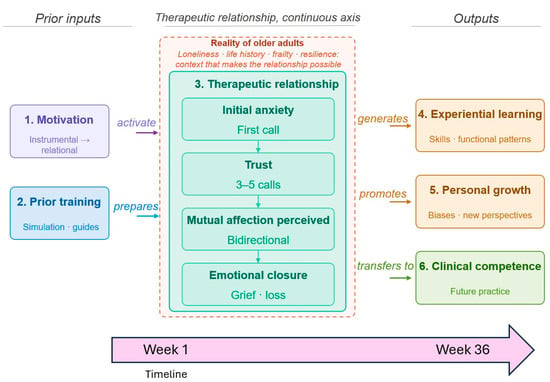
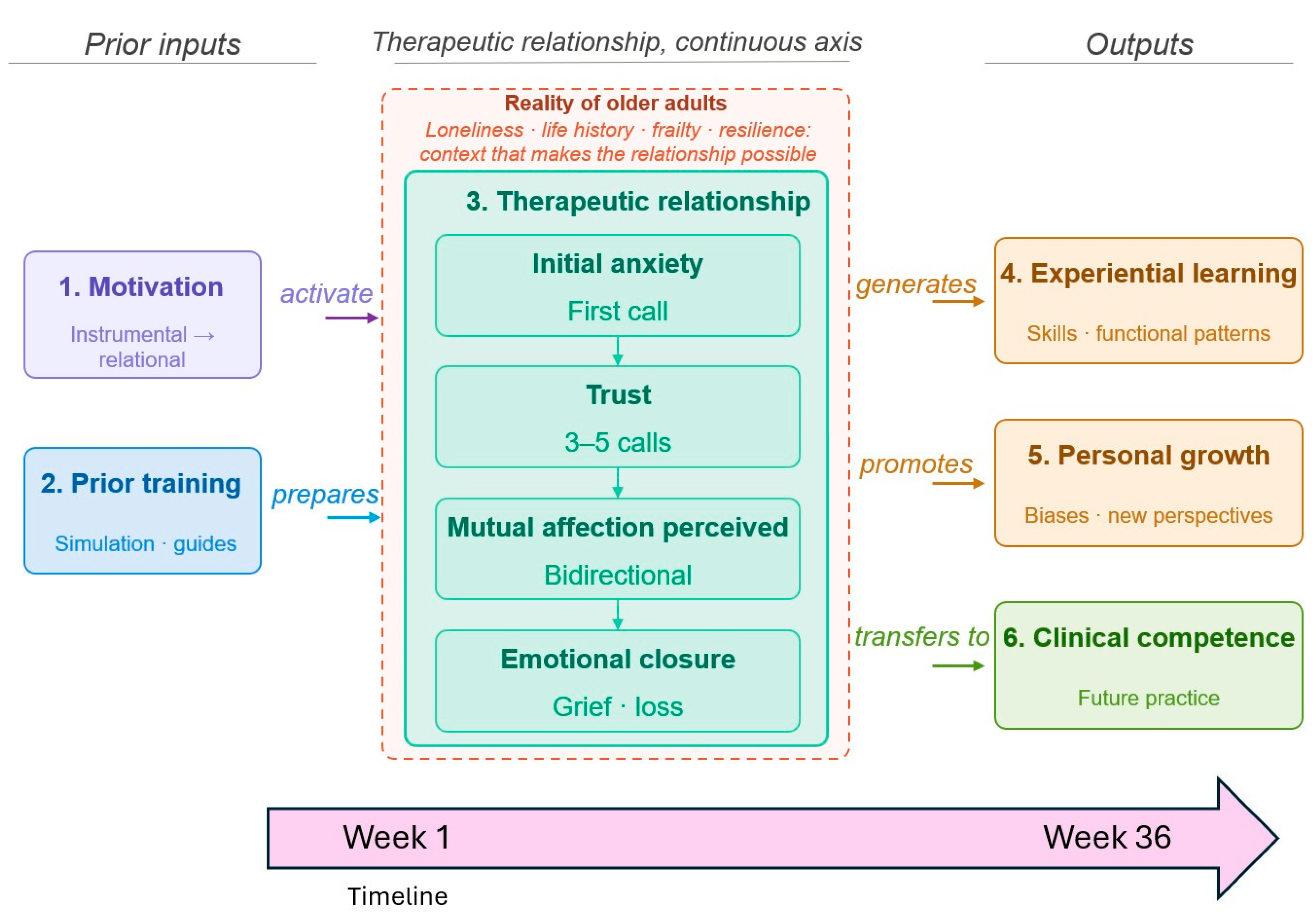
The analysis was led by A.J.R.M., who neither conducted the sessions nor had any contact with the volunteers, and who worked with the anonymised transcripts. Consistent with the reflexive approach, the analysis was not designed to produce independent codings to reconcile, and inter-coder agreement was not calculated, because researcher subjectivity is regarded as a resource for knowledge production rather than a source of bias to be eliminated [31]. Figure 1 represents the final thematic map as an interpretative model, developed in phases 4–5 by ordering the codes that described the bond according to the point of the cycle to which participants referred.
Figure 1.
Interpretative model of volunteers’ experience in the HELPeN programme.
Member checking was carried out in an online meeting with six participants, selected from both the focus groups and the individual interviews (four from the focus groups and two from the interviews). During the meeting, the study findings and preliminary interpretations were presented, and participants were invited to say whether they faithfully reflected their experiences [32]. All six participants confirmed that the findings and interpretations matched their experiences in the most important respects. No disagreements or corrections were expressed. Only minor suggestions were made (for example, one participant mentioned that she once had to refresh the application page because it had frozen, a technical issue unrelated to the thematic findings), which did not require any modification of the themes or interpretations. Consequently, no changes were made to the themes or interpretations following member checking.
Quotations were selected for their capacity to illustrate each theme [33]. Individual interviews often provided more elaborated and uninterrupted accounts than the focus groups, where contributions were shorter and overlapped; therefore, some themes are illustrated mainly with interview quotations, although similar views were expressed in the focus groups. Each quotation is identified by data collection method and participant code, and the number of participants contributing to each subcategory, by data collection method, is reported in Appendix A (Table A1, Table A2, Table A3 and Table A4).
2.6. Reflexivity
Reflexivity is integral to reflexive thematic analysis, where the researcher’s subjectivity is treated as a resource to be examined rather than a bias to be eliminated [21,31]. The research team comprised seven nursing lecturers with expertise in community health and loneliness in older adults, which may have favoured positive readings of the programme. The focus groups were conducted by M.R.M. and M.J.H.L., and the individual interviews by M.J.H.L., both female lecturers at the participants’ university, based on two different campuses. Both also took part in the volunteers’ online training, and they may have taught some participants in previous years; participants therefore knew them through the programme and, in some cases, through their studies. All other team members except the analyst also took part in the training, but not in data collection. Because HELPeN is a university-based programme in which students could obtain academic credits, participants may have tended to give socially desirable accounts. Credits were awarded in three independent stages (an initial training course and volunteering for 25 or 50 h), and completing the training did not oblige students to continue. Each stage was graded only as pass or fail by M.R.M., based solely on completion, so neither taking part in the study nor its content could affect the credits. To explore less favourable experiences, every section of the focus group and interview guides included specific questions on difficulties and negative aspects. Less favourable experiences were reported (Section 3.2 and Section 3.4), although they may still be under-represented. The analysis was led by A.J.R.M., the only team member with no contact with the volunteers, who worked exclusively with the anonymised transcripts.
2.7. Ethical Considerations
The study was conducted in accordance with the ethical principles of the Declaration of Helsinki and with European data protection regulations (EU Regulation 2016/679). Participants received information about the study aims, the voluntary nature of participation, and data confidentiality. Informed consent was obtained for participation and for the recording of the interviews. Data were anonymised using alphanumeric codes and stored on secure servers with restricted access. The study was approved by the Ethics Committee of the University of Murcia (protocol code 3267/2021; approval date: 28 April 2021).
3. Results
Thirty-one volunteers participated in the study, 27 in six focus groups and 4 in individual interviews. Participant characteristics are presented in Table 1. The thematic analysis identified four main categories: (1) motivation to start the programme; (2) the therapeutic bond as a dynamic and relational structuring process; (3) the meaning of volunteering as a space for experiential learning; and (4) programme evaluation. These categories were organised into subcategories, which are described below and presented in full, together with illustrative verbatim quotations, in Appendix A (Table A1, Table A2, Table A3 and Table A4). Quotations are identified by participant code: FG1–FG27 for focus group participants and I1–I4 for interview participants.
3.1. Motivation to Start the Programme
Participants described two initial motivations: one centred on learning and on contact with older adults, and another more instrumental, linked to earning academic credits. Both trajectories evolved over time towards a deeper relational commitment.
Students interested in therapeutic relationships and in supporting older adults described a personal connection with ageing: “During my hospital internship, I enjoyed talking to the elderly about everything.” And I wanted to learn more about the therapeutic relationship. I also find reminiscence therapy very interesting.” (I2)
Others acknowledged that their initial decision was principally motivated by academic credits: “I signed up just for the credits towards my fourth year, because I saw it was online and the schedule was convenient… But the truth is that now my view of everything has changed a bit and I really like the programme.” (I3)
Regardless of their initial motivation, over time participants who referred to this aspect described strong commitment, respect, and responsibility towards the programme and the older adults, and leaving the programme was not mentioned in their accounts: “What I initially saw simply as credit, now, obviously after so many weeks, I’m starting to grow fond of older women.” (I2)
3.2. The Therapeutic Bond as a Dynamic and Relational Structuring Process
The therapeutic bond emerged as the core axis of the volunteering experience, progressing from initial anxiety to a relationship of trust and affection that volunteers perceived as bidirectional.
The first call was described as a moment of uncertainty and anticipatory anxiety: “At first I was super nervous about calling an older person. I had never spoken to anyone outside the home, I had never spoken to an older person other than my grandfather. I was very nervous.” (FG25). Many volunteers reported that the actual experience exceeded their expectations.
Volunteers perceived that the older adults’ initial caution, sometimes attributed by participants to fear of fraud, gradually diminished across subsequent contacts. Volunteers commonly reported that the bond began to consolidate after three to five calls, and the older adult remembering the volunteer’s name was described as a key indicator: “Well, I think the fourth or fifth. Yes, more or less. We’ve gotten to know each other better by now.” (I1). This reflects a pattern reported by participants rather than a generalisable time threshold.
A defining feature of the bond, as perceived and described by the volunteers, was its bidirectionality. Volunteers reported that older adults spontaneously expressed interest in the volunteers’ academic lives and showed explicit affection: “They try to encourage me. Well, little by little you’ll have your job… they also support you in what you do. And they ask you: when do the internships start, how are you doing with the exams?” (I2). Desires to meet in person were not uncommon. Because the older adults were not interviewed, this reciprocity reflects the volunteers’ perception rather than a relational experience established from both perspectives.
In some cases, the bond did not develop adequately owing to misunderstanding of the programme’s purpose, cognitive impairment, or persistent mistrust: “The older adult I had, well, we didn’t connect. I think the lady also had a bit of dementia; she never remembered who I was.” (FG4)
Programme closure was anticipated with a negative emotional tone. Volunteers expressed concern about the impact on older adults, as well as personal feelings of loss: “If you’re interested in someone every week and then suddenly you’re not, well, maybe there’s a bit of a void… more so for him, I think he’s going to notice it a lot.” (I4). Some of these accounts came from interview participants, whose cycle was still ongoing, and therefore refer to an anticipated rather than an experienced closure.
3.3. Meaning of Volunteering: A Space for Experiential Learning
Participants described volunteering as a meaningful learning experience at both academic and personal levels.
Volunteers described the programme as a space in which theoretical content taught in nursing methodology and communication, Gordon’s functional health patterns, therapeutic listening, empathy, and active listening, became meaningful: “This is a different kind of training because when you go to a hospital… they ask four questions and that’s it. So this is a very different way of establishing that connection, of getting to know someone and really putting everything we’ve studied to use.” (FG6)
Although the exclusively telephone format was initially perceived with unease, it was subsequently valued as a demanding communication context requiring effective use of voice, tone, silences, and active listening in the absence of non-verbal cues: “Knowing if he doesn’t want to talk about something, bringing up another topic, seeing just by phone if he was more or less willing to talk, feeling, without being physically present, without any non-verbal language… just with that I should already understand his situation.” (I1)
Volunteers identified a contrast between task-centred hospital nursing and the person-centred relational care experienced in the programme: “During my internships, I see that the focus is more on treatment and not on spending a little time with them and talking.” (I2). For most participants, this was expressed as a discovery; for some, it led to questioning practices they had observed and previously taken for granted, such as the reduction of patients to their diagnosis: “When they go into a room, they don’t say, ‘His name is Pepe,’ no, ‘He’s the one with the appendix,’ but that person with the appendix… he has a story behind it.” (FG9).
The programme enabled a deep, panoramic understanding of older adults’ identities, histories, losses, and resilience, contrasting with the compressed assessment typical of clinical settings: “It’s giving me a lot of insight because having the perspective of someone who is 80 years old really enriches you and teaches you how to see what’s important and what isn’t.” (FG4)
Contact with older adults’ experiences led volunteers to deconstruct prejudices and to restructure their understanding of ageing: “In the end, they are just like us, who, because of their age, tend to be more fragile and need extra care. And they can teach you a lot.” (I2). Participants also reported greater confidence in clinical practice settings: “It helps me a lot because now I have the practical training right away, and I feel more confident in myself to do the practical training to treat a patient.” (I4)
3.4. Programme Evaluation
Prior training was highly valued. The call simulation was frequently highlighted by those who discussed the training as the most important component, and participants related it directly to a reduction in anticipatory anxiety: “One of the things I liked most was the phone call we made because we made it feel very real, so in the end it helps a little.” (FG5)
The REDHI® digital platform was described as clear, well structured, and easy to use. The permanent tutoring provided via WhatsApp was valued for providing psychological safety. Regarding reminiscence therapy, participants identified a gap between the structured written tasks included in the protocol and their practical feasibility for older adults with visual, literacy, cognitive, or emotional barriers; oral conversational reminiscence within the call was described as an effective substitute.
Scheduling flexibility was identified as a key facilitator, enabling volunteers to combine the calls with their academic commitments. Volunteers underlined that a specific volunteer profile was required: empathetic, actively listening, and genuinely motivated, and expressed ethical concerns about potential mandatory participation. Volunteers also described negative situations, including older adults’ explicit or implicit refusal to continue and emotionally complex calls, such as an older adult in crisis (Table A4, subcategory 4.7).
Proposals for improvement included a greater variety of reminiscence topics, better timing (avoiding summer breaks and examination periods), the incorporation of video calls, and the provision of practical guidance for managing monosyllabic responses.
Figure 1 presents the interpretative synthesis integrating the study findings, illustrating the dynamic, relational, and longitudinal process articulated around the therapeutic bond, from initial motivation and training through to the outcomes generated. The researcher constructed the sequence from the accounts of different participants, rather than having the participants describe it themselves, and it is not an empirically validated explanatory model. Apart from the bonds that did not develop adequately (Section 3.2; Table A2, subcategory 2.5), the accounts of volunteers who completed the cycle were consistent with this sequence. In two cases, the relationship ended during the trust-building phase for reasons outside the volunteer–older adult relationship: a serious health problem for the older adult and pressure from a family member not to continue. Both volunteers were reassigned to another older adult and completed the cycle.
4. Discussion
The present study explored the experiences of nursing students who participated as volunteers in the HELPeN programme, a telephone-based intervention for community-dwelling older adults in situations of loneliness and social isolation. The results indicate that, from the participants’ perspective, involvement transcended conventional volunteering and was experienced both as relational support for older adults and as a meaningful learning experience, reinforcing the potential usefulness of community-based models that combine volunteering with professional training.
Integrated into the interpretative model developed (Figure 1), the findings suggest that the therapeutic bond functions as the axis around which the entire experiential process revolves, not merely as an outcome of the intervention, but as the element that, as described by volunteers, organised their experience of the nature of the training and the personal benefits. This constitutes a relevant contribution to the literature, in that it conceptualises telephone-based support interventions not only as social support strategies, but also as learning and relational processes mediated by the quality of the bond established. Initial motivations were both altruistic and instrumental, which is consistent with the broader volunteering literature [9,15,34,35]. Students with primarily instrumental motivations developed genuine relational commitment over time as interpersonal bonds strengthened, a trajectory previously described in health-related volunteering [34]. Prior training through simulation appeared to function as a preparation device that reduced initial uncertainty and facilitated entry into the relationship, although it did not substitute structured support during the intervention [10,15]. Volunteers’ ethical reservations about making this type of participation compulsory contrast with evidence from mandatory academic service-learning, which has reported effects on graduates’ subsequent civic engagement [36].
The evolution of the therapeutic bond, from initial anxiety to affection perceived as mutual across 36 weeks, is consistent with Peplau’s Theory of Interpersonal Relationships [16], in which trust and collaboration are constructed through sustained contact with the singularity of the other, their personal history, fragility, and resilience. This framework has been updated within the specific context of older adult care, underlining that a continued relationship and empathetic communication are key elements for consolidating trust [16]. In the present study, the bond also acted as a mechanism providing meaning and continuity to the programme, in line with previous studies on telephone-based and intergenerational programmes [10,11,13].
The bidirectionality of the bond, as perceived by the volunteers, is a particularly relevant finding. Volunteers reported not only offering listening, support, and follow-up, but also receiving interest, recognition, and affection from the older adults. From the volunteers’ perspective, this reciprocity challenged the image of older adults as passive care recipients and positioned them as agents able to provide emotional support to younger generations, in line with approaches based on reciprocity and mutuality in active ageing and intergenerational interventions [11]. However, because the older adults’ perspectives were not examined, whether they experienced the relationship as reciprocal remains unknown, and the volunteers’ accounts may partly reflect their own wish for the relationship to be meaningful.
Transformative Learning Theory [18] requires distinguishing between experiential learning and transformation, understood as the critical reassessment of previously taken-for-granted assumptions. Most of what participants described (greater confidence, communication skills, gratitude and emotional maturity) is better characterised as experiential learning and personal development. However, some accounts suggested a reconsideration of prior assumptions consistent with transformative processes: volunteers questioned stereotypes about ageing, criticised the reduction of patients to their diagnosis (“the one with the appendix”) and reconsidered how they related to older people in their own families, in line with patterns documented in similar programmes [37]. Because these accounts were retrospective and self-reported, they indicate processes compatible with transformative learning rather than demonstrating it. The personal benefits described (greater gratitude, new life perspectives, emotional maturity) are well documented in the volunteering literature [38]. The contrast participants identified between task-centred hospital nursing and person-centred relational care is consistent with service-learning frameworks [39], through which community experience generates learning that transcends procedural competencies.
Telephone-based communication required additional intentional effort to compensate for reduced non-verbal channels [17]. The absence of non-verbal cues was described by students as requiring them to develop advanced communication skills, transforming initial insecurity into a demanding context that, according to participants, strengthened their clinical listening skills, consistent with previous research on remote care and service learning [11,40]. Similar demands on communicative intentionality have been described in nurse-delivered telephone support with informal caregivers of older adults [41]. Students subsequently reported greater confidence in face-to-face clinical contexts; from their perspective, the telephone setting may have prepared them for clinical encounters, although competence was not assessed and would require objective evaluation.
A gap was identified between the structured written reminiscence tasks and their practical feasibility for older adults with visual, literacy, cognitive, or emotional barriers. This suggests the need for flexible interventions that prioritise natural conversational formats over rigid protocols [42]. Scheduling flexibility was identified as a determinant facilitator of continuity, which is consistent with evidence on the organisational conditions that support community volunteering [12,15].
The end of the bond emerged as the most emotionally complex experience in the process, consistent with evidence on the closure of long-term therapeutic relationships [43]. Volunteers anticipated or recalled feelings of loss and expressed concern about the effect of ending the calls on the older adults, and some wished to maintain contact after the programme. These findings have implications for volunteer preparation, supervision, and ethical practice. Closure should be addressed in some depth in training, including how to prepare the older adult for the end of the relationship from the first calls; it should also be discussed in supervision, so that volunteers can process their own emotions; and it requires clear guidelines on post-programme contact and on referring older adults who remain isolated to community resources, so that the end of the programme does not leave them without support.
The cases in which bonds were not consolidated suggest the need for adequate participant selection and for differential strategies according to functional profile and individual expectations, an aspect that has been little explored in the literature on long-term telephone-based support programmes.
4.1. Implications for Practice
These findings suggest that programmes such as HELPeN could be integrated as optional structured experiences within health sciences degrees, offering what volunteers perceived as opportunities for the development of communication skills, increased awareness of loneliness, improved attitudes towards ageing, and the promotion of person-centred care. Implementation should incorporate adequate volunteer selection, experiential training, ongoing supervision, flexible scheduling, protocol adaptation, and planned relationship closures.
4.2. Limitations
This study has several limitations. Participants were self-selected volunteers with high intrinsic motivation, which limits the transferability of the findings. The perspective of the participating older adults was not explored. The discourse was predominantly female, reflecting both the feminisation of nursing and the scarce male participation in volunteering, which limits the analysis of potential gender differences. As the study was conducted within a single university programme, transferability requires assessment in similar contexts. Future research should include the voices of the participating older adults, explore possible differences by gender and academic discipline, and comparatively evaluate telephone-based, video call, and hybrid formats. Similarly, the learning outcomes and the gains in confidence and communication skills reflect the volunteers’ accounts, as competence was not objectively assessed. Member checking involved six of the 31 participants and did not lead to modifications of the themes or interpretations; it should be understood as a dialogic credibility check rather than as validation of the findings [32].
5. Conclusions
This study provides qualitative evidence on the subjective experiences of nursing students who acted as volunteers in a long-term, telephone-based support programme for older adults experiencing loneliness. Its main contribution lies in the conceptualisation of the therapeutic bond not as an outcome of the intervention, but as the element that, as described by volunteers, organised their experience and shaped the nature of the educational, personal, and relational benefits they perceived. Reciprocity and learning outcomes reflect the volunteers’ perceptions; the older adults’ views were not examined. As a qualitative study, these findings describe experiences and attributed meanings and do not constitute evidence of the effectiveness of the intervention.
From an educational standpoint, the results support the inclusion of longitudinal community support programmes in nursing training as learning spaces complementary to hospital clinical practice, which volunteers perceived as fostering relational and communication skills that are difficult to develop in acute care settings. To realise this potential, institutional support should include prior training, accessible supervision, and structured spaces for reflection.
From a programme design perspective, the sustainability of long-term telephone-based interventions appears to depend on organisational flexibility and on protocols adapted to the functional, cognitive, and narrative diversity of older adults, with particular attention to the planned closure of the bond in order to protect all parties involved.
Author Contributions
Conceptualization, M.J.H.-L., J.G.-G. and A.S.-C.; methodology, M.R.-M. and A.J.R.-M.; data collection, M.J.H.-L. and M.R.-M.; formal analysis, A.J.R.-M.; resources, M.J.H.-L., J.G.-G. and A.S.-C.; data curation, M.J.H.-L., J.G.-G. and A.S.-C.; writing—original draft preparation, M.R.-M., M.J.H.-L. and A.J.R.-M.; writing—review and editing, J.G.-G. and A.S.-C.; supervision, M.R.-M. and A.J.R.-M.; project administration, M.R.-M. All authors have read and agreed to the published version of the manuscript.
Funding
This research was funded by the Instituto de Salud Carlos III (ISCIII) and co-funded by the European Union, grant number PI21/00984.
Institutional Review Board Statement
The study was conducted in accordance with the Declaration of Helsinki and approved by the Ethics Committee of the University of Murcia (protocol code 3267/2021, approval date 28 April 2021).
Informed Consent Statement
Informed consent was obtained from all subjects involved in the study.
Data Availability Statement
The data presented in this study are available on request from the corresponding author due to ethical reasons.
Public Involvement Statement
No public involvement in any aspect of this research.
Guidelines and Standards Statement
This manuscript was drafted against the Consolidated Criteria for Reporting Qualitative Research (COREQ) for qualitative research and the Standards for Reporting Qualitative Research (SRQR).
Use of Artificial Intelligence
During the preparation of the revised manuscript and the response to reviewers, the authors used Claude Sonnet 5.5 (Anthropic; accessed through claude.ai, november 2026)large language model (LLM)o assist with drafting and language editing.
Acknowledgments
We are grateful for the generosity and time of all the students who participated in this study as volunteers.
Conflicts of Interest
The authors declare no conflicts of interest. The funders had no role in the design of the study; in the collection, analyses, or interpretation of data; in the writing of the manuscript; or in the decision to publish the results.
Abbreviations
The following abbreviations are used in this manuscript:
| COREQ | Consolidated Criteria for Reporting Qualitative Research |
| SRQR | Standards for Reporting Qualitative Research |
| SD | Standard deviation |
| FG | Quotation from a focus group participant |
| I | Quotation from an individual interview |
Appendix A
Table A1, Table A2, Table A3 and Table A4 present all categories and subcategories identified in the analysis, with a description of their content, the number of contributing participants and illustrative verbatim quotations. Quotations were translated from Spanish by the authors.
Table A1.
Category 1. Motivation to start the programme: subcategories, content, number of contributing participants and verbatim quotations.
Table A2.
Category 2. The therapeutic bond as a dynamic and relational structuring process in the intervention: subcategories, content, number of contributing participants and verbatim quotations.
Table A3.
Category 3. Meaning of volunteering as a space for experiential learning: subcategories, content, number of contributing participants and verbatim quotations.
Table A4.
Category 4. Programme evaluation: subcategories, content, number of contributing participants and verbatim quotations.
References
- Holt-Lunstad, J.; Smith, T.; Baker, M.; Harris, T.; Stephenson, D. Loneliness and Social Isolation as Risk Factors for Mortality: A Meta-Analytic Review. Perspect. Psychol. Sci. 2015, 10, 227–237. [Google Scholar] [CrossRef] [Scilit] [PubMed]
- Santini, Z.I.; Jose, P.E.; Cornwell, E.Y.; Koyanagi, A.; Nielsen, L.; Hinrichsen, C.; Meilstrup , C.; Madsen , K.R.; Koushede , V. Social disconnectedness, perceived isolation, and symptoms of depression and anxiety among older Americans (NSHAP): A longitudinal mediation analysis. Lancet Public Health 2020, 5, e62–e70. [Google Scholar] [CrossRef] [Scilit] [PubMed]
- Gardiner, C.; Geldenhuys, G.; Gott, M. Interventions to Reduce Social Isolation and Loneliness among Older People: An Integrative Review. Health Soc. Care Community 2018, 26, 147–157. [Google Scholar] [CrossRef] [Scilit] [PubMed]
- Hernández-López, M.; García-González, J.; Leal-Costa, C.; Ramos-Morcillo, A.; Díaz-García, I.; López-Pérez, M.; Hernández-Méndez, S.; Ruzafa-Martínez, M. Reducing Loneliness and Social Isolation Through the HELPeN Telephone-Call Program: Results from a Randomized Controlled Trial. J. Clin. Med. 2026, 15, 93. [Google Scholar] [CrossRef] [Scilit] [PubMed]
- Mierzwicki, J.T.; Kline, J.; Schach, B.; Vandenberg, L. Loneliness Improved by Either Telephone or Video Communications in Community-Dwelling Older Adults. Arch. Gerontol. Geriatr. Plus 2024, 1, 100011. [Google Scholar] [CrossRef] [Scilit]
- Fu, Z.; Yan, M.; Meng, C. The Effectiveness of Remote Delivered Intervention for Loneliness Reduction in Older Adults: A Systematic Review and Meta-Analysis. Front. Psychol. 2022, 13, 935544. [Google Scholar] [CrossRef] [Scilit] [PubMed]
- Hough, K.A.; Tha, S.H.; Perissinotto, C.M.; Burnes, P.; Kotwal, A.A. A Proactive Phone Intervention for Older Adults to Address Loneliness Identified by a Health Plan. Ann. N. Y. Acad. Sci. 2024, 1540, 191–199. [Google Scholar] [CrossRef] [Scilit] [PubMed]
- Landwehr, A.; Pollack, L.; Schütt, S.; Kals, E. “Telephone Angels” against Loneliness: Evaluation of Telephone Partnerships with Older Adults. J. Gerontol. Soc. Work 2025, 68, 145–160. [Google Scholar] [CrossRef] [Scilit] [PubMed]
- Shorey, S.; Seow, J.S.L.; Mahendran, R.; Wee, G.H.; Goh, L.G.; Kua, E.H. Peer Volunteers’ Journeys through Training and Engagement in Older Adult Communities: A Qualitative Study. JMIR Aging 2025, 8, e71810. [Google Scholar] [CrossRef] [Scilit] [PubMed]
- Joosten-Hagye, D.; Katz, A.; Sivers-Teixeira, T.; Yonshiro-Cho, J. Age-Friendly Student Senior Connection: Students’ Experience in an Interprofessional Pilot Program to Combat Loneliness and Isolation among Older Adults during the COVID-19 Pandemic. J. Interprofessional Care 2020, 34, 668–671. [Google Scholar] [CrossRef] [Scilit] [PubMed]
- Sundström, M.; Blomqvist, K.; Edberg, A. Being a Volunteer Encountering Older People’s Loneliness and Existential Loneliness: Alleviating Loneliness for Others and Oneself. Scand. Caring Sci. 2021, 35, 538–547. [Google Scholar] [CrossRef] [Scilit] [PubMed]
- Gaber, J.; Oliver, D.; Valaitis, R.; Cleghorn, L.; Lamarche, L.; Avilla, E.; Parascandalo, F.; Price, D.; Dolovich, L. Experiences of Integrating Community Volunteers as Extensions of the Primary Care Team to Help Support Older Adults at Home: A Qualitative Study. BMC Fam. Pract. 2020, 21, 92. [Google Scholar] [CrossRef] [Scilit] [PubMed]
- Kumar, A.B.; Zide, B.S.; Bhardwaj, T.; Lipschitz, J.M.; Altman, A.N.; Donovan, N.J. Evaluating Feasibility, Value and Characteristics of an Intergenerational Friendly Telephone Visit Program During the Covid-19 Pandemic. Am. J. Geriatr. Psychiatry 2023, 31, 341–352. [Google Scholar] [CrossRef] [Scilit] [PubMed]
- Sen, K.; Laheji, N.; Ramamonjiarivelo, Z.; Renick, C.; Osborne, R.; Beauvais, B. Examining the Effect of Contactless Intergenerational Befriending Intervention on Social Isolation Among Older Adults and Students’ Attitude Toward Companionship: Content Analysis. JMIR Aging 2024, 7, e47908. [Google Scholar] [CrossRef] [Scilit] [PubMed]
- Huang, L.; Wu, H.; Zhang, Y.; Zhang, F.; Liao, L.; Wu, X.; Xu, J.; Yao, Y.; Wang, S.; Liu, Y. Motivations and Strategies of Voluntary Service for Urban Home-Based Older Adults Provided by Volunteers with Nursing Background: A Qualitative Study. BMC Nurs. 2025, 24, 277. [Google Scholar] [CrossRef] [Scilit] [PubMed]
- Hall, S.; Shearer, K. Applying Peplau’s Interpersonal Relations Theory to Enhance Older Adults’ Health Literacy Through Nursing Care: A Theory Analysis. J. Holist. Nurs. 2025, 44, 402–418. [Google Scholar] [CrossRef] [Scilit] [PubMed]
- Geller, S. Cultivating Online Therapeutic Presence: Strengthening Therapeutic Relationships in Teletherapy Sessions. Couns. Psychol. Q. 2021, 34, 687–703. [Google Scholar] [CrossRef] [Scilit]
- Mezirow, J. Transformative Dimensions of Adult Learning; Jossey-Bass: San Francisco, CA, USA, 1991. [Google Scholar]
- Hernández-López, M.J.; Ruzafa-Martínez, M.; Leal-Costa, C.; Ramos-Morcillo, A.J.; Díaz-García, I.; López-Pérez, M.V.; Hernández-Méndez, S.; García-González, J. Effects of a Clinical Simulation-Based Training Program for Nursing Students to Address Social Isolation and Loneliness in the Elderly: A Quasi-Experimental Study. Healthcare 2023, 11, 2587. [Google Scholar] [CrossRef] [Scilit] [PubMed]
- Braun, V.; Clarke, V. Using Thematic Analysis in Psychology. Qual. Res. Psychol. 2006, 3, 77–101. [Google Scholar] [CrossRef] [Scilit]
- Braun, V.; Clarke, V. Reflecting on Reflexive Thematic Analysis. Qual. Res. Sport Exerc. Health 2019, 11, 589–597. [Google Scholar] [CrossRef] [Scilit]
- Tong, A.; Sainsbury, P.; Craig, J. Consolidated Criteria for Reporting Qualitative Research (COREQ): A 32-Item Checklist for Interviews and Focus Groups. Int. J. Qual. Health Care 2007, 19, 349–357. [Google Scholar] [CrossRef] [Scilit] [PubMed]
- O’Brien, B.C.; Harris, I.B.; Beckman, T.J.; Reed, D.A.; Cook, D.A. Standards for Reporting Qualitative Research: A Synthesis of Recommendations. Acad. Med. 2014, 89, 1245–1251. [Google Scholar] [CrossRef] [Scilit] [PubMed]
- Lincoln, Y.S.; Guba, E.G. Naturalistic Inquiry; Sage: Newbury Park, CA, USA, 1985; ISBN 978-0-8039-2431-4. [Google Scholar]
- Boström, E.; Ali, L.; Fors, A.; Ekman, I.; Andersson, A.E. Registered Nurses’ Experiences of Communication with Patients When Practising Person–Centred Care over the Phone: A Qualitative Interview Study. BMC Nurs. 2020, 19, 54. [Google Scholar] [CrossRef] [Scilit] [PubMed]
- Perissinotto, C.M.; Hough, K.; Tha, S.H.; Matusovsky, B.; Escueta, D.; Burnes, P.; Kotwal, A.A. Implementing a Telephone-based Support Program to Address Loneliness in Older Adults. Ann. N. Y. Acad. Sci. 2025, 1552, 174–185. [Google Scholar] [CrossRef] [Scilit] [PubMed]
- Malterud, K.; Siersma, V.D.; Guassora, A.D. Sample Size in Qualitative Interview Studies: Guided by Information Power. Qual. Health Res. 2016, 26, 1753–1760. [Google Scholar] [CrossRef] [Scilit] [PubMed]
- Hennink, M.; Kaiser, B.N. Sample Sizes for Saturation in Qualitative Research: A Systematic Review of Empirical Tests. Soc. Sci. Med. 2022, 292, 114523. [Google Scholar] [CrossRef] [Scilit] [PubMed]
- Kiger, M.E.; Varpio, L. Thematic Analysis of Qualitative Data: AMEE Guide No. 131. Med. Teach. 2020, 42, 846–854. [Google Scholar] [CrossRef] [Scilit] [PubMed]
- Braun, V.; Clarke, V. To Saturate or Not to Saturate? Questioning Data Saturation as a Useful Concept for Thematic Analysis and Sample-Size Rationales. Qual. Res. Sport Exerc. Health 2021, 13, 201–216. [Google Scholar] [CrossRef] [Scilit]
- Braun, V.; Clarke, V. One Size Fits All? What Counts as Quality Practice in (Reflexive) Thematic Analysis? Qual. Res. Psychol. 2021, 18, 328–352. [Google Scholar] [CrossRef] [Scilit]
- Birt, L.; Scott, S.; Cavers, D.; Campbell, C.; Walter, F. Member Checking: A Tool to Enhance Trustworthiness or Merely a Nod to Validation? Qual. Health Res. 2016, 26, 1802–1811. [Google Scholar] [CrossRef] [Scilit] [PubMed]
- Sandelowski, M. Focus on Qualitative Methods. The Use of Quotes in Qualitative Research. Res. Nurs. Health 1994, 17, 479–482. [Google Scholar] [CrossRef] [Scilit] [PubMed]
- Benevene, P.; Buonomo, I.; West, M. The Relationship Between Leadership Behaviors and Volunteer Commitment: The Role of Volunteer Satisfaction. Front. Psychol. 2020, 11, 602466. [Google Scholar] [CrossRef] [Scilit] [PubMed]
- Same, A.; McBride, H.; Liddelow, C.; Mullan, B.; Harris, C. Motivations for Volunteering Time with Older Adults: A Qualitative Study. PLoS ONE 2020, 15, e0232718. [Google Scholar] [CrossRef] [Scilit] [PubMed]
- Lin, S.; Ngai, G.; Kwan, K.P.; Chan, S.C.F.; Lo, K.W.K. The Impact of Mandatory Academic Service-Learning on University Graduates’ Continual Civic Engagement: Evidence from a Curriculum Reform. High. Educ. Res. Dev. 2025, 44, 1143–1157. [Google Scholar] [CrossRef] [Scilit]
- Rojo, J.; Ramjan, L.; George, A.; Hunt, L.; Heaton, L.; Kaur, A.; Salamonson, Y. Applying Mezirow’s Transformative Learning Theory into Nursing and Health Professional Education Programs: A Scoping Review. Teach. Learn. Nurs. 2023, 18, 63–71. [Google Scholar] [CrossRef] [Scilit]
- Barker, M.-E.; Crowfoot, G.; King, J. Empathy Development and Volunteering for Undergraduate Healthcare Students: A Scoping Review. Nurse Educ. Today 2022, 116, 105441. [Google Scholar] [CrossRef] [Scilit] [PubMed]
- Bringle, R.G.; Hatcher, J.A. A Service-Learning Curriculum for Faculty. Mich. J. Community Serv. Learn. 1995, 2, 112–122. [Google Scholar]
- Zhu, Z.; Xing, W.; Liang, Y.; Hong, L.; Hu, Y. Nursing Students’ Experiences with Service Learning: A Qualitative Systematic Review and Meta-Synthesis. Nurse Educ. Today 2022, 108, 105206. [Google Scholar] [CrossRef] [Scilit] [PubMed]
- Loo, C.Y.; Slatyer, S.; Kamdar, A.; Starling, T.; Hill, K.D.; Grealish, L.; Lance, H.; Hill, A.-M. Nurse Telephone Support for Informal Caregivers of Older Adults: A Qualitative Exploratory Study. J. Adv. Nurs. 2026, 82, 6648–6659. [Google Scholar] [CrossRef] [Scilit] [PubMed]
- Woods, B.; O’Philbin, L.; Farrell, E.M.; Spector, A.E.; Orrell, M. Reminiscence Therapy for Dementia. Cochrane Database Syst. Rev. 2018, 2018, CD001120. [Google Scholar] [CrossRef] [Scilit] [PubMed]
- Rabinowitz, Y.L.; Yim, B.; Muran, J.C. Termination of Psychotherapy: A Systematic Review. Cogent Ment. Health 2025, 4, 2535626. [Google Scholar] [CrossRef] [Scilit] [PubMed]

Disclaimer/Publisher’s Note: The statements, opinions and data contained in all publications are solely those of the individual author(s) and contributor(s) and not of MDPI and/or the editor(s). MDPI and/or the editor(s) disclaim responsibility for any injury to people or property resulting from any ideas, methods, instructions or products referred to in the content. |
© 2026 by the authors. Licensee MDPI, Basel, Switzerland. This article is an open access article distributed under the terms and conditions of the Creative Commons Attribution (CC BY) license.