


Abstract
Background/Objectives: Clinical nutrition education in postgraduate nursing is little studied, despite nurses providing nutrition care. We examined whether more than 10 years of clinical experience was associated with knowledge and self-reported practice (primary) and whether recall and application items differed (secondary). Methods: Students of one Vietnamese Master of Nursing programme completed a cross-sectional survey online (n = 227) or on paper (n = 181). Knowledge was scored against a guideline-based answer key, with items classified as recall or application. Online responses formed the main set because identical answer sets among paper questionnaires remain unexplained; linear regression with robust standard errors was repeated in all records and three subsets excluding identical or invariant answers. Results: Experience was associated with a practice score (range 20 to 100) that was 6.41 points lower (95% CI −11.24 to −1.58), with no detectable difference in knowledge (0.24 points, 95% CI −0.94 to 1.43). In primary-model sensitivity analyses, the practice estimate stayed negative (interval excluded zero in two of four analyses); no knowledge interval excluded zero. Respondents answered 78.9% of recall and 67.7% of application items correctly (difference: 11.2 percentage points, 95% CI 8.8 to 13.5). The gap depended on which items each set contained. In exploratory analyses, role belief was associated with practice before, but not after, correction for multiple comparisons; knowledge was not associated with practice. Conclusions: In this programme, longer experience was associated with less frequent reported nutrition care practice, with no detectable difference in knowledge; bedside decisions scored lowest. Both merit curriculum review.
1. Introduction
Whether a hospital identifies patients with malnutrition depends in part on whether bedside nurses recognise nutritional risk and act on the findings. Although screening tools are available and recommended, reviews of nutrition-care delivery repeatedly identify the knowledge, routines, and systems surrounding their use as important barriers [1,2,3]. A completed screen provides a score and a category; subsequent care requires a series of decisions, including whether a patient who screens positive can swallow safely enough to receive oral feeding, how much energy to provide during the first days of critical illness, and which formula to initiate through a jejunostomy. Knowing the content of a screening tool and knowing how to act on its findings are different forms of knowledge, and a curriculum may provide the former without the latter. A programme that expects graduates to act on nutrition problems therefore needs to establish what its students already know at each level. This has not been described among nurses in Vietnam.
Bedside nutrition care is largely delivered by nurses, yet analyses of health-professions curricula, mostly outside nursing, describe nutrition teaching as weighted towards knowledge rather than skills. A mapping of twenty medical curricula in Australia and New Zealand found that nutrition learning outcomes were predominantly cognitive [4]. An analysis of learning objectives across tertiary health degree programmes at an Australian university similarly identified an emphasis on basic knowledge rather than practical application and recommended skills-based teaching [5]. In nursing, an analysis of Polish educational standards identified four nutrition-related learning outcomes at the master’s level: one concerned knowledge, three concerned skills, and none concerned attitudes [6].
A needs assessment cannot rely solely on learners’ self-perceptions. Among 325 nurses assessed on diabetes care, measured knowledge was substantially lower than the knowledge those nurses attributed to themselves, and the two were essentially unrelated [7]. Clinical vignettes offer one way to assess applied knowledge when direct observation is impractical; among community health workers, correct management was more common for straightforward cases than for severe cases [8]. To describe what was missing, rather than only how much, we classified items by the level they reached in Miller’s framework. This framework distinguishes what learners know, how they apply that knowledge, what they can demonstrate under observation, and what they do in practice [9]. A competency framework proposed for nutrition education in medicine has drawn on Miller’s framework, among others [10], and assessment methods in dietetics are now being classified by the Miller level they reach [11].
Surveys of nurses’ clinical nutrition knowledge, attitudes and practices have been reported from several regions. Intensive care nurses in China had insufficient knowledge of enteral nutrition [12] and moderate knowledge of the management of diarrhoea related to enteral nutrition [13], and a systematic review described intensive care nurses’ knowledge of nutritional assessment as low or inadequate [14]. Hospital nurses in Iran showed moderate knowledge of the nutritional management of diabetes [15], and nursing-home staff in Austria answered 60.6% of malnutrition knowledge questions correctly on average [16]. Some of these surveys used instruments with documented content validity, such as a malnutrition knowledge test developed through an expert Delphi panel [16] and later adapted into German, Czech, Dutch and Turkish [17]. Another questionnaire was derived from enteral nutrition guidelines and content-validated by an expert panel [13]. A nutrition-care questionnaire for hospital staff was tested for reliability in Canada [18] and translated into Arabic and validated for use in Palestine [19]. Whether longer clinical experience correlates with more knowledge has been examined in several of these surveys, with inconsistent results [13,15,16,19,20].
None of these surveys concerned nurses in postgraduate study, and curriculum studies have mostly described programmes rather than learners. What remains unclear is the learner perspective at a level of detail that can inform curriculum content: which capabilities nurses already hold, where performance is weaker, and what factors influence their practice. No such description is available for nurses in postgraduate study in Vietnam, although a Ministry of Health circular assigns nutritional risk screening and support, monitoring, counselling and documentation of patients’ nutrition care to hospital nurses [21]. A published comparison based on one university’s programmes counted six credits of nutrition coursework for nursing (6% of the programme) and 58 credits (40%) for dietetics [22].
This study surveyed clinical nutrition knowledge, role beliefs, and self-reported practice among nurses enrolled in a master’s programme and interpreted the findings as a curriculum needs assessment. The primary question, specified before the first regression was run, was whether more than 10 years of clinical experience was associated with knowledge and with self-reported practice. The secondary question was whether performance differed between recall and application items for the same respondent. Item-level performance, role beliefs and the other workforce characteristics were examined in exploratory analyses, and the findings were used to identify candidate priorities for curriculum review.
2. Materials and Methods
2.1. Design and Setting
A cross-sectional survey was conducted among nurses enrolled at one of Vietnam’s largest providers of Master of Nursing education. All students enrolled in the programme during the survey period were invited, regardless of their intake and whether or not they were working clinically, and there were no exclusion criteria. The sample therefore consisted of the students who agreed to take part (census approach): 408 of the 630 students enrolled during the survey period (64.8%). Data collection began after ethical approval was granted in November 2025. Responses were collected in two ways: 227 through an online form, submitted between 11 March and 5 May 2026, and 181 through paper questionnaires, whose answers were later typed into the same response sheet. Students were invited through the platform used for contact between the school and its students and were reminded once, and those who had missed the online form deadline were then asked to complete a paper questionnaire. The paper questionnaires were handed out at the end of a workshop held by the school; it was completed there and collected in the same session. A research assistant typed the paper questionnaires into the sheet in September 2026 and a second research assistant checked the entries. Respondents came mainly from the 2024 and 2025 intakes. The 227 online responses formed the main analysis set, and all 408 records were analysed as a sensitivity analysis; the characteristics of the data file are described in Section 2.5. Most participants worked in hospitals, mainly in southern Vietnam (Table 1); the sample therefore comprised both students and those in the clinical workforce.
Table 1.
Participant characteristics, n (%).
Because respondents were students in the programme and the questionnaire recorded a student identifier, participation was kept separate from academic assessment. Participation was voluntary and had no bearing on grading or progression; respondents were informed of this before starting, and identifiers were not accessible to staff involved in those decisions. Ethical approval and consent procedures are reported in the Declarations. The first author invited the students and research staff obtained consent. Participants read the study information on the first page of the online form or paper questionnaire, and completing it was taken as consent. Student identifiers were hidden, kept confidential and played no part in grading or progression decisions.
2.2. Instrument
The questionnaire was adapted and extended from the questionnaire published by Ma et al. for Vietnam’s hospital nutrition workforce [22]. Knowledge items B1 to B10 correspond to its ten items in content, order and response options, with the wording changed for nurses; the demographic section and some role-belief and practice items draw on it, with changes in wording and response format. Items B11 to B20, the other role-belief and practice items and the 25 barrier items have no counterpart in it. Experts and teaching staff adjusted the questionnaire and wrote these items based on clinical practice and teaching in Vietnam, and two experts reviewed it before use. The authors of the source questionnaire translated and pilot tested it; these steps were not performed for the version used here (Section 5).
The questionnaire comprised five sections: demographic and professional characteristics (15 items), clinical nutrition knowledge (20 multiple-choice items), beliefs about the nursing role in nutrition care (15 items rated on a five-point agreement scale), self-reported practice frequency (20 items rated on a five-point frequency scale), and perceived barriers (25 items rated on a five-point agreement scale and grouped into five domains of five items each). Every knowledge item included an explicit “do not know/not sure” option. The questionnaire closed with one open question on how to improve training and practice (File S6), which was not analysed.
Of the 15 items concerning the nursing role in nutrition care, the scores for 13 were summed to form a nutrition-care role-belief agreement score. Two items were excluded: C12 (“because of limits on time and staffing I am often unable to carry out screening”) describes a workload constraint and addresses the same construct as two barrier items; C13 (“parenteral nutrition (TPN) needs should be the physician’s responsibility”) combines prescribing authority, which rests with physicians in Vietnam, and therefore has no defensible scoring direction: agreement may reflect either a narrow view of nursing or an accurate understanding of professional scope. Both exclusions were made after the first analysis, following review of the construct, and are reported as post hoc decisions. An earlier 14-item version comprising these 13 items plus reverse-coded C13 was retained for sensitivity analysis, and at the reviewers’ request, all 15 items administered, with C12 and C13 reverse-coded, were also analysed. C13 was also reported separately: in all records, the mean was 3.73 out of 5, and 69.9% agreed or strongly agreed.
The questionnaire was administered in Vietnamese. Each score was the sum of its items: the knowledge score was the number of the 16 keyed items answered correctly (0 to 16; Section 2.4); the role belief score was the sum of the 13 items scored 1 to 5 (13 to 65); the self-reported practice frequency was the sum of the 20 items scored 1 (never) to 5 (always) (20 to 100); and the barriers score was the sum of the 25 items scored 1 to 5 (25 to 125), with five domain scores of 5 to 25. A score was computed only for respondents who answered every item of its scale: 227 for every scale in the online responses and, in all records, 406 for knowledge, 408 for role belief, 406 for practice and 405 for barriers. In the online responses, Cronbach’s alpha was 0.981 for role belief, 0.962 for practice and 0.967 for barriers (0.891 to 0.953 for the barrier domains); values this high may reflect redundancy among items as well as internal consistency. Agreement items were rated as strongly disagree (1), disagree (2), neutral (3), agree (4) or strongly agree (5), and practice items were scored as never (1), rarely (2), sometimes (3), often (4) or always (5).
2.3. Assignment of Knowledge Items to Miller Levels
Knowledge items were classified according to the construction of their stems, rather than through judgement informed by the observed data. Application items present a patient with clinical details and ask for a decision; these correspond to Miller’s ‘knows how’ level. Recall items ask what a named tool or guideline states; these correspond to the ‘knows’ level. Two statement-set items present numbered true-or-false propositions and belong to neither category; they were scored but excluded from the level contrast. Self-reported practice frequency was measured, but it does not correspond to Miller’s ‘does’ level, which requires observation of performance in practice. The ‘shows how’ level was not measured.
2.4. Derivation of the Answer Key
After survey data collection, the answer key for the main analyses was derived from published guidance. The source questionnaire provides no answer key for items B1 to B10 [22]. Sixteen of the twenty items could be matched to guidance and were scored. The key, sources and reasons for excluding the four remaining items are given in Supplementary Table S1. The original key was not reviewed by independent content experts (Section 5).
During manuscript revision, after survey data collection and the initial analyses, three reviewers re-examined the 20 knowledge items. The keying procedure was specified before the reviewers’ answers were collected. Reviewers were asked to select one option or indicate “no single defensible answer”, and to cite a guideline source. Free-text or conditional answers were coded as “no single defensible answer”. An item was keyed if at least two reviewers chose the same option. The remaining items were excluded from the knowledge score calculated with the re-review key. We only used that key for sensitivity analyses. None of the three reviewers was a study author.
Correct answers were scored as 1. Incorrect and “do not know” responses were scored as 0, and the number of “do not know” responses was also retained separately. Knowledge scores were calculated only for respondents who answered every keyed item.
2.5. Characteristics of the Data File
The online form recorded submission dates and times automatically. The research team attributed the dates attached to the paper records to an administrative error. These dates did not indicate when the questionnaires were completed and were excluded from analysis.
Student identifiers were used to check for repeat submissions. Of the 406 records with an identifier, 403 carried distinct identifiers. Records with the same identifier differed in telephone number, date of birth and answers. Two paper records lacked an identifier. No record was removed as a repeat submission.
We compared each pair of records on all 80 knowledge, role-belief, practice and barrier items. In total, 265 records formed 124 groups of identical answers. Of the 181 paper records, 141 had the same answers as a record entered earlier in the sheet. No two online responses were identical. The cause of the identical answers has not been determined.
In addition, 134 respondents gave the same answer to every item in at least one rating block, including 70 of the 227 online respondents. These responses were retained in the main analysis but excluded in the sensitivity analysis.
After the initial analysis, years of clinical experience were corrected in 101 of the 408 records. Paper records were corrected against the original questionnaires, and online records against the responses originally submitted. The main and response-pattern sensitivity analyses used the corrected data. An additional sensitivity analysis refitted the primary models using the values recorded before correction (Table S3, panel F). The 227 online responses were selected as the main analysis set after results were available for all sets because the identical response patterns among the paper questionnaires remained unexplained. We ran sensitivity analyses with all 408 records and with three subsets. The subsets comprised records without groups of identical answers (n = 143), records without any block answered with a single value (n = 274), and records meeting both criteria (n = 103). The second subset was analysed post hoc before submission. The other two subset analyses and the online-only analysis were added during revision.
2.6. Statistical Analysis
Scale scores were calculated only for respondents who answered every item in the relevant scale. Incomplete cases were counted but not imputed. Internal consistency is reported using Cronbach’s alpha and, for the dichotomous knowledge items, KR-20.
The secondary comparison was added on the day of the initial analysis. We compared the within-person proportions of recall and application items that were answered correctly using the Wilcoxon signed-rank test. We estimated Cohen’s dz and calculated a percentile bootstrap confidence interval with 10,000 draws. We repeated the comparison after matching five application items one-to-one to the five recall items on the proportion that was correct in the main analysis set.
The primary analysis examined whether clinical experience of more than 10 years was associated with knowledge and self-reported practice frequency, compared with experience of 10 years or fewer. The experience categories were collapsed before the first regression because there were few respondents in the two lowest categories (Table 1). The primary models were adjusted for nutrition training, guideline use, hospital level, position, sex and frequency of nutrition-related work. Table 2 also reports models that were adjusted for all workforce characteristics. Linear regression used HC3 heteroskedasticity-consistent standard errors and a t reference distribution, with Benjamini–Hochberg correction across the terms of each model. HC3 was adopted after the analysis plan was written because the fully adjusted practice model showed heteroskedasticity. Estimates using classical standard errors are given in Table S2. Outcomes were analysed as continuous scores because a 50% adequacy cut-off has not been validated for this instrument.
Table 2.
Association of more than 10 years, compared with 10 years or fewer, of clinical experience with knowledge and self-reported practice: primary analysis and sensitivity analyses.
Two decision rules were recorded in the analysis script after scoring and before the first regression. For the experience estimate to fall within the study-defined small-effect margin, its entire 95% confidence interval had to lie within ±0.25 standard deviations of the outcome among each model’s complete cases. This corresponds to two one-sided tests at α = 0.025. During revision, we specified that intervals excluding zero would be reported as associations and set 80% power for the minimum detectable difference. For intervals that included zero and extended beyond the margin, we reported no detectable difference and gave the minimum detectable difference. For the barrier-domain test, the five domains had to account for at least 10% additional variance, and the coefficient with the largest absolute value after standardising the domain scores had to be statistically significant. A sensitivity estimate was considered consistent with the main analysis when it had the same sign and met the same interpretation criteria. This rule was specified during revision, when results were available for all records and the subset without single-value blocks, before the other sets were analysed. We examined common-method variance using Harman’s single-factor test. We repeated the knowledge analyses for the same respondents using the 11 scored tier A items, each of which had one option supported by a clear guideline statement (Table S1). Independent content experts did not grade these items. The experience estimates were interpreted using the main criteria, and one item was omitted at a time to assess its influence. We also repeated the knowledge analyses using the re-review key in all five analysis sets. For both sets of analyses, criteria specified in advance required the recall–application difference to retain its sign and its 95% CI to exclude zero.
The primary analysis and the barrier-domain test (Section 3.6) were specified before the first regression. The recall–application comparison was secondary. Other associations, including that between role belief and practice, were exploratory. We examined the dimensionality of the role-belief items on their own and together with the practice items by principal-axis factoring of polychoric correlations with oblimin rotation. Parallel analysis used 500 random data sets and the 95th percentile. Before conducting the factor analysis, we specified that its two-factor solution would support separate constructs if at least 80% of the items in each scale loaded at least 0.40 on their own factor and no item loaded 0.30 or more on the other.
Analyses were conducted using Python 3.9 with statsmodels 0.14.6 and, for the factor analysis, R 4.5.1 with psych 2.6.3. Code availability is reported in the Declarations. Claude (Anthropic) was used to draft and copy-edit the manuscript text and to draft the English translation of the questionnaire (see Use of Artificial Intelligence).
3. Results
3.1. Participants
Of the 408 respondents, 227 answered online and form the main analysis set (Table 1). Most online respondents were women (85.5%), and most had more than ten years of clinical experience (59.5%). The mean age was 38.1 years (SD 6.4).
Among online respondents, 55.5% had never attended clinical nutrition training and 39.6% had attended only a course shorter than one month. Table 1 also reports the characteristics of all 408 respondents.
3.2. Clinical Experience, Knowledge, and Self-Reported Practice
In the online responses, the mean knowledge score was 11.70 out of 16 (SD 4.24; n = 227), equivalent to 73.2% correct, with a KR-20 score of 0.894. The mean self-reported practice score was 76.3 on the 20 to 100 scale (SD 16.6; n = 227).
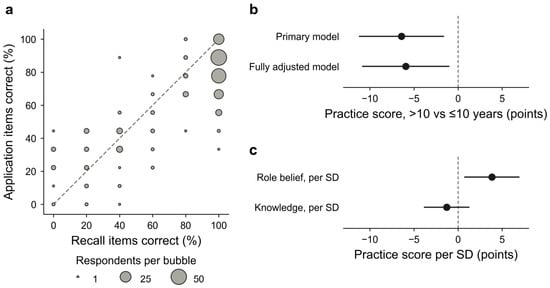
In the primary analysis, more than 10 years of clinical experience was compared with 10 years or fewer. No difference in knowledge was detected (b = 0.24, 95% CI −0.94 to 1.43, p = 0.69; n = 227; Table 2). The 95% CI was wider than the prespecified margin of ±0.25 SD (±1.06 points); the minimum detectable difference at 80% power was 1.69 points. Respondents with more than 10 years of experience reported a practice score 6.41 points lower than those with 10 years or fewer (95% CI −11.24 to −1.58, p = 0.010, q = 0.096; n = 227; Figure 1b); in all records, q was 0.046. In the fully adjusted models, the estimate for knowledge was 0.30 points (95% CI −0.98 to 1.59), which is also wider than the margin (minimum detectable difference: 1.83 points). The estimate for practice was −5.93 points (95% CI −10.89 to −0.97, q = 0.17; n = 227).
Figure 1.
Recall and application item performance and estimates for self-reported nutrition practice. (a) Recall versus application performance within respondents (secondary analysis, online responses, n = 227). Bubble area represents the number of respondents with each score pair. The dashed line indicates equal scores. Recall was scored over five items and application over nine, so attainable values are coarser on the horizontal axis. (b) Difference in practice score for more than 10 versus 10 or fewer years of clinical experience in the primary and fully adjusted models (n = 227 in each). (c) Difference in practice score per standard deviation of role belief (12.92 points) or knowledge (4.24 items) in the fully adjusted exploratory model (n = 227). Panels (b,c) use the same scale for practice-score points (possible range: 20 to 100). Markers show estimates and bars show 95% confidence intervals based on HC3 standard errors. The dashed vertical line marks zero difference.
The practice estimate was negative in all four sensitivity analyses using the primary model (Table 2). The 95% CI excluded zero in all records and in the subset that excluded both identical response patterns and single-value blocks. Minimum detectable differences in the other two sets were 8.68 and 5.43 points. For knowledge, no sensitivity analysis detected a difference. The 95% CI lay within the prespecified margin only in all records, and the minimum detectable differences in the other three sets ranged from 1.39 to 2.35 points. Based on the criteria in Section 2.6, the practice result agreed with the main analysis in two sets and the knowledge result in one (records without a single-value block). The tier A analysis also agreed with the main knowledge result (primary-model estimate: 0.07 points, 95% CI −0.72 to 0.87). The fully adjusted tier A result also agreed with the main analysis result. The interval included zero after omitting each tier A item in turn. In the online responses, the refit using experience values recorded before correction met the consistency criteria for practice only (Table S3, panel F).
After correction for multiple comparisons, no other workforce characteristic was associated with the total knowledge score, either item-type score or the difference between them (Table S2). In the fully adjusted knowledge model, only the estimate for frequency of nutrition-related work (per level) had a 95% CI within ±0.25 SD.
In the analysis of all records, respondents who did not report a province (all in paper questionnaire group) scored 3.20 points lower (95% CI −4.96 to −1.44, q = 0.007); every online respondent reported a province.
3.3. Recall and Application Item Performance
The secondary analysis found that respondents answered 78.9% of the five recall items and 67.7% of the nine application items correctly (online responses, n = 227, Table 3 and Figure 1a). The mean within-person difference was 11.2 percentage points (95% CI 8.8 to 13.5, Wilcoxon signed-rank p = 3.6 × 10⁻¹⁶, Cohen’s dz = 0.61). The difference ranged from 10.0 to 12.9 percentage points across the four sensitivity analyses (Table S3). For the tier A items, the difference was 9.4 percentage points (95% CI 6.4 to 12.3), with the interval excluding zero in every analysis where one item was dropped. With the 12-item re-review key, the experience analysis detected no difference in knowledge (b = 0.11, 95% CI −0.73 to 0.94), and the recall–application difference was 13.1 percentage points (95% CI 9.9 to 16.2, Table S3, panel G).
Table 3.
Percentage of respondents answering each keyed knowledge item correctly, with items classified by Miller level. Online responses (n = 227).
When recall and application items were matched in terms of correct percentage, the difference was 1.1 percentage points (95% CI −1.3 to 3.6). Its 95% CI included zero in every sensitivity analysis (Table S3). Matching based on correct percentage narrows the observed difference by design and cannot separate item type from item difficulty.
3.4. Item-Level Performance
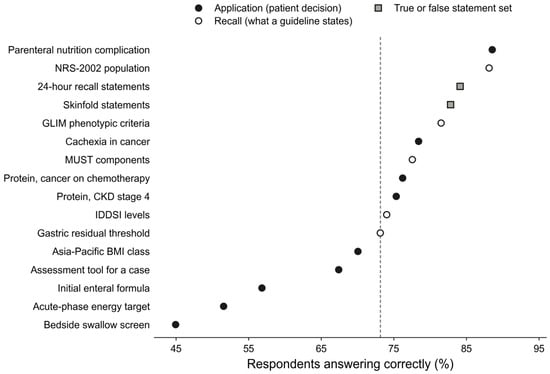
The lowest-scoring items concerned interpretation of a bedside swallow screen (44.9% correct), the energy target during the acute phase of critical illness (51.5%), and selection of an initial enteral formula (56.8%). The highest-scoring item was also an application item and concerned a suspected complication of parenteral nutrition (88.5% correct). Scores overlapped across the two item types (Figure 2).
Figure 2.
Percentage of respondents answering each keyed knowledge item correctly (online responses, n = 227), ordered from lowest to highest. Filled circles indicate application items, open circles indicate recall items and grey squares indicate statement sets. The dashed vertical line shows the mean percentage correct across the 16 items (73.2%). Table 3 summarises the item content.
3.5. Knowledge, Role Beliefs, and Self-Reported Practice
The fully adjusted exploratory model did not detect an association between knowledge and self-reported practice (b = −0.30 points per item correct, 95% CI −0.91 to 0.31, q = 0.66, n = 227, Figure 1c). The 95% CI also included zero when knowledge was scored using the tier A items (Table S3).
Higher role-belief scores were associated with higher self-reported practice scores before correction for multiple comparisons (b = 0.297 practice points per role-belief point, 95% CI 0.055 to 0.540, p = 0.016). The association did not meet the threshold after correction (q = 0.17). Across the three scoring versions and four sensitivity sets, all 12 estimates were positive with 95% CIs excluding zero, and five had a q value below 0.05 (Table S3). Adding role belief to the model increased the variance explained in practice from 10.9% to 15.4%.
The role-belief score was concentrated near its maximum, with 15.0% of respondents at the ceiling. The prespecified two-factor solution separated role-belief and practice items, with no cross-loading of 0.30 or more (Table S4). Parallel analysis suggested three factors for the two scales together. A three-factor solution for the combined scales was not examined.
Section 5 reports the Harman’s test results for common-method variance. Because these associations are cross-sectional, none can identify a mechanism.
3.6. Barriers
Perceived barrier scores were similar across the five domains (Table 4). Respondents did not rank the domains. Table S5 reports the agreement with individual items.
Table 4.
Perceived barriers according to domain. Each domain score is the sum of five items (range: 5 to 25).
The barrier domains did not meet the prespecified criterion for explaining the knowledge–practice gap. Among respondents scoring at least 12 out of 16 (n = 156), the five domains explained an additional 5.4% of the variance in practice, below the 10% threshold. A post hoc test of this increase gave p = 0.13. After standardising the domain scores, the personal domain had the largest coefficient in absolute value (p = 0.024).
4. Discussion
In the primary analysis of the online responses, nurses with more than 10 years of clinical experience reported a practice score 6.41 points lower than nurses at or below that threshold. No difference in clinical nutrition knowledge was detected, and the 95% CI was wider than the prespecified margin of ±0.25 SD. The practice estimate was negative in all four sensitivity analyses, although its interval included zero in two.
Several surveys of clinical staff found no association between clinical experience and nutrition knowledge [13,15,16,19]. A survey of oncology nurses in Italy found higher scores after more than 10 years of experience [20]. Lower self-reported practice among some groups with longer service has also been reported among intensive care nurses [13] and in an exploratory comparison of hospital staff [18]. Differences in instruments limit direct comparisons of knowledge levels [14].
Respondents answered a higher proportion of recall items correctly compared to application items. The contrast depended on the items included. Table 5 links the item-level findings to possible learning activities and assessments within the relevant nursing role.
Table 5.
Proposed clinical nutrition learning activities and assessments by nursing role and capability. The performance column reports results from the online responses. The proposals have not been tested. The tiers distinguish nursing autonomy, actions under an approved pathway or order, and decisions made by or with the medical and dietetic team. Local regulation and institutional policy determine which tier applies.
4.1. Candidate Curriculum Content and Professional Scope
Curriculum planning begins with specifying which activities nurses carry out independently and which involve a team decision. Screening for swallowing and nutrition risks and monitoring prescribed care fall within nursing practice where local policies permit them. Independent diagnosis, prescription of energy and protein targets, and selection of a feeding formula require explicit authority. In Table 5, swallow screening falls under autonomous nursing practice. Energy targeting and formula selection fall under interprofessional decision-making.
The lowest-scoring items concerned interpreting a swallow screen before oral intake, setting an energy target during acute illness and choosing an initial enteral formula. Performance overlapped across recall and application items. The lowest scores point to specific decisions for curriculum review.
This learner-level perspective complements programme-level curriculum analyses, which report that nutrition learning outcomes are concentrated mainly at the cognitive level [4,5]. A programme review can show where its stated outcomes fall in Miller’s framework. A needs assessment can identify specific decisions for which learners scored lower.
4.2. Candidate Approaches to Teaching and Assessment
Low scores on several decision items suggest a place for case-based learning alongside content teaching. In Miller’s framework, written cases assess application of knowledge, while higher levels require demonstration and observation in practice [9]. Assessment methods in dietetics have also been examined using this hierarchy [11].
In an uncontrolled before-and-after study of 29 dietetics students, case-based learning improved the ability to construct individualised care plans [23]. In nursing education, studies reported better short-term retention with case-based learning compared with didactic lectures [24] and larger knowledge gains in a randomised comparison of ethics teaching [25]. A master’s curriculum could use these approaches to develop skills in guideline appraisal and staff coaching. More than one third of respondents already held head nurse or department head positions.
4.3. Role Beliefs and Self-Reported Practice
In exploratory analyses, we did not detect an association between knowledge and self-reported practice. The positive association between role belief and practice did not remain statistically significant after correction for multiple comparisons. The estimate showed the same direction across different versions of the score and sensitivity analyses. A shared response style may have contributed because the scales used adjacent grids with the same response format (see Harman’s test in Section 5).
How nurses understand their role in nutrition care may merit attention during curriculum review. An analysis of Polish nursing education standards identified four nutrition-related learning outcomes at the master’s level, none of which addressed attitudes [6]. The barrier domains did not meet the prespecified criterion for explaining variation in self-reported practice among nurses with higher knowledge scores.
4.4. Implications for Targeting Education
The exploratory analyses did not detect differences in knowledge by workforce characteristics after correction for multiple comparisons. Most estimates were imprecise. We did not detect a knowledge difference based on short-course attendance. Few respondents had received training lasting one month or longer, limiting comparisons based on training duration. A larger Chinese study of 1218 clinical nurses reported greater nutritional nursing competence among those who had received systematic nutrition education [26]. That study measured self-rated competence.
4.5. Comparison with the Hospital Nutrition Workforce
We did not find the association between nutrition knowledge and practice among Vietnam’s hospital nutrition workforce reported in [22]. This study scored knowledge differently and enrolled different populations. The earlier survey focused on hospital nutrition department staff. Most nurses in our sample worked in hospitals and were enrolled in a master’s programme. Neither study detected an association between knowledge and length of experience [22].
A postgraduate curriculum could build on familiarity with screening tools and use cases to address bedside decisions for which performance was lower.
5. Limitations
The origin of the identical answers in paper questionnaires remains unknown (Section 2.5). Of the 181 paper questionnaires, 141 repeated all 80 answers of a record entered earlier in the sheet. The dates on the paper records do not show when the questionnaires were completed, and 134 respondents gave the same answer throughout at least one rating block. The practice estimates varied in size and precision across the sensitivity analyses.
The role-belief score was formed after the initial analysis by excluding two of the 15 items. It has not been validated against other measures. The Cronbach’s alpha of 0.981 for the online responses may reflect item redundancy or uniform agreement. Role belief and practice shared a response format and appeared on adjacent grids, which may have contributed to their association. Harman’s single factor accounted for 24.8% of the variance in the online responses (28.2% in all records). This test cannot rule out common-method bias.
The questionnaire measured knowledge through written items and practice through self-report. Neither the ‘shows how’ nor the ‘does’ level of Miller’s framework was assessed. As with other written knowledge assessments [8], these scores do not establish what nurses do in clinical practice.
Recall and application items differed in content and difficulty as well as type. The item sets therefore do not isolate the contribution of item type to the observed difference (Section 3.3).
The answer key was derived from published guidance after data collection. Four items that could not be keyed were excluded. Where guidelines differed, the keyed option followed most of the current guidance, and the divergence was documented with the key. The later re-review supplied an alternative key for sensitivity analyses during revision. The original guideline-based key was not independently reviewed and still requires external validation.
The survey included nurses enrolled in one Master of Nursing programme. The response rate was 64.8% (408 of 630 enrolled students), and no information was available on nonrespondents. The findings may not apply to other programmes or to nurses outside postgraduate study. Selection and non-response bias cannot be assessed.
The adapted questionnaire was reviewed by two experts. No formal content validation, pilot testing or test–retest reliability assessment was performed, and the scores have not been compared with other measures.
6. Conclusions
Among nurses enrolled in one master’s programme, more than 10 years of clinical experience was associated with less frequent self-reported nutrition practice. No difference in clinical nutrition knowledge was detected. The practice estimate remained negative across all four sensitivity analyses, although its interval included zero in two. Respondents answered a lower proportion of application items correctly compared to recall items, and the size of the contrast depended on which items were included. The lowest scores highlight bedside decisions for curriculum review.
Supplementary Materials
The following supporting information can be downloaded at: https://www.mdpi.com/article/10.3390/nursrep16120431/s1, Table S1: The answer key for the 20 knowledge items, guideline sources, and reasons for excluding four items; Table S2: All terms of the regression models, with results based on classical standard errors; Table S3: Sensitivity analyses; Table S4: Factor analysis of the role-belief and practice items; Table S5: Item-level barrier results; File S6: The demographic fields and the questionnaire items that have no counterpart in the source named in Section 2.2, with an English translation, and a list of the adapted items; File S7: The completed STROBE checklist.
Author Contributions
Conceptualization, T.A.N. and T.D.C.; methodology, T.A.N.; investigation and data collection, M.K.N., T.M.N.P., T.M.H.L., T.-T.T.N. and N.T.H.M.; data curation, M.K.N. and T.M.N.P.; formal analysis, T.A.N.; writing—original draft, T.A.N.; writing—review and editing, M.K.N., T.M.N.P., T.M.H.L., T.-T.T.N., N.T.H.M. and T.D.C.; supervision and funding acquisition, T.D.C. All authors have read and agreed to the published version of the manuscript.
Funding
This research was funded by Hong Bang International University under grant code GVTC19.76. All authors are staff of this university; the university did not play a role in the design of the study; in the data collection, analysis or interpretation; or in the writing of the manuscript.
Institutional Review Board Statement
The study was approved by the Biomedical Research Ethics Committee of Hong Bang International University (approval No. 94/PCT-HĐĐĐ-ĐT, 24 November 2025), based on the committee meeting of 15 November 2025. Approval preceded the start of data collection.
Informed Consent Statement
Informed consent was obtained from all participants before they began the questionnaire. Participation was voluntary and had no bearing on assessment or progression in the programme, and participants were informed of this before starting the questionnaire. Identifiers were collected to allow for duplicate checking and were held separately from, and were not accessible to, staff involved in grading or progression decisions.
Data Availability Statement
The analysis code and the output tables are available from the corresponding author upon reasonable request. They have not been deposited in a public repository because the underlying response file cannot be sufficiently separated from the student group to protect confidentiality. A de-identified response file, from which student identifiers, telephone numbers and dates of birth were removed before analysis, is available from the corresponding author under the same conditions. The characteristics of the data file are described in Section 2.5.
Public Involvement Statement
There was no public involvement in any aspect of this research.
Guidelines and Standards Statement
This revised manuscript was checked against the Strengthening the Reporting of Observational Studies in Epidemiology (STROBE) statement for cross-sectional research [27]; the completed checklist is provided as File S7.
Use of Artificial Intelligence
Claude (Anthropic) was used to draft and copy-edit the manuscript text and to draft the English translation of the questionnaire (File S6), which an author checked. It was not used to generate the research question, to select the study design or the exposure definitions, or to decide which analyses were primary and which were sensitivity analyses—those decisions are the authors’ own. After using this tool, the authors reviewed and edited the content as needed and take full responsibility for the content of the publication.
Acknowledgments
The authors thank the Master of Nursing students who completed the questionnaire. During the preparation of this manuscript, the authors used Claude (Opus 5, Opus 5.5 and Sonnet 5.5; Anthropic) for the purposes of drafting and copy-editing text and drafting the English translation of the questionnaire. The authors have reviewed and edited the output and take full responsibility for the content of this publication.
Conflicts of Interest
The authors declare no conflicts of interest.
References
- Mlakar-Mastnak, D.; Kozjek, N.R.; Skela-Savič, B. Factors for Effective Identification of Patients at Nutritional Risk in Clinical Practice: Thematic Analysis of Qualitative Research. Zdr. Varst. 2022, 61, 191–197. [Google Scholar] [CrossRef] [Scilit] [PubMed] [PubMed Central]
- Molle, J.; Agnel, J.; Colson, S.; Chays-Amania, A. Using implementation science to promote evidence-based nutritional care in healthcare settings: A mixed-methods systematic review. Int. J. Nurs. Stud. Adv. 2025, 9, 100414. [Google Scholar] [CrossRef] [Scilit] [PubMed] [PubMed Central]
- Baird, J.; Desneves, K.; Chapman, B.; Hughes, R.; Tuck, C. Addressing Malnutrition in Australian Hospitals: A Scoping Review to Inform Systems Thinking. J. Hum. Nutr. Diet. 2026, 39, e70230. [Google Scholar] [CrossRef] [Scilit] [PubMed] [PubMed Central]
- King, R.E.; Palermo, C.; Wilson, A.N. Mapping nutrition within medical curricula in Australia and New Zealand: A cross-sectional content analysis. BMJ Nutr. Prev. Health 2023, 6, 196–202. [Google Scholar] [CrossRef] [Scilit] [PubMed] [PubMed Central]
- Derry, M.G.; Ball, L.; Lepre, B. Where is the nutrition? Content analysis of learning objectives within tertiary medicine and health degree programs at an Australian university. BMJ Nutr. Prev. Health 2025, 8, e001263. [Google Scholar] [CrossRef] [Scilit] [PubMed] [PubMed Central]
- Kupis, R.; Rudzińska, A.; Piotrowicz, K. Nutrition-related competencies in undergraduate training of health professionals in Poland: A descriptive analysis of educational standards. BMC Med. Educ. 2026, 26, 906. [Google Scholar] [CrossRef] [Scilit]
- Albagawi, B.; Alkubati, S.A.; Abdul-Ghani, R. Levels and predictors of nurses’ knowledge about diabetes care and management: Disparity between perceived and actual knowledge. BMC Nurs. 2023, 22, 342. [Google Scholar] [CrossRef] [Scilit]
- Downey, J.; McKenna, A.H.; Mendin, S.F.; Waters, A.; Dunbar, N.; Tehmeh, L.G.; White, E.E.; Siedner, M.J.; Panjabi, R.; Kraemer, J.D.; et al. Measuring Knowledge of Community Health Workers at the Last Mile in Liberia: Feasibility and Results of Clinical Vignette Assessments. Glob. Health Sci. Pract. 2021, 9, S111–S121. [Google Scholar] [CrossRef] [Scilit] [PubMed] [PubMed Central]
- Witheridge, A.; Ferns, G.; Scott-Smith, W. Revisiting Miller’s pyramid in medical education: The gap between traditional assessment and diagnostic reasoning. Int. J. Med. Educ. 2019, 10, 191–192. [Google Scholar] [CrossRef] [Scilit] [PubMed] [PubMed Central]
- Lepre, B.; Mansfield, K.J.; Ray, S.; Beck, E.J. Nutrition competencies for medicine: An integrative review and critical synthesis. BMJ Open 2021, 11, e043066. [Google Scholar] [CrossRef] [Scilit] [PubMed] [PubMed Central]
- Jamieson, J.; Palermo, C.; Hay, M.; Gibson, S. Assessment practices for dietetic students: An updated systematic review (2017–2024). Nutr. Diet. 2025, 82, 467–486. [Google Scholar] [CrossRef] [Scilit] [PubMed] [PubMed Central]
- Song, C.; Zhang, W.; Zhu, L.; Ge, T.; Cao, M.; Xu, H. Knowledge, Attitudes and Practices Regarding Enteral Nutrition Management Among ICU Nurses. Nurs. Crit. Care 2026, 31, e70260. [Google Scholar] [CrossRef] [Scilit] [PubMed] [PubMed Central]
- Ni, W.; Zhu, S.; Zou, H.; Jiao, X.; Ma, Y. Knowledge, attitudes, and behaviors of ICU nurses for enteral nutrition-related diarrhea management: A cross-sectional study. BMC Nurs. 2025, 24, 967. [Google Scholar] [CrossRef] [Scilit]
- Doménech Briz, V.; Gea-Caballero, V.; Chover-Sierra, E.; Czapla, M.; Fehler, P.; Rodríguez-Calvo, A.; Ballestar-Tarín, M.L.; Marín-Maicas, P.; Cabellos-García, A.C.; Pardo-Bosch, M.; et al. Knowledge Level of ICU Nurses Regarding Nutritional Assessment of Critically Ill Patients: A Systematic Review. Nurs. Rep. 2024, 14, 586–602. [Google Scholar] [CrossRef] [Scilit] [PubMed] [PubMed Central]
- Farzaei, M.; Shahbazi, S.; Gilani, N.; Ostadrahimi, A.; Gholizadeh, L. Nurses’ knowledge, attitudes, and practice with regards to nutritional management of diabetes mellitus. BMC Med. Educ. 2023, 23, 192. [Google Scholar] [CrossRef] [Scilit]
- Bauer, S.; Halfens, R.J.; Lohrmann, C. Knowledge and Attitudes of Nursing Staff Towards Malnutrition Care in Nursing Homes: A Multicentre Cross-Sectional Study. J. Nutr. Health Aging 2015, 19, 734–740. [Google Scholar] [CrossRef] [Scilit] [PubMed] [PubMed Central]
- Bauer, S.; Pospichal, J.; Huppertz, V.; Blanar, V.; Saka, B.; Eglseer, D. The Knowledge of Malnutrition-Geriatric (KoM-G) 2.0 Questionnaire for Health Care Institutions: Cross-Cultural Adaptation into German, Czech, Dutch and Turkish. Nutrients 2024, 16, 1374. [Google Scholar] [CrossRef] [Scilit]
- Laur, C.; Marcus, H.; Ray, S.; Keller, H. Quality Nutrition Care: Measuring Hospital Staff’s Knowledge, Attitudes, and Practices. Healthcare 2016, 4, 79. [Google Scholar] [CrossRef] [Scilit]
- Shakhshir, M.; Alkaiyat, A. Healthcare providers’ knowledge, attitude, and practice on quality of nutrition care in hospitals from a developing country: A multicenter experience. J. Health Popul. Nutr. 2023, 42, 15. [Google Scholar] [CrossRef] [Scilit] [PubMed] [PubMed Central]
- Alaimo, G.; Mancin, S.; Ferrante, S.; Morenghi, E.; Palomares, S.M.; Cattani, D.; Cosmai, S.; Lopane, D.; Petrelli, F.; Cangelosi, G.; et al. Nutrition Knowledge in Oncology Nursing: A Cross-Sectional Analysis of Care and Practice Implications. Nurs. Open 2026, 13, e70443. [Google Scholar] [CrossRef] [Scilit] [PubMed] [PubMed Central]
- Ministry of Health of Vietnam. Circular No. 18/2020/TT-BYT of 12 November 2020: Regulations on Nutrition Activities in Hospitals (Consolidated Text No. 16/VBHN-BYT of 9 December 2025). Available online: https://datafiles.chinhphu.vn/cpp/files/vbpq/2025/12/16-vbhn-byt.pdf (accessed on 31 October 2026).
- Ma, Y.N.; Nguyen, L.T.; Ha, S.T.; Aiga, H. Determinants of clinical nutrition knowledge, attitudes, and practices of the nutrition workforce in Vietnam’s public hospitals. Hum. Resour. Health 2025, 23, 45. [Google Scholar] [CrossRef] [Scilit] [PubMed] [PubMed Central]
- Abu Farha, R.J.; Zein, M.H.; Al Kawas, S. Introducing integrated case-based learning to clinical nutrition training and evaluating students’ learning performance. J. Taibah Univ. Med. Sci. 2021, 16, 558–564. [Google Scholar] [CrossRef] [Scilit] [PubMed] [PubMed Central]
- Das, S.; Ponnusamy, K.A.; Tripathi, A.; Jaison, J.; Rathinam, B.A.D. Case-based learning: A ‘Case’ for restructuring anatomy education in Indian nursing curriculum. J. Educ. Health Promot. 2022, 11, 258. [Google Scholar] [CrossRef] [Scilit] [PubMed] [PubMed Central]
- Khaleghparast, S.; Ghaffarinejad, Z.; Arbabi, M.; Karimian, S.; Shababi, F.; Farahani, M.A. Comparison of the effectiveness of case-based and lecture-based learning strategies on the moral knowledge of the nursing staff. J. Educ. Health Promot. 2026, 15, 68. [Google Scholar] [CrossRef] [Scilit] [PubMed] [PubMed Central]
- Tang, Y.; Wen, X.; Tang, X.; Li, X.; Zhang, L.; Duan, S.; Long, P.; Zhou, Z. Nutritional nursing competence of clinical nurses and its influencing factors: A cross-sectional study. Front. Nutr. 2024, 11, 1449271. [Google Scholar] [CrossRef] [Scilit]
- von Elm, E.; Altman, D.G.; Egger, M.; Pocock, S.J.; Gøtzsche, P.C.; Vandenbroucke, J.P.; Initiative, S. The Strengthening the Reporting of Observational Studies in Epidemiology (STROBE) statement: Guidelines for reporting observational studies. Lancet 2007, 370, 1453–1457. [Google Scholar] [CrossRef] [Scilit] [PubMed]

Disclaimer/Publisher’s Note: The statements, opinions and data contained in all publications are solely those of the individual author(s) and contributor(s) and not of MDPI and/or the editor(s). MDPI and/or the editor(s) disclaim responsibility for any injury to people or property resulting from any ideas, methods, instructions or products referred to in the content. |
© 2026 by the authors. Licensee MDPI, Basel, Switzerland. This article is an open access article distributed under the terms and conditions of the Creative Commons Attribution (CC BY) license.