


Abstract
Background/Objectives: The Portuguese cross-cultural adaptation of the Multidimensional Nursing Generations Questionnaire established its linguistic and content appropriateness, but its structural validity and reliability required empirical evaluation. This study aimed to analyse the validity and reliability of the Portuguese version of the Multidimensional Nursing Generations Questionnaire (MNGQ-PT). Methods: A cross-sectional psychometric study included 688 hospital nurses from a local health unit in northern Portugal. The original 48-item model was evaluated using confirmatory factor analysis, followed by evaluation of a reformulated 47-item model in the same sample. Results: Several fit indices improved between the respecified 48-item model and the final 47-item model. The final six-factor model showed favourable RMSEA (0.05) and χ2/df (2.59) values. The CFI (0.88), TLI (0.87) and IFI (0.88) remained below 0.90. Across the six subscales, Cronbach’s alpha ranged from 0.73 to 0.86 and composite reliability from 0.70 to 0.86. The results supported discriminant validity across all six dimensions. At the reported precision, only one dimension reached the average variance extracted reference value of 0.50. Conclusions: The final 47-item version of the MNGQ-PT retained the six dimensions of the original instrument and showed satisfactory subscale reliability and evidence of discriminant validity. Evidence of convergent validity was limited, and some fit indices fell below their reference thresholds. The MNGQ-PT may support research on hospital nurses’ perceptions of generational diversity, with further evaluation needed to determine whether its factor structure and measurement properties are replicated in other healthcare settings, including primary care.
1. Introduction
Nursing practice environments encompass organisational and relational characteristics that influence professional practice, including leadership, resources, autonomy, and professional relationships [1,2,3]. Favourable environments have been associated with job satisfaction, work engagement, and nurses’ perceived quality and safety of care [4,5,6,7]. Within these environments, generational diversity raises questions about how nurses perceive communication, collaboration, and differences in professional expectations.
Alongside these challenges, generational diversity has become increasingly relevant within the nursing workforce. As experienced nurses remain in practice while younger professionals enter healthcare organisations, contemporary nursing teams may include Baby Boomers and members of Generations X, Y (Millennials), and Z, whose professional perspectives have developed within different social, economic, technological, and organisational contexts [8,9]. Although generational categories should not be regarded as rigid determinants of individual behaviour, they provide a useful framework for exploring differences in work-related values, communication, leadership preferences, attitudes towards technology and change, professional development, and work–life balance.
Evidence suggests that these differences may influence nursing team dynamics. Generational differences have been identified in work-related values and attitudes, technological adaptation, work–life balance, recognition, communication, leadership preferences, and professional expectations [10,11]. Generational diversity may therefore represent both an organisational resource, by facilitating knowledge transfer, complementary competencies, innovation, and intergenerational learning, and a management challenge when differences contribute to interpersonal tensions or difficulties in team cohesion [8,9,11]. Understanding these dynamics is particularly important in nursing, where effective communication, teamwork, and collaboration are fundamental to safe and high-quality care.
Leadership, professional relationships, and organisational resources are relevant to nurses’ work engagement and to their experiences of practice environments [4,12,13]. Recent evidence further indicates that generational affiliation may be associated with differences in stress, coping strategies, and perceptions of patient safety, reinforcing the relevance of generationally sensitive approaches to nursing workforce management [14]. However, assessing intergenerational dynamics requires an instrument that distinguishes related aspects of these perceptions, rather than inferring them solely from generational membership.
Despite growing research on generational diversity in nursing, existing studies have predominantly compared predefined generational cohorts and examined specific outcomes such as work values, job satisfaction, engagement, and intention to leave [10,11]. Such approaches may not fully capture the multidimensional nature of intergenerational dynamics. Moreover, the limited availability of psychometrically robust instruments specifically designed to assess nurses’ perceptions of these dynamics restricts their systematic evaluation across areas directly relevant to nursing practice, including teamwork, interpersonal relationships, patient safety, attitudes towards change, and willingness to work.
The Multidimensional Nursing Generations Questionnaire (MNGQ), developed in 2019 [15] was designed to address this need by assessing nurses’ perceptions of generational diversity across six dimensions: Conflicts between generations (10 items), Patient safety view (10 items), Relationship issues between generations (8 items), Working as a multigenerational team (6 items), Orientation to change (7 items), and Work propensity and availability (7 items). Rather than merely classifying nurses into generational cohorts, the MNGQ provides a multidimensional assessment of how generational dynamics are perceived within nursing teams and may generate relevant evidence to inform nursing management and leadership.
An instrument developed in a given cultural and professional context cannot be assumed to retain its measurement properties in another context. Cross-cultural adaptation establishes linguistic and conceptual appropriateness, whereas empirical psychometric evaluation examines whether the proposed dimensional structure and the reliability and validity of scores are supported in the target population.
Castro et al. (2026) conducted the cross-cultural adaptation and content validation of the MNGQ for Portugal [16], providing evidence of linguistic, semantic, and cultural appropriateness and of content validity. That work did not empirically establish the six-factor structure, subscale reliability, or convergent and discriminant validity in a large Portuguese sample. These measurement properties are the focus of the present investigation.
Accordingly, this study addressed the following research question: What are the validity and reliability of the Portuguese version of the Multidimensional Nursing Generations Questionnaire (MNGQ-PT) in a sample of Portuguese hospital nurses? In line with this question, this study aimed to analyse the validity and reliability of the Portuguese version of the Multidimensional Nursing Generations Questionnaire (MNGQ-PT).
2. Materials and Methods
2.1. Design and Setting
A methodological study was conducted to evaluate the validity and reliability of the Portuguese version of the Multidimensional Nursing Generations Questionnaire (MNGQ-PT). The assessment of its measurement properties was informed by contemporary methodological frameworks [15,16] and the Consensus-based Standards for the selection of health Measurement Instruments (COSMIN) guidance [17,18,19].
The study was conducted between November 2024 and January 2025 at a Local Health Unit (LHU) in northern Portugal, integrated into the Portuguese National Health Service. The LHU provides differentiated healthcare and is considered, at national level, a reference centre in several medical and surgical specialty areas. It has a large health workforce, including approximately 2580 nurses. For the purposes of this study, data collection was restricted to hospital settings encompassing medical, surgical, emergency, intensive care, and women’s and children’s health departments.
2.2. Participants and Sample
The target population comprised nurses providing nursing care in the hospital departments of the participating LHU. Participants were recruited using non-probability convenience sampling.
The inclusion criteria were working in a hospital department included in the study and having worked at the institution for at least six months, regardless of employment contract or professional category. Nurses who were absent from the workplace during the data-collection period due to leave, illness, or other reasons were excluded.
The final sample comprised 688 nurses for a 48-item model distributed across six dimensions, corresponding to approximately 14.3 participants per item. Sample size was based on the participant-to-item ratio, using as reference the recommendation of 10 participants per item for scale development and evaluation studies [18,20,21]. Considering the 48 items of the MNGQ-PT, this criterion corresponds to a reference sample size of 480 participants. In addition, the sample meets the sample-size requirement rated as very good in the COSMIN framework for structural validity studies using factor analysis: at least seven participants per item and a minimum of 100 participants [22]. Beyond this participant-to-item criterion, no formal a priori model-based sample-size calculation was performed; the adequacy of the achieved sample was therefore judged against these methodological criteria for factor analysis.
Of the 1200 questionnaires distributed to eligible nurses, 699 were returned (58.25%). Of these, 11 were excluded because they contained missing responses on the MNGQ-PT items, which precluded their inclusion in the CFA, and 688 were included in the analysis, corresponding to 57.33% of the questionnaires distributed and 98.43% of those returned.
2.3. Data Collection Instrument
The data-collection instrument comprised two sections: a questionnaire assessing sociodemographic, professional, and academic characteristics; the Portuguese version of the Multidimensional Nursing Generations Questionnaire (MNGQ-PT), previously cross-culturally adapted and content-validated for the Portuguese nursing context [16].
2.3.1. Sociodemographic, Professional, and Academic Characterisation
The sociodemographic characteristics assessed were age and sex. Professional characteristics included work setting, professional experience, nursing speciality, professional title and category. Academic qualifications were also recorded.
2.3.2. Multidimensional Nursing Generations Questionnaire (MNGQ)
The MNGQ was originally developed by Stevanin et al. in 2019 [15] as a standardised instrument for assessing nurses’ perceptions of generational diversity and intergenerational dynamics within organisational settings. The instrument is intended to support understanding of multigenerational nursing teams and the development of management strategies responsive to generational characteristics.
The original MNGQ is a self-report instrument comprising 48 items organised into six subscales. These are Conflicts between generations (items 1–10), Patient safety view (items 11–20), Relationship issues between generations (items 21–28), Working as a multigenerational team (items 29–34), Orientation to change (items 35–41), and Work propensity and availability (items 42–48) [15].
Respondents indicate their level of agreement with each statement on a five-point Likert scale ranging from 1 (strongly disagree) to 5 (strongly agree). Before analysis, three items are reverse-scored by subtracting the recorded response from 6: item 17 in the Patient safety view subscale and items 45 and 46 in the Work propensity and availability subscale. After reverse-scoring, responses are interpreted at the item level within their respective subscales. No overall MNGQ score is calculated [15].
The cross-cultural adaptation and content validation of the MNGQ for the Portuguese context were previously conducted, resulting in the MNGQ-PT [16]. This process established the linguistic, semantic, and cultural appropriateness of the Portuguese version and provided evidence of its content validity. Therefore, the present study focused specifically on evaluating the psychometric properties of the MNGQ-PT in a sample of Portuguese nurses.
2.4. Data Collection Procedures
Following institutional and ethical approval, eligible nurses were informed about the purpose and procedures of the study and invited to participate voluntarily. Paper-based study materials included an information sheet, informed consent form, sociodemographic and professional questionnaire, and the MNGQ-PT. Questionnaires were distributed across the participating hospital departments/services. Nurse managers or designated deputies facilitated logistical access to the departments and supported the distribution and collection process. They were not involved in individual nurses’ decisions to participate and had no access to completed questionnaires or individual responses.
Participants completed the questionnaires individually. The informed consent form and questionnaire were kept separate to prevent the identification of individual responses. Completed materials were placed in sealed envelopes to protect confidentiality. In agreement with the nurse manager of each department/service, two collection points were scheduled during the study period. These allowed the research team to clarify procedural questions, provide additional study information when required, and collect completed materials at an interim and final stage.
2.5. Statistical Analysis
Data were organised in Microsoft Excel, followed by a preliminary analysis to detect possible data-entry errors. Descriptive statistics were used to analyse the variables characterising the sample.
Structural construct validity was assessed using confirmatory factor analysis, performed with IBM SPSS AMOS version 30 using maximum likelihood estimation. Analyses were based on the covariance matrix of the item scores. Although the five-point Likert items are ordinal, they were treated as approximately continuous, an approach generally considered acceptable for items with five or more response categories when distributions are not severely non-normal [16]. Because questionnaires with missing MNGQ-PT responses were excluded, analyses were conducted on complete cases, and no imputation was performed. Analyses included preliminary and item analysis, structural validity, internal consistency and reliability, and convergent and discriminant validity, following recommendations for the evaluation of multidimensional measurement instruments [17,20,21,23].
2.5.1. Preliminary and Item Analysis
A preliminary analysis was performed to identify and correct possible data-entry errors. Sociodemographic, academic, and professional characteristics were summarised using simple descriptive statistics, namely absolute and relative frequencies for categorical variables and means and standard deviations (SD) for numerical variables. Item performance was examined using descriptive statistics, response distributions, inter-item correlations, and corrected item–total correlations. Sampling adequacy for factor analysis was assessed using the Kaiser–Meyer–Olkin (KMO) measure.
2.5.2. Structural Validity
Structural validity was assessed using confirmatory factor analysis (CFA) to examine whether the original six-factor structure of the MNGQ was supported in the Portuguese sample. The initial model comprised 48 items assigned to the six dimensions of the original instrument. CFA was performed using maximum likelihood estimation.
Model fit was evaluated using the chi-square/degrees of freedom ratio (χ2/df), Comparative Fit Index (CFI), Tucker–Lewis Index (TLI), Root Mean Square Error of Approximation (RMSEA), Root Mean Square Residual (RMR), Incremental Fit Index (IFI), Goodness-of-Fit Index (GFI), Adjusted Goodness-of-Fit Index (AGFI), and Modified Expected Cross-Validation Index (MECVI). Fit indices were interpreted jointly, considering the complexity of the multidimensional model and using values ≥ 0.90 as the reference for CFI, TLI, and IFI [18,21,23]. Standardised factor loadings and individual item reliability were also examined.
2.5.3. Internal Consistency and Reliability
Internal consistency was assessed using Cronbach’s alpha (α) for each of the six MNGQ-PT dimensions, with values ≥ 0.70 considered satisfactory [19,20]. Given the multidimensional nature of the instrument, priority was given to dimension-level coefficients.
Composite reliability (CR) was calculated for each dimension, with values ≥ 0.70 considered satisfactory. Guttman split-half and Spearman–Brown coefficients were calculated as complementary reliability estimates for the 48-item and final 47-item versions [19,20]. Correlation coefficients between 0.10 and 0.29 are considered weak, those between 0.30 and 0.49 moderate, and values of 0.50 or higher strong.
2.5.4. Convergent Validity
Convergent validity was assessed using standardised factor loadings, composite reliability, and average variance extracted (AVE). AVE values ≥ 0.50 were considered indicative of adequate convergent validity, reflecting that the construct accounted for at least half of the variance in its indicators [19,23]. AVE values below this threshold were interpreted in conjunction with factor loadings, composite reliability, internal consistency, and the theoretical coherence of the respective dimension.
2.5.5. Discriminant Validity
Discriminant validity was assessed by comparing the AVE of each dimension with the squared correlations between latent dimensions. For each pair of dimensions, the squared correlation should be lower than the AVE of both dimensions to support their distinctiveness under this criterion [24].
2.6. Ethical Considerations
The study was conducted in accordance with the Declaration of Helsinki and applicable ethical principles for research involving human participants. Ethical approval was obtained from the Health Ethics Committee and the Data Protection Officer, and the study was authorised by the Board of Directors of the participating Local Health Unit (Approval No. 334/2024).
All potential participants received information about the study objectives, procedures, voluntary nature of participation, confidentiality, and their right to decline or withdraw without any consequences or disadvantage. Written informed consent was obtained before participation. To protect confidentiality, informed consent forms were collected separately from completed questionnaires. Data were coded for analysis, and no directly identifying information was collected. Nurse managers and other members of the participants’ hierarchical structure had no access to individual responses. Data were stored and processed in accordance with applicable data-protection requirements.
3. Results
3.1. Sample Description
A total of 688 nurses were included in the study. Participants had a mean age of 40.34 years (SD = 9.41), and 80.52% were female. According to year of birth, 19 (2.76%) participants were Baby Boomers (1946–1964), 183 (26.60%) belonged to Generation X (1965–1979), 400 (58.14%) to Generation Y (1980–1995), and 86 (12.50%) to Generation Z (born after 1995) [8]. Most participants held a bachelor’s degree (84.16%). Regarding professional category, 76.74% were nurses, 22.09% were specialist nurses, and 1.16% were nurse managers.
Among nurses holding a specialist qualification, Rehabilitation Nursing (31.35%) and Medical–Surgical Nursing (22.22%) were the most frequently represented areas of specialisation. Participants had a mean of 17.00 years of professional experience (SD = 9.31) and had worked in their current department for a mean of 10.96 years (SD = 9.03). The largest proportions of participants worked in medical (32.56%) and surgical (29.51%) departments, followed by intensive care (16.57%), women’s and children’s health (11.34%), and emergency departments (10.03%).
The sociodemographic, academic, and professional characteristics of the participants are presented in Table 1.
Table 1.
Sociodemographic, professional, and academic characteristics of the participants (n = 688).
3.2. Preliminary Item Analysis and Data Suitability
As a preliminary step, the suitability of the data for factor analysis was evaluated. Inter-item correlations ranged from −0.42 to 0.86, with a mean correlation of 0.08, including moderate and some high values. Corrected item–total correlations ranged from −0.03 to 0.44, with a mean of 0.25, with several moderate correlations. The results for each item are available in the Supplementary Material, in Table S1, entitled “Corrected item–total correlation in the 48-item MNGQ-PT model”. Inter-item and corrected item–total correlations provide information on the relationships among items and on the contribution of individual items to the overall scale [20].
For the 48-item MNGQ-PT model, Cronbach’s alpha coefficients for the two 24-item halves were 0.79 and 0.75, respectively, both considered adequate. The mean inter-item correlation was low, owing to the presence of some negative or near-zero correlations alongside many positive, moderate, or even high correlations.
The correlation between the two halves was 0.20, and both the Guttman split-half and Spearman–Brown coefficients were 0.33 (Table 2). These low split-half coefficients should be interpreted in light of the multidimensional structure of the MNGQ: split-half estimates assume that both halves measure the same unidimensional construct, whereas each half of the MNGQ-PT combines items from six conceptually distinct dimensions with weak inter-dimension correlations. Consequently, these coefficients are not appropriate indicators of the reliability of the instrument as a whole, and reliability was primarily evaluated at the dimension level.
Table 2.
Reliability coefficients for the 48-item MNGQ-PT model.
The 48-item MNGQ-PT model yielded a high overall Kaiser–Meyer–Olkin (KMO) measure of sampling adequacy (0.87). Item-level values were generally high or very high, except for items 45 and 46, both of which showed moderate values of 0.68, and item 47, which yielded a low value of 0.49.
Thus, all item-level values exceeded 0.50, with most exceeding 0.70, apart from item 47. Overall, these findings indicate good factorability of the correlation matrix, supporting the suitability of the data for factor analysis. The results of the KMO measure of sampling adequacy for each item are available in the Supplementary Material, in Table S2, entitled “Kaiser–Meyer–Olkin (KMO) measure of sampling adequacy in the 48-item MNGQ-PT model”.
3.3. Structural Validity of the 48-Item MNGQ-PT Model
Confirmatory factor analysis (CFA) was used to assess whether the six-factor structure of the original MNGQ [15] was supported in the Portuguese sample. All 48 items were retained at this stage.
The model was respecified by examining modification indices for pairs of item residuals. An index greater than 11, based on the chi-square distribution with one degree of freedom, was used to identify candidate residual covariances. Eleven within-factor residual covariances were estimated between items 3 and 4, 9 and 10, 15 and 18, 25 and 27, 26 and 28, 30 and 34, 31 and 32, 42 and 44, 42 and 46, 43 and 44, and 47 and 48.
Regarding 48-item model fit, only 228 non-redundant residuals (20%) had absolute values greater than 0.05, indicating good fit according to the criterion that fewer than 50% of residuals should exceed this threshold. Model fit was also evaluated using additional goodness-of-fit indices.
The CFI was 0.86, indicating fit close to being considered adequate. The GFI and AGFI were 0.84 and 0.82, respectively, approaching the threshold generally considered indicative of good fit (>0.90). Similarly, the IFI (0.86) and TLI (0.85) approached this threshold. The RMR was 0.06, indicating good fit. The RMSEA was 0.05, with P(RMSEA ≤ 0.05) = 0.28, also indicating good fit. Finally, the MECVI and the chi-square-to-degrees-of-freedom ratio (χ2/df) were 4.63 and 2.77, respectively, and are reported to facilitate comparisons with other models.
3.4. Internal Consistency and Construct Reliability of the 48-Item MNGQ-PT Model
The reliability of the 48-item MNGQ-PT model was assessed in terms of internal consistency, using Cronbach’s alpha, and composite reliability. The results for the six dimensions are presented in Table 3. Cronbach’s alpha for the overall scale was 0.80, indicating good internal consistency. Internal consistency was also good across the dimensions, except for the sixth dimension.
Table 3.
Reliability of the 48-item MNGQ-PT model (n = 688).
Composite reliability was high across the dimensions, except for the sixth dimension, for which it was acceptable. Composite reliability values of ≥0.70 were considered indicative of adequate construct reliability.
Factorial validity was examined by assessing the individual reliability of each item within its respective dimensions. Values of ≥0.25 were considered adequate. Most items demonstrated good, high or very high reliability, although a small number showed low reliability, particularly within the sixth dimension. Nevertheless, this dimension also included items with very high reliability. Overall, these findings were considered to support the factorial validity of the dimensions. Individual item reliability estimates are presented in Supplementary Material, Table S3, entitled “Individual reliability of each item in the 48-item MNGQ-PT model”.
3.5. Convergent and Discriminant Validity of the 48-Item MNGQ-PT Model
Working as a multigenerational team reached the commonly recommended reference value of 0.50. AVE values for Relationship issues between generations and Orientation to change dimensions were 0.42, while Conflicts between generations, Patient safety view, and Work propensity and availability presented values of 0.39, 0.30, and 0.30, respectively. An AVE of approximately 0.50 or higher is commonly considered favorable evidence of convergent validity, although validity should be evaluated using multiple sources of psychometric evidence rather than relying on a single criterion [24].
Discriminant validity is established when the average variance extracted of two dimensions is greater than or equal to the squared correlation between them (Table 4). The AVE of every dimension exceeded the corresponding squared correlation coefficients. Consequently, all pairs of dimensions showed discriminant validity, and the discriminant validity of the scale can be considered acceptable.
Table 4.
Matrix of squared correlations between the dimensions of the 48-item MNGQ-PT model (n = 688).
AVE values in the 48-item MNGQ-PT model were 0.39, 0.30, 0.42, 0.50, 0.42, and 0.30, respectively. The largest squared correlation (0.24, between dimensions 1 and 3) was lower than the AVE of both dimensions.
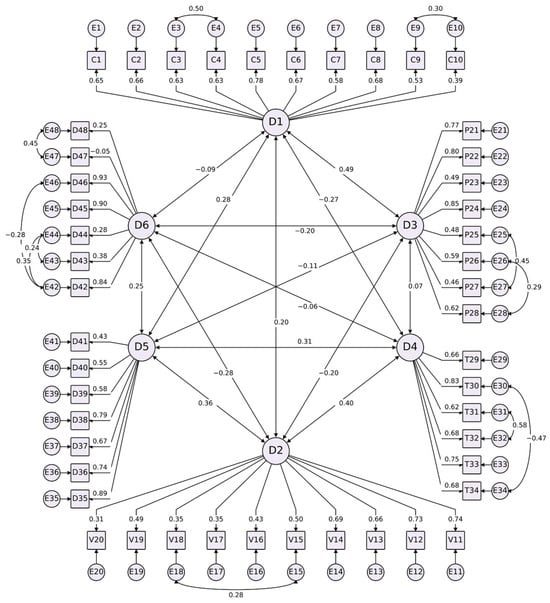
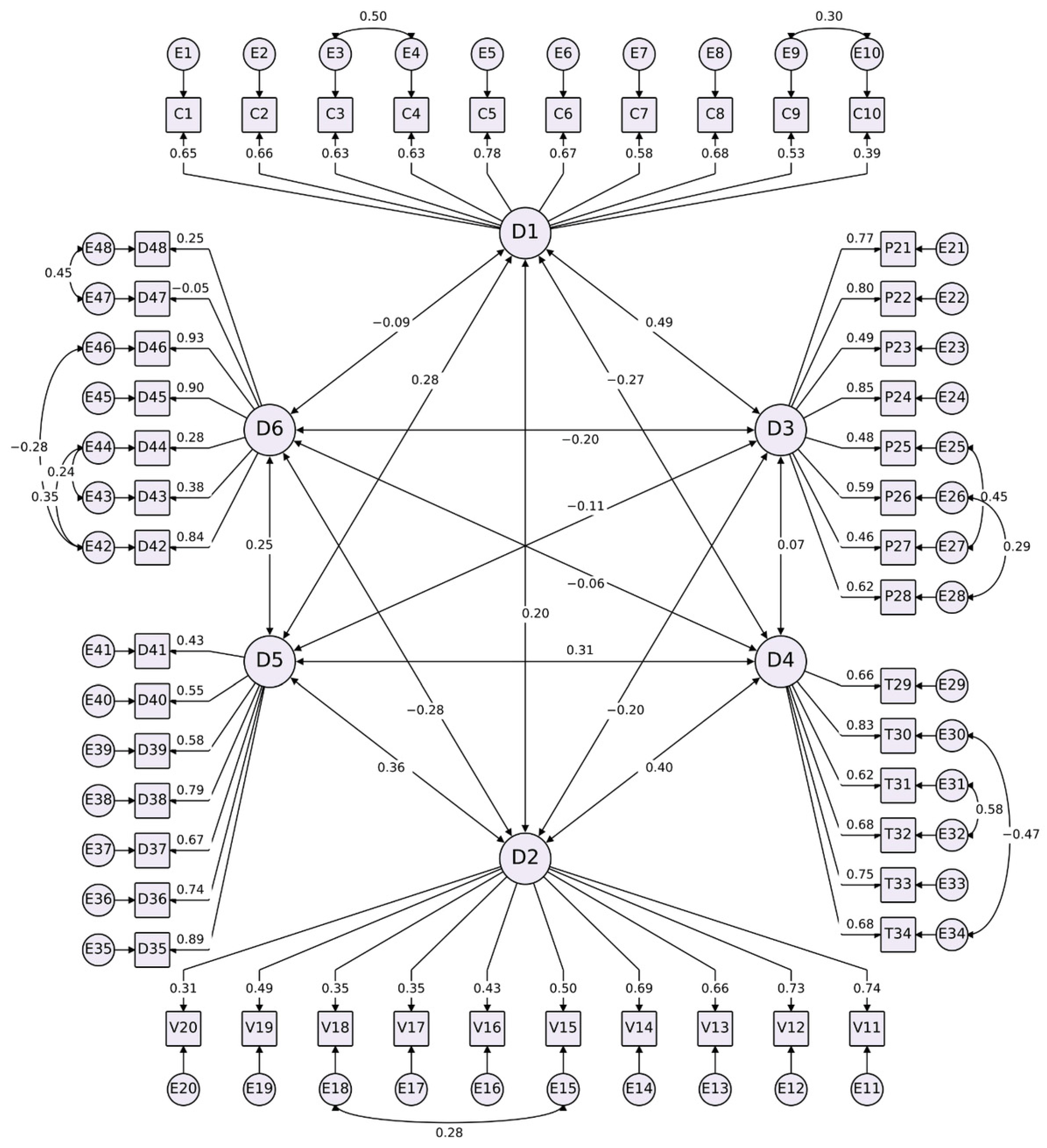
The standardized factor loadings of the 48 items on their respective latent constructs in the six-factor model are presented in Figure 1.
Figure 1.
Path diagram of the 48-item, six-factor MNGQ-PT model with correlated residuals.
3.6. Refinement of the Measurement Model
Following factor analysis of the 48-item MNGQ-PT model, item psychometric performance was examined, and poor performance was identified for item 47, worded “I willingly swap shifts with my colleagues”. The decision was made to remove item 47. This option is consistent with the instrument refinement process described in the literature [20], which involves examining items’ contribution to the construct and considering the exclusion of those with insufficient performance. This result may be related to difficulty in understanding the item content and to its subjective interpretation. However, it should be noted that, in the cross-cultural adaptation and content validation phase, item 47 obtained a content validity index of 1. In the 48-item MNGQ-PT model, item 47 showed a standardised factor loading close to zero, individual reliability (squared standardised loading) of 0.00, and an individual measure of sampling adequacy of 0.49. The decision to remove the item was not based on predefined criteria but was taken after examining the initial model, weighing its statistical performance against its conceptual contribution. Conceptually, item 47 reflects reciprocity and flexibility among colleagues in exchanging shifts, an aspect of work availability. However, shift exchange in hospital settings depends largely on rostering rules and managerial approval, so responses may reflect organisational constraints rather than individual propensity, which may explain its weak association with the remaining items. Its removal may narrow the coverage of this reciprocity facet, although the remaining six items continue to address important aspects of the Work propensity and availability dimension.
Consequently, a respecified 47-item MNGQ-PT model retaining the six-factor specification was evaluated in the same sample. The initial and respecified models were compared in terms of fit indices and the measurement properties of each dimension.
In the respecified model, the suitability of the data for factor analysis was verified. The inter-item correlations and corrected item–total correlations remained unchanged from those observed in the 48-item model. The homogeneity of the items comprising the scale was therefore considered acceptable.
The following table (Table 5) presents several reliability coefficients. When the scale was divided into two halves, Cronbach’s alpha was acceptable in both halves. The correlation between the two halves and the mean corrected item–total correlation were somewhat weak. The mean inter-item correlation was also low, owing to some negative or near-zero correlations alongside many moderate or even strong positive correlations. Guttman’s split-half coefficient and the Spearman–Brown coefficients were low. Overall, these coefficients suggest that the internal consistency of the instrument can be considered acceptable.
Table 5.
Reliability coefficients for the 47-item MNGQ-PT model.
The overall Kaiser–Meyer–Olkin measure of sampling adequacy was high (0.88). The item-level values were high or very high for almost all items, with the exception of items 45 and 46, both of which had a value of 0.68. Nevertheless, all item-level values were well above 0.50. These results indicate that the correlation matrix had good factorability and that factor analysis was therefore appropriate for these data. The results of the KMO measure of sampling adequacy for each item are available in the Supplementary Material, in Table S4, entitled “Kaiser–Meyer–Olkin (KMO) measure of sampling adequacy in the 47-item MNGQ-PT model.”
Following the removal of item 47, the six-factor model was re-estimated with the 47 retained items and respecified post hoc. Modification indices greater than 11 were used to screen fixed residual covariances for possible inclusion. This threshold was based on the chi-square critical value of approximately 10.83 for one degree of freedom. The final model included 17 within-factor residual covariances. Nine were retained from the respecified 48-item model (3–4, 9–10, 15–18, 25–27, 26–28, 30–34, 31–32, 42–44 and 43–44), and eight were added (1–2, 22–25, 23–25, 23–27, 30–33, 33–34, 35–36 and 42–43). The covariance between the residuals of items 42 and 46 was omitted, and that between items 47 and 48 was removed with item 47. As these modifications were data-driven, the resulting model should be evaluated in an independent sample.
In the respecified 47-item model, 212 non-redundant residuals (19%) exceeded 0.05 in absolute value, compared with 228 (20%) in the respecified 48-item model. The χ2/df ratio decreased from 2.77 to 2.59, and the MECVI decreased from 4.63 to 4.17. The CFI increased from 0.86 to 0.88, the TLI from 0.85 to 0.87, the IFI from 0.86 to 0.88, the GFI from 0.84 to 0.86 and the AGFI from 0.82 to 0.84. The RMSEA and RMR were 0.05 and 0.06, respectively, in both models at the reported precision. The final RMSEA was consistent with acceptable fit, while the CFI, TLI and IFI remained below 0.90.
Cronbach’s alpha for the full item set was 0.80 in both models and all dimensions demonstrated satisfactory internal consistency. For the Work propensity and availability subscale, Cronbach’s alpha increased from 0.69 to 0.73 and composite reliability (CR) from 0.65 to 0.70. Across the six subscales of the final 47-item model, Cronbach’s alpha ranged from 0.73 to 0.86 and CR from 0.70 to 0.86 (Table 6). Individual reliability estimates for all 47 retained items are available in the Supplementary Material, in Table S5, entitled “Individual item reliability in the final 47-item MNGQ-PT model”.
Table 6.
Reliability and convergent validity of the final 47-item MNGQ-PT model (n = 688).
The AVE for Working as a multigenerational team was 0.50. The AVE values for the other five dimensions were below the reference value of 0.50. They were 0.40 for Conflicts between generations, 0.30 for Patient safety view, 0.44 for Relationship issues between generations, 0.42 for Orientation to change and 0.35 for Work propensity and availability. These results indicate limited evidence of convergent validity across the six dimensions.
The psychometric properties of the six dimensions in the final 47-item model are presented in Table 6.
With regard to discriminant validity, the AVE for each dimension was clearly higher than its squared correlations with the other dimensions (Table 7). Consequently, all pairs of dimensions demonstrated discriminant validity, suggesting that the instrument had acceptable discriminant validity.
Table 7.
Matrix of squared correlations between the dimensions of the final 47-item MNGQ-PT model (n = 688).
These results suggest satisfactory subscale reliability alongside limited convergent validity in five dimensions.
Following the removal of item 47, the final 47-item Portuguese version (MNGQ-PT) follows the same procedures for administration, scoring and interpretation as the original instrument. Respondents use the same five-point response scale, items 17, 45 and 46 are reverse-scored, and responses are interpreted item by item within their respective subscales.
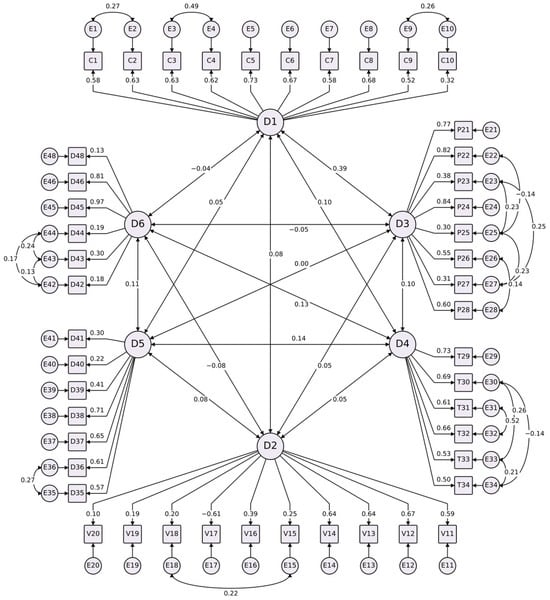
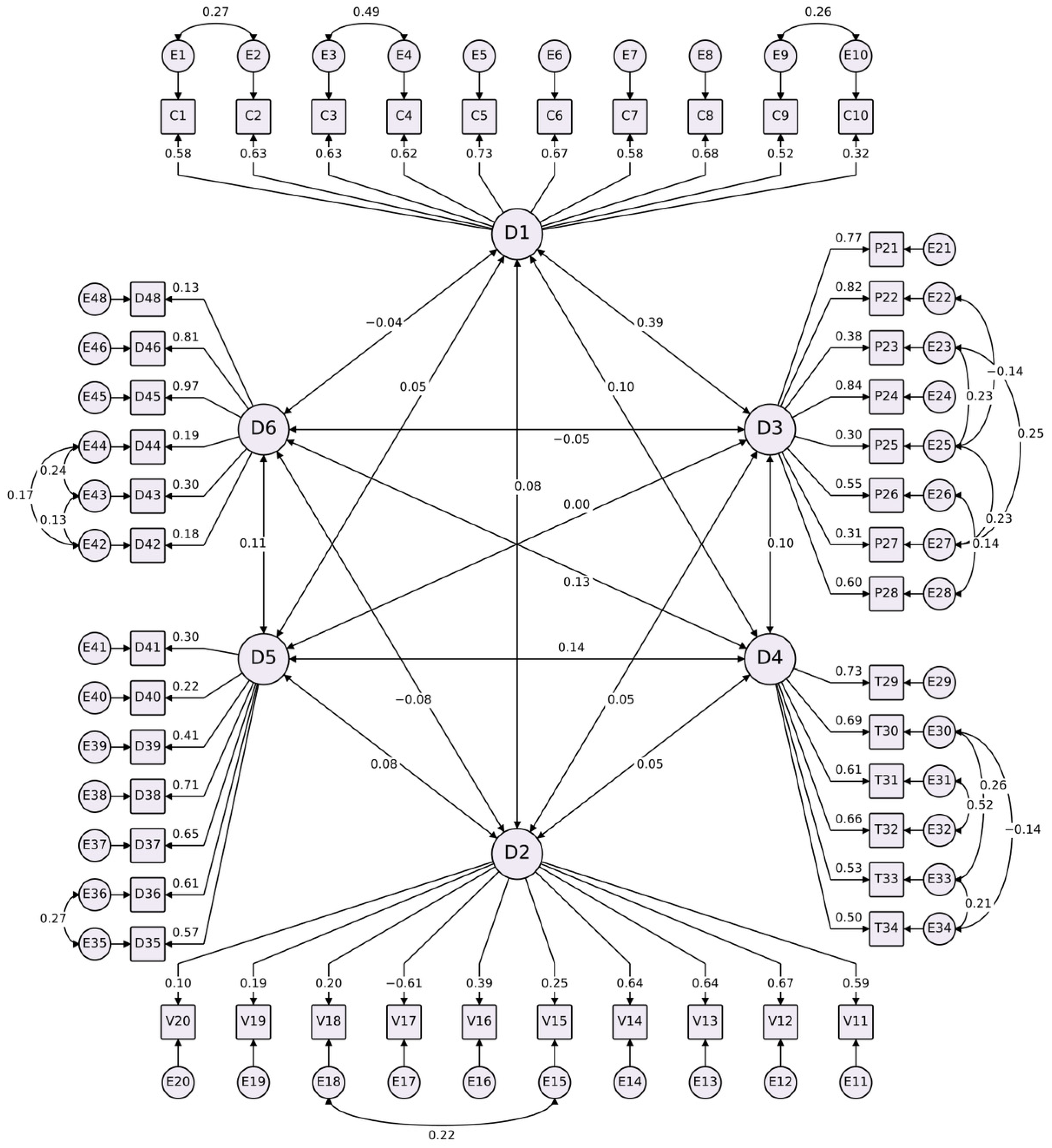
The standardised factor loadings of the 47 items on their respective latent constructs in the final six-factor model are presented in Figure 2.
Figure 2.
Path diagram of the final 47-item, six-factor MNGQ-PT model with correlated residuals.
4. Discussion
This study builds on the cross-cultural adaptation and content validation for Portugal [16] by examining empirical measurement properties in 688 hospital nurses. The final respecified 47-item MNGQ-PT model (final version of the 47-item MNGQ-PT model) showed satisfactory internal consistency and CR across the six dimensions.
The overall Kaiser–Meyer–Olkin value of 0.87 indicated good sampling adequacy. Inter-item correlations varied considerably, including negative, weak, moderate, and high correlations. This variability should be interpreted in light of the multidimensional nature of the MNGQ, which assesses six conceptually distinct but related aspects of intergenerational dynamics. Consequently, uniformly high correlations across all items would not necessarily be expected in an instrument designed to capture different dimensions of a complex construct [20].
The reformulated CFA retained the six-factor specification. However, despite an RMSEA of 0.05, CFI (0.88), TLI (0.87), and IFI (0.88) remained below 0.90. Compared with the original study, which reported CFI and TLI values of 0.99 [15], the Portuguese results show weaker structural support. Possible explanations include differences in item interpretation, organisational context, factor loadings, or estimation procedures, but these explanations were not directly tested.
The Polish validation [14] also reported limited initial fit of the original specification (χ2/df = 2.25, RMSEA = 0.05, RMR = 0.08, CFI = 0.89, and TLI = 0.89). After exploratory analysis and removal of five items, the 43-item model showed better fit in an independent CFA sample (χ2/df = 1.09, RMSEA = 0.02, RMR = 0.06, CFI = 0.99, and TLI = 0.99). The Portuguese 47-item instrument was evaluated in the same sample and therefore does not provide equivalent independent confirmation.
Subscale alpha values of the final Portuguese instrument ranged from 0.73 to 0.86, broadly approaching the range of 0.73–0.88 reported for the original instrument [15]. This similarity suggests that the dimensions retained comparable internal coherence following adaptation to the Portuguese nursing context. Collectively, these findings indicate that the six dimensions can achieve satisfactory reliability across different cultural settings, although their relative psychometric performance may vary.
Convergent validity is a limitation. Only Working as a multigenerational team reached AVE = 0.50, whereas the remaining dimensions ranged from 0.30 to 0.41. Thus, in five dimensions, the latent factor explained less than half of the variance of its indicators. Patient safety view (AVE = 0.30) and Work propensity and availability (AVE = 0.34) warrant particular caution. Heterogeneity of item content and context-dependent interpretation may explain these results.
The Polish version showed AVE values between 0.37 and 0.82, reaching 0.50 in four dimensions; Conflict between generations (0.42) and Patient safety view (0.37) remained below the reference value [14]. The low AVE for Patient safety view in both adaptations points to a domain requiring further investigation. Nevertheless, comparisons with the original and Polish versions should be interpreted cautiously, because the instruments comprise different numbers of items (48, 47, and 43) and the refinement procedures were not identical.
The present findings also respond directly to the recommendation made by the original authors of the MNGQ for further evaluation of the MNGQ across countries, cultures, healthcare systems, and working environments. Together with the Polish validation, the Portuguese results contribute to the emerging evidence supporting the international applicability of the MNGQ while also demonstrating that cultural adaptation may affect the performance of individual items. Further cross-cultural studies and formal measurement invariance analyses would be valuable to determine the extent to which scores can be directly compared across countries.
Potential applications of this research include examining nurses’ perceptions of conflict, intergenerational relationships, teamwork, patient safety, orientation to change, and work propensity. Overall, the final 47-item version of the MNGQ-PT may offer a promising tool for use in nursing practice settings, nursing management and leadership, and nursing research [25].
4.1. Limitations of the Study
Participants were recruited by convenience sampling from the hospital departments of a single Local Health Unit in northern Portugal. Selection bias is possible, and questionnaire return does not establish the representativeness of the eligible population. The findings apply to the hospital sample studied and cannot be generalised to all Portuguese nurses, such as those working in primary healthcare, or to other non-hospital settings without further evaluation.
The cross-sectional design precluded assessment of test–retest reliability and temporal stability. The final model was evaluated in the same sample used to identify item 47 for removal, so the observed improvement may be sample-specific. The AVE values below 0.50 in five dimensions limit structural and convergent validity.
The Portuguese, original, and Polish versions comprise different item sets, which limits direct comparisons. The effect of removing item 47 on the theoretical coverage of the Work propensity and availability dimension requires explicit evaluation. Future studies should examine more diverse Portuguese samples, include primary healthcare and other settings, assess temporal stability, and investigate measurement invariance across generational groups and cultural contexts.
4.2. Implications for Nursing Practice and Research
The final MNGQ-PT may provide a structured way to explore hospital nurses’ perceptions of intergenerational dynamics.
In nursing management, scores may inform exploratory discussion of perceived strengths and challenges in multigenerational teams. They should be interpreted together with contextual information and other sources of evidence.
The MNGQ-PT could be used in future research on nurse mentoring, intergenerational learning, staff induction and integration, patient safety, and staff retention.
Future organisational research may examine the relationship between the six dimensions and nursing practice environments. Such research should avoid attributing observed differences solely to generational membership and should consider professional experience and organisational context.
5. Conclusions
Following the cross-cultural adaptation and content validation of the MNGQ for use in Portugal [16], this study evaluated the measurement properties of the MNGQ-PT in a sample of 688 hospital nurses. The final 47-item version retained the six dimensions of the original instrument.
The six dimensions showed satisfactory reliability and acceptable discriminant validity. The fit indices provided mixed evidence for the six-factor structure. The RMSEA and χ2/df values were favourable, while the CFI, TLI and IFI remained below 0.90. Evidence of convergent validity was also limited, with only one dimension reaching the reference value of 0.50 for average variance extracted (AVE).
The MNGQ-PT may support research on nurses’ perceptions of generational diversity in hospital practice. As the study involved nurses from a single Local Health Unit, the final model would benefit from further evaluation in other healthcare settings, including primary care, to determine whether its factor structure and measurement properties can be replicated.
Supplementary Materials
The following supporting information can be downloaded at https://www.mdpi.com/article/10.3390/nursrep16110418/s1: Table S1:Corrected item-total correlation in the 48-item MNGQ-PT model; Table S2:Kaiser–Meyer–Olkin (KMO) measure of sampling adequacy in the 48-item MNGQ-PT model; Table S3: Individual reliability of each item in the 48-item MNGQ-PT model; Table S4: Kaiser–Meyer–Olkin (KMO) measure of sampling adequacy in the final 47-item MNGQ-PT model; Table S5: Individual reliability of each item in the final 47-item MNGQ-PT model:
Author Contributions
Conceptualization, S.F.M.D.C., L.D.L.T. and O.M.P.L.R.; Methodology, S.F.M.D.C., M.P.R., L.D.L.T. and O.M.P.L.R.; Software, S.F.M.D.C., M.P.R., J.M.A.V.D.S., P.J.F.C.T., L.D.L.T. and O.M.P.L.R.; Validation, S.F.M.D.C., M.P.R., J.M.A.V.D.S., S.S., L.D.L.T. and O.M.P.L.R.; Formal analysis, S.F.M.D.C., M.P.R., J.M.A.V.D.S., P.J.F.C.T., L.D.L.T. and O.M.P.L.R.; Investigation, S.F.M.D.C., M.P.R., L.D.L.T. and O.M.P.L.R.; Resources, S.F.M.D.C., M.P.R., L.D.L.T. and O.M.P.L.R.; Data curation, S.F.M.D.C., M.P.R., L.D.L.T. and O.M.P.L.R.; Writing—original draft preparation, S.F.M.D.C., M.P.R., P.J.F.C.T., L.D.L.T. and O.M.P.L.R.; Writing—review and editing, S.F.M.D.C., M.P.R., J.M.A.V.D.S., P.J.F.C.T., S.S., L.D.L.T. and O.M.P.L.R.; Visualization, S.F.M.D.C., M.P.R., J.M.A.V.D.S., S.S., L.D.L.T. and O.M.P.L.R.; Supervision, S.F.M.D.C., M.P.R., J.M.A.V.D.S., L.D.L.T. and O.M.P.L.R.; Project administration, S.F.M.D.C., L.D.L.T. and O.M.P.L.R. All authors have read and agreed to the published version of the manuscript.
Funding
This research received no external funding.
Institutional Review Board Statement
The study was conducted in accordance with the Declaration of Helsinki and approved by the Health Ethics Committee of the participating Local Health Unit (Approval No. 334/2024, approval date 31 October 2024). In addition, written permission was received from the original authors who developed the scale.
Informed Consent Statement
Informed consent was obtained from all subjects involved in the study.
Data Availability Statement
The data supporting the findings of this study are available from the corresponding author upon reasonable request. The dataset is not publicly available in order to protect participant confidentiality and to comply with the ethical and data-protection requirements applicable to the study.
Public Involvement Statement
No public involvement in any aspect of this research.
Guidelines and Standards Statement
This manuscript was prepared on the basis of COSMIN for methodological study research.
Use of Artificial Intelligence
AI or AI-assisted tools were not used in drafting any aspect of this manuscript.
Conflicts of Interest
The authors declare no conflicts of interest.
References
- Pereira, S.; Ribeiro, M.; Mendes, M.; Ferreira, R.; Santos, E.; Fassarella, C.; Ribeiro, O. Positive nursing practice environment: A concept analysis. Nurs. Rep. 2024, 14, 3052–3068. [Google Scholar] [CrossRef] [Scilit] [PubMed]
- Ribeiro, O.M.P.L.; Trindade, L.L.; Novo, A.F.M.P.; Rocha, C.G.; Sousa, C.N.; Teles, P.J.F.C.; Reis, A.C.R.S.; Perondi, A.R.; Andrigue, K.C.K.; Pereira, S.C.A.; et al. The COVID-19 pandemic and professional nursing practice in the context of hospitals. Healthcare 2022, 10, 326. [Google Scholar] [CrossRef] [Scilit] [PubMed]
- Ribeiro, O.M.P.L.; Vicente, C.M.F.B.; Sousa, C.N.; Teles, P.J.F.C.; Trindade, L.L.; Martins, M.M.F.P.S.; Cardoso, M.F.P.T. Scale for the Environment Evaluation of Professional Nursing Practice: Construct validation. J. Nurs. Manag. 2021, 29, 1809–1818. [Google Scholar] [CrossRef] [Scilit] [PubMed]
- Aungsuroch, Y.; Gunawan, J.; Juanamasta, I.G.; Montayre, J. Updating factors influencing nurse work engagement in hospital settings: A systematic review. J. Healthc. Leadersh. 2024, 16, 157–176. [Google Scholar] [CrossRef] [Scilit] [PubMed]
- Lucas, P.; Jesus, É.; Almeida, S.; Costa, P.; Cruchinho, P.; Teixeira, G.; Araújo, B. The nursing practice environment and job satisfaction, intention to leave, and burnout among primary healthcare nurses: A cross-sectional study. Nurs. Rep. 2025, 15, 224. [Google Scholar] [CrossRef] [Scilit] [PubMed]
- Moisoglou, I.; Katsiroumpa, A.; Katsapi, A.; Konstantakopoulou, O.; Galanis, P. Poor nurses’ work environment increases quiet quitting and reduces work engagement: A cross-sectional study in Greece. Nurs. Rep. 2025, 15, 19. [Google Scholar] [CrossRef] [Scilit] [PubMed]
- Ribeiro, O.M.P.L.; Perondi, A.R.; Gomes, J.T.; Ventura-Silva, J.M.A.; Ribeiro, M.P.; Castro, S.F.M.; Oliveira, T.D.F.; Trindade, L.L. Nursing practice environments in hospitals: A comparative study between Portugal and Brazil. Nurs. Rep. 2024, 14, 2910–2922. [Google Scholar] [CrossRef] [Scilit] [PubMed]
- Sanches, D.; Pereira, S.; Castro, S.; Mendes, M.; Santos, E.; Ribeiro, O. Generational diversity in nursing practice environments: A scoping review. BMC Nurs. 2024, 23, 928. [Google Scholar] [CrossRef] [Scilit] [PubMed]
- Tussing, T.E.; Chipps, E.; Tornwall, J. Generational differences in the nursing workforce: Strategies for nurse leaders. Nurse Lead. 2024, 22, 602–608. [Google Scholar] [CrossRef] [Scilit]
- Tan, S.H.E.; Chin, G.F. Generational effect on nurses’ work values, engagement, and satisfaction in an acute hospital. BMC Nurs. 2023, 22, 88. [Google Scholar] [CrossRef] [Scilit] [PubMed]
- Abujaber, A.A.; Nashwan, A.J.; Santos, M.D.; Al-Lobaney, N.F.; Mathew, R.G.; Alikutty, J.P.; Kunjavara, J.; Alomari, A.M. Bridging the generational gap between nurses and nurse managers: A qualitative study from Qatar. BMC Nurs. 2024, 23, 623. [Google Scholar] [CrossRef] [Scilit] [PubMed]
- Wright, M.I.; Sha, S.; Hall, L.A.; Hessler, B. Factors in the perioperative nurses’ work environment that predict work engagement. AORN J. 2024, 119, e1–e12. [Google Scholar] [CrossRef] [Scilit] [PubMed]
- Chiminelli-Tomás, V.; Tutte-Vallarino, V.; Ferreira-Umpiérrez, A.; Hernández-Morante, J.J.; Reche-García, C. Impact of nursing practice environments on work engagement and burnout: A systematic review. Healthcare 2025, 13, 779. [Google Scholar] [CrossRef] [Scilit] [PubMed]
- Pawlak, N.; Serafin, L.; Czarkowska-Pączek, B. Generational nursing challenges: Cross-cultural adaptation and validation of the Multidimensional Nursing Generations Questionnaire. J. Adv. Nurs. 2026, 82, 1706–1715. [Google Scholar] [CrossRef] [Scilit] [PubMed]
- Stevanin, S.; Mikkonen, S.; Bressan, V.; Vehviläinen-Julkunen, K.; Kvist, T. Psychometric validation of the Multidimensional Nursing Generations Questionnaire. J. Adv. Nurs. 2019, 75, 3147–3155. [Google Scholar] [CrossRef] [Scilit] [PubMed]
- Castro, S.; Ribeiro, M.; Sanches, D.; Stevanin, S.; Trindade, L.; Ribeiro, O. Multidimensional Nursing Generations Questionnaire: Cross-cultural adaptation and content validation for the Portuguese context. Millenium—J. Educ. Technol. Health 2026, 2, e42856. [Google Scholar] [CrossRef]
- Mokkink, L.B.; Terwee, C.B.; Knol, D.L.; Stratford, P.W.; Alonso, J.; Patrick, D.L.; Bouter, L.M.; de Vet, H.C. The COSMIN checklist for evaluating the methodological quality of studies on measurement properties: A clarification of its content. BMC Med. Res. Methodol. 2010, 10, 22. [Google Scholar] [CrossRef] [Scilit] [PubMed]
- Kline, R.B. Principles and Practice of Structural Equation Modeling, 5th ed.; Guilford Press: New York, NY, USA, 2023. [Google Scholar]
- Stefana, A.; Damiani, S.; Granziol, U.; Provenzani, U.; Solmi, M.; Youngstrom, E.A.; Fusar-Poli, P. Psychological, psychiatric, and behavioral sciences measurement scales: Best practice guidelines for their development and validation. Front. Psychol. 2025, 15, 1494261. [Google Scholar] [CrossRef] [Scilit] [PubMed]
- Boateng, G.O.; Neilands, T.B.; Frongillo, E.A.; Melgar-Quiñonez, H.R.; Young, S.L. Best practices for developing and validating scales for health, social, and behavioral research: A primer. Front. Public Health 2018, 6, 149. [Google Scholar] [CrossRef] [Scilit] [PubMed]
- Swan, K.; Speyer, R.; Scharitzer, M.; Farneti, D.; Brown, T.; Woisard, V.; Cordier, R. Measuring what matters in healthcare: A practical guide to psychometric principles and instrument development. Front. Psychol. 2023, 14, 1225850. [Google Scholar] [CrossRef] [Scilit] [PubMed]
- COSMIN. COSMIN Risk of Bias Checklist for PROMs, Version 3.1; COSMIN: Amsterdam, The Netherlands, 2024; Available online: https://www.cosmin.nl/wp-content/uploads/COSMIN-RoB-checklist-for-PROMs-V3_1.pdf (accessed on 5 January 2025).
- Hair, J.F., Jr.; Hult, G.T.M.; Ringle, C.M.; Sarstedt, M.; Danks, N.P.; Ray, S. Evaluation of reflective measurement models. In Partial Least Squares Structural Equation Modeling Using R: A Workbook; Springer: Cham, Switzerland, 2021; pp. 75–90. [Google Scholar] [CrossRef] [Scilit]
- Cheung, G.W.; Cooper-Thomas, H.D.; Lau, R.S.; Wang, L.C. Reporting reliability, convergent and discriminant validity with structural equation modeling: A review and best-practice recommendations. Asia Pac. J. Manag. 2024, 41, 745–783. [Google Scholar] [CrossRef] [Scilit]
- Ribeiro, O.; Martins, M.M.F.P.S.; Tronchin, D.M.R. Nursing care quality: A study carried out in Portuguese hospitals. Rev. Enferm. Ref. 2017, IV, 89–100. [Google Scholar] [CrossRef] [Scilit]

Disclaimer/Publisher’s Note: The statements, opinions and data contained in all publications are solely those of the individual author(s) and contributor(s) and not of MDPI and/or the editor(s). MDPI and/or the editor(s) disclaim responsibility for any injury to people or property resulting from any ideas, methods, instructions or products referred to in the content. |
© 2026 by the authors. Licensee MDPI, Basel, Switzerland. This article is an open access article distributed under the terms and conditions of the Creative Commons Attribution (CC BY) license.