


Abstract
Bidens pilosa L. is a widespread weed that invades grasslands, agricultural fields, and roadsides, and outcompetes indigenous plant species for resources, posing significant challenges to sustainable agricultural management. The study investigated the allelopathic potential of different P. glomerata plant parts on the germination and growth of B. Pilosa and identified secondary metabolites potentially responsible for the herbicidal activity. Rhizome and leaf aqueous extracts were prepared in 0, 1, 2, 3, 4 and 5% (w/v) concentrations, where the control was distilled water. Bidens pilosa seeds were subjected to a germination assay, and seedlings were foliar sprayed with the extracts in a completely randomized design. The phytochemical composition was analyzed by Gas Chromatography–Mass Spectrometry. The results demonstrated that P. glomerata extracts at ≥2% concentrations retarded seed germination and seedling growth of B. pilosa, whereas concentrations of ≥4% inhibited germination. Aqueous foliar application reduced plant height and chlorophyll content and caused leaf morphological deformities including chlorosis, necrosis, leaf folding, and purple and black spots. The phytochemical analysis revealed the presence of alkanes, cyclic alkanes, aromatic hydrocarbons, alkaloids, fatty acids ester, fluorinated esters, and thiols phytochemical groups. These findings highlight the allelopathic potential of P. glomerata aqueous extracts. However, more studies are required to determine their effects in field application as potential candidates for bioherbicide development.
1. Introduction
Allelopathy, a natural ecological phenomenon in which plants either stimulate or inhibit the germination and growth of other plants by releasing secondary metabolites into the environment [1], represents a promising avenue for sustainable weed management. These secondary metabolites are found in different plant organs, such as roots, rhizomes, stems, leaves, fruits, fruit coat, flowers, pollen and seeds [2], and are released through root exudation, volatilization, leaf leaching, and the breakdown of plant material in the soil [3]. Allelopathy can therefore be used as a mechanism and a future strategy for ecological and agricultural farm management to potentially develop natural bioherbicides for weed control [4].
Bidens pilosa L., a member of the Asteraceae family, is a weed distributed across temperate and tropical regions of the world [5,6]. It invades grasslands, agricultural fields and roadsides, and thus outcompetes indigenous plant species for resources [7]. The high seed production, adaptability and rapid spread of this weed make it particularly difficult to control [8]. The commonly used method for applying herbicides on weeds is through foliar spraying, where the leaves become the main site of entry [9]. However, this practice causes leaf morphological deformities such as chlorosis and necrosis [10,11], and the utilization of synthetic herbicides leads to substantial costs, while their excessive application results in detrimental effects on both the environment and human health [12]. This highlights the need for alternative, eco-friendly approaches to weed control.
Plant secondary metabolites, including phenolic compounds, alkaloids, terpenoids and sulphur-containing compounds, are among the most common bioactive molecules with allelochemical potential [13]. Terpenes interfere with plant cell processes by inhibiting mitosis and decreasing cellular respiration and chlorophyll content [14]. They more broadly affect seed germination by disrupting cell division, cellular differentiation, water and ion transport, phytohormone metabolism, respiration, photosynthesis, enzymatic processes and lipid peroxidation of the cell membrane [15,16]. Additionally, phenolic compounds such as phenols and phenolic acids assist plants in defending themselves against biotic stressors, pests, pathogens and herbivores [17]. It is also well established that different plant parts perform specific functions, which reflect diversity in phytochemical composition, such as roots, stems, leaves, fruits and flowers, each possessing distinct chemical profiles related to their individual roles [18,19]. The allelopathic potential of plant extracts has been demonstrated across several species. For instance, Curcuma longa L. leaf aqueous extract at 2 and 4% concentrations significantly reduced the germination and growth of Lactuca sativa [20], while Zingiber officinale Rosc. rhizome and leaf aqueous extracts at 10–80% concentrations affected the germination and seedling growth of Glycine max L. (Merrill) and Allium schoenoprasum L. [21].
Platycarpha glomerata (Thunb.) Less. is a perennial herbaceous plant of the Asteraceae family traditionally used in medicine, and widely studied for its antiproliferative, antibacterial and antioxidant pharmacological properties [22]. Platycarpha glomerata grows inland of the eastern portion of KwaZulu-Natal and the Eastern Cape and thrives in poor, rocky soils in damp, humid places and in disturbed areas [22]. Given its rich phytochemical profile and its membership in the same family as B. pilosa, P. glomerata represents a promising candidate for investigating allelochemical activity.
The rhizome and leaf were selected as the focal plant parts for this study for two reasons. First, preliminary screening trials comparing aqueous extracts of the stem, seeded fruit, rhizome and leaf of P. glomerata against B. pilosa germination showed that the rhizome and leaf extracts produced the strongest and most consistent inhibitory responses (Supplementary Data S3); the stem and seeded fruit extracts were therefore not carried forward into the main experiments. Second, rhizome and leaf are physiologically and functionally distinct organs. The rhizome is a below-ground storage and translocation organ, whereas the leaf is the principal site of photosynthesis and, in many species, of secondary-metabolite biosynthesis [23,24]. Comparing these two organs therefore provides a basis for examining whether organ-specific physiological roles correspond to differences in phytochemical composition and allelopathic potency, in addition to identifying the secondary metabolites potentially responsible for the herbicidal activity of P. glomerata.
Incorporating allelochemicals derived from such plants into agricultural management may, pending further validation, contribute to reducing reliance on synthetic herbicides for weed control [25]. Therefore, the objectives of this study were to investigate the effects of concentration and potential phytochemicals of P. glomerata rhizome and leaf extracts on the germination and growth of B. pilosa.
2. Materials and Methods
2.1. Sourcing and Preparation of Plant Materials
Bidens pilosa, seeds and Platycarpha glomerata plants were both collected from naturally occurring populations at the University of Zululand farm, KwaDlangezwa Campus, KwaZulu-Natal, South Africa (28°51′0″ S, 31°49′60″ E). Mature plants of Platycarpha glomerata were sourced (using the uprooting harvest method) from KwaDlangezwa’s main campus (28°50.04″ S, 31°17.27″ E). The botanical identification of both plants was verified by a taxonomist/ecologist from the Department of Botany, University of Zululand. We did not look at genotypic variation in either species.
Excess soil was manually removed from each plant and washed under a gently running tap. Plants were separated into rhizomes and leaves. Material from each plant part was blot-dried with a paper towel (Kleenex, Kim-Dry Tissue, Irving, TX, USA) and spread out in the laboratory for shade-drying at room temperature (±25 °C) for 24 h. Plant parts were chopped into smaller pieces and oven-dried at 50 °C until a constant dry weight was obtained. Previous research has identified 50 °C drying temperature as optimal for maximizing essential oil detection [19]. Plant material was ground into a fine powder using a three-bladed rotary hammer mill grinding machine with a 2 mm pore-sized sieve. The resulting powder was labelled and stored in plastic honey jar containers at room temperature (±25 °C) until used.
2.2. Extract Preparation
Powders of 1, 2, 3, 4 and 5 g from P. glomerata rhizome and leaves were measured using a balance (PM600, Mettler-Toledo AG, Switzerland), according to [26], with some modifications. These powders were soaked separately for 24 h in 100 mL distilled water to produce 1, 2, 3, 4 and 5% (w/v) extracts for each plant part. These concentrations were adopted from [26]. Each mixture was filtered through Whatman No. 1 filter paper using a vacuum pump (Merck diaphragm vacuum pump, ME 2, Darmstadt, Germany). The filtrates were transferred into 100 mL beakers and stored in the refrigerator until used.
2.3. Seed Germination Study
The seed germination study was conducted in 90 mm diameter plastic Petri dishes that were lined with a double layer of Whatman No. 4 filter paper. Petri dishes contained 5 mL of 1, 2, 3, 4 and 5% (w/v) of each plant extract, including the control (distilled water). All treatments were replicated five times and arranged in a completely randomized design (CRD). Trial 1 and trial 2 were conducted separately, serving both as a repetition and to enable comparison between the two trials. Seeds of B. pilosa were initially soaked in distilled water for one hour and thereafter ten seeds were placed in Petri dishes that contained plant extracts, including the control. Germination was conducted in a growth chamber that was set at room temperature (25 °C) under continuous white light conditions. When necessary, a maximum of 5 mL of extract and/or distilled water was added to keep the filter papers moist. Seeds with protruding radicles were considered germinated. The number of germinated seeds was recorded daily for seven days after seed sowing. Germination count data were used to calculate the following parameters: germination percentage, Timson’s index of germination velocity, speed of germination and seedling vigour index. The germination inhibition of Bidens pilosa in this study refers to the total germination at the end of the experiment, as reported in a previous study [27], referring to the same terminology reflecting B. pilosa inhibition by plant extracts.
2.3.1. Germination Percentage
The number of germinated seeds was counted daily, with the first count commencing a day after seed sowing and the final count on the fifth day. The seeds were considered germinated when there was a radicle protrusion [28].
The germination percentage was established through the following formula:
2.3.2. Germination Velocity
Timson’s index of germination velocity = Σ G/t was used to calculate the rate of germination, where G is the percentage of seed germination at one-day intervals and t is the total germination period (the higher the value the more rapid the germination [29].
2.3.3. Germination Speed
The number of germinations was counted daily, where n is the number of newly germinated seeds at time t, and t is the number of days from sowing [28].
The cumulative index was calculated by the formula:
2.3.4. Seedling Vigour Index (SVI)
The seedling size (radicle and plumule lengths (mm) was measured seven days after sowing using a tape measure. Radicle length was determined from the tip of the radicle until where the plumule starts. The plumule was measured from where it meets the radicle to the tip. Ten seedlings served as replicates to calculate the mean for radicle, plumule and seedling length. The seedling length of the test was obtained by the summation of the radicle and plumule length (mm) of each seedling. Seedling vigour was calculated by multiplying the germination percentage and the mean seedling length, as expressed in the following formula by [28]:
SVI = germination % × Seedling length (Radicle and plumule)
2.4. Plant Treatment
The study was conducted in an enclosed, controlled rainproof greenhouse in the Department of Botany, University of Zululand. The experiment used a completely randomized design (CRD) with three replicate pots per rhizome or leaf extract concentration treatment in each trial; because the rhizome and leaf treatment series at a given concentration were run in the same block, they shared one control (distilled water) pot rather than each series having its own separate control.
The experiment was repeated for two trials. The plant treatments comprised a control (distilled water) and extracts from the rhizome and leaf of P. glomerata in 1, 2, 3, 4 and 5% concentrations each. A total of 98 plastic pots (120 × 159 mm) were each filled with a mixture of clay (25%) and sandy (75%) soil. Prior to seed planting, pots were irrigated with distilled water to pot capacity.
Bidens pilosa seeds were soaked in distilled water for an hour prior to seed sowing. Ten imbibed seeds were then placed on top of the soil in pots and subsequently covered with a thin layer of vermiculite. Irrigation was conducted, when necessary, from seed sowing until the B. pilosa plants reached two sets (pairs) of true leaves. Extracts from P. glomerata plant parts were applied using a 100 m L transparent compressed air spray bottle. Prior to the foliar spray, irrigation with water was performed to activate turgidity in guard cells, which eventually facilitates stomatal opening and enhances the absorption of the extracts. Plants received 3 mL of the respective extract every two days for 21 days. The foliar application was done at two-day intervals throughout the treatment. The measurements of plant growth parameters were conducted at 7-, 14-, and 21-day intervals until 21 days after treatment, according to [27], methodology. Control plants were sprayed with distilled water.
Measurements of B. pilosa plants, including plant height (mm), leaf area (width and length) (mm2) and chlorophyll content (mol/m2) were taken from the first set (pair) of true leaves and were recorded at 7, 14 and 21 days after treatment. Four plants from each pot were used as subsamples. Measurements from each pot were averaged to produce one value for each pot. Plant height was measured from the soil level to the upper point of the terminal bud of the plant using a 300 mm ruler. The chlorophyll content of all plants at each concentration was measured using a portable chlorophyll metre (Spad-502 plus, Konica-Minolta, Tokyo, Japan), with five readings taken on one leaf for all treatments. The readings were recorded by placing the chlorophyll metre from the tip to the middle of the leaf and from the middle of the midrib to the leaf margin.
Leaf area according to [30].
where A = area of the leaf, L = length of the leaf, W = width of the leaf and 0.75 = a constant. Using a constant contributes to increasing the accuracy of the leaf area calculation [31].
A = L × W × 0.75
2.5. Phytochemical Analysis GC-MS
2.5.1. Aqueous Extraction
An extract from each plant part was prepared by soaking 5 g of the powder in 100 mL of distilled water for 24 h at room temperature. The mixture was filtered through No. 1 Whatman filter paper using a vacuum pump (Merck diaphragm vacuum pump, ME 2). The filtrate was transferred into 100 mL beakers and evaporated at 50 °C in an oven (Labcon incubator, Model 5016LC, LABCON laboratory equipment, Krugersdorp, South Africa) until the contents were dry. The final residue obtained from drying was stored in prepared beakers until used for phytochemical analysis by GC-MS. The samples were replicated three times. The three replicates of the rhizome and leaf extracts were combined to obtain a single composite list of phytochemicals, ensuring that as many phytochemicals as possible were captured. When the same compound fragment appeared more than once in the composite list, the retention times were averaged, and the chromatographic peak percentages were summed to obtain a single retention time and percentage value for that compound fragment.
2.5.2. GC-MS Instrumentation
The instrument used was a Shimadzu GC-MS QP-2010SE (Shimadzu, Kyoto, Japan) and fitted with a Zebron ZB-5MSplus (30 m × 0.25 mm, 0.25 um d.f) column. The instrument was not equipped with a FID. The ultra-high purity grade (Afrox, Gauteng, South Africa) carrier gas, helium, was used and operated at a flow rate of 7.5 kPa with a flow of 109 mL/min, column flow of 1.32 mL/min, linear velocity of 41.5 cm/sec. The purge flow was 3.0 mL/min. The column oven temperature was initially maintained at 40 °C for 1 min, then increased to 200 °C at a ramping rate of 12 °C per min, with a holding time of 20 min. The split injection mode was used with an injection temperature of 200 °C at a split ratio of 5.0 (Supplementary Data S4). The solvent cut time was 3 min; the mass spectrometer detection was performed in scan acquisition mode, with an ion source and interface temperature set at 200 °C, respectively.
The phytochemical analysis of the sample was conducted using an auto system buck 530 chromatograph in the gas phase equipped with an on-column automatic injector and Hp88 capillary column (100 m × 0.25 mm internal diameter and 0.25 μm film thickness) from Restek (Bellefonte, PA, USA). Chromatographic conditions were calibrated to an injector temperature of 200 °C, detector temperature of 250 °C, oven temperature of 180 °C, injection volume = 1 mL of the sample, and hydrogen was used as a carrier gas (165.474 kPa).
2.5.3. Identification and Quantification of Phytochemical Constituents
The phytochemical composition of the residues from aqueous extracts was tentatively identified and quantified similarly, following the protocol that is explained hereafter. The mixture of n-hexane and dichloromethane was used to solubilise the dried extract to capture a wide range of non-polar compounds and polar compounds. However, we cannot confirm that all phytochemicals were detected. The Supplementary Data S2c displays the blank used, which consists of a solvent mixture of n-hexane and dichloromethane, injected at the same volume.
A total of 100 μL of n-hexane was used to solubilise the sample, of which 20 μL was transferred to a vial on the Gas Chromatography (GC-MS) machine for phytochemical analysis. However, before transfer into the GC analyser, samples were filtered through short (~4 mm) silica plugs before injection to remove any highly polar compounds that would stick on and clog the column, as well as any compounds that would combust (as opposed to volatilise into the gas phase) in the injection port, such as sugars. Reagent n-hexane (CAS number 110-54-3) was purchased from Laboquip supplier, KwaZulu-Natal, South Africa).
2.5.4. Data Analysis
The data on germination and plant treatment of trials (1 and 2) and GC-MS data analysis on the comparisons of the relative chromatographic area percentage to determine which plant parts contained high proportions of the identified compounds were also subjected to analysis of variance (ANOVA) using the GenStat® Version 23 (VSN International, Hemel Hempstead, UK) package (VSN International, 2009). Trials (1 and 2), plant parts and concentrations were included in the statistical model to determine the effects of plant parts and their concentrations on B. pilosa weed across two trials. The two experimental trials were included in the analysis to determine the variation between trials. The main effects of extract (rhizome/leaf), concentration and trial were tested, together with the extract × concentration, concentration × trial and extract × concentration × trial interaction terms, to determine whether treatment effects differed between trials and concentrations. Tukey’s test was used to separate means at the 5% significance level where a main effect or interaction was significant; where the concentration × trial interaction was significant for a given response variable, trial-level means are interpreted accordingly rather than pooled.
The gas chromatographic data acquired from the Shimadzu GC-MS were run using software and the Agilent offline station. The software was equipped with standard mass libraries (NIST) and was used to identify volatile compounds. The tentative assessment of compound identification was based on the concentration of each active component was determined based on the ratio between the area and the area of the peaks of the tentatively identified phytochemicals. The chemical compounds (analytes) were tentatively identified by relating their retention times with those of the polychlorinated biphenyl (PCB) standards found in the National Institute of Standards and Technology (NIST) library. The GC-MS analysis was an untargeted analysis. Therefore, no standards were used for the study; this is mainly a baseline study to identify compounds. The internal standards for Phenolic Acids, Flavonoids, Terpenoids, Alkaloids, Saponins and Quinones (among others) were utilized. To verify the compounds, we used the following applications and search engines: MS Dial, MS Finder and NIST. For visualization of these compounds, we used a software called SIMCA, version 13.0.3.
3. Results
The reduction and absence of Bidens pilosa L. seed germination differed significantly (p < 0.05) when seeds were exposed to different concentrations of Platycarpha glomerata rhizome and leaf extracts (Table 1). The 5% extract in the first trial, as well as the 4% and 5% extracts in the second trial from P. glomerata rhizomes, inhibited the germination of B. pilosa, respectively. The absence of B. pilosa seed germination was also recorded at 4 and 5% P. glomerata leaf extracts in both trials. Therefore, the values for all tested germination parameters (germination percentage, speed, velocity and vigour index) failed to germinate at these concentrations.
Table 1.
Effects of P. glomerata rhizome and leaf extracts on the germination of B. pilosa seeds.
3.1. Effects of Platycarpha glomerata Rhizome and Leaf Aqueous Extracts on Bidens pilosa Seed Germination
Platycarpha glomerata rhizome and leaf extracts at a minimum of 2% in the first and second trials, respectively, induced lower germination percentages than the control (Table 1). However, the differences were insignificant when comparing the results of both trials at all concentrations. Platycarpha glomerata rhizome and leaf extracts at a minimum of 1% in the first and second trials, respectively, reduced the germination velocity, speed and seedling vigour when compared with the control. The effect of P. glomerata on Bidens pilosa was greater in the second trial than the first trial, for all germination parameters.
The lengths of Bidens pilosa radicles and plumules differed significantly (p < 0.05) when seeds were exposed to different extract concentrations of Platycarpha glomerata rhizome and leaves (Table 2). Lengths of B. pilosa radicles and plumules were not measured under 5% P. glomerata rhizome in the first trial, as well as under 4 and 5% P. glomerata rhizome and leaf extracts during the first and second trials, because no germination was observed at these concentrations. Platycarpha glomerata rhizome and leaf extracts at a minimum of 1% in both trials resulted in shorter B. pilosa radicles and plumules when compared with the control. However, comparisons between trials at 1 and 2% of P. glomerata rhizome extracts, as well as at 1, 2 and 3% of leaf extracts, recorded shorter B. pilosa radicles and plumules in the first than in the second trial.
Table 2.
Size of Bidens pilosa seedlings exposed to different extracts of P. glomerata plant parts.
3.2. Morphological Deformities
The foliar treatment of P. glomerata rhizome and leaf extracts significantly affected the leaf chlorophyll content of B. pilosa plants at 14 days after treatment (DAT) as well as plant height at 21 DAT (Table 3). All (1–5%) concentrations of rhizome extracts in the first trial and of 2, 3 and 4% in the second trial reduced the leaf chlorophyll content when compared with the control. Furthermore, all concentrations of leaf extracts in the first trial and of 1, 2 and 5% in the second trial lowered the chlorophyll content when compared with the control. Comparisons of the results in both trials showed no differences in the chlorophyll content for both rhizome and leaf extracts.
Table 3.
Effects of Platycarpha glomerata extracts on the morphology of Bidens pilosa plants.
Platycarpha glomerata rhizome extracts at 4 and 1% reduced the height of B. pilosa plants when compared with the control in the first and second trials, respectively (Table 3). Plants treated with 2 and 4% leaf extracts were shorter than the control in trial one. Leaf extract at 2% concentration resulted in taller plants than 4% in the first trial. Comparisons between trials at 2% leaf extract showed that plants were shorter in the first than in the second trial. Foliar application of P. glomerata rhizome and leaf extracts in all concentrations did not affect B. pilosa leaf area in both trials. The differences were insignificant when comparing the results of both trials in all concentrations of P. glomerata rhizomes and leaves.
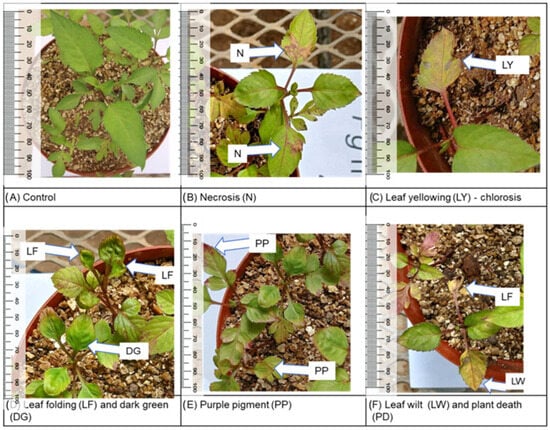
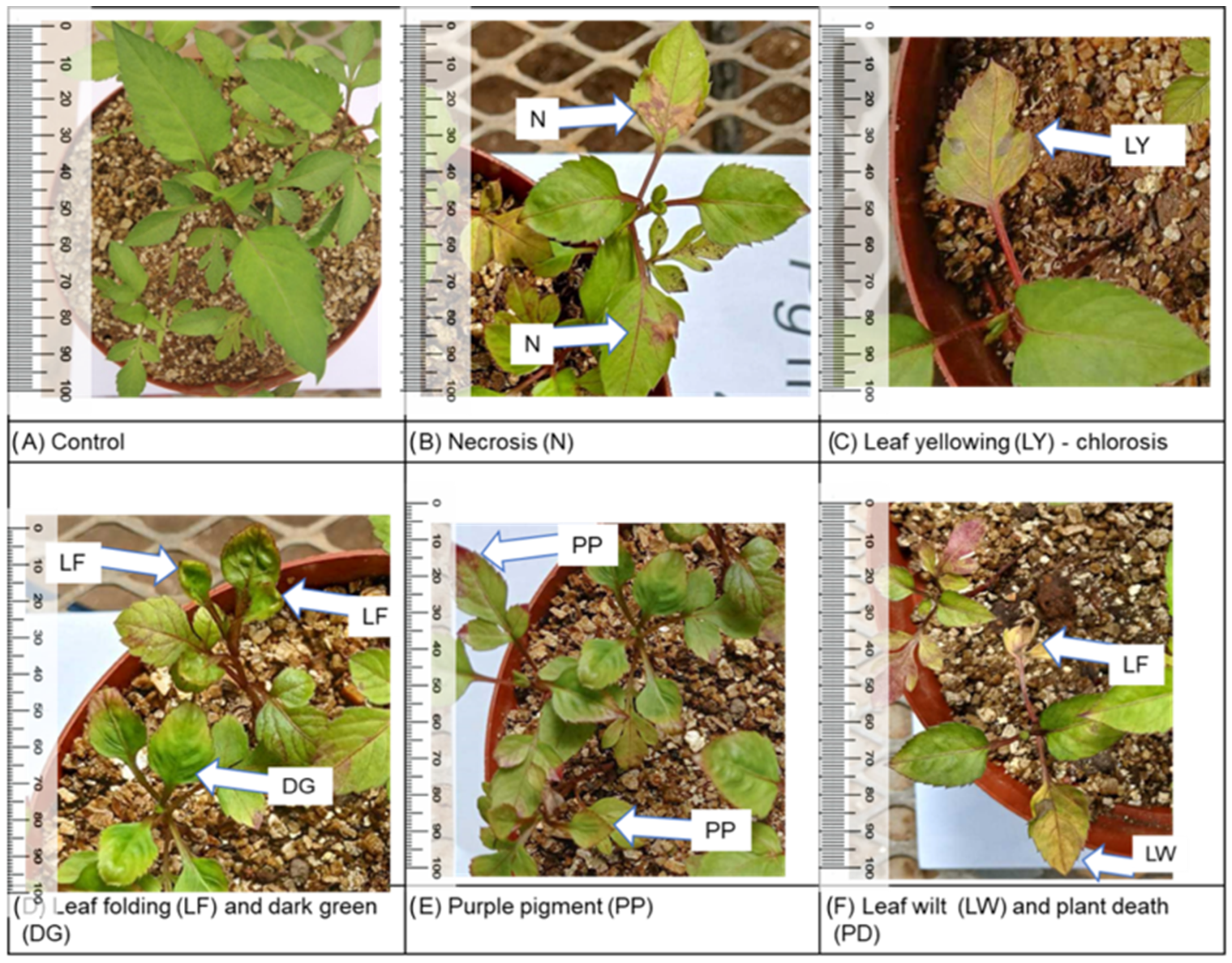
Defects in B. pilosa leaves after foliar spray using different concentrations of P. glomerata rhizome and leaf extracts showed the following deformities: necrosis, chlorosis, leaf folding, necrotic brown spots, dark green colour, black, purple spots, purple pigments and leaf wilting along the leaf midrib, base, leaf edges, or leaf tips and margins during trials one and two (Figure 1). Defects first appeared at 1% and intensified as the concentration increased. The deformations on B. pilosa leaves started to appear at 3 DAT and increased as the plant grew to 21 DAT.
Figure 1.
Effects of P. glomerata extracts on the morphology of B. pilosa leaves: (A) untreated control (B) necrotic brown spots; (C) leaf yellowing (chlorosis); (D) leaf folding and dark green leaves; (E) purple pigmentation; and (F) leaf wilting and falling. Integrated on a 0 to 100 mm scale.
3.3. Phytochemical Composition of Platycarpha glomerata
Platycarpha glomerata rhizomes and leaves had a total of 119 and 100 phytochemical compounds, respectively. Among these, 62 compounds were common between rhizomes and leaves, with fourteen phytochemicals showing significant differences in area percentages (Table 4). Also, the chemical abstract service registry number (CAS), molecular weight, retention index, and the compound structure are provided (Table 5). The Supplementary Data includes total ion chromatograms (TIC) of the detected compounds in both plant parts (Supplementary Data S1a–c). A total of 57 and 38 compounds were identified in the rhizomes and leaves, with their relative chromatographic area percentages and retention times, respectively (Supplementary Data S1a). Supplementary Data S2a shows the chromatograms of rhizome and leaf samples, while Supplementary Data S2b shows the rhizome and leaf tentatively identified compounds with corresponding: CAS, Molecular weight, Mass peak and retention index.
Table 4.
Identified phytochemicals shared among P. glomerata plant parts.
Table 5.
Identified phytochemicals shared among P. glomerata plant parts and their literature-based verification.
3.3.1. Phytochemicals Shared Between Rhizome and Leaves of P. glomerata
The fourteen detected phytochemicals showed significant differences in area percentages between rhizomes and leaves, which primarily belonged to alkanes, cyclic alkanes, aromatic hydrocarbons, alkaloids, fatty acids ester, fluorinated ester and thiols (Table 4 and Table 5). Most of these compounds, except for o-xylene, decane, eicosane, benzene, 1,3-dimethyl- and nonane, 5-(2-methylpropyl)-, had area percentages of less than one. Retention times for all identified phytochemicals were similar regardless of their presence in different plant parts.
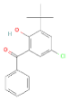
The rhizome extract had the highest concentration of hexane, 3,3-dimethyl-, o-xylene, decane, cyclopentane, 1,2-dipropyl-, nonane, 5-(2-methylpropyl)-, tetradecane, 4,11-dimethyl-, 2-methylhexacosane, benzene, 1,3-dimethyl-, 3-tert-butyl-5-chloro-2-hydroxybenzophenone and 2-undecanethiol, 2-methyl-, with lower quantities in the leaf extract (Table 4). The leaf extract recorded the highest quantity of heptadecane, 2-methyl-, eicosane, isopropylmyristate and eicosyl heptafluorobutyrate, with lower quantities in the rhizome extracts.
3.3.2. Phytochemicals Are Only Found in Rhizome and Leaf Extracts
A total of fifty-seven and thirty-eight phytochemicals were detected only in P. glomerata rhizome and leaf, with significant differences in their relative chromatogram area percentages (Supplementary Data S1b). The compounds that were identified in the rhizome and leaf extracts belong to different chemical groups: alcohols, aldehydes, aliphatic and aromatic hydrocarbons, carbamates, ethers, fatty acids, ketones, organosilicon, phenol and sulfur-containing compounds (Supplementary Data S1a). Most of these compounds, except undecane, 3,4-dimethyl-, pentadecane, 4,6-di-tert-butyl-m-cresol and ethylbenzene, dibutyl phthalate, pentadecane, 8-hexyl- and hexadecane, 1-chloro-, were less than one percent. Retention times for all identified phytochemicals were similar regardless of their presence in different plant parts (Supplementary Data S1a).
The rhizome extract included three distinct chemical groups: diol, carbamate and halogenated ketone. Furthermore, diketone and organosilicon were found in the leaf extract. The rhizome extract recorded the highest relative chromatogram area percentage of Undecane, 3,4-dimethyl-, followed by 4,6-di-tert-butyl-m-cresol and pentadecane, respectively. The leaf extract had the highest quantity of ethylbenzene, followed by dibutyl phthalate, pentadecane, 8-hexyl- and hexadecane, 1-chloro-, respectively.
4. Discussion
4.1. Allelopathic Properties of Platycarpha Glomerata Plant Parts and Concentrations on Bidens pilosa Weed
The retardation of B. pilosa seed germination and seedling growth by at least 2% concentration of P. glomerata extracts (Table 1) may be attributed to the rhizome being the site for storage and also the translocation of resources between leaves and rhizome may have contributed to the similar number of phytochemicals present in both plant parts [23,24]. Also, leaves, being the main site of photosynthesis [35,36], may include the synthesis of compounds that could have allelopathic effects on B. pilosa weeds. The inhibition of B. pilosa seed germination caused by the higher (≥4%) P. glomerata rhizome and leaf concentrations (Table 1) may also be related to the enhanced effectiveness of the germination inhibitors with an increased extract concentration [37], which may disrupt cell membrane permeability, cell division, and the development of the embryo, thus potentially inhibiting seed germination [38]. These variations indicate that various parts of the same plant can demonstrate different inhibitory effects on weed species [39]. Similarly, Zingiber officinale Rosc., rhizome and leaf aqueous extracts decreased the germination and seedling growth of Glycine max L. and Allium schoenoprasum L. (Merril) [21].
Platycarpha glomerata rhizome and leaf extracts of 4% and 5% in the current study were far lower than the 15% and 20% Phragmities australis (Cav.) Trin. ex Steud rhizome and leaf extract concentrations [40] required to prevent the seed germination and seedling growth of B. pilosa. This shows the high effectiveness of P. glomerata rhizome and leaf extracts at low concentrations in inhibiting the germination of this weed. In addition, the rhizome and leaf extracts of the following plants were applied at higher concentrations to inhibit the seed germination and seedling growth of other targeted plants. These plants include 15 and 20% P. australis rhizome and leaves that totally inhibited the germination of Lactuca sativa L. and Raphanus sativus seeds [40]. Again, 10% Cynodon dactylon, rhizome extract totally inhibited the seed germination of Pisum sativum L., Vicia faba L., Sorghum halepense L., Pers, Avena fatua L., Thymus vulgaris L., Melissa officinalis L. and Mentha spicata L. seeds [41]. Again, 25 and 50 g of Euryops floribundus leaf extract concentrations showed a strong decrease in the seed germination and seedling growth of L. sativa [38]. The utilization of leaves is generally preferable, as it ensures sustainable harvesting compared to the destructive rhizome harvest method [42]. The effects of the high-level extract concentration may be attributed to the possible penetration of allelopathic compounds within the cell membranes, which may suppress cell proliferation in the root epical meristem, thus preventing germination [43].
The significant reduction in plant height and chlorophyll content of B. pilosa at 14 and 21 days after treatment with P. glomerata rhizome and leaf aqueous extracts (Table 3) suggests that foliar application targets the leaves as the main site of entry and may affect growth and morphological parameters such as leaves, leaf area and the physiological indicator chlorophyll content [9]. The intensified reduction in chlorophyll content and dwarfism by leaf extracts may be attributed to the leaves being the main site of photosynthesis [35,36], which may include the synthesis of compounds that could have allelopathic effects on B. pilosa weed. The degradation of chlorophyll pigments may be associated with the possible ability of allelochemicals to block energy and electron transfer inside the mitochondria, inhibit ATP synthesis, enzyme activity, affect stomatal conductance, and transpiration; thus, disrupting the photosynthesis process [2]. The reduction in plant height may be associated with the inhibition of new shoot elongation, synthesis of gibberellic acid, inhibiting cell division and elongation of the subapical meristem of the plant [44].
The morphological deformities observed in the reduction in chlorophyll content and plant height associated with high concentrations (≥4%) of P. glomerata leaf extract (Figure 1), may be attributed to allelopathic compounds released by leaves, which may affect elongation and cause impairment of cell division [45], potentially inhibiting the growth of B. pilosa plants. Various phytohormones and plant growth inhibitors may be affected and modified by allelochemicals, possibly inhibiting the growth, chlorophyll content and development of the plants [46]. In a previous study, allelochemical aqueous extracts from Mentha piperita L. leaves decreased the chlorophyll content of Helianthus annuus L. leaves [47], which may have caused damage to the photosynthetic apparatus, interfering with the synthesis of porphyrin precursors, resulting in the loss of chlorophyll pigment in the leaves [48,49]. Thus, the allelopathic compounds in plant extracts may have contributed to the retardation of chlorophyll content synthesis and disrupted the related metabolic pathways [49,50]. Similarly, Z. officinale rhizome and leaf extracts retarded the height of V. radiata plants, which may have been attributed to allelochemicals present in extracts that inhibited the biosynthesis of gibberellins responsible for cell elongation and plant height [51].
Platycarpha glomerata rhizome and leaf extracts at 4 and 5% concentrations were far lower than the 10% Z. officinale rhizome and leaf extract concentrations [51] required to retard plant height and chlorophyll content of B. pilosa plants. This shows that the high effectiveness of P. glomerata rhizome and leaf extracts at low concentrations may be enough to retard the growth of this weed. In addition, rhizome and leaf extracts of the following plants were applied in higher concentrations to retard chlorophyll content and plant height of the targeted plants: 10% rhizome and leaf extract concentrations from Z. officinale retarded V. radiata plant height [51]. Again, high (25, 50 and 100%) Triticum aestivum L. extracts retarded the chlorophyll content of Trianthema portulacastrum Linn. [52]. The utilization of leaves is generally preferable, as it ensures sustainable harvesting compared to the destructive rhizome harvest method [41].
Leaf folding, chlorosis and the presence of brown necrotic spots on B. pilosa leaves as a result of foliar application with high concentrations from P. glomerata rhizome and leaf extracts (Figure 1) may be attributed to allelopathic effects that could induce an increase in superoxide, hydrogen peroxide and hydroxyl radicals, which may lead to DNA damage and cellular membrane leakage of proteins, toxins and nutrients [2,53], possibly causing leaf chlorosis, necrotic spots and leaf folding. Similarly, foliar application of 37.5 g L−1 displayed formation of necrotic brown spots and yellowing (chlorosis) visible on young Bidens bipinnata L. leaves [50]. Also, the seeds of Phalaris minor Retz are treated with Eucalyptus citriodora Hook. caused visible injury, such as necrotic spots, wilting and even plant death as a result of leaf foliar spraying [54]. Foliar spraying of higher concentrations (75, 150 and 300 g L−1) of Ricinus communis L. and Piper tuberculatum Jacq. displayed severe symptoms of injury, with leaf yellowing and wrinkled leaves [50]. Also, the allelopathic effects on chlorophyll content leading to morphological injury may be attributed to the possible phytotoxic compounds penetrating through the leaf surface area and being absorbed through guard cells, potentially disrupting key physiological processes such as photosynthesis [55]. Further, the application of essential oils from E. citriodora inhibited respiration and caused loss of membrane integrity, chlorosis, necrotic spots, leaf wilting and eventual plant death [53].
The foliar application with high concentrations of P. glomerata rhizome and leaf extracts on B. pilosa leaves (Figure 1) may have caused black, purple spots and purple pigments, potentially attributed to the biosynthesis of anthocyanin when the plant is under allelochemical-induced stress. Application of extracts of the essential oils from Cymbopogon citratus (DC) Stapf. retarded metabolic functions, increased lipid peroxidation activity, and promoted electrolyte leakage, causing cellular injury and death of the cell membrane [17,46]. In the current study, pigmentation was localized in the newly formed leaves, which may be attributed to the allelopathic-induced stress on the leaves of B. pilosa by plant extracts, and the possible over-production of anthocyanins as a coping mechanism to stress [56].
When plants are exposed to stress such as drought, salinity stress, nutrient deficiency, or foliar application of extracts, the accumulation of anthocyanin may also be triggered as a protection mechanism [56,57]. For example, a study by [57] reported that plants subjected to abiotic stresses such as drought, cold and salinity produced anthocyanins, leading to pigmentation; 1-dominant (pap1-D) plants’ leaves turned purple. In the current study, foliar application of P. glomerata rhizome and leaf extracts on B. pilosa leaves may have also induced the production of anthocyanins, with the black and purple pigment observed representing a stress-coping mechanism against the treatment with extracts [2,56].
4.2. Platycarpha Glomerata Phytochemicals Identified in Rhizome and Leaf Aqueous Extracts
The study is the first to report on the phytochemical profiling of P. glomerata rhizome and leaf aqueous extracts. The rhizome and leaf extracts were subjected to GC-MS phytochemical analysis, which quantifies, identifies, and shows chromatographic separations of the phytochemical compounds. Phytochemical analysis using GC-MS is a useful tool for profiling volatile compounds in plant-derived non-polar fractions [58]. However, the identification of these compound fractions must be interpreted cautiously [59]. In this study, the National Institute of Standards and Technology (NIST) mass spectral library was used. The retention indices, CAS numbers, molecular weight, compound structure, and chromatograph peak area percentages were used to support compound identification and verification (Supplementary Data S1a,b) [58]. The chromatographic data verification and NIST library matches were used to support the tentative compound identification (Supplementary Datas S1a–c and S2a–c).
The rhizome and leaf extracts of P. glomerata showed the presence of the following chemical groups: alcohols, aldehydes, aliphatic hydrocarbons, aromatic hydrocarbons, carbamates, esters, ethers, fatty acids, ketones, organosilicon compounds, phenols, and sulfur-containing compounds. The identified undecane, 3,4-dimethyl-, belonging to the alkane chemical class (Supplementary Data S1a–c), was detected at a high abundance in the rhizome extract. Previous studies indicate that the allelopathic effects of plant extracts vary according to plant organ, concentration, and extraction method used [25]. This variation may be associated with the types of secondary metabolites present in different plant parts. Although there is a considerable amount of literature available on the allelopathic effects of plant extracts on weed germination and growth, evidence on the effects of P. glomerata plant parts on B. pilosa remains limited. The selection of different plant parts for this study was guided by the distinct functions different plant parts serve. For example, rhizomes, roots, and stems store and transport water and minerals, while leaves are involved in photosynthesis and fruits store and preserve genetic material for future generations [25]. Furthermore, many studies have used whole plant extracts to assess allelopathic effects on weeds and to conduct phytochemical profiling. The present study focused on individual plant parts to determine whether their effects differ according to plant part and concentration. Exposing B. pilosa to extracts from different plant parts at varying concentrations was aimed at determining their effects on seed germination, plant height, and different growth stage parameters.
Among the identified compounds in the rhizome extract had high numbers of benzene, 1,3-dimethyl- (10.27%), and O-xylene (9.86%) were classified as aromatic hydrocarbons, followed by decane (3.7%) and nonane, 5-(2-methylproyl)- (1.14%) classified as aliphatic alkanes. Eicosane (14.6%), an alkane, was detected as a high relative chromatogram area percentage in the leaf extracts. The germination and seedling growth showed that both rhizomes and leaf extracts affected the germination and growth of Bidens pilosa.
Our results showed that the high abundance of dibutyl phthalate and other phthalate esters was identified through comparisons in the NIST mass spectral library (Supplementary Data S1a), together with their chromatograms presented in Supplementary Data S1a,b. However, other studies have identified these compounds as possible environmental contaminants. [60], reported that high phthalate levels may be attributed to environmental contamination. A previous study reported that root extracts from Eucalyptus grandis contained a variety of compound groups including alkanes, alkenes, aldehyde ketones, long-chain fatty acids, and aromatic esters [61]. Alkanes have been reported to be toxic and affect K/Ca uptake of other plants [62]. This was not investigated in the study; however, it may explain the possible mechanism effect of the tentatively identified compounds in the study.
In the present study, water was used as the primary solvent for the aqueous extraction of P. glomerata rhizome and leaves. These methodological procedures used in this study presented some limitations, such as the temperature, solvents, and drying method used. Oven drying at 50 °C was used, and a previous study reported that 50 °C oven drying was an optimal temperature preferred [63]. For example, a previous study reported that 50° is the optimal temperature for the enhanced extraction of compounds from plant extracts [64]. To address this limitation, we analyzed three replicates to maximize compound detection. To ensure the capture of non-polar and polar compounds, a mixture of n-hexane and dichloromethane was used to solubilize the dried plant extracts. Future studies should explore other drying methods, such as freeze-drying methods, to improve compound retention.
Another limitation was the focus on one weed species, Bidens pilosa. Future studies should include more weed species, ensuring broader applicability of the findings. In addition, the identified phytochemicals were not isolated and purified to test them in germination and field experiments. The mode of action underlying the inhibitory effects was not investigated in this study. Therefore, the results only provide preliminary evidence that Platycarpha glomerata rhizome and leaf extracts have allelopathic potential under controlled conditions. Further studies are required to determine their effects under field conditions and assess their suitability as potential candidates for bioherbicide development.
5. Conclusions
This study demonstrated that aqueous extracts derived from the rhizome and leaves of P. glomerata had significant allelochemical activity against B. pilosa, an invasive weed of agricultural and ecological concern. A minimum concentration of 2% of both rhizome and leaf extracts was sufficient to inhibit seed germination, seedling growth and chlorophyll content of B. pilosa, highlighting the potency of P. glomerata extracts even at relatively low application rates. Furthermore, foliar application of the extracts resulted in visible morphological deformities in B. pilosa, including chlorosis, necrosis, leaf folding, and the appearance of purple and black spots, as well as reductions in both chlorophyll content and plant height. These responses may be indicative of phytotoxic activity at the cellular and physiological levels, further supporting the allelopathic potential of P. glomerata extracts. However, this was not investigated in the current study.
These findings are consistent with the broader literature on plant secondary metabolites and their roles in disrupting germination, cellular processes and seedling development. Collectively, these results suggest that P. glomerata rhizome and leaf aqueous extracts may have the potential for further studies under field conditions and to assess their suitability as potential candidates for plant-based bioherbicide development, contributing to the growing body of research on allelochemicals for agricultural weed management. Future studies should focus on the isolation and purification of the phytochemicals identified in the highest quantities and evaluate their herbicidal efficacy both individually and in combination, before optimizing formulations for practical field application.
These results indicate that P. glomerata rhizome and leaf aqueous extracts warrant further investigation as a potential source of bioactive allelochemicals. However, given the controlled experimental conditions, tentative compound identification and single-species testing in the present study. There still remains additional work, including compound isolation, purity confirmation against authentic standards, compound-specific bioassays, and multi-species and field-level trials is needed before any bioherbicidal application can be considered.
Supplementary Materials
The following supporting information can be downloaded at: https://www.mdpi.com/article/10.3390/ijpb17100102/s1, Supplementary Data S1a. Tentatively identified Platycarpha glomerata rhizome and leaf phytochemicals with their formula, retention time, and relative chromatogram area percentage. Supplementary Data S1b. Tentatively identified phytochemicals eclusively in Platycarpha glomerata rhizome and leave with their respective: CAS, molecular weight, mass peak and retention index. Supplementary Data S1c. Total ion chromatograms of tentatively identified Compounds shore between rhizome and leaf in Table 4. Supplementary Data S2a. Chromatogram of Platycarpha glomerata rhizome and leaf replicates. Supplementary Data S2b. Chromatogram of Platycarpha glomerata compounds tentatively identified exclusively in rhizome and in leaves. Supplementary Data S2c. Blank for Solvent mixture of n-hexane and dichloromethane at the same injection volume. Supplementary Data S3. Preliminary data on the effects of root, stem, fruit and fruit coats (Ceratotheca triloba) and P. glomerata rhizome and leaves extracts on the germination of Bidens pilosa seeds. Supplementary Data S4. General—split—extended method details.
Author Contributions
Conceptualization and methodology, P.N.S., Z.M. and N.R.N.; software, P.N.S.; validation, Z.M. and N.R.N.; formal analysis, P.N.S.; investigation, P.N.S.; resources, P.N.S.; data curation, P.N.S.; writing—original draft preparation, P.N.S.; writing—review and editing, Z.M. and N.R.N.; supervision, Z.M. and N.R.N.; project administration, P.N.S.; funding acquisition, N.R.N. All authors have read and agreed to the published version of the manuscript.
Funding
This research received no external funding.
Data Availability Statement
The research data can be requested from the authors.
Acknowledgments
The authors have reviewed and edited the output and take full responsibility for the content of this publication.
Conflicts of Interest
The authors declare no conflicts of interest. Everyone contributed in a positive manner and agreed to publish the work.
References
- Cheng, F.; Cheng, Z. Research progress on the use of plant allelopathy in agriculture and the physiological and ecological mechanisms of allelopathy. Front. Plant Sci. 2015, 7, 1697. [Google Scholar] [CrossRef] [Scilit] [PubMed]
- Lal, N.; Biswas, A.K. Allelopathic interaction and eco-physiological mechanisms in Agri-horticultural systems: A review. Erwerbs-Obstbau 2023, 65, 1861–1872. [Google Scholar] [CrossRef] [Scilit]
- Akbar, R.; Sun, J.; Bo, Y.; Khattak, W.A.; Khan, A.A.; Jin, C.; Zeb, U.; Ullah, N.; Abbas, A.; Liu, W.; et al. Understanding the influence of secondary metabolites in plant invasion strategies: A Comprehensive review. Plants 2024, 13, 3162. [Google Scholar] [CrossRef] [Scilit] [PubMed]
- Qasem, J.R.; Foy, C.L. Weed allelopathy, Its ecological impacts and future prospects: A Review. J. Crop Prod. 2001, 4, 43–119. [Google Scholar] [CrossRef] [Scilit]
- Zhang, K.; Yao, L.; Zhang, Y.; Tao, J. Achene heteromorphism in Bidens pilosa (Asteraceae): Differences in germination and possible adaptive significance. Ann. Bot. 2019, 11, plz026. [Google Scholar] [CrossRef] [Scilit] [PubMed]
- Yan, Z.; Chen, Z.; Zhang, L.; Wang, X.; Zhang, Y.; Tian, Z. Bioactive polyacetylenes from Bidens pilosa L and their anti-inflammatory activity. Nat. Prod. Res. 2022, 36, 6353–6358. [Google Scholar] [CrossRef] [Scilit] [PubMed]
- Kato-Noguchi, H.; Kurniadie, D. The invasive mechanisms of the noxious alien plant species Bidens Pilosa. Plants 2024, 13, 356. [Google Scholar] [CrossRef] [Scilit] [PubMed]
- Chauhan, B.S.; Ali, H.H.; Florentine, S. Seed germination ecology of Bidens pilosa and its implications for weed management. Sci. Rep. 2019, 9, 16004. [Google Scholar] [CrossRef] [Scilit] [PubMed]
- Puig, C.G.; Reigosa, M.J.; Valentão, P.; Andrade, P.B.; Pedrol, N. Unravelling the bioherbicide potential of Eucalyptus globulus Labill: Biochemistry and effects of its aqueous extract. PLoS ONE 2018, 13, e0192872. [Google Scholar] [CrossRef] [Scilit] [PubMed]
- Janusauskaite, D.; Kadziene, G. Influence of different intensities of tillage on physiological characteristics and productivity of crop-rotation plants. Plants 2022, 11, 3107. [Google Scholar] [CrossRef] [Scilit] [PubMed]
- Yu, Y.; Alseekh, S.; Zhu, Z.; Zhou, K.; Fernie, A.R. Multiomics and biotechnologies for understanding and influencing cadmium accumulation and stress response in plants. Plant Biotechnol. J. 2024, 22, 2641–2659. [Google Scholar] [CrossRef] [Scilit] [PubMed]
- Musa, D.D.; Sanusi, H.; Adam, R. Allelopathic effect of African mahogany (Khaya senegalensis) on the germination rate of Senna occidentalis. Inter. J. Pure. Appl. Sci. 2023, 40, 28–32. [Google Scholar]
- Dmitrović, S.; Nestorović Živković, J.; Smailagić, D.; Trajković, M.; Banjac, N.; Ninković, S.; Stanišić, M. Via Air or Rhizosphere: The Phytotoxicity of Nepeta essential Oils and Malus Dihydrochalcones. Plants 2025, 14, 701. [Google Scholar] [CrossRef] [Scilit] [PubMed]
- Romero, J.J.; Soler-Arango, J.; Coustet, M.E.; Moracci, D.B.; Reinoso, S.; Yanniccari, M.E.; Schneider-Teixeira, A.; Herrera, J.M. Herbicidal formulations with plant-based compounds to control Amaranthus hybridus, Lolium multiflorum, and Brassica rapa weeds. Plants 2025, 14, 276. [Google Scholar] [CrossRef] [Scilit] [PubMed]
- Tanase, C.; Bujor, O.C.; Popa, V.I. Phenolic natural compounds and their influence on physiological processes in plants. In Polyphenols in Plants; Academic Press: Cambridge, MA, USA, 2019; pp. 45–58. [Google Scholar] [CrossRef] [Scilit]
- Zhao, J.; Yang, Z.; Zou, J.; Li, Q. Allelopathic effects of sesame extracts on seed germination of Moso bamboo and identification of potential allelochemicals. Sci. Rep. 2022, 12, 6661. [Google Scholar] [CrossRef] [Scilit] [PubMed]
- Lim, C.J.; Lim, C.K.; Ee, G.C.L. Allelopathic invasive plants as phytoinhibitor bioresource material in weed control: A review. Agric. Nat. Res. 2019, 53, 439–448. [Google Scholar] [CrossRef] [Scilit]
- Houshmand, S.; Alizadeh-Salteh, S.; Bolandnazar, S.; Aryakia, E. Investigating of phytochemical compositions and antioxidant potential of ethanol and ethyl acetate extracts of three ecotypes of medicinal plant Artemisia absinthium. Iran. J. Hortic. Sci. Technol. 2023, 24, 345–358. [Google Scholar]
- Mendes da Silva, L.; Novaes Matilde, M.E.; Júnio da Silva, F. Allelopathic and phytochemical potential of the aqueous extract of Curcuma longa L.: Contributions to the production of bioherbicides. Rev. Ciênc. Agrovet. 2024, 23, 184–195. [Google Scholar] [CrossRef] [Scilit]
- Aryakia, E. Uncovering the Key Factors Influencing Phytochemical and phytopharmacological properties during medicinal plant processing. eFood 2026, 7, e70105. [Google Scholar] [CrossRef] [Scilit]
- Khuat, Q.V.; Kalashnikova, E.A.; Nguyen, H.T.; Trukhachev, V.I.; Kirakosyan, R.N. In Vitro Effect of Purple Amomum (Amomum longiligulare TL Wu) Extracts on seed germination and seedling growth of different crop species. Horticulturae 2023, 9, 554. [Google Scholar] [CrossRef] [Scilit]
- Lamula, S.Q.; Taliwe, A.; Buwa-Komoreng, L.V. Pharmacological properties of Platycarpha glomerata extracts—A plant used to treat and manage Elephantiasis. Int. J. Mol. Sci. 2025, 26, 646. [Google Scholar] [CrossRef] [Scilit] [PubMed]
- Asaeda, T.; Rajapakse, L.; Manatunge, J.; Sahara, N. The effect of summer harvesting of Phragmites australis on growth characteristics and rhizome resource storage. Hydrobiologia 2006, 553, 327–335. [Google Scholar] [CrossRef] [Scilit]
- Harris, T.; Klimeš, A.; Martínková, J.; Klimešová, J. Herbs are not just small plants: What biomass allocation to rhizomes tells us about differences between trees and herbs. Am. J. Bot. 2023, 110, e16202. [Google Scholar] [CrossRef] [Scilit] [PubMed]
- Ali, A.; Hussain, I.; Khan, A.A.; Ul Haq, E.; Kiran, S.; Baloch, M.S.; Shaheen, S.; Khan, R. Evaluation of allelopathic potential of plant extracts against common weed species under vivo conditions. Discov. Plants 2026, 3, 238. [Google Scholar] [CrossRef] [Scilit]
- Bagheri, S.; Raufirad, V.; Tavili, A.; Jafari, M. Allelopathy and Sowing Depth Effects on Agropyron desertorum and Onobrychis sativa. Res. Sq. 2024, 1–15. [Google Scholar] [CrossRef] [Scilit] [PubMed]
- Ahmed, H.; Juraimi, A.S.; Hamdani, M.S.A.; Omar, D.; Yusof, M.R. Phytotoxicity stress induced by allelochemicals from foliar spray of Sida cordifolia Methanol leaf extract on Ageratum conyzoides and Oryza sativa. Curr. Appl. Sci. Technol. 2025, 25, e0258789. [Google Scholar] [CrossRef] [Scilit]
- Prajapati, N.; Sharma, R.; Singh, H. Unraveling the bio-herbicidal potential of Eucalyptus species aqueous leaf extract and leaf oil on germination and initial growth performance of weed Parthenium hysterophorus. Int. J. Curr. Microbiol. Appli. Sci. 2020, 9, 3028–3040. [Google Scholar] [CrossRef] [Scilit]
- El-Shaieny, A.H. Seed germination percentage and early seedling establishment of five (Vigna unguiculata L. (Walp) genotypes under salt stress. Eur. J. Exp. Biol. 2015, 5, 22–32. [Google Scholar]
- Ayeni, M.J.; Kayode, J. Allelopathic effects of extracts from maize roots and rice husks’ residues on the germination and growth of Bidens pilosa L. J. Agri. Sci. 2013, 5, 146. [Google Scholar] [CrossRef] [Scilit]
- Sala, F.; Arsene, G.G.; Iordănescu, O.; Boldea, M. Leaf area constant model in optimizing foliar area measurement in plants: A case study in apple tree. Sci. Hortic. 2015, 193, 218–224. [Google Scholar] [CrossRef] [Scilit]
- Anyia, F.A.; Onwuli, D.; Elekima, I.; Ibegbulem, E.O. Phytochemical and Anti-nutrients Composition in chromolaena odorata Leaves. Int. J. Biochem. Res. Rev. 2026, 35, 220–239. [Google Scholar] [CrossRef] [Scilit]
- Lingfa, L.; Tirumala, A.; Ankanagari, S. GC-MS profiling of anticancer and antimicrobial phytochemicals in the vegetative leaf, root, and stem of Withania somnifera (L.) Dunal. Int. J. Second. Metab. 2024, 11, 63–77. [Google Scholar] [CrossRef] [Scilit]
- Elumalai, L.; Nagarajan, S.; Anbalmani, S.; Murthy, S.; Manikkam, R.; Ramasamy, B. Bioactive compound from marine seagrass Streptomyces argenteolus TMA13: Combatting fish pathogens with time-kill kinetics and live-dead cell imaging. Braz. J. Microbiol. 2024, 55, 2669–2681. [Google Scholar] [CrossRef] [Scilit] [PubMed]
- Ossola, R.; Farmer, D. The chemical landscape of leaf surfaces and its interaction with the atmosphere. Chem. Rev. 2024, 124, 5764–5794. [Google Scholar] [CrossRef] [Scilit] [PubMed]
- Wang, Q.; Bian, Z.; Wang, S.; Zhao, Y.; Zhan, X.; Yang, Q. Far-Red Light Inhibits soybean biomass and yield by modulating plant photosynthesis. Agronomy 2024, 14, 2684. [Google Scholar] [CrossRef] [Scilit]
- Joshi, R.K.; Kuriyal, S.K.; Joshi, N.; Sati, S.P. Allelopathic effects of Cassia fistula L on germination and seedlings growth of Raphanus sativus L. Allelopath. J. 2024, 61, 189–206. [Google Scholar] [CrossRef] [Scilit]
- Gxasheka, M.; Mbita, Z.; Laka, K.; Mndela, M.; Dlamini, P. Phytochemical analysis and allelopathic potential of an aggressive encroacher shrub, Euryops floribundus (Asteraceae). Plants 2025, 14, 601. [Google Scholar] [CrossRef] [Scilit] [PubMed]
- Islam, A.K.M.M.; Suttiyut, T.; Anwar, M.P.; Juraimi, A.S.; Kato-Noguchi, H. Allelopathic properties of Lamiaceae species: Prospects and challenges to use in agriculture. Plants 2022, 11, 1478. [Google Scholar] [CrossRef] [Scilit]
- Uddin, M.N.; Caridi, D.; Robinson, R.W. Phytotoxic evaluation of Phragmites australis: An investigation of aqueous extracts of different organs. Mar. Freshw. Res. 2012, 63, 777–787. [Google Scholar] [CrossRef] [Scilit]
- Mahmoodzadeh, H.; Mahmoodzadeh, M. Allelopathic effects of rhizome aqueous extract of Cynodon dactylon L. on seed germination and seedling growth of Legumes, Labiatae and Poaceae. Iran. J. Plant Physiol. 2014, 4, 1047–1054. [Google Scholar]
- Zhao, J.; Fan, L.; Hu, S.; Poha, J.; Wan, A.K.Y.; Zeng, Y.; Yang, Y.; Duan, B.; Lee, T.M. Understanding indigenous people’s traditional Chinese medicinal plants harvesting preferences to guide sustainable management. People Nat. 2023, 5, 1174–1186. [Google Scholar] [CrossRef] [Scilit]
- Jassbi, A.R.; Zare, S.; Firuzi, O.; Xiao, J. Bioactive phytochemicals from shoots and roots of Salvia species. Phytochem. Rev. 2016, 15, 829–867. [Google Scholar] [CrossRef] [Scilit]
- Li, Q.; Guo, J.; Zhang, H.; Zhao, M. The competition between Bidens pilosa and Setaria viridis alters soil microbial composition and soil ecological function. J. Integr. Agric. 2024, 23, 267–282. [Google Scholar] [CrossRef] [Scilit]
- Zhao, X.; Sun, X.F.; Zhao, L.L.; Huang, L.J.; Wang, P.C. Morphological, transcriptomic and metabolomic analyses of Sophora davidii mutants for plant height. BMC Plant Biol. 2022, 22, 144. [Google Scholar] [CrossRef] [Scilit] [PubMed]
- Motmainna, M.; Juraimi, A.S.; Ahmad-Hamdani, M.S.; Hasan, M.; Yeasmin, S.; Anwar, M.P.; Islam, A.M. Allelopathic potential of tropical plants—A review. Agronomy 2023, 13, 2063. [Google Scholar] [CrossRef] [Scilit]
- Karkanis, A.; Alexiou, A.; Katsaros, C.; Petropoulos, S. Allelopathic activity of spearmint (Mentha spicata L.) and peppermint (Menthax piperita L.) reduces yield, growth, and photosynthetic rate in a succeeding crop of maize (Zea mays L.). Agronomy 2019, 9, 461. [Google Scholar] [CrossRef] [Scilit]
- Hadadchi, G.R.; Masoudi, K.F. Allelopathic effects of aqueous extracts of Sinapis arvensis on growth and related physiological and biochemical responses of Brassica napus. J. Sci. Univ. Tehran 2006, 32, 23–28. [Google Scholar]
- Maurya, P.; Dwivedi, N.; Mazeed, A.; Kumar, D.; Kumar, B.; Chanotiya, C.S.; Dev, K.; Suryavanshi, P. Allelopathic weed management in wheat (Triticum aestivum L.) through essential oil emulsions and aqueous botanical extracts-based novel bioherbicides. J. Plant Dis. Prot. 2024, 131, 445–458. [Google Scholar] [CrossRef] [Scilit]
- Lopes, R.W.N.; Marques Morais, E.; Lacerda, J.J.D.J.; Araújo, F.D.D.S. Bioherbicidal potential of plant species with allelopathic effects on the weed Bidens bipinnata L. Sci. Rep. 2022, 12, 13476. [Google Scholar] [CrossRef] [Scilit] [PubMed]
- Basalingamma, P.; Hemanth Kumar, N.K.; Jagannath, S. Allelopathic efficacy of aqueous extracts of Zingiber officinale Rosc. on germination, vigour, growth and yield of Vigna radiata L. J. Appl. Biol. Biotechnol. 2015, 3, 48–51. [Google Scholar] [CrossRef] [Scilit]
- Khaliq, A.; Matloob, A.; Aslam, F.; Mushtaq, M.N.; Khan, M.B. Toxic action of aqueous wheat straw extract on horse e purslane. Planta Daninha 2012, 30, 269–278. [Google Scholar] [CrossRef] [Scilit][Green Version]
- Radhakrishnan, R.; Alqarawi, A.A.; Abd Allah, E.F. Bioherbicides: Current knowledge on weed control mechanism. Ecotoxicol. Environ. Saf. 2018, 158, 131–138. [Google Scholar] [CrossRef] [Scilit] [PubMed]
- Batish, D.R.; Arora, K.; Singh, H.P.; Kohli, R.K. Potential utilization of dried powder of Tagetes minuta as a natural herbicide for managing rice weeds. Crop Prot. 2007, 26, 566–571. [Google Scholar] [CrossRef] [Scilit]
- Jabeen, N.; Batool, M. Determining Allelopathic Potential of Anethum graveolens to Control Chenopodium album. Int. J. Agric. Sustain. Dev. 2025, 7, 173–181. [Google Scholar] [CrossRef] [Scilit]
- Magaña Cerino, J.M.; Peniche Pavía, H.A.; Tiessen, A.; Gurrola Díaz, C.M. Pigmented maize (Zea mays L.) contains anthocyanins with potential therapeutic action against oxidative stress-a review. Pol. J. Food Nutr. Sci. 2020, 70, 85–99. [Google Scholar] [CrossRef] [Scilit]
- Xu, Z.; Mahmood, K.; Rothstein, S.J. ROS induces anthocyanin production via late biosynthetic genes and anthocyanin deficiency confers the hypersensitivity to ROS-generating stresses in Arabidopsis. Plant Cell Physiol. 2017, 58, 1364–1377. [Google Scholar] [CrossRef] [Scilit] [PubMed]
- Paat, F.J.; Sintaro, S. Solvent-Dependent GC–MS Fingerprinting of Lipophilic Constituents in Syzygium polyanthum Leaves: A Baseline Study for Future Greener Extraction Optimization. Molecules 2026, 31, 1932. [Google Scholar] [CrossRef] [Scilit] [PubMed]
- Buthelezi, L.G.; Mavengahama, S.; Sibiya, J.; Mchunu, C.N.; Ntuli, N.R. Phytochemical composition of Lagenaria siceraria fruits from KwaZulu-Natal and Limpopo, South Africa. Food Chem. X 2024, 22, 101338. [Google Scholar] [CrossRef] [Scilit] [PubMed]
- Offiong, N.A.; Inam, E.J.; Edet, J.B. Preliminary review of sources, fate, analytical challenges and regulatory status of emerging organic contaminants in aquatic environments in selected African countries. Chem. Afr. 2019, 2, 573–585. [Google Scholar] [CrossRef] [Scilit]
- Zhang, D.J.; Zhang, J.; Yang, W.Q.; Wu, F.Z. Potential allelopathic effect of Eucalyptus grandis across a range of plantation ages. Ecol. Res. 2010, 25, 13–23. [Google Scholar] [CrossRef] [Scilit]
- Yuan, L.; Guo, P.; Guo, S.; Wang, J.; Huang, Y. Influence of C14 alkane stress on antioxidant defense capacity, mineral nutrient element accumulation, and cadmium uptake of ryegrass. Environ. Sci. Pollut. Res. 2022, 29, 13857–13868. [Google Scholar] [CrossRef] [Scilit] [PubMed]
- Ariska, N.Y.; Wardana, F.Y.; Prasetiyo, B.D. Testing of Antioxidant Activity of n-Hexane, Ethyl Acetate, and Ethanol Compound Fractions of Mulberry Leaves (Morus alba L.) Using the DPPH Method. BIO Web Conf. 2025, 198, 02006. [Google Scholar] [CrossRef] [Scilit]
- Mohd Rosdan, M.D.; Awang, M.A.; Benjamin, M.A.; Mohd Amin, S.F.; Julmohammad, N. Effect of ultrasound-assisted osmotic dehydration (UAOD) pretreatment on Mangifera pajang Kosterm. fruit pulp: Drying kinetics, chemical qualities, and color measurement. J. Food Process Eng. 2024, 47, e14721. [Google Scholar] [CrossRef] [Scilit]





Disclaimer/Publisher’s Note: The statements, opinions and data contained in all publications are solely those of the individual author(s) and contributor(s) and not of MDPI and/or the editor(s). MDPI and/or the editor(s) disclaim responsibility for any injury to people or property resulting from any ideas, methods, instructions or products referred to in the content. |
© 2026 by the authors. Licensee MDPI, Basel, Switzerland. This article is an open access article distributed under the terms and conditions of the Creative Commons Attribution (CC BY) license.