


Abstract
Malaria causes high mortality and morbidity globally, despite progress stalling due to parasite and vector resistance to current strategies. Hence, alternative interventions like vaccines and microbiome-based interventions are proposed to be useful tools in the fight against malaria. Human gut microbiota has served a central role in health and diseases, and in the last decade has experienced significant scientific interest in its role in malaria. We conducted a descriptive review of 29 microbiome–malaria-focused studies to decipher the interaction between malaria and the gut microbiome. These articles were searched from different databases: PubMed, Scopus, and Google Scholar within ten years. The interaction between gut microbiome and malaria is bidirectional, with evidence of complexity observed from studies in humans, mice, and rhesus macaques. The microbiome modulates malaria severity through the immune system, with mechanisms including changes in cytokines, humoral immune responses, and parasite-specific antibodies. In addition, several bacteria, particularly those from the phyla Prevotella, Firmicutes, Bacteroidetes, Verrucomicrobia, and Proteobacteria, and lactic acid bacteria, have been associated with different disease outcomes. Our findings reveal a correlation but not the mechanistic underpinnings of malaria and gut microbiome dysbiosis. We propose more human longitudinal studies using multi-omics system biology approaches to gain insights into the mechanisms of malaria–microbiome dynamics.
1. Introduction
Malaria infection resulting from Plasmodium species is one of the top ten tropical diseases, which has showcased long-term global clinical importance, with an estimated 263 million infections and approximately 597,000 deaths reported in 2023. Africa accounts for about 95% of the global malaria burden [1,2]. The recent rise in global malaria cases is largely attributed to Ethiopia (+4.5 million), Madagascar (+2.7 million), Pakistan (+1.6 million), Nigeria (+1.4 million), and the Democratic Republic of the Congo (+600,000). Notably, Nigeria (25.9% of cases and 30.9% of deaths) and the Democratic Republic of the Congo (12.6% of cases and 11.6% of deaths) together account for over a third of global malaria cases (38.5%) and nearly half of malaria-related deaths (42.2%) [2]. When combined with Uganda, Ethiopia, and Mozambique, these countries account for more than 52% of the global malaria burden [2]. However, progress made in the fight against malaria has stalled due to the rising prevalence of malaria as well as increased reports of parasite and vector resistance to treatment and insecticide use [3].
Primarily, intervention in malaria-endemic localities focuses on interrupting malaria transmission by restricting vector spread through indoor residual spraying, long-lasting insecticide-treated nets [4], and larviciding [5], and on reducing morbidity and mortality through the administration of artemisinin-based combination therapy [4,5]. However, major obstacles to malaria control and elimination strategies disrupt efforts and affect disease epidemiology. Control strategies are fraught with the development of parasite and vector resistance to antimalarial drugs and insecticides, respectively, as well as the challenge in developing an efficacious malaria vaccine [4,6]. Considerably, it becomes pertinent for alternative malaria interventions to be explored for their potential addition to the arsenal of anti-malaria measures.
The human microbiota is a microbial consortium associated with the host and known for its rich diversity, outnumbering human cells by approximately 12-fold. It has been associated with host homeostasis and development, whereas the term microbiome refers to the collective genetic material and microbial products associated with these microorganisms [7,8,9,10].
The human gut microbiota (HGM) comprises microorganisms that live in the gastrointestinal tract and is associated with various aspects of health and disease [11]. One of the most prevalent techniques is targeted sequencing of variable regions of the 16S rRNA and, more recently, whole metagenome sequencing to explore or unravel the microbial constituents and function of the microbiome.
Generally, the HGM plays a role in health maintenance, including protection against infections, and has a pivotal role in metabolism, especially indigestible dietary components [12,13]. Additionally, its role in maturing and guiding the immune system has also been recognised in several diseases [13]. The microbiome has been proven to influence the development of obesity, inflammatory bowel diseases and human cancer [14]. The gut microbiome is known to interact with the immune system and provides signals needed to promote immune maturation and the development of immune functions [15]. The HGM is primarily populated by bacteria, with smaller numbers of fungi and archaea, which are known to modulate malaria severity [16].
In recent years, studies have associated HGM composition with malaria (and its ranging disease state) [12]. It has now become imperative that studies go beyond these association studies and adopt a more mechanistic and systems biology approach to delineate how the microbiome influences malaria disease state and be exploited for control interventions.
The available literature exploring gut microbiome and malaria interaction is heterogeneous, involving various study designs, model organisms, sequencing methods, microbiome profiling, and parasite species. This variability limits direct comparability required for synthesis or meta-analysis, necessitating the choice to describe and interpret existing evidence rather than generating a pooled study effect. We have carried out a descriptive review of published literature that focuses on the human gut microbiome and its interaction with malaria. In this review, we identify (i) potential knowledge gaps; (ii) limitations in methods and study plans; and (iii) recommend better approaches and techniques in bridging this gap. Overall, this review aims to properly understand the scope and direction of knowledge in gut microbiome–malaria interactions and describe findings from the last decade to identify emerging mechanisms, inconsistencies in existing evidence, and key knowledge gaps that require further scientific exploration and might help guide future research in the field.
2. Materials and Methods
2.1. Literature Search Strategy
This review was conducted as a descriptive narrative review. This was informed by the broad scope of the review and heterogeneity of the existing evidence. These differences limit direct comparability across studies and the feasibility of meaningful pooled quantitative effects. Therefore, the review focused on descriptive synthesis and interpretation of findings across the different study contexts, including areas of agreement and inconsistencies.
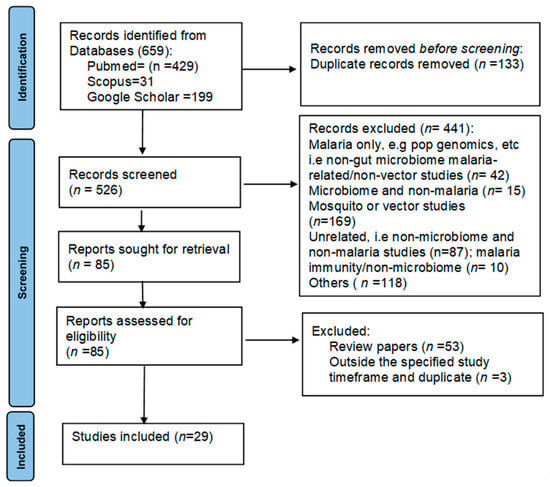
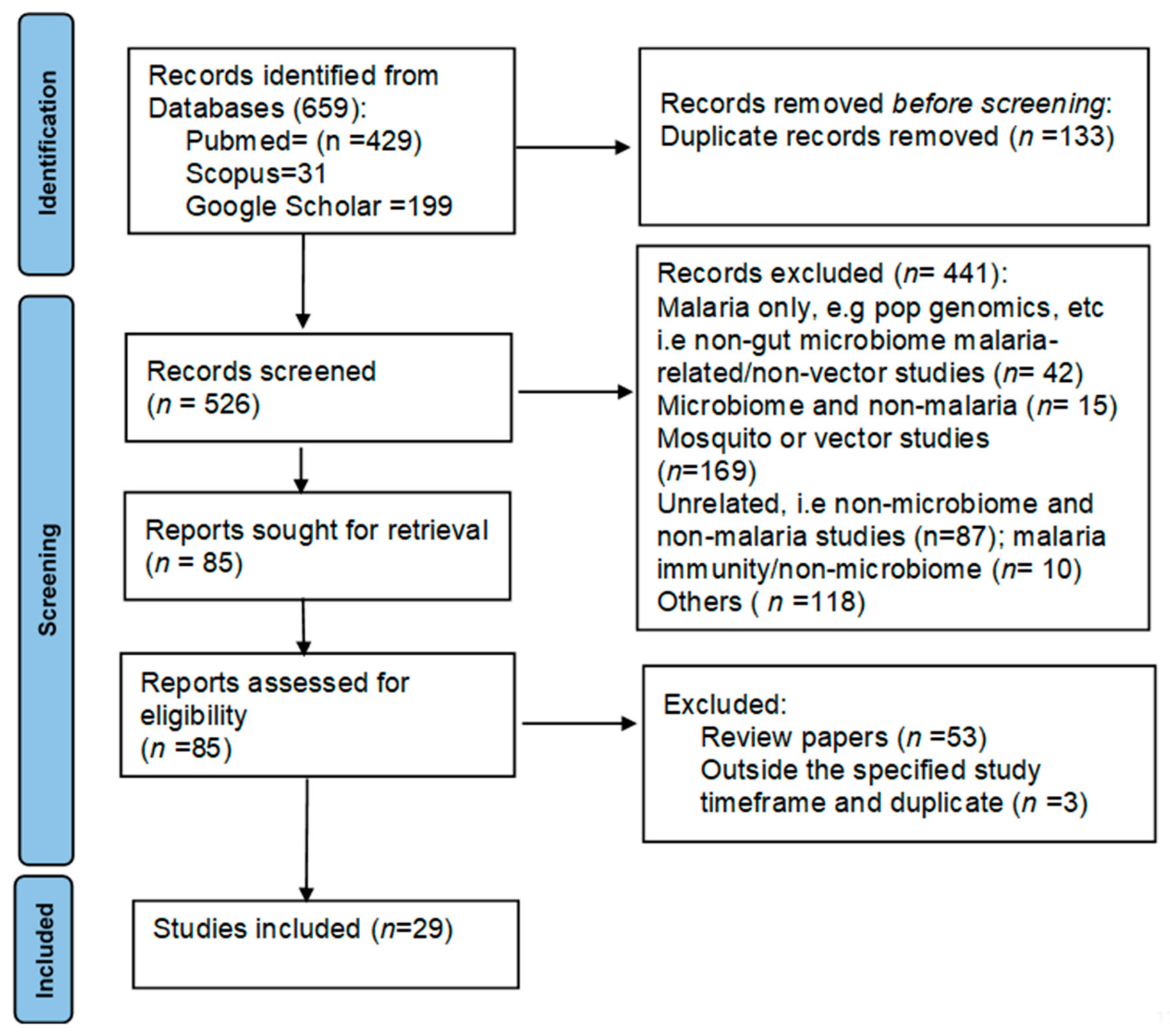
The initial literature search was conducted in March 2023 and was later updated in December 2025 to include studies published in 2024, to allow for a decade-long descriptive review. The same search string, “(gut microbiome and malaria severity) OR (microbiome and Plasmodium infection)” was used across PubMed, Scopus, and Google Scholar between January 2014 and December 2024. A total of 659 records were retrieved: 42 records from PubMed, 31 from Scopus, and 199 from Google Scholar. After removal of 133 duplicate records, 526 records remained for title and abstract screening. Following screening, 86 reports were sought for retrieval and assessed for eligibility. After full-text assessment, 55 reports were excluded, comprising 53 review articles and 2 articles outside the specified study timeframe, resulting in 29 studies included in the final review. The search strategy and screening outcomes are summarised in Figure 1.
Figure 1.
Flowchart describing the identification, screening and inclusion of relevant literature used in this study.
2.2. Inclusion and Exclusion Criteria
Only research articles carried out in human or animal models such as mice, sparrows, birds, and rhesus macaques with reported data on sequencing type and research outcomes related to microbial composition, diversity, infection severity, parasitemia burden, and microbiome metabolite products were included (Figure 1). The animal species listed are examples of vertebrate models identified from the included studies. In addition, articles included clearly stated the Plasmodium species used, the host organisms, and the type of biological samples collected. Although mosquito-associated microbiome may influence Plasmodium transmission, they represent a different microbiome dynamic compared to malaria blood stage infection. Hence, studies investigating mosquitoes’ microbiome or other malaria vectors as it relates to Plasmodium infection or transmission were considered outside the scope of the review to focus on host gut microbiome and malaria. All other studies, including review articles and research papers on malaria only, microbiome only, non-microbiome studies, malaria-immunity only, skin, oral, lung or nasopharyngeal microbiome, were not included.
2.3. Screening Procedure
Initial article searches and screening for eligibility were carried out by author FA against the predefined eligibility criteria. Potentially relevant records were retrieved for full-text assessment by FA to determine final eligibility. Subsequently, KOL reviewed the screening and eligibility decisions to verify their consistency with the predefined criteria. Where disagreements arose, these were discussed between the reviewers and resolved by consensus from MAO.
2.4. Summary of Studies Included
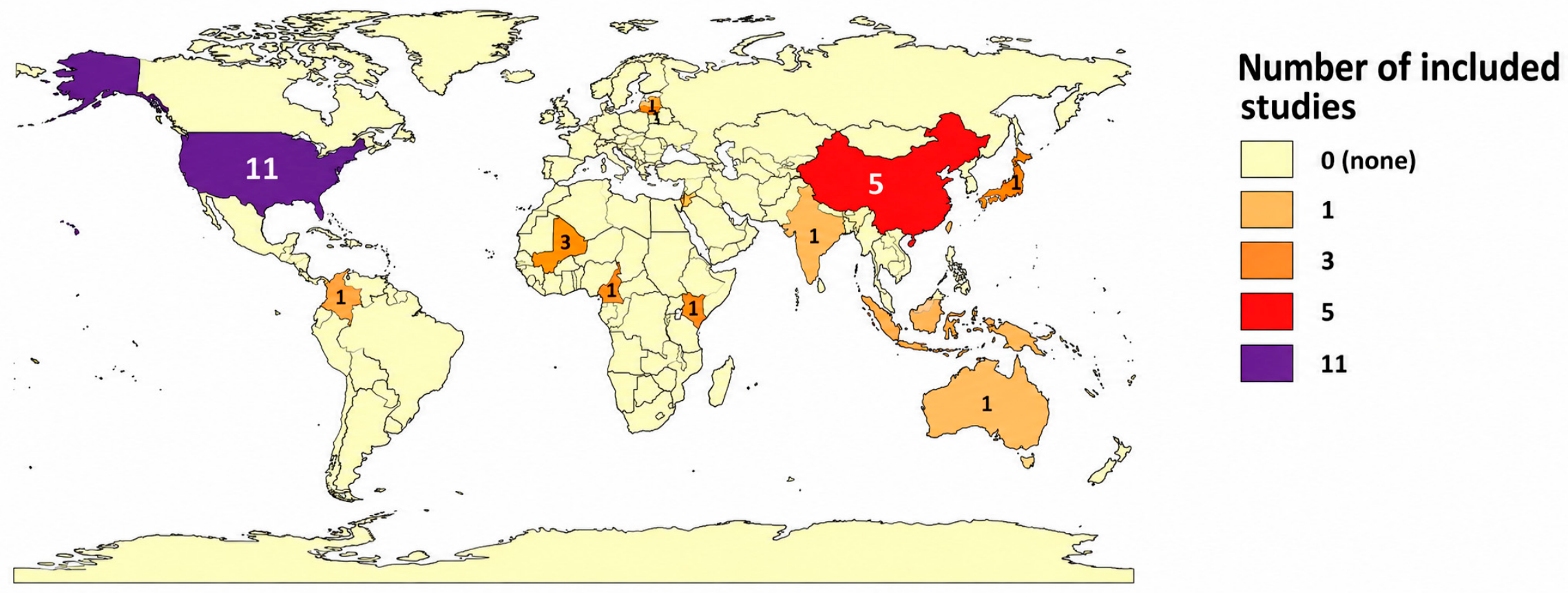
An estimated 29 microbiome-related malaria non-review papers were selected after going through the abstract at first instance and confirmed by full-text screening (Supplementary File and Figure 1). These studies focused primarily on the association between microbiome composition and malaria resistance/susceptibility, the transmission of parasites, and various clinical forms of malaria, such as acute febrile malaria, asymptomatic, uncomplicated, cerebral malaria, and severe malaria. Generally, many of the studies so far have been generated outside Africa, with 20.7% of them in sub-Saharan Africa (sSA) countries (6/29; Cameroon, Kenya, Uganda and Mali [17,18,19,20,21,22]). Eight reports were in Asia (India, China, Japan and Indonesia) [23,24,25,26,27,28,29,30], while the remaining studies were conducted in the USA, Australia, Colombia and Lithuania. One report included an unverifiable country [31]. The geographical distribution of included studies is uneven, with fewer studies in the sub-Saharan African region despite its malaria endemicity (Figure 2). The distribution therefore highlights an important geographic gap in malaria–gut microbiome research, which, together with the limited number of human studies, represents a major gap in the current evidence base.
Figure 2.
Global overview of malaria–gut microbiome research (2014–2024), showing the number of included studies per country. One included study with an unverifiable country of origin was not represented on the map.
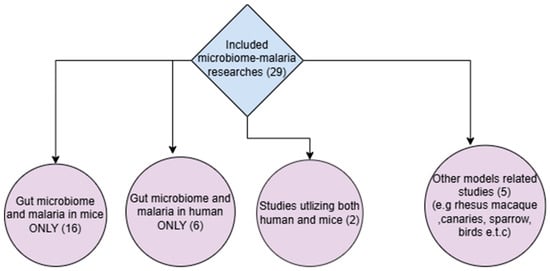
The studies ranged from 2014 to 2024, emanating from the role of microbiota in the transmission of the Plasmodium parasite to modulating severe malaria, blood-stage infection, and prebiotic microbiome–malaria reports. Microbiome/malaria studies in sSA were mainly in mice and some in human samples, with mouse studies significantly higher (approx. 55%), as depicted in Figure 3. Primarily, different Plasmodium parasites were employed to effectively induce malaria infection, which is very dependent on the respective model organism; Plasmodium yoelii, P. homocircumflexum, Plasmodium vivax, Plasmodium berghei, and Plasmodium falciparum being predominant.
Figure 3.
Description of experimental models used by research articles included in this study.
Also, faecal samples were the preferred biological material for observing microbiome composition in all models. In mice, the use of other sample types was also recorded, including colon, colorectal, caecum, distal region of the small intestine, and rectal swabs in the rhesus macaque model.
The complexity of microbiota–malaria interaction is first embodied in the bidirectionality of their interactions. This implies the microbiome influences malaria outcome, and Plasmodium infection also influences dysbiosis in the gut microbiome. To harness potential alternative pathways in malaria treatment, and gain insight into other parasitic and non-parasitic illnesses, a more methodical approach to unravelling these intricate cross-talks is pertinent.
3. Results
3.1. Bidirectional Interactions Between the Gut Microbiome and Malaria
In humans, the microbiome–Plasmodium interaction has been studied in different malaria clinical manifestations, outcomes, susceptibility to infection, acute and febrile malaria, uncomplicated asymptomatic, symptomatic, and severe malaria. Monitoring gut microbiome composition in humans during disease progression is often used to identify key microbial signatures that may underlie patients’ disease states [18,22,29]. Through analysis of serially collected microbiome samples, a strong association has been reported with an increased risk of influencing parasitemia levels [32,33]. An individual’s microbiome before infection may influence the severity of malaria infection, as shown in some studies [18,32].
Further findings to understand the complexity of the interaction between malaria and the microbiome come from murine models. Mice, being mammals, have unique genetic and behavioural similarities with humans, and as such, are suitable as an animal model of choice. In addition, they are known to have ailments resembling those of humans, allowing researchers to replicate human disease for closer observation [34]. Above all, the mouse model is highly important in studying severe malaria for ethical reasons. Recently, issues with the reproducibility of gut microbiota-related mouse studies have generated concern. This stems from variation in the effect of genetically identical mice (obtained from the same source) on malaria severity in P. yoelii-infected mice, a phenomenon referred to as temporospatial shifts, which has created issues with validating and verifying findings from murine models [35]. However, non-murine studies investigating the microbiome in malaria are more prominent, such as birds, sparrows, and monkeys, as observed in some recent reports [36,37,38].
The number of studies conducted using each experimental model is shown in Figure 3, while the key findings from these models are synthesised in the following sections. Most studies were done in the murine model illustrated in Figure 3; insights from the murine studies can be summarised into some key points. First, Plasmodium infection alters gut microbiome composition diversity and functionality, while cerebral malaria is associated with intestinal pathology. In addition, experimental manipulation of the gut microbiome by administration of microbes such as Lactobacillus and Bifidobacterium provides evidence that they reduce parasitemia in infected mice. The evidence from human studies further strengthens the claims for association between gut microbiome composition and malaria, which, as expected, are mainly observational compared to murine models. The main association involves susceptibility to infection, parasitemia, as well as identified microbial correlates; however, the insights from the studies vary, which suggests that the dynamics of the interaction are influenced by parasite species, infection status, host biology, and environmental and dietary factors. Additionally, antimalarial treatment might have just a minimal effect on the overall gut bacterial community structure. This necessitates the need for uniformity of research design while investigating using human models, to affirm the directionality and causality of gut microbiome–malaria interactions. Avian studies in the context of the review also indicate a relationship between avian malaria phenotypes and gut microbiome. Humoral immunity, specifically alpha gal antibodies, is identified as a probable mechanism of action; causality is yet to be established.
In cross-species models, they provide complementary evidence that allows for validating and manipulating observational associations. Studies in both rhesus macaques and humans showed that baseline microbiome composition is associated with consequent malaria parasitemia as well as malaria effects on the gut microbiome. Mouse–human studies identified a consortium of Bacteroides associated with susceptibility to severe malaria in both models. The cross-species studies consistently support the association between gut microbial characteristics and malaria susceptibility and severity.
3.2. Gut Microbiome Associations with Plasmodium Infection and Susceptibility
Human susceptibility to parasite infection (such as soil-transmitted helminths as well as Plasmodium) is influenced by microbiota composition. Age-dependent gut microbial diversity [18,39] is associated with parasitemia levels in patients despite substantial overall microbiota profile variation within the African population [18,29]. Firstly, the gut microbiome composition changes during episodes of Plasmodium infections, but these changes are typically reversible, implying that malaria-related microbiome perturbation may have limited long-term effects on host susceptibility to Plasmodium infection, although this relationship is yet to be well substantiated [17,23]. However, baseline microbiome composition is associated with risk of Plasmodium infection and host susceptibility [18].
Studies have shown a negative association (more Lactobacillus, reduced parasite burden) between Lactobacillus abundance and malaria parasite burden [12,26,29,40]. However, this association might vary depending on the type of parasitic infection; P. falciparum has significantly higher Lactobacillus abundance than with soil helminth infections [29]. In a murine study, higher Lactobacillus abundance was observed in uninfected groups, whereas its abundance decreases as malaria parasitemia rises [26]. However, experimental evidence supports the causal effect of Lactobacillus together with Bifidobacterium indicated reduced parasitemia. Acute malaria infection in rhesus macaques has been reported to disrupt the gut microbiota, change metabolic profiles, and decrease microbiome diversity at the peak of the disease condition [37]. Interestingly, a longitudinal study of babies from birth has revealed an increase in Fusobacteraceae family abundance after acute malaria [17]. Taken together, the available evidence suggests that the microbiota composition may be associated with susceptibility to Plasmodium infection in humans [17].
The murine malaria parasite P. yoelli causes changes in the microbiome and also reconstruction of the gut microbiota during infection, resulting in altered relative richness of dominant taxa after infection, which could be interesting targets for their roles in malaria disease clinical progressions/outcomes [27]. However, some reports reveal that the mouse gut dysbiosis (P. yoelii) is transient [41,42], which agrees with human malaria reports [17], although this conflicts with another murine study utilising P. berghei ANKA in which they observed a lack of gut microbiota recovery after malaria infection [26]. This discrepancy highlights the variability of gut microbiome-related studies and implies that some of this variation (dysbiosis permanence or transient) could be the resultant effect of the host factors, infection severity, and Plasmodium species [43]. The studies both had different infection stages, which could be relevant in explaining the variance. Mooney et al.’s experimental design had a more delayed or prolonged infection stage (day 10–15) with longer recovery time (day = 30), whereas Fan et al. [26] had a shorter period (infection period = day 8; recovery time = day 22). P. yoelii- and P. berghei-infected mice showed changes in Firmicutes and Bacteroidetes, while Verrucomicrobia and Proteobacteria were at detectable levels in animals with P. berghei infection only. Also, inflammatory changes were observed in mice, which were influenced by parasite infection rather than microbiota taxa. These inflammatory changes might be responsible for changes in the microbiota composition [41]. Further, alteration in the intestinal environment has been shown to cause a shift in the community structure of the gut microbiota and allow for colonisation/susceptibility to Salmonella typhimurium and Escherichia coli, reducing resistance to Plasmodium infection [41]. In both canaries and Eurasian sparrows, malaria causes microbiome compositional changes, although microbial diversity is not disrupted during infection, as only specific microbes are impacted [36]. A significant reduction in the family of Enterobacteriaceae (known for its anti-gal activity) was observed in infected birds. Disruptions in Proteobacteria and Firmicutes are associated with malaria in both sparrows and other bird species. Additionally, Chloroflexi and Verrucomicrobia have been linked to avian malaria, despite differences in the microbiome sources, i.e., cloacal swabs and faecal [36,38].
Evidence of the influence of malaria infection on the microbiome is non-refutable, but whether this change is transient or irreversible is yet to be established in humans. The likelihood that a population may become infected with Plasmodium parasites depends on several factors [44]. Findings from studies that provide relevant answers to susceptibility and/or resistance to Plasmodium are key in malaria management.
The understanding of the mechanism by which the microbiome influences malaria progression in malaria-infected patients has gained attention more recently. Firstly, several metabolic pathways and profiles are predicted to be involved because of the observation of differences in resistant and susceptible mice infected by P. yoelii [45]. In addition, the functional properties of the gut microbiome in C57BL/6 mice with various susceptibilities to P. yoelii infection were largely diverse [45,46]. Secondly, commensal bacteria with high microbial diversity in mice were more resistant to malaria than mice with lower commensal diversity [45]. Further, in malaria-resistant mice, microbial metabolic pathways (carbon, amino acid metabolism, and energy) were enriched, while pro-inflammatory bacterial flagellin protein (FliC) was overexpressed in susceptible mice [45]. Metabolite levels were measured; however, the majority of significant metabolites are associated with metabolic pathways (amino acid and nucleotide metabolism), and their functional relevance to clinical states is unclear, while short-chain fatty acid levels were not directly measured. In another study using the same mouse strain (C57BL/6 mice), no differential abundance in the SCFA profile was observed between mice resistant and susceptible to P. yoelii infection, indicating short-chain fatty acids are unlikely to be, or at least are not the primary mechanism employed by the gut microbiota in modulating P. yoelii infection in C57BL/6 mice [47].
Microbiota composition drives differences in the humoral immune response, including variation in germinal centre cell numbers and parasite-specific antibodies, ultimately affecting the memory response to subsequent infection. Gut microbiota affect the quality and quantity of Plasmodium-specific antibodies. It was also discovered that gut microbiota-induced resistance to P. yoelli malaria severity resulted in increased protection against P. bergei infection [43]. Generally, this substantiates the proposition that the gut microbiota influences the host immunological response to malaria and is perhaps the mechanism used by the microbiome [12,45].
Plasmodium vivax, one of the Plasmodium species predominantly found in Southeast Asia, is strongly associated with differences in the gut microbiota, with evidence stronger than that for associations with soil-transmitted helminth (STH) infection [33]. However, P. vivax infection is associated with increased levels of interleukin-6 (IL-6), IL-8, and IL-10 in comparison to vivax-uninfected individuals [33]. P. vivax infection is proposed to be the primary cause of variations in blood cell counts, including a higher percentage of neutrophils, associated with a transcriptional signature of neutrophil activation. Children infected with P. vivax have elevated Bacteroides and reduced Prevotella and Clostridiaceae abundance [33]. Overall, utilising a machine learning model, bacterial taxa are the most important predictors of the P. vivax parasite burden (among P. vivax-infected individuals) [33].
Human susceptibility to P. falciparum malaria is also influenced by gut microbiota. The composition and diversity of the stool microbiota in individual samples were determined and showed a significant association with the risk of being infected with P. falciparum, but no association with the risk of developing febrile malaria [18]. It was suggested that strategic modulation of gut microbiota composition could be viable in decreasing the risk of P. falciparum infection in malaria-endemic areas. Conversely, febrile malaria does not show a relationship with microbiota composition, especially after infection has been established [18].
In a human-subject study in Mali, it was observed that the gut microbiome might affect susceptibility to P. falciparum infection; individuals who were at a lower risk of being infected with P. falciparum had significantly higher proportions of Bifidobacterium and Streptococcus in their gut microbiomes [18]. Susceptible and less susceptible individuals had different compositions and diversity of microbiota [17,29]. A significant reduction was noted in the species diversity of the gut microbiota of patients with malaria infection compared to healthy controls. Also, a decrease in gut microbiome tryptophan (an essential amino acid) was seen during P. falciparum infection. Hence, microbiota composition and metabolites (such as tryptophan metabolism) are associated with disease development [32]. Altogether, these findings span microbial composition, community diversity, and metabolic alterations across different stages of parasite exposure and infection, highlighting the broader potential reach of the microbiome in influencing risks of malaria infection and clinical outcomes.
3.3. Gut Microbiome Association with Various Malaria Clinical Manifestations
Malaria is dynamic in clinical presentation across all ages, geographic regions, ethnicity, and race [48]. Primarily, malaria presentation ranges from asymptomatic to mild symptoms to severe conditions such as cerebral malaria and organ failure. Microbial composition (especially gut bacteria) is reportedly seen to be associated with the different malaria clinical states (i.e., different microbes are correlated with different clinical states). In addition, human studies have shown that gut bacterial composition effects among individuals with extreme cases of malaria are not necessarily due to compositional changes, but shifts in microbiome structure (alpha and beta diversity) [32]. The gut microbiota interacts dynamically with the host through different microbiome features that could control the severity of malaria in resistant and susceptible mice [15]. This suggests that malaria clinical manifestation correlates with changes in microbial taxa and community structure, although the specific microbes involved vary across clinical states and study populations.
This is substantiated by the observation that microbiota composition surpasses genetic determinants or influences in defining disease fate (resistance or susceptibility) in mice, although diversity has a lower effect on microbe functionality [40]. Disruption of gut homeostasis and functional capacity of the microbiome is associated with progressively increased malaria clinical manifestations observed among severe malaria patients [46].
3.3.1. Symptomatic and Asymptomatic Malaria
Mild or symptomatic malaria patients are characterised by flu-like symptoms (headache, chills and fever), while asymptomatic individuals show no observable signs and are only detectable by active surveillance, with areas of high endemicity having more occurrences of this clinical state (asymptomatic malaria) [49,50].
In the observation of symptomatic and asymptomatic malaria patients, the influence of the microbiome on malaria transmission is vital based on its role in disease progression after infection [21,42]. Mice colonised with the α-galactosyl-expressing gut pathobiont E. coli O86:B7 produced anti-α-galactosyl antibodies that cross-reacted with Plasmodium spp. Sporozoites conferred protection against hepatic invasion by the parasite [21]. Plasmodium spp. and the human gut pathobiont E. coli O86:B7 express α-gal, and anti-gal antibodies are associated with protection against malaria transmission in humans [51], which is also seen in birds [31]. This implies that the potential protective effect of the gut microbiome may extend beyond differences in bacterial abundance to include microbiota-induced immune responses, particularly antibody responses against microbial antigens that cross-react with Plasmodium.
Unfortunately, E. coli cannot be used as a probiotic because of some pathovars with the propensity to be pathogenic [52]. This does not negate the relevance of α-Gal antibodies, but it allowed for research into other viable organisms (such as lactic acid bacteria—Bifidobacterium, Streptococcus, Enterococcus, and Lactococcus) [52] in the development of an α-Gal glycovaccine. They could also be used as a postbiotic by inducing the α-Gal immune response towards preventing some infectious diseases [51]. This report is consistent with avian malaria, as there are indications that birds are protected against Plasmodium infection by this same anti-α-Gal IgM. There are α1,3-galactosyltransferase (α1,3GT) genes in the avian gut which might confer protection to offspring [31]. This indicates the immunological mechanism of the gut microbiome (the microbiota triggers a protective immunological response against malaria transmission), activating the immune system, creating antibodies and cytokines needed to combat malaria [21,31]. It is predicted that the gut bacteria could modulate spleen germinal centres and are responsible for protection against severe malaria in individuals who are asymptomatic [32]. Some microbes are involved in lowered parasitemia levels observed as resistance or asymptomatic. In experimental murine models, increased abundance of Eubacterium coprostanoligenes, Gemmiger formicilis, Anaerostipes hadrus, and Roseburia faecis is linked with lowered parasitemia, while in humans, enriched Streptococcus thermophiles is linked with lowered parasitemia levels [22]. Thus, specific microbial taxa might contribute distinctly to host control of parasitemia in a host-dependent manner, with different microbes influencing host–parasite–microbiome interactions.
Although Bifidobacterium species have been previously proposed to confer protection [12,21,23] against malaria susceptibility, emerging evidence suggests the relationship may be complex and context-specific. For instance, Villarino et al. (2016) reported significantly reduced abundance of Bifidobacterium and Lactobacillus in mice with heightened parasite burden and malaria severity [12]. Similarly, an experimental study of B. longum administration lowered parasitemia and inflammation [30]. However, findings from Mandal et al. (2023) challenge this understanding, suggesting Bifidobacterium abundance does not suppress hyper-parasitemia in susceptible mice, challenging the preconceived association between this genus and reduced susceptibility to malaria infection [20]. Despite its increased abundance in resistant mice in the same study, this suggests that its association reflects broader microbiome structure rather than direct causality.
These observations suggest that the Bifidobacterium association does not imply causality, but its role could depend on or be influenced by a consortium of other microbes. In addition, different Bifidobacterium species could have different effects on malaria, which could contribute to inconsistent findings, as Mandal et al. (2023) evaluated overall Bifidobacterium abundance rather than the specific functional effect observed in Fitri et al. (2023) [20,30].
Intriguingly, resistant mice displayed reduced microbial diversity but enriched Erysipelotrichaceae and Bacteroidaceae [40]. Therefore, greater microbial diversity does not necessarily imply protection, but functional characteristics of the microbial communities might be more relevant than overall microbial richness alone.
3.3.2. Severe and Cerebral Malaria
Severe malaria is defined by symptoms of high fever, confusion, seizures, severe anaemia, kidney failure, and difficulty breathing [20]. The gut bacterial composition appears to modulate the severity of malaria [12,32]. The gut–liver axis refers to the bidirectional relationship between the gut and its microbiota and the liver, resulting from the integration of signals generated by dietary, genetic, and environmental factors, which can influence homeostasis [46]. Malaria-infected mice are influencers of this balance; changes in gut–liver homeostasis are associated with susceptibility, and alterations were also seen in gut microbial composition and oxidative stress [46]. There was an increase in proinflammatory cells in the lamina propria and prolonged liver damage, and changes in cecal metabolites in mice with severe malaria [46]. Parasites’ ability to disrupt gut–liver axis homeostasis might contribute to malaria severity, which is consistent with changes at the species level as a result of Plasmodium infection [53]. Microbiome community diversity and parasitemia show a positive correlation during P. yoelii infection until severe malaria (high parasitemia) sets in [28].
In C57BL/6 mice from different vendors, significant differences were observed in malaria pathology and gut microbiota composition after Plasmodium infection. Notably, Lactobacillus [12,23,24] and Bifidobacterium [12] were associated with reduced Plasmodium burden. Gut Bacteroides has been identified as a potential signature of susceptibility to severe malaria, in both mouse and human approaches, although it is proposed to function together with a consortium of microbes, and the mechanism is yet to be fully understood [20]. One hypothesised mechanism is through immunomodulatory effects by the production of microbial products, which could modulate immunity as observed in other infections [20,54]. However, the specific taxa associated with parasitemia are not entirely consistent across studies. Elevated levels of Bacteroides are positively linked with high parasitaemia among Ugandan children [20], while another study identifies Ruminococcus, Dorea, and Blautia to be evident among susceptible children [22]. However, within the study by Mandal et al. (2023), a mouse investigation highlights heightened levels of Clostridium citroniae, Dorea longicatena, Coprococcus comes, Blautia faecis, Bacteroides intestinalis, and Bacteroides ovatus, as well as two unclassified species, Clostridium sp. FS41 and Ruminococcus sp. Marseille-P328 in highly parasitised mice [20]. Interestingly, these murine gut microbes have been implicated in gut bacterial disruption and are associated with inflammatory bowel disease [22,55]. Taken together, severe malaria associates with gut microbial alterations, but the lack of consistency in taxonomic pattern across studies indicates that susceptibility might be impacted by baseline composition and might also involve broader microbial community interactions instead of a single bacterial taxon.
Intestinal response is substantially connected to the infected states, and there are significant parasitaemia-dependent alterations in the intestinal microbiota and transcriptome [28]. Cerebral malaria (CM), a neurological complication of severe malaria that affects the brain, is predicted to be associated with gut microbiota composition. P. berghei resulted in experimental cerebral malaria in C57BL/6 mice, and the malaria condition is correlated with changes in gut microbiota and intestinal pathology. During parasite infection, significant changes in gut microbiome diversity, including an increase in pro-inflammatory bacteria and a decrease in beneficial bacteria, were observed. This strengthens the argument that gut microbiota contributes significantly to disease development, and it could be targeted for potential therapeutic interventions [23]. This could imply that the effect of the parasite in disrupting gut homeostasis further worsens disease outcomes via gut leakage contributing to hyperinflammation.
In experimental cerebral malaria (ECM) in mice, Bacteroides and Verrucomicrobia abundance grew considerably less after P. berghei ANKA (PbA) infection, whereas Firmicutes and Proteobacteria increased [24]. The interaction is possibly bidirectional, as cerebral malaria could disrupt the gut microbiome in mice [24]. Infected and non-infected mice have shown differences in the abundance of some microbes of the gut, with reportedly lower abundance in parasitised mice/infected mice. Experimental cerebral malaria in C57BL/6 mice is correlated with changes in gut microbiota and intestinal pathology [56]. The mechanism of action of cerebral malaria on the microbiome is predicted to involve secretory protein–macrophage migration inhibitory factors (MIF) on microbiota during cerebral malaria in mice. To substantiate this claim, the MIF gene was deleted in C57BL/6 mice, which resulted in significant changes in the gut microbiota before and after PbA infection. The deficiency of the secretory protein is predicted to affect uninfected and PbA-infected mice by reducing the abundance of intestinal mucin-degrading bacteria. This implicates MIF as a potential mechanism by which CM is regulated [25]. These observations support a potentially bidirectional interaction between cerebral malaria and the gut microbiome, and Plasmodium infection-associated intestinal changes might impact microbial communities, while a disrupted microbiome might contribute to inflammation and pathological processes associated with cerebral malaria. Nonetheless, the mechanism involved in this interaction is still unclear.
3.4. Translational Insights and Challenges: From Animal Models into Human Malaria
While animal models have tremendous benefits and have contributed to the understanding of microbiome–malaria interactions and various diseases (e.g., obesity, IBD), adopting and translating these insights to human pathophysiology (i.e., translational medicine) requires caution and insight. Despite anatomical similarities between humans and mice, some salient uniqueness and differences exist in microbial ecosystems, diet, immune biology, and parasite species (P. berghei, P. yoelii vs. P. falciparum, P. vivax) that can alter or change the dynamics of microbiome–malaria interactions, which might not properly represent the human response [57]. Humans have a glandular stomach with a more acidic environment (pH 1), while a non-glandular stomach (pH 3), which is attributed to the unique strains of L. reuteri [58,59], can be found in mice.
Murine studies also tend to simplify environmental and nutritional factors, often excluding other factors like co-infections and genetic diversity that could contribute to disease outcome. Nutritional and dietary description of both mice and humans relates to the fact that mice are exclusive herbivores, while humans are omnivores, with more flexibility in food sources, which could be impacted by culture and availability [58]. Microbiota composition is known to be strongly influenced by diet even among source organisms. However, exploiting insights from both animal and human studies provides an integrative view and strategy for addressing complex questions and knowledge gaps, thereby validating mechanistic hypotheses and enhancing translational relevance.
3.5. Probiotics Evidence in Gut Microbiome–Malaria Dynamics
Emerging data and investigations have begun to probe beyond associations based on established interlinks between the gut microbiome and malaria. To leverage scientific ways of manoeuvring or manipulating microbial communities in the gut by microbes, such as prebiotics, as a strategy in exploring management options for malaria and their influence on progression among infected individuals/models. Specific microbes have garnered the interest of scientists in unlocking the mystery box of the microbiome in malaria based on different sequencing methods. However, some of these microbes have been understudied using scientific methods as possible probiotics in malaria management outcomes; this is still an actively evolving area of investigation. Limited by our search criteria and period, a few studies fall into this category.
The limited number of probiotic intervention studies in malaria may reflect the early stage of development of this field. During the review period, research largely focused on characterising the gut microbiome in malaria and identifying microbial correlates of infection and clinical outcomes, with increasing efforts to understand their potential biological mechanisms. The understanding of mechanisms linking specific microbial taxa or microbial products to protection against malaria remains emerging [43], and this limits the ability to identify suitable microbial targets for intervention. In addition, probiotic effects are strain- and context-dependent, making it necessary to establish appropriate strains, doses, treatment durations, and mechanisms of action before their effects can be adequately evaluated in malaria. These considerations may have contributed to the limited transition from microbiome characterisation and experimental observations to controlled probiotic intervention studies in malaria.
In murine models, supplementation of Limosilactobacillus fermentum YZ01, a lactic acid bacterium, to infected mice resulted in delayed disease progression (i.e., stalled rise in parasitemia), and disrupting microbiome composition improved immune responses. IgM and cytokines such as IL-4 and IFN- γ are correlated with modulating mechanisms of the prebiotic, improving survival and reducing pathology. Bifidobacterium, aside from lactic acid, has been explored as a possible probiotic in malaria therapy. As with LAB, reduced parasitemia was observed, along with reduced systemic inflammation, enhanced gut regulation by T cell responses, and reduced malaria severity in a model [30].
In a randomised clinical trial among paediatric patients infected with P. falciparum, Arthrospira platensis supplementation, alongside a standard antimalarial drug (Artemether–Lumefantrine), was associated with lower parasitemia compared to the antimalarial drug alone [19]. Despite the strength of its randomised intervention study design, the findings are limited by its relatively small sample size (n = 75). The finding is consistent with murine studies, suggesting microbiota manipulation can influence malaria disease outcomes [12,30]. However, evidence on antimalarial influence on the gut microbiome is less consistent [17]. Changes in gut microbiome composition were observed following treatment with both probiotics and antimalarial drugs [60], while experimental evidence indicates a transitory effect of antimalarial drugs on the microbiome. In contrast, a Kenyan study found no significant changes in gut microbiome composition as a result of malaria episodes and Artemether/Lumefantrine drug Artemether/Lumefantrine. These findings suggest the interaction between malaria, antimalarial therapy, and probiotics could vary based on context, and it requires further exploration. The potential relevance of dietary interventions and probiotic strategies in improving malaria disease outcomes, particularly in highly endemic regions and among vulnerable populations, is enticing. Hence, controlled human investigations are needed to determine whether microbiome-mediated effects can reproducibly reduce malaria severity and mortality in malnourished and impoverished settings. The translation of these findings into clinical practice is challenging because probiotic influence depends on numerous factors such as baseline microbiota composition in humans, diets, location, and microbial strain specificity. This, coupled with limited controlled human studies, strongly limits generalisation of experimental findings into therapeutics.
4. Limitations
All studies included in this review examined the bidirectional interaction between malaria and the microbiome and have some form of limitation, and as such, it is imperative to apply caution when interpreting, approaching and/or utilising their findings, as they provide a huge risk for publication bias. Furthermore, though still few African studies are available, there is a deficit (lack of studies) in non-African malaria endemic regions (i.e., Southeast Asia, South America), showing a limiting effect in making significant, credible generalisations of insights on malaria–microbiota interactions. We have categorised these limitations into three major areas: model organisms used, sequencing platform, and study locations.
4.1. Study Location and Model Organism
Microbiome studies in Africa are very sparse compared to the Western population [61]. At the time of this review, only seven human studies on the association of the microbiome and various malaria disease states were available, with two studies in Africa (Mali and Kenya) (Figure 2). The majority of all studies were done in murine models and very few in rhesus macaques (Figure 3). As a result of this, it is somewhat challenging to make a direct correlation between the effect of gut malaria on malaria severity in humans [12,43].
More human studies in African populations are essential in gut microbiome research because geographic distribution, host genetics, diet, birth mode, ethnicity, disease medication, climate, and other environmental factors influence microbiome assemblage [61,62]. To buttress this, there are more remarkable differences in environmental determinants and genomic heterogeneity within the African continent compared to other continents [62]. Regardless of host, most microbiomes are extremely diverse and often differ greatly from the microbes inhabiting their surrounding environment; hence, characterising the microbiome of as many unique populations is very necessary even within the African continent.
4.2. Sequencing Technique
Sequencing platforms differed among studies, which included Illumina MiSeq, Illumina HiSeq, 454 FLX, and pyrosequencing. Most studies used 16S rRNA sequencing, while a few studies utilised shotgun metagenomics sequencing or combined both sequencing techniques. The targeted regions differed across studies: separate hypervariable regions such as V2 and V4, while others analysed using a combination of regions such as V3–V4, V3–V5, V4–V5, full-length 16S rRNA sequencing, and the MVRSION approach covering V1–V9. This methodological heterogeneity might influence taxonomic resolution and identification, limiting comparability of the study findings.
The 1500-base-pair (16S rRNA gene) has nine variable areas that are interspersed throughout the highly conserved 16S sequence, and 16S rRNA sequencing is a culture-free approach based on this gene [60,63]. Different sub-regions of this gene are often targeted by several studies, which range from single variable regions, such as V4 or V6, to three variable regions, such as V1–V3 or V3–V5 (used in the Human Microbiome Project in conjunction with the 454-sequencing platform) [60]. Different sub-regions demonstrated bias in the bacterial taxa they were able to identify, indicating that hypervariable regions can alter microbiome makeup. For instance, the classification of sequences belonging to the phylum Proteobacteria by the V1–V2 region and the classification of sequences belonging to the phylum Actinobacteria by the V3–V5 region. Similar patterns for taxa with possible medicinal importance were seen at the genus level [60]. The V6–V9 region was notably the best sub-region for classifying sequences belonging to the genera Clostridium and Staphylococcus; the V3–V5 region produced good results for Klebsiella, and the V1–V3 region produced good results for Escherichia/Shigella, even though the full V1–V9 region consistently produced the best results [60].
It was shown that there were considerable differences in how confidently different sub-regions could identify the full-length 16S sequences used to represent species. The least successful in silico amplicons were from the V4 region, with 56% of them failing to accurately match their sequence of origin at this taxonomic level [60]. On the other hand, almost all sequences could be categorised as belonging to the proper species when a full-length sequence including all variable areas was employed [60]. Also, some novel organisms and bacteria in the gut might be missed, as the primers might not give a complete insight into the bacterial community of the microbiome. To avoid this level of selectivity in the microbiome, the use of whole metagenomics provides a broader scope into all organisms and richer information on the bacterial community, while minimising biases associated with targeted 16S rRNA gene amplicon sequencing. However, it does not eliminate some technical and analytical biases such as microbial contaminants, DNA extraction, sequencing depth, and reference databases. It allows for characterising non-bacterial microorganisms including fungi, viruses, and some parasites that could impact any physiological changes associated with an infectious agent. Therefore, these methodological differences should be considered when interpreting the findings and extrapolating them to translational applications.
5. Discussion
In this descriptive review, the relationship between microbiome and malaria is identified as complex, and there is evidence of interdependency (i.e., malaria parasite affecting microbiota composition and microbiota composition influencing malaria severity) [23,41]. Microbiome studies have received increased attention in recent years, and more microbiome-related malaria research is anticipated to emerge. The need to reduce the global burden of malaria, particularly among high-risk populations, has been of interest among researchers. This has allowed scientists to find new approaches that can be exploited in solving this threat to health and well-being. The human microbiome’s role in health and disease is an emerging and important area of research; however, the microbiome became a subject of focus in malaria research recently, despite its role in many other disease conditions having been reported [60]. Numerous association studies established that the health of the microbiome informs resistance to malaria and disease progression. Additionally, while there is still much to explore before gut microbiota modulation becomes an effective and optimal potential treatment or diagnostic tool for preventing fatal malaria, recent evidence in both human studies and rodent models has indicated that gut microbiota composition factors in the progression of the disease. This finding has been demonstrated mainly in murine models, with limited reports in humans, while the rhesus monkey has emerged as a promising model for gut microbiome investigations. This provides a foundation for future research to make use of rhesus macaques to identify the functionality of microbial communities in controlling malaria severity and to explore microbiome options in reducing malaria burden [37]. Generally, the studies thus far are primarily association studies, not tailored to a mechanistic approach to understanding their interaction, especially in human studies.
Microbiome-mediated immune modulation has been demonstrated in both experimental and human studies [12,18]. Beyond α-gal and SCFA pathways, the gut microbiome can innate immunity via Toll-like receptor signalling and epigenetic modifications, facilitating early parasite control and shaping cytokine response [64,65,66]. During malaria infection, microbiome interactions influence CD4+ T cell differentiation, including Th1 and Th17 subsets, which produce cytokines such as IFN-γ, IL-17, and TNF-α, critical for parasite clearance and inflammatory balance [28]. Some commensal bacteria promote FoxP3+ Treg development, though their role in malaria remains uncertain [67]. During infection, regulatory pathways are also engaged, with FOXP3− IL-10+ CD4+ T cells expanding to limit excessive inflammation [68]. Additionally, commensal microbes support germinal centre formation, B cell maturation, and T follicular helper cell activity, promoting robust antibody responses that contribute to parasite control [12]. Collectively, these mechanisms illustrate multiple ways in which the gut microbiome may shape immune responses and influence malaria progression.
Additionally, the various limitations in study design related to sampling site, parasite speciation, sequencing platform and methodologies, and even informatics pipelines, could contribute to bias in microbiota research, with studies having significant results more likely to be accessible or accepted for publication compared with non-significant results. These limitations should be critically considered when interpreting and providing translational insights, not mere statistical validations, because of the considerable variability of microbiome studies. Our proposition on investigating microbiome–malaria to push the field forward requires more human observational longitudinal studies using a multi-omics approach. Insights from this could then be used to design experiments first with germ-free mice, then validated with a controlled human trial. Although germ-free mice and other animal models provide an important way of investigating mechanisms and causality, they limit translation to human malaria because of differences in gut microbiome composition, immune response, parasite species, and disease pathogenesis between animal models and humans. Currently, alongside the numerous limitations, generalisation of findings is also contentious due to the poor representation of malaria–microbiome research across malaria-endemic regions. Sparse evidence from different geographical settings does not capture the heterogeneity in gut microbiome composition, dietary practices, host genetics, and malaria transmission across populations. This is particularly relevant in sub-Saharan Africa, which bears the greatest malaria burden, where differences in environmental, dietary, parasite species, and coinfection may impact observed microbiome–malaria relationships in the region. Hence, individual findings from study populations need validation across diverse malaria settings before being generalised.
6. Conclusions, Recommendation and Future Direction
Microbiome malaria research in this decade took an upward dive; as studies and scientific interest increase, the field of microbiome research garners more momentum globally and in different health issues. The literature progressed from early exploration of microbiome composition to investigations of underlying mechanisms, employing analytical approaches such as metagenomics and metabolomics, alongside host immune profiling in some studies, with research extending from predominantly animal models to human observational studies.
Among the priorities identified from the existing evidence, the immediate priority is for stronger longitudinal human research to unravel gut microbiome dynamics in relation to malaria clinical outcomes, together with methodological harmonisation. These studies should integrate metagenomics, metatranscriptomics, metabolomics, and host immune profiling to determine how microbial taxa, functions, and metabolites change across malaria clinical states. They should also investigate how immune pathways and systems are impacted by the gut microbiome, particularly humoral and inflammatory responses during Plasmodium infection and whether these interactions contribute to differences in malaria clinical outcomes.
The subsequent focus should be mechanistic validation of microbial correlates identified in observational studies to understand how they may influence parasite burden, immune response, gut barrier integrity and disease progression in humans. Methodological harmonisation is a critically needed approach across microbiome investigations of parasitic infections, particularly pertaining to sample handling, sequencing and bioinformatics analysis in order to allow for broad insights, geographically. Microbiome-targeted interventions based on observational and experimental studies should subsequently be evaluated in randomised controlled trials alongside standard antimalarial treatment, with outcomes including parasite clearance, recurrence or recrudescence, treatment response, and safety. Such studies prioritise malaria-endemic regions and high-risk populations, and account for factors such as age and diet, nutritional status, coinfections, and antibiotic exposure.
Supplementary Materials
The following supporting information can be downloaded at: https://www.mdpi.com/article/10.3390/microbiolres17100204/s1, Table S1: Summary of included studies on Host microbiome malaria interactions.
Author Contributions
F.E.A. conducted the literature review and prepared the original draft of the manuscript. M.A.O. conceptualised the study, provided supervision and methodological insights, critically reviewed the manuscript, and served as the corresponding author. K.O.L. conducted a second review of all literature included after F.E.A.’s review to ensure accuracy and remove duplicates. M.A.O., F.E.A., and K.O.L. developed the search strategy. K.O.L., J.A.O., H.A., R.N., O.O., U.D., A.A.-N., M.M.M., G.L.H. and E.H. contributed to the critical review, and insightful revisions of the manuscript that strengthened the manuscript. The authorship reflects not just individual roles but a shared intellectual engagement. All authors have read and agreed to the published version of the manuscript.
Funding
This document has been produced with the financial assistance of the European Union (Grant no. ARISE-PP-FA-122), through the African Research Initiative for Scientific Excellence (ARISE), pilot programme. ARISE is implemented by the African Academy of Sciences with support from the European Commission and the African Union Commission. The contents of this document are the sole responsibility of the authors and can under no circumstances be regarded as reflecting the position of the European Union, the African Academy of Sciences, and the African Union Commission.
Institutional Review Board Statement
Not applicable.
Informed Consent Statement
Not applicable.
Data Availability Statement
No new data were created or analysed in this study. Data sharing is not applicable to this article.
Acknowledgments
We appreciate all departmental colleagues who provided insights and valuable suggestions during the writing of this manuscript.
Conflicts of Interest
The authors declare no conflicts of interest.
References
- Venkatesan, P. WHO world malaria report 2024. Lancet Microbe 2025, 6, 101073. [Google Scholar] [CrossRef] [Scilit] [PubMed]
- World Health Organization. World Malaria Report 2024: Addressing Inequity in the Global Malaria Response; World Health Organization: Geneva, Switzerland, 2024. [Google Scholar]
- Greenhalgh, S.; Chandwani, V. Advocating an attack against severe malaria: A cost-effectiveness analysis. BMC Public Health 2020, 20, 17. [Google Scholar] [CrossRef] [Scilit] [PubMed]
- Phillips, M.A.; Burrows, J.N.; Manyando, C.; Van Huijsduijnen, R.H.; Van Voorhis, W.C.; Wells, T.N.C. Malaria. Nat. Rev. Dis. Primers 2017, 3, 17050. [Google Scholar] [CrossRef] [Scilit] [PubMed]
- Walker, E.J.; Peterson, G.M.; Grech, J.; Paragalli, E.; Thomas, J. Are we doing enough to prevent poor-quality antimalarial medicines in the developing world? BMC Public Health 2018, 18, 630. [Google Scholar] [CrossRef] [Scilit] [PubMed]
- Amelo, W.; Makonnen, E. Efforts Made to Eliminate Drug-Resistant Malaria and Its Challenges. BioMed Res. Int. 2021, 2021, 5539544. [Google Scholar] [CrossRef] [Scilit] [PubMed]
- Adelman, M.W.; Woodworth, M.H.; Langelier, C.; Busch, L.M.; Kempker, J.A.; Kraft, C.S.; Kraft, C.S.; Martin, G.S.; Martin, G.S. The gut microbiome’s role in the development, maintenance, and outcomes of sepsis. Crit. Care 2020, 24, 278. [Google Scholar] [CrossRef] [Scilit] [PubMed]
- Ogunrinola, G.A.; Oyewale, J.O.; Oshamika, O.O.; Olasehinde, G.I. The Human Microbiome and Its Impacts on Health. Int. J. Microbiol. 2020, 2020, 8045646. [Google Scholar] [CrossRef] [Scilit] [PubMed]
- Clemente, J.C.; Ursell, L.K.; Parfrey, L.W.; Knight, R. The impact of the gut microbiota on human health: An integrative view. Cell 2012, 148, 1258–1270. [Google Scholar] [CrossRef] [Scilit] [PubMed]
- Marchesi, J.R.; Ravel, J. The vocabulary of microbiome research: A proposal. Microbiome 2015, 3, 31. [Google Scholar] [CrossRef] [Scilit] [PubMed]
- Manor, O.; Dai, C.L.; Kornilov, S.A.; Smith, B.; Price, N.D.; Lovejoy, J.C.; Gibbons, S.M.; Magis, A.T. Health and disease markers correlate with gut microbiome composition across thousands of people. Nat. Commun. 2020, 11, 5206. [Google Scholar] [CrossRef] [Scilit] [PubMed]
- Villarino, N.F.; LeCleir, G.R.; Denny, J.E.; Dearth, S.P.; Harding, C.L.; Sloan, S.S.; Gribble, J.L.; Campagna, S.R.; Wilhelm, S.W.; Schmidt, N.W. Composition of the gut microbiota modulates the severity of malaria. Proc. Natl. Acad. Sci. USA 2016, 113, 2235–2240. [Google Scholar] [CrossRef] [Scilit] [PubMed]
- Wise, J. Heart failure is still as “malignant” as some cancers, study finds. BMJ 2017, 357, j2179. [Google Scholar] [CrossRef] [Scilit]
- Pereira-Marques, J.; Hout, A.; Ferreira, R.M.; Weber, M.; Pinto-Ribeiro, I.; Van Doorn, L.J.; Knetsch, C.W.; Figueiredo, C. Impact of host DNA and sequencing depth on the taxonomic resolution of whole metagenome sequencing for microbiome analysis. Front. Microbiol. 2019, 10, 1277. [Google Scholar] [CrossRef] [Scilit] [PubMed]
- Yoo, J.Y.; Groer, M.; Dutra, S.V.O.; Sarkar, A.; McSkimming, D.I. Gut microbiota and immune system interactions. Microorganisms 2020, 8, 1587, Erratum in Microorganisms 2020, 8, 2046. https://doi.org/10.3390/microorganisms8122046. [Google Scholar] [CrossRef] [Scilit] [PubMed]
- Mutoni, J.D.; Coutelier, J.P.; Rujeni, N.; Mutesa, L.; Cani, P.D. Possible Interactions between Malaria, Helminthiases and the Gut Microbiota: A Short Review. Microorganisms 2022, 10, 721. [Google Scholar] [CrossRef] [Scilit] [PubMed]
- Mandal, R.K.; Crane, R.J.; Berkley, J.A.; Gumbi, W.; Wambua, J.; Ngoi, J.M.; Ndungu, F.M.; Schmidt, N.W. Longitudinal Analysis of Infant Stool Bacteria Communities before and after Acute Febrile Malaria and Artemether-Lumefantrine Treatment. J. Infect. Dis. 2020, 221, 687–698. [Google Scholar] [CrossRef] [Scilit] [PubMed]
- Yooseph, S.; Kirkness, E.F.; Tran, T.M.; Harkins, D.M.; Jones, M.B.; Torralba, M.G.; O’Connell, E.; Nutman, T.B.; Doumbo, S.; Doumbo, O.K.; et al. Stool microbiota composition is associated with the prospective risk of Plasmodium falciparum infection. BMC Genom. 2015, 16, 631. [Google Scholar] [CrossRef] [Scilit] [PubMed]
- Awah-Nanzdum, A.J.; Metoh, T.N.; Mbifung, M.K.; Fru, C.T.; Djouosseu, A.C.; Yensii, N.G.; Bongjo, N.B.; Ngo-Matip, M.; Moses Mbofung, C. Inter-Relationship between Malaria, Probiotic Food Intake and Gut Microbiota Status among Malaria Patients. J. Biomed. Res. Environ. Sci. 2023, 4, 600–609. [Google Scholar] [CrossRef] [Scilit]
- Mandal, R.K.; Mandal, A.; Denny, J.E.; Namazii, R.; John, C.C.; Schmidt, N.W. Gut Bacteroides act in a microbial consortium to cause susceptibility to severe malaria. Nat. Commun. 2023, 14, 6465. [Google Scholar] [CrossRef] [Scilit] [PubMed]
- Yilmaz, B.; Portugal, S.; Tran, T.M.; Gozzelino, R.; Ramos, S.; Gomes, J.; Regalado, A.; Cowan, P.J.; D’Apice, A.J.F.; Chong, A.S.; et al. Gut microbiota elicits a protective immune response against malaria transmission. Cell 2014, 159, 1277–1289. [Google Scholar] [CrossRef] [Scilit] [PubMed]
- Van Den Ham, K.M.; Bower, L.K.; Li, S.; Lorenzi, H.; Doumbo, S.; Doumtabe, D.; Kayentao, K.; Ongoiba, A.; Traore, B.; Crompton, P.D.; et al. The gut microbiome is associated with susceptibility to febrile malaria in Malian children. Nat. Commun. 2024, 15, 9525. [Google Scholar] [CrossRef] [Scilit] [PubMed]
- Taniguchi, T.; Miyauchi, E.; Nakamura, S.; Hirai, M.; Suzue, K.; Imai, T.; Nomura, T.; Handa, T.; Okada, H.; Shimokawa, C.; et al. Plasmodium berghei ANKA causes intestinal malaria associated with dysbiosis. Sci. Rep. 2015, 5, 15699, Erratum in Sci. Rep. 2016, 6, 17248. https://doi.org/10.1038/srep17248. [Google Scholar] [CrossRef] [Scilit] [PubMed]
- Guan, W.; Yang, S.; Zhao, Y.; Cheng, W.; Song, X.; Yao, Y.; Xie, Y.; Du, W.; Li, J. Observation of the Gut Microbiota Profile in C57BL/6 Mice Induced by Plasmodium berghei ANKA Infection. Front. Cell. Infect. Microbiol. 2021, 11, 680383. [Google Scholar] [CrossRef] [Scilit] [PubMed]
- Xie, Y.; Guan, W.; Zhao, Y.; Yan, S.; Guo, K.; Chen, S.; Hu, X.; Shi, H.; Li, J. Deficiency of migration inhibitory factor influences the gut microbiota of C57BL/6 mice infected with Plasmodium berghei ANKA. Front. Microbiol. 2022, 13, 978644. [Google Scholar] [CrossRef] [Scilit] [PubMed]
- Fan, Z.; Li, X.; Fu, H.; Zhou, L.; Gong, F.; Fang, M. Gut Microbiota Reconstruction Following Host Infection with Blood-stage Plasmodium berghei ANKA Strain in a Murine Model. Curr. Med. Sci. 2019, 39, 883–889. [Google Scholar] [CrossRef] [Scilit] [PubMed]
- Guan, W.; Song, X.; Yang, S.; Zhu, H.; Li, F.; Li, J. Observation of the Gut Microbiota Profile in BALB/c Mice Induced by Plasmodium yoelii 17XL Infection. Front. Microbiol. 2022, 13, 858897. [Google Scholar] [CrossRef] [Scilit] [PubMed]
- Yawen, Z.; Xiangyun, C.; Binyou, L.; Xingchen, Y.; Taiping, L.; Xuedong, Z.; Jiyao, L.; Lei, C.; Wenyue, X.; Biao, R. The dynamic landscape of parasitemia dependent intestinal microbiota shifting and the correlated gut transcriptome during Plasmodium yoelii infection. Microbiol. Res. 2022, 258, 126994. [Google Scholar] [CrossRef] [Scilit] [PubMed]
- Huwe, T.; Prusty, B.K.; Ray, A.; Lee, S.; Ravindran, B.; Michael, E. Interactions between parasitic infections and the human gut microbiome in Odisha, India. Am. J. Trop. Med. Hyg. 2019, 100, 1486–1489. [Google Scholar] [CrossRef] [Scilit] [PubMed]
- Fitri, L.E.; Sardjono, T.W.; Winaris, N.; Pawestri, A.R.; Endharti, A.T.; Norahmawati, E.; Handayani, D.; Kurniawan, S.N.; Azizah, S.; Alifia, L.I.; et al. Bifidobacterium longum Administration Diminishes Parasitemia and Inflammation During Plasmodium berghei Infection in Mice. J. Inflamm. Res. 2023, 16, 1393–1404. [Google Scholar] [CrossRef] [Scilit] [PubMed]
- Palinauskas, V.; Mateos-Hernandez, L.; Wu-Chuang, A.; de la Fuente, J.; Aželytė, J.; Obregon, D.; Cabezas-Cruz, A. Exploring the Ecological Implications of Microbiota Diversity in Birds: Natural Barriers Against Avian Malaria. Front. Immunol. 2022, 13, 807682. [Google Scholar] [CrossRef] [Scilit] [PubMed]
- Mandal, R.K.; Denny, J.E.; Namazzi, R.; Opoka, R.O.; Datta, D.; John, C.C.; Schmidt, N.W. Dynamic modulation of spleen germinal center reactions by gut bacteria during Plasmodium infection. Cell Rep. 2021, 35, 109094. [Google Scholar] [CrossRef] [Scilit] [PubMed]
- Easton, A.V.; Raciny-Aleman, M.; Liu, V.; Ruan, E.; Marier, C.; Heguy, A.; Yasnot, M.F.; Rodriguez, A.; Loke, P. Immune response and microbiota profiles during coinfection with Plasmodium vivax and soil-transmitted helminths. mBio 2020, 11, 1–17. [Google Scholar] [CrossRef] [Scilit]
- Canales, C.P.; Walz, K. The mouse, a model organism for biomedical research. In Cellular and Animal Models in Human Genomics Research; Elsevier: Amsterdam, The Netherlands, 2019; pp. 119–140. [Google Scholar] [CrossRef] [Scilit]
- Mandal, R.K.; Denny, J.E.; Waide, M.L.; Li, Q.; Bhutiani, N.; Anderson, C.D.; Baby, B.V.; Jala, V.R.; Egilmez, N.K.; Schmidt, N.W. Temporospatial shifts within commercial laboratory mouse gut microbiota impact experimental reproducibility. BMC Biol. 2020, 18, 83. [Google Scholar] [CrossRef] [Scilit] [PubMed]
- Aželytė, J.; Wu-Chuang, A.; Maitre, A.; Žiegytė, R.; Mateos-Hernández, L.; Obregón, D.; Palinauskas, V.; Cabezas-Cruz, A. Avian Malaria Parasites Modulate Gut Microbiome Assembly in Canaries. Microorganisms 2023, 11, 563. [Google Scholar] [CrossRef] [Scilit] [PubMed]
- Farinella, D.N.; Kaur, S.; Tran, V.L.; Cabrera-Mora, M.; Joyner, C.J.; Lapp, S.A.; Pakala, S.B.; Nural, M.V.; DeBarry, J.D.; MaHPIC Consortium; et al. Malaria disrupts the rhesus macaque gut microbiome. Front. Cell. Infect. Microbiol. 2023, 12, 1058926. [Google Scholar] [CrossRef] [Scilit] [PubMed]
- Rohrer, S.D.; Robertson, B.Q.; Chubiz, L.M.; Parker, P.G. Gut microbiome composition associated with Plasmodium infection in the Eurasian tree sparrow. J. Avian Biol. 2023, 2023, e03027. [Google Scholar] [CrossRef] [Scilit]
- de la Cuesta-Zuluaga, J.; Kelley, S.T.; Chen, Y.; Escobar, J.S.; Mueller, N.T.; Ley, R.E.; McDonald, D.; Huang, S.; Swafford, A.D.; Knight, R.; et al. Age- and Sex-Dependent Patterns of Gut Microbial Diversity in Human Adults. mSystems 2019, 4, 10-1128. [Google Scholar] [CrossRef] [Scilit] [PubMed]
- Morffy Smith, C.D.; Gong, M.; Andrew, A.K.; Russ, B.N.; Ge, Y.; Zadeh, M.; Cooper, C.A.; Mohamadzadeh, M.; Moore, J.M. Composition of the gut microbiota transcends genetic determinants of malaria infection severity and influences pregnancy outcome. eBioMedicine 2019, 44, 639–655. [Google Scholar] [CrossRef] [Scilit] [PubMed]
- Mooney, J.P.; Lokken, K.L.; Byndloss, M.X.; George, M.D.; Velazquez, E.M.; Faber, F.; Butler, B.P.; Walker, G.T.; Ali, M.M.; Potts, R.; et al. Inflammation-associated alterations to the intestinal microbiota reduce colonization resistance against non-typhoidal Salmonella during concurrent malaria parasite infection. Sci. Rep. 2015, 5, 14603. [Google Scholar] [CrossRef] [Scilit] [PubMed]
- Ippolito, M.M.; Denny, J.E.; Langelier, C.; Sears, C.L.; Schmidt, N.W. Malaria and the microbiome: A systematic review. Clin. Infect. Dis. 2018, 67, 1831–1839. [Google Scholar] [CrossRef] [Scilit] [PubMed]
- Waide, M.L.; Schmidt, N.W. The gut microbiome, immunity, and Plasmodium severity. Curr. Opin. Microbiol. 2020, 58, 56–61. [Google Scholar] [CrossRef] [Scilit] [PubMed]
- Jeevatharan, H.; Wickremasinghe, R. Susceptibility to malaria during the prevention of re-establishment phase in Sri Lanka. Malar. J. 2022, 21, 108. [Google Scholar] [CrossRef] [Scilit] [PubMed]
- Stough, J.M.A.; Dearth, S.P.; Denny, J.E.; LeCleir, G.R.; Schmidt, N.W.; Campagna, S.R.; Wilhelm, S.W. Functional characteristics of the gut microbiome in C57BL/6 mice differentially susceptible to Plasmodium yoelii. Front. Microbiol. 2016, 7, 1520. [Google Scholar] [CrossRef] [Scilit] [PubMed]
- Denny, J.E.; Schmidt, N.W. Oral Administration of Clinically Relevant Antimalarial Drugs Does Not Modify the Murine Gut Microbiota. Sci. Rep. 2019, 9, 11952. [Google Scholar] [CrossRef] [Scilit] [PubMed]
- Chakravarty, S.; Mandal, R.K.; Duff, M.L.; Schmidt, N.W. Intestinal short-chain fatty acid composition does not explain gut microbiota-mediated effects on malaria severity. PLoS ONE 2019, 14, e0214449, Erratum in PLoS ONE 2019, 14, e0218250. https://doi.org/10.1371/journal.pone.0218250. [Google Scholar] [CrossRef] [Scilit] [PubMed]
- Bittaye, S.O.; Jagne, A.; Jaiteh, L.E.; Nadjm, B.; Amambua-Ngwa, A.; Sesay, A.K.; Singhateh, Y.; Effa, E.; Nyan, O.; Njie, R. Clinical manifestations and outcomes of severe malaria in adult patients admitted to a tertiary hospital in the Gambia. Malar. J. 2022, 21, 270. [Google Scholar] [CrossRef] [Scilit] [PubMed]
- Lindblade, K.A.; Steinhardt, L.; Samuels, A.; Kachur, S.P.; Slutsker, L. The silent threat: Asymptomatic parasitemia and malaria transmission. Expert Rev. Anti-Infect. Ther. 2013, 11, 623–639. [Google Scholar] [CrossRef] [Scilit] [PubMed]
- Abebaw, A.; Aschale, Y.; Kebede, T.; Hailu, A. The prevalence of symptomatic and asymptomatic malaria and its associated factors in Debre Elias district communities, Northwest Ethiopia. Malar. J. 2022, 21, 167. [Google Scholar] [CrossRef] [Scilit] [PubMed]
- Hodžić, A.; Mateos-Hernández, L.; de la Fuente, J.; Cabezas-Cruz, A. α-Gal-Based Vaccines: Advances, Opportunities, and Perspectives. Trends Parasitol. 2020, 36, 992–1001. [Google Scholar] [CrossRef] [Scilit] [PubMed]
- Bamgbose, T.; Alberdi, P.; Abdullahi, I.O.; Inabo, H.I.; Bello, M.; Sinha, S.; Anvikar, A.R.; Mateos-Hernandez, L.; Torres-Maravilla, E.; Bermúdez-Humarán, L.G.; et al. Functional characterization of α-Gal producing lactic acid bacteria with potential probiotic properties. Sci. Rep. 2022, 12, 7484. [Google Scholar] [CrossRef] [Scilit] [PubMed]
- Denny, J.E.; Powers, J.B.; Castro, H.F.; Zhang, J.; Joshi-Barve, S.; Campagna, S.R.; Schmidt, N.W. Differential Sensitivity to Plasmodium yoelii Infection in C57BL/6 Mice Impacts Gut-Liver Axis Homeostasis. Sci. Rep. 2019, 9, 3472. [Google Scholar] [CrossRef] [Scilit] [PubMed]
- Zhou, Y.; Zhi, F. Lower Level of Bacteroides in the Gut Microbiota Is Associated with Inflammatory Bowel Disease: A Meta-Analysis. BioMed Res. Int. 2016, 2016, 5828959. [Google Scholar] [CrossRef] [Scilit] [PubMed]
- Bakir-Gungor, B.; Hacılar, H.; Jabeer, A.; Nalbantoglu, O.U.; Aran, O.; Yousef, M. Inflammatory bowel disease biomarkers of human gut microbiota selected via different feature selection methods. PeerJ 2022, 10, e13205. [Google Scholar] [CrossRef] [Scilit] [PubMed]
- Knowler, S.A.; Shindler, A.; Wood, J.L.; Lakkavaram, A.; Thomas, C.J.; de Koning-Ward, T.F.; Hill-Yardin, E.L.; Carvalho, T.G.; Franks, A.E. Altered gastrointestinal tract structure and microbiome following cerebral malaria infection. Parasitol. Res. 2023, 122, 789–799. [Google Scholar] [CrossRef] [Scilit] [PubMed]
- Nguyen, T.L.A.; Vieira-Silva, S.; Liston, A.; Raes, J. How informative is the mouse for human gut microbiota research? Dis. Model. Mech. 2015, 8, 1–16. [Google Scholar] [CrossRef] [Scilit] [PubMed]
- Hugenholtz, F.; de Vos, W.M. Mouse models for human intestinal microbiota research: A critical evaluation. Cell. Mol. Life Sci. 2018, 75, 149–160. [Google Scholar] [CrossRef] [Scilit] [PubMed]
- Frese, S.A.; Benson, A.K.; Tannock, G.W.; Loach, D.M.; Kim, J.; Zhang, M.; Oh, P.L.; Heng, N.C.K.; Patil, P.B.; Juge, N.; et al. The Evolution of Host Specialization in the Vertebrate Gut Symbiont Lactobacillus reuteri. PLoS Genet. 2011, 7, e1001314. [Google Scholar] [CrossRef] [Scilit] [PubMed]
- Johnson, J.S.; Spakowicz, D.J.; Hong, B.Y.; Petersen, L.M.; Demkowicz, P.; Chen, L.; Leopold, S.R.; Hanson, B.M.; Agresta, H.O.; Gerstein, M.; et al. Evaluation of 16S rRNA gene sequencing for species and strain-level microbiome analysis. Nat. Commun. 2019, 10, 5029. [Google Scholar] [CrossRef] [Scilit] [PubMed]
- Allali, I.; Abotsi, R.E.; Tow, L.A.; Thabane, L.; Zar, H.J.; Mulder, N.M.; Nicol, M.P. Human microbiota research in Africa: A systematic review reveals gaps and priorities for future research. Microbiome 2021, 9, 241, Erratum in Microbiome 2022, 10, 10. https://doi.org/10.1186/s40168-022-01226-x. [Google Scholar] [CrossRef] [Scilit] [PubMed]
- Gilbert, J.A.; Blaser, M.J.; Caporaso, J.G.; Jansson, J.K.; Lynch, S.V.; Knight, R. Current understanding of the human microbiome. Nat. Med. 2018, 24, 392–400. [Google Scholar] [CrossRef] [Scilit] [PubMed]
- Clarridge, J.E. Impact of 16S rRNA gene sequence analysis for identification of bacteria on clinical microbiology and infectious diseases. Clin. Microbiol. Rev. 2004, 17, 840–862. [Google Scholar] [CrossRef] [Scilit] [PubMed]
- McCall, M.B.B.; Netea, M.G.; Hermsen, C.C.; Jansen, T.; Jacobs, L.; Golenbock, D.; van der Ven, A.J.A.M.; Sauerwein, R.W. Plasmodium falciparum Infection Causes Proinflammatory Priming of Human TLR Responses. J. Immunol. 2007, 179, 162–171. [Google Scholar] [CrossRef] [Scilit] [PubMed]
- Netea, M.G.; Domínguez-Andrés, J.; Barreiro, L.B.; Chavakis, T.; Divangahi, M.; Fuchs, E.; Joosten, L.A.B.; van der Meer, J.W.M.; Mhlanga, M.M.; Mulder, W.J.M.; et al. Defining trained immunity and its role in health and disease. Nat. Rev. Immunol. 2020, 20, 375–388. [Google Scholar] [CrossRef] [Scilit] [PubMed]
- Schofield, L.; Grau, G.E. Immunological processes in malaria pathogenesis. Nat. Rev. Immunol. 2005, 5, 722–735. [Google Scholar] [CrossRef] [Scilit] [PubMed]
- Round, J.L.; Mazmanian, S.K. Inducible Foxp3+ regulatory T-cell development by a commensal bacterium of the intestinal microbiota. Proc. Natl. Acad. Sci. USA 2010, 107, 12204–12209. [Google Scholar] [CrossRef] [Scilit] [PubMed]
- Walther, M.; Jeffries, D.; Finney, O.C.; Njie, M.; Ebonyi, A.; Deininger, S.; Lawrence, E.; Ngwa-Amambua, A.; Jayasooriya, S.; Cheeseman, I.H.; et al. Distinct Roles for FOXP3+ and FOXP3− CD4+ T Cells in Regulating Cellular Immunity to Uncomplicated and Severe Plasmodium falciparum Malaria. PLoS Pathog. 2009, 5, e1000364. [Google Scholar] [CrossRef] [Scilit] [PubMed]
Disclaimer/Publisher’s Note: The statements, opinions and data contained in all publications are solely those of the individual author(s) and contributor(s) and not of MDPI and/or the editor(s). MDPI and/or the editor(s) disclaim responsibility for any injury to people or property resulting from any ideas, methods, instructions or products referred to in the content. |
© 2026 by the authors. Licensee MDPI, Basel, Switzerland. This article is an open access article distributed under the terms and conditions of the Creative Commons Attribution (CC BY) license.