


Abstract
Background: Adenovirus infection in children is frequently accompanied by marked systemic inflammation that may overlap with laboratory features traditionally associated with bacterial infection, potentially contributing to antibiotic prescribing. We aimed to characterize the clinical and inflammatory phenotype of hospitalized pediatric adenovirus infection and to investigate the association between inflammatory markers and antibiotic prescribing. Methods: We conducted a retrospective observational study of 111 consecutive children hospitalized with polymerase chain reaction (PCR)-confirmed adenovirus infection between 10 February 2024 and 31 December 2025. Clinical characteristics were described in a detailed 2025 subcohort (n = 60). The 2025 adenovirus cohort was compared with a contemporaneous cohort of children hospitalized with other PCR-confirmed respiratory viral infections (n = 93) and with a previously published Italian cohort (n = 100). Multivariable logistic regression analyses were performed to identify factors independently associated with overall and parenteral antibiotic therapy. Results: The overall cohort had a median age of 22 months (interquartile range [IQR], 14.0–35.5), a median CRP concentration of 63.0 mg/L (IQR, 32.8–117.4), and an antibiotic prescribing rate of 52.3%. Compared with children hospitalized for other respiratory viral infections, those with adenovirus exhibited significantly higher white blood cell counts, absolute neutrophil counts, and CRP concentrations (all p ≤ 0.006), whereas overall antibiotic prescribing was similar (48.3% vs. 51.6%; p = 0.690). Increasing CRP concentrations were independently associated with antibiotic therapy: for each doubling of CRP + 1, the adjusted odds of receiving any antibiotic increased by 58% (adjusted odds ratio [aOR], 1.58; 95% confidence interval [CI], 1.23–2.03; p < 0.001), whereas the odds of receiving parenteral antibiotic therapy increased by 43% (aOR, 1.43; 95% CI, 1.13–1.82; p = 0.003). After adjustment for CRP concentration, age, and sex, adenovirus detection was associated with lower odds of receiving any antibiotic therapy compared with other respiratory viral infections (aOR, 0.31; 95% CI, 0.13–0.75; p = 0.010), whereas no statistically significant association was observed with parenteral antibiotic therapy. Conclusions: Hospitalized children with adenovirus detection exhibited a pronounced inflammatory response compared with children hospitalized with other respiratory viral infections, despite less frequent oxygen therapy and a shorter median hospital stay. Higher CRP concentrations were associated with increased adjusted odds of antibiotic prescribing, whereas adenovirus detection was associated with lower adjusted odds of receiving any antibiotic therapy. These findings underscore the importance of interpreting inflammatory biomarkers within the broader clinical context and support careful antimicrobial prescribing without compromising vigilance for bacterial infection.
1. Introduction
Human adenoviruses (HAdVs) are non-enveloped double-stranded DNA viruses belonging to the Adenoviridae family and are among the leading viral pathogens causing hospitalization in infants and young children. They are responsible for a broad spectrum of clinical syndromes, including upper and lower respiratory tract infections, gastroenteritis, conjunctivitis and, less frequently, disseminated disease in immunocompromised hosts. Although most infections are self-limiting, HAdVs account for a substantial proportion of pediatric emergency department visits and hospital admissions worldwide. Their clinical presentation is highly heterogeneous, and prolonged fever often raises concern for serious bacterial infection [1,2,3,4,5,6].
A distinctive feature of adenovirus infection is its ability to elicit a marked systemic inflammatory response. Hospitalized children frequently present with leukocytosis, neutrophilia and markedly elevated C-reactive protein (CRP) concentrations despite the absence of confirmed bacterial infection. Consequently, adenovirus infection may closely resemble invasive bacterial disease during the initial clinical assessment, particularly before microbiological results become available [7,8,9].
This overlap may contribute to empirical antibiotic prescribing in routine pediatric practice and represents a challenge for antimicrobial stewardship. At the same time, the widespread implementation of rapid multiplex molecular diagnostics has substantially improved the recognition of adenovirus infection and offers the opportunity to better interpret inflammatory markers within their appropriate etiological context [10].
Although several studies have described inflammatory markers in children with adenovirus infection, relatively few have simultaneously characterized the clinical presentation, inflammatory response and management of hospitalized patients. Contemporary Italian data remain limited, and direct comparisons with other respiratory viral infections are scarce. Furthermore, the relationship between the inflammatory phenotype of adenovirus infection and antibiotic prescribing has not been comprehensively explored in routine clinical practice. In the only previous Italian cohort of hospitalized children with adenovirus infection, Mariani and colleagues described a comparable inflammatory profile and reported antibiotic use in approximately two thirds of patients [11].
The primary objective of this study was to characterize the demographic, clinical, laboratory, and therapeutic features of children hospitalized with PCR-confirmed adenovirus infection.
Secondary objectives were to compare the cohort with a previously published Italian series and with children hospitalized with other respiratory viral infections, and to investigate the association between inflammatory markers and antibiotic prescribing.
2. Materials and Methods
2.1. Study Design
We conducted a retrospective observational study of children hospitalized with polymerase chain reaction (PCR)-confirmed adenovirus infection at Giovanni XXIII Children’s Hospital, Bari, Italy, between 10 February 2024 and 31 December 2025. The study was designed to characterize the clinical and inflammatory phenotype of hospitalized adenovirus infection and to investigate the association between inflammatory markers and antibiotic prescribing.
2.2. Study Population and Data Collection
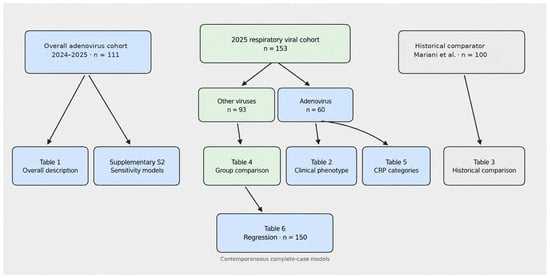
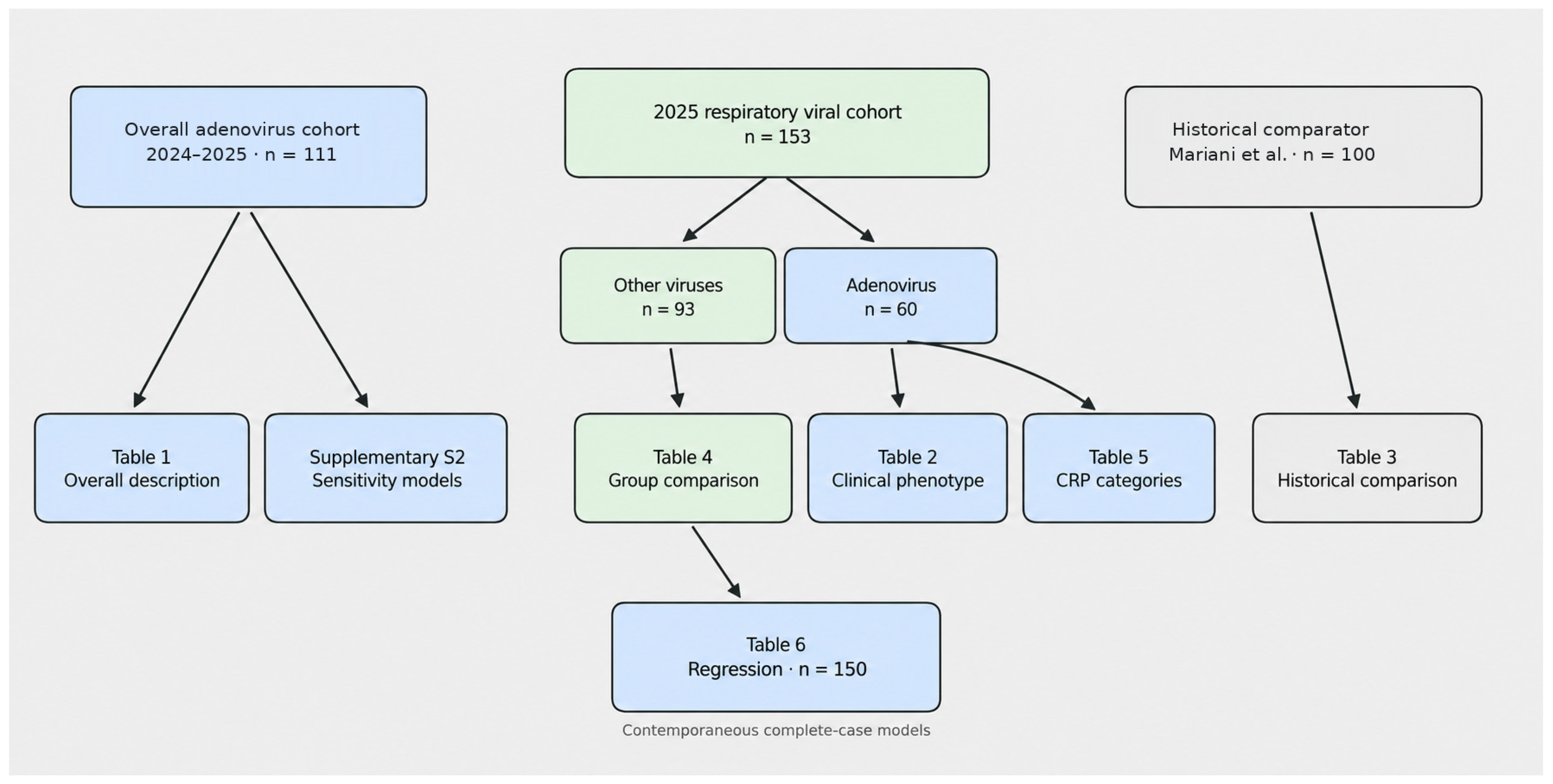
Three analytical cohorts were defined (Figure 1). The primary study cohort comprised all 111 hospitalized children with PCR-confirmed adenovirus detection between 10 February 2024 and 31 December 2025 and was used for overall descriptive analyses. A detailed clinical dataset was available for the 60 children hospitalized during 2025 and was used to characterize their clinical phenotype. During the same year, these patients were compared with 93 hospitalized children with PCR-confirmed respiratory viral infections other than adenovirus, whose distribution by primary viral diagnosis is presented in Supplementary Table S1.
Figure 1.
Study design and analytical framework. Respiratory viruses were identified by multiplex polymerase chain reaction (PCR). The overall adenovirus cohort (n = 111) was used for descriptive analyses and sensitivity analyses. The 2025 respiratory viral cohort (n = 153) comprised children hospitalized with adenovirus infection (n = 60) and children hospitalized with other PCR-confirmed respiratory viral infections (n = 93). This cohort was used for the primary comparative analyses, while multivariable logistic regression models included 150 patients with complete data. The external comparator cohort reported by Mariani et al. [11] (n = 100) was used for historical comparison. The figure illustrates the study populations and analytical framework rather than the complete screening and exclusion process.
None of the 93 comparator patients had a positive adenovirus PCR result. Molecular testing was requested according to clinical indications, including suspected viral infection, fever of undetermined origin, and respiratory distress; it was not performed as universal screening of pediatric admissions. All identified hospitalized patients with adenovirus PCR positivity were included; no patients were excluded on the basis of presumed incidental detection.
Clinical, laboratory and management data were retrieved from institutional electronic medical records and the hospital respiratory viral infection registry. Variables available for the entire study cohort included demographic characteristics, laboratory findings, antibiotic exposure and hospital length of stay.
More detailed characterization of clinical presentation, microbiological investigations, imaging findings, and associated clinical conditions was available for children hospitalized during 2025 following implementation of the institutional respiratory viral infection registry. Accordingly, analyses describing the detailed clinical phenotype were restricted to this subcohort (n = 60), whereas overall descriptive analyses were based on the complete adenovirus cohort (n = 111).
2.3. Virological Testing
Respiratory viral detection was performed on nasopharyngeal swab specimens using commercially available multiplex real-time PCR assays (Allplex Respiratory Panel Assays, Seegene, Seoul, Republic of Korea). Viral nucleic acids were extracted using the STARMag Universal Cartridge Kit on the automated Nimbus IV platform (Seegene). The respiratory panel included adenovirus among the targeted respiratory viruses. The same molecular diagnostic methodology was used throughout the 2024–2025 study period and for both adenovirus-positive patients and the contemporaneous respiratory-virus comparator cohort. The exact intervals between sample collection, laboratory processing, and availability of PCR results to the treating clinicians were not systematically retrievable from the retrospective records.
2.4. Comparator Cohorts
Two comparator populations were used. The first consisted of the previously published Italian cohort reported by Mariani et al. [11], for which anonymized individual-level data were available, allowing direct statistical comparison. The second consisted of the contemporaneous 2025 institutional cohort of children hospitalized with PCR-confirmed respiratory viral infections other than adenovirus.
2.5. Definitions
Respiratory, gastrointestinal, and neurological syndromes were classified according to the clinical diagnoses documented in the medical records. Respiratory viral coinfection was defined as detection of one or more additional respiratory viruses during the same hospitalization. Bacterial and fungal findings, and atypical bacterial pathogens, were not classified as respiratory viral coinfections.
For patients with multiple respiratory viral detections, the primary viral diagnosis recorded in the institutional database was used for descriptive classification. No retrospective algorithm based on viral load, clinical severity, or presumed etiological predominance was applied to establish the causative pathogen. Additional viral detections were recorded separately when supported by the available microbiological documentation. Consequently, the designation of a primary viral diagnosis should be interpreted as a database classification rather than definitive attribution of the presenting illness to a single pathogen.
Chronic underlying diseases were defined as previously diagnosed medical conditions requiring regular specialist follow-up. Associated clinical conditions were additional diagnoses or clinically relevant manifestations recorded by the treating physicians in the institutional database, without predefined complication criteria. Their timing relative to admission was not systematically recorded, and they could therefore represent conditions present at admission or events identified later during hospitalization. They were not interpreted as incident in-hospital complications. Antibiotic treatment was classified by recorded route; patients receiving both oral and parenteral therapy were considered exposed to any antibiotic therapy and to parenteral therapy.
2.6. Statistical Analysis
Continuous variables are presented as medians with interquartile ranges (IQRs), whereas categorical variables are presented as numbers and percentages. Comparisons between two independent groups were performed using the Mann–Whitney U test for continuous variables and Pearson’s chi-square test or Fisher’s exact test for categorical variables, as appropriate. Comparisons across CRP categories were performed using the Kruskal–Wallis test for continuous variables and Pearson’s chi-square test or Fisher’s exact test for categorical variables, as appropriate.
To complement hypothesis testing, unadjusted between-group differences with 95% confidence intervals were estimated for selected continuous and categorical variables. Confidence intervals for differences in proportions were calculated using the Newcombe method based on Wilson score intervals. For continuous variables, differences between sample medians and their 95% confidence intervals were estimated using the percentile bootstrap method with 20,000 resamples. These analyses were exploratory and intended to describe the magnitude and precision of observed differences, rather than to support causal inference. To evaluate factors associated with antibiotic prescribing after adjustment for selected covariates, multivariable logistic regression models were constructed using any antibiotic therapy and parenteral antibiotic therapy as separate dependent variables. To account for the right-skewed distribution of CRP concentrations, CRP was transformed as log2(CRP + 1). Accordingly, the corresponding odds ratios represent the change in odds associated with a doubling of CRP + 1, approximating a doubling of CRP concentration at higher values. The linearity-in-the-logit assumption for log2(CRP + 1) and age was assessed for both antibiotic outcomes by comparing the original linear specifications with flexible quadratic B-spline specifications using likelihood-ratio tests.
For descriptive analyses, CRP concentrations were also categorized as <40, 40–100, and >100 mg/L. These thresholds were selected pragmatically to represent increasing degrees of inflammatory response commonly encountered in pediatric clinical practice. They were used only for descriptive subgroup analyses, whereas all primary multivariable analyses treated CRP as a continuous variable.
CRP was selected as the principal inflammatory biomarker for the multivariable analyses because of its widespread use in the clinical evaluation of febrile children and its relevance to decisions regarding empirical antibiotic treatment. WBC and ANC were evaluated in the descriptive and comparative analyses but were not included as additional inflammatory predictors in the primary regression models, to maintain a focused and parsimonious analytical approach.
In the overall 2024–2025 adenovirus cohort (n = 111), six CRP measurements were missing and seven additional results from 2024 were reported as <4 mg/L without an exact numeric value. The latter were considered left-censored observations rather than missing measurements. Primary analyses requiring exact numeric CRP values were therefore restricted to 98 patients. To evaluate the robustness of the findings, sensitivity analyses were performed by assigning hypothetical CRP values of 2 mg/L and 4 mg/L to the seven left-censored observations (Supplementary Table S2).
These substitutions were used exclusively for sensitivity analyses and were not considered actual laboratory measurements. The six patients with missing CRP measurements remained excluded. In contrast, all 60 children in the 2025 adenovirus subcohort had numeric CRP measurements and were included in the descriptive CRP-stratified analyses.
In the 2025 contemporaneous comparator cohort, data availability varied across variables. Among the 93 children with respiratory viral infections other than adenovirus, age and sex were available for 92 patients, WBC, ANC, and CRP for 90 patients, antibiotic treatment information for 91 patients, and length of hospital stay for 89 patients. Descriptive comparisons were based on available observations for each variable, whereas multivariable regression models used complete cases for the corresponding outcome and covariates. Variable-specific denominators are provided in the comparative results presented in Section 3.4, and overall data availability is summarized in Supplementary Table S3.
The primary multivariable analyses were performed in the 2025 cohort of children hospitalized with PCR-confirmed respiratory viral infections (adenovirus and other respiratory viruses), using a complete-case approach without imputation of missing values. Models included adenovirus detection, log2-transformed CRP concentration, age, and sex as covariates. Of the 153 patients in the contemporaneous cohort, 150 had complete data for these models. An additional sensitivity analysis restricted to the overall adenovirus cohort was performed. Because this analysis included children hospitalized in both 2024 and 2025, calendar year (2025 versus 2024) was included as an additional covariate.
Model discrimination was assessed using the area under the receiver operating characteristic curve (AUC), whereas calibration was evaluated using the Hosmer–Lemeshow goodness-of-fit test. The Brier score was used as an additional measure of overall predictive accuracy, representing the mean squared difference between predicted probabilities and observed binary outcomes, with lower values indicating better predictive performance. Two-sided p values < 0.05 were considered statistically significant.
Statistical analyses were performed using IBM SPSS Statistics for Windows, Version 31 (IBM Corp., Armonk, NY, USA), and Python (Python Software Foundation, Wilmington, DE, USA; https://www.python.org, accessed on 20 October 2026) with the statsmodels statistical library (https://www.statsmodels.org/, accessed on 20 October 2026).
Multivariable logistic regression models and sensitivity analyses were independently reproduced and updated using Python/statsmodels.
3. Results
3.1. Study Population
The study included 111 hospitalized children with PCR-confirmed adenovirus detection between 10 February 2024 and 31 December 2025 (Figure 1). Testing had been requested for clinical indications, and no adenovirus PCR-positive hospitalized patients identified in the study period were excluded. Viral detection was not taken as definitive evidence of a causal role in the presenting illness. The overall cohort had a median age of 22.0 months (interquartile range [IQR], 14.0–35.5), and 72 children (64.9%) were male. The median white blood cell (WBC) count was 12,950/μL (IQR, 9180–17,880), the median absolute neutrophil count (ANC) was 6970/μL (IQR, 4100–9100), and the median C-reactive protein (CRP) concentration was 63.0 mg/L (IQR, 32.8–117.4). Overall, 58 children (52.3%) received antibiotic therapy, including 49 (44.1%) treated with parenteral antibiotics. The median length of hospital stay was 5 days (IQR, 4–6) (Table 1).
Table 1.
Baseline demographic, laboratory and management characteristics of 111 children hospitalized with laboratory-confirmed adenovirus infection.
3.2. Clinical Phenotype of Adenovirus Infection
The detailed clinical phenotype was evaluated in the 2025 adenovirus cohort comprising 60 hospitalized children (Table 2). The median age was 24.0 months (IQR, 13.8–55.0), and 43 patients (71.7%) were male. Eleven children (18.3%) had an underlying chronic condition, whereas only one patient was immunocompromised.
Table 2.
Clinical phenotype of hospitalized children with laboratory-confirmed adenovirus infection in the 2025 institutional cohort (N = 60).
All children presented with fever, with a median maximum body temperature of 39.5 °C (IQR, 39.1–40.0) and a median fever duration of 5 days (IQR, 4–6). Prolonged fever lasting more than four days was observed in 31 patients (51.7%). Upper respiratory tract involvement predominated, with pharyngeal involvement documented in 83.3% of children and cervical lymphadenopathy in 75.0%. Coryza and cough were reported in 58.3% and 41.7% of patients, respectively, whereas conjunctivitis occurred in 21.7%. Gastrointestinal manifestations were also common, including diarrhea in 43.3% and vomiting in 35.0%. Respiratory distress, wheezing, rash, and febrile seizures were less frequent.
Laboratory investigations demonstrated a pronounced inflammatory response, with median WBC, ANC, and CRP values of 13,085/μL, 7170/μL, and 68.0 mg/L, respectively. Respiratory viral coinfection was identified in 18 children (30.0%). Blood cultures were performed in half of the cohort and were uniformly negative, whereas positive urine and throat cultures were uncommon.
Chest radiography was performed in 22 children, of whom 15 (68.2%) showed abnormalities compatible with lower respiratory tract involvement. Twenty-nine children (48.3%) received antibiotic therapy, including 26 (43.3%) who received parenteral treatment. The antibiotics recorded were ampicillin/sulbactam (n = 12), ceftriaxone (n = 11), and amoxicillin/clavulanate (n = 6).
Four children (6.7%) required supplemental oxygen, no patient required pediatric intensive care admission, and the median hospital stay was 5 days (IQR, 4–6). Additional clinical conditions were recorded in 18 children (30.0%); their timing relative to admission could not be established systematically.
3.3. Comparison with a Previously Reported Italian Cohort
Comparison with the previously published Italian cohort reported by Mariani et al. [11] is presented in Table 3. The historical comparator cohort was recruited at a general hospital where pediatric emergency care was provided by the Pediatric Department, whereas the present study was conducted at a dedicated children’s hospital with an autonomous Pediatric Emergency Department and multiple specialized inpatient units. These differences in healthcare organization and patient referral pathways, together with the different observation periods and testing strategies, limit the validity of direct comparisons of hospital-based incidence or admission rates.
Table 3.
Comparison between the present cohort and a previously reported Italian cohort of hospitalized children with PCR-confirmed adenovirus infection.
Anonymized individual-level data from the Mariani et al. [11] cohort were available for analysis, allowing direct statistical comparisons of clinical, laboratory, and management characteristics. However, these comparisons were intended to provide external clinical context rather than to establish epidemiological equivalence or causal differences between the two populations.
Children in the present series were significantly younger than those in the comparator cohort (median age, 22.0 vs. 43.0 months; p < 0.001). Median WBC count, ANC, and CRP concentrations did not differ significantly between cohorts. However, antibiotic therapy was prescribed less frequently in the present cohort than in the Mariani cohort (52.3% vs. 75.0%; p < 0.001). The median length of hospital stay was slightly longer in the present cohort (5 vs. 4 days; p = 0.019), whereas no significant difference was observed in sex distribution.
3.4. Comparison with Other Respiratory Viral Infections
The comparison with other respiratory viral infections was restricted to children hospitalized during 2025, when detailed clinical information was consistently available in the institutional registry (Table 4). Age and sex distribution were comparable between groups.
Table 4.
Comparison of the inflammatory profile and clinical management of children hospitalized with adenovirus infection and other respiratory viral infections in the 2025 institutional cohort.
Children with adenovirus infection exhibited significantly higher inflammatory markers than those with other respiratory viral infections, including higher median WBC count (13,085 vs. 9535/μL; p < 0.001), ANC (7170 vs. 5270/μL; p = 0.006), and CRP concentration (68.0 vs. 11.2 mg/L; p < 0.001).
Despite these laboratory differences, the proportion of children receiving any antibiotic therapy was similar in the two groups (48.3% vs. 51.6%; p = 0.690), as was the proportion treated with parenteral antibiotics (43.3% vs. 36.3%; p = 0.384). Conversely, children hospitalized with other respiratory viral infections more frequently required supplemental oxygen (21.5% vs. 6.7%; p = 0.014), had a longer hospital stay (median, 6 vs. 5 days; p = 0.004), and had a higher proportion of additional recorded clinical conditions (60.2% vs. 30.0%; unstandardized recording, descriptive comparison only). To complement the hypothesis tests, unadjusted effect estimates with 95% confidence intervals were calculated for selected between-group comparisons (Supplementary Table S4). These estimates provide additional information on the magnitude and precision of the observed differences and should be interpreted descriptively, without implying causal relationships.
3.5. Inflammatory Response According to CRP Categories
Within the 2025 adenovirus subcohort (n = 60), all children had numeric CRP measurements and were stratified into three categories: <40 mg/L (n = 18), 40–100 mg/L (n = 26), and >100 mg/L (n = 16). Increasing CRP categories were associated with progressively older age (p = 0.010), whereas WBC count, ANC, length of hospital stay, and the frequency of additional recorded clinical conditions did not differ significantly across CRP strata (Table 5).
Table 5.
Inflammatory response and clinical management according to C-reactive protein categories in the 2025 adenovirus subcohort (n = 60).
In contrast, the six missing CRP values and seven results reported as <4 mg/L without an exact numeric value belonged to the 2024 component of the overall adenovirus cohort (n = 111). These observations did not affect the 2025 CRP-stratified analyses presented in Table 5. Their handling in the two-year sensitivity analyses is described separately.
The proportion of children receiving antibiotic therapy increased numerically from 33.3% among those with CRP concentrations below 40 mg/L to approximately 54–56% among children with CRP concentrations of 40 mg/L or higher. A similar pattern was observed for parenteral antibiotic therapy. However, neither association reached statistical significance when CRP was analyzed as a categorical variable.
3.6. Multivariable Analyses
Multivariable logistic regression analyses were performed in the complete 2025 viral cohort to evaluate factors independently associated with antibiotic prescribing (Table 6). After adjustment for age, sex, and viral diagnosis, increasing CRP concentration remained independently associated with both any antibiotic therapy and parenteral antibiotic therapy. For each doubling of CRP + 1, the adjusted odds of receiving any antibiotic increased by 58% (adjusted odds ratio [aOR], 1.58; 95% confidence interval [CI], 1.23–2.03; p < 0.001), whereas the odds of receiving parenteral antibiotic therapy increased by 43% (aOR, 1.43; 95% CI, 1.13–1.82; p = 0.003). Diagnostic assessments using flexible spline specifications did not identify statistically significant departures from linearity in the logit for transformed CRP (p = 0.236 for any antibiotic therapy and p = 0.358 for parenteral antibiotic therapy) or age (p = 0.699 and p = 0.792, respectively).
Table 6.
Multivariable logistic regression analyses of factors associated with antibiotic prescribing among children hospitalized with viral infections in the 2025 institutional cohort.
After adjustment for CRP concentration and other covariates, adenovirus infection itself was associated with lower odds of receiving any antibiotic therapy than other respiratory viral infections (aOR, 0.31; 95% CI, 0.13–0.75; p = 0.010), whereas no independent association was observed with parenteral antibiotic therapy. Model discrimination was moderate, and the Hosmer–Lemeshow tests did not detect statistically significant evidence of lack of fit for either regression model (Table 6).
Sensitivity analyses restricted to the overall adenovirus cohort yielded consistent results, confirming the independent association between increasing CRP concentration and antibiotic prescribing (Supplementary Table S2). In a further exploratory analysis, the seven 2024 CRP measurements reported as <4 mg/L were assigned hypothetical values of 2 mg/L or 4 mg/L. In both scenarios, the associations of CRP with any antibiotic therapy and parenteral therapy remained statistically significant (all p < 0.001; Supplementary Table S2).
4. Discussion
In this two-year cohort of children hospitalized with PCR-confirmed adenovirus detection, we observed a pronounced inflammatory response, with higher inflammatory marker concentrations than in children hospitalized with other respiratory viral infections. Increasing CRP concentrations were associated with higher adjusted odds of both overall and parenteral antibiotic prescribing, whereas adenovirus detection was associated with lower adjusted odds of receiving any antibiotic therapy. These findings highlight the distinct associations of inflammatory response and viral diagnosis with antibiotic prescribing, with implications for antimicrobial stewardship [1,2,10].
The clinical phenotype was consistent with the recognized multisystem manifestations of pediatric adenovirus infection [1,2,3,5]. Persistent high fever, pharyngeal involvement, and cervical lymphadenopathy predominated, while gastrointestinal symptoms and conjunctivitis were also frequent. This combination of systemic manifestations and pronounced inflammation may resemble bacterial disease during the initial clinical assessment, particularly before virological results become available [7,8,9].
Compared with children hospitalized for other PCR-confirmed respiratory viral infections, those with adenovirus detection exhibited significantly higher WBC counts, ANC values, and CRP concentrations, consistent with previous reports of pronounced systemic inflammation in pediatric adenovirus infection [7,8,9]. Nevertheless, they required supplemental oxygen less frequently and had a shorter median hospital stay. Additional recorded clinical conditions were also less frequent, although their definitions and timing were not standardized. These findings suggest that the magnitude of the inflammatory response did not necessarily parallel the selected indicators of clinical resource use. However, differences in viral case mix, patient characteristics, admission criteria, and discharge practices preclude conclusions about relative disease severity.
The contemporaneous comparator cohort was heterogeneous and predominantly comprised influenza infections (69/93; 74.2%). Consequently, the observed differences should not be generalized to comparisons with individual respiratory pathogens. Regional preventive strategies, including RSV immunoprophylaxis with nirsevimab during the 2024–2025 season and seasonal influenza vaccination, may have influenced the composition of hospitalized viral infections, although individual immunization histories were unavailable.
The association between inflammatory markers and antibiotic prescribing represents a principal finding of this study. Although antibiotic use increased numerically across CRP categories without reaching statistical significance, continuous modelling demonstrated that higher CRP concentrations were independently associated with both overall and parenteral antibiotic prescribing. Conversely, after adjustment for CRP, age, and sex, adenovirus detection was associated with lower odds of receiving any antibiotic therapy, but not significantly associated with parenteral treatment. These findings suggest that inflammatory burden and viral diagnosis have distinct associations with prescribing decisions. However, they do not establish whether knowledge of the viral diagnosis influenced treatment or whether unmeasured clinical characteristics contributed to the observed associations [10,12].
Comparison with the previously published Italian cohort by Mariani et al. [11] showed similar inflammatory profiles despite differences in age, whereas antibiotic prescribing was less frequent in the present series. This difference may reflect variations in patient characteristics, clinical practice, healthcare organization, or observation periods and cannot establish an improvement in antimicrobial stewardship. In the Pescara cohort, rapid availability of positive adenovirus PCR results was associated with antibiotic discontinuation and early discharge [11]. Although this experience illustrates the potential clinical value of timely virological diagnosis, treatment timelines and subsequent antibiotic modifications were not systematically available in the present dataset. Consequently, we cannot determine whether similar management patterns occurred in Bari or contributed to the observed association between adenovirus detection and antibiotic prescribing. The association between inflammatory markers and antibiotic use is also consistent with the findings of Buonsenso et al. [12].
Differences between the two Italian cohorts may also reflect temporal changes in adenovirus epidemiology or variation in the circulating adenovirus types. However, adenovirus typing was not routinely performed in the present study, precluding assessment of this possibility.
The implications of these findings extend beyond adenovirus infection. CRP is widely used in the initial evaluation of febrile children, and markedly elevated concentrations frequently raise suspicion of bacterial infection [7,8,9,10,12]. Our findings demonstrate that high CRP values are common in hospitalized children with adenovirus detection and are independently associated with antibiotic prescribing. However, the study was not designed to assess prescribing appropriateness or determine whether individual antibiotic courses were clinically justified. Empirical treatment decisions depend on the child’s overall clinical presentation, duration of illness, imaging findings, underlying conditions, and the need to avoid delayed treatment of serious bacterial infection. Our findings therefore support interpreting inflammatory biomarkers within the broader clinical assessment rather than using CRP alone to guide antimicrobial decisions. Prospective studies incorporating procalcitonin, clinical severity indicators, systematic microbiological investigations, and treatment timelines may help clarify the contribution of adenovirus-associated inflammation to antibiotic prescribing and improve antimicrobial decision support.
The strengths of this study include a relatively large contemporary Italian cohort of hospitalized children with PCR-confirmed adenovirus detection, detailed clinical characterization of the 2025 subcohort, and comparisons with both a previously published Italian series and a contemporaneous cohort of children hospitalized with other respiratory viral infections. Multivariable analyses further allowed assessment of associations between CRP concentrations, viral diagnosis, and antibiotic prescribing after adjustment for selected covariates.
Several limitations should also be acknowledged. This was a retrospective single-center study restricted to hospitalized children tested according to clinical indication rather than universal screening; the findings therefore cannot be extrapolated to all admissions or to milder infections managed in outpatient settings. Detailed clinical information was systematically available only for the 2025 adenovirus subcohort, following implementation of the institutional respiratory viral infection registry. Consequently, the clinical characterization could not be extended with comparable detail to all patients hospitalized in 2024. A positive respiratory PCR result does not necessarily establish that adenovirus caused the presenting illness, as asymptomatic carriage or prolonged viral shedding may occur [13]. Furthermore, concurrent detection of other respiratory viruses complicates etiological attribution, and the relative contribution of individual pathogens could not be determined in this retrospective study.
Microbiological investigations and chest radiography were performed according to clinical indications rather than a standardized protocol. Although all 30 blood cultures obtained in the 2025 adenovirus subcohort were negative, reliable denominators for urine and throat cultures were unavailable, and the few positive findings from these investigations could only be reported as absolute counts. Similarly, radiographic abnormalities were documented in a selected subset of patients and could not establish bacterial etiology. Consequently, bacterial coinfection could not be systematically excluded, and the absence of microbiological confirmation should not be interpreted as evidence of its absence.
The database recorded additional clinical conditions without predefined complication criteria or consistent information on their onset; comparisons of these entries between groups do not measure incident complications. The sequence of CRP sampling, antibiotic initiation, and availability of PCR results could not be reconstructed reliably.
Although the antibiotic agents prescribed in the 2025 adenovirus subcohort could be identified, detailed information on antimicrobial regimens, treatment duration, clinical indications, and subsequent treatment modifications, including discontinuation or de-escalation following PCR results, was not consistently available across the study population.
Therefore, the study cannot establish that CRP results caused antibiotic prescribing or that PCR results affected antibiotic continuation, nor can it determine the appropriateness of individual prescriptions. Although the multivariable models adjusted for viral diagnosis, CRP concentration, age, and sex, antibiotic prescribing may also have been influenced by additional clinical factors, including fever duration, clinical appearance, underlying conditions, radiological findings, oxygen requirement, and suspected bacterial coinfection. These variables were not consistently available or sufficiently standardized across the study populations to permit their reliable inclusion in the regression models. Consequently, the observed associations should be interpreted as adjusted for the selected covariates rather than independent of all potential clinical confounders. Residual confounding cannot be excluded.
Missing data were handled through complete-case analyses. Additional respiratory viruses were documented inconsistently in the comparator database, and pathogen-specific coinfection frequencies may be underestimated when strict documentation criteria are applied.
5. Conclusions
In this retrospective cohort, hospitalized children with PCR-confirmed adenovirus detection exhibited a pronounced inflammatory response, characterized by higher CRP concentrations, leukocyte counts, and neutrophil counts than children hospitalized with other respiratory viral infections. Increasing CRP concentrations were associated with higher adjusted odds of both overall and parenteral antibiotic prescribing. Conversely, adenovirus detection was associated with lower adjusted odds of receiving any antibiotic therapy, while no statistically significant association was observed with parenteral antibiotic treatment. These findings emphasize that inflammatory biomarker concentrations and viral diagnosis may show distinct associations with antibiotic prescribing. Given the observational design and the possibility of residual confounding, these associations should not be interpreted as causal. Careful integration of laboratory results with clinical assessment remains essential to support appropriate antimicrobial prescribing without compromising the recognition and treatment of possible bacterial infection.
Supplementary Materials
The following supporting information can be downloaded at: https://www.mdpi.com/article/10.3390/idr18060125/s1, Table S1: Composition of the 2025 respiratory viral comparator cohort; Table S2: Sensitivity analyses of factors associated with antibiotic prescribing; Table S3: Availability of study variables used in the primary analyses; Table S4: Unadjusted differences between the 2025 adenovirus and other respiratory viral infection cohorts, with 95% confidence intervals.
Author Contributions
Conceptualization, M.O.A., M.A., D.T. and D.C.; methodology, M.A. and D.C.; validation, E.F., C.R. and A.B.; formal analysis, C.C., E.F. and M.A.; investigation, C.C., E.F., C.R., A.B. and V.G.M.; data curation, C.C., D.T. and E.F.; writing—original draft preparation, M.A.; writing—review and editing, M.O.A., D.T., M.A. and D.C.; supervision, M.A. and D.C. All authors have read and agreed to the published version of the manuscript.
Funding
This research received no external funding.
Institutional Review Board Statement
The study was conducted in accordance with the principles of the Declaration of Helsinki. This was a retrospective, non-interventional observational study based exclusively on clinical information collected during routine hospital care. No additional diagnostic procedures, therapeutic interventions, or patient contacts were undertaken for research purposes. The study involved secondary analysis of existing clinical records, with appropriate measures to protect patient confidentiality and prevent identification in the research outputs. Given its retrospective and non-interventional design and the absence of research-related procedures involving patients, formal Ethics Committee review was considered not required for this study.
Informed Consent Statement
The study was based on retrospectively collected anonymized clinical data. Beginning in 2025, written informed consent for the secondary use of clinical data for scientific research and publication was routinely requested from parents or legal guardians of children admitted to the Pediatric Infectious Diseases Unit, using a dedicated institutional consent form. The form explicitly addressed data protection, anonymization or pseudonymization, and the voluntary nature of consent. Data from 2024 were collected before the introduction of this procedure and were analyzed retrospectively.
Data Availability Statement
The datasets generated and analyzed during the current study are available from the corresponding author upon reasonable request.
Acknowledgments
During the preparation and revision of this manuscript, the authors used ChatGPT-5.5 (OpenAI, San Francisco, CA, USA) to assist with language editing, manuscript organization, data consistency checks, and statistical analysis using Python-based computational tools. All analytical results were critically reviewed and validated by the authors, who retained full responsibility for the study design, data interpretation, scientific conclusions, and accuracy and integrity of the manuscript.
Conflicts of Interest
The authors declare no conflicts of interest.
References
- Lynch, J.P., 3rd; Kajon, A.E. Adenovirus: Epidemiology, Global Spread of Novel Serotypes, and Advances in Treatment and Prevention. Semin. Respir. Crit. Care Med. 2016, 37, 586–602. [Google Scholar] [CrossRef] [Scilit] [PubMed]
- Sandkovsky, U.; Vargas, L.; Florescu, D.F. Adenovirus: Current epidemiology and emerging approaches to prevention and treatment. Curr. Infect. Dis. Rep. 2014, 16, 416. [Google Scholar] [CrossRef] [Scilit] [PubMed]
- Edwards, K.M.; Thompson, J.; Paolini, J.; Wright, P.F. Adenovirus infections in young children. Pediatrics 1985, 76, 420–424. [Google Scholar] [CrossRef] [Scilit]
- Jain, S.; Williams, D.J.; Arnold, S.R.; Ampofo, K.; Bramley, A.M.; Reed, C.; Stockmann, C.; Anderson, E.J.; Grijalva, C.G.; Self, W.H.; et al. Community-acquired pneumonia requiring hospitalization among U.S. children. N. Engl. J. Med. 2015, 372, 835–845. [Google Scholar] [CrossRef] [Scilit] [PubMed]
- Xie, L.; Zhang, B.; Xiao, N.; Zhang, F.; Zhao, X.; Liu, Q.; Xie, Z.; Gao, H.; Duan, Z.; Zhong, L. Epidemiology of human adenovirus infection in children hospitalized with lower respiratory tract infections in Hunan, China. J. Med. Virol. 2019, 91, 392–400. [Google Scholar] [CrossRef] [Scilit] [PubMed]
- Lion, T. Adenovirus infections in immunocompetent and immunocompromised patients. Clin. Microbiol. Rev. 2014, 27, 441–462. [Google Scholar] [CrossRef] [Scilit] [PubMed]
- Appenzeller, C.; Ammann, R.A.; Duppenthaler, A.; Gorgievski-Hrisoho, M.; Aebi, C. Serum C-reactive protein in children with adenovirus infection. Swiss Med. Wkly. 2002, 132, 345–350. [Google Scholar] [CrossRef] [Scilit] [PubMed]
- Putto, A.; Meurman, O.; Ruuskanen, O. C-reactive protein in the differentiation of adenoviral, Epstein–Barr viral and streptococcal tonsillitis in children. Eur. J. Pediatr. 1986, 145, 204–206. [Google Scholar] [CrossRef] [Scilit] [PubMed]
- Kawasaki, Y.; Hosoya, M.; Katayose, M.; Suzuki, H. Correlation between serum interleukin-6 and C-reactive protein concentrations in patients with adenoviral respiratory infection. Pediatr. Infect. Dis. J. 2002, 21, 370–374. [Google Scholar] [CrossRef] [Scilit] [PubMed]
- Aricò, M.O.; Valletta, E.; Caselli, D. Appropriate use of antibiotic and principles of antimicrobial stewardship in children. Children 2023, 10, 740. [Google Scholar] [CrossRef] [Scilit] [PubMed]
- Mariani, A.; Cavallo, F.; La Bella, S.; Graziano, G.; Passarelli, M.; Crescenzi, C.; Trotta, D.; Aricò, M. A high copy number from a pharyngeal swab is not associated with different presenting features in 100 children with acute adenovirus infection from a cluster in Italy. Children 2023, 10, 1788. [Google Scholar] [CrossRef] [Scilit] [PubMed]
- Buonsenso, D.; Camporesi, A.; Viozzi, F.; Lazzareschi, I.; Manca, L.; Caci, A.; Menna, D.; Santangelo, R.; Sanguinetti, M.; Raffaelli, F.; et al. Determinants of antibiotic prescription in children with adenovirus respiratory tract infections. Eur. J. Pediatr. 2024, 183, 3489–3497. [Google Scholar] [CrossRef] [Scilit] [PubMed]
- Kalu, S.U.; Loeffelholz, M.; Beck, E.; Patel, J.A.; Revai, K.; Fan, J.; Henrickson, K.J.; Chonmaitree, T. Persistence of adenovirus nucleic acids in nasopharyngeal secretions: A diagnostic conundrum. Pediatr. Infect. Dis. J. 2010, 29, 746–750. [Google Scholar] [CrossRef] [Scilit] [PubMed]

Disclaimer/Publisher’s Note: The statements, opinions and data contained in all publications are solely those of the individual author(s) and contributor(s) and not of MDPI and/or the editor(s). MDPI and/or the editor(s) disclaim responsibility for any injury to people or property resulting from any ideas, methods, instructions or products referred to in the content. |
© 2026 by the authors. Licensee MDPI, Basel, Switzerland. This article is an open access article distributed under the terms and conditions of the Creative Commons Attribution (CC BY) license.