


Abstract
Background: Environmental surface contamination in early childhood education settings has been recognized as a potential source of exposure to microorganisms. However, the available evidence on bacterial contamination in these environments remains limited, methodologically heterogeneous, and difficult to interpret from an epidemiological perspective. Methods: A scoping review was conducted following Joanna Briggs Institute methodology and reported according to the PRISMA-ScR guidelines. Searches were performed in PubMed/MEDLINE, Embase, Scopus, Web of Science, CINAHL, LILACS, and gray literature sources. Studies reporting bacterial contamination of environmental surfaces and fomites in early childhood education settings were included. Data were extracted and synthesized using descriptive and thematic approaches. Results: Nine studies met the inclusion criteria. Most employed cross-sectional designs and showed substantial variability in sampling strategies, microbiological methods, and outcome definitions. Frequently identified microorganisms included Staphylococcus aureus (including methicillin-resistant strains [MRSA]), Bacillus spp., Pseudomonas spp., Klebsiella spp., Enterococcus spp., and Escherichia coli. Bacterial contamination was consistently reported on high-touch surfaces such as toys, tables, doorknobs, and shared objects. However, most studies did not distinguish between microbial detection, viability, and transmission potential, limiting epidemiological interpretation. Evidence regarding antimicrobial resistance was restricted to a small number of studies and remained fragmented. Conclusions: Evidence on the bacterial contamination of surfaces and fomites in early childhood education settings is scarce, heterogeneous, and predominantly descriptive. Current knowledge is largely limited to documenting the presence of microorganisms, with insufficient evidence to determine their viability or role in transmission processes. Future studies should adopt standardized methodologies and integrate environmental, microbiological, and epidemiological measures to strengthen the understanding of contamination patterns and their public health relevance.
1. Introduction
Environmental contamination has been defined as the presence of microorganisms on surfaces, objects, or materials within a given environment that may act as potential points of human exposure. However, the interpretation of environmental contamination is not straightforward. The simple detection of microorganisms on a surface does not necessarily indicate microbial viability, nor does it demonstrate the capacity for transmission or infection [1]. These distinctions are particularly important in studies conducted in community environments, where microbial presence, survival, and epidemiological relevance are often treated as interchangeable concepts despite representing different stages of a complex transmission process [1,2,3].
Therefore, in the context of this review, microbial presence refers to the detection of bacterial material or organisms on surfaces [4,5], viability refers to the ability of these organisms to survive under environmental conditions, and transmission potential refers to the possibility that viable microorganisms may be transferred between surfaces and hosts in a manner that contributes to disease occurrence [6,7,8,9].
Early childhood education settings, including daycare centers and preschools, represent a particularly relevant context for the study of environmental contamination [10,11]. These environments are characterized by high population density, frequent sharing of objects, intense physical interaction among children and staff, and constant contact with high-touch surfaces such as toys, tables, furniture, doorknobs, and sanitary facilities [12,13]. In addition, young children exhibit behavioral and developmental characteristics that may increase exposure to environmental microorganisms, including frequent hand-to-mouth contact, limited adherence to hygiene practices, and close interpersonal interactions [14,15].
Although the contamination of educational environments has been investigated in relation to bacteria, viruses, and fungi, the present review focuses specifically on bacterial contamination. This decision was motivated by the substantial biological and methodological differences among microbial groups. Bacteria differ from viruses and fungi regarding environmental persistence, cultivation methods, molecular detection approaches, antimicrobial susceptibility profiles, and epidemiological interpretation [1,16]. Furthermore, antimicrobial resistance, currently recognized as one of the major global public health challenges, is intrinsically associated with bacterial populations and represents an emerging dimension of environmental contamination that remains insufficiently explored in early childhood education settings [17,18].
From a public health perspective, interest in the bacterial contamination of daycare centers and preschools has increased due to the recognized susceptibility of children to infectious diseases and the potential role of shared environments in microbial circulation [14,19]. Studies conducted in educational settings have identified potentially pathogenic bacteria, including Staphylococcus aureus, Escherichia coli, Salmonella spp., Shigella spp., Pseudomonas spp., and other opportunistic microorganisms on frequently touched surfaces and shared objects [12,17,20]. These findings have raised concerns regarding the role of environmental surfaces as potential contributors to microbial exposure and dissemination in community settings.
Despite growing interest in environmental contamination in educational settings, the available literature encompasses a wide range of microbiological approaches and analytical objectives. Existing investigations include culture-based assessments of environmental surfaces and fomites [12,17], studies focused on antimicrobial resistance [18,21], and molecular analyses of environmental microbial communities using techniques such as 16S rRNA sequencing [13]. These differences in study design, sampling strategies, microbiological methods, target microorganisms, and outcome measures may complicate the interpretation and integration of findings across studies. As a result, direct comparisons between investigations remain challenging, highlighting the need for a comprehensive mapping of the available evidence.
Equally important, environmental contamination is not always defined or measured consistently across studies. While some investigations focus primarily on microbial detection through culture-based methods [12,15], others incorporate molecular approaches to characterize microbial diversity, virulence factors, or antimicrobial resistance [13,17,18]. Moreover, the detection of microorganisms on surfaces does not necessarily provide information regarding microbial viability, persistence, or epidemiological relevance [6]. As a result, findings based on microbial presence may be interpreted differently across studies, making comparisons and synthesis more challenging. These methodological and conceptual differences highlight the need for greater clarity regarding how environmental contamination is defined, measured, and interpreted in educational settings.
Another important gap concerns antimicrobial resistance. Although resistant microorganisms have been reported in some daycare environments, evidence remains sparse and unevenly distributed across geographic regions and study designs [17,18]. Most available studies originate from high-income countries, with relatively little evidence from low- and middle-income settings, where differences in sanitation infrastructure, environmental conditions, and resource availability may substantially influence contamination patterns and associated risks. Consequently, important uncertainties remain regarding the occurrence, distribution, and epidemiological implications of resistant bacteria in these environments.
Taken together, the diversity of approaches reported in the existing literature suggests that evidence on bacterial contamination in early childhood education settings may be difficult to compare and synthesize. Variability in study objectives, microbiological approaches, and outcome definitions highlights the need for a comprehensive mapping of the available evidence.
Given this scenario, this scoping review aims to map and critically synthesize the available evidence on the bacterial contamination of surfaces and fomites in early childhood education settings, with particular attention to microbial diversity, the presence of potentially pathogenic bacteria, and emerging evidence related to antimicrobial resistance.
2. Materials and Methods
This scoping review was conducted in accordance with the methodological framework proposed by the Joanna Briggs Institute (JBI) and reported following the Preferred Reporting Items for Systematic Reviews and Meta-Analyses Extension for Scoping Reviews (PRISMA-ScR) guidelines [22,23]. The completed PRISMA-ScR checklist is available as Supplementary Table S1. The study selection process is presented using the PRISMA 2020 flow diagram [24]. To enhance transparency, reproducibility, and methodological rigor, the review protocol was prospectively registered on the Open Science Framework (OSF) (https://osf.io/7c4fp/, accessed on 28 March 2026).
The choice of a scoping review design was guided by a preliminary exploration of the literature, which indicated that research on the bacterial contamination of surfaces in early childhood education settings is limited, methodologically heterogeneous, and conceptually fragmented. Scoping reviews are particularly appropriate for mapping emerging or dispersed bodies of evidence, identifying research gaps, clarifying key concepts, and examining the characteristics of available studies without the restrictions associated with effectiveness-focused evidence synthesis [23]. Accordingly, this review sought to provide a comprehensive overview of the extent, characteristics, and methodological features of the available literature.
The review was structured using the Population–Concept–Context (PCC) framework recommended by the JBI for scoping reviews [23]. Given the environmental focus of the review, the PCC framework was adapted so that the population component referred to environmental units rather than human participants. Thus, the population included environmental surfaces, shared objects, high-touch surfaces, and indirect fomites present in educational settings. The concept comprised bacterial contamination, including microbial identification, bacterial diversity, bacterial load, antimicrobial resistance, and virulence factors. The context included early childhood education settings such as daycare centers, childcare facilities, preschools, kindergartens, nurseries, and equivalent educational environments.
A comprehensive search strategy was developed using three conceptual blocks: (i) educational setting, including terms such as daycare, preschool, childcare, kindergarten, nursery, and early childhood education; (ii) environmental unit, including surfaces, fomites, environmental contamination, built environment, environmental microbiology, and related terms; and (iii) bacterial outcomes, including bacteria, bacterial contamination, bacterial load, microbiota, microbiome, antimicrobial resistance, and bacterial diversity. Controlled vocabulary terms, including Medical Subject Headings (MeSH) and Emtree descriptors, were combined with free-text keywords using Boolean operators (AND, OR). Search strategies were adapted to the syntax and indexing characteristics of each database.
Electronic searches were conducted in PubMed/MEDLINE, Embase, Scopus, Web of Science, CINAHL, and LILACS. The initial search was performed on 15 January 2026, and updated on 10 February 2026, to identify recently indexed studies. No restrictions were applied regarding publication date.
To complement database searches and increase retrieval sensitivity, gray literature was explored using Google Scholar. Following recommendations for evidence synthesis studies, the first 100 records sorted by relevance were screened [25]. Although Google Scholar indexes a substantially larger number of records, relevance ranking tends to prioritize the most influential and frequently cited studies, and screening beyond the first 100 results has been shown to yield progressively diminishing returns while substantially increasing reviewer workload [25]. Nevertheless, this approach may have reduced the sensitivity to some gray literature sources and local publications, a limitation that was considered during interpretation of the findings.
In addition, reverse searching through manual screening of the reference lists of all included studies was planned as part of the review protocol. However, no additional eligible studies were identified through this procedure. For transparency, this process is reported in the PRISMA flow diagram as “reverse search = 0”.
Studies were considered eligible if they reported primary microbiological data obtained from environmental surfaces or fomites in early childhood education settings. Eligible microbiological methods included culture-based techniques, polymerase chain reaction (PCR), sequencing approaches, antimicrobial susceptibility testing, or combinations of these methods. The restriction to bacterial contamination was intentional and established a priori. Although environmental contamination in educational settings may involve bacteria, viruses, and fungi, substantial differences exist among these microbial groups regarding environmental persistence, laboratory detection, ecological behavior, and epidemiological interpretation. Restricting the review to bacteria allowed for a more coherent synthesis of the findings while enabling an exploration of antimicrobial resistance, a phenomenon uniquely associated with bacterial populations and increasingly recognized as a public health concern in community environments.
Studies were excluded if they focused exclusively on viral or fungal contamination, did not evaluate environmental surfaces or fomites as the primary unit of analysis, investigated only human colonization without environmental assessment, or consisted of reviews, editorials, letters, conference commentaries, or other publications lacking primary microbiological data. Publications written in English, Portuguese, and Spanish were considered eligible.
All identified records were exported to Rayyan, which was used for reference management, duplicate identification, and study screening. Duplicate records were automatically identified and subsequently verified manually. Study selection was conducted in two sequential phases. First, titles and abstracts were independently screened by two reviewers according to predefined eligibility criteria. Subsequently, full texts of potentially relevant studies were retrieved and independently assessed for eligibility. Before screening commenced, reviewers conducted a pilot calibration exercise to ensure consistency in interpretation and application of the eligibility criteria. Disagreements were resolved through discussion and consensus.
Data extraction was performed independently using a standardized extraction form developed by the research team and pilot-tested before implementation. The form was designed to ensure consistency and completeness across reviewers. Extracted information included publication characteristics (authors, year, country), methodological characteristics (study design, sampling approach, microbiological methods), environmental characteristics (type of educational setting, sample sources, surfaces and fomites evaluated), microbiological findings (identified microorganisms, bacterial diversity, bacterial load), and information related to antimicrobial resistance and virulence factors when reported.
Data synthesis followed a descriptive and qualitative approach informed by inductive thematic analysis [23]. Initially, all included studies were read in full to promote familiarization with the evidence base. Subsequently, data were coded according to recurring concepts, methodological characteristics, microbiological outcomes, and interpretive challenges identified across studies. Codes were iteratively grouped into broader analytical categories that captured recurring patterns, methodological convergences and divergences, conceptual ambiguities, and gaps in the literature. Particular attention was devoted to issues affecting epidemiological interpretation, including distinctions between microbial detection, viability, resistance profiles, and potential public health relevance.
In accordance with JBI recommendations for scoping reviews, no formal assessment of methodological quality, risk of bias, or certainty of evidence was performed [23]. Consequently, the review does not present a critical appraisal of the included studies. Instead, methodological aspects reported in the studies were descriptively characterized and considered during interpretation of the findings. The purpose of this characterization was not to classify study quality but rather to contextualize the evidence base, identify methodological variability, and highlight interpretive constraints that may influence the comparability and applicability of the findings.
Because this review was based exclusively on the analysis of publicly available documents and did not involve human participants, approval by a research ethics committee was not required.
Use of Artificial Intelligence (AI) Tools
During manuscript preparation, the authors used ChatGPT—GPT-5.3 version (OpenAI, San Francisco, CA, USA) to assist with language editing, grammar refinement, and improvement of textual clarity. The authors critically reviewed, edited, and validated all AI-generated suggestions and take full responsibility for the content of this manuscript.
3. Results
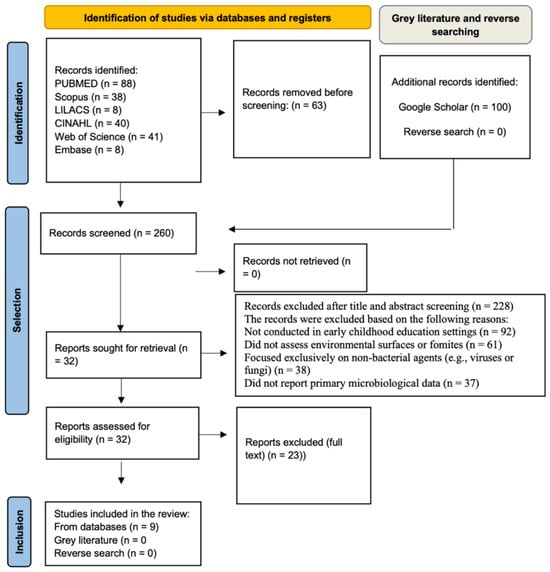
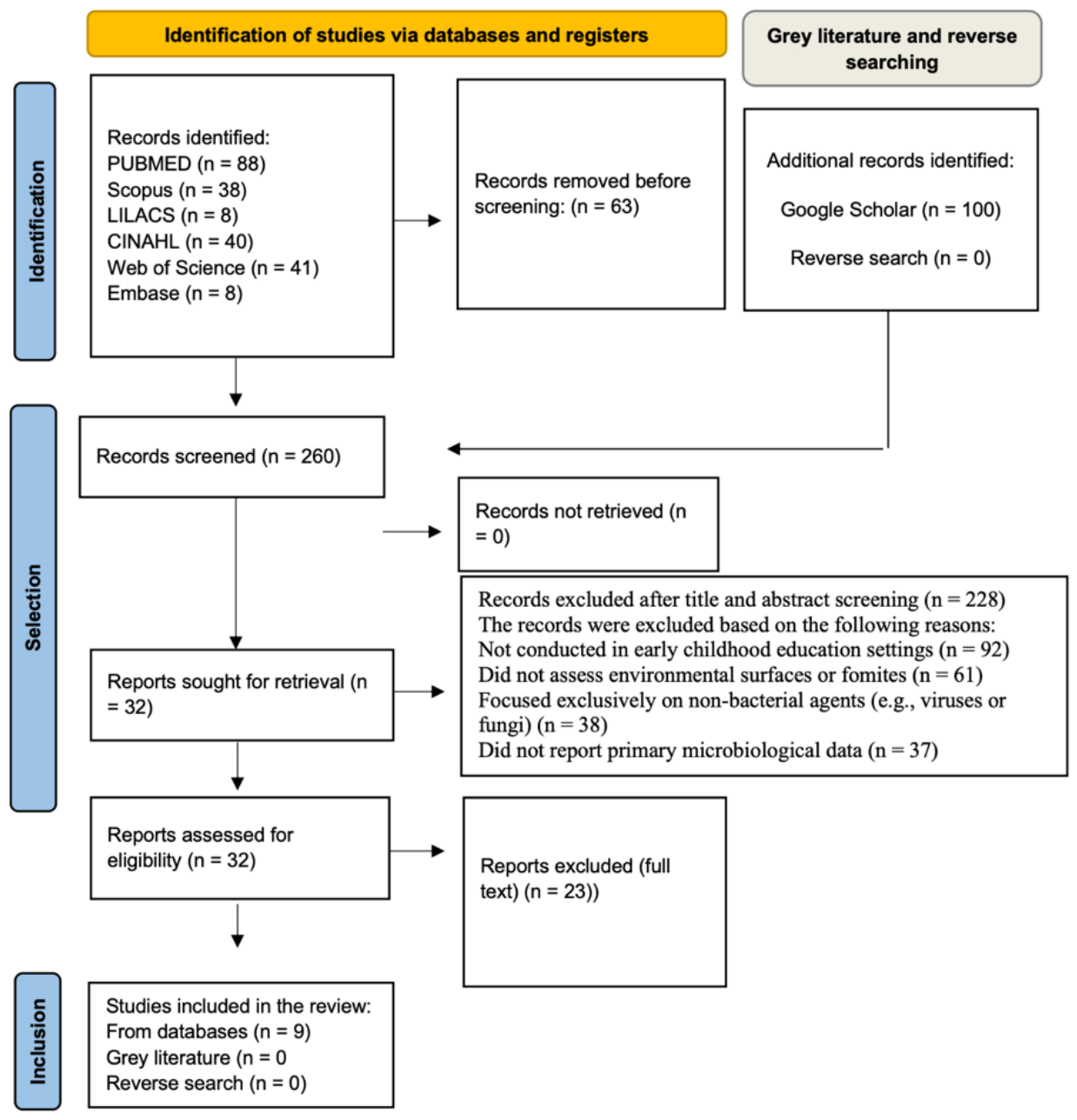
A total of 223 records were identified through database searching (Appendix A), with an additional 100 records identified through Google Scholar, resulting in 323 records. After the removal of 63 duplicates, 260 records were screened by title and abstract. Of these, 228 were excluded. Thirty-two full-text articles were assessed for eligibility, and 23 were excluded. The main reasons for exclusion at the title and abstract screening stage included studies not conducted in early childhood education settings, studies not assessing environmental surfaces or fomites, studies focusing on non-bacterial agents, and studies not reporting primary microbiological data. Among the articles assessed in full text, the main reasons for exclusion were the absence of environmental surface assessment (n = 8), exclusive focus on human colonization (n = 5), lack of bacterial outcomes (n = 4), and publication types not reporting primary data, such as reviews, editorials, or commentaries (n = 6). Ultimately, nine studies were included in the review (Figure 1).
Figure 1.
PRISMA flow diagram of the study selection process.
The characteristics of the included studies are summarized in Table 1. Most studies were conducted in the United States (n = 6), followed by Nigeria (n = 2) and Slovenia (n = 1). Regarding study design, cross-sectional investigations predominated (n = 5), followed by longitudinal studies (n = 2) and observational studies without a clearly specified temporal framework (n = 2).
Table 1.
Characteristics of the included studies that evaluated the bacterial contamination of surfaces in early childhood education settings.
Most studies were conducted in daycare centers or early childhood education settings. One study was undertaken in a school environment and was retained as a borderline case because it investigated high-touch surfaces within an educational setting and provided information relevant to understanding environmental contamination in contexts involving children.
Important differences were observed regarding sampling units. Four studies exclusively evaluated environmental surfaces and fomites, whereas five studies adopted mixed sampling strategies that combined environmental samples with human or human-associated specimens, including hands, nasal swabs, clothing, children, and staff members. This distinction is important because studies incorporating both environmental and human samples provide broader information on microbial circulation but limit the attribution of the findings exclusively to environmental surface contamination.
Across the studies, the most frequently investigated environmental units were high-touch surfaces, including toys, tables, doorknobs, furniture, sanitary facilities, and other shared objects. One study specifically evaluated clothing worn by daycare staff as an indirect fomite. The diversity of sampled surfaces reflects the absence of standardized environmental monitoring approaches in early childhood education settings.
Considerable heterogeneity was observed in microbiological methods (Table 1). Conventional culture-based techniques were the most frequently used approach and were often combined with molecular methods such as polymerase chain reaction (PCR) and 16S rRNA gene sequencing. A smaller number of studies incorporated antimicrobial susceptibility testing, antimicrobial resistance characterization, or virulence gene detection, reflecting substantial variability in analytical scope and microbiological complexity across investigations.
Beyond the descriptive characterization of the included studies, methodological and interpretive features were examined to better understand sources of heterogeneity across the evidence base. Consistent with JBI recommendations for scoping reviews, no formal assessment of methodological quality or risk of bias was conducted. Instead, studies were characterized according to their design, sampling strategies, microbiological methods, analytical scope, and potential limitations affecting interpretation of the findings. The resulting methodological characteristics and interpretive constraints are summarized in Table 2.
Table 2.
Methodological features and interpretive considerations of the included studies.
The analysis of the included studies revealed a wide diversity of microorganisms associated with surfaces and fomites in early childhood education settings, as presented in Table 3. A predominance of commensal and opportunistic bacteria associated with human skin was observed, such as Streptococcus and Propionibacterium, as well as genera widely distributed in the environment, such as Bacillus, Staphylococcus, and Pseudomonas.
Table 3.
Microorganisms identified and antimicrobial resistance/virulence profiles in the included studies.
Among the most relevant pathogens, the presence of Staphylococcus aureus stood out, including methicillin-resistant strains (MRSA), highlighting the potential of these settings as reservoirs of clinically relevant microorganisms. In addition, Gram-negative bacteria, such as Klebsiella spp. and Pseudomonas aeruginosa, were identified, associated with the presence of virulence genes and pathogenic potential. The assessment of antimicrobial resistance was limited to a small number of studies, reinforcing the fragmented and incipient nature of the evidence on resistance in these settings, in which resistance profiles to multiple antibiotics and the presence of genes such as mecA, blaSHV, tetA, and dfr1 were identified. Additionally, virulence genes such as fimH, algD, icaA, and cna were reported, indicating the capacity for adhesion, biofilm formation, and bacterial invasiveness.
Some studies used fecal indicator bacteria, such as Enterococcus spp. and Escherichia coli, as proxies for environmental contamination, suggesting possible routes of indirect transmission associated with inadequate hygiene. On the other hand, a portion of the studies reported only the general presence of environmental bacteria, without taxonomic detail or assessment of resistance.
Table 4 presents the methods used to assess bacterial contamination in the included studies, encompassing collection techniques, types of analysis, and reported outcomes. A predominance of microbiological culture was observed, in some studies combined with molecular methods, with variation in analytical approaches and in the measurement of results.
Table 4.
Microbiological methods and analytical approaches used to assess bacterial contamination in the included studies.
Table 5 presents the main types of surfaces and fomites investigated in the included studies, their classification according to level of contact, and the findings related to bacterial contamination. A predominance of high-touch surfaces was observed, such as toys, tables, doorknobs, and shared objects, frequently associated with the presence of potentially pathogenic bacteria, including resistant microorganisms. In addition, some studies highlighted the importance of indirect fomites, such as staff clothing, as potential routes of transmission. Overall, the findings indicate that frequently handled surfaces play a relevant role in the maintenance and dissemination of microorganisms in these settings.
Table 5.
Surfaces and fomites associated with bacterial contamination in the included studies.
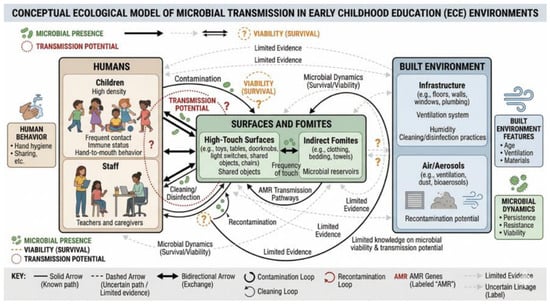
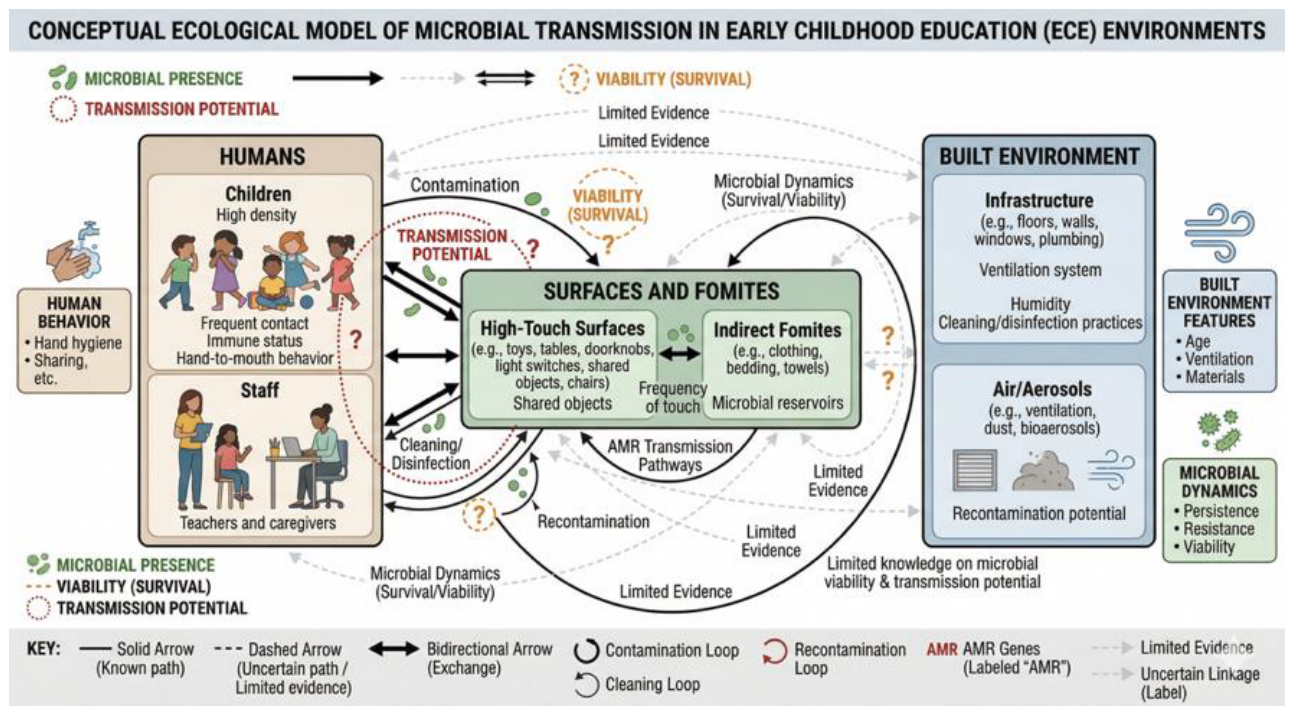
The model in Figure 2 illustrates environmental surfaces and fomites as potential sites of microbial contamination within early childhood education settings. Interactions among children, staff, environmental surfaces, indirect fomites, and elements of the built environment (including infrastructure and air/aerosols) are represented as possible pathways of microbial exchange reported in the literature.
Figure 2.
Author-developed conceptual model of bacterial contamination in early childhood education settings.
Solid arrows indicate relationships that were directly examined or frequently described in the included studies, whereas dashed arrows represent pathways that remain uncertain, understudied, or insufficiently characterized. The model distinguishes between microbial presence, viability, and transmission potential, highlighting important conceptual and methodological gaps identified across the evidence base.
Cycles of contamination, cleaning/disinfection, and recontamination are depicted to illustrate the dynamic nature of environmental microbial persistence and redistribution. The model also incorporates antimicrobial resistance (AMR) as an emerging but insufficiently explored dimension of environmental contamination in educational settings. Rather than representing validated transmission pathways, the model is intended as a conceptual synthesis of the available evidence and a framework for identifying priority areas for future research.
4. Discussion
4.1. Fragmentation, Ambiguity, and Interpretive Challenges in the Available Evidence
This scoping review identified the bacterial contamination of surfaces and fomites as a recurrent finding across studies conducted in early childhood education settings. However, beyond documenting the presence of microorganisms, the review highlights important methodological and conceptual challenges that complicate the interpretation and integration of the available evidence. Although bacterial contamination was consistently reported, only a small number of eligible studies were identified, and substantial variability was observed in study designs, sampling strategies, microbiological methods, target microorganisms, and outcome measures. Such differences limit a direct comparison across investigations and make it difficult to establish a coherent understanding of environmental contamination across settings.
The recurrent identification of genera such as Staphylococcus, Bacillus, Pseudomonas, and members of the Enterobacteriaceae family suggests that daycare centers and other early childhood education environments are characterized by continuous interactions between human-associated and environmental microbiota [12,13]. Similar findings have been reported in studies conducted in schools and other community environments, where microbial communities on frequently touched surfaces reflect patterns of human occupancy, environmental characteristics, and cleaning practices [20,28]. Nevertheless, the epidemiological significance of these findings remains uncertain.
A central challenge identified across the included studies concerns the interpretation of microbial detection. While several investigations reported the presence of potentially pathogenic bacteria on environmental surfaces, most relied on measures of presence, absence, or relative abundance without evaluating microbial viability, persistence under environmental conditions, infectious dose, or effective transfer between surfaces and hosts. Consequently, the detection of microorganisms should not be interpreted as direct evidence of transmission risk. As noted by Julian et al. [15], environmental contamination may plausibly contribute to exposure pathways, but available studies rarely provide sufficient evidence to establish causal relationships between contaminated surfaces and infectious outcomes.
This distinction is particularly important because the concepts of microbial presence, viability, and transmission potential were frequently treated as equivalent or implicitly connected across studies, despite representing different stages of a complex ecological and epidemiological process. Similar concerns have been raised in the environmental microbiology literature, where advances in molecular detection methods have substantially increased the capacity to identify microorganisms but have not necessarily improved the ability to determine their epidemiological relevance [13]. As a result, current evidence provides valuable information regarding patterns of environmental contamination, but remains limited in its capacity to clarify the public health implications of these findings.
Taken together, these observations suggest that the main challenge in this field is not merely the quantity of available studies but the heterogeneity of approaches used to characterize environmental contamination. Future investigations would benefit from greater methodological standardization and from study designs capable of integrating environmental, microbiological, and epidemiological data, thereby improving the interpretability and comparability of the findings across different educational settings.
4.2. Interpreting Environmental Contamination Beyond Microbial Detection
Beyond documenting bacterial contamination on surfaces and fomites, the findings of this review highlight the complexity involved in interpreting the epidemiological significance of environmental contamination in early childhood education settings. The recurrent detection of microorganisms on frequently touched surfaces suggests that these environments may contribute to microbial exposure pathways; however, current evidence remains insufficient to determine the extent to which surface contamination translates into effective transmission or infection. Therefore, the available literature supports epidemiological plausibility rather than a direct demonstration of transmission processes.
This distinction is particularly important because environmental surfaces occupy an intermediate position within broader microbial exchange networks involving children, staff, shared objects, and features of the built environment. Rather than characterizing surfaces as passive reservoirs or active drivers of transmission, the available evidence suggests that they may represent one component within a complex ecological system in which microorganisms are continuously deposited, redistributed, and removed through human activities and environmental processes [13]. However, the specific contribution of surfaces to infection risk remains difficult to quantify due to limited evidence regarding microbial viability, infectious dose, persistence, and effective transfer between surfaces and hosts.
Current methodological approaches are not always well-aligned with this complexity. Most studies employed cross-sectional designs that provide a snapshot of contamination at a single point in time. While such designs are useful for identifying microbial presence, they offer limited information regarding temporal variation, persistence, recontamination processes, or the effectiveness of cleaning and disinfection practices. As observed by Lee et al. [12], microbial communities on environmental surfaces may vary over time, suggesting that contamination should be understood as a dynamic phenomenon rather than a fixed environmental condition. Nevertheless, the scarcity of longitudinal investigations limits the understanding of these temporal processes.
Methodological heterogeneity further complicates interpretation. Culture-based methods remain valuable for detecting viable microorganisms but may underestimate microbial diversity, whereas molecular techniques such as 16S rRNA sequencing expand detection capacity without necessarily providing information on viability or infectivity [13]. Consequently, different methodological approaches may generate substantially different representations of environmental contamination. This variability, combined with differences in sampling strategies, outcome definitions, and analytical objectives, limits comparability across studies and hinders the development of more consistent epidemiological indicators for environmental contamination in educational settings.
Taken together, these findings suggest that future research should move beyond the simple detection of microorganisms and seek to integrate environmental, microbiological, and epidemiological dimensions. Such approaches may contribute to a more comprehensive understanding of how environmental contamination relates to microbial exposure and public health, while avoiding assumptions that equate microbial presence with demonstrated transmission or disease occurrence.
4.3. Public Health Relevance and Policy Implications
The studies included in this review consistently documented bacterial contamination on surfaces and fomites within early childhood education settings. However, the public health implications of these findings remain difficult to define because most studies were descriptive, cross-sectional, and did not evaluate clinical outcomes, microbial viability, or transmission events. Consequently, the available evidence primarily supports the occurrence of environmental contamination rather than its direct contribution to disease transmission.
Among the microorganisms identified, studies reported fecal indicator bacteria such as Escherichia coli and Enterococcus spp., as well as potentially pathogenic organisms including Staphylococcus aureus [15,17]. These findings suggest that environmental surfaces may contribute to microbial exposure pathways in childcare environments. Nevertheless, the epidemiological significance of such contamination remains uncertain because few studies incorporated health outcomes or evaluated the links between environmental contamination and infection occurrence.
Evidence regarding antimicrobial resistance was even more limited. Only a small number of studies investigated resistant microorganisms or resistance-associated genes, and considerable variability was observed in sampling strategies, laboratory methods, and analytical approaches [17,18,21,26]. Therefore, although resistant bacteria were detected in some educational environments, the current evidence is insufficient to determine the extent to which these settings contribute to broader patterns of antimicrobial resistance dissemination. Rather than demonstrating a defined epidemiological role, the available studies indicate an area that warrants further investigation.
The evidence base was also characterized by marked geographic concentration. Most studies were conducted in high-income countries, with comparatively limited evidence from low- and middle-income settings [18,20,26]. This imbalance restricts the generalizability of the findings and limits the understanding of how differences in sanitation infrastructure, environmental conditions, resource availability, and educational practices may influence patterns of environmental contamination across diverse contexts.
From a broader public health perspective, the findings of this review suggest that environmental contamination in early childhood education settings remains an understudied component of community health. However, this interpretation should be understood as a conceptual implication derived from the identified evidence gaps rather than as a direct finding of the included studies. Future research would benefit from integrative study designs capable of combining environmental sampling, microbiological characterization, and epidemiological outcomes. Such approaches may help clarify the relationship between environmental contamination, microbial exposure, and potential health consequences, thereby providing a stronger evidence base to inform prevention and control strategies in educational settings.
4.4. Limitations
This scoping review has some limitations that should be considered when interpreting its findings. First, the available evidence was characterized by substantial methodological heterogeneity. Important differences were observed in sampling strategies, microbiological methods, target microorganisms, outcome definitions, and analytical approaches, limiting direct comparability across studies and restricting the synthesis of findings across different educational settings.
Second, most included studies employed cross-sectional designs, providing only a snapshot of environmental contamination at a specific point in time. Consequently, important aspects such as microbial persistence, temporal variability, seasonal patterns, and recontamination processes remain insufficiently explored. In addition, the diversity of sampled surfaces and fomites across studies hindered comparisons between investigations and limited the identification of consistent contamination patterns.
A further limitation relates to the sampling units evaluated in the included studies. Several investigations combined environmental samples with human or human-associated specimens, including hands, nasal swabs, clothing, children, and staff members. Although these approaches provide broader information regarding microbial circulation within educational environments, they complicate the interpretation of findings specifically attributable to environmental surfaces and fomites.
The review also included one study conducted in a school environment rather than exclusively within an early childhood education setting. Although this study was retained because of its conceptual relevance to environmental contamination in educational contexts, its inclusion may have introduced some contextual heterogeneity into the evidence base.
Regarding the review process, the gray literature screening was restricted to the first 100 Google Scholar records ranked by relevance. Although this approach is commonly adopted in evidence synthesis studies and has been recommended to improve the feasibility of gray literature searches, some potentially relevant reports or local publications may not have been identified. Additionally, the review was restricted to studies published in English, Portuguese, and Spanish. While these languages encompass the vast majority of publications indexed in the selected databases, relevant studies published in other languages may not have been captured.
Overall, the predominantly descriptive nature of the available literature should be acknowledged. Most studies focused on documenting microbial presence on environmental surfaces and did not evaluate microbial viability, infectious dose, transmission events, or clinical outcomes. As a result, the epidemiological significance of environmental contamination in early childhood education settings remains incompletely understood.
5. Conclusions
This scoping review identified a limited and methodologically heterogeneous body of evidence regarding the bacterial contamination of surfaces and fomites in early childhood education settings. Across the included studies, bacterial contamination was consistently reported on frequently touched surfaces, including the detection of potentially pathogenic microorganisms, and in a smaller number of studies, antimicrobial resistance markers. However, important differences in study design, sampling strategies, microbiological methods, and outcome definitions limited comparability across investigations and complicated the interpretation of the findings.
Current evidence primarily documents microbial presence in educational environments but provides limited information regarding microbial viability, transmission pathways, or links with clinical outcomes. Consequently, the epidemiological significance of environmental contamination in these settings remains incompletely understood.
Future research should prioritize methodological standardization and more integrative study designs capable of combining environmental, microbiological, and epidemiological data. Such advances may contribute to a more robust understanding of the role of environmental contamination in educational settings and support the development of evidence-informed infection prevention strategies in community environments.
Supplementary Materials
The following supporting information can be downloaded at: https://www.mdpi.com/article/10.3390/idr18060124/s1, Table S1: PRISMA 2020 Checklist.
Author Contributions
Conceptualization, B.S.d.S., A.G.C. and A.F.L.d.S.; Methodology, B.S.d.S., H.E.F.C., L.B.d.O., A.M.d.S.F. and A.F.L.d.S.; Search strategy and study selection, B.S.d.S., H.E.F.C., O.M.A.B., L.B.d.O. and A.M.d.S.F.; Data curation, B.S.d.S., H.E.F.C., L.B.d.O., V.d.L.L. and A.M.d.S.F.; Formal analysis and synthesis, B.S.d.S., A.G.C., M.A.R. and A.F.L.d.S.; Writing—original draft preparation, B.S.d.S. and A.F.L.d.S.; Writing—review and editing, all authors; Supervision, A.F.L.d.S. and A.M.F.; Project administration, A.M.F. All authors have read and agreed to the published version of the manuscript.
Funding
The authors declare that financial support was received for the research and/or publication of this article. This work was supported by Coordenação de Aperfeiçoamento de Pessoal de Nível Superior—Brasil (CAPES)—Funding Code 001 88887.995763/2024-00; Fundação de Apoio ao Desenvolvimento do Ensino, Ciência e Tecnologia do Estado de Mato Grosso do Sul (FUNDECT); and Universidade Federal de Mato Grosso do Sul (UFMS). The funders had no role in the design of the study; in the collection, analyses, or interpretation of data; in the writing of the manuscript; or in the decision to publish the results.
Institutional Review Board Statement
Not applicable.
Informed Consent Statement
Not applicable.
Data Availability Statement
No new data were created or analyzed in this study. Data sharing is not applicable to this article.
Acknowledgments
During manuscript preparation, the authors used ChatGPT (Version GPT-5.3, OpenAI, San Francisco, CA, USA) to support language editing, text organization, and drafting of preliminary narrative sections. All outputs generated by the AI tool were carefully reviewed, verified, and substantially edited by the authors. The authors retain full responsibility for the accuracy, integrity, and originality of the manuscript.
Conflicts of Interest
The authors declare no conflicts of interest.
Appendix A
Table A1.
Search strategies for the databases consulted. Mato Grosso do Sul, Brazil. 2026.
References
- Ramirez-Plascencia, H.H.F.; Colima-Fausto, A.G.; Licona-Lasteros, K.C.; Díaz-Zaragoza, M.; Cazarez-Navarro, G.; Macias-Barragan, J.G.; Rodriguez-Preciado, S.Y. Presence of Microorganisms in the Environment: One Health Approach. Microorganisms 2025, 13, 2435. [Google Scholar] [CrossRef] [Scilit]
- Bonadonna, L.; Briancesco, R.; Coccia, A.M. Analysis of Microorganisms in Hospital Environments and Potential Risks. In Indoor Air Quality in Healthcare Facilities; Springer: Cham, Switzerland, 2017; pp. 53–62. [Google Scholar] [CrossRef] [Scilit]
- Elias, L.A.A.; Nobukuni, M.C.; Carvalho, H.E.F.; Carneiro, L.M.; Batista, O.M.A.; Sousa, A.F.L.; Junior, A.G.S. Germicidal ultraviolet C (UV-C) light for surface disinfection in hospitals: Mapping the evidence on devices, parameters, effectiveness, and implementation. Hygiene 2026, 6, 14. [Google Scholar] [CrossRef] [Scilit]
- Griffith, C. Surface Sampling and the Detection of Contamination. In Handbook of Hygiene Control in the Food Industry; Woodhead Publishing: Cambridge, UK, 2016; pp. 673–696. [Google Scholar] [CrossRef] [Scilit]
- Krämer, C.L.; Müller, D.W.; Arndt, F.; Rehm, A.; Walkenfort, B.; Ahmed, A.S.; Haben, A.; Schiele, A.; Auerhammer, A.; Hasenberg, M.; et al. Touching Surfaces—Presence of Microorganisms on Antimicrobial Metal Surfaces on the International Space Station and in German Schools. BMC Microbiol. 2025, 25, 631. [Google Scholar] [CrossRef] [Scilit]
- Fernandez, R.E.; Rohani, A.; Farmehini, V.; Swami, N.S. Review: Microbial Analysis in Dielectrophoretic Microfluidic Systems. Anal. Chim. Acta 2017, 966, 11–33. [Google Scholar] [CrossRef] [Scilit]
- Sosah, F.K.; Odoom, A.; Anim-Baidoo, I.; Donkor, E.S. How Long Do Pathogens Persist and Survive in Water? A Systematic Review. Front. Microbiol. 2025, 16, 1654785. [Google Scholar] [CrossRef] [Scilit]
- Kramer, A.; Assadian, O. Survival of Microorganisms on Inanimate Surfaces. In Use of Biocidal Surfaces for Reduction of Healthcare Acquired Infections; Springer: Cham, Switzerland, 2014; pp. 7–26. [Google Scholar] [CrossRef] [Scilit]
- Carneiro, L.M.; Sousa, A.F.L.; Oliveira, L.B.; Cury, E.R.J.; Alvim, A.L.S.; Carvalho, H.E.F.; Ferreira, A.M. Multimodal Intervention to Improve Operating Room Surface Cleaning: A Quasi-Experimental Study with Multimethod Monitoring. Hygiene 2026, 6, 32. [Google Scholar] [CrossRef] [Scilit]
- Centers for Disease Control and Prevention. How to Clean and Disinfect Early Care and Education Settings. 2024. Available online: https://www.cdc.gov/hygiene/about/how-to-clean-and-disinfect-early-care-and-education-settings.html (accessed on 12 March 2026).
- Samira, R.; Monsur, M.; Trina, N.A. How the Built Environment Shapes Children’s Microbiome: A Systematic Review. Microorganisms 2025, 13, 950. [Google Scholar] [CrossRef] [Scilit]
- Lee, L.; Tin, S.; Kelley, S.T. Culture-independent analysis of bacterial diversity in a child-care facility. BMC Microbiol. 2007, 7, 27. [Google Scholar] [CrossRef] [Scilit]
- Beasley, D.E.; Monsur, M.; Hu, J.; Dunn, R.R.; Madden, A.A. The Bacterial Community of Childcare Centers: Potential Implications for Microbial Dispersal and Child Exposure. Environ. Microbiome 2022, 17, 8. [Google Scholar] [CrossRef] [Scilit]
- Nesti, M.M.; Goldbaum, M. Infectious Diseases and Daycare and Preschool Education. J. Pediatr. 2007, 83, 299–312. [Google Scholar] [CrossRef] [Scilit]
- Julian, T.R.; Pickering, A.J.; Leckie, J.O.; Boehm, A.B. Enterococcus spp. on Fomites and Hands Indicate Increased Risk of Respiratory Illness in Child Care Centers. Am. J. Infect. Control. 2013, 41, 728–733. [Google Scholar] [CrossRef] [Scilit]
- Matys, J.; Kensy, J.; Gedrange, T.; Zawiślak, I.; Grzech-Leśniak, K.; Dobrzyński, M. A Molecular Approach for Detecting Bacteria and Fungi in Healthcare Environment Aerosols: A Systematic Review. Int. J. Mol. Sci. 2024, 25, 4154. [Google Scholar] [CrossRef] [Scilit]
- Moritz, E.D.; Hanson, B.M.; Kates, A.E.; Smith, T.C. Molecular Characteristics of Staphylococcus aureus Isolated from Employees, Children, and Environmental Surfaces in Iowa Child Daycare Facilities. Am. J. Infect. Control 2015, 43, 482–488. [Google Scholar] [CrossRef] [Scilit]
- Wilkie, E.D.; Alao, J.O.; Thonda, O.A.; Oluduro, A.O. Prevalence, Distribution, and Antibiotic Resistance of Bacterial Isolates in Daycare Centers in Ile-Ife, Nigeria. Antimicrob. Steward. Healthc. Epidemiol. 2024, 4, e220. [Google Scholar] [CrossRef] [Scilit]
- Arkwright, P.D.; Abinun, M. Recently Identified Factors Predisposing Children to Infectious Diseases. Curr. Opin. Infect. Dis. 2008, 21, 217–222. [Google Scholar] [CrossRef] [Scilit]
- Oriekwo, J.O.; Williams, J.O.; Peekate, L.P. Bacterial Population of Environmental Surfaces in Child-Care Centres in Omoku and Port Harcourt, Nigeria. J. Adv. Microbiol. Res. 2023, 4, 53–59. [Google Scholar] [CrossRef] [Scilit]
- Žagar, D.; Zore, A.; Godič Torkar, K. The Occurrence of Antibiotic-Resistant Bacteria on the Clothes of Nursery Teachers in Daycare Centres. J. Appl. Microbiol. 2022, 132, 4517–4530. [Google Scholar] [CrossRef] [Scilit]
- Tricco, A.C.; Lillie, E.; Zarin, W.; O’Brien, K.K.; Colquhoun, H.; Levac, D.; Straus, S.E. PRISMA Extension for Scoping Reviews (PRISMA-ScR): Checklist and Explanation. Ann. Intern. Med. 2018, 169, 467–473. [Google Scholar] [CrossRef] [Scilit]
- Peters, M.D.J.; Godfrey, C.; McInerney, P.; Munn, Z.; Tricco, A.C.; Khalil, H. Updated Methodological Guidance for the Conduct of Scoping Reviews. JBI Evid. Synth. 2020, 18, 2119–2126. [Google Scholar] [CrossRef] [Scilit]
- Page, M.J.; McKenzie, J.E.; Bossuyt, P.M.; Boutron, I.; Hoffmann, T.C.; Mulrow, C.D.; Shamseer, L.; Tetzlaff, J.M.; Akl, E.A.; Brennan, S.E.; et al. The PRISMA 2020 statement: An updated guideline for reporting systematic reviews. BMJ 2021, 372, n71. [Google Scholar] [CrossRef] [Scilit]
- Haddaway, N.R.; Collins, A.M.; Coughlin, D.; Kirk, S. The Role of Google Scholar in Evidence Reviews and Its Applicability to Grey Literature Searching. PLoS ONE 2015, 10, e0138237. [Google Scholar] [CrossRef] [Scilit]
- Wilkie, E.D.; Alao, J.O.; Thonda, O.A.; Oluduro, A.O. Molecular Characterization of Antibiotic Resistance in Bacteria from Daycare Centres in Ile-Ife, Nigeria. JAC-Antimicrob. Resist. 2024, 7, dlae213. [Google Scholar] [CrossRef] [Scilit]
- Chedid, K.; Hayashi, M.; DeJonge, P.; Yancey, O.; Siebert, E.; Getz, A.; Eisenberg, J.; Hashikawa, A.; Martin, E. Antimicrobial Bacteria and Viruses Detected through Systematic Sampling in the Childcare Environment. Infect. Control Hosp. Epidemiol. 2020, 41, s461. [Google Scholar] [CrossRef] [Scilit]
- Bright, K.R.; Boone, S.A.; Gerba, C.P. Occurrence of Bacteria and Viruses on Elementary Classroom Surfaces and the Potential Role of Classroom Hygiene in the Spread of Infectious Diseases. J. Sch. Nurs. 2010, 26, 33–41. [Google Scholar] [CrossRef] [Scilit]

Disclaimer/Publisher’s Note: The statements, opinions and data contained in all publications are solely those of the individual author(s) and contributor(s) and not of MDPI and/or the editor(s). MDPI and/or the editor(s) disclaim responsibility for any injury to people or property resulting from any ideas, methods, instructions or products referred to in the content. |
© 2026 by the authors. Licensee MDPI, Basel, Switzerland. This article is an open access article distributed under the terms and conditions of the Creative Commons Attribution (CC BY) license.