


Abstract
Background/Objectives: Patients with prolonged disorder of consciousness (PDOC) who regained consciousness in intensive care for consciousness rehabilitation (ICCR) were referred to further brain rehabilitation (FBR). The current retrospective cohort study evaluated the functional and cognitive outcomes of FBR. Methods: We assessed outcomes in 258 PDOC patients during FBR and used multivariate regression analyses to examine the influence of demographic and clinical characteristics on outcomes. Results: During FBR, Functional Independence Measure (FIM) motor, cognitive, and total scores improved from 21 ± 11, 11 ± 10, and 32 ± 15 to 43 ± 26, 18 ± 7, and 61 ± 32, respectively (p < 0.001). Dynamic Lowenstein Occupational Therapy Cognitive Assessment (DLOTCA) total scores increased from 57 ± 29 to 82 ± 36, and the average 6-min-walk (6MW) distances improved from 295 to 374 m (p < 0.001). Higher discharge FIM and DLOTCA scores were associated with younger age, traumatic etiology of the brain injury, shorter time to regaining consciousness, and higher FIM and DLOTCA scores at admission to FBR (p < 0.05). Conclusions: We observed functional and cognitive improvement in the examined patients. The improvement was associated with factors that may mainly reflect the severity of brain damage. The findings support continuing rehabilitation before and after emerging from PDOC.
1. Introduction
Traumatic and non-traumatic brain injuries may result in prolonged disorders of consciousness (PDOC). PDOC include unresponsive wakefulness syndrome (UWS), which is characterized by sleep–wake cycles and reflexive and spontaneous behaviors, without evidence of awareness, and the minimally conscious state (MCS), in which there is some evidence of self or environmental awareness [1]. Characterization of PDOC is performed by bedside examination and can be assisted by electroencephalography (EEG) techniques and neuroimaging [2].
Recovery from UWS or MCS to a conscious state characterized by functional interactive communication or by functional use of objects occurs mainly during the first months following brain injury [1,3]. Over the last decades, consciousness recovery rates increased [4,5], and consciousness recovery was reported even after a longer time [6,7]. Consciousness recovery was found to be related to characteristics of brain injury, length of PDOC, and EEG response to eye opening [8,9]. In some cases, imaging (MRI) or electrophysiology (EEG) may predict consciousness recovery [5]. Eye tracking responses may also be useful in the evaluation of patients with PDOC [10,11,12]. Recently, researchers examined the effect of emerging rehabilitation technology such as non-invasive brain stimulation techniques on consciousness recovery [13]. Machine learning and deep learning models may assist the diagnosis and prognosis of PDOC patients, identifying factors that influence recovery, and artificial intelligence may assist in creating computer-generated multi-sensory experiences [14,15]. Based on evidence of the efficacy of multidisciplinary approaches for PDOC management, international rehabilitation guidelines recommended that neuro-rehabilitation of patients with prolonged PDOC include teamwork, preferably in a specialized unit. Guidelines recommend that PDOC rehabilitation should focus on the management of the primary medical condition and complications, routine evaluations based on standardized evaluation tools, which can be assisted by monitoring behavior, electroencephalography (EEG), and neuroimaging, as well as on the assistance required for everyday body functions, family support, and decision making for further treatment [1,2]. Recommendations also included reference to individualized rehabilitation planning, family-centered care, community reintegration, and steps aimed to improve health-related quality of life [16,17,18].
Improvement in consciousness recovery, however, did not eliminate brain impairments after this recovery. Patients who regained consciousness still suffer from cognitive and functional impairments [5,19], which have a negative effect on life satisfaction and the cost of care [20,21].
Therefore, after regaining consciousness in an intensive care unit, in some facilities, patients undergo further rehabilitation at the same unit [22], and in certain facilities, at a different one [23,24]. At the facility where the study presented in this article was conducted, after consciousness rehabilitation and regaining consciousness in an intensive care for consciousness rehabilitation (ICCR) department, patients may undergo further brain rehabilitation (FBR) in another specialized rehabilitation department, as detailed in the Methods section. At this stage, neuroplasticity may be enhanced to improve cognitive and motor outcomes by traditional methods, as well as by virtual reality and brain–computer interface technologies [15].
Several publications reported on functional improvement in patients after PDOC. The improvement was more noticeable in patients of younger age, with milder brain injuries, MCS rather than UWS, fewer medical complications, shorter PDOC period, and male sex [19,22,25,26]. Information on the functional and cognitive outcomes of patients with UWS or MCS who underwent FBR after ICCR and consciousness recovery remains limited; however, in most cases, these were investigated in small groups, and none of the studies focused on the outcomes of FBR itself, after ICCR.
To consolidate this information and fill the knowledge gap regarding the outcomes of FBR itself, the present study assessed functional and cognitive outcomes and the factors affecting them during FBR, in a relatively large cohort of PDOC patients who regained consciousness after ICCR.
2. Materials and Methods
2.1. Study Population
In a retrospective single-center cohort study, we screened the medical records of patients with PDOC, following traumatic and non-traumatic brain injury (TBI and NTBI, respectively), who were referred to an ICCR department in a rehabilitation medical center (RMC) between 2010 and 2021. Inclusion criteria were admission to ICCR, age 16 and above, a clinical diagnosis of UWS or MCS at admission to ICCR, admission to FBR after consciousness recovery, and stay in FBR at one of several departments of the RMC for at least 28 days (expecting to observe rehabilitation effects within 28 days). Exclusion criteria were missing data regarding consciousness state before FBR, no data on FBR outcomes, and nonconformity of the clinical UWS or MCS diagnosis with that based on the Coma Recovery Scale Revised (CRS-R) scores (except for some cases where intact consciousness was clinically verified despite being misclassified based on the scale because of severe motor or language impairment) [27].
The ICCR program included medical care to prevent and treat medical problems, focusing on complications of brain damage, including those of the respiratory and urinary systems, swallowing impairments, pressure sores, spasticity, contractures, intracranial pressure or infection, and wound infection. To optimize the patients’ physical condition, the staff strictly adjusted fluids and electrolytes and conducted bladder and bowel management, close clinical follow-up, neurosurgical consultations, and repeated radiological assessments, as required. For optimal functioning, in addition to medication and nursing, the care included physical measures, adaptive measures (such as placing), and aids (such as splints, adapted wheelchairs, and tilt tables). To enhance arousal and recovery of awareness and to improve communication, patients received medication and environmental stimulation during physiotherapy and occupational therapy, Snoezelen, and music therapy, among others. Alternative communication measures were used when relevant. Close surveillance was conducted to detect new opportunities for communication. When ongoing medical follow-up was indicated, patients were referred to neurosurgery for interventions such as shunt insertion or surgical control of infection. These activities were carried out by a multidisciplinary team consisting of physiatrists, nursing staff, occupational therapists, physiotherapists, speech language pathologists, a psychologist, social workers, a dietitian, and a music therapist, who cared for the patients and supported and advised their families.
At FBR, physiatrists coordinated and directed multidisciplinary teams similar to those of the ICCR, to continue optimizing the medical care, focusing on prevention and treatment of ongoing medical problems and late complications of the brain injury, and on achieving the maximum ability realization assessed as possible considering the patients’ medical condition. Training focused on physical, cognitive, and language functioning at levels that are higher than those addressed at the ICCR, with more attention and intensity devoted to higher physical functioning, cognition, speech, and the patients’ psychological condition.
2.2. Procedure
Investigators who were not involved in the care of the included patients reviewed the medical records of the screened patients and retrospectively collected demographic and clinical data. Data from the ICCR records included CRS-R scores, the consciousness state diagnosis based on them, and the Loewenstein Communication Scale (LCS) scores assessing the level of communicativeness [28,29]. CRS-R scores were formally recorded only since 2018. When CRS-R scores were missing in the medical records, they were determined retrospectively by an occupational therapist with over 30 years of experience and training in CRS-R administration, based on descriptions that the ICCR staff had recorded. Data from the FBR records included the scores at discharge from FBR and the difference between discharge and admission scores of the Functional Independence Measure (FIM) motor, cognitive, and total scores (range 18–126; higher scores representing better functioning) [30], and of the Dynamic Loewenstein Occupational Therapy Cognitive Assessment (DLOTCA) domain and total scores (maximum possible score = 138; higher scores representing better functioning). FIM is the most widely used tool for assessing function in individuals with a disability and has undergone extensive validation and reliability testing [31,32]. DLOTCA is useful in detecting cognitive deficits and was found reliable and valid [33,34]. The FBR data also included the walking distance in the 6-min walk test (6MW, reported range for healthy people 380–782 m), assessed for patients who could walk, when they started walking unassisted, and at discharge [35]. Data were entered into an Excel file for analysis.The statistical analysis was performed using the Statistical Package for Social Sciences (SPSS) version 31.0 for Windows (IBM Inc. Armonk, NT, USA).
2.3. Ethical Considerations
The Institutional Review Board of Loewenstein Rehabilitation Medical Center (Protocol code 0014-20-LOE, approved 8 July 2020) approved the study and waived the requirement to obtain informed consent from the patients because the study was retrospective and the investigators anonymized the data before analysis.
2.4. Statistical Analysis
The patients included in the analysis and those who qualified for inclusion but were excluded from the study were compared using independent sample T- and chi-square tests for continuous and discrete variables, respectively. The differences between admission and discharge outcomes were evaluated using paired sample t-tests, and the minimal clinically important difference (MCID) was calculated as the standard deviation (SD) at admission × 0.5 [36]. Relationships between various factors and outcomes at discharge from FBR, and between various factors and the difference from admission to discharge, were evaluated by bivariate analyses, using independent sample t-tests and Pearson correlations with Bonferroni corrections for multiple comparisons, followed by multivariate linear regressions, to assess independent relationships with outcomes. We entered the variables that were significant in the bivariate analyses into the multiple regression analyses. The DLOTCA admission score, however, which was often missing, was omitted from the regression analyses if otherwise the number of patients would have been severely reduced. We used bootstraps (1000 repetitions) to generate robust estimates. We evaluated multicollinearity with variance inflation factors (VIF), looking for values above 5. Residual diagnostics were evaluated.
3. Results
3.1. Patients
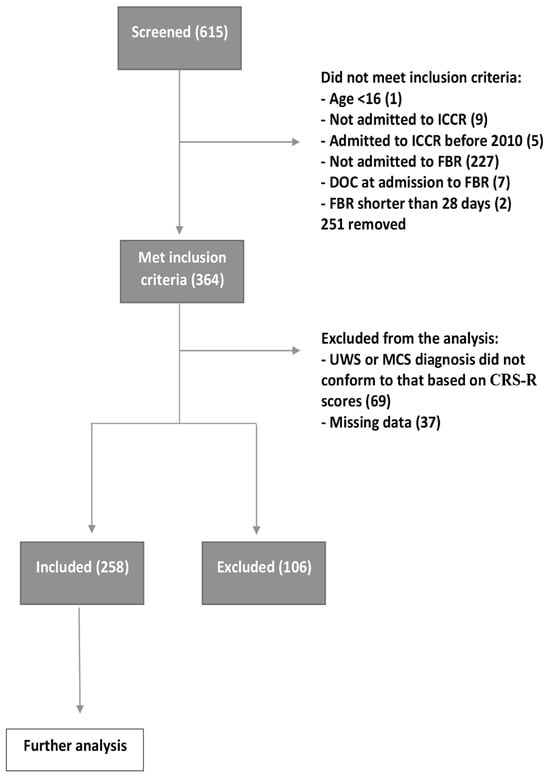
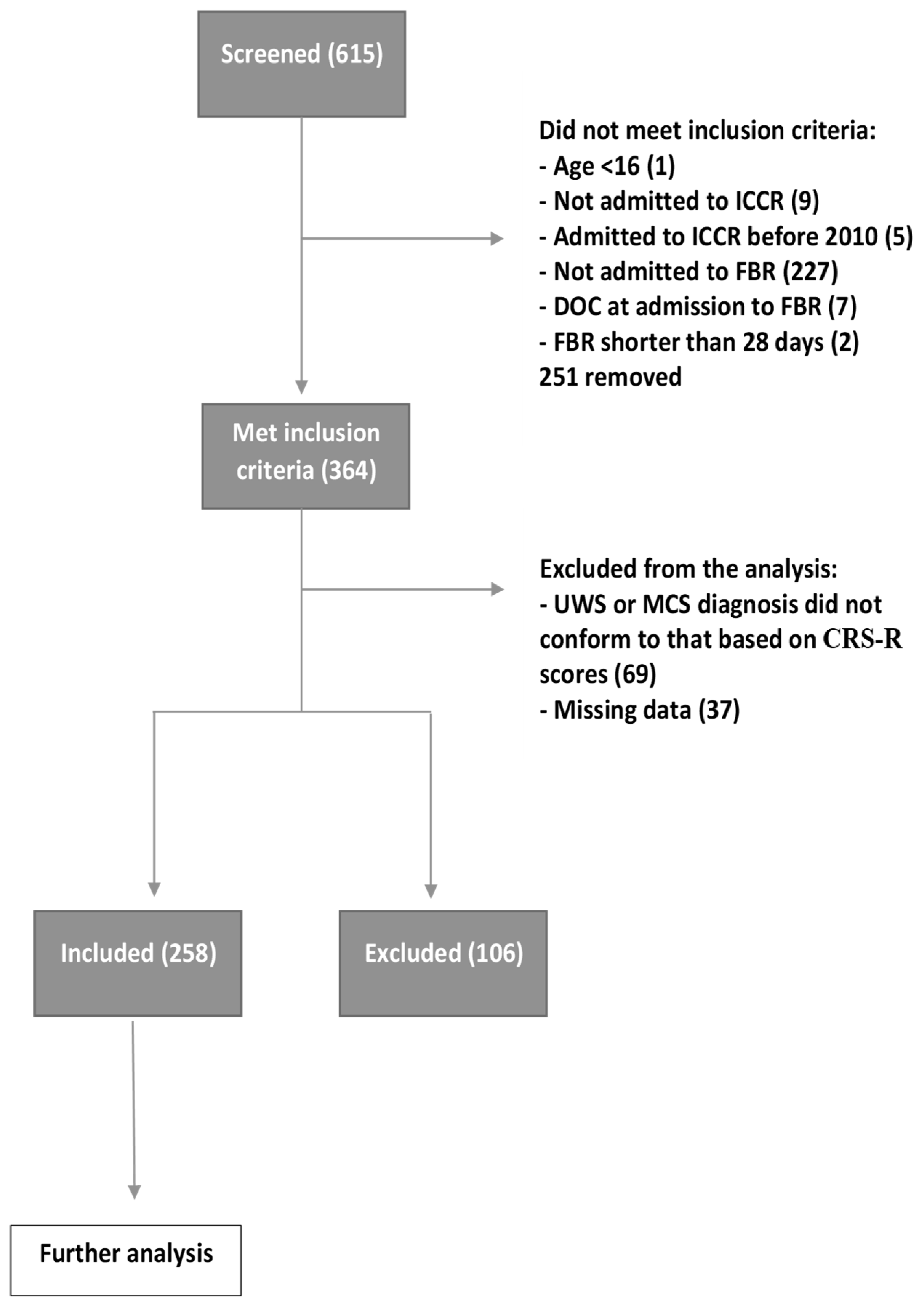
Of 615 patients screened for the study, 364 met the inclusion criteria, and 106 of them were excluded. Sixty-nine were excluded because retrospective CRS-R assessment showed that they were conscious on admission to ICCR and did not meet the inclusion criteria. Eleven patients were not excluded despite low CRS-R scores at discharge from ICCR because clinical judgement indicated that the scale misclassified them owing to severe aphasia or motor impairment. Of the remaining 295 who met the CRS-R inclusion criteria, 37 were excluded for missing data, leaving 258 patients (87%) who participated in the analysis (Figure 1).
Figure 1.
Flow chart of inclusion and exclusion criteria.
All 258 patients included in the study had been in PDOC for 28 days or more, except one who recovered consciousness after 25 days in MCS. All of them had available CRS-R scores, and more than 92% had LCS scores.
Demographic and clinical data of the 258 included patients are presented in Table 1.
Table 1.
Patient data.
The 258 patients included in the analysis had a lower consciousness level at admission to ICCR than the 37 patients who had PDOC at admission to ICCR but were excluded (41% UWS and 59% MCS in the 258 included patients, and 23% UWS and 77% MCS in the 37 excluded, p < 0.001). The 37 excluded patients and the 258 included in the analysis did not significantly differ in age (46 ± 19 vs. 45 ± 18, p > 0.3), length of stay (LOS) in ICCR (63 ± 86 vs. 70 ± 48 days, p > 0.2), percentage of men (76% vs. 71%, p > 0.3), or etiology of brain damage (TBI in 61% and 63% of the excluded and included patients, respectively, p > 0.8).
CRS-R evaluations were performed retrospectively for 148 (57%) of the patients at admission to the ICCR and for 180 (69%) at discharge. The CRS-R evaluations and the clinical diagnosis of consciousness were in total agreement regarding the eligibility for inclusion in the study in 247 of 327 patients with available CRS-R data (76%). The prospective and the retrospective CRS-R evaluations did not significantly differ in the score value (8.7, SD = 4.1 and 9.2, SD = 4.8, respectively) or in the UWS/MCS ratio (38%/62%, and 45%/55%, respectively) (p > 0.1).
3.2. Outcomes
FIM scores at admission to FBR and at discharge were available for all patients but one. DLOTCA total scores were available for 153 patients (59%) at admission, and 117 (45%) at discharge, and 6MW data for 52 patients (20%) at start walking without assistance, and 78 (30%) at discharge. The percentage of patients with TBI of those with available DLOTCA scores was lower than that of those with missing DLOTCA data (57% and 70%, respectively, p = 0.037).
The scores of FIM, DLOTCA, and the 6MW distance, at start walking without assistance and at discharge from FBR, are presented in Table 2. Differences between admission and discharge scores were significant and exceeded the MCID. At discharge, 47 patients, 18% of the patients who regained consciousness in ICCR, achieved a total FIM score ≥ 100, and 15 (5.8%) achieved a score ≥ 5 on all FIM subscales. The mean total FIM and DLOTCA scores at admission to FBR were 25% and 41% of their maximum, and at discharge, 48% and 59%, respectively. The mean 6MW distances at admission and discharge were 50% and 64% of the average value of the reported range for healthy people, respectively. FIM and DLOTCA total and domain scores, as well as 6MW distances, increased significantly during FBR stay (p < 0.001). Two patients (0.8%) died during FBR, and 7 (2.7%) within about one year after being transferred from FBR, owing to clinical deterioration.
Table 2.
Outcomes of FBR after discharge from ICCR.
3.3. Particularly Remarkable Functional Achievements at FBR
One patient achieved scores of 6 or 7 on all FIM subscales, which means that after FBR, he did not require any assistance in basic daily activities. The other 14 patients who achieved scores ≥ 5 on all FIM subscales became independent in daily activities after FBR, at least with environmental adaptation and supervision or with guidance and encouragement. They needed supervision or guidance mainly in tasks of memory, problem solving, stair-climbing, washing, and showering. Of the 14, 6 were also independent in tasks of extended daily activities.
After discharge from FBR, a 17-year-old patient achieved independent ambulation and driving; a 19-year-old patient had intact memory, managed a daily schedule independently, conducted coherent conversations, and showed learning and planning ability; a 33-year-old patient was independent in all basic and extended daily activities; a 41-year-old patient had functional speech, good writing ability, and ability to walk any distance; and a 62-year-old patient had no cognitive deficit.
3.4. Relationship Between Outcomes and Patient Characteristics
Relationships between outcomes and patient characteristics are presented in Table 3, Table 4, Table 5, Table 6, Table 7, Table 8, Table 9, Table 10, Table 11 and Table 12. Many of these relationships are similar for most outcomes, but outcomes differ in some.
Table 3.
Relationship between demographic characteristics and outcomes.
Table 4.
Outcomes for 2010–2015 and 2016–2021.
Table 5.
Relationship between general clinical characteristics and outcomes.
Table 6.
Relationship between additional characteristics and outcomes.
Table 7.
Relationship between CRS-R scores in ICCR and outcomes.
Table 8.
Relationship between LCS scores in ICCR and outcomes.
Table 9.
Relationship between scores at FBR admission and outcomes.
Table 10.
Relationship between complications at rehabilitation and outcomes (1).
Table 11.
Relationship between complications at ICCR and FBR and outcomes (2).
Table 12.
Relationship between procedures at ICCR and outcomes.
Among the associations that were examined only in bivariate analyses, the 6MW distance at discharge from FBR was found to be associated with LOS in ICCR and with FIM score at admission to FBR (Table 6 and Table 9). The LOS in FBR was negatively correlated with motor and total FIM scores and with DLOTCA scores at FBR admission (r = −0.190, −0.166 and −0.304, respectively, p < 0.01) and was not significantly correlated with FIM cognitive score at admission to FBR or with CRS-R score at admission to ICCR.
Relationships between outcomes and patient characteristics, after controlling for factors that were associated with the outcomes in the bivariate analysis, are presented in Table 13 and Table 14. The functional outcome FIM motor at discharge from FBR and its gain during FBR were found independently related to younger age, TBI, and time from injury to admission to FBR. At discharge, they were independently related to FIM score at admission to FBR, and the gain was also independently related to a diagnosis of hydrocephalus. The gain of cognitive outcomes, FIM cognitive and DLOTCA, was independently associated with LOS in FBR. Discharge FIM cognitive was independently associated with younger age, shorter LOS in ICCR, lack of hydrocephalus diagnosis, and FIM total at admission to FBR, and its gain with shorter LOS in ICCR. Discharge DLOTCA was also independently associated with its score at admission to FBR. Sex, consciousness state (UWS or MCS) at admission to ICCR, CRS-R and LCS scores, procedures, and most complications were not found to be independently related to outcomes. No excessive multicollinearity was observed. Bootstrapping analyses were consistent with the outcomes. The assumptions for linear regression were verified.
Table 13.
Factors associated with outcomes at discharge from FBR (multiple regression).
Table 14.
Factors associated with FBR outcome gain (multiple regression).
4. Discussion
This is the first report that focuses on outcomes of FBR itself after ICCR. It describes functional and cognitive achievements in a large group of patients with PDOC who regained consciousness. Participants were patients with TBI and NTBI who underwent ICCR, followed by FBR, after consciousness recovery.
A significant positive difference was found in all outcomes, above MCID, between admission and discharge from FBR scores (Table 2). After FBR, the mean FIM total score was 61 (SD = 32), and in 18% of patients, it was ≥100, reflecting independence that allowed discharge to the community [37]. The included patients achieved reasonable functional, motor, and cognitive outcomes, reaching, on average, 48% and 59% of the maximum possible FIM and DLOTCA scores and 64% of the average 6MW distances of the range reported for healthy people. We found improvement during FBR in these outcome measures in 44–100% of the patients. A non-negligible portion of them (5.8%) needed no assistance in any daily task. Temporal trends in clinical practice did not affect outcome, which did not significantly differ between 2010–2015 and 2016–2021 (Table 1 and Table 4).
Although most of the patients who regained consciousness after PDOC did not reach complete independence in daily activities, the improvement during FBR can be considered significant. This is because many achieved a remarkable functional state, ranging from independent functioning in one or several important tasks to complete independence. These achievements were good by comparison with what was expected based on other studies [21,22,26,38,39], in the highly dependent population of patients after ICCR, and a non-negligible portion of the patients achieved very high functioning.
FIM gain and discharge FIM scores in this study were comparable to those found in most previous studies of patients who regained consciousness after a brain injury and intensive rehabilitation programs or better [21,22,26,38,39]. Functional outcomes were better, however, in studies that included only TBI patients [40,41]. This is consistent with the relationship found between better outcomes in TBI than in NTBI in this study, as well as in previous studies, which may indicate that the studied TBIs were less severe than the NTBIs [25,39,40,41,42].
Better functional and cognitive outcomes at discharge from FBR were also independently related in this study to younger age, shorter time from brain injury onset to regaining consciousness and admission to FBR, higher FIM or DLOTCA scores at admission to FBR, and lack of diagnosis of hydrocephalus during rehabilitation (Table 13). Improvement of outcomes during FBR was independently related to the same factors, except FIM scores at admission to FBR, which were negatively associated with outcomes. In addition, we found a positive relationship between outcome improvement and LOS in FBR (Table 14). The effects of age, which may be associated with lifetime accumulation of minute brain damage, time from brain injury onset to regaining consciousness, and hydrocephalus, probably reflect a lower potential for recovery owing to more severe brain injury. Patients who had better functional or cognitive performance at admission to FBR showed better outcomes at discharge, probably because of less severe injuries or better recovery at ICCR. The inverse relationship between admission scores and improvement may reflect regression to the mean, but it probably primarily reflects a clinical ceiling effect, as patients with higher FIM scores at admission to FBR showed higher scores at discharge, the functioning of about 90% of the patients improved from admission to discharge, and it is likely that improvement halted as patients approached their rehabilitative potential. The relationship between longer stay in FBR and improvement in outcomes may suggest that patients whose function did not improve were discharged from rehabilitation earlier. But the fact that LOS in FBR was shorter in patients with better admission performance does not support this possibility. Greater improvement can be attributed, therefore, to the length of stay in rehabilitation and probably to the effect of rehabilitation itself.
Previous studies have also shown that younger age [39,43,44], TBI [25,39], less severe brain damage [19,22,25,45,46], shorter time to regaining consciousness [19,25], no hydrocephalus [26], and longer rehabilitation [45] have a positive effect on motor and functional outcomes in patients with brain injuries. Unlike other studies [22,25], the present one found no independent relationship between being in UWS or MCS at admission to ICCR and functional outcomes after regaining consciousness. The reason for this difference is not clear but may be explained by the differences between the populations that participated in the various studies. Other studies that have examined this relationship included the entire ICCR population with UWS or MCS, whereas the present study included only those selected for FBR. It makes sense that the UWS patients who regained consciousness and were selected for FBR were those in UWS with milder brain damage, so the severity of their brain damage was close to that of the patients in MCS.
Short-term mortality after admission to FBR (3.5%) was much lower than that found in our previous study in patients admitted to the same ICCR department with UWS (12–27%) [4]. This finding is not surprising, as the patients in FBR were ICCR patients who regained consciousness, and it is consistent with other findings showing that consciousness recovery reduced the risk of mortality [47].
The functional and cognitive outcomes of the patients in this study, as well as in smaller groups with PDOC who underwent special programs similar to the ICCR and FBR after consciousness recovery [22,25,26], attest to the importance of ICCR and FBR for achieving favorable outcomes after PDOC. Achievements reported in this and other relatively recent studies reduce doubts voiced in previous years about the ethical justification of operating intensive care units for these patients, citing the high cost and the suffering of the patients’ relatives [39,48], and demonstrate the need to refer PDOC patients to ICCR and those who regain consciousness to FBR. Ethical justification does not depend only on clinically prominent efficacy or cost-effectiveness. The fact that intensive rehabilitation enables patients to attain functional milestones is of paramount importance for both their families and society [23,49]. Therefore, society must not forgo the opportunity to facilitate such life-changing recovery for these individuals.
4.1. Study Limitations
A limitation of the study is that it did not address complications that occurred before rehabilitation and could affect outcomes. This limits the generalizability of the conclusions to patients with a similar rate of pre-rehabilitation complications. Another limitation is that the study focused only on basic functional outcomes and did not assess extended activities, psychological adjustment, perception of health, or quality of life. Most of these outcomes, however, are important mainly in the community, after discharge from inpatient rehabilitation. An additional limitation is the retrospective single-center design, which can limit external validity; the data consists of past records that may be incomplete, the findings lack geographic diversity, and some specific rehabilitation modalities are needed to generalize to other healthcare settings. The absence of a comparison group, no long-term follow-up, and the possible effects of missing data are further limitations. The values of R2 in the multivariate linear regressions, which indicate that the patient characteristics found to be related to the outcomes explain only a low to medium portion of the variation in outcomes, limit the predictive value of these characteristics. These limitations, however, do not derogate from the functional and cognitive achievements during FBR after PDOC demonstrated in the study. The possible effect on generalizability of selection bias related to the lower consciousness state at admission to ICCR in the patients included in the analysis, when compared with the qualifying excluded, may also be considered a limitation. But no other significant differences were found between these two groups, and the difference we found indicates that the functional achievements at FBR may be even better than those presented, supporting the conclusions of the study.
4.2. Future Research
Future research may include additional paths for exploration, such as long-term follow-up post-discharge, community participation, vocational reentry, caregiver results/outcomes, and the potential contributions of new rehabilitation technologies like virtual reality, robotics, brain–computer interface, and AI-supported rehabilitation [15,50].
5. Conclusions
FBR for patients with PDOC whose consciousness recovered after ICCR achieved functional and cognitive improvement, which can be considered significant in patients after ICCR. Younger age, traumatic etiology, not having hydrocephalus, shorter time to regaining consciousness, and better function at admission to FBR were associated with better functional or cognitive outcomes at the end of rehabilitation. The main outcomes support rehabilitation for these patients before and after consciousness recovery.
Author Contributions
Conceptualization, E.A., A.C., and A.O.; methodology, E.A., A.C., and A.O.; formal analysis, I.G.; investigation, A.K. and L.F.; resources, S.S., M.M., C.S., and D.R.-A.; data curation, L.F.; writing—original draft preparation, A.C., L.F., and A.K.; writing—review and editing, A.O., E.A., A.C., I.G., S.S., M.M., C.S., and D.R.-A.; supervision, E.A.; project administration, E.A., funding acquisition, E.A. All authors have read and agreed to the published version of the manuscript.
Funding
This research was supported by a Loewenstein Rehabilitation Medical Center fund, grant number KM600010322.
Institutional Review Board Statement
The Institutional Review Board of Loewenstein Rehabilitation Medical Center (Protocol code 0014-20-LOE, approved 8 July 2020) approved the study and waived the requirement to obtain informed consent from the patients because the study was retrospective and the investigators anonymized the data before analysis.
Informed Consent Statement
The requirement for informed consent was waived by the institutional review board due to the retrospective nature of the study and the de-identification of the data.
Data Availability Statement
The data that support this study will be shared onrequest sent to the corresponding author.
Acknowledgments
The authors wish to acknowledge Hila Lehrer for collecting the CRS-R scores and Yifat Schwartz for advice.
Conflicts of Interest
The authors declare no conflicts of interest.
References
- Royal College of Physicians. Prolonged Disorders of Consciousness Following Sudden Onset Brain Injury: National Clinical Guidelines; RCP: London, UK, 2020. [Google Scholar]
- Kondziella, D.; Bender, A.; Diserens, K.; van Erp, W.; Estraneo, A.; Formisano, R.; Laureys, S.; Naccache, L.; Ozturk, S.; Rohaut, B.; et al. European Academy of Neurology guideline on the diagnosis of coma and other disorders of consciousness. Eur. J. Neurol. 2020, 27, 741–756. [Google Scholar] [CrossRef] [Scilit] [PubMed]
- the Multi-Society Task Force on PVS. Medical aspects of the persistent vegetative state (1). N. Engl. J. Med. 1994, 330, 1499–1508. [CrossRef] [Scilit] [PubMed]
- Aidinoff, E.; Groswasser, Z.; Bierman, U.; Gelernter, I.; Catz, A.; Gur-Pollack, R. Vegetative state outcomes improved over the last two decades. Brain Inj. 2018, 32, 297–302. [Google Scholar] [CrossRef] [Scilit] [PubMed]
- Edlow, B.L.; Claassen, J.; Schiff, N.D.; Greer, D.M. Recovery from disorders of consciousness: Mechanisms, prognosis and emerging therapies. Nat. Rev. Neurol. 2021, 17, 135–156. [Google Scholar] [CrossRef] [Scilit] [PubMed]
- Aidinoff, E.; Keren, E.; Ana, O.; Zeev, G.; Ilana, G.; Catz, A. Consciousness recovery after various periods in vegetative state. Brain Inj. 2020, 34, 1253–1256. [Google Scholar] [CrossRef] [Scilit] [PubMed]
- Yelden, K.; Duport, S.; James, L.M.; Kempny, A.; Farmer, S.F.; Leff, A.P.; Playford, E.D. Late recovery of awareness in prolonged disorders of consciousness—A cross-sectional cohort study. Disabil. Rehabil. 2018, 40, 2433–2438. [Google Scholar] [CrossRef] [Scilit] [PubMed]
- Estraneo, A.; Fiorenza, S.; Magliacano, A.; Formisano, R.; Mattia, D.; Grippo, A.; Romoli, A.M.; Angelakis, E.; Cassol, H.; Thibaut, A.; et al. Multicenter prospective study on predictors of short-term outcome in disorders of consciousness. Neurology 2020, 95, e1488–e1499. [Google Scholar] [CrossRef] [Scilit] [PubMed]
- Pavlov, Y.G.; Spiegelsberger, F.; Kotchoubey, B. Predicting outcome in disorders of consciousness: A mega-analysis. Ann. Clin. Transl. Neurol. 2024, 11, 1465–1477. [Google Scholar] [CrossRef] [Scilit] [PubMed]
- Grzegorz, Ż.; Karolina, K.N.; Bartosz, K.; Marek, B. Eye tracking as a novel approach to cognitive assessment in DOC patients based on evidence from a multicenter clinical trial. Sci. Rep. 2025, 15, 44205. [Google Scholar] [CrossRef] [Scilit] [PubMed]
- Kujawa, K.; Zurek, A.; Goraczko, A.; Zurek, G. Application of High-Tech Solution for Memory Assessment in Patients With Disorders of Consciousness. Front. Neurol. 2022, 13, 841095. [Google Scholar] [CrossRef] [Scilit] [PubMed]
- Zurek, G.; Binder, M.; Kunka, B.; Kosikowski, R.; Rodzeń, M.; Karaś, D.; Mucha, G.; Olejniczak, R.; Gorączko, A.; Kujawa, K.; et al. Can Eye Tracking Help Assess the State of Consciousness in Non-Verbal Brain Injury Patients? J. Clin. Med. 2024, 13, 6227. [Google Scholar] [CrossRef] [Scilit] [PubMed]
- Thibaut, A.; Martens, G. Neuromodulation for severe brain injury: Time for a paradigm shift? Nat. Rev. Neurol. 2024, 20, 441–442. [Google Scholar] [CrossRef] [Scilit] [PubMed]
- Bonanno, M.; Cardile, D.; Liuzzi, P.; Celesti, A.; Micali, G.; Corallo, F.; Quartarone, A.; Tomaiuolo, F.; Calabrò, R.S. Can artificial intelligence improve the diagnosis and prognosis of disorders of consciousness? A scoping review. Front. Artif. Intell. 2025, 8, 1608778. [Google Scholar] [CrossRef] [Scilit] [PubMed]
- Drigas, A.; Sideraki, A. Brain Neuroplasticity Leveraging Virtual Reality and Brain-Computer Interface Technologies. Sensors 2024, 24, 5725. [Google Scholar] [CrossRef] [Scilit] [PubMed]
- Tung, J.; Speechley, K.N.; Gofton, T.; Gonzalez-Lara, L.E.; Graham, M.; Naci, L.; Peterson, A.H.; Owen, A.M.; Weijer, C. Towards the assessment of quality of life in patients with disorders of consciousness. Qual. Life Res. 2020, 29, 1217–1227. [Google Scholar] [CrossRef] [Scilit] [PubMed]
- Batiha, A.M. Implementing Family-Centred Care for Patients With Disorders of Consciousness in Jordanian Intensive Care Units: A Mixed-Methods Quasi-Experimental Study. Nurs. Crit. Care 2025, 30, e70227. [Google Scholar] [CrossRef] [Scilit] [PubMed]
- Perrin, F.; Castro, M.; Tillmann, B.; Luaute, J. Promoting the use of personally relevant stimuli for investigating patients with disorders of consciousness. Front. Psychol. 2015, 6, 1102. [Google Scholar] [CrossRef] [Scilit] [PubMed]
- Kowalski, R.G.; Hammond, F.M.; Weintraub, A.H.; Nakase-Richardson, R.; Zafonte, R.D.; Whyte, J.; Giacino, J.T. Recovery of Consciousness and Functional Outcome in Moderate and Severe Traumatic Brain Injury. JAMA Neurol. 2021, 78, 548–557. [Google Scholar] [CrossRef] [Scilit] [PubMed]
- Juengst, S.B.; Adams, L.M.; Bogner, J.A.; Arenth, P.M.; O’Neil-Pirozzi, T.M.; Dreer, L.E.; Hart, T.; Bergquist, T.F.; Bombardier, C.H.; Dijkers, M.P.; et al. Trajectories of life satisfaction after traumatic brain injury: Influence of life roles, age, cognitive disability, and depressive symptoms. Rehabil. Psychol. 2015, 60, 353–364. [Google Scholar] [CrossRef] [Scilit] [PubMed]
- Turner-Stokes, L.; Dzingina, M.; Shavelle, R.; Bill, A.; Williams, H.; Sephton, K. Estimated Life-Time Savings in the Cost of Ongoing Care Following Specialist Rehabilitation for Severe Traumatic Brain Injury in the United Kingdom. J. Head Trauma Rehabil. 2019, 34, 205–214. [Google Scholar] [CrossRef] [Scilit] [PubMed]
- DeFina, P.A.; Fellus, J.; Thompson, J.W.; Eller, M.; Moser, R.S.; Frisina, P.G.; Schatz, P.; Deluca, J.; Zigarelli-McNish, M.; Prestigiacomo, C.J. Improving outcomes of severe disorders of consciousness. Restor. Neurol. Neurosci. 2010, 28, 769–780. [Google Scholar] [CrossRef] [Scilit] [PubMed]
- Zhang, B.; O’Brien, K.; Woo, J.; Chi, B.; Reeh, C.; Li, S.; Kothari, S. Specialized intensive inpatient rehabilitation is crucial and time-sensitive for functional recovery from disorders of consciousness. Front. Neurol. 2023, 14, 1126532. [Google Scholar] [CrossRef] [Scilit] [PubMed]
- Eilander, H.J.; Wijnen, V.J.; Schouten, E.J.; Lavrijsen, J.C. Ten-to-twelve years after specialized neurorehabilitation of young patients with severe disorders of consciousness: A follow-up study. Brain Inj. 2016, 30, 1302–1310. [Google Scholar] [CrossRef] [Scilit] [PubMed]
- Katz, D.I.; Polyak, M.; Coughlan, D.; Nichols, M.; Roche, A. Natural history of recovery from brain injury after prolonged disorders of consciousness: Outcome of patients admitted to inpatient rehabilitation with 1-4 year follow-up. Prog. Brain Res. 2009, 177, 73–88. [Google Scholar] [CrossRef] [Scilit] [PubMed]
- Ganesh, S.; Guernon, A.; Chalcraft, L.; Harton, B.; Smith, B.; Louise-Bender Pape, T. Medical comorbidities in disorders of consciousness patients and their association with functional outcomes. Arch. Phys. Med. Rehabil. 2013, 94, 1899–1907. [Google Scholar] [CrossRef] [Scilit] [PubMed]
- Giacino, J.T.; Kalmar, K.; Whyte, J. The JFK Coma Recovery Scale-Revised: Measurement characteristics and diagnostic utility. Arch. Phys. Med. Rehabil. 2004, 85, 2020–2029. [Google Scholar] [CrossRef] [Scilit] [PubMed]
- Borer-Alafi, N.; Gil, M.; Sazbon, L.; Korn, C. Loewenstein communication scale for the minimally responsive patient. Brain Inj. 2002, 16, 593–609. [Google Scholar] [CrossRef] [Scilit] [PubMed]
- Oksamitni, A.; Lehrer, H.; Gelernter, I.; Scharf, M.; Front, L.; Bendit-Goldenberg, O.; Catz, A.; Aidinoff, E. Reliability and Validity of the Lowenstein Communication Scale. Neurol. Int. 2025, 17, 116. [Google Scholar] [CrossRef] [Scilit] [PubMed]
- Linacre, J.M.; Heinemann, A.W.; Wright, B.D.; Granger, C.V.; Hamilton, B.B. The structure and stability of the Functional Independence Measure. Arch. Phys. Med. Rehabil. 1994, 75, 127–132. [Google Scholar] [CrossRef] [Scilit]
- Shukla, D.; Devi, B.I.; Agrawal, A. Outcome measures for traumatic brain injury. Clin. Neurol. Neurosurg. 2011, 113, 435–441. [Google Scholar] [CrossRef] [Scilit] [PubMed]
- Kidd, D.; Stewart, G.; Baldry, J.; Johnson, J.; Rossiter, D.; Petruckevitch, A.; Thompson, A.J. The Functional Independence Measure: A comparative validity and reliability study. Disabil. Rehabil. 1995, 17, 10–14. [Google Scholar] [CrossRef] [Scilit] [PubMed]
- Katz, N.; Bar-Haim Erez, A.; Livni, L.; Averbuch, S. Dynamic Lowenstein Occupational Therapy Cognitive Assessment: Evaluation of potential to change in cognitive performance. Am. J. Occup. Ther. 2012, 66, 207–214. [Google Scholar] [CrossRef] [Scilit] [PubMed][Green Version]
- Wang, S.Y.; Gong, Z.K.; Sen, J.; Han, L.; Zhang, M.; Chen, W. The usefulness of the Loewenstein Occupational Therapy Cognition Assessment in evaluating cognitive function in patients with stroke. Eur. Rev. Med. Pharmacol. Sci. 2014, 18, 3665–3672. [Google Scholar] [PubMed]
- ATS Committee on Proficiency Standards for Clinical Pulmonary Function Laboratories. ATS statement: Guidelines for the six-minute walk test. Am. J. Respir. Crit. Care Med. 2002, 166, 111–117. [Google Scholar] [CrossRef] [Scilit] [PubMed]
- Norman, G.R.; Sloan, J.A.; Wyrwich, K.W. Interpretation of changes in health-related quality of life: The remarkable universality of half a standard deviation. Med. Care 2003, 41, 582–592. [Google Scholar] [CrossRef] [Scilit] [PubMed]
- Granger, C.V.; Hamilton, B.B.; Fiedler, R.C. Discharge outcome after stroke rehabilitation. Stroke 1992, 23, 978–982. [Google Scholar] [CrossRef] [Scilit] [PubMed]
- Estraneo, A.; Moretta, P.; Loreto, V.; Santoro, L.; Trojano, L. Clinical and neuropsychological long-term outcomes after late recovery of responsiveness: A case series. Arch. Phys. Med. Rehabil. 2014, 95, 711–716. [Google Scholar] [CrossRef] [Scilit] [PubMed]
- Sazbon, L.; Zagreba, F.; Ronen, J.; Solzi, P.; Costeff, H. Course and outcome of patients in vegetative state of nontraumatic aetiology. J. Neurol. Neurosurg. Psychiatry 1993, 56, 407–409. [Google Scholar] [CrossRef] [Scilit] [PubMed][Green Version]
- Whyte, J.; Nakase-Richardson, R.; Hammond, F.M.; McNamee, S.; Giacino, J.T.; Kalmar, K.; Greenwald, B.D.; Yablon, S.A.; Horn, L.J. Functional outcomes in traumatic disorders of consciousness: 5-year outcomes from the National Institute on Disability and Rehabilitation Research Traumatic Brain Injury Model Systems. Arch. Phys. Med. Rehabil. 2013, 94, 1855–1860. [Google Scholar] [CrossRef] [Scilit] [PubMed]
- Groswasser, Z.; Sazbon, L. Outcome in 134 patients with prolonged posttraumatic unawareness: Part 2: Functional outcome of 72 patients recovering consciousness. J. Neurosurg. 1990, 72, 81–84. [Google Scholar] [PubMed]
- Jeong, T.S.; Choi, D.H.; Kim, W.K. Comparison of Outcomes at Trauma Centers versus Non-Trauma Centers for Severe Traumatic Brain Injury. J. Korean Neurosurg. Soc. 2023, 66, 63–71. [Google Scholar] [CrossRef] [Scilit] [PubMed]
- Al-Hassani, A.; Strandvik, G.F.; El-Menyar, A.; Dhumale, A.R.; Asim, M.; Ajaj, A.; Al-Yazeedi, W.; Al-Thani, H. Functional Outcomes in Moderate-to-Severe Traumatic Brain Injury Survivors. J. Emerg. Trauma Shock. 2018, 11, 197–204. [Google Scholar] [CrossRef] [Scilit] [PubMed]
- Katz, D.I.; Alexander, M.P. Traumatic brain injury. Predicting course of recovery and outcome for patients admitted to rehabilitation. Arch. Neurol. 1994, 51, 661–670. [Google Scholar] [CrossRef] [Scilit] [PubMed]
- Rosenbaum, A.M.; Gordon, W.A.; Joannou, A.; Berman, B.A. Functional outcomes following post-acute rehabilitation for moderate-to-severe traumatic brain injury. Brain Inj. 2018, 32, 907–914. [Google Scholar] [CrossRef] [Scilit] [PubMed]
- McCrea, M.A.; Giacino, J.T.; Barber, J.; Temkin, N.R.; Nelson, L.D.; Levin, H.S.; Dikmen, S.; Stein, M.; Bodien, Y.G.; Boase, K.; et al. Functional Outcomes Over the First Year After Moderate to Severe Traumatic Brain Injury in the Prospective, Longitudinal TRACK-TBI Study. JAMA Neurol. 2021, 78, 982–992. [Google Scholar] [CrossRef] [Scilit] [PubMed]
- Yan, D.; Simei, L.; Hongzhao, B.; Hongyan, D.; Yuchao, D. Prognosis of patients with prolonged disorders of consciousness after brain injury: A longitudinal cohort study. Front. Public Health 2024, 12, 1421779. [Google Scholar] [CrossRef] [Scilit] [PubMed]
- Wade, D.T. Ethical issues in diagnosis and management of patients in the permanent vegetative state. BMJ 2001, 322, 352–354. [Google Scholar] [CrossRef] [Scilit] [PubMed]
- Devi, Y.; Khan, S.; Rana, P.; Dhandapani, M.; Ghai, S.; Gopichandran, L.; Dhandapani, S. Cognitive, Behavioral, and Functional Impairments among Traumatic Brain Injury Survivors: Impact on Caregiver Burden. J. Neurosci. Rural. Pract. 2020, 11, 629–635. [Google Scholar] [CrossRef] [Scilit] [PubMed]
- Rajashekar, D.; Boyer, A.; Larkin-Kaiser, K.A.; Dukelow, S.P. Technological advances in stroke rehabilitation: Robotics and virtual reality. Phys. Med. Rehabil. Clin. 2024, 35, 383–398. [Google Scholar]

Disclaimer/Publisher’s Note: The statements, opinions and data contained in all publications are solely those of the individual author(s) and contributor(s) and not of MDPI and/or the editor(s). MDPI and/or the editor(s) disclaim responsibility for any injury to people or property resulting from any ideas, methods, instructions or products referred to in the content. |
© 2026 by the authors. Licensee MDPI, Basel, Switzerland. This article is an open access article distributed under the terms and conditions of the Creative Commons Attribution (CC BY) license.