


Abstract
Autonomous vehicles (AVs) are moving from pilots to regular urban service, yet the speed of large-scale implementation remains uncertain. While prior research emphasizes technological feasibility and adoption, less attention has been paid to the socio-technical dynamics that constrain deployment. This study examines how unintended consequences shape the pace of AV implementation in cities. Drawing on a mixed-methods design combining a structured scoping review with 18 expert interviews, interrelated dynamics are identified across institutional, behavioral, economic-platform, spatial, and normative-societal domains. The findings indicate that implementation speed is not determined by technology alone but emerges from reinforcing feedback loops that generate systemic frictions, including governance lag, demand rebound, spatial bottlenecks, and legitimacy challenges. The study advances a systems-oriented framework that conceptualizes implementation speed as an emergent property of socio-technical dynamics, highlighting the importance of adaptive and anticipatory governance for sustainable urban mobility transitions.
1. Introduction
The implementation of autonomous vehicles (AVs) is accelerating rapidly, with large-scale deployments emerging across China, the United States, and Europe. Advances in artificial intelligence, sensor technologies, and large-scale simulation have significantly shortened development cycles and enabled the transition from experimental pilots to operational urban services [1,2,3]. As a result, the central question is no longer whether AVs will be deployed, but how they can be integrated into cities in ways that support sustainable and socially beneficial mobility systems [4,5].
While the technological feasibility of autonomous driving has largely been established, its implementation within urban systems presents a fundamentally different challenge. AV deployment constitutes a socio-technical transformation that extends beyond transport systems to affect urban infrastructure, governance structures, market organization, and everyday mobility practices [6,7]. Unlike traditional transport infrastructures, which evolve incrementally within relatively stable institutional frameworks, AV systems are characterized by high uncertainty, multi-actor coordination, and continuous reconfiguration through digital feedback mechanisms [8].
A central challenge arises from the mismatch between the pace of technological development and the adaptive capacity of urban governance systems. Municipal planning processes have historically been designed for linear and predictable infrastructures, relying on “predict and provide” approaches that assume stable demand and system boundaries [9,10]. In contrast, AV ecosystems are dynamic and evolving, shaped by changing business models, user behavior, and platform-based coordination. This creates conditions under which implementation trajectories become non-linear, path-dependent, and difficult to steer through traditional planning instruments.
At the same time, AVs are expected to generate wide-ranging impacts across the spatial, economic, and social fabric of cities. They may reshape land-use patterns, redefine accessibility, and enable new service models that integrate mobility with retail, logistics, healthcare, and leisure activities [11,12,13]. As travel time becomes increasingly productive, mobility behavior itself may shift, lowering perceived travel costs and expanding demand in ways that are difficult to anticipate ex ante [13,14]. These developments introduce the risk that expected sustainability benefits may be offset by rebound effects and unintended system-level consequences [15].
The introduction of transformative technologies has long been associated with unintended consequences that diverge from initial design goals [16]. Such consequences emerge when technologies interact with existing institutional arrangements, behavioral patterns, and economic structures, often producing outcomes that were not anticipated ex ante. In the context of autonomous mobility, these unintended consequences are likely to arise across multiple domains, including governance, demand formation, spatial organization, and market coordination. However, current research has largely focused on intended performance outcomes, while the systemic role of unintended consequences in shaping implementation dynamics remains insufficiently understood.
Against this backdrop, this study addresses the following research questions:
(1) Which unintended consequences do urban stakeholders anticipate or observe that can slow or stall the scaling of autonomous vehicles in cities?
(2) How do these unintended consequences interact across socio-technical domains to shape the speed and trajectory of AV implementation?
Despite growing interest in autonomous mobility, existing research has primarily emphasized technological feasibility, safety performance, and adoption dynamics, often treating implementation as a linear process driven by technological progress and policy support [2,4,5]. This perspective underestimates the extent to which AV deployment unfolds as a complex socio-technical transformation characterized by feedback effects, cross-sectoral interactions, and non-linear system responses. In particular, the role of unintended consequences as endogenous drivers of implementation dynamics remains under-theorized.
This study addresses this gap by advancing a systems-oriented perspective on AV implementation. Rather than conceptualizing implementation speed as an outcome of technological readiness or regulatory efficiency, it is reframed as an emergent property of interacting socio-technical dynamics. Drawing on a mixed-methods approach that combines a structured scoping review with expert interviews, the analysis identifies how unintended consequences arise across institutional, behavioral, economic-platform, spatial, and normative-societal domains and interact through reinforcing feedback loops.
The study contributes to the literature in three ways. First, it introduces an unintended consequence perspective to the study of autonomous mobility, shifting attention from intended performance outcomes to system-level effects that shape implementation trajectories. Second, it reconceptualizes implementation speed as a dynamic and endogenous system property rather than a linear function of technological progress. Third, it develops a structured framework of socio-technical dynamics that explains how feedback loops between governance, behavior, markets, and space generate systemic frictions that can slow or redirect AV deployment.
2. Background
2.1. Potential Sustainability Benefits of Autonomous Urban Mobility
Cities now anchor strategy in time-bound sustainability targets, notably 2030 and 2050 roadmaps toward net-zero, reinforced by the EU Cities Mission that designates municipalities to reach climate neutrality by 2030 as demonstrators for broader diffusion by mid-century [17,18,19]. “Sustainability” is operationalized through the environmental–social–economic triad derived from the UN’s 2030 Agenda, emphasizing integrated progress across these dimensions [20,21]. Within this policy frame, research increasingly treats autonomous vehicles as a sustainability-relevant technology; when coupled with electrification, pooling, and strong integration with mass transit, AVs can advance energy and spatial efficiency, safety, accessibility, and network performance [4,15,22,23]. Early field evidence is consistent with these pathways, suggesting AVs can be mobilized to support municipal 2030/2050 commitments under appropriate design and governance [24].
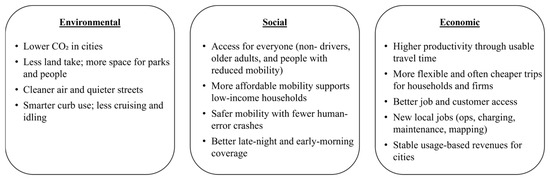
The potential contribution of autonomous vehicles to urban development extends across environmental, social, and economic dimensions, as summarized in Figure 1.
Figure 1.
Anticipated benefits of autonomous vehicles across environmental, social, and economic dimensions [4,5,14,24,25,26,27,28,29,30].
Autonomous urban mobility can enable cities to shrink their environmental footprint by pairing operational efficiency with electrification, which lowers CO2 emissions and reduces noise while allowing the reclamation of land from parking to parks and people-oriented space; smarter curb and fleet management further cuts cruising and idling and improves air quality at street level [4,15,22,23,25]. Socially, autonomy can widen access for non-drivers, older adults, and people with disabilities, support more affordable mobility for low-income households, reduce human error crashes, and strengthen late-night and early-morning coverage when conventional service is thin [4,24,26,27,31,32]. Economically, AVs are able to convert travel into productive time, unlock more flexible and often cheaper trips for households and firms, expand effective job and customer access within the commonly acceptable 45–60 min window, create local jobs in operations, charging, maintenance, and mapping, and open the door to usage based revenue streams that can stabilize city finances [4,29].
2.2. Deploying Autonomous Vehicles Is No Longer a Matter of Technical Feasibility
From an operational standpoint, autonomous driving has cleared the technical-feasibility threshold for bounded urban service areas. Fully driverless fleets now operate continuously in mixed-traffic environments under formal regulatory approval [31]. Independent evaluations show significantly lower crash rates than human-driven benchmarks across multiple categories, demonstrating urban-scale reliability of perception, prediction, and planning systems [24,31]. Regulatory authorities in several jurisdictions have accepted structured safety cases and operating procedures, granting authorizations for public passenger service, indicating that AV systems have achieved the public-service safety benchmark (CPUC/State permits; Chinese municipal approvals). Redundancy in sensing, computation, actuation, and power, combined with remote assistance and continuous monitoring, enables safe fail-operational performance (engineering disclosures; operator safety reports). Importantly, the core technology stack has been replicated across cities and cultural contexts, with millions of driverless miles in the U.S. and China demonstrating transferability beyond single markets. The remaining constraints are therefore operational and commercial rather than technological feasibility [24,31].
2.3. Unintended Consequences and the Paradox of Technological Innovation
The introduction of transformative technologies such as AVs often produces unintended consequences that diverge from initial design goals. This phenomenon is long described as the paradox of progress [16]. Historically, technologies designed for one purpose have been repurposed in ways that generate new societal risks. The evolution of the Sport Utility Vehicle (SUV) illustrates this dynamic: conceived for military and agricultural use, it became a popular urban family car, increasing road danger and emissions due to its mass and regulatory exemptions [33]. Likewise, disruptive technologies tend to reshape markets and behaviors in unforeseen ways, with downstream effects on equity, environment, and governance [34]. For autonomous mobility, potential rebound effects could offset expected sustainability gains [15]. Managing such unintended outcomes is therefore critical: the net benefit of technological innovation depends not only on technical performance but also on the governance frameworks that anticipate and mitigate its social and spatial externalities.
3. Methodology and Research Design
This study adopts an exploratory mixed-methods design combining a structured scoping review with qualitative expert interviews. Such designs are particularly suited for investigating emerging socio-technical phenomena where empirical evidence remains fragmented and causal mechanisms are not yet fully understood [35,36].
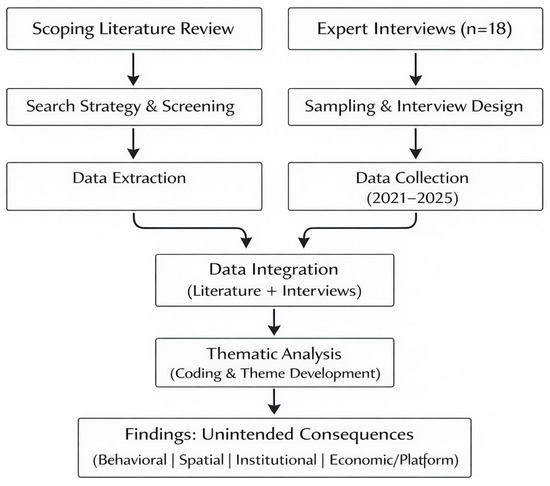
The objective is not statistical generalization but theory building and the identification of mechanisms that shape the implementation dynamics of autonomous vehicles (AVs) in urban contexts. The research design follows a sequential logic: the scoping review provides conceptual grounding and informs the empirical inquiry, while the interview data constitute the primary basis for identifying and analyzing unintended consequences. Figure 2 illustrates the overall research design, showing how literature-based insights and empirical data are integrated into a unified analytical framework.
Figure 2.
Mixed-methods research design for identifying unintended consequences of autonomous vehicle implementation.
3.1. Scoping Review
A structured scoping review was conducted following the methodological framework proposed by [37] and refined by [38]. The purpose of the review was to map the breadth of existing research, clarify key concepts, and identify knowledge gaps related to autonomous vehicles, urban mobility, governance, and unintended consequences.
- Search Strategy and Selection Criteria
The literature search was conducted across major academic databases, including Scopus, Web of Science, and Google Scholar. The search combined keywords such as “autonomous vehicles,” “self-driving cars,” “urban mobility,” “smart cities,” “governance,” “policy,” “unintended consequences,” and “rebound effects.” In addition, targeted screening of policy reports from organizations such as the International Transport Forum (ITF) and the OECD was conducted, complemented by backward and forward citation tracking of highly cited studies.
Inclusion criteria were defined as follows: (1) relevance to autonomous vehicle deployment in urban contexts; (2) explicit discussion of systemic, behavioral, governance-related, spatial, or unintended effects; and (3) publication in peer-reviewed journals or as authoritative institutional reports. Studies were excluded if they focused primarily on technical or engineering aspects without broader urban, societal, or governance implications.
The review followed a structured multi-stage screening process to enhance transparency and reproducibility. The initial database search across Scopus, shown in Table 1, Web of Science, and Google Scholar identified 130 records. After the removal of duplicates, 105 records remained for title and abstract screening. Based on the predefined inclusion and exclusion criteria, 76 records were excluded during this stage. The remaining 29 publications were subsequently assessed through full-text review. Following eligibility assessment, 24 publications were retained for inclusion in the final review sample.
Table 1.
Scoping review screening process.
The structured screening workflow improved transparency and methodological consistency throughout the review process. Full-text articles were evaluated regarding their conceptual relevance and explicit engagement with governance, behavioral, spatial, or systemic implications of autonomous vehicle implementation.
While the review was conducted iteratively, consistent with the purpose of scoping studies [39], key elements of systematic review procedures were incorporated to ensure a transparent and structured selection process.
The scoping review served three primary purposes: (a) informing the development of the interview guide, (b) identifying recurring themes and conceptual gaps, and (c) supporting the interpretation of empirical findings. It does not constitute a systematic meta-analysis and is not used as a direct empirical basis for the findings presented in this paper.
3.2. Data Collection and Sampling (Interviews)
Primary empirical data were collected through 18 semi-structured expert interviews conducted between 2021 and 2025.
- Sampling Strategy
A purposive sampling approach was employed to capture a diverse range of stakeholder perspectives relevant to AV implementation [40]. Participants were selected based on their professional involvement in the planning, regulation, operation, or critical assessment of autonomous mobility systems.
The final sample comprised 18 expert interviews. The sample was constructed to ensure representation across key stakeholder groups, including public sector actors, private sector organizations (both established firms and early-stage companies) and research institutions. This approach enabled the inclusion of both implementation-oriented and critical perspectives across institutional contexts.
The sample includes representatives from municipal and regional governments, urban and transport planning agencies, public transport operators, autonomous vehicle companies and technology providers, startups and entrepreneurs, and civil society organizations.
The sampling strategy aimed for conceptual diversity rather than statistical representativeness, enabling comparison across institutional roles and governance contexts [41]. Recruitment continued until sufficient thematic saturation was reached.
To enhance methodological transparency, Table 2 summarizes the composition of the interview sample across stakeholder groups and organizational contexts. A more detailed anonymized overview of the interview participants is provided in Table 3.
Table 2.
Summary of interview participants by Stakeholder Group.
Table 3.
Detailed overview of Interview Participants (Anonymized).
To preserve confidentiality, participant characteristics are reported in generalized and non-identifiable categories.
- Interview Procedure
Interviews were conducted either online or in person, lasted between 45 and 90 min, and followed a semi-structured interview guide. The guide was developed based on insights from the scoping review and focused on four main themes: (1) perceived opportunities and risks of AV deployment; (2) anticipated unintended consequences; (3) governance challenges and institutional readiness; and (4) barriers to implementation and scaling.
3.3. Data Analysis
Interview data were analyzed using reflexive thematic analysis as outlined by [42,43]. This method is particularly suitable for identifying patterns of meaning across qualitative data while allowing for interpretive depth and theoretical sensitivity.
The analysis followed six iterative phases: (1) familiarization with the data; (2) initial open coding; (3) development of candidate themes; (4) review and refinement of themes; (5) definition and naming of themes; and (6) integration into the analytical narrative.
- Coding Approach
Coding was conducted by a single researcher. This approach is consistent with reflexive thematic analysis, which does not prioritize inter-coder reliability in a positivist sense but instead emphasizes analytical coherence, reflexivity, and interpretive consistency [43].
To enhance rigor and transparency, several measures were implemented. First, an iterative codebook was developed and refined throughout the analysis. Second, constant comparison across interviews and stakeholder groups was applied to identify recurring patterns. Third, analytic memos were used to document coding decisions and emerging interpretations, thereby strengthening the transparency of the analytical process [44].
Themes were retained when they appeared across multiple interviews and actor groups, indicating broader relevance beyond individual perspectives.
- Linking Data to Interpretation
To strengthen the connection between empirical data and analytical claims, the analysis explicitly traces how themes emerge from interview material.
3.4. Integration of Methods
The scoping review and interview data were integrated sequentially. Insights from the literature informed the development of the interview guide and the conceptual framing of the study. The empirical findings, however, are primarily derived from the interview data.
Literature is used to contextualize and interpret these findings rather than to generate them. This approach aligns with exploratory mixed-methods designs aimed at theory development and mechanism identification [35].
3.5. Limitations of the Methodological Approach
This study has several limitations. First, the scoping review prioritizes breadth over depth and may be subject to selection bias [37,39]. Second, the interview sample, while diverse, is not statistically representative and reflects expert perspectives rather than general population views. Third, the use of a single coder may introduce interpretive bias, although this is mitigated through reflexive analysis, iterative coding, and systematic documentation of analytical decisions [43].
Finally, the qualitative design does not allow for causal inference or quantitative estimation of effects. The findings should therefore be interpreted as exploratory insights into mechanisms and patterns rather than as predictive or generalizable results.
4. Findings
To structure the empirical results, this study adopts a systems-oriented perspective on unintended consequences in autonomous vehicle (AV) implementation. The findings indicate that these effects do not emerge in isolation, but as part of an interrelated system of dynamics that jointly shape the trajectory and speed of AV deployment.
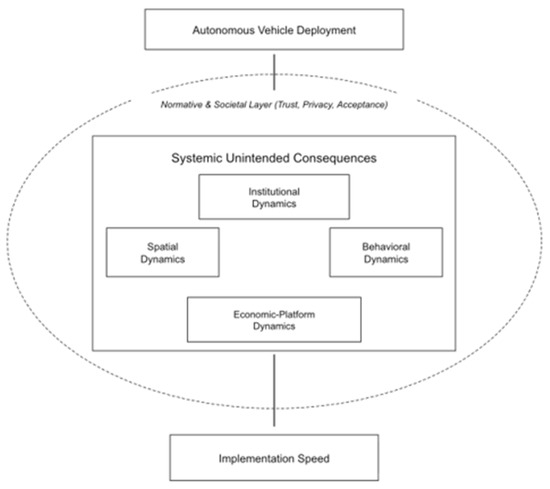
Figure 3 illustrates this framework. It organizes the findings into five interdependent dimensions—institutional, behavioral, economic–platform, spatial, and normative–societal dynamics—and highlights the feedback loops between them. The four core system dimensions interact through mutually reinforcing mechanisms, while the normative and societal layer operates as a cross-cutting influence shaping trust, acceptance, and legitimacy.
Figure 3.
Systemic unintended consequences and autonomous vehicle implementation speed.
Across interviews, participants repeatedly described increasing coordination challenges between regulation, infrastructure capacity, and platform operations. These recurring patterns informed the interpretation of systemic frictions shaping AV implementation. This perspective suggests that AV deployment is not determined solely by technological readiness, but by the interaction of multiple socio-technical processes.
The following sections present the findings along these five dimensions.
4.1. Institutional Dynamics: Governance Lag, Scaling Risks, and Erosion of Public Control
The findings indicate that AV implementation is fundamentally constrained by institutional dynamics, particularly by the mismatch between established planning paradigms and the non-linear dynamics of AV systems.
A central mechanism underlying this mismatch is the “pacing problem,” defined as the divergence between rapid technological advancement and slower institutional adaptation [45,46]. Interviewees consistently described regulatory frameworks as reactive rather than proactive, resulting in a governance lag.
In addition, several interviewees identified uncertainty regarding liability assignment in the event of accidents as a further institutional barrier to large-scale AV deployment. Participants emphasized that unresolved questions concerning responsibility between manufacturers, operators, and users create regulatory uncertainty and increase institutional risk aversion.
“Without clear liability rules, cities and operators remain cautious about scaling autonomous systems.”(Interview 12, city administration)
These findings suggest that liability regimes may significantly influence implementation speed by affecting regulatory approval processes, investment decisions, and public acceptance. regulatory frameworks as reactive rather than proactive, resulting in a governance lag.
Several participants emphasized that public institutions often struggle to adapt at the same speed as technological development:
“Technology moves in months, but regulation moves in years.”.(Interview 15, technology company)
In addition, the analysis identifies a “scaling paradox,” whereby AV deployment may accelerate faster than institutional readiness. While technological capabilities are advancing rapidly, many municipalities delay regulatory action due to perceived uncertainty or lack of immediate relevance. Historical research on the transition to automobility demonstrates that such delays can lead to path-dependent outcomes, including infrastructure lock-in and long-term spatial inequities [10,47].
Interviewees repeatedly linked this delay to uncertainty regarding responsibility and long-term urban consequences:
“Cities hesitate because they fear making irreversible infrastructure decisions too early.”(Interview 2, city administration)
Several interviewees emphasized that platform operators increasingly shape operational decision-making through proprietary algorithms and data infrastructures:
‘Cities no longer control mobility through roads alone—control increasingly happens through data and digital coordination.’(Interview 11, public sector)
This dynamic introduces regulatory asymmetries and challenges the ability of cities to steer mobility systems toward public objectives [5]. Participants expressed concern that, without early intervention, governance authority may shift toward platform operators:
“If cities don’t define the rules early, platforms will define them instead.”(Interview 7, city administration)
Additional complexity arises from decentralized fleet models, where privately owned AVs participate in peer-to-peer systems. While these models increase efficiency, prior research suggests they may contribute to increased vehicle kilometers traveled (VKT) and reduced regulatory control [48,49].
Taken together, institutional dynamics emerge as a critical determinant of AV implementation speed. Both the literature and the interview data suggest that existing governance structures are poorly aligned with the dynamic and cross-sectoral characteristics of AV systems. Traditional urban mobility planning has historically been conceptualized as a sequential ‘predict and provide’ process [9,10], assuming relatively stable demand patterns. However, AV systems introduce uncertainty, feedback effects, and cross-sectoral interdependencies that challenge this paradigm [49,50].
Across interviews, participants emphasized that current planning approaches are not designed to handle such dynamics:
“Planning assumes stability. With AVs, we are dealing with a moving target.”(Interview 8, automotive OEM)
Several interviewees also stressed that existing governance structures remain too fragmented to address these cross-sectoral dynamics effectively:
“Transport, digital infrastructure, land use, and data governance are still handled separately, but AVs connect all of them.”(Interview 12, city administration)
4.2. Behavioral Dynamics: Demand Expansion and Accessibility Effects
The findings identify behavioral responses as a key driver of AV system dynamics. Both literature and empirical evidence indicate that AVs reduce the generalized cost of travel by lowering both monetary costs and the perceived disutility of travel time [4,16].
Participants consistently described AVs as transforming travel time into a usable resource:
“Travel time becomes usable time, which changes how people think about distance.”(Interview 10, start-up)
Several interviewees emphasized that AVs may fundamentally reshape everyday mobility routines and commuting behavior by lowering psychological barriers to travel:
“People will tolerate much longer commutes if travel time can be used productively.”(Interview 6, consulting)
This shift lowers the threshold for initiating trips and leads to an expansion of mobility demand. Prior research suggests that such reductions in travel costs are associated with rebound effects and increased travel activity [15,25]. Our findings confirm these dynamics, with interviewees anticipating both increased passenger trips and additional empty vehicle movements related to fleet repositioning.
Interviewees also raised concerns regarding empty vehicle circulation and operational inefficiencies associated with autonomous fleet management:
“A significant share of AV traffic may actually consist of empty vehicles repositioning themselves.”(Interview 3, infrastructure/platform provider)
Furthermore, AVs are increasingly embedded within digital service ecosystems, enabling the delivery of services such as logistics, healthcare, and retail directly to users [11,12]. This servitization of mobility further expands demand by integrating mobility with consumption and service provision.
Table 4 summarizes the accessibility implications of these dynamics across different user groups. While AVs have the potential to improve access for elderly populations, non-drivers, and mobility-constrained individuals [4,27], both literature and interview data indicate that these benefits are unevenly distributed. Without targeted policy intervention, increased accessibility may coexist with rising inequality in service provision.
Table 4.
Anticipated user groups and accessibility benefits of autonomous vehicles.
Overall, behavioral dynamics highlight a key tension: while AVs enhance convenience and accessibility, they also increase system demand and contribute to congestion pressures that may slow implementation.
Taken together, the findings suggest that behavioral adaptation represents not merely a secondary effect of AV deployment but a central mechanism shaping long-term implementation dynamics and urban mobility patterns.
4.3. Economic and Platform Dynamics: Market Restructuring and the “Vehicle-as-Venue”
The findings indicate that the deployment of autonomous vehicles (AVs) is closely associated with the emergence of platform-based economic structures that fundamentally reconfigure value creation in urban mobility systems. Rather than operating as discrete transport technologies, AVs are increasingly embedded within digital ecosystems that integrate mobility, data, and service provision [5,11,12]. This transformation shifts the locus of value creation from vehicle ownership toward platform-mediated service orchestration.
A central mechanism identified across both the literature and the interview data is the transition from mobility as a transport function to mobility as a multi-sided platform service. In this configuration, AVs act as intermediaries that connect users, service providers, and digital infrastructures, enabling the bundling of mobility with complementary services. Participants consistently emphasized that this shift alters competitive dynamics within the mobility sector by privileging actors capable of orchestrating ecosystems rather than merely operating vehicles:
“Who controls the platform controls the system.”(Interview 8, automotive OEM)
Within this context, the findings reveal the emergence of the “vehicle-as-venue” paradigm as a defining feature of AV-enabled business models. Table 5 synthesizes the range of emerging and anticipated service applications across sectors, including tourism, hospitality, commerce, healthcare, and work. Rather than representing isolated use cases, these applications collectively illustrate a structural shift: the decoupling of services from fixed spatial infrastructures and their re-embedding into mobile, platform-mediated environments.
Table 5.
Emerging and anticipated service applications of autonomous vehicles across sectors.
A cross-sectoral analysis of Table 5 reveals a consistent underlying pattern. Across all sectors, AVs enable (1) the relocation of service delivery from stationary facilities to mobile units, (2) the monetization of in-vehicle time as a productive or experiential resource, and (3) the integration of physical mobility with digital service ecosystems. This pattern suggests that AVs function as mobile nodes within platform economies, where value is co-created through the interaction of users, data, and services rather than through transport alone.
This transformation has significant implications for value capture. Interviewees highlighted that economic value is increasingly derived from data generation, service integration, and user engagement rather than from the mobility service itself:
“The real value is not the ride—it’s what happens during the ride.”(Interview 6, consulting)
These findings align with broader literature on platform economies, which emphasizes the role of data-driven network effects and ecosystem control in shaping market outcomes. As AV platforms scale, they are likely to exhibit tendencies toward concentration, as first movers accumulate data advantages and establish dominant positions within urban mobility ecosystems.
At the same time, the integration of service provision into mobility systems introduces new forms of competition over urban infrastructure. While traditionally analyzed as a spatial issue, the allocation of resources such as curb access can be understood as an economic coordination problem shaped by platform logics. AV-based services rely on high-frequency access to urban space, and platform operators are incentivized to optimize this access according to demand and profitability.
Participants expressed concern that, in the absence of regulatory intervention, these dynamics may lead to the commodification of public space and the prioritization of high-revenue activities:
“Public space risks becoming a marketplace if cities don’t intervene.”(Interview 9, city administration)
Moreover, platform-driven optimization may result in uneven service distribution, with a concentration of services in high-demand areas and among high-value users. This dynamic introduces risks of economic and spatial stratification, as lower-demand areas and cost-sensitive user groups may be underserved [25].
Taken together, the findings suggest that economic and platform dynamics are central to understanding AV implementation. The transformation of vehicles into mobile service platforms not only expands the scope of mobility systems but also reconfigures the mechanisms of value creation, control, and distribution. As a result, the speed and trajectory of AV deployment are closely tied to how platform-based economic structures are governed, particularly with regard to data ownership, market concentration, and access to urban infrastructure.
4.4. Spatial Dynamics: Infrastructure Constraints and Curb Competition as System Bottlenecks
The findings indicate that the spatial implications of autonomous vehicle (AV) deployment are not independent phenomena but emerge as a consequence of behavioral expansion and platform-driven service integration. While AV systems are often associated with reduced parking demand and more efficient land use, both the literature and the empirical evidence suggest that these potential gains are offset by increased vehicle circulation and intensified demand for curb access [4,5].
A central insight from the analysis is that platform-mediated mobility systems fundamentally alter how urban space is utilized. As outlined in Section 4.3, AVs enable the integration of services into mobile platforms, thereby shifting economic activity into the mobility system itself. This transformation generates new forms of spatial demand, particularly for pick-up, drop-off, and service-related interactions. Consequently, curb space emerges as a critical interface between digital platform logics and physical urban infrastructure.
Interviewees consistently emphasized that existing urban infrastructures are already operating under significant pressure from competing uses, including private vehicles, logistics, and active mobility. The introduction of AV-based services is expected to further intensify this competition:
“The challenge is not moving vehicles—it’s managing where they stop.”(Interview 3, research)
In addition to passenger-related curb demand, interviewees emphasized that large-scale AV deployment may also generate new forms of operational infrastructure pressure associated with fleet maintenance and servicing. Participants highlighted that autonomous fleets require regular sensor cleaning, charging, inspection, and repair operations, particularly under adverse weather and urban operating conditions.
“AV fleets do not only need space for passengers—they also need space for continuous maintenance and servicing.”(Interview 16, OEM)
Several interviewees further noted that operational disruptions caused by dirt, weather-related sensor obstruction, or delayed repair turnaround times may influence vehicle availability and public trust in AV systems.
The literature on curb management supports this observation, identifying curb space as a scarce and strategically important resource in future mobility systems [5]. Unlike traditional parking demand, which is relatively static, AV-related curb demand is dynamic and high-frequency, requiring continuous allocation and coordination.
Importantly, the findings suggest that spatial constraints are not merely a function of increased traffic volumes but are structurally linked to platform dynamics. As AV systems enable new service models—such as mobile retail, healthcare delivery, and in-vehicle workspaces (see Table 5)—the demand for curb access becomes economically driven. Platform operators optimize vehicle routing and stopping behavior based on efficiency and profitability, which may conflict with broader urban planning objectives.
Participants highlighted that, without regulatory intervention, these dynamics could lead to inefficient and inequitable allocation of urban space:
“If left unmanaged, the most profitable uses will dominate the curb.”(Interview 10, policy)
This introduces a distributional dimension to spatial dynamics. High-demand locations and high-value services are likely to receive preferential access, potentially crowding out public transport, pedestrians, and lower-priority uses. Prior research suggests that such dynamics may reinforce existing spatial inequalities and reduce the accessibility of urban environments [25].
Moreover, increased vehicle circulation associated with AV systems—including empty vehicle movements for repositioning—further exacerbates spatial pressure. Studies indicate that these additional movements can significantly increase vehicle kilometers traveled (VKT), thereby contributing to congestion and reducing system efficiency [53,54].
Taken together, the findings suggest that spatial dynamics represent a critical system-level bottleneck for AV implementation. The interaction between platform-driven service models, increased mobility demand, and limited urban space generates coordination challenges that cannot be resolved through infrastructure expansion alone. Instead, the effective management of curb space and urban infrastructure emerges as a central condition for scalable and sustainable AV deployment.
4.5. Normative and Societal Dynamics: Trust, Legitimacy, and the Social Acceptability of Autonomous Mobility
The findings indicate that normative and societal dynamics act as a cross-cutting layer influencing how autonomous vehicle (AV) systems are perceived, accepted, and implemented. Unlike other dimensions, these dynamics operate indirectly by shaping trust, legitimacy, and public acceptance.
A central mechanism concerns trust in AV systems and their operators. While technological performance may be high, acceptance depends on transparency, accountability, and perceived reliability. Interviewees emphasized that system functionality alone is insufficient to ensure adoption:
“It’s not just about whether the system works—it’s about whether people feel comfortable with how it works.”(Interview 2, city administration)
Closely related are issues of data governance and privacy. AV systems rely on extensive data collection, creating tensions between system optimization and societal expectations regarding data protection. Uncertainty about data ownership and usage was identified as a potential barrier to acceptance.
Several interviewees emphasized that questions of data sovereignty are central to adaptive urban governance. Participants discussed whether operational and mobility-related data generated by AV systems should primarily remain under the control of operators, municipalities, or users themselves.
“Who controls the data ultimately controls the mobility system.”(Interview 15, technology company)
Interviewees further argued that limited municipal access to AV-related operational data may reduce the ability of cities to monitor system performance, regulate curb usage, and adapt mobility planning dynamically.
Participants repeatedly linked societal acceptance to perceived fairness and transparency in platform governance:
‘People will only trust these systems if they understand who benefits and who controls the data.’(Interview 9, public sector)
Without clear governance frameworks, AV systems may be perceived as privileging commercial over public interests.
In addition, emerging social norms within AV environments remain unsettled. As vehicles evolve into multifunctional spaces, expectations regarding use and behavior are still forming, which may contribute to uncertainty in adoption.
Overall, normative and societal dynamics influence implementation by shaping the conditions under which AV systems are considered acceptable and legitimate. These dynamics interact with institutional, economic, behavioral, and spatial processes, and may slow or redirect deployment where trust, fairness, or transparency are contested.
4.6. Impact on Implementation Speed: Systemic Frictions and Scaling Constraints
The findings provide a direct answer to the central research question of this study: the speed of autonomous vehicle (AV) implementation is not determined by technological readiness alone but by the interaction of unintended consequences emerging across multiple socio-technical dimensions. As one interviewee (Interview 17, start-up) noted, “The technology is moving faster than the institutions around it,” highlighting the growing mismatch between technological progress and governance capacity.
Rather than acting as isolated barriers, these unintended consequences generate systemic frictions that shape both the pace and trajectory of AV deployment.
Institutional dynamics slow implementation through governance lag and regulatory uncertainty. Behavioral dynamics increase system demand and operational complexity. Economic and platform dynamics introduce coordination challenges and regulatory tensions. Spatial dynamics create physical bottlenecks, particularly in curb space and infrastructure capacity. Normative dynamics influence trust, legitimacy, and societal acceptance. One respondent (Interview 9, city administration) emphasized that “everyone wants the curb space, but nobody is coordinating it,” illustrating how spatial and governance-related frictions increasingly overlap in urban environments.
These dimensions do not operate independently but interact through reinforcing feedback loops. Increased demand intensifies spatial pressure, spatial constraints require institutional responses, and governance lag reinforces platform-driven outcomes. At the same time, societal concerns influence both regulation and user adoption.
As a result, AV implementation follows a non-linear and path-dependent trajectory, where scaling is contingent on the ability to manage these systemic frictions.
This suggests that the key question is not whether AVs can be implemented, but under which conditions they can be implemented efficiently and at scale. As summarized by one expert (Interview 6, consulting), “Autonomous vehicles are not just a technology problem—they are a system transformation problem.”
5. Conclusions
While research on autonomous vehicles (AVs) has expanded rapidly over the past decade, much of the academic and policy discourse has focused on technological feasibility, safety, and ethics rather than on the dynamics of real-world implementation. Yet AV deployment unfolds under conditions of deep uncertainty, where outcomes are shaped not only by technological performance but also by complex interactions between behavior, governance, and urban systems. Understanding what accelerates or constrains implementation is therefore essential for anticipating broader societal, economic, and infrastructural impacts.
This study addressed this gap by examining (1) which unintended consequences can slow or stall the scaling of AVs in cities, and (2) how these consequences contribute to misalignment between AV deployment and its intended societal objectives. Drawing on a mixed-methods design combining a scoping review and expert interviews, the findings indicate that AV implementation is less constrained by technological readiness than by systemic socio-technical dynamics.
The analysis shows that unintended consequences emerge across five interconnected domains, including a cross-cutting normative and societal layer. These consequences do not occur in isolation but interact through reinforcing feedback loops. Reduced travel costs and new use cases increase mobility demand, which intensifies spatial pressures such as curb competition and traffic congestion. At the same time, institutional arrangements often lag behind technological developments, while platform-based business models reshape control over mobility systems. Taken together, these dynamics can generate governance frictions, rebound effects, and public resistance that may ultimately slow the large-scale deployment of AVs.
This perspective contributes to the literature on sustainable urban mobility, smart cities, and socio-technical transitions by shifting the analytical focus from vehicle performance to implementation dynamics. The study introduces a structured framework of unintended consequences and demonstrates how these mechanisms influence implementation speed. By linking qualitative stakeholder insights with systems-oriented theory, it advances the understanding of AVs as catalysts of broader urban transformation rather than as isolated technological innovations.
From a managerial and policy perspective, the findings suggest that the implementation of AVs is closely linked to how cities structure key system-level conditions. Three interrelated areas appear particularly relevant. First, the pacing and conditions of deployment emerge as a critical factor. Approaches such as phased rollout strategies combined with performance-based evaluation criteria may enable cities to align scaling processes with system outcomes rather than technological availability. Second, the management of urban space—particularly curb access and vehicle circulation—represents a central leverage point. Mechanisms such as dynamic allocation and pricing of street space can influence how efficiently AV systems operate and how potential rebound effects unfold. Participants further highlighted that cities may require new curb-pricing hierarchies and dynamic allocation systems to balance competing demands between AV fleets, logistics services, public transport, and active mobility.
Third, questions of data governance and system oversight become increasingly important as mobility services are organized through digital platforms. The definition of data access, usage rights, and performance monitoring frameworks may shape the extent to which public actors retain the ability to steer mobility systems toward broader societal objectives. Several interviewees argued that adaptive governance will likely require mandatory reporting frameworks for AV operators, including standardized disclosure of operational data related to congestion, fleet occupancy, empty repositioning trips, service coverage, and system reliability. Taken together, these findings suggest that AV governance may increasingly shift from static approval systems toward continuous monitoring and adaptive regulatory management.
The study has several limitations. First, the findings are based on qualitative expert interviews and reflect informed perspectives rather than statistically representative data. Second, the scoping review prioritizes breadth over depth and may be subject to selection bias. Third, the analysis focuses on conceptual mechanisms and does not provide quantitative estimates of effects. These limitations suggest caution in generalizing results across different urban contexts.
Future research could build on these insights by empirically testing the identified mechanisms across cities and through quantitative or simulation-based approaches. In particular, comparative studies of governance models, as well as agent-based simulations of AV-induced behavioral and spatial dynamics, could provide further evidence on how unintended consequences shape implementation trajectories. Additional research should further examine how liability regimes, operational fleet maintenance challenges, and evolving data governance structures influence large-scale AV deployment across different urban and regulatory contexts. Such research may help identify which governance approaches are most effective in balancing implementation speed, public legitimacy, and sustainability objectives.
In conclusion, the implementation of autonomous vehicles is shaped not only by technological progress but by the ability of urban systems to anticipate and respond to unintended consequences. Cities that develop adaptive, system-oriented approaches to governance may be better positioned to manage the complexities associated with AV deployment and to align emerging mobility systems with sustainability and equity objectives.
Author Contributions
Conceptualization, M.A.R. and J.W.; methodology, M.A.R.; data curation, M.A.R.; writing—original draft preparation, M.A.R.; writing—review and editing, M.A.R. and J.W.; visualization and formatting, D.P.; supervision, J.W. Artificial intelligence-based language models were used solely for linguistic refinement and editorial support. All authors have read and agreed to the published version of the manuscript.
Funding
This research received no external funding.
Institutional Review Board Statement
Institutional Review Board approval was not required for this study, as the research was non-interventional and did not involve medical procedures, patients, vulnerable groups, or the collection of sensitive personal data, in accordance with the Ethics Committee guidelines of the University of St. Gallen (HSG).
Informed Consent Statement
Informed consent was obtained from all subjects involved in the study.
Data Availability Statement
The data supporting the findings of this study consist of anonymized qualitative interview data collected during the research. Due to ethical and confidentiality considerations and to protect the privacy of participants, the data are not publicly available. Requests for access to anonymized data may be considered by the corresponding author on a case-by-case basis, subject to ethical approval and confidentiality requirements.
Conflicts of Interest
The authors declare no conflicts of interest.
References
- Kalra, N.; Paddock, S.M. Driving to safety: How many miles of driving would it take to demonstrate autonomous vehicle reliability? Transp. Res. Part A Policy Pract. 2016, 94, 182–193. [Google Scholar] [CrossRef] [Scilit]
- Shladover, S.E. Connected and automated vehicle systems: Introduction and overview. J. Intell. Transp. Syst. 2017, 22, 190–200. [Google Scholar] [CrossRef] [Scilit]
- SAE Standard No. J3016_202104; Taxonomy and Definitions for Terms Related to Driving Automation Systems for On-Road Motor Vehicles. SAE International: Warrendale, PA, USA, 2021.
- Milakis, D.; Van Arem, B.; Van Wee, B. Policy and society related implications of automated driving: A review of literature and directions for future research. J. Intell. Transp. Syst. 2017, 21, 324–348. [Google Scholar] [CrossRef] [Scilit]
- International Transport Forum. Governance of Autonomous Mobility; OECD Publishing: Paris, France, 2023. [Google Scholar]
- Pakusch, C.; Bossauer, P.; Shakoor, M.; Stevens, G. Using, Sharing, and Owning Smart Cars—A Future Scenario Analysis Taking General Socio-Technical Trends into Account. In Proceedings of the 13th International Joint Conference on e-Business and Telecommunications, Lisbon, Portugal, 26–28 July 2016; Volume 0 ICETE, pp. 19–30. [Google Scholar] [CrossRef] [Scilit]
- Docherty, I.; Marsden, G.; Anable, J. The governance of smart mobility. Transp. Res. Part A Policy Pract. 2017, 115, 114–125. [Google Scholar] [CrossRef] [Scilit]
- Narayanan, S.; Chaniotakis, E.; Antoniou, C. Shared autonomous vehicle services: A comprehensive review. Transp. Res. Part C Emerg. Technol. 2020, 111, 255–293. [Google Scholar] [CrossRef] [Scilit]
- Owens, S. From ‘predict and provide’ to ‘predict and prevent’?: Pricing and planning in transport policy. Transp. Policy 1995, 2, 43–49. [Google Scholar] [CrossRef] [Scilit]
- Norton, P.D. Fighting Traffic: The Dawn of the Motor Age in the American City. Ph.D. Thesis, University of Virginia, Charlottesville, VA, USA, 2002. [Google Scholar] [CrossRef] [Scilit]
- Cohen, S.A.; Hopkins, D. Autonomous vehicles and the future of urban tourism. Ann. Tour. Res. 2019, 74, 33–42. [Google Scholar] [CrossRef] [Scilit]
- Kellerman, A. Automated and Autonomous Spatial Mobilities; Edward Elgar: Cheltenham, UK, 2018; Available online: https://www.e-elgar.com/shop/gbp/automated-and-autonomous-spatial-mobilities-9781786438485.html?srsltid=AfmBOoroEv5ohbtJoVP5gU0q4yObRt5zujRu8Mvh3epAY44Ji6YY7CvT (accessed on 14 August 2025).
- Gortaire, L.; Rodrigues da Silva, A.N. Connections between electric vehicles and sustainable urban mobility: A system dynamics approach. In Proceedings of the 19th International Conference on Computational Urban Planning and Urban Management, London, UK, 23–27 June 2025. [Google Scholar]
- Wadud, Z. Fully automated vehicles: A cost of ownership analysis to inform early adoption. Transp. Res. Part A Policy Pract. 2017, 101, 163–176. [Google Scholar] [CrossRef] [Scilit]
- Wadud, Z.; MacKenzie, D.; Leiby, P. Help or hindrance? The travel, energy and carbon impacts of highly automated vehicles. Transp. Res. Part A Policy Pract. 2016, 86, 1–18. [Google Scholar] [CrossRef] [Scilit]
- Merton, R.K. The unanticipated consequences of purposive social action. Am. Sociol. Rev. 1936, 1, 894. [Google Scholar] [CrossRef] [Scilit]
- Ville de Paris. Plan Climat de Paris. 2018. Available online: https://www.paris.fr/pages/paris-pour-le-climat-2148 (accessed on 4 March 2026).
- City of New York. OneNYC 2050: Building a Strong and Fair City. 2019. Available online: https://onenyc.cityofnewyork.us (accessed on 14 August 2025).
- European Commission. 100 Climate-Neutral and Smart Cities by 2030: By and for the Citizens: Mission Implementation Plan; Publications Office of the European Union: Luxembourg, 2022.
- Purvis, B.; Mao, Y.; Robinson, D. Three pillars of sustainability: In search of conceptual origins. Sustain. Sci. 2018, 14, 681–695. [Google Scholar] [CrossRef] [Scilit]
- United Nations General Assembly. Transforming Our World: The 2030 Agenda for Sustainable Development (A/RES/70/1); United Nations General Assembly: New York, NY, USA, 2015. [Google Scholar]
- International Transport Forum. Urban Mobility System Upgrade: How Shared Self-Driving Cars Could Change City Traffic; OECD Publishing: Paris, France, 2015. [Google Scholar]
- Zhang, R.; Pavone, M. Control of robotic mobility-on-demand systems: A queueing-theoretical perspective. Int. J. Robot. Res. 2015, 35, 186–203. [Google Scholar] [CrossRef] [Scilit]
- Kusano, K.D.; Scanlon, J.M.; Chen, Y.; McMurry, T.L.; Chen, R.; Gode, T.; Victor, T. Comparison of Waymo rider-only crash data to human benchmarks at 7.1 million miles. Traffic Inj. Prev. 2024, 25, S66–S77. [Google Scholar] [CrossRef] [Scilit] [PubMed]
- Tirachini, A.; Antoniou, C. The economics of automated public transport: Effects on operator cost, travel time, fare and subsidy. Econ. Transp. 2019, 21, 100151. [Google Scholar] [CrossRef] [Scilit]
- Harper, C.D.; Hendrickson, C.T.; Mangones, S.; Samaras, C. Estimating potential increases in travel with autonomous vehicles for the non-driving, elderly and people with travel-restrictive medical conditions. Transp. Res. Part C Emerg. Technol. 2016, 72, 1–9. [Google Scholar] [CrossRef] [Scilit]
- Golbabaei, F.; Dwyer, J.; Gomez, R.; Peterson, A.; Cocks, K.; Bubke, A.; Paz, A. Enabling mobility and inclusion: Designing accessible autonomous vehicles for people with disabilities. Cities 2024, 154, 105333. [Google Scholar] [CrossRef] [Scilit]
- Morrison, C.N.; Jacoby, S.F.; Dong, B.; Delgado, M.K.; Wiebe, D.J. Ridesharing and motor vehicle crashes in 4 US cities: An Interrupted Time-Series analysis. Am. J. Epidemiol. 2017, 187, 224–232. [Google Scholar] [CrossRef] [Scilit] [PubMed]
- Waymo. Waymo Safety Report; Waymo LLC: Mountain View, CA, USA, 2023; Available online: https://waymo.com/safety/ (accessed on 14 August 2025).
- Zhong, H.; Li, W.; Burris, M.W.; Talebpour, A.; Sinha, K.C. Will autonomous vehicles change auto commuters’ value of travel time? Transp. Res. Part D Transp. Environ. 2020, 83, 102303. [Google Scholar] [CrossRef] [Scilit]
- Waymo. Safety Impact Report; Waymo LLC: Mountain View, CA, USA, 2025. [Google Scholar]
- Greenwood, B.N.; Wattal, S. Show Me the Way to Go Home: An Empirical investigation of Ride-Sharing and Alcohol Related Motor Vehicle Fatalities. MIS Q. 2017, 41, 163–187. [Google Scholar] [CrossRef] [Scilit]
- Gayer, T. The fatality risks of Sport-Utility vehicles, vans, and pickups relative to cars. J. Risk Uncertain. 2004, 28, 103–133. [Google Scholar] [CrossRef] [Scilit]
- Nohria, N.; Taneja, H. A New Model to Spark Innovation Inside Big Companies. Harvard Business Review. 12 May 2021. Available online: https://hbr.org/2021/05/a-new-model-to-spark-innovation-inside-big-companies (accessed on 4 March 2026).
- Creswell, J.W.; Plano Clark, V.L. Designing and Conducting Mixed Methods Research, 3rd ed.; SAGE Publications: Thousand Oaks, CA, USA, 2018. [Google Scholar]
- Marsden, G.; Reardon, L. Questions of governance: Rethinking the study of transportation policy. Transp. Res. Part A Policy Pract. 2017, 101, 238–251. [Google Scholar] [CrossRef] [Scilit]
- Arksey, H.; O’Malley, L. Scoping studies: Towards a methodological framework. Int. J. Soc. Res. Methodol. 2005, 8, 19–32. [Google Scholar] [CrossRef] [Scilit]
- Levac, D.; Colquhoun, H.; O’Brien, K.K. Scoping studies: Advancing the methodology. Implement. Sci. 2010, 5, 69. [Google Scholar] [CrossRef] [Scilit] [PubMed]
- Munn, Z.; Peters, M.D.J.; Stern, C.; Tufanaru, C.; McArthur, A.; Aromataris, E. Systematic review or scoping review? Guidance for authors when choosing between a systematic or scoping review approach. BMC Med. Res. Methodol. 2018, 18, 143. [Google Scholar] [CrossRef] [PubMed]
- Patton, M. Qualitative Research and Evaluation Methods, 4th ed.; SAGE Publications: Thousand Oaks, CA, USA, 2015. [Google Scholar]
- Guest, G.; MacQueen, K.; Namey, E. Applied Thematic Analysis; SAGE Publications: Thousand Oaks, CA, USA, 2012. [Google Scholar] [CrossRef] [Scilit]
- Braun, V.; Clarke, V. Using thematic analysis in psychology. Qual. Res. Psychol. 2006, 3, 77–101. [Google Scholar] [CrossRef] [Scilit]
- Braun, V.; Clarke, V. Thematic Analysis. In Thematic Analysis a Practical Guide; Springer: Cham, Switzerland, 2022; pp. 1–7. [Google Scholar] [CrossRef] [Scilit]
- Wicks, D. The Coding Manual for Qualitative Researchers (3rd edition). Qual. Res. Organ. Manag. Int. J. 2017, 12, 169–170. [Google Scholar] [CrossRef] [Scilit]
- Thierer, A. The Pacing Problem and the Future of Technology Regulation. Mercatus Center at George Mason University. 2018. Available online: https://www.mercatus.org/economic-insights/expert-commentary/pacing-problem-and-future-technology-regulation (accessed on 4 March 2026).
- Richter, M.A.; Hagenmaier, M.; Bandte, O.; Parida, V.; Wincent, J. Smart cities, urban mobility and autonomous vehicles: How different cities needs different sustainable investment strategies. Technol. Forecast. Soc. Change 2022, 184, 121857. [Google Scholar] [CrossRef] [Scilit]
- McShane, C.; Tarr, J.A. The horse in the city: Living machines in the nineteenth century. In Technology and the Rise of the Networked City in Europe and America; Tarr, J.A., Dupuy, G., Eds.; Temple University Press: Philadelphia, NY, USA, 2007; pp. 272–290. [Google Scholar]
- Gkartzonikas, C.; Gkritza, K. What have we learned? A review of stated preference and choice studies on autonomous vehicles. Transp. Res. Part C Emerg. Technol. 2018, 98, 323–337. [Google Scholar] [CrossRef] [Scilit]
- Geels, F.W. Technological transitions as evolutionary reconfiguration processes: A multi-level perspective and a case-study. Res. Policy 2002, 31, 1257–1274. [Google Scholar] [CrossRef] [Scilit]
- Geels, F.W.; Schot, J. Typology of sociotechnical transition pathways. Res. Policy 2007, 36, 399–417. [Google Scholar] [CrossRef] [Scilit]
- Kashani, M.A.; Abbasi, M.; Mamdoohi, A.R.; Sierpiński, G. The Role of Attitude, Travel-Related, and Socioeconomic Characteristics in Modal Shift to Shared Autonomous Vehicles with Ride Sharing. World Electr. Veh. J. 2023, 14, 23. [Google Scholar] [CrossRef] [Scilit]
- MacKenzie, D.; Wadud, Z.; Leiby, P. A first-order estimate of energy impacts of automated vehicles in the United States. In Proceedings of the Transportation Research Board 93rd Annual Meeting, Washington, DC, USA, 12–16 January 2014. [Google Scholar]
- Fagnant, D.J.; Kockelman, K. Preparing a nation for autonomous vehicles: Opportunities, barriers and policy recommendations. Transp. Res. Part A Policy Pract. 2015, 77, 167–181. [Google Scholar] [CrossRef] [Scilit]
- Henao, A.; Marshall, W.E. The impact of ride-hailing on vehicle miles traveled. Transportation 2018, 46, 2173–2194. [Google Scholar] [CrossRef] [Scilit]
- Lee, S.; Oh, W.Y.; Yi, I. Transpitality: How Autonomous Driving Technology Will Reshape the Industry Landscape. The European Business Review. 2019. Available online: https://www.europeanbusinessreview.com/transpitality-how-autonomous-driving-technology-will-reshape-the-industry-landscape/ (accessed on 4 March 2026).

Disclaimer/Publisher’s Note: The statements, opinions and data contained in all publications are solely those of the individual author(s) and contributor(s) and not of MDPI and/or the editor(s). MDPI and/or the editor(s) disclaim responsibility for any injury to people or property resulting from any ideas, methods, instructions or products referred to in the content. |
© 2026 by the authors. Published by MDPI on behalf of the World Electric Vehicle Association. Licensee MDPI, Basel, Switzerland. This article is an open access article distributed under the terms and conditions of the Creative Commons Attribution (CC BY) license.