


Abstract
Program KBLBB was implemented to reduce carbon emissions and mitigate climate change by 2030. Total sales of Battery Electric Vehicles (BEVs) in Indonesia until June 2025 are 107,428, with the increase in sales resulting in a proportional rise in EV battery waste. EV battery waste requires comprehensive policy recommendations for its management, as in Indonesia. The goal of this research is to develop a sustainable assessment for an EV battery waste management model that addresses environmental, economic, and social perspectives. The assessment is carried out using the End-of-Waste framework model, Reuse, with recycling technology hydrometallurgy for Nickel Manganese Cobalt (NMC) and Lithium Ferro Phosphate (LFP) batteries. The results show that the environmental impacts of waste from NMC batteries are 20% smaller than those of LFP batteries, with 80% of the impacts. The total cost of waste from LFP batteries is lower than that of NMC batteries. The S-LCA risk score shows the same results for waste from NMC and LPF batteries: a very high risk for actual female employment, unequal remuneration, no collective bargaining indicators, and no right to organize. Sensitivity analysis results for EV battery waste management model for NMC batteries with hydrometallurgy, collection level of 30%, and recovery rate of 85%.
1. Introduction
Program KBLBB (Battery-Based Electric Motor Vehicle Acceleration) was launched in December 2020 to facilitate the implementation of business activities offering electric power and vehicles for road transportation in Indonesia [1], aiming to reduce carbon emissions and mitigate climate change by 2030. To accelerate this adoption, several efforts are needed, including the issuance of Presidential Regulation (Perpres) number 55 of 2019 in August 2019 [2]. Electric vehicles (EVs) from an economic perspective aim to increase national energy security by reducing dependence on imported fuel oil (BBM), as Indonesia has been a net oil importer since 2004, thereby reducing pressure on Indonesia’s balance of payments. Meanwhile, from an environmental perspective, electric vehicles are a solution to protecting the environment, because the forestry and energy sectors make the largest contribution to emissions, as well as reducing carbon emissions from the transportation sector [3].
Total sales of battery electric vehicles (BEVs) in Indonesia from 2019 to June 2025 are 107,428, according to data from Gaikindo (Association of Indonesian Automotive Industries). By 2025, BEV sales are projected to account for 9.6% of total car sales in Indonesia. In 2020, BEV car sales were recorded at 125 units, in 2021, they were 687 units or an increase of 450% compared to 2020, in 2022, they were 10,327 units or an increase of 1403% compared to 2021, in 2023, they were 17,051 units or an increase of 65%, in 2024, they were 43,188 units or an increase of 153%. As of June 2025, it was recorded at 35,481 units, and it is projected that sales will reach 60,000 units by the end of 2025 [4]. EV battery waste will reach 352.77 metric tons by 2030. The volume of battery waste from EVs is increasing, requiring the implementation of Government Regulations [5]. Waste from EV batteries is regulated as hazardous waste [6]. Indonesia, as a developing country, currently lacks clear regulations and requires stakeholder support to develop a framework for EV battery waste management [7]. The growing number of EV users in Indonesia requires comprehensive policy recommendations for managing EV batteries. This gap highlights the need for incentives tailored to the environmental, economic, and social factors important in developing countries.
To achieve the sustainable development goals by providing a comprehensive approach to EV battery waste management in implementing circular economy (CE) policies through scientific methods and relevant policies. CE is crucial for achieving sustainable EV battery waste management, thereby minimizing waste and promoting resource efficiency [8]. The CE framework aims to protect the environment and conserve natural resources [9], prevent waste [10], and utilize recycling techniques [11]. Internationally, Japan, South Korea, China, the USA, Canada, and some EU countries have led the transition from a linear, waste-management-based system to a circular, economy-based system [12,13]. Economic and environmental factors, as noted by [14], are also considered along with technological methods proposed by [15,16]. In accordance with the CE goal, EV batteries should be used to the maximum extent possible before disposal, with the remaining power and essential materials used at end-of-waste.
The goal of the end-of-waste concept is to shorten and simplify the recycling process by minimizing the administrative burden related to waste regulations, ensuring safe [17], effective, high-quality, and recyclable products; product standardization; quality and safety determination; and increasing legal harmonization and clarity in the recycling market [18]. The end-of-waste concept facilitates the transition from waste to product, supports the circular economy as a legal instrument in the European Union [19], and is seen as a potential gamechanger [20]. A sustainable approach that considers environmental, economic, and social factors requires an EV battery waste management framework.
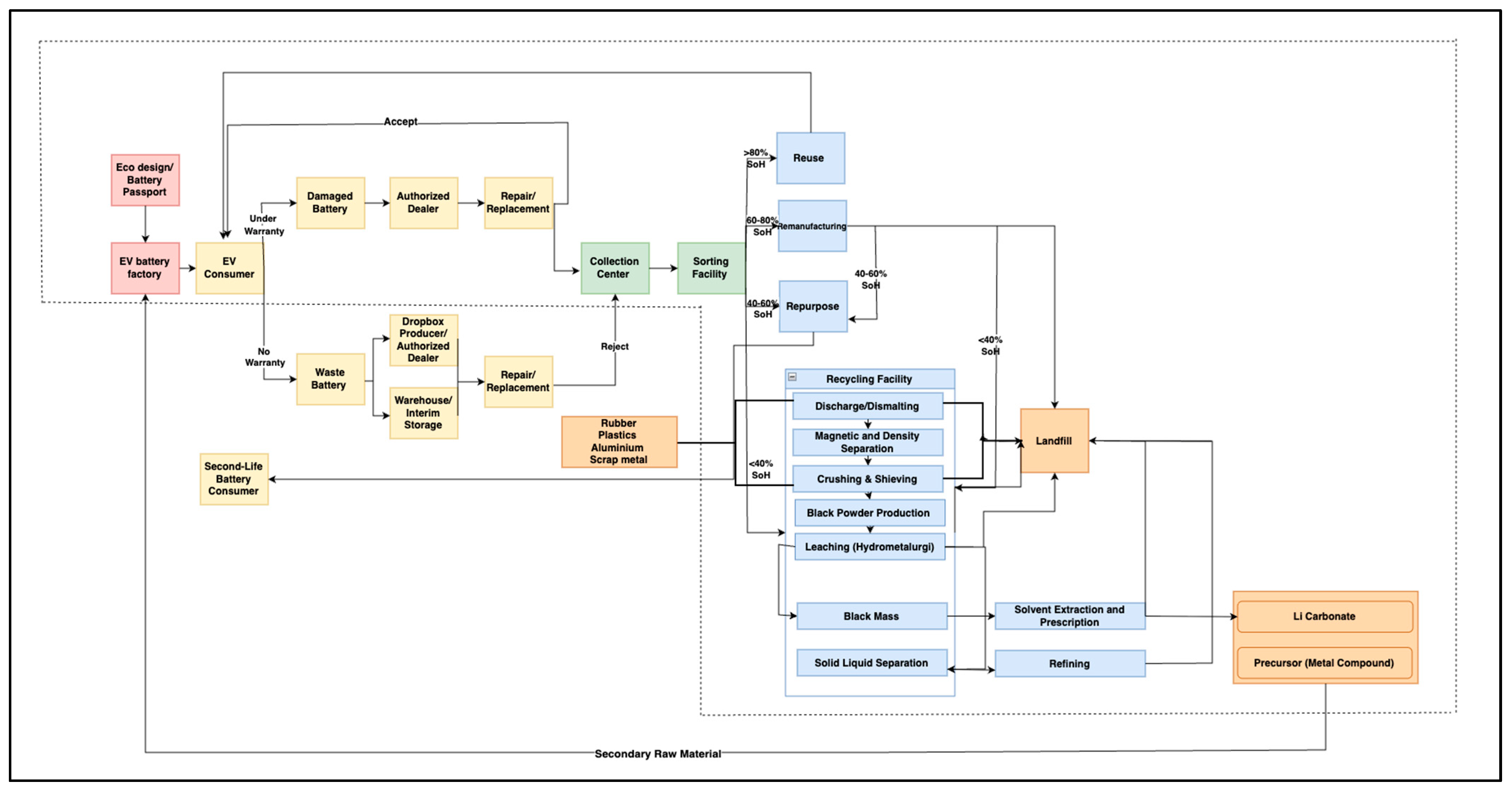
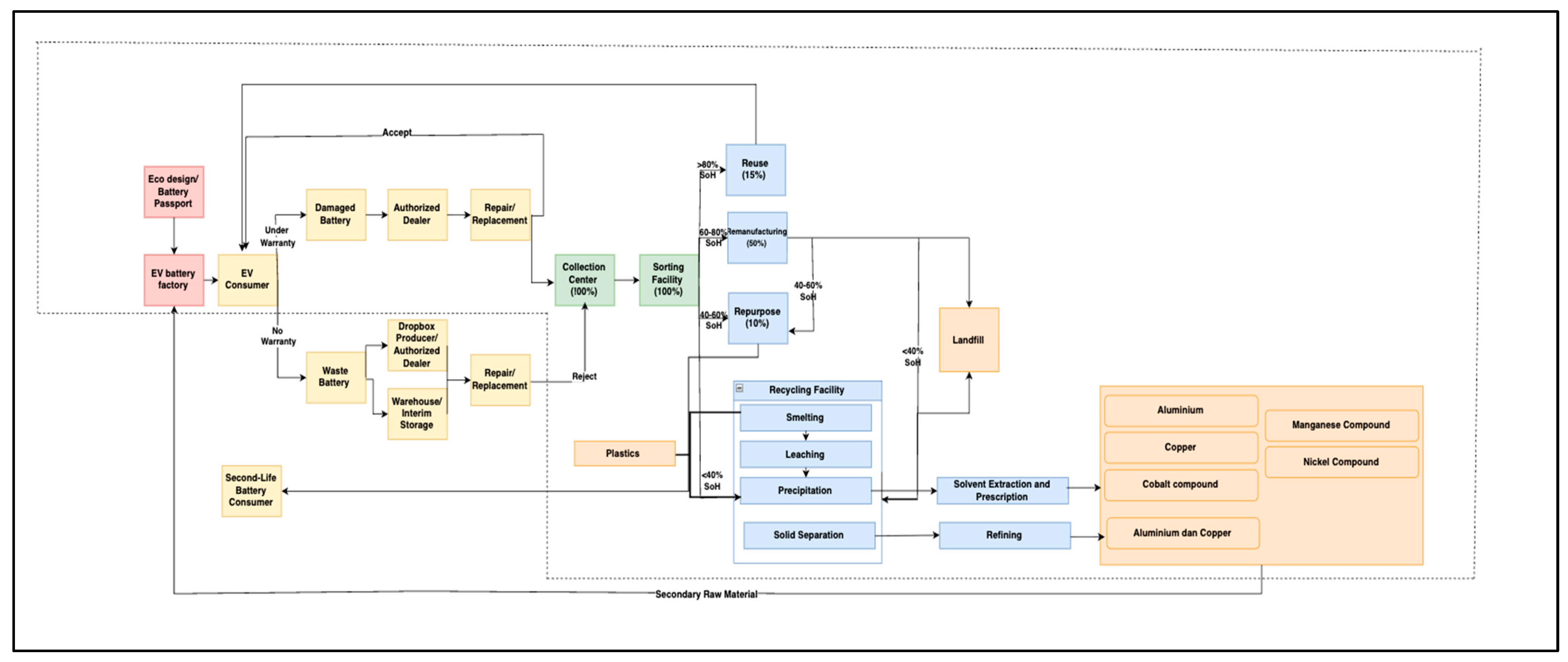
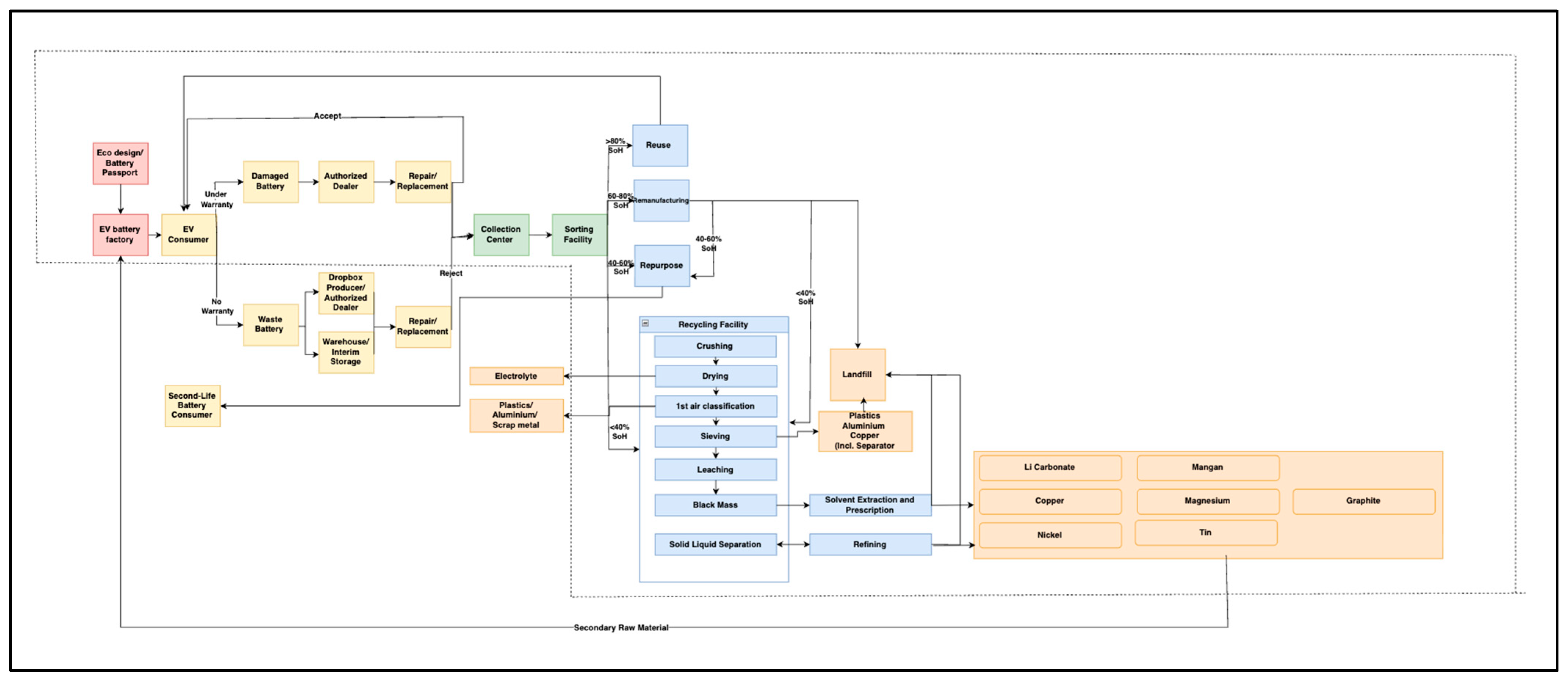
The literature review yields an EV battery waste-management framework [21,22,23,24,25,26,27,28,29,30,31,32,33,34,35,36,37,38], “Reuse,” based on CE principles. The framework begins with the collection of electric vehicle battery waste through collection points or manufacturer-owned storage warehouses, followed by a State of Health (SoH) assessment of the batteries at a sorting facility; batteries with SoH > 80% enter the reuse pathway, batteries with SoH > 60–80% are reused for secondary energy applications (repurpose), and batteries with SoH < 60% undergo disassembly/dismantling before entering the recycling facility. Unusable recycled products are sent to landfills. Authorized dealers inspect and repair damage to repairable batteries, then return them to consumers. Battery manufacturers receive the extracted supply results as secondary raw materials.
Previous research on sustainable assessment remains very limited overall, and even less so for EV battery waste management. The assessment is still from an environmental and economic perspective. There are several studies on the waste of NMC battery in environmental perspective or LCA with system boundary cradle-to-grave [39] and cradle-to-gate [40] with the objective in UEA scenario hydrometallurgy recycling technology, with objective assessment in China, Europe, and North America, with scenario conventional hydrometallurgy (CHR), truncated hydrometallurgy (THR), and pyrometallurgy. Combination LCA and LCA use to assess environmental and economic perspectives in China with a system boundary cradle-to-gate in China with recycling technology, hydrometallurgy, pyrometallurgy, and bio-metallurgical for waste of NMC battery [41,42]. Research on the waste from NMC and LFP batteries has also been conducted in China, including recycling via hydrometallurgy, pyrometallurgy, direct recycling, and a combination of hydrometallurgy and pyrometallurgy [43,44].
Regarding the waste of LFP and LiO2 in China [45], there is no research on the social impacts (S-LCA) of EV battery waste management. The social assessment has already been applied to waste-to-energy [46] and the informal recycling sector. In a developing country, all social indicators require careful planning and active stakeholder participation to establish specific indicators, develop reference scales, and guide data collection. The indicators were also aligned with best practices. Meanwhile, the interpretation phases aimed at creating long-term impacts need to verify and disseminate results [47].
In this study, due to insufficient data, incorrect assumptions, or inadequate information, significant uncertainties exist, so LCSA uncertainties need to be identified. Therefore, a sensitivity analysis was conducted to address these uncertainties [48,49] and to assess the three aspects of EV battery waste management, with social impact assessed subjectively. A sensitivity analysis was conducted on BEVs in China to identify the main factors influencing environmental and economic aspects [49], to identify key variables for recycling LiB batteries in the United Arab Emirates (UAE) [41], and to identify the most significant factors, address fraud, and provide more clarity, specifically on the battery supply chain, particularly in Europe and North America [40]. The systematic comparison between sustainable Assessment for EV battery waste management is shown in Table 1.
Table 1.
Comparison of sustainable assessment for EV battery waste management.
Table 1 shows that research on sustainable assessment focuses only on environmental and economic perspectives, and there isn’t yet any from a social perspective, especially in EV battery waste management. This study adds a social perspective to a sustainable assessment of multiple perspectives on EV battery waste management, positioning it as a state-of-the-art and a benefit crucial for sustainable development. A social assessment of EV battery waste management includes six stakeholder groups: workers, local communities, value chain actors, children, and consumers. The key factors influencing the sustainability assessment of EV battery waste management are identified through a sensitivity analysis. A sensitivity analysis uses three control variables: collection rate, recovery value, and recycling technology. The goal of this research is to develop an EV battery waste management model grounded in a sustainability assessment from environmental, economic, and social perspectives, particularly in developing countries such as Indonesia.
The contributions of this research are
- To calculate the environmental, economic, and social impacts of EV battery waste management
- To assist stakeholders with policy recommendations related to EV battery waste management
- To create a sustainable EV battery waste management model, especially in developing countries like Indonesia.
2. Methodology
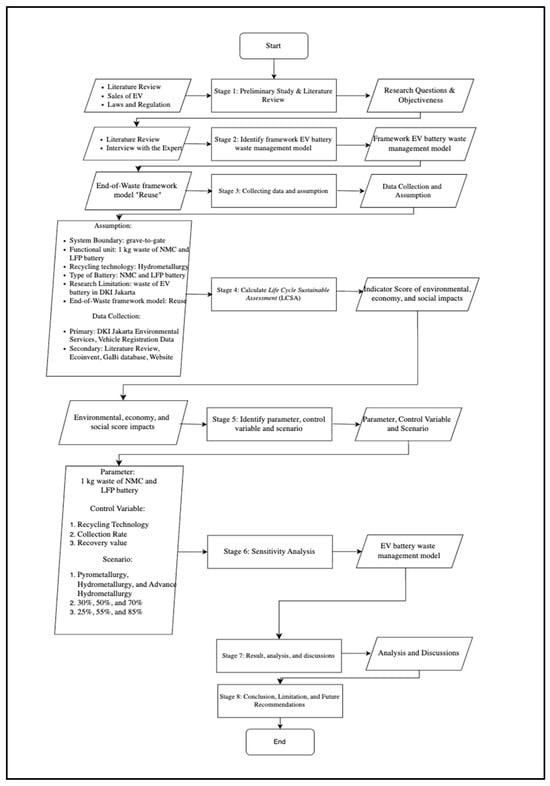
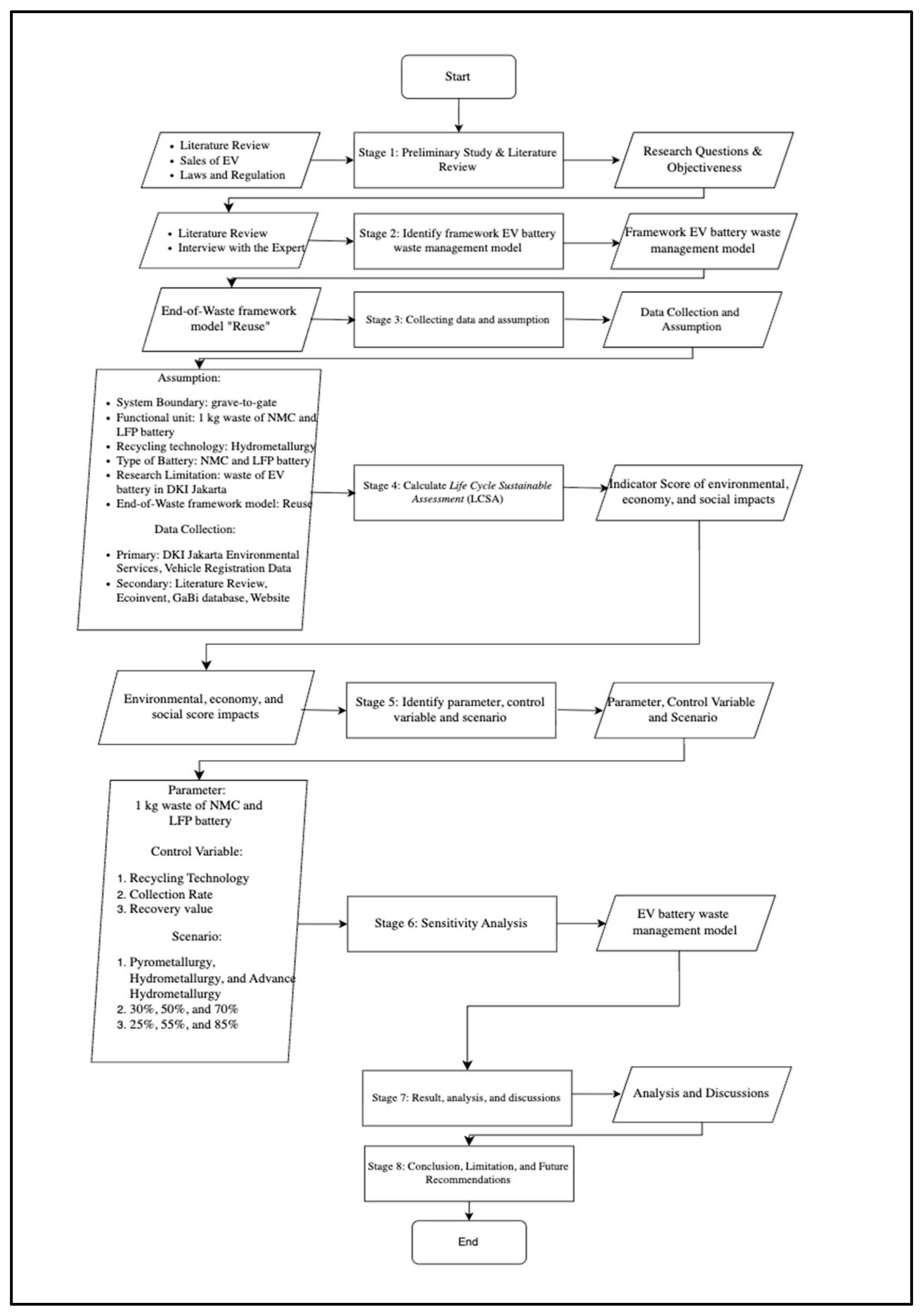
This research follows an eight-stage methodology, as shown in the flowchart in Figure 1. The first stage is a preliminary study and a literature review. The initial phase involves conducting a preliminary survey and reviewing the relevant literature. The initial phase involves a preliminary study and comprehensive analysis of the existing literature to define the research questions, research objectives, the position of this inquiry, and the limitations of this research. The next phase is to identify the framework for the EV battery waste management model, followed by data collection and assumption development. The fourth phase was to calculate the sustainable assessment using the Life Cycle of Sustainable Assessment (LCSA) methods. In this stage, data on environmental, economic, and social impacts are collected using GaBi Education Edition (version 7.3). The fifth phase identifies the parameter, control variable, and scenario. In this phase, the parameter, control variable, and scenario are identified by the literature review and the indicator score. After identifying the parameter, the control variable, and the scenario, we calculate the sensitivity analysis. In this phase, sensitivity analysis is conducted using three control variables and three scenarios. This research seeks to develop an EV battery waste management model based on a sustainable assessment framework from multiple perspectives and to identify key factors influencing it. Following this, the researchers conducted an analysis and presented their findings. In the final stage, the research presents conclusions, identifies limitations, and offers recommendations for future research.
Figure 1.
Flowchart methodology.
2.1. Goal and Scope
The goal and scope of this research are to establish and complete the entire LCI for waste of LFP and NMC batteries, to assess multi-criteria aspects from the environmental, economic, and social aspects in adopting waste management of EV batteries, and to provide a comparative analysis of various battery types and recycling methods within the scope of the DKI Jakarta area.
2.2. System Boundary
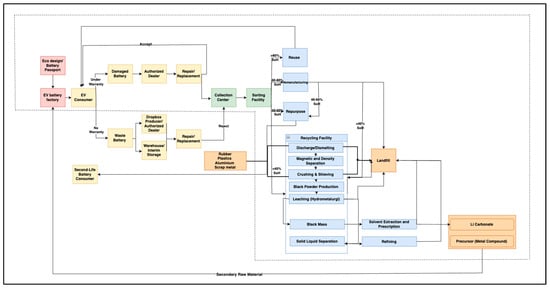
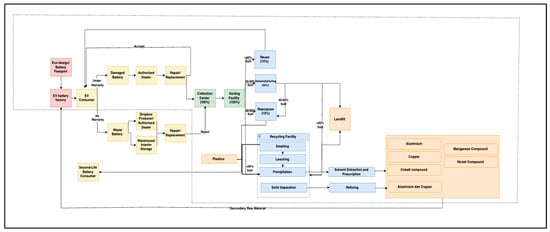
This research uses a system boundary from the grave to the gate. The stages are: first use, disposal after first use, collection point, sorting facility, reuse, remanufacturing, recycling, disposal to landfill, or secondary raw materials. The system boundary does not include mining and manufacturing processes. The system boundary in this research is battery recycling technology using hydrometallurgy, as shown in Figure 2, as the basic scenario for LCSA data processing.
Figure 2.
System boundary EV battery waste management.
2.3. Functional Unit
The functional units in this sustainable assessment are 1 kg of waste from NMC batteries and 1 kg of waste from LFP batteries. NMC batteries have better comprehensive environmental performance than LFP batteries, but their service life is shorter throughout the entire life cycle [43]. The LCSA is a sustainable assessment of environmental, economic, and social perspectives. Functional unit kg of waste of battery, which is often used when the work mainly targets the End of Life recycling context, excluding the use stage. A distance-based functional unit represents the main purpose of a transportation system: to transport people or goods over a certain distance, depending on the battery mass, especially for a cradle-to-grave or cradle-to-cradle system boundary [50]. When determining the reference flow, also consider the battery mass [51]. To ensure comparable results for the environmental, economic, and social impacts of different batteries, this research used data for LCSA calculations, converted to a common functional unit to ensure accurate results.
2.4. End-of-Waste Framework
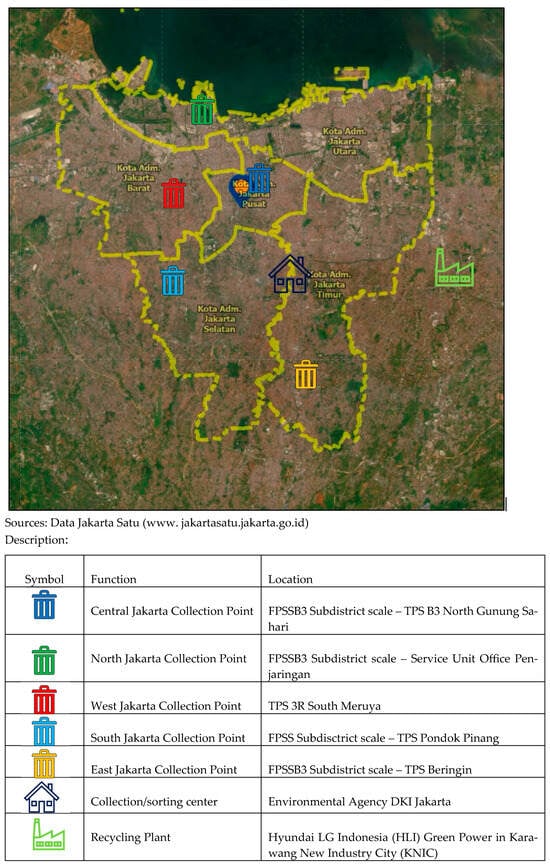
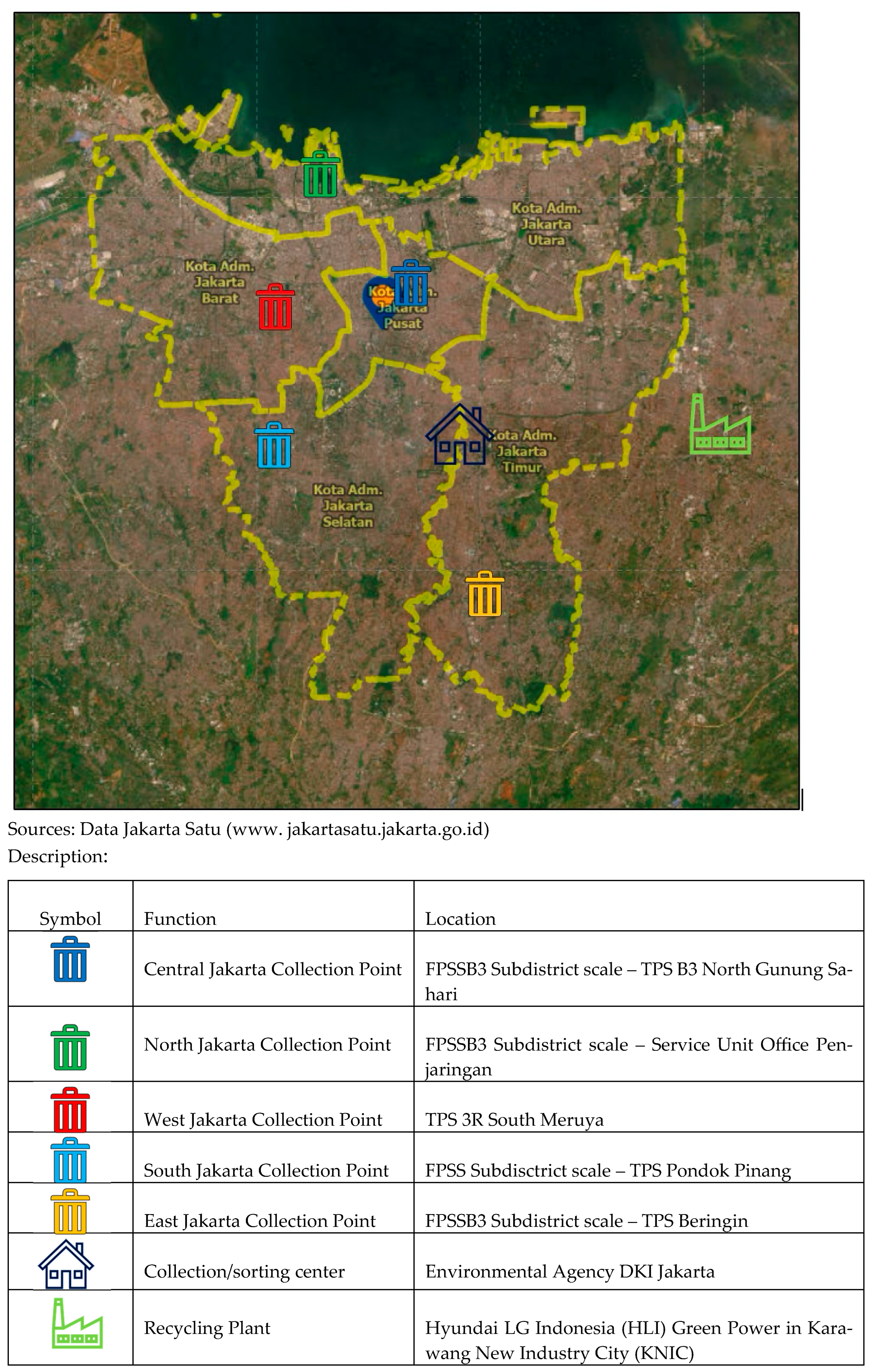
Waste management of EV batteries consists of first use, transportation to the collection point, collection at the collection point, transportation to the collection center/sorting point, reuse, remanufacturing, repurposing, recycling, disposal at the recycling site (landfill), or secondary raw materials. The limitations of battery waste management data in Indonesia, especially the DKI Jakarta area, use secondary data in the form of a literature review, as well as primary data in the form of TPS B3 data in the DKI Jakarta area in the Jakarta Environmental and Cleanliness Information System (SILIKA) as a collection point, and a B3 waste warehouse at the DKI Jakarta DLH office as a collection center/sorting point and a recycling site assumed at PT—Hyundai LG Indonesia (HLI) Green Power in Karawang New Industry (KNIC). The locations of the collection point and the collection center/sorting point for electric vehicle battery waste are shown in Figure 3.
Figure 3.
Location of collection points and collection centers/sorting points for EV battery waste management in DKI Jakarta.
2.5. Life Cycle Inventory (LCI) and Evaluation Methodology
Data for the material flow diagram and cost flow diagram of this study consists of background data and foreground data. The background data were derived from Eco Invent v. 3.8 and the GaBi database. Foreground data for the first phase, reuse, remanufacturing, repurpose, and recycling stages, were derived from relevant literature reviews [43,52,53]. Data on transportation, collection points, and collection center/sorting points were obtained from the Department of Environment DKI Jakarta (DLH DKI Jakarta) website. The extracted data detailed input-output parameters, adhered to the principles of reliability, completeness, and technical representativeness, and ensured data quality [43]. The LCSA processing was performed in GaBi Education Edition. GaBi has powerful computational capabilities and an extensive database, enabling reliable, accurate results [42,54].
In sustainable social impact assessment (S-LCA), indicator selection is carefully carried out, as social impacts are shaped by human behavior, institutional context, and perspectives, making measurement more qualitative. One globally recognized standard is ISO 14075:2024, the Principles and Framework for Environmental and Social Life Cycle Assessment. The indicator structure of the Product Social Impact Life Cycle Assessment (PSILCA) aligns with ISO 14075 and supports Sustainable Product Documents (SPDs). This system is designed with Product Category Rules (PCRs) that govern SPD disclosures and is aligned with UNEP. The PSILCA database for S-LCA has been developed, with substantial improvements in quality, methodology, and user support. PSILCA database classification into two distinct entities: industries and commodities. PSILCA compiles indicators based on six stakeholder groups: workers, local communities, society, value chain actors, children, and consumers. The child and consumer stakeholder indicators are considered to support more accurate impact modeling across various life-cycle stages and are consistent with the requirements of ISO 14075 [55]. Six stakeholder groups were divided into eight social risk indicators: actual women employment, child labor, discrimination in job access, forced labor, hazardous child labor, no collective bargaining, no right organization, and unequal remuneration. All social indicators use the “informal sectors” classification database. In Indonesia, the recycling market is involved in the informal sector [56]. S-LCA indicators calculated with the Social Hotspot Database (SHDB) methodology use two types of Assessment, namely performance assessment (type 1) and causal chain modeling (type 2), by choosing the type 2 method to understand the magnitude and significance of the data collected during the inventory phase and to isolate the causal chain. By considering the risk characteristics across the database, weighting represents the relative probability of a moderate risk [55]. The weightings for the SHDB method’s impact assessment are shown in Table 2.
Table 2.
Impact assessment SHDB method.
Weighting can increase or decrease the number of hours worked. The SHDB research method is modified to meet specific needs. For example, practitioners include certain low-risk country sectors that result in zero assessments in their S-LCA data processing [57]. This research uses the type 2 method to assess social impacts, using the impact indicators in PSILCA.
2.6. Basic Assumptions and Scenario
Due to the complexity of the End-of-Waste framework model for EV battery waste management, to reflect the actual model and eliminate the external factors, the following assumptions and scenarios are made:
- The type of waste from EV batteries is LFP and NMC. In Indonesia, the market share of battery types is dominated by LFP and NMC batteries. LFP batteries are used by manufacturers such as Wuling, BYD, and Cherry in China. Meanwhile, NMC batteries are used by manufacturers such as Hyundai, Kia, and BMW in Korea and Europe [4].
- The type of recycling technology is hydrometallurgy. The hydrometallurgical recycling process is recommended for recycling waste from EV batteries due to its superior environmental performance compared to pyrometallurgy and direct physical recycling [43]. Waste of NMC and LFP batteries with hydrometallurgy recycling technology used as a baseline scenario for calculation.
- The limitation of research is the waste of EV batteries in DKI Jakarta. Collection point located in TPS B3 data from Jakarta Environmental and Cleanliness Information System (SILIKA) with a 25 km radius from the collecting center/sorting with five sub-districts: north, south, east, west, and central DKI Jakarta. The location of the collecting center/sorting facility is the Department of Environmental DKI Jakarta in Kramat Jati, East Jakarta, with 40 km to the recycling facility at PT—Hyundai LG Indonesia (HLI) Green Power in Karawang New Industry (KNIC).
- The transportation that is used to deliver the waste of EV battery from the collection point to the collection center/sorting facility is GLO: Truck, Euro 3 5–10 t gross weight, and deliver the waste of EV battery from the collection center/sorting facility is GLO: Truck, Euro 3 12–14 t gross/weight with type of fuel DE: Diesel mix at refinery ts from GaBi database.
- Electricity using DE: electricity grid mix t3 ts, with electricity prices based on the PLN website https://web.pln.co.id/media/2025/12/tarif-listrik (accessed on 18 December 2025).
- The End-of-Waste framework model Reuse (Figure 2) consists of the following phases: first, reuse; second, remanufacturing; third, repurposing; and fourth, recycling. Because of limited data availability, primarily from recycling and battery manufacturing, material flow analysis is based on literature reviews [43,52,53], and cost flows from online marketplaces and the mineral commodity price website https://www.lme.com/.
- Social indicator score based on the PSILCA database [55] classification of industries into “informal sectors,” calculated using the Social Hotspot Database (SHDB) methodology with an empirical approach.
2.7. Life Cycle Impact Assessment
This study uses CML 2016 with 11 midpoint impact categories for environmental impacts, namely abiotic depletion (elemental and fossil ADP), acidification potential (AP), eutrophication potential (EP), freshwater ecotoxicity potential (FAETP inf.), global warming potential (100-year GWP, excluding biogenic carbon), human toxicity potential (HTP inf.), marine ecotoxicity potential (MAETP inf.), ozone layer depletion potential (ODP, steady state), photochemical ozone formation potential (POCP), and terrestrial ecotoxicity potential (TETP inf.). For economic impacts, the total cost comprises cycle, machine, and personnel costs. Meanwhile, the social impacts consist of quality working time standards (QWT) consisting of GaBi Quality Level (GQL), occupational health and safety standards (HSWT) consisting of unhealthy working conditions, and human and working conditions standards (HWT) consisting of 7 social midpoint impacts, namely actual women’s work, employing children, discrimination in access to employment, forced labor, hazardous child labor, no collective bargaining, no right to organize and unequal remuneration.
2.8. Sensitivity Analysis
This model uses assumptions based on the baseline scenario, namely NMC and LFP batteries with hydrometallurgical recycling. To address the uncertainty in the assumptions and their impacts, a sensitivity analysis is conducted. The research also evaluates the collection rate, the recovery value (calculated as revenue from secondary raw materials), and the recycling method across three scenarios. Table 3 summarizes sensitivity analysis variables.
Table 3.
Variable for sensitivity analysis.
The baseline scenario used in the sensitivity analysis is NMC and LFP batteries, with hydrometallurgical recycling technology, a 30% waste collection rate, and 85% recovery value (secondary raw materials from battery waste recycling) [42]. In the sensitivity analysis, the recovery value is compared with other scenarios (worst and best) [42]. For the recycling technology sensitivity analysis, three scenarios are used: Scenario 1 with pyrometallurgical recycling technology (Figure 4), Scenario 2 (baseline) with hydrometallurgical recycling technology (Figure 2), and Scenario 3 with advanced hydrometallurgical recycling technology (Figure 5) [53].
Figure 4.
Scenario recycling technology pyrometallurgy.
Figure 5.
Scenario recycling technology advanced hydrometallurgy.
3. Results
3.1. Life Cycle Sustainability Assessment (LCSA)
The End-of-Waste “Reuse” framework model will then undergo a Life Cycle Sustainability Assessment (LCSA). LCSA data processing is carried out using GaBi education, with Life Cycle Impact Assessment (LCIA) Summary 2012, Global Thinkstep CML 2016, CML 2001–Jan 2016, etc. Biogenic carbon (global equivalent weighted).
3.1.1. Life Cycle Assessment (LCA)
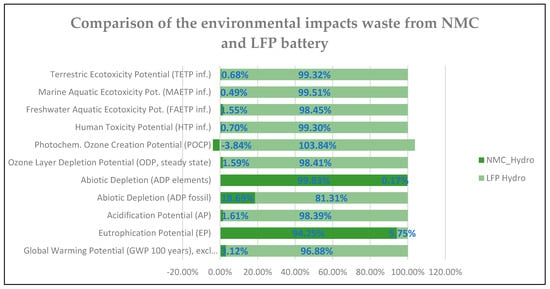
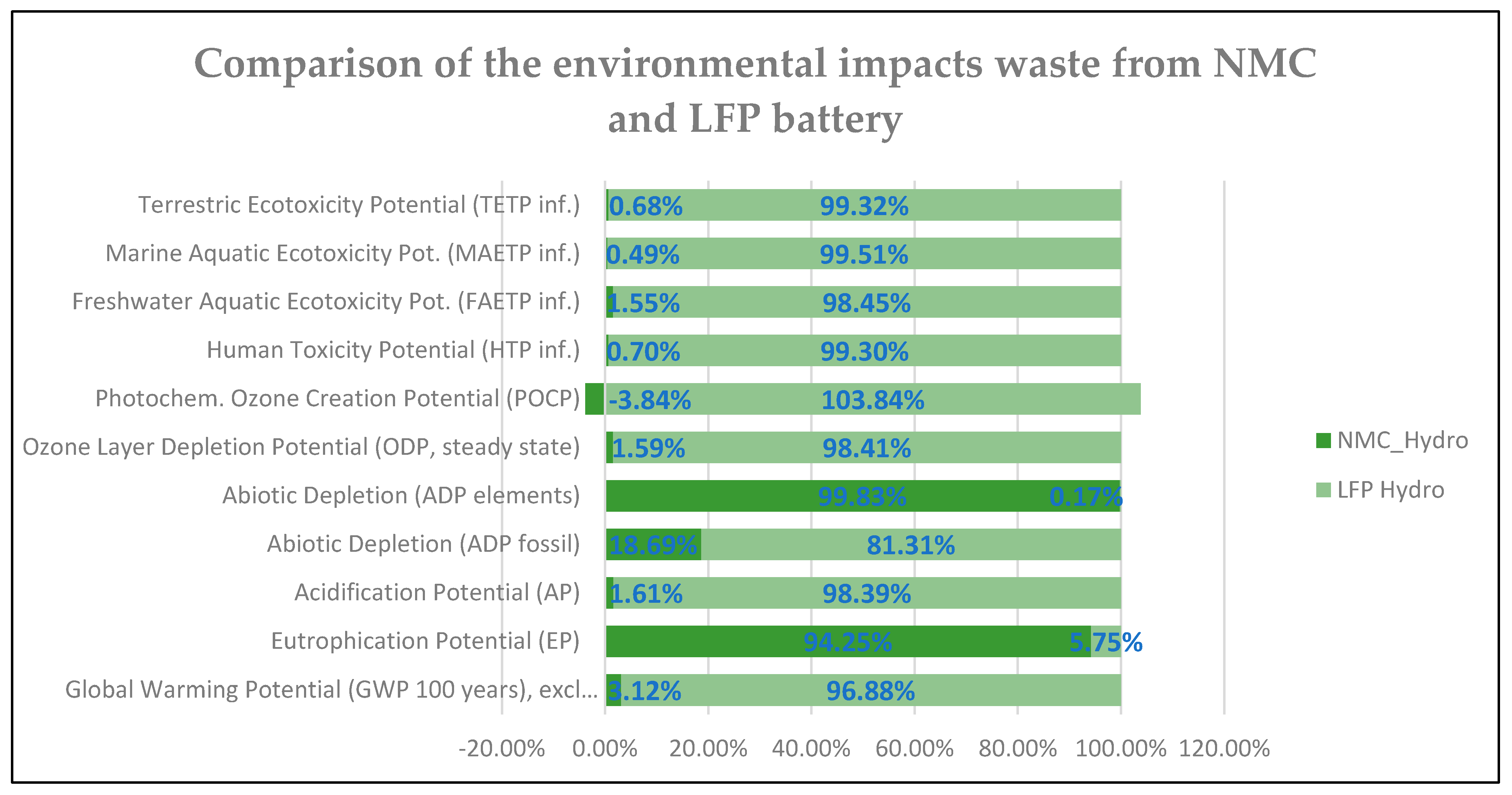
The processing of environmental perspective or life cycle assessment (LCA) data uses LCIA CML 2016 with 11 midpoint impact categories for environmental impacts, namely Abiotic Depletion Potential (elements and fossil ADP), Acidification Potential (AP), Eutrophication Potential (EP), Freshwater Ecotoxicity Potential (FAETP inf.), Global Warming Potential (GWP 100 years, excluding biogenic carbon), Human Toxicity Potential (HTP inf.), Marine Ecotoxicity Potential (MAETP inf.), Ozone Layer Depletion Potential (ODP, steady state), Photochemical Ozone Formation Potential (POCP), and Terrestrial Ecotoxicity Potential (TETP inf.). LCA data processing is carried out using NMC and LFP battery scenarios with a hydrometallurgical battery recycling process. Comparison of all midpoint impact categories for the environmental impact of NMC and LFP batteries in the hydrometallurgy scenario, shown in Figure 6.
Figure 6.
Comparison of the environmental impacts of waste from NMC and LFP batteries in the hydrometallurgy scenario.
Sustainable assessment for environmental impacts or LCA results using the hydrometallurgical recycling technology scenario, NMC batteries have a smaller environmental impact than LFP batteries in the categories of Abiotic Depletion Potential (elements and fossil ADP), Acidification Potential (AP), Freshwater Ecotoxicity Potential (FAETP inf.), Global Warming Potential (100-year GWP, excluding biogenic carbon), Human Toxicity Potential (HTP inf.), Marine Ecotoxicity Potential (MAETP inf.), Ozone Layer Depletion Potential (ODP, steady state), Photochemical Ozone Formation Potential (POCP), and Terrestrial Ecotoxicity Potential (TETP inf.). Meanwhile, the Eutrophication Potential (EP) impact category shows that LFP batteries have a smaller environmental impact than NMC batteries. The results support data from [43,44], indicating that waste from NMC batteries has better environmental performance than that from LFP batteries for EV battery waste management in China. EV battery waste management also use waste of NMC battery with variant cathode material composition with hydrometallurgy recycling technology in EUA [39], China [41], also North America, Europe, and China [40] Waste of NMC Based on the results, policy implications in Indonesia should focus on processing EV battery waste through recycling technologies, such as hydrometallurgy, especially the secondary raw material nickel, as Indonesia is the second-largest nickel producer globally. Also, get more incentives for EVs with NMC batteries.
3.1.2. Life Cycle Costing (LCC)
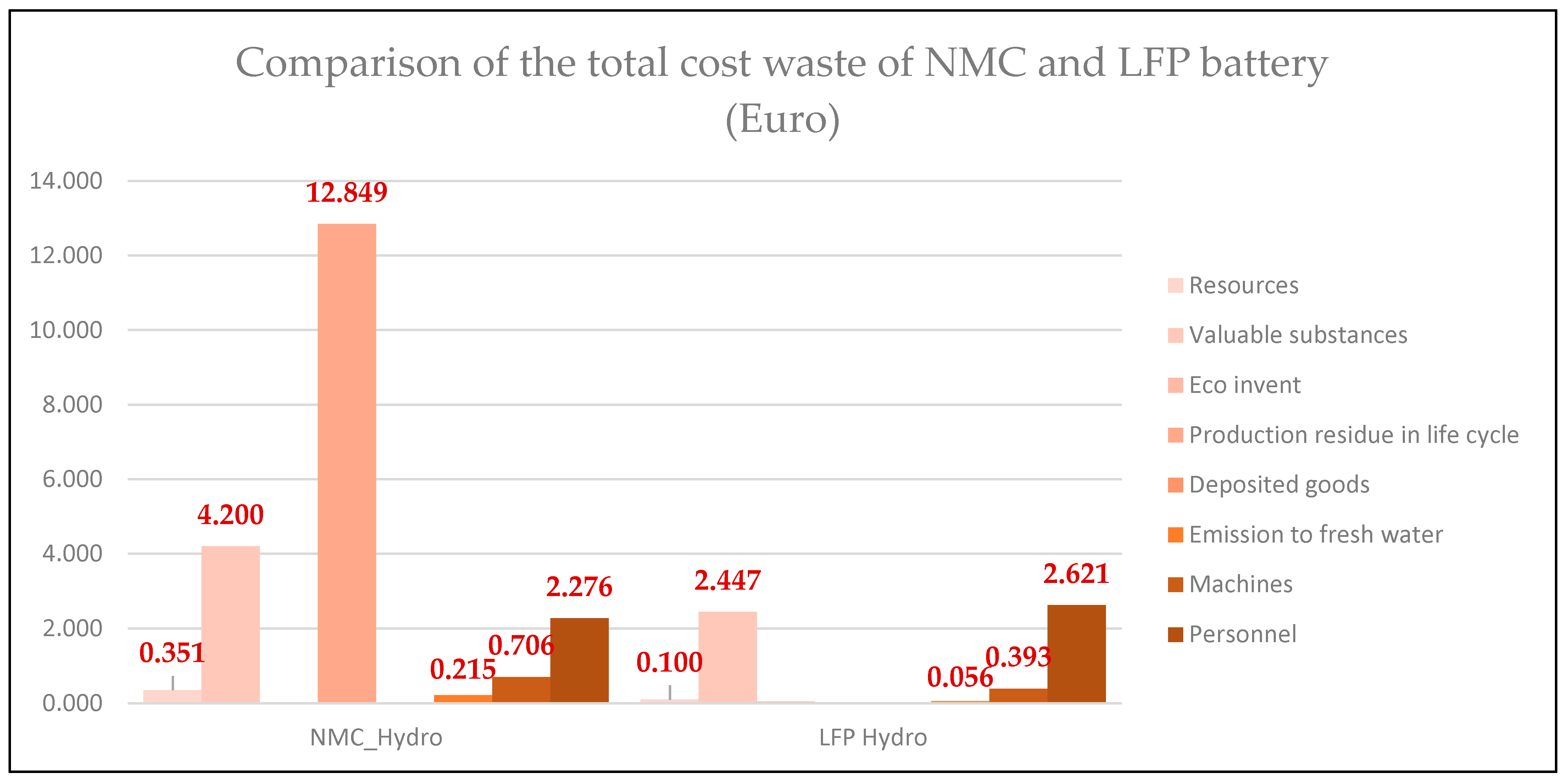
The economic impact is the total cost, comprising cycle, machine, and personnel costs. The sustainable assessment of the economic perspective (LCC) for NMC and LFP batteries for battery recycling technology in a hydrometallurgical scenario is shown in Figure 7. In the hydrometallurgical scenario for EV battery waste management, the total cost of NMC batteries is €20,615, compared to € 5665 for LFP batteries. The high total cost of NMC batteries is due to the cost of production residues. In the hydrometallurgical scenario, NMC batteries are not directly burned; instead, they form residues that can be reprocessed into secondary raw materials [57].
Figure 7.
Comparison of the total cost waste of NMC and LFP batteries in the hydrometallurgy scenario (Euro).
3.1.3. Social Life Cycle Assessment (S-LCA)
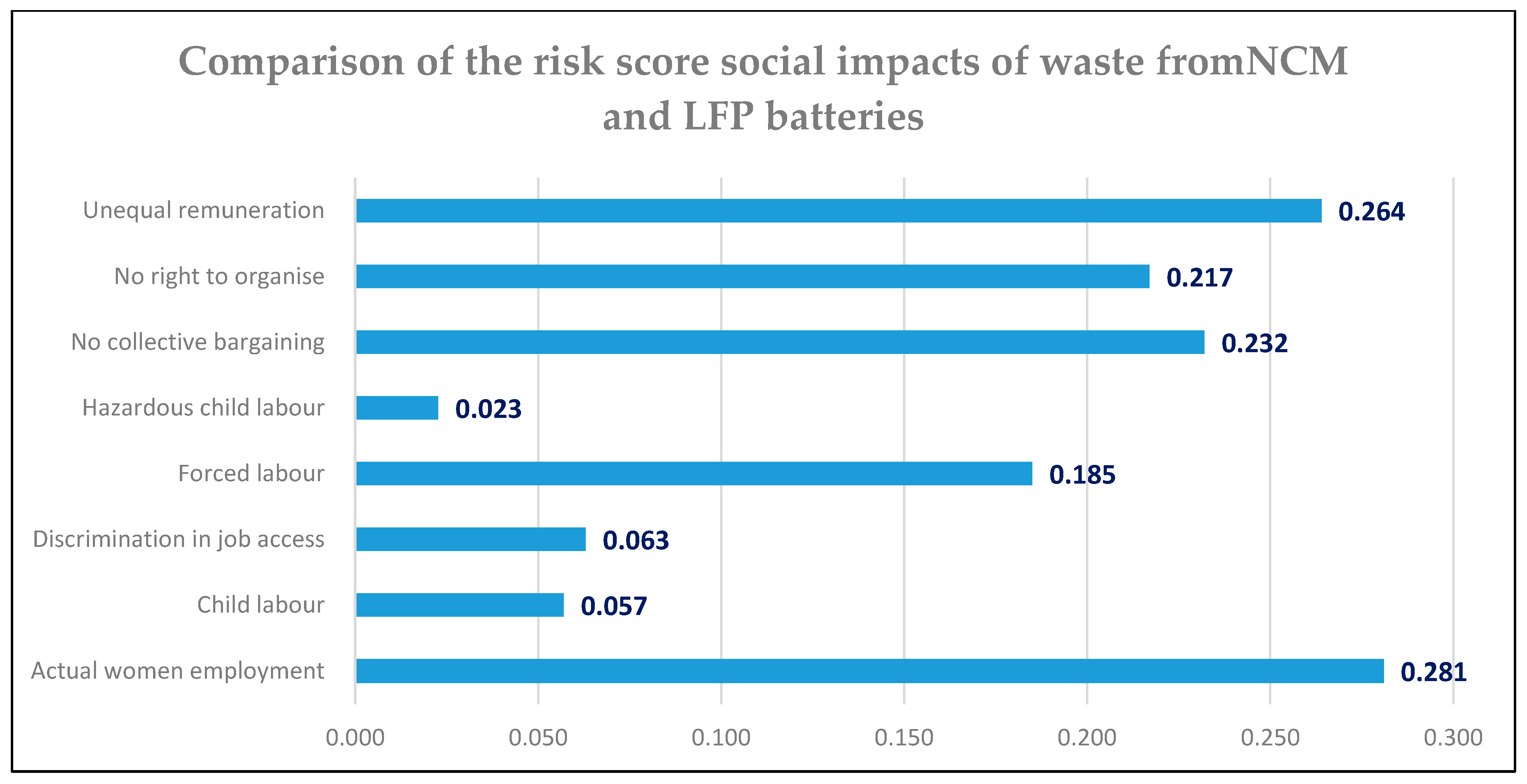
In Sustainable Assessment for Social Perspective (S-LCA), there are eight categories of social impact midpoints: actual female employment, child employment, discrimination in access to employment, forced labor, hazardous child labor, lack of collective bargaining, lack of the right to organize, and unequal remuneration. Calculating the social perspective (S-LCA) in the EV battery waste management model to the phase where human contribution is involved in the collection point, collection center, reuse, remanufacturing, repurposing, dismantling, and recycling phase. In the S-LCA data processing, there is only one similar result for the NMC and LFP batteries. The comparison of risk scores for S-LCA impact indicators is shown in Figure 8.
Figure 8.
Comparison of the risk score of the social impacts of waste from NMC and LFP battery.
The S-LCA risk score indicates that actual female employment in Indonesia, particularly in the waste management sector, is at very high risk, with a score of 0.281. The Unequal Remuneration risk score is 0.264, a very high risk. The risk score for the No Collective Bargaining indicator is 0.232, influenced by the disparity between the number of companies with a Collective Bargaining Agreement (PKB) and the total number of registered companies [58]. The risk score for the lack of right to organize is 0.217, indicating that workers lack effective access to these rights and are often exposed to unfair treatment. The risk of forced labor is 0.186, a high-risk score. Meanwhile, for indicators of child employment, discrimination in access to employment and hazardous child labor have a low risk. The S-LCA impact indicator’s risk score shows better performance in relation to “value chain actors’ relationship” [59], leading to better decision-making and the development of more sustainable waste management strategies [46].
3.2. Sensitivity Analysis Results
Three scenarios and three control variables are used in the Sensitivity analysis: battery recycling technology, waste collection rate, and the recovery value of NMC- and LFP-type electric vehicle battery waste.
3.2.1. Battery Recycling Technology
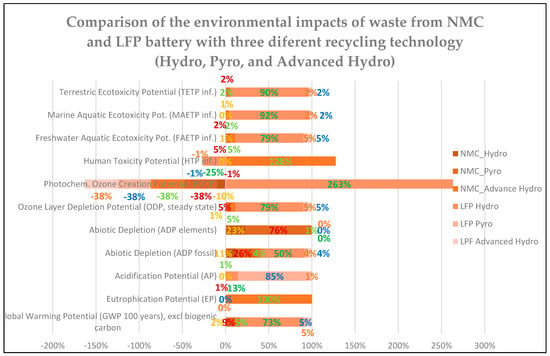
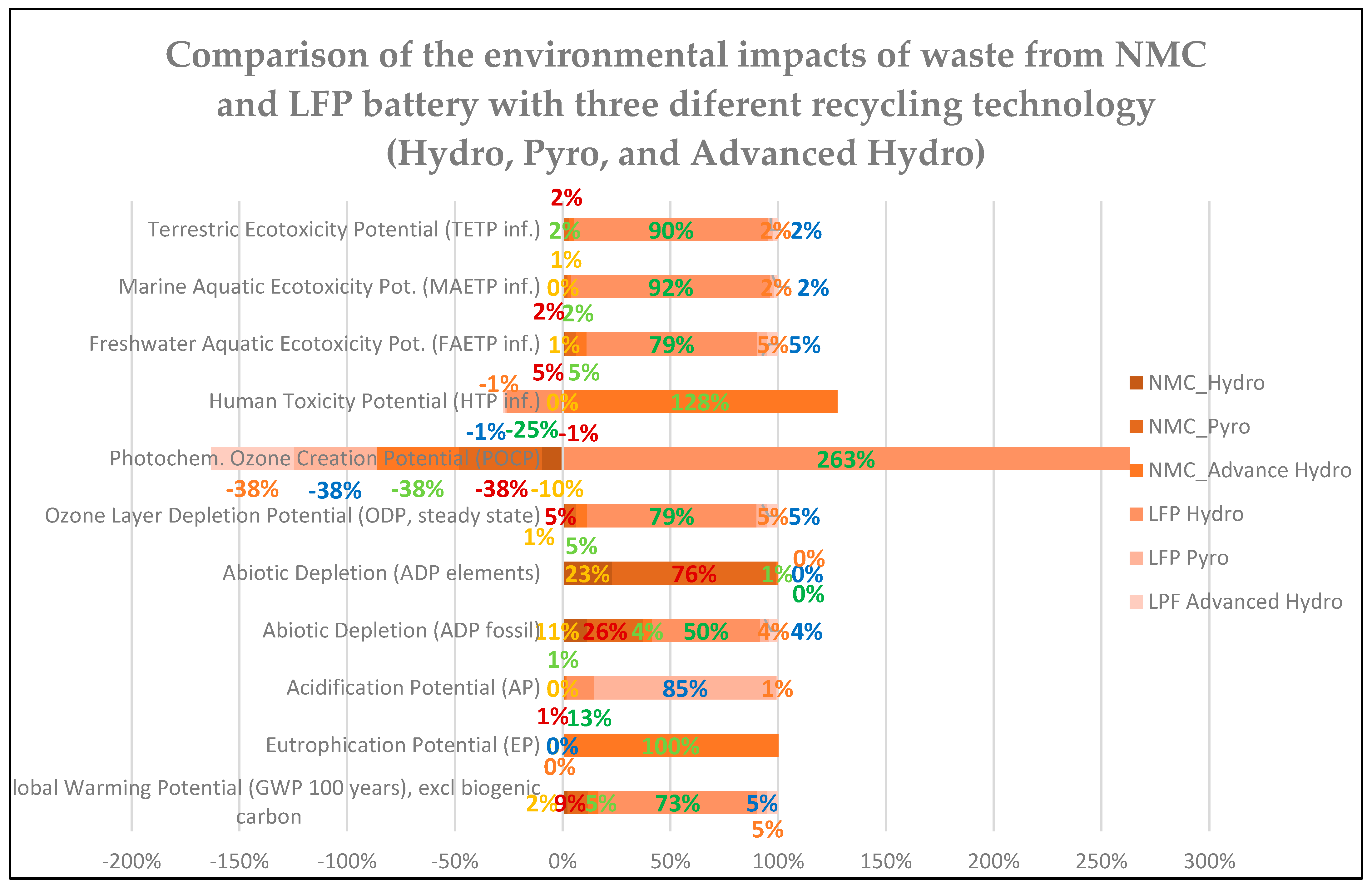
EV battery recycling technology for NMC and LFP types uses three scenarios: pyrometallurgy (scenario 1), hydrometallurgy (scenario 2), and advanced hydrometallurgy (scenario 3). This study assesses the sustainability multi-perspective for environmental impacts (LCA) of NMC and LFP battery waste across 11 midpoint environmental impact categories. It compares these categories among three battery recycling technology scenarios, as shown in Figure 9.
Figure 9.
Comparison of the environmental impacts of waste from NMC and LFP batteries with three different technologies (hydrometallurgy, pyrometallurgy, and advanced hydrometallurgy).
Based on the sensitivity analysis results for battery recycling technology scenarios, waste from NMC batteries in the hydrometallurgical scenario has the lowest environmental impact, followed by that in the advanced hydrometallurgical scenario. Meanwhile, LFP batteries in the hydrometallurgical scenario have the highest environmental impact. The waste from NMC batteries has the smallest environmental impacts in terms of global warming potential (GWP), acidification potential (AP), ozone layer depletion potential (ODP), freshwater aquatic ecotoxicity (FAETP), marine aquatic ecotoxicity potential (MAETP), and terrestrial ecotoxicity potential (TETP).
3.2.2. Waste Collection Rate
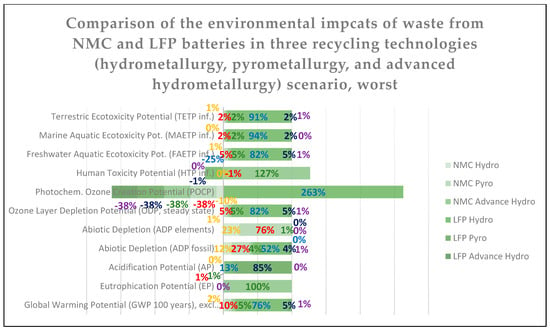
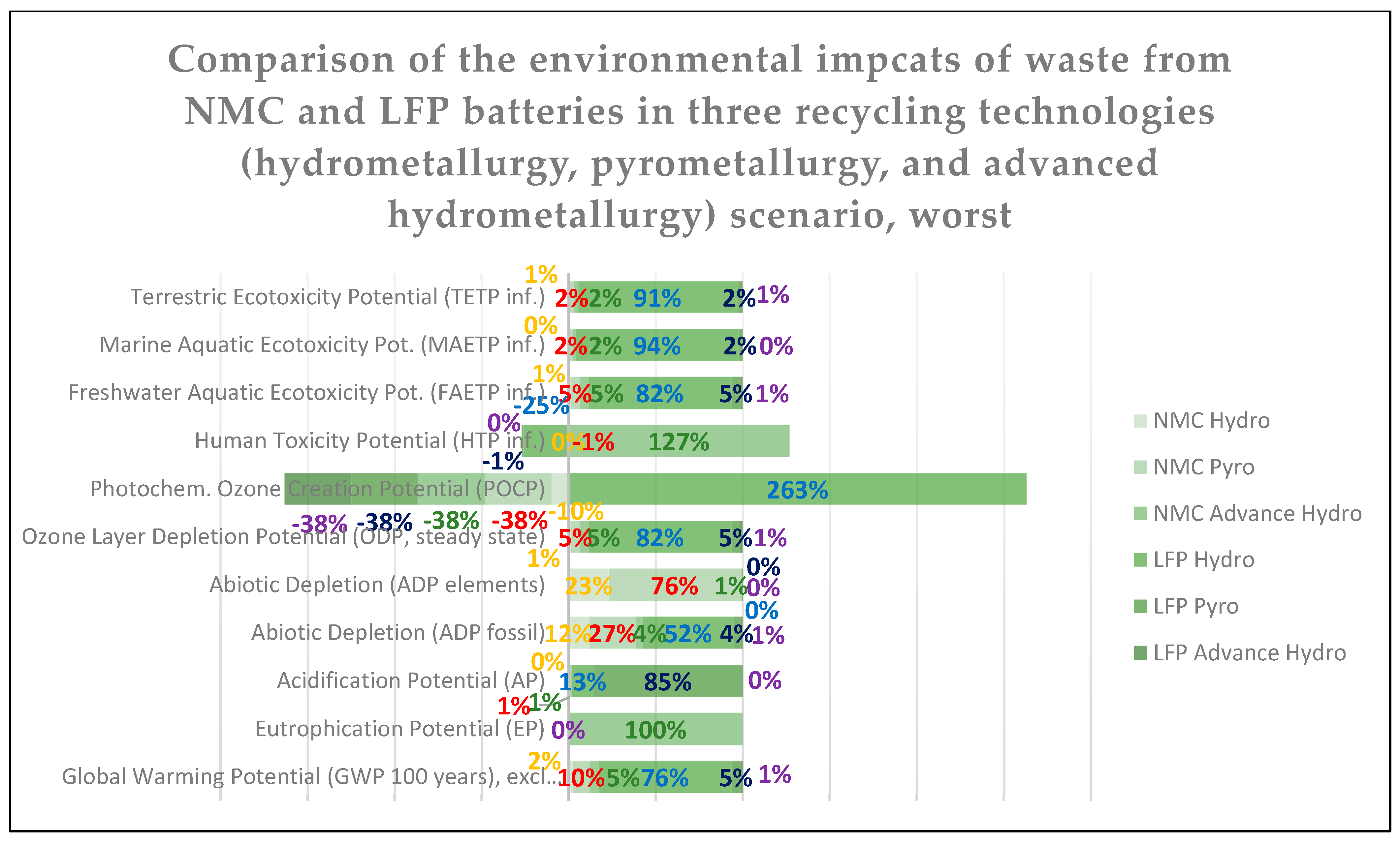
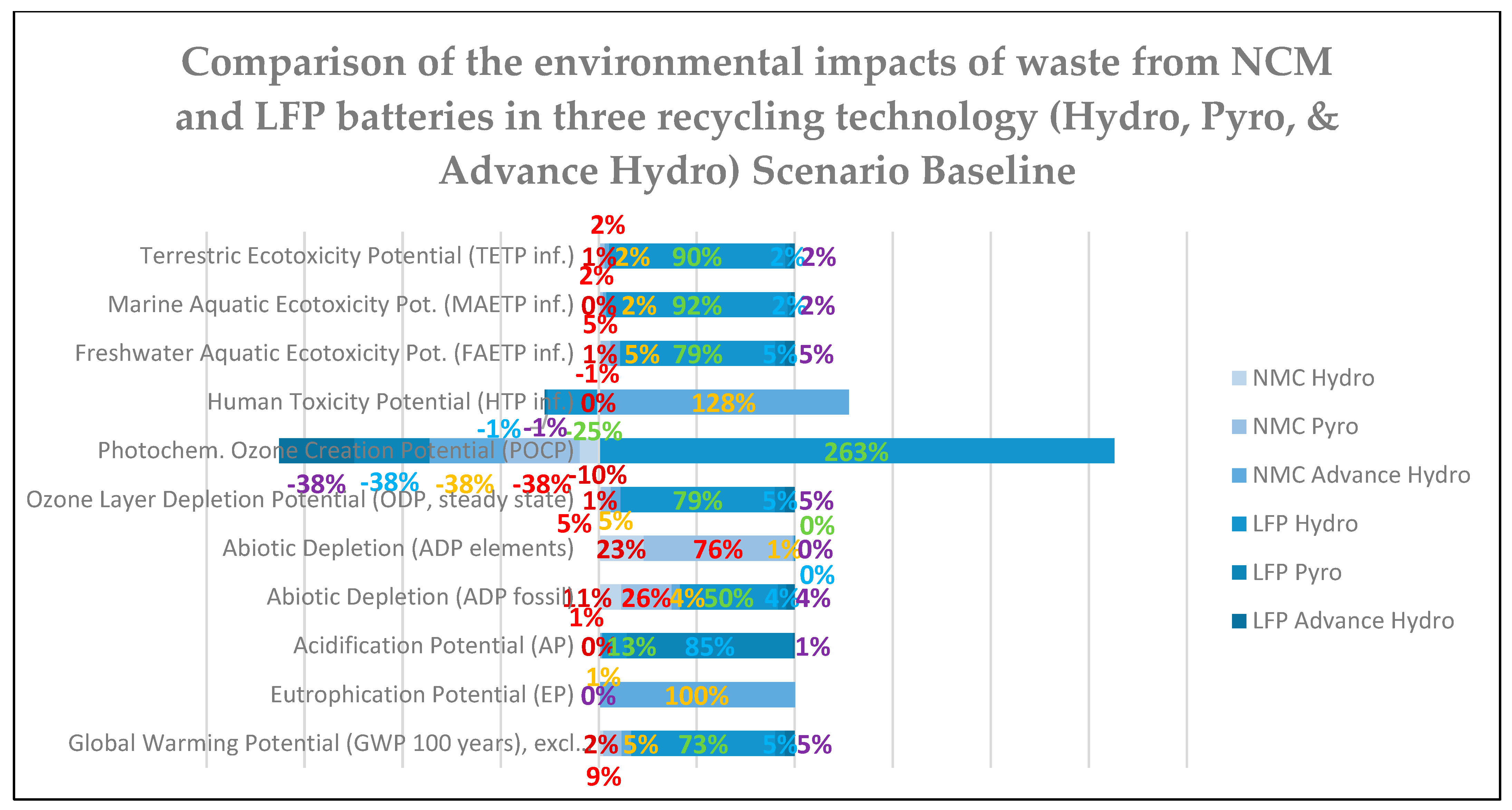
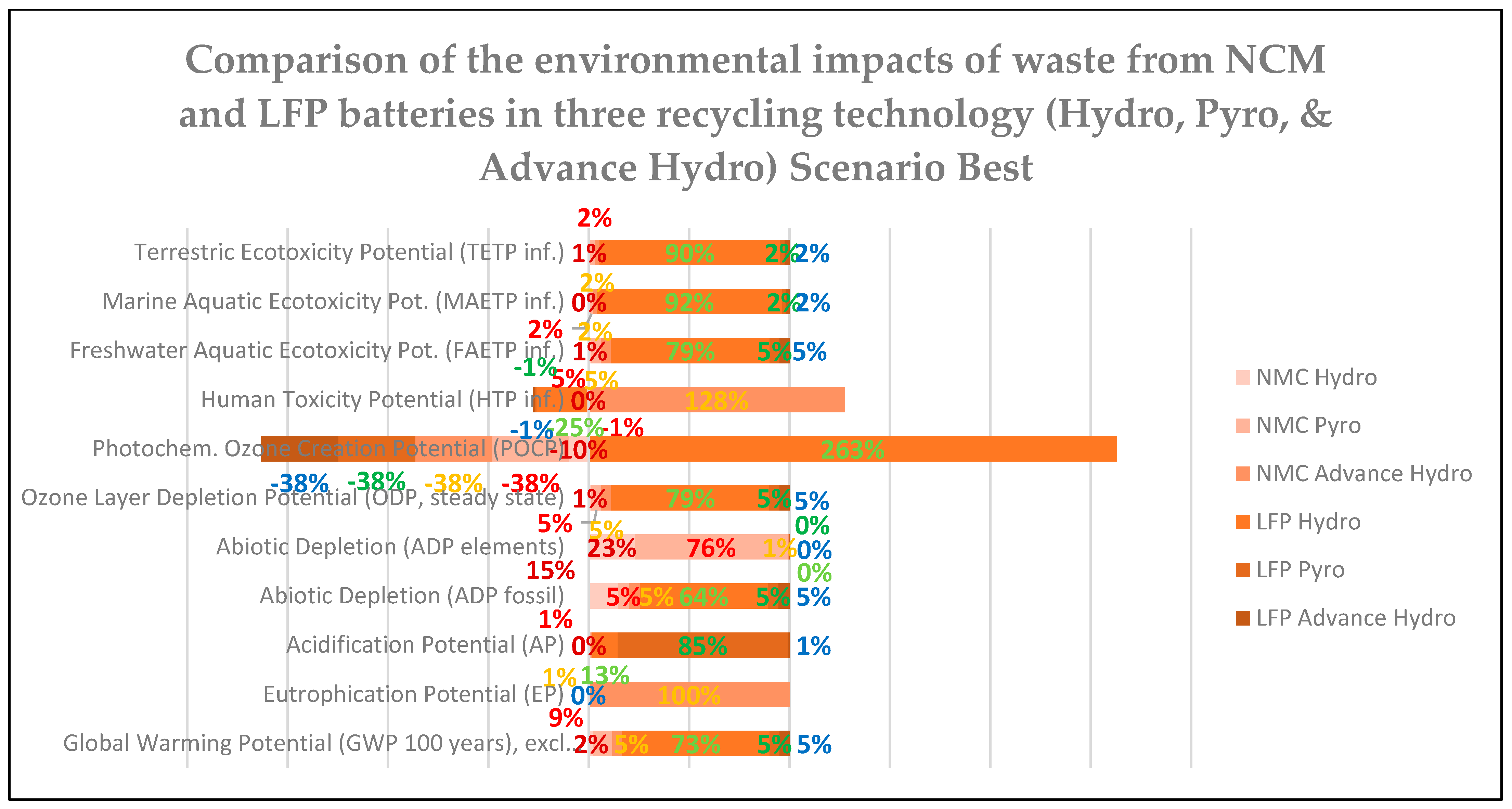
At the level of waste collection, the scenarios are divided into three: worst 30% (1.893 tons) (Figure 10), baseline 50% (3.155 tons) (Figure 11), and best 70% (4.417 tons) (Figure 12). Based on the sensitivity analysis of waste collection levels, the NMC battery in the advanced hydrometallurgy and hydrometallurgy scenario with a 30% collection level (scenario worst) has the smallest environmental impact among all recycling technology scenarios, battery types, and collection rates for almost all environmental impact categories except eutrophication potential (EP) and human toxicity potential (HTP) impacts. Meanwhile, the LFP battery in the hydrometallurgical scenario, with a 70% collection rate (the best-case scenario), has the highest environmental impact.
Figure 10.
Comparison of the environmental impacts of waste from NMC and LFP batteries in three recycling technologies (hydrometallurgy, pyrometallurgy, and advanced hydrometallurgy) scenario, worst.
Figure 11.
Comparison of the environmental impacts of waste from NMC and LFP batteries across three recycling technologies (hydrometallurgy, pyrometallurgy, and advanced hydrometallurgy) in the baseline scenario.
Figure 12.
Comparison of the environmental impacts of waste from NMC and LFP batteries in three recycling technologies (hydrometallurgy, pyrometallurgy, and advanced hydrometallurgy) scenario, Best.
3.2.3. Recovery Value
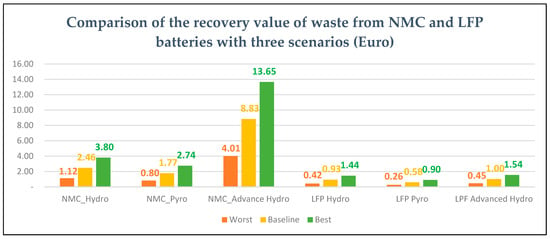
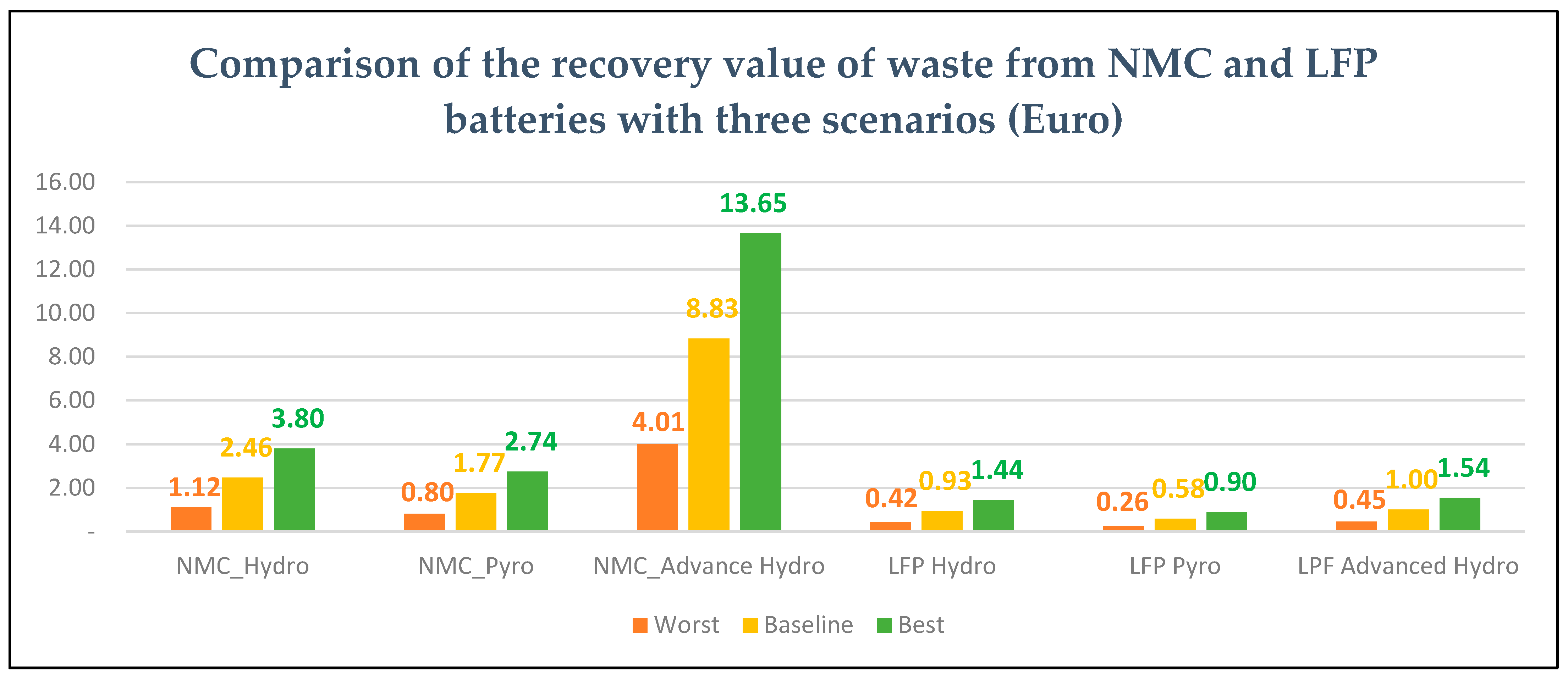
A sensitivity analysis of the recovery value for EV battery waste management used three recovery value scenarios based on the total revenue generated from the sale of secondary raw materials generated from battery recycling: scenario worst—25% recovery rate, scenario baseline—55% recovery rate, and scenario best—85% recovery rate, with the results shown in Figure 13.
Figure 13.
Comparison of the recovery value of waste from NMC and LFP batteries with three scenarios (Euro).
Based on the sensitivity analysis of the recovery value scenarios, comparing the total revenue obtained from the recovery value results based on the three scenarios, it was found that the waste of NMC battery in advanced hydrometallurgical scenario with a recovery rate of scenario best (85%) had the highest profit, followed by the NMC battery in the hydrometallurgical scenario with a recovery rate of scenario best (85%). Meanwhile, the LFP battery in the pyrometallurgy scenario, with a 25% recovery rate (the worst-case scenario), had the lowest profit.
Sensitivity analysis between three control variables and three scenarios with parameter waste of NMC and LFP battery and hydrometallurgy recycling technology above, it was found that the NMC battery waste management model with hydrometallurgical recycling technology, with a battery waste collection rate of 30% and a recovery value of 85%, has the lowest environmental impact categories and highest profit. These results consider sustainable assessment with environmental, economic, and social perspectives, combined with Multi-Criteria Decision Analysis (MCDA) and trade-off analysis. This EV battery waste management model is expected to serve as input for stakeholders in developing sustainable EV battery waste management from upstream to downstream, in line with the CE principle. The detailed results for environmental impacts, cost and economic impacts, and social impacts, as well as a comparison of the environmental impacts of recycling technology, collection rate, and recovery value, can be seen in Appendix A.
4. Discussion
Sustainable assessment of EV battery waste management is already being conducted extensively from environmental and economic perspectives. The assessment of EV battery waste management from an environmental perspective [39,40,43,44,45], and from a combined environmental and economic perspective [41,42], but not yet from a social perspective. A social assessment perspective is needed in relation to “value chain actors’ [59], leading to better decision-making and the development of sustainable waste management strategies [46]. So, needed the study to assess sustainability from multiple environmental, economic, and social perspectives.
This study assesses the sustainability of EV battery waste management from environmental, economic, and social perspectives in developing countries such as Indonesia, particularly in DKI Jakarta. The sustainable assessment of waste from NMC and LFP batteries using the End-of-Waste framework model, Reuse with recycling technology, hydrometallurgy, and a system boundary from grave to gate. The environmental impact perspective, or LCA, shows that waste from NMC batteries has a smaller environmental impact than that from LFP batteries [42,43,44]. This is the basis for the proposed use of hydrometallurgical battery recycling technology and NMC batteries as an EV battery waste management model in Indonesia, utilizing secondary raw materials as inputs in the battery production process, as Indonesia is the world’s 2nd-largest nickel producer.
Sustainable assessment from an economic perspective or LCC for EV battery waste management, the total cost of NMC batteries is greater than the total cost of LFP batteries. The high total cost of NMC batteries is due to production residues. In the hydrometallurgical scenario, NMC batteries are not directly burned; instead, they form residues that can be reprocessed into secondary raw materials. LFP batteries have lower economic value than NMC batteries and other battery cathodes, because they contain lower levels of high-value metals [41]. Higher energy density is associated with higher overall cost, due to the higher material costs, and the waste from LFP batteries offers cost advantages [60].
The Sustainable Assessment for Social aspects (S-LCA) risk score indicates that actual female employment in Indonesia, particularly in the waste management sector, is at very high risk, with a score of 0.281. As of August 2024, female workers accounted for only 17% of the workforce, compared to 83% of male workers [61]. The Unequal Remuneration risk score of 0.264 indicates that, according to Statistics Indonesia (BPS), the average income of women in the waste management sector was Rp 1,138,959. In contrast, the average income of men in the waste management sector was Rp 2,616,843, corresponding to a very high-risk score [62,63].
S-LCA risk score for the No Collective Bargaining indicator is 0.232, influenced by the disparity in the number of companies with a Collective Bargaining Agreement (PKB) compared to the total output of registered companies. Based on One Data from the Ministry of Manpower Indonesia and BPS in 2024–2025, with a total of registered companies (WLKP) of 3,651,941 companies, while companies that have Collective Labor Agreements (PKB) are 16,078 companies or only 0.44%, with a high-risk score [58]. Indonesia’s status refers to global standards consistently at a rating of 5, which means “No guarantee of rights”, even though written laws exist, workers do not have effective access to these rights and are often exposed to unfair and high-risk poaching practices [64]. According to data [64], the level of vulnerability to modern slavery in Indonesia is 49%, and it has a high risk. Meanwhile, for indicators of child employment, discrimination in access to employment and hazardous child labor have a low risk.
Sensitivity analysis conducted using three scenarios and three control variables, with parameter waste of NMC and LFP battery. Three control variables are battery recycling technology, waste collection rate, and the recovery value of NMC- and LFP-type EV battery waste. Sensitivity analysis of recycling technology shows that the hydrometallurgical scenario with waste from NMC batteries has the lowest environmental impact, followed by the advanced hydrometallurgical scenario. In waste collection levels, waste from NMC batteries in the hydrometallurgical and advanced hydrometallurgy scenarios at 30% collection has the smallest environmental impact. The waste from NMC batteries in the advanced hydrometallurgical scenario, with an 85% recovery rate, yielded the highest profit. This result Ref. [53], as shown in Ref. [53], supports the view that the highest benefits are achieved through advanced hydrometallurgical processing for NMC and NCA lithium batteries, with the recovery of cobalt and nickel as a major factor. In LFP batteries, recycling performance is often neglected due to resource depletion; recycling battery cells can reduce the “net impact” on the battery. The battery recovery process is not always environmentally friendly, especially in hydrometallurgical recycling, depending on the chemistry of the battery cells. The lowest collection rate yields the smallest environmental impact, while the highest recovery value yields the highest profit.
In Indonesia, according to Presidential Regulation 55/2019 [2], BEV industries and/or domestic BEV component industries must obtain a permit to manage battery waste, issued under a license in accordance with statutory regulations on waste management. This regulation is related to the Ministry of Industry Regulation 6/2022 [65] on the target for the battery reuse and recycling industry by 2030. Currently, Indonesia does not yet have a specific regulation for EV battery waste management [66], and it is classified as general hazardous waste [67]. The results of the EV battery waste management model will be recommended to stakeholders to inform the development of policies and regulations on EV battery waste management in Indonesia.
The calculation about sustainable assessment from multiple perspectives: environmental, economic, and social aspects have limitations due to data restrictions because of the unavailability of primary data, data assumption scenarios, and constraints used in the calculation. The limitation will affect the model’s deployment in a real-world case. The secondary data or literature review to be used may affect the case study’s impact on EV battery waste in Indonesia. The research has a limited scope focused on the DKI Jakarta region; this may affect the collection point and collection rate because not every region in Indonesia has a designated location for the disposal of hazardous and toxic waste materials (TPS–B3).
5. Conclusions
Based on Life Cycle Sustainable Assessment (LCSA) of two types waste of EV battery NMC and LFP batteries, using the baseline scenario of hydrometallurgical recycling technology, the environmental impact assessment (LCA) results show that out of 11 environmental impact categories, NMC batteries have lower environmental impacts than LFP batteries in the following categories: potential abiotic depletion (elements and fossil of ADP), Acidification Potential (AP), Freshwater Aquatic Ecotoxicity Potential (FAETP inf.), Global Warning Potential (GWP), Human Toxicity Potential (HTP inf.), Marine Aquatic Ecotoxicity Potential (MAETP inf.), Ozone Layer Depletion Potential (ODP, ready state), Photochemical Ozone Creation Potential (POCP), and Terrestrial Ecotoxicity Potential (TETP inf.). Meanwhile, in the Eutrophication Potential (EP) impacts category, NMC batteries have a higher environmental impact than LFP batteries.
In contrast with the sustainable Assessment of economic aspects or LCC impact assessment, the total cost of NMC battery waste management is higher than that of LFP batteries. Meanwhile, the S-LCA indicator risk scores for waste management of EV Batteries are similar, with high risks of actual female employment and unequal remuneration. The S-LCA indicator risk scores for the absence of collective bargaining, ineffective access to rights, and forced labor are high. Meanwhile, the indicators for child labor, discrimination in access to employment, and hazardous child labor are low. Electric vehicle battery waste management model
Based on the sensitivity analysis results for battery recycling technology scenarios, the waste from NMC batteries in the hydrometallurgical scenario has the lowest environmental impact, followed by that in the advanced hydrometallurgical scenario. Meanwhile, LFP battery waste in the hydrometallurgical scenario has the highest environmental impact. Sensitivity analysis of waste collection levels revealed that waste from NMC batteries in the hydrometallurgical and advanced hydrometallurgy scenario, with a collection rate of 30%, had the lowest environmental impact among recycling technology scenarios, battery types, and collection rates. Meanwhile, waste of LFP batteries in the hydrometallurgical scenario (with a collection rate of scenario 70%) had the highest environmental impact.
Meanwhile, a sensitivity analysis of the recovery value scenario, comparing the total revenue obtained from the recovery value results based on the three scenarios, revealed that waste of NMC batteries in the advanced hydrometallurgical scenario with a recovery rate of scenario 85% had the highest profit, followed by waste of NMC batteries in the hydrometallurgical scenario with a recovery rate of scenario 85%. Meanwhile, the waste of LFO batteries in the pyrometallurgy scenario, with a recovery rate of 25%, had the lowest profit. Overall sensitivity analysis results, EV battery waste management model for waste of NMC battery with End-of-Waste reuse using hydrometallurgical recycling technology, with a battery waste collection rate of 30% and a recovery rate of 85%, is a sustainable assessment EV battery waste management model with environmental, economic, and social perspectives, combined with Multi-Criteria Decision Analysis (MCDA) and trade-off analysis.
The absence of an EV battery waste management and battery recycling technology industry in Indonesia means that the sustainable Assessment of environmental aspects (LCA), economic aspects (LCC), and social aspects (S-LCA) still relies on secondary data and a stoichiometric approach. Therefore, it is expected that the output of this research will be useful and provide recommendations not only for the Government as the regulator, but also for industry and academics in creating a framework and a waste management model for EV batteries in Indonesia as the number of EV batteries increases. The EV battery waste management model should be an input to attract investment and capital to create a sustainable EV industry, from upstream to downstream, in realizing CE.
Author Contributions
Conceptualization, A.N.G.P. and I.S.; methodology, A.N.G.P. and R.A.; software, A.N.G.P.; validation, A.N.G.P., I.S. and R.A.; formal analysis, A.N.G.P.; resources: A.N.G.P.; data interpretation: A.N.G.P.; writing-original draft preparation, A.N.G.P., I.S. and R.A.; visualization: A.N.G.P.; supervision, I.S. and R.A. All authors have read and agreed to the published version of the manuscript.
Funding
This research received no external funding.
Data Availability Statement
The data presented in this study are available on request from the corresponding author. The data are not publicly available due to privacy restrictions and because the datasets are part of an ongoing study.
Acknowledgments
During the preparation of this manuscript/study, the author(s) used GaBi Education Edition (version 7.3) for the purposes of processing Life Cycle Sustainable Assessment (LCSA). The authors have reviewed and edited the output and take full responsibility for the content of this publication.
Conflicts of Interest
The authors declare no conflicts of interest.
Abbreviations
The following abbreviations are used in this manuscript:
| EV | Electric Vehicle |
| BEV | Battery Electric Vehicle |
| KBLBB | Battery-Based Electric Motor Vehicle Acceleration Program |
| LCSA | Life Cycle Sustainability Assessment |
| LCA | Life Cycle Assessment |
| LCC | Life Cycle Cost |
| S-LCA | Social Life Cycle Assessment |
| NMC | Nickel Manganese Cobalt |
| LFP | Lithium Ferro Phosphate |
| GWP | Global Warming Potential |
| ADP | Abiotic Depletion |
| EP | Eutrophication Potential |
| FAETP | Freshwater Aquatic Ecotoxicity |
| HTP | Human Toxicity Potential |
| MAETP | Marine Aquatic Ecotoxicity |
| ODP | Ozone Layer Depletion Potential |
| POCP | Photochem. Ozone Creation Potential |
| TETP | Terrestrial Ecotoxicity Potential |
| MCDA | Multi-Criteria Decision Analysis |
Appendix A
This appendix provides the detailed results from midpoint impact categories for the environmental perspective, economy perspective, and social perspective of waste of NMC and LFP batteries EV battery waste management, the sensitivity analysis of three control variables: battery recycling technology, collection rate, and recovery value in three scenarios: hydrometallurgy, pyrometallurgy, and advanced hydrometallurgy for waste of NMC and LFP batteries.
Table A1.
Midpoint impact categories, environmental perspectives, waste of NMC and LFP batteries in the hydrometallurgy scenario (normalization).
Table A2.
Midpoint impact categories, economic perspective, EV battery waste management for 1 kg of NMC and LFP batteries in the hydrometallurgical scenario
Table A3.
Risk score of S-LCA impact indicators on EV battery waste management in NMC and LFP battery.
Table A4.
Comparison of the midpoint assessment of environmental impact categories of waste NMC and LFP batteries in three scenarios of battery recycling technology (normalization).
Table A5.
Comparison of the midpoint categories’ impact on the waste of NMC and LPF battery for the waste collection rate (normalization).
Table A6.
Comparison of the total revenue waste of NMC and LFP battery for recovery value with three scenarios.
References
- President of the Republic of Indonesia. Presidential Instruction Number 7 of 2022 Concerning the Use of Battery-Based Electric Motor Vehicles (Battery Electric Vehicles) as Operational Service Vehicles and/or Personal Service Vehicles for Central Government and Regional Government Agencies; Legal Centric: Jakarta, Indonesia, 2022.
- President of the Republic of Indonesia. Presidential Regulation No. 55 of 2019 on the Acceleration of Battery Electric Vehicles Program for Road Transportation; Government of the Republic Indonesia: Jakarta, Indonesia, 2019.
- Lasman, A.N. Strategy for Accelerating the Development of Battery Based Electric Vehicles, and a Sustainable National Battery Industry; Unpublished Report; Independent Research/National Energy Council (DEN): Jakarta, Indonesia, 2021. [Google Scholar]
- Gaikindo, The Association of Indonesian Automotive Industries. Electric Vehicle Opportunity Ad Challenge in Indonesia; Center for Strategic and International Studies: Jakarta, Indonesia, 2025. [Google Scholar]
- Padhilah, F.A.; Aji, P.; Surya, I.R.F. Indonesia Electric Vehicle Outlook 2023; Institute for Essential Services Reform (IESR): Jakarta, Indonesia, 2023. [Google Scholar]
- Xu, C.; Zhang, W.; He, W.; Li, G.; Huang, J.; Zhu, H. Generation and Management of Waste Electric Vehicle Batteries in China. Environ. Sci. Pollut. Res. Int. 2017, 24, 20825–20830. [Google Scholar] [CrossRef] [Scilit] [PubMed]
- KLHK (Ministry of Environment and Forestry of the Republic of Indonesia). Regulation of the Minister of Environment and Forestry No. 12 of 2021 Concerning Emission Quality Standards for Lithium Battery Recycling; Berita Negara Republik Indonesia, No. 551; Ministry of Environment and Forestry: Jakarta, Indonesia, 2021.
- Rosa, P.; Sassanelli, C.; Terzi, S. Towards Circular Business Models: A Systematic Literature Review on Classification Frameworks and Archetypes. J. Clean. Prod. 2019, 236, 117696. [Google Scholar] [CrossRef] [Scilit]
- Ko, S.; Kim, W.; Shin, S.C.; Shin, J. The Economic Value of Sustainable Recycling and Waste Management Policies: The Case of a Waste Management Crisis in South Korea. Waste Manag. 2020, 104, 220–227. [Google Scholar] [CrossRef] [Scilit]
- Rosa, P.; Sassanelli, C.; Terzi, S. Circular Business Models versus Circular Benefits: An Assessment in the Waste from Electrical and Electronic Equipments Sector. J. Clean. Prod. 2019, 231, 940–952. [Google Scholar] [CrossRef] [Scilit]
- Favot, M.; Massarutto, A. Rare-Earth Elements in the Circular Economy: The Case of Yttrium. J. Environ. Manag. 2019, 240, 504–510. [Google Scholar] [CrossRef] [Scilit]
- Jabbour, C.J.C.; Jabbour, A.B.L.d.S.; Sarkis, J.; Filho, M.G. Unlocking the Circular Economy through New Business Models Based on Large-Scale Data: An Integrative Framework and Research Agenda. Technol. Forecast. Soc. Change 2019, 144, 546–552. [Google Scholar] [CrossRef] [Scilit]
- Lombardi, G.V.; Gastaldi, M.; Rapposelli, A.; Romano, G. Assessing Efficiency of Urban Waste Services and the Role of Tariff in a Circular Economy Perspective: An Empirical Application for Italian Municipalities. J. Clean. Prod. 2021, 323, 129097. [Google Scholar] [CrossRef] [Scilit]
- D’Adamo, I.; Gastaldi, M.; Imbriani, C.; Morone, P. Assessing Regional Performance for the Sustainable Development Goals in Italy. Sci. Rep. 2021, 11, 24117. [Google Scholar] [CrossRef] [Scilit] [PubMed]
- Colasante, A.; D’Adamo, I.; Morone, P.; Rosa, P. Assessing the Circularity Performance in a European Cross-Country Comparison. Environ. Impact Assess. Rev. 2022, 93, 106730. [Google Scholar] [CrossRef] [Scilit]
- Sassanelli, C.; Rosa, P.; Terzi, S. Supporting Disassembly Processes through Simulation Tools: A Systematic Literature Review with a Focus on Printed Circuit Boards. J. Manuf. Syst. 2021, 60, 429–448. [Google Scholar] [CrossRef] [Scilit]
- Zorpas, A.A. Sustainable Waste Management through End-of-Waste Criteria Development. Environ. Sci. Pollut. Res. 2015, 23, 7376–7389. [Google Scholar] [CrossRef] [Scilit]
- Kamble, S.J.; Singh, A.; Kharat, M.G. A Hybrid Life Cycle Assessment Based Fuzzy Multi-Criteria Decision Making Approach for Evaluation and Selection of an Appropriate Municipal Wastewater Treatment Technology. Euro-Mediterr. J. Environ. Integr. 2017, 2, 9. [Google Scholar] [CrossRef] [Scilit]
- Johansson, O. The End-of-Waste for the Transition to Circular Economy: A Legal Review of the European Union Waste Framework Directive. Environ. Policy Law 2023, 53, 167–179. [Google Scholar] [CrossRef] [Scilit]
- Johansson, N.; Forsgren, C. Is This the End of End-of-Waste? Uncovering the Space between Waste and Products. Resour. Conserv. Recycl. 2020, 155, 104656. [Google Scholar] [CrossRef] [Scilit]
- Ai, N.; Zheng, J.; Chen, W.-Q. U.S. End-of-Life Electric Vehicle Batteries: Dynamic Inventory Modeling and Spatial Analysis for Regional Solutions. Resour. Conserv. Recycl. 2019, 145, 208–219. [Google Scholar] [CrossRef] [Scilit]
- Albertsen, L.; Richter, J.L.; Peck, P.; Dalhammar, C.; Plepys, A. Circular Business Models for Electric Vehicle Lithium-Ion Batteries: An Analysis of Current Practices of Vehicle Manufacturers and Policies in the EU. Resour. Conserv. Recycl. 2021, 172, 105658. [Google Scholar] [CrossRef] [Scilit]
- Baars, J.; Domenech, T.; Bleischwitz, R.; Melin, H.E.; Heidrich, O. Circular Economy Strategies for Electric Vehicle Batteries Reduce Reliance on Raw Materials. Nat. Sustain. 2020, 4, 71–79. [Google Scholar] [CrossRef] [Scilit]
- Christensen, P.A.; Anderson, P.A.; Harper, G.D.J.; Lambert, S.M.; Mrozik, W.; Rajaeifar, M.A.; Wise, M.S.; Heidrich, O. Risk Management over the Life Cycle of Lithium-Ion Batteries in Electric Vehicles. Renew. Sustain. Energy Rev. 2021, 148, 111240. [Google Scholar] [CrossRef] [Scilit]
- Dawson, L.; Ahuja, J.; Lee, R. Steering Extended Producer Responsibility for Electric Vehicle Batteries. Environ. Law Rev. 2021, 23, 128–143. [Google Scholar] [CrossRef] [Scilit]
- Li, J.; Qiao, Z.; Simeone, A.; Bao, J.; Zhang, Y. An Activity Theory-Based Analysis Approach for End-of-Life Management of Electric Vehicle Batteries. Resour. Conserv. Recycl. 2020, 162, 105040. [Google Scholar] [CrossRef] [Scilit]
- Li, Y.; Liu, Y.; Chen, Y.; Huang, S.; Ju, Y. Estimation of End-of-Life Electric Vehicle Generation and Analysis of the Status and Prospects of Power Battery Recycling in China. Waste Manag. Res. 2022, 40, 1424–1432. [Google Scholar] [CrossRef] [Scilit]
- Malinauskaite, J.; Anguilano, L.; Rivera, X.S. Circular Waste Management of Electric Vehicle Batteries: Legal and Technical Perspectives from the EU and the UK Post Brexit. Int. J. Thermofluids 2021, 10, 100078. [Google Scholar] [CrossRef] [Scilit]
- Meegoda, J.N.; Malladi, S.; Zayas, I.C. End-of-Life Management of Electric Vehicle Lithium-Ion Batteries in the United States. Clean Technol. 2022, 4, 1162–1174. [Google Scholar] [CrossRef] [Scilit]
- Moore, E.A.; Russell, J.D.; Babbitt, C.W.; Tomaszewski, B.; Clark, S.S. Spatial Modeling of a Second-Use Strategy for Electric Vehicle Batteries to Improve Disaster Resilience and Circular Economy. Resour. Conserv. Recycl. 2020, 160, 104889. [Google Scholar] [CrossRef] [Scilit]
- Noudeng, V.; Quan, N.V.; Xuan, T.D. A Future Perspective on Waste Management of Lithium-Ion Batteries for Electric Vehicles in Lao PDR: Current Status and Challenges. Int. J. Environ. Res. Public Health 2022, 19, 16169. [Google Scholar] [CrossRef] [Scilit]
- Prates, L.; Karthe, D.; Zhang, L.; Wang, L.; O’Connor, J.; Lee, H.; Dornack, C. Sustainability for All? The Challenges of Predicting and Managing the Potential Risks of End-of-Life Electric Vehicles and Their Batteries in the Global South. Environ. Earth Sci. 2023, 82, 143. [Google Scholar] [CrossRef] [Scilit]
- Reinhardt, R.; Christodoulou, I.; Gasso-Domingo, S.; Amante Garcia, B. Towards Sustainable Business Models for Electric Vehicle Battery Second Use: A Critical Review. J. Environ. Manag. 2019, 245, 432–446. [Google Scholar] [CrossRef] [Scilit]
- Richa, K.; Babbitt, C.W.; Gaustad, G. Eco-Efficiency Analysis of a Lithium-Ion Battery Waste Hierarchy Inspired by Circular Economy. J. Ind. Ecol. 2017, 21, 715–730. [Google Scholar] [CrossRef] [Scilit]
- Sopha, B.M.; Purnamasari, D.M.; Ma’mun, S. Barriers and Enablers of Circular Economy Implementation for Electric-Vehicle Batteries: From Systematic Literature Review to Conceptual Framework. Sustainability 2022, 14, 6359. [Google Scholar] [CrossRef] [Scilit]
- Wang, S.; Yu, J.; Okubo, K. Life Cycle Assessment on the Reuse and Recycling of the Nickel-Metal Hydride Battery: Fleet-Based Study on Hybrid Vehicle Batteries from Japan. J. Ind. Ecol. 2021, 25, 1236–1249. [Google Scholar] [CrossRef] [Scilit]
- Yang, J.; Gu, F.; Guo, J. Environmental Feasibility of Secondary Use of Electric Vehicle Lithium-Ion Batteries in Communication Base Stations. Resour. Conserv. Recycl. 2020, 156, 104713. [Google Scholar] [CrossRef] [Scilit]
- Zeng, X.; Li, J.; Liu, L. Solving Spent Lithium-Ion Battery Problems in China: Opportunities and Challenges. Renew. Sustain. Energy Rev. 2015, 52, 1759–1767. [Google Scholar] [CrossRef] [Scilit]
- Bawankar, S.; Dwivedi, G.; Nanda, I.; Daniel Jiménez Macedo, V.; Kesharvani, S.; Meshram, K.; Jain, S.; Mishra, S.; Pratap Singh, V.; Verma, P. Environmental Impact Assessment of Lithium Ion Battery Employing Cradle to Grave. Sustain. Energy Technol. Assess. 2023, 60, 103530. [Google Scholar] [CrossRef] [Scilit]
- Hanna, F.; Somers, C.; Anctil, A. Life Cycle Assessment of Lithium-Ion Battery Recycling: Evaluating the Impact of Recycling Methods and Location. Environ. Sci. Technol. 2025, 59, 14432–14443. [Google Scholar] [CrossRef] [Scilit] [PubMed]
- Almahri, R.; An, H. Evaluating Economic and Environmental Viability of Recycling Lithium-Ion Battery for Electric Vehicles in the Middle East: A Case Study in the UAE. Humanit. Soc. Sci. Commun. 2025, 12, 508. [Google Scholar] [CrossRef] [Scilit]
- Zhang, X.; Bai, X.; Ma, F.; Wang, Y. Economic and Environmental Feasibility Assessment of Emerging Biometallurgical Recycling Methods for Spent Electric-Vehicle Batteries. Environ. Technol. Innov. 2025, 40, 104369. [Google Scholar] [CrossRef] [Scilit]
- Quan, J.; Zhao, S.; Song, D.; Wang, T.; He, W.; Li, G. Comparative Life Cycle Assessment of LFP and NCM Batteries Including the Secondary Use and Different Recycling Technologies. Sci. Total Environ. 2022, 819, 153105. [Google Scholar] [CrossRef] [Scilit]
- Zhou, Y.; Cui, X.D.; Lin, A.J.; Dong, Y.; Duan, G.L. Environmental Life Cycle Assessment on the Recycling Processes of Power Batteries for New Energy Vehicles. J. Clean. Prod. 2025, 488, 144641. [Google Scholar] [CrossRef] [Scilit]
- Shu, X.; Guo, Y.; Yang, W.; Wei, K.; Zhu, G. Life-Cycle Assessment of the Environmental Impact of the Batteries Used in Pure Electric Passenger Cars. Energy Rep. 2021, 7, 2302–2315. [Google Scholar] [CrossRef] [Scilit]
- Ramos, A. Sustainability Assessment in Waste Management: An Exploratory Study of the Social Perspective in Waste-to-Energy Cases. J. Clean. Prod. 2024, 475, 143693. [Google Scholar] [CrossRef] [Scilit]
- Sigcha, E.; Sucozhañay, D.; Cabrera, F.; Pacheco, G.; Vanegas, P. Applying Social Life Cycle Assessment in the Informal Recycling Sector: Understanding Challenges and Limitations. Waste Manag. 2024, 181, 20–33. [Google Scholar] [CrossRef] [Scilit]
- Cellura, M.; Longo, S.; Mistretta, M. Sensitivity Analysis to Quantify Uncertainty in Life Cycle Assessment: The Case Study of an Italian Tile. Renew. Sustain. Energy Rev. 2011, 15, 4697–4705. [Google Scholar] [CrossRef] [Scilit]
- Paul, D.; Pechancová, V.; Saha, N.; Pavelková, D.; Saha, N.; Motiei, M.; Jamatia, T.; Chaudhuri, M.; Ivanichenko, A.; Venher, M.; et al. Life Cycle Assessment of Lithium-Based Batteries: Review of Sustainability Dimensions. Renew. Sustain. Energy Rev. 2024, 206, 114860. [Google Scholar] [CrossRef] [Scilit]
- Eltohamy, H.; van Oers, L.; Lindholm, J.; Raugei, M.; Lokesh, K.; Baars, J.; Husmann, J.; Hill, N.; Istrate, R.; Jose, D.; et al. Review of Current Practices of Life Cycle Assessment in Electric Mobility: A First Step towards Method Harmonization. Sustain. Prod. Consum. 2024, 52, 299–313. [Google Scholar] [CrossRef] [Scilit]
- Yudhistira, R.; Khatiwada, D.; Sanchez, F. A Comparative Life Cycle Assessment of Lithium-Ion and Lead-Acid Batteries for Grid Energy Storage. J. Clean. Prod. 2022, 358, 131999. [Google Scholar] [CrossRef] [Scilit]
- Dong, Q.; Liang, S.; Li, J.; Kim, H.C.; Shen, W.; Wallington, T.J. Cost, Energy, and Carbon Footprint Benefits of Second-Life Electric Vehicle Battery Use. iScience 2023, 26, 107195. [Google Scholar] [CrossRef] [Scilit]
- Mohr, M.; Peters, J.F.; Baumann, M.; Weil, M. Toward a Cell-Chemistry Specific Life Cycle Assessment of Lithium-Ion Battery Recycling Processes. J. Ind. Ecol. 2020, 24, 1310–1322. [Google Scholar] [CrossRef] [Scilit]
- Saleem, J.; Tahir, F.; Baig, M.Z.K.; Al-Ansari, T.; McKay, G. Assessing the Environmental Footprint of Recycled Plastic Pellets: A Life-Cycle Assessment Perspective. Environ. Technol. Innov. 2023, 32, 103289. [Google Scholar] [CrossRef] [Scilit]
- Hamed, A.; Maister, K.; Murali, S.H.; Radwan, L.; Paternostro, A.; Ciroth, A. PSILCA V4.0 Product Social Impact Life Cycle Assessment Data; GreenDelta: Berlin, Germany, 2025. [Google Scholar]
- Putri, A.R.; Fujimori, T.; Takaoka, M. Plastic Waste Management in Jakarta, Indonesia: Evaluation of Material Flow and Recycling Scheme. J. Mater. Cycles Waste Manag. 2018, 20, 2140–2149. [Google Scholar] [CrossRef] [Scilit]
- Norris, C.B.; Norris, G.A.; Aulisio, D. Efficient Assessment of Social Hotspots in the Supply Chains of 100 Product Categories Using the Social Hotspots Database. Sustainability 2014, 6, 6973–6984. [Google Scholar] [CrossRef] [Scilit]
- MOM, Ministry of Manpower. One Data Ministry of Manpower in 2024–2025; Ministry of Manpower: Singapore, 2025.
- Ibáñez-Forés, V.; Bovea, M.D.; Coutinho-Nóbrega, C.; de Medeiros, H.R. Assessing the Social Performance of Municipal Solid Waste Management Systems in Developing Countries: Proposal of Indicators and a Case Study. Ecol. Indic. 2019, 98, 164–178. [Google Scholar] [CrossRef] [Scilit]
- Assi, M.; Amer, M. A Comparative Analysis of Lithium-Ion Batteries Using a Proposed Electrothermal Model Based on Numerical Simulation. World Electr. Veh. J. 2025, 16, 60. [Google Scholar] [CrossRef] [Scilit]
- ILO, International Labour Organization. Women and Men in the Informal Economy: A Statistical Update; International Labour Organization: Geneva, Switzerland, 2023. [Google Scholar]
- BPS, Statistics Indonesia. Laborer Situation in Indonesia August 2025; Statistics Indonesia: Jakarta, Indonesia, 2025.
- BPS, Statistics Indonesia. Labor Force Situation in Indonesia, August 2025; Statistics Indonesia: Jakarta, Indonesia, 2025.
- Walk Free. The Global Slavery Index 2023; Walk Free: Perth, Australia, 2023. [Google Scholar]
- Minister of Industry Regulation No. 6 of 2022; Kemenperin (Ministry of Industry of the Republic of Indonesia). Specifications, Development Roadmap, and Provisions for Calculating the Domestic Component Level of Battery Electric Vehicles. Ministry of Industry of the Republic of Indonesia: Jakarta, Indonesia, 2022.
- Doi, N.; Putranto, A.J.; Suehiro, S.; Morimoto, S.; Takamine, A.; Kawada, Y.; Sasaki, K.; Matsuo, Y. Reuse of Electric Vehicle Batteries in ASEAN; Economic Research Institute for ASEAN and East Asia (ERIA): Jakarta, Indonesia, 2024. [Google Scholar]
- Mursalim, M.; Susanto, A. Ambivalence of Renewable Energy: Electric Vehicles for Reducing Carbon Emissions and Its Impact on Environmental Damage in Indonesia. J. Justisia J. Ilmu Huk. Perundang-Undangan Dan Pranata Sos. 2021, 7, 306–321. [Google Scholar]

Disclaimer/Publisher’s Note: The statements, opinions and data contained in all publications are solely those of the individual author(s) and contributor(s) and not of MDPI and/or the editor(s). MDPI and/or the editor(s) disclaim responsibility for any injury to people or property resulting from any ideas, methods, instructions or products referred to in the content. |
© 2026 by the authors. Published by MDPI on behalf of the World Electric Vehicle Association. Licensee MDPI, Basel, Switzerland. This article is an open access article distributed under the terms and conditions of the Creative Commons Attribution (CC BY) license.