


Abstract
Modern electric vehicle (EV) charging stations must increase their adaptability to dynamic demand patterns driven by users’ heterogeneous charging behaviors, which often result in high spatial–temporal fluctuations. This study develops an agent-based model to accurately evaluate the potential of partial-charging strategy in addressing this issue, taking into account the influence of drivers’ heterogeneous waiting patience. The simulating results indicate that the operational efficiency of the charging station and the level of crowding are most sensitive to changes in vehicle arrival rates and the total number of charging stations. However, individual-level heterogeneity in waiting patience emerges as the core factor preventing limitless queuing increase. Compared with other strategies, the partial-charging strategy improves the turnover of charging stations by reducing per-vehicle charging duration, allowing stations to adapt to varying charging demand conditions without capacity expansions. Setting the charging threshold at 80% state of charge allows the stations to efficiently serve twice the demand level as under full-charging strategy, while a 70% threshold may increase this adaptability by approximately 2.5 times. This study provides structured recommendations for the strategic and adaptive deployment of the partial-charging strategy in alleviating queue-related inefficiencies of charging stations.
1. Introduction
In recent years, electric vehicles (EVs) have emerged as a more sustainable and environmentally friendly mode of transportation [1], with adoption expanding rapidly around the world. In 2024, global EV sales exceeded 17 million, accounting for over 20% of the automobile market share, and the surge in charging demand led to the deployment of more than 5 million chargers since 2022 [2]. As public charging stations remain the primary charging option for EV users [3], their convenience is crucial to promoting the large-scale adoption of EVs [4,5,6,7].
However, the rollout of public charging infrastructure remains relatively insufficient worldwide [7], and a substantial number of EV owners continue to face issues such as limited charging station availability, long charging durations, and unreliable service [8]. At the same time, due to users’ spatiotemporal uneven demand, public charging stations face a new challenge related to crowding during holidays and tourist peaks [9], while remaining seriously underutilized in normal periods. With the continuous growth of EV ownership and the rising probability of long-distance EV travel, such imbalance tends to become a more regular phenomenon. For example, even in EV leading markets such as China, where the development of charging infrastructure is relatively advanced [2], long charging queues at charging stations during holidays remain a common problem for EV users.
To address these challenges, public authorities are continuing to invest in public charging infrastructure [10]. However, simply increasing the number of chargers cannot fundamentally solve this problem [11]. It can only partially relieve the aggregate demand pressure, and cannot adequately adapt to varying demand conditions. Efficient operational strategies, by contrast, can better adapt charging resources to align with user demand, reduce queues, and improve chargers’ utilization. For instance, studies have shown that using the dynamic pricing mechanism can effectively adjust EV users’ charging behavior, therefore helping charging stations alleviate queuing and improve the service efficiency under high demand conditions without capacity expansion [12]. Meanwhile, optimizing spatial planning and configuration of the charging network has been proven to be effective in adapting charging stations to varying demand conditions [13]. Therefore, how to use operational strategies to help charging stations to improve efficiency and adapt to varying charging conditions has become the focus of academic research and practice.
In addition to the above operational strategy, the partial-charging strategy has emerged as a promising approach to improve turnover efficiency and alleviate crowding for charging stations during peak times. By reducing the time for each vehicle occupancy under limited charging resources, this strategy effectively boosts overall service capacity without requiring infrastructure expansion. As a result, this strategy can rapidly increase the service capacity of a charging station, achieving an effect comparable to capacity expansion, therefore enhancing the stations’ adaptability to varying demand. However, most existing studies regard it as an energy management method and a means to improve charging efficiency at the vehicle level [14,15,16,17]. This is largely due to the nonlinear charging characteristics of lithium-ion batteries: once the state of charge (SOC) reaches around 80%, the battery management system switches to a constant voltage phase to protect battery health, significantly slowing the charging rate—particularly during fast-charging sessions. Therefore, charging within the 20–80% SOC range is recommended, as it helps mitigate battery degradation, improves charging efficiency, and reduces charging costs [17].
Given these technical attributes, the partial-charging strategy is therefore expected to serve as an effective operational approach for enhancing charging stations’ adaptability under varying demand conditions. To the best of our knowledge, there is no study that has explicitly explored its role in this context. Therefore, this study adopts a station-level operational perspective and builds an agent-based simulation model to systematically evaluate how a partial-charging strategy can address this issue. More importantly, we compared this strategy with other demand adaptation strategies, such as increasing the proportion of ultra-fast chargers and expanding capacity, to systematically analyze its comparative advantages and substitutability of other strategies in alleviating long queues issues. Ultimately, this study establishes an operable decision-making benchmark that informs charging station operators on how to determine the SOC thresholds of partial charging under varying EV-to-charger flow ratios; thus the findings offer valuable theoretical support and practical guidance for charging stations to improve service adaptability and operational flexibility in response to varying demand conditions.
Based on this, the rest of this paper is structured as follows: Section 2 reviews the relevant literature and outlines the academic contributions of this study. Section 3 describes the construction of the simulation model and the associated parameter settings. Section 4 presents the simulation results, along with detailed analysis. Section 5 concludes our research and provides the policy and managerial implications.
2. Literature Review
As EVs continue to gain widespread adoption and the demand for charging grows steadily, improving the operational performance of EV charging stations has become a key area of research in recent years [12]. Since ensuring a reasonable return on investment is essential for the long-term sustainability of charging infrastructure, enhancing profitability has become a central objective in the management of these facilities. Much of the previous research has focused on strategies to boost revenue by optimizing infrastructure utilization, reducing operational costs, and improving system efficiency through scheduling optimization, pricing mechanisms, and strategic site planning [11,18]. For instance, Liang [19] examined the economic factors influencing charging station operations and offered guidance for day-to-day management practices. Ma and Xie [13] framed the siting of charging stations as a two-layer optimization problem, proposing an online charging strategy that effectively reduces the charging time of EVs, improves equipment utilization, and increases overall revenue. Wu et al. [20] applied an enhanced NSGA-II algorithm to solve the EV charging scheduling problem, demonstrating that optimized dispatching can lower operational expenses while enhancing system efficiency. Similarly, Luo et al. [21] emphasize the value of jointly selecting multiple charger types and capacities during the planning phase to minimize annualized operating costs and improve both resource use and investment returns. Lin et al. [22] further introduce intelligent scheduling under time-of-use pricing schemes, to widen profit margins and support more sustainable station operations.
However, the significant increase in daily charging demand has made it common for users to face long wait times at public charging sites. This issue largely stems from the inability of existing operational strategies to effectively align charging resources with user demand in both time and location [23]. To address this challenge, researchers have proposed a range of solutions. Since the root of the problem is in the overloaded service placed on charging sites, most strategies fall into three categories: (i) increasing the overall service capacity of stations, (ii) reducing the number of vehicles attempting to access charging at the same time, and (iii) improving the turnaround speed of charging infrastructure.
Expanding station capacity is the most direct way to enhance a system’s ability to serve more vehicles. For example, Pourvaziri et al. [24] and Wu et al. [25] integrated queuing theory with deep-learning and robust-optimization techniques, to explore under uncertain demand conditions how strategic siting and sizing of stations can shorten user wait times. Xiao et al. [26] incorporated constraints on queue capacity into their siting and expansion models to better capture the real-world limitations of charging infrastructure and to explore how elevating physical capacity can alleviate excessive waiting. Vijay et al. [27] focused specifically on fast-charging stations and examined how optimizing grid connection points, particularly in the context of distributed renewable energy integration, can improve system performance and mitigate queuing issues at the station level.
In addition to expanding capacity, another effective approach to easing station-level pressure is to reduce the number of vehicles attempting to access over-stressed charging stations. In this regard, Schoenberg and Dressler [28] proposed an adaptive route-planning method for EVs that enables coordination among multiple stations, aiming to distribute charging demand in a balanced manner across the network and reduce the probability of excessive load at any single location. Building on user preferences in selecting charging stations, Kazemtarghi et al. [29] introduced a dynamic, multi-site pricing strategy to guide user decisions and mitigate queuing through coordinated pricing mechanisms. Ammer et al. [30] further integrated station siting with price regulation, investigating how to simultaneously optimize the spatial distribution of charging infrastructure and the associated pricing schemes at the city level. Their goal is to encourage users to shift demand across different locations, thereby relieving pressure on high-demand areas of the network. Some studies also explored alternative charging supply approaches, such as mobile charging and reservation systems [31,32]. However, these strategies mainly focus on demand redistribution, rather than improving charger turnover efficiency within charging stations.
Beyond supply–demand imbalances, overstaying by some EV users after completing charging significantly reduces charger turnover, becoming another major factor limiting station performance. To address this, Zeng et al. [33] introduced an overstay penalty mechanism. By dynamically adjusting pricing and penalties based on users’ sensitivity to energy demand and fines, the strategy improves utilization efficiency without requiring additional infrastructure investment. To further raise turnover, Varshney et al. [34] proposed a service-rate-switching mechanism that increases the number of vehicles served per charger during peak periods. Building on this, Sun et al. [23] incorporated the nonlinear charging characteristics of lithium-ion batteries and developed a two-stage pricing model based on state-of-charge (SOC) thresholds. When SOC exceeds a set threshold (e.g., 80%), the station dynamically adjusts the second-stage price according to real-time station traffic, discouraging users from entering the slower charging phase and thus improving charger turnover.
Although previous studies have explored partial-charging strategies in EV charging systems, the present study differs from the existing literature in several important aspects. Sun et al. [23] mainly investigated a pricing-based congestion mitigation mechanism in which users are economically incentivized to stop charging after a certain SOC threshold. Their focus was placed on pricing efficiency and charger turnover under queueing conditions. By contrast, this study does not examine pricing responses, but instead evaluates the operational adaptability of directly enforced partial-charging rules under dynamically varying congestion conditions. Meanwhile, Xiao et al. [26] proposed an intelligent partial-charging navigation strategy to optimize routing and reduce travel time, with charging decisions embedded within route planning optimization. Different from their planning-oriented perspective, the present study focuses on station-level operational management and explicitly investigates how partial charging can flexibly improve service capacity and reduce queue pressure without infrastructure expansion.
For EV owners, implementing a partial-charging strategy offers several significant benefits. First, it promotes better battery health. As lithium-ion batteries have become the dominant type used in EVs in recent years [35], their degradation is mainly affected by three factors: battery temperature fluctuations, charge–discharge cycle count, and variations in state of charge (SOC) [36]. Studies show that, when other factors are held constant, minimizing the time spent charging at high SOC, essentially adopting a partial-charging strategy, can significantly reduce battery degradation [37,38], thereby extending battery lifespan [39]. Experimental results reported by Hoke et al. [40] suggest that optimized partial-charging strategies may substantially extend battery cycle life under specific operating conditions, with improvements of up to 150% observed in their controlled experimental setting. Second, because partial charging shortens the actual charging time, it helps EV owners manage their time more efficiently. For example, Yuan et al. [41] designed a proactive partial-charging strategy for electric taxis that minimizes both empty travel time to charging stations and waiting time at the station, thereby improving their ability to meet passenger demand. Lastly, partial charging can help reduce costs. Kostopoulos et al. [17] found in a real-world study that when an EV is charged beyond 80% state of charge (SOC), the energy loss nearly doubles compared to charging within the 20% to 80% range, directly increasing the cost under a full-charging strategy. Therefore, they recommend maintaining the SOC within that range whenever possible.
Despite its advantages, partial charging has not been widely embraced by users. Motoaki and Shirk [42] found that many users do not adopt this strategy in real-world charging scenarios, even though charging efficiency declines significantly at high SOC levels. The main reasons are two aspects: first, range anxiety compels users to fully charge their EVs in pursuit of longer driving range; second, some treat charging stations as parking lots, perceiving the additional cost of charging beyond 80% SOC as a reasonable trade-off for parking fees. This suggests that strategies proposed by Zeng et al. [33] and Sun et al. [23], which rely on price penalties to prompt user departure, may fall short of expectations. Moreover, price-based approaches may lead to perceptions of unfairness [43] and reduce overall service satisfaction, potentially discouraging future use. In contrast, a more effective solution would involve charging stations actively engaging users based on real-time traffic conditions, raising awareness of the benefits of partial charging, and taking more decisive actions such as directly stopping charging upon reaching a certain SOC threshold and guiding users to leave the charging point, in order to reduce station crowding more effectively.
This study builds on the above premise by directly examining the potential impact of the partial-charging strategy itself in adapting EV charging stations to varying charging conditions, rather than relying on pricing-based mechanisms such as those proposed by Zeng et al. [33] and Sun et al. [23], which require consideration of various external factors, including how complex decision-making behavior of users affects the performance of such mechanisms. This focus helps exclude external interference and enables an isolated evaluation of the ideal, maximum level of crowding relief that the partial-charging strategy alone could deliver. The results can serve as a reference point for assessing the performance of other crowd management strategies. Additionally, they offer practical guidance for operators to design structured emergency response mechanisms, such as temporarily mandating the partial-charging strategy during sudden increases in demand, to improve charger turnover and reduce station-level pressure.
To achieve the goals mentioned above, this study develops a charging waiting-time calculation model based on an agent-based framework. Unlike most previous studies that simplify or statically estimate user wait times using queueing theory [24,26,27], our model treats each EV requesting service as an independent agent and precisely simulates user behaviors within the station, including arrival, queuing, charging, and departure. This enables accurate calculation of individual wait times and their distributional characteristics. Such analysis not only provides a more precise understanding of average waiting time, but also reveals imbalances among individuals, which is an often overlooked aspect that is critical to managing user satisfaction. Prior research [44] has shown that perceived unfairness due to unbalanced waiting experiences is a key driver of user dissatisfaction.
Furthermore, acknowledging that users do not wait indefinitely in real-world scenarios [26], our model assigns each EV agent a randomized and heterogeneous patience threshold. Once a user’s wait time exceeds this threshold, they will leave the station and abandon the charging request. Unlike prior studies [23,34] that rely on finite-population abandonment probabilities to approximate user behavior, our model captures heterogeneity at the individual level, allowing deeper insights into its effect on system dynamics. Accordingly, the main academic contributions of this study are as follows:
- (i)
- Constructing an agent-based model that accurately captures the full behavioral process of individual EV users at charging stations, enabling detailed analysis of the distribution of wait times and offering a comprehensive framework to examine imbalance across user experiences.
- (ii)
- Incorporating heterogeneous waiting-patience thresholds at the individual level, providing theoretical support for understanding how differentiated abandonment behaviors under crowded conditions influence the dynamic equilibrium of system-wide waiting times.
- (iii)
- Systematically evaluating the potential effectiveness of partial-charging strategy on improving the service adaptability and operational efficiency of charging stations under varying demand conditions, thereby establishing an operable benchmark that enables operators to flexibly determine appropriate SOC thresholds for partial charging across different contexts.
3. Methods and Models
3.1. Model Construction
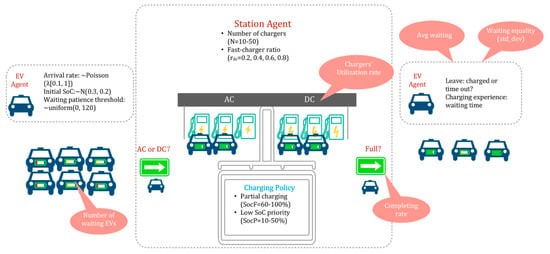
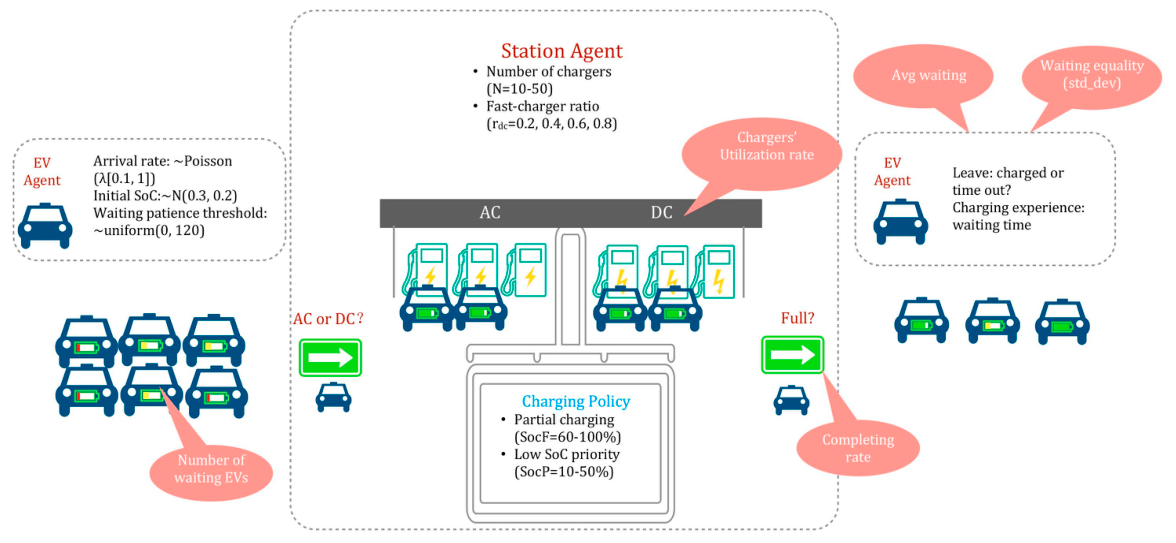
This study develops an agent-based model, as illustrated in Figure 1, to simulate the impact of partial-charging strategies on operational efficiency and user waiting-time equality of a crowded EV charging station. The model consists of two primary agents: EV agents () seeking charging services and an EV charging-station agent managing chargers’ allocation.
Figure 1.
Agent-based simulation framework for operation of EV charging station.
The EV charging station is equipped with a total number of chargers, among which a proportion are fast chargers . The remainder are slow chargers.
As crowding at charging stations typically arises in locations with higher charging demand, such as highways, transportation hubs and urban large commercial centers, where DC (Direct Current) charging stations are widely adopted [45], the simulation defines “slow” chargers as the DC chargers with low power output (e.g., 50 kW), while the fast chargers refer to those with higher power output (e.g., 120 kW or 150 kW).
The key operational decisions made by the EV charging-station agent include the following:
- (1)
- The allocation strategy of the charging station: to ensure both safety and fairness, the charging station adopts a two-stage allocation mechanism. At the first stage, at each time step, the system checks for available chargers and scans through all vehicles waiting for service but not yet assigned to a charger. Vehicles with extremely low state of charge (SOC < 10%) are prioritized, to prevent total battery depletion and to ensure operational safety. These vehicles are immediately assigned an available charger if one is present. At the second stage, the remaining chargers are allocated based on a first-come, first-served principle. If both fast- and slow-charging stations are available, the system further evaluates the current SOC of the vehicle: those with SOC below a predefined threshold socP (SOC priority threshold) are given preference for fast-charging stations. If only one type of charger is available, it is assigned, regardless of SOC, maintaining basic equality in access.
- (2)
- Partial-Charging Strategy: this decision concerns whether to encourage EVs to leave before reaching full charge, especially under crowded conditions. By allowing early leaving when a vehicle reaches a predefined socF (SOC full threshold), the charging station can improve turnover efficiency and enhance overall service capacity. This approach contributes to shorter waiting times and less strain on the station when it is under heavy load.
Each EV agent arriving at the charging station follows the Poisson arrival process with an given arrival rate of , meaning that the number of EVs arriving per unit of time follows a Poisson distribution, which is a common assumption in the queuing system and EV arrival modeling [46]. At the time of arrival, each EV agent is assigned an initial SOC that follows a normal distribution with a mean () and standard deviation (), representing the remaining battery level of the EV, which also affects its allocation priority.
We also used the heterogeneity of initial SOC to better reflect the diverse characteristics of EV charging demand in a real-world scenario. Although the EV charging demand is often expressed in terms of electricity volume, the charging current and voltage of each EV are actually managed by its battery management system (BMS), which adjusts these values based on its thermal limits and cell chemistry [17,42], and are ultimately determined by its SOC level. As a result, many studies adopt SOC as the principal metric for representing charging rates [17,42,47], as the heterogeneity in initial SOC more accurately captures variations in charging demand. Accordingly, this study adopts an SOC-based charging-rate model, to capture the heterogeneous nature of EV charging demand and align with real-world operational behavior.
In addition, each EV agent is assigned a waiting-patience threshold , which is randomly drawn from a uniform distribution over a predefined interval . This means that if an EV’s cumulative waiting time exceeds its waiting-patience threshold , the driver is assumed to abandon the queue and leave the charging station.
3.2. Key Performance Metrics for EV Charging Station Operations
Given that this study is mainly focusing on simulating the operational performance of EV charging stations under crowed conditions, the following metrics are selected to comprehensively evaluate the system’s efficiency and equality:
(1) Average utilization rate of Chargers
This indicator is mainly used to evaluate the operational efficiency of the EV charging station. The system counts the charging occupation time of all fast and slow chargers across all time steps in the simulation. Based on this, the average utilization rate of all chargers is calculated by
in which denotes the total simulation duration, and and are the cumulative usage time of fast and slow chargers. ranges from 0 to 1, and 1 represents the full utilization of all available chargers throughout the simulation period; a higher utilization rate means more efficient use of charging resources and better overall station performance.
(2) Average waiting time
Due to crowded conditions, it is inevitable that EVs will queue up for charging. However, to avoid users’ dissatisfaction due to excessive queuing, stations should improve their service capacity through adjusting operational strategies to reduce the average waiting time. Therefore, this metric serves to indicate how effectively the system addresses users’ collective waiting experience, which is calculated by
where represents the average waiting time of all EVs, and is the actual waiting of EV i (i = 1, 2, …, N). Lower values of this metric reflect higher scheduling efficiency and an improved user experience.
(3) Waiting inequality
Although minimizing the average waiting time improves the overall charging experience, substantial variation in waiting times across users may still generate perceptions of unfairness and reduce user satisfaction. Waiting inequality can be measured using either absolute or relative differences [48,49,50]. Following the recommendation of Asada [49] this study adopts an absolute-difference perspective because, in the operational context of EV charging stations, users are more sensitive to the actual time gap in waiting experiences than to proportional differences. Therefore, the standard deviation of waiting time is used to measure inequality in users’ waiting experiences, which is calculated as
Obviously, a higher value of indicates greater variation in individual EV’s waiting times, reflecting a worse performance for station’s operation in terms of users’ serving equality. Conversely, a lower value suggests a fairer operation.
(4) Charging-completion ratio
Upon leaving the charging station, an EV can be in one of two possible states. The first is that the charging is completed, and the second is that the EV leaves because its waiting time exceeds its patience threshold, that is ; in this case, the system labels it as “time out”, meaning the charging service was not completed. For EVs that have not left but have not completed charging by the end of the simulation, the system labels them as “incomplete”, indicating that the charging process is interrupted, due to the termination of the simulation. Therefore, the charging-completion ratio is calculated as
in which is the number of EVs completing the charging process. Obviously, a higher value of this metric indicates that station is able to serve more EVs, reflecting stronger operational efficiency under the implemented strategy.
3.3. Parameterization and Scenario Development
To ensure the functioning of the agent-based model, the parameters of the baseline scenario are configured as Table 1. A medium-sized EV charging station with a total of 20 chargers is simulated in this research, half of which are fast-charging facilities. The EV arrival rate is set to 0.5, meaning that, on average, one vehicle arrives every 2 min to request charging. The station will prioritize fast-charging facility allocation for vehicles with initial SOC below 20%. Each EV’s initial SOC is randomly generated from a normal distribution with a mean of 30% and a standard deviation of 20%. The waiting-patience thresholds for all EVs are uniformly distributed in the range of [0, 120] min. The overall simulation duration is 720 min, with a time step of 1 min. The 720 min simulation horizon was designed to represent a prolonged high-demand operational period rather than a full-day charging-station cycle.
Table 1.
Baseline scenario parameter settings of the agent-based model.
For the rate of charging, this study follows previous research using the soc-based rate as the unit of measurement. As reported by Motoaki and Shirk [42] and Lim et al. [47], DC chargers will typically reduce the charging rate when the SOC of the EV reaches 80%, because the BMS will taper the current to prevent overcharging and protect battery health. Following the empirical observations mentioned by Motoaki and Shirk [42], the charging rate of DC fast chargers is fastest when the SOC is very low, but drops sharply after SOC reaches 80%, falling to less than 1/4 of the initial rate. In this study, as the initial SOC of simulated EVs is assumed to be around 30%, the charging rate during 30–80% SOC is taken to represent the relatively fast, though not the fastest, rate observed in the extreme early SOC stage. Therefore, we assumed the charging rate of DC fast chargers in the post 80% SOC stage as 1/3 of the rate observed in the 30–80% SOC interval.
According to the monitor data of Mahlberg et al. [51], the median charge time for EVs using DC fast chargers was between 28 and 36 min. Based on this, we assumed a charging rate of 2% SOC per minute for EVs using fast chargers in the 20–80% SOC range in our model, which typically requires 30 min for an EV to charge from 20% to 80% SOC. However, if the EVs are charged with slow-charging facilities, the charging rate of 1% SOC per minute is assumed, given that their maximum power output is typically about half that of fast-charging facilities. This means an EV has to spend 1 h to charge from 20% to 80% SOC with slow ones.
To comprehensively assess the operational performance of the charging station under different strategies and configurations, a set of sensitivity analysis scenarios is developed by systematically adjusting key parameters, and is shown in Table 2.
Table 2.
Parameter settings for sensitivity analysis scenarios.
The total number of chargers is adjusted to range from 10 to 50, to simulate the impact of station scale on its operational performance. The ratio of fast-charging facilities, ranging from 0.2 to 0.8, reflects different charging-facility configuration schemes. The SOC priority threshold is set between 10% and 50%, to examine how the priority fast-charging facility-allocation rule influences the efficiency and equality of charging. The SOC full threshold, ranging from 60% to 100%, is used to assess the effect of the partial-charging strategy. Finally, the EV arrival rate spans from 0.1 to 1.0, capturing the crowded conditions of the charging station. The upper-bound arrival rate (λ = 1.0) was intentionally included as a stress-testing scenario, to evaluate charging-station performance under highly congested demand conditions.
To improve the statistical robustness of the simulation outcomes, each experimental configuration in the sensitivity analysis was independently replicated 30 times, using different random seeds. Since the simulation starts from an empty system state, a warm-up period of 120 min was introduced to reduce initialization bias in the statistical analysis. Therefore, observations collected during the first 120 min were excluded from subsequent operational performance calculations and visualization analyses.
4. Simulation Results
Unless otherwise specified, the sensitivity testing results reported in this section are based on the mean outcomes of 30 independent stochastic simulation replications, after excluding the initial 120 min warm-up period.
4.1. Results of the Basic Scenario
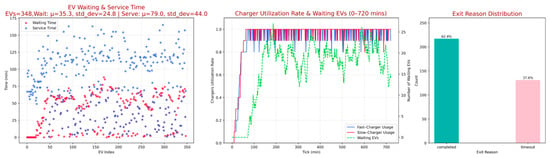
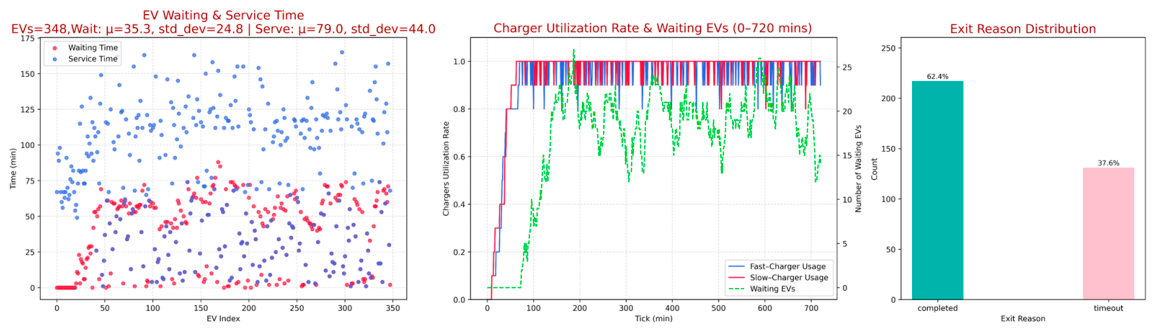
Figure 2 presents a representative single-run realization of the baseline scenario over the full 720 min simulation period, illustrating the temporal evolution of queue formation, charger utilization, and EV-abandonment behavior. In this representative simulation run, EV users experienced an average waiting time of 35.3 min, with a standard deviation of 24.8 min, indicating substantial variability in waiting experiences among users. Although the first 20 vehicles experienced relatively short waiting times, afterwards, users experienced longer waiting times. Although the waiting time temporarily decreased, due to a large number of EVs abandoning the queue after exceeding their patience threshold, it quickly rebounded, and fluctuated within the range of approximately 40–75 min until the end of the simulation. This is basically consistent with the behavioral studies indicating that most people become angry and tend to abandon queuing once the waiting time exceeds 40 min [52].
Figure 2.
Representative realization of the baseline scenario from a single stochastic simulation run.
On average, each EV had to stay in the station for about 80 min to complete the entire charging session, which is relatively long. Due to a higher EV arrival rate (= 0.5) comparing with the relative limited number of charging stations, their utilization rate ramped up quickly at the beginning and reached near full capacity by the 50th min. Overall, slow-charging facilities had higher utilization than fast-charging ones. This is mainly because fast-charging facilities are only prioritized when the initial SOC of EVs is below 20%, resulting in more frequent assignments to slow-charging options.
The trend in the number of waiting EVs was closely aligned with the pattern of waiting times, which stabilized and fluctuated within the range of 15–25 EVs after reaching its peak at approximately the 200th min. Obviously, this is largely attributable to the inclusion of users’ waiting-patience threshold, which functions as a regulating mechanism to prevent the queue from growing indefinitely and guide it toward a self-adjusting equilibrium.
Over the whole 720 min simulation period, a total number of 348 vehicles requested to charge. The charging station successfully served approximately 62.4% of the vehicles, while the remaining 37.6% left, due to their waiting times surpassing patience thresholds. As behavioral research shows that people will become irritable when their waiting time exceeds 10 min and above [52], such a long waiting time and high leaving rate obviously reflect a sub-optimal user experience.
4.2. Results of the Sensitivity Testing Scenarios
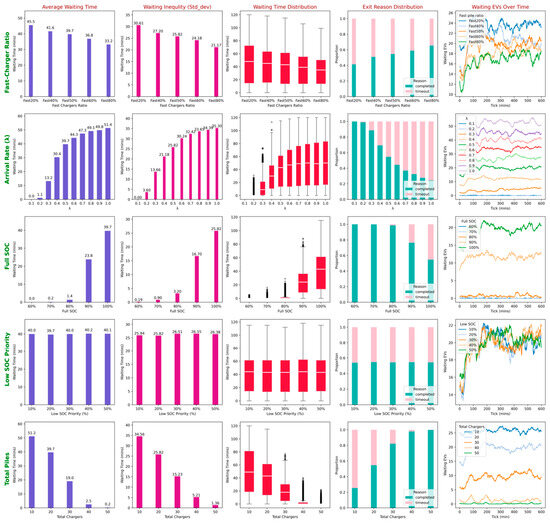
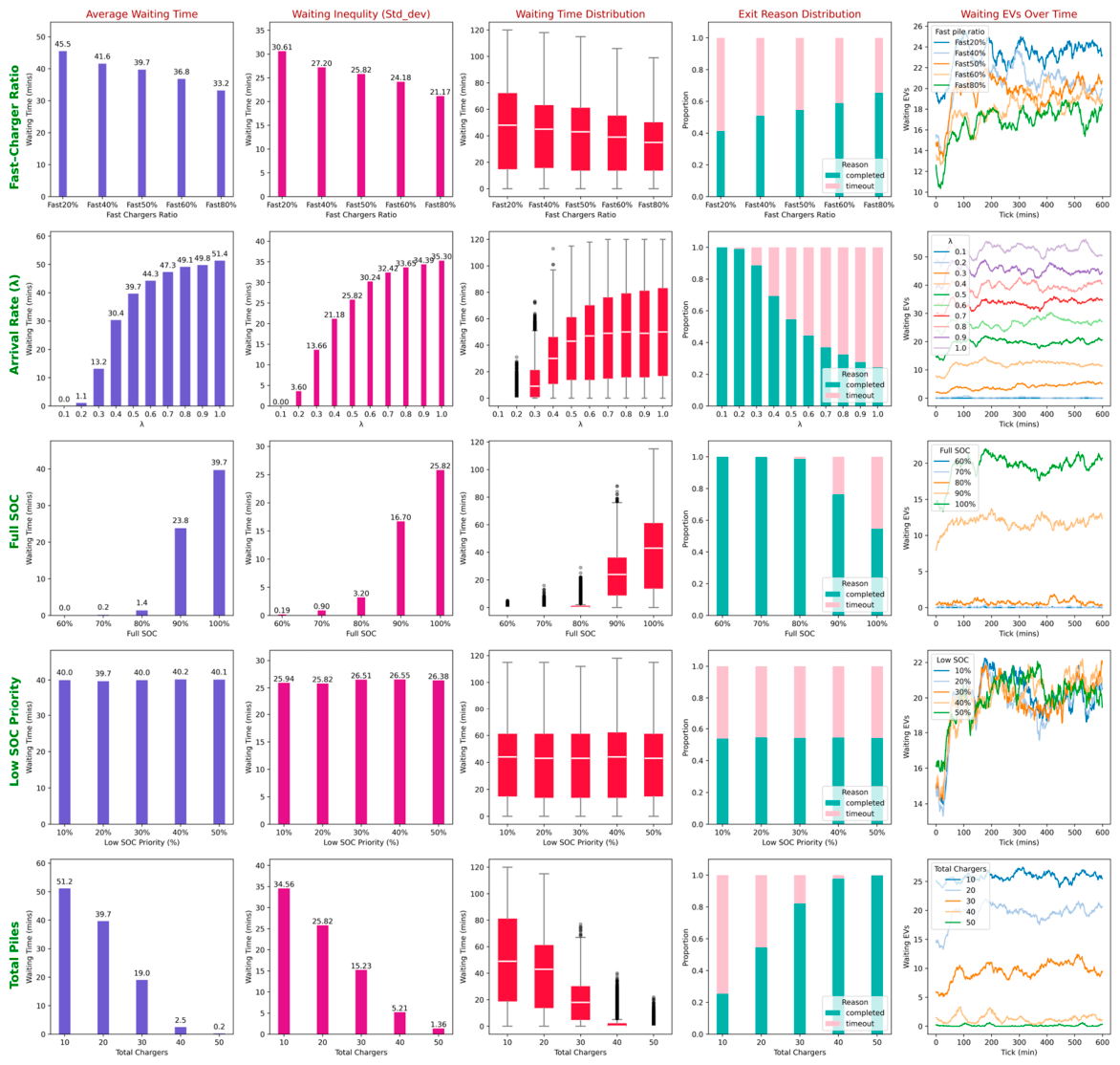
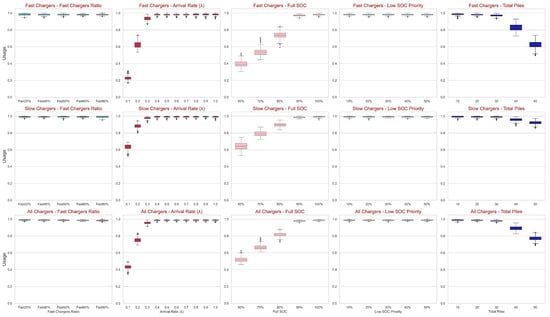
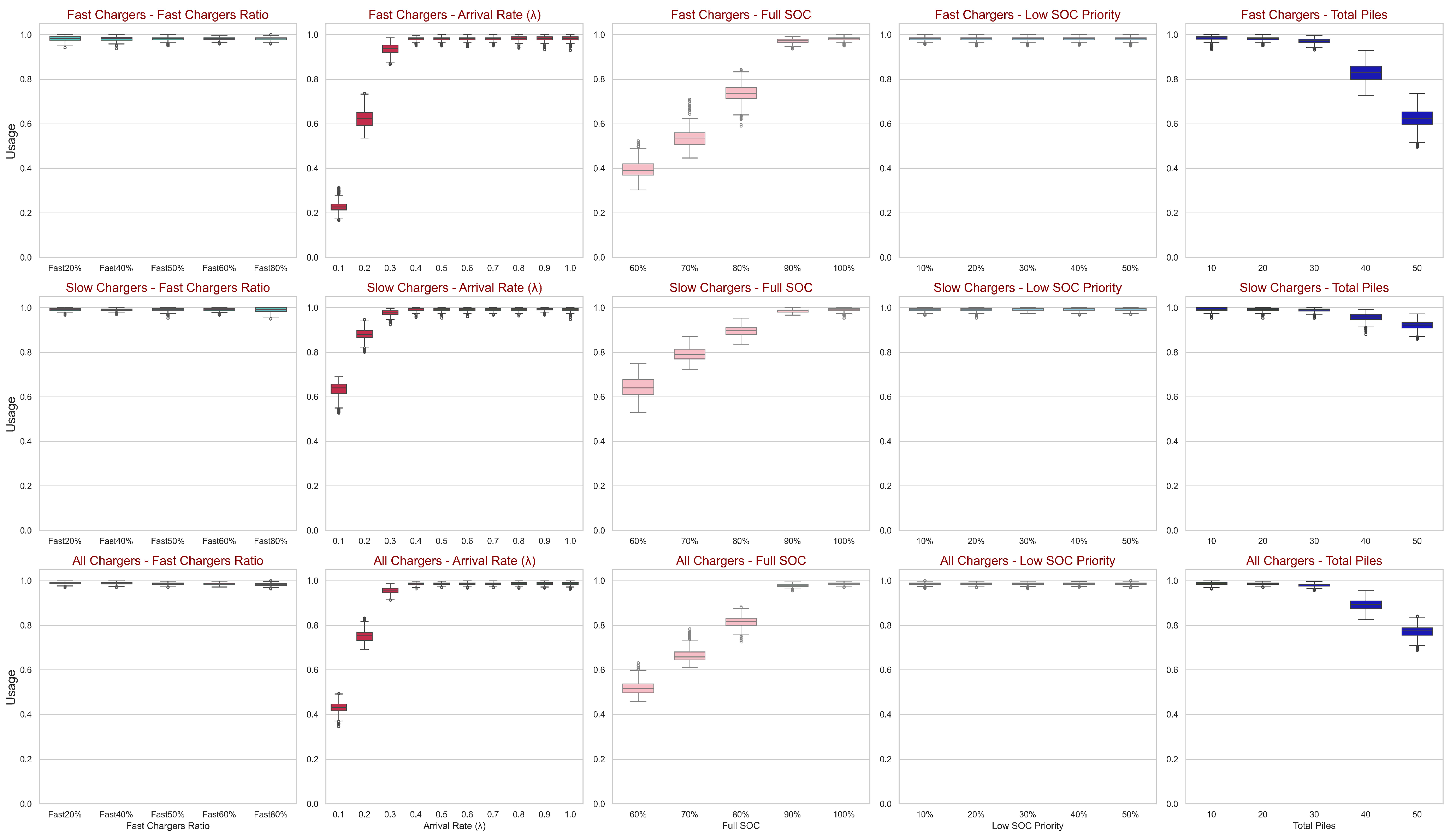
Figure 3 and Figure 4, respectively, present the mean operational performance indicators obtained from 30 independent stochastic simulation replications under the sensitivity testing scenarios. To reduce initialization bias associated with the empty-system starting condition, the first 120 min of each simulation run were excluded as a warm-up period (as shown in Table 2). In terms of reducing waiting times, the most sensitive factors are the arrival rate (), full SOC, and total number of charging stations. For example, in the case of a low arrival rate, such as ≤ 0.3, the average waiting time of EVs is reduced to less than 5 min, which is considered to be short and acceptable to users, as shown in a stated preference survey by Hoen et al. [53]; with an average waiting time of 5 min, 98% of EVs chose to charge. The waiting inequality was less than 5 min too, indicating an extremely fair situation. The charging station was capable of ensuring that nearly all EVs completed charging successfully. However, when the arrival rate increased to 0.4 or higher, the number of waiting EVs gradually rose, accompanied by an increase in waiting inequality and more uneven distribution of waiting times. As a result, some EVs began to give up charging. This phenomenon became particularly pronounced when the arrival rate reached 0.7 or above, at which point the average waiting time of EVs generally stabilizes at around 45 min. This occurred because more EVs chose to leave without charging, thereby enabling the queuing system to self-adjust through abandonment.
Figure 3.
Results of EV waiting time and charging-completion ratio under sensitivity testing scenarios.
Figure 4.
Results of chargers’ average utilization rate under sensitivity testing scenarios.
Similarly, adjusting the number of charging facilities significantly affects the operational performance of the charging site. However, adding too many charging facilities is not always beneficial: for example, when the number of charging stations increased to 30, further expansion led to diminishing marginal returns in operational efficiency and declining facility-utilization efficiency. As shown in Figure 4, when the station was equipped with 40 charging stations, although most EVs completed the charging process with almost no waiting (Figure 3), the overall utilization rate of charging facilities dropped to around 80% for most of the time, with even a lower utilization rate of fast-charging facilities.
Under such conditions, implementing a partial-charging strategy, such as lowering the socF threshold from 100% to 80%, not only significantly reduced average waiting times of EVs and their inequality, but also helped achieve a relatively high level of charging-station utilization (Figure 4). This, in turn, enabled the charging site to accommodate the vast majority of EVs to complete their charging request (Figure 3).
In comparison, adjusting the other two factors, namely, the proportion of fast-charging facilities and socP, did not lead to significant improvements in the operational efficiency of the charging site. As shown in Figure 3, regardless of whether the proportion of fast-charging facilities was increased or the socP were adjusted, approximately 40% of EVs could not complete their charging process, due to excessive waiting times. Even when the utilization rate of charging stations was already very high (Figure 4), the vast majority of EVs still had to wait a very long time before accessing a charging facility. This indicates that, under crowded conditions, increasing the proportion of fast-charging facilities or adjusting socP alone is insufficient to alleviate long queues or enhance service efficiency.
4.3. Sensitivity Testing Results of Varying Crowded Conditions
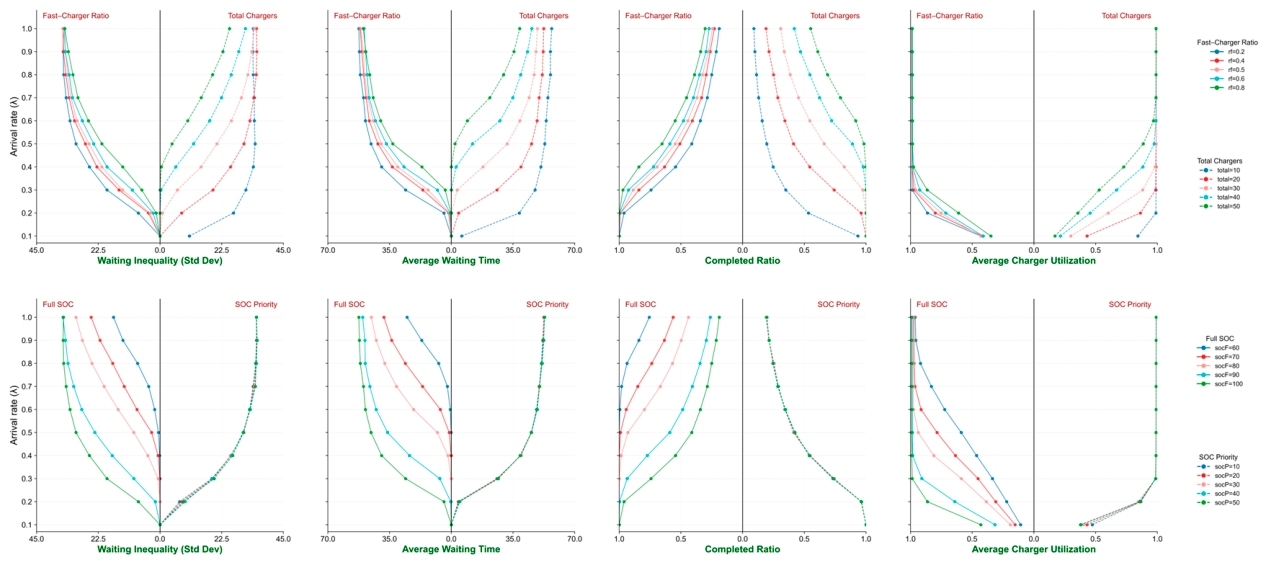
The following results are based on the mean outcomes of 30 independent stochastic simulation replications after excluding the warm-up period. To further examine how operational strategies affect the charging site operations and equality of users’ waiting experience under various levels of crowded conditions, this study further conducted a combined analysis of arrival rates of EVs with other strategies. These strategies include adjusting the ratio of fast-charging facilities, changing the total number of charging stations, modifying the socP value, and applying partial-charging strategies with different socF thresholds. The results are presented in Figure 5.
Figure 5.
Sensitivity testing results of arrival rate.
The results of Figure 5 show that although modifying the socP value has some impacts on the operational performance under low arrival rates, the impacts under high arrival rates are very limited. In contrast, the effects of the other strategies increase progressively with higher arrival rates. Notably, when the number of charging stations reaches 50, the station can maintain a high level of service, even under high arrival rates (e.g., = 0.7), enabling a large proportion of users to complete charging without excessive waiting, while maintaining a high utilization rate across the charging infrastructure.
A similar observation is found with applying the partial-charging strategy. Under low arrival rates, due to limited volume of charging demand, implementing this strategy could not significantly improve EV users’ waiting experience because it was already very short; it may, however, reduce charging-station utilization efficiency instead. However, as arrival rates exceed moderate levels (e.g., 0.3), the partial-charging strategy becomes significantly more effective. In such cases, the partial-charging strategies eases queuing pressure, reduces user waiting times, and mitigates waiting inequality, all while preserving relatively high facility utilization.
Figure 5 also shows that increasing the proportion of fast-charging facilities could also improve the operational performance of the charging site and the waiting experience of EV users when the arrival rate is within a medium range (e.g., [0.3, 0.5]), while adjusting socP value did not exert any effect, no matter how the arrival rate changed. As occupying fast-DC-charging stations always involves high installation and maintenance costs, the above results suggest that the marginal benefits of deploying additional fast-charging facilities diminish, as increasing their ratio fails to effectively relieve heavy-load conditions. For example, when the arrival rate reaches 0.7 or above, even where 80% of the charging stations are fast, users still have to wait for nearly 45 min to get a charging station (Figure 5).
4.4. Sensitivity Testing Results of Joint Performance-Enhancing Strategies
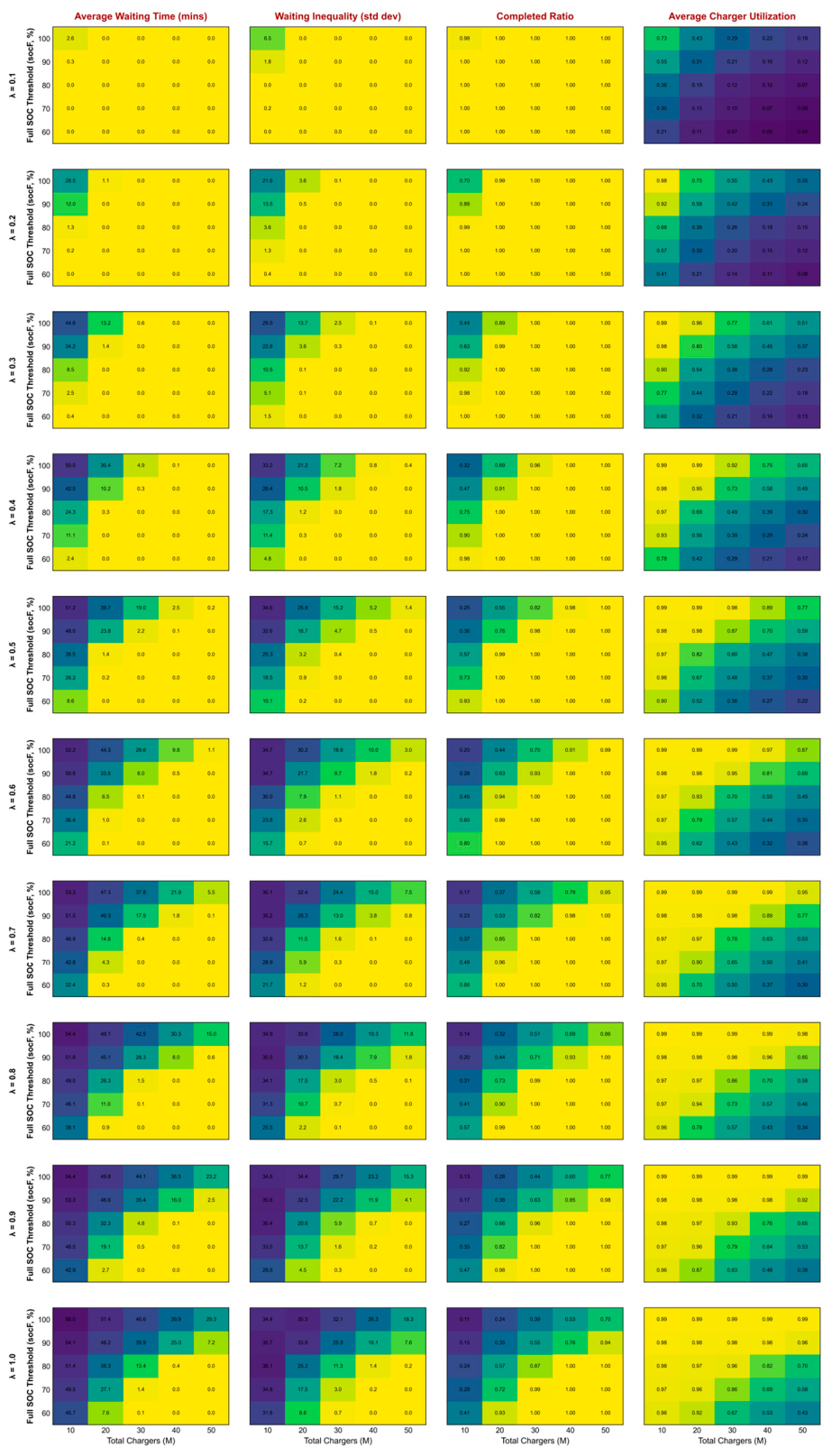
Figure 6 reports the mean operational outcomes across 30 independent simulation replications for each joint strategy configuration, after excluding the warm-up period. The above results show that when arrival rates are high, both increasing the number of charging facilities and adopting partial-charging strategies improves the operational performance, reducing waiting times and decreasing their waiting inequalities. However, due to the inherent variability in EV arrival patterns, increasing the number of charging stations may lead to significantly reduced charging-facility utilization and resource wastage during low arrival rates. In contrast, the partial-charging strategy can flexibly adjust the overall service pace by encouraging EVs to depart before reaching full charging. Based on this, the study further explores the combined effects of the partial-charging strategy and increasing facility count on station operational performance. More importantly, by analyzing their marginal benefits and combined effects under different arrival rates, this study aimed to assess to what extent can partial-charging strategy replaces the increase in the number of charging stations.
Figure 6.
Effects of joint performance-enhancing strategies.
According to Figure 6, when the arrival rate of EVs requesting charging reaches the maximum value of the simulation (λ = 1), meaning an average of one EV arrives per minute, the adoption of a partial-charging strategy with a Full SOC Threshold (socF) = 90% at a charging site equipped with 50 charging facilities enables approximately 98% of EVs to complete charging. In this case, facility utilization approaches 90%, and the average waiting time for users is only 3.3 min, with a standard deviation of 5.3 min, indicating a high level of equality in users’ waiting experiences.
When the number of charging facilities was reduced to 40 and the arrival rate remained unchanged, adopting a partial-charging strategy of Full SOC Threshold (socF) = 80% resulted in improved operational outcomes. Similarly, with 30 chargers, adopting a partial-charging strategy of Full SOC Threshold (socF) = 70% achieved better user service performance for users, with a slight decrease in facility utilization. However, when the number of charging facilities was reduced to 20, even lowering the threshold to 60% still fails to achieve comparable operational performance.
It is worth noting that if all EVs are assumed to leave once their SOC reaches 80%, when the total number of chargers at the station is 40, 30 and 20, respectively, with the corresponding EV arrival rate of 1.0, 0.9 and 0.5, respectively, this results in an hourly charging demand in these scenarios of 60, 54, and 30 EVs, respectively. Under these conditions, the utilization rate of charging stations can be maintained at a relatively higher level; users did not need to wait for a long time to obtain facilities to fully charge, with the EV-to-charger flow ratio (that is, the ratio of the total number of vehicles arriving during the average hour to the number of charging stations) ranging from 1.5 to 1.8. When adopting the partial-charging strategy of Full SOC Threshold (socF) of 70%, the station achieved a relatively high utilization of charging stations, and enabled users to have a better waiting experience. For instance, with 30, 20 or 10 chargers and EV arrival rates of 1.0, 0.7 and 0.3 (equal to 60, 42 and 18 EVs requesting charging hourly), the EV-to-charger flow ratio rose to between 1.8 and 2.1, while still maintaining high utilization and an improved user waiting experience.
In contrast, under the full-charge strategy, when the total number of charging stations at the station is 50, 40, 30, 20, with a corresponding EV arrival rate of 0.7, 0.5, 0.4 and 0.3, respectively, resulting in an hourly charging demand of 42, 30, 24, and 18 EVs, respectively, the charging site demonstrates consistently high operational performance and better user experience across all four scenarios, with EV-to-charger flow ratio ranging from 0.75 to 0.9.
These results suggest that adopting a partial-charging strategy with a Full SOC Threshold (socF) of 70–80% may substantially improve the effective service throughput of charging facilities without significantly reducing the overall operational performance, under the simulated conditions. Specifically, under the full-charging strategy, the charging station maintained relatively high operational performance when each charging facility served approximately 0.8 EVs per hour. By contrast, under the socF = 70–80% partial-charging strategy, each charger was able to accommodate approximately 1.6–2.0 EVs per hour, while maintaining comparable operational outcomes, corresponding to an approximate 2.0–2.5-fold increase in effective service throughput under the simulated conditions.
5. Conclusions and Implications
5.1. Conclusions
This study used a multi-agent modeling approach to simulate the impacts of a partial-charging strategy on adapting an EV charging station to varying demand conditions. By simulating and comparing the effects of the partial-charging strategy with other strategies on reducing EVs’ average waiting time and waiting inequality, increasing charging-completion ratio, and utilization rate of charging stations, this study found that the level of crowding at charging stations is highly dependent on the arrival rate of EVs that request charging. This finding is basically consistent with that of Pourvaziri et al. [24], which also highlights the significant of variability in EVs’ arrival rate on the performance of the queueing system. However, as each charging site consists of a different number of charging stations, it is the EV-to-charger flow ratio in this study, rather than the arrival rate of EVs, which fundamentally determines the level of crowding. Although Pourvaziri et al. [24] also acknowledge that the variability of EV-to-charger flow ratio impacts EVs’ waiting time significantly, our research further reveals the threshold of the maximum EV-to-charger flow ratio that each charger can accommodate without triggering serious long queues under different charging strategies. For example, we have found that, under the full-charging strategy, each charger can accommodate at most 0.8 EVs per hour without causing substantial queue build-up.
Differently from previous studies that apply queueing theory to simulate waiting time under simplified assumptions of homogeneous arrival and waiting behavior [26,27], and which can only capture the average group performance of the waiting time, but fail to reflect the inequality among individual users, the agent-based modeling in this study incorporated heterogenous user-waiting patience and charging-abandonment decision dynamically, meaning that not every user will continue to wait, regardless of the queue length. This provides a more realistic reflection of actual users’ waiting behavior. In contrast to Xiao et al. [26], who artificially imposed a predetermined cutoff on waiting length to reflect the finite waiting time, our simulation reveals that it is the users’ heterogenous waiting patience driving the system to achieve a self-balancing pattern, whereby the overall waiting times fluctuate around a relatively stable level rather than increasing without bound as EV arrivals intensify, thereby preventing uncontrolled queue build-up, though it comes at the cost of a rising number of unserved charging requests.
As is widely acknowledged, increasing the number of charging stations could effectively reduce user waiting time and ease queuing pressure at charging facilities, by expanding overall service capacity directly [24,26]. However, our study indicates that this would lead to a significant waste of resources, as the added infrastructure often remains underutilized during periods of low demand. In contrast, the partial-charging strategies can flexibly shorten and allocate charging sessions to match EVs’ varying charging demand, which is equivalent to expanding the service capacity of stations without adding new charging facilities. Importantly, our findings suggest that the sizing effects of partial charging are comparable to those of a costly overbuilding of physical infrastructure. For example, adopting an 80% partial-charging strategy is equivalent to temporarily doubling the effective service capacity of a station, while a more aggressive 70% partial-charging strategy can further expand the capacity by about 2.5 times.
In addition, the results of our study also show that increasing the proportion of super-fast charging stations is not as effective as expected in reducing users’ waiting time. This is mainly because this strategy is only effective when the arrival rates of EVs are within a moderate range. Under conditions of exceptionally high inflow, even a high share of super-fast charging facilities fails to accommodate the demand, as the volume of arriving EVs surpasses the facility’s maximum service capacity. This highlights the advantage of partial-charging strategies, which effectively enhance throughput by reducing individual charging durations. While increasing the share of super-fast chargers merely accelerates the charging process, partial charging more substantially boosts overall service capacity. Our results therefore differ from many previous studies [54,55], which emphasize that increasing the number of fast-charging stations could be effective in reducing customers’ waiting times. The key difference is that these studies did not explicitly consider the variability of EV arrival rates across different operation conditions. By incorporating this variability, our research extends their findings and offers a more comprehensive understanding of strategies for mitigating prolonged queuing at charging facilities.
5.2. Policy Implications
Although our research shows that the partial-charging strategy has significant potential in relieving crowding at EV charging stations, its successful implementation depends very much on user cooperation. Specifically, users must adhere strictly to the rule of leaving immediately after reaching the recommended SOC threshold. However, this requirement faces several challenges. One of the most significant ones is that users often chose to fully charge their EVs, even though many are aware that charging beyond 80% SOC using DC charging offers limited benefit [42]. The reasons behind this include the fact that users are accustomed to charging their EVs as if they were fossil fuel vehicles, which are usually refueled to full capacity. Another major factor for this behavior is charging anxiety [56,57]. As crowding often arises when charging facilities are limited, users often feel the need to charge fully to ensure they have enough power to reach their destination.
As a result of this, achieving a high level of user cooperation requires more than simply encouraging users to leave immediately as soon as charging reaches the recommended level. Because of this consideration, the dynamic pricing strategy has been frequently mentioned by other studies as an effective policy to encourage users to leave earlier [42,58,59]. However, researchers suggest that it may not function as expected in all situations. Users tend to perceive price increases as fair and reasonable, and, in urgent circumstances, many are still willing to pay a higher cost to ensure sufficient charging [43,59]. Consequently, relying on the dynamic pricing strategy alone may not exert the expected effects in crowded situations where the supply of charging resources is insufficient, as most users are more concerned about securing enough energy to complete their trip over the additional cost.
Therefore, a more comprehensive strategy is needed, which not only encourages users to leave faster, but relieves users’ charging anxiety. For example, this could involve offering reduced prices for early departures with guaranteed access to charging facilities at the next station along their journey. This could be realized through real-time data integration, allowing users to receive live updates about charging station availability at the next stop, and integrated reservation systems, which allow the station to build partnerships with nearby stations, enabling users to secure a charging station in advance, for their next charging.
The main limitation of this study lies in the assumption that users will accept the partial-charging strategy without reservation: that is, all users would charge their EV to the recommended SOC and leave the charging station immediately. While this simplification allows this model to estimate the ideal maximum level of the partial-charging strategy’s potential in relieving congestion in a crowded EV charging station, the real-world situation may be more complicated. For example, even if users comply with the partial-charging strategy and are ready to leave immediately, traffic conditions may delay their actual departure plan. Meanwhile, users always exhibit a heterogeneous willingness to accept the partial-charging strategy, as they differ in risk attitudes, which may reduce the practical effects of this strategy in managing queues. In real-world operations, the effectiveness of partial-charging strategies may also be affected by users’ charging anxiety and travel uncertainty. Although the simulation results indicate that 70–80% SOC thresholds can significantly improve charging station adaptability and service capacity, users with stronger range anxiety may prefer higher charging thresholds, especially during long-distance travel or periods of heavy traffic. Therefore, the optimal SOC threshold may need to be dynamically adjusted according to different travel scenarios and charging availability conditions. Future research should therefore incorporate heterogeneous compliance probabilities, alternative empirical distributions of user-waiting patience, and heterogeneous abandonment behavior into the agent-based simulation framework to better capture users’ varying behavioral responses under crowded charging conditions. This would allow for a more accurate representation of the real-world constraints, enabling a richer analysis of how infrastructural and behavioral factors jointly affect the charging crowding at EV charging stations, and ultimately offering broader policy insights for policymakers and infrastructure planners to effectively cope with long queues for charging at crowded charging stations.
Author Contributions
Conceptualization, J.Z. and L.L.; methodology, J.Z., M.Y. and L.L.; software, J.Z., M.Y., X.L. and F.L.; validation, J.Z., M.Y., X.L. and F.L.; formal analysis, J.Z., M.Y. and X.L.; investigation, J.Z., M.Y., X.L., F.L. and X.Z.; resources, L.L.; data curation, J.Z., M.Y. and X.L.; writing—original draft preparation, J.Z.; writing—review and editing, J.Z. and L.L.; visualization, J.Z. and M.Y.; supervision, L.L.; project administration, L.L.; funding acquisition, L.L. All authors have read and agreed to the published version of the manuscript.
Funding
This research was funded by the National Natural Science Foundation of China (Grant No. 72071077).
Data Availability Statement
The agent-based model (ABM) code, parameter settings, and related implementation files are publicly available at the following GitHub repository: https://github.com/Remx11/code-wevj (accessed on 14 May 2026).
Acknowledgments
The authors gratefully acknowledge the support of the Beijing Research Base of Knowledge Management.
Conflicts of Interest
The authors declare that they have no known competing financial interests or personal relationships that could have appeared to influence the work reported in this paper.
Abbreviations
The following abbreviations are used in this manuscript:
| EV | Electric vehicle |
| SOC | State of charge |
| DC | Direct Current |
| BMS | Battery management system |
References
- Nealer, R.; Reichmuth, D.; Anair, D. Cleaner Cars from Cradle to Grave: How Electric Cars Beat Gasoline Cars on Lifetime Global Warming Emissions; Union of Concerned Scientists: Cambridge, MA, USA, 2015. [Google Scholar]
- IEA. Global EV Outlook 2025; IEA: Paris, France, 2025. [Google Scholar]
- Lee, J.H.; Chakraborty, D.; Hardman, S.J.; Tal, G. Exploring Electric Vehicle Charging Patterns: Mixed Usage of Charging Infrastructure. Transp. Res. Part D Transp. Environ. 2020, 79, 102249. [Google Scholar] [CrossRef] [Scilit]
- LaMonaca, S.; Ryan, L. The State of Play in Electric Vehicle Charging Services—A Review of Infrastructure Provision, Players, and Policies. Renew. Sustain. Energy Rev. 2022, 154, 111733. [Google Scholar] [CrossRef] [Scilit]
- Singer, M. Consumer Views on Plug-In Electric Vehicles—National Benchmark Report; U.S. Department of Energy, Vehicle Technologies Office: Washington, DC, USA, 2016.
- Taalbi, J.; Nielsen, H. The Role of Energy Infrastructure in Shaping Early Adoption of Electric and Gasoline Cars. Nat. Energy 2021, 6, 970–976. [Google Scholar] [CrossRef] [Scilit]
- Vaughn, M. JD Power Finds Charging Access Biggest Problem for EV Adoption. Available online: https://www.autoweek.com/news/a63965563/ev-charging-access-jd-power-study/ (accessed on 20 September 2025).
- DeLollis, B.; Justice, G. The State of EV Charging in America: Harvard Research Shows Chargers 78% Reliable and Pricing Like the ‘Wild West’|Institute for Business in Global Society. Available online: https://www.hbs.edu/bigs/the-state-of-ev-charging-in-america (accessed on 20 September 2025).
- Stock, K. America’s EV Charging Network Faces Its Next Challenge: Congestion—Bloomberg. Available online: https://www.bloomberg.com/news/articles/2024-08-20/america-s-ev-charging-network-faces-its-next-challenge-congestion (accessed on 20 September 2025).
- Kampshoff, P.; Kumar, A.; Peloquin, S.; Sahdev, S. Building the Electric-Vehicle Charging Infrastructure America Needs; McKinsey & Company: New York, NY, USA, 2022. [Google Scholar]
- Pritchard, E.; Borlaug, B.; Yang, F.; Gonder, J. Evaluating Electric Vehicle Public Charging Utilization in the United States Using the EV WATTS Dataset: Preprint (Conference)|OSTI.GOV; National Renewable Energy Laboratory (NREL): Golden, CO, USA, 2023. [Google Scholar]
- Motlagh, S.G.; Oladigbolu, J.; Li, L. A Review on Electric Vehicle Charging Station Operation Considering Market Dynamics and Grid Interaction. Appl. Energy 2025, 392, 126058. [Google Scholar] [CrossRef] [Scilit]
- Ma, T.-Y.; Xie, S. Optimal Fast Charging Station Locations for Electric Ridesharing with Vehicle-Charging Station Assignment. Transp. Res. Part D Transp. Environ. 2021, 90, 102682. [Google Scholar] [CrossRef] [Scilit]
- Montoya, A.; Guéret, C.; Mendoza, J.E.; Villegas, J.G. The Electric Vehicle Routing Problem with Nonlinear Charging Function. Transp. Res. Part B Methodol. 2017, 103, 87–110. [Google Scholar] [CrossRef] [Scilit]
- Zhang, Y.; Aliya, B.; Zhou, Y.; You, I.; Zhang, X.; Pau, G.; Collotta, M. Shortest Feasible Paths with Partial Charging for Battery-Powered Electric Vehicles in Smart Cities. Pervasive Mob. Comput. 2018, 50, 82–93. [Google Scholar] [CrossRef] [Scilit]
- Hou, L.; Zhang, X.; Gu, X.; Qiu, T.; Shang, Y. A Fast Charging Method for Lithium-Ion Batteries Considering Charging Urgency of the User. IEEE Trans. Energy Convers. 2024, 40, 1237–1248. [Google Scholar] [CrossRef] [Scilit]
- Kostopoulos, E.D.; Spyropoulos, G.C.; Kaldellis, J.K. Real-World Study for the Optimal Charging of Electric Vehicles. Energy Rep. 2020, 6, 418–426. [Google Scholar] [CrossRef] [Scilit]
- Borlaug, B.; Yang, F.; Pritchard, E.; Wood, E.; Gonder, J. Public Electric Vehicle Charging Station Utilization in the United States. Transp. Res. Part D Transp. Environ. 2023, 114, 103564. [Google Scholar] [CrossRef] [Scilit]
- Liang, Y.; Wang, H.; Zhao, X. Analysis of Factors Affecting Economic Operation of Electric Vehicle Charging Station Based on DEMATEL-ISM. Comput. Ind. Eng. 2022, 163, 107818. [Google Scholar] [CrossRef] [Scilit]
- Wu, T.; Fainman, E.; Maïzi, Y.; Shu, J.; Li, Y. Allocate Electric Vehicles’ Public Charging Stations with Charging Demand Uncertainty. Transp. Res. Part D Transp. Environ. 2024, 130, 104178. [Google Scholar] [CrossRef] [Scilit]
- Luo, L.; Gu, W.; Zhou, S.; Huang, H.; Gao, S.; Han, J.; Wu, Z.; Dou, X. Optimal Planning of Electric Vehicle Charging Stations Comprising Multi-Types of Charging Facilities. Appl. Energy 2018, 226, 1087–1099. [Google Scholar] [CrossRef] [Scilit]
- Lin, M.; Zhong, M.; Meng, J.; Wang, W.; Wu, J. EV Charging Scheduling under Limited Charging Constraints by an Improve Proximal Policy Optimization Algorithm. Energy 2025, 333, 137422. [Google Scholar] [CrossRef] [Scilit]
- Sun, W.; Zhang, Z.; Li, S. Two-Stage Queueing Model for Electric Vehicles Charging Stations with Dynamic Server Allocation. J. Energy Storage 2025, 133, 117953. [Google Scholar] [CrossRef] [Scilit]
- Pourvaziri, H.; Sarhadi, H.; Azad, N.; Afshari, H.; Taghavi, M. Planning of Electric Vehicle Charging Stations: An Integrated Deep Learning and Queueing Theory Approach. Transp. Res. Part E Logist. Transp. Rev. 2024, 186, 103568. [Google Scholar] [CrossRef] [Scilit]
- Wu, Y.; Yan, D.; Yang, J.-M.; Wang, A.-P.; Feng, D. Optimal Scheduling Strategy of Electric Vehicle Based on Improved NSGA-III Algorithm. PLoS ONE 2024, 19, e0298572. [Google Scholar] [CrossRef] [Scilit]
- Xiao, J.; Sun, B.; Gao, X.; Yang, H.; Wang, L. An Intelligent Partial Charging Navigation Strategy for Electric Vehicles. Geo-Spat. Inf. Sci. 2024, 28, 1382–1385. [Google Scholar] [CrossRef] [Scilit]
- Vijay, V.; Venkaiah, C.; Kumar, D.M.V. Multi Objective Queue Theory Based Optimal Planning of Rapid Charging Stations and Distributed Generators in Coupled Transportation and Distribution Network. Energy Storage 2024, 6, e484. [Google Scholar] [CrossRef] [Scilit]
- Schoenberg, S.; Dressler, F. Reducing Waiting Times at Charging Stations with Adaptive Electric Vehicle Route Planning. IEEE Trans. Intell. Veh. 2023, 8, 95–107. [Google Scholar] [CrossRef] [Scilit]
- Kazemtarghi, A.; Mallik, A.; Chen, Y. Dynamic Pricing Strategy for Electric Vehicle Charging Stations to Distribute the Congestion and Maximize the Revenue. Int. J. Electr. Power Energy Syst. 2024, 158, 109946. [Google Scholar] [CrossRef] [Scilit]
- Ameer, H.; Wang, Y.; Fan, X.; Chen, Z. Hybrid Optimization of EV Charging Station Placement and Pricing Using Bender’s Decomposition and NSGA-II Algorithm. Appl. Energy 2025, 397, 126385. [Google Scholar] [CrossRef] [Scilit]
- Qiu, J.; Du, L. Optimal Dispatching of Electric Vehicles for Providing Charging On-Demand Service Leveraging Charging-on-the-Move Technology. Transp. Res. Part C Emerg. Technol. 2023, 146, 103968. [Google Scholar] [CrossRef] [Scilit]
- Tucker, N.; Alizadeh, M. An Online Admission Control Mechanism for Electric Vehicles at Public Parking Infrastructures. IEEE Trans. Smart Grid 2020, 11, 161–170. [Google Scholar] [CrossRef] [Scilit]
- Zeng, T.; Bae, S.; Travacca, B.; Moura, S. Inducing Human Behavior to Maximize Operation Performance at PEV Charging Station. IEEE Trans. Smart Grid 2021, 12, 3353–3363. [Google Scholar] [CrossRef] [Scilit]
- Varshney, S.; Panda, K.P.; Shah, M.; Srinivas, B.A.; Deshmukh, A.; Choudhary, K.K.; Bajaj, M.; Prokop, L.; Rubanenko, O. Novel Control Strategies for Electric Vehicle Charging Stations Using Stochastic Modeling and Queueing Analysis. Sci. Rep. 2025, 15, 21391. [Google Scholar] [CrossRef] [Scilit]
- Hu, X.; Xu, L.; Lin, X.; Pecht, M. Battery Lifetime Prognostics. Joule 2020, 4, 310–346. [Google Scholar] [CrossRef] [Scilit]
- Smith, K.; Markel, T.; Kim, G.-H.; Pesaran, A. Design of Electric Drive Vehicle Batteries for Long Life and Low Cost: Robustness to Geographic and Consumer-Usage Variation (Presentation); National Renewable Energy Lab. (NREL): Golden, CO, USA, 2010. [Google Scholar]
- Pelletier, S.; Jabali, O.; Laporte, G.; Veneroni, M. Battery Degradation and Behaviour for Electric Vehicles: Review and Numerical Analyses of Several Models. Transp. Res. Part B Methodol. 2017, 103, 158–187. [Google Scholar] [CrossRef] [Scilit]
- Urquizo, J.; Singh, P. A Review of Health Estimation Methods for Lithium-Ion Batteries in Electric Vehicles and Their Relevance for Battery Energy Storage Systems. J. Energy Storage 2023, 73, 109194. [Google Scholar] [CrossRef] [Scilit]
- Vries, H.; Nguyen, T.T.; Op het Veld, B. Increasing the Cycle Life of Lithium Ion Cells by Partial State of Charge Cycling. Microelectron. Reliab. 2015, 55, 2247–2253. [Google Scholar] [CrossRef] [Scilit]
- Hoke, A.; Brissette, A.; Maksimović, D.; Kelly, D.; Pratt, A.; Boundy, D. Maximizing Lithium Ion Vehicle Battery Life through Optimized Partial Charging. In Proceedings of the 2013 IEEE PES Innovative Smart Grid Technologies Conference (ISGT), Lyngby, Denmark, 6–9 October 2013; pp. 1–5. [Google Scholar]
- Yuan, Y.; Zhang, D.; Miao, F.; Chen, J.; He, T.; Lin, S. p2 Charging: Proactive Partial Charging for Electric Taxi Systems. In Proceedings of the 2019 IEEE 39th International Conference on Distributed Computing Systems (ICDCS), Dallas, TX, USA, 7–10 July 2019; pp. 688–699. [Google Scholar]
- Motoaki, Y.; Shirk, M.G. Consumer Behavioral Adaption in EV Fast Charging through Pricing. Energy Policy 2017, 108, 178–183. [Google Scholar] [CrossRef] [Scilit]
- Chavanne, D.; Danz, Z.; Dribssa, J.; Powell, R.; Sambor, M. Context and the Perceived Fairness of Price Increases Coming out of COVID-19. Soc. Sci. Q. 2022, 103, 55–68. [Google Scholar] [CrossRef] [Scilit]
- Maister, D. The Psychology of Waiting Lines; Harvard Business School: Boston, MA, USA, 1984. [Google Scholar]
- Xie, R.; Wu, Y.; Tang, H.; Zhuang, Y.; Zhang, Y. A Strongly Coupled Vehicle-to-Vehicle Wireless Charging System for Emergency Charging Purposes with Constant-Current and Constant-Voltage Charging Capabilities. IEEE Trans. Power Electron. 2024, 39, 3985–3989. [Google Scholar] [CrossRef] [Scilit]
- Varshney, S.; Srinivas, B.A.; Gupta, M.; Shah, M.; Bavisi, A. Stochastic Modeling of Multiple-Server Charging Stations for Electric Vehicle Networks Using Feedback Strategies: A Queueing-Theoretic Approach. Int. J. Thermofluids 2024, 24, 100859. [Google Scholar] [CrossRef] [Scilit]
- Lim, K.L.; Speidel, S.; Bräunl, T. A Comparative Study of AC and DC Public Electric Vehicle Charging Station Usage in Western Australia. Renew. Sustain. Energy Transit. 2022, 2, 100021. [Google Scholar] [CrossRef] [Scilit]
- Harper, S.; King, N.B.; Meersman, S.C.; Reichman, M.E.; Breen, N.; Lynch, J. Implicit Value Judgments in the Measurement of Health Inequalities. Milbank Q. 2010, 88, 4–29. [Google Scholar] [CrossRef] [Scilit] [PubMed]
- Asada, Y. On the Choice of Absolute or Relative Inequality Measures. Milbank Q. 2010, 88, 616–622. [Google Scholar] [CrossRef] [Scilit]
- Yan, D. Subtraction or Division: Evaluability Moderates Reliance on Absolute Differences versus Relative Differences in Numerical Comparisons. J. Consum. Res. 2019, 45, 1103–1116. [Google Scholar] [CrossRef] [Scilit]
- Mahlberg, J.A.; Desai, J.; Bullock, D.M. Evaluation of Electric Vehicle Charging Usage and Driver Activity. World Electr. Veh. J. 2023, 14, 308. [Google Scholar] [CrossRef] [Scilit]
- Qiu, G.; Liu, W.X.; Zhang, J.H. Equipment Optimization Method of Electric Vehicle Fast Charging Station Based on Queuing Theory|Scientific.Net. Appl. Mech. Mater. 2013, 291, 872–877. [Google Scholar] [CrossRef] [Scilit]
- Hoen, F.S.; Díez-Gutiérrez, M.; Babri, S.; Hess, S.; Tørset, T. Charging Electric Vehicles on Long Trips and the Willingness to Pay to Reduce Waiting for Charging. Stated Preference Survey in Norway. Transp. Res. Part A Policy Pract. 2023, 175, 103774. [Google Scholar] [CrossRef] [Scilit]
- Guler, N. Smart Allocation and Sizing of Fast Charging Stations: A Metaheuristic Solution. Int. J. Sustain. Energy 2024, 43, 2350970. [Google Scholar] [CrossRef] [Scilit]
- Hanig, L.; Ledna, C.; Nock, D.; Harper, C.D.; Yip, A.; Wood, E.; Spurlock, C.A. Finding Gaps in the National Electric Vehicle Charging Station Coverage of the United States. Nat. Commun. 2025, 16, 561. [Google Scholar] [CrossRef] [Scilit]
- Afshar, S.; Macedo, P.; Mohamed, F.; Disfani, V. A Literature Review on Mobile Charging Station Technology for Electric Vehicles. In Proceedings of the 2020 IEEE Transportation Electrification Conference & Expo (ITEC), Chicago, IL, USA, 24–26 June 2020; pp. 1184–1190. [Google Scholar]
- Afshar, S.; Pecenak, Z.K.; Barati, M.; Disfani, V. Mobile Charging Stations for EV Charging Management in Urban Areas: A Case Study in Chattanooga. Appl. Energy 2022, 325, 119901. [Google Scholar] [CrossRef] [Scilit]
- Chaudhari, K.; Kandasamy, N.K.; Krishnan, A.; Ukil, A.; Gooi, H.B. Agent-Based Aggregated Behavior Modeling for Electric Vehicle Charging Load. IEEE Trans. Ind. Inform. 2019, 15, 856–868. [Google Scholar] [CrossRef] [Scilit]
- Wang, Y.; Yao, E.; Pan, L. Electric Vehicle Drivers’ Charging Behavior Analysis Considering Heterogeneity and Satisfaction. J. Clean. Prod. 2021, 286, 124982. [Google Scholar] [CrossRef] [Scilit]

Disclaimer/Publisher’s Note: The statements, opinions and data contained in all publications are solely those of the individual author(s) and contributor(s) and not of MDPI and/or the editor(s). MDPI and/or the editor(s) disclaim responsibility for any injury to people or property resulting from any ideas, methods, instructions or products referred to in the content. |
© 2026 by the authors. Published by MDPI on behalf of the World Electric Vehicle Association. Licensee MDPI, Basel, Switzerland. This article is an open access article distributed under the terms and conditions of the Creative Commons Attribution (CC BY) license.