
Coordinated Stator–Rotor Structural Optimization of an Automotive IPMSM for Improved Torque Performance


Abstract
1. Introduction
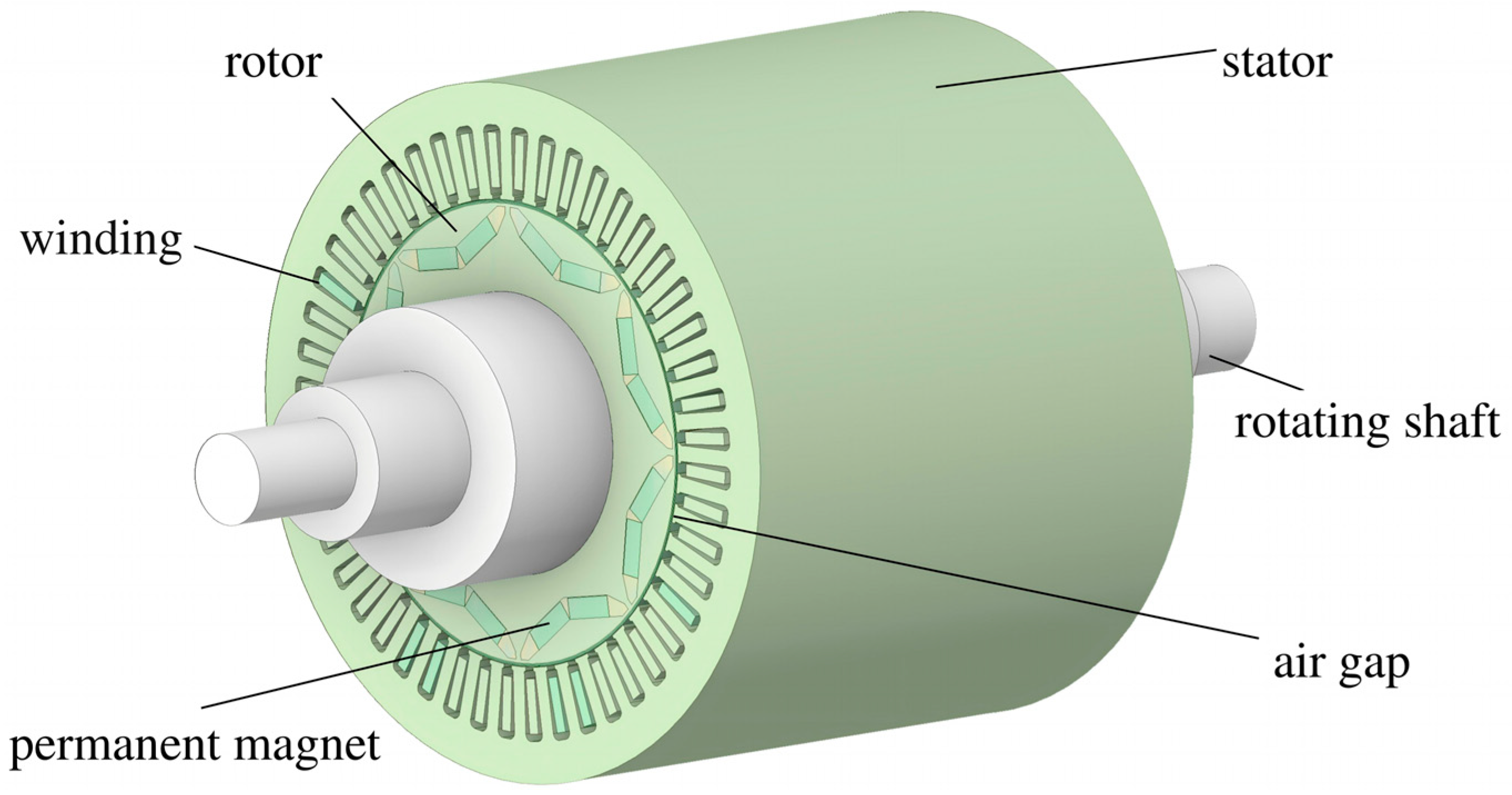
2. Establishment and Analysis of the Motor Finite Element Model
2.1. Fundamental Motor Parameters
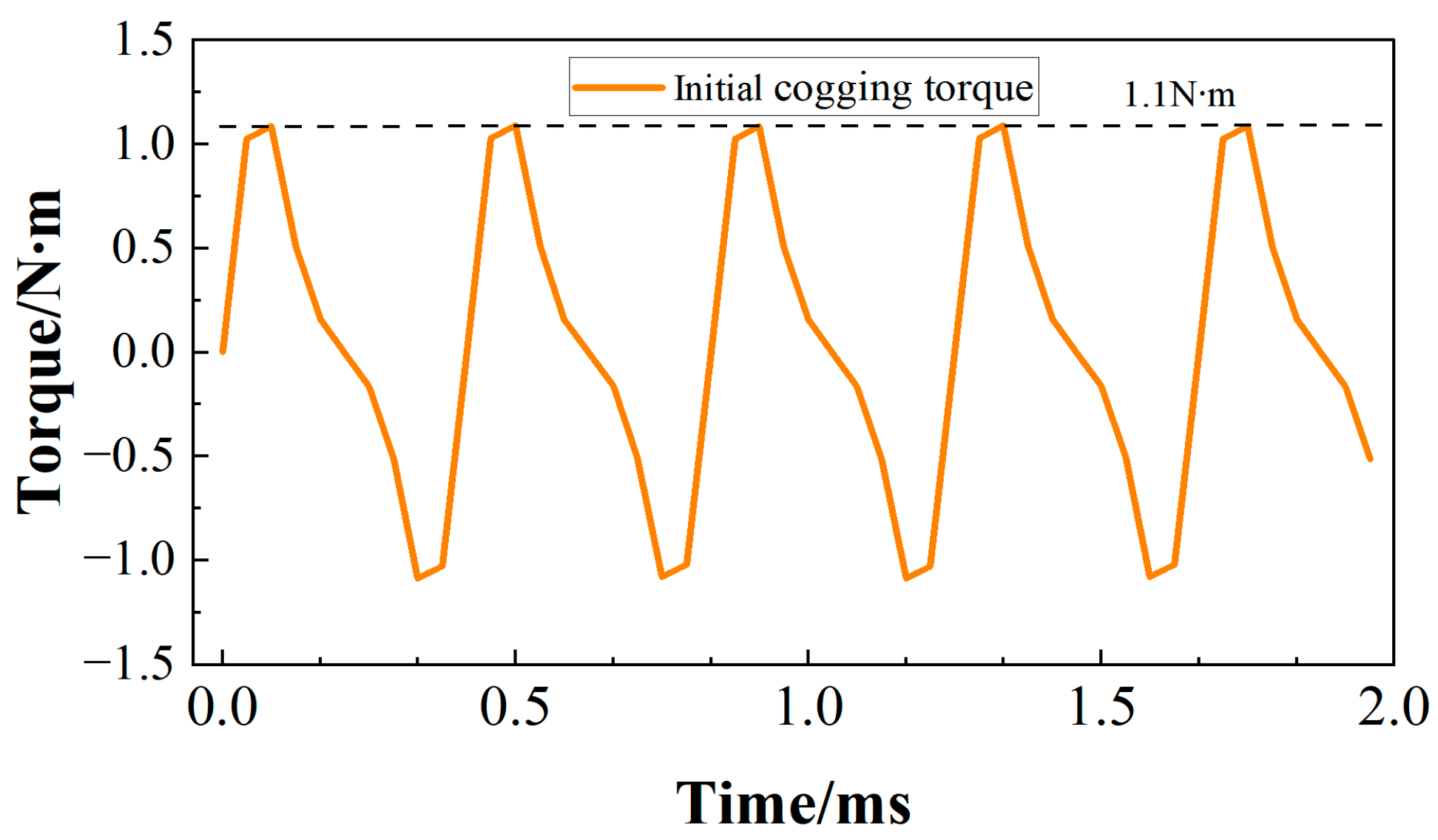
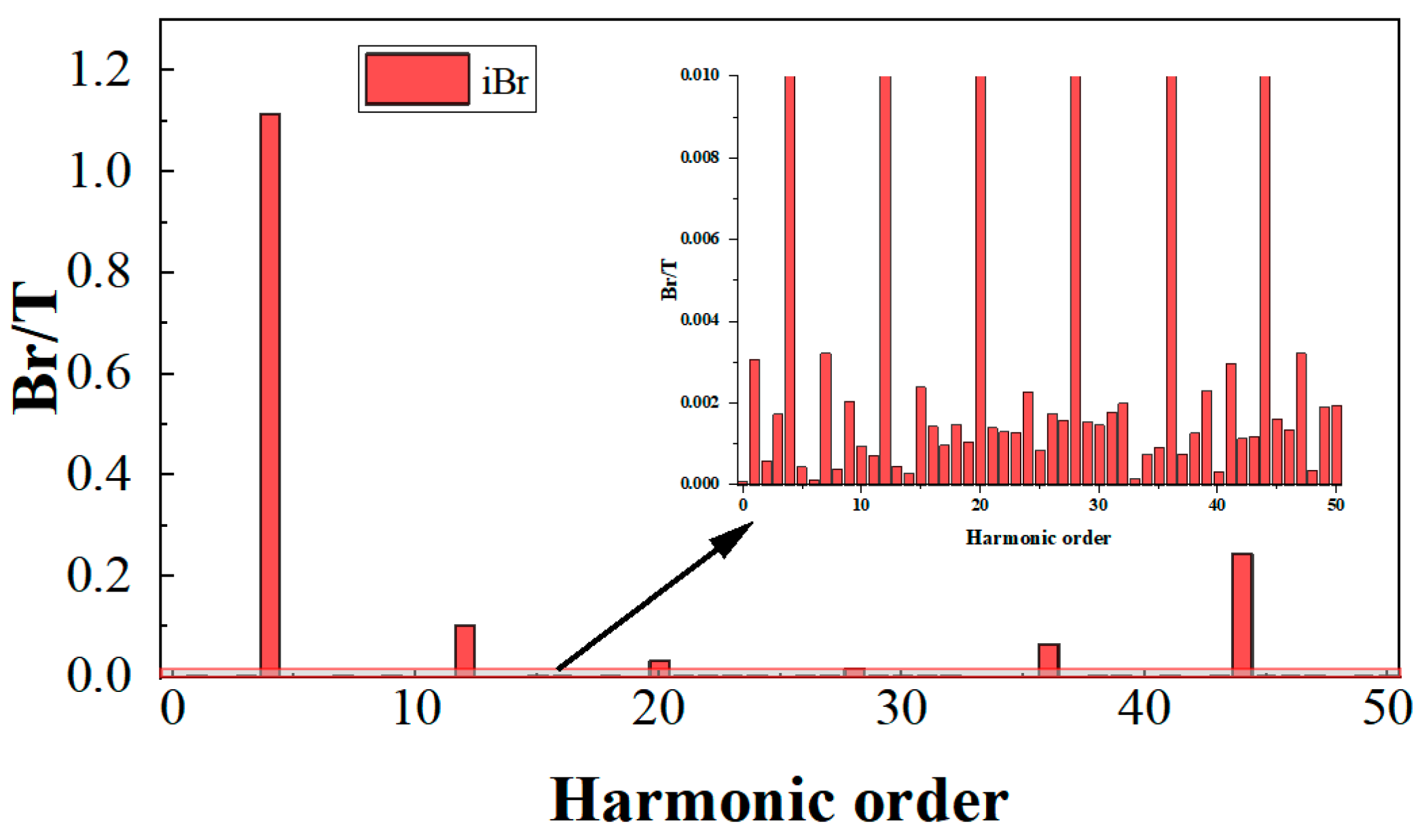
2.2. Motor Model Analysis and Validation
3. Mathematical Model Analysis
3.1. Mathematical Model of Cogging Torque
3.2. Mathematical Model of Torque Ripple and Average Output Torque
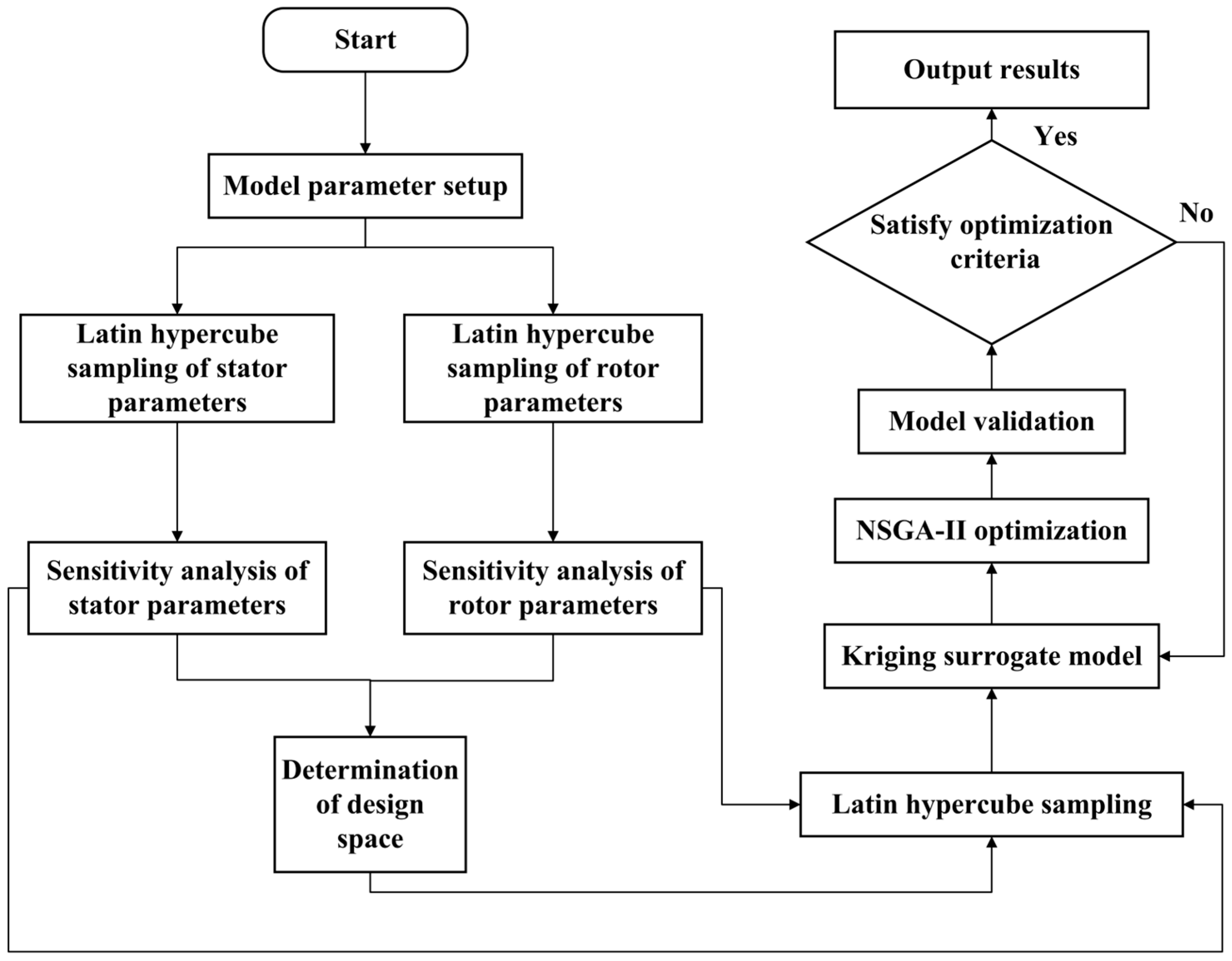
4. Parameter Optimization Design
4.1. Optimization Variable Selection
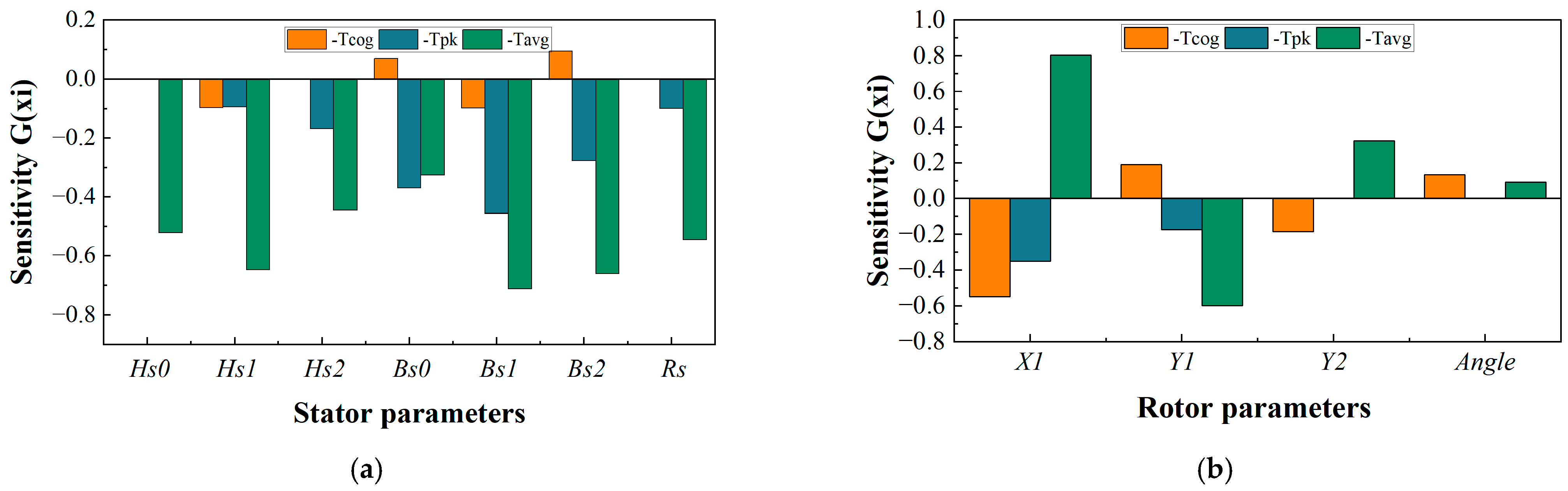
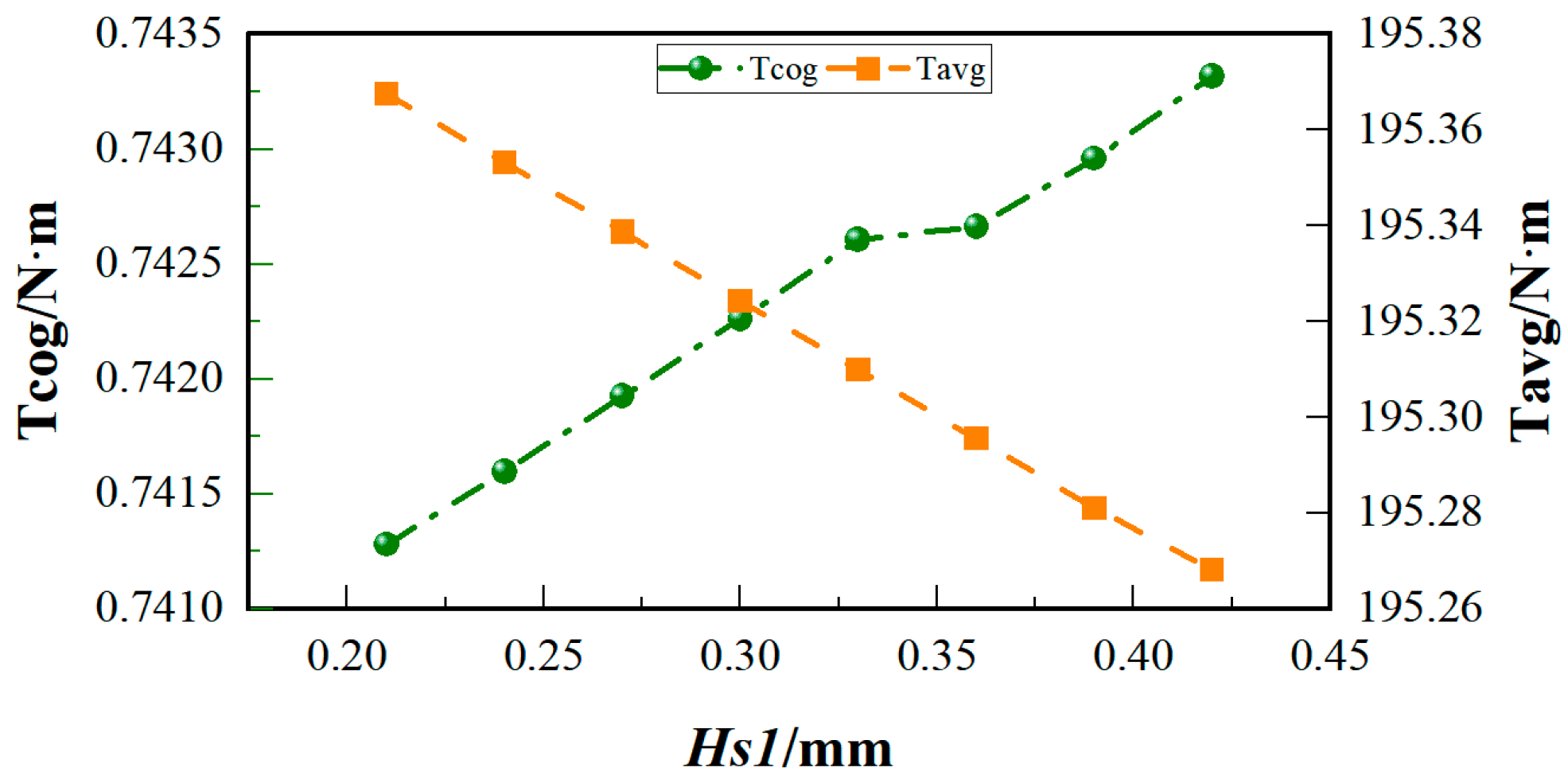
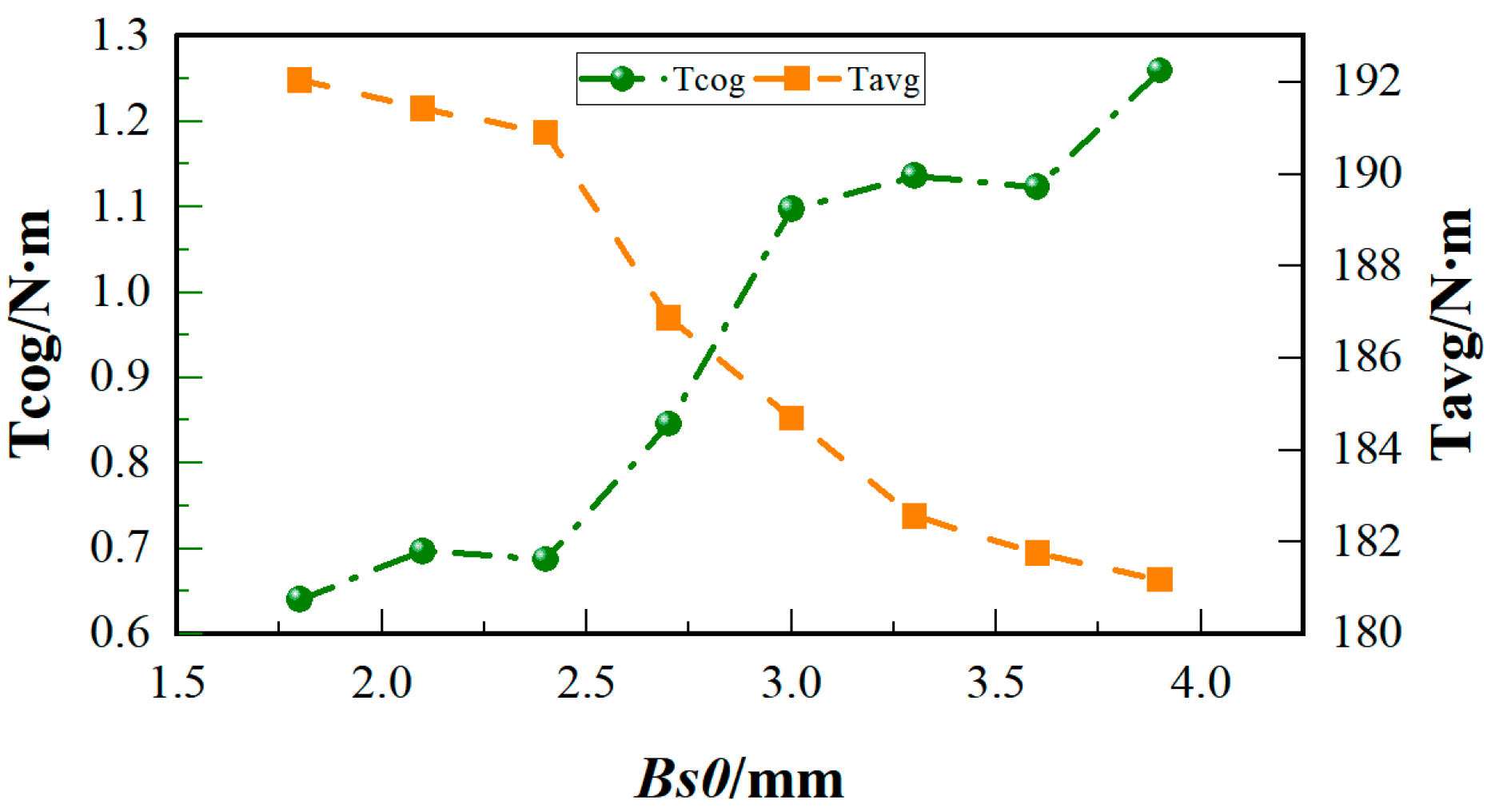
4.2. Sensitivity Analysis
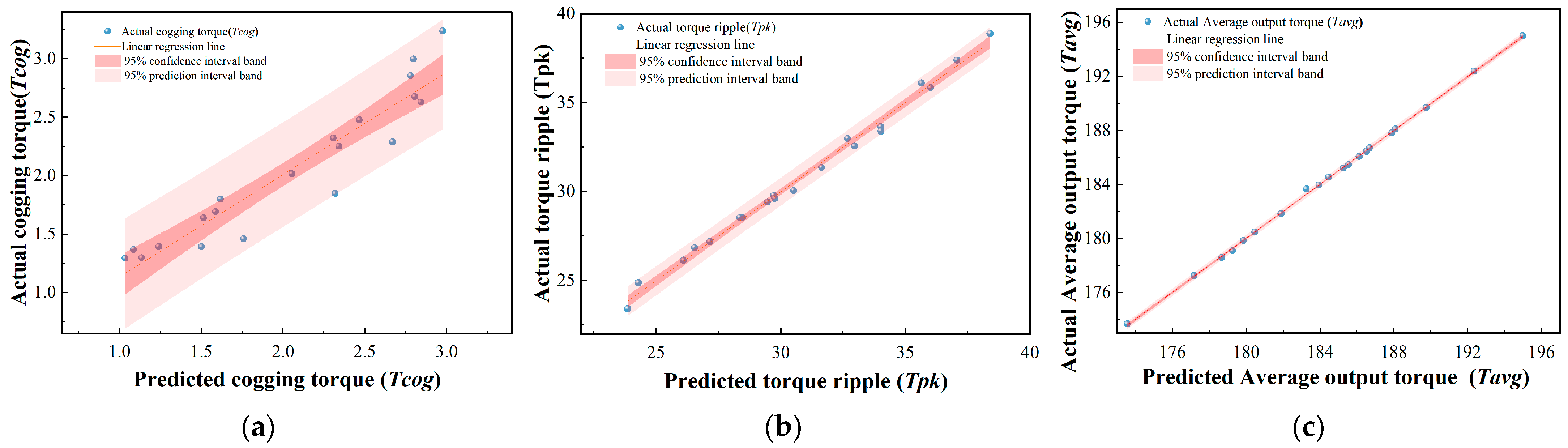
4.3. Development and Validation of the Kriging Surrogate Model
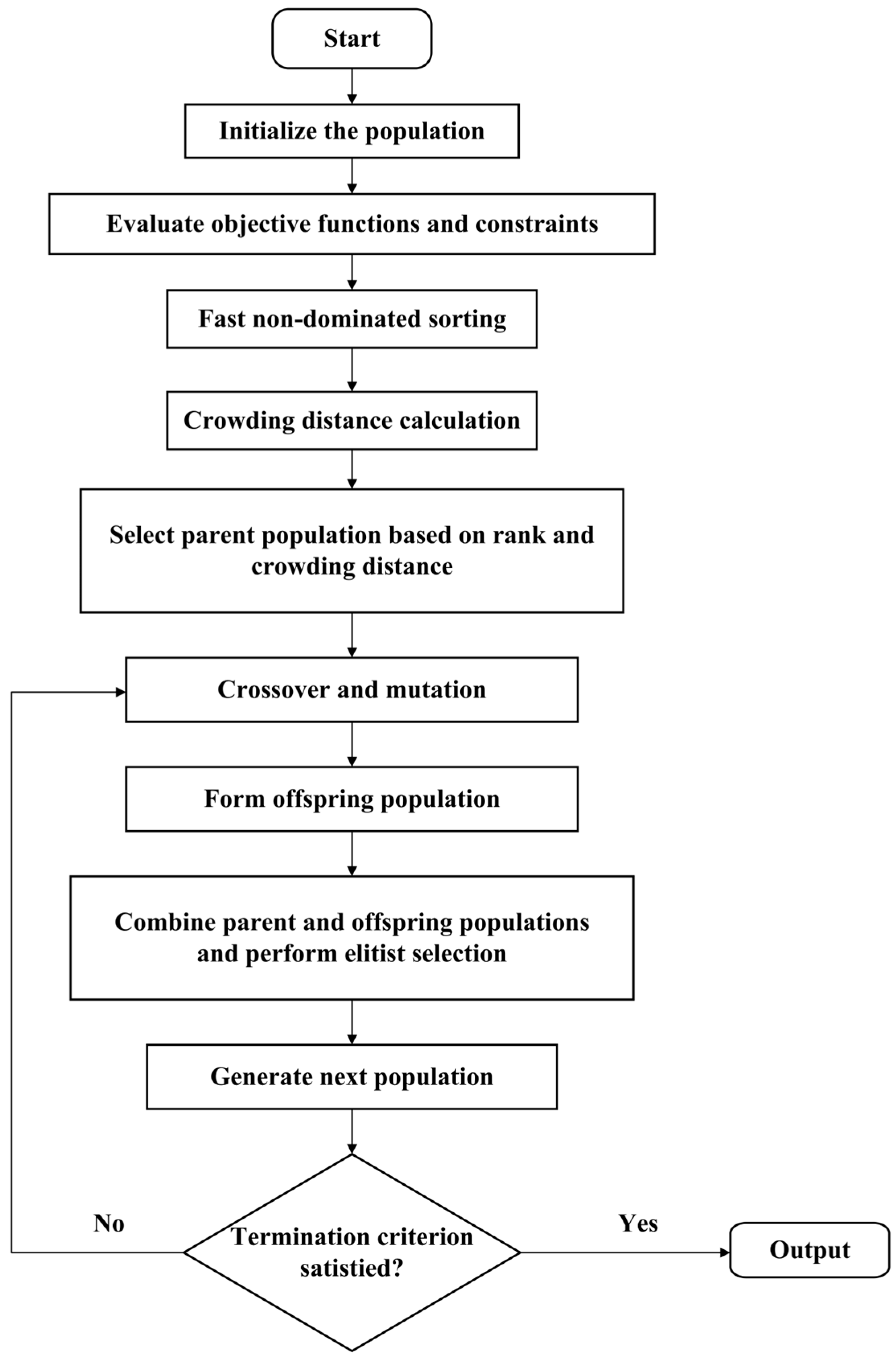
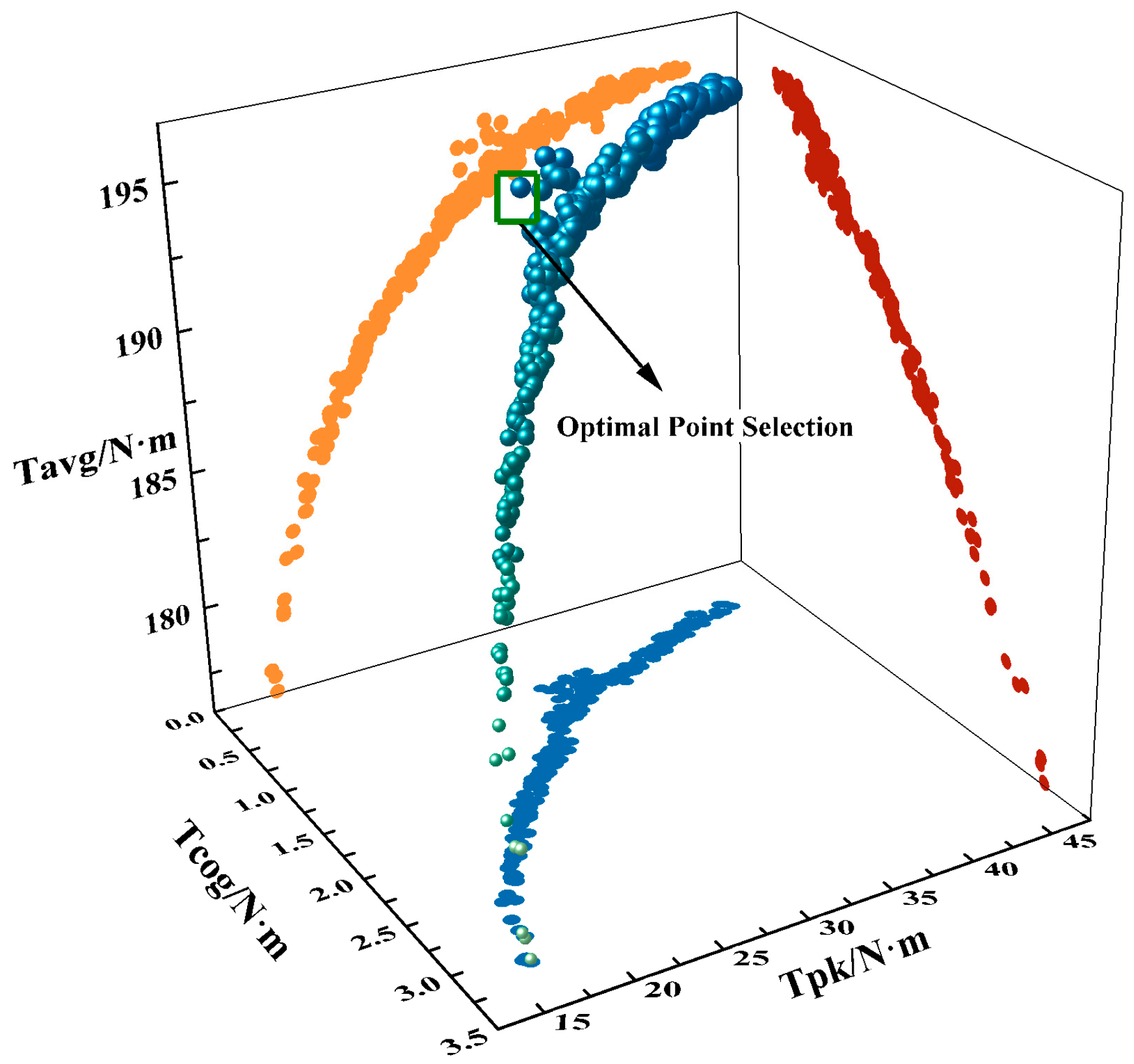
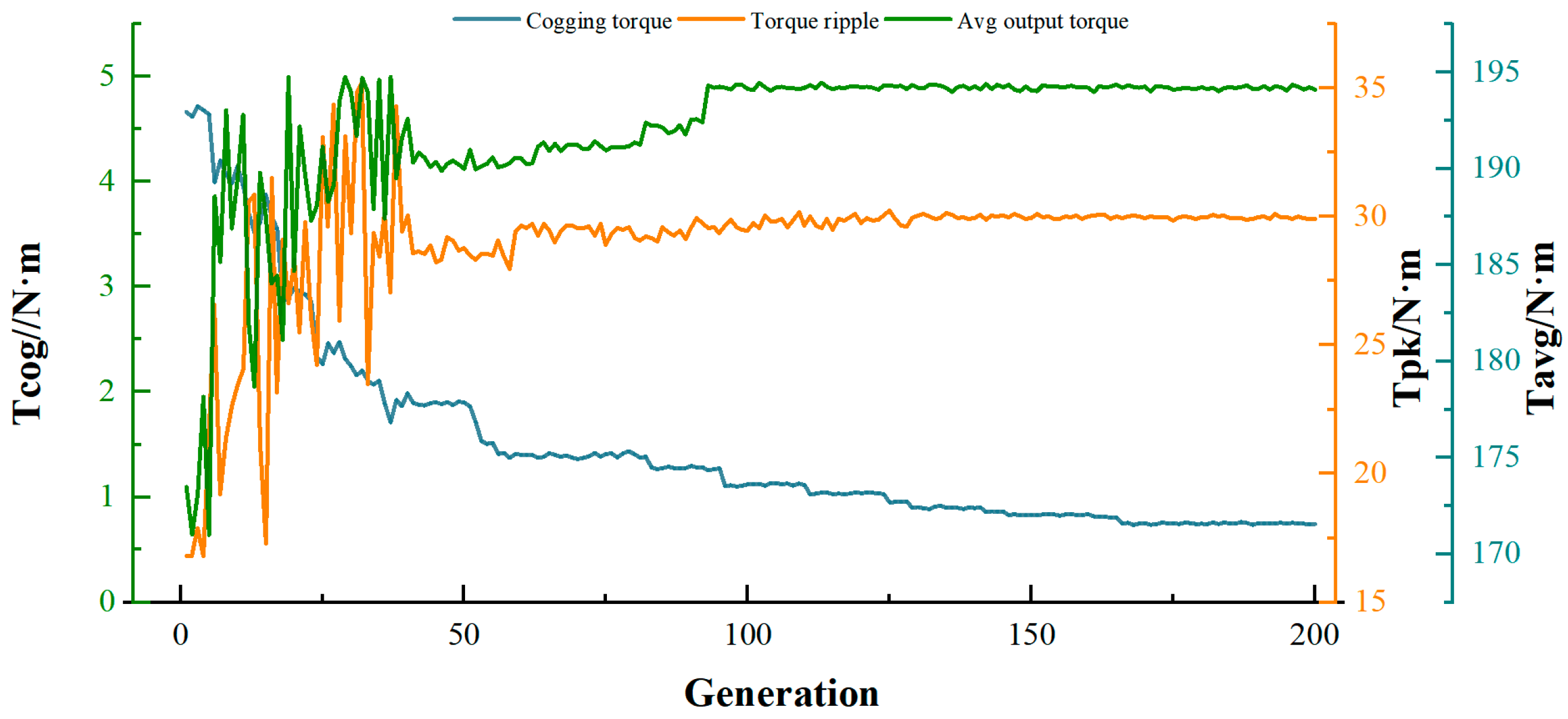
4.4. Construction of Multi-Objective Optimization Model Based on NSGA-II
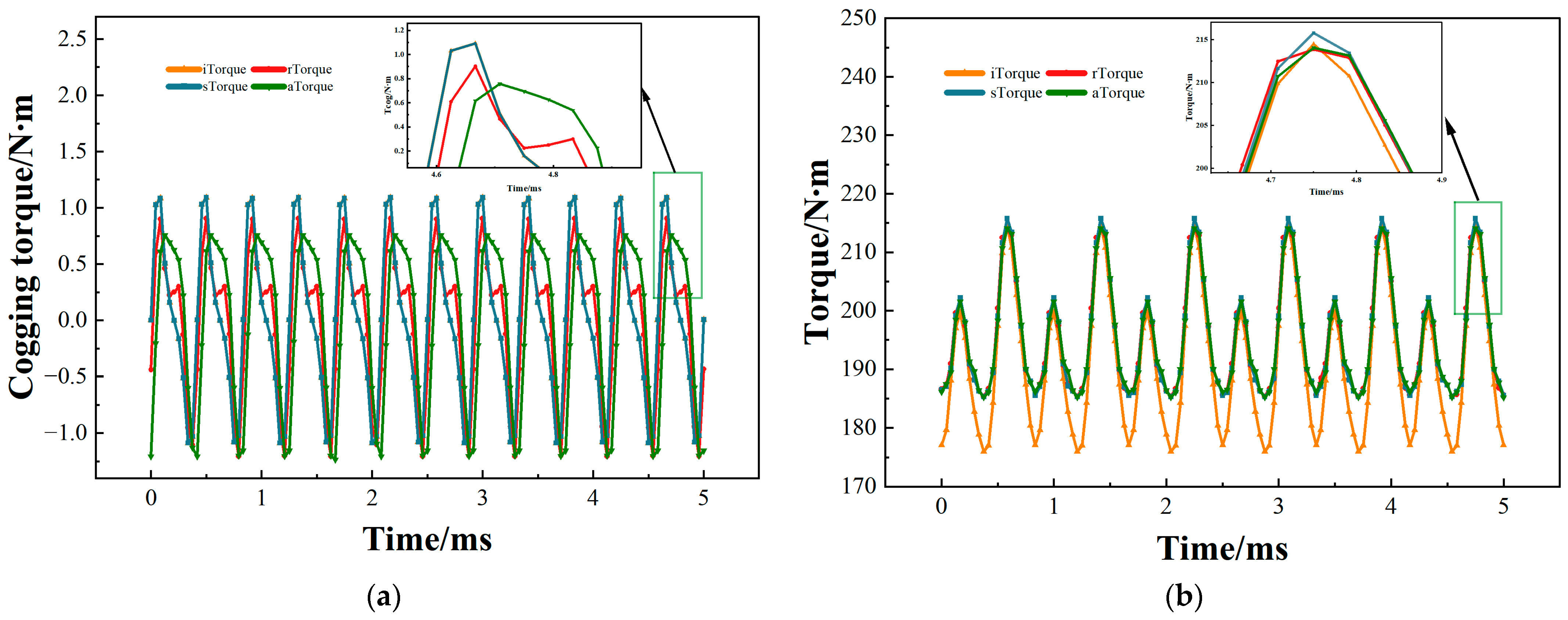
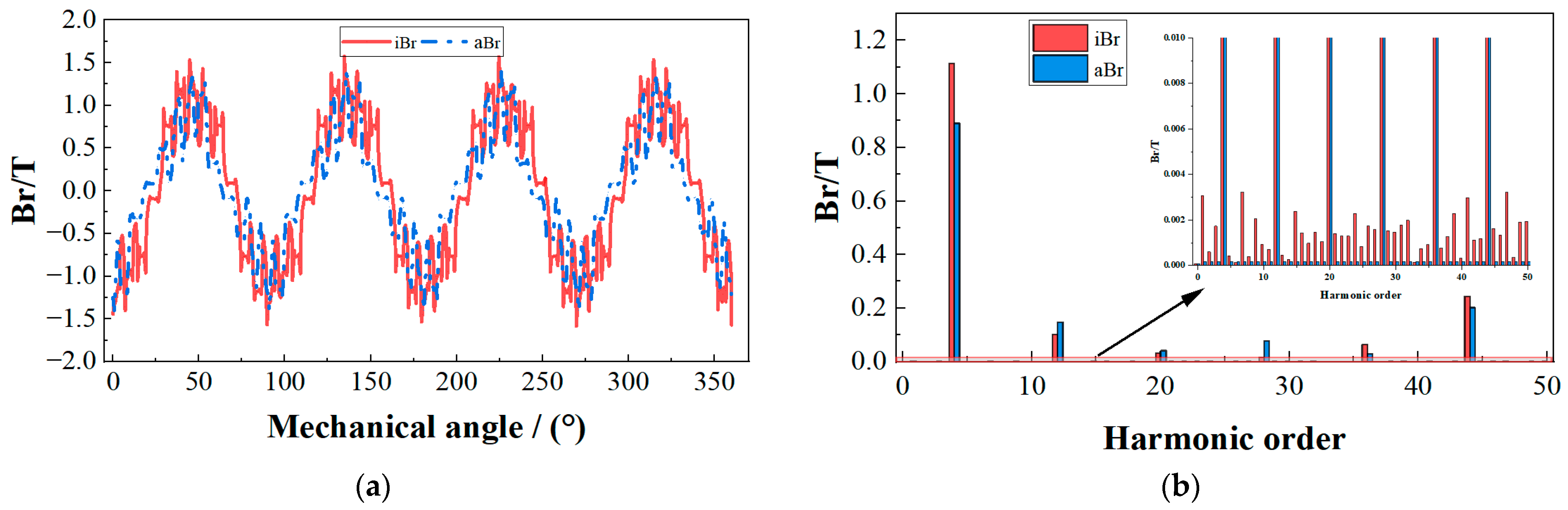
5. Simulation-Based Analysis of Optimization Results
- (1)
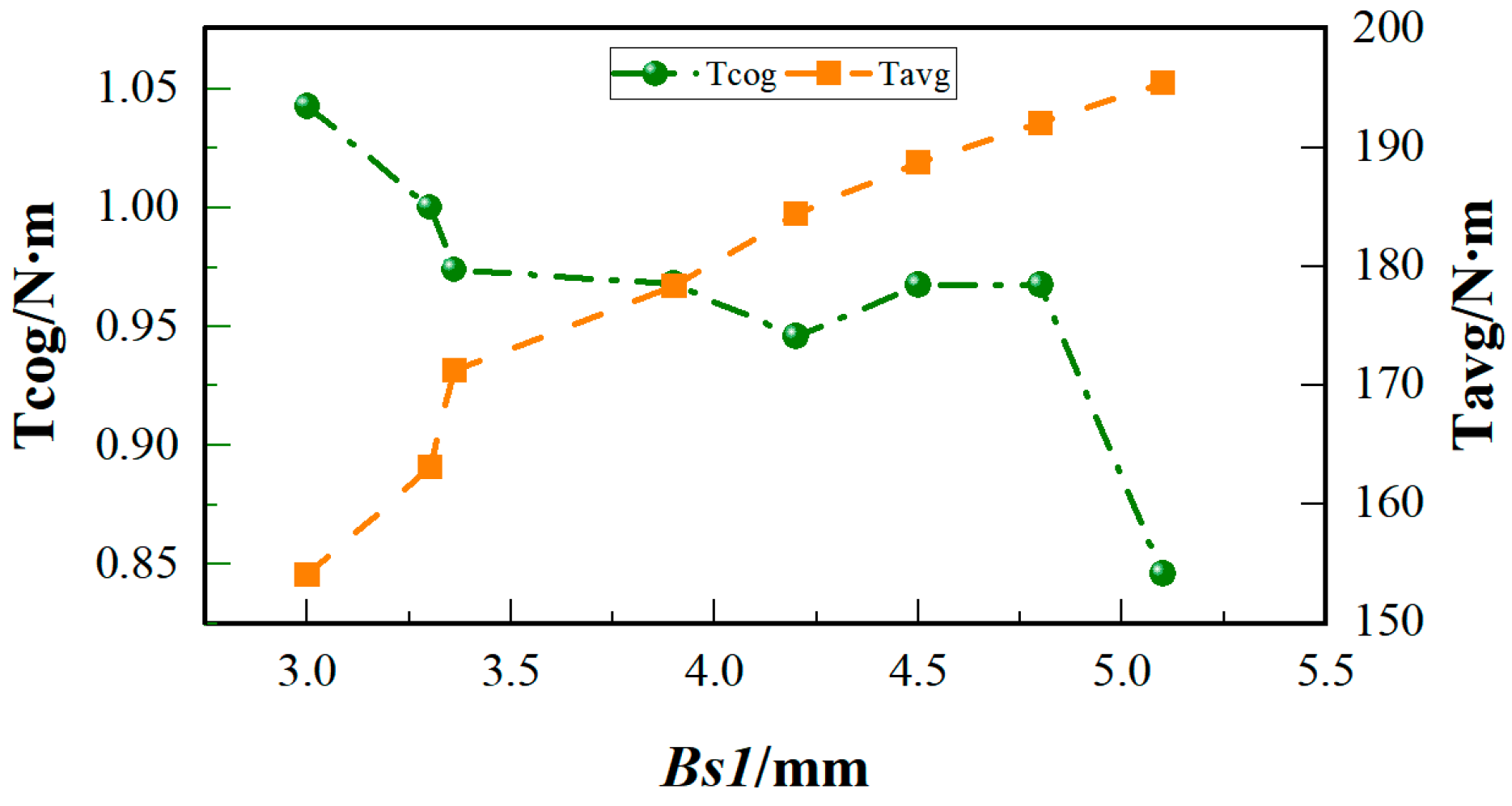
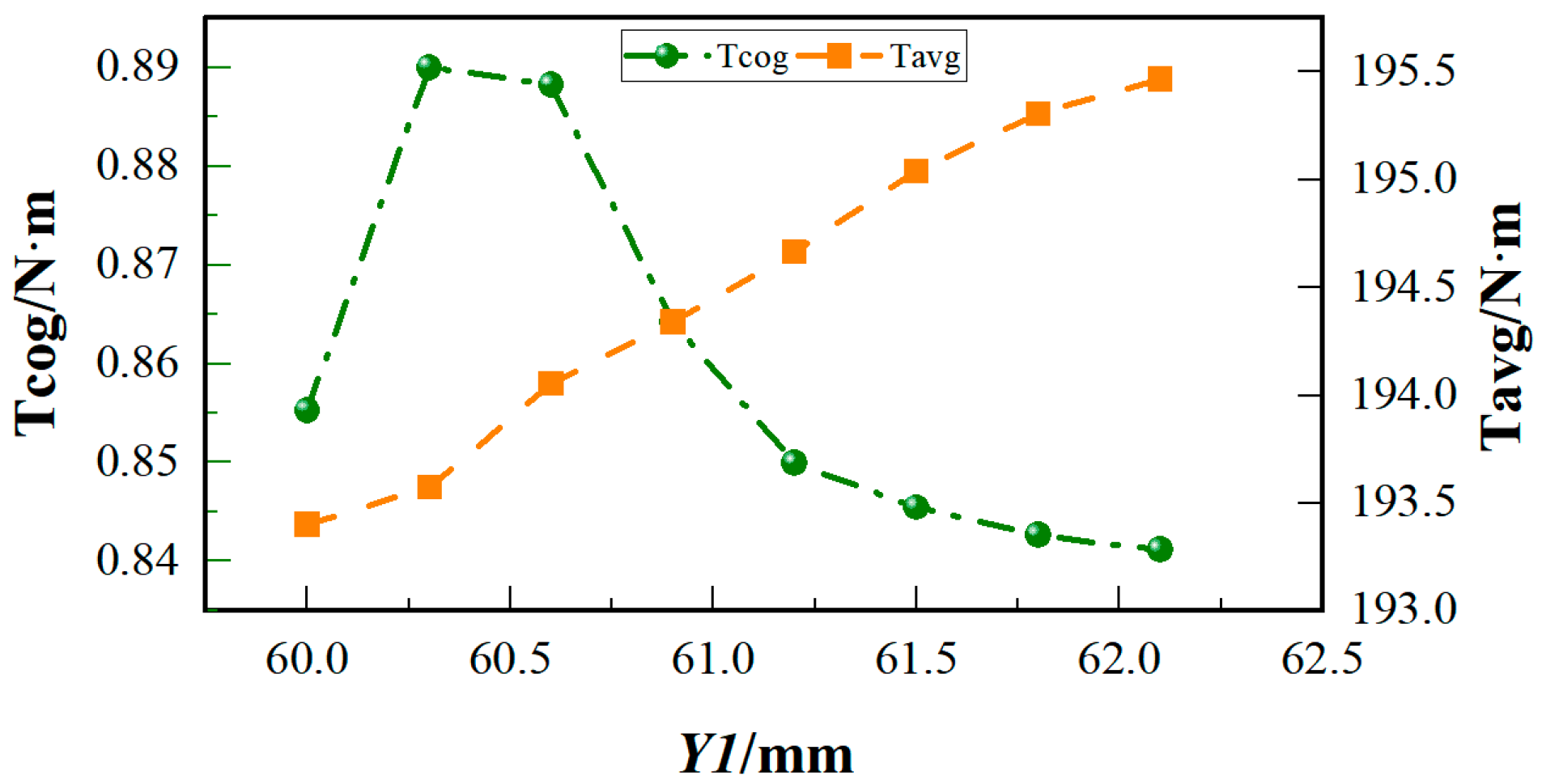
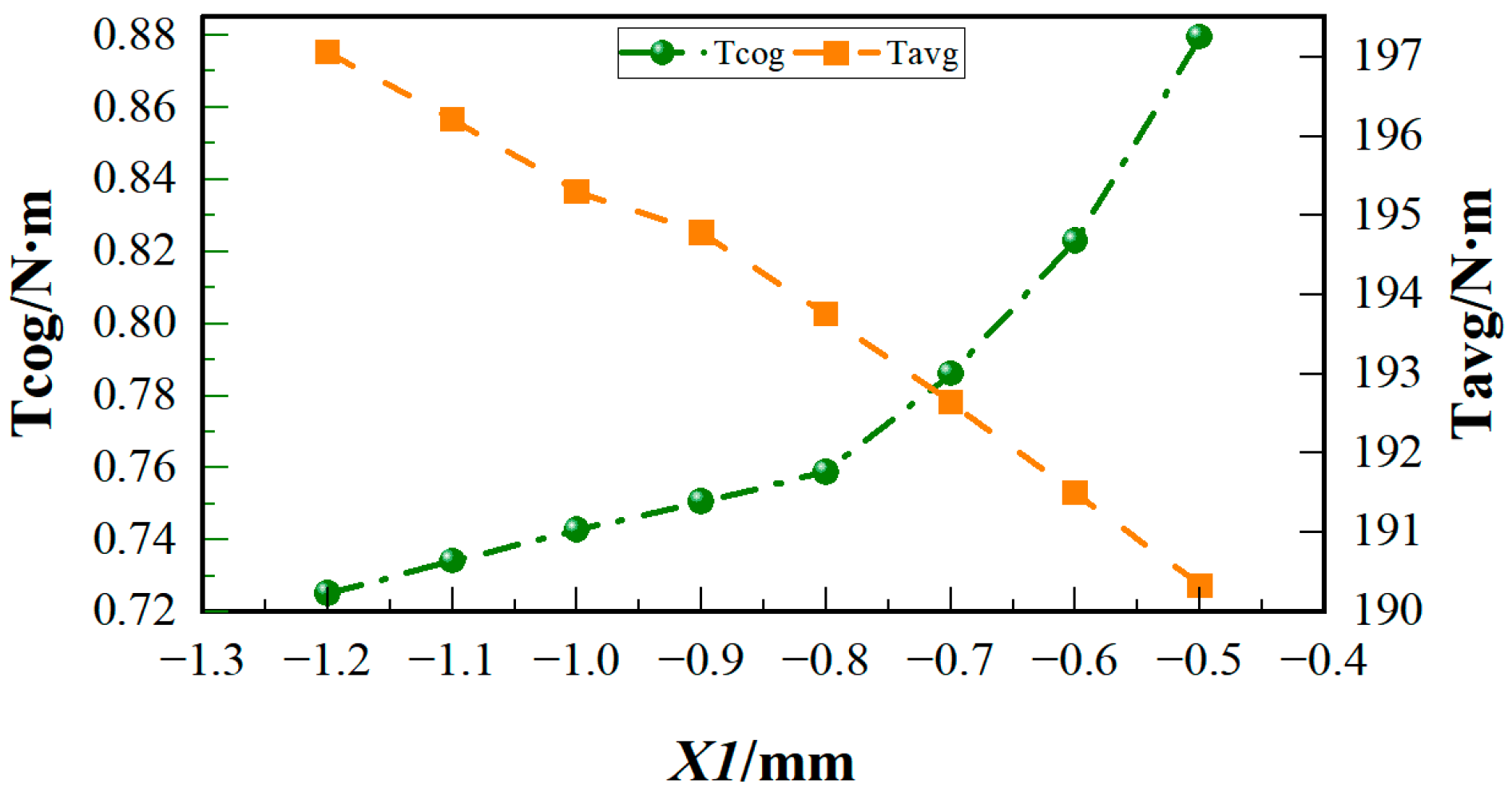
- Sensitivity analysis confirms that torque performance is a coupled output of the entire magnetic circuit, where stator tooth-width Bs0, Bs1 effects are modulated by rotor magnet positioning X1, Y1;
- (2)
- By filtering parameters via a 10% sensitivity threshold and coupling stator slot variables, the design space was reduced to 7 independent variables, enhancing optimization efficiency and ensuring assembly simplicity;
- (3)
- The synergistic configuration effectively suppressed the 24th and 48th spatial harmonics, reducing Tcog and torque ripple rate Trip by 31.8% and 28.1%, respectively, without compromising the 90.1% mechanical safety margin.
Author Contributions
Funding
Data Availability Statement
Conflicts of Interest
References
- Zhu, Z.Q.; Howe, D. Electrical machines and drives for electric, hybrid, and fuel cell vehicles. Proc. IEEE 2007, 95, 746–765. [Google Scholar] [CrossRef]
- Bianchi, N.; Bolognani, S. Design techniques for reducing the cogging torque in surface-mounted PM motors. In Conference Record of the 2000 IEEE Industry Applications Conference. Thirty-Fifth IAS Annual Meeting and World Conference on Industrial Applications of Electrical Energy (Cat. No. 00CH37129); IEEE: New York, NY, USA, 2000; Volume 1, pp. 179–185. [Google Scholar] [CrossRef]
- Islam, M.S.; Mir, S.; Sebastian, T. Issues in reducing the cogging torque of mass-produced permanent-magnet brushless DC motor. IEEE Trans. Ind. Appl. 2004, 40, 813–820. [Google Scholar] [CrossRef]
- Yang, I.J.; Lee, S.H.; Lee, K.B.; Lee, J.; Kim, W.-H.; Jang, I.-S. A process to reduce the electromagnetic vibration by reducing the spatial harmonics of air gap magnetic flux density. IEEE Trans. Magn. 2020, 57, 8103006. [Google Scholar] [CrossRef]
- Huang, J.; Wang, C. Analysis and Suppression of Spoke-Type Permanent Magnet Machines Cogging Torque with Different Conditions for Electric Vehicles. World Electr. Veh. J. 2024, 15, 376. [Google Scholar] [CrossRef]
- Guo, L.; Yu, H.; Wang, H. Design and Optimization of External Rotor Consequent Pole Permanent Magnet Motor with Low Iron Loss and Low Torque Ripple. World Electr. Veh. J. 2024, 15, 232. [Google Scholar] [CrossRef]
- Gao, P.; Sun, X.; Gerada, D.; Gerada, C.; Wang, X. Improved V-shaped interior permanent magnet rotor topology with inward-extended bridges for reduced torque ripple. IET Electr. Power Appl. 2020, 14, 2404–2411. [Google Scholar] [CrossRef]
- Liang, J.; Parsapour, A.; Yang, Z.; Caicedo-Narvaez, C.; Moallem, M.; Fahimi, B. Optimization of air-gap profile in interior permanent-magnet synchronous motors for torque ripple mitigation. IEEE Trans. Transp. Electrif. 2019, 5, 118–125. [Google Scholar] [CrossRef]
- Zhu, Z.Q.; Howe, D. Analytical prediction of the cogging torque in radial-field permanent magnet brushless motors. IEEE Trans. Magn. 1992, 28, 1371–1374. [Google Scholar] [CrossRef]
- Zhu, Z.Q.; Howe, D. Influence of design parameters on cogging torque in permanent magnet machines. In 1997 IEEE International Electric Machines and Drives Conference Record; IEEE: New York, NY, USA, 1997; p. MA1-3. [Google Scholar] [CrossRef]
- Pyrhönen, J.; Jokinen, T.; Hrabovcová, V. Design of Rotating Electrical Machines, 2nd ed.; John Wiley & Sons: Chichester, UK, 2013; pp. 154–200. [Google Scholar]
- Wang, J.; Wang, Y. Electromagnetic torque analysis and structure optimization of interior permanent magnet synchronous machine with Air-Gap eccentricity. Energies 2023, 16, 1665. [Google Scholar] [CrossRef]
- Wang, Y.; Zhao, M.; Huang, Y.; Jia, X.; Lu, M. Torque performance optimization of a novel hybrid PMSM with eccentric Halbach based on improved Taguchi method. IEEE Trans. Instrum. Meas. 2024, 73, 3523712. [Google Scholar] [CrossRef]
- Yu, Y.; Pan, Y.; Chen, Q.; Hu, Y.; Gao, J.; Zhao, Z.; Niu, S.; Zhou, S. Multi-objective optimization strategy for permanent magnet synchronous motor based on combined surrogate model and optimization algorithm. Energies 2023, 16, 1630. [Google Scholar] [CrossRef]
- Moussa, M.F.; Helal, A.; Gaber, Y.; Youssef, H.A. Unity power factor control of permanent magnet motor drive system. In 2008 12th International Middle-East Power System Conference; IEEE: New York, NY, USA, 2008; pp. 360–367. [Google Scholar] [CrossRef]
- Christopher Frey, H.; Patil, S.R. Identification and Review of Sensitivity Analysis Methods. Risk Anal. 2002, 22, 553–578. [Google Scholar] [CrossRef]
- Simpson, T.W.; Poplinski, J.D.; Koch, P.N.; Allen, J.K. Metamodels for Computer-based Engineering Design: Survey and recommendations. Eng. Comput. 2001, 17, 129–150. [Google Scholar] [CrossRef]
- Jin, R.; Chen, W.; Simpson, T.W. Comparative studies of metamodelling techniques under multiple modelling criteria. Struct. Multidiscip. Optim. 2001, 23, 1–13. [Google Scholar] [CrossRef]
- Guo, S.; Su, X.; Zhao, H. Optimal Design of an Interior Permanent Magnet Synchronous Motor for Electric Vehicle Applications Using a Machine Learning-Based Surrogate Model. Energies 2024, 17, 3864. [Google Scholar] [CrossRef]
- Zhang, H.; Wang, G.; Zhang, J.; Gao, Y.; Hua, W.; Wang, Y. An improved Kriging surrogate model method with high robustness for electrical machine optimization. IEEE Trans. Ind. Appl. 2024, 60, 6799–6810. [Google Scholar] [CrossRef]
- Deb, K.; Pratap, A.; Agarwal, S.; Meyarivan, T. A fast and elitist multiobjective genetic algorithm: NSGA-II. IEEE Trans. Evol. Comput. 2002, 6, 182–197. [Google Scholar] [CrossRef]
- Yuan, G.A.O.; Tao, Y.; Bozhko, S.; Wheeler, P.; Dragicevic, T.; Gerada, C. Neural Network aided PMSM multi-objective design and optimization for more-electric aircraft applications. Chin. J. Aeronaut. 2022, 35, 233–246. [Google Scholar] [CrossRef]
- Sun, C.; Li, Q.; Fan, T.; Wen, X.; Li, Y.; Li, H. Multi-objective optimal design of 200 kW permanent magnet synchronous motor based on NSGA-II. World Electr. Veh. J. 2025, 16, 299. [Google Scholar] [CrossRef]
- Wang, X.; Yang, Y.; Fu, D. Study of Cogging Torque in Surface-Mounted Permanent Magnet Motors with Energy Method. J. Magn. Magn. Mater. 2003, 267, 80–85. [Google Scholar] [CrossRef]
- Zhu, L.; Jiang, S.Z.; Zhu, Z.Q.; Chan, C.C. Analytical methods for minimizing cogging torque in permanent-magnet machines. IEEE Trans. Magn. 2009, 45, 2023–2031. [Google Scholar] [CrossRef]
- Mirahki, H.; Moallem, M. Analytical prediction of cogging torque for interior permanent magnet synchronous machines. Prog. Electromagn. Res. M 2014, 37, 31–40. [Google Scholar] [CrossRef]
- Wang, L.; Lu, S.; Chen, Y. Two-dimensional analytical models for cogging torque prediction in interior permanent magnet ma chine. Machines 2023, 11, 233. [Google Scholar] [CrossRef]
- Zarko, D.; Ban, D.; Lipo, T.A. Analytical calculation of magnetic field distribution in the slotted air gap of a surface permanent-magnet motor using complex relative air-gap permeance. IEEE Trans. Magn. 2006, 42, 1828–1837. [Google Scholar] [CrossRef]
- Sun, T.; Dai, Y.; Wang, Z.T.; Liu, W. Analysis of the Generation and Weakening of Cogging Torque in Interior Permanent Magnet Machine. J. Phys. Conf. Ser. 2020, 1549, 052082. [Google Scholar] [CrossRef]
- Lee, S.; Kim, C.; Choo, Y.; Yun, G.; Lee, C. Torque analysis of a permanent magnet synchronous motor using flux densities in air gap. AIP Adv. 2023, 13, 025313. [Google Scholar] [CrossRef]
- You, Y.m. Multi-objective optimal design of permanent magnet synchronous motor for electric vehicle based on deep learning. Appl. Sci. 2020, 10, 482. [Google Scholar] [CrossRef]
- White, S.E.; Witing, F.; Wittekind, C.I.H.; Volk, M.; Strauch, M. Distilling the Pareto optimal front into actionable insights. Environ. Model. Softw. 2025, 191, 106508. [Google Scholar] [CrossRef]








| Parameter Name | Parameter Value |
|---|---|
| Stator outer diameter/mm | 198 |
| Stator inner diameter/mm | 132 |
| Air gap length/(mm) | 1 |
| Rotor inner diameter/(mm) | 80 |
| Core length/(mm) | 150 |
| Number of slots | 48 |
| Number of pole pairs | 4 |
| Load velocity/(rpm) | 6000 |
| Load torque/(N·m) | 191 |
| Rated power/(kW) | 120 |
| Rotor Parameter Name | Parameter Range |
|---|---|
| X1/(mm) | −1.2–−0.5 |
| Y1/(mm) | 60.0–62.5 |
| Y2/(mm) | 62.5–64.2 |
| Angle/(°) | 2.4–3.5 |
| Stator Parameter Name | Parameter Range/(mm) |
|---|---|
| Slot Opening Height Hs0 | 0.5–1.2 |
| Slot Core Height Hs1 | 0.21–0.42 |
| Slot Width Height Hs2 | 15.5–18.5 |
| Slot Opening Width Bs0 | 1.8–4.0 |
| Slot Core Width Bs1 | 3.0–4.5 |
| Slot Bottom Width Bs2 | 5.2–7.2 |
| Slot Bottom Fillet Radius R | 2.0–3.5 |
| Surrogate Model | Cogging Torque (Tcog) | Torque Ripple (Tpk) | Average Torque (Tavg) | |||
|---|---|---|---|---|---|---|
| R2 | MAE/% | R2 | R2 | MAE/% | R2 | |
| Kriging | 0.908 | 5.58 | 0.994 | 0.95 | 0.996 | 0.03 |
| RSM | 0.882 | 6.52 | 0.978 | 0.99 | 0.999 | 0.02 |
| RBF | 0.812 | 8.86 | 0.925 | 1.09 | 0.979 | 0.79 |
| Optimization Design Variable | Optimal Interval/mm |
|---|---|
| Hs1 | 0.25–0.40 |
| Bs0 | 2.25–2.70 |
| Bs1 | 4.50–5.09 |
| X1 | −1.20–−0.80 |
| Y1 | 61–62 |
| Y2 | 63–64 |
| Parameter | Optimization Results | Simulation Results |
|---|---|---|
| Tcog/(N·m) | 0.744 | 0.75 |
| Tpk/(N·m) | 29.53 | 29.37 |
| Tavg/(N·m) | 194.12 | 194.23 |
| Parameter | Initial Value /mm | Stator-Only/mm | Rotor-Only /mm | Optimized Value/mm |
|---|---|---|---|---|
| Hs0 | 1 | 0.934 | - | - |
| Hs1 | 0.373 | 0.277 | - | 0.335 |
| Hs2 | 17.541 | 18.101 | - | - |
| Bs0 | 3 | 2.729 | - | 2.457 |
| Bs1 | 4.314 | 4.503 | - | 5.094 |
| Bs2 | 6.614 | 5.832 | - | 6.733 |
| Rs | 2 | 1.548 | - | - |
| X1 | −1 | - | −0.841 | −1.133 |
| Y1 | 61.992 | - | 60.625 | 61.914 |
| Y2 | 63.992 | - | 64.136 | 63.895 |
| Angle | 2.732 | - | 2.963 | - |
| Optimization Objective | Tcog/(N·m) | Trip/(%) | Tavg/(N·m) |
|---|---|---|---|
| Before Optimization | 1.10 | 21.04 | 191.20 |
| After Optimization | 0.75 | 15.12 | 194.23 |
Disclaimer/Publisher’s Note: The statements, opinions and data contained in all publications are solely those of the individual author(s) and contributor(s) and not of MDPI and/or the editor(s). MDPI and/or the editor(s) disclaim responsibility for any injury to people or property resulting from any ideas, methods, instructions or products referred to in the content. |
© 2026 by the authors. Published by MDPI on behalf of the World Electric Vehicle Association. Licensee MDPI, Basel, Switzerland. This article is an open access article distributed under the terms and conditions of the Creative Commons Attribution (CC BY) license.
Share and Cite
Gao, C.; Han, Y.; Liang, K.; Li, M.; Su, S.; Zhu, Y. Coordinated Stator–Rotor Structural Optimization of an Automotive IPMSM for Improved Torque Performance. World Electr. Veh. J. 2026, 17, 272. https://doi.org/10.3390/wevj17050272
Gao C, Han Y, Liang K, Li M, Su S, Zhu Y. Coordinated Stator–Rotor Structural Optimization of an Automotive IPMSM for Improved Torque Performance. World Electric Vehicle Journal. 2026; 17(5):272. https://doi.org/10.3390/wevj17050272
Chicago/Turabian StyleGao, Chunyan, Yimeng Han, Kunfeng Liang, Min Li, Shiman Su, and Yun Zhu. 2026. "Coordinated Stator–Rotor Structural Optimization of an Automotive IPMSM for Improved Torque Performance" World Electric Vehicle Journal 17, no. 5: 272. https://doi.org/10.3390/wevj17050272
APA StyleGao, C., Han, Y., Liang, K., Li, M., Su, S., & Zhu, Y. (2026). Coordinated Stator–Rotor Structural Optimization of an Automotive IPMSM for Improved Torque Performance. World Electric Vehicle Journal, 17(5), 272. https://doi.org/10.3390/wevj17050272