


Abstract
This paper presents a comprehensive systematic review examining the application of augmented reality (AR) and sensor technologies for visualizing ionizing radiation in virtual training environments. The review methodology involved systematic identification and analysis of the relevant literature based on predetermined criteria including publication type, year of publication, application domain, and technological approach. The literature search encompassed publications from 2011 to 2021 across four major academic databases: Web of Science, Google Scholar, IEEE Xplore, and Scopus. Through rigorous screening following PRISMA 2020 guidelines, 23 research articles met the inclusion criteria for detailed analysis. From 404 initial database records, 360 were excluded during title/abstract screening (primarily for lacking AR components, radiation focus, or training applications) and 4 during full-text assessment (all for lacking sensor integration). The findings reveal that AR-based ionizing radiation visualization has been successfully implemented across diverse domains, including nuclear facility operations, medical procedures, CERN research activities, and educational and monitoring applications. The analysis identified multiple dimensions of impact, encompassing distinct benefits, emerging opportunities, and implementation challenges associated with AR deployment for ionizing radiation training. Each of these dimensions is comprehensively examined and documented within this review. Additionally, this study identifies critical research gaps that currently limit the full potential of AR technology in supporting ionizing radiation training programs. These gaps are systematically analyzed and discussed to establish clear directions for future research endeavors in this emerging field.
1. Introduction
Radiation safety has emerged as an increasingly critical concern in current society, given the rising levels of man-made radiation exposure that includes both non-ionizing and ionizing radiation (IR) that individuals encounter in their daily lives [1]. The International Atomic Energy Agency (IAEA) distinguishes between these radiation types, noting that while non-ionizing radiation from sources such as microwaves and mobile devices poses no established health risk, exposure to IR presents significant health concerns, whether through single high-dose exposure or cumulative low-dose exposure over extended periods [2]. Various commercial, industrial, and medical applications generate IR, ranging from tanning facilities and nuclear power installations to diagnostic medical X-ray procedures [3]. Consequently, comprehensive radiation safety education and training has become essential, particularly given that inadequate monitoring practices have resulted in insufficient general awareness and understanding of radiation safety principles [4,5]. Virtual training environments enhanced with immersive technologies, particularly augmented reality (AR), offer a convincing solution by facilitating realistic simulations that optimize training effectiveness while minimizing actual IR exposure risks for trainees [6].
The widespread presence of IR in modern environments stems directly from technological progress in medical and energy sectors. Since humans lack any natural physiological mechanism for detecting IR, which exists entirely beyond the visible electromagnetic spectrum, technological solutions become essential. AR technology addresses this limitation by overlaying digital information onto real-world visual perception, thereby enabling IR visualization for healthcare applications, training scenarios, and educational contexts [7]. While conventional IR visualization methods depend on approximate interpolation and basic mathematical computations performed on-site, AR technology provides an immersive platform for real-time radiation dose monitoring, estimation, and visualization, while simultaneously presenting additional contextual information [8]. Demonstrating educational applications, Schiano Lo Moriello et al. [9] created an AR-based educational application that allows students to safely interact with simulated radioactive materials. Moreover, AR technology demonstrates superior accuracy and precision compared to unaided human observations [9]. AR applications have achieved millimeter-level precision with accuracy rates reaching 95%, proving particularly valuable for critical medical procedures [10].
While AR technology facilitates radiation distribution visualization, effective IR monitoring necessitates appropriate sensor systems. Various sensor technologies, including Geiger–Müller counters, enable detection and measurement of radiation from radioactive sources [11]. Contemporary IR monitoring solutions encompass mobile detection units, wireless sensor networks, and unmanned aerial vehicle (UAV) platforms [11]. Addressing industrial applications, Tran-Quang and Dao-Viet [12] developed the Internet of Radiation Sensor System, integrating multiple wireless mobile and stationary sensors to identify radioactive materials in waste recycling and metal processing facilities. UAV-based monitoring systems have gained considerable traction due to their cost-effectiveness and ability to operate without direct human presence [13]. Lee and Kim [14] evaluated various UAV sensor configurations for radiological surveillance missions and introduced a novel figure of merit to assist researchers in selecting optimal systems for aerial radiation surveys.
The integration of AR visualization and sensor technologies presents substantial opportunities for advancing virtual training in radiation safety, particularly for monitoring procedures. The combined application of these technologies in IR-focused virtual training has gathered increasing attention within the research community. As AR implementation continues to expand across various training and educational domains, we observe growing momentum toward adopting AR for IR-related training and educational programs. Consequently, researchers would benefit significantly from a comprehensive understanding of current developments in this field, motivating this study’s focus on analyzing and synthesizing existing research and identifying future research trajectories.
While virtual reality (VR) has indeed been explored for radiation safety training, AR presents fundamentally different capabilities that warrant separate investigation [15]. VR creates fully immersive, synthetic environments where users train in simulated scenarios completely removed from actual radiation sources. In contrast, AR overlays digital information onto real-world environments, enabling in-situ training and real-time operational support that VR cannot provide. The distinction is critical for several reasons:
- 1.
- Operational Context Preservation: Unlike VR, AR allows trainees to maintain visual and spatial awareness of their actual work environment. When training for radiation safety in nuclear facilities or medical settings, understanding the specific spatial configurations, equipment placement, and environmental constraints is essential. VR training, while valuable for initial familiarization, cannot replicate the complexity of real operational environments.
- 2.
- Real-time Sensor Integration: AR uniquely enables live radiation sensor data to be visualized in the actual space where radiation exists. While VR can simulate radiation fields, AR can display actual, real-time radiation measurements overlaid on the physical environment. This capability transforms AR from a training tool into an operational safety system.
- 3.
- Transitional Training: AR bridges the gap between simulated VR training and real-world operations. Trainees can progress from VR simulations to AR-guided practice with actual (low-level) radiation sources, providing a scaffolded learning experience impossible with VR alone.
- 4.
- Simultaneous Operation and Training: Medical professionals and nuclear facility operators often cannot leave their work environment for VR training. AR enables “training while doing”—providing guidance and safety information during actual procedures rather than requiring separate training sessions.
Furthermore, the 2011–2021 period saw dramatic advances in AR-specific technologies (mobile AR [16], HoloLens [17], and ARCore/ARKit) that fundamentally changed implementation possibilities. These developments, irrelevant to VR, necessitate focused analysis.
To our knowledge, no comprehensive systematic review has examined the intersection of AR technology and sensor systems specifically for IR safety training. While previous reviews have explored AR in medical training [18] or radiation detection technologies independently [19], the convergence of these technologies for training applications remains unexamined. This gap is particularly significant given the rapid advancement in both AR capabilities and sensor miniaturization between 2011–2021, a period marked by the widespread adoption of mobile AR platforms and IoT-enabled radiation sensors. This review addresses this critical gap by providing the first systematic analysis of how these converging technologies enhance radiation safety training effectiveness.
Although augmented reality has been reviewed in broader medical and surgical education contexts, existing reviews generally address AR or AR/VR together, emphasize educational use cases across diverse specialties, or focus on clinical training rather than ionizing radiation safety training with sensor-integrated AR systems [6,18,20,21,22]. For example, previous reviews have focused on AR-assisted surgical guidance and procedural simulation without analyzing radiation sensor integration architectures or data pipelines for safety training contexts. Similarly, broader AR-in-education reviews synthesize pedagogical outcomes but do not examine sensing modality, spatial registration, or system architecture in radiation-specific environments. In contrast, the present review applies narrower eligibility criteria that require the combined use of AR visualization and radiation sensor data within ionizing radiation training or educational contexts. This focus allows us to compare not only training applications, but also implementation architecture, sensor selection, data transmission strategies, and domain-specific deployment constraints that are not typically synthesized in prior AR education reviews.
This systematic review encompasses peer-reviewed articles that explicitly combine AR visualization with radiation sensor data for training or educational purposes. Included studies must demonstrate: (1) use of AR technology for visualization, (2) integration with radiation detection sensors, and (3) application to training or educational contexts. Excluded from this review are studies focusing solely on AR without sensor integration, pure visualization without training components, or theoretical proposals without implementation. This review considers all types of AR devices (head-mounted displays, mobile devices, and projection-based systems) and radiation regardless of geographical origin, though it is limited to English-language publications. Although published literature on this specific topic remains relatively limited, this study provides a systematic review of available research identified through comprehensive database searches, examining AR applications that utilize sensor data to develop and enhance professional training programs. The investigation primarily emphasizes IR safety applications and the potential of AR to improve IR-related safety protocols.
This review makes several key contributions to the field: it (1) provides the first comprehensive synthesis of AR–sensor integration for IR training across multiple domains, (2) develops a novel categorization framework for classifying implementation approaches, (3) identifies critical technological and pedagogical gaps hindering widespread adoption, and (4) establishes a research agenda for advancing the field. The review follows PRISMA (Preferred Reporting Items for Systematic Reviews and Meta-Analyses) guidelines, employing a systematic search strategy across four major databases, rigorous inclusion/exclusion criteria, and qualitative synthesis methods to analyze the selected studies. These contributions are realized through a structured extraction schema and a comparative synthesis applied consistently across the included studies, as described in Section 2.4, Section 2.5 and Section 2.6 and reported in Section 3.
This review examines how augmented reality systems integrate radiation sensing to support ionizing radiation safety training. To move beyond study description and toward comparable design and implementation insight, we address the following research questions.
- What end-to-end implementation approaches are used for augmented reality and sensor integration in ionizing radiation safety training, including platform choice, spatial registration, sensing modality, and radiation information representation?
- What system architectures and data pipelines recur across implementations, and what trade-offs are reported regarding latency, reliability, and deployment constraints?
- How are training objectives and evaluation approaches operationalized, and what evidence is reported regarding usability, learning outcomes, task performance, or safety-related proxy measures?
- What technical factors, human factors, and evaluation gaps limit adoption and comparability, and what recommendations follow directly from these gaps?
The remainder of the paper is organized as follows. Section 2 describes the systematic review methodology, including search strategy, inclusion criteria, extraction schema, and synthesis approach. Section 3 reports the results and cross-study comparative synthesis. Section 4 discusses implications, limitations, and recommendations, and Section 5 concludes the paper.
2. Methods
This systematic review adheres to the Preferred Reporting Items for Systematic Reviews and Meta-Analyses (PRISMA) 2020 guidelines. The PRISMA statement, initially developed in 2009 through collaboration among 29 review authors, methodologists, consumers, and interdisciplinary experts, was created to enhance the quality and transparency of systematic review reporting [23]. Following significant methodological advancements and terminological evolution over the subsequent decade, the PRISMA 2020 guidelines were established to supersede the previous version, providing updated reporting standards that reflect contemporary best practices in systematic review methodology [24].
2.1. Eligibility Criteria and Search Strategy
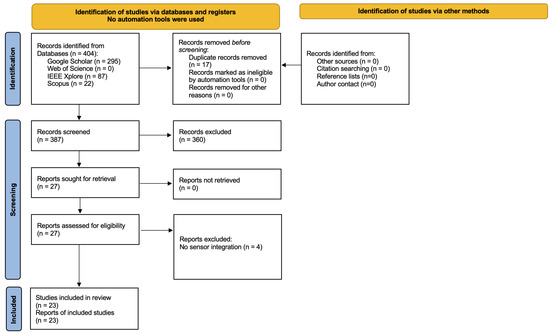
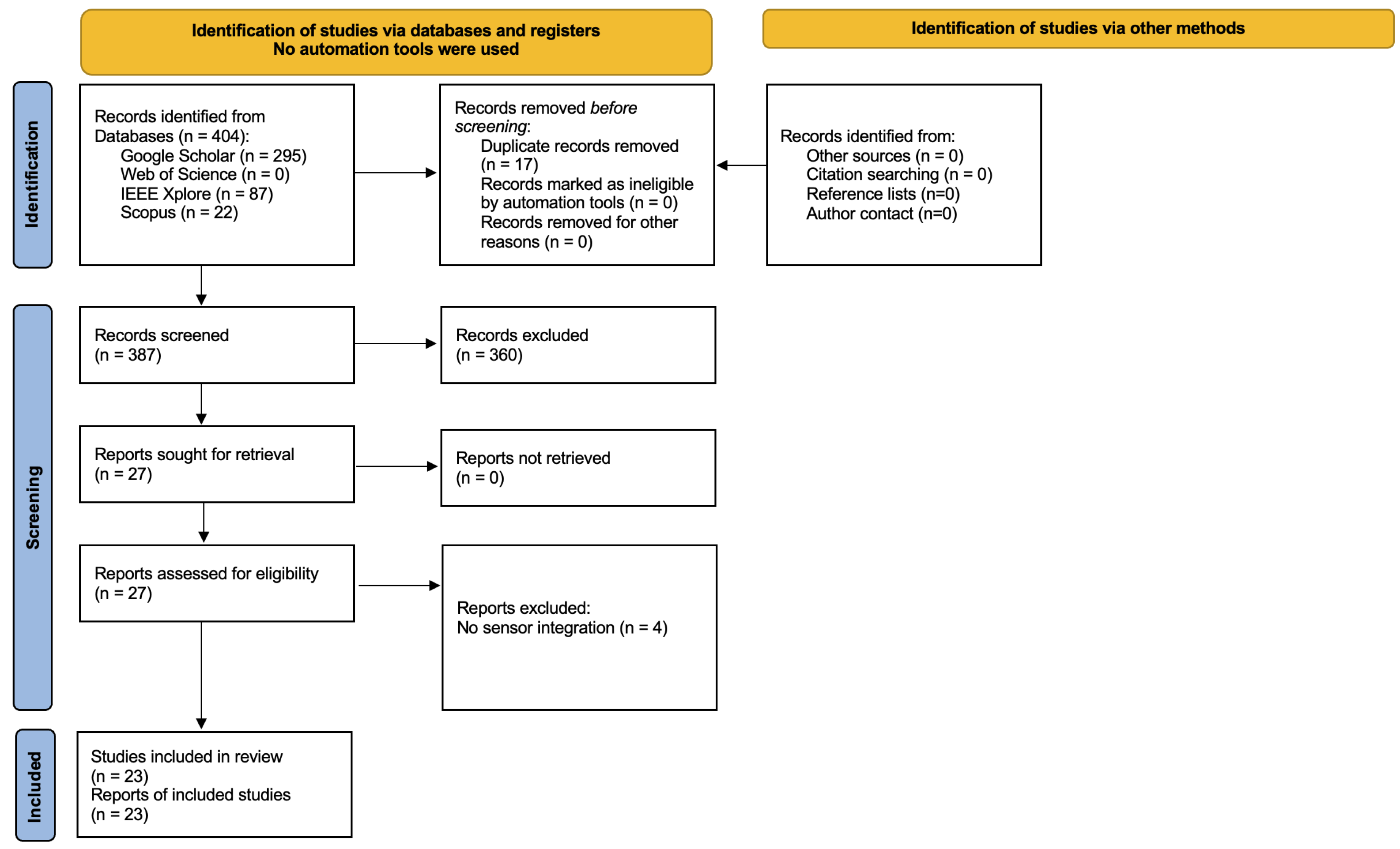
The systematic literature selection process, illustrated in Figure 1, was executed through three sequential phases: Identification, Screening, and Included. The review considered all peer-reviewed journal articles, conference proceedings, and academic theses that documented existing state-of-the-art applications combining AR and sensor technologies for radiation safety purposes.
Figure 1.
Flowchart of the article selection process based on inclusion/exclusion criteria.
Four primary academic databases were systematically searched to ensure comprehensive coverage of relevant literature: Google Scholar, Web of Science, IEEE Xplore, and Scopus. These databases were selected based on their extensive coverage of interdisciplinary research spanning technology, engineering, medical physics, and safety training domains, thereby capturing the vast majority of publications relevant to this review.
The search strategy employed four core keywords: “augmented reality,” “ionizing radiation,” “sensor,” and “training.” This keyword combination was strategically selected to align with the research objectives of examining AR-based training systems specifically designed for IR safety protocols. Boolean operators were used to create systematic search strings combining these terms across all databases. Publications were required to satisfy the following inclusion criteria:
- 1.
- Published in the English language
- 2.
- Publication date between 2011 and 2021 (representing a 10-year period of technological advancement in AR and sensor technologies)
- 3.
- Explicit focus on AR technology implementation (not virtual reality or mixed reality alone)
- 4.
- Integration of sensor data for radiation detection or monitoring
- 5.
- Clear application to training or educational contexts in IR safety
The review focuses on studies published between 2011 and 2021 to support a consistent systematic synthesis of a coherent decade of augmented reality and sensor integration work in ionizing radiation training contexts. The systematic searches were executed between May and August 2022. We therefore used 2021 as the final publication year to reduce partial coverage associated with indexing delays and incomplete database updates for very recent publications across platforms. Extending the window beyond 2021 would require repeating screening, full text retrieval, extraction, and synthesis to preserve systematic completeness. We acknowledge the importance of post 2021 work and treat it as a clear direction for a future update, while maintaining a reproducible dataset for the present analysis.
Articles failing to meet these criteria were systematically excluded from the review. Specifically, publications focusing exclusively on virtual reality technology without AR components were excluded, as were studies utilizing AR or sensor technologies for applications unrelated to training purposes or outside the domain of radiation safety. Additionally, purely theoretical proposals without implementation or validation were excluded to maintain focus on demonstrated applications.
2.2. Search Strategy Details
The systematic search was conducted between May and August 2022 by two independent reviewers (JD, XY). The search strategy was developed iteratively through preliminary searches. The selected keywords were derived from the main concepts of the review question and were further informed by representative literature in augmented reality training and education [6,18,22], radiation-related AR applications [8,9,21,25], and radiation sensing and monitoring systems [14,26,27,28]. This literature supported the inclusion of related terms and synonyms within each concept group, such as AR, augmented visualization, detector, dosimeter, monitoring, training, and education, in order to improve search sensitivity while preserving relevance to the scope of the review. The following search string was adapted for each database based on their specific syntax requirements: ((“augmented reality” OR “AR” OR “augmented visualization”) AND (“ionizing radiation” OR “radiation” OR “radioactive” OR “nuclear radiation”) AND (“sensor*” OR “detector*” OR “dosimeter*”) AND (“training” OR “education” OR “simulation” OR “virtual training”)) Database-specific filters were applied where available: publication year (2011–2021), document type (journal articles, conference papers, dissertations/theses), and language (English only).
In addition to systematic database searching, supplementary search methods were employed to identify relevant literature not captured by database indexing:
- Citation searching: Reference lists of all studies meeting initial screening criteria were manually examined to identify additional relevant publications.
- Forward citation tracking: Key publications identified early in the review process were tracked using Google Scholar to identify citing papers.
- Author contact: Authors of conference abstracts lacking full publications were contacted via email to request full papers or additional information.
2.3. Study Selection Process
Two independent reviewers conducted the screening process in three stages. First, titles and abstracts were screened for relevance. Second, full-text articles were assessed against the inclusion criteria. Third, data extraction was performed on included studies. A pilot screening of randomly selected articles was conducted to ensure consistency.
To improve consistency, the pilot screening explicitly focused on borderline cases that commonly create ambiguity in this topic area. These included distinguishing AR from VR-only implementations, separating operational monitoring systems from training or education-focused systems, and distinguishing simulated radiation visualization from implementations that integrate sensor-derived measurements. Decision rules developed during the pilot were applied throughout screening to reduce subjective judgments and to ensure that inclusion and exclusion criteria were applied consistently across records.
When uncertainty arose during title/abstract or full-text screening, the record was flagged for discussion and resolved by consensus among the authors. For full-text assessment, exclusions were documented with an explicit reason mapped to the operationalized exclusion criteria (Section Operationalized Exclusion Criteria). These reasons are summarized in the PRISMA flow diagram (Figure 1) and the search results summary (Section 2.8).
Operationalized Exclusion Criteria
To ensure consistency in screening decisions, exclusion criteria were operationalized as follows:
No AR component: Studies were excluded if they used only virtual reality (VR), mixed reality (MR without real-world overlay), traditional 2D visualization, or other display technologies without augmented reality features. AR was defined as technology that overlays digital information on real-world environments in real-time, allowing users to see both physical and virtual elements simultaneously.
No radiation focus: Studies were excluded if they applied AR and sensor technologies to domains other than ionizing radiation safety, monitoring, or training. This included studies focused on industrial safety (without radiation), construction safety, medical training (without radiation exposure), or other application domains.
Not training/education focused: Studies were excluded if they implemented AR–sensor systems solely for operational monitoring, routine maintenance, inspection, or emergency response purposes without explicit training or educational objectives. Studies needed to demonstrate clear application to skill development, knowledge transfer, or preparedness training.
Wrong radiation type: Studies were excluded if they focused on non-ionizing radiation (electromagnetic fields, radio frequency, microwave, infrared, ultraviolet) rather than ionizing radiation (alpha, beta, gamma, X-ray, neutron). The distinction is critical as non-ionizing radiation presents fundamentally different safety challenges and detection requirements.
Not in English: Publications in languages other than English were excluded due to resource constraints for professional translation and verification of technical content. While this limitation may have excluded relevant research from non-English-speaking countries, pragmatic constraints necessitated this restriction.
Other reasons: This category included purely theoretical or conceptual proposals without implementation or validation evidence, editorials, commentaries, letters, opinion pieces, and records with insufficient information to determine eligibility despite attempts to obtain additional details.
2.4. Data Extraction
A standardized extraction form was used to ensure consistent capture of study context, implementation details, training design, and evaluation outcomes across the included literature. To improve clarity and reproducibility, the extraction variables were operationalized and are summarized in Table 1, along with their purpose in supporting the research questions and comparative synthesis.
Table 1.
Data extraction schema used in this systematic review.
2.5. Quality Assessment
Given the heterogeneous nature of included studies (technical implementation reports, case studies, system evaluations), formal risk of bias assessment tools designed for clinical trials (e.g., Cochrane Risk of Bias tool) or observational studies (e.g., Newcastle-Ottawa Scale) were not applicable. Instead, we assessed study quality using criteria adapted from the Mixed Methods Appraisal Tool (MMAT) and supplemented with criteria specific to technical implementation studies:
- Clear research objectives: Are the study’s aims and research questions clearly stated?
- Appropriate methodology for objectives: Are the chosen methods suitable for addressing the research objectives?
- Complete reporting of technical specifications: Are hardware, software, sensors, and system architecture adequately described to enable understanding and potential replication?
- Valid evaluation methods: If the system was evaluated, were appropriate methods used (user testing, accuracy assessment, etc.)?
- Consideration of limitations: Do authors acknowledge technical, methodological, or practical limitations of their work?
Each included study was assessed against these five criteria by one reviewer, with each criterion scored as “Yes” (criterion met), “Partial” (criterion partially met), or “No” (criterion not met). Studies were not excluded based on quality assessment scores; rather, quality assessment informed the interpretation of findings and identification of methodological limitations in the field. Results of quality assessment are presented in Section 3.5.
2.6. Data Synthesis
Because the included studies are heterogeneous in application domain and reporting style, we used a narrative synthesis approach informed by Popay et al. [29]. The synthesis was structured around a comparative framework derived from the extraction schema.
First, an initial descriptive synthesis was developed for each study using the extraction form. Second, studies were coded into a concept matrix using shared implementation dimensions that enable comparison across domains. These dimensions included augmented reality platform type, spatial registration approach, sensor modality, radiation information representation, integration architecture, visualization approach, training objective, and evaluation method. Third, cross-study patterns were identified by examining co occurrence of coded attributes, with the goal of identifying dominant integration approaches and recurring architectural strategies. Finally, relationships between implementation choices and reported limitations were summarized to support the gap analysis and evidence linked recommendations in Section 4.7.
2.7. Protocol Registration and Deviations
This systematic review protocol was developed and finalized before initiating the literature search in May 2022. The protocol was not prospectively registered in an international registry as registration is not required for non-clinical systematic reviews. However, a detailed protocol document was created and approved by all authors before data collection began.
During the review process, no substantive deviations from the initial protocol occurred. Minor refinements to the operationalization of exclusion criteria were made during the pilot screening phase to ensure consistent application, but these refinements did not change the fundamental inclusion/exclusion criteria established in the protocol.
2.8. Search Results Summary
The systematic literature search and selection process is illustrated in the PRISMA 2020 flow diagram (Figure 1). Database searching across four platforms identified 404 records: Google Scholar (n = 295, 73.0%), IEEE Xplore (n = 87, 21.5%), Scopus (n = 22, 5.4%), and Web of Science (n = 0, 0%), reflecting limited indexing coverage of this emerging topic area. The absence of results from Web of Science reflects the database’s limited coverage of emerging AR applications in radiation safety, which has primarily appeared in specialized conferences and newer journals not yet indexed in Web of Science.
Supplementary search methods (citation searching, reference list examination, author contact) yielded no additional records (n = 0), suggesting that the systematic database search achieved comprehensive coverage of available published literature in this emerging field.
After removing 17 duplicate records (4.2% of initial records), 387 unique records underwent title and abstract screening. During this screening phase, 360 records (93.0%) were excluded based on predefined criteria: absence of AR technology component, no focus on ionizing radiation, lack of training/educational application, wrong radiation type, non-English language, or other reasons. The remaining 27 reports (7.0% of screened records) were sought for full-text retrieval. All 27 full-text articles were successfully obtained through institutional subscriptions, direct database access, or open-access repositories (n = 0 not retrieved).
Full-text assessment against detailed eligibility criteria resulted in the exclusion of 4 reports (14.8% of full-text assessed). All four exclusions were due to absence of sensor integration for radiation detection (n = 4, 100%). These studies implemented AR systems for radiation safety training but relied on simulated or fictional radiation data rather than actual sensor measurements, thus failing to meet the fundamental inclusion criterion of AR–sensor integration.
The final systematic review included 23 studies represented by 23 publications that met all inclusion criteria. These 23 studies form the basis of the analysis presented in the Results and Discussion sections.
2.9. Limitations of Search Strategy
Several limitations should be acknowledged. First, restriction to English-language publications may have excluded relevant research from countries with significant nuclear industries. Second, the rapidly evolving nature of AR technology means relevant studies published after August 2021 are not included. Third, grey literature such as technical reports from nuclear agencies or AR companies was not systematically searched, potentially missing practical implementations not reported in academic venues. Finally, the interdisciplinary nature of this topic may have resulted in relevant studies indexed under terminology not captured by our search strings.
3. Results
The following sections present a comprehensive analysis of AR and sensor integration for radiation safety training based on the 23 selected studies. Section 3.1 examines the demographic characteristics and publication trends of the reviewed literature. Section 3.2 categorizes applications across four primary domains: nuclear facilities, medical operations, CERN, and educational/monitoring contexts. Technical aspects are explored in Section 3.3, which details sensor technologies employed for radiation detection, data collection, transmission protocols, and AR visualization approaches.
3.1. Article Demographics
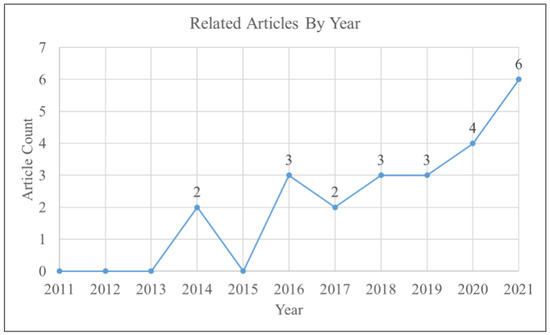
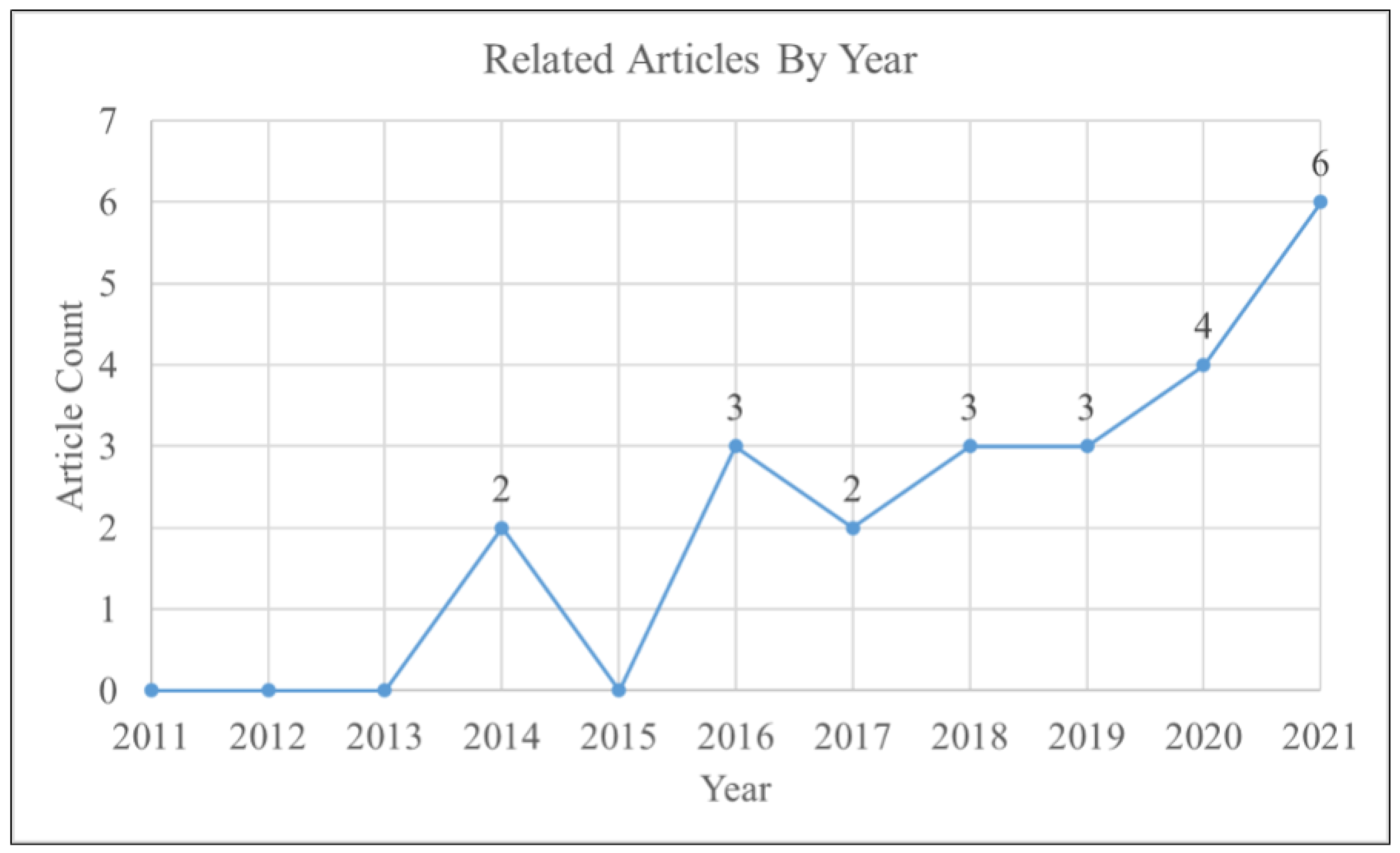
Analysis of the 23 studies included in this review reveals distinct patterns in publication trends and article types. Examining the temporal distribution across the decade-long study period (2011–2021), we observe a notable upward trajectory beginning in 2016, as illustrated in Figure 2. The initial years showed minimal activity, with only scattered publications appearing before 2014. A marked increase occurred from 2016 onward, with publication frequency reaching its peak in 2021 (n = 6). This growth pattern suggests increasing recognition of AR’s potential for radiation safety applications.
Figure 2.
Overall trend of related articles published by year.
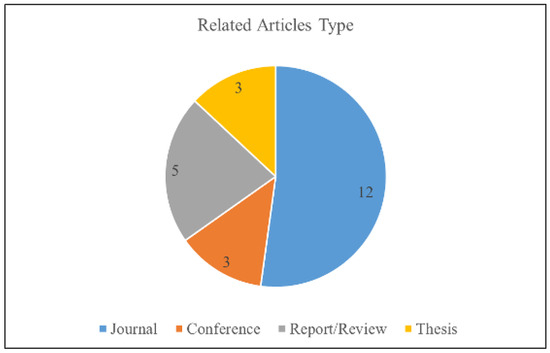
The corpus comprised predominantly peer-reviewed journal articles (n = 12, 52%), followed by reports and reviews (n = 5, 22%), conference proceedings (n = 3, 13%), and doctoral theses (n = 3, 13%), as shown in Figure 3. This distribution indicates that while journal publications dominate, the field benefits from diverse publication venues that capture both theoretical advances and practical implementations.
Figure 3.
Types of related articles.
3.2. Application Domain
Among the reviewed studies, 16 explicitly demonstrated functional AR–sensor integration for radiation visualization. These implementations span four distinct application domains: nuclear facilities (n = 4), medical operations (n = 4), CERN research infrastructure (n = 4), and educational/monitoring applications (n = 3). Each domain presents unique requirements and challenges that shape the technological approaches adopted.
3.2.1. Nuclear Facility Applications
Nuclear facilities demand robust radiation monitoring systems to maintain operational safety and protect personnel. Paradiso [30] developed an innovative workflow integrating radioactive hotspot positioning data with portable iPIX gamma cameras, enabling real-time 3D volumetric visualization of radiation fields. This system represents a significant advancement over traditional 2D monitoring approaches. Building on similar principles, Bird et al. [31] created an autonomous ground-based robotic platform equipped with 2D LiDAR, thermo-radiation sensors, and AR visualization capabilities for hazardous environment surveillance.
Remote operations have emerged as a critical application area. Salman et al. [32] developed a sophisticated telerobot system for nuclear facility decontamination, incorporating semi-intelligent robotics with AR-enhanced operator interfaces. Their approach, detailed in Marques [27], leverages a state-of-the-art mobile detection platform integrating multiple radiation sensors to identify and map contamination in nuclear emergency scenarios. These systems demonstrate how AR can transform traditional radiation monitoring from abstract numerical readings into intuitive spatial visualizations that enhance operational decision-making.
3.2.2. Medical Operations
Medical environments present unique challenges for radiation safety, requiring precise visualization while maintaining clinical workflow efficiency. The integration of X-ray imaging with AR visualization has shown particular promise for reducing unnecessary radiation exposure to both patients and medical personnel. Loy Rodas et al. [25] pioneered a system enabling real-time visualization of X-ray propagation patterns during medical procedures, providing clinicians with immediate spatial awareness of radiation fields.
Flexman et al. [8] advanced this concept by developing a comprehensive monitoring system for catheterization laboratories. Their wearable AR interface displays real-time radiation dosimetry data, allowing interventional radiologists to optimize their positioning and minimize exposure. Similarly, Cami et al. [33] focused on X-ray device positioning optimization, demonstrating how AR guidance can reduce both patient and staff radiation doses. In a different application, Nowak et al. [28] used a Timepix3 hybrid pixel detector to monitor IR in an intervention radiology room. Complementing these clinical applications, Sato and Kamimura [34] developed a user-friendly electromagnetic field visualization tool, proving that simplified AR interfaces can effectively communicate complex radiation distribution patterns to non-specialist users.
3.2.3. CERN Applications
The European Organization for Nuclear Research (CERN) operates some of the world’s most complex particle physics facilities, presenting exceptional radiation monitoring challenges. CERN’s involvement in AR-radiation visualization research reflects the critical importance of advanced safety systems in high-energy physics environments. Fabry [35] initiated CERN’s exploration of AR technologies through the Virtualization ToolKit, developing augmented reality systems and telerobotic platforms specifically designed for interventions in high-radiation areas.
This foundational work evolved into more sophisticated implementations. Adamidi et al. [36] presented a comprehensive architecture for immersive radiation visualization within CERN’s ATLAS detector cavern. Their system addresses the unique challenge of visualizing radiation fields in complex, three-dimensional underground spaces where traditional monitoring approaches prove inadequate. Wireless sensor networks emerged as a crucial enabling technology, as demonstrated by Parasuraman et al. [37], who developed a robust stochastic optimization framework for multi-sensor radio signal enhancement in CERN’s challenging electromagnetic environment.
The culmination of CERN’s AR research efforts is exemplified by their integrated safety platform, which achieved success rates exceeding 80% in recent operational trials. Adamidi et al. [38] documented how this comprehensive system provides real-time radiation guidance under extreme conditions, utilizing advanced gamma radiation cameras coupled with sophisticated AR visualization algorithms.
3.2.4. Educational and Monitoring Applications
Educational implementations represent a growing application area, addressing the critical need for effective radiation safety training without exposure risks. Two distinct methodological approaches emerged from the reviewed studies. They utilized affordable sensors with mobile AR platforms to create accessible training environments for radiation awareness. In contrast, Keller et al. [39] developed a sophisticated prototype integrating iPad devices with pixelated silicon sensors, enabling students to visualize and interact with simulated radioactive particles.
The educational applications reviewed demonstrate innovation in making abstract radiation concepts tangible. A 2019 study utilized smartphone and tablet-based AR to enable direct interaction with virtual radioactive sources via portable diode-based sensors. This approach proved especially effective for conveying fundamental radiation physics principles while maintaining complete safety. The integration of consumer-grade devices with professional-grade sensors, as documented by the Internet of Things (IoT) implementation in Blanco-Novoa et al.’s study [40], suggests promising directions for scalable educational deployments.
3.3. Data
3.3.1. Data Collection
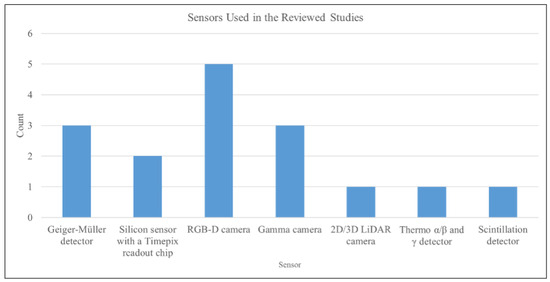
Sensor selection emerged as a critical factor determining system capabilities and application suitability (see Figure 4). The reviewed studies employed diverse radiation detection technologies, each offering distinct advantages for specific use cases. Geiger–Müller detectors represented the most common choice (n = 3), valued for their reliability, cost-effectiveness, and straightforward integration with digital systems. Silicon-based sensors with Timepix readout chips appeared in two studies, offering superior spatial resolution essential for precise radiation field mapping. RGB-D cameras (n = 5) and gamma cameras (n = 3) provided complementary imaging capabilities, while LiDAR sensors and thermal infrared detectors (n = 1 each) enabled multi-modal environmental sensing.
Figure 4.
Sensors used in the reviewed articles.
Platform diversity characterized the implementation approaches. Vetter [41] pioneered mobile detection systems, demonstrating how different sensor configurations suit varying operational requirements. Stationary monitoring networks provide continuous coverage but lack flexibility, while mobile platforms offer adaptability at the cost of temporal coverage gaps. Lee and Kim [14] conducted comparative evaluations of drone-based radiation sensing platforms, establishing performance metrics for aerial survey optimization. Their analysis revealed that optimal sensor selection depends critically on mission parameters—Geiger–Müller counters excel for rapid area surveys, while scintillation detectors provide superior spectral information despite increased system complexity. The emergence of hybrid approaches, combining DJI Inspire drones with DJI Mavic platforms as demonstrated by Molnar et al. [13], illustrates how complementary sensor systems can address the limitations of single-platform solutions.
3.3.2. Data Transmission
Wireless communication technologies dominate the data transmission landscape in reviewed implementations, reflecting the need for flexible, real-time information flow. IoT protocols, particularly Wi-Fi and Bluetooth variants, appeared in most applications [11]. This wireless infrastructure enables seamless integration between distributed sensors and centralized processing systems, crucial for maintaining situational awareness across extended operational areas.
Adamidi et al. [36] exemplified advanced architectural design by implementing a hierarchical control system integrating real-time sensor data acquisition with cloud-based processing and visualization pipelines. Their approach addresses the challenging balance between local responsiveness and centralized coordination. Parasuraman et al. [37] tackled wireless reliability in electromagnetically noisy environments through innovative tethering systems, demonstrating how hybrid wired–wireless architectures can ensure robust communication when purely wireless solutions prove inadequate. The six reviewed studies utilizing Monte Carlo methods for radiation-level simulation underscore the computational demands these systems place on data transmission infrastructure.
3.4. Systems
AR Systems
The maturation of AR hardware has enabled increasingly sophisticated radiation visualization implementations. While early systems relied primarily on desktop displays and basic overlays, contemporary implementations leverage advanced head-mounted displays and mobile platforms. Microsoft HoloLens emerged as a preferred platform in recent studies [42]. These devices offer computational power and display quality necessary for rendering complex radiation field visualizations in real-time. Costantino et al. [43] articulated the fundamental challenge facing AR system designers: balancing visualization fidelity with user safety. Their analysis revealed that effective AR implementations must navigate competing demands for information density, visual clarity, and operational safety. The evolution from simple numerical displays to sophisticated volumetric renderings reflects both technological advancement and deepening understanding of human factors in high-risk environments.
3.5. Quality Assessment Results
All 23 included studies were assessed for quality using criteria adapted from the Mixed Methods Appraisal Tool (Version 2018). Assessment focused on five key dimensions: clarity of research objectives, appropriateness of methodology, completeness of technical specifications, validity of evaluation methods, and consideration of limitations.
Overall, the included studies demonstrated adequate quality. All 23 studies (100%) clearly stated their research objectives and the problems they aimed to address. The majority employed appropriate methodologies and provided sufficient technical detail for understanding system implementation. Most studies that included evaluation components used valid assessment methods, though four studies lacked rigorous evaluation or used methods with significant limitations.
Quality patterns varied across time periods and domains. Earlier publications (2011–2015) emphasized technical feasibility with less systematic evaluation, while recent studies (2016–2021) demonstrated improved methodological rigor including user testing and validation protocols. Studies from research institutions (CERN, national laboratories) generally provided more comprehensive technical specifications compared to conference papers. Medical applications consistently demonstrated stronger evaluation methodologies, reflecting established evidence-based practice traditions in healthcare.
No studies were excluded based on quality scores. However, quality variations were considered when interpreting findings, with particular caution applied to studies lacking rigorous evaluation or complete technical documentation.
3.6. Cross-Study Comparative Synthesis Using the Concept Matrix
To move beyond sequential description of individual studies, we coded each included publication using the comparative dimensions defined in Section 2.6 and compiled the results into a concept matrix. Table 2 reports the coded attributes for all included studies, enabling cross-study comparison of recurring integration approaches, architectural patterns, and evaluation practices across application domains.
Table 2.
Concept matrix for the included studies. AR platform entries summarize the primary user-facing AR interface reported in each study (e.g., wearable head-mounted display, mobile/tablet AR, projection AR, or robotic/teleoperation interface). NR indicates that the AR platform was not reported with sufficient specificity in the source publication.
Section 3.1, Section 3.2, Section 3.3 and Section 3.4 describe the literature by demographics, application domain, and technical themes. This subsection provides a cross-study comparison using the concept matrix derived from the extraction schema and synthesis framework in Section 2.6. Table 2 reports the coded attributes for each included study and enables identification of dominant integration patterns across the corpus.
Across the reviewed studies, four recurring integration patterns are observed.
First, several systems emphasize direct overlay of point measurements, where radiation readings are presented as numeric values or simple indicators anchored to the user view or to the measurement location. These systems prioritize simplicity and real time feedback, but they provide limited representation of spatial gradients unless multiple samples are fused [8,40].
Second, a set of systems emphasizes radiation field mapping, where multiple measurements, imaging sensors, or repeated sampling are combined into two dimensional or three dimensional representations such as heatmaps, contours, or volumetric renderings. These approaches rely more strongly on spatial registration and introduce modeling assumptions, but they better support spatial understanding of exposure conditions.
Third, a set of systems integrates radiation information into procedural or task-aware augmented reality guidance. In these studies, visualization is coupled with workflow support, step guidance, or contextual cues intended to influence operator behavior during procedures or training scenarios. This pattern is most sensitive to human factor constraints such as information prioritization and cognitive load.
Fourth, a set of systems relies on distributed or remote sensing, including networked sensing configurations and robotic or remote platforms. These approaches address environments where direct human presence is constrained, but they introduce additional architecture complexity involving synchronization, reliability, and communication constraints.
This comparative synthesis clarifies that different application domains tend to emphasize different patterns because of distinct operational constraints. It also provides the evidence base used in Section 4 to motivate gaps and recommendations.
4. Discussion
Despite limited published research, the integration of AR and sensor technologies shows considerable promise for transforming radiation safety training. Our systematic review of 23 studies published between 2011 and 2021 reveals both the potential and current limitations of these technologies. Our review reveals that AR–sensor integration for radiation safety remains in its early stages yet demonstrates sufficient promise to warrant continued investment and research. The accelerating publication rate since 2016 reflects growing recognition that traditional radiation safety training and monitoring approaches have fundamental limitations that AR can address. Technology’s unique ability to visualize invisible radiation fields in real time, within actual operational contexts, offers advantages that neither conventional training nor virtual reality can match.
Implementation approaches vary significantly across domains, revealing both AR’s versatility and the absence of standardized solutions. Nuclear facilities prioritize robustness and remote operation; medical applications focus on real-time procedural guidance; research institutions like CERN push technical boundaries, and educational implementations emphasize safe, interactive learning. This variety suggests that effective AR systems must be tailored to specific operational contexts rather than pursue one-size-fits-all solutions.
4.1. Growing Interest Amid Limited Research
The temporal analysis of publications reveals an interesting paradox. While the absolute number of studies remains modest, the accelerating publication rate, particularly from 2016 onward, signals growing recognition of AR’s potential in radiation safety applications. This trend coincides with the commercial release of more sophisticated AR hardware, particularly Microsoft HoloLens in 2016 and the widespread adoption of RGB-D cameras. The increasing availability of affordable, high-quality AR devices has clearly lowered barriers to experimentation in this field.
What makes this growth particularly noteworthy is its occurrence across diverse, traditionally conservative domains. Nuclear facilities, medical centers, and research institutions like CERN have historically been cautious about adopting new technologies, given the high stakes involved in radiation safety. The fact that these institutions are investing in AR research suggests recognition of fundamental limitations in current training and monitoring approaches that AR might address. This trend is consistent with the publication trajectory observed in Section 3.1 and with the shift in platform capability and sensing integration reported across the included studies in Section 3.3 and Section 3.4.
The temporal analysis of publications reveals an interesting pattern. While the absolute number of studies remains modest, the increase in publications after 2016 suggests growing recognition of AR’s potential in radiation safety applications. This trend is consistent with the appearance of more mature AR hardware and software ecosystems and with reported implementations that moved from conceptual visualization toward integrated operational and training use cases in medical, nuclear, and research settings [8,26,33,36,38].
What makes this growth particularly notable is its presence across domains that traditionally adopt new technologies cautiously because of safety and operational requirements. The reviewed studies include implementations in nuclear facilities and CERN environments, where system reliability, environmental constraints, and workflow integration are critical, as well as medical settings where real-time procedural support and dose awareness are central concerns [8,25,27,30,31,32,35,37]. This trend is consistent with the publication trajectory observed in Section 3.1 and with the shift in platform capability and sensing integration reported across the included studies in Section 3.3 and Section 3.4.
4.2. Domain-Specific Implementation Patterns
Our analysis reveals distinct implementation strategies across the four identified application domains, each shaped by unique operational requirements and safety constraints.
- Nuclear Facilities demonstrate a conservative implementation approach that prioritizes robustness, reliability, and remote operation over adoption of new interfaces for their own sake. The emphasis on robotic platforms, hotspot localization, and workflow-integrated visualization reflects the hazardous conditions and operational demands of these environments [27,30,31,32].
- Medical Applications show comparatively faster iteration cycles and stronger emphasis on real-time procedural guidance and dose awareness during interventions. The reviewed systems focus on improving immediate spatial understanding and decision support during clinical procedures while still facing integration constraints related to clinical workflow and usability [8,25,28,33,34].
- CERN Applications represent some of the most technically sophisticated implementations in the reviewed literature, including immersive visualization, complex sensor integration, and communication solutions adapted to electromagnetically challenging environments. These studies illustrate how advanced infrastructure can support experimentation with novel visualization and control architectures [35,36,37,38].
- Educational and Monitoring Applications illustrate a progression from lower-cost visualization tools toward more interactive learning systems that combine mobile AR with sensor-based feedback. These implementations suggest strong potential for scalable training and awareness applications while also highlighting the need for more rigorous evaluation in educational settings [9,26,39,40].
4.3. Technical Considerations and Trade-Offs
The diversity of sensor types employed across studies reflects the lack of standardized approaches to radiation visualization. While Geiger–Müller counters dominate due to familiarity and low cost, their limited spatial resolution constrains visualization quality. More sophisticated sensors like silicon-based detectors with Timepix readouts enable precise radiation field mapping but at significantly higher costs and complexity.
The choice between mobile and stationary monitoring systems reveals fundamental tensions between coverage and flexibility. Drone-based systems offer unprecedented access to hazardous areas but struggle with battery life and payload limitations. Stationary networks provide continuous monitoring but lack adaptability to changing conditions. The emergence of hybrid approaches suggests the field is moving toward more nuanced solutions that leverage multiple platform types.
Data transmission presents another critical challenge. The reliance on wireless technologies introduces vulnerabilities in electromagnetically noisy environments typical of nuclear and research facilities. While IoT protocols offer convenience, questions remain about reliability and security, particularly given the sensitive nature of radiation data. The innovative tethering systems developed for CERN applications point toward hybrid wired–wireless architectures as a pragmatic compromise.
4.4. AR-VR Complementarity Rather than Competition
This review reveals that AR and VR serve distinct but complementary roles in radiation safety training.
4.4.1. VR Excels in
- Initial concept introduction without any radiation exposure;
- Scenario-based training for rare emergency events;
- Psychological preparation for high-radiation environments.
4.4.2. However, AR Uniquely Provides
- Real-time operational guidance;
- In situ visualization of actual radiation fields;
- Contextual awareness during live procedures;
- Continuous monitoring rather than discrete training events.
The literature suggests an optimal training pipeline:
This progression leverages each technology’s strengths while mitigating their limitations.
4.5. Human Factors and User Acceptance
Beyond technical specifications, the success of AR systems depends critically on user acceptance and effective integration with human cognitive processes. The reviewed studies reveal several key insights about human factors that deserve greater attention.
CERN’s ‘information breathing’ concept addresses a fundamental AR design challenge: presenting complex data without overwhelming users. Traditional interfaces often cause information overload, especially in high-stress radiation environments. Dynamic displays that adapt to context and user attention represent a promising direction, though implementation remains challenging.
Calibrating user trust represents another critical factor. Users must develop appropriate confidence in AR visualizations, as neither blind trust nor excessive skepticism serves safety goals. The studies reporting graduated complexity approaches, where users progressively build understanding of system capabilities and limitations, offer valuable models for training design.
The reported development of “radiation intuition” through AR training deserves particular attention. Unlike abstract numerical displays, spatial AR visualizations apparently enable users to develop embodied understanding of radiation behavior. This finding has profound implications for training effectiveness and long-term retention of safety practices.
4.6. Limitations and Challenges
Despite promising results, significant challenges constrain current implementations. Environmental recognition remains problematic in complex industrial settings where metallic structures and electromagnetic interference degrade tracking accuracy. Virtual content rendering quality varies considerably across platforms, with many systems struggling to maintain visual clarity in bright environments typical of medical settings.
Perhaps most concerning is the potential for AR systems to introduce new risks. Device exposure to radiation fields raises questions about long-term reliability and potential data corruption. The dependency on complex technology for safety-critical information creates single points of failure that traditional monitoring approaches avoid. Furthermore, the cognitive load of processing AR information while performing complex procedures may actually decrease safety in some scenarios. The disconnect between developer expertise and end-user needs presents another barrier. Many reviewed systems demonstrate technical sophistication but limited understanding of operational requirements. Successful implementations invariably involved close collaboration between technologists and domain experts, suggesting that interdisciplinary teams are essential rather than optional.
Furthermore, several limitations constrain our findings. The relatively small number of studies meeting inclusion criteria limits generalizability. Publication bias likely favors successful implementations over failed attempts, potentially overestimating effectiveness. The rapid evolution of AR technology means studies from earlier years may not reflect current capabilities. Geographic concentration in developed countries with established nuclear programs may miss innovations from emerging economies.
Methodological variations across studies complicate direct comparisons. Few studies report long-term outcomes or comparative effectiveness against traditional training. The absence of standardized evaluation metrics makes it difficult to assess relative success across implementations.
4.7. Recommendations
The recommendations below are derived from recurrent gaps observed across the included studies and summarized in the comparative synthesis.
4.7.1. Strengthen Evaluation with Safety-Relevant Outcomes
Many studies report feasibility demonstrations and usability feedback, but fewer report standardized learning outcomes, retention, transfer, or comparable baselines. Future work should include evaluation measures that reflect training impact, such as task error rates in representative scenarios, workload and usability instruments, and where feasible, proxy exposure measures or time spent in higher risk regions of the workspace. This recommendation follows directly from the heterogeneity of evaluation approaches documented in Table 2 and from the quality assessment summary in Section 3.5.
4.7.2. Report Spatial Registration Fidelity, Latency, and Uncertainty
Several implementations present radiation measurements in augmented reality without reporting the accuracy of sensor pose estimation, alignment, update rate, or uncertainty propagation. Because safety training depends on spatial interpretation, future systems should report the registration approach, latency budget, and how uncertainty is communicated in the interface. This reporting is necessary for reproducibility and for interpreting training claims across studies.
4.7.3. Design Explicitly for Attention Management and Trust Calibration
Across domains, the risk of information overload and over reliance on augmented reality appears repeatedly as a practical concern. Visualization strategies that adapt information density to context, combined with training modules that clarify system limitations, are likely to improve safe use and appropriate trust. This recommendation aligns with the human factors issues discussed in Section 4.5 and with limitations reported across the reviewed implementations.
4.7.4. Validate Robustness Under Operational Constraints
Environmental complexity, electromagnetic interference, occlusion, and bright lighting conditions can reduce tracking stability and visualization reliability. Systems intended for safety training should be validated under representative constraints for the target domain, and hybrid architectures should be considered where communication reliability is critical.
4.7.5. Promote Interoperability Through Shared Conventions
The literature currently lacks shared conventions for coordinate frames, radiation field representations, and reporting of sensor and visualization pipelines. Common conventions would improve comparability and accelerate cumulative progress beyond isolated prototypes. This recommendation is supported by the cross-study fragmentation revealed in the concept matrix and by the limitations summarized in Section 4.6.
4.8. Future Directions and Opportunities
AR–sensor integration for radiation safety training is at an inflection point. While technical capabilities have matured enough for practical deployment, standardization remains elusive. The field would benefit significantly from common data formats, visualization conventions, and safety protocols that enable interoperability across systems and domains. The convergence of improving AR hardware, sophisticated sensor networks, and growing safety demands creates favorable conditions for expanded adoption. We anticipate that within the next decade, AR-enhanced radiation monitoring will transition from experimental implementations to routine operational tools in many facilities. However, realizing this potential requires addressing current limitations through sustained research, development, and evaluation.
Wearable AR devices, particularly lightweight smart glasses, offer promising directions for reducing obtrusiveness while maintaining functionality. As these devices become more capable and affordable, we anticipate accelerated adoption in educational settings where cost constraints currently limit access. The ultimate measure of success for AR in radiation safety will not be technological sophistication but demonstrated improvements in human safety. Reduced exposure rates, fewer accidents, and better-prepared workers represent the true goals. This systematic review provides a foundation for pursuing these objectives through evidence-based development of AR–sensor systems.
The integration of artificial intelligence and machine learning presents another frontier. Current systems largely present raw or simply processed sensor data. Future systems could provide predictive alerts, optimize suggested routes through radiation fields, and adapt visualizations based on user expertise and cognitive state.
Most critically, the field needs comprehensive evaluation frameworks that go beyond technical metrics to assess actual safety outcomes. Long-term studies tracking exposure rates, procedural errors, and training retention would provide evidence necessary for regulatory acceptance and widespread adoption. As we continue to work with ionizing radiation in medicine, energy, and research, the invisible nature of this hazard demands innovative approaches to visualization and training. Augmented reality, properly implemented and rigorously evaluated, offers a powerful tool for making the invisible visible and the dangerous safer. The studies reviewed here represent early steps in what promises to be a transformative journey for radiation safety practice.
4.9. Implications for Practice
For practitioners considering AR implementation, our review suggests several key considerations. First, successful deployment requires sustained institutional commitment beyond initial pilots. The most effective implementations evolved through multiple iterations based on user feedback. Second, hybrid approaches combining AR with traditional monitoring provide necessary redundancy while enabling innovation. Third, training programs must address not just system operation but appropriate trust calibration and limitation awareness.
The evidence suggests that AR should not be viewed as replacing traditional radiation safety approaches but rather as augmenting them with spatial context and real-time awareness. Technology excels at making invisible hazards visible and providing intuitive understanding of complex radiation fields. However, numerical precision and fail-safe operation still require traditional instrumentation.
As this field continues to evolve, maintaining focus on fundamental safety goals rather than technological capabilities will be essential. The promise of AR lies not in its novelty but in its potential to reduce radiation exposure, prevent accidents, and enable more effective training. Realizing this potential requires continued collaboration between technologists, safety professionals, and end users, guided by rigorous evaluation and unwavering commitment to safety.
5. Conclusions
This systematic review synthesized 23 studies published between 2011 and 2021 that combine augmented reality visualization with sensor-derived ionizing radiation information for training or education contexts. The evidence shows that implementations span multiple platforms and sensing modalities and that they can be organized into a small number of recurring integration patterns, including direct overlay of point measurements, mapped field representations, task-aware procedural guidance, and distributed or remote sensing architectures.
Across the reviewed studies, the strongest evidence supports technical feasibility and improved situational understanding in constrained settings. At the same time, the review identifies persistent gaps that limit comparability and adoption. These include inconsistent reporting of spatial registration fidelity and latency, limited treatment of uncertainty in visualization, and uneven evaluation practice with relatively few studies reporting standardized learning outcomes or transfer measures. The comparative synthesis provided in this review clarifies dominant approaches and trade-offs, and it motivates a research agenda focused on stronger evaluation tied to safety-relevant outcomes, improved robustness in complex operational environments, and shared reporting conventions that support reproducibility.
Author Contributions
R.K. contributed to the conception and design of this systematic review. J.K. helped to manage and guide the project. J.D., X.Y., and R.K. performed the literature review. J.D. wrote a summary of the reviewed literature. X.Y. wrote the first draft of the manuscript. R.K. revised and re-wrote the manuscript. All authors have read and agreed to the published version of the manuscript.
Funding
This work was supported by the Center for Advanced Energy Studies (CAES) business development funds as part of the Idaho National Laboratory under the Department of Energy (DOE) Idaho Operations Office (an agency of the U.S. Government) Contract DE-AC07-05ID145142.
Data Availability Statement
No new data were created or analyzed in this study.
Acknowledgments
We thank CAES for funding this systematic review.
Conflicts of Interest
The authors declare no conflicts of interest.
References
- Sugrue, A.; Le, K.Y.; Dearani, P.; Asirvatham, S.J. Minimizing Radiation—Why Aren’t We Down to Zero? J. Innov. Card. Rhythm. Manag. 2018, 9, 3271–3273. [Google Scholar] [CrossRef] [Scilit] [PubMed]
- IAEA. What is Radiation? 2022. Available online: https://www.iaea.org/newscenter/news/what-is-radiation (accessed on 22 January 2026).
- Washington State Department of Health. Background Radiation Natural Versus Man-Made; Technical report; Washington State Department of Health: Tumwater, WA, USA, 2002. [Google Scholar]
- Friedman, A.A.; Ghani, K.R.; Peabody, J.O.; Jackson, A.; Trinh, Q.D.; Elder, J.S. Radiation Safety Knowledge and Practices among Urology Residents and Fellows: Results of a Nationwide Survey. J. Surg. Educ. 2013, 70, 224–231. [Google Scholar] [CrossRef] [Scilit] [PubMed]
- Yurt, A.; Çavuşoğlu, B.; Günay, T. Evaluation of Awareness on Radiation Protection and Knowledge about Radiological Examinations in Healthcare Professionals Who Use Ionized Radiation at Work. Mol. Imaging Radionucl. Ther. 2014, 22, 48–53. [Google Scholar] [CrossRef] [Scilit] [PubMed]
- Sheik-Ali, S.; Edgcombe, H.; Paton, C. Next-Generation Virtual and Augmented Reality in Surgical Education: A Narrative Review. Surg. Technol. Int. 2019, 35, 27–35. [Google Scholar]
- Martínez, H.; Skournetou, D.; Hyppölä, J.; Laukkanen, S.; Heikkilä, A. Drivers and Bottlenecks in the Adoption of Augmented Reality Applications. J. Multimed. Theory Appl. 2014, 2, 27–44. [Google Scholar] [CrossRef] [Scilit]
- Flexman, M.; Panse, A.; Mory, B.; Martel, C.; Gupta, A. Augmented Reality for Radiation Dose Awareness in the Catheterization Lab. In Proceedings of the ACM SIGGRAPH 2017 Posters, Los Angeles, CA, USA, 30 July–3 August 2017; pp. 2–3. [Google Scholar] [CrossRef] [Scilit]
- Schiano Lo Moriello, R.; Liccardo, A.; Bonavolonta, F.; Caputo, E.; Gloria, A.; De Alteriis, G. On the Suitability of Augmented Reality for Safe Experiments on Radioactive Materials in Physics Educational Applications. IEEE Access 2022, 10, 54185–54196. [Google Scholar] [CrossRef] [Scilit]
- Heinrich, F.; Schwenderling, L.; Becker, M.; Skalej, M.; Hansen, C. Holoinjection: Augmented Reality Support for CT-Guided Spinal Needle Injections. Healthc. Technol. Lett. 2019, 6, 165–171. [Google Scholar] [CrossRef] [Scilit]
- Ahmad, M.I.; Mohd, M.H.; Nordin, R.; Mohamed, F.; Abu-Samah, A.; Abdullah, N.F. Ionizing Radiation Monitoring Technology at the Verge of Internet of Things. Sensors 2021, 21, 7629. [Google Scholar] [CrossRef] [Scilit]
- Tran-Quang, V.; Dao-Viet, H. An Internet of Radiation Sensor System (IoRSS) to Detect Radioactive Sources out of Regulatory Control. Sci. Rep. 2022, 12, 7195. [Google Scholar] [CrossRef] [Scilit]
- Molnar, A.; Domozi, Z.; Lovas, I. Drone-Based Gamma Radiation Dose Distribution Survey with a Discrete Measurement Point Procedure. Sensors 2021, 21, 4930. [Google Scholar] [CrossRef] [Scilit]
- Lee, C.; Kim, H.R. Optimizing UAV-Based Radiation Sensor Systems for Aerial Surveys. J. Environ. Radioact. 2019, 204, 76–85. [Google Scholar] [CrossRef] [Scilit] [PubMed]
- Burdea, G.C.; Coiffet, P. Virtual Reality Technology; John Wiley & Sons: Hoboken, NJ, USA, 2003. [Google Scholar]
- Höllerer, T.; Feiner, S. Mobile Augmented Reality. In Telegeoinformatics: Location-Based Computing and Services; Routledge: London, UK, 2004; Volume 21, pp. 221–260. [Google Scholar]
- Evans, G.; Miller, J.; Pena, M.I.; MacAllister, A.; Winer, E. Evaluating the Microsoft HoloLens through an Augmented Reality Assembly Application. In Proceedings of the Degraded Environments: Sensing, Processing, and Display 2017, Anaheim, CA, USA, 11–12 April 2017; SPIE: Bellingham, WA, USA, 2017; Volume 10197, pp. 282–297. [Google Scholar]
- Barsom, E.Z.; Graafland, M.; Schijven, M.P. Systematic Review on the Effectiveness of Augmented Reality Applications in Medical Training. Surg. Endosc. 2016, 30, 4174–4183. [Google Scholar] [CrossRef] [Scilit] [PubMed]
- Connor, D.T.; Wood, K.; Martin, P.G.; Goren, S.; Megson-Smith, D.; Verbelen, Y.; Scott, T.B. Radiological Mapping of Post-Disaster Nuclear Environments Using Fixed-Wing Unmanned Aerial Systems: A Study from Chornobyl. Front. Robot. AI 2020, 6, 149. [Google Scholar]
- Salehahmadi, F.; Hajialiasgari, F. Grand Adventure of Augmented Reality in Landscape of Surgery. World J. Plast. Surg. 2019, 8, 135–145. [Google Scholar] [CrossRef] [Scilit]
- Elsayed, M.; Kadom, N.; Ghobadi, C.; Strauss, B.; Al Dandan, O.; Aggarwal, A.; Anzai, Y.; Griffith, B.; Lazarow, F.; Straus, C.M.; et al. Virtual and Augmented Reality: Potential Applications in Radiology. Acta Radiol. 2020, 61, 1258–1265. [Google Scholar] [CrossRef] [Scilit]
- Elmqaddem, N. Augmented Reality and Virtual Reality in Education: Myth or Reality? Int. J. Emerg. Technol. Learn. (iJET) 2019, 14, 234. [Google Scholar] [CrossRef] [Scilit]
- Liberati, A.; Altman, D.G.; Tetzlaff, J.; Mulrow, C.; Gøtzsche, P.C.; Ioannidis, J.P.A.; Clarke, M.; Devereaux, P.J.; Kleijnen, J.; Moher, D. The PRISMA Statement for Reporting Systematic Reviews and Meta-Analyses of Studies That Evaluate Healthcare Interventions: Explanation and Elaboration. BMJ (Clin. Res. Ed.) 2009, 339, b2700. [Google Scholar] [CrossRef] [Scilit]
- Page, M.J.; McKenzie, J.E.; Bossuyt, P.M.; Boutron, I.; Hoffmann, T.C.; Mulrow, C.D.; Shamseer, L.; Tetzlaff, J.M.; Akl, E.A.; Brennan, S.E.; et al. The PRISMA 2020 Statement: An Updated Guideline for Reporting Systematic Reviews. Int. J. Surg. 2021, 88, 105906. [Google Scholar] [CrossRef]
- Loy Rodas, N.; Barrera, F.; Padoy, N. See It with Your Own Eyes: Markerless Mobile Augmented Reality for Radiation Awareness in the Hybrid Room. IEEE Trans. Biomed. Eng. 2016, 64, 429–440. [Google Scholar] [CrossRef] [Scilit]
- Keller, O.; Benoit, M.; Müller, A.; Schmeling, S. Smartphone and Tablet-Based Sensing of Environmental Radioactivity: Mobile Low-Cost Measurements for Monitoring, Citizen Science, and Educational Purposes. Sensors 2019, 19, 4264. [Google Scholar] [CrossRef] [Scilit]
- Marques, L.; Vale, A.; Vaz, P. State-of-the-Art Mobile Radiation Detection Systems for Different Scenarios. Sensors 2021, 21, 1051. [Google Scholar] [CrossRef] [Scilit] [PubMed]
- Nowak, M.; Carbonez, P.; Krauss, M.; Verdun, F.R.; Damet, J. Characterisation and Mapping of Scattered Radiation Fields in Interventional Radiology Theatres. Sci. Rep. 2020, 10, 18754. [Google Scholar] [CrossRef] [Scilit] [PubMed]
- Popay, J.; Roberts, H.; Sowden, A.; Petticrew, M.; Arai, L.; Rodgers, M.; Britten, N.; Roen, K.; Duffy, S. Guidance on the Conduct of Narrative Synthesis in Systematic Reviews: A Product from the ESRC Methods Programme Version; Lancaster University: Lancaster, UK, 2006; Volume 1, p. b92. [Google Scholar]
- Paradiso, V. Development of a Portable Gamma Camera for Accurate 3-D Localization of Radioactive Hotspots. Ph.D. Thesis, University of Caen Normandy, Caen, France, 2017. [Google Scholar]
- Bird, B.; Griffiths, A.; Martin, H.; Codres, E.; Jones, J.; Stancu, A.; Lennox, B.; Watson, S.; Poteau, X. A Robot to Monitor Nuclear Facilities: Using Autonomous Radiation-Monitoring Assistance to Reduce Risk and Cost. IEEE Robot. Autom. Mag. 2018, 26, 35–43. [Google Scholar] [CrossRef] [Scilit]
- Salman, A.E.; Saleh, H.I.; Roman, M. Intuitive Robot Task Planning for Routine Monitoring and Surveillance in Nuclear Facilities to Increase Radiation Safety; Technical report; Egyptian Atomic Energy Authority: Cairo, Egypt, 2021. [Google Scholar]
- Cami, L.; Contact, S.; Padoy, N.; Camma, C.; Visvikis, D.; Bert, J. Context-Aware Radiation Protection for the Hybrid Operating Room; Technical report; University of Strasbourg: Strasbourg, France, 2018. [Google Scholar]
- Sato, K.; Kamimura, Y. A Simple Measurement Method of Electromagnetic Field Distribution Using Machine-Learning. In Proceedings of the 2020 International Symposium on Electromagnetic Compatibility—EMC EUROPE, Rome, Italy, 23–25 September 2020; pp. 2020–2023. [Google Scholar] [CrossRef] [Scilit]
- Fabry, T. Interactive Visual Intervention Planning in Particle Accelerator Environments with Ionizing Radiation. Ph.D. Thesis, University of Grenoble, Saint-Martin-d’Hères, France, 2014. [Google Scholar]
- Adamidi, E.; Gazis, E.; Nikita, K. Control System (CS) and Data Acquisition (DAQ) Architecture for the Radiation Background Monitoring of a Personnel Safety System in the ATLAS Cavern. HNPS Proc. 2016, 24, 72. [Google Scholar] [CrossRef] [Scilit]
- Parasuraman, R.; Fabry, T.; Molinari, L.; Kershaw, K. A Multi-Sensor RSS Spatial Sensing-Based Robust Stochastic Optimization Algorithm for Enhanced Wireless Tethering. Sensors 2014, 14, 23970–24003. [Google Scholar] [CrossRef] [Scilit]
- Adamidi, E.S.; Gazis, E.N.; Nikita, K.S. A Safety System for Human Radiation Protection and Guidance in Extreme Environmental Conditions. IEEE Syst. J. 2020, 14, 1384–1394. [Google Scholar] [CrossRef] [Scilit]
- Keller, O.; Schmeling, S.; Müller, A.; Benoit, M. iPadPix—A Novel Educational Tool to Visualise Radioactivity Measured by a Hybrid Pixel Detector. J. Instrum. 2016, 11, C11032. [Google Scholar] [CrossRef] [Scilit]
- Blanco-Novoa, O.; Fernández-Caramés, T.M.; Fraga-Lamas, P.; Castedo, L. A Cost-Effective IoT System for Monitoring Indoor Radon Gas Concentration. Sensors 2018, 18, 2198. [Google Scholar] [CrossRef] [Scilit]
- Vetter, K. The Nuclear Legacy Today of Fukushima. Annu. Rev. Nucl. Part. Sci. 2020, 70, 257–292. [Google Scholar] [CrossRef] [Scilit]
- Microsoft. Microsoft HoloLens: Mixed Reality Technology for Business. 2022. Available online: https://learn.microsoft.com/en-us/hololens/hololens-commercial-features (accessed on 22 January 2026).
- Costantino, F.; Falegnami, A.; Fedele, L.; Bernabei, M.; Stabile, S.; Bentivenga, R. New and Emerging Hazards for Health and Safety within Digitalized Manufacturing Systems. Sustainability 2021, 13, 948. [Google Scholar] [CrossRef] [Scilit]
- Jharko, E.; Meshcheryakov, R.; Promyslov, V. Aspects of Nuclear Power Plant Digital Decommissioning. In SIBCON 2021—International Siberian Conference on Control and Communications; IEEE: Piscataway, NJ, USA, 2021. [Google Scholar] [CrossRef] [Scilit]

Disclaimer/Publisher’s Note: The statements, opinions and data contained in all publications are solely those of the individual author(s) and contributor(s) and not of MDPI and/or the editor(s). MDPI and/or the editor(s) disclaim responsibility for any injury to people or property resulting from any ideas, methods, instructions or products referred to in the content. |
© 2026 by the authors. Licensee MDPI, Basel, Switzerland. This article is an open access article distributed under the terms and conditions of the Creative Commons Attribution (CC BY) license.