
Usability and User Experience in an Industrial Metaverse: A Mixed-Methods Study of the Necoverse Point Cloud Inspection System for Shipbuilding

 ,
,
Abstract
1. Introduction
2. Literature Review
2.1. Industrial Metaverse
2.2. Usability
2.3. Cognition and Cognitive Workload in Industrial Metaverse Systems
2.4. Presence Theory in Industrial Metaverse Systems
2.5. Flow Theory in Industrial Metaverse Systems
2.6. Research Gaps
2.7. Research Questions
- RQ1: What is the perceived usability of the Necoverse system for point cloud inspection?
- RQ2: What level of cognitive workload do users experience when using the Necoverse system?
- RQ3: To what extent do users experience a sense of presence within the industrial metaverse environment?
- RQ4: To what extent do users experience flow while using the industrial metaverse system?
- RQ5: What relationships exist among perceived usability, cognitive workload, presence, and flow in the industrial metaverse system?
- RQ6: What usability challenges and opportunities emerge from user interactions and qualitative feedback during system use?
- RQ7: What actionable, empirically grounded design recommendations can be derived to improve usability and user experience in industrial metaverse systems?
3. Necoverse—Point Cloud Visualization & Inspection System
4. Method
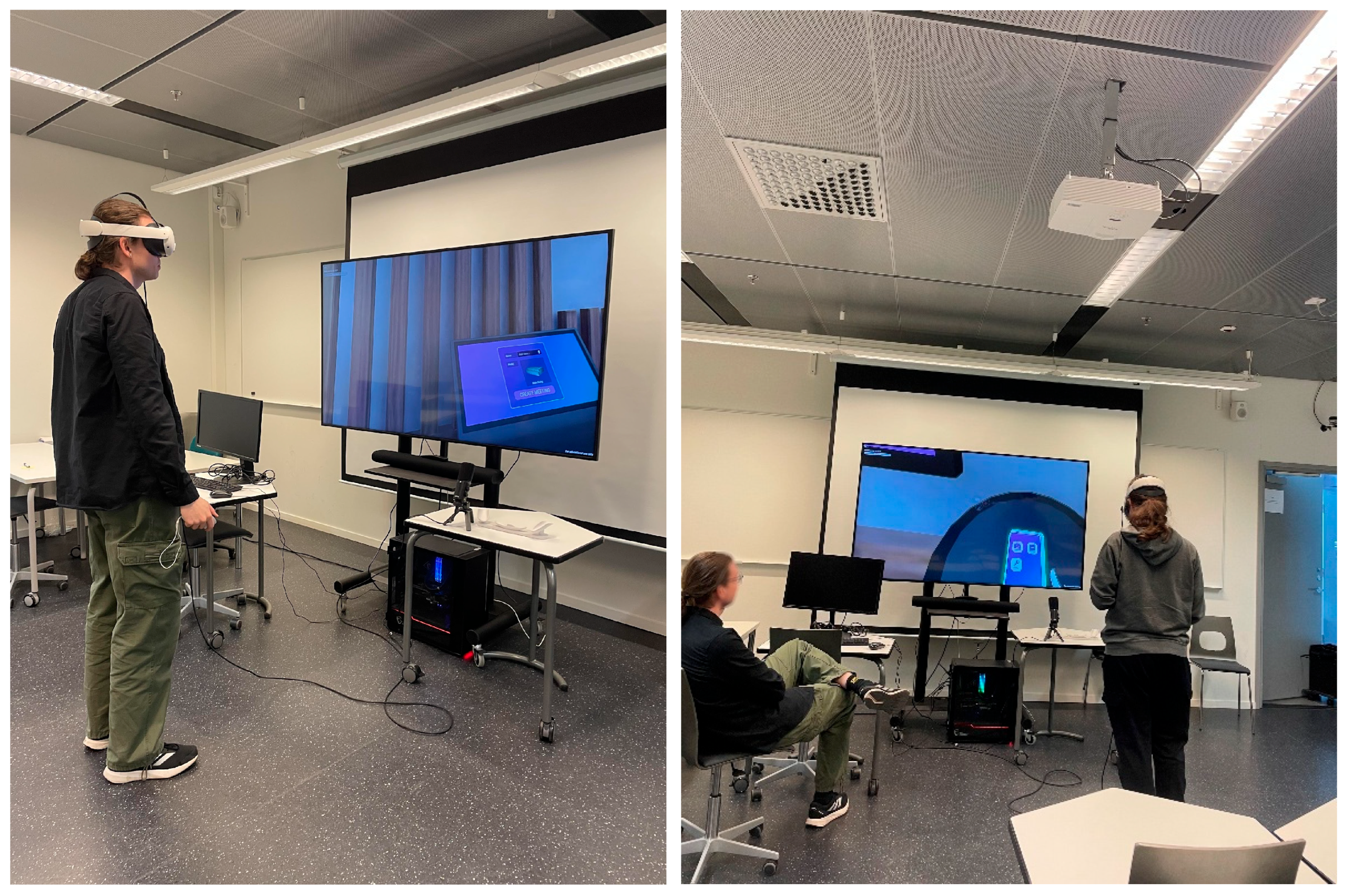
4.1. Design and Procedures
4.2. Measures
5. Results
5.1. Usability Results
5.2. Presence Results
5.3. Flow Results
5.3.1. Flow Items
5.3.2. Fluency Items and Scores
5.3.3. Flow—Absorption Items
5.3.4. Flow—Worrying Items
5.4. NASA-TLX Results Interpretation
5.5. Interview Results
5.5.1. Overall Experience and Engagement
5.5.2. Onboarding and Learning Curve
5.5.3. Control Ergonomics and Interaction Design
5.5.4. Motion Sickness and Comfort
5.5.5. Technical Reliability and Stability
5.5.6. Immersion and Environmental Fidelity
5.5.7. Guidance Versus Independent Use
5.5.8. Summary
5.6. Correlation Analysis
5.7. Observation Results
6. Discussion
- A consolidated empirical account of how usability, cognitive workload, presence, and flow manifest during immersive industrial inspection activities;
- Demonstration of how combining self-report, observational, and qualitative data can expose interaction frictions that are not evident through questionnaires alone;
- Practice-oriented design insights to inform the development of industrial metaverse inspection systems that support efficient interaction and manageable cognitive demand.
6.1. Design Implications for Industrial Metaverse Systems
6.2. Design Recommendations
- Introduce adaptive onboarding through embedded tutorials and progressive guidance to reduce reliance on external facilitation.
- Improve tool discoverability by making critical interaction elements persistently visible and spatially anchored.
- Enhance system feedback with explicit visual and auditory indicators for all system states to reduce uncertainty.
- Prioritize technical reliability, including robust handling of input failures, freezes, and recovery from interruptions.
- Support motion comfort and accessibility through configurable locomotion options such as snap turning.
- Improve environmental and point cloud fidelity where it directly supports inspection accuracy and spatial interpretation.
- Expand annotation modalities to support flexible, precise documentation aligned with professional inspection workflows.
6.3. Limitations and Future Work
7. Conclusions
Author Contributions
Funding
Institutional Review Board Statement
Informed Consent Statement
Data Availability Statement
Acknowledgments
Conflicts of Interest
References
- Schnack, A.; Wright, M.J.; Holdershaw, J.L. An exploratory investigation of shopper behaviour in an immersive virtual reality store. J. Consum. Behav. 2020, 19, 182–195. [Google Scholar] [CrossRef] [Scilit]
- Luimula, M.; Haavisto, T.; Pham, D.; Markopoulos, P.; Aho, J.; Markopoulos, E.; Saarinen, J. The use of metaverse in maritime sector—A combination of social communication, hands on experiencing and digital twins. In Creativity, Innovation and Entrepreneurship; Markopoulos, E., Goonetilleke, R.S., Luximon, Y., Eds.; AHFE International: Louisville, KY, USA, 2022; Volume 31. [Google Scholar] [CrossRef] [Scilit]
- Johnson-Glenberg, M.C. Immersive VR and Education: Embodied Design Principles That Include Gesture and Hand Controls. Front. Robot. AI 2018, 5, 81. [Google Scholar] [CrossRef] [Scilit]
- Nanjappan, V.; Uunila, A.; Vaulanen, J.; Välimaa, J.; Georgiev, G.V. Effects of immersive virtual reality in enhancing creativity. Proc. Des. Soc. 2023, 3, 1585–1594. [Google Scholar] [CrossRef] [Scilit]
- Obeid, S.; Demirkan, H. The influence of virtual reality on design process creativity in basic design studios. Interact. Learn. Environ. 2023, 31, 1841–1859. [Google Scholar] [CrossRef] [Scilit]
- Kyrlitsias, C.; Michael-Grigoriou, D. Social interaction with agents and avatars in immersive virtual environments: A survey. Front. Virtual Real. 2022, 2, 786665. [Google Scholar] [CrossRef] [Scilit]
- Karvonen, A.; Aho, J.; Koskinen, H.; Luimula, M.; Myllylä, M.; Tammentie, B.; Aromaa, S.; Tammela, A.; Saariluoma, P. Human-centered intelligent process control: Vision, design, and implementation. In Industry 4.0 and Intelligent Manufacturing Technologies; Mrugalska, B., Karwowski, W., Ahram, T.Z., Eds.; Routledge: New York, NY, USA, 2025; pp. 109–131. [Google Scholar] [CrossRef] [Scilit]
- Mourtzis, D.; Angelopoulos, J. Development of an extended reality-based collaborative platform for engineering education: Operator 5.0. Electronics 2023, 12, 3663. [Google Scholar] [CrossRef] [Scilit]
- Industrial Metaverse Research Study: 451 Research Discovery Report. Available online: https://assets.new.siemens.com/siemens/assets/api/uuid:f6a7c220-bc7e-4bb7-a348-aa2d07c21d77/S-P-Siemens-Industrial-Metaverse-Research-Study-Technology-2024.pdf (accessed on 29 November 2025).
- The Emergent Industrial Metaverse: Updated for 2024. Available online: https://assets.new.siemens.com/siemens/assets/api/uuid:e36f2de7-f3c4-481f-bb20-9791dc12bbec/the-emergent-industrial-metaverse-update-2024.pdf (accessed on 29 November 2025).
- Zigart, T.; Kormann-Hainzl, G.; Lovasz-Bukvova, H.; Hölzl, M.; Moser, T.; Schlund, S. From Lab to Industry: Lessons Learned from the Evaluation of Augmented and Virtual Reality Use Cases in the Austrian Manufacturing Industry. Prod. Manuf. Res. 2023, 11, 2286345. [Google Scholar] [CrossRef] [Scilit]
- Klieštik, T.; Kráľ, P.; Bugaj, M.; Ďurana, P. Generative artificial intelligence of things systems, multisensory immersive extended reality technologies, and algorithmic big data simulation and modelling tools in digital twin industrial metaverse. Equilib. Q. J. Econ. Econ. Policy 2024, 19, 429–461. [Google Scholar] [CrossRef] [Scilit]
- Kwegyir-Afful, E.; Lindholm, M.; Tilabi, S.; Tajudeen, S.; Kantola, J. Optimizing occupational safety through 3-D simulation and immersive virtual reality. In Advances in Human Factors and Simulation; Cassenti, D., Ed.; Springer: Cham, Switzerland, 2020; Volume 958. [Google Scholar] [CrossRef] [Scilit]
- Yildiz, E.; Melo, M.; Møller, C.; Bessa, M. Designing collaborative and coordinated virtual reality training integrated with virtual and physical factories. In Proceedings of the 2019 International Conference on Graphics and Interaction (ICGI), Faro, Portugal, 21–22 November 2019; pp. 48–55. [Google Scholar] [CrossRef] [Scilit]
- Ramalho, F.R.; Soares, A.L.; Almeida, A.H. Immersive systems in human-centered manufacturing: The informational dimension. In Boosting Collaborative Networks 4.0. PRO-VE 2020; Camarinha-Matos, L.M., Afsarmanesh, H., Ortiz, A., Eds.; Springer: Cham, Switzerland, 2020; Volume 598. [Google Scholar] [CrossRef] [Scilit]
- Abe, H.; Blanco Bataller, V.; Kimura, S.; Terävä, H.; Ravyse, W.; Luimula, M.; Lopez, G. Combining AR and input device to control remotely a robot arm. Hum.-Intell. Syst. Integr. 2025, 7, 279–292. [Google Scholar] [CrossRef] [Scilit]
- Ravyse, W.; Tarkkanen, K.; Luimula, M.; Smed, J. A data-driven approach to identify feedback elements for effective VR training. In Human Factors, Business Management and Society; Salminen, V., Ed.; AHFE International: Louisville, KY, USA, 2024; Volume 135. [Google Scholar] [CrossRef] [Scilit]
- Blackmore, K.L.; Smith, S.P.; Bailey, J.D.; Krynski, B. Integrating biofeedback and artificial intelligence into extended reality training scenarios: A systematic literature review. Simul. Gaming 2024, 55, 445–478. [Google Scholar] [CrossRef] [Scilit]
- Zheleva, A.; De Bruyne, J.; Durnez, W.; Van De Walle, S.; Verreyken, S.; Demanet, J.; Bombeke, K. CaliBrainVR: Using psycho-physiological measures to calibrate virtual reality training. In Proceedings of the 15th International Conference on Quality of Multimedia Experience (QoMEX), Ghent, Belgium, 20–22 June 2023; pp. 123–126. [Google Scholar] [CrossRef] [Scilit]
- Vona, F.; Warsinke, M.; Kojić, T.; Voigt-Antons, J.-N.; Möller, S. User-centric evaluation methods for digital twin applications in extended reality. In Proceedings of the 2025 IEEE International Conference on Artificial Intelligence and eXtended and Virtual Reality (AIxVR), Lisbon, Portugal, 27–29 January 2025; pp. 142–146. [Google Scholar] [CrossRef] [Scilit]
- Tu, X.; Autiosalo, J.; Ala-Laurinaho, R.; Yang, C.; Salminen, P.; Tammi, K. TwinXR: Method for using digital twin descriptions in industrial eXtended reality applications. Front. Virtual Real. 2023, 4, 1019080. [Google Scholar] [CrossRef] [Scilit]
- Aho, J.; Karvonen, A.; Koskinen, H.; Luimula, M.; Myllylä, M.; Tammentie, B. Human centered research agenda for intelligent technology in process control. In Human Aspects of Advanced Manufacturing, Production Management and Process Control; Mrugalska, B., Karwowski, W., Trzcielinski, S., Eds.; AHFE International: Louisville, KY, USA, 2024; Volume 146, pp. 129–139. [Google Scholar] [CrossRef] [Scilit]
- Kour, R.; Karim, R.; Venkatesh, S.N.; Kumar, U. Metaverse in industrial contexts: A comprehensive review. Front. Virtual Real. 2025, 6, 1488926. [Google Scholar] [CrossRef] [Scilit]
- Kolla, S.S.V.K.; Plapper, P. Interaction Modalities for Augmented Reality Applications in Manufacturing. Adv. Transdiscipl. Eng. 2023, 35, 379–390. [Google Scholar] [CrossRef] [Scilit]
- Song, C.; Shin, S.-Y.; Shin, K.-S. Exploring the key characteristics and theoretical framework for research on the metaverse. Appl. Sci. 2023, 13, 7628. [Google Scholar] [CrossRef] [Scilit]
- Martínez-Gutiérrez, A.; Díez-González, J.; Perez, H.; Araújo, M. Towards Industry 5.0 through Metaverse. Robot. Comput.-Integr. Manuf. 2024, 89, 102764. [Google Scholar] [CrossRef] [Scilit]
- Immerman, D.; Hughes, I. Industrial Metaverse Research Study: Business Perspective. In 451 Research Discovery Report; S&P Global: New York, NY, USA, 2024. [Google Scholar]
- Hughes, I.; Immerman, D. Industrial Metaverse Research Study: Technology. In 451 Research Discovery Report; S&P Global: New York, NY, USA, 2024. [Google Scholar]
- Ritterbusch, G.D.; Teichmann, M.R. Defining the Metaverse: A Systematic Literature Review. IEEE Access 2023, 11, 12368–12377. [Google Scholar] [CrossRef] [Scilit]
- Bhardwaj, A. Metaverse and the future of work transforming industries and employment. In The Metaverse: A Game Changer for Business and Society; Anandakumar, H., Porkodi, V., Eds.; Bentham Science Publishers: Singapore, 2024; pp. 259–281. [Google Scholar] [CrossRef] [Scilit]
- Ziegler, V.; Viswanathan, H.; Batra, N. How 6G Will Enable the Industrial Metaverse. TechRxiv 2024, preprint. [Google Scholar] [CrossRef] [Scilit]
- Smith, H. The Metaverse-Industrial Complex. Inf. Commun. Soc. 2025, 28, 797–814. [Google Scholar] [CrossRef] [Scilit]
- NVIDIA Omniverse: Physical AI for Industrial Digitalization. Available online: https://www.nvidia.com/en-us/omniverse/ (accessed on 5 December 2025).
- ProVerse: Revolutionize Your Business with ProVerse. Available online: https://www.proverse.ai/Proverse.html (accessed on 5 December 2025).
- Guo, J.; Leng, J.; Zhao, J.L.; Zhou, X.; Yuan, Y.; Lu, Y.; Mourtzis, D.; Qi, Q.; Huang, S.; Song, X.; et al. Industrial metaverse towards Industry 5.0: Connotation, architecture, enablers, and challenges. J. Manuf. Syst. 2024, 76, 25–42. [Google Scholar] [CrossRef] [Scilit]
- Lyu, Z.; Fridenfalk, M. Digital twins for building industrial metaverse. J. Adv. Res. 2024, 66, 31–38. [Google Scholar] [CrossRef] [Scilit]
- Sarkar, B.D.; Shardeo, V.; Mir, U.B.; Negi, H. Harvesting success: Metaverse adoption in agriculture sector as a sustainable business strategy. J. Enterp. Inf. Manag. 2024, 37, 1858–1884. [Google Scholar] [CrossRef] [Scilit]
- ISO 9241-11:2018; Ergonomics of Human–System Interaction, Part 11: Usability—Definitions and Concepts. ISO: Geneva, Switzerland, 2018.
- Nielsen, J. Usability Engineering; Academic Press: Boston, MA, USA, 1993. [Google Scholar]
- Rubin, J.; Chisnell, D. Handbook of Usability Testing: How to Plan, Design, and Conduct Effective Tests, 2nd ed.; Wiley: Indianapolis, IN, USA, 2008. [Google Scholar]
- Brooke, J. SUS: A ‘quick and dirty’ usability scale. In Usability Evaluation in Industry; Jordan, P.W., Thomas, B., Weerdmeester, B.A., McClelland, I.L., Eds.; Taylor & Francis: London, UK, 1996; pp. 189–194. [Google Scholar]
- Mayhew, D.J. The Usability Engineering Lifecycle: A Practitioner’s Handbook for User Interface Design; Morgan Kaufmann: San Francisco, CA, USA, 1999. [Google Scholar]
- Arpaia, P.; De Benedetto, E.; De Paolis, L.; D’Errico, G.; Donato, N.; Duraccio, L. Performance and usability evaluation of an extended reality platform to monitor patient’s health during surgical procedures. Sensors 2022, 22, 3908. [Google Scholar] [CrossRef] [Scilit]
- Dodoo, J.E.; Al-Samarraie, H.; Alzahrani, A.I.; Tang, T. XR and workers’ safety in high-risk industries: A comprehensive review. Saf. Sci. 2025, 185, 106804. [Google Scholar] [CrossRef] [Scilit]
- Lacoche, J.; Villain, E.; Foulonneau, A. Evaluating usability and user experience of AR applications in VR simulation. Front. Virtual Real. 2022, 3, 881318. [Google Scholar] [CrossRef] [Scilit]
- Kamińska, D.; Zwoliński, G.; Laska-Leśniewicz, A. Usability testing of virtual reality applications—The pilot study. Sensors 2022, 22, 1342. [Google Scholar] [CrossRef] [Scilit]
- Breves, P.; Stein, J.-P. Cognitive Load in Immersive Media Settings: The Role of Spatial Presence and Cybersickness. Virtual Real. 2023, 27, 1077–1089. [Google Scholar] [CrossRef] [Scilit]
- Dhami, M.; Zhu, Y. Possibilities for decision science in the metaverse. Decision 2024, 11, 523–536. [Google Scholar] [CrossRef] [Scilit]
- Chen, M.-X.; Hu, H.; Yao, R.; Qiu, L.; Li, D. A survey on the design of virtual reality interaction interfaces. Sensors 2024, 24, 6204. [Google Scholar] [CrossRef] [Scilit]
- Paas, F.; van Merriënboer, J.J.G. Cognitive-load theory: Methods to manage working memory load in the learning of complex tasks. Curr. Dir. Psychol. Sci. 2020, 29, 394–398. [Google Scholar] [CrossRef] [Scilit]
- Sun, J.; Liao, T. Designing adaptive feedback systems for managing cognitive load in augmented reality. Des. Sci. 2025, 11, e49. [Google Scholar] [CrossRef] [Scilit]
- Bassi, G.; Orso, V.; Salcuni, S.; Gamberini, L. Understanding workers’ well-being and cognitive load in human–cobot collaboration: Systematic review. J. Med. Internet Res. 2025, 27, e75658. [Google Scholar] [CrossRef] [Scilit]
- Adami, P.; Rodrigues, P.B.; Woods, P.J.; Becerik-Gerber, B.; Soibelman, L.; Copur-Gencturk, Y.; Lucas, G. Impact of VR-based training on human–robot interaction for remote operating construction robots. J. Comput. Civ. Eng. 2022, 36, 04022006. [Google Scholar] [CrossRef] [Scilit]
- Lee, J.; Hu-Au, E. E3XR: An analytical framework for ethical, educational and eudaimonic XR design. Front. Virtual Real. 2021, 2, 697667. [Google Scholar] [CrossRef] [Scilit]
- Oh, C.S.; Bailenson, J.N.; Welch, G.F. A systematic review of social presence: Definition, antecedents, and implications. Front. Robot. AI 2018, 5, 114. [Google Scholar] [CrossRef] [Scilit]
- Skarbez, R.; Brooks, F.P., Jr.; Whitton, M.C. A survey of presence and related concepts. ACM Comput. Surv. 2017, 50, 96. [Google Scholar] [CrossRef] [Scilit]
- Slater, M.; Wilbur, S. A framework for immersive virtual environments (FIVE): Speculations on the role of presence in virtual environments. Presence Teleoper. Virtual Environ. 1997, 6, 603–616. [Google Scholar] [CrossRef] [Scilit]
- Triberti, S.; Sapone, C.; Riva, G. Being there but where? Sense of presence theory for virtual reality applications. Humanit. Soc. Sci. Commun. 2025, 12, 79. [Google Scholar] [CrossRef] [Scilit]
- Zhang, G.; Cao, J.; Liu, D.; Qi, J. Popularity of the metaverse: Embodied social presence theory perspective. Front. Psychol. 2022, 13, 997751. [Google Scholar] [CrossRef] [Scilit]
- Garcia, M.B.; Quejado, C.K.; Maranan, C.R.; Ualat, O.; Adao, R.; Happonen, A.; Yilmaz, R.; Bozkurt, A. Social relationship development in the metaverse: The roles of embodiment, immersion, and the moderating effect of copresence. In Proceedings of the TENCON 2024—2024 IEEE Region 10 Conference, Bangkok, Thailand, 1–4 December 2024. [Google Scholar] [CrossRef] [Scilit]
- Csikszentmihalyi, M. Flow: The Psychology of Optimal Experience; Harper & Row: New York, NY, USA, 1990. [Google Scholar]
- Hassan, L.; Jylhä, H.; Sjöblom, M.; Hamari, J. Flow in VR: A study on the relationships between preconditions, experience and continued use. In Proceedings of the 53rd Hawaii International Conference on System Sciences, Maui, HI, USA, 7–10 January 2020; pp. 1196–1205. [Google Scholar] [CrossRef] [Scilit]
- Rutrecht, H.; Wittmann, M.; Khoshnoud, S.; Igarzábal, F.A. Time speeds up during flow states: A study in virtual reality with the video game Thumper. Timing Time Percept. 2021, 9, 353–376. [Google Scholar] [CrossRef] [Scilit]
- Lemmens, J.S.; von Münchhausen, C.F. Let the beat flow: How game difficulty in virtual reality affects flow. Acta Psychol. 2023, 232, 103812. [Google Scholar] [CrossRef] [Scilit] [PubMed]
- Pramod, D.; Patil, K.P. Unlocking metaverse flow experience using theory of interactivity and user gratification theory. In Transfer, Diffusion and Adoption of Next-Generation Digital Technologies; Sharma, S.K., Dwivedi, Y.K., Metri, B., Rana, N.P., Eds.; Springer: Cham, Switzerland, 2024; pp. 499–515. [Google Scholar] [CrossRef] [Scilit]
- Yang, X.; Cheng, P.Y.; Liu, X.; Shih, S.-P. The impact of immersive virtual reality on art education: A study of flow state, cognitive load, brain state, and motivation. Educ. Inf. Technol. 2024, 29, 6087–6106. [Google Scholar] [CrossRef] [Scilit]
- Necoverse Project—Metaverse Environment in Shipbuilding. Available online: https://necoverse.fi/ (accessed on 3 February 2026).
- Turku AMK: Necoverse—Next Generation Training, Design and Operation Environment Utilizing Industrial Metaverse. Available online: https://www.turkuamk.fi/en/project/necoverse-next-generation-training-design-and-operation-environment-utilizing-industrial-metaverse/ (accessed on 6 December 2025).
- Sauro, J.; Lewis, J.R. Quantifying the User Experience: Practical Statistics for User Research, 2nd ed.; Morgan Kaufmann: Cambridge, MA, USA, 2016. [Google Scholar]
- Hart, S.G.; Staveland, L.E. Development of NASA-TLX (Task Load Index): Results of empirical and theoretical research. In Human Mental Workload; Hancock, P.A., Meshkati, N., Eds.; North-Holland: Amsterdam, The Netherlands, 1988; pp. 139–183. [Google Scholar] [CrossRef] [Scilit]
- Hart, S.G. NASA-Task Load Index (NASA-TLX); 20 years later. Proc. Hum. Factors Ergon. Soc. Annu. Meet. 2006, 50, 904–908. [Google Scholar] [CrossRef] [Scilit]
- Usoh, M.; Catena, E.; Arman, S.; Slater, M. Using presence questionnaires in reality. Presence Teleoper. Virtual Environ. 2000, 9, 497–503. [Google Scholar] [CrossRef] [Scilit]
- Engeser, S.; Rheinberg, F. Flow, performance and moderators of challenge–skill balance. Motiv. Emot. 2008, 32, 158–172. [Google Scholar] [CrossRef] [Scilit]
- Braun, V.; Clarke, V. Using thematic analysis in psychology. Qual. Res. Psychol. 2006, 3, 77–101. [Google Scholar] [CrossRef] [Scilit]




| Point Cloud Tasks | Description |
|---|---|
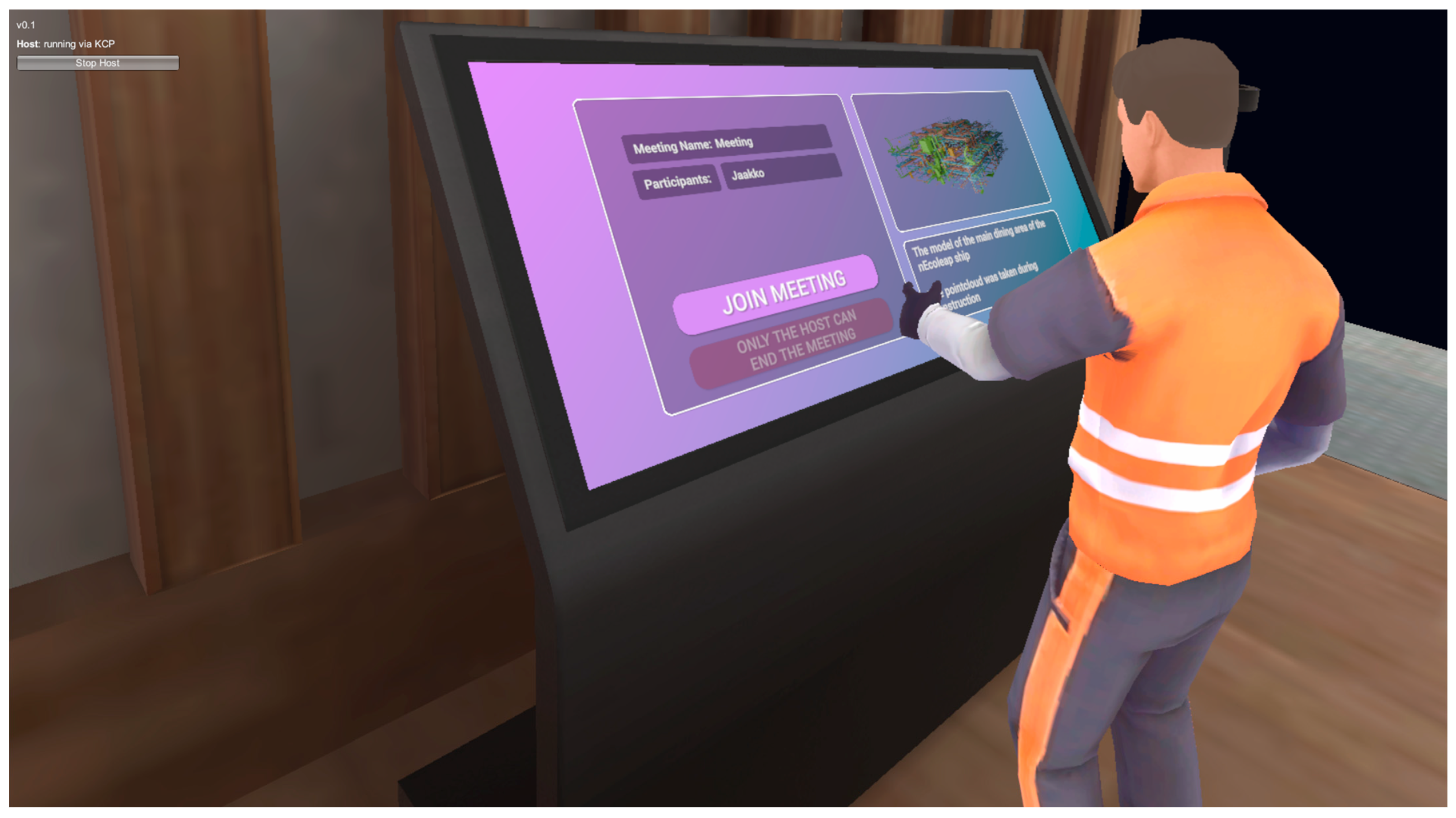
| Set up the meeting | Using the meeting creation interface to name and create the meeting. |
| Create the meeting and enter | After creating the meeting, you can wait for others to join or start the meeting (enter). |
| Grab the mobile controller/interface | Collect the virtual smartphone from the dispenser located beside the meeting panel by grabbing it with the virtual hand. |
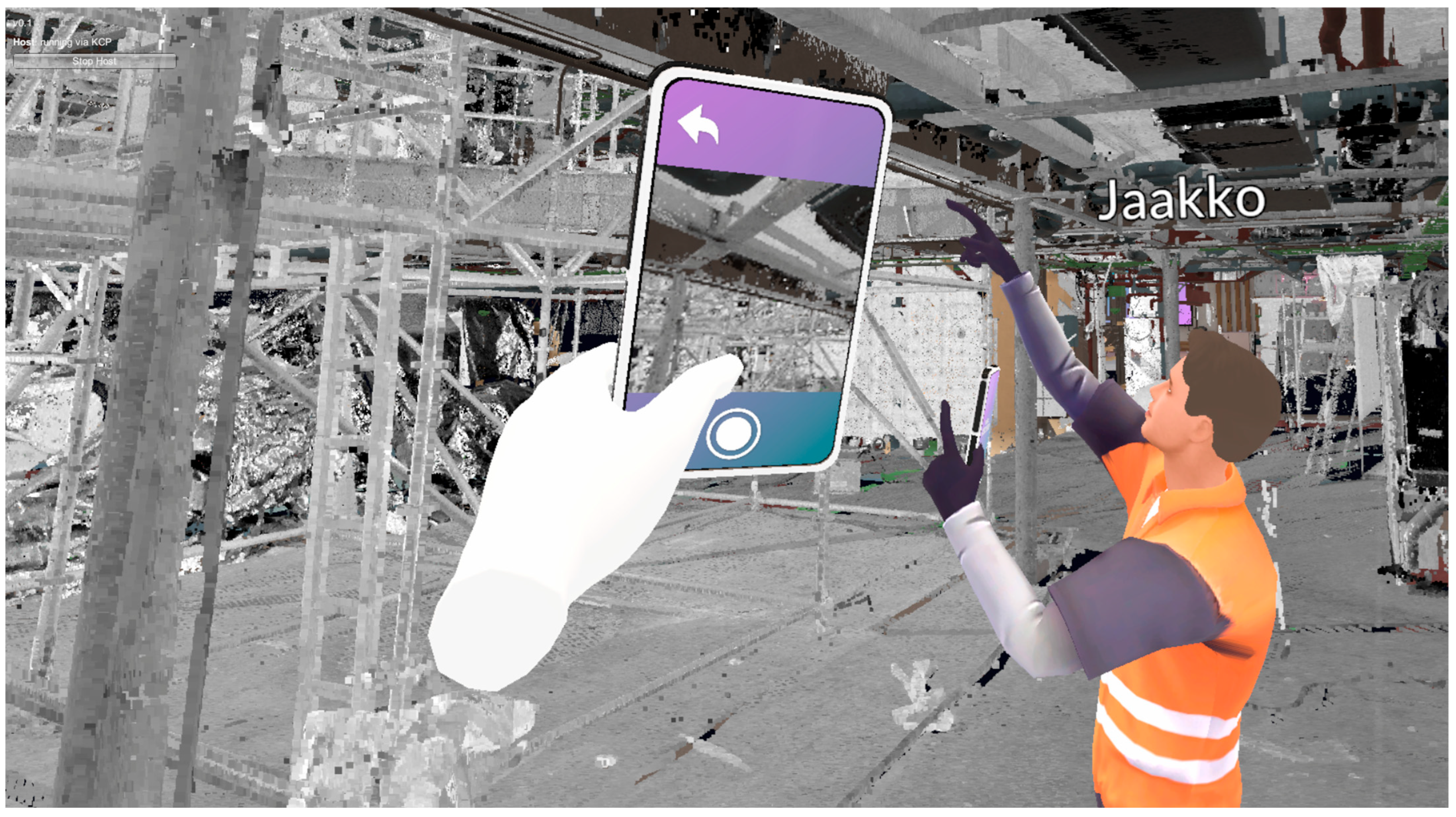
| Use the mobile phone/ Select the model/Press the buttons | The user can use the phone interface by pressing buttons on its display with the index finger of their free hand. |
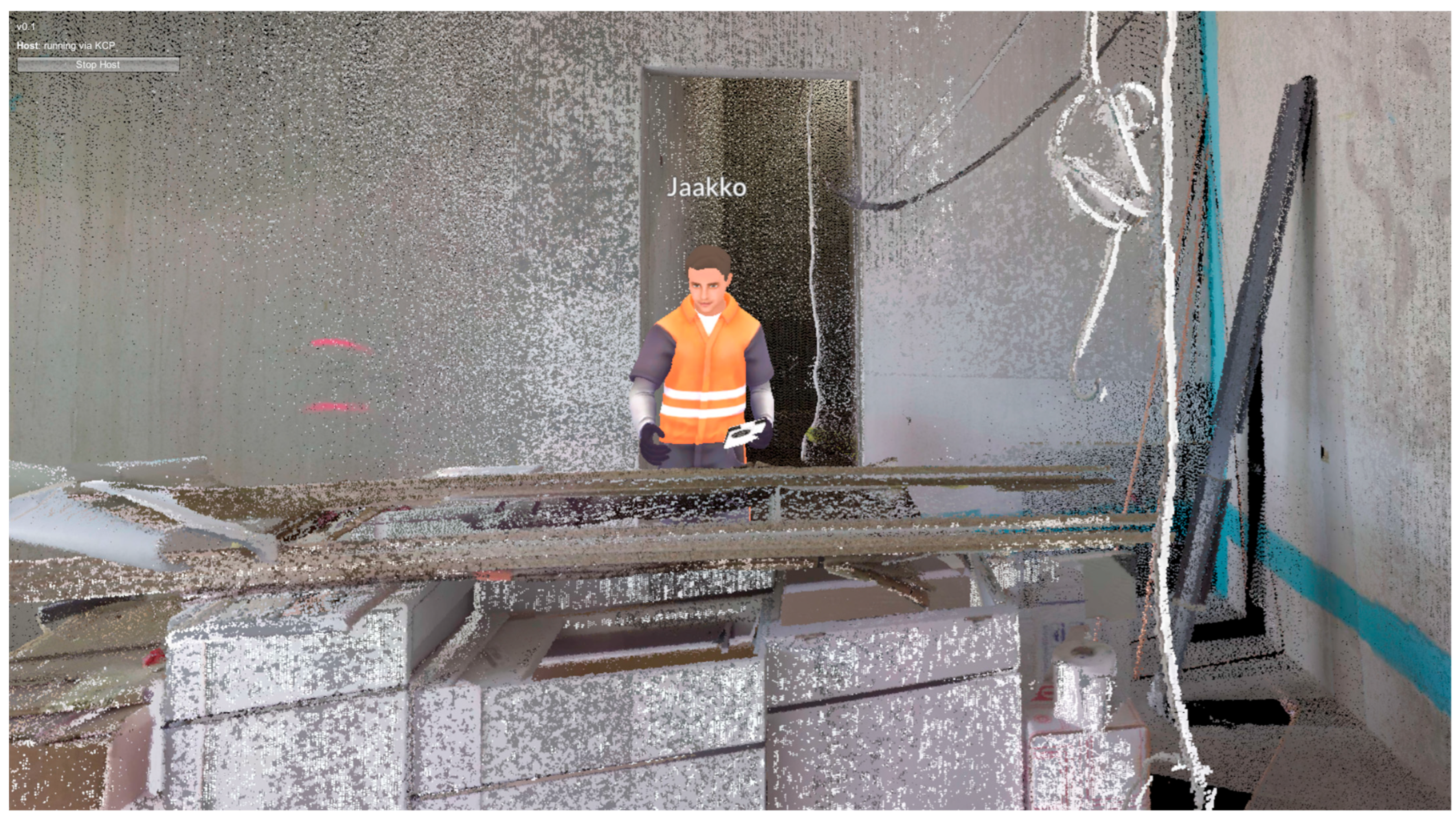
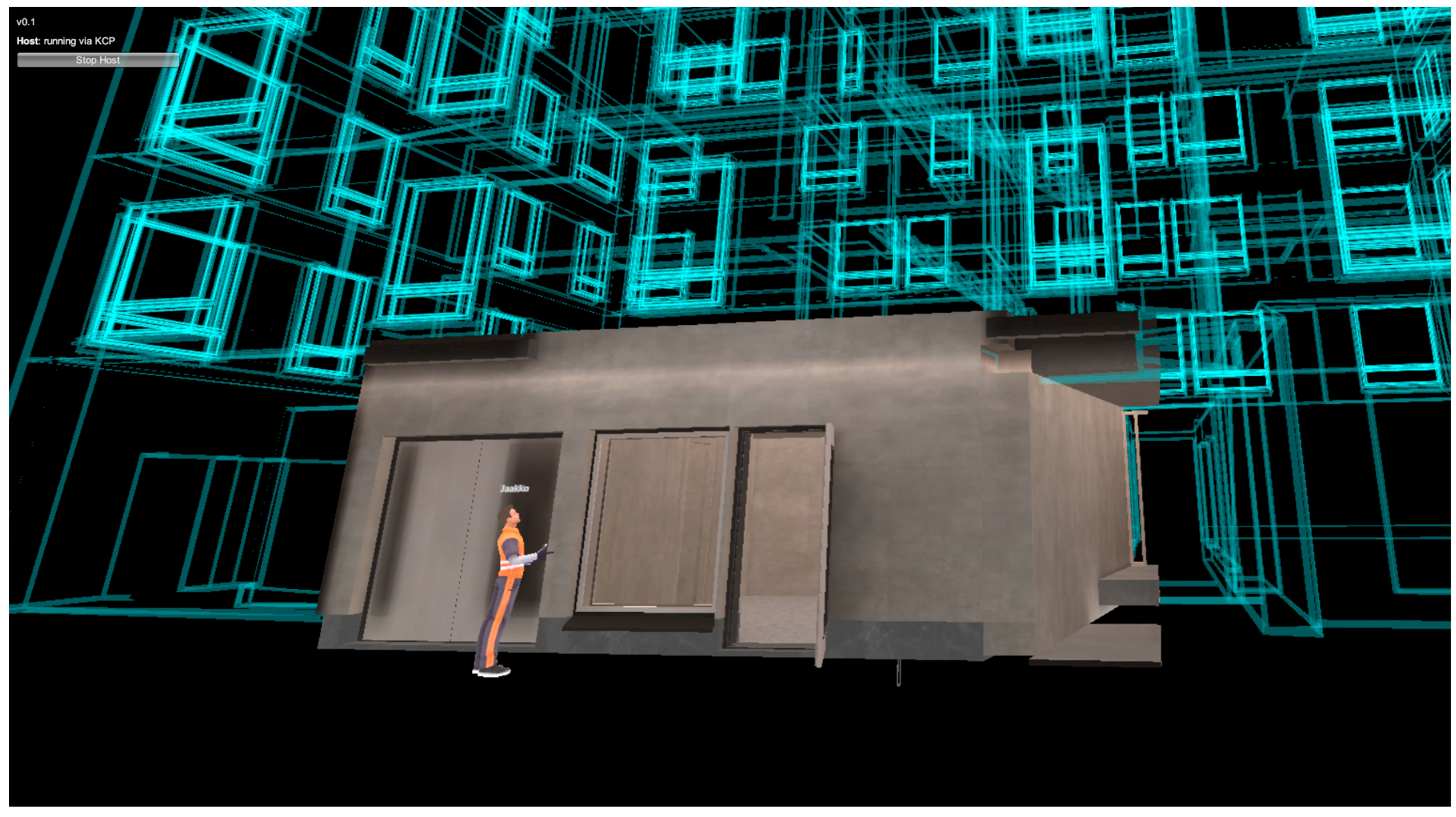
| Walk inside model (building) | The user navigates the virtual environment either by “walking,” which involves smooth movement using the left controller’s analog stick, or by “teleporting.” In the teleportation method, pushing the right analog stick forward displays an indicator extending from the user’s right hand. Releasing the stick instantly moves the user to the indicated position. Since the only collision detection is with the floor, users can freely move throughout the environment. The building model itself is positioned in an open space adjacent to the starting area. |
| Find the error | This represents a hypothetical scenario in which an architect employs the tool to assess the construction state by navigating the environment, recording notes from multiple locations, and comparing point cloud scans against CAD models. Such an example was offered to participants who appeared confused about the task. Yet, most participants intuitively carried out similar inspection activities on their own. |
| Take picture | Capture a virtual photograph of the inspection area or identified issue within the XR environment using the virtual smartphone interface. The image is automatically saved and can be referenced in annotations and meeting records. |
| Communicate | All interactions use speech-to-text (STT) input, including in VR, with text-to-speech (TTS) used to render spoken annotations as audio. |
| Go back to the meeting | After everything else users were prompted to return back to the starting area to end the meeting. Most people also ended up returning the phone back to the “dispenser” unprompted; this was also completely unnecessary as the phone just disappears when the meeting is ended. |
| Phase | Tasks | Duration | Research Roles |
|---|---|---|---|
| Pre-Test |
| 10–15 min | One researcher introduced and guided the participant. One researcher asked the pre-test questionnaire. |
| In-Test |
| 20 min | One researcher noted down and observed the interaction experiences and usability challenges encountered by the participant. |
| Post-Test |
| 20 min | One researcher conducted the post-test section and asked the post-test questionnaire and interview questions. |
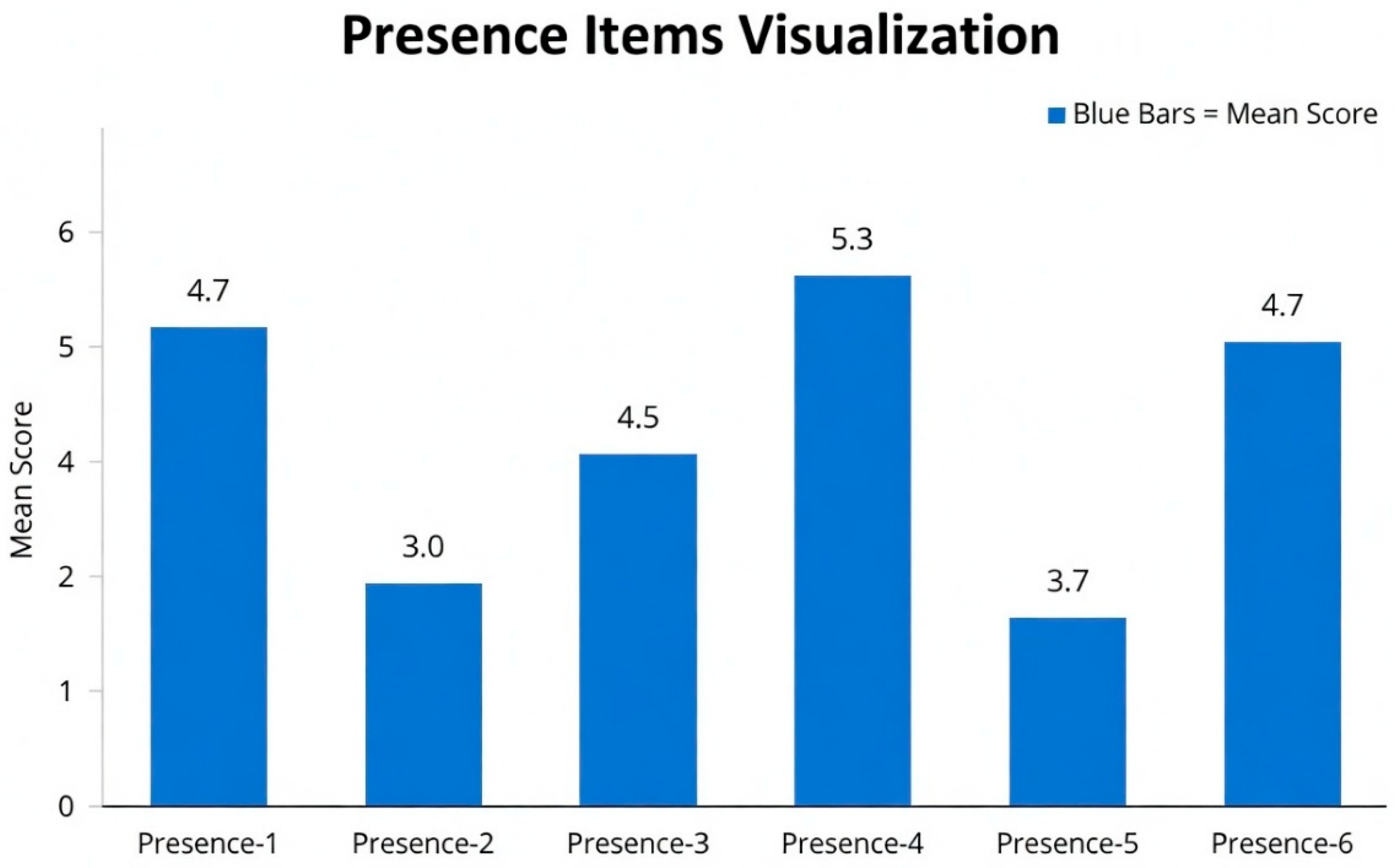
| No | Presence Items | Mean | SD |
|---|---|---|---|
| 1 | I experienced a sense of ‘being there’ in the Necoverse System, as though it were a real place. | 4.70 | 1.30 |
| 2 | During the experience, there were instances when the Necoverse System was perceived as real. | 3.00 | 1.60 |
| 3 | In retrospect, I perceive the Necoverse System as a place I visited, rather than a collection of visual images. | 4.50 | 1.50 |
| 4 | While immersed in the experience, I was more aware of being in the Necoverse System than in the physical world around me. | 5.30 | 1.20 |
| 5 | My recollection of the Necoverse System is comparable to memories of real-world locations, particularly in aspects such as vividness, color, spatial dimensions, and structural detail. | 3.70 | 1.90 |
| 6 | Throughout the experience, I frequently had the sensation of physically standing within the Necoverse System. | 4.70 | 1.60 |
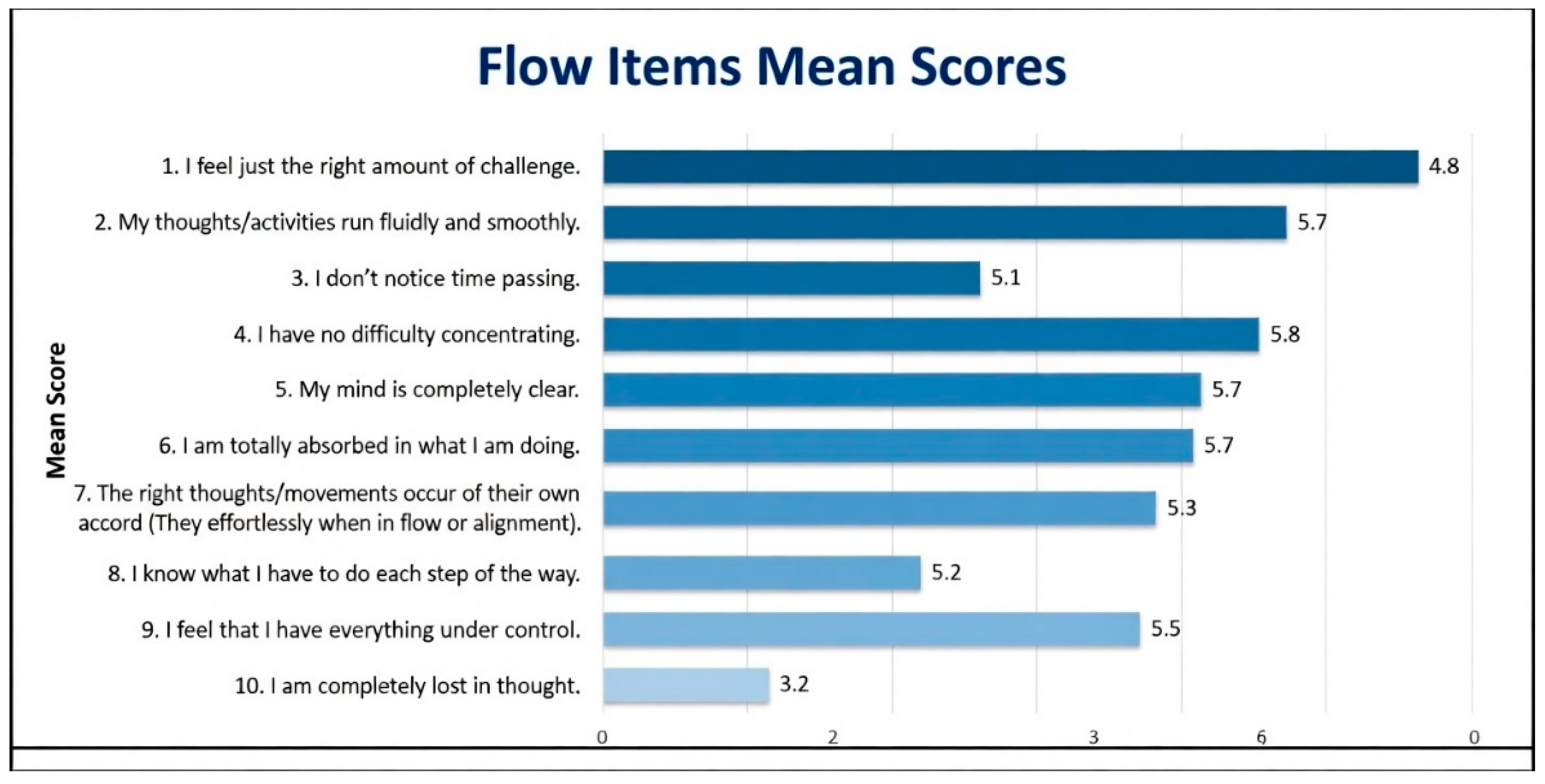
| Flow Items | Mean | SD |
|---|---|---|
| 1. I feel just the right amount of challenge. | 4.80 | 1.50 |
| 2. My thoughts/activities run fluidly and smoothly. | 5.70 | 0.90 |
| 3. I don’t notice time passing. | 5.10 | 1.60 |
| 4. I have no difficulty concentrating. | 5.80 | 1.20 |
| 5. My mind is completely clear. | 5.70 | 1.10 |
| 6. I am totally absorbed in what I am doing. | 5.70 | 1.10 |
| 7. The right thoughts/movements occur of their own accord (They happen effortlessly when in flow or alignment). | 5.30 | 1.20 |
| 8. I know what I have to do each step of the way. | 5.20 | 1.50 |
| 9. I feel that I have everything under control. | 5.50 | 1.30 |
| 10. I am completely lost in thought. | 3.20 | 1.40 |
| Fluency Items | Mean | SD |
|---|---|---|
| My thoughts/activities run fluidly and smoothly. | 5.70 | 0.90 |
| I have no difficulty concentrating. | 5.80 | 1.10 |
| My mind is completely clear. | 5.70 | 1.10 |
| The right thoughts/movements occur of their own accord (They happen effortlessly when in flow or alignment). | 5.30 | 1.20 |
| I know what I have to do each step of the way. | 5.20 | 1.50 |
| I feel that I have everything under control. | 5.50 | 1.30 |
| Absorption Items | Mean | SD |
|---|---|---|
| I feel just the right amount of challenge. | 4.80 | 1.50 |
| I don’t notice time passing. | 5.10 | 1.60 |
| I am totally absorbed in what I am doing. | 5.70 | 1.00 |
| I am completely lost in thought. | 3.20 | 1.40 |
| Flow Worrying Items | Mean | SD |
|---|---|---|
| Something important to me is at stake here (whether I feel that achieving the goal or completing the task is personally significant or impactful to me). | 3.30 | 1.40 |
| I won’t make any mistake here. | 4.20 | 1.70 |
| I am worried about failing. | 2.30 | 1.60 |
| NASA Items | Mean | SD |
|---|---|---|
| How mentally demanding was the Necoverse system task? | 22.8 | 19.9 |
| How physically demanding was the Necoverse system task? | 14.7 | 17.6 |
| How rushed or hurried did you feel during the Necoverse system task? | 4.8 | 8.6 |
| How successful were you in completing the Necoverse system task? | 28.6 | 31.0 |
| How much effort did the Necoverse system task require? | 19.5 | 13.2 |
| How frustrated did you feel while using the Necoverse system task? | 11.1 | 18.2 |
Disclaimer/Publisher’s Note: The statements, opinions and data contained in all publications are solely those of the individual author(s) and contributor(s) and not of MDPI and/or the editor(s). MDPI and/or the editor(s) disclaim responsibility for any injury to people or property resulting from any ideas, methods, instructions or products referred to in the content. |
© 2026 by the authors. Licensee MDPI, Basel, Switzerland. This article is an open access article distributed under the terms and conditions of the Creative Commons Attribution (CC BY) license.
Share and Cite
Pyae, A.; Saarinen, J.; Haavisto, J.; Virta, J.; Gröhn, M.; Luimula, M. Usability and User Experience in an Industrial Metaverse: A Mixed-Methods Study of the Necoverse Point Cloud Inspection System for Shipbuilding. Future Internet 2026, 18, 160. https://doi.org/10.3390/fi18030160
Pyae A, Saarinen J, Haavisto J, Virta J, Gröhn M, Luimula M. Usability and User Experience in an Industrial Metaverse: A Mixed-Methods Study of the Necoverse Point Cloud Inspection System for Shipbuilding. Future Internet. 2026; 18(3):160. https://doi.org/10.3390/fi18030160
Chicago/Turabian StylePyae, Aung, Juha Saarinen, Jaakko Haavisto, Jaro Virta, Matti Gröhn, and Mika Luimula. 2026. "Usability and User Experience in an Industrial Metaverse: A Mixed-Methods Study of the Necoverse Point Cloud Inspection System for Shipbuilding" Future Internet 18, no. 3: 160. https://doi.org/10.3390/fi18030160
APA StylePyae, A., Saarinen, J., Haavisto, J., Virta, J., Gröhn, M., & Luimula, M. (2026). Usability and User Experience in an Industrial Metaverse: A Mixed-Methods Study of the Necoverse Point Cloud Inspection System for Shipbuilding. Future Internet, 18(3), 160. https://doi.org/10.3390/fi18030160