


Abstract
Background: Topical delivery of high-dose L-ascorbic acid (AA) is limited by rapid oxidative degradation in water and physical particle aggregation in lipophilic vehicles. Here, we engineered an anhydrous delivery system combining a structured wax–oil matrix with high-shear roll-milling process to stabilize up to 40% AA. Methods: Dispersion morphology and 3D ultrastructure were evaluated via optical microscopy and Cryo-SEM. Rheological flow profiles and thixotropic recovery were measured using a rotational rheometer. Accelerated chemical stability was monitored at 0–50 °C for 4 weeks via RP-HPLC. Percutaneous delivery kinetics were investigated across synthetic biomimetic membranes (Strat-M®) using a sequential toner-application regimen. Biological efficacy was clinically assessed in 15 human volunteers over 4 weeks using 3D optical skin analysis (ANTERA 3D®). Results: The high-shear roll-milling process homogenized AA aggregates into micro-dispersions, establishing an apparent yield-stress network with an ultra-high zero-shear plateau (105 P) and shear-thinning thixotropy. The milled formulation retained highly stable chemical potency (93.99%) at 50 °C for 4 weeks. Sequential application with an aqueous toner facilitated in situ active dissolution at the barrier interface, increasing the absolute delivered payload from the 20% system by >10.5-fold relative to the 5% formulation. A 4-week clinical evaluation confirmed measurable improvements in skin brightness (∆L* = 1.66%), and reductions in hyper-pigmentation (25.65%), wrinkle area (31.17%), and pore area (26.00%). Conclusions: The milling-integrated anhydrous matrix provides a robust formulation framework that resolves physical sedimentation and oxidative instability while enabling the stable delivery of high-dose payloads via enhanced thermodynamic concentration gradients for enhanced dermatological rejuvenation.
1. Introduction
L-ascorbic acid (AA, Vitamin C) is widely used in dermatology for its multifaceted biological functions [1,2]. It serves as a potent antioxidant that neutralizes reactive oxygen species (ROS), plays a critical role as a cofactor for prolyl and lysyl hydroxylase in collagen biosynthesis [3], and effectively inhibits melanogenesis by reducing o-quinones [4]. Despite these well-documented benefits, the practical application of Vitamin C in topical formulations remains a significant challenge for cosmetic scientists due to its extreme instability and the difficulty of effective delivery [5,6].
The efficacy of Vitamin C is widely understood to be dose-dependent, where higher concentrations typically yield superior clinical outcomes in terms of skin brightening and structural rejuvenation [7,8]. Reflecting this, the cosmetic market has seen a growing trend toward high-concentration Vitamin C products. However, as the concentration increases, the physical stability of the formulation becomes increasingly compromised. High-dose Vitamin C often leads to significant technical issues such as particle aggregation, sedimentation, and poor dispersibility [9,10]. These physical instabilities not only diminish the aesthetic appeal of the product but also hinder the consistent delivery of the active ingredient to the skin, potentially causing uneven results or localized irritation.
In conventional oil-in-water (O/W) emulsions, this instability is compounded by rapid hydrolysis and aerobic oxidation [11,12]. Even with the addition of stabilizers, significant discoloration and a decrease in potency are often observed within a few weeks. To circumvent this, anhydrous (water-free) systems have been proposed as an alternative to arrest chemical degradation. However, anhydrous vehicles introduce their own set of dispersion challenges. Since Vitamin C is a polar crystalline solid that is insoluble in non-polar oils, high-dose particles tend to undergo rapid sedimentation and strong aggregation due to inter-particle hydrogen bonding [13,14]. This results in a non-homogeneous distribution and a gritty texture, which are undesirable in premium skincare.
Recent technological attempts to stabilize Vitamin C, such as liposomal encapsulation, have shown promise at ambient temperatures but often fail under accelerated conditions (40~50 °C) [15]. In anhydrous systems, the lack of a structured network to prevent particle collision frequently results in irreversible phase separation and active ingredient precipitation during high-temperature storage.
Recent advancements in topical delivery have also explored various gel-based and organogel systems to stabilize Vitamin C by restricting molecular mobility and limiting oxidative degradation pathways [16,17]. However, these networks frequently face structural collapse when loaded with hyper-concentrations of polar active ingredients under accelerated thermal stress. Furthermore, evaluating the transdermal delivery kinetics of such high-dose, low-pH formulations on biological tissues (e.g., porcine skin) often induces artificial tissue degradation. Consequently, synthetic biomimetic barriers, such as Strat-M® membranes, have been extensively validated in recent dermatological literature as highly reproducible and chemically resistant alternatives for screening the percutaneous flux of complex cosmetic actives [18,19].
To address both chemical degradation and physical sedimentation, our strategy combines an engineered anhydrous matrix with a high-shear roll-milling process. This process applies intense mechanical force to break down crystal-like aggregates into micro-sized particles [20,21], allowing them to be uniformly suspended within a thixotropic wax–oil network [22,23]. This micro-dispersion prevents sedimentation and ensures that the high-dose active remains stable even under extreme thermal stress.
The objective of this paper is to provide a comprehensive validation of this milling-integrated anhydrous system. First, we characterized the micro-dispersion state and rheological network integrity of the formulation using optical microscopy, Cryo-Scanning Electron Microscopy (Cryo-SEM), and steady-state rotational rheometry. Subsequently, we conducted a comparative stability analysis at temperatures up to 50 °C to track potency longevity over four weeks. Furthermore, to empirically justify the necessity of such high-dose formulations, we evaluated the dose-dependent skin permeability using a Franz-type diffusion cell. Finally, the clinical relevance was validated through a four-week human clinical trial to quantify measurable skin benefits. This integrated approach establishes a practical framework for stabilizing and delivering high-potency Vitamin C in topical skincare.
2. Materials and Methods
2.1. Preparation of High-Concentration L-Ascorbic Acid Anhydrous Formulation via High-Shear Roll-Milling
Control and experimental formulations were prepared by dispersing high-purity L-ascorbic acid (AA) powder into a non-aqueous lipophilic vehicle. This anhydrous system was engineered using a synergistic combination of polar ester oils (e.g., Coco-Caprylate/Caprate, Pentaerythrityl Tetraisostearate) and plant-derived structured waxes (e.g., Helianthus Annuus Seed Wax) at a loading range of 5–10% (w/w) to establish a stable, thixotropic matrix for the active ingredient. While the control formulation was prepared using conventional high-speed homogenization, the experimental formulation was further processed through a high-shear roll-milling system (e.g., EXAKT 50I, EXAKT Advanced Technologies GmbH, Norderstedt, Germany). The roller gap size was progressively reduced to a final constraint of 7–14 μm to ensure a homogeneous micro-dispersion. Specific dynamic parameters, including exact roller speeds, multi-pass cycles, and thermodynamic cooling profiles, are proprietary to the manufacturing process. This mechanical treatment was employed to effectively break down the AA crystal-like aggregates and ensure a stable, homogeneous micro-dispersion within the thixotropic lipid matrix. The process was carefully controlled to maintain the chemical integrity of the AA while achieving the desired particle size reduction and spatial uniformity.
2.2. Morphological and Structural Characterization
To visually ascertain the mitigation of AA agglomeration and evaluate the spatial distribution of the dispersed phase, the internal morphological structures of both formulations were analyzed. Initial macroscopic evaluations were conducted utilizing optical microscopy (U-MSSPG, Olympus, Tokyo, Japan). For high-resolution ultrastructural profiling, cryogenic scanning electron microscopy (Crossbeam 550, Carl Zeiss Microscopy GmbH, Jena, Germany) was employed. The anhydrous formulation samples were rapidly quenched in a liquid nitrogen slush to arrest molecular mobility, subsequently fractured in a high-vacuum environment, and sublimated to reveal the authentic three-dimensional arrangement of the AA micro-particles embedded within the lipophilic matrix without inducing solvent evaporation or crystallization artifacts [24].
To elucidate the mechanical mechanism underlying particle dispersion and suspension stability, steady-state shear rheological measurements were conducted using a rotational rheometer (Discovery Hybrid Rheometer, TA instruments, New Castle, DE, USA) equipped with a cone-and-plate geometry. Viscosity profiles (η) were recorded as a function of continuous shear rate () over a range from 0.01 to 100 s−1 in both upward and downward sweeps to assess pseudoplastic shear-thinning behavior and thixotropic hysteresis. All rheological profiles were measured in independent replicates (n = 3–5) at a strictly controlled temperature of 25 °C. A specific gap size of 14 and 7 μm was applied, and samples were allowed an equilibrium time of 2 min prior to measurement. Comparative analyses were systematically performed across five distinct vehicle architectures: the base vehicle, the unmilled formulation, the milled formulation, and wax-depleted formulations (with and without additional oil gelling agents).
2.3. HPLC Analysis for Chemical Stability Assessment
The chemical stability and degradation kinetics of the AA formulations were quantitatively assessed over a 4-week storage duration under accelerated environmental conditions (0 °C, 25 °C, 40 °C, and 50 °C), utilizing an aqueous AA solution of identical concentration as a benchmark. The residual concentration of intact AA was quantified employing a reversed-phase High-Performance Liquid Chromatography (RP-HPLC) system coupled with a UV-Vis detector. Chromatographic separation was optimized on a C18 column (250 mm × 4.6 mm, 5 µm). To achieve exhaustive extraction of AA from the hydrophobic lipid matrix, a specific liquid–liquid extraction protocol was executed: samples were initially dispersed in dichloromethane and subsequently extracted vigorously using the acidic aqueous mobile phase. The isocratic mobile phase consisted of 0.2% metaphosphoric acid, methanol, and acetonitrile (90:8:2, v/v/v), delivered at a steady flow rate of 1.0 mL/min. The detection wavelength was precisely set to 254 nm to capture the maximum absorbance of the enediol conjugated system of AA. The HPLC method was internally validated, exhibiting excellent linearity and quantitative recovery (>98.5%) for ascorbic acid extracted from the anhydrous matrix [25].
2.4. In Vitro Skin Permeation Assay via Franz Diffusion Cell
In accordance with ethical guidelines on non-animal testing, an in vitro percutaneous permeation study was performed using a static Franz diffusion cell system. Initially, ex vivo porcine skin was considered; however, the extreme low pH of 40% AA induced severe macroscopic perforations in the biological tissue over prolonged exposure, artificially skewing the kinetics. Therefore, simplified aqueous vehicles containing ascending concentrations of AA (10%, 20%, 30%, and 40%, w/w) as well as the engineered milled anhydrous formulations (10%, 20%, 30%, and 40%, w/w) were evaluated using a static Franz diffusion cell system. The apparatus was fitted with a Strat-M® synthetic skin membrane, structurally engineered with intersecting polyethersulfone layers impregnated with synthetic lipids to physiologically emulate human stratum corneum permeation barriers [26,27]. The effective diffusion cross-sectional area was standardized to 1.0 cm2. The receptor compartment (reservoir), with an approximate capacity of 3.0 mL, was filled with meticulously degassed Phosphate-Buffered Saline (PBS, pH 7.4) to assure the maintenance of perfect sink conditions.
To emulate actual skincare application regimens and facilitate interfacial active dissolution for the anhydrous system, a simplified aqueous toner vehicle was pre-applied onto the donor membrane surface prior to the application of the anhydrous formulation. The entire diffusion cell assembly was then incubated in a constant temperature and humidity chamber to facilitate permeation over a continuous 48-h period. Upon completion of the 48-h permeation phase, the fluid from the receptor reservoir was sampled to determine the completely transited AA concentration. Concurrently, to quantify the active ingredient retained within the barrier (intra-membrane permeation), the synthetic membrane was carefully excised, transferred into a vial containing 3.0 mL of fresh PBS, and subjected to ultrasonication for complete extraction of the entrapped AA. The exact concentrations of AA from both the receptor reservoir and the sonicated membrane extracts were analytically quantified utilizing the established RP-HPLC methodology.
2.5. In Vivo Clinical Efficacy Evaluation
To determine whether the physical stabilization and enhanced permeation translate into clinical efficacy, an in vivo human application study was performed. The study protocol was approved by the Institutional Review Board (IRB No. [LGHH-20251113-AA-02]) and performed in accordance with the Declaration of Helsinki. A 4-week continuous application study was performed on 15 human volunteers to assess the in vivo efficacy of the experimental 40% AA milled anhydrous system. Non-invasive biometric measurements were conducted at baseline (Week 0), Week 2, and after 4 weeks of treatment. Skin brightness (L*), hyper-pigmentation, wrinkle area, and pore area were assessed using an advanced 3D skin analysis imaging system (ANTERA 3D®) [28,29]. Specific parameters were meticulously extracted and statistically analyzed using a paired t-test to quantify the skin-enhancing efficacy of the formulation from baseline. The percentage change in brightness was calculated as , while improvements in hyper-pigmentation, wrinkle area, and pore area were calculated as percentage reductions from baseline. This in vivo study was designed as an early-stage, exploratory proof-of-concept pilot to confirm dermatological feasibility.
2.6. Statistics
All statistical analyses were performed using IBM SPSS Statistics 21.0 software (IBM, Armonk, NY, USA). The results were expressed as the mean ± standard deviation (SD). Differences between time points or groups were analyzed using paired t-tests for clinical data, and One-way ANOVA followed by Tukey’s post-hoc test for permeation data with the statistical significance set at p < 0.05.
3. Results and Discussions
3.1. Morphological and Structural Characterization of High-Concentration L-Ascorbic Acid in Anhydrous Systems
The incorporation of high-dose L-ascorbic acid (AA) into non-aqueous lipophilic vehicles presents a fundamental challenge due to the significant polarity mismatch between the hydrophilic active ingredient and the hydrophobic continuous phase. Because polar AA crystals cannot interact favorably with non-polar continuous phases, strong inter-particle hydrogen bonding and van der Waals forces drive rapid aggregation and sedimentation. To address this, we developed an anhydrous matrix utilizing a synergistic blend of ester oils and structured waxes, complemented by a high-shear roll-milling process.
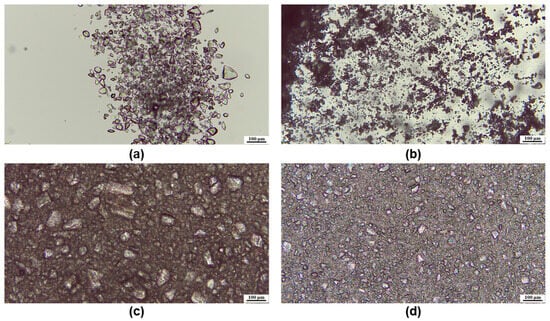
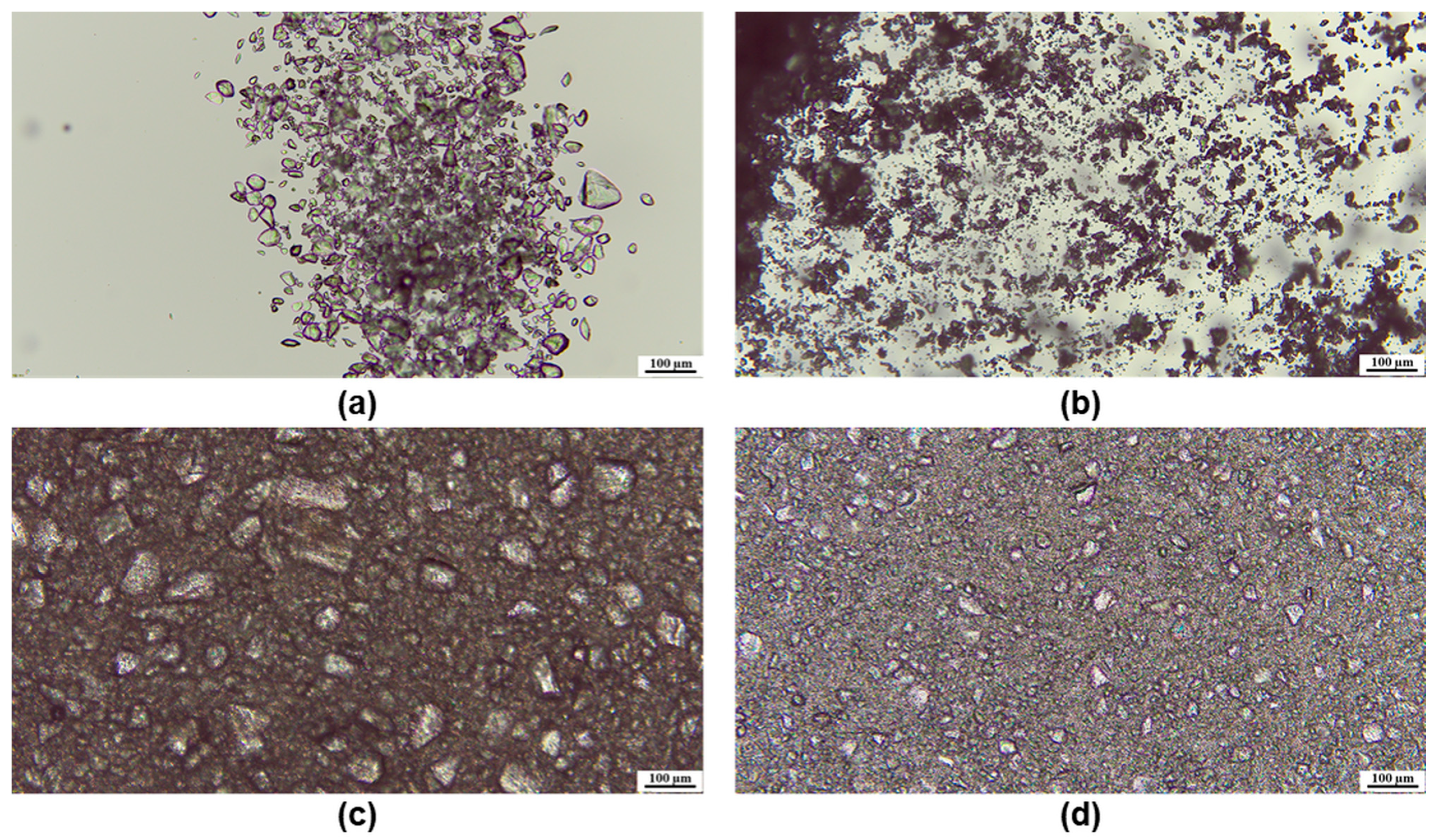
The influence of the dispersion medium on AA particle behavior was first evaluated using optical microscopy (Figure 1). Unlike the typical crystalline state observed in aqueous environments (Figure 1a), AA dispersed in conventional non-polar oils (Figure 1b) underwent severe macro-aggregation, forming coarse, irregular clusters due to strong polar repulsion. In contrast, when AA was incorporated into our specifically engineered ester oil and wax-based anhydrous system (Figure 1c), the thixotropic wax network provided a degree of structural hindrance that partially inhibited uncontrolled particle collisions. However, even within this optimized matrix, localized agglomerates remained visible. The introduction of high-shear roll-milling to this system (Figure 1d) resulted in a dramatic shift, where crystal-like aggregates were effectively comminuted into micro-sized particles, achieving a highly homogeneous micro-dispersion.
Figure 1.
Morphological behavior of L-ascorbic acid (AA) in various dispersion media and processing conditions. (a) AA crystals in an aqueous solution, (b) AA dispersed in conventional non-polar mineral oil (exhibiting severe macro-aggregation), (c) AA in the engineered ester oil-wax anhydrous matrix without milling, (d) AA in the engineered anhydrous matrix with high-shear roll-milling process.
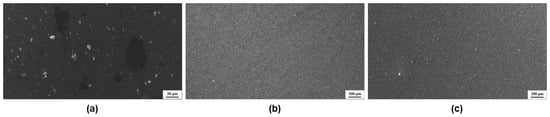
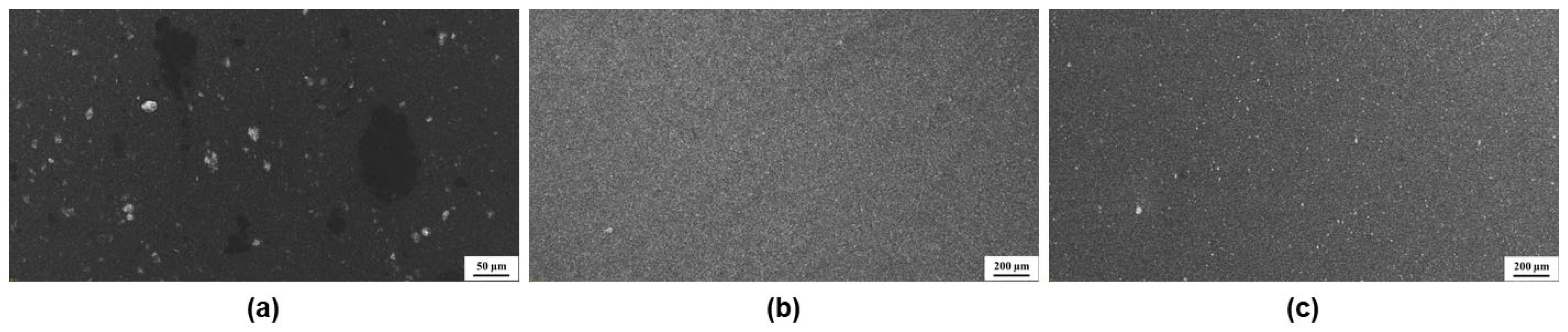
To optimize the processing efficiency, the dispersion quality was assessed as a function of milling frequency (Figure 2). Compared to the unmilled control (Figure 2a), the formulation subjected to a single cycle of high-shear roll-milling process (Figure 2b) successfully pulverized macroscopic aggregates into a homogeneous micro-dispersion (1–10 μm). Interestingly, a second milling cycle (Figure 2c) did not yield a statistically significant improvement in visual dispersion quality. This suggests that the initial high-shear cycle provides sufficient mechanical energy to overcome the cohesive energy of the AA crystals and effectively isolate them within the wax–oil network.
Figure 2.
Comparison of dispersion states in high-concentration Vitamin C anhydrous formulations according to the number of high-shear roll-milling cycles. (a) Unmilled control, (b) 1-cycle milling, (c) 2-cycle milling. The results show that a single high-shear cycle effectively reaches the critical threshold for homogeneous micro-dispersion.
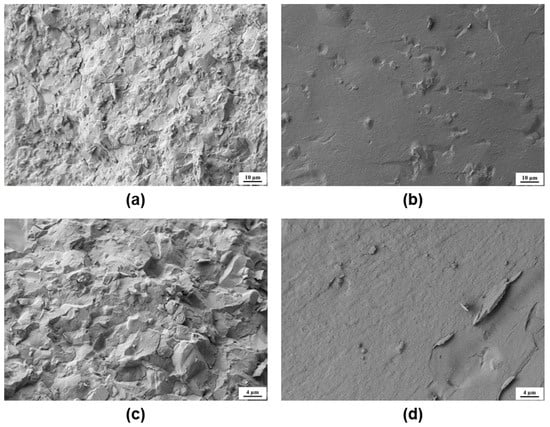
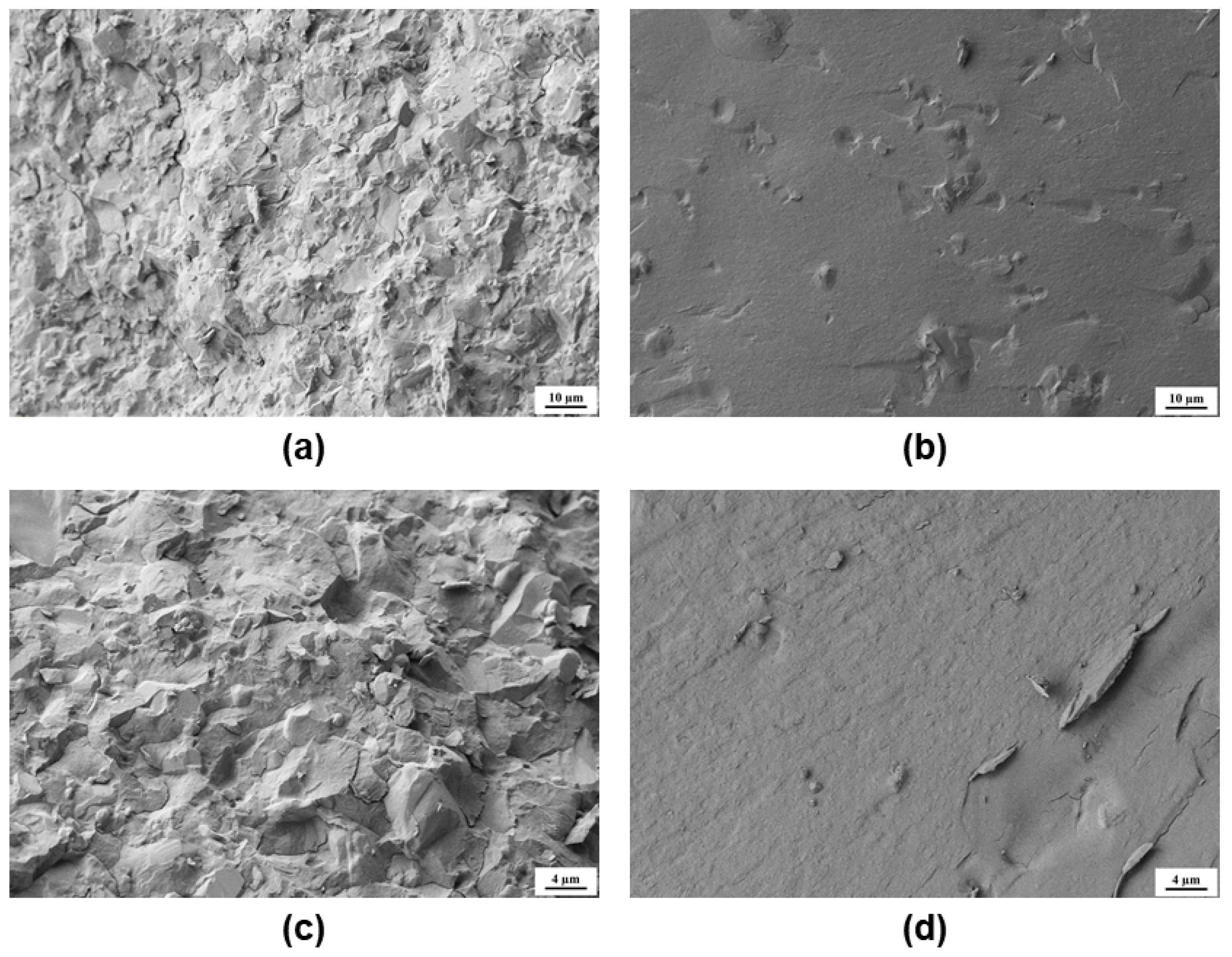
To further validate these observations, Cryo-SEM was employed to examine the three-dimensional ultrastructure (Figure 3). The internal cross-section of the milled formulation (Figure 3a) revealed a dense, monolithic arrangement where micro-fine AA crystals were seamlessly integrated into the lipid matrix. Conversely, the unmilled control (Figure 3c) exhibited large, protruding crystalline structures, creating a disorganized topographical profile. The robustness of the dispersion was most evident in the oil-dilution assay; in the milled samples (Figure 3b), AA particles remained independently suspended, whereas the diluted unmilled samples (Figure 3d) showed immediate exposure of large aggregates.
Figure 3.
Ultrastructural analysis via Cryogenic Scanning Electron Microscopy (Cryo-SEM) showing the impact of high-shear roll-milling. (a) Surface morphology of the milled anhydrous formulation, (b) milled formulation after oil dilution, (c) unmilled anhydrous formulation, (d) unmilled formulation after oil dilution.
It is important to note that conventional quantitative dynamic light scattering (DLS) could not be utilized, as diluting the solid-lipid matrix with organic solvents fundamentally destroys the in situ thixotropic wax network. Therefore, we relied on Cryo-SEM imaging to authentically preserve the dispersion state. Furthermore, because the high-shear roll-milling was conducted within a viscous, structured wax–oil continuous phase (wet-milling), the lipophilic matrix acted as a hydrodynamic cushion. This protected the crystal-like habit of AA from structural fracture or amorphization, preserving its chemical integrity.
Collectively, these morphological findings demonstrate that the integration of a structured anhydrous matrix with high-shear roll-milling provides a robust solution to the physical instability of high-concentration Vitamin C. This structural integrity serves as the essential foundation for the subsequent chemical longevity and enhanced skin benefits observed in our clinical evaluations.
3.2. Rheological Behavior and Structural Network Integrity of the Anhydrous Matrix
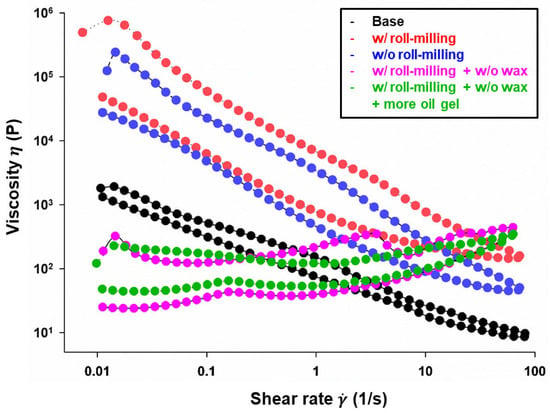
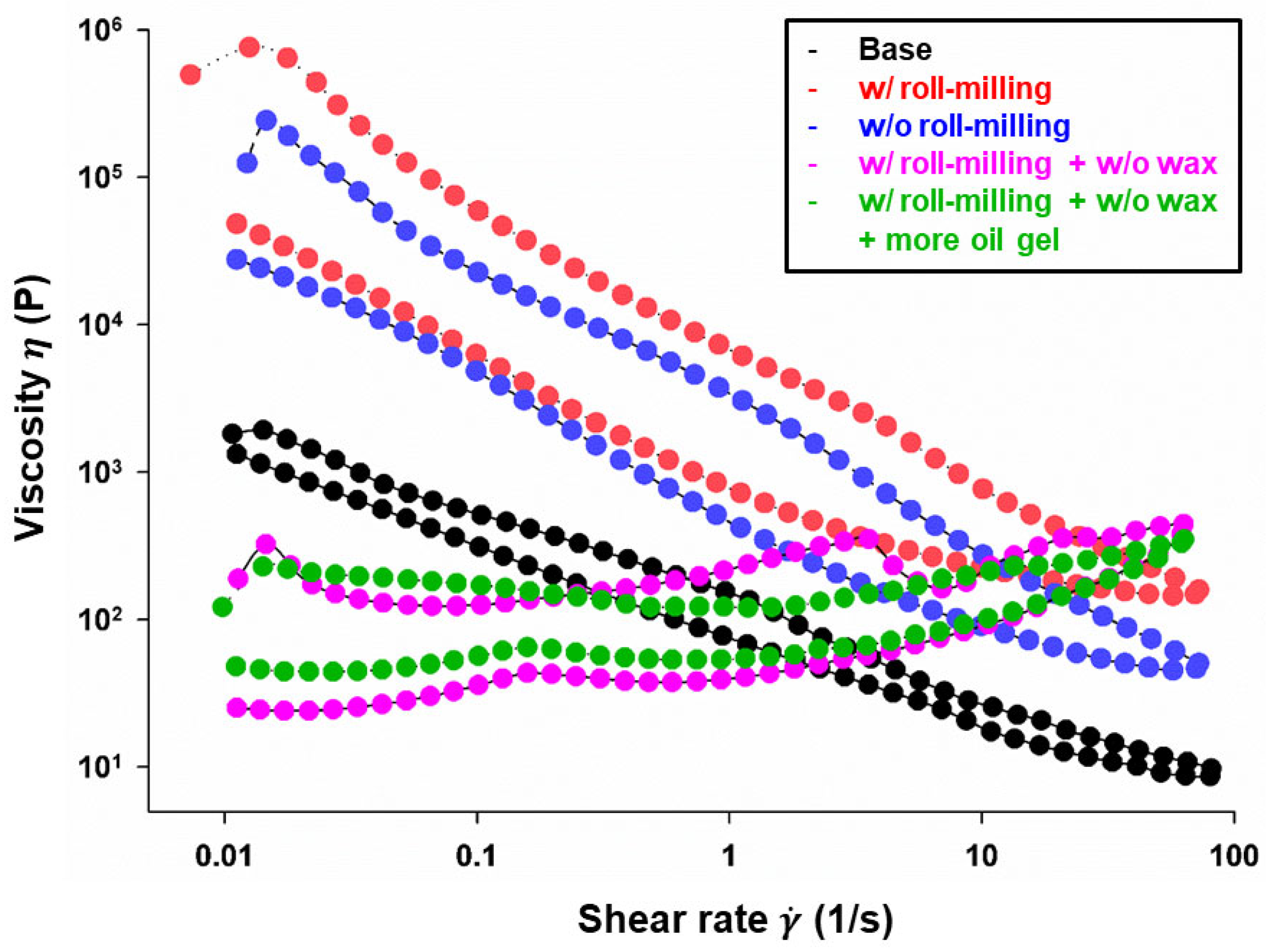
The physical stabilization mechanism achieved by the combination of structured wax and high-shear roll-milling was quantitatively evaluated via steady-state flow rheology (Figure 4). All continuous formulations incorporating the structured wax network displayed pronounced non-Newtonian, shear-thinning (pseudoplastic) behavior. In the quiescent state (low shear rate, ), the milled anhydrous system (w/roll-milling) exhibited a remarkably high zero-shear plateau viscosity exceeding 105 P, which was substantially higher than that of the unmilled counterpart. This high low-shear viscosity provides a physical barrier against gravitational settling and particle collision, consistent with the Cryo-SEM observations [30]. As the shear rate increased toward application-relevant regimes (), the viscosity of the milled formulation dropped abruptly by more than three orders of magnitude, reaching below 102 P. This rapid shear-induced thinning ensures exceptional spreadability and aesthetic compliance upon topical application. Furthermore, the evident hysteresis loop between the ascending and descending flow curves demonstrates the thixotropic reversibility of the system, wherein the disrupted matrix reconstructs upon stress relaxation [31,32]. Chemically, the solid plant-derived waxes interact within the polar ester oil phase to form a stable, three-dimensional reticulated network, which provides the structural basis for this ultra-high apparent yield-stress behavior. Crucially, the formulation devoid of structured wax (w/o wax) exhibited a baseline viscosity collapse (101~102 P) across all shear regimes, failing to maintain a yield-like structure even with the addition of supplementary oil gelling agents. This comparative rheological profiling confirms that the crystalline wax network acts as an indispensable structural backbone, while high-shear roll-milling maximizes the effective hydrodynamic volume fraction and inter-particle dispersion homogeneity of the AA phase.
Figure 4.
Continuous shear flow curves and thixotropic behavior of anhydrous Vitamin C formulations under varying processing and compositional conditions. Steady-state shear viscosity (η, Poise) as a function of shear rate (, 0.01 to 100 s−1) measured in continuous forward (upward) and backward (downward) sweeps at 25 °C. Evaluated systems include: the vehicle base without active particles (Base, black); the fully engineered anhydrous formulation processed via high-shear roll-milling (w/roll-milling, red); the unmilled control formulation (w/o roll-milling, blue); the wax-deficient formulation (w/roll-milling + w/o wax, magenta); and the wax-deficient formulation supplemented with additional oil gelling agents (w/roll-milling + w/o wax + more oil gel, green). The milled formulation (red) exhibits a high zero-shear viscosity plateau exceeding 105 P with pronounced pseudoplastic (shear-thinning) and thixotropic hysteresis properties, confirming the essential structural synergy between the microcrystalline wax network and high-shear mechanical micro-dispersion.
3.3. Accelerated Chemical Stability and Potency Longevity of the Anhydrous System
The morphological perfection of the milled anhydrous system, as demonstrated in Section 3.1, is ultimately a means to an end: protecting the highly susceptible L-ascorbic acid (AA) molecule from chemical degradation. To quantitatively evaluate the “potency longevity” of our formulation, an accelerated chemical stability assay was conducted. The residual titer of AA in the 40% milled anhydrous formulation was compared against a 40% aqueous solution baseline over a 4-week period across a thermal gradient of 0 °C, 25 °C, 40 °C, and 50 °C.
The quantitative results, analyzed via RP-HPLC, are summarized in Table 1. As anticipated, the aqueous solution exhibited a pronounced, temperature-dependent degradation profile. While the aqueous control maintained an acceptable titer at 0 °C (95.15%) and 25 °C (92.18%), its stability collapsed under accelerated conditions. After 4 weeks at 40 °C, the residual AA plummeted to 66.15%, and at 50 °C, only 40.63% of the initial active ingredient remained intact. This massive loss is attributed to the rapid hydrolytic cleavage and aerobic oxidation pathways catalyzed by water and heat.
Table 1.
Comparative chemical stability (potency retention) of 40% L-ascorbic acid in the engineered anhydrous system versus an aqueous solution over a 4-week storage period at various temperatures.
In contrast, the milled anhydrous system showed excellent chemical stability, retaining 93.99 ± 8.51% of the initial AA titer even at the extreme accelerated condition of 50 °C over 4 weeks. Furthermore, it is important to note that while an unmilled anhydrous formulation was also evaluated, its data were intentionally excluded from Table 1 due to a lack of analytical reliability. In the unmilled samples, the macroscopic aggregation of AA crystals induced severe physical instability under thermal stress, leading to macroscopic phase separation, oil bleeding (syneresis), and complete structural collapse. This physical phase separation led to significant fluctuations in measured concentration. This spatial heterogeneity resulted in inconsistent potency readings that failed to meet the standards for statistical reproducibility.
These observations underscore the indispensable role of the high-shear roll-milling process in achieving both physical and chemical stability. While the anhydrous matrix prevents chemical hydrolysis, the milling process provides the essential micro-homogeneity required to ensure that the active payload is uniformly distributed and maintained throughout the formulation. These results demonstrate that the high-shear roll-milling is necessary to ensure consistent dosing and uniform potency throughout high-concentration formulations.
3.4. In Vitro Skin Permeation Profiling: Transdermal Delivery in Aqueous vs. Anhydrous Systems
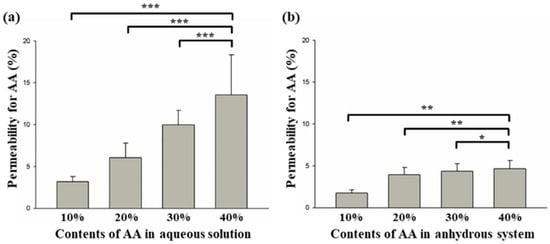
The clinical efficacy of topical L-ascorbic acid is fundamentally governed by its ability to cross the hydrophobic stratum corneum and reach viable target skin layers. According to Fick’s first law of steady-state passive diffusion (), the transdermal flux (JSS) is directly proportional to the thermodynamic chemical potential gradient (ΔC) established across the barrier [33,34]. To evaluate this delivery dynamic and establish formulation feasibility, in vitro permeation assays across synthetic Strat-M® membranes were performed in a two-tier evaluation over 48 h (Figure 5).
Figure 5.
In vitro skin permeation profiles of L-ascorbic acid (AA) across synthetic Strat-M® membranes over 48 h. (a) Proof-of-concept concentration-dependent permeation in simplified aqueous solutions (10%, 20%, 30%, and 40%, w/w), demonstrating linear passive diffusion behavior. (b) Transdermal permeation efficiency in the engineered milled anhydrous matrix across ascending intrinsic formulation concentrations (10%, 20%, 30%, and 40%, w/w). Horizontal brackets indicate comparisons with 40% AA group. * p < 0.05, ** p < 0.01, and *** p < 0.001.
In the initial proof-of-concept phase utilizing simplified aqueous solutions, ascending AA concentrations (10%, 20%, 30%, and 40%, w/w) yielded a distinctly linear escalation in cumulative permeation percentage: 3.18%, 6.05%, 9.98%, and 13.57%, respectively (Figure 5a). Crucially, the 40% aqueous solution delivered an absolute payload more than 17 times higher than that of the 10% solution (40% × 13.57% = 5.428 a.u. vs. 10% × 3.18% = 0.318 a.u.). This confirmed that elevating the formulation concentration drastically increases the thermodynamic driving force, verifying the pharmacological justification for developing high-potency topical systems.
Subsequently, the percutaneous permeation behavior within the engineered anhydrous matrix was characterized across varying intrinsic active loadings: 10%, 20%, 30%, and 40% (w/w) AA (Figure 5b). The corresponding percentage permeation efficiencies were determined to be 1.76% (10% AA), 3.95% (20% AA), 4.36% (30% AA), and 4.65% (40% AA). While the relative percentage permeation efficiency approached an asymptotic plateau above 15% loading due to finite membrane partitioning capacity and solvation kinetics at the skin interface, the absolute delivery payload of active L-ascorbic acid delivered across the barrier increased dramatically with concentration. Specifically, the 40% anhydrous formulation achieved a more than 10.5-fold increase in net transported active payload compared to the 10% vehicle (40% × 4.65% = 1.860 a.u. vs. 10% × 1.76% = 0.176 a.u. normalized mass transfer index). Critically, this superior transdermal bioavailability from the lipophilic vehicle was unlocked by employing a biomimetic sequential application regimen with an aqueous toner. In an isolated non-aqueous environment, hydrophilic AA crystals remain entrapped within the structured lipid-wax continuous phase, an arrangement vital for halting hydrolytic degradation during storage, but one that inherently restricts partitioning across a dry barrier. Upon sequential contact with the pre-applied aqueous toner layer on the membrane interface, the micro-dispersed AA particles instantly dissolve in situ, establishing a localized, ultra-high concentration gradient (ΔC) directly at the membrane boundary. These findings substantiate a dual-function delivery paradigm: the engineered anhydrous matrix ensures 100% chemical potency longevity during shelf-life storage, while the sequential skincare regimen triggers instantaneous release and high thermodynamic bioavailability upon application. This mechanism provides a practical rationale for high-dose anhydrous systems, combining shelf-life stability with efficient active delivery upon application.
3.5. In Vivo Clinical Efficacy: Translating Structural Perfection into Biological Benefits
Having established the superior physical stability and transdermal permeation of the milled anhydrous system in vitro, an in vivo clinical evaluation was conducted to verify its tangible biological benefits. A 4-week continuous application study involving 15 human volunteers was performed using the 40% AA milled anhydrous formulation. Non-invasive biometric assessments were conducted to quantify improvements in skin brightness, hyper-concentration, wrinkle area, and pore area.
The clinical outcomes, expressed as percentage improvements from baseline at Week 4, are summarized in Table 2. The results demonstrate that the daily application of the high-concentration milled anhydrous system yielded statistically significant enhancements across all measured parameters. Specifically, skin brightness (ΔL*) exhibited a highly significant improvement of 1.66% (p < 0.001), while hyper-concentration was reduced by a remarkable 25.65% (p < 0.01), confirming the effective delivery of the active antioxidant to mitigate pigmentation. Furthermore, the formulation provided substantial structural rejuvenation, evidenced by a 31.17% improvement in wrinkle area (p < 0.05) and a 26.00% improvement in pore area (p < 0.01).
Table 2.
Mean improvement rates in skin parameters from baseline after 4 weeks of continuous application of the 40% AA milled anhydrous system (n = 15).
These robust clinical improvements directly correlate with the morphological and permeation findings detailed in previous sections. The high-shear roll-milling process ensured a homogeneous micro-dispersion, maximizing the active ingredient’s contact area with the skin while preventing the formation of abrasive macroscopic aggregates. The high concentration gradient facilitated transdermal delivery, supporting both melanin inhibition and collagen renewal. These clinical findings confirm that the milled anhydrous matrix provides an effective topical vehicle for high-dose Vitamin C. However, as an exploratory single-arm pilot study, vehicle-controlled randomized clinical trials (RCTs) with larger cohorts will be necessary in future studies to establish rigorous causal validation.
4. Conclusions
In this study, we successfully developed a highly stable and clinically superior 40% L-ascorbic acid (AA) delivery system by integrating a specifically engineered anhydrous matrix with a high-shear roll-milling process. To overcome the profound physical and chemical instabilities inherent to such high-dose systems, we optimized a thixotropic ester oil and wax network. Crucially, the application of high-shear roll-milling effectively comminuted large AA aggregates into a homogeneous micro-dispersion, as confirmed by optical and Cryo-SEM analyses. Rheological profiling demonstrated that this micro-dispersion establishes an apparent yield-stress network with an ultra-high zero-shear viscosity (>105 P), effectively preventing gravitational sedimentation while maintaining shear-thinning thixotropy for smooth cosmetic spreadability.
This structural dispersion provided robust chemical stability, with the formulation maintaining highly stable active retention (>93%) at 50 °C over 4 weeks. Furthermore, our in vitro permeation assay established the physiological necessity of this formulation by demonstrating a linear, dose-dependent enhancement in transdermal AA delivery. Finally, the in vivo clinical evaluation validated the biological superiority of this micro-dispersion technology. Following a 4-week continuous application, the 40% AA milled formulation exhibited statistically significant improvements from baseline in skin brightness, hyper-pigmentation, wrinkle area, and pore area reduction.
In summary, this study demonstrates a formulation strategy that resolves the dual challenges of physical sedimentation and oxidative degradation in high-dose Vitamin C products. The milling-integrated anhydrous matrix offers a practical platform for topical skincare applications requiring high active potency and long-term stability.
Author Contributions
Conceptualization, H.J., J.C., J.G.W. and S.C.; methodology, H.J., J.C., J.G.W., S.C. and S.L.; formal analysis, H.J.; investigation, H.J.; data curation, J.C.; resources, J.G.W.; writing—original draft preparation, H.J.; writing—review and editing, H.J.; visualization, H.J.; supervision, W.C. and S.-W.P.; project administration, W.C. and S.-W.P.; funding acquisition, M.K. and N.S.S. All authors have read and agreed to the published version of the manuscript.
Funding
This research received no external funding.
Institutional Review Board Statement
The study was conducted in accordance with the Declaration of Helsinki, and approved by the Institutional Review Board of LG Household & Health Care (IRB No. LGHH-20251113-AA-02).
Informed Consent Statement
Informed consent was obtained from all subjects involved in the study.
Data Availability Statement
The data used to support the findings of this study are included within the article or available from the corresponding author upon request.
Acknowledgments
The authors acknowledge that an AI language model was used solely for language polishing and grammatical editing during the preparation of this manuscript. The AI tool was not used to generate data, conduct scientific analyses, or draw conclusions. The authors have carefully reviewed the manuscript and take full responsibility for the final content of the publication.
Conflicts of Interest
All authors are employees of LG Household & Health Care (LG H&H). The authors declare no other competing financial or personal interests that could influence the work reported in this paper.
Abbreviations
The following abbreviations are used in this manuscript:
| AA | L-ascorbic acid (Vitamin C) |
| Cryo-SEM | cryogenic scanning electron microscopy |
| RP-HPLC | reversed-phase High-Performance Liquid Chromatography |
References
- Pullar, J.M.; Carr, A.C.; Vissers, M.C.M. The roles of vitamin C in skin health. Nutrients 2017, 9, 866. [Google Scholar] [CrossRef] [Scilit] [PubMed]
- Telang, P.S. Vitamin C in dermatology. Indian Dermatol. Online J. 2013, 4, 143–146. [Google Scholar] [CrossRef] [Scilit] [PubMed]
- Sanadi, R.M.; Deshmukh, R.S. The effect of Vitamin C on melanin pigmentation—A systematic review. J. Oral Maxillofac. Pathol. 2020, 24, 374–382. [Google Scholar] [CrossRef] [Scilit] [PubMed]
- Gęgotek, A.; Skrzydlewska, E. Antioxidative and Anti-Inflammatory Activity of Ascorbic Acid. Antioxidants 2022, 11, 1993. [Google Scholar] [CrossRef] [Scilit] [PubMed]
- Caritá, A.C.; Fonseca-Santos, B.; Shultz, J.D.; Michniak-Kohn, B.; Chorilli, M.; Leonardi, G.R. Vitamin C: One compound, several uses. Advances for delivery, efficiency and stability. Nanomed. Nanotechnol. Biol. Med. 2020, 24, 102117. [Google Scholar] [CrossRef] [Scilit] [PubMed]
- Stamford, N.P.J. Stability, transdermal penetration, and cutaneous effects of ascorbic acid and its derivatives. J. Cosmet. Dermatol. 2012, 11, 310–317. [Google Scholar] [CrossRef] [Scilit] [PubMed]
- Iliopoulos, F.; Sil, B.C.; Moore, D.J.; Lucas, R.A.; Lane, M.E. 3-O-ethyl-l-ascorbic acid: Characterisation and investigation of single solvent systems for delivery to the skin. Int. J. Pharm. X 2019, 1, 100025. [Google Scholar] [CrossRef] [Scilit] [PubMed]
- Crisan, D.; Roman, I.; Crisan, M.; Scharffetter-Kochanek, K.; Badea, R. The role of vitamin C in pushing back the boundaries of skin aging: An ultrasonographic approach. Clin. Cosmet. Investig. Dermatol. 2015, 8, 463–470. [Google Scholar] [CrossRef] [Scilit] [PubMed]
- Wu, L.; Zhang, J.; Watanabe, W. Physical and chemical stability of drug nanoparticles. Adv. Drug Deliv. Rev. 2011, 63, 456–469. [Google Scholar] [CrossRef] [Scilit] [PubMed]
- Tadros, T.F. Dispersion of Powders in Liquids and Stabilization of Suspensions; Wiley-VCH: Weinheim, Germany, 2012. [Google Scholar]
- Sheraz, M.A.; Ahmed, S.; Ahmad, I.; Shaikh, R.H.; Vaid, F.H.M.; Iqbal, K. Formulation and stability of ascorbic acid in topical preparations. Syst. Rev. Pharm. 2011, 2, 86–90. [Google Scholar] [CrossRef] [Scilit]
- Yin, X.; Chen, K.; Cheng, H.; Chen, X.; Feng, S.; Song, Y.; Huang, L. Chemical stability of ascorbic acid integrated into commercial products: A review on bioactivity and delivery technology. Antioxidants 2022, 11, 153. [Google Scholar] [CrossRef] [Scilit] [PubMed]
- Sawant, A.; Kamath, S.; Kg, H.; Kulyadi, G.P. Solid-in-Oil-in-Water Emulsion: An Innovative Paradigm to Improve Drug Stability and Biological Activity. AAPS PharmSciTech 2021, 22, 185. [Google Scholar] [CrossRef] [Scilit] [PubMed]
- Heber, G.K.; Markovic, B.; Hayes, A. An immunohistological study of anhydrous topical ascorbic acid compositions on ex vivo human skin. J. Cosmet. Dermatol. 2006, 5, 150–156. [Google Scholar] [CrossRef] [Scilit] [PubMed]
- Amiri, S.; Rezazadeh-Bari, M.; Alizadeh-Khaledabad, M.; Amiri, S. New formulation of vitamin C encapsulation by nanoliposomes: Production and evaluation of particle size, stability and control release. Food Sci. Biotechnol. 2019, 28, 423–432. [Google Scholar] [CrossRef] [Scilit] [PubMed]
- Szatkowski, P.; Fils, Z.; Ptak, A.; Molik, E. Hydrogel Dressing Biomaterial Enriched with Vitamin C: Synthesis and Characterization. Int. J. Mol. Sci. 2024, 25, 10565. [Google Scholar] [CrossRef] [Scilit] [PubMed]
- Rozman, B.; Zvonar, A.; Falson, F.; Gašperlin, M. Temperature-sensitive microemulsion gel: An effective topical delivery system for simultaneous delivery of vitamins C and E. AAPS PharmSciTech 2009, 10, 54–61. [Google Scholar] [CrossRef] [Scilit] [PubMed]
- Haq, A.; Goodyear, B.; Ameen, D.; Joshi, V.; Michniak-Kohn, B. Strat-M® synthetic membrane: Permeability comparison to human cadaver skin. Int. J. Pharm. 2018, 547, 432–437. [Google Scholar] [CrossRef] [Scilit] [PubMed]
- Uchida, T.; Kadhum, W.R.; Kanai, S.; Bando, H.; Todo, H.; Sugibayashi, K. Prediction of skin permeation by chemical compounds using a new artificial membrane, Strat-M®. Eur. J. Pharm. Sci. 2015, 67, 113–118. [Google Scholar] [CrossRef] [Scilit] [PubMed]
- Loh, Z.H.; Samanta, A.K.; Heng, P.W.S. Overview of milling techniques for improving the solubility of poorly water-soluble drugs. Asian J. Pharm. Sci. 2015, 10, 255–274. [Google Scholar] [CrossRef] [Scilit]
- Peltonen, L.; Hirvonen, J. Pharmaceutical nanocrystals by nanomilling: Critical process parameters, particle fracturing and stabilization methods. J. Pharm. Pharmacol. 2010, 62, 1569–1579. [Google Scholar] [CrossRef] [Scilit] [PubMed]
- Martinez, R.M.; Oseliero Filho, P.L.; Gerbelli, B.B.; Barud, H.S.; Igartúa, D.E.; Prieto, M.J.; Oliveira, C.L.P.; Velasco, M.V.R.; Rosado, C.; Baby, A.R. Influence of the Mixtures of Vegetable Oil and Vitamin E over the Microstructure and Rheology of Organogels. Gels 2022, 8, 36. [Google Scholar] [CrossRef] [Scilit] [PubMed]
- Esposito, C.L.; Kirilov, P.; Roullin, V.G. Organogels, promising drug delivery systems: An update of state-of-the-art and recent applications. J. Control. Release 2018, 271, 1–20. [Google Scholar] [CrossRef] [Scilit] [PubMed]
- Friedrich, H.; Frederik, P.M.; de With, G.; Sommerdijk, N.A. Imaging of self-assembled structures: Interpretation of TEM and cryo-TEM images. Angew. Chem. Int. Ed. 2010, 49, 7850–7858. [Google Scholar] [CrossRef] [Scilit] [PubMed]
- Azmi, S.N.H.; Al Hoqani, U.; Al Mamari, J.O.S.; Al Mamari, B.M.S.; Al Jassasi, B.S.A.R.; Al Rubaiai, A.S.S.; Rahman, N.; Nasir, M.; Haque, S.M.; Khan, S.A.; et al. Box–Behnken design based development of UV-Reversed phase high performance liquid chromatographic method for determination of ascorbic acid in tablet formulations. Separations 2022, 9, 361. [Google Scholar] [CrossRef] [Scilit]
- Neupane, R.; Boddu, S.H.S.; Renukuntla, J.; Babu, R.J.; Tiwari, A.K. Alternatives to Biological Skin in Permeation Studies: Current Trends and Possibilities. Pharmaceutics 2020, 12, 152. [Google Scholar] [CrossRef] [Scilit] [PubMed]
- Abd, E.; Yousef, S.A.; Pastore, M.N.; Telaprolu, K.; Mohammed, Y.H.; Namjoshi, S.; Grice, J.E.; Roberts, M.S. Skin models for the testing of transdermal drugs. Clin. Pharmacol. 2016, 8, 163–176. [Google Scholar] [CrossRef] [Scilit] [PubMed]
- Goberdhan, L.T.; Pellacani, G.; Ardigo, M.; Schneider, K.; Makino, E.T.; Mehta, R.C. Assessing changes in facial skin quality using noninvasive in vivo clinical skin imaging techniques after use of a topical retinoid product in subjects with moderate-to-severe photodamage. Skin. Res. Technol. 2022, 28, 604–613. [Google Scholar] [CrossRef] [Scilit] [PubMed]
- Messaraa, C.; Metois, A.; Walsh, M.; Hurley, S.; Doyle, L.; Mansfield, A.; O’Connor, C.; Mavon, A. Wrinkle and roughness measurement by the Antera 3D and its application for evaluation of cosmetic products. Skin. Res. Technol. 2018, 24, 359–366. [Google Scholar] [CrossRef] [Scilit] [PubMed]
- Larson, R.G.; Wei, L. A review of thixotropy and its rheological modeling. J. Rheol. 2019, 63, 477–501. [Google Scholar] [CrossRef] [Scilit]
- Simões, A.; Miranda, M.; Cardoso, C.; Veiga, F.; Vitorino, C. Rheology by design: A regulatory tutorial for analytical method validation. Pharmaceutics 2020, 12, 820. [Google Scholar] [CrossRef] [Scilit] [PubMed]
- Holey, S.A.; Sekhar, K.P.; Swain, D.K.; Bojja, S.; Nayak, R.R. Supramolecular glycolipid-based hydro-/organogels with enzymatic bioactive release ability by tuning the chain length and headgroup size. ACS Biomater. Sci. Eng. 2022, 8, 1103–1114. [Google Scholar] [CrossRef] [Scilit] [PubMed]
- Benson, H.A.; Grice, J.E.; Mohammed, Y.; Namjoshi, S.; Roberts, M.S. Topical and transdermal drug delivery: From simple potions to smart technologies. Curr. Drug Deliv. 2019, 16, 444–460. [Google Scholar] [CrossRef] [Scilit] [PubMed]
- Xu, F.; Qiu, Z.; Zhang, M.; Ren, Y.; Kong, L.; Liu, Y.; Zhang, T.; Wang, C.; Wang, P. Transdermal Drug Delivery Systems: A Comprehensive Review of Mechanisms, Technologies, and Clinical Applications. Pharm. Res. 2025, 42, 2429–2442. [Google Scholar] [CrossRef] [Scilit] [PubMed]

Disclaimer/Publisher’s Note: The statements, opinions and data contained in all publications are solely those of the individual author(s) and contributor(s) and not of MDPI and/or the editor(s). MDPI and/or the editor(s) disclaim responsibility for any injury to people or property resulting from any ideas, methods, instructions or products referred to in the content. |
© 2026 by the authors. Licensee MDPI, Basel, Switzerland. This article is an open access article distributed under the terms and conditions of the Creative Commons Attribution (CC BY) license.