You are currently viewing a new version of our website. To view the old version click .

Pharmaceutics, Volume 12, Issue 9

September 2020 - 122 articles

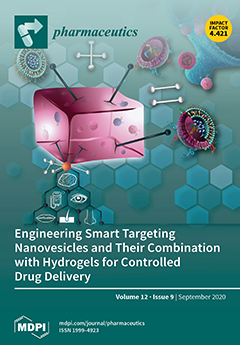
Cover Story: Exosomes are naturally derived nanovesicles that can target specific cells and tissues without particular modifications, whereas liposomes are well-established drug carriers that can deliver heavy loads. These types of nanovesicles present many advantages, but each has its own drawbacks. To overcome their shortcomings, a membrane fusion between exosomes and liposomes can generate superior hybrid nanovesicles. This novel hybrid delivery system can be armed with both the smart targeting behavior of exosomes and the high loading capacity of liposomes. Moreover, to enhance, control, and prolong drug release, these nanovesicles can be loaded in naturally derived hydrogels, which can then be administered in better routes, such as oral, nasal, parenteral, ocular, topical, and brain delivery routes. View this paper.
  • Issues are regarded as officially published after their release is announced to the table of contents alert mailing list .
  • You may sign up for email alerts to receive table of contents of newly released issues.
  • PDF is the official format for papers published in both, html and pdf forms. To view the papers in pdf format, click on the "PDF Full-text" link, and use the free Adobe Reader to open them.

Articles (122)

  • Article
  • Open Access
10 Citations
5,065 Views
19 Pages

Efficient Non-Viral Gene Modification of Mesenchymal Stromal Cells from Umbilical Cord Wharton’s Jelly with Polyethylenimine

  • Ana Isabel Ramos-Murillo,
  • Elizabeth Rodríguez,
  • Karl Beltrán,
  • Cristian Ricaurte,
  • Bernardo Camacho,
  • Gustavo Salguero and
  • Rubén Darío Godoy-Silva

Mesenchymal stromal cells (MSC) derived from human umbilical cord Wharton’s jelly (WJ) have a wide therapeutic potential in cell therapy and tissue engineering because of their multipotential capacity, which can be reinforced through gene thera...

  • Article
  • Open Access
15 Citations
3,173 Views
7 Pages

Frequency of CYP3A5 Genetic Polymorphisms and Tacrolimus Pharmacokinetics in Pediatric Liver Transplantation

  • Jefferson Antonio Buendía,
  • Esteban Halac,
  • Andrea Bosaleh,
  • María T. Garcia de Davila,
  • Oscar Imvertasa and
  • Guillermo Bramuglia

The evidence available in the pediatric population is limited for making clinical decisions regarding the optimization of tacrolimus (TAC) in pharmacotherapy. The objective of this study was to estimate the frequency of CYP3A5 genetic polymorphisms a...

  • Article
  • Open Access
32 Citations
4,592 Views
17 Pages

Liposomes Co-Encapsulating Cisplatin/Mifepristone Improve the Effect on Cervical Cancer: In Vitro and In Vivo Assessment

  • Fabricio Ledezma-Gallegos,
  • Rafael Jurado,
  • Roser Mir,
  • Luis Alberto Medina,
  • Laura Mondragon-Fuentes and
  • Patricia Garcia-Lopez

Cervical cancer is usually diagnosed in the later stages despite many campaigns for early detection and continues to be a major public health problem. The standard treatment is cisplatin-based chemotherapy plus radiotherapy, but patient response is f...

  • Article
  • Open Access
7 Citations
5,385 Views
14 Pages

Optimisation of Mycobacterium bovis BCG Fermentation and Storage Survival

  • Jordan Pascoe,
  • Charlotte L. Hendon-Dunn,
  • Colin P.D. Birch,
  • Gareth A. Williams,
  • Mark A. Chambers and
  • Joanna Bacon

Mycobacterium bovis Bacillus Calmette–Guérin (M. bovis BCG) was generated over a century ago for protection against Mycobacterium tuberculosis (Mtb) and is one the oldest vaccines still in use. The BCG vaccine is currently produced using...

  • Article
  • Open Access
7 Citations
5,100 Views
20 Pages

Photostability Testing of a Third-Generation Retinoid—Tazarotene in the Presence of UV Absorbers

  • Agata Kryczyk-Poprawa,
  • István Zupkó,
  • Péter Bérdi,
  • Paweł Żmudzki,
  • Justyna Popiół,
  • Bożena Muszyńska and
  • Włodzimierz Opoka

Exposure of a drug to UV irradiation could affect its physicochemical properties. Hence, photostability testing is essential for topically administered drugs. Tazarotene, a receptor-selective, third-generation retinoid, is commonly used to treat acne...

  • Article
  • Open Access
22 Citations
7,815 Views
16 Pages

Development of 3D Printed Drug-Eluting Scaffolds for Preventing Piercing Infection

  • Emad Naseri,
  • Christopher Cartmell,
  • Matthew Saab,
  • Russell G. Kerr and
  • Ali Ahmadi

Herein, novel drug-eluting, bio-absorbable scaffold intended to cover piercing studs is introduced. This “biopierce” will stay in human tissue following piercing, and will slowly release an antimicrobial agent to prevent infection while t...

  • Article
  • Open Access
37 Citations
4,786 Views
15 Pages

Composite hydrogels with electrospun nanofibers (NFs) have recently been used to mimic the native extracellular matrix. In this study, composite hydrogels of methacrylated hyaluronic acid containing fragmented polycaprolactone NFs were used for bone...

  • Article
  • Open Access
8 Citations
3,903 Views
11 Pages

Encapsulation of pharmaceutical powders within thin functional polymer films is a powerful and versatile method to modify drug release properties. Conformal coating over the complete surface of the particle via chemical vapor deposition techniques is...

  • Review
  • Open Access
7 Citations
4,078 Views
22 Pages

Can Implementation of Genetics and Pharmacogenomics Improve Treatment of Chronic Low Back Pain?

  • Vladislav Suntsov,
  • Filip Jovanovic,
  • Emilija Knezevic,
  • Kenneth D. Candido and
  • Nebojsa Nick Knezevic

Etiology of back pain is multifactorial and not completely understood, and for the majority of people who suffer from chronic low back pain (cLBP), the precise cause cannot be determined. We know that back pain is somewhat heritable, chronic pain mor...

of 13

Get Alerted

Add your email address to receive forthcoming issues of this journal.

XFacebookLinkedIn
Pharmaceutics - ISSN 1999-4923